UNITED COLLEGE OF
ENGINEERING
& RESEARCH
NAINI ALLAHABAD
DEPARTMENT OF CIVIL ENGINEERING
DATE-27TH AUGUST 2016
8/26/2016 1
8/26/2016 2
PRESENTATION ON
INDUSTRIAL TRAINING
F R O M - N O R T H C E N T R A L R A I LWAY
PRESENTED BY – ABHIJIT KUMAR
ROLL NO- 1301000001
B.TECH 4TH YEAR
BATC H 2016-2017
:
 Storage Reservoir:
A reservoir (etymology: from French reservoir a “storehouse”)
is an enlarged natural or artificial lake, storage pond or
impoundment created using a dam or lock to store water.
Tank reservoirs store liquids or gases in storage tanks that may be elevated,
at grade level, or buried. Tank reservoirs for water are also called cisterns.
Underground reservoirs store almost exclusively water and petroleum below
ground.
 Water Tank:
In simple words a water tank is a container for storing liquid.
8/26/2016 3
8/26/2016 4
1 Based on the types of material and location:
(i) Chemical contact tank: This type of water tank is made of
polyethylene construction, allows for retention time for
chemical treatment.
(ii) Ground water tank: This type of water tank is made of lined
carbon steel, it may receive water from a water well or from surface
water allowing a large volume of water to be placed in inventory
and used during peak demand cycles.
(iii)Elevated Water Tank: This type of water tank is also known
as a water tower, an elevated water tower will create pressure at the
ground-level outlet of 1 psi per 2.31 feet of elevation, thus a tank
elevated to 70 feet creates about 30 psi of discharge pressure. 30 psi
is sufficient for most domestic and industrial requirements.
8/26/2016 5
(iv) Vertical cylindrical dome top : This type of tanks may hold
from fifty gallons to several million gallons. Horizontal cylindrical
tanks are typically used for transport because their low-profile creates
a low center of gravity helping to maintain equilibrium for the
transport vehicle, trailer or truck.
(v) A Hydro-pneumatic Tank: This type of tank is typically a
horizontal pressurized storage tank. Pressurizing this reservoir of
water creates a surge free delivery of stored water into the
distribution system.
8/26/2016 6
2Based upon the shapes:
i Circular Tanks: They are most economical and used for large
capacity in water supply, sewage treatment etc.
iiRectangular Tanks: They are used for small storage capacity and
their framework is costly.
iii Spherical Tanks: They are used for the economy and aesthetic view
point.
iv Intze Tanks: They are used for large storage capacity. In such tanks,
domes are used in place of level slabs.
8/26/2016 7
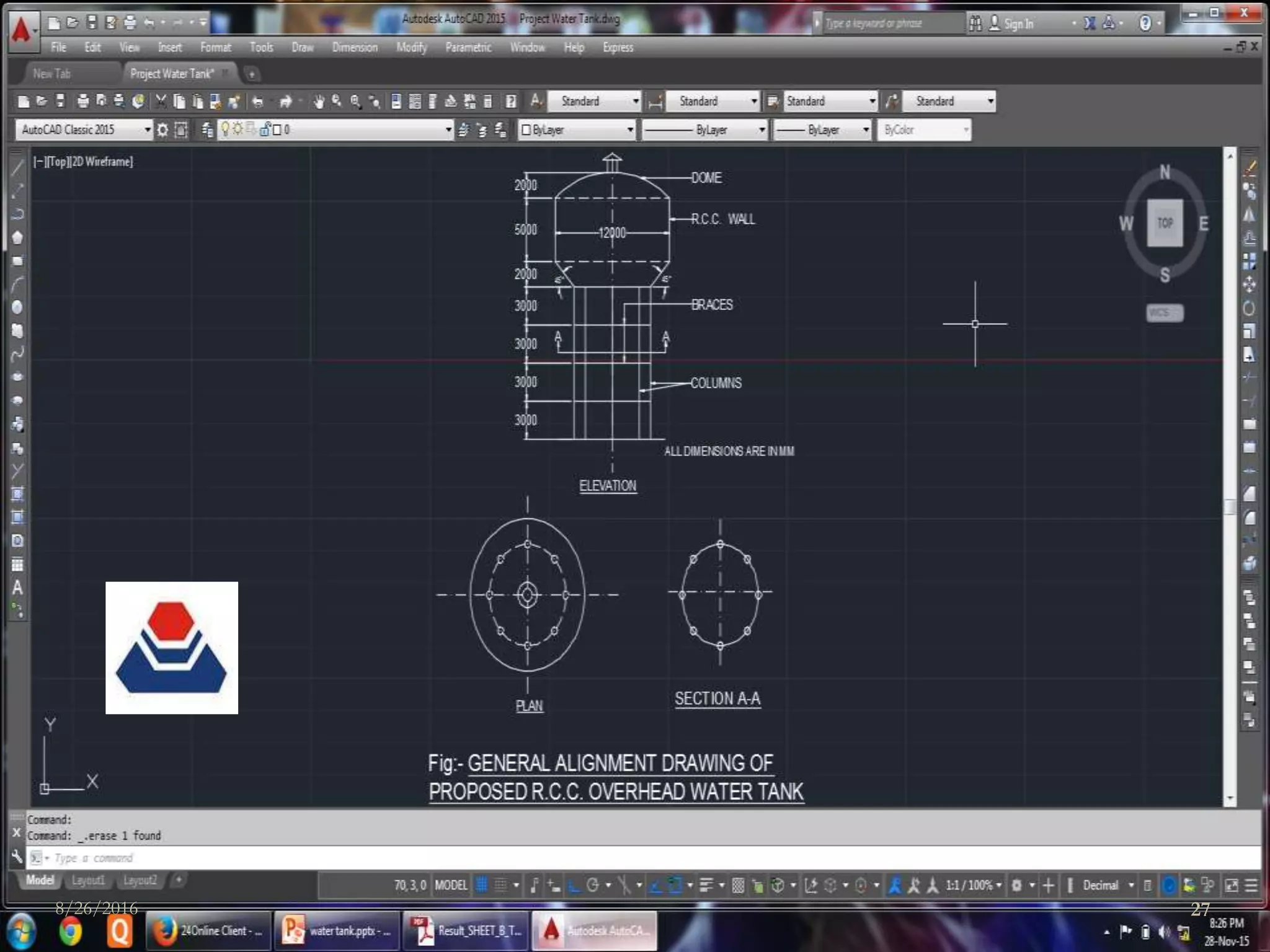
A typical Intze tank consists of :
1) Top dome.
2) Top ring beam.
3) Side walls.
4) Bottom ring beam.
5) Conical dome.
6)Bottom spherical dome.
7) Bottom circular ring beam.
8)Staging – Columns & bracings.
9)Foundation.
8/26/2016 8
DESIGN A R.C.C OVERHEAD WATER
TANK LOCATED AT RAILWAY COLONY
ALLAHABAD FOR A TARGET
POPULATION OF 1500
8/26/2016 9
Location: Kalyani
Target Population: 1500
Maximum daily consumption (demand)
=180% of average daily demand = 1.8q
[Ref: Water Supply Engineering by S.K.Garg, Page-19]
8/26/2016 10
Domestic water demand = 200 lit/capita/day
Average daily demand (q) = per demand  Population
= 200  1500
= 3, 00,000 lit/day
Hence, maximum daily demand = 1.8  q litres/day
= 1.8  300000 litres/day
= 540  103 litres/day
= 540 m3/day
8/26/2016 11
Let us assume, diameter of tank (D) = 12m (< 30m)
[as per Clause 7.2.1.1 of IS:2210-1988, page 8]
Hence, radius of tank (R) = 12/2 = 6m.
Now, volume of tank = 540 m3.
Let h be the height of the cylindrical tank.
Capacity of tank =  R2 h
8/26/2016 12
Substituting the values, we get
 62 h = 540
or, h = 540/( 36)
or, h = 4.77
Thus, height of the cylindrical tank = 4.77 m.
Assuming, free board = 0.25 m.
Hence, total height of the tank = (4.77+0.25)
= 5.02 m  5 m
8/26/2016 13
Proposed Foundation – Raft foundation
Bearing Capacity of soil - 90 KN/m2
Grade of Concrete – M30
Grade of steel – Fe500
Staging height – 12m up to bottom of tank
Capacity – 540000 litres
No. of columns – 8
Diameter of columns – 1.5m
8/26/2016 14
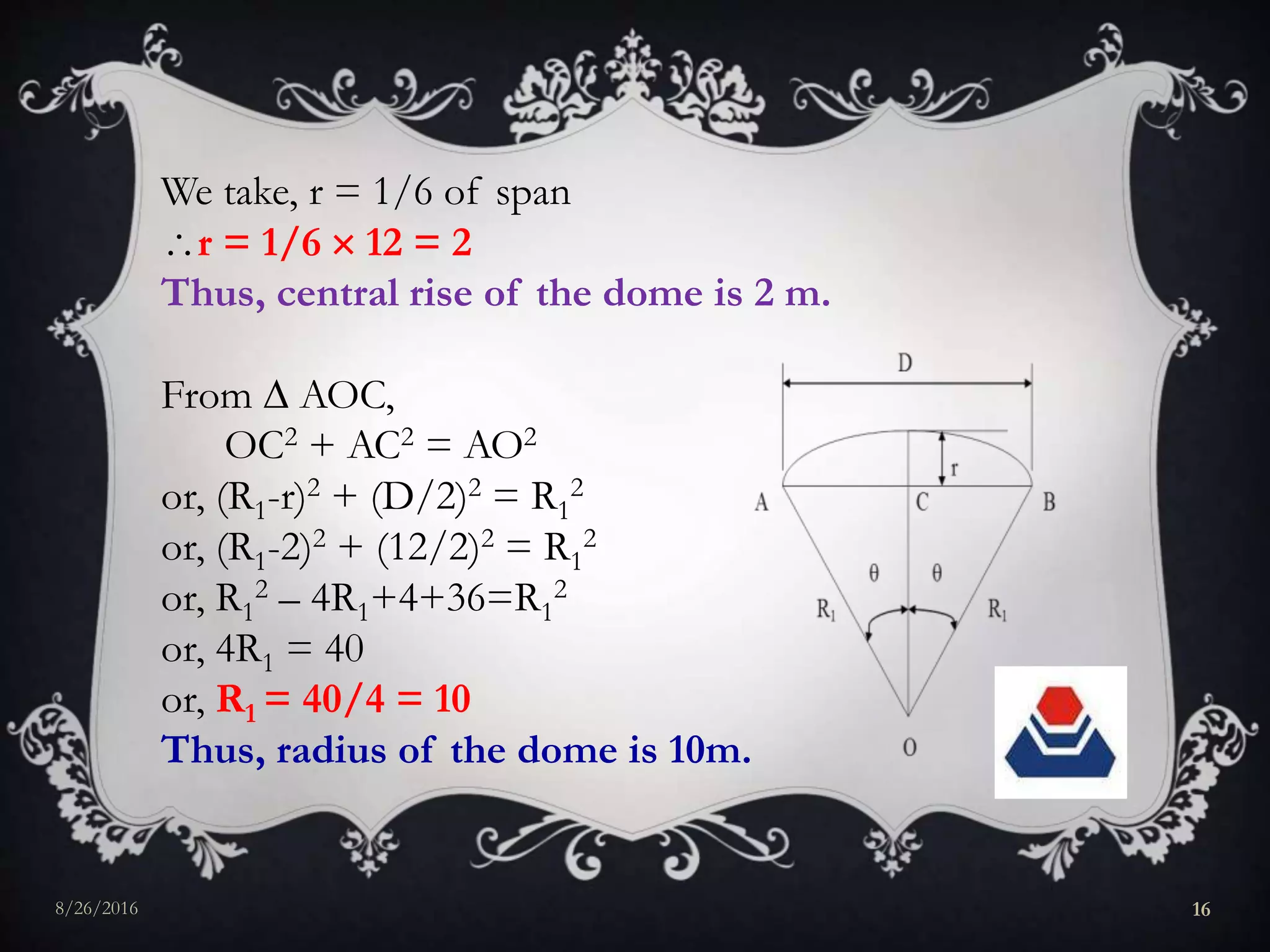
D
r
A C B
 
R1 R1
O
Notations:
D = Diameter of the tank = 12m
r = Central rise of the dome
R1= Radius of the dome
= Semi-central angle of the dome
From the geometry of the figure,
 AOC &  BOC are right-angled triangles.
Central rise, r = 1/8 to 1/6 of span
[Ref: Advanced Reinforced Concrete by H.J.Shah, page-406]
8/26/2016 15
We take, r = 1/6 of span
r = 1/6  12 = 2
Thus, central rise of the dome is 2 m.
From  AOC,
OC2 + AC2 = AO2
or, (R1-r)2 + (D/2)2 = R1
2
or, (R1-2)2 + (12/2)2 = R1
2
or, R1
2 – 4R1+4+36=R1
2
or, 4R1 = 40
or, R1 = 40/4 = 10
Thus, radius of the dome is 10m.
8/26/2016 16
Again, cos  = = = = 0.8
or,  = cos-1(0.8)
or,  = 36.87
Thus, semi-central angle of the dome is 36.87
30<< 40. Hence, OK.
[as per IS:2210-1988, page-8]
8/26/2016 17
Again,  = 36.87< 51.8
Hence, tensile stress is not developed.
[Ref: Advanced Reinforced Concrete by H.J Shah,
page 64]
Now, r/D = 2/12 = 1/6 (< 1/5)
[as per IS: 2210-1988, page-10]
So, it is a deep doubly curved shell and membrane
analysis is required.
8/26/2016 18
Load calculation:
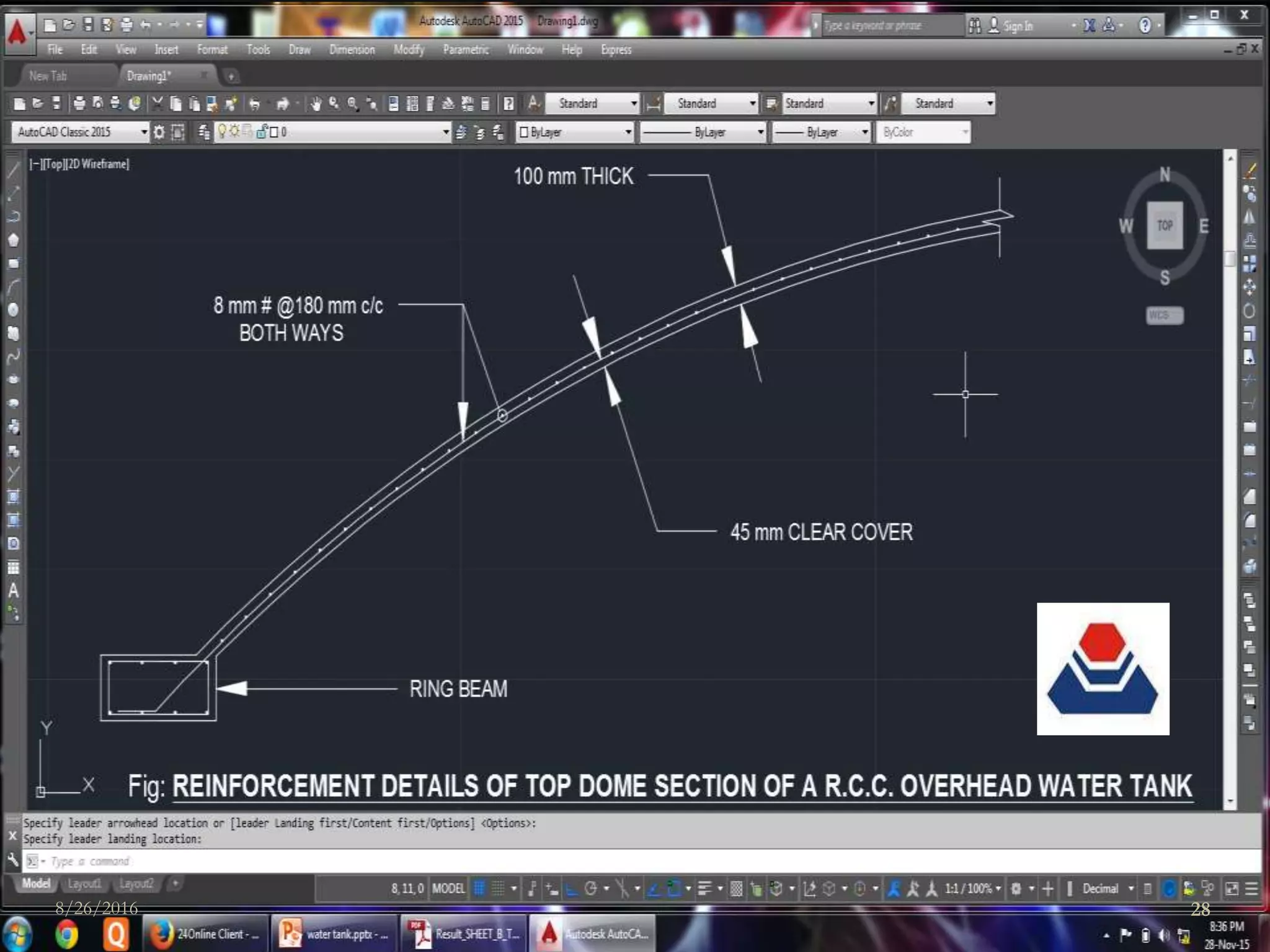
We assume, thickness of top dome = 100 mm ( 40 mm)
[as per Clause 7.1.1 of IS:2210-1988, page-8]
Minimum imposed load for accessible roof = 1.5KN/m2
[as per IS-875 Part-2]
Self-weight of the dome = 0.1  25 = 2.5 KN/m2
Finishing = 0.05  24 = 1.2 KN/m2
___________________________________________________
Total load = (1.5+2.5+1.2) = 5.2 KN/m2
8/26/2016 19
Calculation of Meridional stress and Hoop stress:
Meridional force:
Due to UDL =
[Ref: Advanced Reinforced Concrete by H.J Shah, page-64]
Meridional force = 5.2  10 
= 28.89 KN.
Meridional stress for per meter span =
= 0.2889 N/mm2
 0.29 N/mm2 (compressive)
8/26/2016 20
As the minimum grade of concrete is M30, thus for M30
[as per IS-456:2000, Table-21, page-81]
σcc = 8N/mm2
Thus, 0.29 < 8 N/mm2. Hence, OK.
8/26/2016 21
Hoop force:
Due to UDL =
[Ref: Advanced Reinforced Concrete by H.J Shah,
page-64]
Hoop force = 5.2  10 
= 12.71KN.
Hoop stress for per meter span =
= 0.1271 N/mm2
 0.13 N/mm2 (compressive)
Thus, 0.13 < 8 N/mm2. Hence OK.
Hence, the stresses are within the safe limit.
8/26/2016 22
Since the stresses are very small, we provide nominal
tensile reinforcement of 0.3%
[as per IS: 3370 (Part-2:2009) page-3, Table-3 the
nominal percentage of nominal tensile reinforcement
shall not be less than 0.15% in any case]
= 0.3
or, Ast = 1000  100
or, Ast = 300 mm2
Thus, area of steel reinforcement is 300 mm2.
8/26/2016 23
We provide 6 - 8mm # bars,
[as per clause 12.3.1 of IS: 2210-1988]
Spacing of 8mm # bars = = 167.53 mm
 180 mm c/c
Thus, we provide 6 – 8mm @180mm c/c both ways.
Actual Percentage of steel required (Pt)
= = = 0.30%
8/26/2016 24
Clear cover [as per clause 7.1.1.1 of IS: 2210-1988]:-
(i) 15mm.
(ii) Nominal size
whichever is greater.
Now, for severe exposure, nominal cover = 45 mm
[as per Table 16 of IS: 456-2000]
As, 45 > 15mm, so we provide clear cover = 45mm.
8/26/2016 25
Thickness =100mm
Clear cover =45mm
Grade of concrete =M30
Grade of steel =Fe500
Reinforcement=8 mm # @180 c/c – Meridional Direction
8 mm # @180 c/c – Circumferential Direction
8/26/2016 26
8/26/2016 27
8/26/2016 28
8/26/2016 29
8/26/2016 30
(i) Water Supply Engineering by S.K.Garg
(ii) IS 2210-1988
(iii) Advanced Reinforced Concrete by H.J.Shah
(iv) IS 875 (Part 1 & 2)
(iv) IS-456:2000
(v) IS: 3370:2009 [Part-2]
(vi) Wikipedia
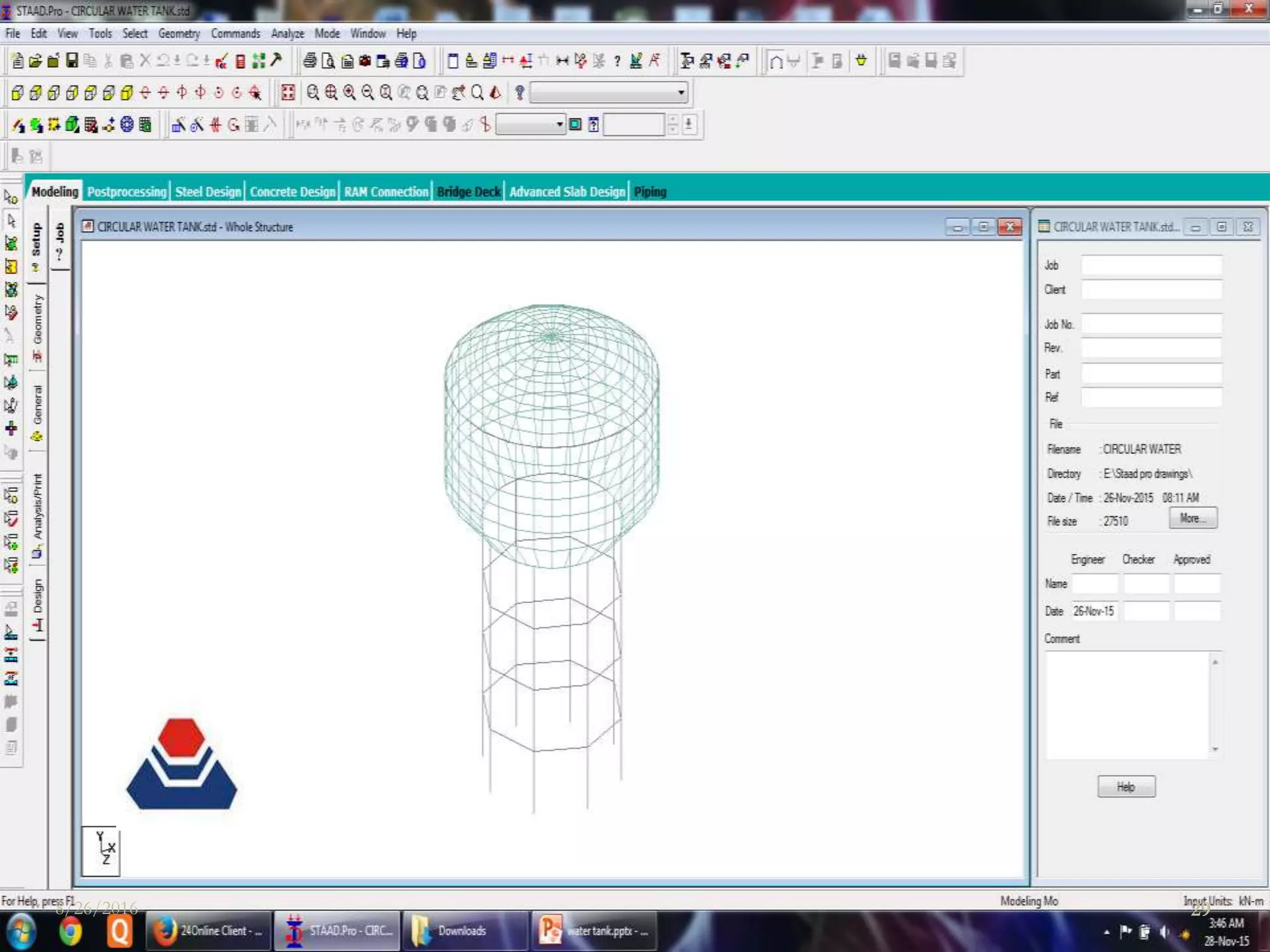
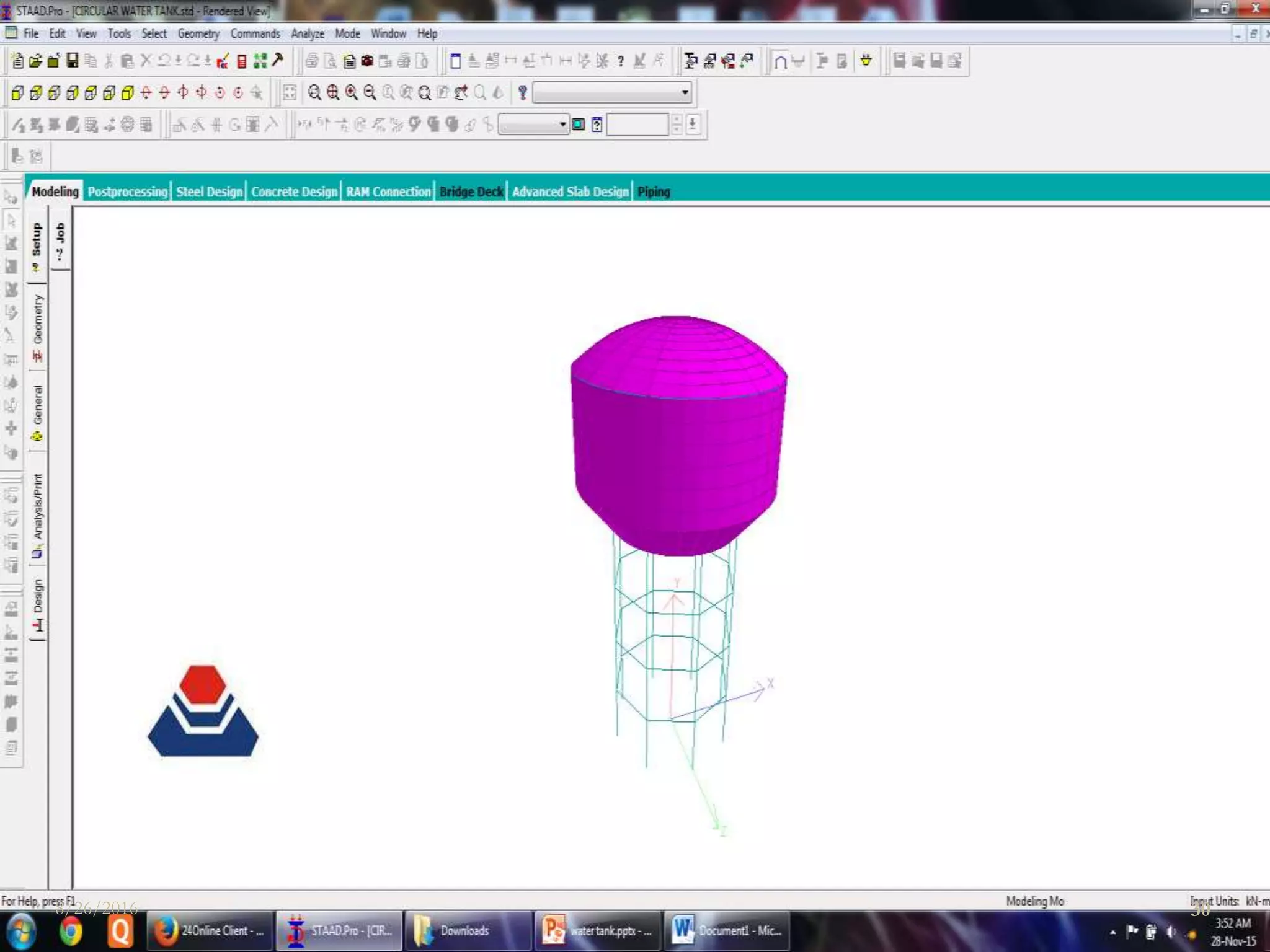
(vii) Softwares – AutoCAD & STAAD.Pro
8/26/2016 31
MEN AT WORK
8/26/2016 32
 SITE : NEAR RAILWAY GROUND @ RAILWAY COLONY ALLAHABAD JUNCTION
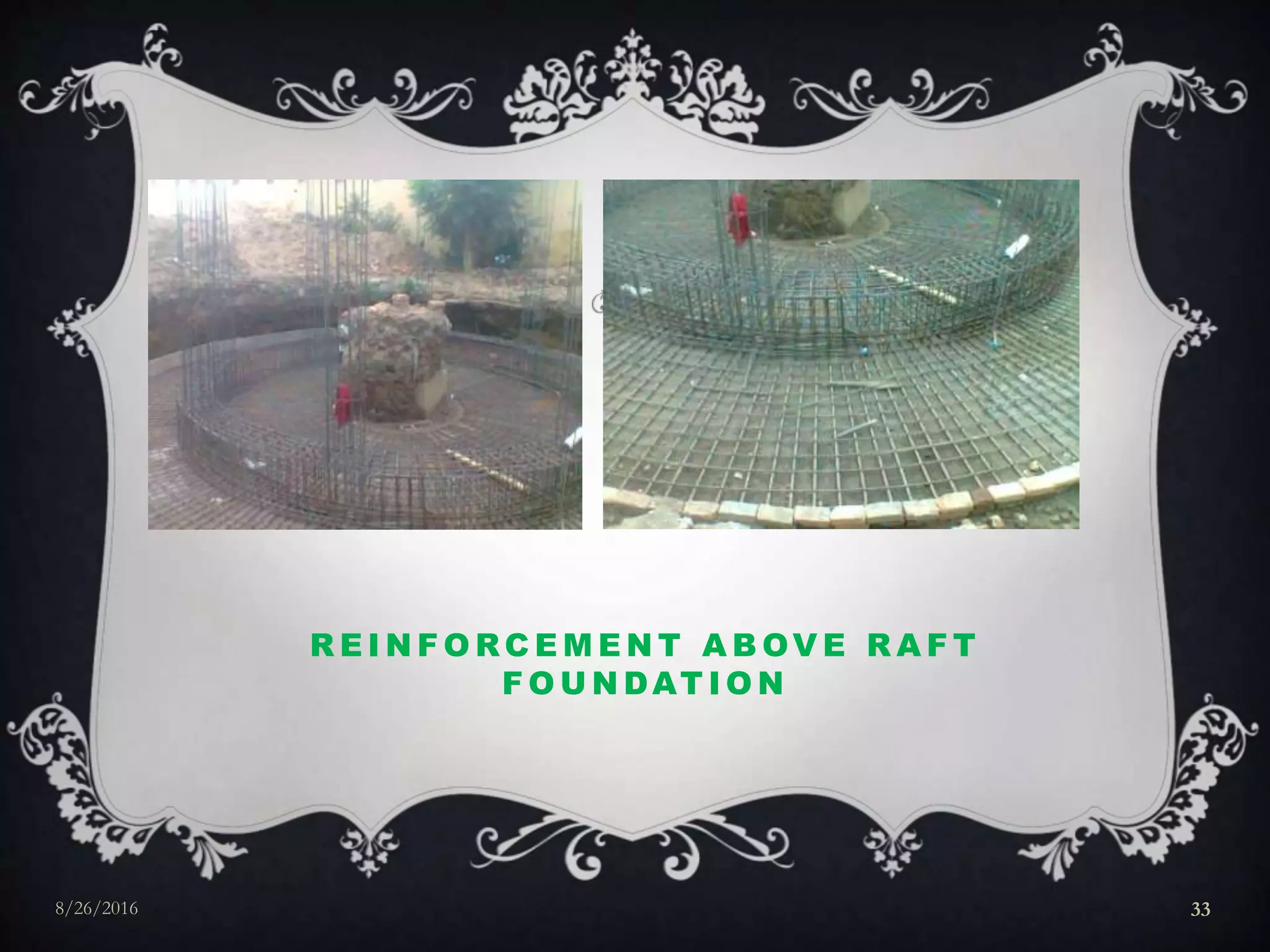
R E I N F O RC E M E N T A B OV E R A F T
F O U N DAT I O N
8/26/2016 33
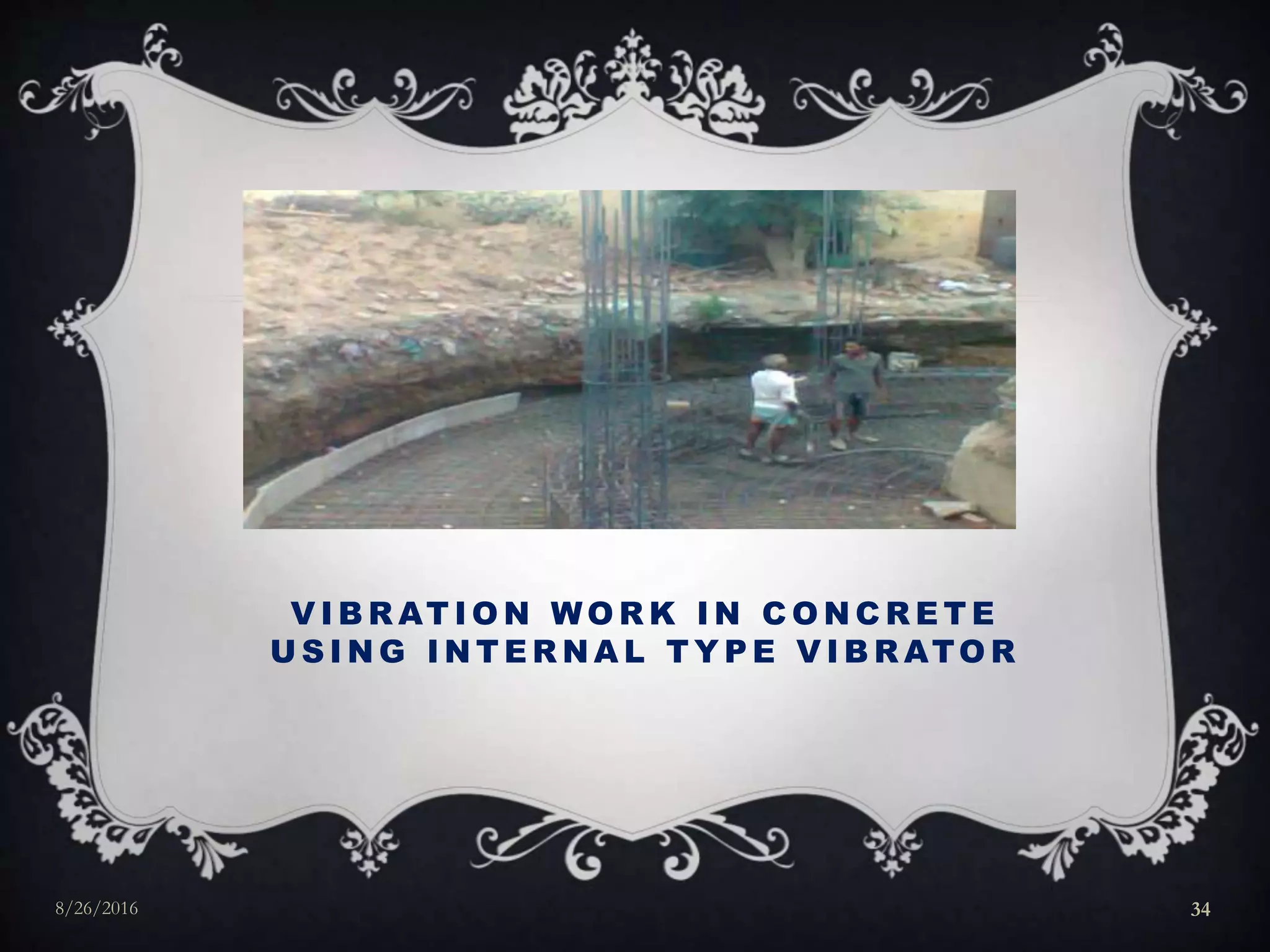
V I B R AT I O N WO R K I N C O N C R E T E
U S I N G I N T E R N A L T Y P E V I B R ATO R
8/26/2016 34
PO URING O F C O NC RE TE USING RA MP
SHO E
8/26/2016 35
THANKS FOR YOUR
PRECIOUS TIME
8/26/2016 36

Abhijit kumar

  • 1.
    UNITED COLLEGE OF ENGINEERING &RESEARCH NAINI ALLAHABAD DEPARTMENT OF CIVIL ENGINEERING DATE-27TH AUGUST 2016 8/26/2016 1
  • 2.
    8/26/2016 2 PRESENTATION ON INDUSTRIALTRAINING F R O M - N O R T H C E N T R A L R A I LWAY PRESENTED BY – ABHIJIT KUMAR ROLL NO- 1301000001 B.TECH 4TH YEAR BATC H 2016-2017
  • 3.
    :  Storage Reservoir: Areservoir (etymology: from French reservoir a “storehouse”) is an enlarged natural or artificial lake, storage pond or impoundment created using a dam or lock to store water. Tank reservoirs store liquids or gases in storage tanks that may be elevated, at grade level, or buried. Tank reservoirs for water are also called cisterns. Underground reservoirs store almost exclusively water and petroleum below ground.  Water Tank: In simple words a water tank is a container for storing liquid. 8/26/2016 3
  • 4.
  • 5.
    1 Based onthe types of material and location: (i) Chemical contact tank: This type of water tank is made of polyethylene construction, allows for retention time for chemical treatment. (ii) Ground water tank: This type of water tank is made of lined carbon steel, it may receive water from a water well or from surface water allowing a large volume of water to be placed in inventory and used during peak demand cycles. (iii)Elevated Water Tank: This type of water tank is also known as a water tower, an elevated water tower will create pressure at the ground-level outlet of 1 psi per 2.31 feet of elevation, thus a tank elevated to 70 feet creates about 30 psi of discharge pressure. 30 psi is sufficient for most domestic and industrial requirements. 8/26/2016 5
  • 6.
    (iv) Vertical cylindricaldome top : This type of tanks may hold from fifty gallons to several million gallons. Horizontal cylindrical tanks are typically used for transport because their low-profile creates a low center of gravity helping to maintain equilibrium for the transport vehicle, trailer or truck. (v) A Hydro-pneumatic Tank: This type of tank is typically a horizontal pressurized storage tank. Pressurizing this reservoir of water creates a surge free delivery of stored water into the distribution system. 8/26/2016 6
  • 7.
    2Based upon theshapes: i Circular Tanks: They are most economical and used for large capacity in water supply, sewage treatment etc. iiRectangular Tanks: They are used for small storage capacity and their framework is costly. iii Spherical Tanks: They are used for the economy and aesthetic view point. iv Intze Tanks: They are used for large storage capacity. In such tanks, domes are used in place of level slabs. 8/26/2016 7
  • 8.
    A typical Intzetank consists of : 1) Top dome. 2) Top ring beam. 3) Side walls. 4) Bottom ring beam. 5) Conical dome. 6)Bottom spherical dome. 7) Bottom circular ring beam. 8)Staging – Columns & bracings. 9)Foundation. 8/26/2016 8
  • 9.
    DESIGN A R.C.COVERHEAD WATER TANK LOCATED AT RAILWAY COLONY ALLAHABAD FOR A TARGET POPULATION OF 1500 8/26/2016 9
  • 10.
    Location: Kalyani Target Population:1500 Maximum daily consumption (demand) =180% of average daily demand = 1.8q [Ref: Water Supply Engineering by S.K.Garg, Page-19] 8/26/2016 10
  • 11.
    Domestic water demand= 200 lit/capita/day Average daily demand (q) = per demand  Population = 200  1500 = 3, 00,000 lit/day Hence, maximum daily demand = 1.8  q litres/day = 1.8  300000 litres/day = 540  103 litres/day = 540 m3/day 8/26/2016 11
  • 12.
    Let us assume,diameter of tank (D) = 12m (< 30m) [as per Clause 7.2.1.1 of IS:2210-1988, page 8] Hence, radius of tank (R) = 12/2 = 6m. Now, volume of tank = 540 m3. Let h be the height of the cylindrical tank. Capacity of tank =  R2 h 8/26/2016 12
  • 13.
    Substituting the values,we get  62 h = 540 or, h = 540/( 36) or, h = 4.77 Thus, height of the cylindrical tank = 4.77 m. Assuming, free board = 0.25 m. Hence, total height of the tank = (4.77+0.25) = 5.02 m  5 m 8/26/2016 13
  • 14.
    Proposed Foundation –Raft foundation Bearing Capacity of soil - 90 KN/m2 Grade of Concrete – M30 Grade of steel – Fe500 Staging height – 12m up to bottom of tank Capacity – 540000 litres No. of columns – 8 Diameter of columns – 1.5m 8/26/2016 14
  • 15.
    D r A C B  R1 R1 O Notations: D = Diameter of the tank = 12m r = Central rise of the dome R1= Radius of the dome = Semi-central angle of the dome From the geometry of the figure,  AOC &  BOC are right-angled triangles. Central rise, r = 1/8 to 1/6 of span [Ref: Advanced Reinforced Concrete by H.J.Shah, page-406] 8/26/2016 15
  • 16.
    We take, r= 1/6 of span r = 1/6  12 = 2 Thus, central rise of the dome is 2 m. From  AOC, OC2 + AC2 = AO2 or, (R1-r)2 + (D/2)2 = R1 2 or, (R1-2)2 + (12/2)2 = R1 2 or, R1 2 – 4R1+4+36=R1 2 or, 4R1 = 40 or, R1 = 40/4 = 10 Thus, radius of the dome is 10m. 8/26/2016 16
  • 17.
    Again, cos = = = = 0.8 or,  = cos-1(0.8) or,  = 36.87 Thus, semi-central angle of the dome is 36.87 30<< 40. Hence, OK. [as per IS:2210-1988, page-8] 8/26/2016 17
  • 18.
    Again,  =36.87< 51.8 Hence, tensile stress is not developed. [Ref: Advanced Reinforced Concrete by H.J Shah, page 64] Now, r/D = 2/12 = 1/6 (< 1/5) [as per IS: 2210-1988, page-10] So, it is a deep doubly curved shell and membrane analysis is required. 8/26/2016 18
  • 19.
    Load calculation: We assume,thickness of top dome = 100 mm ( 40 mm) [as per Clause 7.1.1 of IS:2210-1988, page-8] Minimum imposed load for accessible roof = 1.5KN/m2 [as per IS-875 Part-2] Self-weight of the dome = 0.1  25 = 2.5 KN/m2 Finishing = 0.05  24 = 1.2 KN/m2 ___________________________________________________ Total load = (1.5+2.5+1.2) = 5.2 KN/m2 8/26/2016 19
  • 20.
    Calculation of Meridionalstress and Hoop stress: Meridional force: Due to UDL = [Ref: Advanced Reinforced Concrete by H.J Shah, page-64] Meridional force = 5.2  10  = 28.89 KN. Meridional stress for per meter span = = 0.2889 N/mm2  0.29 N/mm2 (compressive) 8/26/2016 20
  • 21.
    As the minimumgrade of concrete is M30, thus for M30 [as per IS-456:2000, Table-21, page-81] σcc = 8N/mm2 Thus, 0.29 < 8 N/mm2. Hence, OK. 8/26/2016 21
  • 22.
    Hoop force: Due toUDL = [Ref: Advanced Reinforced Concrete by H.J Shah, page-64] Hoop force = 5.2  10  = 12.71KN. Hoop stress for per meter span = = 0.1271 N/mm2  0.13 N/mm2 (compressive) Thus, 0.13 < 8 N/mm2. Hence OK. Hence, the stresses are within the safe limit. 8/26/2016 22
  • 23.
    Since the stressesare very small, we provide nominal tensile reinforcement of 0.3% [as per IS: 3370 (Part-2:2009) page-3, Table-3 the nominal percentage of nominal tensile reinforcement shall not be less than 0.15% in any case] = 0.3 or, Ast = 1000  100 or, Ast = 300 mm2 Thus, area of steel reinforcement is 300 mm2. 8/26/2016 23
  • 24.
    We provide 6- 8mm # bars, [as per clause 12.3.1 of IS: 2210-1988] Spacing of 8mm # bars = = 167.53 mm  180 mm c/c Thus, we provide 6 – 8mm @180mm c/c both ways. Actual Percentage of steel required (Pt) = = = 0.30% 8/26/2016 24
  • 25.
    Clear cover [asper clause 7.1.1.1 of IS: 2210-1988]:- (i) 15mm. (ii) Nominal size whichever is greater. Now, for severe exposure, nominal cover = 45 mm [as per Table 16 of IS: 456-2000] As, 45 > 15mm, so we provide clear cover = 45mm. 8/26/2016 25
  • 26.
    Thickness =100mm Clear cover=45mm Grade of concrete =M30 Grade of steel =Fe500 Reinforcement=8 mm # @180 c/c – Meridional Direction 8 mm # @180 c/c – Circumferential Direction 8/26/2016 26
  • 27.
  • 28.
  • 29.
  • 30.
  • 31.
    (i) Water SupplyEngineering by S.K.Garg (ii) IS 2210-1988 (iii) Advanced Reinforced Concrete by H.J.Shah (iv) IS 875 (Part 1 & 2) (iv) IS-456:2000 (v) IS: 3370:2009 [Part-2] (vi) Wikipedia (vii) Softwares – AutoCAD & STAAD.Pro 8/26/2016 31
  • 32.
    MEN AT WORK 8/26/201632  SITE : NEAR RAILWAY GROUND @ RAILWAY COLONY ALLAHABAD JUNCTION
  • 33.
    R E IN F O RC E M E N T A B OV E R A F T F O U N DAT I O N 8/26/2016 33
  • 34.
    V I BR AT I O N WO R K I N C O N C R E T E U S I N G I N T E R N A L T Y P E V I B R ATO R 8/26/2016 34
  • 35.
    PO URING OF C O NC RE TE USING RA MP SHO E 8/26/2016 35
  • 36.
    THANKS FOR YOUR PRECIOUSTIME 8/26/2016 36