Pathophysiology (cont’d)
• Types of abdominal organs
– Vascular organs
 Several large blood vessels in the
abdomen.
 Trauma can cause massive hidden blood
loss.
Pathophysiology (cont’d)
• Trauma to the abdomen
– Direct force injury
– Compression injury
– Shearing/Deceleration injury
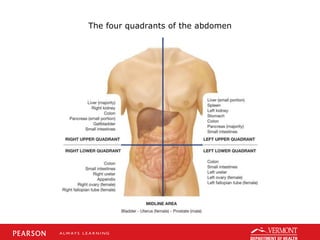
The four quadrants of the abdomen
Assessment Findings
• Depending on the quadrant injured and
the organs involved:
– Abdominal pain
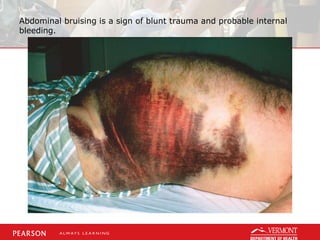
– Ecchymosis around the naval or flanks
– Abdominal guarding, distention, masses
– Findings of hypovolemic shock
Assessment Findings (cont’d)
• Depending on the quadrant injured and
the organs involved (continued):
– Nausea, vomiting
– Tenderness to palpation
– External indications of trauma
Abdominal bruising is a sign of blunt trauma and probable internal
bleeding.
Emergency Medical Care
• Spinal immobilization considerations
– Traumatic incidents
• Airway considerations
– Ensure open airway.
– Maintain airway if needed.
Emergency Medical Care (cont’d)
• Circulatory considerations
– Importance of pulse checks
– If major bleed present (whether arterial
or venous), control it as soon as
possible.
• Transport with knees flexed if possible.
• Other considerations
– Management of evisceration
– Management of impaled object
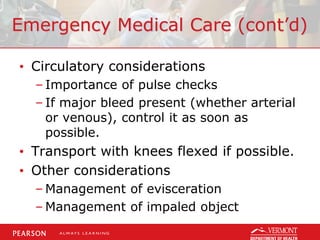
Cut away clothing from the wound.
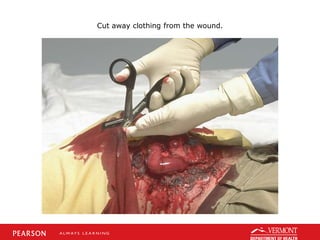
Soak a dressing with sterile saline.
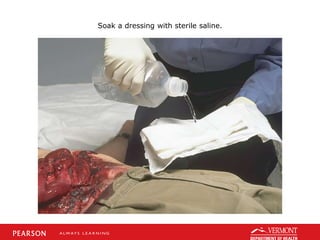
Place the moist dressing over the wound.
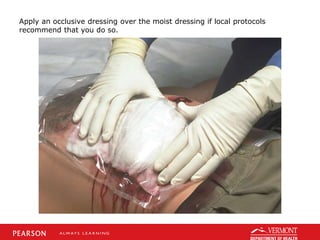
Apply an occlusive dressing over the moist dressing if local protocols
recommend that you do so.
Case Study
• You are treating a female patient who
was kicked in the abdomen by a horse
while working on her farm. Bystanders
stated she was knocked out, but as you
approach, the patient looks responsive.
Case Study (cont’d)
• Pertinent Secondary Assessment
Findings
– Pupils slightly dilated, but still reactive
to light.
– Airway patent and maintained by the
patient.
– Breathing is rapid, alveolar sounds
present.
– Central and peripheral pulse present.
Case Study (cont’d)
• Pertinent Secondary Assessment
Findings (continued)
– Skin cool and moist, RUQ abdominal
pain with some guarding.
– B/P 110/95, HR 110, RR 22.
– SpO2 95% on room air, 99% on oxygen.
Case Study (cont’d)
• If this patient suddenly deteriorated,
what would be your suspicion as to
why?
• What organ do you think has been
damaged from the horse kick?
Case Study (cont’d)
• Care provided:
– Patient kept supine.
– High-flow oxygen via NRB mask.
– Full spinal immobilization done very
carefully.
Case Study (cont’d)
• Care provided:
– Patient packaged and taken to
ambulance via wheeled cot.
– Rapid transport to hospital initiated.
– Intravenous fluid administration for
shock based on local protocol.
Summary
• Abdominal injuries will many times go
undiagnosed by the Advanced EMT due
to the complexity of advanced
diagnostics needed to make the
decision. But this does not alleviate the
need to care for them correctly.
Summary (cont’d)
• Repeated assessments while
transporting will allow the Advanced
EMT to detect any deterioration in the
patient's condition.

abdominal-trauma.ppt

  • 1.
    Pathophysiology (cont’d) • Typesof abdominal organs – Vascular organs  Several large blood vessels in the abdomen.  Trauma can cause massive hidden blood loss.
  • 2.
    Pathophysiology (cont’d) • Traumato the abdomen – Direct force injury – Compression injury – Shearing/Deceleration injury
  • 3.
    The four quadrantsof the abdomen
  • 4.
    Assessment Findings • Dependingon the quadrant injured and the organs involved: – Abdominal pain – Ecchymosis around the naval or flanks – Abdominal guarding, distention, masses – Findings of hypovolemic shock
  • 5.
    Assessment Findings (cont’d) •Depending on the quadrant injured and the organs involved (continued): – Nausea, vomiting – Tenderness to palpation – External indications of trauma
  • 6.
    Abdominal bruising isa sign of blunt trauma and probable internal bleeding.
  • 7.
    Emergency Medical Care •Spinal immobilization considerations – Traumatic incidents • Airway considerations – Ensure open airway. – Maintain airway if needed.
  • 8.
    Emergency Medical Care(cont’d) • Circulatory considerations – Importance of pulse checks – If major bleed present (whether arterial or venous), control it as soon as possible. • Transport with knees flexed if possible. • Other considerations – Management of evisceration – Management of impaled object
  • 9.
    Cut away clothingfrom the wound.
  • 10.
    Soak a dressingwith sterile saline.
  • 11.
    Place the moistdressing over the wound.
  • 12.
    Apply an occlusivedressing over the moist dressing if local protocols recommend that you do so.
  • 13.
    Case Study • Youare treating a female patient who was kicked in the abdomen by a horse while working on her farm. Bystanders stated she was knocked out, but as you approach, the patient looks responsive.
  • 14.
    Case Study (cont’d) •Pertinent Secondary Assessment Findings – Pupils slightly dilated, but still reactive to light. – Airway patent and maintained by the patient. – Breathing is rapid, alveolar sounds present. – Central and peripheral pulse present.
  • 15.
    Case Study (cont’d) •Pertinent Secondary Assessment Findings (continued) – Skin cool and moist, RUQ abdominal pain with some guarding. – B/P 110/95, HR 110, RR 22. – SpO2 95% on room air, 99% on oxygen.
  • 16.
    Case Study (cont’d) •If this patient suddenly deteriorated, what would be your suspicion as to why? • What organ do you think has been damaged from the horse kick?
  • 17.
    Case Study (cont’d) •Care provided: – Patient kept supine. – High-flow oxygen via NRB mask. – Full spinal immobilization done very carefully.
  • 18.
    Case Study (cont’d) •Care provided: – Patient packaged and taken to ambulance via wheeled cot. – Rapid transport to hospital initiated. – Intravenous fluid administration for shock based on local protocol.
  • 19.
    Summary • Abdominal injurieswill many times go undiagnosed by the Advanced EMT due to the complexity of advanced diagnostics needed to make the decision. But this does not alleviate the need to care for them correctly.
  • 20.
    Summary (cont’d) • Repeatedassessments while transporting will allow the Advanced EMT to detect any deterioration in the patient's condition.

Editor's Notes

  • #2 Give examples of each type of organ, review their location in the abdominal cavity, discuss the presentation of each organ type when injured: Hollow—sharp, burning pain Solid—delayed hemorrhage Vascular—abrupt hemorrhage
  • #3 Discuss the transfer of energy to the abdomen from each of these mechanisms (give examples). Also, relate the type of presentations the Advanced EMT may see as each quadrant is subjected to trauma.
  • #5 Relate the clinical findings of abdominal trauma to the organs and body systems involved.
  • #6 Relate the clinical findings of abdominal trauma to the organs and body systems involved.
  • #8 The most important elements of care for a patient with abdominal trauma are directed by findings in the primary assessment. Treat airway, breathing, and circulation with the highest priority.
  • #9 Constantly reassess patients with abdominal injuries, as their status can change rapidly. Internal bleeding can quickly lead to a decompensated patient, and it is your obligation to recognize such deterioration.
  • #14 Discuss the case study.
  • #15 Discuss the case progression.
  • #16 Discuss the case progression.
  • #17 If the patient suddenly deteriorated, suspect a rupture of the capsule that encases the liver. Commonly, the liver will bleed into the capsule space, and once it fills the bleed will start to tamponade itself. However, a time may come that it can no longer maintain integrity and it bursts. This then allows the damaged organ to bleed freely into the abdominal compartment. Given the location and presentation, it would seem likely that the liver has been fractured and it started leaking into the capsule, until the capsule broke.
  • #18 Discuss the care provided.
  • #19 Discuss the care provided.
  • #20 Review as appropriate.
  • #21 Review as appropriate.