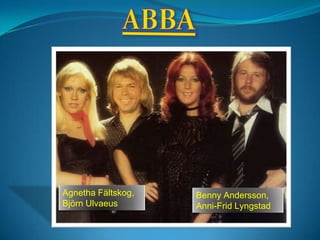
Agnetha Fältskog,   Benny Andersson,
Björn Ulvaeus       Anni-Frid Lyngstad
 ABBA was a Swedish pop rock disco group
  formed in Stockholm in 1972,
  comprising Agnetha Fältskg, Benny Andersson,
 Björn Ulvaeus and Anni-Frid Lyngstad.

 ABBA is an acronym of the first letters of the
 band members' first names and is sometimes
 stylized as the registered trademark ᗅᗅᗅᗅ.
 They became one of the most commercially
 successful acts in the history of pop music,
 topping the charts worldwide from 1972 to 1982.
 They are also known for winning the 1974
  Eurovision Song Contest, giving Sweden its first
 victory in the history of the contest.

 ABBA was the first pop group to come from a non-
 English-speaking country that enjoyed consistent
 success in the charts of English-speaking countries.

 In 1999, ABBA's music was adapted into the
  successful musical Mamma Mia! that toured
  worldwide. A film of the same name released in
  2008 became the highest-grossing film in the United
 Kingdom that year.
Form in Music

Form is a way of describing the structure
or shape of a piece of music - i.e. the
way it has been constructed from
various smaller sections. Form is mostly
determined by the harmony (keys,
chords etc.), although melody, rhythm,
dynamics and texture can also be
important.
Some commonly used forms are:
• Binary - AB, often | |: A :| |: B :| | ,
  occasionally | |: A :| | B or A | |: B :| |
  Two sections. Either or both may be
  repeated.

 • Ternary - ABA, sometimes | |: A :| | BA
   Three sections, with the third being
   similar to the first. In some cases the
   first and third sections are identical
   (e.g. a da Capo).
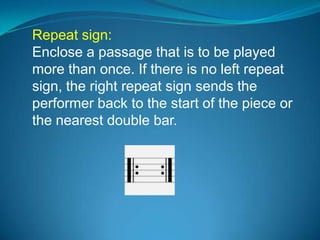
Repeat sign:
Enclose a passage that is to be played
more than once. If there is no left repeat
sign, the right repeat sign sends the
performer back to the start of the piece or
the nearest double bar.
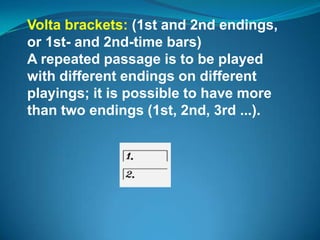
Volta brackets: (1st and 2nd endings,
or 1st- and 2nd-time bars)
A repeated passage is to be played
with different endings on different
playings; it is possible to have more
than two endings (1st, 2nd, 3rd ...).
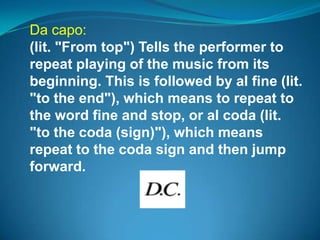
Da capo:
(lit. "From top") Tells the performer to
repeat playing of the music from its
beginning. This is followed by al fine (lit.
"to the end"), which means to repeat to
the word fine and stop, or al coda (lit.
"to the coda (sign)"), which means
repeat to the coda sign and then jump
forward.
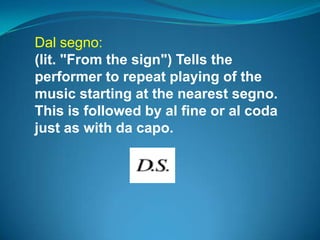
Dal segno:
(lit. "From the sign") Tells the
performer to repeat playing of the
music starting at the nearest segno.
This is followed by al fine or al coda
just as with da capo.
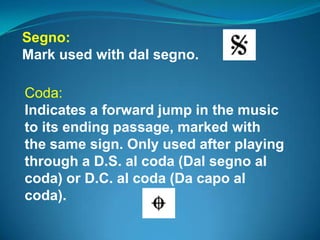
Segno:
Mark used with dal segno.

Coda:
Indicates a forward jump in the music
to its ending passage, marked with
the same sign. Only used after playing
through a D.S. al coda (Dal segno al
coda) or D.C. al coda (Da capo al
coda).
Abba
Abba
Abba
Abba
Abba
Abba

Abba

  • 1.
    Agnetha Fältskog, Benny Andersson, Björn Ulvaeus Anni-Frid Lyngstad
  • 2.
     ABBA wasa Swedish pop rock disco group formed in Stockholm in 1972, comprising Agnetha Fältskg, Benny Andersson, Björn Ulvaeus and Anni-Frid Lyngstad.  ABBA is an acronym of the first letters of the band members' first names and is sometimes stylized as the registered trademark ᗅᗅᗅᗅ. They became one of the most commercially successful acts in the history of pop music, topping the charts worldwide from 1972 to 1982.
  • 4.
     They arealso known for winning the 1974 Eurovision Song Contest, giving Sweden its first victory in the history of the contest.  ABBA was the first pop group to come from a non- English-speaking country that enjoyed consistent success in the charts of English-speaking countries.  In 1999, ABBA's music was adapted into the successful musical Mamma Mia! that toured worldwide. A film of the same name released in 2008 became the highest-grossing film in the United Kingdom that year.
  • 8.
    Form in Music Formis a way of describing the structure or shape of a piece of music - i.e. the way it has been constructed from various smaller sections. Form is mostly determined by the harmony (keys, chords etc.), although melody, rhythm, dynamics and texture can also be important.
  • 9.
    Some commonly usedforms are: • Binary - AB, often | |: A :| |: B :| | , occasionally | |: A :| | B or A | |: B :| | Two sections. Either or both may be repeated. • Ternary - ABA, sometimes | |: A :| | BA Three sections, with the third being similar to the first. In some cases the first and third sections are identical (e.g. a da Capo).
  • 10.
    Repeat sign: Enclose apassage that is to be played more than once. If there is no left repeat sign, the right repeat sign sends the performer back to the start of the piece or the nearest double bar.
  • 11.
    Volta brackets: (1stand 2nd endings, or 1st- and 2nd-time bars) A repeated passage is to be played with different endings on different playings; it is possible to have more than two endings (1st, 2nd, 3rd ...).
  • 12.
    Da capo: (lit. "Fromtop") Tells the performer to repeat playing of the music from its beginning. This is followed by al fine (lit. "to the end"), which means to repeat to the word fine and stop, or al coda (lit. "to the coda (sign)"), which means repeat to the coda sign and then jump forward.
  • 13.
    Dal segno: (lit. "Fromthe sign") Tells the performer to repeat playing of the music starting at the nearest segno. This is followed by al fine or al coda just as with da capo.
  • 14.
    Segno: Mark used withdal segno. Coda: Indicates a forward jump in the music to its ending passage, marked with the same sign. Only used after playing through a D.S. al coda (Dal segno al coda) or D.C. al coda (Da capo al coda).