ST. LAWRENCE COLLEGE: BEHAVIOURAL PSYCHOLOGY
Behavioural Intervention Program
Implementing Positive Reinforcement in the Treatment of Socially Withdrawn Behaviour
in a 11-Year-Old Boy During Group Work
Client: Charlie Thompson*
Setting: Regular classroom in a Middle School
Field Supervisor: Larissa Collins*
Students: Team #10
Bailey Rose
Isabella McLean
Taylor Walters
Danielle Elliott
Course: PSYC 6 - 102
College Supervisor: Gary Bernfeld
Date: February 24th, 2017
CAUTION
While this report can be used informally to guide clinical work, it is not a formal psychological
report, and was completed as part of a supervised student placement. It should not be placed on
any official file, nor would it be appropriate to discuss its findings in official agency reports.
* For reasons of confidentiality all names used in this report are fictional.
Honours Bachelor of Behavioural Psychology
ST. LAWRENCE COLLEGE: BEHAVIOURAL PSYCHOLOGY ii
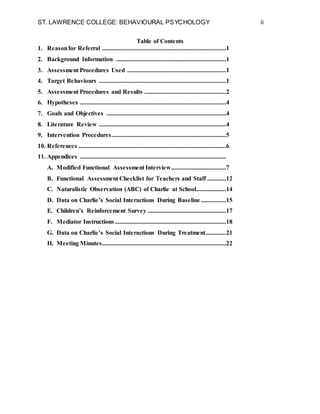
Table of Contents
1. Reasonfor Referral ...............................................................................1
2. Background Information ......................................................................1
3. Assessment Procedures Used ...............................................................1
4. Target Behaviours .................................................................................1
5. Assessment Procedures and Results ....................................................2
6. Hypotheses .............................................................................................4
7. Goals and Objectives ............................................................................4
8. Literature Review .................................................................................4
9. Intervention Procedures.........................................................................5
10. References ..............................................................................................6
11. Appendices .............................................................................................
A. Modified Functional Assessment Interview...................................7
B. Functional Assessment Checklist for Teachers and Staff ............12
C. Naturalistic Observation (ABC) of Charlie at School...................14
D. Data on Charlie’s Social Interactions During Baseline ................15
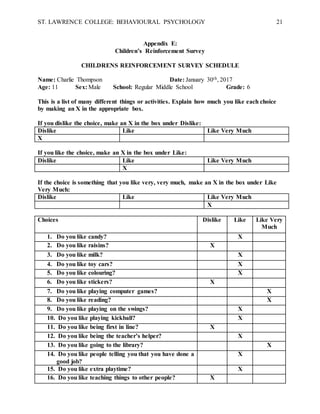
E. Children’s Reinforcement Survey ..................................................17
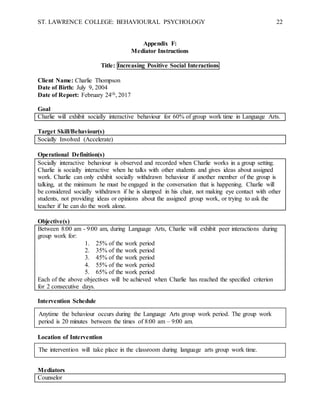
F. Mediator Instructions.......................................................................18
G. Data on Charlie’s Social Interactions During Treatment.............21
H. Meeting Minutes...............................................................................22
ST. LAWRENCE COLLEGE: BEHAVIOURAL PSYCHOLOGY 3
Behavioural Intervention Program
Client Name: Charlie Smith Date: February 13th, 2017
Counsellor: Larissa Collins
Program: Use of positive reinforcement for the increase in interactions with peers during
group work.
Reasonfor Referral
Charlie’s sixth-grade teacher, Ms. Potter, referred Charlie to a behaviour analyst. Charlie
was referred to receive treatment due to his lack of social interaction with peers during group
work and playtime. Charlie exhibits non-verbal signs of listening, but his verbal participation
requires improvement. The lack of verbal participation often resulted in incomplete group
participation marks, and for peers to bother Charlie due to his lack of participation. Therefore,
the goal of the intervention was to increase Charlie’s positive social interactions with peers,
enabling him to become more involved in the school community.
Background Information
Charlie is an 11-year-old boy who lives in Ontario with his mother, father, and 3-year-old sister,
Marie. Charlie’s family move frequently due to his father’s career in the military. Charlie attends
a regular middle school in Ontario and is in the sixth grade. He has no developmental, physical,
or biologically based concerns. The socially withdrawn behaviour is displayed at all times during
the school day. There was difficulty when trying to reach Charlie’s previous teachers due to the
frequent moves, but those who were contacted disclosed that he was socially withdrawn in their
classrooms as well. Charlie has received no other previous behavioural treatment or medication,
and is not currently receiving any medication. His teacher is willing to collaborate with the
behaviour analyst in the design and implementation of an appropriate behavioural treatment for
Charlie.
Assessment Procedures Used
Functional Assessment:
1. Modified Functional Assessment Interview
2. Naturalistic Observation (ABC) at School
3. Functional Assessment Checklist for Teachers and Staff
Baseline Assessment:
4. Frequency Recording of Social Interactions with Peers
Target Behaviour(s)
Interaction with Peers (Accelerate):
Interaction with peers is observed and recorded when Charlie interacts with his peers
during his language arts period. Charlie is to be considered interacting with his peers when he is
interacting with other students during group work. Charlie will not be recorded when he is
working on independent schoolwork and during classes other than language arts. Charlie is to be
considered not interacting with peers when he is alone, quiet while around other students, and
not verbally participating during group activities during his language arts class.
ST. LAWRENCE COLLEGE: BEHAVIOURAL PSYCHOLOGY 4
Rationale:
Interacting with others is an important skill for Charlie to learn so he can better carry
conversations with others at school and during activities outside of school. Charlie was not
interacting with others during assigned group work, which has lead to a decrease in friends,
social skills, confidence, and increased his anti-social behaviour. It is important for Charlie to
learn how to interact with others not only to gain confidence and friends, but also to increase
social skills for when he will need to use them during his future endeavours.
Assessment Procedures and Results Appendixes
Functional Assessment
1. Modified Functional Assessment Interview
A Modified Functional Assessment Interview (Modified Functional Assessment Interview;
Bernfeld (2012); Appendix A) was done with Ms Potter, Charlie’s teacher, on February 8th,
2017. According to Ms Potter, Charlie’s most common behaviours were not completing his
work, and exhibiting withdrawn behaviour during group work. The behaviours were said to
emerge constantly throughout the school day, especially during group work periods. The
consequences to Charlie’s behaviours were teacher attention, and being removed from group
work scenarios to complete his work independently; escape is the most probable factor
maintaining Charlie’s behaviour.
2. Functional Assessment Checklist for Teacher and Staff
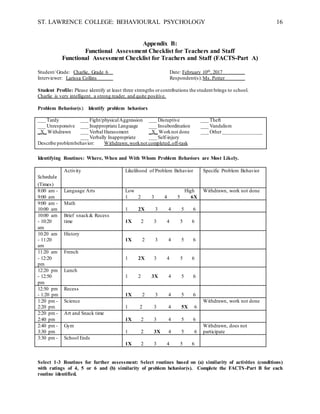
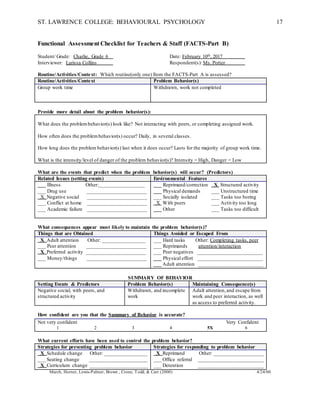
Ms Potter, Charlie’s teacher, was interviewed on February 10th, 2017 using the Functional
Assessment Checklist for Teachers and Staff (FACTS; March et al, 2000; Appendix B). The
most frequent behaviours noted in the FACTS interview were incomplete work, off task, and
withdrawn behaviour. These behaviours occurred most frequently during group work situations,
and playtime. The consequences were most often teacher attention, and isolation from the group
to complete work independently. According to the FACTS interview, it appears as if the primary
function maintaining Charlie’s withdrawn behaviour is escape.
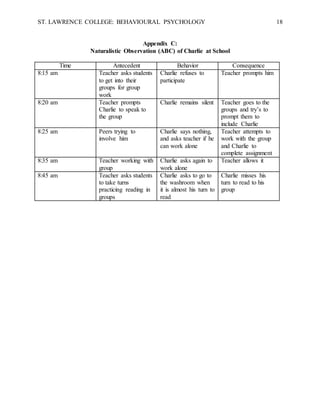
3. Naturalistic Observation (ABC) at School
Charlie’s socially withdrawn behaviour was recorded using an ABC chart throughout the school
day on February 9th, 2017 (Appendix C). According to the data, Charlie’s behaviour occurred
most often during group work periods, and playtime. He engaged in behaviours such as not
talking to peers, not completing his work, and removing himself from situations. Engaging in
these behaviours gained attention of his teacher, and escape of group work after repeated
prompts to them. Throughout the day, the consequences for his withdrawn behaviour was escape.
According to the data, the most likely function of Charlie’s withdrawn behaviour may be escape.
Baseline Assessment
4. Data on Charlie’s Social Interactions During Baseline
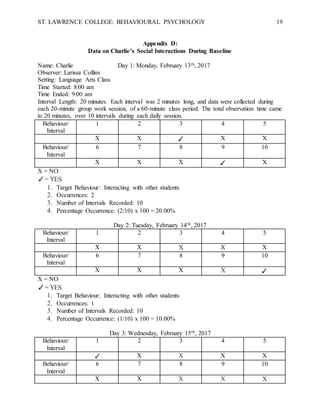
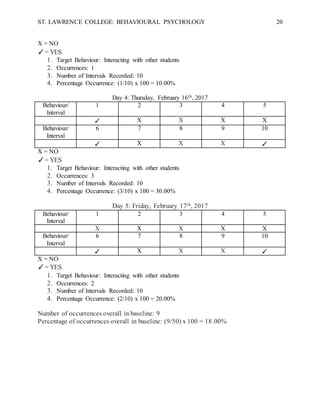
Charlie’s social interactions were observed using frequency recording (Appendix D). The
behaviour was observed over 5 school days, during language arts class. Each interval was 2
minutes long, and data was collected during each 20-minute group work session, of a 60-minute
class period. The total observation time came to 20 minutes, over 10 intervals during each daily
ST. LAWRENCE COLLEGE: BEHAVIOURAL PSYCHOLOGY 5
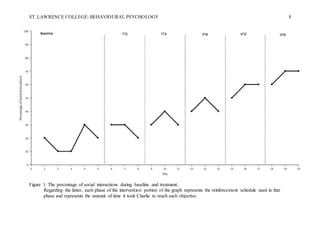
session. During baseline, Charlie exhibited socially interactive behaviour for an average of
18.00% of the group work time (see Figure 1).
ST. LAWRENCE COLLEGE: BEHAVIOURAL PSYCHOLOGY 6
Hypothesis
Review of the assessment results show that when group work did not allow for individual
input, Charlie did not participate in discussion of the work, and exhibited socially withdrawn
behaviour. The main consequence for Charlie’s behaviour was escape from group work. Given
that Charlie’s socially withdrawn behaviour occurs more in-group situations, than isolated
situations, he may exhibit some behavioural skills deficits in peer communication. He may
require more reinforcers to increase his positive social interactions. If Charlie’s behaviour is
maintained by escape, then praise and set alone time should increase the occurrence of his
involvement in peer interactions and group work.
Goal #1 and Objectives
Increased peer interactions (accelerate)
Charlie will interact with his peers during group work for 65% of the time during the language
arts period.
Objectives
Between 8:00 am - 9:00 am, during Language Arts, Charlie will exhibit peer interactions during
group work for:
1. 25% of the work period
2. 35% of the work period
3. 45% of the work period
4. 55% of the work period
5. 65% of the work period
Each of the above objectives will be achieved when Charlie has reached the specified criterion
for 3 consecutive days.
Literature Review
All behaviors are followed by certain consequence, which makes reinforcement one of
humankinds’ naturally occurring phenomena (Maag, 2001). When the consequence of behaviour
acts as a reinforcer for that behaviour, the behaviour increases, which has been demonstrated in
studies from all over the world (Maag, 2001). If a child is exhibiting socially withdrawn
behaviours, they tend to be noticeably shy and demonstrate a preference for secluding
themselves from others (Coplan et al., 2013). This response to social interactions results in
difficulties making friends and developing relationships with peers (Coplan et al., 2013). When it
comes to socially withdrawn behaviours, a high correlation of effectiveness and acceptability has
been found between positive reinforcement and social skills training (Miller, DuPaul, & Lutz,
2002). Social skills training involves the child initiating social interactions, responding to social
cues from others, and maintaining conversations (Miller, DuPaul, & Lutz, 2002). More research
has shown that multiple household moves are associated with increased emotional/behavioural
problems in school, as well as lower levels of social competence with peers (Hoglund &
Leadbeater, 2004). The goal is to relive these maladaptive behaviours and turn them into
appropriate behaviours through positive reinforcement (Snow & Brooks, 2004). Studies have
shown that if the desired behaviour is followed by a reward, the behaviour will increase in
frequency (Snow & Brooks, 2004). The same is true if positive reinforcement is taken away; the
behaviour will decrease in frequency (Snow & Brooks, 2004). It is also important to put a
ST. LAWRENCE COLLEGE: BEHAVIOURAL PSYCHOLOGY 7
reinforcement system in place to promote efficient levels of responding. According to Luczynski
and Hanley (2014), children prefer contingent reinforcement (CR) to alternate types of
reinforcement. There was also the highest success rate and satisfaction in clients when fixed-ratio
reinforcement was used to obtain social interactions (Luczynski & Hanley, 2014). Thus, the use
of positive reinforcement should increase Charlie’s instances of socially interactive behaviour.
Intervention Procedures
Positive Reinforcement
A positive reinforcement strategy was put into action in order to increase Charlie’s
positive social interactions. A fixed time (FT2) schedule of reinforcement was utilized to
increase social interactions. A FT reinforcement schedule is more effective in a classroom
situation as the schedule does not require the mediator to be constantly monitoring the child.
Charlie completed the Children’s Reinforcement Survey (Cautella & Brion-Meisels; Appendix
E) to help pinpoint possible reinforcers. Items that Charlie seemed to find most enjoyable
included playing computer games, reading, and going to the library. Other reinforcers that he
enjoys are candy, and milk, neither of which was used due to the associated difficulties in the
delivery, and fading out. He will also receive gestural reinforcement, through smiling and
nodding, or verbal reinforcements of praise when he is interacting with peers.
Prompts
If Charlie refuses to interact with peers, he was given a gestural prompt to return to
working as a team. If he continued to be withdrawn, he was then verbally prompted to become
more involved.
A counsellor began implementing the intervention during the language arts, and science
periods on Monday, February 6th, 2017. Data were collected during classes from Monday to
Friday between 8:00 am – 9:00 am for a period of 4 weeks. Charlie was initially reinforced for
his socially interactive behaviour on a FT2 schedule. The data were collected on a chart and,
each time the teacher looked at Charlie and he was interacting with his peers, an “X” was marked
on the data sheet and reinforcement was given. See Appendix F for Mediator Instructions.
Intervention Results
Charlie’s positive reinforcement intervention was implemented over a 15-day period.
This intervention was effective in increasing Charlie’s socially interactive behaviour. During
baseline, Charlie’s socially interactive behaviour averaged 18.00%. However, during
interventions his socially interactive behaviour averaged 45.33% (Appendix D), which represents
an increase of 151.83%. Figure 1 represents a graph of Charlie’s socially interactive behaviour
during the baseline and treatment phases. Each phase of the intervention portion of the graph
reflects the reinforcement schedule used in that phase and represents the amount of time it took
Charlie to reach each objective.
ST. LAWRENCE COLLEGE: BEHAVIOURAL PSYCHOLOGY 8
Figure 1. The percentage of social interactions during baseline and treatment.
Regarding the latter, each phase of the intervention portion of the graph represents the reinforcement schedule used in that
phase and represents the amount of time it took Charlie to reach each objective.
ST. LAWRENCE COLLEGE: BEHAVIOURAL PSYCHOLOGY 9
Program Changes
The initial plan for the intervention was to reinforce Charlie using a reinforcer that he had
indicated was the most desirable from then Children’s Reinforcement Survey (Appendix E)
However, in order to avoid satiation to the reinforcer, it was decided to use a combination of
three different reinforcers that could easily be faded out. This made it possible to keep Charlie as
interested as possible in achieving his objective, while slowly fading out the undesirable
behaviour.
Maintenance and Generalization
Since the program was only being implemented in Language Arts, in order to encourage
generalization, the program would need to be used in Charlie’s other classes. This will be easier
to achieve since there are few teachers that Charlie interacts with throughout the day. The verbal
and gestural prompts given to Charlie when he exhibits socially interactive behaviour continued
to be used, as they are natural prompts that use very little effort from the mediator. Charlie also
continued to receive social reinforcement, such as praise, while other reinforcers were faded out
from the initial FT2 schedule to a more natural scheduler using a variable time (VT) schedule of
reinforcement.
Specifically, after Charlie achieved his first objective, his reinforcement schedule was
shifted from FT2 to FT3. After reaching each subsequent objective, his schedule shifted to the
following: FT4, VT3, and finally to VT6.
Summary and Recommendations
This positive reinforcement intervention was effective in increasing Charlie’s socially
interactive behaviour. While during baseline, his socially interactive behaviour averaged 18.00%,
it averaged 45.33% during the entire intervention, which is an increase of 151.83%. Thus,
Charlie met all goals and objectives of the program. After Charlie had demonstrated mastery of
an objective for a 3-day period, the criteria changed, encouraging Charlie’s progress to
continually increase. Charlie exhibited no skill deficits in verbal participation, as hypothesized;
he simply was not exhibiting the behaviour due to his desire to escape the situation. Reinforcers
that Charlie previously indicated as desirable were delivered when he engaged in socially
interactive behaviour. These reinforcers, including social praise, were reinforcing for Charlie and
encouraged him to increase his social interactions to meet each objective. Gestural and verbal
prompts were used when Charlie became off-task, increasing his understanding of the difference
between being socially withdrawn, and socially interactive.
The reinforcers in the program were not sufficiently faded to natural reinforcers (e.g. social
praise) as would have been preferred. Instructions were included for the mediator detailing the
process in which the added reinforcers would be faded out and social praise could be used as the
primary reinforcer to maintain Charlie’s socially interactive behaviour. As noted earlier, it is
recommended that the procedure be used in other classes, and settings to encourage further
generalization.
ST. LAWRENCE COLLEGE: BEHAVIOURAL PSYCHOLOGY 10
References
Bernfeld, G. A. (2012) Modified Functional Assessment Interview. Unpublished measure.
Community Services Department, St. Lawrence College, Kingston, Canada.
Cautella, J. R., & Brion-Meisels, L. (1979). A children’s reinforcement survey schedule.
Psychological Reports, 44, 327-338, Table 1.
Coplan, R. J., Rose-Krasnor, L., Weeks, M., Kingsbury, A., Kingsbury, M., & Bullock, A.
(2013). Alone is a crowd: Social motivations, social withdrawal, and socioemotional
functioning in later childhood. Developmental Psychology, 49(5), 861-875. doi:
10.1037/a0028861
Hoglund, W. L., & Leadbeater, B. J. (2004). The effects of family, school, and classroom
ecologies on changes in children ‘s social competence and emotional and behavioural
problems in first grade. Developmental Psychology, 40(4), 533-544. doi: 10.1037/0012-
1649.40.4.533
Luczynski, K. C., & Hanley, G. P. (2014). How should periods without social interaction be
scheduled? Children’s preference for practical schedules of positive reinforcement.
Journal of Applied Behavior Analysis. 47(3), 500-522. doi: 10.1002/jaba.140
Maag, J. W. (2001). Rewarded by punishment: Reflections on the disuse of positive
reinforcement in schools. The Council for Exceptional Children. 67(2), 173-186.
Retrieved from: http://amaesd.org/media/forms/Behavior-Toolbox/7-Team-
Tools/Reinforcement%20Paper.pdf
March, R., Lewis-Palmer, L., Brown, D., Crone, D., Todd, A. W., & Carr, E. (2000). Functional
assessment checklist for teachers and staff (FACTS). Educational and Community
Supports. University of Oregon, Eugene, Oregon.
Miller, D. N., DuPaul, G. J., Lutz, J. G. (2002). School-based psychological interventions for
childhood depression: Acceptability of treatments among school psychologists. School
Psychology Quarterly, 17(1), 79-99. doi: 10.1521/scpq.12.1.78.19903
Snow. D. L., & Brooks, R. B. (1974). Behavior modification techniques in the school setting.
Journal of School Health, 44(4), 198-205. doi: 10.1111/j.1746-1561.1974.tb05221.x
Word Count: 2480
ST. LAWRENCE COLLEGE: BEHAVIOURAL PSYCHOLOGY 11
Appendix A:
Modified Functional Assessment Interview
Section A: Describing the behaviour
What does the behaviour look like when it is happening?
I. Frequency How often does it occur: daily – weekly – monthly.
II. Duration How long does it last.
III. Intensity How damaging or destructive is the Behaviour(s)?
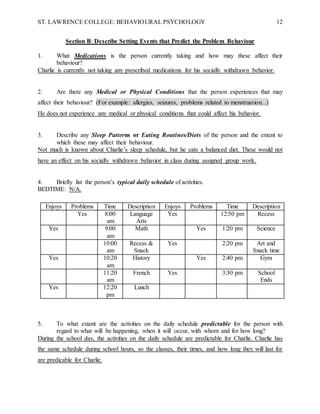
Describe the behaviour I. Frequency II. Duration III. Intensity
Not socializing with peers
during group work
During each
group work
period, on
average 2 a
day
Group-work lasts
for 25-30
minutes.
On average, he
will not speak for
90% of the group
work period.
This behavior could be
considered mildly
destructive as it is causing
him to be isolated by peers,
and some of his peers have
begun to tease him for his
lack of communication.
ST. LAWRENCE COLLEGE: BEHAVIOURAL PSYCHOLOGY 12
Section B: Describe Setting Events that Predict the Problem Behaviour
1. What Medications is the person currently taking and how may these affect their
behaviour?
Charlie is currently not taking any prescribed medications for his socially withdrawn behavior.
2. Are there any Medical or Physical Conditions that the person experiences that may
affect their behaviour? (For example: allergies, seizures, problems related to menstruation...)
He does not experience any medical or physical conditions that could affect his behavior.
3. Describe any Sleep Patterns or Eating Routines/Diets of the person and the extent to
which these may affect their behaviour.
Not much is known about Charlie’s sleep schedule, but he eats a balanced diet. These would not
have an effect on his socially withdrawn behavior in class during assigned group work.
4. Briefly list the person’s typical daily schedule of activities.
BEDTIME: N/A.
5. To what extent are the activities on the daily schedule predictable for the person with
regard to what will be happening, when it will occur, with whom and for how long?
During the school day, the activities on the daily schedule are predictable for Charlie. Charlie has
the same schedule during school hours, so the classes, their times, and how long they will last for
are predicable for Charlie.
Enjoys Problems Time Description Enjoys Problems Time Description
Yes 8:00
am
Language
Arts
Yes 12:50 pm Recess
Yes 9:00
am
Math Yes 1:20 pm Science
10:00
am
Recess &
Snack
Yes 2:20 pm Art and
Snack time
Yes 10:20
am
History Yes 2:40 pm Gym
11:20
am
French Yes 3:30 pm School
Ends
Yes 12:20
pm
Lunch
ST. LAWRENCE COLLEGE: BEHAVIOURAL PSYCHOLOGY 13
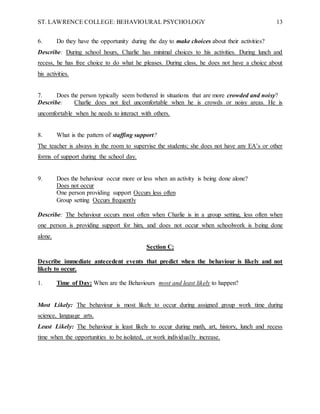
6. Do they have the opportunity during the day to make choices about their activities?
Describe: During school hours, Charlie has minimal choices to his activities. During lunch and
recess, he has free choice to do what he pleases. During class, he does not have a choice about
his activities.
7. Does the person typically seem bothered in situations that are more crowded and noisy?
Describe: Charlie does not feel uncomfortable when he is crowds or noisy areas. He is
uncomfortable when he needs to interact with others.
8. What is the pattern of staffing support?
The teacher is always in the room to supervise the students; she does not have any EA’s or other
forms of support during the school day.
9. Does the behaviour occur more or less when an activity is being done alone?
Does not occur
One person providing support Occurs less often
Group setting Occurs frequently
Describe: The behaviour occurs most often when Charlie is in a group setting, less often when
one person is providing support for him, and does not occur when schoolwork is being done
alone.
Section C:
Describe immediate antecedent events that predict when the behaviour is likely and not
likely to occur.
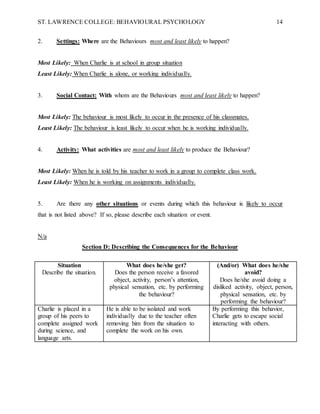
1. Time of Day: When are the Behaviours most and least likely to happen?
Most Likely: The behaviour is most likely to occur during assigned group work time during
science, language arts.
Least Likely: The behaviour is least likely to occur during math, art, history, lunch and recess
time when the opportunities to be isolated, or work individually increase.
ST. LAWRENCE COLLEGE: BEHAVIOURAL PSYCHOLOGY 14
2. Settings: Where are the Behaviours most and least likely to happen?
Most Likely: When Charlie is at school in group situation
Least Likely: When Charlie is alone, or working individually.
3. Social Contact: With whom are the Behaviours most and least likely to happen?
Most Likely: The behaviour is most likely to occur in the presence of his classmates.
Least Likely: The behaviour is least likely to occur when he is working individually.
4. Activity: What activities are most and least likely to produce the Behaviour?
Most Likely: When he is told by his teacher to work in a group to complete class work.
Least Likely: When he is working on assignments individually.
5. Are there any other situations or events during which this behaviour is likely to occur
that is not listed above? If so, please describe each situation or event.
N/a
Section D: Describing the Consequences for the Behaviour
Situation
Describe the situation.
What does he/she get?
Does the person receive a favored
object, activity, person’s attention,
physical sensation, etc. by performing
the behaviour?
(And/or) What does he/she
avoid?
Does he/she avoid doing a
disliked activity, object, person,
physical sensation, etc. by
performing the behaviour?
Charlie is placed in a
group of his peers to
complete assigned work
during science, and
language arts.
He is able to be isolated and work
individually due to the teacher often
removing him from the situation to
complete the work on his own.
By performing this behavior,
Charlie gets to escape social
interacting with others.
ST. LAWRENCE COLLEGE: BEHAVIOURAL PSYCHOLOGY 15
NOT TO BE USED IN THE INTERVIEW OF
MEDIATORS
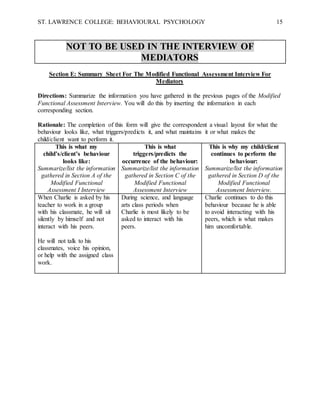
Section E: Summary Sheet For The Modified Functional Assessment Interview For
Mediators
Directions: Summarize the information you have gathered in the previous pages of the Modified
Functional Assessment Interview. You will do this by inserting the information in each
corresponding section.
Rationale: The completion of this form will give the correspondent a visual layout for what the
behaviour looks like, what triggers/predicts it, and what maintains it or what makes the
child/client want to perform it.
This is what my
child’s/client’s behaviour
looks like:
Summarize/list the information
gathered in Section A of the
Modified Functional
Assessment I Interview
This is what
triggers/predicts the
occurrence of the behaviour:
Summarize/list the information
gathered in Section C of the
Modified Functional
Assessment Interview
This is why my child/client
continues to perform the
behaviour:
Summarize/list the information
gathered in Section D of the
Modified Functional
Assessment Interview.
When Charlie is asked by his
teacher to work in a group
with his classmate, he will sit
silently by himself and not
interact with his peers.
He will not talk to his
classmates, voice his opinion,
or help with the assigned class
work.
During science, and language
arts class periods when
Charlie is most likely to be
asked to interact with his
peers.
Charlie continues to do this
behaviour because he is able
to avoid interacting with his
peers, which is what makes
him uncomfortable.
ST. LAWRENCE COLLEGE: BEHAVIOURAL PSYCHOLOGY 16
Appendix B:
Functional Assessment Checklist for Teachers and Staff
Functional Assessment Checklist for Teachers and Staff (FACTS-Part A)
Student/ Grade: Charlie, Grade 6 Date: February 10th, 2017
Interviewer: Larissa Collins Respondent(s):Ms. Potter
Student Profile: Please identify at least three strengths orcontributions the student brings to school.
Charlie is very intelligent, a strong reader, and quite positive.
Problem Behavior(s): Identify problem behaviors
___ Tardy ___ Fight/physicalAggression ___ Disruptive ___ Theft
___ Unresponsive ___ Inappropriate Language ___ Insubordination ___ Vandalism
_X_ Withdrawn ___ Verbal Harassment _X_ Worknot done ___ Other________________
___ Verbally Inappropriate ___ Self-injury
Describe problembehavior: Withdrawn,worknot completed,off-task
Identifying Routines: Where, When and With Whom Problem Behaviors are Most Likely.
Schedule
(Times)
Activity Likelihood of Problem Behavior Specific Problem Behavior
8:00 am -
9:00 am
Language Arts Low High
1 2 3 4 5 6X
Withdrawn, work not done
9:00 am -
10:00 am
Math
1 2X 3 4 5 6
10:00 am
- 10:20
am
Brief snack& Recess
time 1X 2 3 4 5 6
10:20 am
- 11:20
am
History
1X 2 3 4 5 6
11:20 am
- 12:20
pm
French
1 2X 3 4 5 6
12:20 pm
- 12:50
pm
Lunch
1 2 3X 4 5 6
12:50 pm
- 1:20 pm
Recess
1X 2 3 4 5 6
1:20 pm -
2:20 pm
Science
1 2 3 4 5X 6
Withdrawn, work not done
2:20 pm -
2:40 pm
Art and Snack time
1X 2 3 4 5 6
2:40 pm -
3:30 pm
Gym
1 2 3X 4 5 6
Withdrawn, does not
participate
3:30 pm - School Ends
1X 2 3 4 5 6
Select 1-3 Routines for further assessment: Select routines based on (a) similarity of activities (conditions)
with ratings of 4, 5 or 6 and (b) similarity of problem behavior(s). Complete the FACTS-Part B for each
routine identified.
ST. LAWRENCE COLLEGE: BEHAVIOURAL PSYCHOLOGY 17
Functional Assessment Checklist for Teachers & Staff (FACTS-Part B)
Student/ Grade: Charlie, Grade 6 Date: February 10th, 2017
Interviewer: Larissa Collins Respondent(s): Ms. Potter
Routine/Activities/Context: Which routine(only one) from the FACTS-Part A is assessed?
Routine/Activities/Context Problem Behavior(s)
Group work time Withdrawn, work not completed
Provide more detail about the problem behavior(s):
What does the problembehavior(s) look like? Not interacting with peers, or completing assigned work.
How often does the problembehavior(s) occur? Daily, in several classes.
How long does the problem behavior(s) last when it does occur? Lasts for the majority of group work time.
What is the intensity/level of danger of the problem behavior(s)? Intensity = High, Danger = Low
What are the events that predict when the problem behavior(s) will occur? (Predictors)
Related Issues (setting events) Environmental Features
___ Illness Other:_________________
___ Drug use ______________________
X Negative social ______________________
___ Conflict at home ______________________
___ Academic failure ______________________
___ Reprimand/correction X Structured activity
___ Physical demands ___ Unstructured time
___ Socially isolated ___ Tasks too boring
X With peers ___ Activity too long
___ Other ___ Tasks too difficult
What consequences appear most likely to maintain the problem behavior(s)?
Things that are Obtained Things Avoided or Escaped From
X Adult attention Other: ________________
___ Peer attention ______________________
X Preferred activity ______________________
___ Money/things ______________________
___ Hard tasks Other: Completing tasks, peer
___ Reprimands attention/interaction
___ Peer negatives ________________________
___ Physical effort ________________________
___ Adult attention ________________________
SUMMARY OF BEHAVIOR
Setting Events & Predictors Problem Behavior(s) Maintaining Consequence(s)
Negative social, with peers, and
structured activity
Withdrawn, and incomplete
work
Adult attention,and escape from
work and peer interaction, as well
as access to preferred activity.
How confident are you that the Summary of Behavior is accurate?
Not very confident Very Confident
1 2 3 4 5X 6
What current efforts have been used to control the problem behavior?
Strategies for preventing problem behavior Strategies for responding to problem behavior
X Schedule change Other: ________________
___ Seating change ______________________
X Curriculum change ______________________
X Reprimand Other: ___________________
___ Office referral _________________________
___ Detention _________________________
March, Horner, Lewis-Palmer, Brown , Crone, Todd, & Carr (2000) 4/24/00
ST. LAWRENCE COLLEGE: BEHAVIOURAL PSYCHOLOGY 18
Appendix C:
Naturalistic Observation (ABC) of Charlie at School
Time Antecedent Behavior Consequence
8:15 am Teacher asks students
to get into their
groups for group
work
Charlie refuses to
participate
Teacher prompts him
8:20 am Teacher prompts
Charlie to speak to
the group
Charlie remains silent Teacher goes to the
groups and try’s to
prompt them to
include Charlie
8:25 am Peers trying to
involve him
Charlie says nothing,
and asks teacher if he
can work alone
Teacher attempts to
work with the group
and Charlie to
complete assignment
8:35 am Teacher working with
group
Charlie asks again to
work alone
Teacher allows it
8:45 am Teacher asks students
to take turns
practicing reading in
groups
Charlie asks to go to
the washroom when
it is almost his turn to
read
Charlie misses his
turn to read to his
group
ST. LAWRENCE COLLEGE: BEHAVIOURAL PSYCHOLOGY 19
Appendix D:
Data on Charlie’s Social Interactions During Baseline
Name: Charlie Day 1: Monday, February 13th, 2017
Observer: Larissa Collins
Setting: Language Arts Class
Time Started: 8:00 am
Time Ended: 9:00 am
Interval Length: 20 minutes. Each interval was 2 minutes long, and data were collected during
each 20-minute group work session, of a 60-minute class period. The total observation time came
to 20 minutes, over 10 intervals during each daily session.
Behaviour/
Interval
1 2 3 4 5
X X ✓ X X
Behaviour/
Interval
6 7 8 9 10
X X X ✓ X
X = NO
✓= YES
1. Target Behaviour: Interacting with other students
2. Occurrences: 2
3. Number of Intervals Recorded: 10
4. Percentage Occurrence: (2/10) x 100 = 20.00%
Day 2: Tuesday, February 14th, 2017
Behaviour/
Interval
1 2 3 4 5
X X X X X
Behaviour/
Interval
6 7 8 9 10
X X X X ✓
X = NO
✓= YES
1. Target Behaviour: Interacting with other students
2. Occurrences: 1
3. Number of Intervals Recorded: 10
4. Percentage Occurrence: (1/10) x 100 = 10.00%
Day 3: Wednesday, February 15th, 2017
Behaviour/
Interval
1 2 3 4 5
✓ X X X X
Behaviour/
Interval
6 7 8 9 10
X X X X X
ST. LAWRENCE COLLEGE: BEHAVIOURAL PSYCHOLOGY 20
X = NO
✓= YES
1. Target Behaviour: Interacting with other students
2. Occurrences: 1
3. Number of Intervals Recorded: 10
4. Percentage Occurrence: (1/10) x 100 = 10.00%
Day 4: Thursday, February 16th, 2017
Behaviour/
Interval
1 2 3 4 5
✓ X X X X
Behaviour/
Interval
6 7 8 9 10
✓ X X X ✓
X = NO
✓= YES
1. Target Behaviour: Interacting with other students
2. Occurrences: 3
3. Number of Intervals Recorded: 10
4. Percentage Occurrence: (3/10) x 100 = 30.00%
Day 5: Friday, February 17th, 2017
Behaviour/
Interval
1 2 3 4 5
X X X X X
Behaviour/
Interval
6 7 8 9 10
✓ X X X ✓
X = NO
✓= YES
1. Target Behaviour: Interacting with other students
2. Occurrences: 2
3. Number of Intervals Recorded: 10
4. Percentage Occurrence: (2/10) x 100 = 20.00%
Number of occurrences overall in baseline: 9
Percentage of occurrences overall in baseline: (9/50) x 100 = 18.00%
ST. LAWRENCE COLLEGE: BEHAVIOURAL PSYCHOLOGY 21
Appendix E:
Children’s Reinforcement Survey
CHILDRENS REINFORCEMENT SURVEY SCHEDULE
Name: Charlie Thompson Date: January 30th, 2017
Age: 11 Sex: Male School: Regular Middle School Grade: 6
This is a list of many different things or activities. Explain how much you like each choice
by making an X in the appropriate box.
If you dislike the choice, make an X in the box under Dislike:
Dislike Like Like Very Much
X
If you like the choice, make an X in the box under Like:
Dislike Like Like Very Much
X
If the choice is something that you like very, very much, make an X in the box under Like
Very Much:
Dislike Like Like Very Much
X
Choices Dislike Like Like Very
Much
1. Do you like candy? X
2. Do you like raisins? X
3. Do you like milk? X
4. Do you like toy cars? X
5. Do you like colouring? X
6. Do you like stickers? X
7. Do you like playing computer games? X
8. Do you like reading? X
9. Do you like playing on the swings? X
10. Do you like playing kickball? X
11. Do you like being first in line? X
12. Do you like being the teacher’s helper? X
13. Do you like going to the library? X
14. Do you like people telling you that you have done a
good job?
X
15. Do you like extra playtime? X
16. Do you like teaching things to other people? X
ST. LAWRENCE COLLEGE: BEHAVIOURAL PSYCHOLOGY 22
Appendix F:
Mediator Instructions
Title: Increasing Positive Social Interactions
Client Name: Charlie Thompson
Date of Birth: July 9, 2004
Date of Report: February 24th, 2017
Goal
Charlie will exhibit socially interactive behaviour for 60% of group work time in Language Arts.
Target Skill/Behaviour(s)
Socially Involved (Accelerate)
Operational Definition(s)
Socially interactive behaviour is observed and recorded when Charlie works in a group setting.
Charlie is socially interactive when he talks with other students and gives ideas about assigned
work. Charlie can only exhibit socially withdrawn behaviour if another member of the group is
talking, at the minimum he must be engaged in the conversation that is happening. Charlie will
be considered socially withdrawn if he is slumped in his chair, not making eye contact with other
students, not providing ideas or opinions about the assigned group work, or trying to ask the
teacher if he can do the work alone.
Objective(s)
Between 8:00 am - 9:00 am, during Language Arts, Charlie will exhibit peer interactions during
group work for:
1. 25% of the work period
2. 35% of the work period
3. 45% of the work period
4. 55% of the work period
5. 65% of the work period
Each of the above objectives will be achieved when Charlie has reached the specified criterion
for 2 consecutive days.
Intervention Schedule
Location of Intervention
Mediators
Counselor
Anytime the behaviour occurs during the Language Arts group work period. The group work
period is 20 minutes between the times of 8:00 am – 9:00 am.
The intervention will take place in the classroom during language arts group work time.
ST. LAWRENCE COLLEGE: BEHAVIOURAL PSYCHOLOGY 23
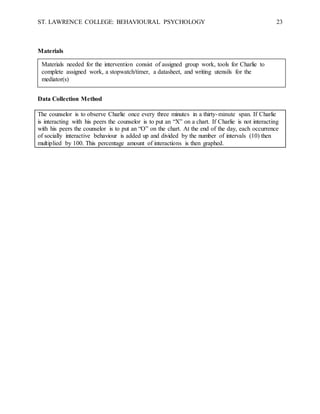
Materials
Data Collection Method
The counselor is to observe Charlie once every three minutes in a thirty-minute span. If Charlie
is interacting with his peers the counselor is to put an “X” on a chart. If Charlie is not interacting
with his peers the counselor is to put an “O” on the chart. At the end of the day, each occurrence
of socially interactive behaviour is added up and divided by the number of intervals (10) then
multiplied by 100. This percentage amount of interactions is then graphed.
Materials needed for the intervention consist of assigned group work, tools for Charlie to
complete assigned work, a stopwatch/timer, a datasheet, and writing utensils for the
mediator(s)
ST. LAWRENCE COLLEGE: BEHAVIOURAL PSYCHOLOGY 24
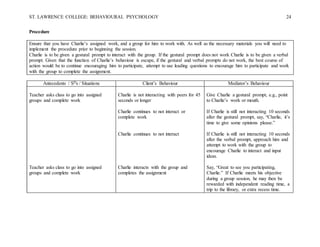
Procedure
Ensure that you have Charlie’s assigned work, and a group for him to work with. As well as the necessary materials you will need to
implement the procedure prior to beginning the session.
Charlie is to be given a gestural prompt to interact with the group. If the gestural prompt does not work Charlie is to be given a verbal
prompt. Given that the function of Charlie’s behaviour is escape, if the gestural and verbal prompts do not work, the best course of
action would be to continue encouraging him to participate, attempt to use leading questions to encourage him to participate and work
with the group to complete the assignment.
Antecedents / SDs / Situations Client’s Behaviour Mediator’s Behaviour
Teacher asks class to go into assigned
groups and complete work
Teacher asks class to go into assigned
groups and complete work
Charlie is not interacting with peers for 45
seconds or longer
Charlie continues to not interact or
complete work
Charlie continues to not interact
Charlie interacts with the group and
completes the assignment
Give Charlie a gestural prompt, e.g., point
to Charlie’s work or mouth.
If Charlie is still not interacting 10 seconds
after the gestural prompt, say, “Charlie, it’s
time to give some opinions please.”
If Charlie is still not interacting 10 seconds
after the verbal prompt, approach him and
attempt to work with the group to
encourage Charlie to interact and input
ideas.
Say, “Great to see you participating,
Charlie.” If Charlie meets his objective
during a group session, he may then be
rewarded with independent reading time, a
trip to the library, or extra recess time.
ST. LAWRENCE COLLEGE BEHAVIOURAL PSYCHOLOGY 25
Appendix G:
Data on Charlie’s Socially Interactive Behaviour During Treatment
As detailed prior in the appendix presenting the baseline data.
Data was collected in ten, 2-minute intervals during each 20-minute group work session, of each
60-minute class period.
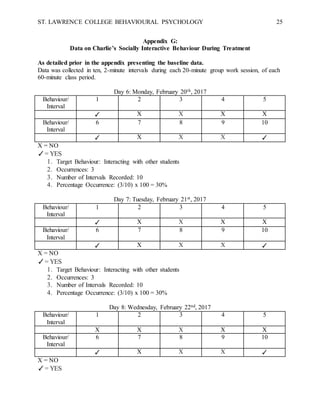
Day 6: Monday, February 20th, 2017
Behaviour/
Interval
1 2 3 4 5
✓ X X X X
Behaviour/
Interval
6 7 8 9 10
✓ X X X ✓
X = NO
✓= YES
1. Target Behaviour: Interacting with other students
2. Occurrences: 3
3. Number of Intervals Recorded: 10
4. Percentage Occurrence: (3/10) x 100 = 30%
Day 7: Tuesday, February 21st, 2017
Behaviour/
Interval
1 2 3 4 5
✓ X X X X
Behaviour/
Interval
6 7 8 9 10
✓ X X X ✓
X = NO
✓= YES
1. Target Behaviour: Interacting with other students
2. Occurrences: 3
3. Number of Intervals Recorded: 10
4. Percentage Occurrence: (3/10) x 100 = 30%
Day 8: Wednesday, February 22nd, 2017
Behaviour/
Interval
1 2 3 4 5
X X X X X
Behaviour/
Interval
6 7 8 9 10
✓ X X X ✓
X = NO
✓= YES
ST. LAWRENCE COLLEGE BEHAVIOURAL PSYCHOLOGY 26
1. Target Behaviour: Interacting with other students
2. Occurrences: 2
3. Number of Intervals Recorded: 10
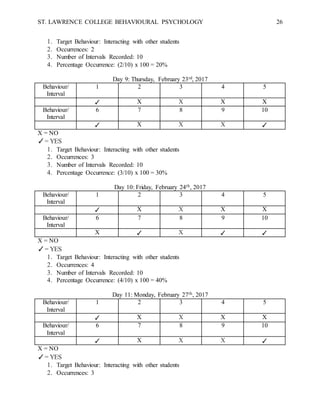
4. Percentage Occurrence: (2/10) x 100 = 20%
Day 9: Thursday, February 23rd, 2017
Behaviour/
Interval
1 2 3 4 5
✓ X X X X
Behaviour/
Interval
6 7 8 9 10
✓ X X X ✓
X = NO
✓= YES
1. Target Behaviour: Interacting with other students
2. Occurrences: 3
3. Number of Intervals Recorded: 10
4. Percentage Occurrence: (3/10) x 100 = 30%
Day 10: Friday, February 24th, 2017
Behaviour/
Interval
1 2 3 4 5
✓ X X X X
Behaviour/
Interval
6 7 8 9 10
X ✓ X ✓ ✓
X = NO
✓= YES
1. Target Behaviour: Interacting with other students
2. Occurrences: 4
3. Number of Intervals Recorded: 10
4. Percentage Occurrence: (4/10) x 100 = 40%
Day 11: Monday, February 27th, 2017
Behaviour/
Interval
1 2 3 4 5
✓ X X X X
Behaviour/
Interval
6 7 8 9 10
✓ X X X ✓
X = NO
✓= YES
1. Target Behaviour: Interacting with other students
2. Occurrences: 3
ST. LAWRENCE COLLEGE BEHAVIOURAL PSYCHOLOGY 27
3. Number of Intervals Recorded: 10
4. Percentage Occurrence: (3/10) x 100 = 30%
Day 12: Tuesday, February 28th, 2017
Behaviour/
Interval
1 2 3 4 5
✓ ✓ X X X
Behaviour/
Interval
6 7 8 9 10
X ✓ ✓ X X
X = NO
✓= YES
1. Target Behaviour: Interacting with other students
2. Occurrences: 4
3. Number of Intervals Recorded: 10
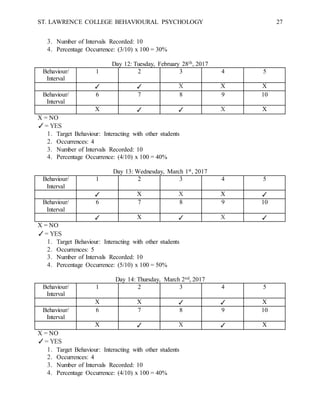
4. Percentage Occurrence: (4/10) x 100 = 40%
Day 13: Wednesday, March 1st, 2017
Behaviour/
Interval
1 2 3 4 5
✓ X X X ✓
Behaviour/
Interval
6 7 8 9 10
✓ X ✓ X ✓
X = NO
✓= YES
1. Target Behaviour: Interacting with other students
2. Occurrences: 5
3. Number of Intervals Recorded: 10
4. Percentage Occurrence: (5/10) x 100 = 50%
Day 14: Thursday, March 2nd, 2017
Behaviour/
Interval
1 2 3 4 5
X X ✓ ✓ X
Behaviour/
Interval
6 7 8 9 10
X ✓ X ✓ X
X = NO
✓= YES
1. Target Behaviour: Interacting with other students
2. Occurrences: 4
3. Number of Intervals Recorded: 10
4. Percentage Occurrence: (4/10) x 100 = 40%
ST. LAWRENCE COLLEGE BEHAVIOURAL PSYCHOLOGY 28
Day 15: Friday, March 3rd, 2017
Behaviour/
Interval
1 2 3 4 5
✓ ✓ X X X
Behaviour/
Interval
6 7 8 9 10
✓ ✓ ✓ X X
X = NO
✓= YES
1. Target Behaviour: Interacting with other students
2. Occurrences: 5
3. Number of Intervals Recorded: 10
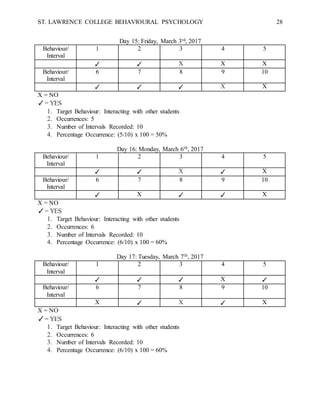
4. Percentage Occurrence: (5/10) x 100 = 50%
Day 16: Monday, March 6th, 2017
Behaviour/
Interval
1 2 3 4 5
✓ ✓ X ✓ X
Behaviour/
Interval
6 7 8 9 10
✓ X ✓ ✓ X
X = NO
✓= YES
1. Target Behaviour: Interacting with other students
2. Occurrences: 6
3. Number of Intervals Recorded: 10
4. Percentage Occurrence: (6/10) x 100 = 60%
Day 17: Tuesday, March 7th, 2017
Behaviour/
Interval
1 2 3 4 5
✓ ✓ ✓ X ✓
Behaviour/
Interval
6 7 8 9 10
X ✓ X ✓ X
X = NO
✓= YES
1. Target Behaviour: Interacting with other students
2. Occurrences: 6
3. Number of Intervals Recorded: 10
4. Percentage Occurrence: (6/10) x 100 = 60%
ST. LAWRENCE COLLEGE BEHAVIOURAL PSYCHOLOGY 29
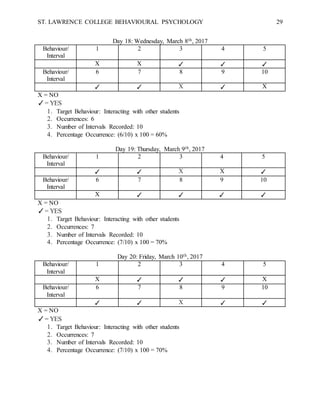
Day 18: Wednesday, March 8th, 2017
Behaviour/
Interval
1 2 3 4 5
X X ✓ ✓ ✓
Behaviour/
Interval
6 7 8 9 10
✓ ✓ X ✓ X
X = NO
✓= YES
1. Target Behaviour: Interacting with other students
2. Occurrences: 6
3. Number of Intervals Recorded: 10
4. Percentage Occurrence: (6/10) x 100 = 60%
Day 19: Thursday, March 9th, 2017
Behaviour/
Interval
1 2 3 4 5
✓ ✓ X X ✓
Behaviour/
Interval
6 7 8 9 10
X ✓ ✓ ✓ ✓
X = NO
✓= YES
1. Target Behaviour: Interacting with other students
2. Occurrences: 7
3. Number of Intervals Recorded: 10
4. Percentage Occurrence: (7/10) x 100 = 70%
Day 20: Friday, March 10th, 2017
Behaviour/
Interval
1 2 3 4 5
X ✓ ✓ ✓ X
Behaviour/
Interval
6 7 8 9 10
✓ ✓ X ✓ ✓
X = NO
✓= YES
1. Target Behaviour: Interacting with other students
2. Occurrences: 7
3. Number of Intervals Recorded: 10
4. Percentage Occurrence: (7/10) x 100 = 70%
ST. LAWRENCE COLLEGE BEHAVIOURAL PSYCHOLOGY 30
Number of occurrences over in the intervention: 68
Percentage of occurrences overall in the intervention: 68 [occurrences] / 150 [intervals] X 100 =
45.33%
Percentage of Improvement in Socially Interactive Behaviour:
[(Treatment Level – Baseline Level) / Baseline Level] X 100
[(45.33 – 18.00) / 18.00] X 100 = 151.83%
ST. LAWRENCE COLLEGE BEHAVIOURAL PSYCHOLOGY 31
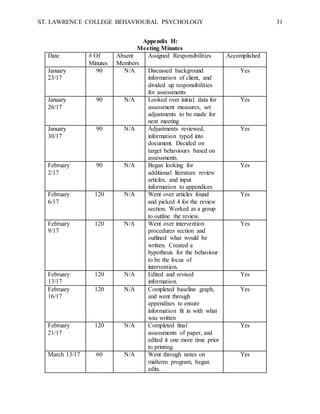
Appendix H:
Meeting Minutes
Date # Of
Minutes
Absent
Members
Assigned Responsibilities Accomplished
January
23/17
90 N/A Discussed background
information of client, and
divided up responsibilities
for assessments
Yes
January
26/17
90 N/A Looked over initial data for
assessment measures, set
adjustments to be made for
next meeting
Yes
January
30/17
90 N/A Adjustments reviewed,
information typed into
document. Decided on
target behaviours based on
assessments.
Yes
February
2/17
90 N/A Began looking for
additional literature review
articles, and input
information to appendices
Yes
February
6/17
120 N/A Went over articles found
and picked 4 for the review
section. Worked as a group
to outline the review.
Yes
February
9/17
120 N/A Went over intervention
procedures section and
outlined what would be
written. Created a
hypothesis for the behaviour
to be the focus of
intervention.
Yes
February
13/17
120 N/A Edited and revised
information.
Yes
February
16/17
120 N/A Completed baseline graph,
and went through
appendixes to ensure
information fit in with what
was written
Yes
February
21/17
120 N/A Completed final
assessments of paper, and
edited it one more time prior
to printing.
Yes
March 13/17 60 N/A Went through notes on
midterm program, began
edits.
Yes
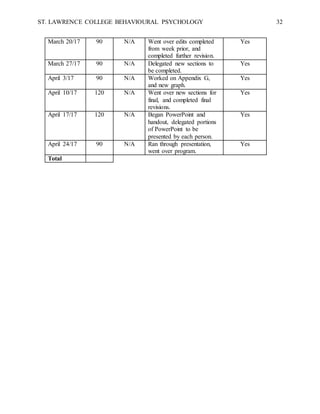
ST. LAWRENCE COLLEGE BEHAVIOURAL PSYCHOLOGY 32
March 20/17 90 N/A Went over edits completed
from week prior, and
completed further revision.
Yes
March 27/17 90 N/A Delegated new sections to
be completed.
Yes
April 3/17 90 N/A Worked on Appendix G,
and new graph.
Yes
April 10/17 120 N/A Went over new sections for
final, and completed final
revisions.
Yes
April 17/17 120 N/A Began PowerPoint and
handout, delegated portions
of PowerPoint to be
presented by each person.
Yes
April 24/17 90 N/A Ran through presentation,
went over program.
Yes
Total

ABA Behavioural Intervention Program

  • 1.
    ST. LAWRENCE COLLEGE:BEHAVIOURAL PSYCHOLOGY Behavioural Intervention Program Implementing Positive Reinforcement in the Treatment of Socially Withdrawn Behaviour in a 11-Year-Old Boy During Group Work Client: Charlie Thompson* Setting: Regular classroom in a Middle School Field Supervisor: Larissa Collins* Students: Team #10 Bailey Rose Isabella McLean Taylor Walters Danielle Elliott Course: PSYC 6 - 102 College Supervisor: Gary Bernfeld Date: February 24th, 2017 CAUTION While this report can be used informally to guide clinical work, it is not a formal psychological report, and was completed as part of a supervised student placement. It should not be placed on any official file, nor would it be appropriate to discuss its findings in official agency reports. * For reasons of confidentiality all names used in this report are fictional. Honours Bachelor of Behavioural Psychology
  • 2.
    ST. LAWRENCE COLLEGE:BEHAVIOURAL PSYCHOLOGY ii Table of Contents 1. Reasonfor Referral ...............................................................................1 2. Background Information ......................................................................1 3. Assessment Procedures Used ...............................................................1 4. Target Behaviours .................................................................................1 5. Assessment Procedures and Results ....................................................2 6. Hypotheses .............................................................................................4 7. Goals and Objectives ............................................................................4 8. Literature Review .................................................................................4 9. Intervention Procedures.........................................................................5 10. References ..............................................................................................6 11. Appendices ............................................................................................. A. Modified Functional Assessment Interview...................................7 B. Functional Assessment Checklist for Teachers and Staff ............12 C. Naturalistic Observation (ABC) of Charlie at School...................14 D. Data on Charlie’s Social Interactions During Baseline ................15 E. Children’s Reinforcement Survey ..................................................17 F. Mediator Instructions.......................................................................18 G. Data on Charlie’s Social Interactions During Treatment.............21 H. Meeting Minutes...............................................................................22
  • 3.
    ST. LAWRENCE COLLEGE:BEHAVIOURAL PSYCHOLOGY 3 Behavioural Intervention Program Client Name: Charlie Smith Date: February 13th, 2017 Counsellor: Larissa Collins Program: Use of positive reinforcement for the increase in interactions with peers during group work. Reasonfor Referral Charlie’s sixth-grade teacher, Ms. Potter, referred Charlie to a behaviour analyst. Charlie was referred to receive treatment due to his lack of social interaction with peers during group work and playtime. Charlie exhibits non-verbal signs of listening, but his verbal participation requires improvement. The lack of verbal participation often resulted in incomplete group participation marks, and for peers to bother Charlie due to his lack of participation. Therefore, the goal of the intervention was to increase Charlie’s positive social interactions with peers, enabling him to become more involved in the school community. Background Information Charlie is an 11-year-old boy who lives in Ontario with his mother, father, and 3-year-old sister, Marie. Charlie’s family move frequently due to his father’s career in the military. Charlie attends a regular middle school in Ontario and is in the sixth grade. He has no developmental, physical, or biologically based concerns. The socially withdrawn behaviour is displayed at all times during the school day. There was difficulty when trying to reach Charlie’s previous teachers due to the frequent moves, but those who were contacted disclosed that he was socially withdrawn in their classrooms as well. Charlie has received no other previous behavioural treatment or medication, and is not currently receiving any medication. His teacher is willing to collaborate with the behaviour analyst in the design and implementation of an appropriate behavioural treatment for Charlie. Assessment Procedures Used Functional Assessment: 1. Modified Functional Assessment Interview 2. Naturalistic Observation (ABC) at School 3. Functional Assessment Checklist for Teachers and Staff Baseline Assessment: 4. Frequency Recording of Social Interactions with Peers Target Behaviour(s) Interaction with Peers (Accelerate): Interaction with peers is observed and recorded when Charlie interacts with his peers during his language arts period. Charlie is to be considered interacting with his peers when he is interacting with other students during group work. Charlie will not be recorded when he is working on independent schoolwork and during classes other than language arts. Charlie is to be considered not interacting with peers when he is alone, quiet while around other students, and not verbally participating during group activities during his language arts class.
  • 4.
    ST. LAWRENCE COLLEGE:BEHAVIOURAL PSYCHOLOGY 4 Rationale: Interacting with others is an important skill for Charlie to learn so he can better carry conversations with others at school and during activities outside of school. Charlie was not interacting with others during assigned group work, which has lead to a decrease in friends, social skills, confidence, and increased his anti-social behaviour. It is important for Charlie to learn how to interact with others not only to gain confidence and friends, but also to increase social skills for when he will need to use them during his future endeavours. Assessment Procedures and Results Appendixes Functional Assessment 1. Modified Functional Assessment Interview A Modified Functional Assessment Interview (Modified Functional Assessment Interview; Bernfeld (2012); Appendix A) was done with Ms Potter, Charlie’s teacher, on February 8th, 2017. According to Ms Potter, Charlie’s most common behaviours were not completing his work, and exhibiting withdrawn behaviour during group work. The behaviours were said to emerge constantly throughout the school day, especially during group work periods. The consequences to Charlie’s behaviours were teacher attention, and being removed from group work scenarios to complete his work independently; escape is the most probable factor maintaining Charlie’s behaviour. 2. Functional Assessment Checklist for Teacher and Staff Ms Potter, Charlie’s teacher, was interviewed on February 10th, 2017 using the Functional Assessment Checklist for Teachers and Staff (FACTS; March et al, 2000; Appendix B). The most frequent behaviours noted in the FACTS interview were incomplete work, off task, and withdrawn behaviour. These behaviours occurred most frequently during group work situations, and playtime. The consequences were most often teacher attention, and isolation from the group to complete work independently. According to the FACTS interview, it appears as if the primary function maintaining Charlie’s withdrawn behaviour is escape. 3. Naturalistic Observation (ABC) at School Charlie’s socially withdrawn behaviour was recorded using an ABC chart throughout the school day on February 9th, 2017 (Appendix C). According to the data, Charlie’s behaviour occurred most often during group work periods, and playtime. He engaged in behaviours such as not talking to peers, not completing his work, and removing himself from situations. Engaging in these behaviours gained attention of his teacher, and escape of group work after repeated prompts to them. Throughout the day, the consequences for his withdrawn behaviour was escape. According to the data, the most likely function of Charlie’s withdrawn behaviour may be escape. Baseline Assessment 4. Data on Charlie’s Social Interactions During Baseline Charlie’s social interactions were observed using frequency recording (Appendix D). The behaviour was observed over 5 school days, during language arts class. Each interval was 2 minutes long, and data was collected during each 20-minute group work session, of a 60-minute class period. The total observation time came to 20 minutes, over 10 intervals during each daily
  • 5.
    ST. LAWRENCE COLLEGE:BEHAVIOURAL PSYCHOLOGY 5 session. During baseline, Charlie exhibited socially interactive behaviour for an average of 18.00% of the group work time (see Figure 1).
  • 6.
    ST. LAWRENCE COLLEGE:BEHAVIOURAL PSYCHOLOGY 6 Hypothesis Review of the assessment results show that when group work did not allow for individual input, Charlie did not participate in discussion of the work, and exhibited socially withdrawn behaviour. The main consequence for Charlie’s behaviour was escape from group work. Given that Charlie’s socially withdrawn behaviour occurs more in-group situations, than isolated situations, he may exhibit some behavioural skills deficits in peer communication. He may require more reinforcers to increase his positive social interactions. If Charlie’s behaviour is maintained by escape, then praise and set alone time should increase the occurrence of his involvement in peer interactions and group work. Goal #1 and Objectives Increased peer interactions (accelerate) Charlie will interact with his peers during group work for 65% of the time during the language arts period. Objectives Between 8:00 am - 9:00 am, during Language Arts, Charlie will exhibit peer interactions during group work for: 1. 25% of the work period 2. 35% of the work period 3. 45% of the work period 4. 55% of the work period 5. 65% of the work period Each of the above objectives will be achieved when Charlie has reached the specified criterion for 3 consecutive days. Literature Review All behaviors are followed by certain consequence, which makes reinforcement one of humankinds’ naturally occurring phenomena (Maag, 2001). When the consequence of behaviour acts as a reinforcer for that behaviour, the behaviour increases, which has been demonstrated in studies from all over the world (Maag, 2001). If a child is exhibiting socially withdrawn behaviours, they tend to be noticeably shy and demonstrate a preference for secluding themselves from others (Coplan et al., 2013). This response to social interactions results in difficulties making friends and developing relationships with peers (Coplan et al., 2013). When it comes to socially withdrawn behaviours, a high correlation of effectiveness and acceptability has been found between positive reinforcement and social skills training (Miller, DuPaul, & Lutz, 2002). Social skills training involves the child initiating social interactions, responding to social cues from others, and maintaining conversations (Miller, DuPaul, & Lutz, 2002). More research has shown that multiple household moves are associated with increased emotional/behavioural problems in school, as well as lower levels of social competence with peers (Hoglund & Leadbeater, 2004). The goal is to relive these maladaptive behaviours and turn them into appropriate behaviours through positive reinforcement (Snow & Brooks, 2004). Studies have shown that if the desired behaviour is followed by a reward, the behaviour will increase in frequency (Snow & Brooks, 2004). The same is true if positive reinforcement is taken away; the behaviour will decrease in frequency (Snow & Brooks, 2004). It is also important to put a
  • 7.
    ST. LAWRENCE COLLEGE:BEHAVIOURAL PSYCHOLOGY 7 reinforcement system in place to promote efficient levels of responding. According to Luczynski and Hanley (2014), children prefer contingent reinforcement (CR) to alternate types of reinforcement. There was also the highest success rate and satisfaction in clients when fixed-ratio reinforcement was used to obtain social interactions (Luczynski & Hanley, 2014). Thus, the use of positive reinforcement should increase Charlie’s instances of socially interactive behaviour. Intervention Procedures Positive Reinforcement A positive reinforcement strategy was put into action in order to increase Charlie’s positive social interactions. A fixed time (FT2) schedule of reinforcement was utilized to increase social interactions. A FT reinforcement schedule is more effective in a classroom situation as the schedule does not require the mediator to be constantly monitoring the child. Charlie completed the Children’s Reinforcement Survey (Cautella & Brion-Meisels; Appendix E) to help pinpoint possible reinforcers. Items that Charlie seemed to find most enjoyable included playing computer games, reading, and going to the library. Other reinforcers that he enjoys are candy, and milk, neither of which was used due to the associated difficulties in the delivery, and fading out. He will also receive gestural reinforcement, through smiling and nodding, or verbal reinforcements of praise when he is interacting with peers. Prompts If Charlie refuses to interact with peers, he was given a gestural prompt to return to working as a team. If he continued to be withdrawn, he was then verbally prompted to become more involved. A counsellor began implementing the intervention during the language arts, and science periods on Monday, February 6th, 2017. Data were collected during classes from Monday to Friday between 8:00 am – 9:00 am for a period of 4 weeks. Charlie was initially reinforced for his socially interactive behaviour on a FT2 schedule. The data were collected on a chart and, each time the teacher looked at Charlie and he was interacting with his peers, an “X” was marked on the data sheet and reinforcement was given. See Appendix F for Mediator Instructions. Intervention Results Charlie’s positive reinforcement intervention was implemented over a 15-day period. This intervention was effective in increasing Charlie’s socially interactive behaviour. During baseline, Charlie’s socially interactive behaviour averaged 18.00%. However, during interventions his socially interactive behaviour averaged 45.33% (Appendix D), which represents an increase of 151.83%. Figure 1 represents a graph of Charlie’s socially interactive behaviour during the baseline and treatment phases. Each phase of the intervention portion of the graph reflects the reinforcement schedule used in that phase and represents the amount of time it took Charlie to reach each objective.
  • 8.
    ST. LAWRENCE COLLEGE:BEHAVIOURAL PSYCHOLOGY 8 Figure 1. The percentage of social interactions during baseline and treatment. Regarding the latter, each phase of the intervention portion of the graph represents the reinforcement schedule used in that phase and represents the amount of time it took Charlie to reach each objective.
  • 9.
    ST. LAWRENCE COLLEGE:BEHAVIOURAL PSYCHOLOGY 9 Program Changes The initial plan for the intervention was to reinforce Charlie using a reinforcer that he had indicated was the most desirable from then Children’s Reinforcement Survey (Appendix E) However, in order to avoid satiation to the reinforcer, it was decided to use a combination of three different reinforcers that could easily be faded out. This made it possible to keep Charlie as interested as possible in achieving his objective, while slowly fading out the undesirable behaviour. Maintenance and Generalization Since the program was only being implemented in Language Arts, in order to encourage generalization, the program would need to be used in Charlie’s other classes. This will be easier to achieve since there are few teachers that Charlie interacts with throughout the day. The verbal and gestural prompts given to Charlie when he exhibits socially interactive behaviour continued to be used, as they are natural prompts that use very little effort from the mediator. Charlie also continued to receive social reinforcement, such as praise, while other reinforcers were faded out from the initial FT2 schedule to a more natural scheduler using a variable time (VT) schedule of reinforcement. Specifically, after Charlie achieved his first objective, his reinforcement schedule was shifted from FT2 to FT3. After reaching each subsequent objective, his schedule shifted to the following: FT4, VT3, and finally to VT6. Summary and Recommendations This positive reinforcement intervention was effective in increasing Charlie’s socially interactive behaviour. While during baseline, his socially interactive behaviour averaged 18.00%, it averaged 45.33% during the entire intervention, which is an increase of 151.83%. Thus, Charlie met all goals and objectives of the program. After Charlie had demonstrated mastery of an objective for a 3-day period, the criteria changed, encouraging Charlie’s progress to continually increase. Charlie exhibited no skill deficits in verbal participation, as hypothesized; he simply was not exhibiting the behaviour due to his desire to escape the situation. Reinforcers that Charlie previously indicated as desirable were delivered when he engaged in socially interactive behaviour. These reinforcers, including social praise, were reinforcing for Charlie and encouraged him to increase his social interactions to meet each objective. Gestural and verbal prompts were used when Charlie became off-task, increasing his understanding of the difference between being socially withdrawn, and socially interactive. The reinforcers in the program were not sufficiently faded to natural reinforcers (e.g. social praise) as would have been preferred. Instructions were included for the mediator detailing the process in which the added reinforcers would be faded out and social praise could be used as the primary reinforcer to maintain Charlie’s socially interactive behaviour. As noted earlier, it is recommended that the procedure be used in other classes, and settings to encourage further generalization.
  • 10.
    ST. LAWRENCE COLLEGE:BEHAVIOURAL PSYCHOLOGY 10 References Bernfeld, G. A. (2012) Modified Functional Assessment Interview. Unpublished measure. Community Services Department, St. Lawrence College, Kingston, Canada. Cautella, J. R., & Brion-Meisels, L. (1979). A children’s reinforcement survey schedule. Psychological Reports, 44, 327-338, Table 1. Coplan, R. J., Rose-Krasnor, L., Weeks, M., Kingsbury, A., Kingsbury, M., & Bullock, A. (2013). Alone is a crowd: Social motivations, social withdrawal, and socioemotional functioning in later childhood. Developmental Psychology, 49(5), 861-875. doi: 10.1037/a0028861 Hoglund, W. L., & Leadbeater, B. J. (2004). The effects of family, school, and classroom ecologies on changes in children ‘s social competence and emotional and behavioural problems in first grade. Developmental Psychology, 40(4), 533-544. doi: 10.1037/0012- 1649.40.4.533 Luczynski, K. C., & Hanley, G. P. (2014). How should periods without social interaction be scheduled? Children’s preference for practical schedules of positive reinforcement. Journal of Applied Behavior Analysis. 47(3), 500-522. doi: 10.1002/jaba.140 Maag, J. W. (2001). Rewarded by punishment: Reflections on the disuse of positive reinforcement in schools. The Council for Exceptional Children. 67(2), 173-186. Retrieved from: http://amaesd.org/media/forms/Behavior-Toolbox/7-Team- Tools/Reinforcement%20Paper.pdf March, R., Lewis-Palmer, L., Brown, D., Crone, D., Todd, A. W., & Carr, E. (2000). Functional assessment checklist for teachers and staff (FACTS). Educational and Community Supports. University of Oregon, Eugene, Oregon. Miller, D. N., DuPaul, G. J., Lutz, J. G. (2002). School-based psychological interventions for childhood depression: Acceptability of treatments among school psychologists. School Psychology Quarterly, 17(1), 79-99. doi: 10.1521/scpq.12.1.78.19903 Snow. D. L., & Brooks, R. B. (1974). Behavior modification techniques in the school setting. Journal of School Health, 44(4), 198-205. doi: 10.1111/j.1746-1561.1974.tb05221.x Word Count: 2480
  • 11.
    ST. LAWRENCE COLLEGE:BEHAVIOURAL PSYCHOLOGY 11 Appendix A: Modified Functional Assessment Interview Modified Functional Assessment Interview Section A: Describing the behaviour What does the behaviour look like when it is happening? I. Frequency How often does it occur: daily – weekly – monthly. II. Duration How long does it last. III. Intensity How damaging or destructive is the Behaviour(s)? Describe the behaviour I. Frequency II. Duration III. Intensity Not socializing with peers during group work During each group work period, on average 2 a day Group-work lasts for 25-30 minutes. On average, he will not speak for 90% of the group work period. This behavior could be considered mildly destructive as it is causing him to be isolated by peers, and some of his peers have begun to tease him for his lack of communication.
  • 12.
    ST. LAWRENCE COLLEGE:BEHAVIOURAL PSYCHOLOGY 12 Section B: Describe Setting Events that Predict the Problem Behaviour 1. What Medications is the person currently taking and how may these affect their behaviour? Charlie is currently not taking any prescribed medications for his socially withdrawn behavior. 2. Are there any Medical or Physical Conditions that the person experiences that may affect their behaviour? (For example: allergies, seizures, problems related to menstruation...) He does not experience any medical or physical conditions that could affect his behavior. 3. Describe any Sleep Patterns or Eating Routines/Diets of the person and the extent to which these may affect their behaviour. Not much is known about Charlie’s sleep schedule, but he eats a balanced diet. These would not have an effect on his socially withdrawn behavior in class during assigned group work. 4. Briefly list the person’s typical daily schedule of activities. BEDTIME: N/A. 5. To what extent are the activities on the daily schedule predictable for the person with regard to what will be happening, when it will occur, with whom and for how long? During the school day, the activities on the daily schedule are predictable for Charlie. Charlie has the same schedule during school hours, so the classes, their times, and how long they will last for are predicable for Charlie. Enjoys Problems Time Description Enjoys Problems Time Description Yes 8:00 am Language Arts Yes 12:50 pm Recess Yes 9:00 am Math Yes 1:20 pm Science 10:00 am Recess & Snack Yes 2:20 pm Art and Snack time Yes 10:20 am History Yes 2:40 pm Gym 11:20 am French Yes 3:30 pm School Ends Yes 12:20 pm Lunch
  • 13.
    ST. LAWRENCE COLLEGE:BEHAVIOURAL PSYCHOLOGY 13 6. Do they have the opportunity during the day to make choices about their activities? Describe: During school hours, Charlie has minimal choices to his activities. During lunch and recess, he has free choice to do what he pleases. During class, he does not have a choice about his activities. 7. Does the person typically seem bothered in situations that are more crowded and noisy? Describe: Charlie does not feel uncomfortable when he is crowds or noisy areas. He is uncomfortable when he needs to interact with others. 8. What is the pattern of staffing support? The teacher is always in the room to supervise the students; she does not have any EA’s or other forms of support during the school day. 9. Does the behaviour occur more or less when an activity is being done alone? Does not occur One person providing support Occurs less often Group setting Occurs frequently Describe: The behaviour occurs most often when Charlie is in a group setting, less often when one person is providing support for him, and does not occur when schoolwork is being done alone. Section C: Describe immediate antecedent events that predict when the behaviour is likely and not likely to occur. 1. Time of Day: When are the Behaviours most and least likely to happen? Most Likely: The behaviour is most likely to occur during assigned group work time during science, language arts. Least Likely: The behaviour is least likely to occur during math, art, history, lunch and recess time when the opportunities to be isolated, or work individually increase.
  • 14.
    ST. LAWRENCE COLLEGE:BEHAVIOURAL PSYCHOLOGY 14 2. Settings: Where are the Behaviours most and least likely to happen? Most Likely: When Charlie is at school in group situation Least Likely: When Charlie is alone, or working individually. 3. Social Contact: With whom are the Behaviours most and least likely to happen? Most Likely: The behaviour is most likely to occur in the presence of his classmates. Least Likely: The behaviour is least likely to occur when he is working individually. 4. Activity: What activities are most and least likely to produce the Behaviour? Most Likely: When he is told by his teacher to work in a group to complete class work. Least Likely: When he is working on assignments individually. 5. Are there any other situations or events during which this behaviour is likely to occur that is not listed above? If so, please describe each situation or event. N/a Section D: Describing the Consequences for the Behaviour Situation Describe the situation. What does he/she get? Does the person receive a favored object, activity, person’s attention, physical sensation, etc. by performing the behaviour? (And/or) What does he/she avoid? Does he/she avoid doing a disliked activity, object, person, physical sensation, etc. by performing the behaviour? Charlie is placed in a group of his peers to complete assigned work during science, and language arts. He is able to be isolated and work individually due to the teacher often removing him from the situation to complete the work on his own. By performing this behavior, Charlie gets to escape social interacting with others.
  • 15.
    ST. LAWRENCE COLLEGE:BEHAVIOURAL PSYCHOLOGY 15 NOT TO BE USED IN THE INTERVIEW OF MEDIATORS Section E: Summary Sheet For The Modified Functional Assessment Interview For Mediators Directions: Summarize the information you have gathered in the previous pages of the Modified Functional Assessment Interview. You will do this by inserting the information in each corresponding section. Rationale: The completion of this form will give the correspondent a visual layout for what the behaviour looks like, what triggers/predicts it, and what maintains it or what makes the child/client want to perform it. This is what my child’s/client’s behaviour looks like: Summarize/list the information gathered in Section A of the Modified Functional Assessment I Interview This is what triggers/predicts the occurrence of the behaviour: Summarize/list the information gathered in Section C of the Modified Functional Assessment Interview This is why my child/client continues to perform the behaviour: Summarize/list the information gathered in Section D of the Modified Functional Assessment Interview. When Charlie is asked by his teacher to work in a group with his classmate, he will sit silently by himself and not interact with his peers. He will not talk to his classmates, voice his opinion, or help with the assigned class work. During science, and language arts class periods when Charlie is most likely to be asked to interact with his peers. Charlie continues to do this behaviour because he is able to avoid interacting with his peers, which is what makes him uncomfortable.
  • 16.
    ST. LAWRENCE COLLEGE:BEHAVIOURAL PSYCHOLOGY 16 Appendix B: Functional Assessment Checklist for Teachers and Staff Functional Assessment Checklist for Teachers and Staff (FACTS-Part A) Student/ Grade: Charlie, Grade 6 Date: February 10th, 2017 Interviewer: Larissa Collins Respondent(s):Ms. Potter Student Profile: Please identify at least three strengths orcontributions the student brings to school. Charlie is very intelligent, a strong reader, and quite positive. Problem Behavior(s): Identify problem behaviors ___ Tardy ___ Fight/physicalAggression ___ Disruptive ___ Theft ___ Unresponsive ___ Inappropriate Language ___ Insubordination ___ Vandalism _X_ Withdrawn ___ Verbal Harassment _X_ Worknot done ___ Other________________ ___ Verbally Inappropriate ___ Self-injury Describe problembehavior: Withdrawn,worknot completed,off-task Identifying Routines: Where, When and With Whom Problem Behaviors are Most Likely. Schedule (Times) Activity Likelihood of Problem Behavior Specific Problem Behavior 8:00 am - 9:00 am Language Arts Low High 1 2 3 4 5 6X Withdrawn, work not done 9:00 am - 10:00 am Math 1 2X 3 4 5 6 10:00 am - 10:20 am Brief snack& Recess time 1X 2 3 4 5 6 10:20 am - 11:20 am History 1X 2 3 4 5 6 11:20 am - 12:20 pm French 1 2X 3 4 5 6 12:20 pm - 12:50 pm Lunch 1 2 3X 4 5 6 12:50 pm - 1:20 pm Recess 1X 2 3 4 5 6 1:20 pm - 2:20 pm Science 1 2 3 4 5X 6 Withdrawn, work not done 2:20 pm - 2:40 pm Art and Snack time 1X 2 3 4 5 6 2:40 pm - 3:30 pm Gym 1 2 3X 4 5 6 Withdrawn, does not participate 3:30 pm - School Ends 1X 2 3 4 5 6 Select 1-3 Routines for further assessment: Select routines based on (a) similarity of activities (conditions) with ratings of 4, 5 or 6 and (b) similarity of problem behavior(s). Complete the FACTS-Part B for each routine identified.
  • 17.
    ST. LAWRENCE COLLEGE:BEHAVIOURAL PSYCHOLOGY 17 Functional Assessment Checklist for Teachers & Staff (FACTS-Part B) Student/ Grade: Charlie, Grade 6 Date: February 10th, 2017 Interviewer: Larissa Collins Respondent(s): Ms. Potter Routine/Activities/Context: Which routine(only one) from the FACTS-Part A is assessed? Routine/Activities/Context Problem Behavior(s) Group work time Withdrawn, work not completed Provide more detail about the problem behavior(s): What does the problembehavior(s) look like? Not interacting with peers, or completing assigned work. How often does the problembehavior(s) occur? Daily, in several classes. How long does the problem behavior(s) last when it does occur? Lasts for the majority of group work time. What is the intensity/level of danger of the problem behavior(s)? Intensity = High, Danger = Low What are the events that predict when the problem behavior(s) will occur? (Predictors) Related Issues (setting events) Environmental Features ___ Illness Other:_________________ ___ Drug use ______________________ X Negative social ______________________ ___ Conflict at home ______________________ ___ Academic failure ______________________ ___ Reprimand/correction X Structured activity ___ Physical demands ___ Unstructured time ___ Socially isolated ___ Tasks too boring X With peers ___ Activity too long ___ Other ___ Tasks too difficult What consequences appear most likely to maintain the problem behavior(s)? Things that are Obtained Things Avoided or Escaped From X Adult attention Other: ________________ ___ Peer attention ______________________ X Preferred activity ______________________ ___ Money/things ______________________ ___ Hard tasks Other: Completing tasks, peer ___ Reprimands attention/interaction ___ Peer negatives ________________________ ___ Physical effort ________________________ ___ Adult attention ________________________ SUMMARY OF BEHAVIOR Setting Events & Predictors Problem Behavior(s) Maintaining Consequence(s) Negative social, with peers, and structured activity Withdrawn, and incomplete work Adult attention,and escape from work and peer interaction, as well as access to preferred activity. How confident are you that the Summary of Behavior is accurate? Not very confident Very Confident 1 2 3 4 5X 6 What current efforts have been used to control the problem behavior? Strategies for preventing problem behavior Strategies for responding to problem behavior X Schedule change Other: ________________ ___ Seating change ______________________ X Curriculum change ______________________ X Reprimand Other: ___________________ ___ Office referral _________________________ ___ Detention _________________________ March, Horner, Lewis-Palmer, Brown , Crone, Todd, & Carr (2000) 4/24/00
  • 18.
    ST. LAWRENCE COLLEGE:BEHAVIOURAL PSYCHOLOGY 18 Appendix C: Naturalistic Observation (ABC) of Charlie at School Time Antecedent Behavior Consequence 8:15 am Teacher asks students to get into their groups for group work Charlie refuses to participate Teacher prompts him 8:20 am Teacher prompts Charlie to speak to the group Charlie remains silent Teacher goes to the groups and try’s to prompt them to include Charlie 8:25 am Peers trying to involve him Charlie says nothing, and asks teacher if he can work alone Teacher attempts to work with the group and Charlie to complete assignment 8:35 am Teacher working with group Charlie asks again to work alone Teacher allows it 8:45 am Teacher asks students to take turns practicing reading in groups Charlie asks to go to the washroom when it is almost his turn to read Charlie misses his turn to read to his group
  • 19.
    ST. LAWRENCE COLLEGE:BEHAVIOURAL PSYCHOLOGY 19 Appendix D: Data on Charlie’s Social Interactions During Baseline Name: Charlie Day 1: Monday, February 13th, 2017 Observer: Larissa Collins Setting: Language Arts Class Time Started: 8:00 am Time Ended: 9:00 am Interval Length: 20 minutes. Each interval was 2 minutes long, and data were collected during each 20-minute group work session, of a 60-minute class period. The total observation time came to 20 minutes, over 10 intervals during each daily session. Behaviour/ Interval 1 2 3 4 5 X X ✓ X X Behaviour/ Interval 6 7 8 9 10 X X X ✓ X X = NO ✓= YES 1. Target Behaviour: Interacting with other students 2. Occurrences: 2 3. Number of Intervals Recorded: 10 4. Percentage Occurrence: (2/10) x 100 = 20.00% Day 2: Tuesday, February 14th, 2017 Behaviour/ Interval 1 2 3 4 5 X X X X X Behaviour/ Interval 6 7 8 9 10 X X X X ✓ X = NO ✓= YES 1. Target Behaviour: Interacting with other students 2. Occurrences: 1 3. Number of Intervals Recorded: 10 4. Percentage Occurrence: (1/10) x 100 = 10.00% Day 3: Wednesday, February 15th, 2017 Behaviour/ Interval 1 2 3 4 5 ✓ X X X X Behaviour/ Interval 6 7 8 9 10 X X X X X
  • 20.
    ST. LAWRENCE COLLEGE:BEHAVIOURAL PSYCHOLOGY 20 X = NO ✓= YES 1. Target Behaviour: Interacting with other students 2. Occurrences: 1 3. Number of Intervals Recorded: 10 4. Percentage Occurrence: (1/10) x 100 = 10.00% Day 4: Thursday, February 16th, 2017 Behaviour/ Interval 1 2 3 4 5 ✓ X X X X Behaviour/ Interval 6 7 8 9 10 ✓ X X X ✓ X = NO ✓= YES 1. Target Behaviour: Interacting with other students 2. Occurrences: 3 3. Number of Intervals Recorded: 10 4. Percentage Occurrence: (3/10) x 100 = 30.00% Day 5: Friday, February 17th, 2017 Behaviour/ Interval 1 2 3 4 5 X X X X X Behaviour/ Interval 6 7 8 9 10 ✓ X X X ✓ X = NO ✓= YES 1. Target Behaviour: Interacting with other students 2. Occurrences: 2 3. Number of Intervals Recorded: 10 4. Percentage Occurrence: (2/10) x 100 = 20.00% Number of occurrences overall in baseline: 9 Percentage of occurrences overall in baseline: (9/50) x 100 = 18.00%
  • 21.
    ST. LAWRENCE COLLEGE:BEHAVIOURAL PSYCHOLOGY 21 Appendix E: Children’s Reinforcement Survey CHILDRENS REINFORCEMENT SURVEY SCHEDULE Name: Charlie Thompson Date: January 30th, 2017 Age: 11 Sex: Male School: Regular Middle School Grade: 6 This is a list of many different things or activities. Explain how much you like each choice by making an X in the appropriate box. If you dislike the choice, make an X in the box under Dislike: Dislike Like Like Very Much X If you like the choice, make an X in the box under Like: Dislike Like Like Very Much X If the choice is something that you like very, very much, make an X in the box under Like Very Much: Dislike Like Like Very Much X Choices Dislike Like Like Very Much 1. Do you like candy? X 2. Do you like raisins? X 3. Do you like milk? X 4. Do you like toy cars? X 5. Do you like colouring? X 6. Do you like stickers? X 7. Do you like playing computer games? X 8. Do you like reading? X 9. Do you like playing on the swings? X 10. Do you like playing kickball? X 11. Do you like being first in line? X 12. Do you like being the teacher’s helper? X 13. Do you like going to the library? X 14. Do you like people telling you that you have done a good job? X 15. Do you like extra playtime? X 16. Do you like teaching things to other people? X
  • 22.
    ST. LAWRENCE COLLEGE:BEHAVIOURAL PSYCHOLOGY 22 Appendix F: Mediator Instructions Title: Increasing Positive Social Interactions Client Name: Charlie Thompson Date of Birth: July 9, 2004 Date of Report: February 24th, 2017 Goal Charlie will exhibit socially interactive behaviour for 60% of group work time in Language Arts. Target Skill/Behaviour(s) Socially Involved (Accelerate) Operational Definition(s) Socially interactive behaviour is observed and recorded when Charlie works in a group setting. Charlie is socially interactive when he talks with other students and gives ideas about assigned work. Charlie can only exhibit socially withdrawn behaviour if another member of the group is talking, at the minimum he must be engaged in the conversation that is happening. Charlie will be considered socially withdrawn if he is slumped in his chair, not making eye contact with other students, not providing ideas or opinions about the assigned group work, or trying to ask the teacher if he can do the work alone. Objective(s) Between 8:00 am - 9:00 am, during Language Arts, Charlie will exhibit peer interactions during group work for: 1. 25% of the work period 2. 35% of the work period 3. 45% of the work period 4. 55% of the work period 5. 65% of the work period Each of the above objectives will be achieved when Charlie has reached the specified criterion for 2 consecutive days. Intervention Schedule Location of Intervention Mediators Counselor Anytime the behaviour occurs during the Language Arts group work period. The group work period is 20 minutes between the times of 8:00 am – 9:00 am. The intervention will take place in the classroom during language arts group work time.
  • 23.
    ST. LAWRENCE COLLEGE:BEHAVIOURAL PSYCHOLOGY 23 Materials Data Collection Method The counselor is to observe Charlie once every three minutes in a thirty-minute span. If Charlie is interacting with his peers the counselor is to put an “X” on a chart. If Charlie is not interacting with his peers the counselor is to put an “O” on the chart. At the end of the day, each occurrence of socially interactive behaviour is added up and divided by the number of intervals (10) then multiplied by 100. This percentage amount of interactions is then graphed. Materials needed for the intervention consist of assigned group work, tools for Charlie to complete assigned work, a stopwatch/timer, a datasheet, and writing utensils for the mediator(s)
  • 24.
    ST. LAWRENCE COLLEGE:BEHAVIOURAL PSYCHOLOGY 24 Procedure Ensure that you have Charlie’s assigned work, and a group for him to work with. As well as the necessary materials you will need to implement the procedure prior to beginning the session. Charlie is to be given a gestural prompt to interact with the group. If the gestural prompt does not work Charlie is to be given a verbal prompt. Given that the function of Charlie’s behaviour is escape, if the gestural and verbal prompts do not work, the best course of action would be to continue encouraging him to participate, attempt to use leading questions to encourage him to participate and work with the group to complete the assignment. Antecedents / SDs / Situations Client’s Behaviour Mediator’s Behaviour Teacher asks class to go into assigned groups and complete work Teacher asks class to go into assigned groups and complete work Charlie is not interacting with peers for 45 seconds or longer Charlie continues to not interact or complete work Charlie continues to not interact Charlie interacts with the group and completes the assignment Give Charlie a gestural prompt, e.g., point to Charlie’s work or mouth. If Charlie is still not interacting 10 seconds after the gestural prompt, say, “Charlie, it’s time to give some opinions please.” If Charlie is still not interacting 10 seconds after the verbal prompt, approach him and attempt to work with the group to encourage Charlie to interact and input ideas. Say, “Great to see you participating, Charlie.” If Charlie meets his objective during a group session, he may then be rewarded with independent reading time, a trip to the library, or extra recess time.
  • 25.
    ST. LAWRENCE COLLEGEBEHAVIOURAL PSYCHOLOGY 25 Appendix G: Data on Charlie’s Socially Interactive Behaviour During Treatment As detailed prior in the appendix presenting the baseline data. Data was collected in ten, 2-minute intervals during each 20-minute group work session, of each 60-minute class period. Day 6: Monday, February 20th, 2017 Behaviour/ Interval 1 2 3 4 5 ✓ X X X X Behaviour/ Interval 6 7 8 9 10 ✓ X X X ✓ X = NO ✓= YES 1. Target Behaviour: Interacting with other students 2. Occurrences: 3 3. Number of Intervals Recorded: 10 4. Percentage Occurrence: (3/10) x 100 = 30% Day 7: Tuesday, February 21st, 2017 Behaviour/ Interval 1 2 3 4 5 ✓ X X X X Behaviour/ Interval 6 7 8 9 10 ✓ X X X ✓ X = NO ✓= YES 1. Target Behaviour: Interacting with other students 2. Occurrences: 3 3. Number of Intervals Recorded: 10 4. Percentage Occurrence: (3/10) x 100 = 30% Day 8: Wednesday, February 22nd, 2017 Behaviour/ Interval 1 2 3 4 5 X X X X X Behaviour/ Interval 6 7 8 9 10 ✓ X X X ✓ X = NO ✓= YES
  • 26.
    ST. LAWRENCE COLLEGEBEHAVIOURAL PSYCHOLOGY 26 1. Target Behaviour: Interacting with other students 2. Occurrences: 2 3. Number of Intervals Recorded: 10 4. Percentage Occurrence: (2/10) x 100 = 20% Day 9: Thursday, February 23rd, 2017 Behaviour/ Interval 1 2 3 4 5 ✓ X X X X Behaviour/ Interval 6 7 8 9 10 ✓ X X X ✓ X = NO ✓= YES 1. Target Behaviour: Interacting with other students 2. Occurrences: 3 3. Number of Intervals Recorded: 10 4. Percentage Occurrence: (3/10) x 100 = 30% Day 10: Friday, February 24th, 2017 Behaviour/ Interval 1 2 3 4 5 ✓ X X X X Behaviour/ Interval 6 7 8 9 10 X ✓ X ✓ ✓ X = NO ✓= YES 1. Target Behaviour: Interacting with other students 2. Occurrences: 4 3. Number of Intervals Recorded: 10 4. Percentage Occurrence: (4/10) x 100 = 40% Day 11: Monday, February 27th, 2017 Behaviour/ Interval 1 2 3 4 5 ✓ X X X X Behaviour/ Interval 6 7 8 9 10 ✓ X X X ✓ X = NO ✓= YES 1. Target Behaviour: Interacting with other students 2. Occurrences: 3
  • 27.
    ST. LAWRENCE COLLEGEBEHAVIOURAL PSYCHOLOGY 27 3. Number of Intervals Recorded: 10 4. Percentage Occurrence: (3/10) x 100 = 30% Day 12: Tuesday, February 28th, 2017 Behaviour/ Interval 1 2 3 4 5 ✓ ✓ X X X Behaviour/ Interval 6 7 8 9 10 X ✓ ✓ X X X = NO ✓= YES 1. Target Behaviour: Interacting with other students 2. Occurrences: 4 3. Number of Intervals Recorded: 10 4. Percentage Occurrence: (4/10) x 100 = 40% Day 13: Wednesday, March 1st, 2017 Behaviour/ Interval 1 2 3 4 5 ✓ X X X ✓ Behaviour/ Interval 6 7 8 9 10 ✓ X ✓ X ✓ X = NO ✓= YES 1. Target Behaviour: Interacting with other students 2. Occurrences: 5 3. Number of Intervals Recorded: 10 4. Percentage Occurrence: (5/10) x 100 = 50% Day 14: Thursday, March 2nd, 2017 Behaviour/ Interval 1 2 3 4 5 X X ✓ ✓ X Behaviour/ Interval 6 7 8 9 10 X ✓ X ✓ X X = NO ✓= YES 1. Target Behaviour: Interacting with other students 2. Occurrences: 4 3. Number of Intervals Recorded: 10 4. Percentage Occurrence: (4/10) x 100 = 40%
  • 28.
    ST. LAWRENCE COLLEGEBEHAVIOURAL PSYCHOLOGY 28 Day 15: Friday, March 3rd, 2017 Behaviour/ Interval 1 2 3 4 5 ✓ ✓ X X X Behaviour/ Interval 6 7 8 9 10 ✓ ✓ ✓ X X X = NO ✓= YES 1. Target Behaviour: Interacting with other students 2. Occurrences: 5 3. Number of Intervals Recorded: 10 4. Percentage Occurrence: (5/10) x 100 = 50% Day 16: Monday, March 6th, 2017 Behaviour/ Interval 1 2 3 4 5 ✓ ✓ X ✓ X Behaviour/ Interval 6 7 8 9 10 ✓ X ✓ ✓ X X = NO ✓= YES 1. Target Behaviour: Interacting with other students 2. Occurrences: 6 3. Number of Intervals Recorded: 10 4. Percentage Occurrence: (6/10) x 100 = 60% Day 17: Tuesday, March 7th, 2017 Behaviour/ Interval 1 2 3 4 5 ✓ ✓ ✓ X ✓ Behaviour/ Interval 6 7 8 9 10 X ✓ X ✓ X X = NO ✓= YES 1. Target Behaviour: Interacting with other students 2. Occurrences: 6 3. Number of Intervals Recorded: 10 4. Percentage Occurrence: (6/10) x 100 = 60%
  • 29.
    ST. LAWRENCE COLLEGEBEHAVIOURAL PSYCHOLOGY 29 Day 18: Wednesday, March 8th, 2017 Behaviour/ Interval 1 2 3 4 5 X X ✓ ✓ ✓ Behaviour/ Interval 6 7 8 9 10 ✓ ✓ X ✓ X X = NO ✓= YES 1. Target Behaviour: Interacting with other students 2. Occurrences: 6 3. Number of Intervals Recorded: 10 4. Percentage Occurrence: (6/10) x 100 = 60% Day 19: Thursday, March 9th, 2017 Behaviour/ Interval 1 2 3 4 5 ✓ ✓ X X ✓ Behaviour/ Interval 6 7 8 9 10 X ✓ ✓ ✓ ✓ X = NO ✓= YES 1. Target Behaviour: Interacting with other students 2. Occurrences: 7 3. Number of Intervals Recorded: 10 4. Percentage Occurrence: (7/10) x 100 = 70% Day 20: Friday, March 10th, 2017 Behaviour/ Interval 1 2 3 4 5 X ✓ ✓ ✓ X Behaviour/ Interval 6 7 8 9 10 ✓ ✓ X ✓ ✓ X = NO ✓= YES 1. Target Behaviour: Interacting with other students 2. Occurrences: 7 3. Number of Intervals Recorded: 10 4. Percentage Occurrence: (7/10) x 100 = 70%
  • 30.
    ST. LAWRENCE COLLEGEBEHAVIOURAL PSYCHOLOGY 30 Number of occurrences over in the intervention: 68 Percentage of occurrences overall in the intervention: 68 [occurrences] / 150 [intervals] X 100 = 45.33% Percentage of Improvement in Socially Interactive Behaviour: [(Treatment Level – Baseline Level) / Baseline Level] X 100 [(45.33 – 18.00) / 18.00] X 100 = 151.83%
  • 31.
    ST. LAWRENCE COLLEGEBEHAVIOURAL PSYCHOLOGY 31 Appendix H: Meeting Minutes Date # Of Minutes Absent Members Assigned Responsibilities Accomplished January 23/17 90 N/A Discussed background information of client, and divided up responsibilities for assessments Yes January 26/17 90 N/A Looked over initial data for assessment measures, set adjustments to be made for next meeting Yes January 30/17 90 N/A Adjustments reviewed, information typed into document. Decided on target behaviours based on assessments. Yes February 2/17 90 N/A Began looking for additional literature review articles, and input information to appendices Yes February 6/17 120 N/A Went over articles found and picked 4 for the review section. Worked as a group to outline the review. Yes February 9/17 120 N/A Went over intervention procedures section and outlined what would be written. Created a hypothesis for the behaviour to be the focus of intervention. Yes February 13/17 120 N/A Edited and revised information. Yes February 16/17 120 N/A Completed baseline graph, and went through appendixes to ensure information fit in with what was written Yes February 21/17 120 N/A Completed final assessments of paper, and edited it one more time prior to printing. Yes March 13/17 60 N/A Went through notes on midterm program, began edits. Yes
  • 32.
    ST. LAWRENCE COLLEGEBEHAVIOURAL PSYCHOLOGY 32 March 20/17 90 N/A Went over edits completed from week prior, and completed further revision. Yes March 27/17 90 N/A Delegated new sections to be completed. Yes April 3/17 90 N/A Worked on Appendix G, and new graph. Yes April 10/17 120 N/A Went over new sections for final, and completed final revisions. Yes April 17/17 120 N/A Began PowerPoint and handout, delegated portions of PowerPoint to be presented by each person. Yes April 24/17 90 N/A Ran through presentation, went over program. Yes Total