Media Enhanced Learning

          PIDP 3240

Section –C: The Digital Media

    SECTION REPORT


       Instructor

    Prof Pru Moore

       VCC Bwy


       Aman Biswas

  Student ID - 000331986

 Phone Number - 709 279 6731


Date of Submission: July18, 2012
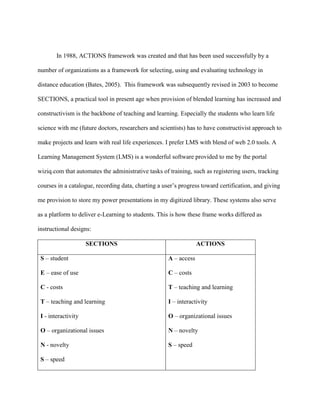
In 1988, ACTIONS framework was created and that has been used successfully by a

number of organizations as a framework for selecting, using and evaluating technology in

distance education (Bates, 2005). This framework was subsequently revised in 2003 to become

SECTIONS, a practical tool in present age when provision of blended learning has increased and

constructivism is the backbone of teaching and learning. Especially the students who learn life

science with me (future doctors, researchers and scientists) has to have constructivist approach to

make projects and learn with real life experiences. I prefer LMS with blend of web 2.0 tools. A

Learning Management System (LMS) is a wonderful software provided to me by the portal

wiziq.com that automates the administrative tasks of training, such as registering users, tracking

courses in a catalogue, recording data, charting a user‟s progress toward certification, and giving

me provision to store my power presentations in my digitized library. These systems also serve

as a platform to deliver e-Learning to students. This is how these frame works differed as

instructional designs:

                     SECTIONS                                     ACTIONS

 S – student                                         A – access

 E – ease of use                                     C – costs

 C - costs                                           T – teaching and learning

 T – teaching and learning                           I – interactivity

 I - interactivity                                   O – organizational issues

 O – organizational issues                           N – novelty

 N - novelty                                         S – speed

 S – speed
SECTION analysis

S – Students. What do I know about the students regarding the appropriateness of the

              technology?

I got the opportunity to start online delivery of lectures in year 2007 on wiziq.com. The first

challenge I had was that many of students in India who were so keen to join these classes either

had no PC at home or PC without internet connection or internet without broad band connection.

As reported by Bates and Poole, 2003, students‟ access to the internet must also be considered.

Many of the new programs as my own LMS delivery portal require large band width (Hughes,

2009). The type of internet provider that students have access to, will determine what Web 2.0

technologies they can readily access. For some students access to a computer may be a concern

(Bates & Poole, 2003), however the landscape of access to the internet is rapidly changing, and

today many students have access to social media and Web 2.0 on their smart phones (Magolda

and Platt, 2009). A significant number of students are not familiar with computers, and none of

them are familiar with e-learning. In the next 3 years I saw so many changes, almost all of my

students purchased computers and opted for broad band connections, suggesting they were

enjoying online sessions. Now all my students irrespective of which country they belong to can

catch me any time for lectures. Above all, the mobile companies have made services and devices
so reasonable that they have reached students in even far off villages in developing countries like

India.

E - Ease of use and reliability.

How easy is the technology to use for students and teachers? How reliable and

cost-effective is it?

Though for delivery of lectures, I prefer wiziq.com but the common second

generation web tools have opened a flood gate for easy applications and access.

A potential problem sometimes arises that few students are familiar with modern educational

constructivist approaches. Shift of paradigm sometimes take time but is fruitful in long run when

my students after learning with me go to professional institutes and find themselves more

confident in comparison to other students who lacked introduction to various tools. Although

there is a feeling that teaching with technology creates more work than face-to face teaching in a

well managed environment as the teacher has to work as part or a team of professionals.

Practically, I faced this difficulty only for couple of months, now I find this handier and time

saver as I have already abundant content loaded in my digital library as power points. It‟s cost

effective for a teacher so easy tool, as one has to pay only around $50 annually to be premium

member. For students there are lectures in public domain which will costs them nothing apart

from type of internet connectivity.
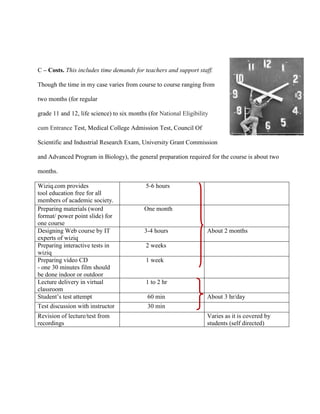
C – Costs. This includes time demands for teachers and support staff.

Though the time in my case varies from course to course ranging from

two months (for regular

grade 11 and 12, life science) to six months (for National Eligibility

cum Entrance Test, Medical College Admission Test, Council Of

Scientific and Industrial Research Exam, University Grant Commission

and Advanced Program in Biology), the general preparation required for the course is about two

months.

Wiziq.com provides                          5-6 hours
tool education free for all
members of academic society.
Preparing materials (word                  One month
format/ power point slide) for
one course
Designing Web course by IT                 3-4 hours                 About 2 months
experts of wiziq
Preparing interactive tests in              2 weeks
wiziq
Preparing video CD                          1 week
- one 30 minutes film should
be done indoor or outdoor
Lecture delivery in virtual                 1 to 2 hr
classroom
Student‟s test attempt                       60 min                  About 3 hr/day
Test discussion with instructor              30 min
Revision of lecture/test from                                        Varies as it is covered by
recordings                                                           students (self directed)
Since I have personnel PC and equipments like scanner/ printer/text books, it is not required to

spend more money on these, it is one time investment. Wiziq IT experts are always willing to

support new initiatives and modifications for know how of additional web 2.0 tools.


T (Teaching and Learning): What approaches to instruction best meet the type of learning?

Being a science teacher, my

programs involve amalgamation

of constructive and cognitive

approach. Most of topic related

to biochemistry or microbiology

require long term memory, a

cognitive approach. As many of my students have to be familiar with constructivist approach

(with elements of social reform) as they have to learn to work as a team for future research or

experimentation. My main motto is “It is not important how many data students hold within

couple of weeks after the end of lessons; it is important how many problem solving skills they

will have in the next five years when they will meet real life problems in professional

college/university”.

To get the most from it, this online training will be supported by media:

       Extra personal discussions.
Providing text and graphics.

       Giving links to important video on Youtube/DNAtube/Teachertube (which will cost

       nothing to both learners and instructors).

       Digital multimedia know how provided free of cost by wiziq IT experts.


I (Interactivity): What types of technologies support the desired forms of interaction?

This LMS allows much better communication and is

improving day by day.

       Students and teacher –interactions.

   World Wide Web, Workbook and video CD            being the

   important sources for interactions. The teachers‟ role is

   – through interaction with students – to motivate their study and to enhance their

   development as problem solving experts. Interactions are done through face to face

   whenever required and online discussions.

       Students with students. During lesions and examinations, through online course, students

       are/will be motivated to work as a team to finish the given projects. They will be

       provided help to have know how of Skype/GoogleTalk/Oovoo and such social networks.

       Students and senior students are generally allowed to interact during sessions for

       encouragement and to have know how of professional examinations from senior students.
Students and Online course includes text, pictures, short videos and interactive tests as

       tools. Technology is changing people to interact socially and in learning environments

       through digital media. New questions need to be considered, and some questions asked

       previously are losing relevance. Technological changes are advancing rapidly in the 21st

       century.

       Students and video interactions. They catch watch videos loaded by instructor on

       Youtube/DNAtube/Teachertube

       Students and www.bisbio.in – students will be motivated to use all relevant data they can

       find on this personal blog.

There will be a great improvement compared to when students are mainly passive listeners with

not much communication or project experience.

O (Organization): Organizational requirements and barriers are considered.

We have all the equipment we need and excellent support provided

by wiziq IT team members.

The only possible barrier is resistance by some students as how

effective is online course in comparison to face to face. If they can

understand the positive side of online courses from both learners

and instructors point of view in:

       Saving time and gas cost to move away from home for learning/teaching.

       Safety under your own roof.
Extra time available to revise from recordings for learners.

       Easy access to more people for interaction from every corner of globe. I feel digitized

       learning is knitting the world very firmly breaking barriers of boundaries, sex, caste,

       religion and most importantly poor and rich.

       On instructor‟s front it should motivate them to leave the dominating position and

       accepting the challenging student centered approach which is very critical. To accept

       project based planning, team work and pedagogic /e-learning skills as standards.

       Clear vision and strategy developed by online teachers together could prevent many

       possible educational problems.


N – Novelty. Advantages and disadvantages of new technology.

For some, online learning/ teaching may sound a

new concept, which need more of such approach

to bring rural and urban people on common

platform. Web 2.0 technologies allow for relatively intuitive, quick and easy use. “These tools

again are relatively simple to use….Posting video to sites such as YouTube is free, quick and

easy”. How quickly materials can be changed ties closely to an instructor‟s pedagogical

approach. Are they objectivist, constructivist or connectivist? If they are the former, speed
related to subject content developments, frequency of teaching material changes, ease of making

changes and who would be suited to make the change, may be a significant factor. If they are a

constructivist or connectivist these considerations will be less significant due to the structure and

organization that their program is likely to take. Questions to consider are, “What kind of

content do we want the learners to access? Where is it? Do we have to create it from scratch, or

does it already exist on the Web? Can learners find their own materials? (Bates, 2011). The fast

invention of new technologies has made instructors, life long learners.

S – Speed

Preparing of such course should not take more then 4.5 months for

one person. It can be stored in library for life long use and certain

modifications in future does not require much of time. Though few

points have to be considered always:

       How fast is the pace of development of the subject matter ?

       How frequently must materials be updated?

       Which web 2.0 tools would best support for further revision or project making? How

       easy and quick is it to make changes?

       Can changes be handed over to someone else to do or must you make them?”
Conclusion

Information and communication technologies allow big

advances in the process of education as

well as in the aftermath for bringing all students from every

niche and globe to common platform. To get the best

results, education should be a well designed lifelong process

based on the practical needs of students. This project is designed to fulfill that condition. Also it

doesn‟t seek for big investments nor a change in educational systems should be done „in one

day‟. Students and teachers can choose the media they prefer (speech, book, notebook, web,

video…etc), and in few years all of them will find benefits of e-Learning.

       The last but not least benefit of this project is students‟ familiarity with Learning

Management Systems, such as wiziq in my case and the constructive education they will get

through this program. That skill will be essential for almost all Lifelong learning courses they

will attend in their postgraduate carrier in professional college/university.
References

Bates, A., and Poole, G. (2003), Effective teaching with technology in higher education. San

       Francisco: Jossey-Bass.

Bates, T. (2011), Understanding web 2.0 and its implications for e-learning. In M. Lee, and

       C. McLoughlin, (Eds.), Web 2.0 – based e-learning: Applying social informatics for

       tertiary teaching (pp 21-42). Hershey: Information Science Reference.

Hughes, A. (2009). Higher education in a web 2.0 world. (May 12, 2009). JISC Publications.

       Retrieved from:

        http://www.jisc.ac.uk/publications/generalpublications/2009/heweb2.aspx

Magolda, P. & Platt, G. (2009), Untangling web 2.0’s influences on students’ learning. About

       campus 14 (3), 10-16. Retrieved from:

       http://web.ebscohost.com.ezproxy.royalroads.ca/ehost/pdfviewer/pdfviewer?vid=15&hid

       =13&sid=e7953502-dce4-43f0-9d98-2325a2a6d3c6%40sessionmgr13

Ab section report model

  • 1.
    Media Enhanced Learning PIDP 3240 Section –C: The Digital Media SECTION REPORT Instructor Prof Pru Moore VCC Bwy Aman Biswas Student ID - 000331986 Phone Number - 709 279 6731 Date of Submission: July18, 2012
  • 2.
    In 1988, ACTIONSframework was created and that has been used successfully by a number of organizations as a framework for selecting, using and evaluating technology in distance education (Bates, 2005). This framework was subsequently revised in 2003 to become SECTIONS, a practical tool in present age when provision of blended learning has increased and constructivism is the backbone of teaching and learning. Especially the students who learn life science with me (future doctors, researchers and scientists) has to have constructivist approach to make projects and learn with real life experiences. I prefer LMS with blend of web 2.0 tools. A Learning Management System (LMS) is a wonderful software provided to me by the portal wiziq.com that automates the administrative tasks of training, such as registering users, tracking courses in a catalogue, recording data, charting a user‟s progress toward certification, and giving me provision to store my power presentations in my digitized library. These systems also serve as a platform to deliver e-Learning to students. This is how these frame works differed as instructional designs: SECTIONS ACTIONS S – student A – access E – ease of use C – costs C - costs T – teaching and learning T – teaching and learning I – interactivity I - interactivity O – organizational issues O – organizational issues N – novelty N - novelty S – speed S – speed
  • 3.
    SECTION analysis S –Students. What do I know about the students regarding the appropriateness of the technology? I got the opportunity to start online delivery of lectures in year 2007 on wiziq.com. The first challenge I had was that many of students in India who were so keen to join these classes either had no PC at home or PC without internet connection or internet without broad band connection. As reported by Bates and Poole, 2003, students‟ access to the internet must also be considered. Many of the new programs as my own LMS delivery portal require large band width (Hughes, 2009). The type of internet provider that students have access to, will determine what Web 2.0 technologies they can readily access. For some students access to a computer may be a concern (Bates & Poole, 2003), however the landscape of access to the internet is rapidly changing, and today many students have access to social media and Web 2.0 on their smart phones (Magolda and Platt, 2009). A significant number of students are not familiar with computers, and none of them are familiar with e-learning. In the next 3 years I saw so many changes, almost all of my students purchased computers and opted for broad band connections, suggesting they were enjoying online sessions. Now all my students irrespective of which country they belong to can catch me any time for lectures. Above all, the mobile companies have made services and devices
  • 4.
    so reasonable thatthey have reached students in even far off villages in developing countries like India. E - Ease of use and reliability. How easy is the technology to use for students and teachers? How reliable and cost-effective is it? Though for delivery of lectures, I prefer wiziq.com but the common second generation web tools have opened a flood gate for easy applications and access. A potential problem sometimes arises that few students are familiar with modern educational constructivist approaches. Shift of paradigm sometimes take time but is fruitful in long run when my students after learning with me go to professional institutes and find themselves more confident in comparison to other students who lacked introduction to various tools. Although there is a feeling that teaching with technology creates more work than face-to face teaching in a well managed environment as the teacher has to work as part or a team of professionals. Practically, I faced this difficulty only for couple of months, now I find this handier and time saver as I have already abundant content loaded in my digital library as power points. It‟s cost effective for a teacher so easy tool, as one has to pay only around $50 annually to be premium member. For students there are lectures in public domain which will costs them nothing apart from type of internet connectivity.
  • 5.
    C – Costs.This includes time demands for teachers and support staff. Though the time in my case varies from course to course ranging from two months (for regular grade 11 and 12, life science) to six months (for National Eligibility cum Entrance Test, Medical College Admission Test, Council Of Scientific and Industrial Research Exam, University Grant Commission and Advanced Program in Biology), the general preparation required for the course is about two months. Wiziq.com provides 5-6 hours tool education free for all members of academic society. Preparing materials (word One month format/ power point slide) for one course Designing Web course by IT 3-4 hours About 2 months experts of wiziq Preparing interactive tests in 2 weeks wiziq Preparing video CD 1 week - one 30 minutes film should be done indoor or outdoor Lecture delivery in virtual 1 to 2 hr classroom Student‟s test attempt 60 min About 3 hr/day Test discussion with instructor 30 min Revision of lecture/test from Varies as it is covered by recordings students (self directed)
  • 6.
    Since I havepersonnel PC and equipments like scanner/ printer/text books, it is not required to spend more money on these, it is one time investment. Wiziq IT experts are always willing to support new initiatives and modifications for know how of additional web 2.0 tools. T (Teaching and Learning): What approaches to instruction best meet the type of learning? Being a science teacher, my programs involve amalgamation of constructive and cognitive approach. Most of topic related to biochemistry or microbiology require long term memory, a cognitive approach. As many of my students have to be familiar with constructivist approach (with elements of social reform) as they have to learn to work as a team for future research or experimentation. My main motto is “It is not important how many data students hold within couple of weeks after the end of lessons; it is important how many problem solving skills they will have in the next five years when they will meet real life problems in professional college/university”. To get the most from it, this online training will be supported by media: Extra personal discussions.
  • 7.
    Providing text andgraphics. Giving links to important video on Youtube/DNAtube/Teachertube (which will cost nothing to both learners and instructors). Digital multimedia know how provided free of cost by wiziq IT experts. I (Interactivity): What types of technologies support the desired forms of interaction? This LMS allows much better communication and is improving day by day. Students and teacher –interactions. World Wide Web, Workbook and video CD being the important sources for interactions. The teachers‟ role is – through interaction with students – to motivate their study and to enhance their development as problem solving experts. Interactions are done through face to face whenever required and online discussions. Students with students. During lesions and examinations, through online course, students are/will be motivated to work as a team to finish the given projects. They will be provided help to have know how of Skype/GoogleTalk/Oovoo and such social networks. Students and senior students are generally allowed to interact during sessions for encouragement and to have know how of professional examinations from senior students.
  • 8.
    Students and Onlinecourse includes text, pictures, short videos and interactive tests as tools. Technology is changing people to interact socially and in learning environments through digital media. New questions need to be considered, and some questions asked previously are losing relevance. Technological changes are advancing rapidly in the 21st century. Students and video interactions. They catch watch videos loaded by instructor on Youtube/DNAtube/Teachertube Students and www.bisbio.in – students will be motivated to use all relevant data they can find on this personal blog. There will be a great improvement compared to when students are mainly passive listeners with not much communication or project experience. O (Organization): Organizational requirements and barriers are considered. We have all the equipment we need and excellent support provided by wiziq IT team members. The only possible barrier is resistance by some students as how effective is online course in comparison to face to face. If they can understand the positive side of online courses from both learners and instructors point of view in: Saving time and gas cost to move away from home for learning/teaching. Safety under your own roof.
  • 9.
    Extra time availableto revise from recordings for learners. Easy access to more people for interaction from every corner of globe. I feel digitized learning is knitting the world very firmly breaking barriers of boundaries, sex, caste, religion and most importantly poor and rich. On instructor‟s front it should motivate them to leave the dominating position and accepting the challenging student centered approach which is very critical. To accept project based planning, team work and pedagogic /e-learning skills as standards. Clear vision and strategy developed by online teachers together could prevent many possible educational problems. N – Novelty. Advantages and disadvantages of new technology. For some, online learning/ teaching may sound a new concept, which need more of such approach to bring rural and urban people on common platform. Web 2.0 technologies allow for relatively intuitive, quick and easy use. “These tools again are relatively simple to use….Posting video to sites such as YouTube is free, quick and easy”. How quickly materials can be changed ties closely to an instructor‟s pedagogical approach. Are they objectivist, constructivist or connectivist? If they are the former, speed
  • 10.
    related to subjectcontent developments, frequency of teaching material changes, ease of making changes and who would be suited to make the change, may be a significant factor. If they are a constructivist or connectivist these considerations will be less significant due to the structure and organization that their program is likely to take. Questions to consider are, “What kind of content do we want the learners to access? Where is it? Do we have to create it from scratch, or does it already exist on the Web? Can learners find their own materials? (Bates, 2011). The fast invention of new technologies has made instructors, life long learners. S – Speed Preparing of such course should not take more then 4.5 months for one person. It can be stored in library for life long use and certain modifications in future does not require much of time. Though few points have to be considered always: How fast is the pace of development of the subject matter ? How frequently must materials be updated? Which web 2.0 tools would best support for further revision or project making? How easy and quick is it to make changes? Can changes be handed over to someone else to do or must you make them?”
  • 11.
    Conclusion Information and communicationtechnologies allow big advances in the process of education as well as in the aftermath for bringing all students from every niche and globe to common platform. To get the best results, education should be a well designed lifelong process based on the practical needs of students. This project is designed to fulfill that condition. Also it doesn‟t seek for big investments nor a change in educational systems should be done „in one day‟. Students and teachers can choose the media they prefer (speech, book, notebook, web, video…etc), and in few years all of them will find benefits of e-Learning. The last but not least benefit of this project is students‟ familiarity with Learning Management Systems, such as wiziq in my case and the constructive education they will get through this program. That skill will be essential for almost all Lifelong learning courses they will attend in their postgraduate carrier in professional college/university.
  • 12.
    References Bates, A., andPoole, G. (2003), Effective teaching with technology in higher education. San Francisco: Jossey-Bass. Bates, T. (2011), Understanding web 2.0 and its implications for e-learning. In M. Lee, and C. McLoughlin, (Eds.), Web 2.0 – based e-learning: Applying social informatics for tertiary teaching (pp 21-42). Hershey: Information Science Reference. Hughes, A. (2009). Higher education in a web 2.0 world. (May 12, 2009). JISC Publications. Retrieved from: http://www.jisc.ac.uk/publications/generalpublications/2009/heweb2.aspx Magolda, P. & Platt, G. (2009), Untangling web 2.0’s influences on students’ learning. About campus 14 (3), 10-16. Retrieved from: http://web.ebscohost.com.ezproxy.royalroads.ca/ehost/pdfviewer/pdfviewer?vid=15&hid =13&sid=e7953502-dce4-43f0-9d98-2325a2a6d3c6%40sessionmgr13