SeniorEngage:
Intergenerational knowledge
exchange – challenges and
findings
Jennifer Woodard, Coordinator - SeniorEngage
                                               Eindhoven, September 28, 2012
“The new future of old age is about
staying in society, staying in the
workplace and staying very connected.
And technology is going to be a very big
part of that, because the new reality
is, increasingly, a virtual reality. It
provides a way to make new
connections, new friends and new
senses of purpose.”

Joseph F. Coughlin, AgeLab, MIT


                                           2 / Pages
The SENIORENGAGE Project


The Premise
               Not everyone can stay in the workplace, but
              thanks to technology they can stay in their work
              SPACE. Continued connection with one’s
              profession can provide mental stimulation and
              psychological benefits.

               Maintaining and creating new professional
              bonds with colleagues (young and older) after
              retirement is of great value for retaining a sense
              of identity.

               Through intergenerational knowledge exchange
              and education, senior professionals provide can
              support to younger ones, and, in turn, seniors will
              continue to be involved in their profession
              contributing to their sense of self-worth.


                                                                    3 / Pages
The SENIORENGAGE Project


                                                Context for the project: 2009

      New research identified problems                                 The rise of Web 2.0 and social networking
               faced by retirees:                                    •   After initial uptake by Gen X users, social
•   Increased isolation after retirement;                                networking was becoming “mainstream”
    breakdown of the social network and                              •    Availability of open-source development
    everyday routines                                                    tools for deploying social networks for
•   Consequences: depression and other                                   smaller groups
    psychological problems which in turn lead                        •   Tide of new “silver surfers” – older
    to physical problems.                                                people online. Still not using mainstream
                                                                         social networks.


             Other factors
                                                                                          Other factors
•   Research showing the benefits of
    intergenerational learning in                                           •   Increased European Comission
    elderly.                                                                    initiatives in the area of healthy
                                                                                aging and ICT.
•   Loss of valuable knowledge as
    elderly professionals leave the
    workforce; it isn’t passed on.


                                                                                                              4 / Pages
The SeniorEngage Project


    Solution: A social network where younger professionals and older professionals share
        knowledge between generations.


Sound simple? It’s a challenge.


CHALLENGE 1: Creating a truly intergenerational platform.

Step 1: Ascertain the real needs for both groups of users: young professionals and
    senior professionals.

     Senior professionals, both retired and near retirement. Younger users – what do they need?

     Development of scenarios, focus groups to discover real needs.


                                                                                                   5 / Pages
The SeniorEngage Project


CHALLENGE 1: Creating a truly
   intergenerational platform.

Step 2: Ensure no one is left behind. There is no
    one size fits all intergenerational
    experience.

- End- user training and involvement gives
    feedback that ensures that everyone will be
    able to use the tool: both young and old.

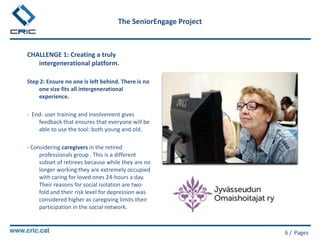
- Considering caregivers in the retired
     professionals group . This is a different
     subset of retirees because while they are no
     longer working they are extremely occupied
     with caring for loved ones 24-hours a day.
     Their reasons for social isolation are two-
     fold and their risk level for depression was
     considered higher as caregiving limits their
     participation in the social network.


                                                               6 / Pages
The SeniorEngage Project


CHALLENGE 1: Creating a
   truly intergenerational
   platform.

Step 2: Ensure no one is left
    behind. Even those with
    no computer skills.
-   Workshops with endusers –
    to bring basic skills to users
-    Caregivers ranked their
    computer skills differently
    than seniors in general.
-   In addressing the Digital
    Divide: Online training
    materials and tutorials;                     Computer skills in senior test groups
    contextual help


                                                                                         7 / Pages
The SeniorEngage Project


CHALLENGE 1: Creating a truly
   intergenerational platform.

Step 3: Creating a platform that is highly usable for
    seniors but still attractive for younger users

Main considerations:
                                                          Asked of young professionals: “The knowledge and
                                                          skills of retired professionals in my domain of work is
-   Create an environment that doesn’t isolate            still of high value.” (%)
    either group. Simple interface, not patronizing.
-   Consider the attractiveness of knowledge
    possessed by senior professionals according to
    young professionals. Is the knowledge of senior
    professionals valuable to them? This varied by
    country but results largely positive. Younger
    adults do want to interact and learn from senior
    mentors.


                                                        Likeliness to want to learn from retired professionals (%).


                                                                                                             8 / Pages
The SeniorEngage Project


CHALLENGE 1: Creating a truly
intergenerational platform.

Step 3: Creating a platform that is highly
usable for seniors but still attractive for
younger users

Main considerations:
USABILITY – user-friendliness for seniors and
ASSISTIVE TECHNOLOGIES that don’t “get in
the way” of younger professionals’ user
experience on the platform who are “digital
natives”

Contextual Help for users who “get lost” in
the platform. Can easily be turned off for
experienced Internet users or those already
familiar with the platform.


                                                                  9 / Pages
The SeniorEngage Project


                                                     What Seniors Say:

CHALLENGE 2: Battling prejudices and                 “My professional knowledge is
   misconceptions that hinder adoption.                 irrelevant because times have
                                                        changed.”
Step 1. Consider that some users, both young and
    older need help understanding the benefits       “Younger people won’t be interested
    of intergenerational exchange. There are            in what I have to share”
    fears and misconceptions.

                                                     “My career was short so I don’t have
                                                        a lot to offer”

                                                     “I’m too old for this type of thing”


                                                                                            10 / Pages
The SeniorEngage Project


What Young Professionals Say:                        What Seniors Say about
                                                       Younger Professionals:
“Seniors´ work experience can be very helpful to
put theory into action and the knowledge of          “Young people have fresh ideas and
    senior professionals should not be lost”              the latest knowledge”
                                                     “ I would love to exchange thoughts
“ Knowledge and skills of retired professionals           and views with younger
    are valuable for example in planning,                 people…”
starting and executing new projects.”                ”New from young people create
                                                          vitality”
                                                     “Young people are better educated so
                                                          they can benefit my daily life”


                                                                                 11 / Pages
The SeniorEngage Project


CHALLENGE 3: Responding to real market needs.
Only by doing so can we ensure the uptake of the platform by both seniors and younger
    professionals.

Step 1. Market research and Survey: “Attitudes and Behaviour of the Senior Population: Exploring
    the digital views of the aging population” – Microlink PC

Key findings:

Barriers hindering seniors’ usage of online resources
• Too expensive and see no need – fear of the unknown
• Have poor technological skills, too complex, inaccessible
• Deteriorating cognitive, physical and sensory capabilities
• Information overload, spam, viruses etc.

Seniors’ use of social networks
• Around 80% of 55-74 year olds send/receive emails, but only 20% use the
Internet for VOIP (Voice over Internet Protocol) and around 18% post messages
to chat sites, blogs and social networking sites.
• But older users are underrepresented in comparison to the general population
on social networking sites.


                                                                                               12 / Pages
The SeniorEngage Project


CHALLENGE 4: Creating a truly European platform.

Step 1. Consider that the social reality for seniors (and
    even younger users) is not the same in all European
    countries. To that end, end users were recruited in
    various countries in the consortium.

Examples:

•   Finnish seniors were less likely to talk about their
    professions in their daily life after retirement and
    many consider their professional life “the past”. In
    the case of Spain, seniors are much more likely to
    continue to talk about their profession.

•   Only a third of Finnish seniors wanted to be a
    mentor for younger colleagues, while the                        Finnish Retired Professionals
    corresponding number in Austria was 77%.


                                                                                              13 / Pages
The SeniorEngage Project


CHALLENGE 4: Creating a truly
   European platform.

Step 2. Consider that cross-
     border, cross-cultural learning will
     enhance the experience.
     However, language is an issue that
     needs to be dealt with (dealt with
     through technology?) How to make
     the experience more natural for
     seniors? This hasn’t been dealt
     with well even in mainstream
     social networks like Facebook.


                                                               14 / Pages
The SENIORENGAGE Project


Conclusions

-   Know the market is different in different countries and even within the same
    country (e.g. caregivers)
-   Foster engagement via a topic that younger and older generations have in
    common – their professions (and hobbies)
-   Design for usability of BOTH target audiences – younger and older adults
-   Consider accesibility tools and assistive technologies that don’t get in the way
    of the user experience
-   Battle misconceptions and prejudices through training with end users and
    awareness.


                                                                                       15 / Pages
The SENIORENGAGE Project


    Thank you!
    www.seniorengage.eu
   Twitter: @seniorengage

  jennifer.woodard@cric.cat


                              16 / Pages

Intergenerational Knowledge Exchange

  • 1.
    SeniorEngage: Intergenerational knowledge exchange –challenges and findings Jennifer Woodard, Coordinator - SeniorEngage Eindhoven, September 28, 2012
  • 2.
    “The new futureof old age is about staying in society, staying in the workplace and staying very connected. And technology is going to be a very big part of that, because the new reality is, increasingly, a virtual reality. It provides a way to make new connections, new friends and new senses of purpose.” Joseph F. Coughlin, AgeLab, MIT 2 / Pages
  • 3.
    The SENIORENGAGE Project ThePremise  Not everyone can stay in the workplace, but thanks to technology they can stay in their work SPACE. Continued connection with one’s profession can provide mental stimulation and psychological benefits.  Maintaining and creating new professional bonds with colleagues (young and older) after retirement is of great value for retaining a sense of identity.  Through intergenerational knowledge exchange and education, senior professionals provide can support to younger ones, and, in turn, seniors will continue to be involved in their profession contributing to their sense of self-worth. 3 / Pages
  • 4.
    The SENIORENGAGE Project Context for the project: 2009 New research identified problems The rise of Web 2.0 and social networking faced by retirees: • After initial uptake by Gen X users, social • Increased isolation after retirement; networking was becoming “mainstream” breakdown of the social network and • Availability of open-source development everyday routines tools for deploying social networks for • Consequences: depression and other smaller groups psychological problems which in turn lead • Tide of new “silver surfers” – older to physical problems. people online. Still not using mainstream social networks. Other factors Other factors • Research showing the benefits of intergenerational learning in • Increased European Comission elderly. initiatives in the area of healthy aging and ICT. • Loss of valuable knowledge as elderly professionals leave the workforce; it isn’t passed on. 4 / Pages
  • 5.
    The SeniorEngage Project Solution: A social network where younger professionals and older professionals share knowledge between generations. Sound simple? It’s a challenge. CHALLENGE 1: Creating a truly intergenerational platform. Step 1: Ascertain the real needs for both groups of users: young professionals and senior professionals.  Senior professionals, both retired and near retirement. Younger users – what do they need?  Development of scenarios, focus groups to discover real needs. 5 / Pages
  • 6.
    The SeniorEngage Project CHALLENGE1: Creating a truly intergenerational platform. Step 2: Ensure no one is left behind. There is no one size fits all intergenerational experience. - End- user training and involvement gives feedback that ensures that everyone will be able to use the tool: both young and old. - Considering caregivers in the retired professionals group . This is a different subset of retirees because while they are no longer working they are extremely occupied with caring for loved ones 24-hours a day. Their reasons for social isolation are two- fold and their risk level for depression was considered higher as caregiving limits their participation in the social network. 6 / Pages
  • 7.
    The SeniorEngage Project CHALLENGE1: Creating a truly intergenerational platform. Step 2: Ensure no one is left behind. Even those with no computer skills. - Workshops with endusers – to bring basic skills to users - Caregivers ranked their computer skills differently than seniors in general. - In addressing the Digital Divide: Online training materials and tutorials; Computer skills in senior test groups contextual help 7 / Pages
  • 8.
    The SeniorEngage Project CHALLENGE1: Creating a truly intergenerational platform. Step 3: Creating a platform that is highly usable for seniors but still attractive for younger users Main considerations: Asked of young professionals: “The knowledge and skills of retired professionals in my domain of work is - Create an environment that doesn’t isolate still of high value.” (%) either group. Simple interface, not patronizing. - Consider the attractiveness of knowledge possessed by senior professionals according to young professionals. Is the knowledge of senior professionals valuable to them? This varied by country but results largely positive. Younger adults do want to interact and learn from senior mentors. Likeliness to want to learn from retired professionals (%). 8 / Pages
  • 9.
    The SeniorEngage Project CHALLENGE1: Creating a truly intergenerational platform. Step 3: Creating a platform that is highly usable for seniors but still attractive for younger users Main considerations: USABILITY – user-friendliness for seniors and ASSISTIVE TECHNOLOGIES that don’t “get in the way” of younger professionals’ user experience on the platform who are “digital natives” Contextual Help for users who “get lost” in the platform. Can easily be turned off for experienced Internet users or those already familiar with the platform. 9 / Pages
  • 10.
    The SeniorEngage Project What Seniors Say: CHALLENGE 2: Battling prejudices and “My professional knowledge is misconceptions that hinder adoption. irrelevant because times have changed.” Step 1. Consider that some users, both young and older need help understanding the benefits “Younger people won’t be interested of intergenerational exchange. There are in what I have to share” fears and misconceptions. “My career was short so I don’t have a lot to offer” “I’m too old for this type of thing” 10 / Pages
  • 11.
    The SeniorEngage Project WhatYoung Professionals Say: What Seniors Say about Younger Professionals: “Seniors´ work experience can be very helpful to put theory into action and the knowledge of “Young people have fresh ideas and senior professionals should not be lost” the latest knowledge” “ I would love to exchange thoughts “ Knowledge and skills of retired professionals and views with younger are valuable for example in planning, people…” starting and executing new projects.” ”New from young people create vitality” “Young people are better educated so they can benefit my daily life” 11 / Pages
  • 12.
    The SeniorEngage Project CHALLENGE3: Responding to real market needs. Only by doing so can we ensure the uptake of the platform by both seniors and younger professionals. Step 1. Market research and Survey: “Attitudes and Behaviour of the Senior Population: Exploring the digital views of the aging population” – Microlink PC Key findings: Barriers hindering seniors’ usage of online resources • Too expensive and see no need – fear of the unknown • Have poor technological skills, too complex, inaccessible • Deteriorating cognitive, physical and sensory capabilities • Information overload, spam, viruses etc. Seniors’ use of social networks • Around 80% of 55-74 year olds send/receive emails, but only 20% use the Internet for VOIP (Voice over Internet Protocol) and around 18% post messages to chat sites, blogs and social networking sites. • But older users are underrepresented in comparison to the general population on social networking sites. 12 / Pages
  • 13.
    The SeniorEngage Project CHALLENGE4: Creating a truly European platform. Step 1. Consider that the social reality for seniors (and even younger users) is not the same in all European countries. To that end, end users were recruited in various countries in the consortium. Examples: • Finnish seniors were less likely to talk about their professions in their daily life after retirement and many consider their professional life “the past”. In the case of Spain, seniors are much more likely to continue to talk about their profession. • Only a third of Finnish seniors wanted to be a mentor for younger colleagues, while the Finnish Retired Professionals corresponding number in Austria was 77%. 13 / Pages
  • 14.
    The SeniorEngage Project CHALLENGE4: Creating a truly European platform. Step 2. Consider that cross- border, cross-cultural learning will enhance the experience. However, language is an issue that needs to be dealt with (dealt with through technology?) How to make the experience more natural for seniors? This hasn’t been dealt with well even in mainstream social networks like Facebook. 14 / Pages
  • 15.
    The SENIORENGAGE Project Conclusions - Know the market is different in different countries and even within the same country (e.g. caregivers) - Foster engagement via a topic that younger and older generations have in common – their professions (and hobbies) - Design for usability of BOTH target audiences – younger and older adults - Consider accesibility tools and assistive technologies that don’t get in the way of the user experience - Battle misconceptions and prejudices through training with end users and awareness. 15 / Pages
  • 16.
    The SENIORENGAGE Project Thank you! www.seniorengage.eu Twitter: @seniorengage jennifer.woodard@cric.cat 16 / Pages