









Smoking Cessation Using motivational interviewing
Welcome! Introductions CS2day Collaboration Brief Activity Overview Your Faculty A Comment about Video
And a word about this program… The CAFP committee on Continuing Professional Development is responsible for management and resolution of conflict for any individual who may have influence on content, who have served as faculty, or who many produce CME/CPD content for the CAFP.  Dr. Lee and Dr. Mitchell state that neither have any financial conflicts to disclose.  This activity is funded by an unrestricted educational grant from Pfizer.
Meet your Instructors Event 1 of 3
Jay Lee Suzanne Mitchell
The Five A’s Ask Advise Assess Assist Arrange
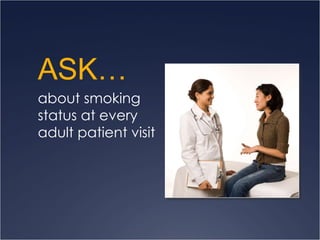
ASK…  about smoking  status at every  adult patient visit
Barrier Busters 70 percent of smokers want to quit More likely to quit if advised Many doctors never ask Only takes 3 minutes Payment plan
Advise…  your patients to  quit smoking
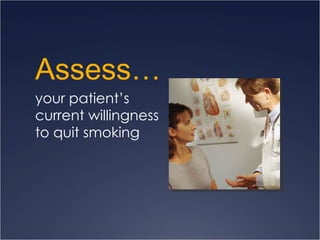
Assess…  your patient’s  current willingness  to quit smoking
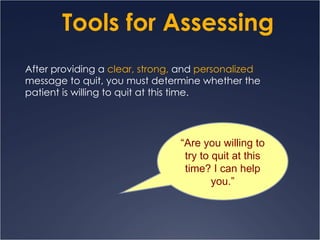
Tools for Assessing After providing a   clear, strong,  and   personalized  message to quit, you must determine whether the patient is willing to quit at this time. “ Are you willing to try to quit at this time? I can help you.”
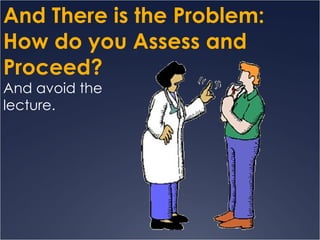
And There is the Problem:  How do you Assess and Proceed? And avoid the lecture.
The Problem Current models of care are paternalistic Communication is provider-centered,  not   patient-centered Information  giving  vs information  exchange A focus on  save the patient  vs  patients save themselves Labeling of patient: “in denial” or “difficult” Compliance vs adherence Dictate rather than negotiate behavior change
The Problem (cont.) Resistance is seen as a flaw rather than useful information to explore Little time spent identifying how patients make sense of illness and treatment – or what benefits they derive from tobacco What do they know and understand about the risk of not treating the illness? Schools teach docs that you are the expert New models of communicating with patients are needed
Motivational Interviewing Miller and Rollnick
Motivational interviewing is a  person-centered directive (guided) method of communication for enhancing intrinsic motivation to change by exploring and resolving ambivalence and resistance.
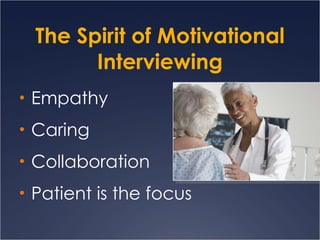
The Spirit of Motivational Interviewing Empathy Caring Collaboration Patient is the focus
Let’s explore the key concepts…
The Goals for MI Establish empathic partnership Elicit change talk Promote positive behavior change
The Challenges in Health Behavior Change  Resistance Ambivalence Discrepancy
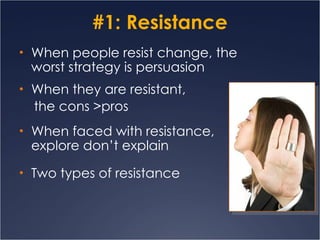
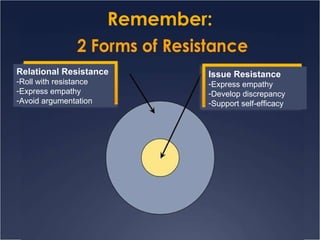
#1: Resistance When people resist change, the worst strategy is persuasion When they are resistant,  the cons >pros When faced with resistance, explore don’t explain Two types of resistance
Issue Resistance “ I am not ready to quit smoking. It relaxes me.” “ I am so tired of you people hounding me about my smoking. Everyone acts like it’s so easy.” Relational Resistance
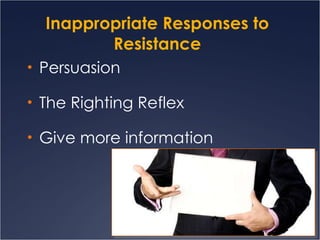
Inappropriate Responses to Resistance Persuasion The Righting Reflex Give more information
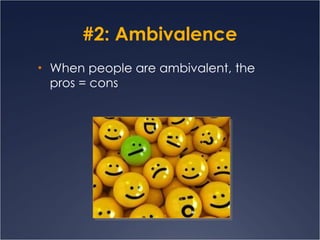
#2: Ambivalence When people are ambivalent, the pros = cons
#3: Lack of Discrepancy Unaware when behaviors contradict values
The MI Skills We Use Roll with resistance Express empathy Avoid argumentation Amplify Ambivalence Develop discrepancy Support self-efficacy
The MI Tools We Use Explore line of reasoning Provide a menu of options Confidence rulers A look over the fence
Rulers Two types:  Importance and Confidence Scale from 1 to 10 “ How important is this change for you?” “ How confident are you that you can make this change if you want to?”  “ Why did you choose a ____, not a 1?” Using this elicits change talk
The Results We Get Importance, confidence, & readiness Autonomy Respect/Understanding
Case Study: Asthma Julie Stockton is a 37-year-old Caucasian female Daughter, Sara, age10, has asthma Julie, the mother, is a smoker When asked about this, Julie says defensively,  “Don’t bother to talk to me about my smoking. I smoke outside so it doesn’t affect Sara’s asthma.”
R oll With  R esistance
Remember: Relational Resistance Roll with resistance Express empathy Avoid argumentation Issue Resistance Express empathy Develop discrepancy Support self-efficacy
Roll With Resistance Example Patient:  I just don’t see how I can quit smoking when my wife smokes too and she won’t quit. Doctor:  You suspect that it will be much more difficult for you to quit smoking if your wife continues to smoke. Patient:  Right…I just don’t see that working. Doctor:  How important is it for you to quit  right now?
R oll With  R esistance You try it.
Roll with Resistance:  You Try It Patient:  “Other people have blood pressure that is much higher than mine. Mine is not so bad.  I’m not worried.”
E xpress  E mpathy
Ways to Express Empathy Active listening and reflection Repeat back the words with feeling Slight or major paraphrase Example starters… “ You seem_____” “ In other words…” “ You feel ___ because ___” “ It seems to you…” “ You seem to be saying…” “ You sound…”
Express Empathy Example Patient:  “Everyone makes it sound so easy…just take the medicine, quit smoking, change your diet, and exercise more!”  Doctor:  “You sound frustrated. You have been asked to make a lot of changes to control your diabetes and blood pressure and people don’t seem to appreciate how overwhelming and difficult all of it can be.”
E xpress  E mpathy You try it.
Express Empathy:  You Try It Patient:  “I know smoking is bad for me, it’s just that all of my friends smoke and we hang out together.”
A void  A rgumentation
Avoid Argumentation Example Patient:  “My doctor says I need to lose weight, take the medicine, quit smoking, and reduce the salt in my diet. I don’t think I need to  quit  smoking, do you? How about cutting back?” Doctor:  “It sounds like a lot to do. It’s great that you are willing to take your medicine and watch your salt intake. Cutting back on your smoking would be a great first step. Ultimately, quitting smoking would be the healthiest thing to do. What are your thoughts?”
Avoid Argumentation:  You Try It Patient:  “I feel fine.  I don’t need to quit smoking.”
D evelop  D iscrepancy
Develop Discrepancy Example (On the one hand….and then, on the other…) Patient:  “I want to lower my blood pressure and reduce my risk of stroke or heart attack but I don’t want to quit smoking.” Doctor:  “On the one hand, you really don’t feel like you want to stop smoking now,  but you can also see that smoking raises your blood pressure and interferes with your goal to avoid a stroke or heart attack.”
Then You Urge Them to  “Look Over the Fence”… “ If you were to wake up tomorrow and you were no longer a smoker, what would you like about that? What would be the benefits to you?” “ If you made no change and kept smoking, what would that look like to you a year from now? How would you feel?”
Develop Discrepancy:  You Try it Patient:  “I’ve tried to quit smoking but I just can’t seem to do it. I’d like to quit but I need the smoking to lower my stress.”
S upport  S elf-Efficacy
Support Self-Efficacy Example Patient:  “I don’t think I am ready to walk four days a week, but I am willing to try twice a week.” Doctor:  That sounds like a great start and will really help with your osteoporosis.
Supporting Self-Efficacy:  You Try It Patient:  “I’ve thought a little more about what you said about quitting smoking. I think I’m ready to try cutting back.”
It’s a Wrap!
A Few Housekeeping Details Any one needing an extra SL tutorial? Next week, same time, same place (make a landmark) Be sure to have a headset for next week
Welcome Back Event 2 of 3
Plan for Event #2 Any questions from last week’s event? Model Interview Teleport to red and blue platforms for role playing Return to this place, at the end, for a wrap up
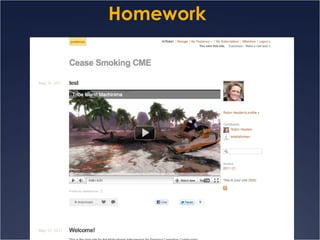
Homework
Welcome Back Event 3 of 3
Tonight’s Plan Discuss the video homework Short presentation Up to platforms for more role-play practice Return to this place, at the end, for a wrap up
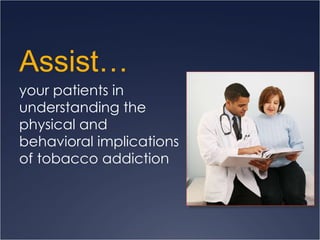
Assist…  your patients in  understanding the  physical and  behavioral implications  of tobacco addiction
What do people get from smoking? Physical benefits Addiction to baseline nicotine blood levels Avoidance of withdrawal symptoms Enjoyment of the “rush” Weight loss Behavioral benefits The rituals Pleasurable associations The “secondary gain” (cigarette breaks) Social camaraderie Self reward Image enhancement
Treatment Options Non-Pharmacologic: Cold Turkey Gradual Tapering Behavioral Modification Aversion Therapy Reward Systems Physician Counseling Scare Tactics Guilt Group Support
Quit Plan Action – Help the patient with a quit plan S et a quit date (should be within 2 weeks) Tell family, friends, and coworkers you are quitting; request understanding & support Anticipate challenges to the upcoming quit attempt Remove tobacco products from your environment  Prior to quitting, avoid smoking in places where you spend a lot of time (e.g. work, home, car)
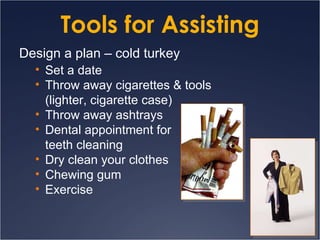
Tools for Assisting Design a plan – cold turkey Set a date Throw away cigarettes & tools (lighter, cigarette case) Throw away ashtrays Dental appointment for  teeth cleaning Dry clean your clothes Chewing gum Exercise
Tools for Assisting Design a Plan – Gradual Tapering Set a date Plan the taper When down to a few cigarettes, follow “Cold Turkey” plan
Tools for Assisting Design a Plan – Behavioral Modification Cigarette diary Break patterns Smoking as a solitary activity Don’t smoke in the car or house Don’t smoke until 30 min after meal
Treatment Options Pharmacologic: Bupropion SR Nicotine gum Nicotine inhaler Nicotine lozenge Nicotine nasal spray Nicotine patch Varenicline
Treatment Option Questions What other factors may influence medication selection? What medications should be used with a highly nicotine dependent patient? Is medication adherence important? May medications ever be combined?
Treatment Option Questions Should we avoid nicotine replacement therapies in patients with a history of C-V disease? Are there special medications for patients with history of depression? Which medications for patients particularly concerned about weight gain?
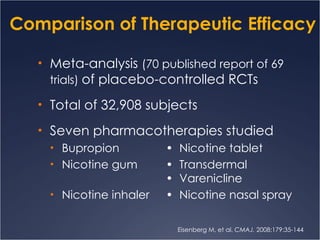
Comparison of Therapeutic Efficacy Meta-analysis  (70 published report of 69 trials)  of placebo-controlled RCTs Total of 32,908 subjects Seven pharmacotherapies studied Bupropion •  Nicotine tablet Nicotine gum •  Transdermal  •  Varenicline Nicotine inhaler  •  Nicotine nasal spray Eisenberg M, et al.  CMAJ.  2008;179:35-144
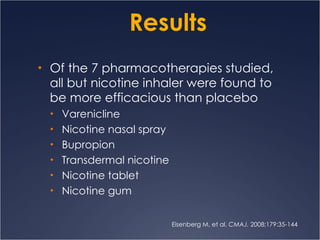
Results Of the 7 pharmacotherapies studied, all but nicotine inhaler were found to be more efficacious than placebo Varenicline Nicotine nasal spray Bupropion Transdermal nicotine Nicotine tablet Nicotine gum Eisenberg M, et al.  CMAJ.  2008;179:35-144
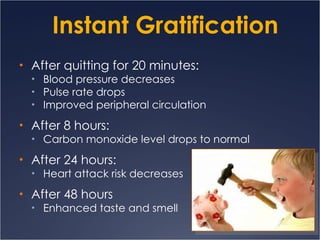
Instant Gratification After quitting for 20 minutes: Blood pressure decreases Pulse rate drops Improved peripheral circulation After 8 hours: Carbon monoxide level drops to normal After 24 hours: Heart attack risk decreases After 48 hours Enhanced taste and smell
Intermediate Gratification After quitting for two weeks to three months: Circulation improves Walking becomes easier Lung function improves After one to nine months: Cough, sinus congestion, fatigue and shortness of breath improve After one year: Heart disease risk reduced by half
Long Term Gratification After 5 to 15 years: Stroke risk is reduced to baseline Lung cancer risk is halved Risk of oral, esophageal, bladder, renal and pancreatic cancer decreases After 15 years CAD risk similar to those who never smoked Risk of death near baseline
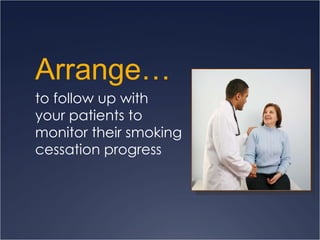
Arrange…  to follow up with  your patients to  monitor their smoking  cessation progress
Tools for Arranging Schedule follow-up within one week after the quit date Telephone contact Email/text message reminders Quit lines The majority of relapse occurs in the first two weeks
 
Thank you.

MI.smokingcme.cs2day

  • 1.
    Smoking Cessation Usingmotivational interviewing
  • 2.
    Welcome! Introductions CS2dayCollaboration Brief Activity Overview Your Faculty A Comment about Video
  • 3.
    And a wordabout this program… The CAFP committee on Continuing Professional Development is responsible for management and resolution of conflict for any individual who may have influence on content, who have served as faculty, or who many produce CME/CPD content for the CAFP. Dr. Lee and Dr. Mitchell state that neither have any financial conflicts to disclose. This activity is funded by an unrestricted educational grant from Pfizer.
  • 4.
  • 5.
  • 6.
    The Five A’sAsk Advise Assess Assist Arrange
  • 7.
    ASK… aboutsmoking status at every adult patient visit
  • 8.
    Barrier Busters 70percent of smokers want to quit More likely to quit if advised Many doctors never ask Only takes 3 minutes Payment plan
  • 9.
    Advise… yourpatients to quit smoking
  • 10.
    Assess… yourpatient’s current willingness to quit smoking
  • 11.
    Tools for AssessingAfter providing a clear, strong, and personalized message to quit, you must determine whether the patient is willing to quit at this time. “ Are you willing to try to quit at this time? I can help you.”
  • 12.
    And There isthe Problem: How do you Assess and Proceed? And avoid the lecture.
  • 13.
    The Problem Currentmodels of care are paternalistic Communication is provider-centered, not patient-centered Information giving vs information exchange A focus on save the patient vs patients save themselves Labeling of patient: “in denial” or “difficult” Compliance vs adherence Dictate rather than negotiate behavior change
  • 14.
    The Problem (cont.)Resistance is seen as a flaw rather than useful information to explore Little time spent identifying how patients make sense of illness and treatment – or what benefits they derive from tobacco What do they know and understand about the risk of not treating the illness? Schools teach docs that you are the expert New models of communicating with patients are needed
  • 15.
  • 16.
    Motivational interviewing isa person-centered directive (guided) method of communication for enhancing intrinsic motivation to change by exploring and resolving ambivalence and resistance.
  • 17.
    The Spirit ofMotivational Interviewing Empathy Caring Collaboration Patient is the focus
  • 18.
    Let’s explore thekey concepts…
  • 19.
    The Goals forMI Establish empathic partnership Elicit change talk Promote positive behavior change
  • 20.
    The Challenges inHealth Behavior Change Resistance Ambivalence Discrepancy
  • 21.
    #1: Resistance Whenpeople resist change, the worst strategy is persuasion When they are resistant, the cons >pros When faced with resistance, explore don’t explain Two types of resistance
  • 22.
    Issue Resistance “I am not ready to quit smoking. It relaxes me.” “ I am so tired of you people hounding me about my smoking. Everyone acts like it’s so easy.” Relational Resistance
  • 23.
    Inappropriate Responses toResistance Persuasion The Righting Reflex Give more information
  • 24.
    #2: Ambivalence Whenpeople are ambivalent, the pros = cons
  • 25.
    #3: Lack ofDiscrepancy Unaware when behaviors contradict values
  • 26.
    The MI SkillsWe Use Roll with resistance Express empathy Avoid argumentation Amplify Ambivalence Develop discrepancy Support self-efficacy
  • 27.
    The MI ToolsWe Use Explore line of reasoning Provide a menu of options Confidence rulers A look over the fence
  • 28.
    Rulers Two types: Importance and Confidence Scale from 1 to 10 “ How important is this change for you?” “ How confident are you that you can make this change if you want to?” “ Why did you choose a ____, not a 1?” Using this elicits change talk
  • 29.
    The Results WeGet Importance, confidence, & readiness Autonomy Respect/Understanding
  • 30.
    Case Study: AsthmaJulie Stockton is a 37-year-old Caucasian female Daughter, Sara, age10, has asthma Julie, the mother, is a smoker When asked about this, Julie says defensively, “Don’t bother to talk to me about my smoking. I smoke outside so it doesn’t affect Sara’s asthma.”
  • 31.
    R oll With R esistance
  • 32.
    Remember: Relational ResistanceRoll with resistance Express empathy Avoid argumentation Issue Resistance Express empathy Develop discrepancy Support self-efficacy
  • 33.
    Roll With ResistanceExample Patient: I just don’t see how I can quit smoking when my wife smokes too and she won’t quit. Doctor: You suspect that it will be much more difficult for you to quit smoking if your wife continues to smoke. Patient: Right…I just don’t see that working. Doctor: How important is it for you to quit right now?
  • 34.
    R oll With R esistance You try it.
  • 35.
    Roll with Resistance: You Try It Patient: “Other people have blood pressure that is much higher than mine. Mine is not so bad. I’m not worried.”
  • 36.
    E xpress E mpathy
  • 37.
    Ways to ExpressEmpathy Active listening and reflection Repeat back the words with feeling Slight or major paraphrase Example starters… “ You seem_____” “ In other words…” “ You feel ___ because ___” “ It seems to you…” “ You seem to be saying…” “ You sound…”
  • 38.
    Express Empathy ExamplePatient: “Everyone makes it sound so easy…just take the medicine, quit smoking, change your diet, and exercise more!” Doctor: “You sound frustrated. You have been asked to make a lot of changes to control your diabetes and blood pressure and people don’t seem to appreciate how overwhelming and difficult all of it can be.”
  • 39.
    E xpress E mpathy You try it.
  • 40.
    Express Empathy: You Try It Patient: “I know smoking is bad for me, it’s just that all of my friends smoke and we hang out together.”
  • 41.
    A void A rgumentation
  • 42.
    Avoid Argumentation ExamplePatient: “My doctor says I need to lose weight, take the medicine, quit smoking, and reduce the salt in my diet. I don’t think I need to quit smoking, do you? How about cutting back?” Doctor: “It sounds like a lot to do. It’s great that you are willing to take your medicine and watch your salt intake. Cutting back on your smoking would be a great first step. Ultimately, quitting smoking would be the healthiest thing to do. What are your thoughts?”
  • 43.
    Avoid Argumentation: You Try It Patient: “I feel fine. I don’t need to quit smoking.”
  • 44.
    D evelop D iscrepancy
  • 45.
    Develop Discrepancy Example(On the one hand….and then, on the other…) Patient: “I want to lower my blood pressure and reduce my risk of stroke or heart attack but I don’t want to quit smoking.” Doctor: “On the one hand, you really don’t feel like you want to stop smoking now, but you can also see that smoking raises your blood pressure and interferes with your goal to avoid a stroke or heart attack.”
  • 46.
    Then You UrgeThem to “Look Over the Fence”… “ If you were to wake up tomorrow and you were no longer a smoker, what would you like about that? What would be the benefits to you?” “ If you made no change and kept smoking, what would that look like to you a year from now? How would you feel?”
  • 47.
    Develop Discrepancy: You Try it Patient: “I’ve tried to quit smoking but I just can’t seem to do it. I’d like to quit but I need the smoking to lower my stress.”
  • 48.
    S upport S elf-Efficacy
  • 49.
    Support Self-Efficacy ExamplePatient: “I don’t think I am ready to walk four days a week, but I am willing to try twice a week.” Doctor: That sounds like a great start and will really help with your osteoporosis.
  • 50.
    Supporting Self-Efficacy: You Try It Patient: “I’ve thought a little more about what you said about quitting smoking. I think I’m ready to try cutting back.”
  • 51.
  • 52.
    A Few HousekeepingDetails Any one needing an extra SL tutorial? Next week, same time, same place (make a landmark) Be sure to have a headset for next week
  • 53.
  • 54.
    Plan for Event#2 Any questions from last week’s event? Model Interview Teleport to red and blue platforms for role playing Return to this place, at the end, for a wrap up
  • 55.
  • 56.
  • 57.
    Tonight’s Plan Discussthe video homework Short presentation Up to platforms for more role-play practice Return to this place, at the end, for a wrap up
  • 58.
    Assist… yourpatients in understanding the physical and behavioral implications of tobacco addiction
  • 59.
    What do peopleget from smoking? Physical benefits Addiction to baseline nicotine blood levels Avoidance of withdrawal symptoms Enjoyment of the “rush” Weight loss Behavioral benefits The rituals Pleasurable associations The “secondary gain” (cigarette breaks) Social camaraderie Self reward Image enhancement
  • 60.
    Treatment Options Non-Pharmacologic:Cold Turkey Gradual Tapering Behavioral Modification Aversion Therapy Reward Systems Physician Counseling Scare Tactics Guilt Group Support
  • 61.
    Quit Plan Action– Help the patient with a quit plan S et a quit date (should be within 2 weeks) Tell family, friends, and coworkers you are quitting; request understanding & support Anticipate challenges to the upcoming quit attempt Remove tobacco products from your environment Prior to quitting, avoid smoking in places where you spend a lot of time (e.g. work, home, car)
  • 62.
    Tools for AssistingDesign a plan – cold turkey Set a date Throw away cigarettes & tools (lighter, cigarette case) Throw away ashtrays Dental appointment for teeth cleaning Dry clean your clothes Chewing gum Exercise
  • 63.
    Tools for AssistingDesign a Plan – Gradual Tapering Set a date Plan the taper When down to a few cigarettes, follow “Cold Turkey” plan
  • 64.
    Tools for AssistingDesign a Plan – Behavioral Modification Cigarette diary Break patterns Smoking as a solitary activity Don’t smoke in the car or house Don’t smoke until 30 min after meal
  • 65.
    Treatment Options Pharmacologic:Bupropion SR Nicotine gum Nicotine inhaler Nicotine lozenge Nicotine nasal spray Nicotine patch Varenicline
  • 66.
    Treatment Option QuestionsWhat other factors may influence medication selection? What medications should be used with a highly nicotine dependent patient? Is medication adherence important? May medications ever be combined?
  • 67.
    Treatment Option QuestionsShould we avoid nicotine replacement therapies in patients with a history of C-V disease? Are there special medications for patients with history of depression? Which medications for patients particularly concerned about weight gain?
  • 68.
    Comparison of TherapeuticEfficacy Meta-analysis (70 published report of 69 trials) of placebo-controlled RCTs Total of 32,908 subjects Seven pharmacotherapies studied Bupropion • Nicotine tablet Nicotine gum • Transdermal • Varenicline Nicotine inhaler • Nicotine nasal spray Eisenberg M, et al. CMAJ. 2008;179:35-144
  • 69.
    Results Of the7 pharmacotherapies studied, all but nicotine inhaler were found to be more efficacious than placebo Varenicline Nicotine nasal spray Bupropion Transdermal nicotine Nicotine tablet Nicotine gum Eisenberg M, et al. CMAJ. 2008;179:35-144
  • 70.
    Instant Gratification Afterquitting for 20 minutes: Blood pressure decreases Pulse rate drops Improved peripheral circulation After 8 hours: Carbon monoxide level drops to normal After 24 hours: Heart attack risk decreases After 48 hours Enhanced taste and smell
  • 71.
    Intermediate Gratification Afterquitting for two weeks to three months: Circulation improves Walking becomes easier Lung function improves After one to nine months: Cough, sinus congestion, fatigue and shortness of breath improve After one year: Heart disease risk reduced by half
  • 72.
    Long Term GratificationAfter 5 to 15 years: Stroke risk is reduced to baseline Lung cancer risk is halved Risk of oral, esophageal, bladder, renal and pancreatic cancer decreases After 15 years CAD risk similar to those who never smoked Risk of death near baseline
  • 73.
    Arrange… tofollow up with your patients to monitor their smoking cessation progress
  • 74.
    Tools for ArrangingSchedule follow-up within one week after the quit date Telephone contact Email/text message reminders Quit lines The majority of relapse occurs in the first two weeks
  • 75.
  • 76.

Editor's Notes

  • #9 99406 Smoking and Tobacco Cessation Counseling Visit (Intermediate, 3-10 minutes) 99407 Smoking and Tobacco Cessation Counseling Visit (Intensive, 10+ minutes)
  • #17 Note: the focus on ambivalence and resistance – this is the key!
  • #18 Agape Caring Collaboration Patient is the focus, not me Asthma patient, 27-year-old male smoker “ You people” “ I only signed up for the decrease in premiums and no, I don’t want to quit smoking”
  • #22 When people resist change, the worst strategy is persuasion  it forces them to defend the very behavior you are trying to change When people are ambivalent, the pros=cons When they are resistant, the cons >pros When faced with ambivalence or resistance, explore  don’t explain 2 types of resistance Issue Relational
  • #23 Your Strategy? Empathize with the core concern (issue) and explore the line of reasoning
  • #24 Persuasion The Righting Reflex Produces paradoxical responses Give more information
  • #25 Anxiety or discomfort when goals, thoughts, and behaviors don’t match up We want to create dissonance in our patients between where they are now in their health behaviors and where they need to be regarding health Creating dissonance A look over the fence Realistic goals and then behaviors that don’t match Discrepancies in what patients say vs what they do
  • #26 Anxiety or discomfort when goals, thoughts, and behaviors don’t match up We want to create dissonance in our patients between where they are now in their health behaviors and where they need to be regarding health Creating dissonance A look over the fence Realistic goals and then behaviors that don’t match Discrepancies in what patients say vs what they do
  • #31 This model interview is with karen. Encourage feedback and suggestions from the participants in local chat.
  • #34 23 Patient blaming wife for not being able to quit (resistance) Doctor acknowledges resistance and then shifting focus from wife to patient
  • #36 21 Suggested Answer: You are right…there are many people whose blood pressure is quite a bit higher. So, you recognize that high blood pressure is risky but you don’t’ think your in any danger. (Right.); Tell me more about that.
  • #39 23
  • #41 23 Suggested Answer: You realize that smoking can have harmful effects on your health, yet it has been difficult for you to quit because your friends smoke and they are important to you.
  • #43 23
  • #44 23 Suggested Answer: It doesn’t sound like you’re ready to consider this right now. I’m happy to help you, when you are.
  • #48 23 On the one hand, you hate feeling ashamed because you keep going back to smoking. On the other hand, you actually started to feel better when you quit, but stress in your life triggers your smoking. If you were to wake up tomorrow and you were no longer a smoker, what would you like about that? What would be the benefits to you?
  • #50 23
  • #51 23 Suggested answer: Great. Tell me more about what you have been thinking. What’s got you thinking about it? Support the baby step. Maybe talk about the readiness ruler (should be above a “7”)
  • #52 Do you want to add in summary bullets here?
  • #55 This model interview is with Neil.
  • #61 Non-Pharmacologic Cold Turkey Gradual Tapering Behavioral Modification Aversion Therapy Reward Systems Use in conjunction with other modalities Set aside monetary reward at weekly intervals Convert to longer periods after the first few months
  • #67 JAY SAYS CUT What other factors may influence medication selection? Pragmatic factors may also influence selection, such as insurance coverage or out-of-pocket patient costs, likelihood of adherence, dentures when considering the gum, or dermatitis when considering the patch. What medications should be used with a highly nicotine dependent patient? The higher dose preparations of nicotine gum, patch, and lozenge have been shown to be effective in highly dependent smokers. Also, there is evidence that combination NRT therapy may be particularly effective in suppressing tobacco withdrawal symptoms. Is medication adherence important? Yes. Patients frequently do not use cessation medications as recommended and this may reduce their effectiveness. May medications ever be combined? Yes. Among first-line medications, evidence exists that combining the nicotine patch long-term (> 14 weeks) with either nicotine gum or nicotine nasal spray, the nicotine patch with the nicotine inhaler, or the nicotine patch with bupropion SR, increases long-term abstinence rates relative to placebo treatments. Combining varenicline with NRT agents has been associated with higher rates of side effects (nausea, headaches).
  • #68 JAY SAYS CUT Should nicotine replacement therapies be avoided in patients with a history of cardiovascular disease? NO . The nicotine patch in particular has been demonstrated as safe for cardiovascular patients. Are there medications that should be especially considered in patients with a past history of depression? Bupropion SR and nortriptyline appear to be effective with this population, but nicotine replacement medications also appear to help individuals with a past history of depression. Which medications should be considered with patients particularly concerned about weight gain? Data show that bupropion SR and nicotine replacement therapies, in particular 4 mg nicotine gum and 4 mg nicotine lozenge, delay, but do not prevent, weight gain.
  • #69 Inclusion/exclusion criteria at: www.cmaj.ca/cgi/content/full/179/2/135/DC2
  • #70 JAY REDID