Download to read offline
![Kaza Gj et al Int. Journal of Engineering Research and Applications www.ijera.com
ISSN : 2248-9622, Vol. 4, Issue 8( Version 4), August 2014, pp.01-11
www.ijera.com 1 | P a g e
Geological-Structural Setting of Massif and the Levels of Quartz - Sulphide Mineralization in the Kaptina Gabbro Massif Kaza Gj1, Doda V1, Naço P1, Onuzi K1, Gjeçi K1, Vinçani F1 & Gjonaj V2 1Institute of Geosciences, Energy, Water and Environment, Tirana, Albania 2Albanian Geological Survey, Tirana, Albania. Abstract Kaptina gabbro massif is placed in the northern half of the eastern Mirdita ophiolitic belt and is spreaded in a relatively large area. Petrology of Kaptina gabbro massif is very complicated as in view of the diversity of rocks that are spreaded within it as well in view of structurally construction. In this region are exposed all components of the Mirdita ophiolitic Complex, as well as oceanic sedimentary cover, the Cretaceous one and the newer mollasic formations of Pliocene-Quaternary. Kaptina gabbro massif has an irregular shape, however is seen a certain extension in the meridional - submeridional direction. This massif is plunged in the South and the West under volcanogenic formations to come back in the small output in the lower Bisaku and to join more south with the Bulshari gabbro massif. The outputs of massif are expanded towards the north - northeast. In construction of gabbro massif take part a range of rocky types that stay in various reports regarding surface spreading. Greater spreading in all the massif have gabbronorite, in close connection with them stay norite and gabbro. Gabbro rocks are generally mesocratic, but also meet the melanocratic, leucocratic types that have the gray- green colour to sometimes motley. Besides belted textures, in gabbronorite are often observed textures with gneiss presence. Belted gabbro represent the deepest parts of gabbro cutting, but while considerable spreading have also to other parts as follows above; the foliated and isotropic gabbro. Quartz sulphide mineralization has relatively large spreading in the region. It is localized mainly in gabbro rocks. In Kaptina gabro massif the main concentrations of quartz - sulphide mineralization meet in the Thirra, Gdheshta, Shëmri - Pista and Golaj- Nikoliq areas. In terms of spatial placement of ore bodies, they do not also belong to a certain horizon of gabbro rock, but represent a series of parallel bodies set in a potent belt of these rocks. This belt, may belong to lower parts, middle until middle-upper of Kaptina gabbro massif cutting, thus belong to deep levels (layered gabbro), middle and upper level of this belt (the foliated and isotropic gabbro). Key words: Albania, Mirdita Ophiolites, Kaptina gabbro massif, quartz-sulphide mineralization, the isotropic gabbro, the foliated gabbro, the layered gabbro.
I. INTRODUCTION
Kaptina gabbro massif, the largest in ophiolites of Albania, has had and has the great interest not only for its geological - structural particulars but also for the high degree of its saturation with sulphide mineralization of copper - pyrite. This massif is characterized by a complete representation of all gabbro components as the layered gabbro, the foliated gabbro and the isotropic gabbro [12], [16]. Another very important aspect is even very emphasized development of shear zones with the presence of sulphide mineralization of copper - pyrite and also the quartz sulphide veins of gold content in some cases with its high values. This massif has been continuous subjected to geological and structural studies and scientific conclusions have supported the conducting of numerous research - exploration surveys for quartz - sulphides mineralization in many of ore showings of this massif.
Being a massif which is saturated with these mineralization is not yet given up to now that in which the rocky complex or level is focused this mineralization type. Although there is a numerous geological and structural material and for sulphide mineralization yet for a proper analysis of contemporary elements can not be claimed to have been performed. Based on the above, this study was undertaken by analyzing levels of mineralization for the bodies of ore deposits as in Thirra deposit, and in other deposits of this massif as the most important representative of the Kaptina gabbro massif as to the quantity and the quality of detected reserves.
II. GEOLOGICAL - STRUCTURAL SETTING OF MASSIF
Kaptina gabbro massif, placed in the northern half of Mirdita Ophiolitic eastern belt and is spreaded in a relatively large area. Petrology of gabbro massif is quite very complicated as in view of the diversity of rocks that are spreaded within it as well in view of structurally construction (fig. 1).
RESEARCH ARTICLE OPEN ACCESS](https://image.slidesharecdn.com/a48040111-140911002805-phpapp02/85/Geological-Structural-Setting-of-Massif-and-the-Levels-of-Quartz-Sulphide-Mineralization-in-the-Kaptina-Gabbro-Massif-1-320.jpg)
![Kaza Gj et al Int. Journal of Engineering Research and Applications www.ijera.com
ISSN : 2248-9622, Vol. 4, Issue 8( Version 4), August 2014, pp.01-11
www.ijera.com 1 | P a g e
Geological-Structural Setting of Massif and the Levels of Quartz - Sulphide Mineralization in the Kaptina Gabbro Massif Kaza Gj1, Doda V1, Naço P1, Onuzi K1, Gjeçi K1, Vinçani F1 & Gjonaj V2 1Institute of Geosciences, Energy, Water and Environment, Tirana, Albania 2Albanian Geological Survey, Tirana, Albania. Abstract Kaptina gabbro massif is placed in the northern half of the eastern Mirdita ophiolitic belt and is spreaded in a relatively large area. Petrology of Kaptina gabbro massif is very complicated as in view of the diversity of rocks that are spreaded within it as well in view of structurally construction. In this region are exposed all components of the Mirdita ophiolitic Complex, as well as oceanic sedimentary cover, the Cretaceous one and the newer mollasic formations of Pliocene-Quaternary. Kaptina gabbro massif has an irregular shape, however is seen a certain extension in the meridional - submeridional direction. This massif is plunged in the South and the West under volcanogenic formations to come back in the small output in the lower Bisaku and to join more south with the Bulshari gabbro massif. The outputs of massif are expanded towards the north - northeast. In construction of gabbro massif take part a range of rocky types that stay in various reports regarding surface spreading. Greater spreading in all the massif have gabbronorite, in close connection with them stay norite and gabbro. Gabbro rocks are generally mesocratic, but also meet the melanocratic, leucocratic types that have the gray- green colour to sometimes motley. Besides belted textures, in gabbronorite are often observed textures with gneiss presence. Belted gabbro represent the deepest parts of gabbro cutting, but while considerable spreading have also to other parts as follows above; the foliated and isotropic gabbro. Quartz sulphide mineralization has relatively large spreading in the region. It is localized mainly in gabbro rocks. In Kaptina gabro massif the main concentrations of quartz - sulphide mineralization meet in the Thirra, Gdheshta, Shëmri - Pista and Golaj- Nikoliq areas. In terms of spatial placement of ore bodies, they do not also belong to a certain horizon of gabbro rock, but represent a series of parallel bodies set in a potent belt of these rocks. This belt, may belong to lower parts, middle until middle-upper of Kaptina gabbro massif cutting, thus belong to deep levels (layered gabbro), middle and upper level of this belt (the foliated and isotropic gabbro). Key words: Albania, Mirdita Ophiolites, Kaptina gabbro massif, quartz-sulphide mineralization, the isotropic gabbro, the foliated gabbro, the layered gabbro.
I. INTRODUCTION
Kaptina gabbro massif, the largest in ophiolites of Albania, has had and has the great interest not only for its geological - structural particulars but also for the high degree of its saturation with sulphide mineralization of copper - pyrite. This massif is characterized by a complete representation of all gabbro components as the layered gabbro, the foliated gabbro and the isotropic gabbro [12], [16]. Another very important aspect is even very emphasized development of shear zones with the presence of sulphide mineralization of copper - pyrite and also the quartz sulphide veins of gold content in some cases with its high values. This massif has been continuous subjected to geological and structural studies and scientific conclusions have supported the conducting of numerous research - exploration surveys for quartz - sulphides mineralization in many of ore showings of this massif.
Being a massif which is saturated with these mineralization is not yet given up to now that in which the rocky complex or level is focused this mineralization type. Although there is a numerous geological and structural material and for sulphide mineralization yet for a proper analysis of contemporary elements can not be claimed to have been performed. Based on the above, this study was undertaken by analyzing levels of mineralization for the bodies of ore deposits as in Thirra deposit, and in other deposits of this massif as the most important representative of the Kaptina gabbro massif as to the quantity and the quality of detected reserves.
II. GEOLOGICAL - STRUCTURAL SETTING OF MASSIF
Kaptina gabbro massif, placed in the northern half of Mirdita Ophiolitic eastern belt and is spreaded in a relatively large area. Petrology of gabbro massif is quite very complicated as in view of the diversity of rocks that are spreaded within it as well in view of structurally construction (fig. 1).
RESEARCH ARTICLE OPEN ACCESS](https://image.slidesharecdn.com/a48040111-140911002805-phpapp02/75/Geological-Structural-Setting-of-Massif-and-the-Levels-of-Quartz-Sulphide-Mineralization-in-the-Kaptina-Gabbro-Massif-1-2048.jpg)
![Kaza Gj et al Int. Journal of Engineering Research and Applications www.ijera.com
ISSN : 2248-9622, Vol. 4, Issue 8( Version 4), August 2014, pp.01-11
www.ijera.com 2 | P a g e
In construction of the Kaptina gabbro massif take
part a variety of rocky types that stay in various
reports regarding the surface spreading. Greater
spreading across the massif have gabbronorite,
meeting almost in all sectors of gabbro outputs. In
close connection with them stay norite and gabbro.
Gabbro rocks are generally mesocratic, but also
meet the melanocratic, leucocratic types that have
gray-green colour sometimes motley. Besides belted
textures, in gabbronorite are often observed textures
with gneiss presence, which is generally oriented in
accordance with the orientation of belted textures [1],
[3], [10]. Belted gabbro represent the deepest parts of
gabbro cutting, but while considerable spreading
have also to other parts as follows above; the foliated
and isotropic gabbro [11], [18].
Kaptina gabbro massif
Gdheshte
Piste
Helshan
Golaj
Nikoliq
^
x
L i q. i F i e r z e s
Ore showing of the massif
Shemri
Thirra
^
^
^
^
x
x
x
x
Kruma
n
V
0 5 000 10 000
n
n
n
n
n
n
n
n
n
Figure 1. Geological map of the Kaptina massif
Photo 1. Meso-grained (Uka brook)
Photo 2. Gabbronorite with belted textures
(Ballna brook), Thirra deposit
Gabronorite, norite and gabbro are usually of
hipidiomorfo - grained gabbro structure more rare
prismatic - grained and rare elements of sideronite
structure. As the primary minerals in them usually
meet: basic plagioclase 50-60% and rhombic
pyroxene 10-20% and monocline 20-30%; as
accessory mineral meets usually ilmenite.
Photo 3. Amphibolitic gabbro (upper gabbbro level),
Thirra deposit
Gabbro - pyroxenite and plagioclase - holder
pyroxenite have the limited spreading in Kaptina
gabbro massif. They meet in the eastern part of
Massif (sector of Kumbulla brook - Ballna brook, fig.
1). In the Kaptina gabbro massif, rarely meet
amphibolitic gabbro. Outputs of these rocks meet in
different parts of the massif as its southern extreme
(Xhuxha - Xhuxha Sangu) as in the southwestern one
near the Hebe village (fig. 1), photo 3. Between the
rocks of Kaptina gabbro massif, meet some
distinctive rocky types that conventionally called
"quartz gabbro" or "gneiss-gabbro-quartz" and rocks
"metasomatic injection". Metasomatic rocks have the
limited spreading and meet in Pista, in the middle
part of Breu stream, in the sector between Uka and
Heba streams (left coast near the village of Domgjoni
Sangu), near the Megulla top etc..](https://image.slidesharecdn.com/a48040111-140911002805-phpapp02/85/Geological-Structural-Setting-of-Massif-and-the-Levels-of-Quartz-Sulphide-Mineralization-in-the-Kaptina-Gabbro-Massif-2-320.jpg)
![Kaza Gj et al Int. Journal of Engineering Research and Applications www.ijera.com
ISSN : 2248-9622, Vol. 4, Issue 8( Version 4), August 2014, pp.01-11
www.ijera.com 3 | P a g e
4 5 Photos 4, 5. The view of pegmatite gabbro, Pista – Gdheshta and southeastern part of massif
Dike series in the Kaptina massif has a relatively large spreading and are of different types. More often meet the dike micro-grained rocks (microdiorite, microdiabase, microgabbro), more rarely meet medium-grain rocks (gabbro pegmatite, dikes of quartz plagioclase and plagioclase rock etc.) (Photos 4,5), [12], [13], [14], [15],[ 16]. In most cases the orientation of these dikes is transversal to the bealted texture as in the case of micro-grained and gabbro pegmatite types. More rare those oriented in accordance with the primary generation, where more typical is the case of pyroxene dikes (Photos 6, 7), [2], [11].
In massif is developed the intensive folded and disjunctive tectonics. Based on detailed analysis of data of the primary structural elements and postmagmatic tectonics earlier in the Kaptina gabbro massif, can be separated following folded structures: Fan anticline, Xhuxha anticline, Thirra anticline, Thia loop syncline, Black Peak anticline, Flet anticline, Mia saddle syncline (Korila Peak), Goska anticline, Kruma syncline. From what we have introduced above, it results that the Kaptina massif has in general an internal folded construction, the folded structures orientation seems consistent with the general morphology of the ceiling and the pan of gabbro massif. 6 7 Photos 6, 7. The view of dike series developed in gabbro massif
Regarding the time of formation of the folded structure, whereas the fact that such structural elements such as transversal dikes, which are indicators of continuity of magmatic process and the fact that quartz-sulphide veins are generally in accordance with the structure of the massif and sometimes form folds as the Medley Stone brachsyncline or Bulshari folded quartz vein, we can assume that folded formation of the massif has begun at the process of its petrification and has finished before the final closing of magmatic activity, namely before the formation of newer dike types. This structure may be complicated by later folded formation [18], [11].
III. QUARTZ-SULPHIDE MINERALIZATION AND THE MINERALIZATION LEVELS OF THIS MASSIF
This type of mineralization, has a relatively large spreading in the region, it is localized mainly in gabbro rocks. In Kaptina gabbro massif meet the main concentrations of quartz - sulphide mineralization in Thirra, Gdheshta, Shëmri - Pista and Golaj Nikoliq areas. Quartz - sulphide mineralization rarely encountered in other rocks as in plagiogranite, in ultrabasic rocks (within their or in tectonic contacts with gabbro rocks) and in the effusive rocks. So, for example in Shëmria area some quartz-sulphide veins meet in plagiogranite. In Helshan area face the quartz-sulphide veins between ultrabasic rocks or in their tectonic contacts with gabbro [17], [18].](https://image.slidesharecdn.com/a48040111-140911002805-phpapp02/85/Geological-Structural-Setting-of-Massif-and-the-Levels-of-Quartz-Sulphide-Mineralization-in-the-Kaptina-Gabbro-Massif-3-320.jpg)
![Kaza Gj et al Int. Journal of Engineering Research and Applications www.ijera.com
ISSN : 2248-9622, Vol. 4, Issue 8( Version 4), August 2014, pp.01-11
www.ijera.com 4 | P a g e
Quartz-sulphide mineralization, generally
presented in the form of quartz veins with different
sizes from several centemeters to several meters and
from a few meters to several hundred meters, in
which observed sulphide different concentrations,
mainly of pyrites and chalcopyrites, more rarely of
pyrotine, in the form of nest and stipple. Besides
quartz-sulphide mineralization, in gabbro rocks of the
region, rarely noticed the other appearance of veiny
type, such as barren quartz veins in view of sulphide
mineralization and epidotic quartz veins with
sulphides and hematite.
The first reach until the significant size, while
the last ones are generally of small size. It should be
noted that in gabbro rocks noticed the chloritized and
quartzed areas of sulphide scattered stipple (pyritoze)
that have generally limited extent [4], [6], [8].
IV. THIRRA ORE DEPOSIT
Thirra deposit is characterized by a relatively
high concentration of quartz - sulphides ore bodies.
Of these, the most important are bodies with no. 1, 6,
6b, 6c, 7, 7d, 8/A quartz-sulphide, veins of Heba,
Lugja Loop, Lugjata, Medley Stone (longitudinal
secttion of figure 2, cross-secction of deposit of
figure 3). In the terms of localization condition and
composition, the mineralization divided into several
types: the most widespread ore type is quartz -
chalcopyrite, more less chlorine – chalcopyrite -
pyrotine type, quartz – tiff -chalcopyrite and for the
limited parts of ore bodies are chlorine – pyrite -
epidot, quartz - chalcopyrite - arsenopyrite, quartz -
chalcopyrite - sphalerite types.
These ores are involved in an ore field based on
their likeness in terms of morphology, setting
conditions, relations with the surrounding rocks,
marginal changes, mineral composition etc. [7], [9].
1020
The brook Qarrit
The brook Kumbulles
1
2
6
6
c
NW
SE
1000
900
800
700
0 100m
160°
n
n n n
n
n
x
x
x
x x
x
n n
Figure 2. Cross-section A –A, Thirra
600
0
NW
650
700
750
800
850
900
950
1000
30m
SE
n
1 2
3 4 5
n
n
n
n
n
n
1. Gabbro rock 2. Gabbro-norite rock 3. Chlorite 4. ore body 5. tectonic fault
Figura 3. Profile +II, 6 C ore body of Thirra deposit](https://image.slidesharecdn.com/a48040111-140911002805-phpapp02/85/Geological-Structural-Setting-of-Massif-and-the-Levels-of-Quartz-Sulphide-Mineralization-in-the-Kaptina-Gabbro-Massif-4-320.jpg)
![Kaza Gj et al Int. Journal of Engineering Research and Applications www.ijera.com
ISSN : 2248-9622, Vol. 4, Issue 8( Version 4), August 2014, pp.01-11
www.ijera.com 5 | P a g e
In terms of spatial placement of ore bodies, they do not also belong to a certain horizon of gabbro rock, but represent a series of parallel bodies set in a potent belt of these rocks. This belt, may belong to lower and middle parts of Kaptina gabbro massif cutting. In relation to each other, ore bodies have such a placement: the ore bodies of Uka brook, Kumbulla brook belong the deep levels of layered gabbro, while ore bodies of Medley Stone, Lugja Loop, Lugjata belong to the upper levels of this generation, the foliated and isotropic gabbro (fig. 4), [11].
Figure 4. Thirra ore deposit
V. GDHESHTA – PISTA ORE DEPOSIT
In the terms of localization condition and composition, the mineralization of Gdheshta – Pista region divided into two main types: 1. Quartz - sulphide type, which is divided into two subtypes: a. quartz - chalcopyrite b. quartz - polymetallic 2. Serpentinite-sulphide type Main minerals are chalcopyrite, pyrite, and pyrotine, where you can group these mineral accompaniment: 1. Quartz - chalcopyrite - pyrite, 2. Quartz - chalcopyrite - pyrotine - pyrite, 3. Quartz - pyrotine - pyrite - chalcopyrite. The most widespread to the region's ore bodies is quartz – chalcopyrite – quartz - pyrite. In general, the mineralization of this genetic type has heterogeneous distribution. This heterogeneity observed in both extension and striking. Due to the heterogeneous distribution of mineralization is perhaps conditioned linear character of mineralization in the main body 1a and 1b of Pista. In Pista-Gdheshta area noticed a certain vertical zonality of mineralization distribution. Example, in comparison to the Pista- Gdheshta deposit, which is characterized by a mineral accompaniment of quartz - chalcopyrite - pyrite, the mineral accompaniment for Prujza is quartz chalcopyrite - pyrotine - pyrite, here pyrotine meet in substantial quantities, even in the gallery of slops meets until to the massive pyrotine; In Mgulla top meet the white quartz with some rare stipple of pyrite with little chalcopyrite, while in Srriqe river
predominates quartz – pyrotine - chalcopyrite - pyrite, so rich in sulphide.
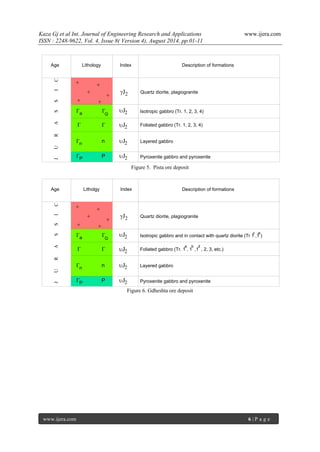
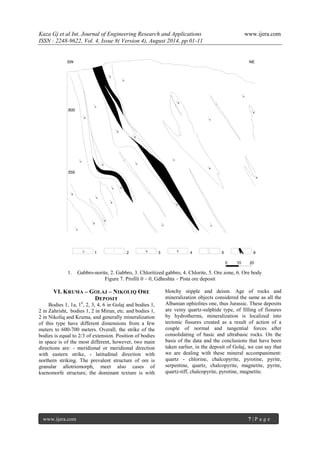
A such vertical zonality observed in Armira etc.. The body 1 with lines a, b, c, d; bodies 2, 3, 4 of Gdheshta and bodies 1, 2, 3, 4 of Pista, have typical veiny shape with distention and slimming as during the extension, as during the striking also have sub- latitudinal extension with azimuth of 80°, the south- eastern strike with the angle of 50°-60° sometimes greater than 60°. In the strike, observed its deviations from south-eastern position, in the vertical strike and even sometimes with the reverse strike. Bodies were followed during the extending with the surface works about 200 m and during the striking with drilling works of 220 m. Thickness ranges from 0.5 m to 8.4 m, while and copper content is 1.59 %. Have simple morphology, with rare ramifications, that opened and locked at certain intervals [4], [5], [7], [18]. In conclusion, quartz-sulphide and serpentine-sulphide mineralization of Pista-Gdheshta ore region related to tectonic fissures with later developing than the formation of other magmatic rocks of this structure. These levels belong to the middle and upper intrusive-gabbro cutting (fig. 5, 6, 7),[11].](https://image.slidesharecdn.com/a48040111-140911002805-phpapp02/85/Geological-Structural-Setting-of-Massif-and-the-Levels-of-Quartz-Sulphide-Mineralization-in-the-Kaptina-Gabbro-Massif-5-320.jpg)
![Kaza Gj et al Int. Journal of Engineering Research and Applications www.ijera.com
ISSN : 2248-9622, Vol. 4, Issue 8( Version 4), August 2014, pp.01-11
www.ijera.com 8 | P a g e
600
QX
QX
0
Q
n
XQ
QX
n
n
n
n
n
n
Q
Q
Q
Q
Q
Q
Q
Q
Q
Q
Q
Q
Q
Q
n
QX
QX
n
n
n
QX n
n
n
n
n
n
X
Q
X
Q
n
550
500
450
400
10 20
1 2 3 4
5 6 7 8 9
n
Q X
SW NE
1. Gabbro 2. Gabbro-norite 3. Serpentinized dunite 4. Pyroxenite 5. Quartz gabbro 6. Chloritized gabbro 7. Ore
zone 8. Ore body 9. Tectonic fault
Figure 8. Profile 11, Nikoliq ore deposit
These three mineral accompaniment,
representing three mineralization stages from these
the first stage is the most principal, the second stage
and third stage in particular are auxiliary stages that
associated with hidrotherm impulses with weaker
mineralization potential. So, for this deposit meet two
generations of pyrite, chalcopyrite, pyrotine,
magnetite. The first generation represented by the
dotted and blotchy texture, while the second
generation from their veiny textures. The major
measure of chalcopyrite is formed at the first stage
and partly at the second stage [8], [11]. As a
conclusion from the made analysis results that Kruma
deposit is located on the upper levels of the gabbro
cutting to isotropic gabbro, Nikoliq deposit is located
on the middle and lower levels, in the foliated gabbro
and layered gabbro, while Golaj deposit placed in the
lower levels of gabbro cutting to the layered gabbro
and piroxenite gabbro until piroxenite (fig. 8, 9, 10,
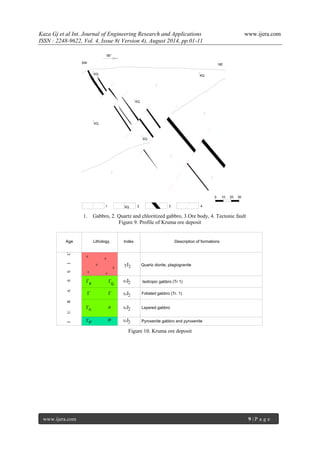
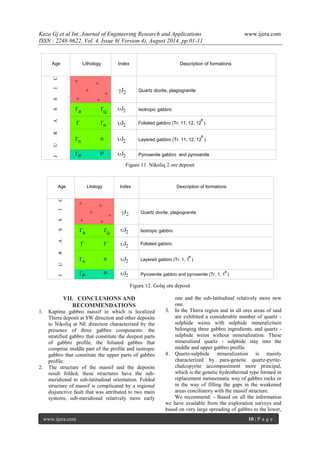
11, 12), [11].](https://image.slidesharecdn.com/a48040111-140911002805-phpapp02/85/Geological-Structural-Setting-of-Massif-and-the-Levels-of-Quartz-Sulphide-Mineralization-in-the-Kaptina-Gabbro-Massif-8-320.jpg)
![Kaza Gj et al Int. Journal of Engineering Research and Applications www.ijera.com
ISSN : 2248-9622, Vol. 4, Issue 8( Version 4), August 2014, pp.01-11
www.ijera.com 11 | P a g e
middle and upper parts, linked with these mineralizations, think that Kaptina gabbro massif represents a very important formation for research - discovery of copper sulphide deposits without output or with output in the surface that at first glance seem unimpressive. We believe that a detailed airborne geophysical surveys will highlight the important data that would lead to the discovery of other important deposits in this massif. REFERENCES
[1] Aleks V., 1972. Report on geological construction and calculation of reserves to Thirra deposit, state 1.01.1972.
[2] Aleksi V., Konomi N., Cina A. 1969. Morphological and mineralogical characteristics of the ore bodies in a copper deposit of Fan area. Summary of studies, No 12.1969.
[3] Bajo L., Konomi N., 1967. Report on the results of geological of exploration works to Thirra deposit (calculations of reserves up to 1.01.1967).
[4] Bytyçi H., 1983. Report of reserve calculations to Leproi deposit, the state 01/01/1983.
[5] Çaushi R., 1976. Report of reserve calculations to Pista - Gdheshta deposit, the state 1976.
[6] Çina A., 1977. Mineral paragenetic accompaniment of hydrothermal ore vein (Mirdita Zone). The publication of Tirana University, Mineralogy-Petrography Department, 1977.
[7] Çina A., 1979. Communities of hydrothermal veiny mineralizations of Mirdita structural-facial area. Summary of studies No 1, 1979.
[8] Hysenaj R., 2008. Quartz - sulphide mineralization in the Has region, the genetic and spatial relation with ultramafic and diorite - plagiogranite intrusions. Bulletin of Geological Sciences No.2/2008.
[9] Imami S., Pjetri F., 1979. Geological report on the geological setting and calculation of reserves of Thirra deposit, state 1.01.1979.
[10] Kaza Gj. etc., 1992. Report on the results of expoloration surveys and calculation of geological reserves of Thirra deposit, state 1.09.1992. Archive of Rubik regional geological branch.
[11] Kaza Gj. ( 2012) The structure of quartz sulphide mineralization located within the massif rocks gabror chapter and the prospect of further exploration (Dissertation).
[12] Milushi I., Meshi A., Neziraj A., Deda T., 2003. Sheeted dyke complex of Mirdita, an excellent Geological site. 4th European Geoparks Meeting, Anogia - Crete, Greece, 2-5 October 2003.
[13] Milushi I., Meshi A., Hoxha I., Deda T., Marto A., Gurabardhi L., 2004. Sheeted dyke complex of Mirdita ophiolite (Albania): structural evidence, 5th International Symposium on Eastern Mediterranean Geology, Thessaloniki, Greece, 14-20 April 2004. Proceedings, Volume 1, pp. 267-270.
[14] Milushi I., Imami S., Meshi A., Hoxha I. (2002). Structural study of the complex of parallel dikes.
[15] Nicolas A., 1989. Structures of ophiolites and oceanic lithosphere of Dynamics. Kluwer Academic Publishers, pp. 367.
[16] Nicolas A., Boudier F., Meshi A., 1999. Slow Spreading accreation and Mantle denudation in the Mirdita ophiolites (Albania). Journal of Geophysical Research.
[17] Shallo M. and Dilek Y., 2003. Development of the ideas on the Origin of Albanian ophiolites. In Dilek Y., and Newcomb S., eds., Ophiolite concept and the evolution of Geological thought. Bouldes' Colorado, Geological Society of America Special Paper 373, pp. 351-363.
[18] Shallo M., Spiro (Qirinxhi) A., Çina A., Kote Dh., Konomi N., Çaushi R., 1970. Assessing of the prospects for quartz- sulphide ores in Kaptina gabbro massif. Results of research-thematic works conducted during 1968-1970 in Kaptina gabbro massif.](https://image.slidesharecdn.com/a48040111-140911002805-phpapp02/85/Geological-Structural-Setting-of-Massif-and-the-Levels-of-Quartz-Sulphide-Mineralization-in-the-Kaptina-Gabbro-Massif-11-320.jpg)

The document discusses the geological and structural characteristics of the Kaptina Gabbro Massif in Albania, highlighting its complex petrology and the extensive quartz-sulphide mineralization present. It details the composition of gabbros, including various rock types, and the spatial organization of mineral deposits within this massif, particularly in areas like Thirra and Gdheshta-Pista. Furthermore, it emphasizes the geological interest due to the presence of valuable minerals such as copper-pyrite and gold within the mineralization.


