Drinks
sponsors:
Partner
sponsor:
Lead
sponsor:
Media
partner:
Tech
partner:
STRENGTH IN DIFFERENCE:
PRACTICAL WAYS TO
ADDRESS BOARD DIVERSITY
CHAIR
IAN JOSEPH
MANAGING DIRECTOR, RUSSAM GMS;
CHIEF EXECUTIVE, TRUSTEES UNLIMITED
SPEAKERS
BEN KERNIGHAN
DEPUTY CEO, LEAP CONFRONTING
CONFLICT
JANE HOBSON
HEAD OF GUIDANCE AND
PRACTICE, CHARITY COMMISSION
TAKEN ON TRUST: THE AWARENESS
AND EFFECTIVENESS OF CHARITY
TRUSTEES IN ENGLAND AND WALES
JANE HOBSON
HEAD OF GUIDANCE AND PRACTICE
CHARITY COMMISSION
Drinks
sponsors:
Partner
sponsor:
Lead
sponsor:
Media
partner:
Tech
partner:
Taken on Trust: the awareness and effectiveness
of charity trustees in England and Wales
Background:
• Joint project with Office of Civil Society, Cass
Business School and The Cranfield Trust
• Purpose was to gain a greater understanding of
the characteristics of contemporary trustees in
England and Wales and their awareness (or
otherwise) of their responsibilities and duties.
• Survey conducted in January 2017 was sent to
19,064 trustees (segmented by income of charity)
and returned by 3,617 [response rate of 19%]
Key findings from the survey…
General characteristics of trustees
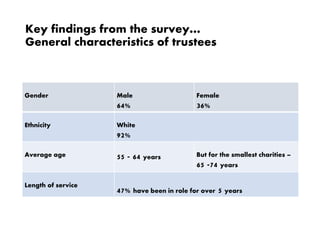
Gender Male
64%
Female
36%
Ethnicity White
92%
Average age 55 - 64 years But for the smallest charities –
65 -74 years
Length of service
47% have been in role for over 5 years
Key findings from the survey…
General characteristics of trustees
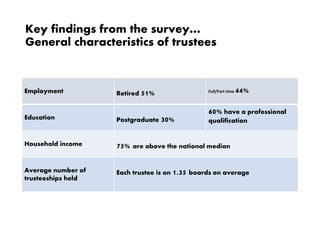
Employment Retired 51% Full/Part time 44%
Education Postgraduate 30%
60% have a professional
qualification
Household income 75% are above the national median
Average number of
trusteeships held
Each trustee is on 1.35 boards on average
Key findings from the survey…
Characteristics of boards
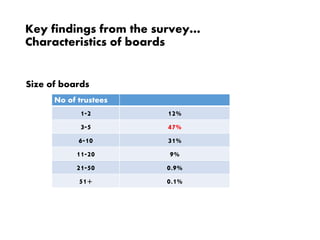
Size of boards
No of trustees
1-2 12%
3-5 47%
6-10 31%
11-20 9%
21-50 0.9%
51+ 0.1%
Key findings from the survey…
Motivation
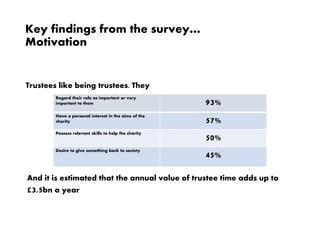
Trustees like being trustees. They
And it is estimated that the annual value of trustee time adds up to
£3.5bn a year
Regard their role as important or very
important to them 93%
Have a personal interest in the aims of the
charity 57%
Possess relevant skills to help the charity
50%
Desire to give something back to society
45%
Key findings from the survey…
Duties
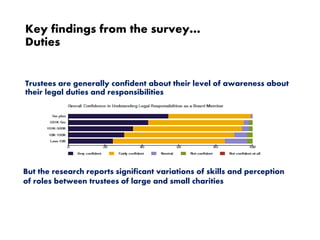
Trustees are generally confident about their level of awareness about
their legal duties and responsibilities
But the research reports significant variations of skills and perception
of roles between trustees of large and small charities
Key findings from the survey…
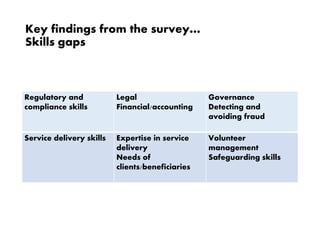
Skills gaps
Regulatory and
compliance skills
Legal
Financial/accounting
Governance
Detecting and
avoiding fraud
Service delivery skills Expertise in service
delivery
Needs of
clients/beneficiaries
Volunteer
management
Safeguarding skills
Key findings from the survey…
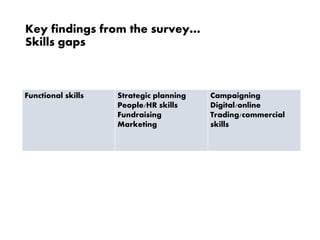
Skills gaps
Functional skills Strategic planning
People/HR skills
Fundraising
Marketing
Campaigning
Digital/online
Trading/commercial
skills
Key findings from the survey…
Recruitment
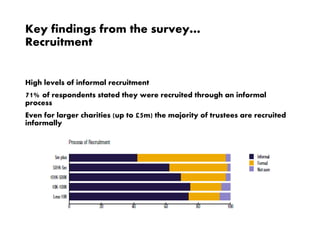
High levels of informal recruitment
71% of respondents stated they were recruited through an informal
process
Even for larger charities (up to £5m) the majority of trustees are recruited
informally
Taken on Trust: the awareness and effectiveness
of charity trustees in England and Wales
Published 13 November 2017
Charity Commission website:
www.gov.uk/charity-commission
@ChtyCommission
Strength in difference: Practical ways
to address board diversity
Ben Kernighan
Deputy CEO
Leap Confronting Conflict
www.leapcc.org.uk@leap_cc
Leap Confronting Conflict
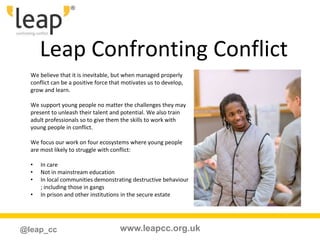
We believe that it is inevitable, but when managed properly
conflict can be a positive force that motivates us to develop,
grow and learn.
We support young people no matter the challenges they may
present to unleash their talent and potential. We also train
adult professionals so to give them the skills to work with
young people in conflict.
We focus our work on four ecosystems where young people
are most likely to struggle with conflict:
• In care
• Not in mainstream education
• In local communities demonstrating destructive behaviour
; including those in gangs
• In prison and other institutions in the secure estate
www.leapcc.org.uk@leap_cc
Diversity of the Board
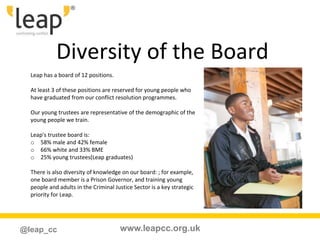
Leap has a board of 12 positions.
At least 3 of these positions are reserved for young people who
have graduated from our conflict resolution programmes.
Our young trustees are representative of the demographic of the
young people we train.
Leap's trustee board is:
o 58% male and 42% female
o 66% white and 33% BME
o 25% young trustees(Leap graduates)
There is also diversity of knowledge on our board: ; for example,
one board member is a Prison Governor, and training young
people and adults in the Criminal Justice Sector is a key strategic
priority for Leap.
www.leapcc.org.uk@leap_cc
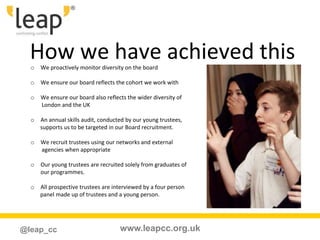
How we have achieved thiso We proactively monitor diversity on the board
o We ensure our board reflects the cohort we work with
o We ensure our board also reflects the wider diversity of
London and the UK
o An annual skills audit, conducted by our young trustees,
supports us to be targeted in our Board recruitment.
o We recruit trustees using our networks and external
agencies when appropriate
o Our young trustees are recruited solely from graduates of
our programmes.
o All prospective trustees are interviewed by a four person
panel made up of trustees and a young person.
www.leapcc.org.uk@leap_cc
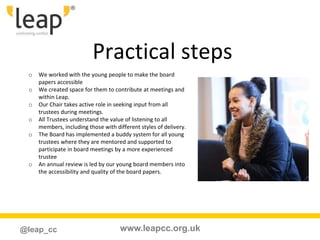
Practical steps
o We worked with the young people to make the board
papers accessible
o We created space for them to contribute at meetings and
within Leap.
o Our Chair takes active role in seeking input from all
trustees during meetings.
o All Trustees understand the value of listening to all
members, including those with different styles of delivery.
o The Board has implemented a buddy system for all young
trustees where they are mentored and supported to
participate in board meetings by a more experienced
trustee
o An annual review is led by our young board members into
the accessibility and quality of the board papers.
www.leapcc.org.uk@leap_cc
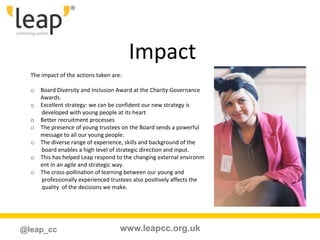
Impact
The impact of the actions taken are:
o Board Diversity and Inclusion Award at the Charity Governance
Awards.
o Excellent strategy: we can be confident our new strategy is
developed with young people at its heart
o Better recruitment processes
o The presence of young trustees on the Board sends a powerful
message to all our young people.
o The diverse range of experience, skills and background of the
board enables a high level of strategic direction and input.
o This has helped Leap respond to the changing external environm
ent in an agile and strategic way.
o The cross-pollination of learning between our young and
professionally experienced trustees also positively affects the
quality of the decisions we make.
www.leapcc.org.uk@leap_cc
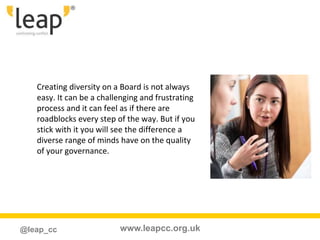
Creating diversity on a Board is not always
easy. It can be a challenging and frustrating
process and it can feel as if there are
roadblocks every step of the way. But if you
stick with it you will see the difference a
diverse range of minds have on the quality
of your governance.
Any questions?
Ben Kernighan
Ben.Kernighan@leapcc.org.uk
020 7561 3700
@leap_cc
www.leapcc.org.uk

A3: Strength in difference: Practical ways to address board diversity

  • 1.
    Drinks sponsors: Partner sponsor: Lead sponsor: Media partner: Tech partner: STRENGTH IN DIFFERENCE: PRACTICALWAYS TO ADDRESS BOARD DIVERSITY CHAIR IAN JOSEPH MANAGING DIRECTOR, RUSSAM GMS; CHIEF EXECUTIVE, TRUSTEES UNLIMITED SPEAKERS BEN KERNIGHAN DEPUTY CEO, LEAP CONFRONTING CONFLICT JANE HOBSON HEAD OF GUIDANCE AND PRACTICE, CHARITY COMMISSION
  • 2.
    TAKEN ON TRUST:THE AWARENESS AND EFFECTIVENESS OF CHARITY TRUSTEES IN ENGLAND AND WALES JANE HOBSON HEAD OF GUIDANCE AND PRACTICE CHARITY COMMISSION Drinks sponsors: Partner sponsor: Lead sponsor: Media partner: Tech partner:
  • 3.
    Taken on Trust:the awareness and effectiveness of charity trustees in England and Wales Background: • Joint project with Office of Civil Society, Cass Business School and The Cranfield Trust • Purpose was to gain a greater understanding of the characteristics of contemporary trustees in England and Wales and their awareness (or otherwise) of their responsibilities and duties. • Survey conducted in January 2017 was sent to 19,064 trustees (segmented by income of charity) and returned by 3,617 [response rate of 19%]
  • 4.
    Key findings fromthe survey… General characteristics of trustees Gender Male 64% Female 36% Ethnicity White 92% Average age 55 - 64 years But for the smallest charities – 65 -74 years Length of service 47% have been in role for over 5 years
  • 5.
    Key findings fromthe survey… General characteristics of trustees Employment Retired 51% Full/Part time 44% Education Postgraduate 30% 60% have a professional qualification Household income 75% are above the national median Average number of trusteeships held Each trustee is on 1.35 boards on average
  • 6.
    Key findings fromthe survey… Characteristics of boards Size of boards No of trustees 1-2 12% 3-5 47% 6-10 31% 11-20 9% 21-50 0.9% 51+ 0.1%
  • 7.
    Key findings fromthe survey… Motivation Trustees like being trustees. They And it is estimated that the annual value of trustee time adds up to £3.5bn a year Regard their role as important or very important to them 93% Have a personal interest in the aims of the charity 57% Possess relevant skills to help the charity 50% Desire to give something back to society 45%
  • 8.
    Key findings fromthe survey… Duties Trustees are generally confident about their level of awareness about their legal duties and responsibilities But the research reports significant variations of skills and perception of roles between trustees of large and small charities
  • 9.
    Key findings fromthe survey… Skills gaps Regulatory and compliance skills Legal Financial/accounting Governance Detecting and avoiding fraud Service delivery skills Expertise in service delivery Needs of clients/beneficiaries Volunteer management Safeguarding skills
  • 10.
    Key findings fromthe survey… Skills gaps Functional skills Strategic planning People/HR skills Fundraising Marketing Campaigning Digital/online Trading/commercial skills
  • 11.
    Key findings fromthe survey… Recruitment High levels of informal recruitment 71% of respondents stated they were recruited through an informal process Even for larger charities (up to £5m) the majority of trustees are recruited informally
  • 12.
    Taken on Trust:the awareness and effectiveness of charity trustees in England and Wales Published 13 November 2017 Charity Commission website: www.gov.uk/charity-commission @ChtyCommission
  • 13.
    Strength in difference:Practical ways to address board diversity Ben Kernighan Deputy CEO Leap Confronting Conflict
  • 14.
    www.leapcc.org.uk@leap_cc Leap Confronting Conflict Webelieve that it is inevitable, but when managed properly conflict can be a positive force that motivates us to develop, grow and learn. We support young people no matter the challenges they may present to unleash their talent and potential. We also train adult professionals so to give them the skills to work with young people in conflict. We focus our work on four ecosystems where young people are most likely to struggle with conflict: • In care • Not in mainstream education • In local communities demonstrating destructive behaviour ; including those in gangs • In prison and other institutions in the secure estate
  • 15.
    www.leapcc.org.uk@leap_cc Diversity of theBoard Leap has a board of 12 positions. At least 3 of these positions are reserved for young people who have graduated from our conflict resolution programmes. Our young trustees are representative of the demographic of the young people we train. Leap's trustee board is: o 58% male and 42% female o 66% white and 33% BME o 25% young trustees(Leap graduates) There is also diversity of knowledge on our board: ; for example, one board member is a Prison Governor, and training young people and adults in the Criminal Justice Sector is a key strategic priority for Leap.
  • 16.
    www.leapcc.org.uk@leap_cc How we haveachieved thiso We proactively monitor diversity on the board o We ensure our board reflects the cohort we work with o We ensure our board also reflects the wider diversity of London and the UK o An annual skills audit, conducted by our young trustees, supports us to be targeted in our Board recruitment. o We recruit trustees using our networks and external agencies when appropriate o Our young trustees are recruited solely from graduates of our programmes. o All prospective trustees are interviewed by a four person panel made up of trustees and a young person.
  • 17.
    www.leapcc.org.uk@leap_cc Practical steps o Weworked with the young people to make the board papers accessible o We created space for them to contribute at meetings and within Leap. o Our Chair takes active role in seeking input from all trustees during meetings. o All Trustees understand the value of listening to all members, including those with different styles of delivery. o The Board has implemented a buddy system for all young trustees where they are mentored and supported to participate in board meetings by a more experienced trustee o An annual review is led by our young board members into the accessibility and quality of the board papers.
  • 18.
    www.leapcc.org.uk@leap_cc Impact The impact ofthe actions taken are: o Board Diversity and Inclusion Award at the Charity Governance Awards. o Excellent strategy: we can be confident our new strategy is developed with young people at its heart o Better recruitment processes o The presence of young trustees on the Board sends a powerful message to all our young people. o The diverse range of experience, skills and background of the board enables a high level of strategic direction and input. o This has helped Leap respond to the changing external environm ent in an agile and strategic way. o The cross-pollination of learning between our young and professionally experienced trustees also positively affects the quality of the decisions we make.
  • 19.
    www.leapcc.org.uk@leap_cc Creating diversity ona Board is not always easy. It can be a challenging and frustrating process and it can feel as if there are roadblocks every step of the way. But if you stick with it you will see the difference a diverse range of minds have on the quality of your governance.
  • 20.