AP Chinese Updates

          Cecilia Chang
         Williams College
今日主题
   AP 中文的课程简介
   AP 中文考试及评分
   2011 AP 中文测试结果分析
   Best Practices: Working with Authentic
    Materials
AP Chinese Development Committee
                                         Lea Ekerberg (Co-Chair)
                                          - Sidwell Friends School
                                         Hong-gan Jin (Co-Chair)
                                          - Hamilton College
                                         Cecilia Chang
                                          - Williams College
                                         Jerome Packard
                                          - University of Illinois
                                         Henry Ruan
Jianhua Bai (College Board Advisor)       - Lower East Side Preparatory High School
- Kenyon College                         Xian Wu
                                          - Northview High School
Richard Chi (Chief Reader)
- University of Utah
AP Course and Exam
   “… is a collaborative effort between motivated
    students; dedicated teachers; and committed high
    schools, colleges and universities.
   AP ( 大学预修课程及测试 ): connecting students
    to college success
   经考试取得 AP 课程学分的中学生,可直接获
    得大学的学分,或抵免大学的外语必修课。
   各大学对 AP 学分的认定有不同的标准。
AP and College Success (CB’s 08
     Report)

   75% high school graduates admitted to higher
    institutions, but there is a high percentage of
    dropouts. 50% of them receive remedial courses.

   Students who take the AP courses and exams
    (especially those with a score of 3 or above) more
    likely to succeed in college/university.
AP 中文的研發及推廣
   2004 年八月大学理事会组建 15 人工作组策划 AP 中文的
    “蓝图”。
   2005 年 AP 中文研发小组成立。
   2006 年大学理事会在美国各地举办各类培训班。
   2006 年春公布 AP 中文课程大纲、教师手册(包括课程
    简介、测试样题、课程大纲样本等相关信息)及网上资
    源(练习手册、网站等)
   2006 年秋天在美国中学正式开课。
   2007 年 5 月首次举行 AP 中文课程统一考试。
AP 中文课程
   AP 中文即“大学中文预修课程”
   AP 中文课程与考试是以 21 世纪标准为核心理念与基
    本框架。
   其难度相当于大学第四学期的课程(达到Intermediate
    水平)。
   取得 AP 课程学分的中学生,可直接获得大学的中文
    学分,或抵免大学的外语必修课。
   各个大学对 AP 学分的认定有不同的标准。
AP 中文課程的指導思想
   提供學生沉浸在語言與文化中的學習經驗
   著重三種溝通模式的練習
    (interpersonal, interpretive, presentational)
   接觸大量真實與地道的語言與文化實料
   介紹恰當的當代文化主題
   提高學生語用能力與文化知識來應對生活
    中的問題
Exam Volume Trends
               2007      2008      2009     2010       2011

             3,261     4,311      5,100    6,388     7,970
Chinese
               NA      +32%      +18%      +25%      +25%
             21,709    20,675    21,029    21,357    20,637
French
              +1%       -5%         2%      +2%       -3%
             5,397     5,259      5,001    5,389     5,232
German
              +5%       -3%        -5%      +8%       -3%
             1,667     1,538      2,085    2,051     2,226
Japanese
               NA       -8%       36%       -2%       +9%
Latin:        4,929     4,847     4,295     6,523     6,044
Vergil        +2%        -2%      -11%      +52%       -7%
Spanish      101,199   101,584   110,723   118,332   122,925
Language       0%        0%       +9%       +7%       +4%
Spanish      15,321    15,971    16,633    17,136    18,103
Literature    +7%       +4%       +4%       +3%       +6%
AP Chinese Scoring Guidelines
  Task Completion:
    response to the prompt
    text type
    organization
  Delivery:
   pace
   pronunciation
   Register
  Language Control:
    vocabulary
    grammatical structures
AP Chinese Scoring Guidelines

Score                     Definition
  6       Excellent: Demonstrates excellence
  5       Very Good: suggests excellence
  4       Good: Demonstrates competence
  3       Adequate: Suggests competence
  2       Weak: Suggests lack of competence
  1       Very Weak: Demonstrates lack of
  0       competence
          Contains nothing that earns credit
Speaking Performance Characteristics:
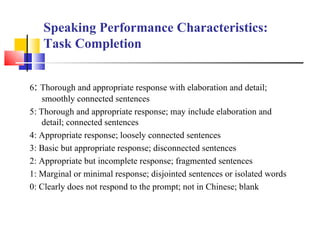
   Task Completion


6: Thorough and appropriate response with elaboration and detail;
    smoothly connected sentences
5: Thorough and appropriate response; may include elaboration and
    detail; connected sentences
4: Appropriate response; loosely connected sentences
3: Basic but appropriate response; disconnected sentences
2: Appropriate but incomplete response; fragmented sentences
1: Marginal or minimal response; disjointed sentences or isolated words
0: Clearly does not respond to the prompt; not in Chinese; blank
Speaking Performance Characteristics:
        Delivery

6: Natural pace and intonation, with minimal hesitation or repetition; accurate
   pronunciation (including tones) with minimal errors; consistent use of register
   appropriate to situation

5: Smooth pace and intonation, with occasional hesitation and repetition;
   occasional errors in pronunciation (including tones); consistent use of register
   appropriate to situation except for occasional lapses

4: Generally consistent pace and intonation, with intermittent hesitation and
   repetition; may have several errors in pronunciation (including tones), which
   do not necessitate special listener effort; may include several lapses in
   otherwise consistent use of register appropriate to situation
Speaking Performance Characteristics:
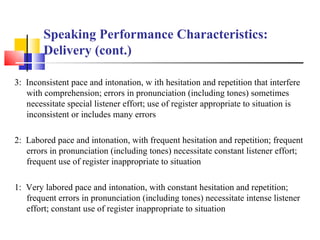
        Delivery (cont.)

3: Inconsistent pace and intonation, w ith hesitation and repetition that interfere
   with comprehension; errors in pronunciation (including tones) sometimes
   necessitate special listener effort; use of register appropriate to situation is
   inconsistent or includes many errors

2: Labored pace and intonation, with frequent hesitation and repetition; frequent
   errors in pronunciation (including tones) necessitate constant listener effort;
   frequent use of register inappropriate to situation

1: Very labored pace and intonation, with constant hesitation and repetition;
   frequent errors in pronunciation (including tones) necessitate intense listener
   effort; constant use of register inappropriate to situation
Speaking Performance Characteristics:
        Language Use

6: Rich and appropriate vocabulary and idioms, with minimal errors; wide range
   of grammatical structures, with minimal errors

5: Appropriate vocabulary and idioms, with sporadic errors; variety of
   grammatical structures, with sporadic errors

4: Mostly appropriate vocabulary and idioms, with errors that do not generally
   obscure meaning; mostly appropriate grammatical structures, with errors that
   do not generally obscure meaning
Speaking Performance Characteristics:
      Language Use (cont.)

3: Limited appropriate vocabulary and idioms, with frequent errors that
   sometimes obscure meaning; intermittent interference from another language;
   mostly simple grammatical structures, with frequent errors that sometimes
   obscure meaning

2: Minimal appropriate vocabulary, with frequent errors that obscure meaning;
   repeated interference from another language; limited grammatical structures,
   with frequent errors that obscure meaning

1: Insufficient, inappropriate vocabulary, with frequent errors that significantly
   obscure meaning; constant interference from another language; little or no
   control of grammatical structures, with frequent errors that significantly
   obscure meaning
Free Response: Part B Speaking
CONVERSATION
• 6 question; 5 minutes
• Test interpersonal communication
• Participating in conversation by responding appropriately
• 你好!请先谈谈,你为什么有兴趣来帮助我们准备中国文化周的活动?
• 在文化周中,我们想组织一次比赛。你觉得什么比赛最有意思?为什么
  ?
• 我们也要安排一次歌舞表演。你认为应该在哪里举办?说说你的理由。
• 除了这些以外,你觉得我们还可以组织什么活动?为什么?
• 你觉得怎么样才能吸引更多的人来参加文化周的活动?
• 你希望来参加这些活动的人对中国文化会有什么新的认识或了解?
Cultural Presentation

Choose ONE Chinese leisure activity (martial arts, Chinese chess, karaoke,
table tennis, etc.). In your presentation, describe this leisure activity and
explain its significance.


         You have four minutes to prepare your presentation.
         You have two minutes to record your presentation.
Score Distributions

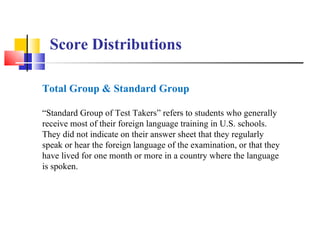
Total Group & Standard Group

“Standard Group of Test Takers” refers to students who generally
receive most of their foreign language training in U.S. schools.
They did not indicate on their answer sheet that they regularly
speak or hear the foreign language of the examination, or that they
have lived for one month or more in a country where the language
is spoken.
2011 Grade Distributions
  Question         Mean Scores         Standard          Points
                                       Deviation        Possible

                  Total   Standard   Total   Standard
 WRITING          Group    Group     Group    Group
 Presentational   4.08     3.35      1.19     1.00         6
Story Narration
 Interpersonal    4.58     3.35      1.47     1.48         6
Email Response

 SPEAKING

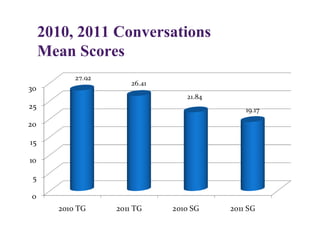
 Interpersonal    26.41    19.17     6.56     8.21        36
 Conversation
Presentational
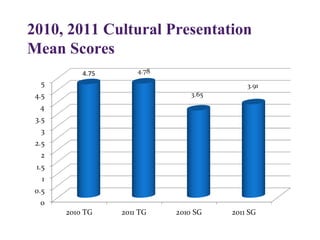
   Cultural       4.78     3.91      1.18     1.31         6
 Presentation
2010, 2011 Story Narration
Mean Scores
2010, 2011 Email Response
Mean Scores

6       5.06
                   4.58       4.28
5
                                         3.35
4

3

2

1

0
    2010 TG    2011 TG    2010 SG    2011 SG
2010, 2011 Conversations
Mean Scores
2010, 2011 Cultural Presentation
Mean Scores
       4.75
Challenging Areas in 2011 AP Chinese Test
                   Common Errors


Story Narration:

• The overriding problem was that students gave un-even
  attention to the four pictures.

• Some students skipped picture #4.
Challenging Areas in 2011 AP Chinese Test
                   Common Errors


Email Responses:

• Many students missed part of the question: 要做好
  一個口頭報告,要注意哪些事項? Some students
  didn't elaborate on 为什么你觉得这个题目很好 .

• Too many typos: 因该(应该) , 应为(因为) ,
  清除(清楚) , 将一将(讲一讲) , 专悲(准备) ,
  先(选) , 在建(再见) , 提(题) , 那些(哪
  些) .

• Unclear or illogical progression of ideas.
Challenging Areas in 2011 AP Chinese Test
                     Common Errors

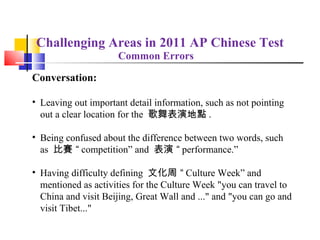
Conversation:

• Leaving out important detail information, such as not pointing
  out a clear location for the 歌舞表演地點 .

• Being confused about the difference between two words, such
  as 比賽 “ competition” and 表演 “ performance.”

• Having difficulty defining 文化周 “ Culture Week” and
  mentioned as activities for the Culture Week "you can travel to
  China and visit Beijing, Great Wall and ..." and "you can go and
  visit Tibet..."
Challenging Areas in 2011 AP Chinese Test
                    Common Errors

Cultural Presentation:

• Not enough elaborations, missing out on details or
  important aspect, such as ‘significance’.

• Language interference from English: ‘good time’/ 好時間
  ; wrong word order—e.g., “ 唱歌在那裏跟你的家人 .

• Insufficient vocabulary was a major concern.
Challenging Areas in 2011 AP Chinese Test
        Recommendations for Better Performance


• Read the instructions carefully and make sure all aspects of the
 questions were addressed.
• Pay equal attention to the information presented by the
 pictures.
• Address the content directly.
• Do not inject irrelevant information into the descriptions.
• Write a coherent story encompassing all the information
 depicted by the pictures.
Challenging Areas in 2011 AP Chinese Test
        Recommendations for Better Performance


• Practice using different words and expressions that have
  similar meanings.
• Guide the students to practice organizing information
  coherently and logically using discourse devices.
• Work on listening comprehension.
• Work on accuracy of pronunciation.
AP 最新資訊之網址


   http://apcentral.collegeboard.com/chinese
   Resources on AP Central
   Professional Development
Best Practices: Working with
Authentic Materials

         Lea Ekeberg
     Sidwell Friends School
Authentic Materials in the AP
Course
   Materials: Teachers “also make use of level-appropriate
    authentic materials designed for native speakers, including
    newspapers, fiction and nonfiction books, plays, poetry, films,
    and Chinese educational system textbooks .”

   Assessment: “Sample reading assessments include timed
    reading tests with selected-response questions that assess
    students’ ability to understand the main points of lengthy
    texts adapted from authentic sources.”


*From the AP Chinese Language and Culture Course Description
Two Scaffolding Techniques for
Authentic Materials
   Create a story to pre-teach key vocabulary
    and structures from a song, text, or video
    《改变自己》王力宏
    《听妈妈的话》周杰伦

   Create an embedded reading f0r a lengthy
    text
    《淘气包马小跳系列》
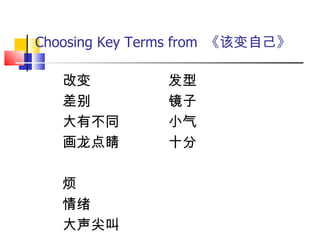
Choosing Key Terms from 《该变自己》

   改变          发型
   差别          镜子
   大有不同        小气
   画龙点睛        十分

   烦
   情绪
   大声尖叫
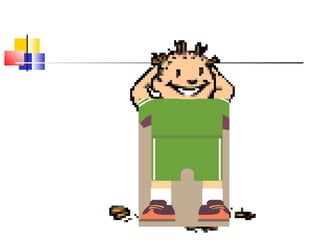
发型
 fàxíng
           发型
  发型      fàxíng
 fàxíng


 发型
fàxíng
烦
          fán
 镜子      情绪不好
jìngzi   qíngxù bù
            hǎ o
改变发型
gǎ ibiàn
 fàxíng
$$
 理发店
lǐ fàdiàn    小气
            xiǎ oqì
理发
                   lǐ fà


    十分紧张
shífēn jǐ nzhāng
大声尖叫            烦
 RAWRRRRRRRRRRRR
 RRRRRRRRRRRRRRRR     dàshēng        fán
 RRRRRRRRRRRRRRRR
 RRRRRRRRRRRRRRRR     jiānjiào
 RRRRRRRRRRRRRR!!!!
         !!                      情绪不好
                                 qíngxù bù
                                    hǎ o
 镜子
jìngzi
剪刀
jiǎ ndāo
有很大的差别
     !        大有不同!
yǒ u hěn dà    dà yǒ u
 de chābié!    bùtóng!
是画龙点睛!
      shì
huàlóngdiǎ njīng!
Embedded Readings


   An embedded reading is a series of versions of one
    reading. The versions are of increasing difficulty,
    designed to prepare students to comprehend the final
    version.

   Embedded readings were co-created by two TPRS
    teachers: Spanish teacher Laurie Clarcq (
    http://blog.heartsforteaching.com/) and Russian teacher
    Michele Whaley http://mjtprs.wordpress.com/).
Creating an Embedded Reading
    Embedded readings can be created from top to bottom, or
     bottom to top.

    The first reading is a very basic outline. It should be
     easily comprehensible to everyone.

    Each succeeding version has more detailed information,
     but also contains all previous versions in it.

    The previous versions make the final version
     comprehensible to all.

    The success of the embedded reading depends on
     comprehensibility.
Creating an Embedded Reading

Version 1   Version 2   Version 3   Version 4
Sample Embedded Reading Version
1
  花木兰想买苹果。
  她去市场。
  她买了十个包子。
Sample Embedded Reading Version
2
  有一天,花木兰很饿,所以她想买苹果。
  她和功夫熊猫一起去超级市场。
  功夫熊猫看见包子。
  花木兰就买了十个包子。
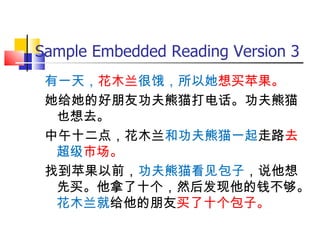
Sample Embedded Reading Version 3
 有一天,花木兰很饿,所以她想买苹果。
 她给她的好朋友功夫熊猫打电话。功夫熊猫
  也想去。
 中午十二点,花木兰和功夫熊猫一起走路去
  超级市场。
 找到苹果以前,功夫熊猫看见包子,说他想
  先买。他拿了十个,然后发现他的钱不够。
  花木兰就给他的朋友买了十个包子。
Extract Version 1
 星期六的早上,马小跳说:“今天我是爸爸,
你是儿子!”
 马天笑先生马上说:“爸爸,你儿子饿了!”
 马小跳去做早饭。
Extract Version 2
 星期六的早上,马小跳还在床上,马天笑先
生就来叫他起来做作业。
 马小跳说:“今天我是爸爸,你是儿子!”
 马天笑先生马上说:“爸爸,你儿子饿了!”
 “ 爸爸”马小跳起了床,问“儿子”马天笑先生想
吃什么?
 “鸡蛋和面包片。”
 马小跳去做早饭。
Extract Version 3
星期六的早上,马小跳还在床上,马天笑先生就来叫他起来做作业。

马小跳都不打开眼睛:“今天我是爸爸,你是儿子!”

马天笑先生马上改口叫马小跳“爸爸”。

“ 爸爸,你儿子肚子饿了,你管不管?”

“ 爸爸”马小跳起了床,问“儿子”马天笑先生想吃什么?

“ 牛奶,鸡蛋,火腿肠,黄瓜片,面包片。”

“ 爸爸”马小跳听着就觉得烦。他说:“你吃这么多,能不能少吃一点?”

“ 儿子”马天笑先生说,“你怕麻烦,就不让你儿子吃饱肚子吗?”

这样的爸爸一定是个狠心的坏爸爸。马小跳可不想做狠心的坏爸爸,他去做早
 饭。
Extract Version 4
星期六的早上,马小跳还赖在床上,马天笑先生就来掀他的被子。

“ 马小跳,快起来做作业!”

马小跳眼睛都不睁:“今天我是爸爸,你是儿子,哪有儿子管老子的?”

马天笑先生马上改口叫马小跳“爸爸”。

“ 爸爸,你儿子肚子饿了,你管不管?”

“ 爸爸”马小跳翻身起床,虽然他还想再睡一会儿,可当爸爸的总不能让儿子饿肚子吧?

“ 爸爸”马小跳起了床,一边打哈欠,一边问“儿子”马天笑先生想吃什么?

“ 牛奶,鸡蛋,火腿肠,黄瓜片,面包片。”“儿子”马天笑先生不厌其烦,“鸡蛋要煎得嫩嫩的。”

“ 爸爸”马小跳听着就觉得烦。他说:“你吃这么多,能不能少吃一点?”

“ 一样也不能少吃。”“儿子”马天笑先生说,“难道你怕麻烦,就不让你儿子吃饱肚子吗?”

如果怕麻烦就不让儿子吃饱肚子,这样的爸爸一定是个狠心的坏爸爸。马小跳可不想做狠心的坏爸爸,他给马天笑先生
  倒上一杯牛奶,把面包片放进烤面包的机器里,开始有两片烤煳了,后来的两片烤得正是火候,接着又切火腿肠,
  又切黄瓜。
Choosing Authentic Materials
    Difficulty – choose materials where the difficulty level
     is a little above that of your strongest students.

    INTEREST – choose materials that are COMPELLING
     to your students.
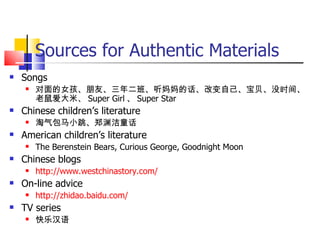
Sources for Authentic Materials
   Songs
       对面的女孩、朋友、三年二班、听妈妈的话、改变自己、宝贝、没时间、
        老鼠爱大米、 Super Girl 、 Super Star
   Chinese children’s literature
       淘气包马小跳、郑渊洁童话
   American children’s literature
       The Berenstein Bears, Curious George, Goodnight Moon
   Chinese blogs
       http://www.westchinastory.com/
   On-line advice
       http://zhidao.baidu.com/
   TV series
       快乐汉语
Sources for Supplementary Reading
     Materials
   www.chinesestoriesplatform.com
   Chinese Text Sampler
    http://www-personal.umich.edu/~dporter/sampler/sampler.ht
   Chinese Voices http://www.clavisinica.com/voices.html
   Read Chinese! http://readchinese.nflc.org/
   The Chinese Reading World
    http://faculty.virginia.edu/cll/chinese_reading/
THE END.
              謝謝!
Cecilia Chang: Cecilia.Chang@williams.edu
Lea Ekeberg: EkebergL@sidwell.edu

Session Evaluation Form
Conference: NCLC
Date: 4/14/12
Session Title: AP Chinese Updates
Presenters: Cecilia Chang and Lea Ekeberg

AP chinese updates

  • 1.
    AP Chinese Updates Cecilia Chang Williams College
  • 2.
    今日主题  AP 中文的课程简介  AP 中文考试及评分  2011 AP 中文测试结果分析  Best Practices: Working with Authentic Materials
  • 3.
    AP Chinese DevelopmentCommittee  Lea Ekerberg (Co-Chair) - Sidwell Friends School  Hong-gan Jin (Co-Chair) - Hamilton College  Cecilia Chang - Williams College  Jerome Packard - University of Illinois  Henry Ruan Jianhua Bai (College Board Advisor) - Lower East Side Preparatory High School - Kenyon College  Xian Wu - Northview High School Richard Chi (Chief Reader) - University of Utah
  • 4.
    AP Course andExam  “… is a collaborative effort between motivated students; dedicated teachers; and committed high schools, colleges and universities.  AP ( 大学预修课程及测试 ): connecting students to college success  经考试取得 AP 课程学分的中学生,可直接获 得大学的学分,或抵免大学的外语必修课。  各大学对 AP 学分的认定有不同的标准。
  • 5.
    AP and CollegeSuccess (CB’s 08 Report)  75% high school graduates admitted to higher institutions, but there is a high percentage of dropouts. 50% of them receive remedial courses.  Students who take the AP courses and exams (especially those with a score of 3 or above) more likely to succeed in college/university.
  • 6.
    AP 中文的研發及推廣  2004 年八月大学理事会组建 15 人工作组策划 AP 中文的 “蓝图”。  2005 年 AP 中文研发小组成立。  2006 年大学理事会在美国各地举办各类培训班。  2006 年春公布 AP 中文课程大纲、教师手册(包括课程 简介、测试样题、课程大纲样本等相关信息)及网上资 源(练习手册、网站等)  2006 年秋天在美国中学正式开课。  2007 年 5 月首次举行 AP 中文课程统一考试。
  • 7.
    AP 中文课程  AP 中文即“大学中文预修课程”  AP 中文课程与考试是以 21 世纪标准为核心理念与基 本框架。  其难度相当于大学第四学期的课程(达到Intermediate 水平)。  取得 AP 课程学分的中学生,可直接获得大学的中文 学分,或抵免大学的外语必修课。  各个大学对 AP 学分的认定有不同的标准。
  • 8.
    AP 中文課程的指導思想  提供學生沉浸在語言與文化中的學習經驗  著重三種溝通模式的練習 (interpersonal, interpretive, presentational)  接觸大量真實與地道的語言與文化實料  介紹恰當的當代文化主題  提高學生語用能力與文化知識來應對生活 中的問題
  • 9.
    Exam Volume Trends 2007 2008 2009 2010 2011 3,261 4,311 5,100 6,388 7,970 Chinese NA +32% +18% +25% +25% 21,709 20,675 21,029 21,357 20,637 French +1% -5% 2% +2% -3% 5,397 5,259 5,001 5,389 5,232 German +5% -3% -5% +8% -3% 1,667 1,538 2,085 2,051 2,226 Japanese NA -8% 36% -2% +9% Latin: 4,929 4,847 4,295 6,523 6,044 Vergil +2% -2% -11% +52% -7% Spanish 101,199 101,584 110,723 118,332 122,925 Language 0% 0% +9% +7% +4% Spanish 15,321 15,971 16,633 17,136 18,103 Literature +7% +4% +4% +3% +6%
  • 10.
    AP Chinese ScoringGuidelines Task Completion: response to the prompt text type organization Delivery: pace pronunciation Register Language Control: vocabulary grammatical structures
  • 11.
    AP Chinese ScoringGuidelines Score Definition 6 Excellent: Demonstrates excellence 5 Very Good: suggests excellence 4 Good: Demonstrates competence 3 Adequate: Suggests competence 2 Weak: Suggests lack of competence 1 Very Weak: Demonstrates lack of 0 competence Contains nothing that earns credit
  • 12.
    Speaking Performance Characteristics: Task Completion 6: Thorough and appropriate response with elaboration and detail; smoothly connected sentences 5: Thorough and appropriate response; may include elaboration and detail; connected sentences 4: Appropriate response; loosely connected sentences 3: Basic but appropriate response; disconnected sentences 2: Appropriate but incomplete response; fragmented sentences 1: Marginal or minimal response; disjointed sentences or isolated words 0: Clearly does not respond to the prompt; not in Chinese; blank
  • 13.
    Speaking Performance Characteristics: Delivery 6: Natural pace and intonation, with minimal hesitation or repetition; accurate pronunciation (including tones) with minimal errors; consistent use of register appropriate to situation 5: Smooth pace and intonation, with occasional hesitation and repetition; occasional errors in pronunciation (including tones); consistent use of register appropriate to situation except for occasional lapses 4: Generally consistent pace and intonation, with intermittent hesitation and repetition; may have several errors in pronunciation (including tones), which do not necessitate special listener effort; may include several lapses in otherwise consistent use of register appropriate to situation
  • 14.
    Speaking Performance Characteristics: Delivery (cont.) 3: Inconsistent pace and intonation, w ith hesitation and repetition that interfere with comprehension; errors in pronunciation (including tones) sometimes necessitate special listener effort; use of register appropriate to situation is inconsistent or includes many errors 2: Labored pace and intonation, with frequent hesitation and repetition; frequent errors in pronunciation (including tones) necessitate constant listener effort; frequent use of register inappropriate to situation 1: Very labored pace and intonation, with constant hesitation and repetition; frequent errors in pronunciation (including tones) necessitate intense listener effort; constant use of register inappropriate to situation
  • 15.
    Speaking Performance Characteristics: Language Use 6: Rich and appropriate vocabulary and idioms, with minimal errors; wide range of grammatical structures, with minimal errors 5: Appropriate vocabulary and idioms, with sporadic errors; variety of grammatical structures, with sporadic errors 4: Mostly appropriate vocabulary and idioms, with errors that do not generally obscure meaning; mostly appropriate grammatical structures, with errors that do not generally obscure meaning
  • 16.
    Speaking Performance Characteristics: Language Use (cont.) 3: Limited appropriate vocabulary and idioms, with frequent errors that sometimes obscure meaning; intermittent interference from another language; mostly simple grammatical structures, with frequent errors that sometimes obscure meaning 2: Minimal appropriate vocabulary, with frequent errors that obscure meaning; repeated interference from another language; limited grammatical structures, with frequent errors that obscure meaning 1: Insufficient, inappropriate vocabulary, with frequent errors that significantly obscure meaning; constant interference from another language; little or no control of grammatical structures, with frequent errors that significantly obscure meaning
  • 19.
    Free Response: PartB Speaking CONVERSATION • 6 question; 5 minutes • Test interpersonal communication • Participating in conversation by responding appropriately • 你好!请先谈谈,你为什么有兴趣来帮助我们准备中国文化周的活动? • 在文化周中,我们想组织一次比赛。你觉得什么比赛最有意思?为什么 ? • 我们也要安排一次歌舞表演。你认为应该在哪里举办?说说你的理由。 • 除了这些以外,你觉得我们还可以组织什么活动?为什么? • 你觉得怎么样才能吸引更多的人来参加文化周的活动? • 你希望来参加这些活动的人对中国文化会有什么新的认识或了解?
  • 20.
    Cultural Presentation Choose ONEChinese leisure activity (martial arts, Chinese chess, karaoke, table tennis, etc.). In your presentation, describe this leisure activity and explain its significance. You have four minutes to prepare your presentation. You have two minutes to record your presentation.
  • 21.
    Score Distributions Total Group& Standard Group “Standard Group of Test Takers” refers to students who generally receive most of their foreign language training in U.S. schools. They did not indicate on their answer sheet that they regularly speak or hear the foreign language of the examination, or that they have lived for one month or more in a country where the language is spoken.
  • 22.
    2011 Grade Distributions Question Mean Scores Standard Points Deviation Possible Total Standard Total Standard WRITING Group Group Group Group Presentational 4.08 3.35 1.19 1.00 6 Story Narration Interpersonal 4.58 3.35 1.47 1.48 6 Email Response SPEAKING Interpersonal 26.41 19.17 6.56 8.21 36 Conversation Presentational Cultural 4.78 3.91 1.18 1.31 6 Presentation
  • 23.
    2010, 2011 StoryNarration Mean Scores
  • 24.
    2010, 2011 EmailResponse Mean Scores 6 5.06 4.58 4.28 5 3.35 4 3 2 1 0 2010 TG 2011 TG 2010 SG 2011 SG
  • 25.
  • 26.
    2010, 2011 CulturalPresentation Mean Scores 4.75
  • 27.
    Challenging Areas in2011 AP Chinese Test Common Errors Story Narration: • The overriding problem was that students gave un-even attention to the four pictures. • Some students skipped picture #4.
  • 28.
    Challenging Areas in2011 AP Chinese Test Common Errors Email Responses: • Many students missed part of the question: 要做好 一個口頭報告,要注意哪些事項? Some students didn't elaborate on 为什么你觉得这个题目很好 . • Too many typos: 因该(应该) , 应为(因为) , 清除(清楚) , 将一将(讲一讲) , 专悲(准备) , 先(选) , 在建(再见) , 提(题) , 那些(哪 些) . • Unclear or illogical progression of ideas.
  • 29.
    Challenging Areas in2011 AP Chinese Test Common Errors Conversation: • Leaving out important detail information, such as not pointing out a clear location for the 歌舞表演地點 . • Being confused about the difference between two words, such as 比賽 “ competition” and 表演 “ performance.” • Having difficulty defining 文化周 “ Culture Week” and mentioned as activities for the Culture Week "you can travel to China and visit Beijing, Great Wall and ..." and "you can go and visit Tibet..."
  • 30.
    Challenging Areas in2011 AP Chinese Test Common Errors Cultural Presentation: • Not enough elaborations, missing out on details or important aspect, such as ‘significance’. • Language interference from English: ‘good time’/ 好時間 ; wrong word order—e.g., “ 唱歌在那裏跟你的家人 . • Insufficient vocabulary was a major concern.
  • 31.
    Challenging Areas in2011 AP Chinese Test Recommendations for Better Performance • Read the instructions carefully and make sure all aspects of the questions were addressed. • Pay equal attention to the information presented by the pictures. • Address the content directly. • Do not inject irrelevant information into the descriptions. • Write a coherent story encompassing all the information depicted by the pictures.
  • 32.
    Challenging Areas in2011 AP Chinese Test Recommendations for Better Performance • Practice using different words and expressions that have similar meanings. • Guide the students to practice organizing information coherently and logically using discourse devices. • Work on listening comprehension. • Work on accuracy of pronunciation.
  • 33.
    AP 最新資訊之網址  http://apcentral.collegeboard.com/chinese  Resources on AP Central  Professional Development
  • 34.
    Best Practices: Workingwith Authentic Materials Lea Ekeberg Sidwell Friends School
  • 35.
    Authentic Materials inthe AP Course  Materials: Teachers “also make use of level-appropriate authentic materials designed for native speakers, including newspapers, fiction and nonfiction books, plays, poetry, films, and Chinese educational system textbooks .”  Assessment: “Sample reading assessments include timed reading tests with selected-response questions that assess students’ ability to understand the main points of lengthy texts adapted from authentic sources.” *From the AP Chinese Language and Culture Course Description
  • 36.
    Two Scaffolding Techniquesfor Authentic Materials  Create a story to pre-teach key vocabulary and structures from a song, text, or video 《改变自己》王力宏 《听妈妈的话》周杰伦  Create an embedded reading f0r a lengthy text 《淘气包马小跳系列》
  • 37.
    Choosing Key Termsfrom 《该变自己》 改变 发型 差别 镜子 大有不同 小气 画龙点睛 十分 烦 情绪 大声尖叫
  • 38.
    发型 fàxíng 发型 发型 fàxíng fàxíng 发型 fàxíng
  • 39.
    fán 镜子 情绪不好 jìngzi qíngxù bù hǎ o
  • 40.
  • 41.
    $$ 理发店 lǐ fàdiàn 小气 xiǎ oqì
  • 42.
    理发 lǐ fà 十分紧张 shífēn jǐ nzhāng
  • 43.
    大声尖叫 烦 RAWRRRRRRRRRRRR RRRRRRRRRRRRRRRR dàshēng fán RRRRRRRRRRRRRRRR RRRRRRRRRRRRRRRR jiānjiào RRRRRRRRRRRRRR!!!! !! 情绪不好 qíngxù bù hǎ o 镜子 jìngzi
  • 44.
  • 46.
    有很大的差别 ! 大有不同! yǒ u hěn dà dà yǒ u de chābié! bùtóng!
  • 47.
    是画龙点睛! shì huàlóngdiǎ njīng!
  • 48.
    Embedded Readings  An embedded reading is a series of versions of one reading. The versions are of increasing difficulty, designed to prepare students to comprehend the final version.  Embedded readings were co-created by two TPRS teachers: Spanish teacher Laurie Clarcq ( http://blog.heartsforteaching.com/) and Russian teacher Michele Whaley http://mjtprs.wordpress.com/).
  • 49.
    Creating an EmbeddedReading  Embedded readings can be created from top to bottom, or bottom to top.  The first reading is a very basic outline. It should be easily comprehensible to everyone.  Each succeeding version has more detailed information, but also contains all previous versions in it.  The previous versions make the final version comprehensible to all.  The success of the embedded reading depends on comprehensibility.
  • 50.
    Creating an EmbeddedReading Version 1 Version 2 Version 3 Version 4
  • 51.
    Sample Embedded ReadingVersion 1 花木兰想买苹果。 她去市场。 她买了十个包子。
  • 52.
    Sample Embedded ReadingVersion 2 有一天,花木兰很饿,所以她想买苹果。 她和功夫熊猫一起去超级市场。 功夫熊猫看见包子。 花木兰就买了十个包子。
  • 53.
    Sample Embedded ReadingVersion 3 有一天,花木兰很饿,所以她想买苹果。 她给她的好朋友功夫熊猫打电话。功夫熊猫 也想去。 中午十二点,花木兰和功夫熊猫一起走路去 超级市场。 找到苹果以前,功夫熊猫看见包子,说他想 先买。他拿了十个,然后发现他的钱不够。 花木兰就给他的朋友买了十个包子。
  • 54.
    Extract Version 1 星期六的早上,马小跳说:“今天我是爸爸, 你是儿子!” 马天笑先生马上说:“爸爸,你儿子饿了!” 马小跳去做早饭。
  • 55.
    Extract Version 2 星期六的早上,马小跳还在床上,马天笑先 生就来叫他起来做作业。 马小跳说:“今天我是爸爸,你是儿子!” 马天笑先生马上说:“爸爸,你儿子饿了!” “ 爸爸”马小跳起了床,问“儿子”马天笑先生想 吃什么? “鸡蛋和面包片。” 马小跳去做早饭。
  • 56.
    Extract Version 3 星期六的早上,马小跳还在床上,马天笑先生就来叫他起来做作业。 马小跳都不打开眼睛:“今天我是爸爸,你是儿子!” 马天笑先生马上改口叫马小跳“爸爸”。 “爸爸,你儿子肚子饿了,你管不管?” “ 爸爸”马小跳起了床,问“儿子”马天笑先生想吃什么? “ 牛奶,鸡蛋,火腿肠,黄瓜片,面包片。” “ 爸爸”马小跳听着就觉得烦。他说:“你吃这么多,能不能少吃一点?” “ 儿子”马天笑先生说,“你怕麻烦,就不让你儿子吃饱肚子吗?” 这样的爸爸一定是个狠心的坏爸爸。马小跳可不想做狠心的坏爸爸,他去做早 饭。
  • 57.
    Extract Version 4 星期六的早上,马小跳还赖在床上,马天笑先生就来掀他的被子。 “马小跳,快起来做作业!” 马小跳眼睛都不睁:“今天我是爸爸,你是儿子,哪有儿子管老子的?” 马天笑先生马上改口叫马小跳“爸爸”。 “ 爸爸,你儿子肚子饿了,你管不管?” “ 爸爸”马小跳翻身起床,虽然他还想再睡一会儿,可当爸爸的总不能让儿子饿肚子吧? “ 爸爸”马小跳起了床,一边打哈欠,一边问“儿子”马天笑先生想吃什么? “ 牛奶,鸡蛋,火腿肠,黄瓜片,面包片。”“儿子”马天笑先生不厌其烦,“鸡蛋要煎得嫩嫩的。” “ 爸爸”马小跳听着就觉得烦。他说:“你吃这么多,能不能少吃一点?” “ 一样也不能少吃。”“儿子”马天笑先生说,“难道你怕麻烦,就不让你儿子吃饱肚子吗?” 如果怕麻烦就不让儿子吃饱肚子,这样的爸爸一定是个狠心的坏爸爸。马小跳可不想做狠心的坏爸爸,他给马天笑先生 倒上一杯牛奶,把面包片放进烤面包的机器里,开始有两片烤煳了,后来的两片烤得正是火候,接着又切火腿肠, 又切黄瓜。
  • 58.
    Choosing Authentic Materials  Difficulty – choose materials where the difficulty level is a little above that of your strongest students.  INTEREST – choose materials that are COMPELLING to your students.
  • 59.
    Sources for AuthenticMaterials  Songs  对面的女孩、朋友、三年二班、听妈妈的话、改变自己、宝贝、没时间、 老鼠爱大米、 Super Girl 、 Super Star  Chinese children’s literature  淘气包马小跳、郑渊洁童话  American children’s literature  The Berenstein Bears, Curious George, Goodnight Moon  Chinese blogs  http://www.westchinastory.com/  On-line advice  http://zhidao.baidu.com/  TV series  快乐汉语
  • 60.
    Sources for SupplementaryReading Materials  www.chinesestoriesplatform.com  Chinese Text Sampler http://www-personal.umich.edu/~dporter/sampler/sampler.ht  Chinese Voices http://www.clavisinica.com/voices.html  Read Chinese! http://readchinese.nflc.org/  The Chinese Reading World http://faculty.virginia.edu/cll/chinese_reading/
  • 61.
    THE END. 謝謝! Cecilia Chang: Cecilia.Chang@williams.edu Lea Ekeberg: EkebergL@sidwell.edu Session Evaluation Form Conference: NCLC Date: 4/14/12 Session Title: AP Chinese Updates Presenters: Cecilia Chang and Lea Ekeberg