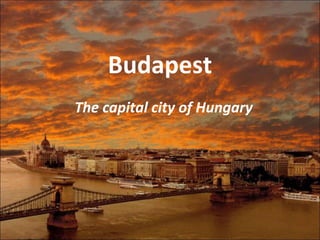
Budapest
The capital city of Hungary
Unification of Buda, Pest and Óbuda:
          17 november 1873

           Coordinates:
        47°28′19″N 19°03′01″E

                 Area:
           City: 525.16km2

         Population (2011):
          1.733.685 people
Budapest has 23 districts.
The History
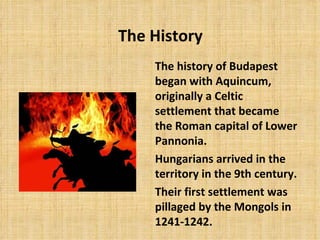
    The history of Budapest
    began with Aquincum,
    originally a Celtic
    settlement that became
    the Roman capital of Lower
    Pannonia.
    Hungarians arrived in the
    territory in the 9th century.
    Their first settlement was
    pillaged by the Mongols in
    1241-1242.
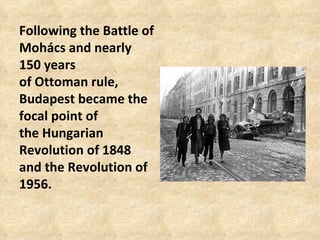
Following the Battle of
Mohács and nearly
150 years
of Ottoman rule,
Budapest became the
focal point of
the Hungarian
Revolution of 1848
and the Revolution of
1956.
Main sights
                                       Buda Castle


Buda Castle is the historical castle and palace complex
  of the Hungarian kings. It was completed in 1265.
Matthias Church

   According to church tradition, it was
    originally built in Romanesque
                  style in 1015.
  It is officially named as the Church of
                    Our Lady.
  The church was restored to its original
13th century state but a number of early
original Gothic elements were uncovered.
Heroes' Square is one of the
major squares of Budapest. Its
iconic statue complex,           Heroes’ Square
the Millennium Memorial was
completed in 1900.
Fisherman’s Bastion
   This is a terrace in neo-Gothic and neo-
Romanesque style situated on the Buda bank
of the Danube, on the Castlehill in Budapest,
around Matthias Church. It was designed and
  built between 1895 and 1902 on the plans
               of Frigyes Schulek.
Hungarian National Museum


 The Hungarian National Museum is the
national museum of Hungary. The museum
was built in the Classical style between 1837
 and 1847 by the architect Mihály Pollack.
Shoes of the Danube Promenade

     It honors the Jews who were killed by
  fascist Arrow Cross militiamen in Budapest
during World War II. They were ordered to take
 off their shoes, and were shot at the edge of
the water so that their bodies fell into the river
   and were carried away. It represents their
         shoes left behind on the bank.
Liberty Bridge

The bridge was built
between 1894 and
1896 to the plans
of János Feketeházy.
Spas


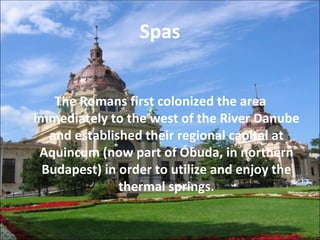
   The Romans first colonized the area
immediately to the west of the River Danube
  and established their regional capital at
 Aquincum (now part of Óbuda, in northern
 Budapest) in order to utilize and enjoy the
              thermal springs.
There are still ruins visible today of the
 enormous baths that were built during that
period. The new baths that were constructed
during the Turkish period (1541–1686) served
  both bathing and medicinal purposes, and
   some of these are still in use to this day.
Indeed, in 1934 Budapest was officially ranked
               as a "City of Spas".
Budapest has 4 famous spas: Király Spa (1565),
     Rudas Spa, Gellért Hotel and Spa and
             Széchenyi Thermal Spa.
Islands
             Margaret Island

The island mostly consists of a park and is a
  popular recreational area for tourists and
locals alike. Dance clubs, swimming pools, an
   Aqua park, athletic and fitness centres,
   bicycle and running tracks can be found
               around the island.
Csepel Island


Csepel Island is the largest island of the River
 Danube in Hungary. It is 48 km long; its width
  is 6–8 km and its area comprises 257 km2.
Hajógyári Island

   Hajógyári Island is a man built
      island, located in the third
                 district.
 This island hosts many activities
  such as wake-boarding, jet-skiing
   during the day, and dance clubs
           during the night.
This is the island where the famous
      Sziget Festival takes place.
 One of the biggest entertainment
          centres of Europe.
Edited by:
 Edina Sipos
 Zoltán Beke
 András Kiss
Péter Bodzsoni

A01 budapest

  • 1.
  • 2.
    Unification of Buda,Pest and Óbuda: 17 november 1873 Coordinates: 47°28′19″N 19°03′01″E Area: City: 525.16km2 Population (2011): 1.733.685 people
  • 3.
    Budapest has 23districts.
  • 4.
    The History The history of Budapest began with Aquincum, originally a Celtic settlement that became the Roman capital of Lower Pannonia. Hungarians arrived in the territory in the 9th century. Their first settlement was pillaged by the Mongols in 1241-1242.
  • 5.
    Following the Battleof Mohács and nearly 150 years of Ottoman rule, Budapest became the focal point of the Hungarian Revolution of 1848 and the Revolution of 1956.
  • 6.
    Main sights Buda Castle Buda Castle is the historical castle and palace complex of the Hungarian kings. It was completed in 1265.
  • 7.
    Matthias Church According to church tradition, it was originally built in Romanesque style in 1015. It is officially named as the Church of Our Lady. The church was restored to its original 13th century state but a number of early original Gothic elements were uncovered.
  • 8.
    Heroes' Square isone of the major squares of Budapest. Its iconic statue complex, Heroes’ Square the Millennium Memorial was completed in 1900.
  • 9.
    Fisherman’s Bastion This is a terrace in neo-Gothic and neo- Romanesque style situated on the Buda bank of the Danube, on the Castlehill in Budapest, around Matthias Church. It was designed and built between 1895 and 1902 on the plans of Frigyes Schulek.
  • 10.
    Hungarian National Museum The Hungarian National Museum is the national museum of Hungary. The museum was built in the Classical style between 1837 and 1847 by the architect Mihály Pollack.
  • 11.
    Shoes of theDanube Promenade It honors the Jews who were killed by fascist Arrow Cross militiamen in Budapest during World War II. They were ordered to take off their shoes, and were shot at the edge of the water so that their bodies fell into the river and were carried away. It represents their shoes left behind on the bank.
  • 12.
    Liberty Bridge The bridgewas built between 1894 and 1896 to the plans of János Feketeházy.
  • 13.
    Spas The Romans first colonized the area immediately to the west of the River Danube and established their regional capital at Aquincum (now part of Óbuda, in northern Budapest) in order to utilize and enjoy the thermal springs.
  • 14.
    There are stillruins visible today of the enormous baths that were built during that period. The new baths that were constructed during the Turkish period (1541–1686) served both bathing and medicinal purposes, and some of these are still in use to this day.
  • 15.
    Indeed, in 1934Budapest was officially ranked as a "City of Spas". Budapest has 4 famous spas: Király Spa (1565), Rudas Spa, Gellért Hotel and Spa and Széchenyi Thermal Spa.
  • 16.
    Islands Margaret Island The island mostly consists of a park and is a popular recreational area for tourists and locals alike. Dance clubs, swimming pools, an Aqua park, athletic and fitness centres, bicycle and running tracks can be found around the island.
  • 17.
    Csepel Island Csepel Islandis the largest island of the River Danube in Hungary. It is 48 km long; its width is 6–8 km and its area comprises 257 km2.
  • 18.
    Hajógyári Island Hajógyári Island is a man built island, located in the third district. This island hosts many activities such as wake-boarding, jet-skiing during the day, and dance clubs during the night. This is the island where the famous Sziget Festival takes place. One of the biggest entertainment centres of Europe.
  • 19.
    Edited by: EdinaSipos Zoltán Beke András Kiss Péter Bodzsoni