A tour of F9 microkernel and BitSec hypervisorA tour of F9 microkernel and BitSec hypervisor
Louie Lu (Louie Lu ( 呂紹榕呂紹榕 ) <louie.lu@hopebaytech.com>) <louie.lu@hopebaytech.com>
11/24 @ ARRC Tainan11/24 @ ARRC Tainan
11/25/16 2
Content
11/25/16 3
From 2nd
gen to 3nd
gen microkenrel
F9 microkernel feature
BitSec: 3rd
generation IoT Hypervisor
11/25/16 4
From 2nd
Gen to 3rd
Gen
microkernel
11/25/16 5
●
From 2nd
gen to 3nd
gen microkenrel
2nd
Generation microkernel
L3
Qualitative improvement of IPC performance
22 times faster then Mach
1993 [Jochen Liedkte]
L4 family
start from 1995, V2 ABI about L3
11/25/16 6
●
From 2nd
gen to 3nd
gen microkenrel
2nd
Generation microkernel
L3
Qualitative improvement of IPC performance
22 times faster then Mach
1993 [Jochen Liedkte]
L4 family
start from 1995, V2 ABI about L3
Fiasco, the first high level language (C++) and open
source L4 microkernel
L4Ka::Pistachio,
OKL4, from OKLabs
11/25/16 7
●
From 2nd
gen to 3nd
gen microkenrel
2nd
Generation microkernel
L3
Qualitative improvement of IPC performance
22 times faster then Mach
1993 [Jochen Liedkte]
L4 family
start from 1995, V2 ABI about L3
Fiasco, the first high level language (C++) and open
source L4 microkernel
L4Ka::Pistachio,
OKL4, from OKLabs
11/25/16 8
●
From 2nd
gen to 3nd
gen microkenrel
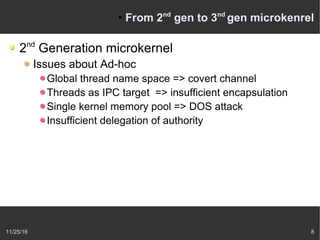
2nd
Generation microkernel
Issues about Ad-hoc
Global thread name space => covert channel
Threads as IPC target => insufficient encapsulation
Single kernel memory pool => DOS attack
Insufficient delegation of authority
11/25/16 9
●
From 2nd
gen to 3nd
gen microkenrel
3rd
Generation microkernel, focus on...
Capability Model
Less system calls (seL4 only have 3 syscalls)
Clear semantics (Async EndPoint ...etc)
Formal Verification
11/25/16 10
●
From 2nd
gen to 3nd
gen microkenrel
Capability Model
Cnode, Caps in seL4
fine-graint permission control
Less system calls (seL4 only have 3 syscalls)
Clear semantics (Async EndPoint ...etc)
Formal Verification
11/25/16 11
●
From 2nd
gen to 3nd
gen microkenrel
Capability Model
Cnode, Caps in seL4
Less system calls (seL4 only have 3 syscalls)
Clear semantics (Async EndPoint ...etc)
Formal Verification
seL4 [SOSO'09]
Verve [PLDI'10]
FSCQ [SOSP'15]
mCertiKOS ['POPL'15]
CoGENT [ASPLOS'16]
11/25/16 12
●
From 2nd
gen to 3nd
gen microkenrel
Formal Verification
seL4 [SOSP'09]
mCertiKOS [POPL'15]
verified sequential kernels
11/25/16 13
●
From 2nd
gen to 3nd
gen microkenrel
Formal Verification
Ironcald [OSDI'14]
verified software stack
11/25/16 14
●
From 2nd
gen to 3nd
gen microkenrel
Formal Verification
FSCQ [SOSP'15]
CoGENT [ASPLOS'16]
verified sequential file systems
11/25/16 15
●
From 2nd
gen to 3nd
gen microkenrel
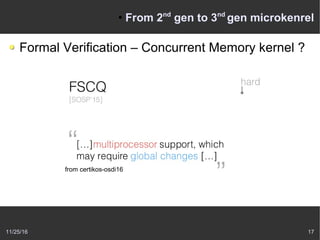
Formal Verification – Concurrent Memory kernel ?
11/25/16 16
●
From 2nd
gen to 3nd
gen microkenrel
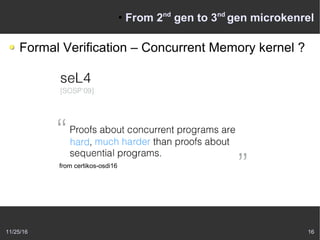
Formal Verification – Concurrent Memory kernel ?
from certikos-osdi16
11/25/16 17
●
From 2nd
gen to 3nd
gen microkenrel
Formal Verification – Concurrent Memory kernel ?
from certikos-osdi16
11/25/16 18
●
From 2nd
gen to 3nd
gen microkenrel
Formal Verification – Concurrent Memory kernel ?
CertiKOS [OSDI'16]
Solve the problem
global changes
I/O concurrency
fine-grained lock
liveness
compiler
cost...
11/25/16 19
●
From 2nd
gen to 3nd
gen microkenrel
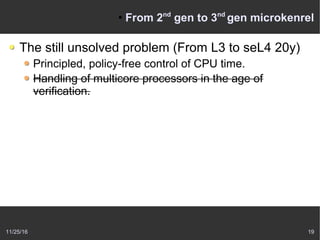
The still unsolved problem (From L3 to seL4 20y)
Principled, policy-free control of CPU time.
Handling of multicore processors in the age of
verification.
11/25/16 20
F9 microkernel
11/25/16 21
F9 microkernel
Memory Management
Debugging Tools
The Bug
Unsolved problems
11/25/16 22
F9 microkernel
Memory Management
MPU (Memory Protection Unit)
Fpage
Address Space
11/25/16 23
F9 microkernel - MPU
Protected Memory System Architecture (PMSAv7)
ARMv7-M supports PMSAv7
MPU
Support 8 memory region for setting
Provide access premission control
Provide memory execute setting
11/25/16 24
F9 microkernel - MPU
MPU Register
MPU_TYPE - Type Register
MPU_CTRL - Control Regiser
MPU_RNR - Region Number Register
MPU_RBAR - Region Base Address Register
MPU_RASR - Region Attribute and Size Register
11/25/16 25
F9 microkernel - MPU
MPU – Region Number Register
Select the region to read or write
affect with RBAR, RASR
11/25/16 26
F9 microkernel - MPU
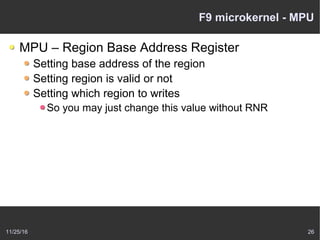
MPU – Region Base Address Register
Setting base address of the region
Setting region is valid or not
Setting which region to writes
So you may just change this value without RNR
11/25/16 27
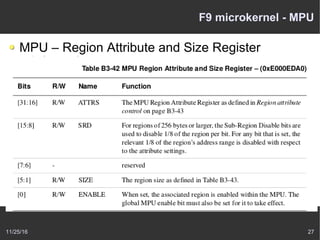
F9 microkernel - MPU
MPU – Region Attribute and Size Register
11/25/16 28
F9 microkernel - MPU
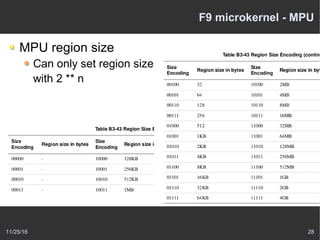
MPU region size
Can only set region size
with 2 ** n
11/25/16 29
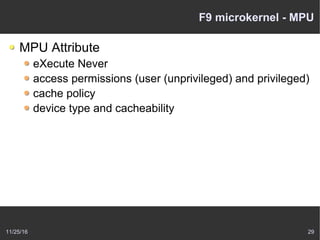
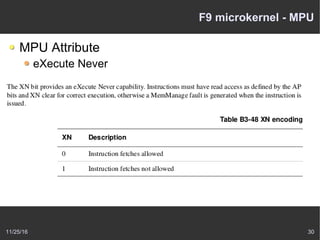
F9 microkernel - MPU
MPU Attribute
eXecute Never
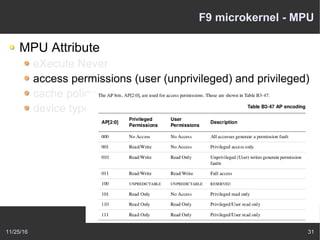
access permissions (user (unprivileged) and privileged)
cache policy
device type and cacheability
11/25/16 30
F9 microkernel - MPU
MPU Attribute
eXecute Never
access permissions (user (unprivileged) and privileged)
cache policy
device type and cacheability
11/25/16 31
F9 microkernel - MPU
MPU Attribute
eXecute Never
access permissions (user (unprivileged) and privileged)
cache policy
device type and cacheability
11/25/16 32
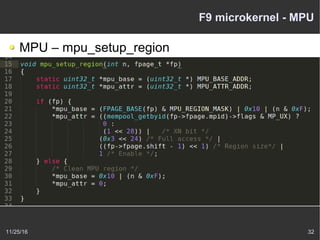
F9 microkernel - MPU
MPU – mpu_setup_region
11/25/16 33
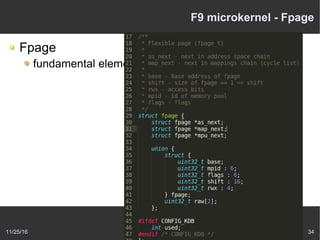
F9 microkernel - Fpage
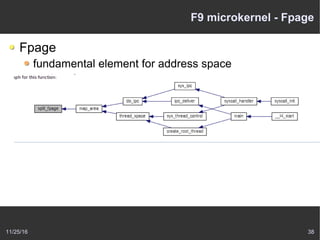
Fpage
fundamental element for address space
11/25/16 34
F9 microkernel - Fpage
Fpage
fundamental element for address space
11/25/16 35
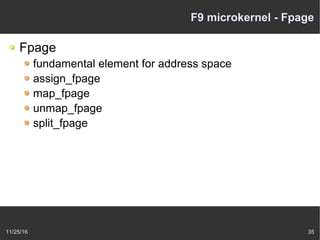
F9 microkernel - Fpage
Fpage
fundamental element for address space
assign_fpage
map_fpage
unmap_fpage
split_fpage
11/25/16 36
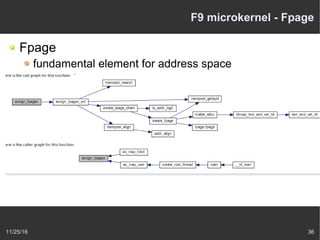
F9 microkernel - Fpage
Fpage
fundamental element for address space
assign_fpage
map_fpage
unmap_fpage
split_fpage
11/25/16 37
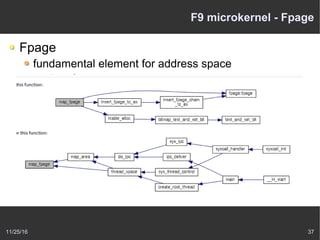
F9 microkernel - Fpage
Fpage
fundamental element for address space
assign_fpage
map_fpage
unmap_fpage
split_fpage
11/25/16 38
F9 microkernel - Fpage
Fpage
fundamental element for address space
assign_fpage
map_fpage
unmap_fpage
split_fpage
11/25/16 39
F9 microkernel – Address Space
Address Space (as)
Construct by fpage list
Contain one thread's fpage information
5 API
11/25/16 40
F9 microkenrel – Address Space
Address Space API
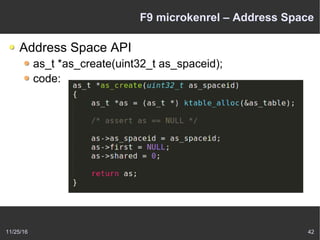
as_t *as_create(uint32_t as_spaceid);
void as_destroy(as_t *as);
void as_setup_mpu(as_t *as, memptr_t sp, memptr_t
pc, memptr_t stack_base, size_t stack_size);
void as_map_user(as_t *as);
void as_map_ktext(as_t *as);
11/25/16 41
F9 microkenrel – Address Space
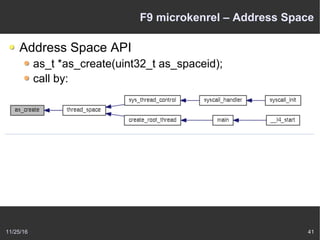
Address Space API
as_t *as_create(uint32_t as_spaceid);
call by:
11/25/16 42
F9 microkenrel – Address Space
Address Space API
as_t *as_create(uint32_t as_spaceid);
code:
11/25/16 43
F9 microkenrel – Address Space
Address Space API
void as_map_user(as_t *as);
Map user text, data and hardware device memory
void as_map_ktext(as_t *as);
Map kernel text, data
11/25/16 44
F9 microkenrel – Address Space
Address Space API
void as_setup_mpu(as_t *as, memptr_t sp, memptr_t
pc, memptr_t stack_base, size_t stack_size);
11/25/16 45
F9 microkenrel – Address Space
Address Space API
as_setup_mpu
protect stack fpages first
then
PC
always-mapped fpages
other
11/25/16 46
F9 microkernel – Memory management
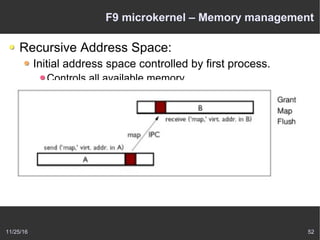
System calls are provided to manage address
spaces:
Grant: The memory page is granted to a new user and
cannot be used anymore by its former user.
Map: This implements shared memory – the memory
page is passed to another task but can be used by both
tasks.
Flush: The memory page that has been mapped to
other users will be flushed out of their address space.
11/25/16 47
F9 microkernel – Memory management
System calls are provided to manage address
spaces:
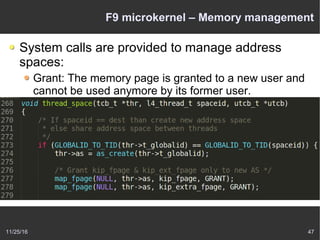
Grant: The memory page is granted to a new user and
cannot be used anymore by its former user.
Map: This implements shared memory – the memory
page is passed to another task but can be used by both
tasks.
Flush: The memory page that has been mapped to
other users will be flushed out of their address space.
11/25/16 48
F9 microkernel – Memory management
System calls are provided to manage address
spaces:
Grant: The memory page is granted to a new user and
cannot be used anymore by its former user.
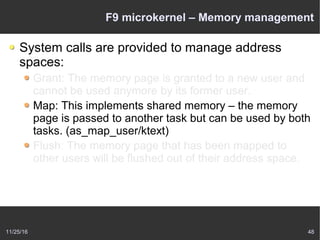
Map: This implements shared memory – the memory
page is passed to another task but can be used by both
tasks. (as_map_user/ktext)
Flush: The memory page that has been mapped to
other users will be flushed out of their address space.
11/25/16 49
F9 microkernel – Memory management
System calls are provided to manage address
spaces:
Grant: The memory page is granted to a new user and
cannot be used anymore by its former user.
Map: This implements shared memory – the memory
page is passed to another task but can be used by both
tasks.
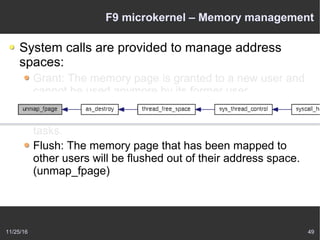
Flush: The memory page that has been mapped to
other users will be flushed out of their address space.
(unmap_fpage)
11/25/16 50
F9 microkernel – Memory management
Recursive Address Space:
Initial address space controlled by first process.
Controls all available memory
Other address spaces empty at boot
In F9 microkernel, root thread was the init address space
holder
11/25/16 51
F9 microkernel – Memory management
Recursive Address Space:
Initial address space controlled by first process.
Controls all available memory
Other address spaces empty at boot
In F9 microkernel, root thread was the init address space
holder
Other processes (threads) obtain memory pages from
first or from their other processes that got page from
parent
11/25/16 52
F9 microkernel – Memory management
Recursive Address Space:
Initial address space controlled by first process.
Controls all available memory
Other address spaces empty at boot
In F9 microkernel, root thread was the init address space
holder
Other processes (threads) obtain memory pages from
first or from their other processes that got page from
parent
11/25/16 53
F9 microkernel – Memory management
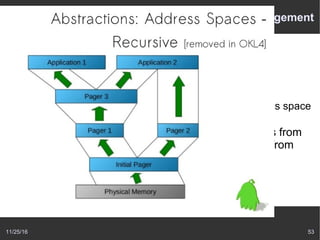
Recursive Address Space:
Initial address space controlled by first process.
Controls all available memory
Other address spaces empty at boot
In F9 microkernel, root thread was the init address space
holder
Other processes (threads) obtain memory pages from
first or from their other processes that got page from
parent
11/25/16 54
F9 microkernel
Debugging Tools
kdb
kproble
openocd + gdb
11/25/16 55
F9 microkernel – Debugging Tools
KDB
In-kernel debugger is built and run at boot by default
support multiple useful command
easy to adding new command
11/25/16 56
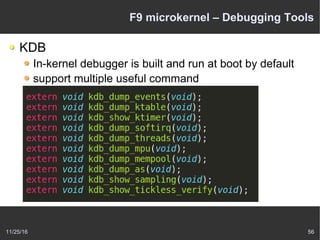
F9 microkernel – Debugging Tools
KDB
In-kernel debugger is built and run at boot by default
support multiple useful command
11/25/16 57
F9 microkernel – Debugging Tools
kprobe
Linux-style kprobe
support banding by symbol name
11/25/16 58
F9 microkernel – Debugging Tools
openocd + gdb
Powerful then st-util
useful command:
http://openocd.org/doc/html/General-Commands.html
11/25/16 59
F9 microkernel – Debugging Tools
openocd + gdb
Powerful then st-util
useful command:
http://openocd.org/doc/html/General-Commands.html
11/25/16 60
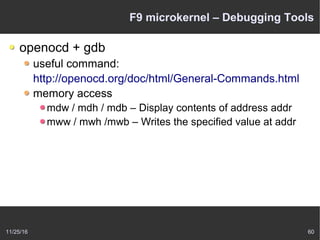
F9 microkernel – Debugging Tools
openocd + gdb
useful command:
http://openocd.org/doc/html/General-Commands.html
memory access
mdw / mdh / mdb – Display contents of address addr
mww / mwh /mwb – Writes the specified value at addr
11/25/16 61
F9 microkernel – Debugging Tools
openocd + gdb
useful command:
http://openocd.org/doc/html/General-Commands.html
memory access
mdw / mdh / mdb – Display contents of address addr
mww / mwh /mwb – Writes the specified value at addr
access register value
reg – dump all register value
reg [number | name] [value] – just OP
11/25/16 62
F9 microkernel – The Bug
The Bug
Really matter one
11/25/16 63
F9 microkernel – The Bug
The Bug
Really matter one
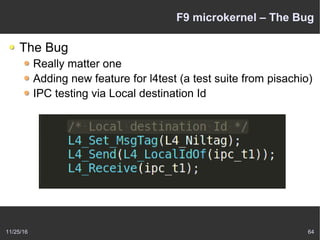
Adding new feature for l4test (a test suite from pisachio)
IPC testing via Local destination Id
11/25/16 64
F9 microkernel – The Bug
The Bug
Really matter one
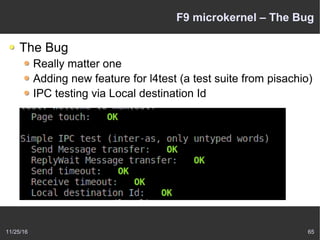
Adding new feature for l4test (a test suite from pisachio)
IPC testing via Local destination Id
11/25/16 65
F9 microkernel – The Bug
The Bug
Really matter one
Adding new feature for l4test (a test suite from pisachio)
IPC testing via Local destination Id
11/25/16 66
F9 microkernel – The Bug
The Bug
Really matter one
Adding new feature for l4test (a test suite from pisachio)
IPC testing via Local destination Id
11/25/16 67
F9 microkernel – The Bug
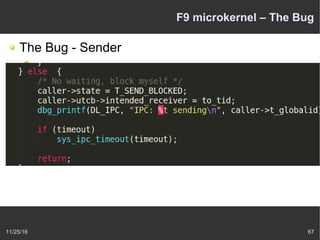
The Bug - Sender
11/25/16 68
F9 microkernel – The Bug
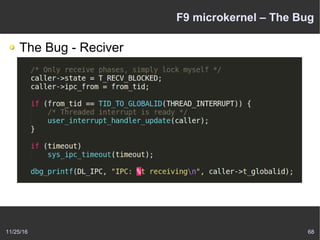
The Bug - Reciver
11/25/16 69
F9 microkernel – The Bug
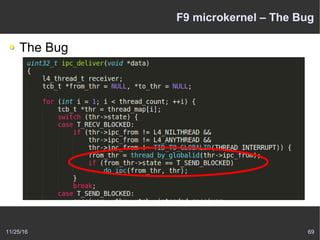
The Bug
11/25/16 70
F9 microkernel – The Bug
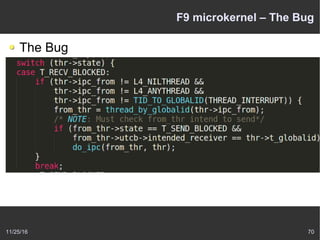
The Bug
11/25/16 71
F9 microkernel – Unsolved problems
Unsolved problems
Time-slice schedule
User space busy loop hang system
POSIX layer support
11/25/16 72
BitSec
11/25/16 73
BitSec
BitSec is......
BitSec is a microkernel intended for high-reliability
embedded applications on ARMv7-M architecture
processors, such as the Cortex-M4.
BitSec is a third-generation microkernel. Its design is
heavily inspired by EROS/KeyKOS, MINIX 3, and the L4
family, particularly seL4.
11/25/16 74
BitSec
BitSec, like other third-generation microkernel
Focuses on minimality and security,
Expresses all authority through explicit capabilities,
Moves other mechanisms with security implications
outside the kernel,
Blurs the line between a traditional microkernel and a
hypervisor, and
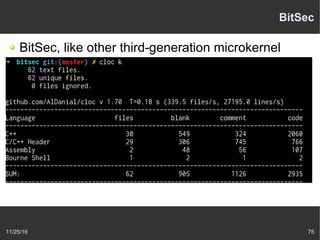
Targets a very small kernel codebase (in BitSec’s case,
less than 2500 sloccount lines of code).
11/25/16 75
BitSec
BitSec, like other third-generation microkernel
Focuses on minimality and security,
Expresses all authority through explicit capabilities,
Moves other mechanisms with security implications
outside the kernel,
Blurs the line between a traditional microkernel and a
hypervisor, and
Targets a very small kernel codebase (in BitSec’s case,
less than 2500 sloccount lines of code).
11/25/16 76
BitSec
BitSec is not...
A complete operating system
11/25/16 77
BitSec
BitSec is not...
A complete operating system
By analogy: putting the Linux kernel on a computer
doesn’t allow one to run Firefox. Linux is only a kernel;
there’s a whole lot of operating system that must be
added to make a complete system.
This is even more true of BitSec than of Linux, because
BitSec’s design is so minimal. Like other third-
generation microkernels, BitSec doesn’t even include
hardware drivers in the kernel.
11/25/16 78
BitSec
BitSec is not...
A complete operating system
11/25/16 79
BitSec
BitSec is not...
A complete operating system
By analogy: putting the Linux kernel on a computer
doesn’t allow one to run Firefox. Linux is only a kernel;
there’s a whole lot of operating system that must be
added to make a complete system.
This is even more true of BitSec than of Linux, because
BitSec’s design is so minimal. Like other third-
generation microkernels, BitSec doesn’t even include
hardware drivers in the kernel.
11/25/16 80
BitSec - Key
BitSec capability: Key
Conceptually, Key combines
A reference to a kernel object
A set of operations on that object that the key enables
11/25/16 81
BitSec - Key
BitSec capability: Key
Implementation, a key is a kernel data structure built
from three part
A brand, which distinguishes kines of keys to particular
object from one another
A generation, which distinguishes keys to successive
objects, created in the same location, from one another.
A pointer to a kernel object.
11/25/16 82
BitSec - Key
BitSec capability: Key
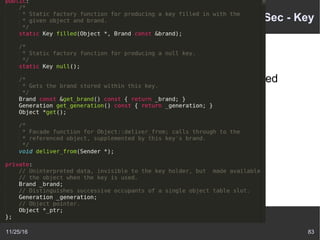
struct
11/25/16 83
BitSec - Key
BitSec capability: Key
struct
keys can be freely copied but not directly created
mint the key from object table
11/25/16 84
BitSec - Key
BitSec capability: Key
Brands
64 bit value chosen when the key was create (minted)
indelible, cannot be alter except by minting a new key
program cannot discover the brand of keys they hold
when a key is copied, the copies bear the same brand
11/25/16 85
BitSec - Key
BitSec capability: Key
keys can be freely copied but not directly created
mint the key from object table
program can only perform three operations on a key
Copy the key into a different key register
Send a message to the object designated by the key
Receive a message from the object designated by the
key
11/25/16 86
BitSec - Key
BitSec capability: Key
keys can be freely copied but not directly created
mint the key from object table
program can not do following without holding addi auth
Determine the kind of kernel object designated by a key
Determine if two keys designate the same kernel object
Determine if two keys give the same rights on their
designated objects
11/25/16 87
BitSec - Key
BitSec capability: Key
keys can be freely copied but not directly created
mint the key from object table
program can not do following without holding addi auth
Determine the kind of kernel object designated by a key
Determine if two keys designate the same kernel object
Determine if two keys give the same rights on their
designated objects
11/25/16 88
BitSec - Key
BitSec capability: Key
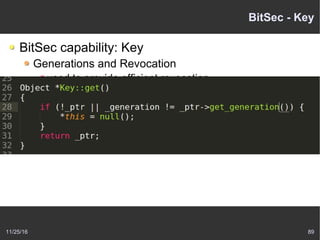
Generations and Revocation
used to provide efficient revocation
When program invokes a key
kernel compares the key's generation to a object
generation
If two match, proceeds normally
If not match, object has been invalidated
11/25/16 89
BitSec - Key
BitSec capability: Key
Generations and Revocation
used to provide efficient revocation
When program invokes a key
kernel compares the key's generation to a object
generation
If two match, proceeds normally
If not match, object has been invalidated
11/25/16 90
BitSec – Object Oriented
BitSec design: Object Oriented
Using c++11 standard
Every resource and service that the system can see in
the kernel is represented as an objectbundling together
state and operations on that state.
11/25/16 91
BitSec – Object Oriented
BitSec design: Object Oriented
Using c++11 standard
Every resource and service that the system can see in
the kernel is represented as an objectbundling together
state and operations on that state.
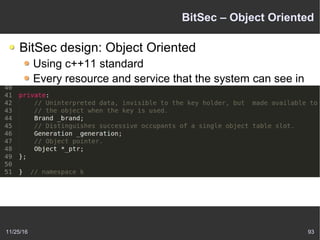
For example: the Keys
11/25/16 92
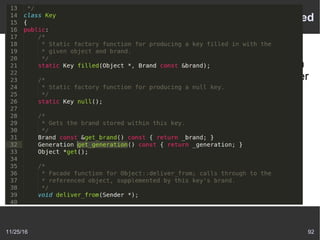
BitSec – Object Oriented
BitSec design: Object Oriented
Every resource and service that the system can see in
the kernel is represented as an objectbundling together
state and operations on that state.
For example: the Keys
11/25/16 93
BitSec – Object Oriented
BitSec design: Object Oriented
Using c++11 standard
Every resource and service that the system can see in
the kernel is represented as an objectbundling together
state and operations on that state.
For example: the Keys
11/25/16 94
BitSec – Object Oriented
BitSec design: Object Oriented
Using c++11 standard
Every resource and service that the system can see in
the kernel is represented as an objectbundling together
state and operations on that state.
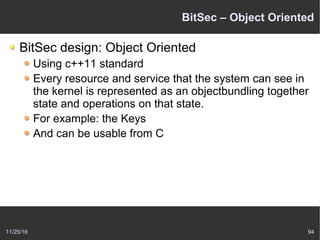
For example: the Keys
And can be usable from C
11/25/16 95
BitSec – Object Oriented
BitSec design: Object Oriented
And can be usable from C
BitSec is implemented in C++11, but was designed to
be usable from legacy languages suchas C and
assembler.
As FreeRTOS/BitSec is entirely C (and C90 at that), this
seems to have worked.
11/25/16 96
BitSec – Future work
BitSec future work
Enhancement of the build systems
porting guest OS to BitSec
(FreeRTOS, Linux, or maybe from stratch)
Formal Verify by CoGENT
Adding network stack ?
11/25/16 97
F9 / BitSec
Demoon stm32f429
11/25/16 98
A tour of F9 microkernel and BitSec hypervisor
Q&A
11/25/16 99
A tour of F9 microkernel and BitSec hypervisor
Thanks
11/25/16 100
References
CertiKOS: An Extensible Architecture for Building Certified Concurrent OS Kernels
http://flint.cs.yale.edu/certikos/publications/certikos-osdi16.pdf
F9 microkernel & ARM hypervisor
https://hackmd.io/s/r16AUMbJe
F9: A secure microkernel for MMUless embedded systems
https://github.com/grapherd/f9-report
F9: A secure and Efficient Microkernel Built for Deeply Embedded Systems
http://www.slideshare.net/jserv/f9-microkernel
Technical Report on the BitSec Kernel
OpenOCD general command
http://openocd.org/doc/html/General-Commands.html

A tour of F9 microkernel and BitSec hypervisor

  • 1.
    A tour ofF9 microkernel and BitSec hypervisorA tour of F9 microkernel and BitSec hypervisor Louie Lu (Louie Lu ( 呂紹榕呂紹榕 ) <louie.lu@hopebaytech.com>) <louie.lu@hopebaytech.com> 11/24 @ ARRC Tainan11/24 @ ARRC Tainan
  • 2.
  • 3.
    11/25/16 3 From 2nd gento 3nd gen microkenrel F9 microkernel feature BitSec: 3rd generation IoT Hypervisor
  • 4.
    11/25/16 4 From 2nd Gento 3rd Gen microkernel
  • 5.
    11/25/16 5 ● From 2nd gento 3nd gen microkenrel 2nd Generation microkernel L3 Qualitative improvement of IPC performance 22 times faster then Mach 1993 [Jochen Liedkte] L4 family start from 1995, V2 ABI about L3
  • 6.
    11/25/16 6 ● From 2nd gento 3nd gen microkenrel 2nd Generation microkernel L3 Qualitative improvement of IPC performance 22 times faster then Mach 1993 [Jochen Liedkte] L4 family start from 1995, V2 ABI about L3 Fiasco, the first high level language (C++) and open source L4 microkernel L4Ka::Pistachio, OKL4, from OKLabs
  • 7.
    11/25/16 7 ● From 2nd gento 3nd gen microkenrel 2nd Generation microkernel L3 Qualitative improvement of IPC performance 22 times faster then Mach 1993 [Jochen Liedkte] L4 family start from 1995, V2 ABI about L3 Fiasco, the first high level language (C++) and open source L4 microkernel L4Ka::Pistachio, OKL4, from OKLabs
  • 8.
    11/25/16 8 ● From 2nd gento 3nd gen microkenrel 2nd Generation microkernel Issues about Ad-hoc Global thread name space => covert channel Threads as IPC target => insufficient encapsulation Single kernel memory pool => DOS attack Insufficient delegation of authority
  • 9.
    11/25/16 9 ● From 2nd gento 3nd gen microkenrel 3rd Generation microkernel, focus on... Capability Model Less system calls (seL4 only have 3 syscalls) Clear semantics (Async EndPoint ...etc) Formal Verification
  • 10.
    11/25/16 10 ● From 2nd gento 3nd gen microkenrel Capability Model Cnode, Caps in seL4 fine-graint permission control Less system calls (seL4 only have 3 syscalls) Clear semantics (Async EndPoint ...etc) Formal Verification
  • 11.
    11/25/16 11 ● From 2nd gento 3nd gen microkenrel Capability Model Cnode, Caps in seL4 Less system calls (seL4 only have 3 syscalls) Clear semantics (Async EndPoint ...etc) Formal Verification seL4 [SOSO'09] Verve [PLDI'10] FSCQ [SOSP'15] mCertiKOS ['POPL'15] CoGENT [ASPLOS'16]
  • 12.
    11/25/16 12 ● From 2nd gento 3nd gen microkenrel Formal Verification seL4 [SOSP'09] mCertiKOS [POPL'15] verified sequential kernels
  • 13.
    11/25/16 13 ● From 2nd gento 3nd gen microkenrel Formal Verification Ironcald [OSDI'14] verified software stack
  • 14.
    11/25/16 14 ● From 2nd gento 3nd gen microkenrel Formal Verification FSCQ [SOSP'15] CoGENT [ASPLOS'16] verified sequential file systems
  • 15.
    11/25/16 15 ● From 2nd gento 3nd gen microkenrel Formal Verification – Concurrent Memory kernel ?
  • 16.
    11/25/16 16 ● From 2nd gento 3nd gen microkenrel Formal Verification – Concurrent Memory kernel ? from certikos-osdi16
  • 17.
    11/25/16 17 ● From 2nd gento 3nd gen microkenrel Formal Verification – Concurrent Memory kernel ? from certikos-osdi16
  • 18.
    11/25/16 18 ● From 2nd gento 3nd gen microkenrel Formal Verification – Concurrent Memory kernel ? CertiKOS [OSDI'16] Solve the problem global changes I/O concurrency fine-grained lock liveness compiler cost...
  • 19.
    11/25/16 19 ● From 2nd gento 3nd gen microkenrel The still unsolved problem (From L3 to seL4 20y) Principled, policy-free control of CPU time. Handling of multicore processors in the age of verification.
  • 20.
  • 21.
    11/25/16 21 F9 microkernel MemoryManagement Debugging Tools The Bug Unsolved problems
  • 22.
    11/25/16 22 F9 microkernel MemoryManagement MPU (Memory Protection Unit) Fpage Address Space
  • 23.
    11/25/16 23 F9 microkernel- MPU Protected Memory System Architecture (PMSAv7) ARMv7-M supports PMSAv7 MPU Support 8 memory region for setting Provide access premission control Provide memory execute setting
  • 24.
    11/25/16 24 F9 microkernel- MPU MPU Register MPU_TYPE - Type Register MPU_CTRL - Control Regiser MPU_RNR - Region Number Register MPU_RBAR - Region Base Address Register MPU_RASR - Region Attribute and Size Register
  • 25.
    11/25/16 25 F9 microkernel- MPU MPU – Region Number Register Select the region to read or write affect with RBAR, RASR
  • 26.
    11/25/16 26 F9 microkernel- MPU MPU – Region Base Address Register Setting base address of the region Setting region is valid or not Setting which region to writes So you may just change this value without RNR
  • 27.
    11/25/16 27 F9 microkernel- MPU MPU – Region Attribute and Size Register
  • 28.
    11/25/16 28 F9 microkernel- MPU MPU region size Can only set region size with 2 ** n
  • 29.
    11/25/16 29 F9 microkernel- MPU MPU Attribute eXecute Never access permissions (user (unprivileged) and privileged) cache policy device type and cacheability
  • 30.
    11/25/16 30 F9 microkernel- MPU MPU Attribute eXecute Never access permissions (user (unprivileged) and privileged) cache policy device type and cacheability
  • 31.
    11/25/16 31 F9 microkernel- MPU MPU Attribute eXecute Never access permissions (user (unprivileged) and privileged) cache policy device type and cacheability
  • 32.
    11/25/16 32 F9 microkernel- MPU MPU – mpu_setup_region
  • 33.
    11/25/16 33 F9 microkernel- Fpage Fpage fundamental element for address space
  • 34.
    11/25/16 34 F9 microkernel- Fpage Fpage fundamental element for address space
  • 35.
    11/25/16 35 F9 microkernel- Fpage Fpage fundamental element for address space assign_fpage map_fpage unmap_fpage split_fpage
  • 36.
    11/25/16 36 F9 microkernel- Fpage Fpage fundamental element for address space assign_fpage map_fpage unmap_fpage split_fpage
  • 37.
    11/25/16 37 F9 microkernel- Fpage Fpage fundamental element for address space assign_fpage map_fpage unmap_fpage split_fpage
  • 38.
    11/25/16 38 F9 microkernel- Fpage Fpage fundamental element for address space assign_fpage map_fpage unmap_fpage split_fpage
  • 39.
    11/25/16 39 F9 microkernel– Address Space Address Space (as) Construct by fpage list Contain one thread's fpage information 5 API
  • 40.
    11/25/16 40 F9 microkenrel– Address Space Address Space API as_t *as_create(uint32_t as_spaceid); void as_destroy(as_t *as); void as_setup_mpu(as_t *as, memptr_t sp, memptr_t pc, memptr_t stack_base, size_t stack_size); void as_map_user(as_t *as); void as_map_ktext(as_t *as);
  • 41.
    11/25/16 41 F9 microkenrel– Address Space Address Space API as_t *as_create(uint32_t as_spaceid); call by:
  • 42.
    11/25/16 42 F9 microkenrel– Address Space Address Space API as_t *as_create(uint32_t as_spaceid); code:
  • 43.
    11/25/16 43 F9 microkenrel– Address Space Address Space API void as_map_user(as_t *as); Map user text, data and hardware device memory void as_map_ktext(as_t *as); Map kernel text, data
  • 44.
    11/25/16 44 F9 microkenrel– Address Space Address Space API void as_setup_mpu(as_t *as, memptr_t sp, memptr_t pc, memptr_t stack_base, size_t stack_size);
  • 45.
    11/25/16 45 F9 microkenrel– Address Space Address Space API as_setup_mpu protect stack fpages first then PC always-mapped fpages other
  • 46.
    11/25/16 46 F9 microkernel– Memory management System calls are provided to manage address spaces: Grant: The memory page is granted to a new user and cannot be used anymore by its former user. Map: This implements shared memory – the memory page is passed to another task but can be used by both tasks. Flush: The memory page that has been mapped to other users will be flushed out of their address space.
  • 47.
    11/25/16 47 F9 microkernel– Memory management System calls are provided to manage address spaces: Grant: The memory page is granted to a new user and cannot be used anymore by its former user. Map: This implements shared memory – the memory page is passed to another task but can be used by both tasks. Flush: The memory page that has been mapped to other users will be flushed out of their address space.
  • 48.
    11/25/16 48 F9 microkernel– Memory management System calls are provided to manage address spaces: Grant: The memory page is granted to a new user and cannot be used anymore by its former user. Map: This implements shared memory – the memory page is passed to another task but can be used by both tasks. (as_map_user/ktext) Flush: The memory page that has been mapped to other users will be flushed out of their address space.
  • 49.
    11/25/16 49 F9 microkernel– Memory management System calls are provided to manage address spaces: Grant: The memory page is granted to a new user and cannot be used anymore by its former user. Map: This implements shared memory – the memory page is passed to another task but can be used by both tasks. Flush: The memory page that has been mapped to other users will be flushed out of their address space. (unmap_fpage)
  • 50.
    11/25/16 50 F9 microkernel– Memory management Recursive Address Space: Initial address space controlled by first process. Controls all available memory Other address spaces empty at boot In F9 microkernel, root thread was the init address space holder
  • 51.
    11/25/16 51 F9 microkernel– Memory management Recursive Address Space: Initial address space controlled by first process. Controls all available memory Other address spaces empty at boot In F9 microkernel, root thread was the init address space holder Other processes (threads) obtain memory pages from first or from their other processes that got page from parent
  • 52.
    11/25/16 52 F9 microkernel– Memory management Recursive Address Space: Initial address space controlled by first process. Controls all available memory Other address spaces empty at boot In F9 microkernel, root thread was the init address space holder Other processes (threads) obtain memory pages from first or from their other processes that got page from parent
  • 53.
    11/25/16 53 F9 microkernel– Memory management Recursive Address Space: Initial address space controlled by first process. Controls all available memory Other address spaces empty at boot In F9 microkernel, root thread was the init address space holder Other processes (threads) obtain memory pages from first or from their other processes that got page from parent
  • 54.
    11/25/16 54 F9 microkernel DebuggingTools kdb kproble openocd + gdb
  • 55.
    11/25/16 55 F9 microkernel– Debugging Tools KDB In-kernel debugger is built and run at boot by default support multiple useful command easy to adding new command
  • 56.
    11/25/16 56 F9 microkernel– Debugging Tools KDB In-kernel debugger is built and run at boot by default support multiple useful command
  • 57.
    11/25/16 57 F9 microkernel– Debugging Tools kprobe Linux-style kprobe support banding by symbol name
  • 58.
    11/25/16 58 F9 microkernel– Debugging Tools openocd + gdb Powerful then st-util useful command: http://openocd.org/doc/html/General-Commands.html
  • 59.
    11/25/16 59 F9 microkernel– Debugging Tools openocd + gdb Powerful then st-util useful command: http://openocd.org/doc/html/General-Commands.html
  • 60.
    11/25/16 60 F9 microkernel– Debugging Tools openocd + gdb useful command: http://openocd.org/doc/html/General-Commands.html memory access mdw / mdh / mdb – Display contents of address addr mww / mwh /mwb – Writes the specified value at addr
  • 61.
    11/25/16 61 F9 microkernel– Debugging Tools openocd + gdb useful command: http://openocd.org/doc/html/General-Commands.html memory access mdw / mdh / mdb – Display contents of address addr mww / mwh /mwb – Writes the specified value at addr access register value reg – dump all register value reg [number | name] [value] – just OP
  • 62.
    11/25/16 62 F9 microkernel– The Bug The Bug Really matter one
  • 63.
    11/25/16 63 F9 microkernel– The Bug The Bug Really matter one Adding new feature for l4test (a test suite from pisachio) IPC testing via Local destination Id
  • 64.
    11/25/16 64 F9 microkernel– The Bug The Bug Really matter one Adding new feature for l4test (a test suite from pisachio) IPC testing via Local destination Id
  • 65.
    11/25/16 65 F9 microkernel– The Bug The Bug Really matter one Adding new feature for l4test (a test suite from pisachio) IPC testing via Local destination Id
  • 66.
    11/25/16 66 F9 microkernel– The Bug The Bug Really matter one Adding new feature for l4test (a test suite from pisachio) IPC testing via Local destination Id
  • 67.
    11/25/16 67 F9 microkernel– The Bug The Bug - Sender
  • 68.
    11/25/16 68 F9 microkernel– The Bug The Bug - Reciver
  • 69.
    11/25/16 69 F9 microkernel– The Bug The Bug
  • 70.
    11/25/16 70 F9 microkernel– The Bug The Bug
  • 71.
    11/25/16 71 F9 microkernel– Unsolved problems Unsolved problems Time-slice schedule User space busy loop hang system POSIX layer support
  • 72.
  • 73.
    11/25/16 73 BitSec BitSec is...... BitSecis a microkernel intended for high-reliability embedded applications on ARMv7-M architecture processors, such as the Cortex-M4. BitSec is a third-generation microkernel. Its design is heavily inspired by EROS/KeyKOS, MINIX 3, and the L4 family, particularly seL4.
  • 74.
    11/25/16 74 BitSec BitSec, likeother third-generation microkernel Focuses on minimality and security, Expresses all authority through explicit capabilities, Moves other mechanisms with security implications outside the kernel, Blurs the line between a traditional microkernel and a hypervisor, and Targets a very small kernel codebase (in BitSec’s case, less than 2500 sloccount lines of code).
  • 75.
    11/25/16 75 BitSec BitSec, likeother third-generation microkernel Focuses on minimality and security, Expresses all authority through explicit capabilities, Moves other mechanisms with security implications outside the kernel, Blurs the line between a traditional microkernel and a hypervisor, and Targets a very small kernel codebase (in BitSec’s case, less than 2500 sloccount lines of code).
  • 76.
    11/25/16 76 BitSec BitSec isnot... A complete operating system
  • 77.
    11/25/16 77 BitSec BitSec isnot... A complete operating system By analogy: putting the Linux kernel on a computer doesn’t allow one to run Firefox. Linux is only a kernel; there’s a whole lot of operating system that must be added to make a complete system. This is even more true of BitSec than of Linux, because BitSec’s design is so minimal. Like other third- generation microkernels, BitSec doesn’t even include hardware drivers in the kernel.
  • 78.
    11/25/16 78 BitSec BitSec isnot... A complete operating system
  • 79.
    11/25/16 79 BitSec BitSec isnot... A complete operating system By analogy: putting the Linux kernel on a computer doesn’t allow one to run Firefox. Linux is only a kernel; there’s a whole lot of operating system that must be added to make a complete system. This is even more true of BitSec than of Linux, because BitSec’s design is so minimal. Like other third- generation microkernels, BitSec doesn’t even include hardware drivers in the kernel.
  • 80.
    11/25/16 80 BitSec -Key BitSec capability: Key Conceptually, Key combines A reference to a kernel object A set of operations on that object that the key enables
  • 81.
    11/25/16 81 BitSec -Key BitSec capability: Key Implementation, a key is a kernel data structure built from three part A brand, which distinguishes kines of keys to particular object from one another A generation, which distinguishes keys to successive objects, created in the same location, from one another. A pointer to a kernel object.
  • 82.
    11/25/16 82 BitSec -Key BitSec capability: Key struct
  • 83.
    11/25/16 83 BitSec -Key BitSec capability: Key struct keys can be freely copied but not directly created mint the key from object table
  • 84.
    11/25/16 84 BitSec -Key BitSec capability: Key Brands 64 bit value chosen when the key was create (minted) indelible, cannot be alter except by minting a new key program cannot discover the brand of keys they hold when a key is copied, the copies bear the same brand
  • 85.
    11/25/16 85 BitSec -Key BitSec capability: Key keys can be freely copied but not directly created mint the key from object table program can only perform three operations on a key Copy the key into a different key register Send a message to the object designated by the key Receive a message from the object designated by the key
  • 86.
    11/25/16 86 BitSec -Key BitSec capability: Key keys can be freely copied but not directly created mint the key from object table program can not do following without holding addi auth Determine the kind of kernel object designated by a key Determine if two keys designate the same kernel object Determine if two keys give the same rights on their designated objects
  • 87.
    11/25/16 87 BitSec -Key BitSec capability: Key keys can be freely copied but not directly created mint the key from object table program can not do following without holding addi auth Determine the kind of kernel object designated by a key Determine if two keys designate the same kernel object Determine if two keys give the same rights on their designated objects
  • 88.
    11/25/16 88 BitSec -Key BitSec capability: Key Generations and Revocation used to provide efficient revocation When program invokes a key kernel compares the key's generation to a object generation If two match, proceeds normally If not match, object has been invalidated
  • 89.
    11/25/16 89 BitSec -Key BitSec capability: Key Generations and Revocation used to provide efficient revocation When program invokes a key kernel compares the key's generation to a object generation If two match, proceeds normally If not match, object has been invalidated
  • 90.
    11/25/16 90 BitSec –Object Oriented BitSec design: Object Oriented Using c++11 standard Every resource and service that the system can see in the kernel is represented as an objectbundling together state and operations on that state.
  • 91.
    11/25/16 91 BitSec –Object Oriented BitSec design: Object Oriented Using c++11 standard Every resource and service that the system can see in the kernel is represented as an objectbundling together state and operations on that state. For example: the Keys
  • 92.
    11/25/16 92 BitSec –Object Oriented BitSec design: Object Oriented Every resource and service that the system can see in the kernel is represented as an objectbundling together state and operations on that state. For example: the Keys
  • 93.
    11/25/16 93 BitSec –Object Oriented BitSec design: Object Oriented Using c++11 standard Every resource and service that the system can see in the kernel is represented as an objectbundling together state and operations on that state. For example: the Keys
  • 94.
    11/25/16 94 BitSec –Object Oriented BitSec design: Object Oriented Using c++11 standard Every resource and service that the system can see in the kernel is represented as an objectbundling together state and operations on that state. For example: the Keys And can be usable from C
  • 95.
    11/25/16 95 BitSec –Object Oriented BitSec design: Object Oriented And can be usable from C BitSec is implemented in C++11, but was designed to be usable from legacy languages suchas C and assembler. As FreeRTOS/BitSec is entirely C (and C90 at that), this seems to have worked.
  • 96.
    11/25/16 96 BitSec –Future work BitSec future work Enhancement of the build systems porting guest OS to BitSec (FreeRTOS, Linux, or maybe from stratch) Formal Verify by CoGENT Adding network stack ?
  • 97.
    11/25/16 97 F9 /BitSec Demoon stm32f429
  • 98.
    11/25/16 98 A tourof F9 microkernel and BitSec hypervisor Q&A
  • 99.
    11/25/16 99 A tourof F9 microkernel and BitSec hypervisor Thanks
  • 100.
    11/25/16 100 References CertiKOS: AnExtensible Architecture for Building Certified Concurrent OS Kernels http://flint.cs.yale.edu/certikos/publications/certikos-osdi16.pdf F9 microkernel & ARM hypervisor https://hackmd.io/s/r16AUMbJe F9: A secure microkernel for MMUless embedded systems https://github.com/grapherd/f9-report F9: A secure and Efficient Microkernel Built for Deeply Embedded Systems http://www.slideshare.net/jserv/f9-microkernel Technical Report on the BitSec Kernel OpenOCD general command http://openocd.org/doc/html/General-Commands.html

Editor's Notes

  • #85 Brands allow two keys to the same object to behave differently. The meaning of a brand is entirely up to the object designated by the key. Kernel objects specify the meaning of brands so that the System can mint appropriate keys,   but transparent objects (particularly Gates) pass the brand up to programs for interpretation.   It may encode access permissions, unique client identifiers, etc.