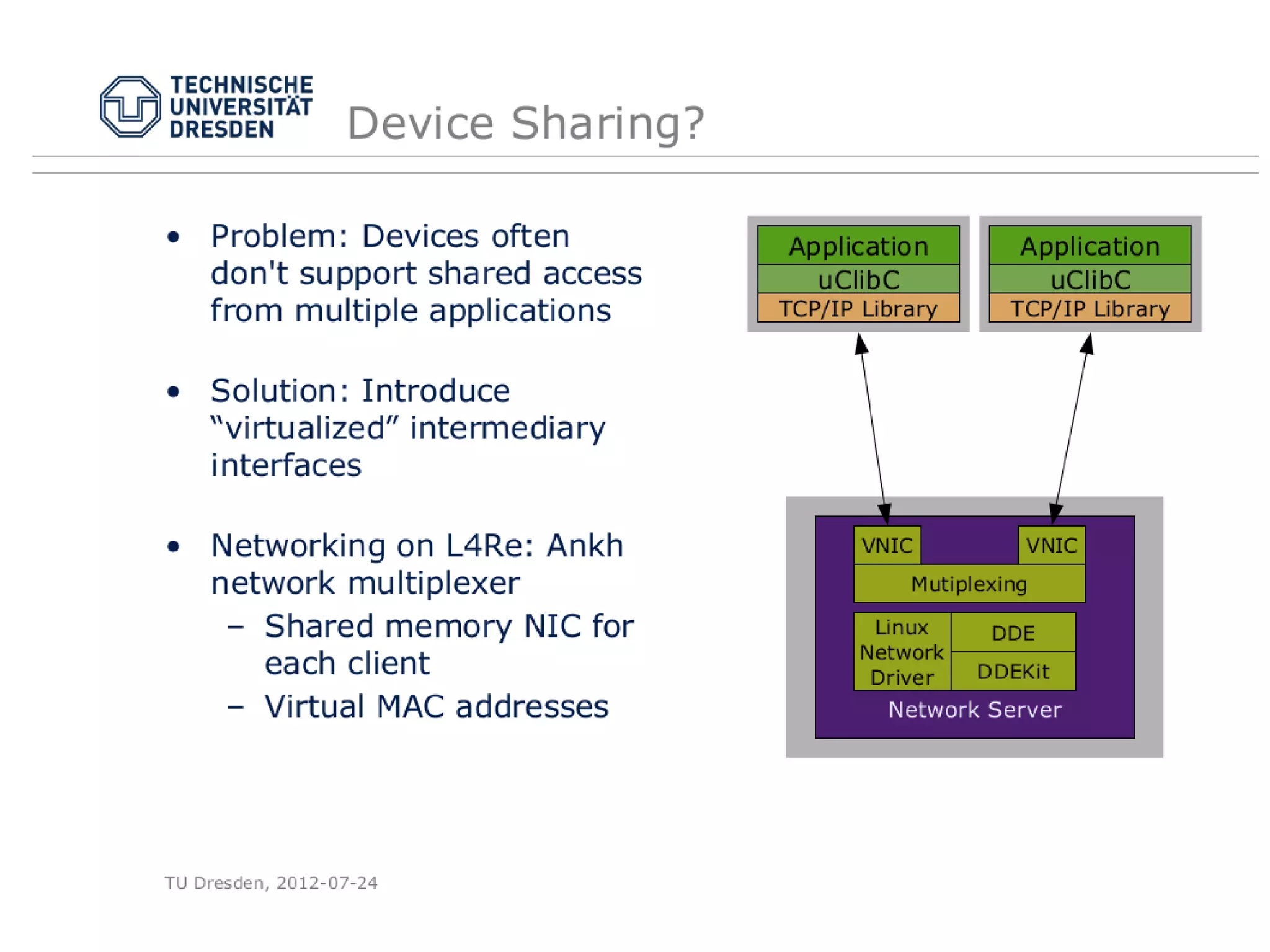
Hints for L4 Microkernel
Jim Huang ( 黃敬群 ) <jserv@0xlab.org>
May 30, 2013 / NCTU, Taiwan
Rights to copy
Attribution – ShareAlike 3.0
You are free
to copy, distribute, display, and perform the work
to make derivative works
to make commercial use of the work
Under the following conditions
Attribution. You must give the original author credit.
Share Alike. If you alter, transform, or build upon this work, you may distribute the
resulting work only under a license identical to this one.
For any reuse or distribution, you must make clear to others the license terms of this work.
Any of these conditions can be waived if you get permission from the copyright holder.
Your fair use and other rights are in no way affected by the above.
License text: http://creativecommons.org/licenses/by-sa/3.0/legalcode
© Copyright 2013 0xlab
http://0xlab.org/
Corrections, suggestions, contributions and translations
are welcome!
Latest update: May 16, 2013
Goals of This Presentation
• Introduce L4 microkernel principles and concepts
– from “Microkernel Construction”
http://os.inf.tu-dresden.de/Studium/MkK/
– From "Microkernel-based Operating Systems"
http://www.inf.tu-dresden.de/index.php?node_id=1314
• Understand the real world usage for microkernels
• Explore the modern implementation of modern L4
microkernel
Agenda
• Background Knowledge
• Microkernel-based Operating Systems
• Case Study
Background Knowledge
Microkernel Concepts
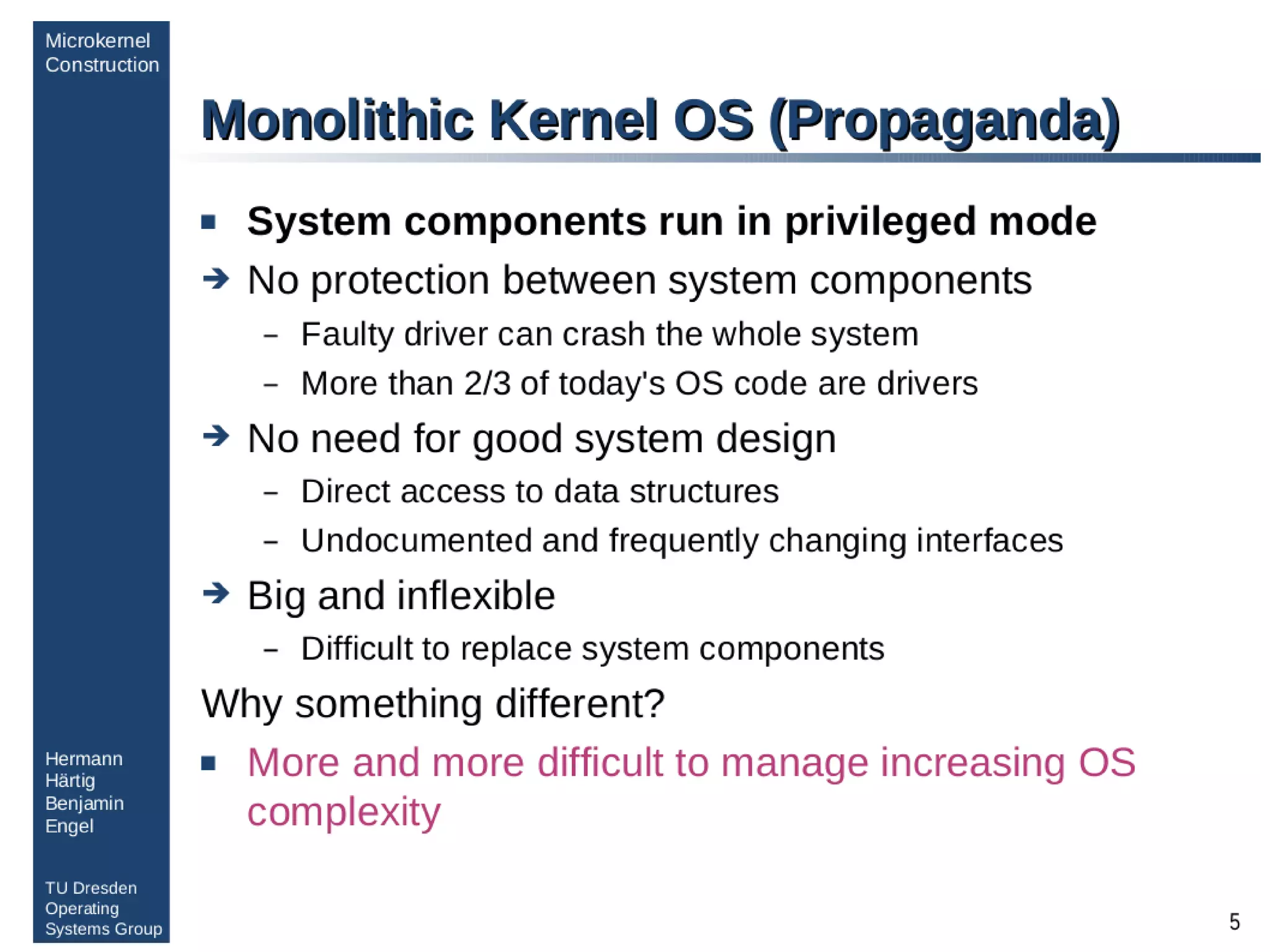
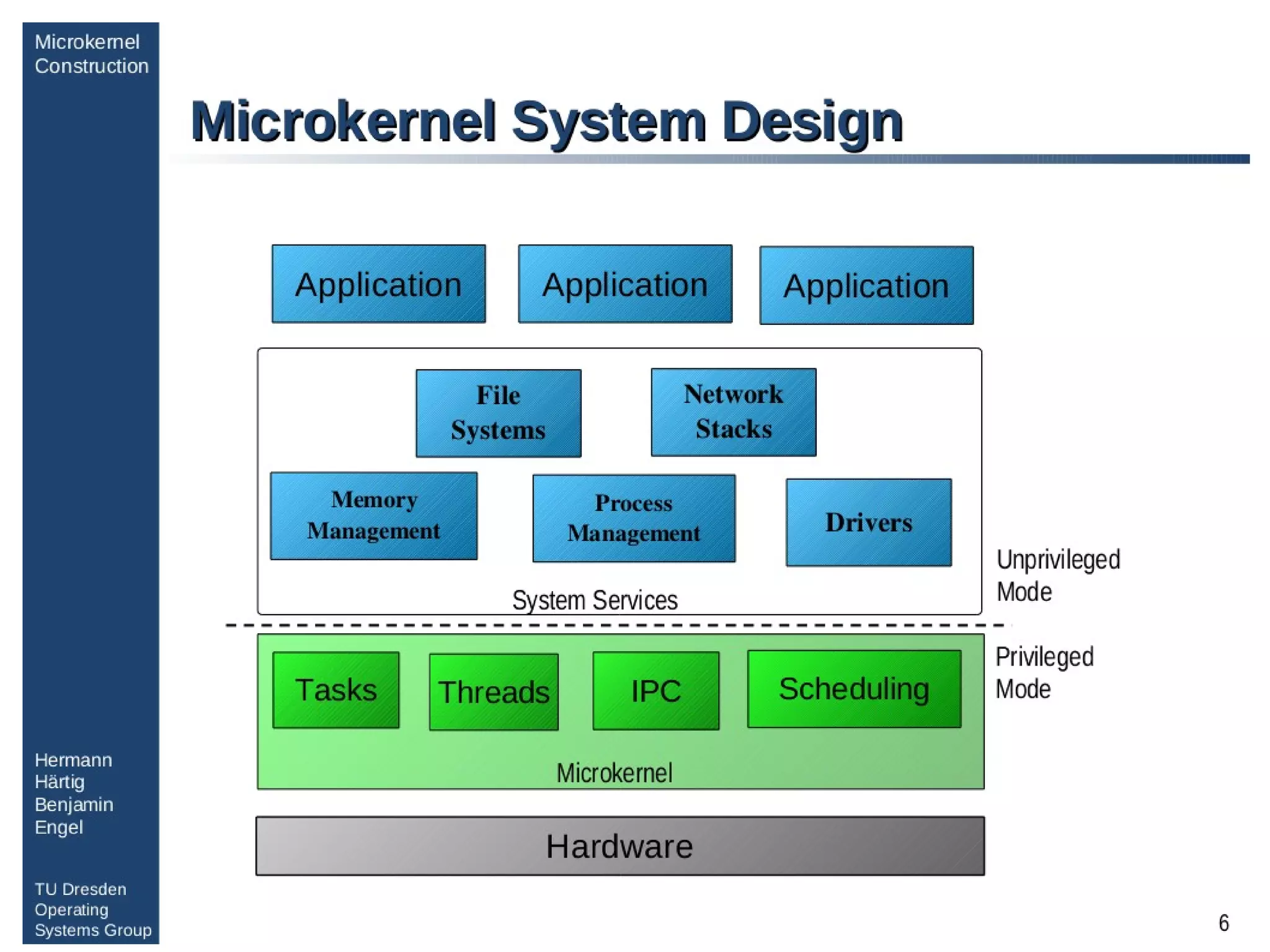
• Minimal kernel and hardware enforce separation
• Only kernel runs in CPU privileged mode
• Components are user!level processes
• No restrictions on component software
• Reuse of legacy software
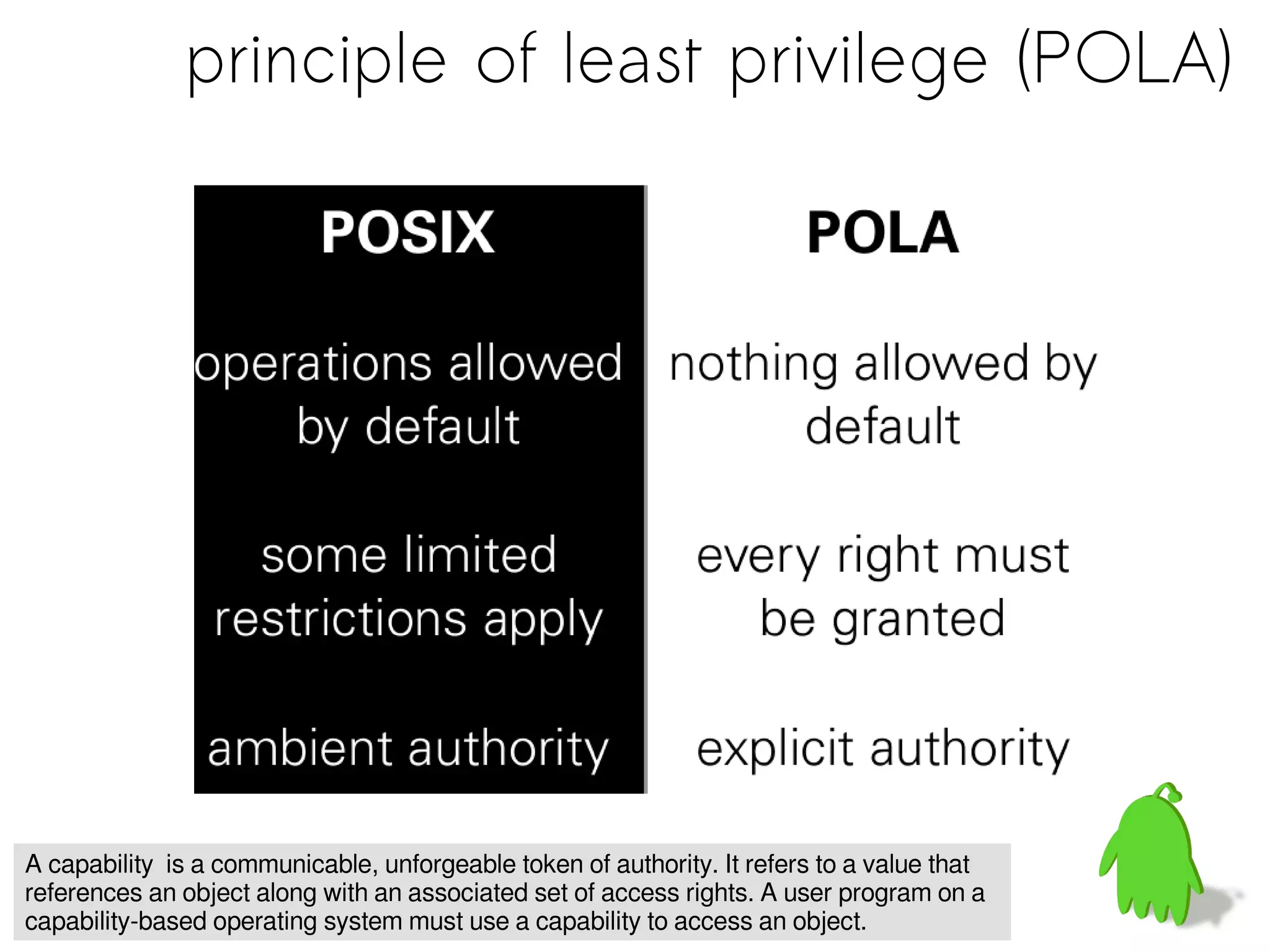
principle of least privilege (POLA)
A capability is a communicable, unforgeable token of authority. It refers to a value that
references an object along with an associated set of access rights. A user program on a
capability-based operating system must use a capability to access an object.
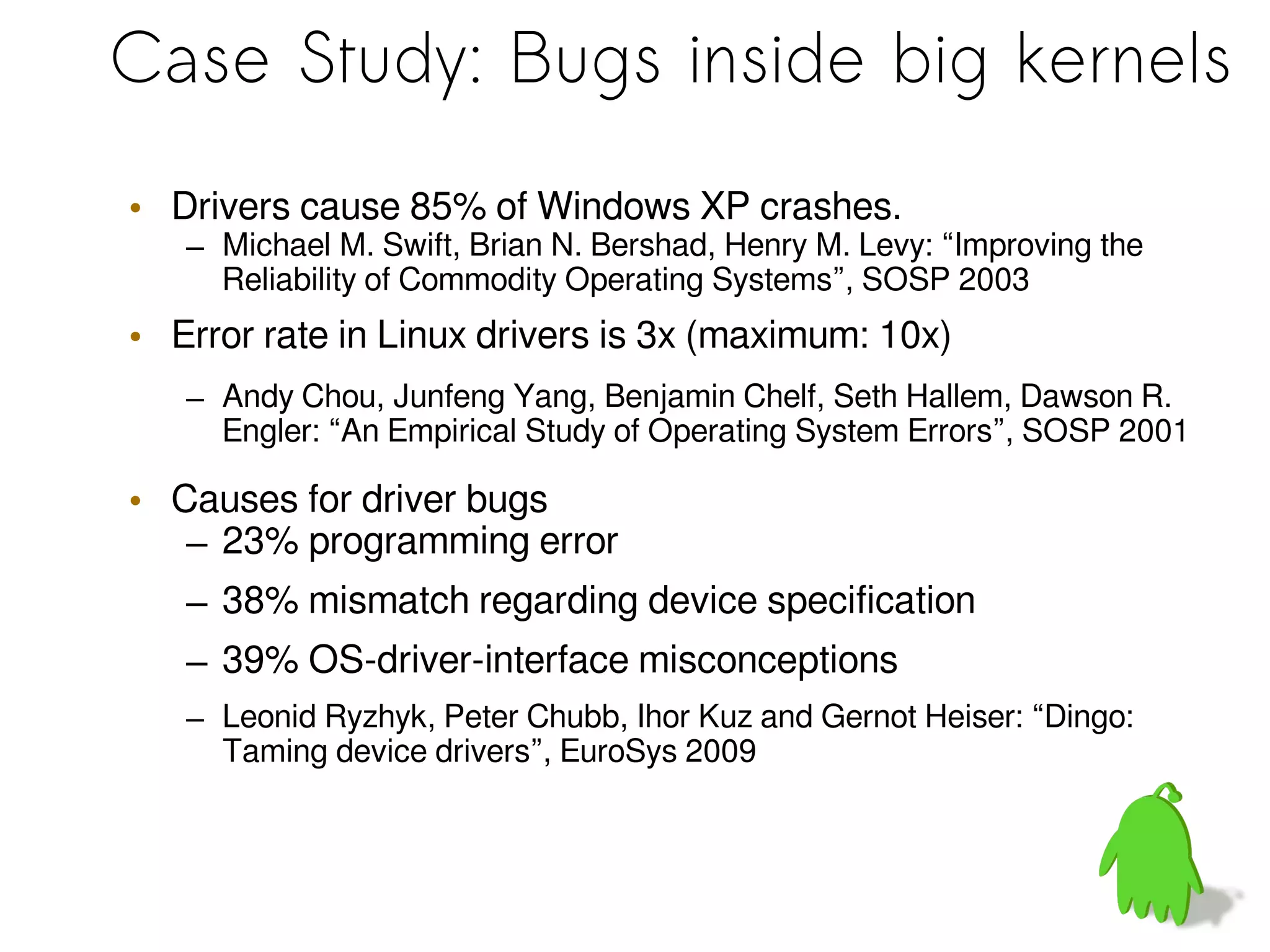
Case Study: Bugs inside big kernels
• Drivers cause 85% of Windows XP crashes.
– Michael M. Swift, Brian N. Bershad, Henry M. Levy: “Improving the
Reliability of Commodity Operating Systems”, SOSP 2003
• Error rate in Linux drivers is 3x (maximum: 10x)
– Andy Chou, Junfeng Yang, Benjamin Chelf, Seth Hallem, Dawson R.
Engler: “An Empirical Study of Operating System Errors”, SOSP 2001
• Causes for driver bugs
– 23% programming error
– 38% mismatch regarding device specification
– 39% OS-driver-interface misconceptions
– Leonid Ryzhyk, Peter Chubb, Ihor Kuz and Gernot Heiser: “Dingo:
Taming device drivers”, EuroSys 2009
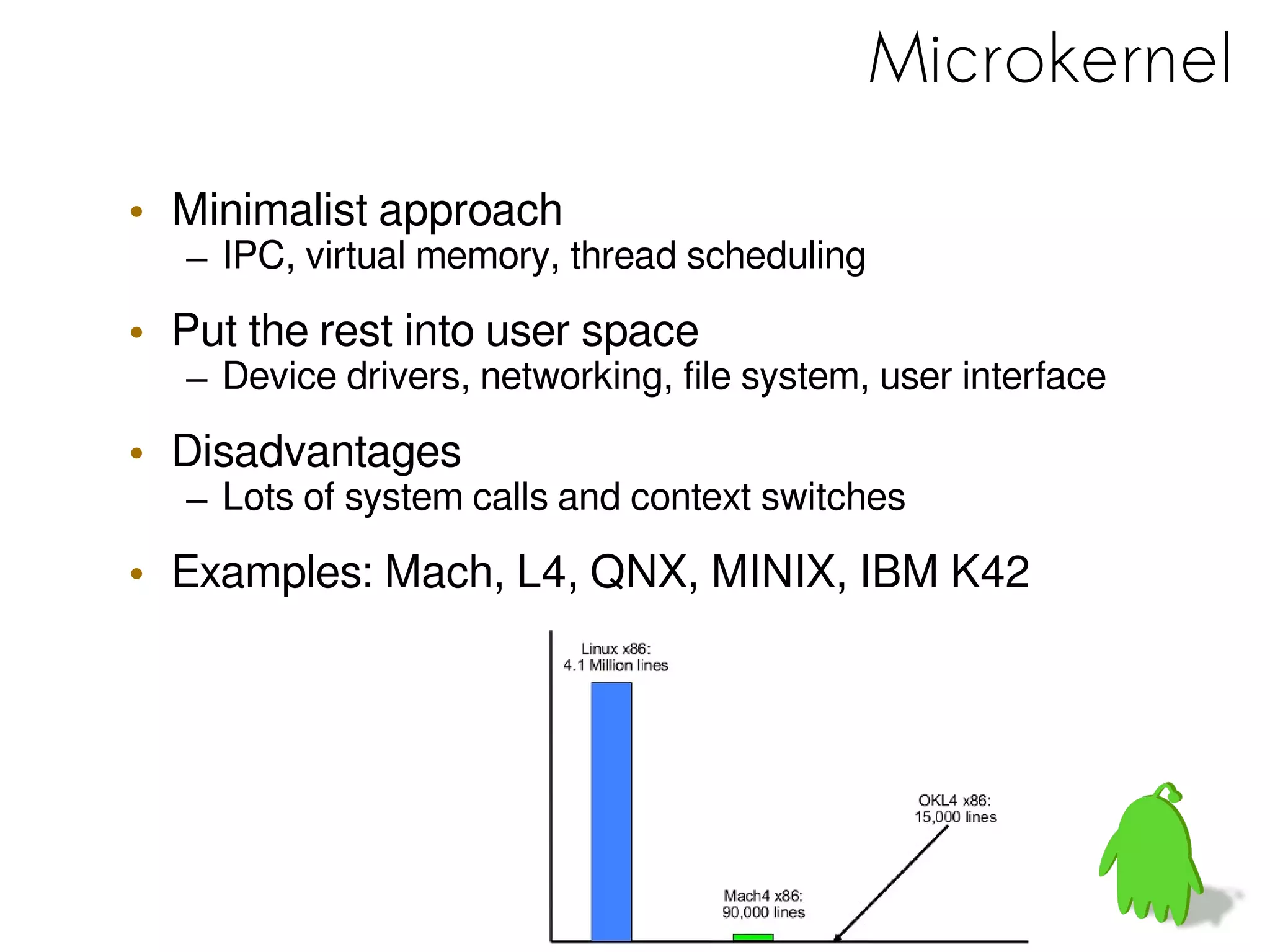
Microkernel
• Minimalist approach
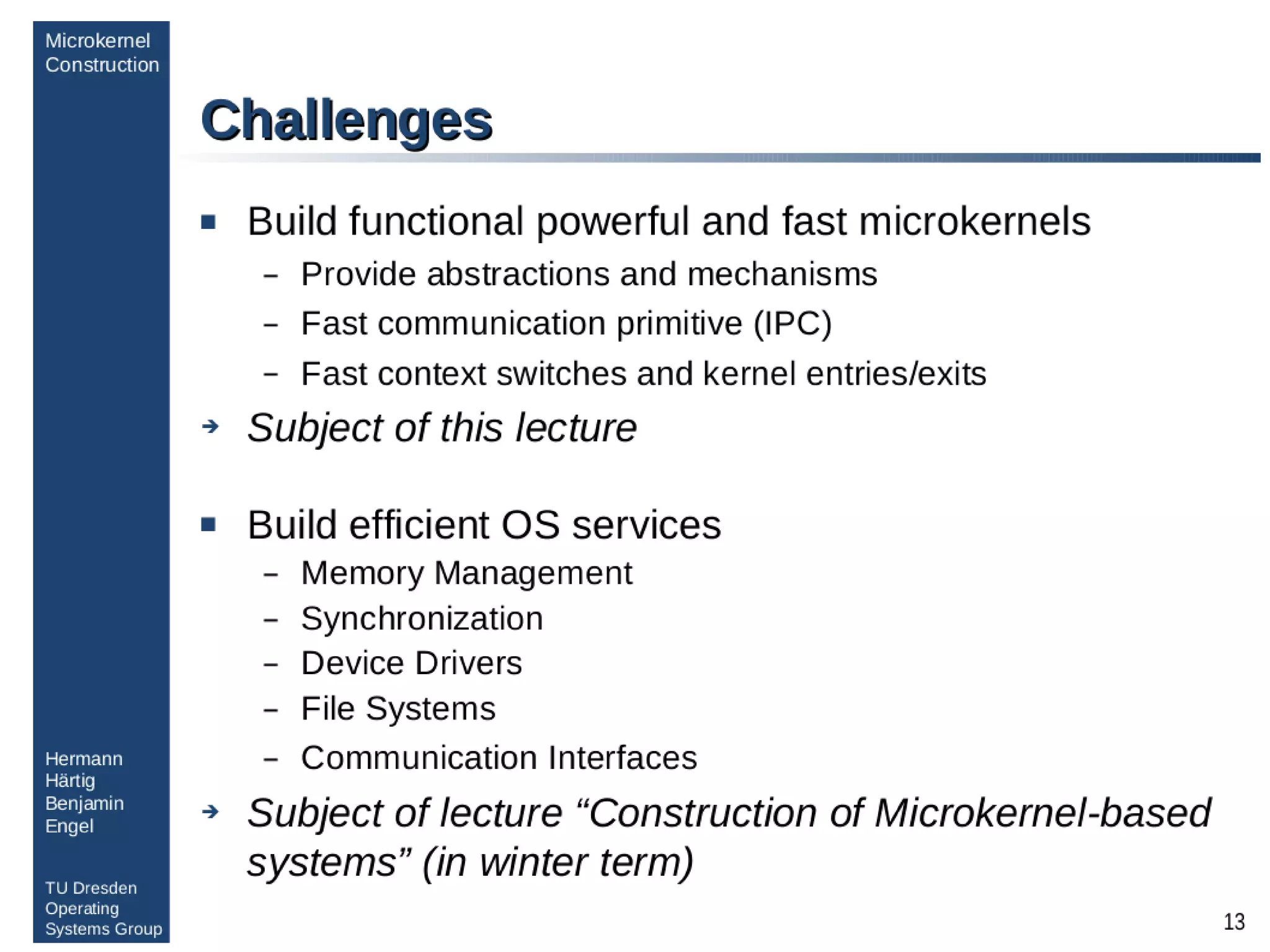
– IPC, virtual memory, thread scheduling
• Put the rest into user space
– Device drivers, networking, file system, user interface
• Disadvantages
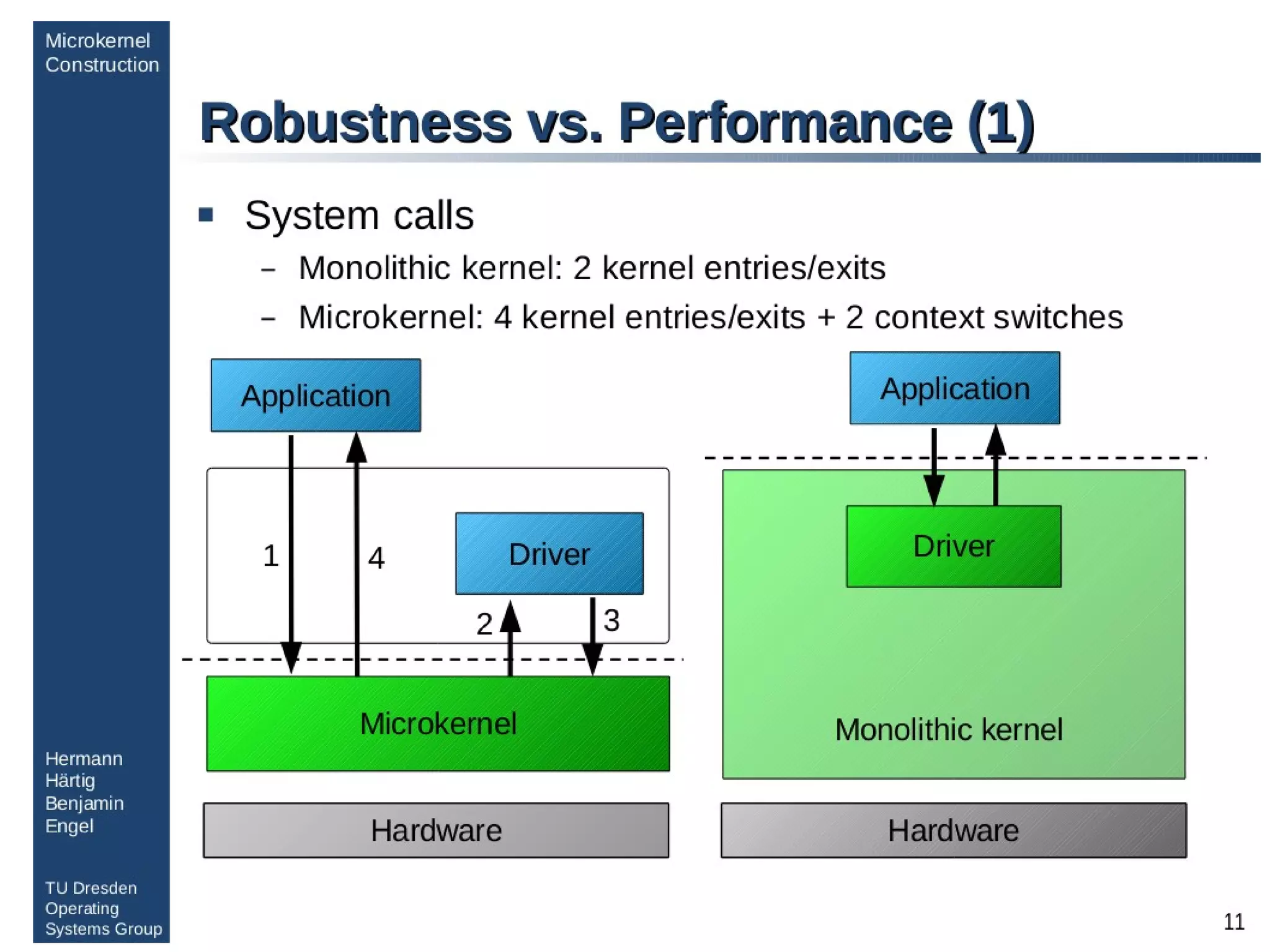
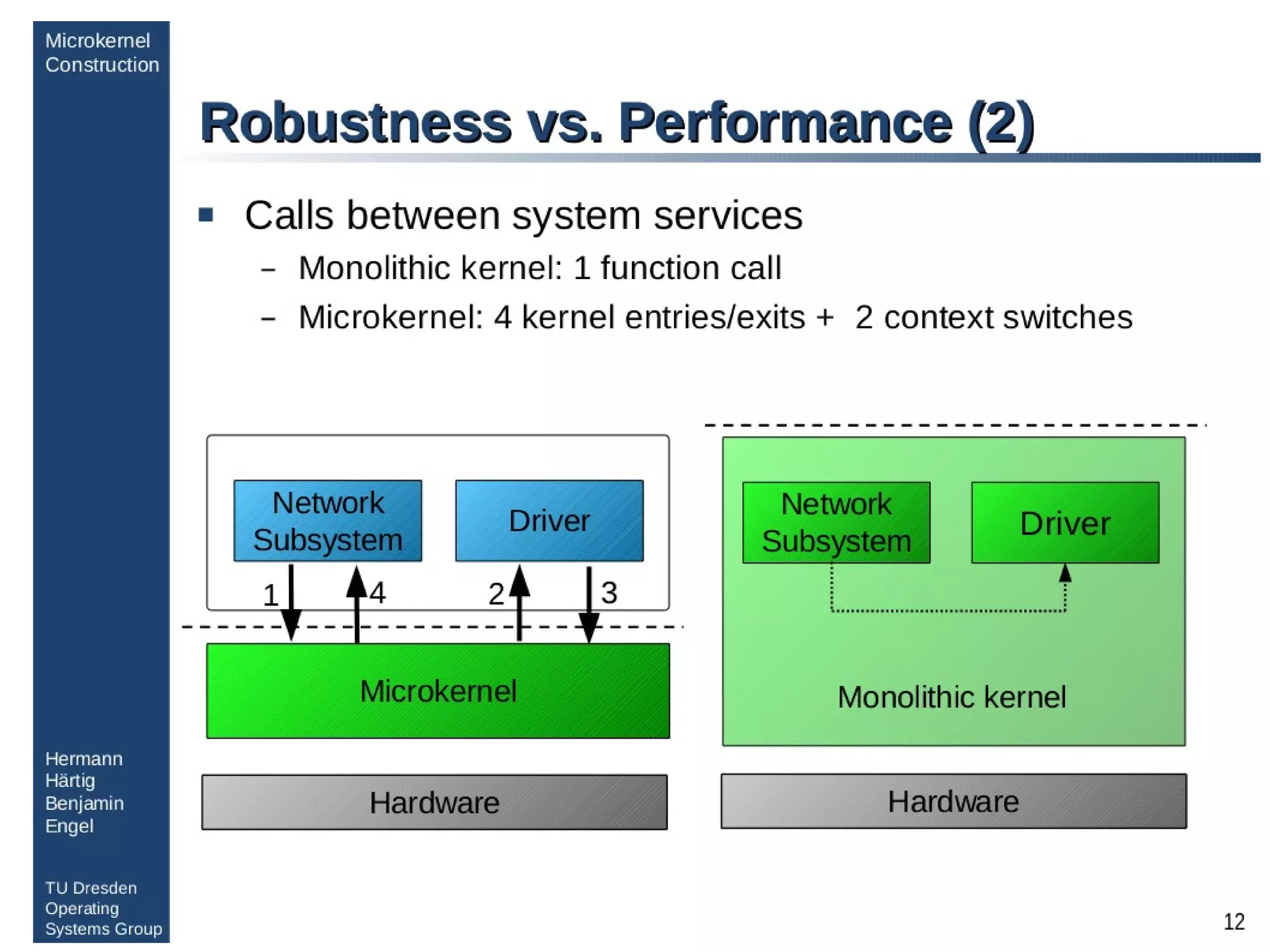
– Lots of system calls and context switches
• Examples: Mach, L4, QNX, MINIX, IBM K42
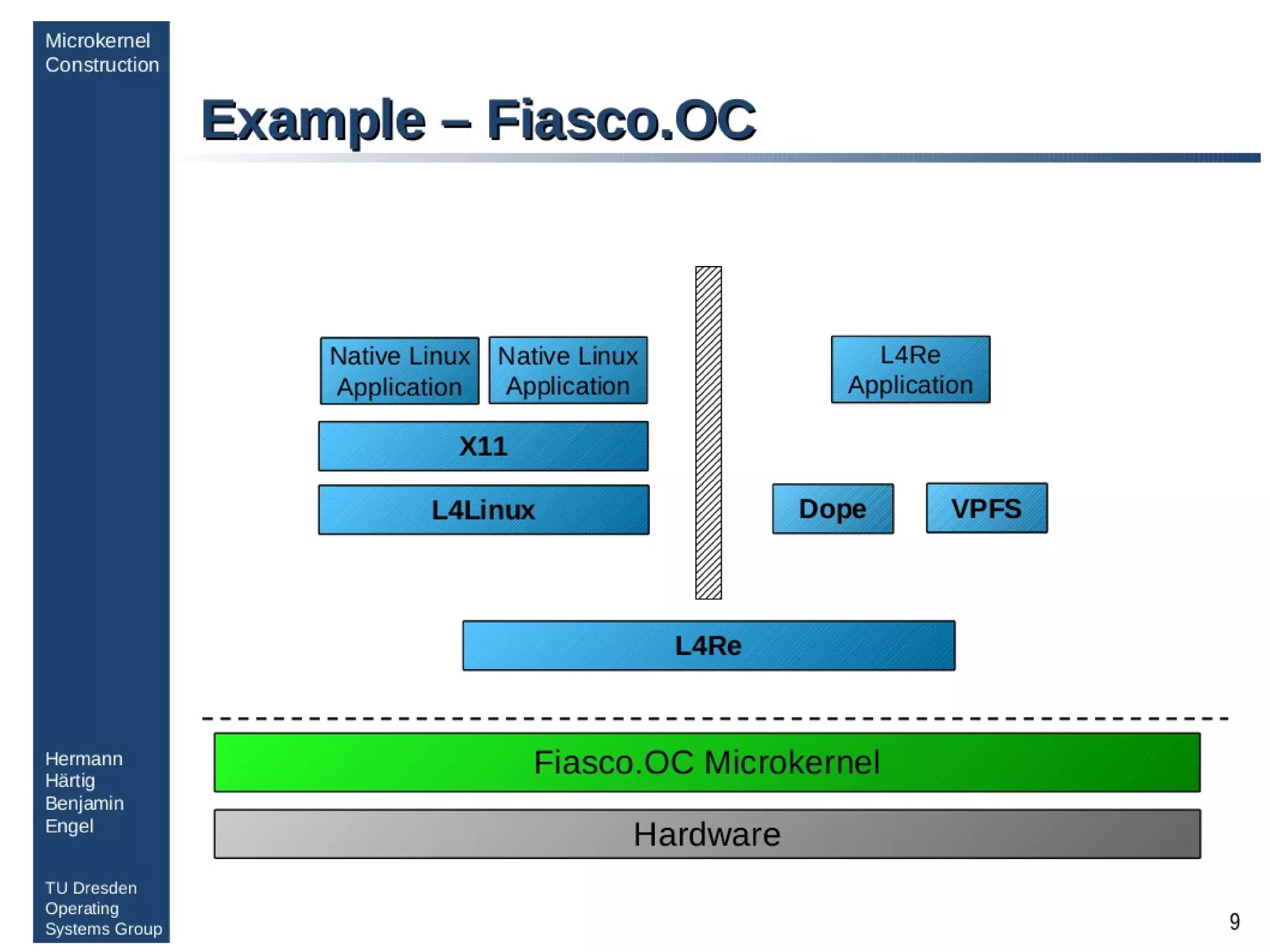
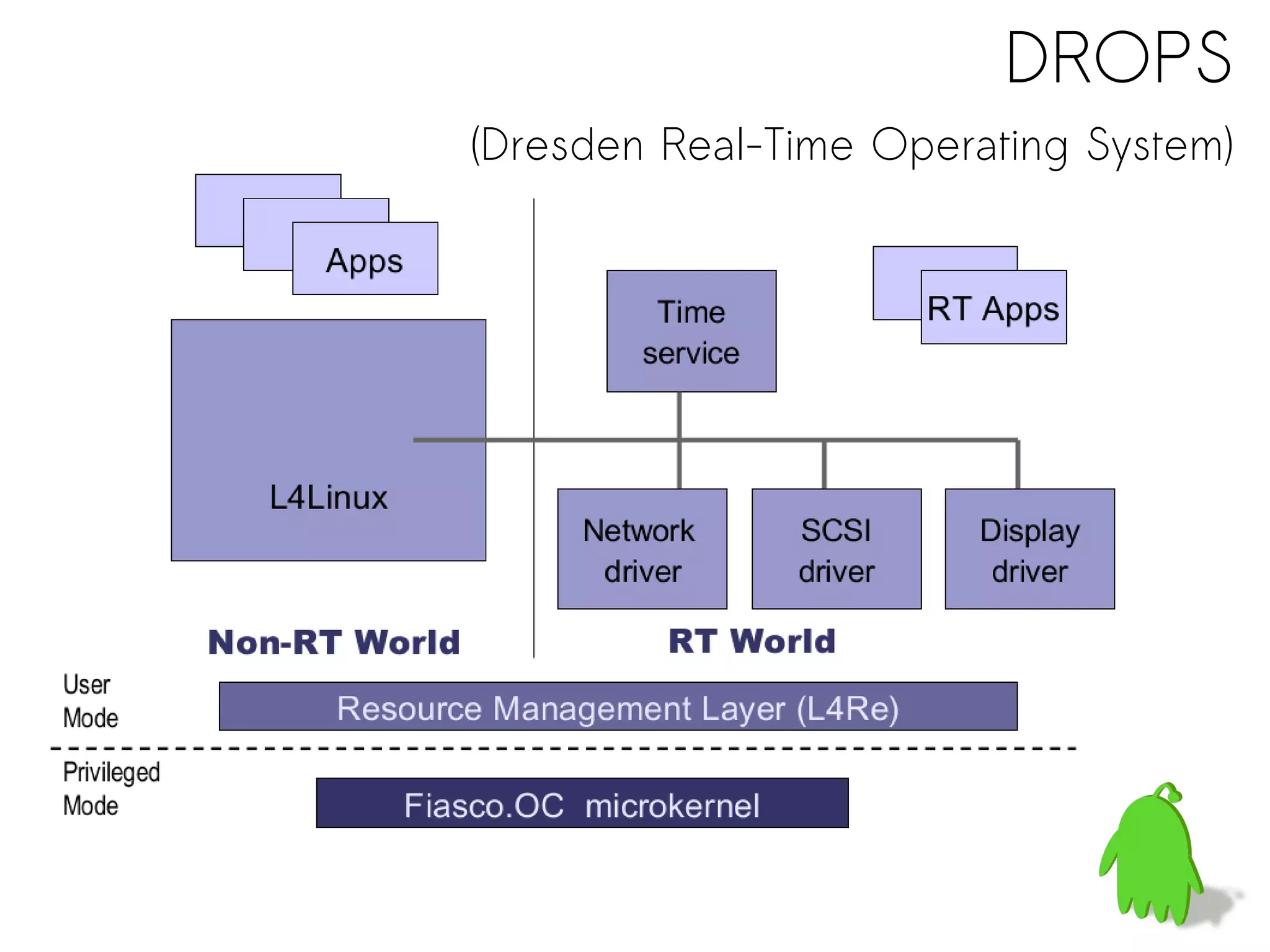
DROPS
(Dresden Real-Time Operating System)
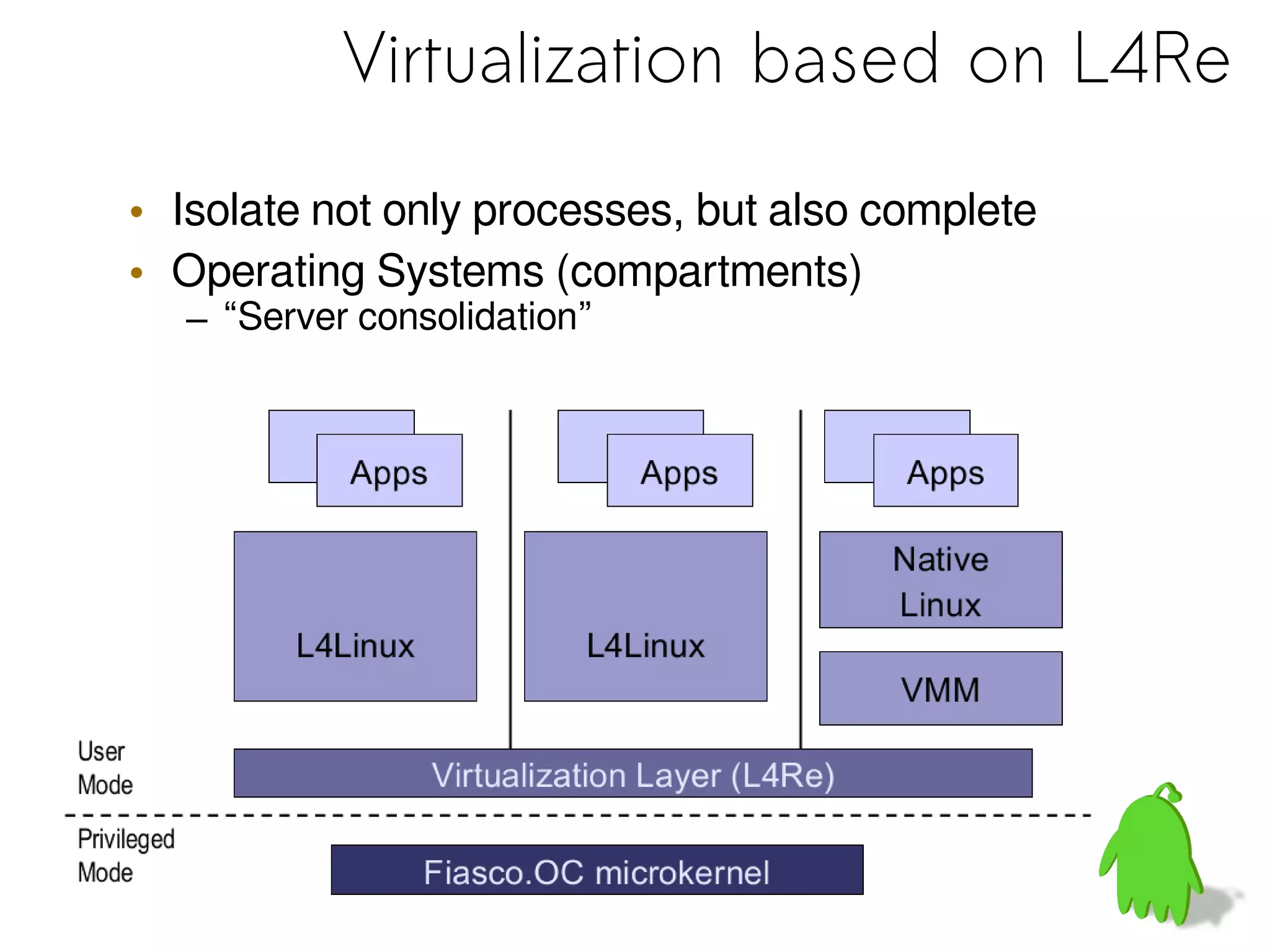
Virtualization based on L4Re
• Isolate not only processes, but also complete
• Operating Systems (compartments)
– “Server consolidation”
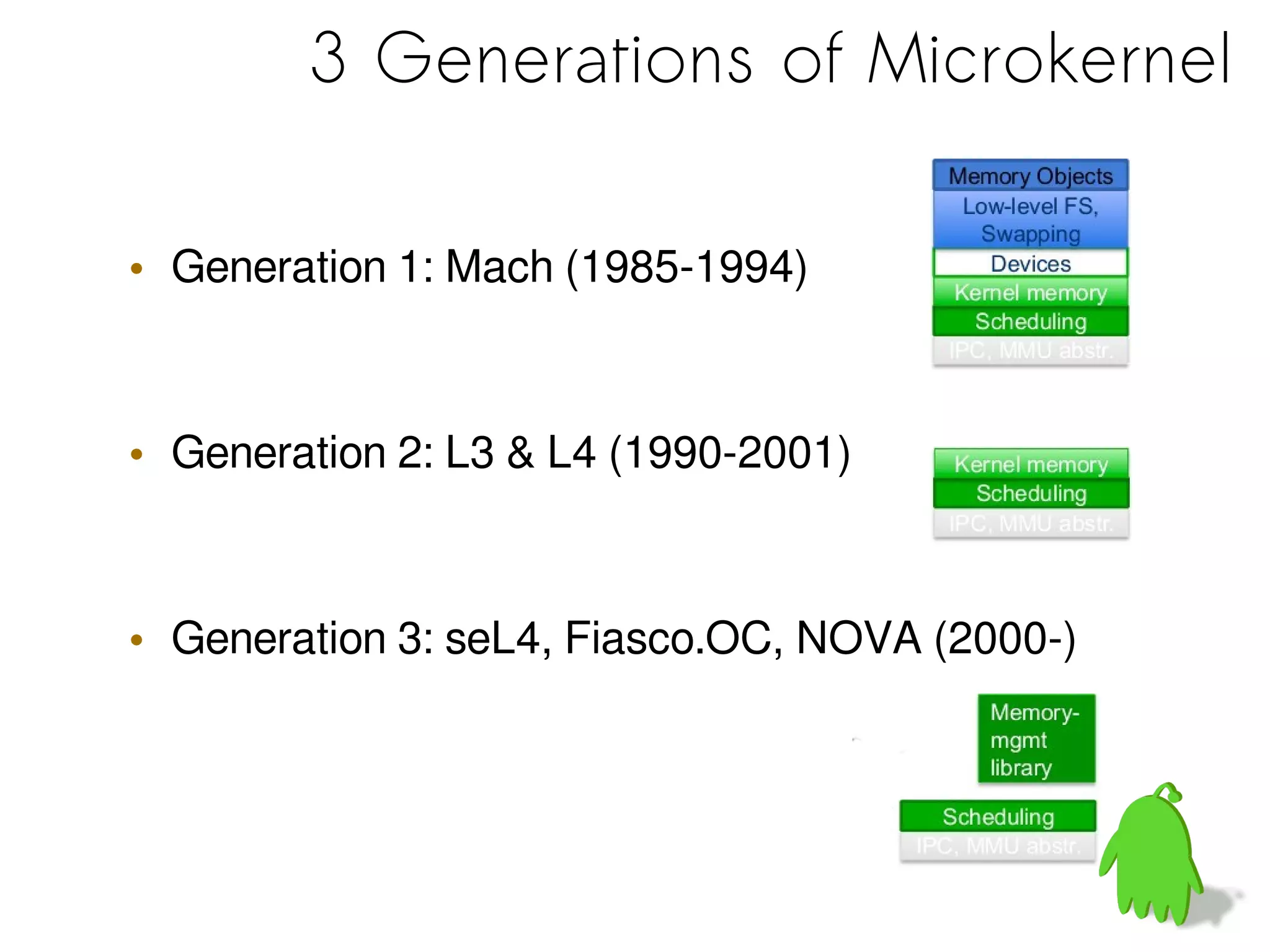
3 Generations of Microkernel
• Generation 1: Mach (1985-1994)
• Generation 2: L3 & L4 (1990-2001)
• Generation 3: seL4, Fiasco.OC, NOVA (2000-)
3 Generations of Microkernel
• Mach (1985-1994)
– replace pipes with IPC (more general) 
– improved stability (vs monolithic kernels)
– poor performance
• L3 & L4 (1990-2001)
– order of magnitude improvement in IPC performance
• written in assembly, sacrificed CPU portability
• only synchronus IPC (build async on top of sync) 
– very small kernel: more functions moved to userspace
• seL4, Fiasco.OC, Coyotos, NOVA (2000-)
– platform independence
– verification, security, multiple CPUs, etc.
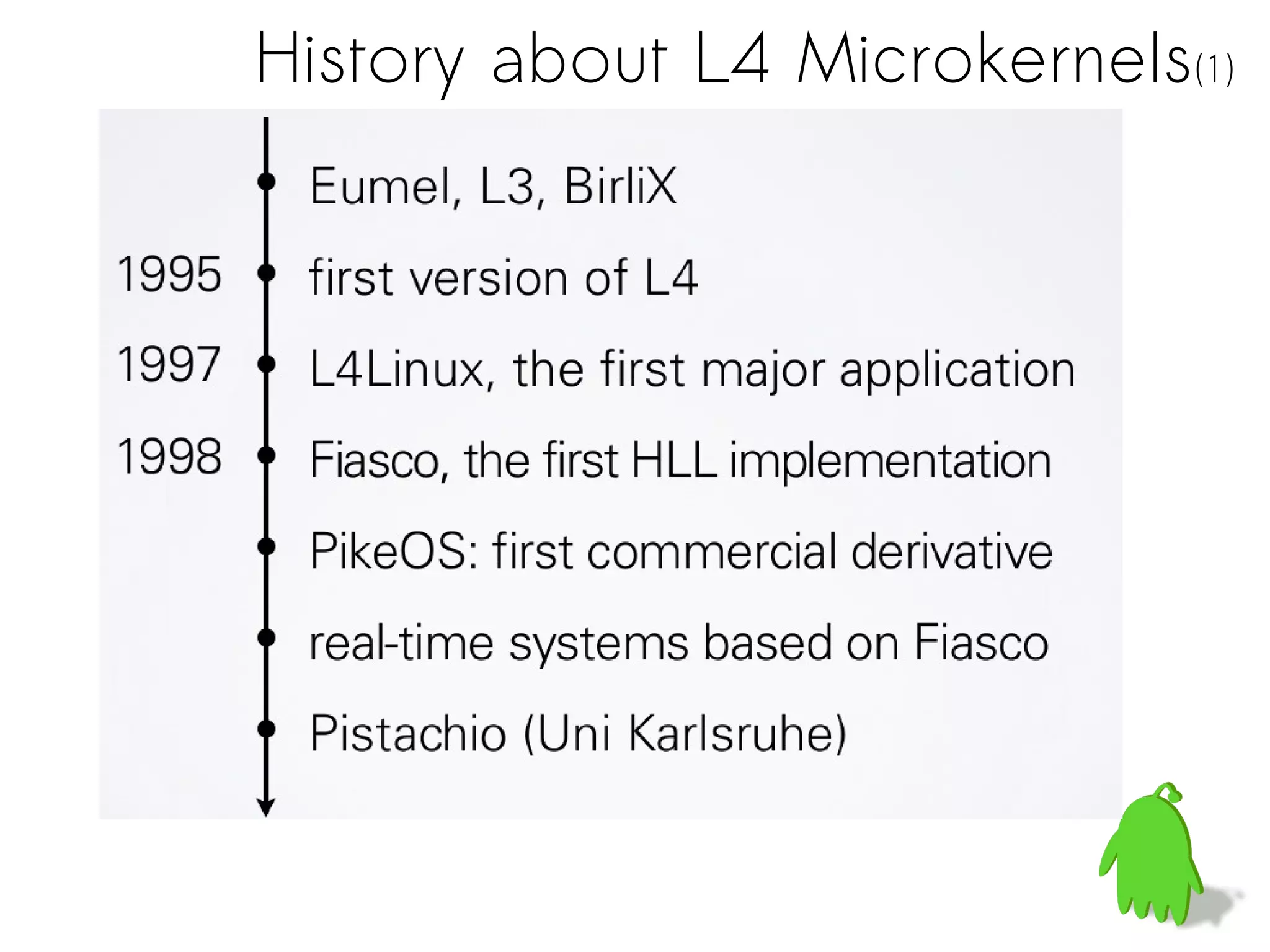
History about L4 Microkernels(1)
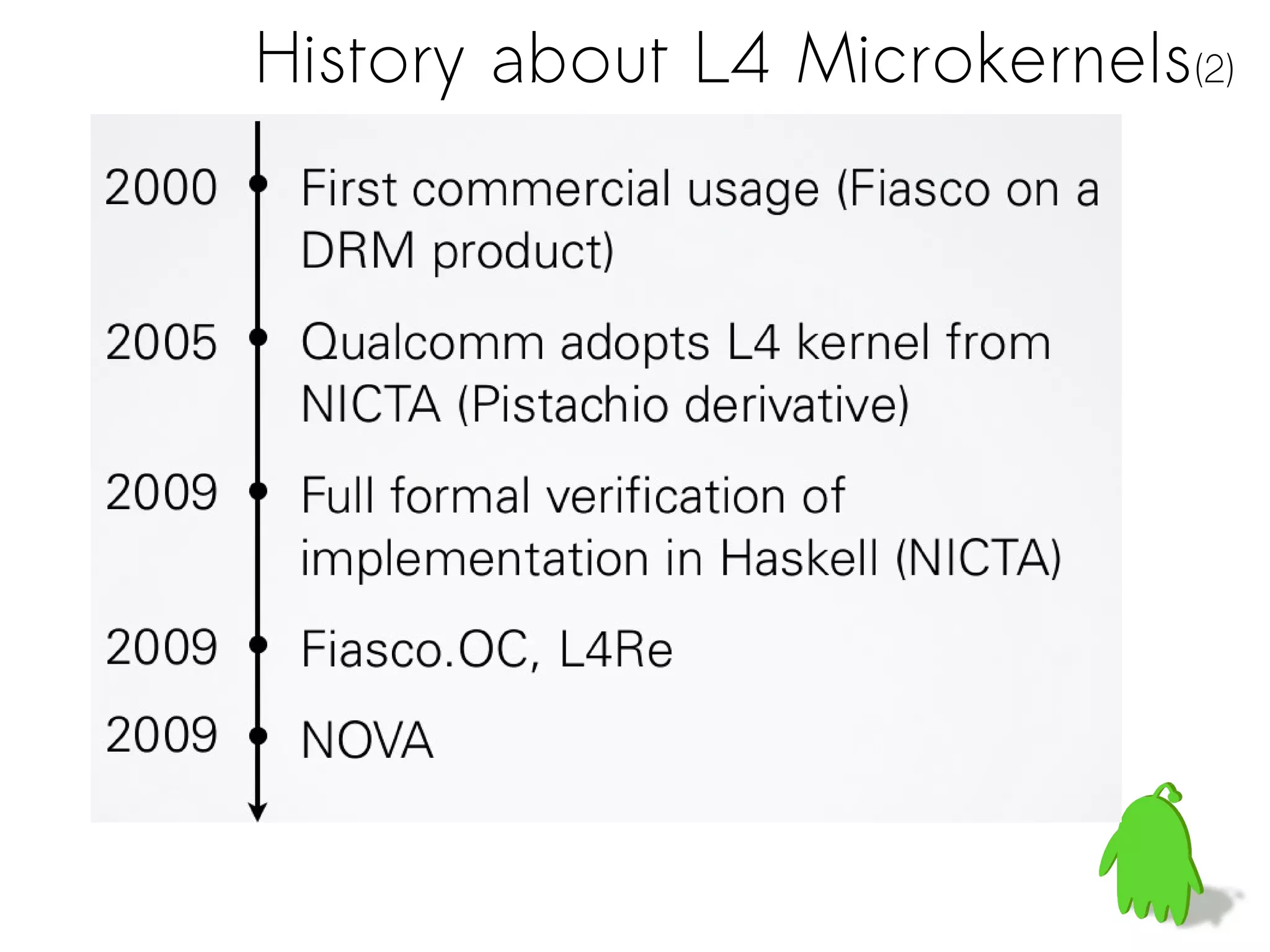
History about L4 Microkernels(2)
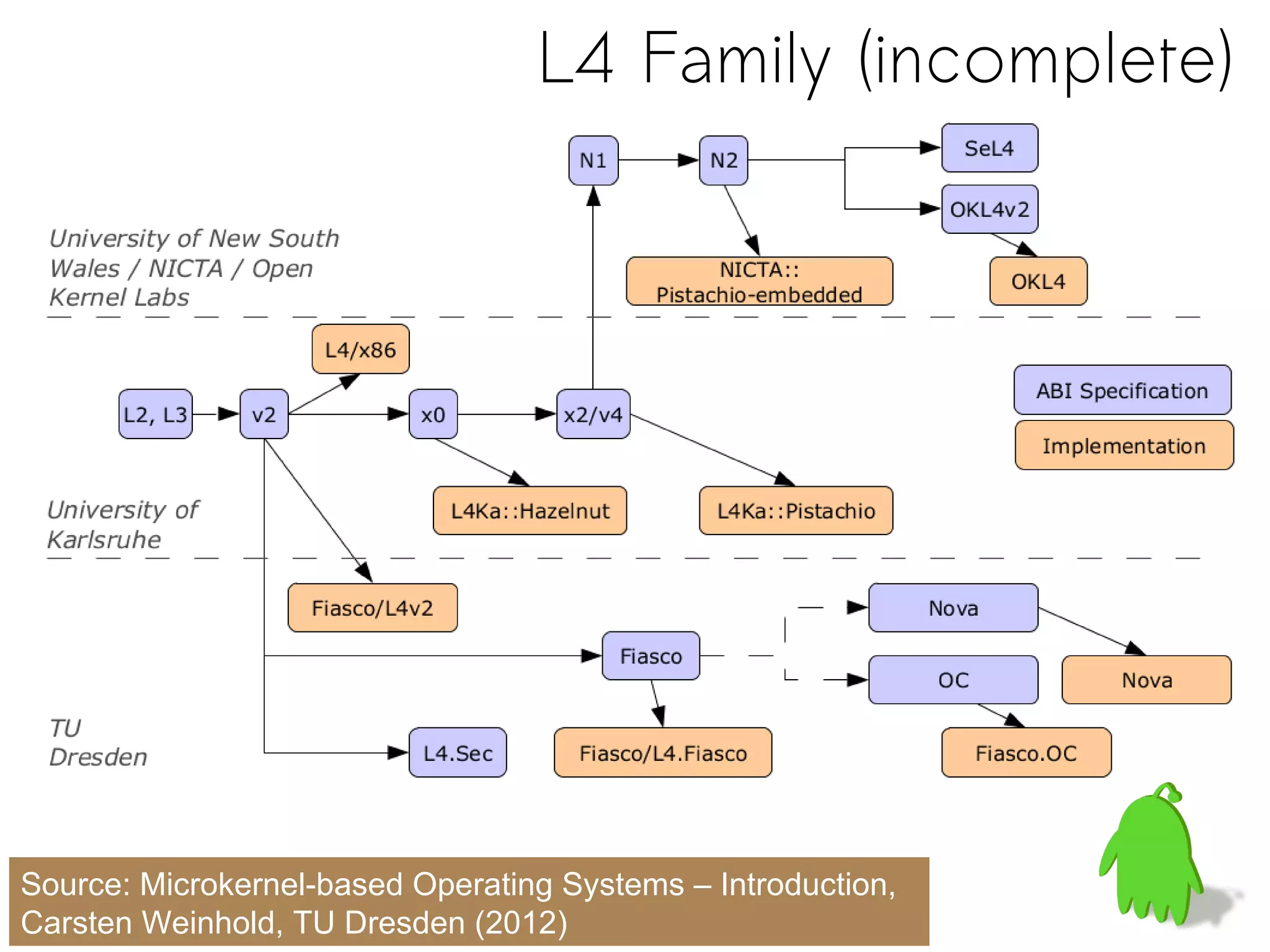
L4 Family (incomplete)
Source: Microkernel-based Operating Systems – Introduction,
Carsten Weinhold, TU Dresden (2012)
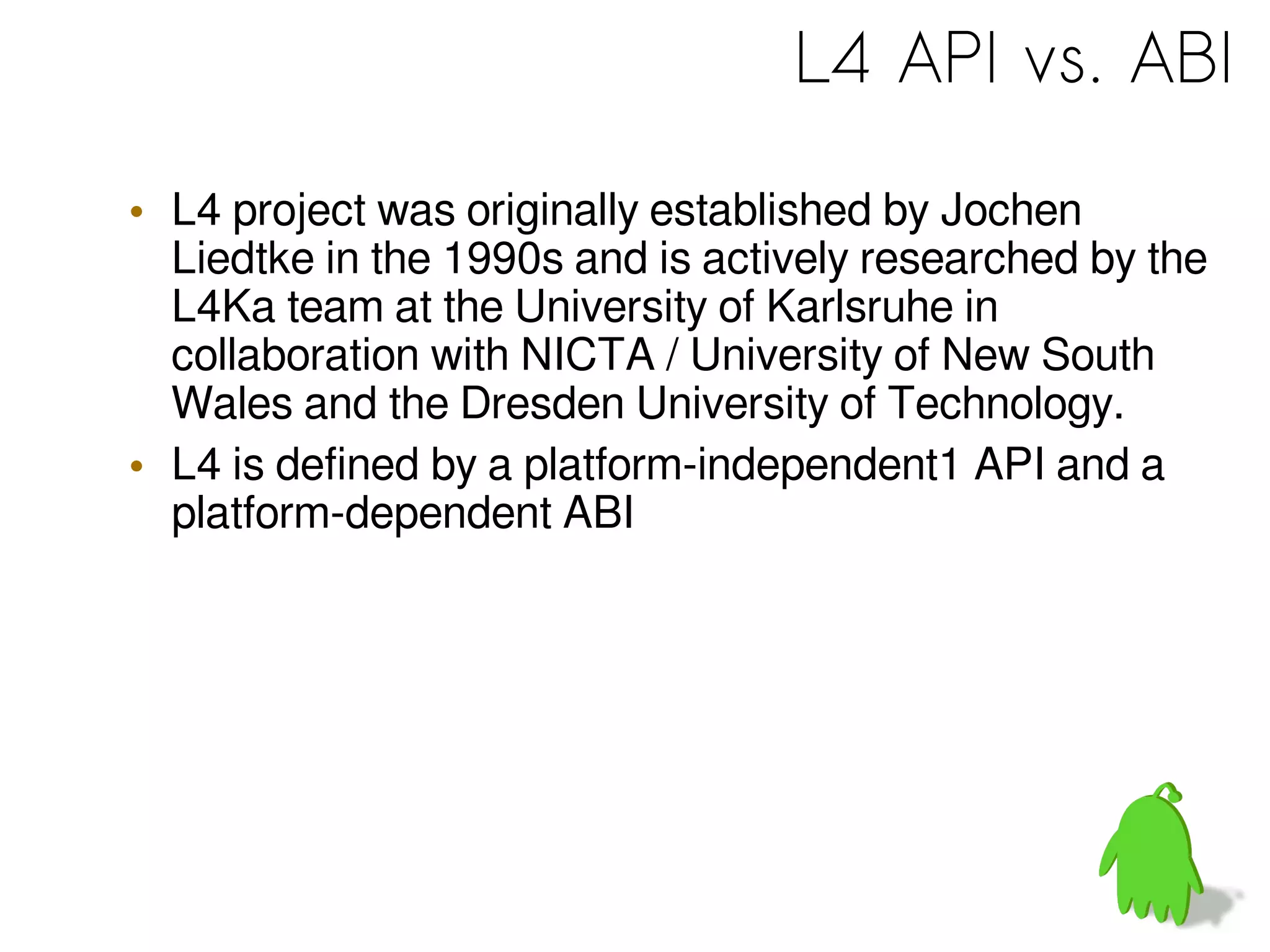
L4 API vs. ABI
• L4 project was originally established by Jochen
Liedtke in the 1990s and is actively researched by the
L4Ka team at the University of Karlsruhe in
collaboration with NICTA / University of New South
Wales and the Dresden University of Technology.
• L4 is defined by a platform-independent1 API and a
platform-dependent ABI
Microkernel-based Operating
Systems
Microkernel-based Operating
Systems - Introduction
• Information:
– Carsten Weinhold
– Dresden, Oct 09th 2012
• Filename: 01-Introduction.pdf
– Page 22 – Page 46
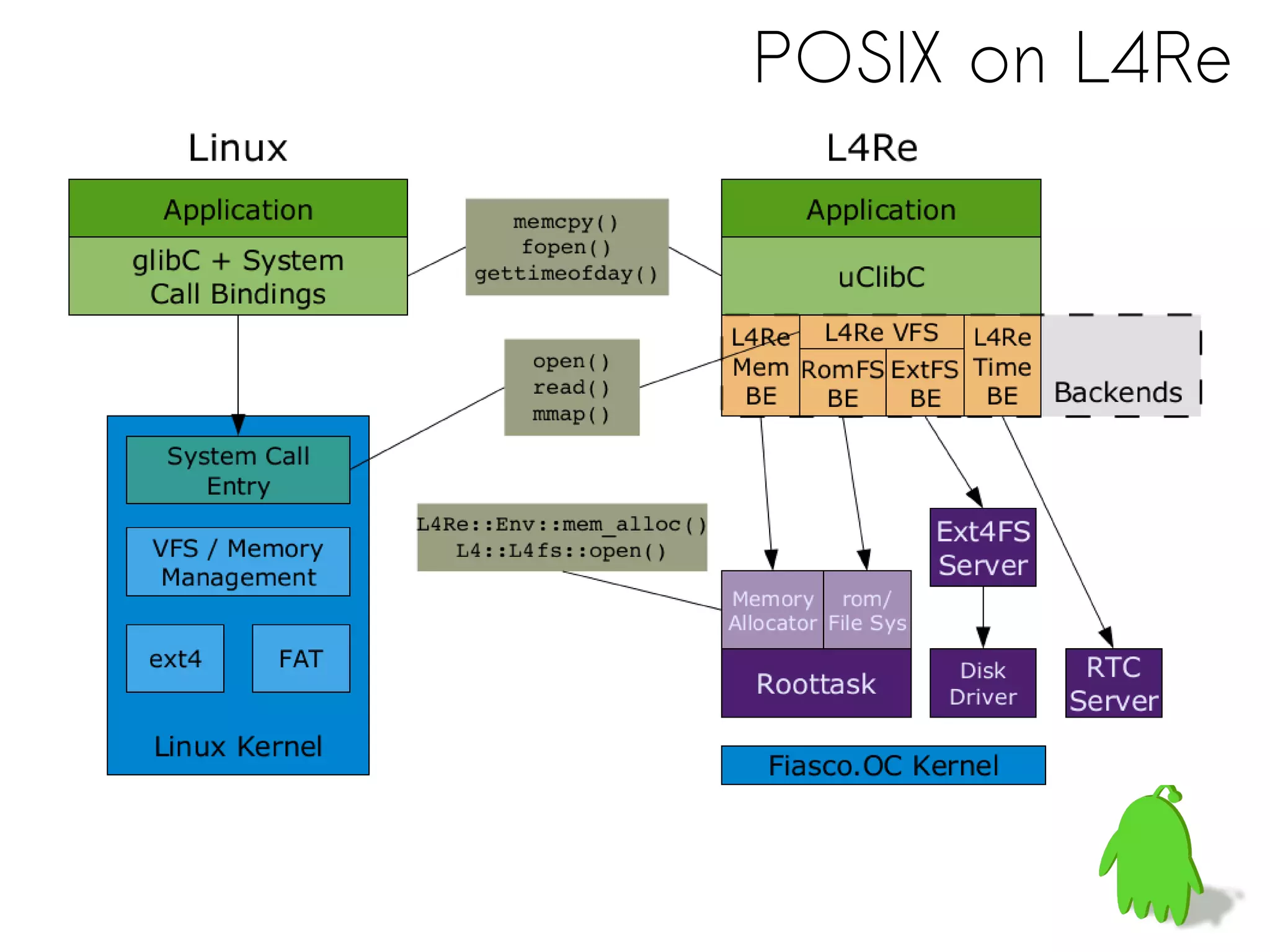
POSIX on L4Re
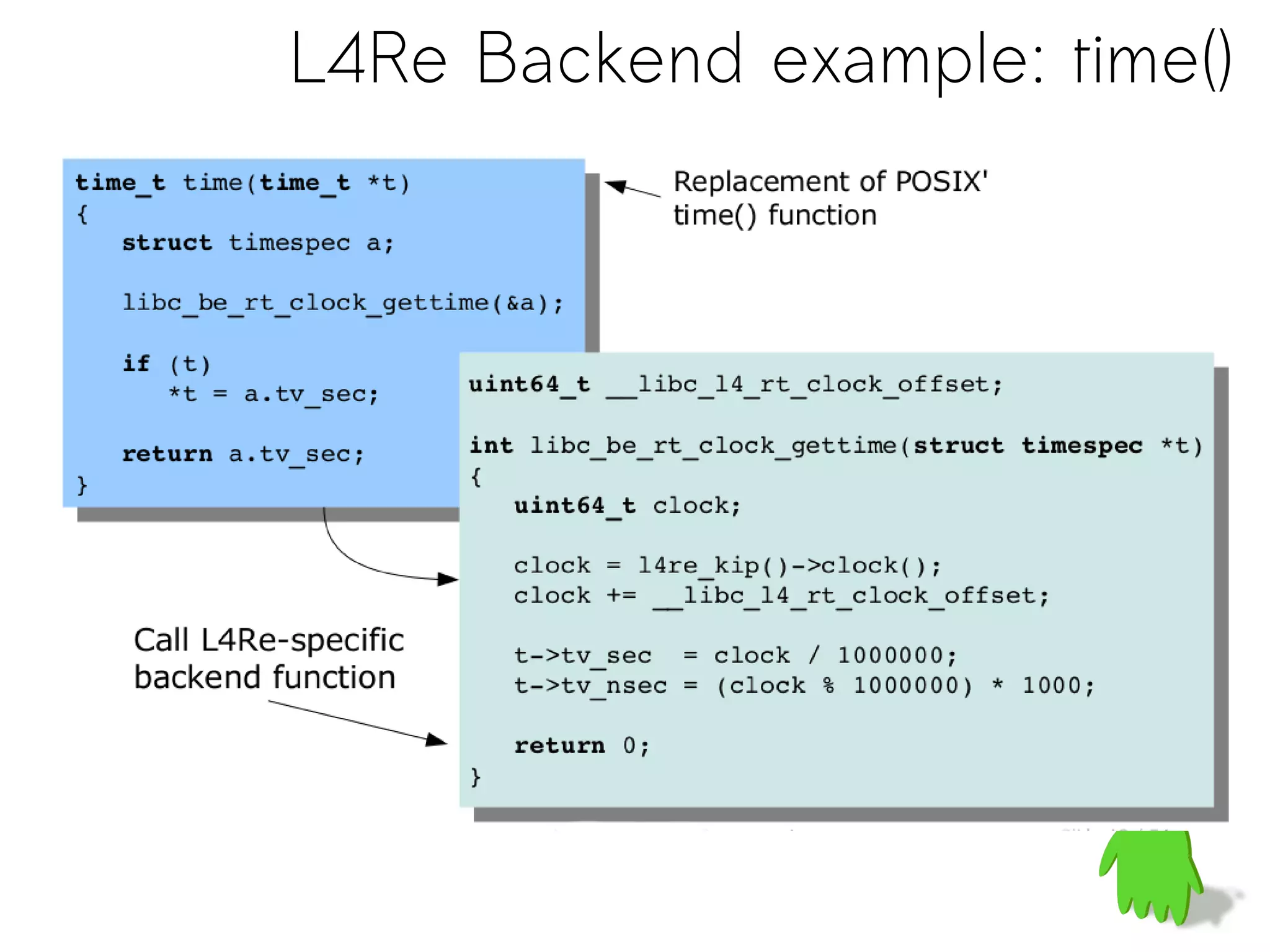
L4Re Backend example: time()
Case Study: Security
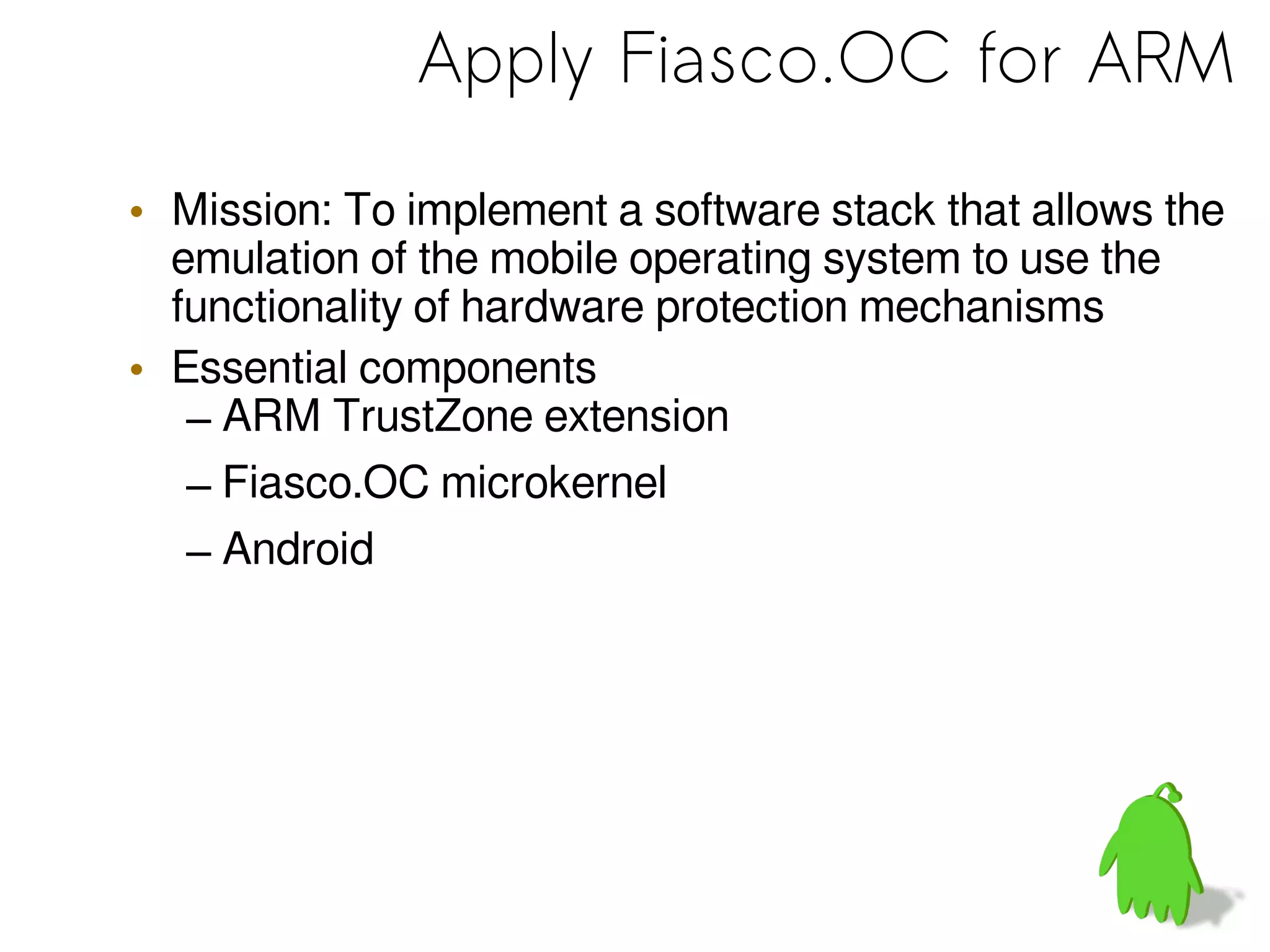
Apply Fiasco.OC for ARM
• Mission: To implement a software stack that allows the
emulation of the mobile operating system to use the
functionality of hardware protection mechanisms
• Essential components
– ARM TrustZone extension
– Fiasco.OC microkernel
– Android
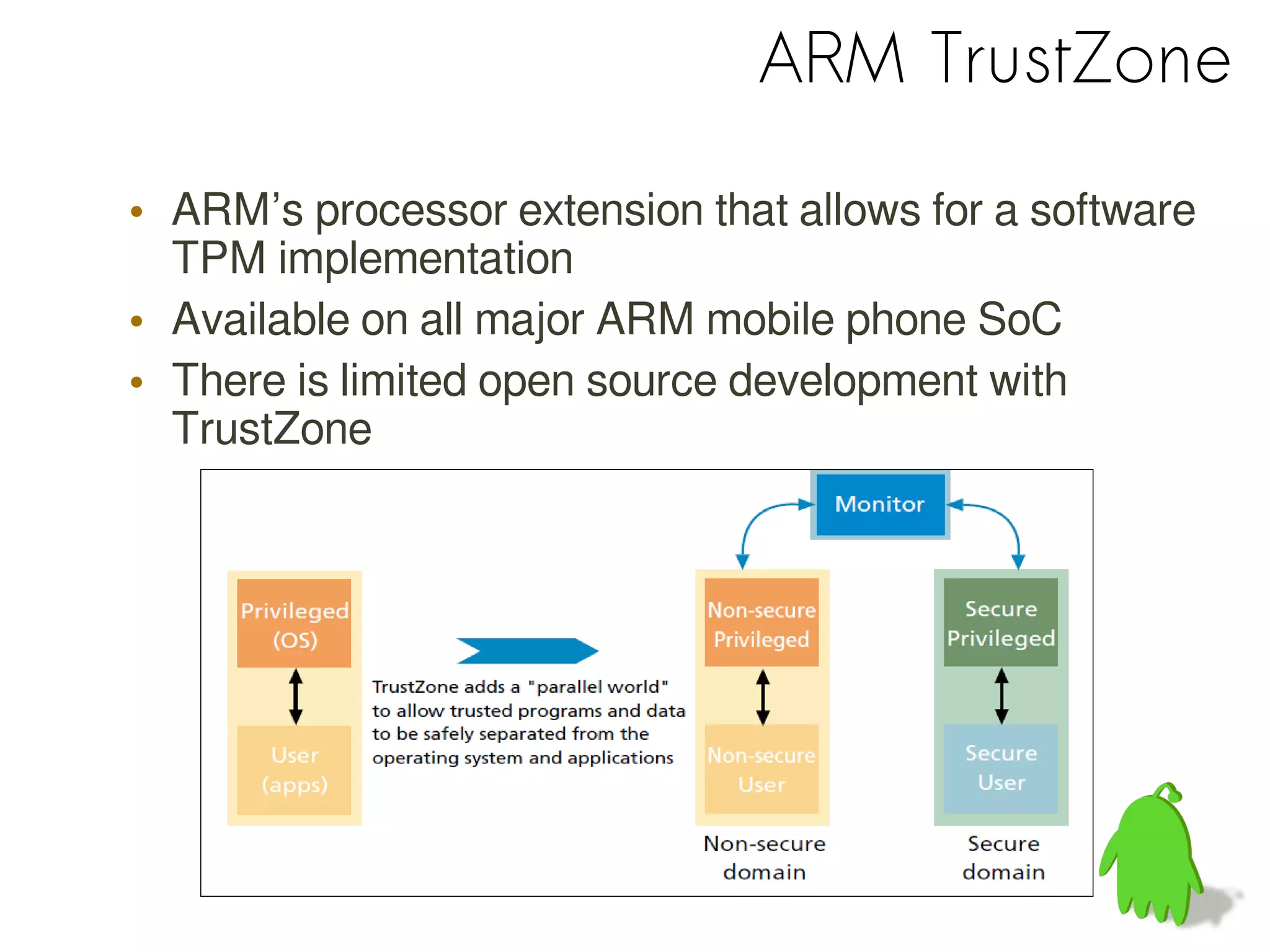
ARM TrustZone
• ARM’s processor extension that allows for a software
TPM implementation
• Available on all major ARM mobile phone SoC
• There is limited open source development with
TrustZone
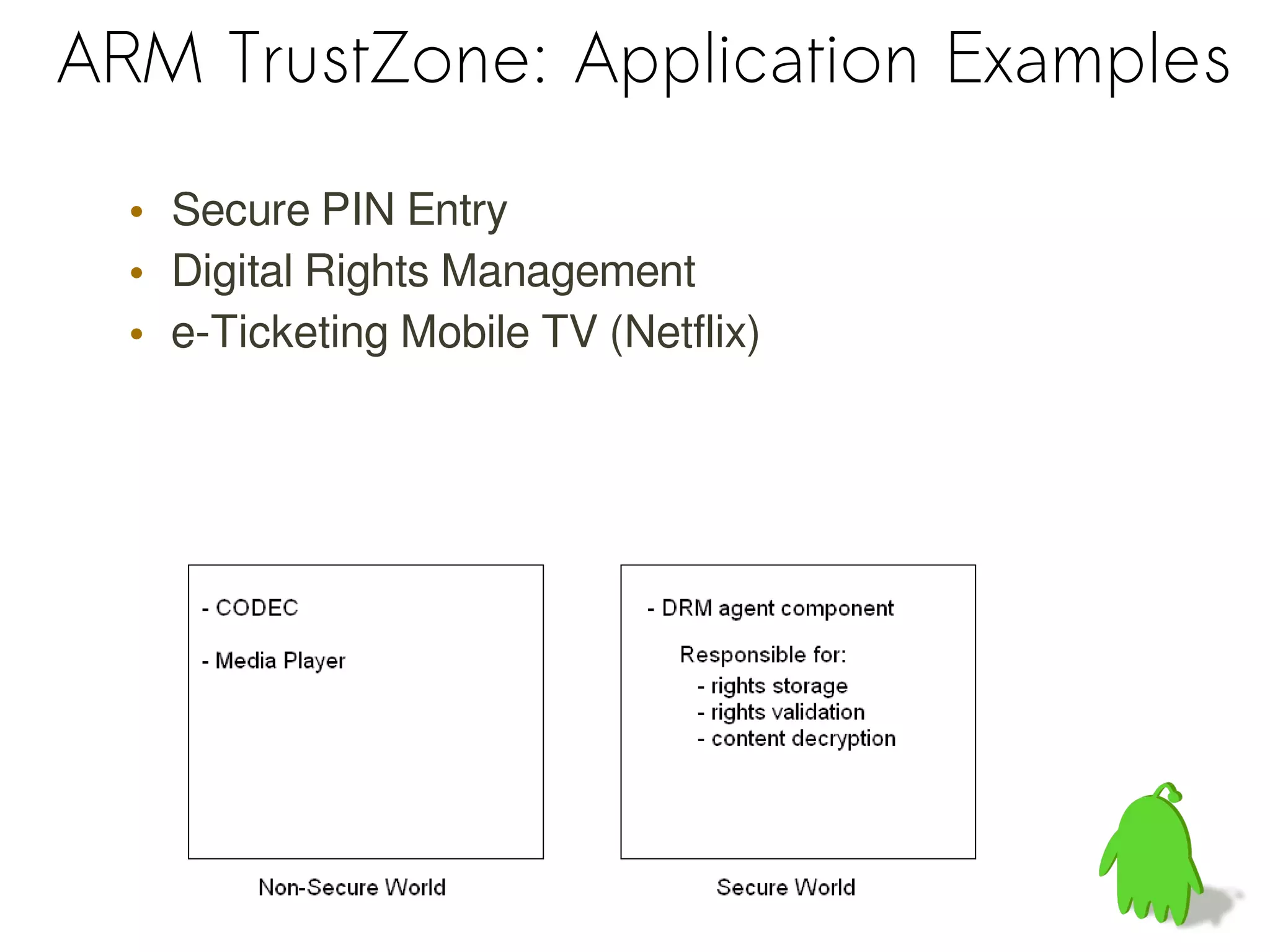
ARM TrustZone: Application Examples
• Secure PIN Entry
• Digital Rights Management
• e-Ticketing Mobile TV (Netflix)
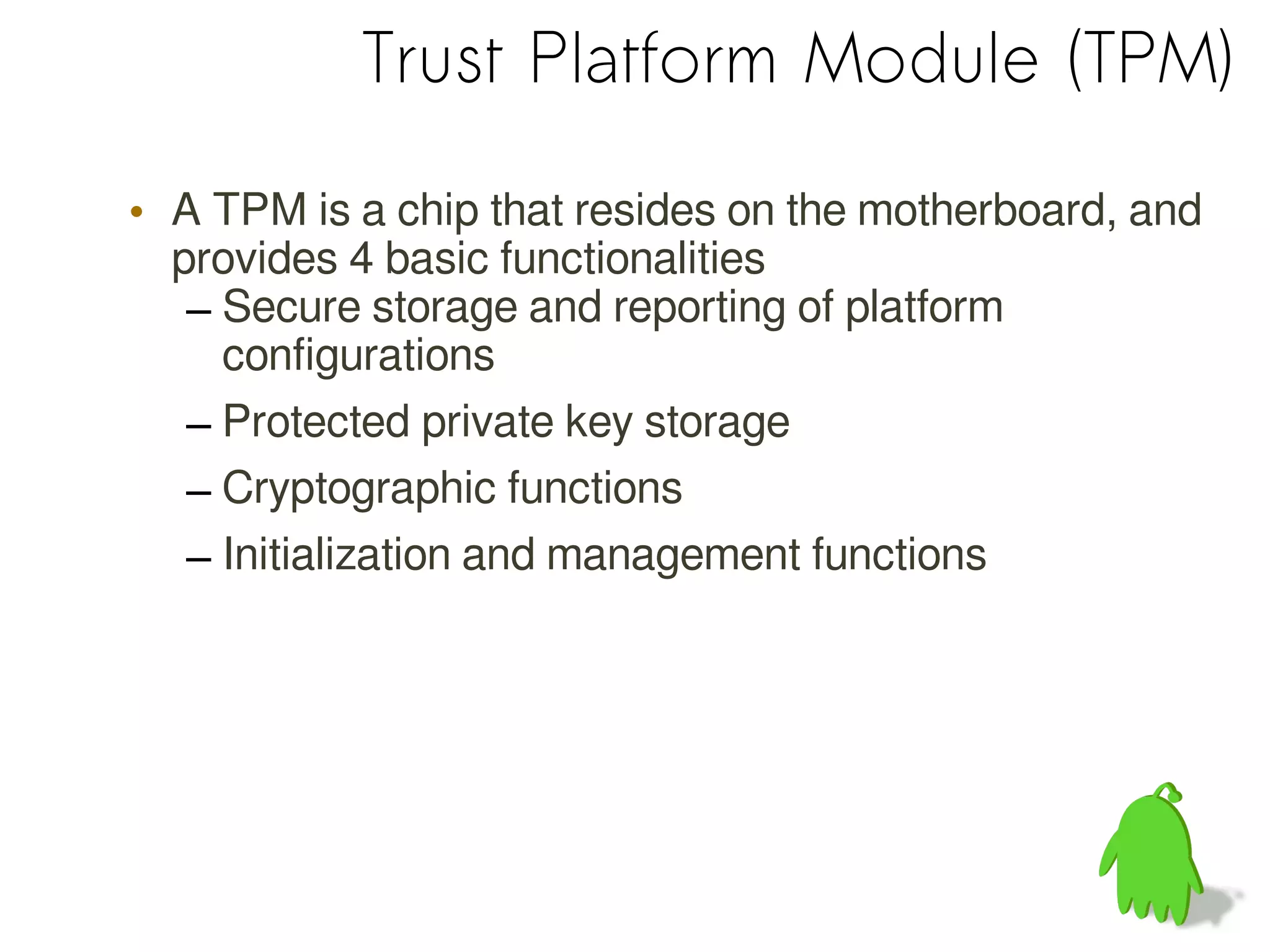
Trust Platform Module (TPM)
• A TPM is a chip that resides on the motherboard, and
provides 4 basic functionalities
– Secure storage and reporting of platform
configurations
– Protected private key storage
– Cryptographic functions
– Initialization and management functions
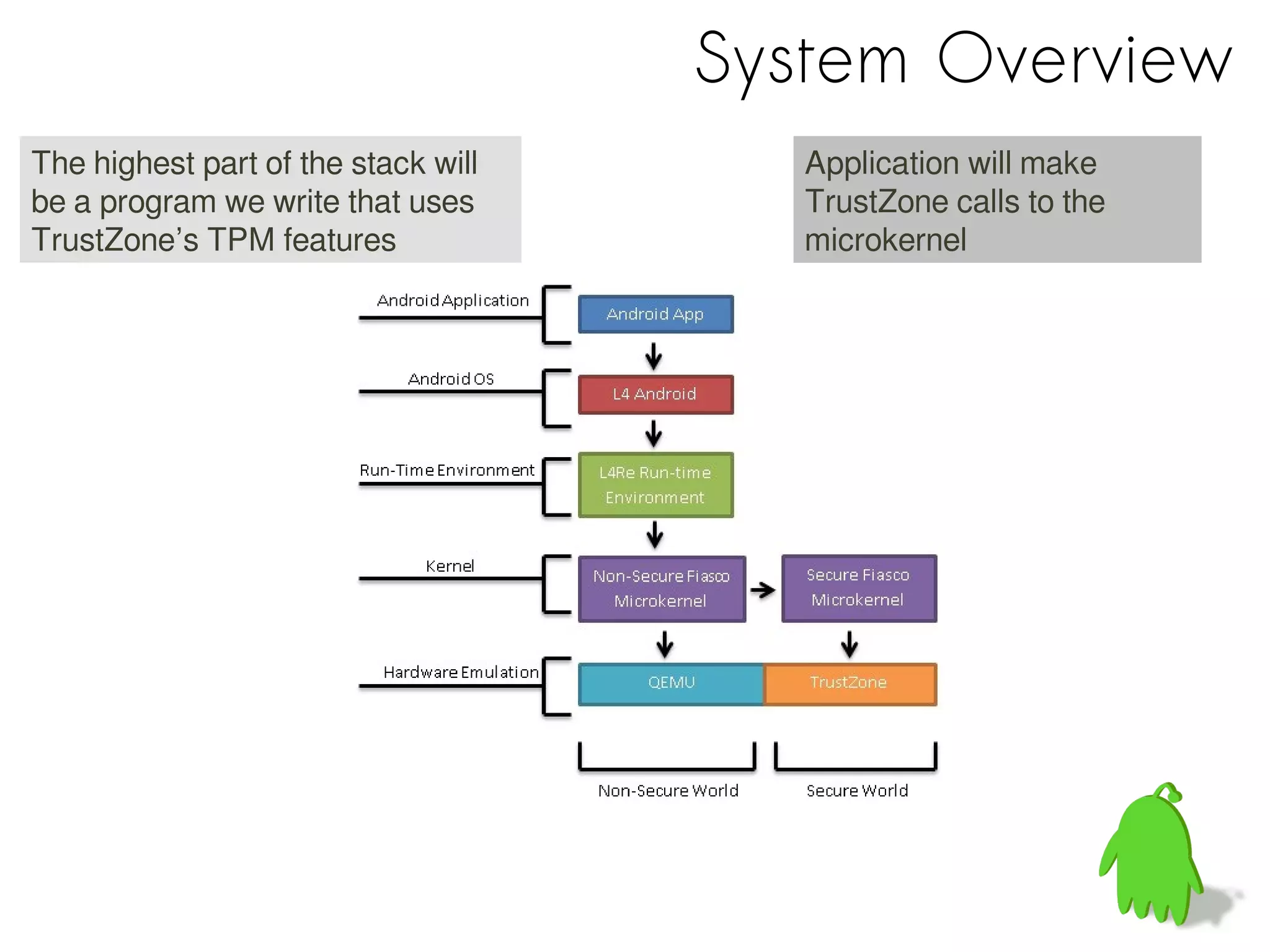
System Overview
The highest part of the stack will
be a program we write that uses
TrustZone’s TPM features
Application will make
TrustZone calls to the
microkernel
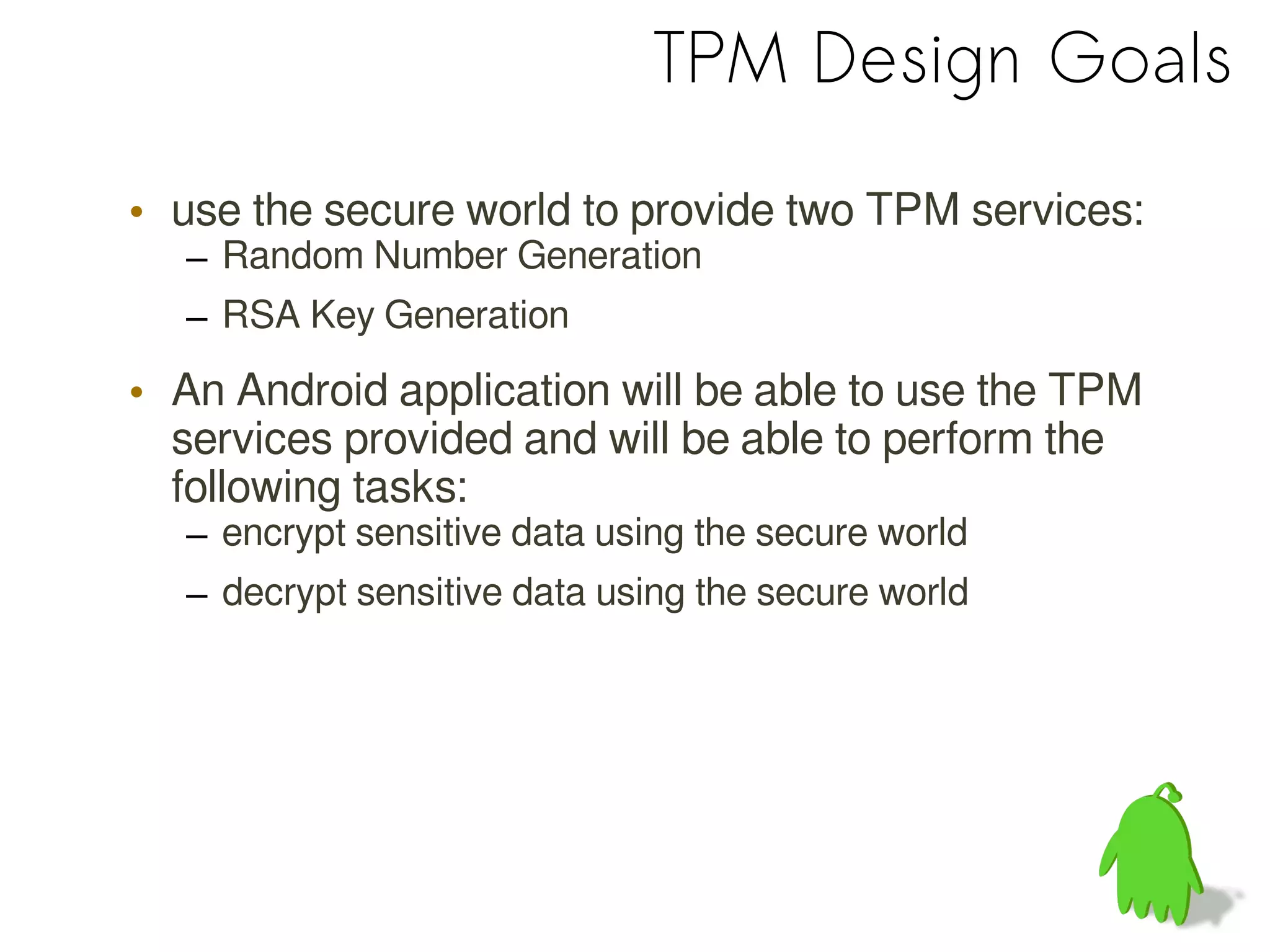
TPM Design Goals
• use the secure world to provide two TPM services:
– Random Number Generation
– RSA Key Generation
• An Android application will be able to use the TPM
services provided and will be able to perform the
following tasks:
– encrypt sensitive data using the secure world
– decrypt sensitive data using the secure world
Reference
• From L3 to seL4: What Have We Learnt in 20 Years of
L4 Microkernels? Kevin Elphinstone and Gernot
Heiser, NICTA/UNSW
• Microkernel Construction"
http://os.inf.tu-dresden.de/Studium/MkK/
• Microkernel-based Operating Systems
http://www.inf.tu-dresden.de/index.php?node_id=1314
• The L4 Microkernel, Hermann Härtig, Technische
Universität Dresden
• Microkernels, Arun Krishnamurthy, University of
Central Florida
http://0xlab.org

Hints for L4 Microkernel

  • 1.
    Hints for L4Microkernel Jim Huang ( 黃敬群 ) <jserv@0xlab.org> May 30, 2013 / NCTU, Taiwan
  • 2.
    Rights to copy Attribution– ShareAlike 3.0 You are free to copy, distribute, display, and perform the work to make derivative works to make commercial use of the work Under the following conditions Attribution. You must give the original author credit. Share Alike. If you alter, transform, or build upon this work, you may distribute the resulting work only under a license identical to this one. For any reuse or distribution, you must make clear to others the license terms of this work. Any of these conditions can be waived if you get permission from the copyright holder. Your fair use and other rights are in no way affected by the above. License text: http://creativecommons.org/licenses/by-sa/3.0/legalcode © Copyright 2013 0xlab http://0xlab.org/ Corrections, suggestions, contributions and translations are welcome! Latest update: May 16, 2013
  • 3.
    Goals of ThisPresentation • Introduce L4 microkernel principles and concepts – from “Microkernel Construction” http://os.inf.tu-dresden.de/Studium/MkK/ – From "Microkernel-based Operating Systems" http://www.inf.tu-dresden.de/index.php?node_id=1314 • Understand the real world usage for microkernels • Explore the modern implementation of modern L4 microkernel
  • 4.
    Agenda • Background Knowledge •Microkernel-based Operating Systems • Case Study
  • 5.
  • 6.
    Microkernel Concepts • Minimalkernel and hardware enforce separation • Only kernel runs in CPU privileged mode • Components are user!level processes • No restrictions on component software • Reuse of legacy software
  • 7.
    principle of leastprivilege (POLA) A capability is a communicable, unforgeable token of authority. It refers to a value that references an object along with an associated set of access rights. A user program on a capability-based operating system must use a capability to access an object.
  • 10.
    Case Study: Bugsinside big kernels • Drivers cause 85% of Windows XP crashes. – Michael M. Swift, Brian N. Bershad, Henry M. Levy: “Improving the Reliability of Commodity Operating Systems”, SOSP 2003 • Error rate in Linux drivers is 3x (maximum: 10x) – Andy Chou, Junfeng Yang, Benjamin Chelf, Seth Hallem, Dawson R. Engler: “An Empirical Study of Operating System Errors”, SOSP 2001 • Causes for driver bugs – 23% programming error – 38% mismatch regarding device specification – 39% OS-driver-interface misconceptions – Leonid Ryzhyk, Peter Chubb, Ihor Kuz and Gernot Heiser: “Dingo: Taming device drivers”, EuroSys 2009
  • 12.
    Microkernel • Minimalist approach –IPC, virtual memory, thread scheduling • Put the rest into user space – Device drivers, networking, file system, user interface • Disadvantages – Lots of system calls and context switches • Examples: Mach, L4, QNX, MINIX, IBM K42
  • 14.
  • 15.
    Virtualization based onL4Re • Isolate not only processes, but also complete • Operating Systems (compartments) – “Server consolidation”
  • 16.
    3 Generations ofMicrokernel • Generation 1: Mach (1985-1994) • Generation 2: L3 & L4 (1990-2001) • Generation 3: seL4, Fiasco.OC, NOVA (2000-)
  • 17.
    3 Generations ofMicrokernel • Mach (1985-1994) – replace pipes with IPC (more general)  – improved stability (vs monolithic kernels) – poor performance • L3 & L4 (1990-2001) – order of magnitude improvement in IPC performance • written in assembly, sacrificed CPU portability • only synchronus IPC (build async on top of sync)  – very small kernel: more functions moved to userspace • seL4, Fiasco.OC, Coyotos, NOVA (2000-) – platform independence – verification, security, multiple CPUs, etc.
  • 18.
    History about L4Microkernels(1)
  • 19.
    History about L4Microkernels(2)
  • 20.
    L4 Family (incomplete) Source:Microkernel-based Operating Systems – Introduction, Carsten Weinhold, TU Dresden (2012)
  • 21.
    L4 API vs.ABI • L4 project was originally established by Jochen Liedtke in the 1990s and is actively researched by the L4Ka team at the University of Karlsruhe in collaboration with NICTA / University of New South Wales and the Dresden University of Technology. • L4 is defined by a platform-independent1 API and a platform-dependent ABI
  • 25.
  • 26.
    Microkernel-based Operating Systems -Introduction • Information: – Carsten Weinhold – Dresden, Oct 09th 2012 • Filename: 01-Introduction.pdf – Page 22 – Page 46
  • 27.
  • 28.
  • 31.
  • 32.
    Apply Fiasco.OC forARM • Mission: To implement a software stack that allows the emulation of the mobile operating system to use the functionality of hardware protection mechanisms • Essential components – ARM TrustZone extension – Fiasco.OC microkernel – Android
  • 33.
    ARM TrustZone • ARM’sprocessor extension that allows for a software TPM implementation • Available on all major ARM mobile phone SoC • There is limited open source development with TrustZone
  • 34.
    ARM TrustZone: ApplicationExamples • Secure PIN Entry • Digital Rights Management • e-Ticketing Mobile TV (Netflix)
  • 35.
    Trust Platform Module(TPM) • A TPM is a chip that resides on the motherboard, and provides 4 basic functionalities – Secure storage and reporting of platform configurations – Protected private key storage – Cryptographic functions – Initialization and management functions
  • 36.
    System Overview The highestpart of the stack will be a program we write that uses TrustZone’s TPM features Application will make TrustZone calls to the microkernel
  • 37.
    TPM Design Goals •use the secure world to provide two TPM services: – Random Number Generation – RSA Key Generation • An Android application will be able to use the TPM services provided and will be able to perform the following tasks: – encrypt sensitive data using the secure world – decrypt sensitive data using the secure world
  • 38.
    Reference • From L3to seL4: What Have We Learnt in 20 Years of L4 Microkernels? Kevin Elphinstone and Gernot Heiser, NICTA/UNSW • Microkernel Construction" http://os.inf.tu-dresden.de/Studium/MkK/ • Microkernel-based Operating Systems http://www.inf.tu-dresden.de/index.php?node_id=1314 • The L4 Microkernel, Hermann Härtig, Technische Universität Dresden • Microkernels, Arun Krishnamurthy, University of Central Florida
  • 39.