Wendy Nieuwland
CHANGE 3.0
– a systemic and ‘clean’ approach to
lasting organisational change
June 2018
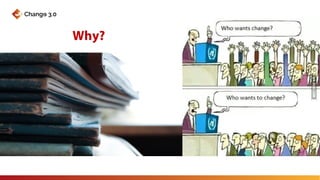
Why?
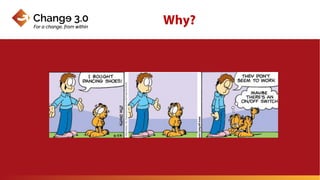
Why?
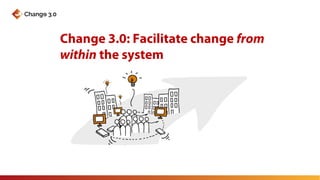
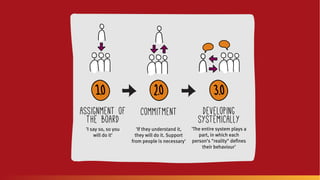
Change 3.0: Facilitate change from
within the system
'I say so, so you
will do it'
'If they understand it,
they will do it. Support
from people is necessary'
'The entire system plays a
part, in which each
person's "reality" defines
their behaviour'
assignment of
the board
commitment developing
systemically
Some assumptions behind Change 3.0
• Change is only change when (natural) behaviour has
changed
• Culture doesn’t lead to behaviour, but behaviour
leads to culture
• (Natural) behaviour is a result of underlying
perceptions of reality
• ‘Resistance’, failure etc. = information
• and many more…
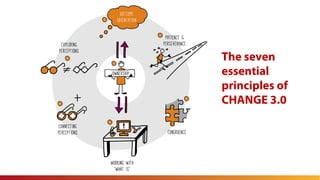
The seven
essential
principles of
CHANGE 3.0
• Helping others realise their desired change: as a system as a whole, not just
parts
• The process does more though….
So maybe we have another agenda as well, such as:
• Creating more antifragile organisations: growing from what’s tricky, diversity –
becoming a ‘better’ organisation
• Taking people within & around the organisation seriously
• Making things easier, simplifying by taking away the ‘mess’
• …
What’s our agenda?
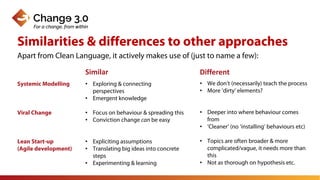
Apart from Clean Language, it actively makes use of (just to name a few):
Similarities & differences to other approaches
Systemic Modelling
Viral Change
Lean Start-up
(Agile development)
• Exploring & connecting
perspectives
• Emergent knowledge
• Focus on behaviour & spreading this
• Conviction change can be easy
• Expliciting assumptions
• Translating big ideas into concrete
steps
• Experimenting & learning
• We don’t (necessarily) teach the process
• More ‘dirty’ elements?
• Deeper into where behaviour comes
from
• ’Cleaner’ (no ‘installing’ behaviours etc)
• Topics are often broader & more
complicated/vague, it needs more than
this
• Not as thorough on hypothesis etc.
Similar Different
• That’s up to you to decide. Discuss:
a. Why should leaders not choose for an approach like this?
b. Why could they not do anything other than choosing this kind of approach?
Why bother?
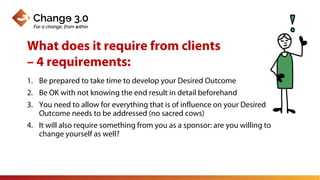
1. Be prepared to take time to develop your Desired Outcome
2. Be OK with not knowing the end result in detail beforehand
3. You need to allow for everything that is of influence on your Desired
Outcome needs to be addressed (no sacred cows)
4. It will also require something from you as a sponsor: are you willing to
change yourself as well?
What does it require from clients
– 4 requirements:
www.change3-0.eu
contact@change3-0.eu
(+33) (0)33 889 06 76
(+44) (0)7399 424 740
More info:

A short introduction into Change 3.0

  • 1.
    Wendy Nieuwland CHANGE 3.0 –a systemic and ‘clean’ approach to lasting organisational change June 2018
  • 2.
  • 3.
  • 4.
    Change 3.0: Facilitatechange from within the system
  • 5.
    'I say so,so you will do it' 'If they understand it, they will do it. Support from people is necessary' 'The entire system plays a part, in which each person's "reality" defines their behaviour' assignment of the board commitment developing systemically
  • 6.
    Some assumptions behindChange 3.0 • Change is only change when (natural) behaviour has changed • Culture doesn’t lead to behaviour, but behaviour leads to culture • (Natural) behaviour is a result of underlying perceptions of reality • ‘Resistance’, failure etc. = information • and many more…
  • 7.
  • 9.
    • Helping othersrealise their desired change: as a system as a whole, not just parts • The process does more though…. So maybe we have another agenda as well, such as: • Creating more antifragile organisations: growing from what’s tricky, diversity – becoming a ‘better’ organisation • Taking people within & around the organisation seriously • Making things easier, simplifying by taking away the ‘mess’ • … What’s our agenda?
  • 10.
    Apart from CleanLanguage, it actively makes use of (just to name a few): Similarities & differences to other approaches Systemic Modelling Viral Change Lean Start-up (Agile development) • Exploring & connecting perspectives • Emergent knowledge • Focus on behaviour & spreading this • Conviction change can be easy • Expliciting assumptions • Translating big ideas into concrete steps • Experimenting & learning • We don’t (necessarily) teach the process • More ‘dirty’ elements? • Deeper into where behaviour comes from • ’Cleaner’ (no ‘installing’ behaviours etc) • Topics are often broader & more complicated/vague, it needs more than this • Not as thorough on hypothesis etc. Similar Different
  • 11.
    • That’s upto you to decide. Discuss: a. Why should leaders not choose for an approach like this? b. Why could they not do anything other than choosing this kind of approach? Why bother?
  • 12.
    1. Be preparedto take time to develop your Desired Outcome 2. Be OK with not knowing the end result in detail beforehand 3. You need to allow for everything that is of influence on your Desired Outcome needs to be addressed (no sacred cows) 4. It will also require something from you as a sponsor: are you willing to change yourself as well? What does it require from clients – 4 requirements:
  • 13.
    www.change3-0.eu contact@change3-0.eu (+33) (0)33 88906 76 (+44) (0)7399 424 740 More info: