Journal oftheFranklinInstitute348(2011)300–314 
A robustvectorcontrolforinductionmotordrives 
with anadaptivesliding-modecontrollaw 
Oscar Barambonesa,, PatxiAlkortab 
aDpto. Ingenier´ıa deSistemasyAutom atica, EUIdeVitoria,UniversidaddelPa´ıs Vasco,Nievescano12,01006 
Vitoria, Spain 
bDpto. Ingenier´ıa deSistemasyAutom atica, EUIdeEibar,UniversidaddelPa´ıs Vasco,Avda.Otaola,2920600 
Eibar (Gipuzkoa) 
Received 4January2010;receivedinrevisedform24November2010;accepted30November2010 
Available online7December2010 
Abstract 
A noveladaptivesliding-modecontrolsystemisproposedinordertocontrolthespeedofan 
induction motordrive.Thisdesignemploystheso-calledvector(orfieldoriented)controltheoryfor 
the inductionmotordrives.Thesliding-modecontrolisinsensitivetouncertaintiesandpresentsan 
adaptive switchinggaintorelaxtherequirementfortheboundoftheseuncertainties.Theswitching 
gain isadaptedusingasimplealgorithmwhichdoesnotimplyahighcomputationalload.Stability 
analysis basedonLyapunovtheoryisalsoperformedinordertoguaranteetheclosedloopstability. 
Finally, simulationresultsshownotonlythattheproposedcontrollerprovideshigh-performance 
dynamic characteristics,butalsothatthisschemeisrobustwithrespecttoplantparametervariations 
and externalloaddisturbances. 
 2010 TheFranklinInstitute.PublishedbyElsevierLtd.Allrightsreserved. 
1. Introduction 
The inductionmotorisacomplexstructurethatconvertselectricalenergy intomechanical 
energy. Althoughinductionmachineswereintroducedmorethanahundredyearsago,the 
researchanddevelopmentinthisareaappearsto benever-ending.Traditionally,ACmachines 
with aconstantfrequencysinusoidalpower supplyhavebeenusedinconstant-speed 
applications, whereasDC machineswerepreferredforvariablespeeddrives,sincetheypresent 
www.elsevier.com/locate/jfranklin 
0016-0032/$32.00  2010 TheFranklinInstitute.PublishedbyElsevierLtd.Allrightsreserved. 
doi:10.1016/j.jfranklin.2010.11.008 
Correspondingauthor.Tel.: þ34 945013235;fax: þ34 945013270. 
E-mail address: ispbacao@ehu.es(O.Barambones).
a simplercontrol.Besides,ACmachinespresentedsomedisadvantagesincomparisonwith 
DC ones,ashighercost,higherrotorinertiaand maintenanceproblems.Nevertheless,inthe 
last twoorthreedecadeswehaveseenextensiveresearchanddevelopmenteffortsinvariable- 
frequency,variable-speedAC machinedrivestechnology [1], whichhaveovercomesomeofthe 
abovedisadvantagesoftheACmotors. 
The developmentoffieldorientedcontrolinthebeginningof1970smadeitfeasibleto 
control theinductionmotorasaseparatelyexcitedDCmotor [1–3]. Inthissense,thefield- 
orientedtechniqueguaranteesthedecouplingoftorqueandfluxcontrolcommandsforthe 
inductionmotor.Thismeansthatwhenthefluxisgovernedbymeansofcontrollingthe 
current id, thetorqueisnotaffected.Similarly,whenthetorqueisgovernedbycontrolling 
the current iq, thefluxisnotaffectedand,therefore,itcanbeachievedtransientresponse 
as fastasinthecaseofDCmachines. 
On theotherhand,whendealingwithindirectfield-orientedcontrolofinduction 
motors,aknowledgeofrotorspeedisrequiredinordertoorienttheinjectedstatorcurrent 
vector andtoestablishanadequatespeedfeedbackcontrol.Althoughtheuseofaflux 
estimatorindirectfieldorientedcontroleliminatestheneedofthespeedsensorinorderto 
orient theinjectedstatorcurrentvector,thismethodisnotpractical.Thisisbecausethe 
flux estimatordoesnotworkproperlyinalowspeedregion.Thefluxestimatorpresentsa 
pole ontheoriginofthe S plane (pureintegrator),andthereforeitisverysensitivetothe 
offset ofthevoltagesensorandtheparametervariations. 
However,thespeedorpositionsensorofinductionmotorstilllimitsitsapplicationsto 
somespecialenvironmentsnotonlyduetothedifficultiesofmountingthesensor,butalso 
becauseoftheneedoflowcostandreliablesystems.Theresearchanddevelopmentworkon 
a sensorlessdriverfortheACmotorisprogressinggreatly.Muchworkhasbeendoneusing 
thefieldorientedbasedmethodapproach [4–7]. Intheseschemesthespeedisobtainedbased 
onthemeasurementofstatorvoltagesandcurrents.Ontheotherhand,theinductionmotor 
modelcanbeobtainedusingaNeuralNetworkapproach.IntheworkofAlanisetal. [8] 
a discrete-timenonlinearsystemidentificationviarecurrenthighorderneuralnetworksis 
proposed.Inthisworkasixth-orderdiscrete-timeinductionmotormodelinthestatorfixed 
referenceframeiscalculatedusingtheproposedrecurrentneuralnetworksscheme. 
Nevertheless,therobustnesstoparametervariationsandloaddisturbancesinthe 
inductionmachinesstilldeservestobefurtherstudiedand,inparticular,specialattention 
should bepaidtothelowspeedregiontransients. 
Thus, theperformanceofthefieldorientedcontrolstronglydependsonuncertainties, 
which areusuallyduetounknownparameters,parametervariations,externalload 
disturbances,unmodelledandnonlineardynamics,etc.Therefore,manystudieshavebeen 
made onthemotordrivesinordertopreservetheperformanceundertheseparameter 
variationsandexternalloaddisturbances,suchasnonlinearcontrol,optimalcontrol, 
variablestructuresystemcontrol,adaptivecontrol,neuralcontrolandfuzzycontrol 
[9–13]. Recently,thegeneticalgorithmapproachhasalsobeenusedinordertocontrolthe 
electric motors.TheworkofMontazeri-Ghetal. [14], describestheapplicationofthe 
geneticalgorithmfortheoptimizationofthecontrolparametersinparallelhybridelectric 
vehiclesdrivenbyanelectricinductionmachine. 
To overcometheabovesystemuncertainties,the variablestructurecontrolstrategyusing 
the sliding-modehasbeenfocussedonmanystudiesandresearchforthecontroloftheAC 
servo drivesysteminthepastdecade [15–19]. Thesliding-modecontrolcanoffermanygood 
properties,suchasgoodperformanceagainstunmodelled dynamics,insensitivitytoparameter 
O. Barambones,P.Alkorta/JournaloftheFranklinInstitute348(2011)300–314 301
variations,externaldisturbance rejection andfastdynamicresponse [20]. Theseadvantagesof 
the sliding-modecontrolmaybeemployedinthepositionandspeedcontrolofanACservo 
system. 
The robustpropertiesofthesliding-modesystemsarealsobeenemployedinthe 
observersdesign [21]. Inthisworkanobserver-basedsliding-modecontrolproblemis 
investigatedforaclassofuncertaindeltaoperatorsystemswithnonlinearexogenous 
disturbanceandthecontrolsystemstabilityisdemonstratedusingtheLyapunovstability 
theory. IntheworkofBoiko [22] the estimationprecisionandbandwidthofsliding-mode 
observersareanalyzedinthefrequencydomainfordifferentsettingsoftheobserverdesign 
parameters.Inthispaperanexampleofsliding-modeobserverdesignforestimationofDC 
motor speedfromthemeasurementsofarmaturecurrentisconsidered. 
A position-and-velocitysensorlesscontrolforbrushlessDCmotorsusinganadaptive 
sliding modeobserverisproposedinFuruhashi [23]. Inthisworkasliding-modeobserver 
is proposedinordertoestimatethepositionandvelocityforbrushlessDCmotors.Then, 
the velocityofthesystemisregulatedusingaPIcontrol.Asensorlesssliding-modetorque 
control forinductionmotorsusedinhybridelectricvehicleapplicationsisdevelopedin 
Proca etal. [24]. Thesliding-modecontrolproposedinthisworkallowsforfastandprecise 
torque trackingoverawiderangeofspeed.Thepaperalsopresentstheidentificationand 
parameterestimationofaninductionmotormodelwithvaryingparameters.Inthepaper 
[25] a surveyofapplicationsofsecond-ordersliding-modecontroltomechanicalsystemsis 
presented.Inthispaperdifferentsecond-ordersliding-modecontrollers,previously 
presentedintheliterature,areshownandsomechallengingcontrolproblemsinvolving 
mechanicalsystemsareaddressedandsolved.Arobustsliding-modesensorlessspeed- 
control schemeofavoltage-fedinductionmotorisproposedinRashedetal. [26]. Inthis 
work asecond-orderslidingmodeisproposedinordertoreducethechatteringproblem 
that usuallyappearsinthetraditionalsliding-modecontrollers.IntheworkofAuroraand 
Ferrara [27] a sliding-modecontrolalgorithmforcurrent-fedinductionmotorsis 
presented.Inthispaperisproposedanadaptivesecond-ordersliding-modeobserverfor 
speed androtorflux,andtheloadtorqueandtherotortimeconstantarealsoestimated. 
Thehigherorderslidingmode(HOSM)proposedinthiswork,presentsomeadvantagesover 
standardsliding-modecontrolschemes,oneofthemostimportantisthechatteringreduction. 
However intheHOSManaccurateknowledgeofrotorfluxandmachineparametersisthekey 
factorinordertoobtainahigh-performanceandhigh-efficiencyinduction-motorcontrol 
scheme. Then,thesecontrolschemesrequireamorepreciseknowledgeofthesystemparameters 
or theuseofestimatorsinordertocalculatethesystemparameters,whichimpliesmore 
computationalcostthantraditionalsliding-modecontrollers. 
On theotherhand,theslidingcontrolschemesrequirepriorknowledgeoftheupperbound 
for thesystemuncertaintiessincethisboundis employed intheswitchinggaincalculation. 
It shouldbenotedthatthechoiceofsuchboundmaynotbeeasilyobtainedduetothe 
complicatedstructureoftheuncertainties inpracticalcontrolsystems [28,29]. Moreover,this 
upperboundshouldbedeterminedasaccurately aspossible,becausethevaluetobe 
considered fortheslidinggainincreaseswiththe bound,andthereforethecontroleffortwillbe 
also proportionaltothisbound.Hence,ahigh upperboundforthesystemuncertainties 
implies morecontroleffortandtheproblemofthechatteringwillbeincreased. 
In ordertosurmountthisdrawback,inthispaperisproposedanadaptivelawinorder 
to calculatetheslidinggain.Therefore,inourproposedadaptivesliding-modecontrol 
scheme wedonotneedtocalculateanupperboundofthesystemuncertainties,which 
O. Barambones,P.Alkorta/JournaloftheFranklinInstitute348(2011)300–314 302
greatlysimplifiesthecontrollerdesign.Moreover,thisupperboundcanbeunknownand 
can bevariablealongthetimebecausetheslidinggainisadaptedon-line. 
In thissense,thispaperpresentsanewsensorlessvectorcontrolschemeconsistingon 
the onehandofaspeedestimationalgorithmsothatthereisnoneedforaspeedsensor 
and ontheotherhandofanadaptativevariablestructurecontrollawwithanintegral 
sliding surfacethatcompensatesfortheuncertaintiesinthesystem.Intheproposed 
adaptivesliding-modecontrolscheme,unlikethetraditionalsliding-modecontrolschemes, 
the slidinggainisnotcalculatedinadvance,becauseitisestimatedon-lineinorderto 
compensatethepresentsystemuncertaintiesthatcanbevariablesalongthetime. 
Using thisvariablestructurecontrolintheinductionmotordrive,thecontrolledspeedis 
insensitivetovariationsinthemotorparametersandloaddisturbances.Thisvariable 
structurecontrolprovidesagoodtransientresponseandexponentialconvergenceofthe 
speed trajectorytrackingdespiteparameteruncertaintiesandloadtorquedisturbances. 
The closedloopstabilityoftheproposedschemeisdemonstratedusingLyapunov 
stabilitytheory,andtheexponentialconvergenceofthecontrolledspeedisalsoprovided. 
Thisreportisorganizedasfollows.Therotor speedestimationisintroducedinSection2. 
Then, theproposedrobustspeedcontrolwithadaptativeslidinggainispresentedinSection3. 
In Section4,somesimulationresultsarepresented.Finally,concludingremarksarestatedin 
the lastsection. 
2. Rotorspeedcomputation 
Many schemesbasedonsimplifiedmotormodelshavebeendevisedtosensethespeedof 
the inductionmotorfrommeasuredterminalquantitiesforcontrolpurposes.Inorderto 
obtain anaccuratedynamicrepresentationofthemotorspeed,itisnecessarytobasethe 
calculationonthecoupledcircuitequationsofthemotor. 
Since themotorvoltagesandcurrentsaremeasuredinastationaryframeofreference,it 
is alsoconvenienttoexpresstheseequationsinthatstationaryframe. 
From thestatorvoltageequationsinthestationaryframeitisobtained [3]: 
_c 
dr ¼ 
Lr 
Lm 
vds 
Lr 
Lm 
Rs þ sLs 
d 
dt 
  
ids ð1Þ 
_c 
qr ¼ 
Lr 
Lm 
vqs 
Lr 
Lm 
Rs þ sLs 
d 
dt 
  
iqs ð2Þ 
where c is thefluxlinkage; L is theinductance; v is thevoltage; R is theresistance; i is the 
current and s ¼ 1L2 
m=ðLrLsÞ is themotorleakagecoefficient.Thesubscripts r and s 
denoterespectivelytherotorandstatorvaluesreferredtothestator,andthesubscripts d 
and q denote the dq-axiscomponentsinthestationaryreferenceframe. 
The rotorfluxequationsinthestationaryframeare [3] 
_c 
dr ¼ 
Lm 
Tr 
idswrcqr 
1 
Tr 
cdr ð3Þ 
_c 
qr ¼ 
Lm 
Tr 
iqs þ wrcdr 
1 
Tr 
cqr ð4Þ 
where wr is therotorelectricalspeedand Tr=Lr/Rr is therotortimeconstant. 
O. Barambones,P.Alkorta/JournaloftheFranklinInstitute348(2011)300–314 303
The angle ye of therotorfluxvector(cr ) inrelationtothe d-axisofthestationaryframe 
is definedasfollows: 
ye ¼ arctan 
cqr 
cdr 
  
ð5Þ 
being itsderivative: 
_y 
e ¼ we ¼ 
cdr 
_c 
qrcqr 
_c 
dr 
c2 
dr þ c2 
qr 
ð6Þ 
SubstitutingEqs.(3)and(4)inEq.(6)itisobtained: 
we ¼ wr 
Lm 
Tr 
cdriqscqrids 
c2 
dr þ c2 
qr 
! 
ð7Þ 
Then, substitutingEq.(6)inEq.(7),andsolvingfor wr we obtain 
wr ¼ 
1 
c2 
r 
cdr 
_c 
qrcqr 
_c 
dr 
Lm 
Tr 
ðcdriqscqridsÞ 
  
ð8Þ 
where c2 
r ¼ c2 
dr þ c2 
qr. 
Therefore,givenacompleteknowledgeofthemotorparameters,theinstantaneous 
speed wr can becalculatedfromthepreviousequation,wherethestatormeasuredcurrent 
and voltages,andtherotorfluxestimationobtainedfromarotorfluxobserverbasedon 
Eqs. (1)and(2)havebeenemployed. 
3. Variablestructurerobustspeedcontrolwithadaptiveslidinggain 
In general,themechanicalequationofaninductionmotorcanbewrittenas 
Jw_ m þ Bwm þ TL ¼ Te ð9Þ 
where J and B are theinertiaconstantandtheviscousfrictioncoefficientoftheinduction 
motorsystemrespectively; TL is theexternalload; wm is therotormechanicalspeedin 
angularfrequency,whichisrelatedtotherotorelectricalspeedby wm=2wr/p where p is the 
polenumbers,and Te denotesthegeneratedtorqueofaninductionmotor,definedas [3] 
Te ¼ 
3p 
4 
Lm 
Lr 
ðce 
drie 
qsce 
qrie 
dsÞ ð10Þ 
where ce 
dr and ce 
qr are therotor-fluxlinkages,thesubscript‘e’denotesthatthequantityis 
referredtothesynchronouslyrotatingreferenceframe; iqs 
e and ids 
e are thestatorcurrents, 
and p is thepolenumber. 
The relationbetweenthesynchronouslyrotatingreferenceframeandthestationary 
reference frameiscomputedbytheso-calledreversePark’stransformation: 
xa 
xb 
xc 
2 
64 
3 
75 
¼ 
cosðyeÞ sinðyeÞ 
cosðye2p=3Þ sinðye2p=3Þ 
cosðye þ 2p=3Þ sinðye þ 2p=3Þ 
2 
64 
3 
75 
xd 
xq 
 # 
ð11Þ 
where ye is theanglepositionbetweenthe d-axis ofthesynchronouslyrotatingandthe 
stationaryreferenceframes,andthequantitiesareassumedtobebalanced. 
O. Barambones,P.Alkorta/JournaloftheFranklinInstitute348(2011)300–314 304
Using thefield-orientationcontrolprinciple [3] the currentcomponent ids 
e is alignedin 
the directionoftherotorfluxvector cr, andthecurrentcomponent iqs 
e is alignedinthe 
directionperpendiculartoit.Undertheseconditions,itissatisfiedthat 
ce 
qr ¼ 0; ce 
dr ¼ jcrj ð12Þ 
Fig. 1 shows thevectorialdiagramoftheinductionmotorinthestationaryandinthe 
synchronouslyrotatingreferenceframes.Thesubscripts‘s’indicatesthestationaryframe 
and thesubscript‘e’indicatesthesynchronouslyrotatingreferenceframe. 
Therefore,takingintoaccountthepreviousresults,theequationofinductionmotor 
torque (10)issimplifiedto 
Te ¼ 
3p 
4 
Lm 
Lr 
ce 
drie 
qs ¼ KT ie 
qs ð13Þ 
wherethetorqueconstant, KT, isdefinedasfollows: 
KT ¼ 
3p 
4 
Lm 
Lr 
ce 
dr ð14Þ 
ce 
dr being thecommandrotorflux. 
With theabove-mentionedfieldorientation,thedynamicsoftherotorfluxisgivenby [3] 
dce 
dr 
dt 
þ 
ce 
dr 
Tr 
¼ 
Lm 
Tr 
ie 
ds ð15Þ 
Then, themechanicalequation(9)becomes 
w_ m þ awm þ f ¼ bie 
qs ð16Þ 
Fig. 1.Vectorialdiagramoftheinductionmotor. 
O. Barambones,P.Alkorta/JournaloftheFranklinInstitute348(2011)300–314 305
where theparametersaredefinedas 
a ¼ 
B 
J 
; b ¼ 
KT 
J 
; f ¼ 
TL 
J 
ð17Þ 
Now,wearegoingtoconsiderthepreviousmechanicalequation(16)withuncertainties 
as follows: 
w_ m ¼ ða þ DaÞwmðf þ DfÞ þ ðb þ DbÞie 
qs ð18Þ 
where theterms Da, Db and Df representtheuncertaintiesoftheterms a, b and f 
respectively.Itshouldbenotedthattheseuncertaintiesareunknown,andthattheprecise 
calculationofanupperboundis,ingeneral,ratherdifficulttoachieve. 
Let usdefinethetrackingspeederrorasfollows: 
eðtÞ ¼ wmðtÞw 
mðtÞ ð19Þ 
where wm 
n is therotorspeedcommand. 
Takingthederivativeofthepreviousequationwithrespecttotimeyields 
e_ðtÞ ¼ w_ mw_  
m ¼ aeðtÞ þ uðtÞ þ dðtÞ ð20Þ 
where thefollowingtermshavebeencollectedinthesignal u(t): 
uðtÞ ¼ bie 
qsðtÞaw 
mðtÞf ðtÞw_  
mðtÞ ð21Þ 
and theuncertaintytermshavebeencollectedinthesignal d(t), 
dðtÞ ¼ DawmðtÞDf ðtÞ þ Dbie 
qsðtÞ ð22Þ 
To compensatefortheabovedescribeduncertaintiespresentinthesystem,asliding 
adaptivecontrolschemeisproposed.Intheslidingcontroltheory,theswitchinggainmust 
be constructedsoastoattaintheslidingcondition [20,30]. Inordertomeetthisconditiona 
suitable choiceoftheslidinggainshouldbemadetocompensatefortheuncertainties.To 
select theslidinggainvector,anupperboundoftheparametervariations,unmodelled 
dynamics,noisemagnitudes,etc.shouldbegiven,butinpracticalapplicationsthereare 
situationsinwhichtheseboundsareunknown,oratleastdifficulttocalculate.Asolution 
could betochooseasufficientlyhighvaluefortheslidinggain,butthisapproachcould 
cause atoohighcontrolsignal,oratleastmorecontrolactivitythanneededinorderto 
achieve thecontrolobjective. 
One possiblewaytoovercomethisdifficultyistoestimatethegainandtoupdateitby 
means ofsomeadaptationlaw,sothattheslidingconditionisachieved. 
Now,wearegoingtoproposetheslidingvariable S(t) withanintegralcomponentas 
SðtÞ ¼ eðtÞ þ 
Z t 
0 
ða þ kÞeðtÞ dt ð23Þ 
where k is aconstantgain,and a is aparameterthatwasalreadydefinedinEq.(17). 
Then theslidingsurfaceisdefinedas 
SðtÞ ¼ eðtÞ þ 
Z t 
0 
ða þ kÞeðtÞ dt ¼ 0 ð24Þ 
Now, wearegoingtodesignavariablestructurespeedcontroller,thatincorporatesan 
adaptiveslidinggain,inordertocontroltheACmotordrive 
uðtÞ ¼ keðtÞ^b 
ðtÞg sgnðSÞ ð25Þ 
O. Barambones,P.Alkorta/JournaloftheFranklinInstitute348(2011)300–314 306
wherethe k is thegaindefinedpreviously, ^b 
is theestimatedswitchinggain, g is apositive 
constant, S is theslidingvariabledefinedinEq.(23)andsgnðÞ is thesignfunction. 
The switchinggain ^b 
is adaptedaccordingtothefollowingupdatinglaw: 
_^b 
¼ gjSj; ^b 
ð0Þ ¼ 0 ð26Þ 
where g is apositiveconstantthatletuschoosetheadaptationspeedfortheslidinggain. 
In ordertoobtainthespeedtrajectorytracking,thefollowingassumptionsshouldbe 
formulated: 
ðA1Þ The gain k must bechosensothattheterm(aþk) isstrictlypositive.Thereforethe 
constant k should be k4a. 
ðA2Þ Thereexitsanunknownfinitenon-negativeswitchinggain b such that 
b4dmax þ Z; Z40 
where dmaxZjdðtÞj 8t and Z is apositiveconstant. 
Note thatthisconditiononlyimpliesthattheuncertaintiesofthesystemarebounded 
magnitudes. 
ðA3Þ The constant g must bechosensothat gZ1. 
Theorem 1. Consider theinductionmotorgivenbyEq. (18). Then, if assumptions ðA1Þ–ðA3Þ 
are verified, the controllaw (25) leads therotormechanicalspeedwm(t) so thatthespeed 
trackingerrore(t)=wm(t)wm 
n (t) tends tozeroasthetimetendstoinfinity. 
The proofofthistheoremwillbecarriedoutusingtheLyapunovstabilitytheory. 
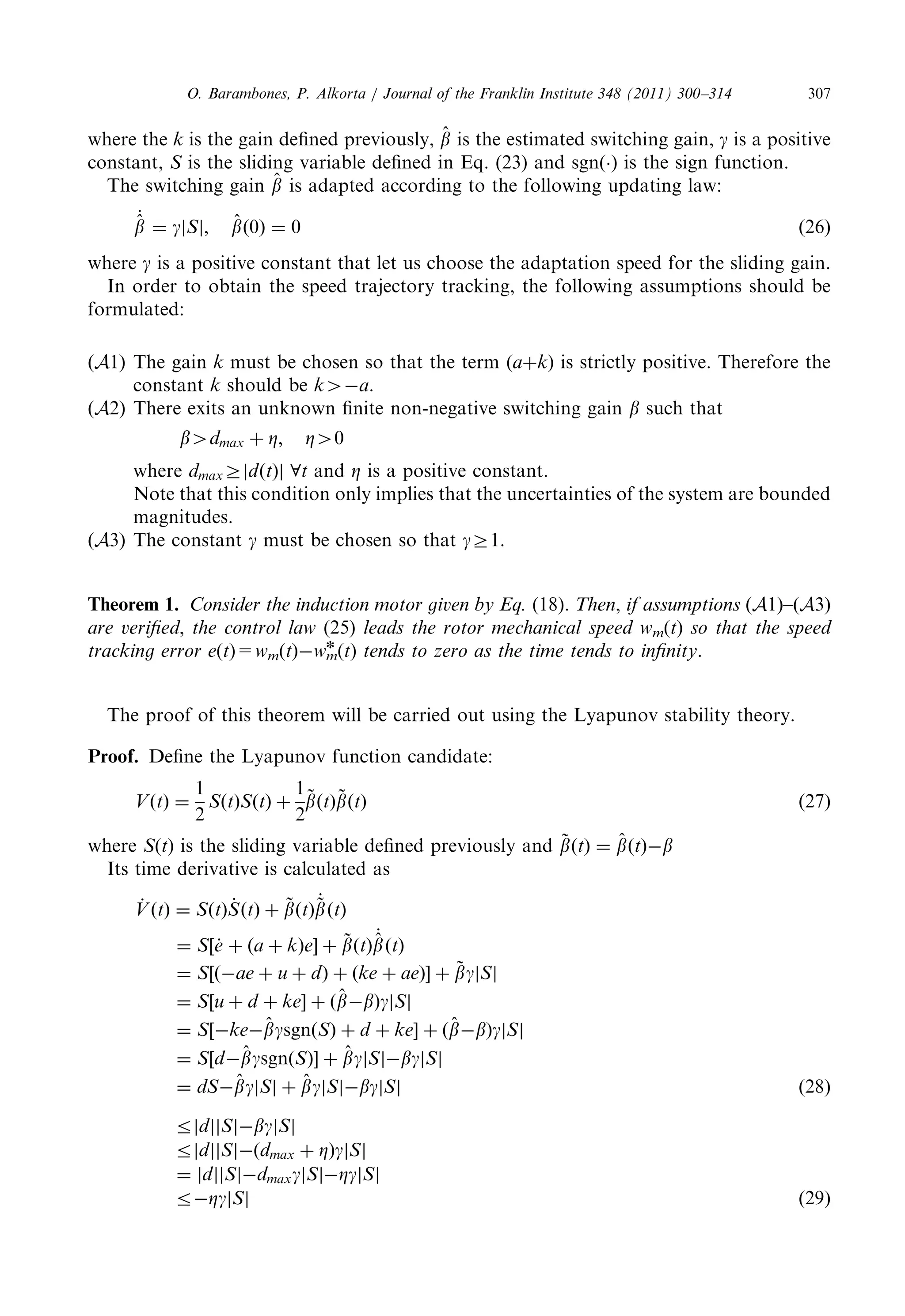
Proof. Define theLyapunovfunctioncandidate: 
VðtÞ ¼ 
1 
2 
SðtÞSðtÞ þ 
1 
2 
~b 
ðtÞ~b 
ðtÞ ð27Þ 
where S(t) istheslidingvariabledefinedpreviouslyand ~b 
ðtÞ ¼ ^b 
ðtÞb 
Its timederivativeiscalculatedas 
_V 
ðtÞ ¼ SðtÞ_S 
ðtÞ þ ~b 
ðtÞ 
_~b 
ðtÞ 
¼ S½_e þ ða þ kÞe þ ~b 
ðtÞ 
_^b 
ðtÞ 
¼ S½ðae þ u þ dÞ þ ðke þ aeÞ þ ~bgjSj 
¼ S½u þ d þ ke þ ð^b 
bÞgjSj 
¼ S½ke^bgsgnðSÞ þ d þ ke þ ð^b 
bÞgjSj 
¼ S½d^ bgsgnðSÞ þ ^bgjSjbgjSj 
¼ dS^ bgjSj þ ^ bgjSjbgjSj ð28Þ 
rjdjjSjbgjSj 
rjdjjSjðdmax þ ZÞgjSj 
¼ jdjjSjdmaxgjSjZgjSj 
rZgjSj ð29Þ 
O. Barambones,P.Alkorta/JournaloftheFranklinInstitute348(2011)300–314 307
then 
_V 
ðtÞr0 ð30Þ 
It shouldbenotedthatEqs.(23),(20),(25)and(26),andtheassumptions ðA2Þ and ðA3Þ 
have beenusedintheproof.  
UsingLyapunov’sdirectmethod,since V(t) isclearlypositive-definite, _V 
ðtÞ is negative 
semidefiniteand V(t) tendstoinfinityas S(t) and ~b 
ðtÞ tends toinfinity,thentheequilibrium 
at theorigin ½SðtÞ; ~b 
ðtÞ ¼½0; 0 is globallystable,andthereforethevariables S(t) and ~b 
ðtÞ 
are bounded.Then,since S(t) isboundedonehasthat e(t) isalsobounded. 
Besides,computingthederivativeofEq.(23),itisobtained: 
_S 
ðtÞ ¼ _eðtÞ þ ða þ kÞeðtÞ ð31Þ 
then, substitutingEq.(20)inEq.(31), 
_S 
ðtÞ ¼ aeðtÞ þ uðtÞ þ dðtÞ þ ða þ kÞeðtÞ 
¼ keðtÞ þ dðtÞ þ uðtÞ ð32Þ 
FromEq.(32)wecanconcludethat _S 
ðtÞ is boundedbecause e(t), u(t) and d(t) are 
bounded. 
Now,fromEq.(28)itisdeducedthat 
€V 
ðtÞ ¼ d_S 
ðtÞbg 
d 
dt 
jSðtÞj ð33Þ 
which isaboundedquantitybecause _S 
ðtÞ is bounded. 
Undertheseconditions,since €V 
is bounded, _V 
is auniformlycontinuousfunction,so 
Barbalat’slemmaletusconcludethat _V 
-0 as t-1, whichimpliesthat SðtÞ-0 as t-1. 
Therefore S(t) tendstozeroasthetime t tendstoinfinity.Moreover,alltrajectories 
startingofftheslidingsurface S=0 mustreachitasymptoticallyandthenwillremainonthis 
surface.Thissystem’sbehavior,onceontheslidingsurfaceisusuallycalled slidingmode [20]. 
Whentheslidingmodeoccursontheslidingsurface(24),then SðtÞ ¼ _S 
ðtÞ ¼ 0, and 
therefore thedynamicbehaviorofthetrackingproblem(20)isequivalentlygovernedby 
the followingequation: 
_S 
ðtÞ ¼ 0 ) _eðtÞ ¼ ða þ kÞeðtÞ ð34Þ 
Then, underassumption ðA1Þ, thetrackingerror e(t) convergestozeroexponentially. 
It shouldbenotedthat,atypicalmotionundersliding-modecontrolconsistsofa reaching 
phase duringwhichtrajectoriesstartingofftheslidingsurface S=0 movetowardsitand 
reachit,followedbya slidingphase duringwhichthemotionisconfinedtothissurfaceand 
wherethesystemtrackingerror,representedbythereduced-ordermodel(34),tendstozero. 
Finally,thetorquecurrentcommand, iqs 
en(t), canbeobtaineddirectlysubstitutingEq.(25) 
in Eq.(21): 
ie 
qs ðtÞ ¼ 
1 
b 
½ke^ bgsgnðSÞ þ aw 
m þ w_  
m þ f ð35Þ 
Therefore,theproposedvariablestructurespeedcontrolwithadaptiveslidinggain 
resolves thespeedtrackingproblemfortheinductionmotor,withuncertaintiesin 
mechanicalparametersandloadtorque. 
O. Barambones,P.Alkorta/JournaloftheFranklinInstitute348(2011)300–314 308
4. Simulationresults 
In thissectionwewillstudythespeedregulationperformanceoftheproposedadaptive 
sliding-modefieldorientedcontrolversusspeedreferenceandloadtorquevariationsby 
means ofsimulationexamples.Inparticular,theexamplepresentedconsistofarepre- 
sentativespeedreferencetrackingproblem,combinedwithloadtorquevariationsduring 
the evolutionoftheexperimentandconsideringacertaindegreeofuncertainty,inorderto 
attain acompletescopeofthebehaviorofthesystem. 
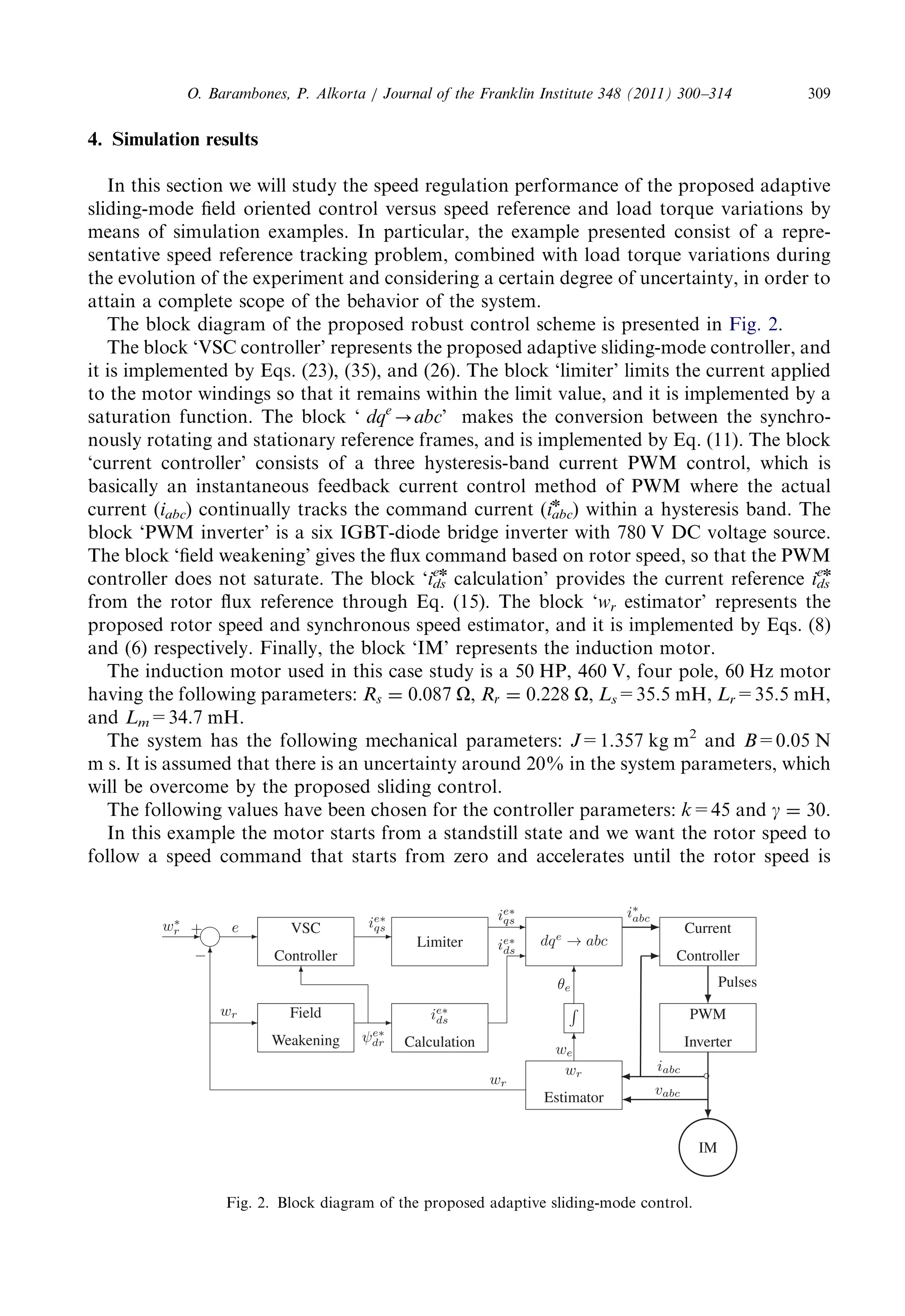
The blockdiagramoftheproposedrobustcontrolschemeispresentedin Fig. 2. 
The block‘VSCcontroller’representstheproposedadaptivesliding-modecontroller,and 
it isimplementedbyEqs.(23),(35),and(26).Theblock‘limiter’limitsthecurrentapplied 
to themotorwindingssothatitremainswithinthelimitvalue,anditisimplementedbya 
saturationfunction.Theblock‘ dqe-abc’ makestheconversionbetweenthesynchro- 
nouslyrotatingandstationaryreferenceframes,andisimplementedbyEq.(11).Theblock 
‘currentcontroller’consistsofathreehysteresis-bandcurrentPWMcontrol,whichis 
basicallyaninstantaneousfeedbackcurrentcontrolmethodofPWMwheretheactual 
current(iabc) continuallytracksthecommandcurrent(iabc 
n ) withinahysteresisband.The 
block‘PWMinverter’isasixIGBT-diodebridgeinverterwith780VDCvoltagesource. 
The block‘fieldweakening’givesthefluxcommandbasedonrotorspeed,sothatthePWM 
controllerdoesnotsaturate.Theblock‘ids 
en calculation’providesthecurrentreference ids 
en 
fromtherotorfluxreferencethroughEq.(15).Theblock‘wr estimator’representsthe 
proposedrotorspeedandsynchronousspeedestimator,anditisimplementedbyEqs.(8) 
and (6)respectively.Finally,theblock‘IM’representstheinductionmotor. 
The inductionmotorusedinthiscasestudyisa50HP,460V,fourpole,60Hzmotor 
having thefollowingparameters: Rs ¼ 0:087 O, Rr ¼ 0:228 O, Ls=35.5 mH, Lr=35.5 mH, 
and Lm=34.7 mH. 
The systemhasthefollowingmechanicalparameters: J=1.357kgm2 and B=0.05 N 
m s.Itisassumedthatthereisanuncertaintyaround20%inthesystemparameters,which 
will beovercomebytheproposedslidingcontrol. 
The followingvalueshavebeenchosenforthecontrollerparameters: k=45 and g ¼ 30. 
In thisexamplethemotorstartsfromastandstillstateandwewanttherotorspeedto 
follow aspeedcommandthatstartsfromzeroandacceleratesuntiltherotorspeedis 
Fig. 2.Blockdiagramoftheproposedadaptivesliding-modecontrol. 
O. Barambones,P.Alkorta/JournaloftheFranklinInstitute348(2011)300–314 309
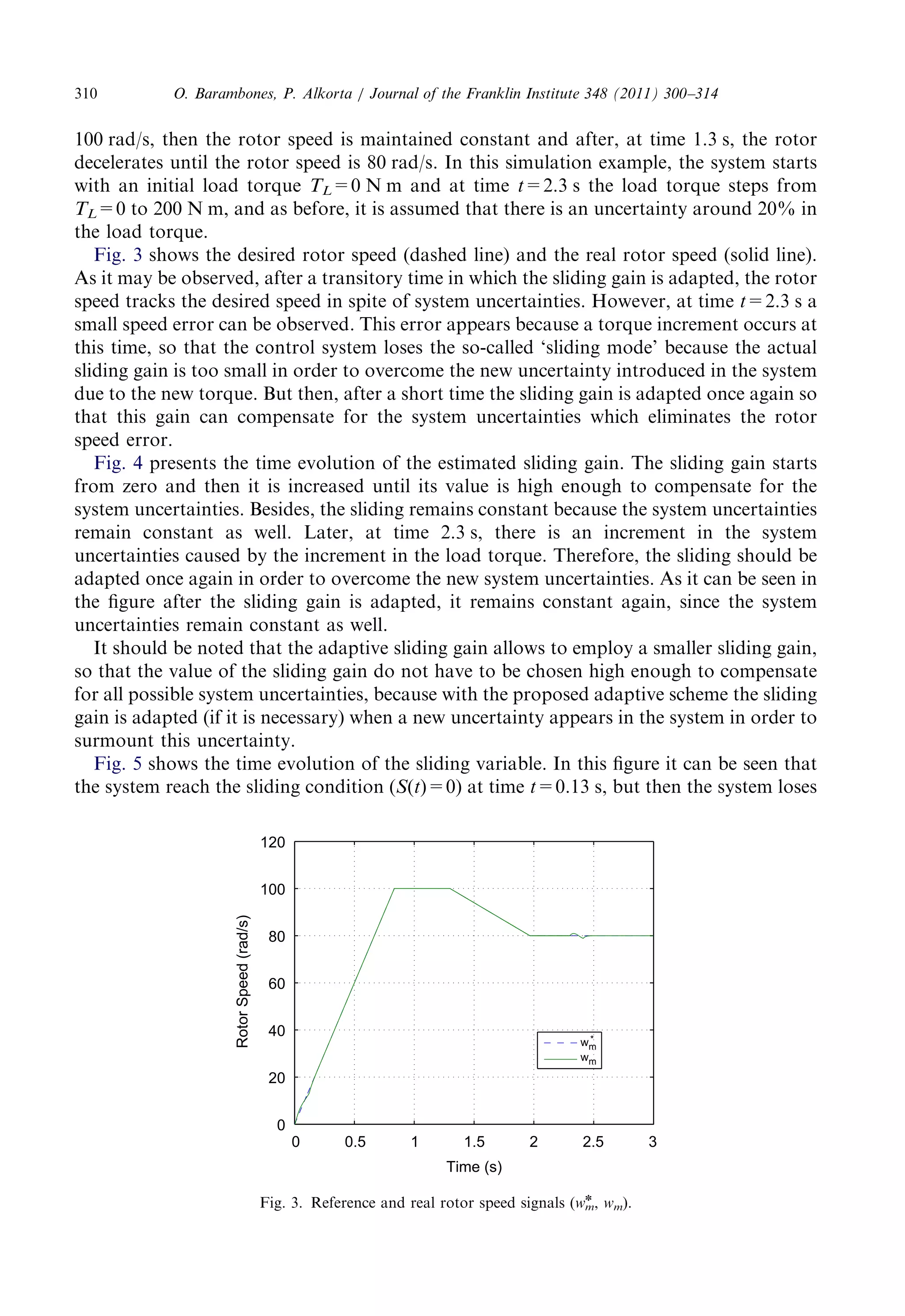
100 rad/s,thentherotorspeedismaintainedconstantandafter,attime1.3s,therotor 
deceleratesuntiltherotorspeedis80rad/s.Inthissimulationexample,thesystemstarts 
with aninitialloadtorque TL=0 Nmandattime t=2.3 stheloadtorquestepsfrom 
TL=0 to200Nm,andasbefore,itisassumedthatthereisanuncertaintyaround20%in 
the loadtorque. 
Fig. 3 shows thedesiredrotorspeed(dashedline)andtherealrotorspeed(solidline). 
As itmaybeobserved,afteratransitorytimeinwhichtheslidinggainisadapted,therotor 
speed tracksthedesiredspeedinspiteofsystemuncertainties.However,attime t=2.3 sa 
small speederrorcanbeobserved.Thiserrorappearsbecauseatorqueincrementoccursat 
this time,sothatthecontrolsystemlosestheso-called‘slidingmode’becausetheactual 
sliding gainistoosmallinordertoovercomethenewuncertaintyintroducedinthesystem 
due tothenewtorque.Butthen,afterashorttimetheslidinggainisadaptedonceagainso 
that thisgaincancompensateforthesystemuncertaintieswhicheliminatestherotor 
speed error. 
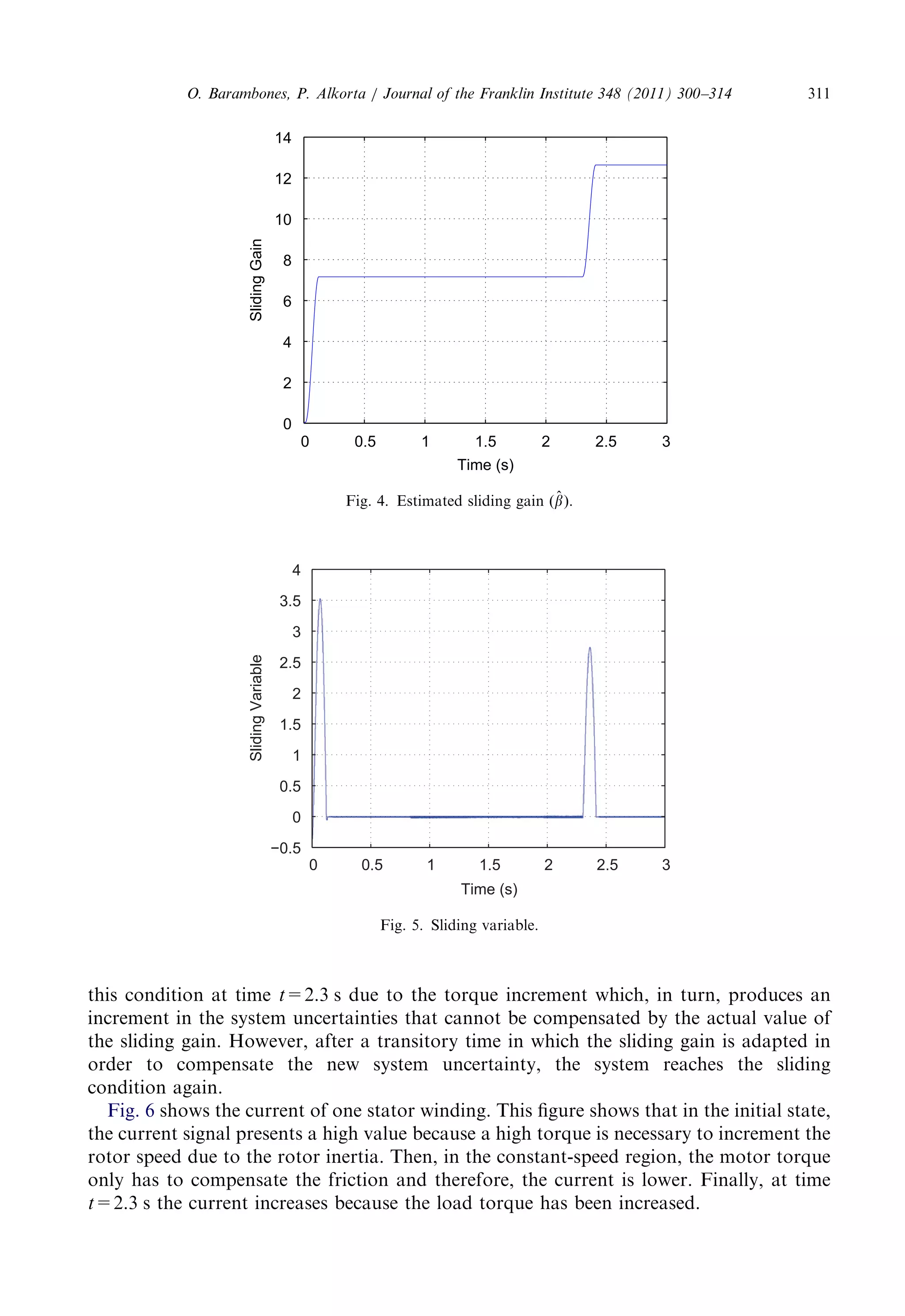
Fig. 4 presentsthetimeevolutionoftheestimatedslidinggain.Theslidinggainstarts 
from zeroandthenitisincreaseduntilitsvalueishighenoughtocompensateforthe 
system uncertainties.Besides,theslidingremainsconstantbecausethesystemuncertainties 
remain constantaswell.Later,attime2.3s,thereisanincrementinthesystem 
uncertaintiescausedbytheincrementintheloadtorque.Therefore,theslidingshouldbe 
adapted onceagaininordertoovercomethenewsystemuncertainties.Asitcanbeseenin 
the figureaftertheslidinggainisadapted,itremainsconstantagain,sincethesystem 
uncertaintiesremainconstantaswell. 
It shouldbenotedthattheadaptiveslidinggainallowstoemployasmallerslidinggain, 
so thatthevalueoftheslidinggaindonothavetobechosenhighenoughtocompensate 
for allpossiblesystemuncertainties,becausewiththeproposedadaptiveschemethesliding 
gain isadapted(ifitisnecessary)whenanewuncertaintyappearsinthesysteminorderto 
surmount thisuncertainty. 
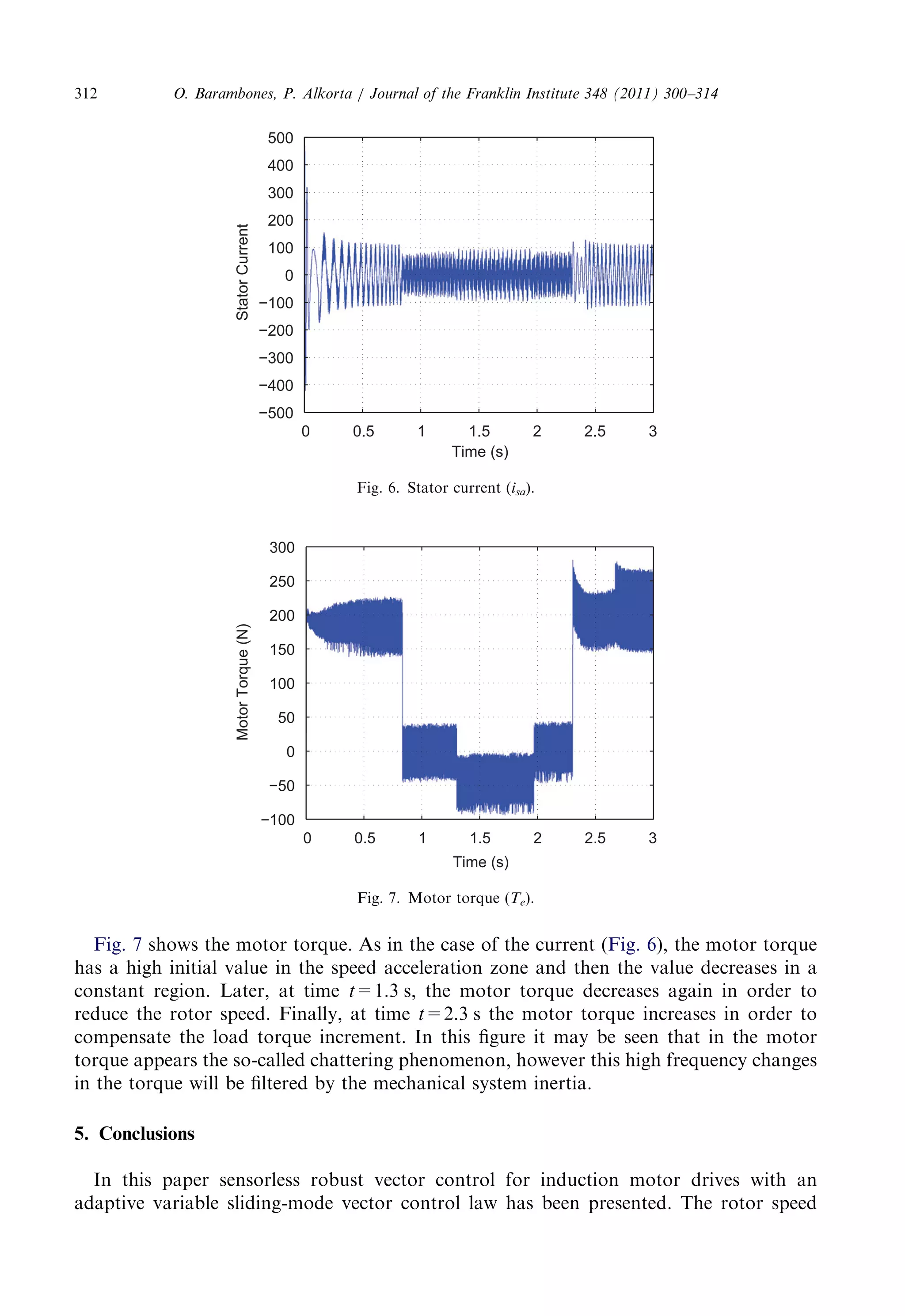
Fig. 5 shows thetimeevolutionoftheslidingvariable.Inthisfigureitcanbeseenthat 
the systemreachtheslidingcondition(S(t)=0) attime t=0.13 s,butthenthesystemloses 
0 0.511.522.53 
0 
20 
40 
60 
80 
100 
120 
Time (s) 
Rotor Speed (rad/s) 
wm * 
wm 
Fig. 3.Referenceandrealrotorspeedsignals(wm 
n , wm). 
O. Barambones,P.Alkorta/JournaloftheFranklinInstitute348(2011)300–314 310
this conditionattime t=2.3 sduetothetorqueincrementwhich,inturn,producesan 
incrementinthesystemuncertaintiesthatcannotbecompensatedbytheactualvalueof 
the slidinggain.However,afteratransitorytimeinwhichtheslidinggainisadaptedin 
order tocompensatethenewsystemuncertainty,thesystemreachesthesliding 
conditionagain. 
Fig. 6 showsthecurrentofonestatorwinding.Thisfigureshowsthatintheinitialstate, 
the currentsignalpresentsahighvaluebecauseahightorqueisnecessarytoincrementthe 
rotor speedduetotherotorinertia.Then,intheconstant-speedregion,themotortorque 
only hastocompensatethefrictionandtherefore,thecurrentislower.Finally,attime 
t=2.3 sthecurrentincreasesbecausetheloadtorquehasbeenincreased. 
0 0.511.522.53 
−0.5 
0 
0.5 
1 
1.5 
2 
2.5 
3 
3.5 
4 
Time (s) 
Sliding Variable 
Fig. 5.Slidingvariable. 
0 0.511.522.53 
0 
2 
4 
6 
8 
10 
12 
14 
Time (s) 
Sliding Gain 
Fig. 4.Estimatedslidinggain ð^b 
Þ. 
O. Barambones,P.Alkorta/JournaloftheFranklinInstitute348(2011)300–314 311
Fig. 7 shows themotortorque.Asinthecaseofthecurrent(Fig. 6), themotortorque 
has ahighinitialvalueinthespeedaccelerationzoneandthenthevaluedecreasesina 
constant region.Later,attime t=1.3 s,themotortorquedecreasesagaininorderto 
reduce therotorspeed.Finally,attime t=2.3 sthemotortorqueincreasesinorderto 
compensatetheloadtorqueincrement.Inthisfigureitmaybeseenthatinthemotor 
torque appearstheso-calledchatteringphenomenon,howeverthishighfrequencychanges 
in thetorquewillbefilteredbythemechanicalsysteminertia. 
5. Conclusions 
In thispapersensorlessrobustvectorcontrolforinductionmotordriveswithan 
adaptivevariablesliding-modevectorcontrollawhasbeenpresented.Therotorspeed 
0 0.511.522.53 
−500 
−400 
−300 
−200 
−100 
0 
100 
200 
300 
400 
500 
Time (s) 
Stator Current 
Fig. 6.Statorcurrent(isa). 
0 0.511.522.53 
−100 
−50 
0 
50 
100 
150 
200 
250 
300 
Motor Torque (N) 
Time (s) 
Fig. 7.Motortorque(Te). 
O. Barambones,P.Alkorta/JournaloftheFranklinInstitute348(2011)300–314 312
estimatorisbasedonstatorvoltageequationsandrotorfluxequationsinthestationary 
referenceframe.Itisproposedasavariablestructurecontrolwhichusesanintegralsliding 
surfacetorelaxtherequirementoftheaccelerationsignal,thatisusualinconventional 
sliding-modespeedcontroltechniques.Duetothenatureoftheslidingcontrolthiscontrol 
scheme isrobustunderuncertaintiescausedbyparametererrorsorbychangesintheload 
torque. Moreover,theproposedvariablestructurecontrolincorporatesandadaptive 
algorithmtocalculatetheslidinggainvalue.Theadaptationoftheslidinggain,ontheone 
hand avoidstheneedofcomputingtheupperboundofthesystemuncertainties,andon 
the otherhandallowstoemployassmallerslidinggainaspossibletoovercometheactual 
system uncertainties.Thenthecontrolsignalofourproposedvariablestructurecontrol 
schemes willbesmallerthanthecontrolsignalsofthetraditionalvariablestructurecontrol 
schemes,becauseinthesetraditionalschemestheslidinggainvalueshouldbechosenhigh 
enoughtoovercomeallthepossibleuncertaintiesthatcouldappearinthesystemalong 
the time. 
The closedloopstabilityofthedesignpresentedinthispaperhasbeenprovedthought 
Lyapunovstabilitytheory.Finally,bymeansofsimulationexamples,ithasbeenshown 
that theproposedcontrolschemeperformsreasonablywellinpractice,andthatthespeed 
trackingobjectiveisachievedunderuncertaintiesintheparametersandloadtorque. 
Acknowledgments 
The authorsareverygratefultotheBasqueGovernmentbythesupportofthiswork 
through theprojectS-PE09UN12andtotheUPV/EHUbyitssupportthroughproject 
GUI07/08. 
References 
[1] W.Leonhard,ControlofElectricalDrives,Springer,Berlin,1996. 
[2] P.Vas,VectorControlofACMachines,OxfordSciencePublications,Oxford,1994. 
[3] B.K.Bose,ModernPowerElectronicsandACDrives,PrenticeHall,NewJersey,2001. 
[4] R.Beguenane,M.A.Ouhrouche,A.M.Trzynadlowski,Anewschemeforsensorlessinductionmotorcontrol 
drives operatinginlowspeedregion,MathematicsandComputersinSimulation71(2006)109–120. 
[5] S.Sunter,Slipenergyrecoveryofarotor-sidefieldorientedcontrolledwoundrotorinductionmotorfedby 
matrix converter,JournaloftheFranklinInstitute345(2008)419–435. 
[6] M.Comanescu,Aninduction-motorspeedestimatorbasedonintegralsliding-modecurrentcontrol,IEEE 
Transactions onIndustrialElectronics56(9)(2009)3414–3423. 
[7] M.I.Marei,M.F.Shaaban,A.A.El-Sattar,Aspeedestimationunitforinductionmotorsbasedonadaptive 
linear combiner,EnergyConversionandManagement50(2009)1664–1670. 
[8] A.Y.Alanis,E.N.Sanchez,A.G.Loukianov,E.A.Hernandez,Discrete-timerecurrenthighorderneural 
networks fornonlinearidentification,JournaloftheFranklinInstitute347(2010)1253–1265. 
[9] T-J.Ren,T-C.Chen,Robustspeed-controlledinductionmotordrivebasedonrecurrentneuralnetwork, 
Electric PowerSystemResearch76(2006)1064–1074. 
[10] M.Montanari,S.Peresada,A.Tilli,Aspeed-sensorlessindirectfield-orientedcontrolforinductionmotors 
based onhighgainspeedestimation,Automatica42(2006)1637–1650. 
[11] R.Marino,P.Tomei,C.M.Verrelli,Anadaptivetrackingcontrolfromcurrentmeasurementsforinduction 
motors withuncertainloadtorqueandrotorresistance,Automatica44(2008)2593–2599. 
[12] J.B.Oliveira,A.D.Araujo,S.M.Dias,Controllingthespeedofathree-phaseinductionmotorusinga 
simplified indirectadaptiveslidingmodescheme,ControlEngineeringPractice18(2010)577–584. 
[13] M.A.Fnaiech,F.Betin,G.A.Capolino,F.Fnaiech,Fuzzylogicandsliding-modecontrolsappliedtosix- 
phase inductionmachinewithopenphases,IEEETransactionsonIndustrialElectronics57(1)(2010) 
354–364. 
O. Barambones,P.Alkorta/JournaloftheFranklinInstitute348(2011)300–314 313
[14] M.Montazeri-Gh,A.Poursamad,B.Ghalichi,Applicationofgeneticalgorithmforoptimizationofcontrol 
strategy inparallelhybridelectricvehicles,JournaloftheFranklinInstitute343(2006)420–435. 
[15] A.Benchaib,C.Edwards,Nonlinearslidingmodecontrolofaninductionmotor,InternationalJournalof 
Adaptive ControlandSignalProcesing14(2000)201–221. 
[16] O.Barambones,A.J.Garrido,Asensorlessvariablestructurecontrolofinductionmotordrives,Electric 
Power SystemsResearch72(2004)21–32. 
[17] R.Yazdanpanah,J.Soltani,G.R.ArabMarkadeh,Nonlineartorqueandstatorfluxcontrollerforinduction 
motor drivebasedonadaptiveinput–outputfeedbacklinearizationandslidingmodecontrol,Energy 
ConversionandManagement49(2008)541–550. 
[18] B.Castillo-Toledo,S.DiGennaro,A.G.Loukianov,J.Rivera,Discretetimeslidingmodecontrolwith 
applicationtoinductionmotors,Automatica44(2008)3036–3045. 
[19] T.Orowska-Kowalska,M.Kami nski, K.Szabat,Implementationofasliding-modecontrollerwithan 
integral functionandfuzzygainvaluefortheelectricaldrivewithanelasticjoint,IEEETransactionson 
Industrial Electronics57(4)(2010)1309–1317. 
[20] V.I.Utkin,Slidingmodecontroldesignprinciplesandapplicationstoelectricdrives,IEEETransactionson 
Industrial Electronics40(1993)26–36. 
[21] H.Yang,Y.Xia,P.Shi,Observer-basedslidingmodecontrolforaclassofdiscretesystemsviadelta 
operator approach,JournaloftheFranklinInstitute347(2010)1199–1213. 
[22] I.Boiko,Frequencydomainprecisionanalysisanddesignofslidingmodeobservers,JournaloftheFranklin 
Institute 347(2010)899–909. 
[23] T.Furuhashi,S.Sangwongwanich,S.Okuma,Aposition-and-velocitysensorlesscontrolforbrushlessDC 
motors usinganadaptiveslidingmodeobserver,IEEETransactionsonIndustrialElectronics39(1992) 
89–95. 
[24] A.B.Proca,A.Keyhani,J.M.Miller,Sensorlesssliding-modecontrolofinductionmotorsusingoperating 
condition dependentmodels,IEEETransactionsonEnergyConversion18(2003)205–212. 
[25] G.Bartolini,A.Pisano,E.Punta,E.Usai,Asurveyofapplicationsofsecond-orderslidingmodecontrolto 
mechanicalsystems,InternationalJournalofControl76(2003)875–892. 
[26] M.Rashed,K.B.Goh,M.W.Dunnigan,P.F.A.MacConnell,A.F.Stronach,B.W.Williams,Sensorless 
second-ordersliding-modespeedcontrolofavoltage-fedinduction-motordriveusingnonlinearstate 
feedback, IEEProceedingsElectricPowerApplications152(2005)1127–1136. 
[27] C.Aurora,A.Ferrara,Aslidingmodeobserverforsensorlessinductionmotorspeedregulation, 
InternationalJournalofSystemsScience38(2007)913–929. 
[28] Y.Xia,Z.Zhu,C.Li,H.Yang,Q.Zhu,Robustadaptiveslidingmodecontrolforuncertaindiscrete-time 
systems withtimedelay,JournaloftheFranklinInstitute347(1)(2010)339–357. 
[29] M.C.Pai,Designofadaptiveslidingmodecontrollerforrobusttrackingandmodelfollowing,Journalofthe 
Franklin Institute347(2010)1838–1849. 
[30] J.J.E.Slotine,W.Li,AppliedNonlinearControl,Prentice-Hall,EnglewoodCliffs,NJ,USA,1991. 
O. Barambones,P.Alkorta/JournaloftheFranklinInstitute348(2011)300–314 314

A robust vector control for induction motor drives with an adaptive sliding mode control law

  • 1.
    Journal oftheFranklinInstitute348(2011)300–314 Arobustvectorcontrolforinductionmotordrives with anadaptivesliding-modecontrollaw Oscar Barambonesa,, PatxiAlkortab aDpto. Ingenier´ıa deSistemasyAutom atica, EUIdeVitoria,UniversidaddelPa´ıs Vasco,Nievescano12,01006 Vitoria, Spain bDpto. Ingenier´ıa deSistemasyAutom atica, EUIdeEibar,UniversidaddelPa´ıs Vasco,Avda.Otaola,2920600 Eibar (Gipuzkoa) Received 4January2010;receivedinrevisedform24November2010;accepted30November2010 Available online7December2010 Abstract A noveladaptivesliding-modecontrolsystemisproposedinordertocontrolthespeedofan induction motordrive.Thisdesignemploystheso-calledvector(orfieldoriented)controltheoryfor the inductionmotordrives.Thesliding-modecontrolisinsensitivetouncertaintiesandpresentsan adaptive switchinggaintorelaxtherequirementfortheboundoftheseuncertainties.Theswitching gain isadaptedusingasimplealgorithmwhichdoesnotimplyahighcomputationalload.Stability analysis basedonLyapunovtheoryisalsoperformedinordertoguaranteetheclosedloopstability. Finally, simulationresultsshownotonlythattheproposedcontrollerprovideshigh-performance dynamic characteristics,butalsothatthisschemeisrobustwithrespecttoplantparametervariations and externalloaddisturbances. 2010 TheFranklinInstitute.PublishedbyElsevierLtd.Allrightsreserved. 1. Introduction The inductionmotorisacomplexstructurethatconvertselectricalenergy intomechanical energy. Althoughinductionmachineswereintroducedmorethanahundredyearsago,the researchanddevelopmentinthisareaappearsto benever-ending.Traditionally,ACmachines with aconstantfrequencysinusoidalpower supplyhavebeenusedinconstant-speed applications, whereasDC machineswerepreferredforvariablespeeddrives,sincetheypresent www.elsevier.com/locate/jfranklin 0016-0032/$32.00 2010 TheFranklinInstitute.PublishedbyElsevierLtd.Allrightsreserved. doi:10.1016/j.jfranklin.2010.11.008 Correspondingauthor.Tel.: þ34 945013235;fax: þ34 945013270. E-mail address: ispbacao@ehu.es(O.Barambones).
  • 2.
    a simplercontrol.Besides,ACmachinespresentedsomedisadvantagesincomparisonwith DCones,ashighercost,higherrotorinertiaand maintenanceproblems.Nevertheless,inthe last twoorthreedecadeswehaveseenextensiveresearchanddevelopmenteffortsinvariable- frequency,variable-speedAC machinedrivestechnology [1], whichhaveovercomesomeofthe abovedisadvantagesoftheACmotors. The developmentoffieldorientedcontrolinthebeginningof1970smadeitfeasibleto control theinductionmotorasaseparatelyexcitedDCmotor [1–3]. Inthissense,thefield- orientedtechniqueguaranteesthedecouplingoftorqueandfluxcontrolcommandsforthe inductionmotor.Thismeansthatwhenthefluxisgovernedbymeansofcontrollingthe current id, thetorqueisnotaffected.Similarly,whenthetorqueisgovernedbycontrolling the current iq, thefluxisnotaffectedand,therefore,itcanbeachievedtransientresponse as fastasinthecaseofDCmachines. On theotherhand,whendealingwithindirectfield-orientedcontrolofinduction motors,aknowledgeofrotorspeedisrequiredinordertoorienttheinjectedstatorcurrent vector andtoestablishanadequatespeedfeedbackcontrol.Althoughtheuseofaflux estimatorindirectfieldorientedcontroleliminatestheneedofthespeedsensorinorderto orient theinjectedstatorcurrentvector,thismethodisnotpractical.Thisisbecausethe flux estimatordoesnotworkproperlyinalowspeedregion.Thefluxestimatorpresentsa pole ontheoriginofthe S plane (pureintegrator),andthereforeitisverysensitivetothe offset ofthevoltagesensorandtheparametervariations. However,thespeedorpositionsensorofinductionmotorstilllimitsitsapplicationsto somespecialenvironmentsnotonlyduetothedifficultiesofmountingthesensor,butalso becauseoftheneedoflowcostandreliablesystems.Theresearchanddevelopmentworkon a sensorlessdriverfortheACmotorisprogressinggreatly.Muchworkhasbeendoneusing thefieldorientedbasedmethodapproach [4–7]. Intheseschemesthespeedisobtainedbased onthemeasurementofstatorvoltagesandcurrents.Ontheotherhand,theinductionmotor modelcanbeobtainedusingaNeuralNetworkapproach.IntheworkofAlanisetal. [8] a discrete-timenonlinearsystemidentificationviarecurrenthighorderneuralnetworksis proposed.Inthisworkasixth-orderdiscrete-timeinductionmotormodelinthestatorfixed referenceframeiscalculatedusingtheproposedrecurrentneuralnetworksscheme. Nevertheless,therobustnesstoparametervariationsandloaddisturbancesinthe inductionmachinesstilldeservestobefurtherstudiedand,inparticular,specialattention should bepaidtothelowspeedregiontransients. Thus, theperformanceofthefieldorientedcontrolstronglydependsonuncertainties, which areusuallyduetounknownparameters,parametervariations,externalload disturbances,unmodelledandnonlineardynamics,etc.Therefore,manystudieshavebeen made onthemotordrivesinordertopreservetheperformanceundertheseparameter variationsandexternalloaddisturbances,suchasnonlinearcontrol,optimalcontrol, variablestructuresystemcontrol,adaptivecontrol,neuralcontrolandfuzzycontrol [9–13]. Recently,thegeneticalgorithmapproachhasalsobeenusedinordertocontrolthe electric motors.TheworkofMontazeri-Ghetal. [14], describestheapplicationofthe geneticalgorithmfortheoptimizationofthecontrolparametersinparallelhybridelectric vehiclesdrivenbyanelectricinductionmachine. To overcometheabovesystemuncertainties,the variablestructurecontrolstrategyusing the sliding-modehasbeenfocussedonmanystudiesandresearchforthecontroloftheAC servo drivesysteminthepastdecade [15–19]. Thesliding-modecontrolcanoffermanygood properties,suchasgoodperformanceagainstunmodelled dynamics,insensitivitytoparameter O. Barambones,P.Alkorta/JournaloftheFranklinInstitute348(2011)300–314 301
  • 3.
    variations,externaldisturbance rejection andfastdynamicresponse[20]. Theseadvantagesof the sliding-modecontrolmaybeemployedinthepositionandspeedcontrolofanACservo system. The robustpropertiesofthesliding-modesystemsarealsobeenemployedinthe observersdesign [21]. Inthisworkanobserver-basedsliding-modecontrolproblemis investigatedforaclassofuncertaindeltaoperatorsystemswithnonlinearexogenous disturbanceandthecontrolsystemstabilityisdemonstratedusingtheLyapunovstability theory. IntheworkofBoiko [22] the estimationprecisionandbandwidthofsliding-mode observersareanalyzedinthefrequencydomainfordifferentsettingsoftheobserverdesign parameters.Inthispaperanexampleofsliding-modeobserverdesignforestimationofDC motor speedfromthemeasurementsofarmaturecurrentisconsidered. A position-and-velocitysensorlesscontrolforbrushlessDCmotorsusinganadaptive sliding modeobserverisproposedinFuruhashi [23]. Inthisworkasliding-modeobserver is proposedinordertoestimatethepositionandvelocityforbrushlessDCmotors.Then, the velocityofthesystemisregulatedusingaPIcontrol.Asensorlesssliding-modetorque control forinductionmotorsusedinhybridelectricvehicleapplicationsisdevelopedin Proca etal. [24]. Thesliding-modecontrolproposedinthisworkallowsforfastandprecise torque trackingoverawiderangeofspeed.Thepaperalsopresentstheidentificationand parameterestimationofaninductionmotormodelwithvaryingparameters.Inthepaper [25] a surveyofapplicationsofsecond-ordersliding-modecontroltomechanicalsystemsis presented.Inthispaperdifferentsecond-ordersliding-modecontrollers,previously presentedintheliterature,areshownandsomechallengingcontrolproblemsinvolving mechanicalsystemsareaddressedandsolved.Arobustsliding-modesensorlessspeed- control schemeofavoltage-fedinductionmotorisproposedinRashedetal. [26]. Inthis work asecond-orderslidingmodeisproposedinordertoreducethechatteringproblem that usuallyappearsinthetraditionalsliding-modecontrollers.IntheworkofAuroraand Ferrara [27] a sliding-modecontrolalgorithmforcurrent-fedinductionmotorsis presented.Inthispaperisproposedanadaptivesecond-ordersliding-modeobserverfor speed androtorflux,andtheloadtorqueandtherotortimeconstantarealsoestimated. Thehigherorderslidingmode(HOSM)proposedinthiswork,presentsomeadvantagesover standardsliding-modecontrolschemes,oneofthemostimportantisthechatteringreduction. However intheHOSManaccurateknowledgeofrotorfluxandmachineparametersisthekey factorinordertoobtainahigh-performanceandhigh-efficiencyinduction-motorcontrol scheme. Then,thesecontrolschemesrequireamorepreciseknowledgeofthesystemparameters or theuseofestimatorsinordertocalculatethesystemparameters,whichimpliesmore computationalcostthantraditionalsliding-modecontrollers. On theotherhand,theslidingcontrolschemesrequirepriorknowledgeoftheupperbound for thesystemuncertaintiessincethisboundis employed intheswitchinggaincalculation. It shouldbenotedthatthechoiceofsuchboundmaynotbeeasilyobtainedduetothe complicatedstructureoftheuncertainties inpracticalcontrolsystems [28,29]. Moreover,this upperboundshouldbedeterminedasaccurately aspossible,becausethevaluetobe considered fortheslidinggainincreaseswiththe bound,andthereforethecontroleffortwillbe also proportionaltothisbound.Hence,ahigh upperboundforthesystemuncertainties implies morecontroleffortandtheproblemofthechatteringwillbeincreased. In ordertosurmountthisdrawback,inthispaperisproposedanadaptivelawinorder to calculatetheslidinggain.Therefore,inourproposedadaptivesliding-modecontrol scheme wedonotneedtocalculateanupperboundofthesystemuncertainties,which O. Barambones,P.Alkorta/JournaloftheFranklinInstitute348(2011)300–314 302
  • 4.
    greatlysimplifiesthecontrollerdesign.Moreover,thisupperboundcanbeunknownand can bevariablealongthetimebecausetheslidinggainisadaptedon-line. In thissense,thispaperpresentsanewsensorlessvectorcontrolschemeconsistingon the onehandofaspeedestimationalgorithmsothatthereisnoneedforaspeedsensor and ontheotherhandofanadaptativevariablestructurecontrollawwithanintegral sliding surfacethatcompensatesfortheuncertaintiesinthesystem.Intheproposed adaptivesliding-modecontrolscheme,unlikethetraditionalsliding-modecontrolschemes, the slidinggainisnotcalculatedinadvance,becauseitisestimatedon-lineinorderto compensatethepresentsystemuncertaintiesthatcanbevariablesalongthetime. Using thisvariablestructurecontrolintheinductionmotordrive,thecontrolledspeedis insensitivetovariationsinthemotorparametersandloaddisturbances.Thisvariable structurecontrolprovidesagoodtransientresponseandexponentialconvergenceofthe speed trajectorytrackingdespiteparameteruncertaintiesandloadtorquedisturbances. The closedloopstabilityoftheproposedschemeisdemonstratedusingLyapunov stabilitytheory,andtheexponentialconvergenceofthecontrolledspeedisalsoprovided. Thisreportisorganizedasfollows.Therotor speedestimationisintroducedinSection2. Then, theproposedrobustspeedcontrolwithadaptativeslidinggainispresentedinSection3. In Section4,somesimulationresultsarepresented.Finally,concludingremarksarestatedin the lastsection. 2. Rotorspeedcomputation Many schemesbasedonsimplifiedmotormodelshavebeendevisedtosensethespeedof the inductionmotorfrommeasuredterminalquantitiesforcontrolpurposes.Inorderto obtain anaccuratedynamicrepresentationofthemotorspeed,itisnecessarytobasethe calculationonthecoupledcircuitequationsofthemotor. Since themotorvoltagesandcurrentsaremeasuredinastationaryframeofreference,it is alsoconvenienttoexpresstheseequationsinthatstationaryframe. From thestatorvoltageequationsinthestationaryframeitisobtained [3]: _c dr ¼ Lr Lm vds Lr Lm Rs þ sLs d dt ids ð1Þ _c qr ¼ Lr Lm vqs Lr Lm Rs þ sLs d dt iqs ð2Þ where c is thefluxlinkage; L is theinductance; v is thevoltage; R is theresistance; i is the current and s ¼ 1L2 m=ðLrLsÞ is themotorleakagecoefficient.Thesubscripts r and s denoterespectivelytherotorandstatorvaluesreferredtothestator,andthesubscripts d and q denote the dq-axiscomponentsinthestationaryreferenceframe. The rotorfluxequationsinthestationaryframeare [3] _c dr ¼ Lm Tr idswrcqr 1 Tr cdr ð3Þ _c qr ¼ Lm Tr iqs þ wrcdr 1 Tr cqr ð4Þ where wr is therotorelectricalspeedand Tr=Lr/Rr is therotortimeconstant. O. Barambones,P.Alkorta/JournaloftheFranklinInstitute348(2011)300–314 303
  • 5.
    The angle yeof therotorfluxvector(cr ) inrelationtothe d-axisofthestationaryframe is definedasfollows: ye ¼ arctan cqr cdr ð5Þ being itsderivative: _y e ¼ we ¼ cdr _c qrcqr _c dr c2 dr þ c2 qr ð6Þ SubstitutingEqs.(3)and(4)inEq.(6)itisobtained: we ¼ wr Lm Tr cdriqscqrids c2 dr þ c2 qr ! ð7Þ Then, substitutingEq.(6)inEq.(7),andsolvingfor wr we obtain wr ¼ 1 c2 r cdr _c qrcqr _c dr Lm Tr ðcdriqscqridsÞ ð8Þ where c2 r ¼ c2 dr þ c2 qr. Therefore,givenacompleteknowledgeofthemotorparameters,theinstantaneous speed wr can becalculatedfromthepreviousequation,wherethestatormeasuredcurrent and voltages,andtherotorfluxestimationobtainedfromarotorfluxobserverbasedon Eqs. (1)and(2)havebeenemployed. 3. Variablestructurerobustspeedcontrolwithadaptiveslidinggain In general,themechanicalequationofaninductionmotorcanbewrittenas Jw_ m þ Bwm þ TL ¼ Te ð9Þ where J and B are theinertiaconstantandtheviscousfrictioncoefficientoftheinduction motorsystemrespectively; TL is theexternalload; wm is therotormechanicalspeedin angularfrequency,whichisrelatedtotherotorelectricalspeedby wm=2wr/p where p is the polenumbers,and Te denotesthegeneratedtorqueofaninductionmotor,definedas [3] Te ¼ 3p 4 Lm Lr ðce drie qsce qrie dsÞ ð10Þ where ce dr and ce qr are therotor-fluxlinkages,thesubscript‘e’denotesthatthequantityis referredtothesynchronouslyrotatingreferenceframe; iqs e and ids e are thestatorcurrents, and p is thepolenumber. The relationbetweenthesynchronouslyrotatingreferenceframeandthestationary reference frameiscomputedbytheso-calledreversePark’stransformation: xa xb xc 2 64 3 75 ¼ cosðyeÞ sinðyeÞ cosðye2p=3Þ sinðye2p=3Þ cosðye þ 2p=3Þ sinðye þ 2p=3Þ 2 64 3 75 xd xq # ð11Þ where ye is theanglepositionbetweenthe d-axis ofthesynchronouslyrotatingandthe stationaryreferenceframes,andthequantitiesareassumedtobebalanced. O. Barambones,P.Alkorta/JournaloftheFranklinInstitute348(2011)300–314 304
  • 6.
    Using thefield-orientationcontrolprinciple [3]the currentcomponent ids e is alignedin the directionoftherotorfluxvector cr, andthecurrentcomponent iqs e is alignedinthe directionperpendiculartoit.Undertheseconditions,itissatisfiedthat ce qr ¼ 0; ce dr ¼ jcrj ð12Þ Fig. 1 shows thevectorialdiagramoftheinductionmotorinthestationaryandinthe synchronouslyrotatingreferenceframes.Thesubscripts‘s’indicatesthestationaryframe and thesubscript‘e’indicatesthesynchronouslyrotatingreferenceframe. Therefore,takingintoaccountthepreviousresults,theequationofinductionmotor torque (10)issimplifiedto Te ¼ 3p 4 Lm Lr ce drie qs ¼ KT ie qs ð13Þ wherethetorqueconstant, KT, isdefinedasfollows: KT ¼ 3p 4 Lm Lr ce dr ð14Þ ce dr being thecommandrotorflux. With theabove-mentionedfieldorientation,thedynamicsoftherotorfluxisgivenby [3] dce dr dt þ ce dr Tr ¼ Lm Tr ie ds ð15Þ Then, themechanicalequation(9)becomes w_ m þ awm þ f ¼ bie qs ð16Þ Fig. 1.Vectorialdiagramoftheinductionmotor. O. Barambones,P.Alkorta/JournaloftheFranklinInstitute348(2011)300–314 305
  • 7.
    where theparametersaredefinedas a¼ B J ; b ¼ KT J ; f ¼ TL J ð17Þ Now,wearegoingtoconsiderthepreviousmechanicalequation(16)withuncertainties as follows: w_ m ¼ ða þ DaÞwmðf þ DfÞ þ ðb þ DbÞie qs ð18Þ where theterms Da, Db and Df representtheuncertaintiesoftheterms a, b and f respectively.Itshouldbenotedthattheseuncertaintiesareunknown,andthattheprecise calculationofanupperboundis,ingeneral,ratherdifficulttoachieve. Let usdefinethetrackingspeederrorasfollows: eðtÞ ¼ wmðtÞw mðtÞ ð19Þ where wm n is therotorspeedcommand. Takingthederivativeofthepreviousequationwithrespecttotimeyields e_ðtÞ ¼ w_ mw_ m ¼ aeðtÞ þ uðtÞ þ dðtÞ ð20Þ where thefollowingtermshavebeencollectedinthesignal u(t): uðtÞ ¼ bie qsðtÞaw mðtÞf ðtÞw_ mðtÞ ð21Þ and theuncertaintytermshavebeencollectedinthesignal d(t), dðtÞ ¼ DawmðtÞDf ðtÞ þ Dbie qsðtÞ ð22Þ To compensatefortheabovedescribeduncertaintiespresentinthesystem,asliding adaptivecontrolschemeisproposed.Intheslidingcontroltheory,theswitchinggainmust be constructedsoastoattaintheslidingcondition [20,30]. Inordertomeetthisconditiona suitable choiceoftheslidinggainshouldbemadetocompensatefortheuncertainties.To select theslidinggainvector,anupperboundoftheparametervariations,unmodelled dynamics,noisemagnitudes,etc.shouldbegiven,butinpracticalapplicationsthereare situationsinwhichtheseboundsareunknown,oratleastdifficulttocalculate.Asolution could betochooseasufficientlyhighvaluefortheslidinggain,butthisapproachcould cause atoohighcontrolsignal,oratleastmorecontrolactivitythanneededinorderto achieve thecontrolobjective. One possiblewaytoovercomethisdifficultyistoestimatethegainandtoupdateitby means ofsomeadaptationlaw,sothattheslidingconditionisachieved. Now,wearegoingtoproposetheslidingvariable S(t) withanintegralcomponentas SðtÞ ¼ eðtÞ þ Z t 0 ða þ kÞeðtÞ dt ð23Þ where k is aconstantgain,and a is aparameterthatwasalreadydefinedinEq.(17). Then theslidingsurfaceisdefinedas SðtÞ ¼ eðtÞ þ Z t 0 ða þ kÞeðtÞ dt ¼ 0 ð24Þ Now, wearegoingtodesignavariablestructurespeedcontroller,thatincorporatesan adaptiveslidinggain,inordertocontroltheACmotordrive uðtÞ ¼ keðtÞ^b ðtÞg sgnðSÞ ð25Þ O. Barambones,P.Alkorta/JournaloftheFranklinInstitute348(2011)300–314 306
  • 8.
    wherethe k isthegaindefinedpreviously, ^b is theestimatedswitchinggain, g is apositive constant, S is theslidingvariabledefinedinEq.(23)andsgnðÞ is thesignfunction. The switchinggain ^b is adaptedaccordingtothefollowingupdatinglaw: _^b ¼ gjSj; ^b ð0Þ ¼ 0 ð26Þ where g is apositiveconstantthatletuschoosetheadaptationspeedfortheslidinggain. In ordertoobtainthespeedtrajectorytracking,thefollowingassumptionsshouldbe formulated: ðA1Þ The gain k must bechosensothattheterm(aþk) isstrictlypositive.Thereforethe constant k should be k4a. ðA2Þ Thereexitsanunknownfinitenon-negativeswitchinggain b such that b4dmax þ Z; Z40 where dmaxZjdðtÞj 8t and Z is apositiveconstant. Note thatthisconditiononlyimpliesthattheuncertaintiesofthesystemarebounded magnitudes. ðA3Þ The constant g must bechosensothat gZ1. Theorem 1. Consider theinductionmotorgivenbyEq. (18). Then, if assumptions ðA1Þ–ðA3Þ are verified, the controllaw (25) leads therotormechanicalspeedwm(t) so thatthespeed trackingerrore(t)=wm(t)wm n (t) tends tozeroasthetimetendstoinfinity. The proofofthistheoremwillbecarriedoutusingtheLyapunovstabilitytheory. Proof. Define theLyapunovfunctioncandidate: VðtÞ ¼ 1 2 SðtÞSðtÞ þ 1 2 ~b ðtÞ~b ðtÞ ð27Þ where S(t) istheslidingvariabledefinedpreviouslyand ~b ðtÞ ¼ ^b ðtÞb Its timederivativeiscalculatedas _V ðtÞ ¼ SðtÞ_S ðtÞ þ ~b ðtÞ _~b ðtÞ ¼ S½_e þ ða þ kÞe þ ~b ðtÞ _^b ðtÞ ¼ S½ðae þ u þ dÞ þ ðke þ aeÞ þ ~bgjSj ¼ S½u þ d þ ke þ ð^b bÞgjSj ¼ S½ke^bgsgnðSÞ þ d þ ke þ ð^b bÞgjSj ¼ S½d^ bgsgnðSÞ þ ^bgjSjbgjSj ¼ dS^ bgjSj þ ^ bgjSjbgjSj ð28Þ rjdjjSjbgjSj rjdjjSjðdmax þ ZÞgjSj ¼ jdjjSjdmaxgjSjZgjSj rZgjSj ð29Þ O. Barambones,P.Alkorta/JournaloftheFranklinInstitute348(2011)300–314 307
  • 9.
    then _V ðtÞr0ð30Þ It shouldbenotedthatEqs.(23),(20),(25)and(26),andtheassumptions ðA2Þ and ðA3Þ have beenusedintheproof. UsingLyapunov’sdirectmethod,since V(t) isclearlypositive-definite, _V ðtÞ is negative semidefiniteand V(t) tendstoinfinityas S(t) and ~b ðtÞ tends toinfinity,thentheequilibrium at theorigin ½SðtÞ; ~b ðtÞ ¼½0; 0 is globallystable,andthereforethevariables S(t) and ~b ðtÞ are bounded.Then,since S(t) isboundedonehasthat e(t) isalsobounded. Besides,computingthederivativeofEq.(23),itisobtained: _S ðtÞ ¼ _eðtÞ þ ða þ kÞeðtÞ ð31Þ then, substitutingEq.(20)inEq.(31), _S ðtÞ ¼ aeðtÞ þ uðtÞ þ dðtÞ þ ða þ kÞeðtÞ ¼ keðtÞ þ dðtÞ þ uðtÞ ð32Þ FromEq.(32)wecanconcludethat _S ðtÞ is boundedbecause e(t), u(t) and d(t) are bounded. Now,fromEq.(28)itisdeducedthat €V ðtÞ ¼ d_S ðtÞbg d dt jSðtÞj ð33Þ which isaboundedquantitybecause _S ðtÞ is bounded. Undertheseconditions,since €V is bounded, _V is auniformlycontinuousfunction,so Barbalat’slemmaletusconcludethat _V -0 as t-1, whichimpliesthat SðtÞ-0 as t-1. Therefore S(t) tendstozeroasthetime t tendstoinfinity.Moreover,alltrajectories startingofftheslidingsurface S=0 mustreachitasymptoticallyandthenwillremainonthis surface.Thissystem’sbehavior,onceontheslidingsurfaceisusuallycalled slidingmode [20]. Whentheslidingmodeoccursontheslidingsurface(24),then SðtÞ ¼ _S ðtÞ ¼ 0, and therefore thedynamicbehaviorofthetrackingproblem(20)isequivalentlygovernedby the followingequation: _S ðtÞ ¼ 0 ) _eðtÞ ¼ ða þ kÞeðtÞ ð34Þ Then, underassumption ðA1Þ, thetrackingerror e(t) convergestozeroexponentially. It shouldbenotedthat,atypicalmotionundersliding-modecontrolconsistsofa reaching phase duringwhichtrajectoriesstartingofftheslidingsurface S=0 movetowardsitand reachit,followedbya slidingphase duringwhichthemotionisconfinedtothissurfaceand wherethesystemtrackingerror,representedbythereduced-ordermodel(34),tendstozero. Finally,thetorquecurrentcommand, iqs en(t), canbeobtaineddirectlysubstitutingEq.(25) in Eq.(21): ie qs ðtÞ ¼ 1 b ½ke^ bgsgnðSÞ þ aw m þ w_ m þ f ð35Þ Therefore,theproposedvariablestructurespeedcontrolwithadaptiveslidinggain resolves thespeedtrackingproblemfortheinductionmotor,withuncertaintiesin mechanicalparametersandloadtorque. O. Barambones,P.Alkorta/JournaloftheFranklinInstitute348(2011)300–314 308
  • 10.
    4. Simulationresults Inthissectionwewillstudythespeedregulationperformanceoftheproposedadaptive sliding-modefieldorientedcontrolversusspeedreferenceandloadtorquevariationsby means ofsimulationexamples.Inparticular,theexamplepresentedconsistofarepre- sentativespeedreferencetrackingproblem,combinedwithloadtorquevariationsduring the evolutionoftheexperimentandconsideringacertaindegreeofuncertainty,inorderto attain acompletescopeofthebehaviorofthesystem. The blockdiagramoftheproposedrobustcontrolschemeispresentedin Fig. 2. The block‘VSCcontroller’representstheproposedadaptivesliding-modecontroller,and it isimplementedbyEqs.(23),(35),and(26).Theblock‘limiter’limitsthecurrentapplied to themotorwindingssothatitremainswithinthelimitvalue,anditisimplementedbya saturationfunction.Theblock‘ dqe-abc’ makestheconversionbetweenthesynchro- nouslyrotatingandstationaryreferenceframes,andisimplementedbyEq.(11).Theblock ‘currentcontroller’consistsofathreehysteresis-bandcurrentPWMcontrol,whichis basicallyaninstantaneousfeedbackcurrentcontrolmethodofPWMwheretheactual current(iabc) continuallytracksthecommandcurrent(iabc n ) withinahysteresisband.The block‘PWMinverter’isasixIGBT-diodebridgeinverterwith780VDCvoltagesource. The block‘fieldweakening’givesthefluxcommandbasedonrotorspeed,sothatthePWM controllerdoesnotsaturate.Theblock‘ids en calculation’providesthecurrentreference ids en fromtherotorfluxreferencethroughEq.(15).Theblock‘wr estimator’representsthe proposedrotorspeedandsynchronousspeedestimator,anditisimplementedbyEqs.(8) and (6)respectively.Finally,theblock‘IM’representstheinductionmotor. The inductionmotorusedinthiscasestudyisa50HP,460V,fourpole,60Hzmotor having thefollowingparameters: Rs ¼ 0:087 O, Rr ¼ 0:228 O, Ls=35.5 mH, Lr=35.5 mH, and Lm=34.7 mH. The systemhasthefollowingmechanicalparameters: J=1.357kgm2 and B=0.05 N m s.Itisassumedthatthereisanuncertaintyaround20%inthesystemparameters,which will beovercomebytheproposedslidingcontrol. The followingvalueshavebeenchosenforthecontrollerparameters: k=45 and g ¼ 30. In thisexamplethemotorstartsfromastandstillstateandwewanttherotorspeedto follow aspeedcommandthatstartsfromzeroandacceleratesuntiltherotorspeedis Fig. 2.Blockdiagramoftheproposedadaptivesliding-modecontrol. O. Barambones,P.Alkorta/JournaloftheFranklinInstitute348(2011)300–314 309
  • 11.
    100 rad/s,thentherotorspeedismaintainedconstantandafter,attime1.3s,therotor deceleratesuntiltherotorspeedis80rad/s.Inthissimulationexample,thesystemstarts with aninitialloadtorque TL=0 Nmandattime t=2.3 stheloadtorquestepsfrom TL=0 to200Nm,andasbefore,itisassumedthatthereisanuncertaintyaround20%in the loadtorque. Fig. 3 shows thedesiredrotorspeed(dashedline)andtherealrotorspeed(solidline). As itmaybeobserved,afteratransitorytimeinwhichtheslidinggainisadapted,therotor speed tracksthedesiredspeedinspiteofsystemuncertainties.However,attime t=2.3 sa small speederrorcanbeobserved.Thiserrorappearsbecauseatorqueincrementoccursat this time,sothatthecontrolsystemlosestheso-called‘slidingmode’becausetheactual sliding gainistoosmallinordertoovercomethenewuncertaintyintroducedinthesystem due tothenewtorque.Butthen,afterashorttimetheslidinggainisadaptedonceagainso that thisgaincancompensateforthesystemuncertaintieswhicheliminatestherotor speed error. Fig. 4 presentsthetimeevolutionoftheestimatedslidinggain.Theslidinggainstarts from zeroandthenitisincreaseduntilitsvalueishighenoughtocompensateforthe system uncertainties.Besides,theslidingremainsconstantbecausethesystemuncertainties remain constantaswell.Later,attime2.3s,thereisanincrementinthesystem uncertaintiescausedbytheincrementintheloadtorque.Therefore,theslidingshouldbe adapted onceagaininordertoovercomethenewsystemuncertainties.Asitcanbeseenin the figureaftertheslidinggainisadapted,itremainsconstantagain,sincethesystem uncertaintiesremainconstantaswell. It shouldbenotedthattheadaptiveslidinggainallowstoemployasmallerslidinggain, so thatthevalueoftheslidinggaindonothavetobechosenhighenoughtocompensate for allpossiblesystemuncertainties,becausewiththeproposedadaptiveschemethesliding gain isadapted(ifitisnecessary)whenanewuncertaintyappearsinthesysteminorderto surmount thisuncertainty. Fig. 5 shows thetimeevolutionoftheslidingvariable.Inthisfigureitcanbeseenthat the systemreachtheslidingcondition(S(t)=0) attime t=0.13 s,butthenthesystemloses 0 0.511.522.53 0 20 40 60 80 100 120 Time (s) Rotor Speed (rad/s) wm * wm Fig. 3.Referenceandrealrotorspeedsignals(wm n , wm). O. Barambones,P.Alkorta/JournaloftheFranklinInstitute348(2011)300–314 310
  • 12.
    this conditionattime t=2.3sduetothetorqueincrementwhich,inturn,producesan incrementinthesystemuncertaintiesthatcannotbecompensatedbytheactualvalueof the slidinggain.However,afteratransitorytimeinwhichtheslidinggainisadaptedin order tocompensatethenewsystemuncertainty,thesystemreachesthesliding conditionagain. Fig. 6 showsthecurrentofonestatorwinding.Thisfigureshowsthatintheinitialstate, the currentsignalpresentsahighvaluebecauseahightorqueisnecessarytoincrementthe rotor speedduetotherotorinertia.Then,intheconstant-speedregion,themotortorque only hastocompensatethefrictionandtherefore,thecurrentislower.Finally,attime t=2.3 sthecurrentincreasesbecausetheloadtorquehasbeenincreased. 0 0.511.522.53 −0.5 0 0.5 1 1.5 2 2.5 3 3.5 4 Time (s) Sliding Variable Fig. 5.Slidingvariable. 0 0.511.522.53 0 2 4 6 8 10 12 14 Time (s) Sliding Gain Fig. 4.Estimatedslidinggain ð^b Þ. O. Barambones,P.Alkorta/JournaloftheFranklinInstitute348(2011)300–314 311
  • 13.
    Fig. 7 showsthemotortorque.Asinthecaseofthecurrent(Fig. 6), themotortorque has ahighinitialvalueinthespeedaccelerationzoneandthenthevaluedecreasesina constant region.Later,attime t=1.3 s,themotortorquedecreasesagaininorderto reduce therotorspeed.Finally,attime t=2.3 sthemotortorqueincreasesinorderto compensatetheloadtorqueincrement.Inthisfigureitmaybeseenthatinthemotor torque appearstheso-calledchatteringphenomenon,howeverthishighfrequencychanges in thetorquewillbefilteredbythemechanicalsysteminertia. 5. Conclusions In thispapersensorlessrobustvectorcontrolforinductionmotordriveswithan adaptivevariablesliding-modevectorcontrollawhasbeenpresented.Therotorspeed 0 0.511.522.53 −500 −400 −300 −200 −100 0 100 200 300 400 500 Time (s) Stator Current Fig. 6.Statorcurrent(isa). 0 0.511.522.53 −100 −50 0 50 100 150 200 250 300 Motor Torque (N) Time (s) Fig. 7.Motortorque(Te). O. Barambones,P.Alkorta/JournaloftheFranklinInstitute348(2011)300–314 312
  • 14.
    estimatorisbasedonstatorvoltageequationsandrotorfluxequationsinthestationary referenceframe.Itisproposedasavariablestructurecontrolwhichusesanintegralsliding surfacetorelaxtherequirementoftheaccelerationsignal,thatisusualinconventional sliding-modespeedcontroltechniques.Duetothenatureoftheslidingcontrolthiscontrol scheme isrobustunderuncertaintiescausedbyparametererrorsorbychangesintheload torque. Moreover,theproposedvariablestructurecontrolincorporatesandadaptive algorithmtocalculatetheslidinggainvalue.Theadaptationoftheslidinggain,ontheone hand avoidstheneedofcomputingtheupperboundofthesystemuncertainties,andon the otherhandallowstoemployassmallerslidinggainaspossibletoovercometheactual system uncertainties.Thenthecontrolsignalofourproposedvariablestructurecontrol schemes willbesmallerthanthecontrolsignalsofthetraditionalvariablestructurecontrol schemes,becauseinthesetraditionalschemestheslidinggainvalueshouldbechosenhigh enoughtoovercomeallthepossibleuncertaintiesthatcouldappearinthesystemalong the time. The closedloopstabilityofthedesignpresentedinthispaperhasbeenprovedthought Lyapunovstabilitytheory.Finally,bymeansofsimulationexamples,ithasbeenshown that theproposedcontrolschemeperformsreasonablywellinpractice,andthatthespeed trackingobjectiveisachievedunderuncertaintiesintheparametersandloadtorque. Acknowledgments The authorsareverygratefultotheBasqueGovernmentbythesupportofthiswork through theprojectS-PE09UN12andtotheUPV/EHUbyitssupportthroughproject GUI07/08. References [1] W.Leonhard,ControlofElectricalDrives,Springer,Berlin,1996. [2] P.Vas,VectorControlofACMachines,OxfordSciencePublications,Oxford,1994. [3] B.K.Bose,ModernPowerElectronicsandACDrives,PrenticeHall,NewJersey,2001. [4] R.Beguenane,M.A.Ouhrouche,A.M.Trzynadlowski,Anewschemeforsensorlessinductionmotorcontrol drives operatinginlowspeedregion,MathematicsandComputersinSimulation71(2006)109–120. [5] S.Sunter,Slipenergyrecoveryofarotor-sidefieldorientedcontrolledwoundrotorinductionmotorfedby matrix converter,JournaloftheFranklinInstitute345(2008)419–435. [6] M.Comanescu,Aninduction-motorspeedestimatorbasedonintegralsliding-modecurrentcontrol,IEEE Transactions onIndustrialElectronics56(9)(2009)3414–3423. [7] M.I.Marei,M.F.Shaaban,A.A.El-Sattar,Aspeedestimationunitforinductionmotorsbasedonadaptive linear combiner,EnergyConversionandManagement50(2009)1664–1670. [8] A.Y.Alanis,E.N.Sanchez,A.G.Loukianov,E.A.Hernandez,Discrete-timerecurrenthighorderneural networks fornonlinearidentification,JournaloftheFranklinInstitute347(2010)1253–1265. [9] T-J.Ren,T-C.Chen,Robustspeed-controlledinductionmotordrivebasedonrecurrentneuralnetwork, Electric PowerSystemResearch76(2006)1064–1074. [10] M.Montanari,S.Peresada,A.Tilli,Aspeed-sensorlessindirectfield-orientedcontrolforinductionmotors based onhighgainspeedestimation,Automatica42(2006)1637–1650. [11] R.Marino,P.Tomei,C.M.Verrelli,Anadaptivetrackingcontrolfromcurrentmeasurementsforinduction motors withuncertainloadtorqueandrotorresistance,Automatica44(2008)2593–2599. [12] J.B.Oliveira,A.D.Araujo,S.M.Dias,Controllingthespeedofathree-phaseinductionmotorusinga simplified indirectadaptiveslidingmodescheme,ControlEngineeringPractice18(2010)577–584. [13] M.A.Fnaiech,F.Betin,G.A.Capolino,F.Fnaiech,Fuzzylogicandsliding-modecontrolsappliedtosix- phase inductionmachinewithopenphases,IEEETransactionsonIndustrialElectronics57(1)(2010) 354–364. O. Barambones,P.Alkorta/JournaloftheFranklinInstitute348(2011)300–314 313
  • 15.
    [14] M.Montazeri-Gh,A.Poursamad,B.Ghalichi,Applicationofgeneticalgorithmforoptimizationofcontrol strategyinparallelhybridelectricvehicles,JournaloftheFranklinInstitute343(2006)420–435. [15] A.Benchaib,C.Edwards,Nonlinearslidingmodecontrolofaninductionmotor,InternationalJournalof Adaptive ControlandSignalProcesing14(2000)201–221. [16] O.Barambones,A.J.Garrido,Asensorlessvariablestructurecontrolofinductionmotordrives,Electric Power SystemsResearch72(2004)21–32. [17] R.Yazdanpanah,J.Soltani,G.R.ArabMarkadeh,Nonlineartorqueandstatorfluxcontrollerforinduction motor drivebasedonadaptiveinput–outputfeedbacklinearizationandslidingmodecontrol,Energy ConversionandManagement49(2008)541–550. [18] B.Castillo-Toledo,S.DiGennaro,A.G.Loukianov,J.Rivera,Discretetimeslidingmodecontrolwith applicationtoinductionmotors,Automatica44(2008)3036–3045. [19] T.Orowska-Kowalska,M.Kami nski, K.Szabat,Implementationofasliding-modecontrollerwithan integral functionandfuzzygainvaluefortheelectricaldrivewithanelasticjoint,IEEETransactionson Industrial Electronics57(4)(2010)1309–1317. [20] V.I.Utkin,Slidingmodecontroldesignprinciplesandapplicationstoelectricdrives,IEEETransactionson Industrial Electronics40(1993)26–36. [21] H.Yang,Y.Xia,P.Shi,Observer-basedslidingmodecontrolforaclassofdiscretesystemsviadelta operator approach,JournaloftheFranklinInstitute347(2010)1199–1213. [22] I.Boiko,Frequencydomainprecisionanalysisanddesignofslidingmodeobservers,JournaloftheFranklin Institute 347(2010)899–909. [23] T.Furuhashi,S.Sangwongwanich,S.Okuma,Aposition-and-velocitysensorlesscontrolforbrushlessDC motors usinganadaptiveslidingmodeobserver,IEEETransactionsonIndustrialElectronics39(1992) 89–95. [24] A.B.Proca,A.Keyhani,J.M.Miller,Sensorlesssliding-modecontrolofinductionmotorsusingoperating condition dependentmodels,IEEETransactionsonEnergyConversion18(2003)205–212. [25] G.Bartolini,A.Pisano,E.Punta,E.Usai,Asurveyofapplicationsofsecond-orderslidingmodecontrolto mechanicalsystems,InternationalJournalofControl76(2003)875–892. [26] M.Rashed,K.B.Goh,M.W.Dunnigan,P.F.A.MacConnell,A.F.Stronach,B.W.Williams,Sensorless second-ordersliding-modespeedcontrolofavoltage-fedinduction-motordriveusingnonlinearstate feedback, IEEProceedingsElectricPowerApplications152(2005)1127–1136. [27] C.Aurora,A.Ferrara,Aslidingmodeobserverforsensorlessinductionmotorspeedregulation, InternationalJournalofSystemsScience38(2007)913–929. [28] Y.Xia,Z.Zhu,C.Li,H.Yang,Q.Zhu,Robustadaptiveslidingmodecontrolforuncertaindiscrete-time systems withtimedelay,JournaloftheFranklinInstitute347(1)(2010)339–357. [29] M.C.Pai,Designofadaptiveslidingmodecontrollerforrobusttrackingandmodelfollowing,Journalofthe Franklin Institute347(2010)1838–1849. [30] J.J.E.Slotine,W.Li,AppliedNonlinearControl,Prentice-Hall,EnglewoodCliffs,NJ,USA,1991. O. Barambones,P.Alkorta/JournaloftheFranklinInstitute348(2011)300–314 314