Adelaide,
9 February 2016
Remote Education Systems project
A Red Dirt Journey
Welcome And Acknowledgements
2
CRC-REP Remote Education Systems project
3
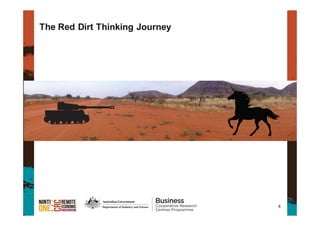
The Red Dirt Thinking Journey
4
10 Key Findings
5
Document source All
sources
All coding
references*
Remote
Aboriginal
references*
Number of
unique
participants
Interviews and focus groups 45 2501 523 250
Field notes and observations 12 111 0 0
Secondary sources/reports created by or for
RES
10 856 603 ~800†
Butchers papers and whiteboards 20 197 0 0
Total 87 3665 1126
Finding #1 Remote Indigenous Disadvantage
• A metro-centric construct not supported by those living in remote
communities
6
0.0%
0.5%
1.0%
1.5%
2.0%
2.5%
3.0%
3.5%
References to
‘disadvantage’
System responses:
reconciliation, equity,
race and aboriginality
System responses:
poverty and socio-
economic status
Cross-cutting theme:
context and complexity
Teaching to success:
health and well being
PERCENTOFALLRESPONSES
EQUITY ITEMS
Remote Aboriginal references* Non-remote responses
Finding #2 The No Jobs Myth
• There are ‘jobs aplenty’ in remote parts of Australia.
7
16395
236
27411
-561
1729
8780
-5000
0
5000
10000
15000
20000
25000
30000
Employed Unemployed Total population
27Changes in employmentges in e
2006
n e
0606-
mploymn e
66-2011
Non-Indigenous Aboriginal and Torres Strait Islander
Finding #3 Simple Solutions For Complex Contexts
• There are no quick fixes.
8
0.0
10.0
20.0
30.0
40.0
50.0
60.0
70.0
80.0
R1 R2 (blank)
SCHOOLATTENDANCERATE
RSAS ROUND 1 AND 2, AND NON-RSAS SCHOOLS
2008
2009
2010
2011
2012
2013
2014
2015
Finding #4 What Is Education For?
• Education should support local aspirations for culture, land, language and
identity.
9
Language, land and
culture
Identity
Strong in both worlds
Employment and economic
participation
Meaningful engagement in the world
Community leadership and
participation
Learning
Choice and opportunity
Holistic
Further learning and skills Socialisation to schooling
Other
Finding #5 Successful Remote Schools
• Success is first about parent and communityinvolvement in school.
10
Parent involvement and
role models in child's
education, 63
Academic outcomes, 42
Community engagement,
27
Attendance, 22
Learning outside school,
21
Children choose to
engage, 20
Place and space, 17
First language literacy, 14
Meeting student needs, 13
Post school transition, 13
Governance and
decision making, 12
Strong, 10
Other, 21
Finding #6 Qualities, Not Quality
Specific teaching context & Frameworks and Standards
• Local Standards - relational
• AITSL Teacher Standards, Assistant teacher standards
• Cultural competency frameworks
Adapt and implement responsive curriculum
• System support
Expertise in teaching, monitoring and assessing English language learning
• in specific TESOL/Multilingual learning setting
• ATESOL Elaborations of the AITSL Standards
# Teaching in very remote schools is a specialist field, requiring
specialist qualities
11
Finding #7 Local Staff Matter
• Schools with higher proportions of non-teaching staff get better results.
12
62
64
66
68
70
72
74
76
78
80
0-.5 (n=512) .51-1 (n=266) 1.01-1.5
(n=177)
1.51-2 (n=92) 2.01-2.5 (n=22) >2.5 (n=35)
AVERAGEPERCENTAGESCHOOL
ATTENDANCERATE
RATIO OF NON-TEACHING TO TEACHING STAFF
Finding #8 Boarding Schools
# There is too much we do not know about the effectiveness &
impact of boarding for very remote students, their families and
communities
13
Policy promoting boarding school at Federal, State/Territory levels
• Non-Government-Government partnerships, eg. Australian Indigenous
Education Foundation, Yalari, Future Footprints
Anecdotal and derivative data indicate low success of boarding for very
remote students, identifies specific issues. Overall,
• No easily available quantitative data
• Little empirical research
• Growing qualitative research
• Development of good practice guidelines to support to enhance
options and opportunities
Finding #9 Money Matters
• Schools with more resources get better outcomes.
14
0
10000
20000
30000
40000
50000
60000
70000
AVERAGERECURRENTINCOME($)PER
STUDENT
SCHOOL ATTENDANCE PERCENTAGE
Finding #10 Engagement For What?
1. Success, as defined by communitiesis parents and communities
involved in education (‘close and constant voices’)
2. If we take community view seriously, community
involvement/power/ownership will be a priority
3. The type of engagement matters: ‘Targeted’ engagement will be
unsustainable. (Tjukurpa nganngi-tjara)
4. Create opportunity structures for participatory involvement: governance,
local staff, engagement accountability
*‘Power-sensitive’ (Haraway 2004), Incorporating the ‘assets’ (Moll et al.
1992) of the students’ families and communities
15
Strategies For Improved Outcomes
Resourcing
Employ, train and develop local workforce
Invest in teacher qualities that matter
Establish local governance structures
Explicit pathways through school to economic participation
Understand the full impact of boarding options AND provide quality
secondary options
16
Concluding Remarks And Thanks
17
More About RES
http://crc-rep.com/remote-education-systems
John Guenther
0412 125 661
john.guenther@flinders.edu.au
Samantha Disbray
0437 330 042
Samantha.Disbray@cdu.edu.au
Sam Osborne
0408 719 939
Samuel.Osborne@unisa.edu.au
18

A Red Dirt Journey

  • 1.
    Adelaide, 9 February 2016 RemoteEducation Systems project A Red Dirt Journey
  • 2.
  • 3.
    CRC-REP Remote EducationSystems project 3
  • 4.
    The Red DirtThinking Journey 4
  • 5.
    10 Key Findings 5 Documentsource All sources All coding references* Remote Aboriginal references* Number of unique participants Interviews and focus groups 45 2501 523 250 Field notes and observations 12 111 0 0 Secondary sources/reports created by or for RES 10 856 603 ~800† Butchers papers and whiteboards 20 197 0 0 Total 87 3665 1126
  • 6.
    Finding #1 RemoteIndigenous Disadvantage • A metro-centric construct not supported by those living in remote communities 6 0.0% 0.5% 1.0% 1.5% 2.0% 2.5% 3.0% 3.5% References to ‘disadvantage’ System responses: reconciliation, equity, race and aboriginality System responses: poverty and socio- economic status Cross-cutting theme: context and complexity Teaching to success: health and well being PERCENTOFALLRESPONSES EQUITY ITEMS Remote Aboriginal references* Non-remote responses
  • 7.
    Finding #2 TheNo Jobs Myth • There are ‘jobs aplenty’ in remote parts of Australia. 7 16395 236 27411 -561 1729 8780 -5000 0 5000 10000 15000 20000 25000 30000 Employed Unemployed Total population 27Changes in employmentges in e 2006 n e 0606- mploymn e 66-2011 Non-Indigenous Aboriginal and Torres Strait Islander
  • 8.
    Finding #3 SimpleSolutions For Complex Contexts • There are no quick fixes. 8 0.0 10.0 20.0 30.0 40.0 50.0 60.0 70.0 80.0 R1 R2 (blank) SCHOOLATTENDANCERATE RSAS ROUND 1 AND 2, AND NON-RSAS SCHOOLS 2008 2009 2010 2011 2012 2013 2014 2015
  • 9.
    Finding #4 WhatIs Education For? • Education should support local aspirations for culture, land, language and identity. 9 Language, land and culture Identity Strong in both worlds Employment and economic participation Meaningful engagement in the world Community leadership and participation Learning Choice and opportunity Holistic Further learning and skills Socialisation to schooling Other
  • 10.
    Finding #5 SuccessfulRemote Schools • Success is first about parent and communityinvolvement in school. 10 Parent involvement and role models in child's education, 63 Academic outcomes, 42 Community engagement, 27 Attendance, 22 Learning outside school, 21 Children choose to engage, 20 Place and space, 17 First language literacy, 14 Meeting student needs, 13 Post school transition, 13 Governance and decision making, 12 Strong, 10 Other, 21
  • 11.
    Finding #6 Qualities,Not Quality Specific teaching context & Frameworks and Standards • Local Standards - relational • AITSL Teacher Standards, Assistant teacher standards • Cultural competency frameworks Adapt and implement responsive curriculum • System support Expertise in teaching, monitoring and assessing English language learning • in specific TESOL/Multilingual learning setting • ATESOL Elaborations of the AITSL Standards # Teaching in very remote schools is a specialist field, requiring specialist qualities 11
  • 12.
    Finding #7 LocalStaff Matter • Schools with higher proportions of non-teaching staff get better results. 12 62 64 66 68 70 72 74 76 78 80 0-.5 (n=512) .51-1 (n=266) 1.01-1.5 (n=177) 1.51-2 (n=92) 2.01-2.5 (n=22) >2.5 (n=35) AVERAGEPERCENTAGESCHOOL ATTENDANCERATE RATIO OF NON-TEACHING TO TEACHING STAFF
  • 13.
    Finding #8 BoardingSchools # There is too much we do not know about the effectiveness & impact of boarding for very remote students, their families and communities 13 Policy promoting boarding school at Federal, State/Territory levels • Non-Government-Government partnerships, eg. Australian Indigenous Education Foundation, Yalari, Future Footprints Anecdotal and derivative data indicate low success of boarding for very remote students, identifies specific issues. Overall, • No easily available quantitative data • Little empirical research • Growing qualitative research • Development of good practice guidelines to support to enhance options and opportunities
  • 14.
    Finding #9 MoneyMatters • Schools with more resources get better outcomes. 14 0 10000 20000 30000 40000 50000 60000 70000 AVERAGERECURRENTINCOME($)PER STUDENT SCHOOL ATTENDANCE PERCENTAGE
  • 15.
    Finding #10 EngagementFor What? 1. Success, as defined by communitiesis parents and communities involved in education (‘close and constant voices’) 2. If we take community view seriously, community involvement/power/ownership will be a priority 3. The type of engagement matters: ‘Targeted’ engagement will be unsustainable. (Tjukurpa nganngi-tjara) 4. Create opportunity structures for participatory involvement: governance, local staff, engagement accountability *‘Power-sensitive’ (Haraway 2004), Incorporating the ‘assets’ (Moll et al. 1992) of the students’ families and communities 15
  • 16.
    Strategies For ImprovedOutcomes Resourcing Employ, train and develop local workforce Invest in teacher qualities that matter Establish local governance structures Explicit pathways through school to economic participation Understand the full impact of boarding options AND provide quality secondary options 16
  • 17.
  • 18.
    More About RES http://crc-rep.com/remote-education-systems JohnGuenther 0412 125 661 john.guenther@flinders.edu.au Samantha Disbray 0437 330 042 Samantha.Disbray@cdu.edu.au Sam Osborne 0408 719 939 Samuel.Osborne@unisa.edu.au 18