A Real-Time Adaptive Algorithm for Video Streaming over 
Multiple Wireless Access Networks 
ABSTRACT: 
Video streaming is gaining popularity among mobile users. The latest mobile 
devices, such as smart phones and tablets, are equipped with multiple wireless 
network interfaces. How to efficiently and cost-effectively utilize multiple links to 
improve video streaming quality needs investigation. In order to maintain high 
video streaming quality while reducing the wireless service cost, in this paper, the 
optimal video streaming process with multiple links is formulated as a Markov 
Decision Process (MDP). The reward function is designed to consider the quality 
of service (QoS) requirements for video traffic, such as the startup latency, 
playback fluency, average playback quality, playback smoothness and wireless 
service cost. To solve the MDP in real time, we propose an adaptive, best-action 
search algorithm to obtain a sub-optimal solution. To evaluate the performance of 
the proposed adaptation algorithm, we implemented a testbed using the Android 
mobile phone and the Scalable Video Coding (SVC) codec. Experiment results 
demonstrate the feasibility and effectiveness of the proposed adaptation algorithm
for mobile video streaming applications, which outperforms the existing state-of-the- 
art adaptation algorithms 
EXISTING SYSTEM: 
Video streaming is gaining popularity among mobile users recently. Considering 
that the mobile devices have limited computational capacity and energy supply, 
and the wireless channels are highly dynamic, it is very challenging to provide 
high quality video streaming services for mobile users consistently. It is a 
promising trend to use multiple wireless network interfaces with different wireless 
communication techniques for mobile devices. Meanwhile, as video data are 
transmitted over HTTP protocols, the video streaming service can be deployed on 
any web server. However, the video quality version can only be manually selected 
by users and such decision can be error-prone. 
DISADVANTAGES OF EXISTING SYSTEM: 
 The smart phones only have limited storage space, it is impractical to 
maintain a very large buffer size.
 The buffered unwatched video may be wasted if the user turns off the video 
player or switches to other videos. 
 Download typically does not support transmitting video data over multiple 
links. 
PROPOSED SYSTEM: 
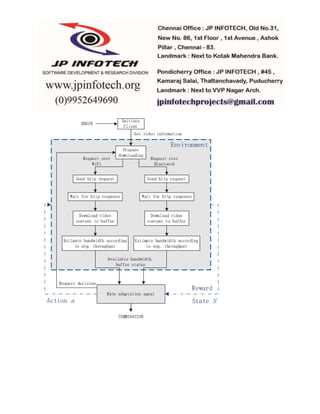
In this paper we proposed dynamic adaptive streaming over HTTP has been 
proposed. In a DASH system, multiple copies of pre-compressed videos with 
different resolution and quality are stored in segments. We formulate the multi-link 
video streaming process as a reinforcement learning task. For each streaming step, 
we define a state to describe the current situation, including the index of the 
requested segment, the current available bandwidth and other system parameters. 
A finitestate Markov Decision Process (MDP) can be modeled for this 
reinforcement learning task. The reward function is carefully designed to consider 
the video QoS requirements, such as the interruption rate, average playback 
quality, and playback smoothness, as well as the service costs
ADVANTAGES OF PROPOSED SYSTEM: 
 Smooth and high quality video streaming. 
 Avoid playback interruption and achieve better smoothness and quality. 
SYSTEM ARCHITECTURE:
SYSTEM REQUIREMENTS: 
HARDWARE REQUIREMENTS: 
 System : Pentium IV 2.4 GHz. 
 Hard Disk : 40 GB. 
 Floppy Drive : 1.44 Mb. 
 Monitor : 15 VGA Colour. 
 Mouse : Logitech. 
 Ram : 512 Mb. 
 MOBILE : ANDROID 
SOFTWARE REQUIREMENTS: 
 Operating system : Windows XP/7. 
 Coding Language : Java 1.7 
 Tool Kit : Android 2.3 ABOVE 
 IDE : Eclipse 
REFERENCE:
Min Xing, Student Member, IEEE, Siyuan Xiang, Member, IEEE, and Lin Cai, 
Senior Member, IEEE, “A Real-Time Adaptive Algorithm for Video Streaming 
over Multiple Wireless Access Networks”, IEEE JOURNAL ON SELECTED 
AREAS IN COMMUNICATIONS, VOL. 32, NO. 4, APRIL 2014.

A Real-Time Adaptive Algorithm for Video Streaming over Multiple Wireless Access Networks

  • 1.
    A Real-Time AdaptiveAlgorithm for Video Streaming over Multiple Wireless Access Networks ABSTRACT: Video streaming is gaining popularity among mobile users. The latest mobile devices, such as smart phones and tablets, are equipped with multiple wireless network interfaces. How to efficiently and cost-effectively utilize multiple links to improve video streaming quality needs investigation. In order to maintain high video streaming quality while reducing the wireless service cost, in this paper, the optimal video streaming process with multiple links is formulated as a Markov Decision Process (MDP). The reward function is designed to consider the quality of service (QoS) requirements for video traffic, such as the startup latency, playback fluency, average playback quality, playback smoothness and wireless service cost. To solve the MDP in real time, we propose an adaptive, best-action search algorithm to obtain a sub-optimal solution. To evaluate the performance of the proposed adaptation algorithm, we implemented a testbed using the Android mobile phone and the Scalable Video Coding (SVC) codec. Experiment results demonstrate the feasibility and effectiveness of the proposed adaptation algorithm
  • 2.
    for mobile videostreaming applications, which outperforms the existing state-of-the- art adaptation algorithms EXISTING SYSTEM: Video streaming is gaining popularity among mobile users recently. Considering that the mobile devices have limited computational capacity and energy supply, and the wireless channels are highly dynamic, it is very challenging to provide high quality video streaming services for mobile users consistently. It is a promising trend to use multiple wireless network interfaces with different wireless communication techniques for mobile devices. Meanwhile, as video data are transmitted over HTTP protocols, the video streaming service can be deployed on any web server. However, the video quality version can only be manually selected by users and such decision can be error-prone. DISADVANTAGES OF EXISTING SYSTEM:  The smart phones only have limited storage space, it is impractical to maintain a very large buffer size.
  • 3.
     The bufferedunwatched video may be wasted if the user turns off the video player or switches to other videos.  Download typically does not support transmitting video data over multiple links. PROPOSED SYSTEM: In this paper we proposed dynamic adaptive streaming over HTTP has been proposed. In a DASH system, multiple copies of pre-compressed videos with different resolution and quality are stored in segments. We formulate the multi-link video streaming process as a reinforcement learning task. For each streaming step, we define a state to describe the current situation, including the index of the requested segment, the current available bandwidth and other system parameters. A finitestate Markov Decision Process (MDP) can be modeled for this reinforcement learning task. The reward function is carefully designed to consider the video QoS requirements, such as the interruption rate, average playback quality, and playback smoothness, as well as the service costs
  • 4.
    ADVANTAGES OF PROPOSEDSYSTEM:  Smooth and high quality video streaming.  Avoid playback interruption and achieve better smoothness and quality. SYSTEM ARCHITECTURE:
  • 6.
    SYSTEM REQUIREMENTS: HARDWAREREQUIREMENTS:  System : Pentium IV 2.4 GHz.  Hard Disk : 40 GB.  Floppy Drive : 1.44 Mb.  Monitor : 15 VGA Colour.  Mouse : Logitech.  Ram : 512 Mb.  MOBILE : ANDROID SOFTWARE REQUIREMENTS:  Operating system : Windows XP/7.  Coding Language : Java 1.7  Tool Kit : Android 2.3 ABOVE  IDE : Eclipse REFERENCE:
  • 7.
    Min Xing, StudentMember, IEEE, Siyuan Xiang, Member, IEEE, and Lin Cai, Senior Member, IEEE, “A Real-Time Adaptive Algorithm for Video Streaming over Multiple Wireless Access Networks”, IEEE JOURNAL ON SELECTED AREAS IN COMMUNICATIONS, VOL. 32, NO. 4, APRIL 2014.