Next Level Group
System, Software & People Based Change Management - Planning and Delivery Framework
– Version 2.3
NLG - Business Change Toolkit – Low Complexity Project
Chg-Pln-V2.3 G:ChangeManagementWorkshops – 2016-2019
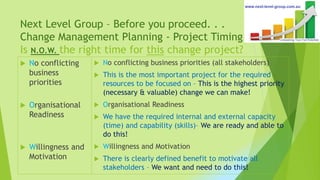
Next Level Group – Before you proceed. . .
Change Management Planning - Project Timing
Is N.O.W. the right time for this change project?
 No conflicting
business
priorities
 Organisational
Readiness
 Willingness and
Motivation
 No conflicting business priorities (all stakeholders)
 This is the most important project for the required
resources to be focused on – This is the highest priority
(necessary & valuable) change we can make!
 Organisational Readiness
 We have the required internal and external capacity
(time) and capability (skills)– We are ready and able to
do this!
 Willingness and Motivation
 There is clearly defined benefit to motivate all
stakeholders – We want and need to do this!
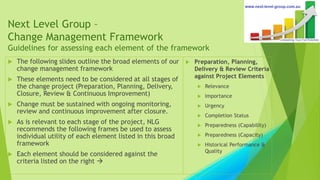
Next Level Group –
Change Management Framework
Guidelines for assessing each element of the framework
 The following slides outline the broad elements of our
change management framework
 These elements need to be considered at all stages of
the change project (Preparation, Planning, Delivery,
Closure, Review & Continuous Improvement)
 Change must be sustained with ongoing monitoring,
review and continuous improvement after closure.
 As is relevant to each stage of the project, NLG
recommends the following frames be used to assess
individual utility of each element listed in this broad
framework
 Each element should be considered against the
criteria listed on the right 
 Preparation, Planning,
Delivery & Review Criteria
against Project Elements
 Relevance
 Importance
 Urgency
 Completion Status
 Preparedness (Capability)
 Preparedness (Capacity)
 Historical Performance &
Quality
Next Level Group –
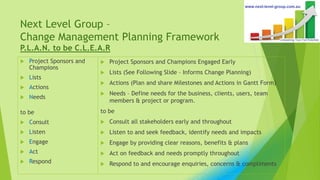
Change Management Planning Framework
P.L.A.N. to be C.L.E.A.R
 Project Sponsors and
Champions
 Lists
 Actions
 Needs
to be
 Consult
 Listen
 Engage
 Act
 Respond
 Project Sponsors and Champions Engaged Early
 Lists (See Following Slide – Informs Change Planning)
 Actions (Plan and share Milestones and Actions in Gantt Form)
 Needs – Define needs for the business, clients, users, team
members & project or program.
to be
 Consult all stakeholders early and throughout
 Listen to and seek feedback, identify needs and impacts
 Engage by providing clear reasons, benefits & plans
 Act on feedback and needs promptly throughout
 Respond to and encourage enquiries, concerns & compliments
Next Level Group –
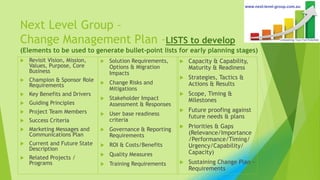
Change Management Plan –LISTS to develop
(Elements to be used to generate bullet-point lists for early planning stages)
 Revisit Vision, Mission,
Values, Purpose, Core
Business
 Champion & Sponsor Role
Requirements
 Key Benefits and Drivers
 Guiding Principles
 Project Team Members
 Success Criteria
 Marketing Messages and
Communications Plan
 Current and Future State
Description
 Related Projects /
Programs
 Solution Requirements,
Options & Migration
Impacts
 Change Risks and
Mitigations
 Stakeholder Impact
Assessment & Responses
 User base readiness
criteria
 Governance & Reporting
Requirements
 ROI & Costs/Benefits
 Quality Measures
 Training Requirements
 Capacity & Capability,
Maturity & Readiness
 Strategies, Tactics &
Actions & Results
 Scope, Timing &
Milestones
 Future proofing against
future needs & plans
 Priorities & Gaps
(Relevance/Importance
/Performance/Timing/
Urgency/Capability/
Capacity)
 Sustaining Change Plan -
Requirements
Next Level Group –
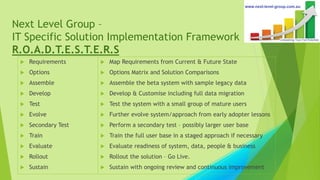
IT Specific Solution Implementation Framework
R.O.A.D.T.E.S.T.E.R.S
 Requirements
 Options
 Assemble
 Develop
 Test
 Evolve
 Secondary Test
 Train
 Evaluate
 Rollout
 Sustain
 Map Requirements from Current & Future State
 Options Matrix and Solution Comparisons
 Assemble the beta system with sample legacy data
 Develop & Customise including full data migration
 Test the system with a small group of mature users
 Further evolve system/approach from early adopter lessons
 Perform a secondary test – possibly larger user base
 Train the full user base in a staged approach if necessary
 Evaluate readiness of system, data, people & business
 Rollout the solution – Go Live.
 Sustain with ongoing review and continuous improvement
Next Level Group –
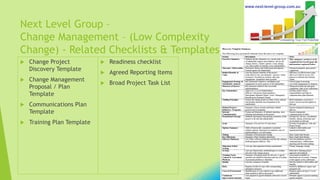
Change Management – (Low Complexity
Change) - Related Checklists & Templates
 Change Project
Discovery Template
 Change Management
Proposal / Plan
Template
 Communications Plan
Template
 Training Plan Template
 Readiness checklist
 Agreed Reporting Items
 Broad Project Task List

A Proven Process & Framework to Manage Your Change Project

  • 1.
    Next Level Group System,Software & People Based Change Management - Planning and Delivery Framework – Version 2.3 NLG - Business Change Toolkit – Low Complexity Project Chg-Pln-V2.3 G:ChangeManagementWorkshops – 2016-2019
  • 2.
    Next Level Group– Before you proceed. . . Change Management Planning - Project Timing Is N.O.W. the right time for this change project?  No conflicting business priorities  Organisational Readiness  Willingness and Motivation  No conflicting business priorities (all stakeholders)  This is the most important project for the required resources to be focused on – This is the highest priority (necessary & valuable) change we can make!  Organisational Readiness  We have the required internal and external capacity (time) and capability (skills)– We are ready and able to do this!  Willingness and Motivation  There is clearly defined benefit to motivate all stakeholders – We want and need to do this!
  • 3.
    Next Level Group– Change Management Framework Guidelines for assessing each element of the framework  The following slides outline the broad elements of our change management framework  These elements need to be considered at all stages of the change project (Preparation, Planning, Delivery, Closure, Review & Continuous Improvement)  Change must be sustained with ongoing monitoring, review and continuous improvement after closure.  As is relevant to each stage of the project, NLG recommends the following frames be used to assess individual utility of each element listed in this broad framework  Each element should be considered against the criteria listed on the right   Preparation, Planning, Delivery & Review Criteria against Project Elements  Relevance  Importance  Urgency  Completion Status  Preparedness (Capability)  Preparedness (Capacity)  Historical Performance & Quality
  • 4.
    Next Level Group– Change Management Planning Framework P.L.A.N. to be C.L.E.A.R  Project Sponsors and Champions  Lists  Actions  Needs to be  Consult  Listen  Engage  Act  Respond  Project Sponsors and Champions Engaged Early  Lists (See Following Slide – Informs Change Planning)  Actions (Plan and share Milestones and Actions in Gantt Form)  Needs – Define needs for the business, clients, users, team members & project or program. to be  Consult all stakeholders early and throughout  Listen to and seek feedback, identify needs and impacts  Engage by providing clear reasons, benefits & plans  Act on feedback and needs promptly throughout  Respond to and encourage enquiries, concerns & compliments
  • 5.
    Next Level Group– Change Management Plan –LISTS to develop (Elements to be used to generate bullet-point lists for early planning stages)  Revisit Vision, Mission, Values, Purpose, Core Business  Champion & Sponsor Role Requirements  Key Benefits and Drivers  Guiding Principles  Project Team Members  Success Criteria  Marketing Messages and Communications Plan  Current and Future State Description  Related Projects / Programs  Solution Requirements, Options & Migration Impacts  Change Risks and Mitigations  Stakeholder Impact Assessment & Responses  User base readiness criteria  Governance & Reporting Requirements  ROI & Costs/Benefits  Quality Measures  Training Requirements  Capacity & Capability, Maturity & Readiness  Strategies, Tactics & Actions & Results  Scope, Timing & Milestones  Future proofing against future needs & plans  Priorities & Gaps (Relevance/Importance /Performance/Timing/ Urgency/Capability/ Capacity)  Sustaining Change Plan - Requirements
  • 6.
    Next Level Group– IT Specific Solution Implementation Framework R.O.A.D.T.E.S.T.E.R.S  Requirements  Options  Assemble  Develop  Test  Evolve  Secondary Test  Train  Evaluate  Rollout  Sustain  Map Requirements from Current & Future State  Options Matrix and Solution Comparisons  Assemble the beta system with sample legacy data  Develop & Customise including full data migration  Test the system with a small group of mature users  Further evolve system/approach from early adopter lessons  Perform a secondary test – possibly larger user base  Train the full user base in a staged approach if necessary  Evaluate readiness of system, data, people & business  Rollout the solution – Go Live.  Sustain with ongoing review and continuous improvement
  • 7.
    Next Level Group– Change Management – (Low Complexity Change) - Related Checklists & Templates  Change Project Discovery Template  Change Management Proposal / Plan Template  Communications Plan Template  Training Plan Template  Readiness checklist  Agreed Reporting Items  Broad Project Task List