Table of Contents







Introduction
to IoT
How
IoTworks
Core Components
of IoT
Applications
of IoT
Benefits
of IoT
Challenges
in IoT
Conclus
ion
Introduction of IoT
“TheInternet of Thingsrefers to a network
of interconnected physical devices that
communicate and exchange data over the
internet without requiring human
intervention”.
Key Idea:
 Devices are embedded with sensors ,
software , and connectivity features.
 They collect , share, and process data to
enable smarter decision-making.
 Just like Internet has changed the way we
work & communicate with each other, by
connecting us through the World Wide Web
(internet), IoT also aims to take this
connectivity to another level by connecting
multiple devices at a time to the internet
thereby facilitating man to
machine and machine to
machine interactions.
 People who came up with this idea, have
also realized that this IoT ecosystem is not
limited to a particular field but has business
applications in areas of home automation,
vehicle automation, factory line automation,
How it Works
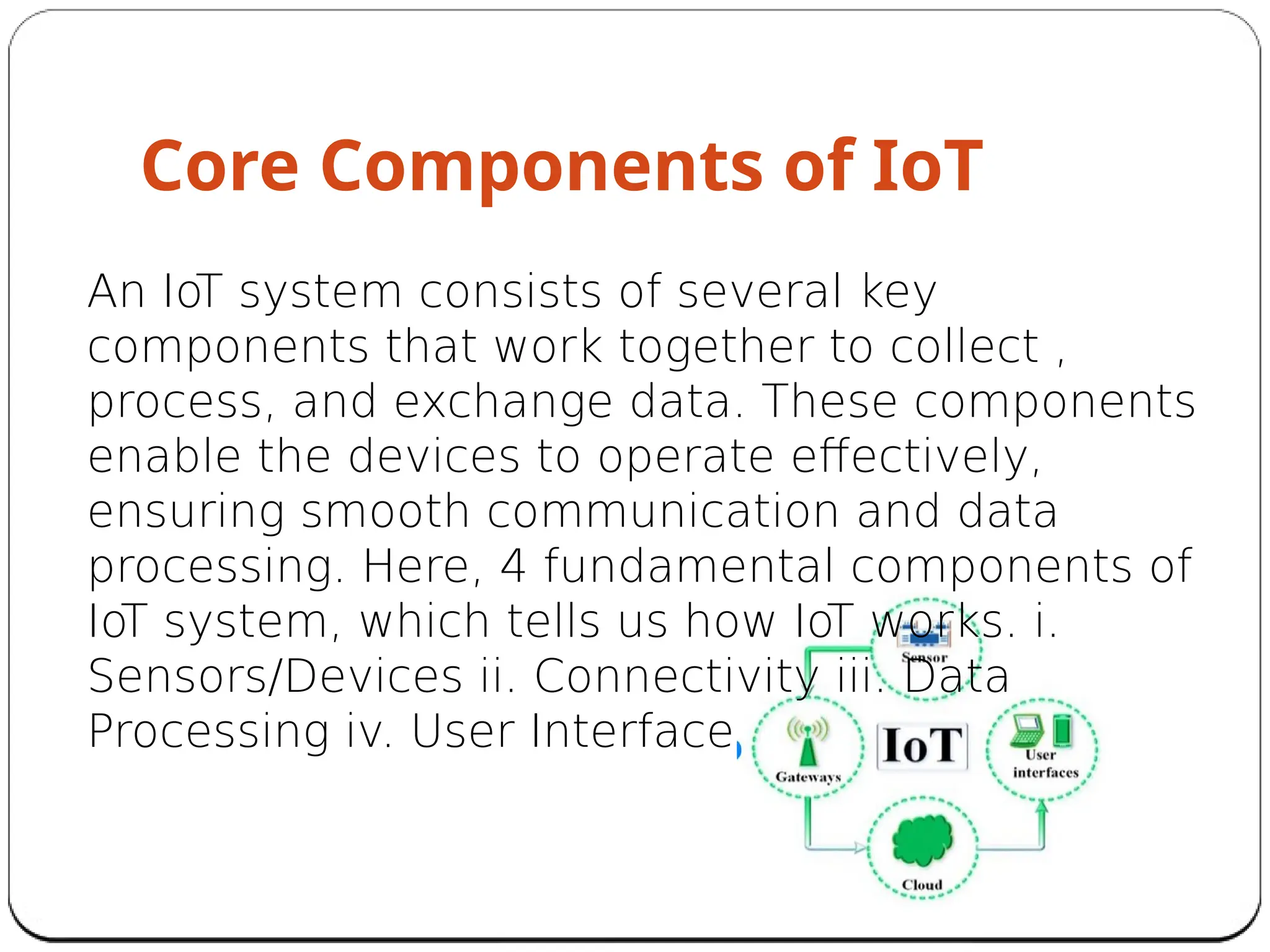
An IoT system consists of several key
components that work together to collect ,
process, and exchange data. These components
enable the devices to operate effectively,
ensuring smooth communication and data
processing. Here, 4 fundamental components of
IoT system, which tells us how IoT works. i.
Sensors/Devices ii. Connectivity iii. Data
Processing iv. User Interface
Core Components of IoT
Sensors
“Devices are embedded with sensors that detect
physical changes in the environment, such as
temperature , pressure , light , motion , or humidity”.
 Sensors gather real-time data from their
surroundings , which forms the basis of the entire IoT
system.
 Without sensors , there is no data to analyze.
Example:
A temperature sensor in a smart thermostat monitors
the temperature in a room.
A motion sensor in a security system detects
movements when someone enters a room.

Connectivity
“The data collected by devices is sent through a network
for processing . This facilitated by various communication
technologies”.
 When data is collected successfully then collected data is
sent to a cloud infrastructure but it needs a medium for
transport.
 The sensors can be connected to the cloud through various
mediums of communication and transports such as cellular
networks, satellite networks, Wi-Fi, Bluetooth, wide-area
networks (WAN), low power wide area network and many
more.
Types of Connectivity : Wi-Fi , Bluetooth, 5G , ZigBee/Z-Wave.
Examples: A smart thermostat sends temperature data to a
cloud server via Wi-Fi for further processing.
Data Processing
“Data processing is thesystematic conversion of raw
data into a more meaningfuland usable form. It involves a
series of actions or steps that turn data into insights,
knowledge, or information that can be used for decision-
making, analysis, or other purposes”.
Here's a breakdown of data processing as an IoT
component:
1.Data Collection
2. Data Preprocessing
3.Data Analysis
4.Data Presentation
5.
6.
Edge vs. Cloud Processing
Feedback Loop
User Interface
“In IoT, a user interface (UI) is the means by which
users interact with and control connected devices
and access data they collect”.
It's how users view, understand, and interact with
the information gathered by IoT systems.

Key aspects of the User Interface as an IoT
component:
1.Data Visualization and Presentation
2.
3.
Control and Interaction
Alerts and Notifications
4.User Experience (UX) Enhancement
Application of IoT
1.

Smart Homes:
Home Automation:
Control lighting, temperature, security
systems, and appliances remotely via
smart phones or voice assistants.
Security:

Integrate security systems with cameras
and sensors for enhanced safety and
remote monitoring.
2. Wearables: • Fitness Tracking: Monitor heart rate,
steps, sleep patterns, and other health metrics.
Health Monitoring
• : Track vital signs, manage
chronic conditions, and provide timely alerts to
healthcare providers.
3.Smart Cities:
•Traffic Management: Optimize traffic flow,
manage parking, and reduce congestion.
Environmental Monitoring: Track air and water
•
quality, noise levels, and other environmental
factors.
4. Healthcare: Remote Patient Monitoring
• : Monitor
patients remotely, manage chronic conditions, and
provide timely interventions. Medication
•
Management: Track medication adherence and
provide reminders. Medical Device
•
Connectivity: Connect medical devices to the
internet for data collection and analysis.
5. Agriculture:
Precision Farming: Monitor soil conditions,
optimize irrigation, and improve crop yields.
Livestock Monitoring: Track animal health,
behavior, and location. Greenhouse
Automation: Optimize environmental
Benefits of IoT
1. Increased Efficiency: Automates
processes, reducing manual
effort and operational delays.
Example: Automated production lines in
manufacturing.
2. Cost Reduction:
Optimizes resource usage, reducing
wastage and operational costs.
Example: Smart lighting systems reducing
electricity bills.
3. Improved Decision: Making Real-time data
and analytics enable accurate and informed
decisions. Example: Predictive maintenance
preventing costly machinery breakdowns. 4.
Enhanced Safety and Security: IoT-enabled
monitoring systems detect risks and send
instant alerts. Example: Smoke detectors
sending notifications to smartphones. 5.
Better Customer Experience: Personalized
services and improved product performance
through usage data. Example: Smart
wearable devices adapting fitness plans
based on user activity.
Challenges of IoT
1.

Security and Privacy:
IoTdevices collect a lot of personal data
(location, health, daily habits).
Weak security can lead to data breaches,
hacking, and identity theft.
Example: A smart camera getting
hacked and showing your home footage.

2. Interoperability: • Different IoT devices use
different standards and communication
protocols. • This makes it hard for devices from
different brands to work together smoothly.
Example: Your smart fridge might not connect
easily with your smart oven.
3. Scalability:
• As IoT networks grow, managing millions of
devices becomes harder. More devices mean
more data traffic, storage, and
processing needs.
Conclusion
 TheInternet of Things (IoT) is a transformative
technology that is revolutionizing the way devices,
people, and systems interact. By enabling real-time
monitoring, automation, and data-driven decision-
making, IoT has the potential to improve efficiency,
enhance quality of life, and create smarter
environments.
 While challenges such as security, privacy, and
standardization remain, the rapid advancement of
connectivity, cloud computing, and artificial intelligence
will continue to expand IoT’s applications and impact.
"IoT is not just connecting devices, it is connecting
possibilities for a smarter and more sustainable future."
Thank You

A Presentation on Artificial Intelligence (AI)

  • 2.
    Table of Contents        Introduction toIoT How IoTworks Core Components of IoT Applications of IoT Benefits of IoT Challenges in IoT Conclus ion
  • 3.
    Introduction of IoT “TheInternetof Thingsrefers to a network of interconnected physical devices that communicate and exchange data over the internet without requiring human intervention”. Key Idea:  Devices are embedded with sensors , software , and connectivity features.  They collect , share, and process data to enable smarter decision-making.
  • 4.
     Just likeInternet has changed the way we work & communicate with each other, by connecting us through the World Wide Web (internet), IoT also aims to take this connectivity to another level by connecting multiple devices at a time to the internet thereby facilitating man to machine and machine to machine interactions.  People who came up with this idea, have also realized that this IoT ecosystem is not limited to a particular field but has business applications in areas of home automation, vehicle automation, factory line automation,
  • 5.
  • 6.
    An IoT systemconsists of several key components that work together to collect , process, and exchange data. These components enable the devices to operate effectively, ensuring smooth communication and data processing. Here, 4 fundamental components of IoT system, which tells us how IoT works. i. Sensors/Devices ii. Connectivity iii. Data Processing iv. User Interface Core Components of IoT
  • 7.
    Sensors “Devices are embeddedwith sensors that detect physical changes in the environment, such as temperature , pressure , light , motion , or humidity”.  Sensors gather real-time data from their surroundings , which forms the basis of the entire IoT system.  Without sensors , there is no data to analyze. Example: A temperature sensor in a smart thermostat monitors the temperature in a room. A motion sensor in a security system detects movements when someone enters a room. 
  • 8.
    Connectivity “The data collectedby devices is sent through a network for processing . This facilitated by various communication technologies”.  When data is collected successfully then collected data is sent to a cloud infrastructure but it needs a medium for transport.  The sensors can be connected to the cloud through various mediums of communication and transports such as cellular networks, satellite networks, Wi-Fi, Bluetooth, wide-area networks (WAN), low power wide area network and many more. Types of Connectivity : Wi-Fi , Bluetooth, 5G , ZigBee/Z-Wave. Examples: A smart thermostat sends temperature data to a cloud server via Wi-Fi for further processing.
  • 9.
    Data Processing “Data processingis thesystematic conversion of raw data into a more meaningfuland usable form. It involves a series of actions or steps that turn data into insights, knowledge, or information that can be used for decision- making, analysis, or other purposes”. Here's a breakdown of data processing as an IoT component: 1.Data Collection 2. Data Preprocessing 3.Data Analysis 4.Data Presentation 5. 6. Edge vs. Cloud Processing Feedback Loop
  • 10.
    User Interface “In IoT,a user interface (UI) is the means by which users interact with and control connected devices and access data they collect”. It's how users view, understand, and interact with the information gathered by IoT systems.  Key aspects of the User Interface as an IoT component: 1.Data Visualization and Presentation 2. 3. Control and Interaction Alerts and Notifications 4.User Experience (UX) Enhancement
  • 11.
    Application of IoT 1.  SmartHomes: Home Automation: Control lighting, temperature, security systems, and appliances remotely via smart phones or voice assistants. Security:  Integrate security systems with cameras and sensors for enhanced safety and remote monitoring.
  • 12.
    2. Wearables: •Fitness Tracking: Monitor heart rate, steps, sleep patterns, and other health metrics. Health Monitoring • : Track vital signs, manage chronic conditions, and provide timely alerts to healthcare providers. 3.Smart Cities: •Traffic Management: Optimize traffic flow, manage parking, and reduce congestion. Environmental Monitoring: Track air and water • quality, noise levels, and other environmental factors.
  • 13.
    4. Healthcare: RemotePatient Monitoring • : Monitor patients remotely, manage chronic conditions, and provide timely interventions. Medication • Management: Track medication adherence and provide reminders. Medical Device • Connectivity: Connect medical devices to the internet for data collection and analysis. 5. Agriculture: Precision Farming: Monitor soil conditions, optimize irrigation, and improve crop yields. Livestock Monitoring: Track animal health, behavior, and location. Greenhouse Automation: Optimize environmental
  • 14.
    Benefits of IoT 1.Increased Efficiency: Automates processes, reducing manual effort and operational delays. Example: Automated production lines in manufacturing. 2. Cost Reduction: Optimizes resource usage, reducing wastage and operational costs. Example: Smart lighting systems reducing electricity bills.
  • 15.
    3. Improved Decision:Making Real-time data and analytics enable accurate and informed decisions. Example: Predictive maintenance preventing costly machinery breakdowns. 4. Enhanced Safety and Security: IoT-enabled monitoring systems detect risks and send instant alerts. Example: Smoke detectors sending notifications to smartphones. 5. Better Customer Experience: Personalized services and improved product performance through usage data. Example: Smart wearable devices adapting fitness plans based on user activity.
  • 16.
    Challenges of IoT 1.  Securityand Privacy: IoTdevices collect a lot of personal data (location, health, daily habits). Weak security can lead to data breaches, hacking, and identity theft. Example: A smart camera getting hacked and showing your home footage. 
  • 17.
    2. Interoperability: •Different IoT devices use different standards and communication protocols. • This makes it hard for devices from different brands to work together smoothly. Example: Your smart fridge might not connect easily with your smart oven. 3. Scalability: • As IoT networks grow, managing millions of devices becomes harder. More devices mean more data traffic, storage, and processing needs.
  • 18.
    Conclusion  TheInternet ofThings (IoT) is a transformative technology that is revolutionizing the way devices, people, and systems interact. By enabling real-time monitoring, automation, and data-driven decision- making, IoT has the potential to improve efficiency, enhance quality of life, and create smarter environments.  While challenges such as security, privacy, and standardization remain, the rapid advancement of connectivity, cloud computing, and artificial intelligence will continue to expand IoT’s applications and impact. "IoT is not just connecting devices, it is connecting possibilities for a smarter and more sustainable future."
  • 19.