Shreyas Srinath Ankita Pal Sandhya . S
Dept. of CSE, RVCE Dept. of CSE, RVCE Dept. of CSE, RVCE
Bangalore, India Bangalore, India Bangalore, India
shreyassrinath94@gmail.com funkypal6@gmail.com @gmail.com sandhya.sampangi@rvce.edu.in
Abstract— Businesses and enterprises are shifting their work
base from traditional obsolete systems to cloud servers. The
reasons of the shift are rapid deployment of an application which
enables the developers to launch their applications within a short
duration of time, lower cost operating models, scalability and
ability to use an operational budget. The increased demand for
computer-intensive applications led to a huge growth in cloud
services. Security of the stored files and applications in the cloud
is a major concern due to lack of standardized control of the
cloud. Traditional cryptographic algorithms like AES and RSA,
though robust in nature, are not lightweight in a mobile cloud
environment. This paper proposes a novel cryptographic method
wherein the file is first encrypted and then stored in cloud and is
decrypted using the same key which is used for encryption as and
when needed. The experimental results of the identified test cases
indeed prove that the proposed algorithm is lightweight in nature
in terms of less execution time and less processing cycles. The
lightweight approach of the proposed algorithm will benefit the
user to encrypt large files in cloud.
Index Terms— Cloud storage ,Data Encryption.
I. INTRODUCTION
Protecting sensitive data is the ultimate goal of all IT
security measures. The accidental and improper disclosure of
sensitive data causes harm to the establishments, such as
leaking out trade secrets, confidential data and so on. As a
result, it is very important for any organization is to identify
the type of information which it wants to protect and
accordingly secure the data after a thorough audit.
Organizations generally have numerous policies for various
types of data so as to manage the data efficiently and prevent
any events related to data loss. As a result, data security
measures need to be sophisticated.
Every organization prefers to store data in cloud as cloud
provides a lot of benefits which are as follows. Employees can
access resources whenever they want by connecting to the
Internet rather than the rigorous procedure of obtaining
credentials from their superiors. Mobility is a huge advantage
as anyone can access the resources from any place rather than
the need for sitting at one place. Cloud provides flexibility to
access information from any device – be it a smartphone,
tablet, computer or any mobile device. Usage of the cloud as a
storage option is a preferred choice as it can be saved on
infrastructure. Services can be used as a pay-as-you-use basis.
It has other characteristics such as ubiquitous network access,
location independent resource pooling, elasticity and usage-
based pricing.
Owing to the above advantages, terabytes of data are stored
in the cloud. But there are some disadvantages with the cloud
such as interoperability issue and vendor service lock-in. The
increase in the number of users results in a large amount of
data being uploaded to the cloud storage servers every second.
Data security and privacy are the two main factors for a
user. It is a serious issue in the cloud environment because
data is scattered in various locations which the user is not
aware of. The data stored at cloud server may be confidential
depending on the needs of the user, thus requiring additional
security consideration, thus making data security in the cloud
more complicated. As a result, it is important to improve and
enhance the data security in the cloud environment. Presently,
there are no standards to protect the privacy of cloud. Due to
the above disadvantage, privacy and security of data are one of
the major concerns in cloud computing data storage.
To secure data in cloud, data needs to be encrypted. The
time taken for this is huge for large files by using traditional
methods which also consumes computational power due to
algorithm complexity. Hence there is a need for a lightweight
cryptographic algorithm to overcome the constraints of
limited computing power and less memory and drawbacks
such as more execution time and it should be robust to attacks.
II. RELATED WORKS
There are many ways in which security in the cloud can be
incorporated. One of the ways is the use of a Gateway server,
which is an active Docker Swarm. The Docker Swarm accepts
the file from the user whenever the user sends data. Docker
Swarm is an administrator of the Docker containers which
runs the Docker images and is controlled by the Gateway
server. The swarm manager sends the user data to the active
node running Docker container which uses AES or RSA
A Novel Approach for Data Security in
Cloud Environment
978-1-5386-4304-4/18/$31.00 ©2018 IEEE
International Conference on Electrical, Electronics, Computers, Communication, Mechanical and Computing (EECCMC)
Page 345 of 433
algorithm and encrypts the data [1]. The data is sent back to
the Gateway server after encryption which then sends the
encrypted data to another node containing Storage Manager
Gluster FS. This node in turn is connected to another node
containing many Docker containers, thus enabling the
distribution of the encrypted data in these containers. The
limitation is that an entire container is used for the
cryptographic purpose which is not advisable for data stored in
a mobile cloud platform.
File-based encryption is also incorporated as security
measures in the cloud. The file present on the device is
encrypted using password-based AES algorithm [2]. The user
has the provision to download the uploaded encrypted files.
Shortcomings of this framework are that the use of the
classical AES approach brings no novelty in the approach
proposed. Also, time taken for encryption and decryption is
more when applied to mobile cloud environment which is a
disadvantage and no comparison is made with respect to
throughput, time is taken for encryption and decryption.
There is also a scheme which first converts the plaintext
into their corresponding ASCII value and then the encryption
and decryption are performed using symmetric hybrid
approach [3]. But the scheme is only applicable for alphabets
and not for numbers and special characters. Also, there is no
comparison of time complexity with the existing methods like
AES and DES and incorporates the use of inverse matrix
operation in decryption algorithm which cannot be used in all
cases (i.e., the inverse of a matrix does not exist if the
determinant is zero).
The use of a secure encryption scheme using advanced
encryption scheme and fully homomorphic encryption in
cloud computing is also incorporated [4]. The user chooses a
passphrase which serves as a hint to the secret key that will be
used to encrypt the data. On entering the passphrase, the
system randomly generates a secret key from the chosen
passphrase. The first encryption process using AES of 128 bits
block size and a 256-bit key. After the first stage, the cipher
text and secret key are available. Next, an additive
homomorphic encryption is used to encrypt the cipher text
generated at the first stage and the secret key together. The
result of this stage generates another cipher text which is
stored in the cloud. But this method is not recommended for
large files because the homomorphic encryption process speed
is slow. The computations on large cipher texts are slower
than the computations on the plain text itself.
Achieving data privacy using the concept of division of
data through the use of Cloud Manager (CM) is one of the
ways to enhance the security in the cloud [5]. RSA is used to
encrypt the data. The encrypted data is then divided into
fragments and stored on different cloud servers. The Cloud
Manager (CM) manages the storage of the fragmented file on
a cloud server. But with the advancing technology, RSA is
subjected to various attacks and thus is not a reliable
cryptographic scheme due to its large computation time when
large prime numbers are involved in it.
Other data security methods such as homomorphic
encryption proposed by Rivest et al , wherein the cipher text
are much larger than the original plain text so system fails
drastically if the input is in the order of few Gigabytes or
Terabytes as it takes a considerable amount of time for
computation.
III. PROPOSED METHODOLOGY
The proposed method is as follows. The document
containing the confidential information is fed as the input
along with the key (secret key) for encryption. The algorithm
makes use of symmetric encryption model wherein the same
key should be used at the time of decryption the document (or
original message). The encrypted document is then stored in
cloud When the user wants to retrieve the document, the
document should be downloaded from the cloud servers and
decryption algorithm is used to get the original message
document, with the help of the same secret key used in
encryption. If the key is mismatched then the decrypted
message will not be same as original , thereby the intruder
cannot get to know which is the original message as for all the
combination of the keys some message will be shown after
decryption.
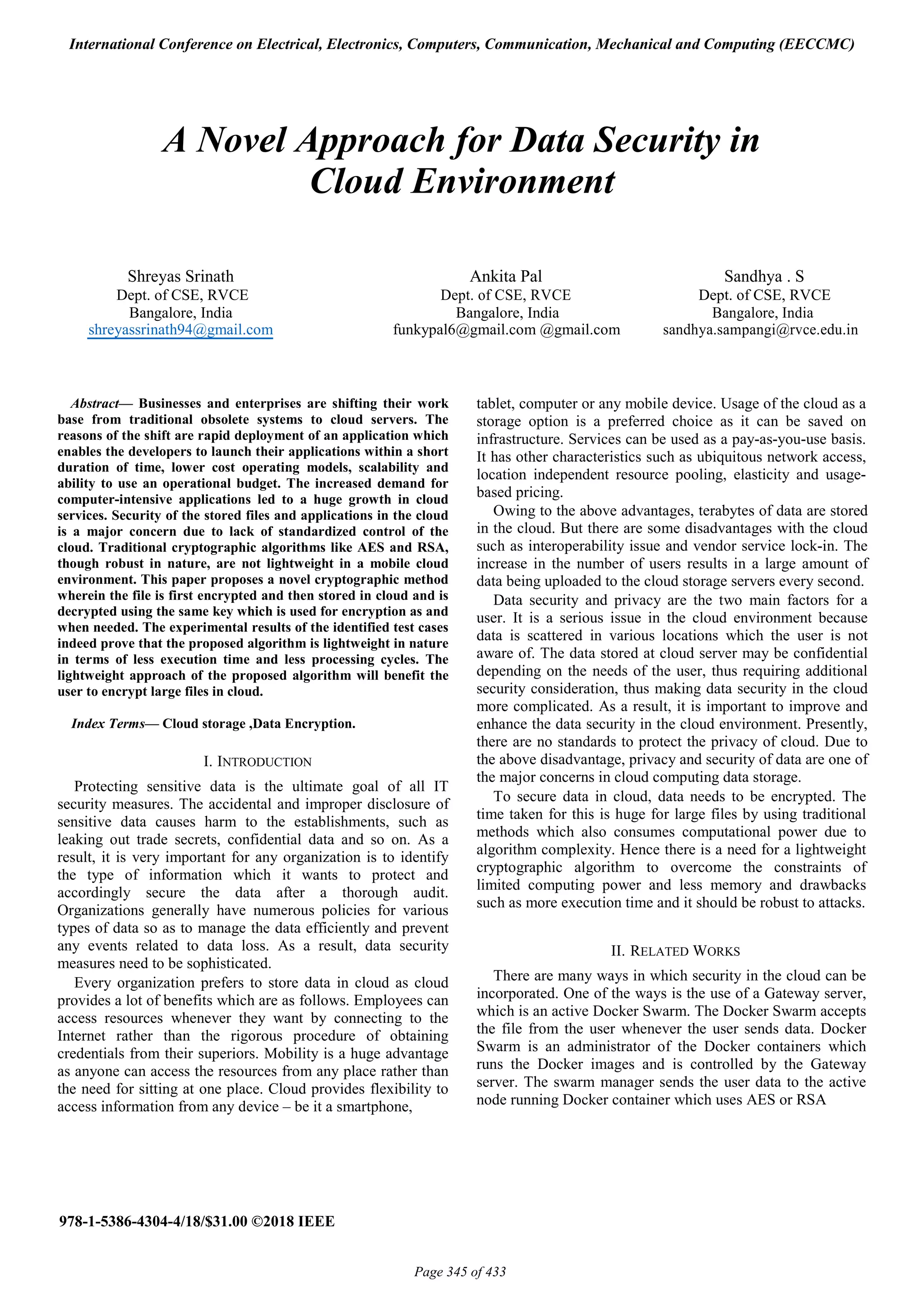
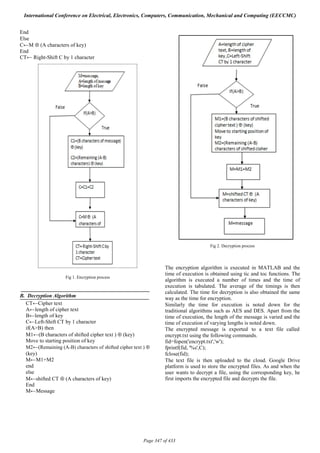
The proposed algorithm is explained as follows. The
encryption technique makes use of the length of the message,
say A, and the length of the key, say B, which is first
compared. If the length of the message is greater than the
length of the key, first B characters of the message are XORed
with the key. Then, the remaining (A-B) characters of the
message are XORed with the key. The two results are then
combined to get the intermediate message. If the length of the
message is less than the length of the key,the shifted cipher
text is XORed with first A characters of the key to get the
intermediate message. The intermediate message is then
shifted by one character to the right to get the encrypted
message.The decryption technique is as follows. The cipher
text is first shifted by one character to the left. The length of
the cipher text, say A, and the length of the key,say B, is then
compared. If the length of the cipher text is greater than the
length of the key, first B characters of the shifted cipher text
are XORed with the key. Then, the remaining (A-B)
characters of the shifted cipher text are XORed with the key.
The two results are then combined to get the decrypted
message. If the length of the ciphertext is less than the length
of the key, the shifted cipher text is XORed with first A
characters of the key. The result of the XOR operation is
decrypted message. The encryption and the decryption flow
algorithm is shown in figure 1 and figure 2 respectively.
A. Encryption Algorithm
M←message
A←length of message
B←length of key
CT←Cipher Text
if(A>B) then
C1←(B characters of message) ⊕ (key)
Move to starting position of key
C2←(Remaining (A-B) characters) ⊕
(key)
C←C1+C2
International Conference on Electrical, Electronics, Computers, Communication, Mechanical and Computing (EECCMC)
Page 346 of 433
End
Else
C←M ⊕ (A characters of key)
End
CT← Right-Shift C by 1 character
Fig 1. Encryption process
B. Decryption Algorithm
CT←Cipher text
A←length of cipher text
B←length of key
C←Left-Shift CT by 1 character
if(A>B) then
M1←(B characters of shifted cipher text ) ⊕ (key)
Move to starting position of key
M2←(Remaining (A-B) characters of shifted cipher text ) ⊕
(key)
M←M1+M2
end
else
M←shifted CT ⊕ (A characters of key)
End
M←Message
Fig 2. Decryption process
The encryption algorithm is executed in MATLAB and the
time of execution is obtained using tic and toc functions. The
algorithm is executed a number of times and the time of
execution is tabulated. The average of the timings is then
calculated. The time for decryption is also obtained the same
way as the time for encryption.
Similarly the time for execution is noted down for the
traditional algorithms such as AES and DES. Apart from the
time of execution, the length of the message is varied and the
time of execution of varying lengths is noted down.
The encrypted message is exported to a text file called
encrypt.txt using the following commands.
fid=fopen('encrypt.txt','w');
fprintf(fid, '%s',C);
fclose(fid);
The text file is then uploaded to the cloud. Google Drive
platform is used to store the encrypted files. As and when the
user wants to decrypt a file, using the corresponding key, he
first imports the encrypted file and decrypts the file.
International Conference on Electrical, Electronics, Computers, Communication, Mechanical and Computing (EECCMC)
Page 347 of 433
IV. RESULTS AND COMPARISON
Proposed algorithm is tested in MATLAB software
R2014a, with a hardware support of Intel i3-4010U processor
with a clock speed of 1.73GHz. The algorithm is tested for
various cases which are as shown below.
A. Time taken for encryption and decryption for different
input lengths
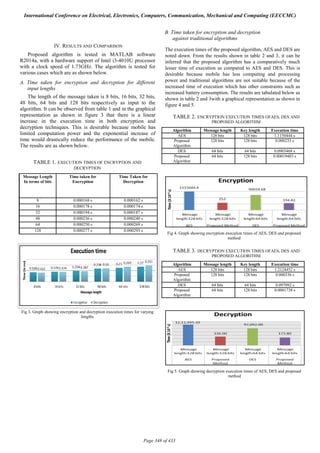
The length of the message taken is 8 bits, 16 bits, 32 bits,
48 bits, 64 bits and 128 bits respectively as input to the
algorithm. It can be observed from table 1 and in the graphical
representation as shown in figure 3 that there is a linear
increase in the execution time in both encryption and
decryption techniques. This is desirable because mobile has
limited computation power and the exponential increase of
time would drastically reduce the performance of the mobile.
The results are as shown below.
TABLE 1. EXECUTION TIMES OF ENCRYPTION AND
DECRYPTION
Message Length Time taken for Time Taken for
In terms of bits Encryption Decryption
8 0.000168 s 0.000162 s
16 0.000178 s 0.000174 s
32 0.000194 s 0.000187 s
48 0.000236 s 0.000240 s
64 0.000250 s 0.000269 s
128 0.000277 s 0.000293 s
Fig 3. Graph showing encryption and decryption execution times for varying
lengths
B. Time taken for encryption and decryption
against traditional algorithms
The execution times of the proposed algorithm, AES and DES are
noted down. From the results shown in table 2 and 3, it can be
inferred that the proposed algorithm has a comparatively much
lesser time of execution as compared to AES and DES. This is
desirable because mobile has less computing and processing
power and traditional algorithms are not suitable because of the
increased time of execution which has other constraints such as
increased battery consumption. The results are tabulated below as
shown in table 2 and 3with a graphical representation as shown in
figure 4 and 5.
TABLE 2. ENCRYPTION EXECUTION TIMES OFAES, DES AND
PROPOSED ALGORITHM
Algorithm Message length Key length Execution time
AES 128 bits 128 bits 1.1150444 s
Proposed 128 bits 128 bits 0.000253 s
Algorithm
DES 64 bits 64 bits 0.0903468 s
Proposed 64 bits 128 bits 0.00019483 s
Algorithm
Fig 4. Graph showing encryption execution times of AES, DES and proposed
method
TABLE 3. DECRYPTION EXECUTION TIMES OFAES, DES AND
PROPOSED ALGORITHM
Algorithm Message length Key length Execution time
AES 128 bits 128 bits 1.2124452 s
Proposed 128 bits 128 bits 0.000336 s
Algorithm
DES 64 bits 64 bits 0.097092 s
Proposed 64 bits 128 bits 0.0001738 s
Algorithm
Fig 5. Graph showing decryption execution times of AES, DES and proposed
method
International Conference on Electrical, Electronics, Computers, Communication, Mechanical and Computing (EECCMC)
Page 348 of 433
C. Cryptanalysis strength against brute force attack
The plain text and the key is used to produce cipher text
using AES, DES, Blow Fish, and the proposed algorithm and
a brute force search space is analyzed.
TABLE 4. BRUTE FORCE SEARCH SPACE ANALYSIS
Key used
Brute force
Algorith [in Plain Cipher Text
Search space
m hexadecima Text produced
analysis
l]
0368945f11
AES[12 1d0cbfc8a1 Good 7Ucho3w+xc1zM 2.95 x 1047
8 bit] 3886fd6ebf Morning QspXUVPLw==
5d
0368945f11
DES 1d0cbfc8a1 Good T0DxqUAivx37R 2.95 x 1047
3886fd6ebf Morning 6YgnCCrEw==
5d
0368945f11
Blow 1d0cbfc8a1 Good nLWGjYn+W2ic 2.95 x 1047
Fish 3886fd6ebf Morning CcW4P2iEpA==
5d
Propose 0368945f11
d 1d0cbfc8a1 Good wY^YyZ^T_X_ 3.81 x 1043
Algorith 3886fd6ebf Morning ^C0cbf
m 5d
From the above analysis shown in table 4, it can be proved
that the proposed algorithm is comparatively strong and is
competent with the AES, DES and blowfish algorithm as
search space for attacking is very close.
V. CONCLUSION
Data Security and privacy are one of the major issues that
exist in all levels of cloud service. A new method for securing
data is proposed to increase the efficiency of storage and
retrieval in cloud .The proposed model is tested and the results
showcase that the proposed data security model is light weight
in terms of time taken for encryption and decryption and is
98.7% faster as compared existing methods such as AES and
DES. Brute force search space analysis shows that the search
space for attacking is considerably on par with AES and DES
algorithm hence time taken to crack the cipher text in
traditional methods and the proposed methods are same as
shown in the above results and comparisons.
REFERENCES
[1] R. R. Gupta et al., "Data storage security in cloud computing using
container clustering," 2016 IEEE 7th Annual Ubiquitous Computing,
Electronics & Mobile Communication Conference (UEMCON), New
York, NY, 2016, pp. 1-7.
[2] B. Thiyagarajan and R. Kamalakannan, "Data integrity and security in
cloud environment using AES algorithm," International Conference on
Information Communication and Embedded Systems (ICICES2014),
Chennai, 2014, pp. 1-5.
[3] S. Kaushik and C. Gandhi, "Cloud data security with hybrid symmetric
encryption," 2016 International Conference on Computational
Techniques in Information and Communication Technologies
(ICCTICT), New Delhi, 2016, pp. 636-640.
[4] K. B. P. Iyer, Manisha R, Subhashree R and Vedhavalli K, "Analysis of
data security in Cloud Computing," 2016 2nd International Conference
on Advances in Electrical, Electronics, Information, Communication and
Bio-Informatics (AEEICB), Chennai, 2016, pp. 540-543.
[5] S. Manjula, M. Indra and R. Swathiya, "Division of data in cloud
environment for secure data storage," 2016 International Conference on
Computing Technologies and Intelligent Data Engineering
(ICCTIDE'16), Kovilpatti, 2016, pp. 1-5.
[6] M. K. Sarkar and Trijit Chatterjee, “Enhancing Data Storage Security in
Cloud Computing Through Steganography”, ACEEE Int. J. on Network
Security, Vol. 5, No. 1, Jan 2014, pp. 13-19.
[7] Sidhu, Aparjita, and Rajiv Mahajan. "Research Article Enhancing
Security In Cloud Computing Structure By Hybrid Encryption."
International Journal of Recent Scientific Research 5 (2014): 128-132.
[8] A. Bhagat and R. Kant Sahu, "Cloud Data Security While using Third
Party Auditor", International Journal of Computer Applications, vol. 70,
no. 16, , 2013, pp. 9-13.
[9] Dastjerdi, Amir Vahid, Kamalrulnizam Abu Bakar, and Sayed Gholam
Hassan Tabatabaei. "Distributed intrusion detection in clouds using
mobile agents." Advanced Engineering Computing and Applications in
Sciences, 2009. ADVCOMP'09. Third International Conference on.
IEEE, 2009
[10] Singla, Sanjoli, and Jasmeet Singh. "Cloud data security using
authentication and encryption technique." Global Journal of Computer
Science and Technology 13.3 (2013).
[11] V .Yadav and P. Aggarwal, “Fingerprinting Based Recursive
Information Hiding Strategy in Cloud Computing Environment”
International Journal of Computer Science and Mobile Computing,
Vol.3 Issue.5, May- 2014, pg. 702-707
[12] Rishav Ray, Jeeyan Sanyal, Debanjan Das, Asoke Nath. “A new
Challenge of hiding any encrypted secret message inside any
Text/ASCII file or in MS word file: RJDA Algorithm”. 2012 IEEE
International Conference on Communication Systems and Network
Technologies
[13] Nath, Joyshree, et al. "New Steganography algorithm using encrypted
secret message." Proceedings of Worldcomp 2011 Held at Las Vegas
(USA), 18-21 Jul, 2011 (2011).
[14] Nath, Joyshree. "A challenge in hiding encrypted message in LSB and
LSB+ 1 bit positions in various cover files." Journal of global research
in computer science 2.4 (2011): 180-185.
[15] S. Manjula, M. Indra and R. Swathiya, "Division of data in cloud
environment for secure data storage," 2016 International Conference on
Computing Technologies and Intelligent Data Engineering
(ICCTIDE'16), Kovilpatti, 2016, pp. 1-5.
[16] M. Ahmadi, F. Fatemi Moghaddam, A. J. Jam, S. Gholizadeh and M.
Eslami, "A 3-level re-encryption model to ensure data protection in
cloud computing environments," 2014 IEEE Conference on Systems,
Process and Control (ICSPC 2014), Kuala Lumpur, 2014, pp. 36-40.
[17] K. V. Raipurkar and A. V. Deorankar, "Improve data security in cloud
environment by using LDAP and two way encryption algorithm," 2016
Symposium on Colossal Data Analysis and Networking (CDAN),
Indore, 2016, pp. 1-4.
[18] Jayapandian, A. M. J. M. Z. Rahman, M. Koushikaa and S.
Radhikadevi, "A novel approach to enhance multi level security system
using encryption with fingerprint in cloud," 2016 World Conference on
Futuristic Trends in Research and Innovation for Social Welfare
(Startup Conclave), Coimbatore, 2016, pp. 1-5.
[19] Nath, Joyshree, and Asoke Nath. "Advanced Steganography Algorithm
using encrypted secret message." International journal of advanced
computer science and applications 2.3 (2011).
[20] Gampala, Veerraju, Srilakshmi Inuganti, and Satish Muppidi. "Data
security in cloud computing with elliptic curve cryptography."
International Journal of Soft Computing and Engineering (IJSCE) 2.3
(2012): 138-141.
International Conference on Electrical, Electronics, Computers, Communication, Mechanical and Computing (EECCMC)
Page 349 of 433

A Novel Approach for Data Security in Cloud Environment

  • 1.
    Shreyas Srinath AnkitaPal Sandhya . S Dept. of CSE, RVCE Dept. of CSE, RVCE Dept. of CSE, RVCE Bangalore, India Bangalore, India Bangalore, India shreyassrinath94@gmail.com funkypal6@gmail.com @gmail.com sandhya.sampangi@rvce.edu.in Abstract— Businesses and enterprises are shifting their work base from traditional obsolete systems to cloud servers. The reasons of the shift are rapid deployment of an application which enables the developers to launch their applications within a short duration of time, lower cost operating models, scalability and ability to use an operational budget. The increased demand for computer-intensive applications led to a huge growth in cloud services. Security of the stored files and applications in the cloud is a major concern due to lack of standardized control of the cloud. Traditional cryptographic algorithms like AES and RSA, though robust in nature, are not lightweight in a mobile cloud environment. This paper proposes a novel cryptographic method wherein the file is first encrypted and then stored in cloud and is decrypted using the same key which is used for encryption as and when needed. The experimental results of the identified test cases indeed prove that the proposed algorithm is lightweight in nature in terms of less execution time and less processing cycles. The lightweight approach of the proposed algorithm will benefit the user to encrypt large files in cloud. Index Terms— Cloud storage ,Data Encryption. I. INTRODUCTION Protecting sensitive data is the ultimate goal of all IT security measures. The accidental and improper disclosure of sensitive data causes harm to the establishments, such as leaking out trade secrets, confidential data and so on. As a result, it is very important for any organization is to identify the type of information which it wants to protect and accordingly secure the data after a thorough audit. Organizations generally have numerous policies for various types of data so as to manage the data efficiently and prevent any events related to data loss. As a result, data security measures need to be sophisticated. Every organization prefers to store data in cloud as cloud provides a lot of benefits which are as follows. Employees can access resources whenever they want by connecting to the Internet rather than the rigorous procedure of obtaining credentials from their superiors. Mobility is a huge advantage as anyone can access the resources from any place rather than the need for sitting at one place. Cloud provides flexibility to access information from any device – be it a smartphone, tablet, computer or any mobile device. Usage of the cloud as a storage option is a preferred choice as it can be saved on infrastructure. Services can be used as a pay-as-you-use basis. It has other characteristics such as ubiquitous network access, location independent resource pooling, elasticity and usage- based pricing. Owing to the above advantages, terabytes of data are stored in the cloud. But there are some disadvantages with the cloud such as interoperability issue and vendor service lock-in. The increase in the number of users results in a large amount of data being uploaded to the cloud storage servers every second. Data security and privacy are the two main factors for a user. It is a serious issue in the cloud environment because data is scattered in various locations which the user is not aware of. The data stored at cloud server may be confidential depending on the needs of the user, thus requiring additional security consideration, thus making data security in the cloud more complicated. As a result, it is important to improve and enhance the data security in the cloud environment. Presently, there are no standards to protect the privacy of cloud. Due to the above disadvantage, privacy and security of data are one of the major concerns in cloud computing data storage. To secure data in cloud, data needs to be encrypted. The time taken for this is huge for large files by using traditional methods which also consumes computational power due to algorithm complexity. Hence there is a need for a lightweight cryptographic algorithm to overcome the constraints of limited computing power and less memory and drawbacks such as more execution time and it should be robust to attacks. II. RELATED WORKS There are many ways in which security in the cloud can be incorporated. One of the ways is the use of a Gateway server, which is an active Docker Swarm. The Docker Swarm accepts the file from the user whenever the user sends data. Docker Swarm is an administrator of the Docker containers which runs the Docker images and is controlled by the Gateway server. The swarm manager sends the user data to the active node running Docker container which uses AES or RSA A Novel Approach for Data Security in Cloud Environment 978-1-5386-4304-4/18/$31.00 ©2018 IEEE International Conference on Electrical, Electronics, Computers, Communication, Mechanical and Computing (EECCMC) Page 345 of 433
  • 2.
    algorithm and encryptsthe data [1]. The data is sent back to the Gateway server after encryption which then sends the encrypted data to another node containing Storage Manager Gluster FS. This node in turn is connected to another node containing many Docker containers, thus enabling the distribution of the encrypted data in these containers. The limitation is that an entire container is used for the cryptographic purpose which is not advisable for data stored in a mobile cloud platform. File-based encryption is also incorporated as security measures in the cloud. The file present on the device is encrypted using password-based AES algorithm [2]. The user has the provision to download the uploaded encrypted files. Shortcomings of this framework are that the use of the classical AES approach brings no novelty in the approach proposed. Also, time taken for encryption and decryption is more when applied to mobile cloud environment which is a disadvantage and no comparison is made with respect to throughput, time is taken for encryption and decryption. There is also a scheme which first converts the plaintext into their corresponding ASCII value and then the encryption and decryption are performed using symmetric hybrid approach [3]. But the scheme is only applicable for alphabets and not for numbers and special characters. Also, there is no comparison of time complexity with the existing methods like AES and DES and incorporates the use of inverse matrix operation in decryption algorithm which cannot be used in all cases (i.e., the inverse of a matrix does not exist if the determinant is zero). The use of a secure encryption scheme using advanced encryption scheme and fully homomorphic encryption in cloud computing is also incorporated [4]. The user chooses a passphrase which serves as a hint to the secret key that will be used to encrypt the data. On entering the passphrase, the system randomly generates a secret key from the chosen passphrase. The first encryption process using AES of 128 bits block size and a 256-bit key. After the first stage, the cipher text and secret key are available. Next, an additive homomorphic encryption is used to encrypt the cipher text generated at the first stage and the secret key together. The result of this stage generates another cipher text which is stored in the cloud. But this method is not recommended for large files because the homomorphic encryption process speed is slow. The computations on large cipher texts are slower than the computations on the plain text itself. Achieving data privacy using the concept of division of data through the use of Cloud Manager (CM) is one of the ways to enhance the security in the cloud [5]. RSA is used to encrypt the data. The encrypted data is then divided into fragments and stored on different cloud servers. The Cloud Manager (CM) manages the storage of the fragmented file on a cloud server. But with the advancing technology, RSA is subjected to various attacks and thus is not a reliable cryptographic scheme due to its large computation time when large prime numbers are involved in it. Other data security methods such as homomorphic encryption proposed by Rivest et al , wherein the cipher text are much larger than the original plain text so system fails drastically if the input is in the order of few Gigabytes or Terabytes as it takes a considerable amount of time for computation. III. PROPOSED METHODOLOGY The proposed method is as follows. The document containing the confidential information is fed as the input along with the key (secret key) for encryption. The algorithm makes use of symmetric encryption model wherein the same key should be used at the time of decryption the document (or original message). The encrypted document is then stored in cloud When the user wants to retrieve the document, the document should be downloaded from the cloud servers and decryption algorithm is used to get the original message document, with the help of the same secret key used in encryption. If the key is mismatched then the decrypted message will not be same as original , thereby the intruder cannot get to know which is the original message as for all the combination of the keys some message will be shown after decryption. The proposed algorithm is explained as follows. The encryption technique makes use of the length of the message, say A, and the length of the key, say B, which is first compared. If the length of the message is greater than the length of the key, first B characters of the message are XORed with the key. Then, the remaining (A-B) characters of the message are XORed with the key. The two results are then combined to get the intermediate message. If the length of the message is less than the length of the key,the shifted cipher text is XORed with first A characters of the key to get the intermediate message. The intermediate message is then shifted by one character to the right to get the encrypted message.The decryption technique is as follows. The cipher text is first shifted by one character to the left. The length of the cipher text, say A, and the length of the key,say B, is then compared. If the length of the cipher text is greater than the length of the key, first B characters of the shifted cipher text are XORed with the key. Then, the remaining (A-B) characters of the shifted cipher text are XORed with the key. The two results are then combined to get the decrypted message. If the length of the ciphertext is less than the length of the key, the shifted cipher text is XORed with first A characters of the key. The result of the XOR operation is decrypted message. The encryption and the decryption flow algorithm is shown in figure 1 and figure 2 respectively. A. Encryption Algorithm M←message A←length of message B←length of key CT←Cipher Text if(A>B) then C1←(B characters of message) ⊕ (key) Move to starting position of key C2←(Remaining (A-B) characters) ⊕ (key) C←C1+C2 International Conference on Electrical, Electronics, Computers, Communication, Mechanical and Computing (EECCMC) Page 346 of 433
  • 3.
    End Else C←M ⊕ (Acharacters of key) End CT← Right-Shift C by 1 character Fig 1. Encryption process B. Decryption Algorithm CT←Cipher text A←length of cipher text B←length of key C←Left-Shift CT by 1 character if(A>B) then M1←(B characters of shifted cipher text ) ⊕ (key) Move to starting position of key M2←(Remaining (A-B) characters of shifted cipher text ) ⊕ (key) M←M1+M2 end else M←shifted CT ⊕ (A characters of key) End M←Message Fig 2. Decryption process The encryption algorithm is executed in MATLAB and the time of execution is obtained using tic and toc functions. The algorithm is executed a number of times and the time of execution is tabulated. The average of the timings is then calculated. The time for decryption is also obtained the same way as the time for encryption. Similarly the time for execution is noted down for the traditional algorithms such as AES and DES. Apart from the time of execution, the length of the message is varied and the time of execution of varying lengths is noted down. The encrypted message is exported to a text file called encrypt.txt using the following commands. fid=fopen('encrypt.txt','w'); fprintf(fid, '%s',C); fclose(fid); The text file is then uploaded to the cloud. Google Drive platform is used to store the encrypted files. As and when the user wants to decrypt a file, using the corresponding key, he first imports the encrypted file and decrypts the file. International Conference on Electrical, Electronics, Computers, Communication, Mechanical and Computing (EECCMC) Page 347 of 433
  • 4.
    IV. RESULTS ANDCOMPARISON Proposed algorithm is tested in MATLAB software R2014a, with a hardware support of Intel i3-4010U processor with a clock speed of 1.73GHz. The algorithm is tested for various cases which are as shown below. A. Time taken for encryption and decryption for different input lengths The length of the message taken is 8 bits, 16 bits, 32 bits, 48 bits, 64 bits and 128 bits respectively as input to the algorithm. It can be observed from table 1 and in the graphical representation as shown in figure 3 that there is a linear increase in the execution time in both encryption and decryption techniques. This is desirable because mobile has limited computation power and the exponential increase of time would drastically reduce the performance of the mobile. The results are as shown below. TABLE 1. EXECUTION TIMES OF ENCRYPTION AND DECRYPTION Message Length Time taken for Time Taken for In terms of bits Encryption Decryption 8 0.000168 s 0.000162 s 16 0.000178 s 0.000174 s 32 0.000194 s 0.000187 s 48 0.000236 s 0.000240 s 64 0.000250 s 0.000269 s 128 0.000277 s 0.000293 s Fig 3. Graph showing encryption and decryption execution times for varying lengths B. Time taken for encryption and decryption against traditional algorithms The execution times of the proposed algorithm, AES and DES are noted down. From the results shown in table 2 and 3, it can be inferred that the proposed algorithm has a comparatively much lesser time of execution as compared to AES and DES. This is desirable because mobile has less computing and processing power and traditional algorithms are not suitable because of the increased time of execution which has other constraints such as increased battery consumption. The results are tabulated below as shown in table 2 and 3with a graphical representation as shown in figure 4 and 5. TABLE 2. ENCRYPTION EXECUTION TIMES OFAES, DES AND PROPOSED ALGORITHM Algorithm Message length Key length Execution time AES 128 bits 128 bits 1.1150444 s Proposed 128 bits 128 bits 0.000253 s Algorithm DES 64 bits 64 bits 0.0903468 s Proposed 64 bits 128 bits 0.00019483 s Algorithm Fig 4. Graph showing encryption execution times of AES, DES and proposed method TABLE 3. DECRYPTION EXECUTION TIMES OFAES, DES AND PROPOSED ALGORITHM Algorithm Message length Key length Execution time AES 128 bits 128 bits 1.2124452 s Proposed 128 bits 128 bits 0.000336 s Algorithm DES 64 bits 64 bits 0.097092 s Proposed 64 bits 128 bits 0.0001738 s Algorithm Fig 5. Graph showing decryption execution times of AES, DES and proposed method International Conference on Electrical, Electronics, Computers, Communication, Mechanical and Computing (EECCMC) Page 348 of 433
  • 5.
    C. Cryptanalysis strengthagainst brute force attack The plain text and the key is used to produce cipher text using AES, DES, Blow Fish, and the proposed algorithm and a brute force search space is analyzed. TABLE 4. BRUTE FORCE SEARCH SPACE ANALYSIS Key used Brute force Algorith [in Plain Cipher Text Search space m hexadecima Text produced analysis l] 0368945f11 AES[12 1d0cbfc8a1 Good 7Ucho3w+xc1zM 2.95 x 1047 8 bit] 3886fd6ebf Morning QspXUVPLw== 5d 0368945f11 DES 1d0cbfc8a1 Good T0DxqUAivx37R 2.95 x 1047 3886fd6ebf Morning 6YgnCCrEw== 5d 0368945f11 Blow 1d0cbfc8a1 Good nLWGjYn+W2ic 2.95 x 1047 Fish 3886fd6ebf Morning CcW4P2iEpA== 5d Propose 0368945f11 d 1d0cbfc8a1 Good wY^YyZ^T_X_ 3.81 x 1043 Algorith 3886fd6ebf Morning ^C0cbf m 5d From the above analysis shown in table 4, it can be proved that the proposed algorithm is comparatively strong and is competent with the AES, DES and blowfish algorithm as search space for attacking is very close. V. CONCLUSION Data Security and privacy are one of the major issues that exist in all levels of cloud service. A new method for securing data is proposed to increase the efficiency of storage and retrieval in cloud .The proposed model is tested and the results showcase that the proposed data security model is light weight in terms of time taken for encryption and decryption and is 98.7% faster as compared existing methods such as AES and DES. Brute force search space analysis shows that the search space for attacking is considerably on par with AES and DES algorithm hence time taken to crack the cipher text in traditional methods and the proposed methods are same as shown in the above results and comparisons. REFERENCES [1] R. R. Gupta et al., "Data storage security in cloud computing using container clustering," 2016 IEEE 7th Annual Ubiquitous Computing, Electronics & Mobile Communication Conference (UEMCON), New York, NY, 2016, pp. 1-7. [2] B. Thiyagarajan and R. Kamalakannan, "Data integrity and security in cloud environment using AES algorithm," International Conference on Information Communication and Embedded Systems (ICICES2014), Chennai, 2014, pp. 1-5. [3] S. Kaushik and C. Gandhi, "Cloud data security with hybrid symmetric encryption," 2016 International Conference on Computational Techniques in Information and Communication Technologies (ICCTICT), New Delhi, 2016, pp. 636-640. [4] K. B. P. Iyer, Manisha R, Subhashree R and Vedhavalli K, "Analysis of data security in Cloud Computing," 2016 2nd International Conference on Advances in Electrical, Electronics, Information, Communication and Bio-Informatics (AEEICB), Chennai, 2016, pp. 540-543. [5] S. Manjula, M. Indra and R. Swathiya, "Division of data in cloud environment for secure data storage," 2016 International Conference on Computing Technologies and Intelligent Data Engineering (ICCTIDE'16), Kovilpatti, 2016, pp. 1-5. [6] M. K. Sarkar and Trijit Chatterjee, “Enhancing Data Storage Security in Cloud Computing Through Steganography”, ACEEE Int. J. on Network Security, Vol. 5, No. 1, Jan 2014, pp. 13-19. [7] Sidhu, Aparjita, and Rajiv Mahajan. "Research Article Enhancing Security In Cloud Computing Structure By Hybrid Encryption." International Journal of Recent Scientific Research 5 (2014): 128-132. [8] A. Bhagat and R. Kant Sahu, "Cloud Data Security While using Third Party Auditor", International Journal of Computer Applications, vol. 70, no. 16, , 2013, pp. 9-13. [9] Dastjerdi, Amir Vahid, Kamalrulnizam Abu Bakar, and Sayed Gholam Hassan Tabatabaei. "Distributed intrusion detection in clouds using mobile agents." Advanced Engineering Computing and Applications in Sciences, 2009. ADVCOMP'09. Third International Conference on. IEEE, 2009 [10] Singla, Sanjoli, and Jasmeet Singh. "Cloud data security using authentication and encryption technique." Global Journal of Computer Science and Technology 13.3 (2013). [11] V .Yadav and P. Aggarwal, “Fingerprinting Based Recursive Information Hiding Strategy in Cloud Computing Environment” International Journal of Computer Science and Mobile Computing, Vol.3 Issue.5, May- 2014, pg. 702-707 [12] Rishav Ray, Jeeyan Sanyal, Debanjan Das, Asoke Nath. “A new Challenge of hiding any encrypted secret message inside any Text/ASCII file or in MS word file: RJDA Algorithm”. 2012 IEEE International Conference on Communication Systems and Network Technologies [13] Nath, Joyshree, et al. "New Steganography algorithm using encrypted secret message." Proceedings of Worldcomp 2011 Held at Las Vegas (USA), 18-21 Jul, 2011 (2011). [14] Nath, Joyshree. "A challenge in hiding encrypted message in LSB and LSB+ 1 bit positions in various cover files." Journal of global research in computer science 2.4 (2011): 180-185. [15] S. Manjula, M. Indra and R. Swathiya, "Division of data in cloud environment for secure data storage," 2016 International Conference on Computing Technologies and Intelligent Data Engineering (ICCTIDE'16), Kovilpatti, 2016, pp. 1-5. [16] M. Ahmadi, F. Fatemi Moghaddam, A. J. Jam, S. Gholizadeh and M. Eslami, "A 3-level re-encryption model to ensure data protection in cloud computing environments," 2014 IEEE Conference on Systems, Process and Control (ICSPC 2014), Kuala Lumpur, 2014, pp. 36-40. [17] K. V. Raipurkar and A. V. Deorankar, "Improve data security in cloud environment by using LDAP and two way encryption algorithm," 2016 Symposium on Colossal Data Analysis and Networking (CDAN), Indore, 2016, pp. 1-4. [18] Jayapandian, A. M. J. M. Z. Rahman, M. Koushikaa and S. Radhikadevi, "A novel approach to enhance multi level security system using encryption with fingerprint in cloud," 2016 World Conference on Futuristic Trends in Research and Innovation for Social Welfare (Startup Conclave), Coimbatore, 2016, pp. 1-5. [19] Nath, Joyshree, and Asoke Nath. "Advanced Steganography Algorithm using encrypted secret message." International journal of advanced computer science and applications 2.3 (2011). [20] Gampala, Veerraju, Srilakshmi Inuganti, and Satish Muppidi. "Data security in cloud computing with elliptic curve cryptography." International Journal of Soft Computing and Engineering (IJSCE) 2.3 (2012): 138-141. International Conference on Electrical, Electronics, Computers, Communication, Mechanical and Computing (EECCMC) Page 349 of 433