A NEW APPROACH TO
PMBOK®
GUIDE 2000
Accepted for publication at
PMI Global Congress North America
Nashville – TE – USA – 2001
A New Approach to PMBOK®
GUIDE 20002
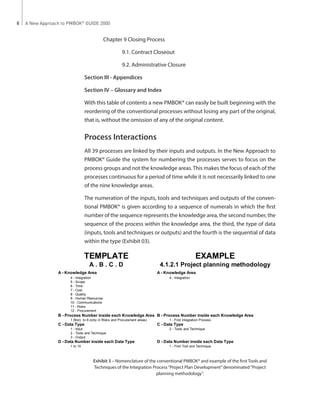
Abstract
This work puts forward a new approach to PMBOK® Guide in which the thir-
ty-nine processes are organized in five groups: initiation, planning, executing,
controlling and closing process. This arrangement suggests a chronologically
structured, more didactic view, which has been successfully tested in two PM
classes in Brazil, instead of the former organization in nine Knowledge Areas.This
approach is also useful to PMP exam preparation where two hundred questions
are divided into process groups rather than knowledge areas.
Related Podcasts
♫♫The New PMBOK® Guide 5th
Edition
http://rvarg.as/5q
♫♫The new PMBOK Guide – 4th
Edition
http://rvarg.as/bb
Related Document
📰📰PMBOK® 5th
Edition Processes
Flow
http://rvarg.as/p5ed
ricardo-vargas.com  3
PMBOK® Guide 2000
The PMBOK® Guide is nowadays the most important reference document about
the Project Management Body of Knowledge. It was defined in 1987 as“all those
topics, subject areas and intellectual processes which are involved in the appli-
cation of sound management principles to ... projects”. The guide is distribut-
ed by PMI, free of charge, with more than 640,000 copies placed in circulation
worldwide (March 2001). As established in the guide, “the primary purpose of
this document is to identify and describe that subset of the PMBOK® which is
generally accepted. Generally accepted means that the knowledge and practices
described are applicable to most projects of the time, and that there is wide-
spread consensus about their value and usefulness” (PMBOK® Guide, 2000 Edi-
tion). According to the purpose of the guide, it is essential to have a logical and
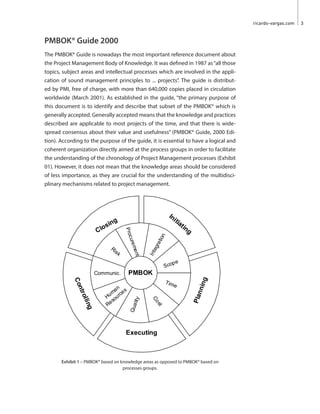
coherent organization directly aimed at the process groups in order to facilitate
the understanding of the chronology of Project Management processes (Exhibit
01). However, it does not mean that the knowledge areas should be considered
of less importance, as they are crucial for the understanding of the multidisci-
plinary mechanisms related to project management.
Executing
Planning
Controlling
Closing
Initiating
PMBOK
Procurement
Scope
Integration
Cost
Communic.
Human
Resources
Time
Quality
Risk
Exhibit 1 – PMBOK® based on knowledge areas as opposed to PMBOK® based on
processes groups.
A New Approach to PMBOK®
GUIDE 20004
Project Management Process Groups
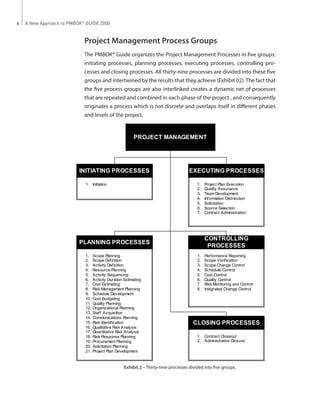
The PMBOK® Guide organizes the Project Management Processes in five groups:
initiating processes, planning processes, executing processes, controlling pro-
cesses and closing processes. All thirty-nine processes are divided into these five
groups and intertwined by the results that they achieve (Exhibit 02).The fact that
the five process groups are also interlinked creates a dynamic net of processes
that are repeated and combined in each phase of the project , and consequently
originates a process which is not discrete and overlaps itself in different phases
and levels of the project.
1. Scope Planning
2. Scope Definition
3. Activity Definition
4. Resource Planning
5. Activity Sequencing
6. Activity Duration Estimating
7. Cost Estimating
8. Risk Management Planning
9. Schedule Development
10. Cost Budgeting
11. Quality Planning
12. Organizational Planning
13. Staff Acquisition
14. Communications Planning
15. Risk Identification
16. Qualitative Risk Analysis
17. Quantitative Risk Analysis
18. Risk Response Planning
19. Procurement Planning
20. Solicitation Planning
21. Project Plan Development
PLANNING PROCESSES
1. Initiation
INITIATING PROCESSES
1. Performance Reporting
2. Scope Verification
3. Scope Change Control
4. Schedule Control
5. Cost Control
6. Quality Control
7. Risk Monitoring and Control
8. Integrated Change Control
CONTROLLING
PROCESSES
1. Contract Closeout
2. Administrative Closure
CLOSING PROCESSES
1. Project Plan Execution
2. Quality Assurance
3. Team Development
4. Information Distribution
5. Solicitation
6. Source Selection
7. Contract Administration
EXECUTING PROCESSES
PROJECT MANAGEMENT
Exhibit 2 – Thirty-nine processes divided into five groups.
ricardo-vargas.com  5
New Structure of PMBOK® Guide
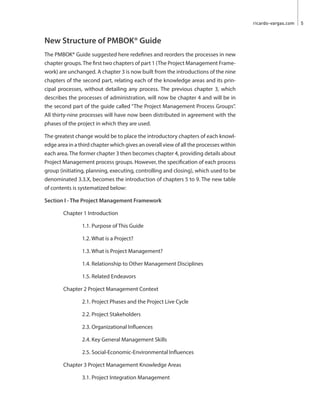
The PMBOK® Guide suggested here redefines and reorders the processes in new
chapter groups.The first two chapters of part 1 (The Project Management Frame-
work) are unchanged. A chapter 3 is now built from the introductions of the nine
chapters of the second part, relating each of the knowledge areas and its prin-
cipal processes, without detailing any process. The previous chapter 3, which
describes the processes of administration, will now be chapter 4 and will be in
the second part of the guide called “The Project Management Process Groups”.
All thirty-nine processes will have now been distributed in agreement with the
phases of the project in which they are used.
The greatest change would be to place the introductory chapters of each knowl-
edge area in a third chapter which gives an overall view of all the processes within
each area.The former chapter 3 then becomes chapter 4, providing details about
Project Management process groups. However, the specification of each process
group (initiating, planning, executing, controlling and closing), which used to be
denominated 3.3.X, becomes the introduction of chapters 5 to 9. The new table
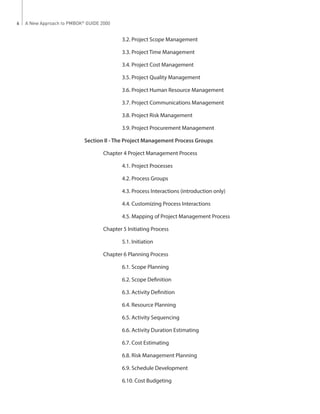
of contents is systematized below:
Section I - The Project Management Framework
	 Chapter 1 Introduction
		 1.1. Purpose of This Guide
		 1.2. What is a Project?
		 1.3. What is Project Management?
		 1.4. Relationship to Other Management Disciplines
		 1.5. Related Endeavors
	 Chapter 2 Project Management Context
		 2.1. Project Phases and the Project Live Cycle
		 2.2. Project Stakeholders
		 2.3. Organizational Influences
		 2.4. Key General Management Skills
		 2.5. Social-Economic-Environmental Influences
	 Chapter 3 Project Management Knowledge Areas
		 3.1. Project Integration Management
A New Approach to PMBOK®
GUIDE 20006
		 3.2. Project Scope Management
		 3.3. Project Time Management
		 3.4. Project Cost Management
		 3.5. Project Quality Management
		 3.6. Project Human Resource Management
		 3.7. Project Communications Management
		 3.8. Project Risk Management
		 3.9. Project Procurement Management
Section II - The Project Management Process Groups
	 Chapter 4 Project Management Process
		 4.1. Project Processes
		 4.2. Process Groups
		 4.3. Process Interactions (introduction only)
		 4.4. Customizing Process Interactions
		 4.5. Mapping of Project Management Process
	 Chapter 5 Initiating Process
		5.1. Initiation
	 Chapter 6 Planning Process
		 6.1. Scope Planning
		 6.2. Scope Definition
		 6.3. Activity Definition
		 6.4. Resource Planning
		 6.5. Activity Sequencing
		 6.6. Activity Duration Estimating
		 6.7. Cost Estimating
		 6.8. Risk Management Planning
		 6.9. Schedule Development
		 6.10. Cost Budgeting
ricardo-vargas.com  7
		 6.11. Quality Planning
		 6.12. Organizational Planning
		 6.13. Staff Acquisition
		 6.14. Communications Planning
		 6.15. Risk Identification
		 6.16. Qualitative Risk Analysis
		 6.17. Quantitative Risk Analysis
		 6.18. Risk Response Planning
		 6.19. Procurement Planning
		 6.20. Solicitation Planning
		 6.21. Project Plan Development
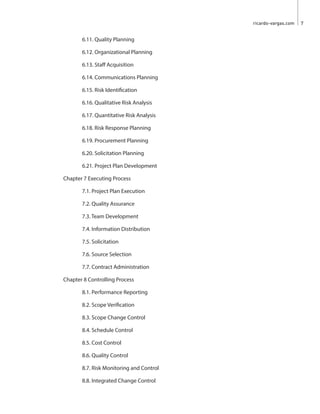
	 Chapter 7 Executing Process
		 7.1. Project Plan Execution
		 7.2. Quality Assurance
		7.3. Team Development
		 7.4. Information Distribution
		7.5. Solicitation
		 7.6. Source Selection
		 7.7. Contract Administration
	 Chapter 8 Controlling Process
		 8.1. Performance Reporting
		8.2. Scope Verification
		 8.3. Scope Change Control
		 8.4. Schedule Control
		 8.5. Cost Control
		 8.6. Quality Control
		 8.7. Risk Monitoring and Control
		 8.8. Integrated Change Control
A New Approach to PMBOK®
GUIDE 20008
	 Chapter 9 Closing Process
		 9.1. Contract Closeout
		 9.2. Administrative Closure
Section III - Appendices
Section IV – Glossary and Index
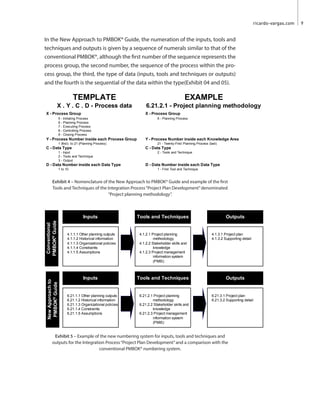
With this table of contents a new PMBOK® can easily be built beginning with the
reordering of the conventional processes without losing any part of the original,
that is, without the omission of any of the original content.
Process Interactions
All 39 processes are linked by their inputs and outputs. In the New Approach to
PMBOK® Guide the system for numbering the processes serves to focus on the
process groups and not the knowledge areas.This makes the focus of each of the
processes continuous for a period of time while it is not necessarily linked to one
of the nine knowledge areas.
The numeration of the inputs, tools and techniques and outputs of the conven-
tional PMBOK® is given according to a sequence of numerals in which the first
number of the sequence represents the knowledge area, the second number, the
sequence of the process within the knowledge area, the third, the type of data
(inputs, tools and techniques or outputs) and the fourth is the sequential of data
within the type (Exhibit 03).
TEMPLATE
A . B . C . D
A - Knowledge Area
4 - Integration
5 - Scope
6 - Time
7 - Cost
8 - Quality
9 - Human Resources
10 - Communications
11 - Risks
12 - Procurement
B - Process Number inside each Knowledge Area
1 (first) to 6 (only in Risks and Procurement areas)
C - Data Type
1 - Input
2 - Tools and Technique
3 - Output
D - Data Number inside each Data Type
1 to 10
EXAMPLE
4.1.2.1 Project planning methodology
A - Knowledge Area
4 - Integration
B - Process Number inside each Knowledge Area
1 - First Integration Process
C - Data Type
2 - Tools and Technique
D - Data Number inside each Data Type
1 - First Tool and Technique
Exhibit 3 – Nomenclature of the conventional PMBOK® and example of the first Tools and
Techniques of the Integration Process“Project Plan Development”denominated“Project
planning methodology”.
ricardo-vargas.com  9
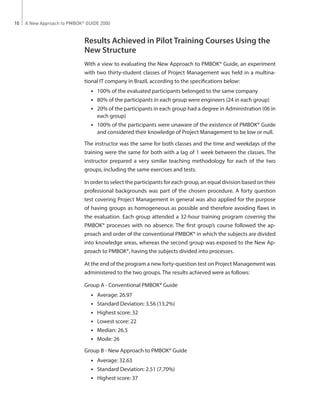
In the New Approach to PMBOK® Guide, the numeration of the inputs, tools and
techniques and outputs is given by a sequence of numerals similar to that of the
conventional PMBOK®, although the first number of the sequence represents the
process group, the second number, the sequence of the process within the pro-
cess group, the third, the type of data (inputs, tools and techniques or outputs)
and the fourth is the sequential of the data within the type(Exhibit 04 and 05).
TEMPLATE
X . Y . C . D - Process data
X - Process Group
5 - Initiating Process
6 - Planning Process
7 - Executing Process
8 - Controlling Process
9 - Closing Process
Y - Process Number inside each Process Group
1 (first) to 21 (Planning Process)
C - Data Type
1 - Input
2 - Tools and Technique
3 - Output
D - Data Number inside each Data Type
1 to 10
EXAMPLE
6.21.2.1 - Project planning methodology
X - Process Group
6 - Planning Process
Y - Process Number inside each Knowledge Area
21 - Twenty-First Planning Process (last)
C - Data Type
2 - Tools and Technique
D - Data Number inside each Data Type
1 - First Tool and Technique
Exhibit 4 – Nomenclature of the New Approach to PMBOK® Guide and example of the first
Tools and Techniques of the Integration Process“Project Plan Development”denominated
“Project planning methodology”.
Inputs
4.1.1.1 Other planning outputs
4.1.1.2 Historical information
4.1.1.3 Organizational policies
4.1.1.4 Constraints
4.1.1.5 Assumptions
Tools and Techniques
4.1.2.1 Project planning
methodology
4.1.2.2 Stakeholder skills and
knowledge
4.1.2.3 Project management
information system
(PMIS)
Outputs
4.1.3.1 Project plan
4.1.3.2 Supporting detail
Inputs
6.21.1.1 Other planning outputs
6.21.1.2 Historical information
6.21.1.3 Organizational policies
6.21.1.4 Constraints
6.21.1.5 Assumptions
Tools and Techniques
6.21.2.1 Project planning
methodology
6.21.2.2 Stakeholder skills and
knowledge
6.21.2.3 Project management
information system
(PMIS)
Outputs
6.21.3.1 Project plan
6.21.3.2 Supporting detail
NewApproachto
PMBOK®
Guide
Conventional
PMBOK®Guide
Exhibit 5 – Example of the new numbering system for inputs, tools and techniques and
outputs for the Integration Process“Project Plan Development”and a comparison with the
conventional PMBOK® numbering system.
A New Approach to PMBOK®
GUIDE 200010
Results Achieved in Pilot Training Courses Using the
New Structure
With a view to evaluating the New Approach to PMBOK® Guide, an experiment
with two thirty-student classes of Project Management was held in a multina-
tional IT company in Brazil, according to the specifications below:
•	 100% of the evaluated participants belonged to the same company
•	 80% of the participants in each group were engineers (24 in each group)
•	 20% of the participants in each group had a degree in Administration (06 in
each group)
•	 100% of the participants were unaware of the existence of PMBOK® Guide
and considered their knowledge of Project Management to be low or null.
The instructor was the same for both classes and the time and weekdays of the
training were the same for both with a lag of 1 week between the classes. The
instructor prepared a very similar teaching methodology for each of the two
groups, including the same exercises and tests.
In order to select the participants for each group, an equal division based on their
professional backgrounds was part of the chosen procedure. A forty question
test covering Project Management in general was also applied for the purpose
of having groups as homogeneous as possible and therefore avoiding flaws in
the evaluation. Each group attended a 32-hour training program covering the
PMBOK® processes with no absence. The first group’s course followed the ap-
proach and order of the conventional PMBOK® in which the subjects are divided
into knowledge areas, whereas the second group was exposed to the New Ap-
proach to PMBOK®, having the subjects divided into processes.
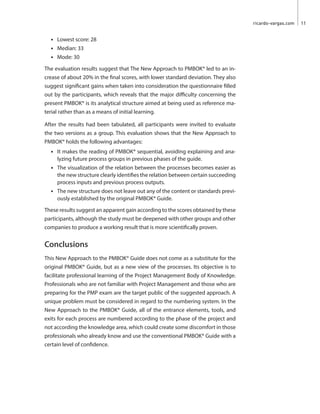
At the end of the program a new forty-question test on Project Management was
administered to the two groups. The results achieved were as follows:
Group A - Conventional PMBOK® Guide
•	 Average: 26.97
•	 Standard Deviation: 3.56 (13.2%)
•	 Highest score: 32
•	 Lowest score: 22
•	 Median: 26.5
•	 Mode: 26
Group B - New Approach to PMBOK® Guide
•	 Average: 32.63
•	 Standard Deviation: 2.51 (7,70%)
•	 Highest score: 37
ricardo-vargas.com  11
•	 Lowest score: 28
•	 Median: 33
•	 Mode: 30
The evaluation results suggest that The New Approach to PMBOK® led to an in-
crease of about 20% in the final scores, with lower standard deviation. They also
suggest significant gains when taken into consideration the questionnaire filled
out by the participants, which reveals that the major difficulty concerning the
present PMBOK® is its analytical structure aimed at being used as reference ma-
terial rather than as a means of initial learning.
After the results had been tabulated, all participants were invited to evaluate
the two versions as a group. This evaluation shows that the New Approach to
PMBOK® holds the following advantages:
•	 It makes the reading of PMBOK® sequential, avoiding explaining and ana-
lyzing future process groups in previous phases of the guide.
•	 The visualization of the relation between the processes becomes easier as
the new structure clearly identifies the relation between certain succeeding
process inputs and previous process outputs.
•	 The new structure does not leave out any of the content or standards previ-
ously established by the original PMBOK® Guide.
These results suggest an apparent gain according to the scores obtained by these
participants, although the study must be deepened with other groups and other
companies to produce a working result that is more scientifically proven.
Conclusions
This New Approach to the PMBOK® Guide does not come as a substitute for the
original PMBOK® Guide, but as a new view of the processes. Its objective is to
facilitate professional learning of the Project Management Body of Knowledge.
Professionals who are not familiar with Project Management and those who are
preparing for the PMP exam are the target public of the suggested approach. A
unique problem must be considered in regard to the numbering system. In the
New Approach to the PMBOK® Guide, all of the entrance elements, tools, and
exits for each process are numbered according to the phase of the project and
not according the knowledge area, which could create some discomfort in those
professionals who already know and use the conventional PMBOK® Guide with a
certain level of confidence.
A New Approach to PMBOK®
GUIDE 200012
References
A Guide to the Project Management Body of Knowledge. Upper Darby: Project Man-
agement Institute, 1996.
A Guide to the Project Management Body of Knowledge. Newton Square: Project
Management Institute, 2000.
BERG, Cyntia A. PMBOK® Guide 2000: Hot Line to Project Knowledge. Sylva: Project
Management Institute – Publishing Division, 2001.

A New Approach to PMBOK® Guide 2000

  • 1.
    A NEW APPROACHTO PMBOK® GUIDE 2000 Accepted for publication at PMI Global Congress North America Nashville – TE – USA – 2001
  • 2.
    A New Approachto PMBOK® GUIDE 20002 Abstract This work puts forward a new approach to PMBOK® Guide in which the thir- ty-nine processes are organized in five groups: initiation, planning, executing, controlling and closing process. This arrangement suggests a chronologically structured, more didactic view, which has been successfully tested in two PM classes in Brazil, instead of the former organization in nine Knowledge Areas.This approach is also useful to PMP exam preparation where two hundred questions are divided into process groups rather than knowledge areas. Related Podcasts ♫♫The New PMBOK® Guide 5th Edition http://rvarg.as/5q ♫♫The new PMBOK Guide – 4th Edition http://rvarg.as/bb Related Document 📰📰PMBOK® 5th Edition Processes Flow http://rvarg.as/p5ed
  • 3.
    ricardo-vargas.com  3 PMBOK® Guide2000 The PMBOK® Guide is nowadays the most important reference document about the Project Management Body of Knowledge. It was defined in 1987 as“all those topics, subject areas and intellectual processes which are involved in the appli- cation of sound management principles to ... projects”. The guide is distribut- ed by PMI, free of charge, with more than 640,000 copies placed in circulation worldwide (March 2001). As established in the guide, “the primary purpose of this document is to identify and describe that subset of the PMBOK® which is generally accepted. Generally accepted means that the knowledge and practices described are applicable to most projects of the time, and that there is wide- spread consensus about their value and usefulness” (PMBOK® Guide, 2000 Edi- tion). According to the purpose of the guide, it is essential to have a logical and coherent organization directly aimed at the process groups in order to facilitate the understanding of the chronology of Project Management processes (Exhibit 01). However, it does not mean that the knowledge areas should be considered of less importance, as they are crucial for the understanding of the multidisci- plinary mechanisms related to project management. Executing Planning Controlling Closing Initiating PMBOK Procurement Scope Integration Cost Communic. Human Resources Time Quality Risk Exhibit 1 – PMBOK® based on knowledge areas as opposed to PMBOK® based on processes groups.
  • 4.
    A New Approachto PMBOK® GUIDE 20004 Project Management Process Groups The PMBOK® Guide organizes the Project Management Processes in five groups: initiating processes, planning processes, executing processes, controlling pro- cesses and closing processes. All thirty-nine processes are divided into these five groups and intertwined by the results that they achieve (Exhibit 02).The fact that the five process groups are also interlinked creates a dynamic net of processes that are repeated and combined in each phase of the project , and consequently originates a process which is not discrete and overlaps itself in different phases and levels of the project. 1. Scope Planning 2. Scope Definition 3. Activity Definition 4. Resource Planning 5. Activity Sequencing 6. Activity Duration Estimating 7. Cost Estimating 8. Risk Management Planning 9. Schedule Development 10. Cost Budgeting 11. Quality Planning 12. Organizational Planning 13. Staff Acquisition 14. Communications Planning 15. Risk Identification 16. Qualitative Risk Analysis 17. Quantitative Risk Analysis 18. Risk Response Planning 19. Procurement Planning 20. Solicitation Planning 21. Project Plan Development PLANNING PROCESSES 1. Initiation INITIATING PROCESSES 1. Performance Reporting 2. Scope Verification 3. Scope Change Control 4. Schedule Control 5. Cost Control 6. Quality Control 7. Risk Monitoring and Control 8. Integrated Change Control CONTROLLING PROCESSES 1. Contract Closeout 2. Administrative Closure CLOSING PROCESSES 1. Project Plan Execution 2. Quality Assurance 3. Team Development 4. Information Distribution 5. Solicitation 6. Source Selection 7. Contract Administration EXECUTING PROCESSES PROJECT MANAGEMENT Exhibit 2 – Thirty-nine processes divided into five groups.
  • 5.
    ricardo-vargas.com  5 New Structureof PMBOK® Guide The PMBOK® Guide suggested here redefines and reorders the processes in new chapter groups.The first two chapters of part 1 (The Project Management Frame- work) are unchanged. A chapter 3 is now built from the introductions of the nine chapters of the second part, relating each of the knowledge areas and its prin- cipal processes, without detailing any process. The previous chapter 3, which describes the processes of administration, will now be chapter 4 and will be in the second part of the guide called “The Project Management Process Groups”. All thirty-nine processes will have now been distributed in agreement with the phases of the project in which they are used. The greatest change would be to place the introductory chapters of each knowl- edge area in a third chapter which gives an overall view of all the processes within each area.The former chapter 3 then becomes chapter 4, providing details about Project Management process groups. However, the specification of each process group (initiating, planning, executing, controlling and closing), which used to be denominated 3.3.X, becomes the introduction of chapters 5 to 9. The new table of contents is systematized below: Section I - The Project Management Framework Chapter 1 Introduction 1.1. Purpose of This Guide 1.2. What is a Project? 1.3. What is Project Management? 1.4. Relationship to Other Management Disciplines 1.5. Related Endeavors Chapter 2 Project Management Context 2.1. Project Phases and the Project Live Cycle 2.2. Project Stakeholders 2.3. Organizational Influences 2.4. Key General Management Skills 2.5. Social-Economic-Environmental Influences Chapter 3 Project Management Knowledge Areas 3.1. Project Integration Management
  • 6.
    A New Approachto PMBOK® GUIDE 20006 3.2. Project Scope Management 3.3. Project Time Management 3.4. Project Cost Management 3.5. Project Quality Management 3.6. Project Human Resource Management 3.7. Project Communications Management 3.8. Project Risk Management 3.9. Project Procurement Management Section II - The Project Management Process Groups Chapter 4 Project Management Process 4.1. Project Processes 4.2. Process Groups 4.3. Process Interactions (introduction only) 4.4. Customizing Process Interactions 4.5. Mapping of Project Management Process Chapter 5 Initiating Process 5.1. Initiation Chapter 6 Planning Process 6.1. Scope Planning 6.2. Scope Definition 6.3. Activity Definition 6.4. Resource Planning 6.5. Activity Sequencing 6.6. Activity Duration Estimating 6.7. Cost Estimating 6.8. Risk Management Planning 6.9. Schedule Development 6.10. Cost Budgeting
  • 7.
    ricardo-vargas.com  7 6.11.Quality Planning 6.12. Organizational Planning 6.13. Staff Acquisition 6.14. Communications Planning 6.15. Risk Identification 6.16. Qualitative Risk Analysis 6.17. Quantitative Risk Analysis 6.18. Risk Response Planning 6.19. Procurement Planning 6.20. Solicitation Planning 6.21. Project Plan Development Chapter 7 Executing Process 7.1. Project Plan Execution 7.2. Quality Assurance 7.3. Team Development 7.4. Information Distribution 7.5. Solicitation 7.6. Source Selection 7.7. Contract Administration Chapter 8 Controlling Process 8.1. Performance Reporting 8.2. Scope Verification 8.3. Scope Change Control 8.4. Schedule Control 8.5. Cost Control 8.6. Quality Control 8.7. Risk Monitoring and Control 8.8. Integrated Change Control
  • 8.
    A New Approachto PMBOK® GUIDE 20008 Chapter 9 Closing Process 9.1. Contract Closeout 9.2. Administrative Closure Section III - Appendices Section IV – Glossary and Index With this table of contents a new PMBOK® can easily be built beginning with the reordering of the conventional processes without losing any part of the original, that is, without the omission of any of the original content. Process Interactions All 39 processes are linked by their inputs and outputs. In the New Approach to PMBOK® Guide the system for numbering the processes serves to focus on the process groups and not the knowledge areas.This makes the focus of each of the processes continuous for a period of time while it is not necessarily linked to one of the nine knowledge areas. The numeration of the inputs, tools and techniques and outputs of the conven- tional PMBOK® is given according to a sequence of numerals in which the first number of the sequence represents the knowledge area, the second number, the sequence of the process within the knowledge area, the third, the type of data (inputs, tools and techniques or outputs) and the fourth is the sequential of data within the type (Exhibit 03). TEMPLATE A . B . C . D A - Knowledge Area 4 - Integration 5 - Scope 6 - Time 7 - Cost 8 - Quality 9 - Human Resources 10 - Communications 11 - Risks 12 - Procurement B - Process Number inside each Knowledge Area 1 (first) to 6 (only in Risks and Procurement areas) C - Data Type 1 - Input 2 - Tools and Technique 3 - Output D - Data Number inside each Data Type 1 to 10 EXAMPLE 4.1.2.1 Project planning methodology A - Knowledge Area 4 - Integration B - Process Number inside each Knowledge Area 1 - First Integration Process C - Data Type 2 - Tools and Technique D - Data Number inside each Data Type 1 - First Tool and Technique Exhibit 3 – Nomenclature of the conventional PMBOK® and example of the first Tools and Techniques of the Integration Process“Project Plan Development”denominated“Project planning methodology”.
  • 9.
    ricardo-vargas.com  9 In theNew Approach to PMBOK® Guide, the numeration of the inputs, tools and techniques and outputs is given by a sequence of numerals similar to that of the conventional PMBOK®, although the first number of the sequence represents the process group, the second number, the sequence of the process within the pro- cess group, the third, the type of data (inputs, tools and techniques or outputs) and the fourth is the sequential of the data within the type(Exhibit 04 and 05). TEMPLATE X . Y . C . D - Process data X - Process Group 5 - Initiating Process 6 - Planning Process 7 - Executing Process 8 - Controlling Process 9 - Closing Process Y - Process Number inside each Process Group 1 (first) to 21 (Planning Process) C - Data Type 1 - Input 2 - Tools and Technique 3 - Output D - Data Number inside each Data Type 1 to 10 EXAMPLE 6.21.2.1 - Project planning methodology X - Process Group 6 - Planning Process Y - Process Number inside each Knowledge Area 21 - Twenty-First Planning Process (last) C - Data Type 2 - Tools and Technique D - Data Number inside each Data Type 1 - First Tool and Technique Exhibit 4 – Nomenclature of the New Approach to PMBOK® Guide and example of the first Tools and Techniques of the Integration Process“Project Plan Development”denominated “Project planning methodology”. Inputs 4.1.1.1 Other planning outputs 4.1.1.2 Historical information 4.1.1.3 Organizational policies 4.1.1.4 Constraints 4.1.1.5 Assumptions Tools and Techniques 4.1.2.1 Project planning methodology 4.1.2.2 Stakeholder skills and knowledge 4.1.2.3 Project management information system (PMIS) Outputs 4.1.3.1 Project plan 4.1.3.2 Supporting detail Inputs 6.21.1.1 Other planning outputs 6.21.1.2 Historical information 6.21.1.3 Organizational policies 6.21.1.4 Constraints 6.21.1.5 Assumptions Tools and Techniques 6.21.2.1 Project planning methodology 6.21.2.2 Stakeholder skills and knowledge 6.21.2.3 Project management information system (PMIS) Outputs 6.21.3.1 Project plan 6.21.3.2 Supporting detail NewApproachto PMBOK® Guide Conventional PMBOK®Guide Exhibit 5 – Example of the new numbering system for inputs, tools and techniques and outputs for the Integration Process“Project Plan Development”and a comparison with the conventional PMBOK® numbering system.
  • 10.
    A New Approachto PMBOK® GUIDE 200010 Results Achieved in Pilot Training Courses Using the New Structure With a view to evaluating the New Approach to PMBOK® Guide, an experiment with two thirty-student classes of Project Management was held in a multina- tional IT company in Brazil, according to the specifications below: • 100% of the evaluated participants belonged to the same company • 80% of the participants in each group were engineers (24 in each group) • 20% of the participants in each group had a degree in Administration (06 in each group) • 100% of the participants were unaware of the existence of PMBOK® Guide and considered their knowledge of Project Management to be low or null. The instructor was the same for both classes and the time and weekdays of the training were the same for both with a lag of 1 week between the classes. The instructor prepared a very similar teaching methodology for each of the two groups, including the same exercises and tests. In order to select the participants for each group, an equal division based on their professional backgrounds was part of the chosen procedure. A forty question test covering Project Management in general was also applied for the purpose of having groups as homogeneous as possible and therefore avoiding flaws in the evaluation. Each group attended a 32-hour training program covering the PMBOK® processes with no absence. The first group’s course followed the ap- proach and order of the conventional PMBOK® in which the subjects are divided into knowledge areas, whereas the second group was exposed to the New Ap- proach to PMBOK®, having the subjects divided into processes. At the end of the program a new forty-question test on Project Management was administered to the two groups. The results achieved were as follows: Group A - Conventional PMBOK® Guide • Average: 26.97 • Standard Deviation: 3.56 (13.2%) • Highest score: 32 • Lowest score: 22 • Median: 26.5 • Mode: 26 Group B - New Approach to PMBOK® Guide • Average: 32.63 • Standard Deviation: 2.51 (7,70%) • Highest score: 37
  • 11.
    ricardo-vargas.com  11 • Lowestscore: 28 • Median: 33 • Mode: 30 The evaluation results suggest that The New Approach to PMBOK® led to an in- crease of about 20% in the final scores, with lower standard deviation. They also suggest significant gains when taken into consideration the questionnaire filled out by the participants, which reveals that the major difficulty concerning the present PMBOK® is its analytical structure aimed at being used as reference ma- terial rather than as a means of initial learning. After the results had been tabulated, all participants were invited to evaluate the two versions as a group. This evaluation shows that the New Approach to PMBOK® holds the following advantages: • It makes the reading of PMBOK® sequential, avoiding explaining and ana- lyzing future process groups in previous phases of the guide. • The visualization of the relation between the processes becomes easier as the new structure clearly identifies the relation between certain succeeding process inputs and previous process outputs. • The new structure does not leave out any of the content or standards previ- ously established by the original PMBOK® Guide. These results suggest an apparent gain according to the scores obtained by these participants, although the study must be deepened with other groups and other companies to produce a working result that is more scientifically proven. Conclusions This New Approach to the PMBOK® Guide does not come as a substitute for the original PMBOK® Guide, but as a new view of the processes. Its objective is to facilitate professional learning of the Project Management Body of Knowledge. Professionals who are not familiar with Project Management and those who are preparing for the PMP exam are the target public of the suggested approach. A unique problem must be considered in regard to the numbering system. In the New Approach to the PMBOK® Guide, all of the entrance elements, tools, and exits for each process are numbered according to the phase of the project and not according the knowledge area, which could create some discomfort in those professionals who already know and use the conventional PMBOK® Guide with a certain level of confidence.
  • 12.
    A New Approachto PMBOK® GUIDE 200012 References A Guide to the Project Management Body of Knowledge. Upper Darby: Project Man- agement Institute, 1996. A Guide to the Project Management Body of Knowledge. Newton Square: Project Management Institute, 2000. BERG, Cyntia A. PMBOK® Guide 2000: Hot Line to Project Knowledge. Sylva: Project Management Institute – Publishing Division, 2001.