





A NASREDDIN STORY
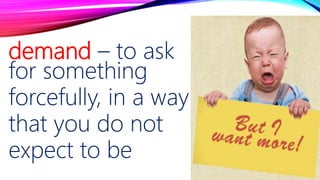
demand – to ask
for something
forcefully, in a way
that you do not
expect to be
Example:
She demanded that he return the books he
borrowed from her.
He has always demanded the highest
standards of behavior from his children.
refused – to say that
you will not do or
accept something
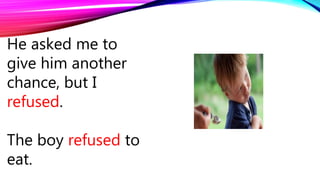
He asked me to
give him another
chance, but I
refused.
The boy refused to
eat.
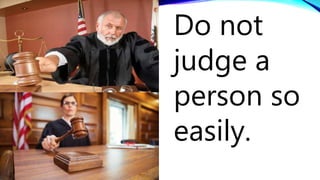
judge – a person who has the
knowledge to give an opinion
about something or is able to
decide if someone or something
is good or bad.
Do not
judge a
person so
easily.
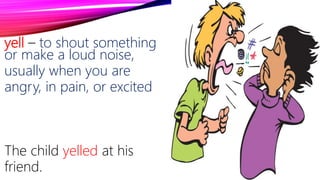
yell – to shout something
or make a loud noise,
usually when you are
angry, in pain, or excited
The child yelled at his
friend.
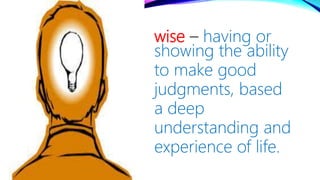
wise – having or
showing the ability
to make good
judgments, based
a deep
understanding and
experience of life.
I think you made a wise choice.
I think it would be wiser to wait and
see how much money you have left
before you make any decisions.
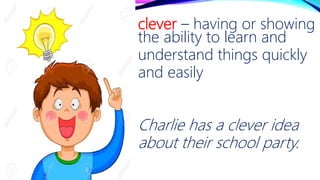
clever – having or showing
the ability to learn and
understand things quickly
and easily
Charlie has a clever idea
about their school party.
jingle – a repeated
gentle ringing sound
I can hear the jingle of
the bells.
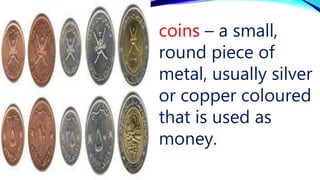
coins – a small,
round piece of
metal, usually silver
or copper coloured
that is used as
money.
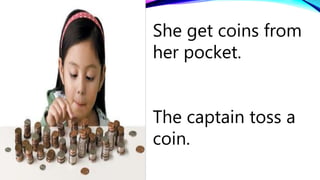
She get coins from
her pocket.
The captain toss a
coin.
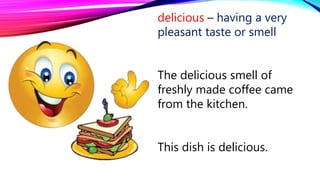
delicious – having a very
pleasant taste or smell
The delicious smell of
freshly made coffee came
from the kitchen.
This dish is delicious.
expensive – costing a
lot of money
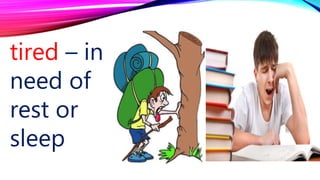
tired – in
need of
rest or
sleep
Use of English:
Has / have
(video / worksheet)
The word has is used
with one noun in the
naming part of a
sentence.
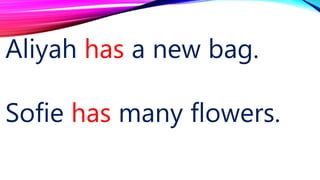
Aliyah has a new bag.
Sofie has many flowers.
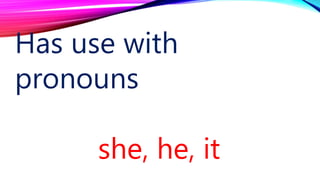
Has use with
pronouns
she, he, it
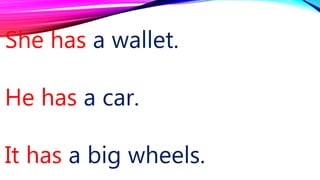
She has a wallet.
He has a car.
It has a big wheels.
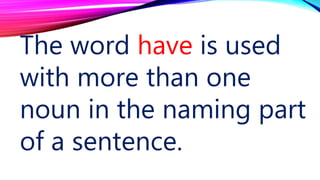
The word have is used
with more than one
noun in the naming part
of a sentence.
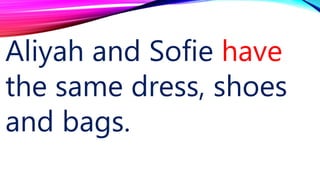
Aliyah and Sofie have
the same dress, shoes
and bags.
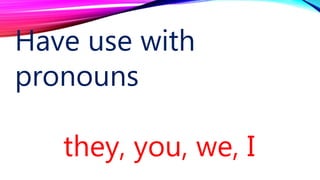
Have use with
pronouns
they, you, we, I
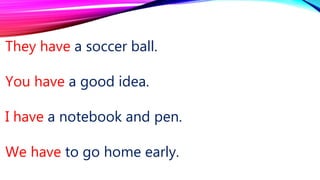
They have a soccer ball.
You have a good idea.
I have a notebook and pen.
We have to go home early.
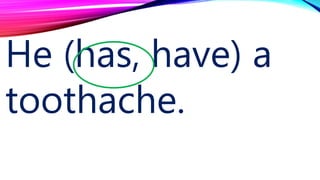
He (has, have) a
toothache.
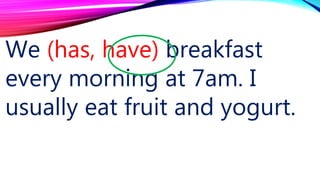
We (has, have) breakfast
every morning at 7am. I
usually eat fruit and yogurt.
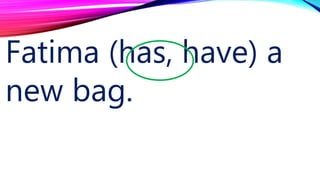
Fatima (has, have) a
new bag.
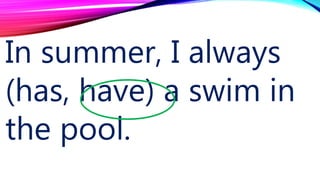
In summer, I always
(has, have) a swim in
the pool.
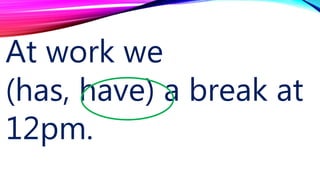
At work we
(has, have) a break at
12pm.
Activity: Write it on the
board.
H.W: worksheet
Day 2
Use of English:
Irregular verbs
Day 3
Reading:
A Nasreddin Story
Day 4
Listening:
Our Amazing Body
Day 5
Vocabulary / Spelling test
A Nasreddin Story 1

A Nasreddin Story 1