A MULTIMODAL LEARNING ANALYTICS VIEW OF HTML5 APIs: 
TECHNICAL BENEFITS AND PRIVACY RISKS 
Pablo Garaizar & Mariluz Guenaga 
DeustoTech Learning 
University of Deusto 
TEEM'2014, Salamanca, Spain
Mobile devices allow 
learners to...
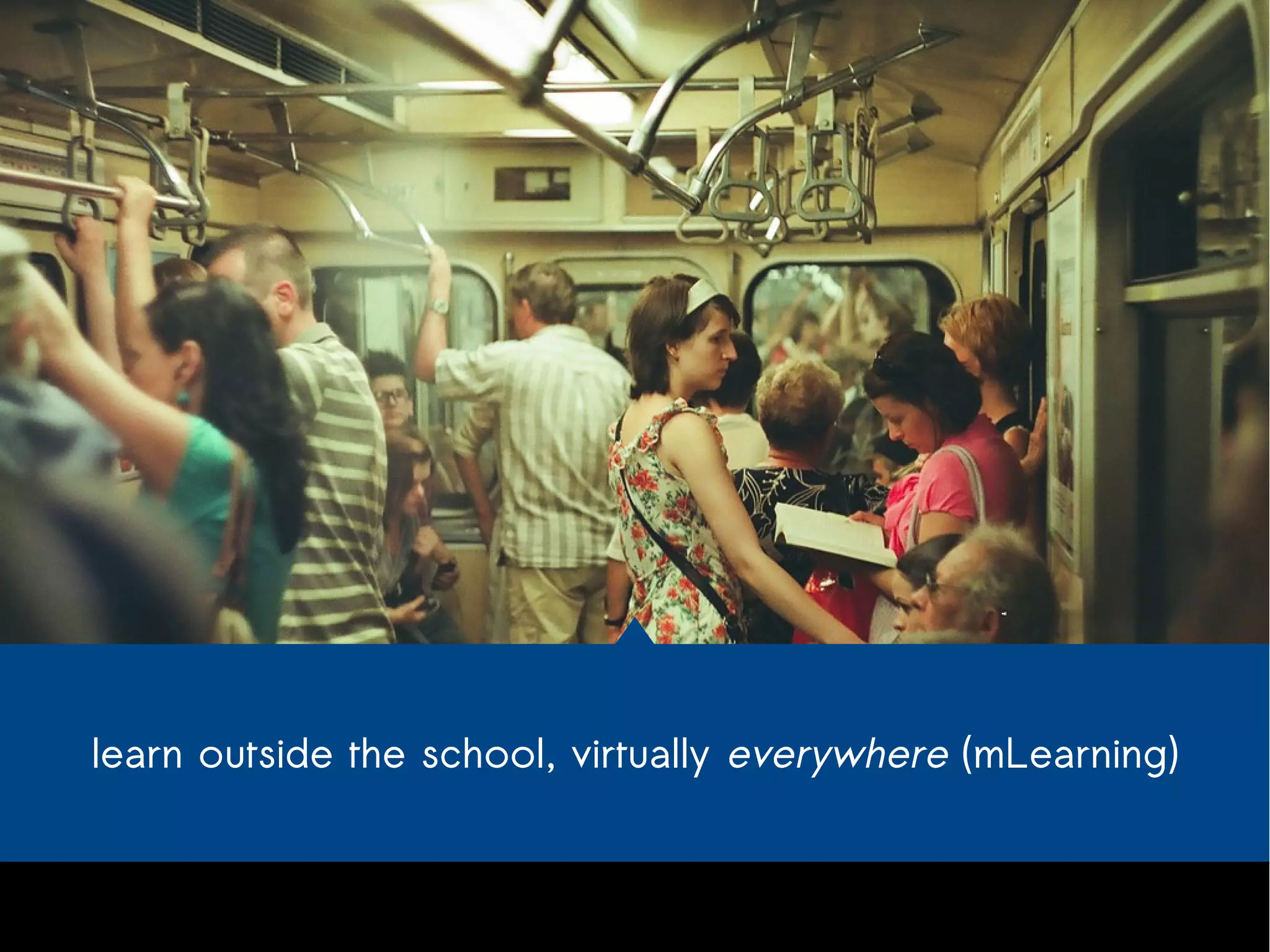
learn outside the school, virtually everywhere (mLearning)
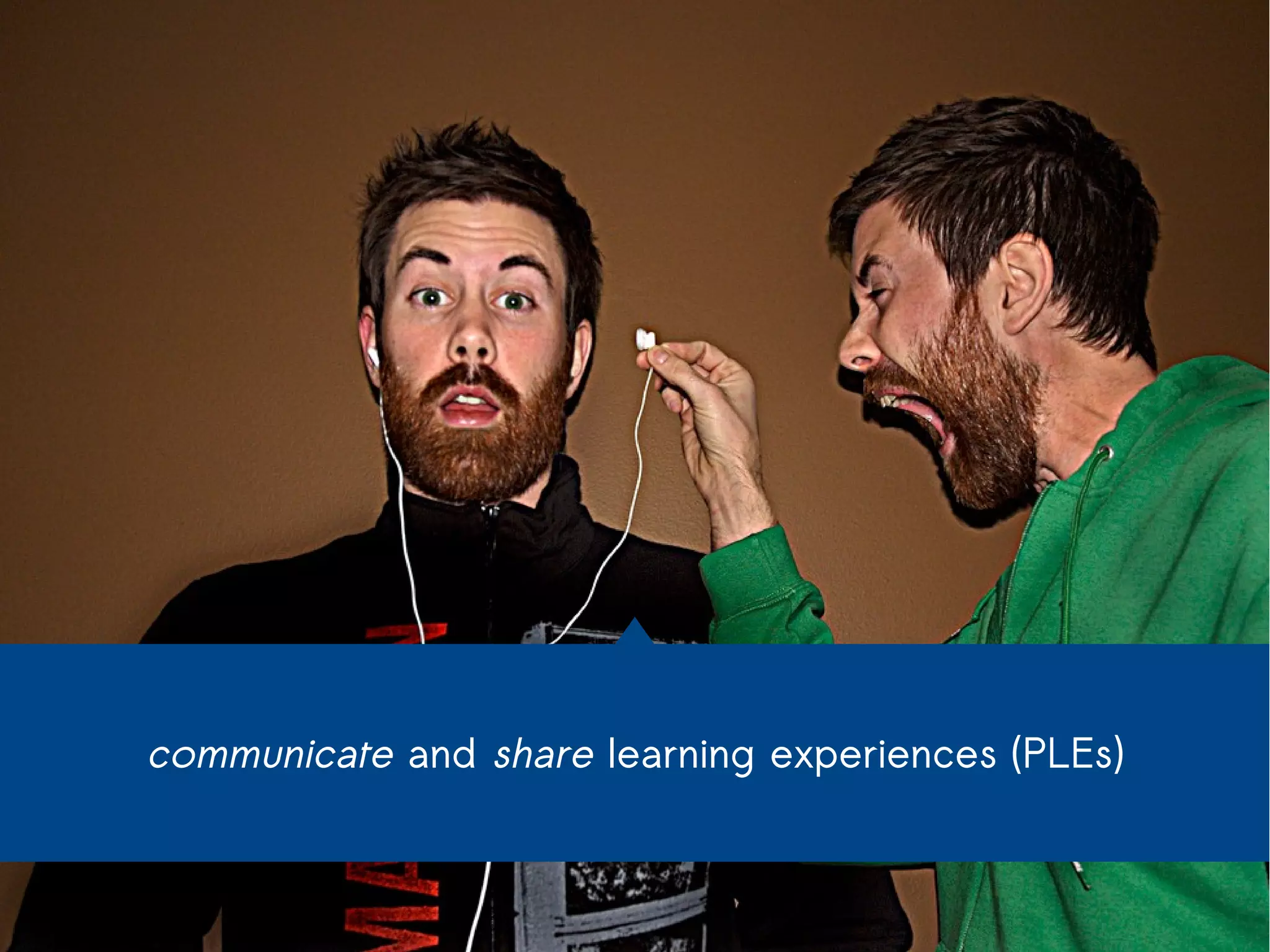
communicate and share learning experiences (PLEs)
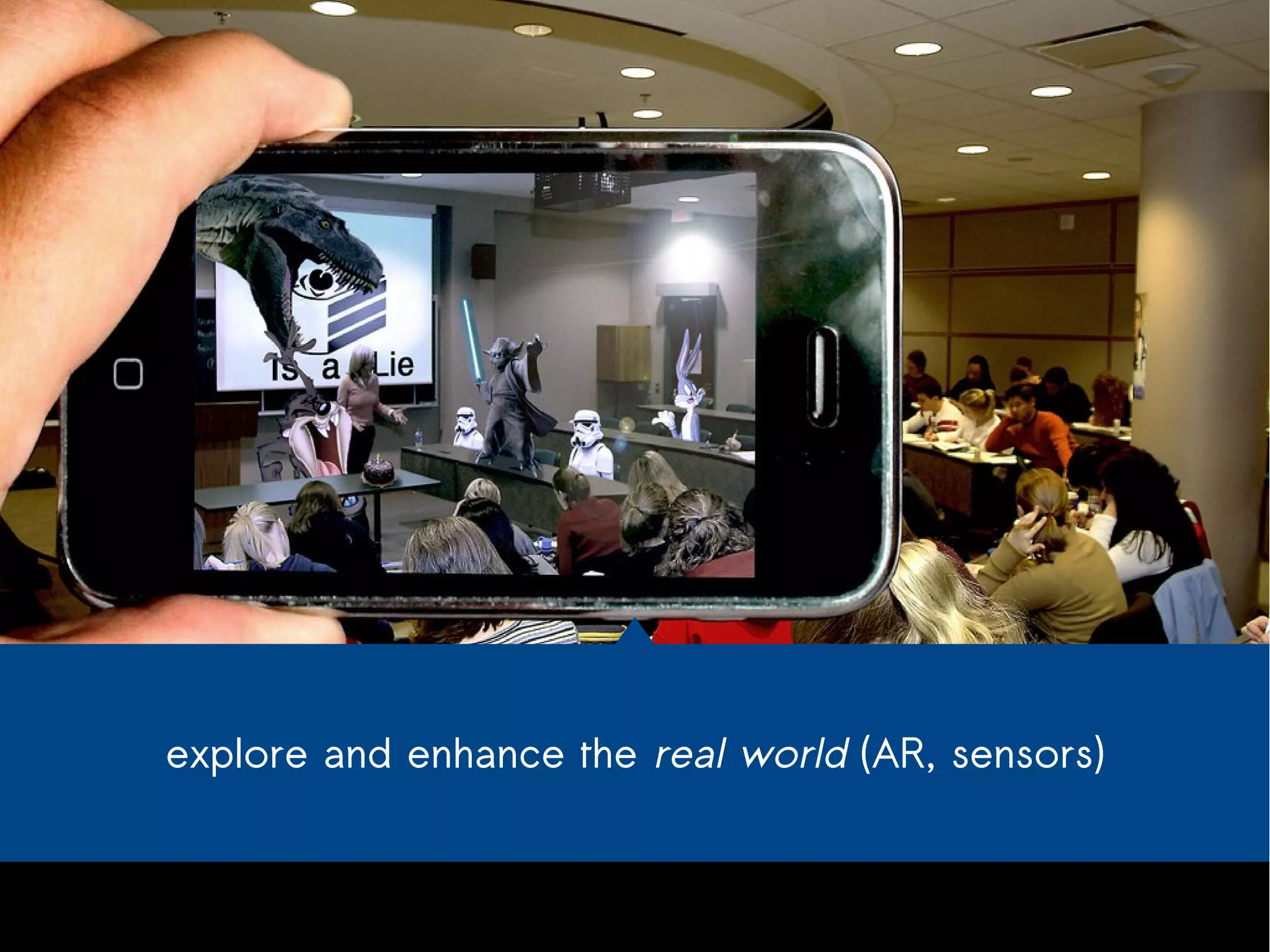
explore and enhance the real world (AR, sensors)
provide insights about their learning processes effortlessly (LA)
mLearning + 
Learning Analytics = 
researchers dream!
Geolocation & Orientation 
Is the learner at school/home? Is she commuting? Where does the learning process take place? 
Is the context suitable for learning?
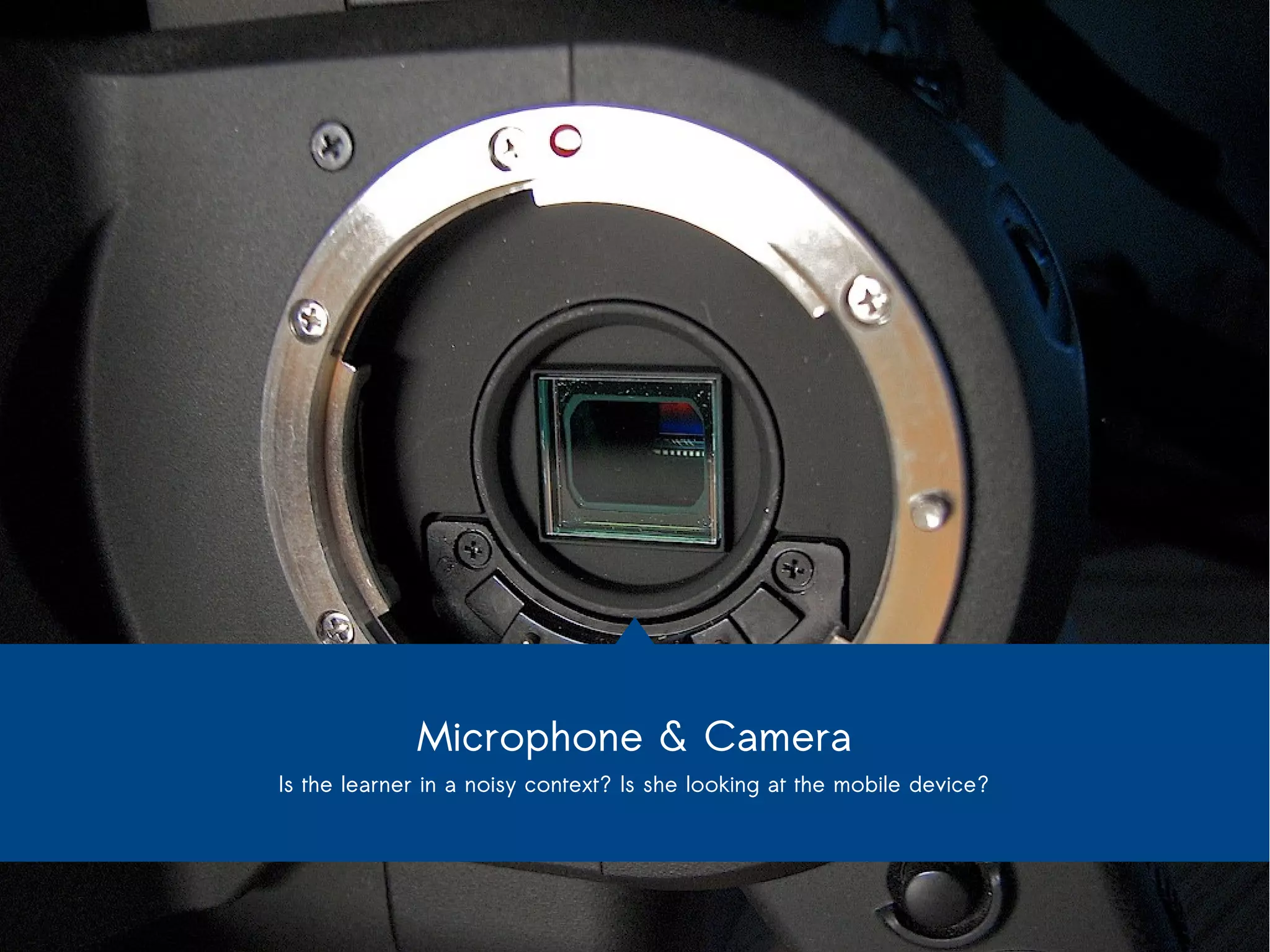
Microphone & Camera 
Is the learner in a noisy context? Is she looking at the mobile device?
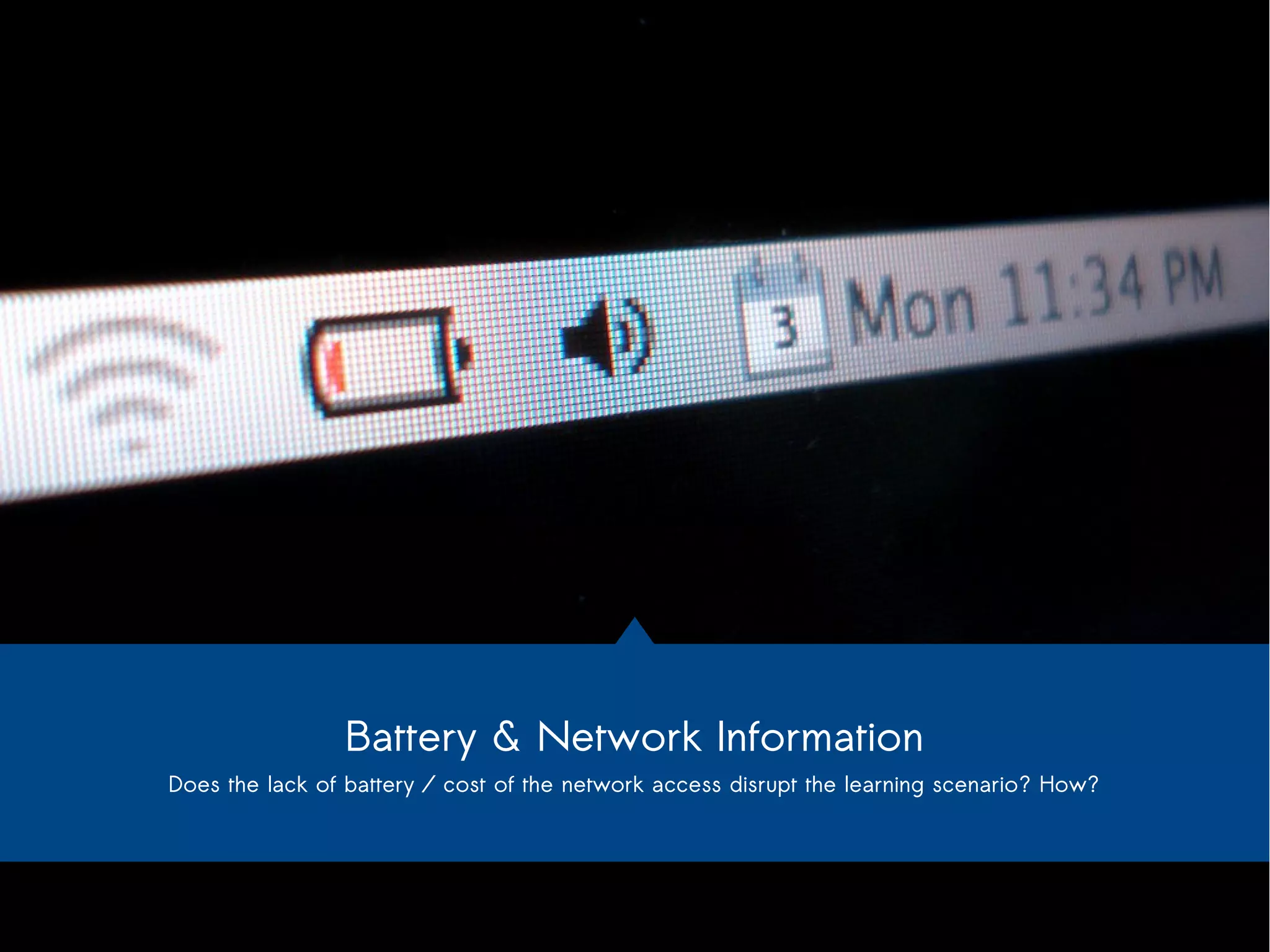
Battery & Network Information 
Does the lack of battery / cost of the network access disrupt the learning scenario? How?
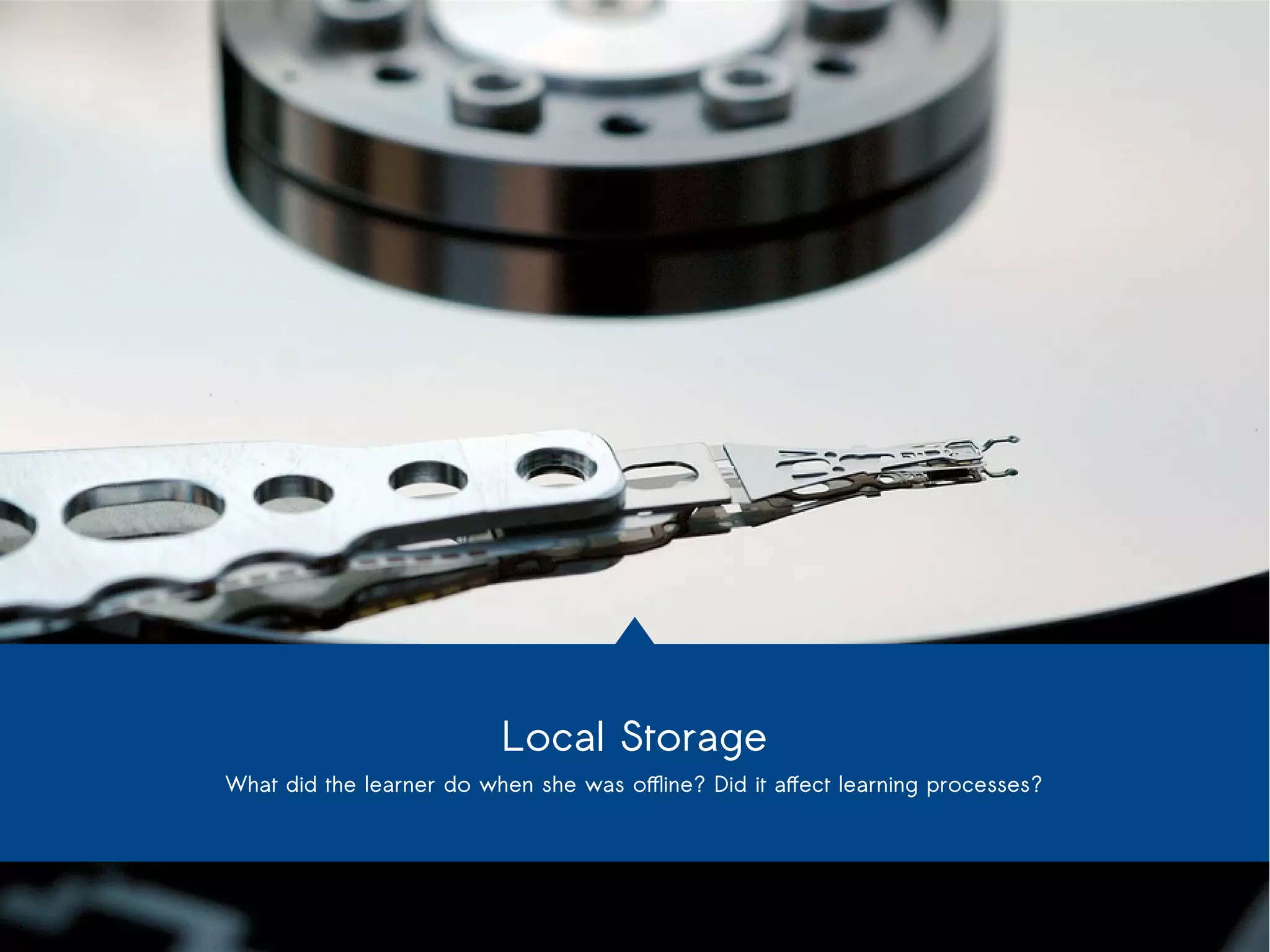
Local Storage 
What did the learner do when she was offline? Did it affect learning processes?
Drafts: ambient light, temperature, humidity, 
atmospheric pressure, etc. 
Insights about the context of learning processes
mLearning + 
Learning Analytics = 
users nightmare!
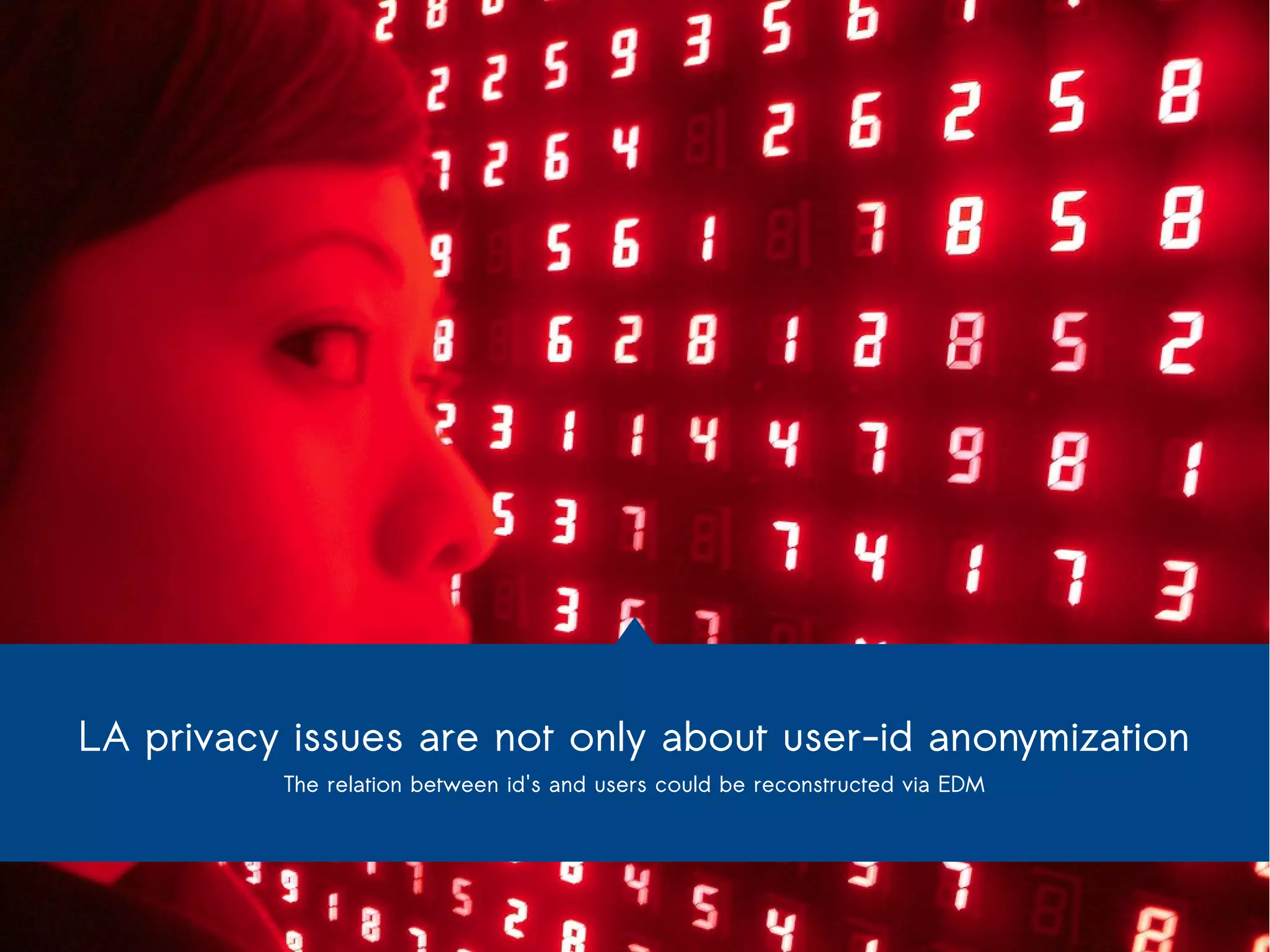
LA privacy issues are not only about user-id anonymization 
The relation between id's and users could be reconstructed via EDM
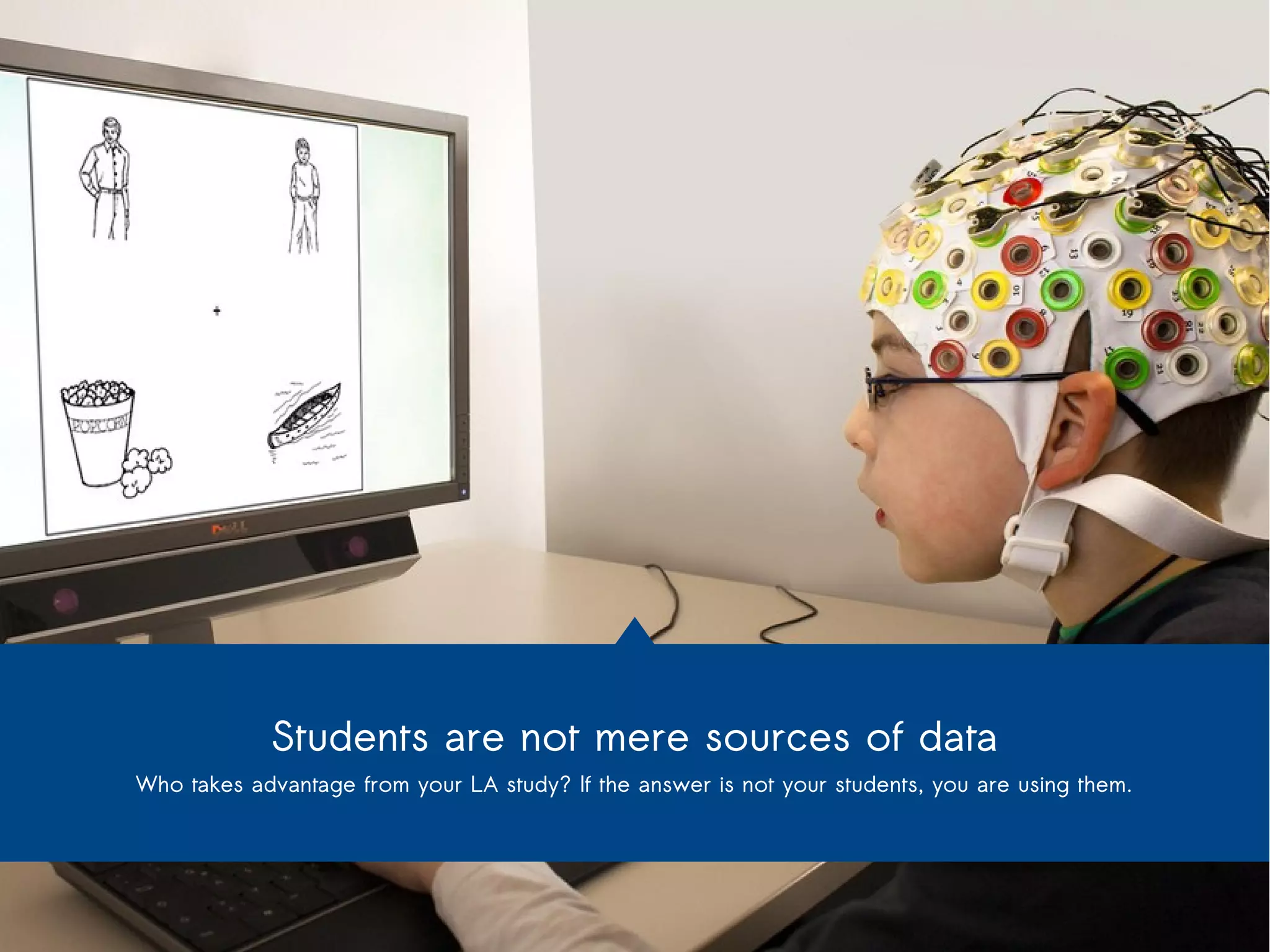
Students are not mere sources of data 
Who takes advantage from your LA study? If the answer is not your students, you are using them.
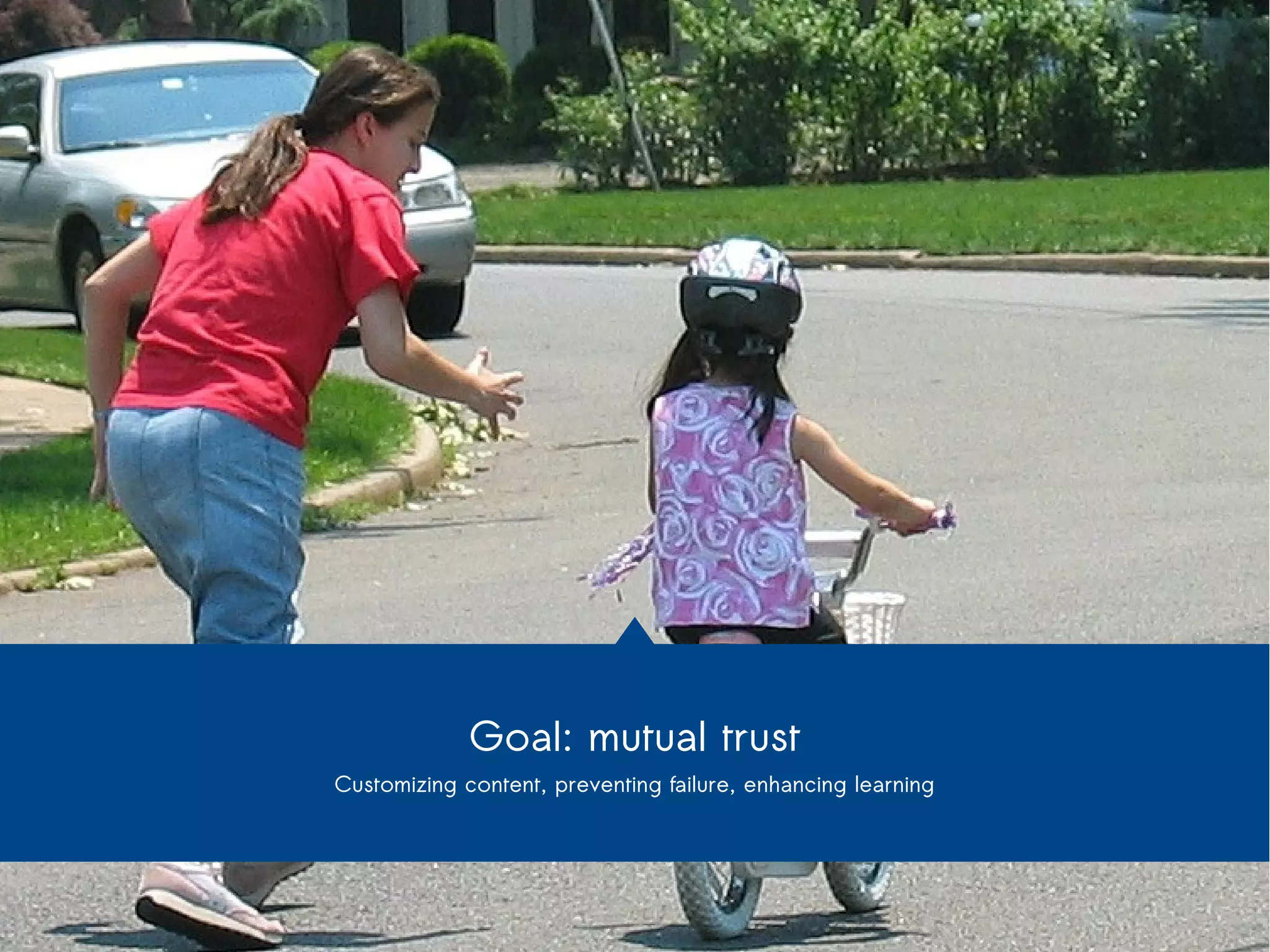
Goal: mutual trust 
Customizing content, preventing failure, enhancing learning
mLearning + 
Learning Analytics = 
a difficult balance
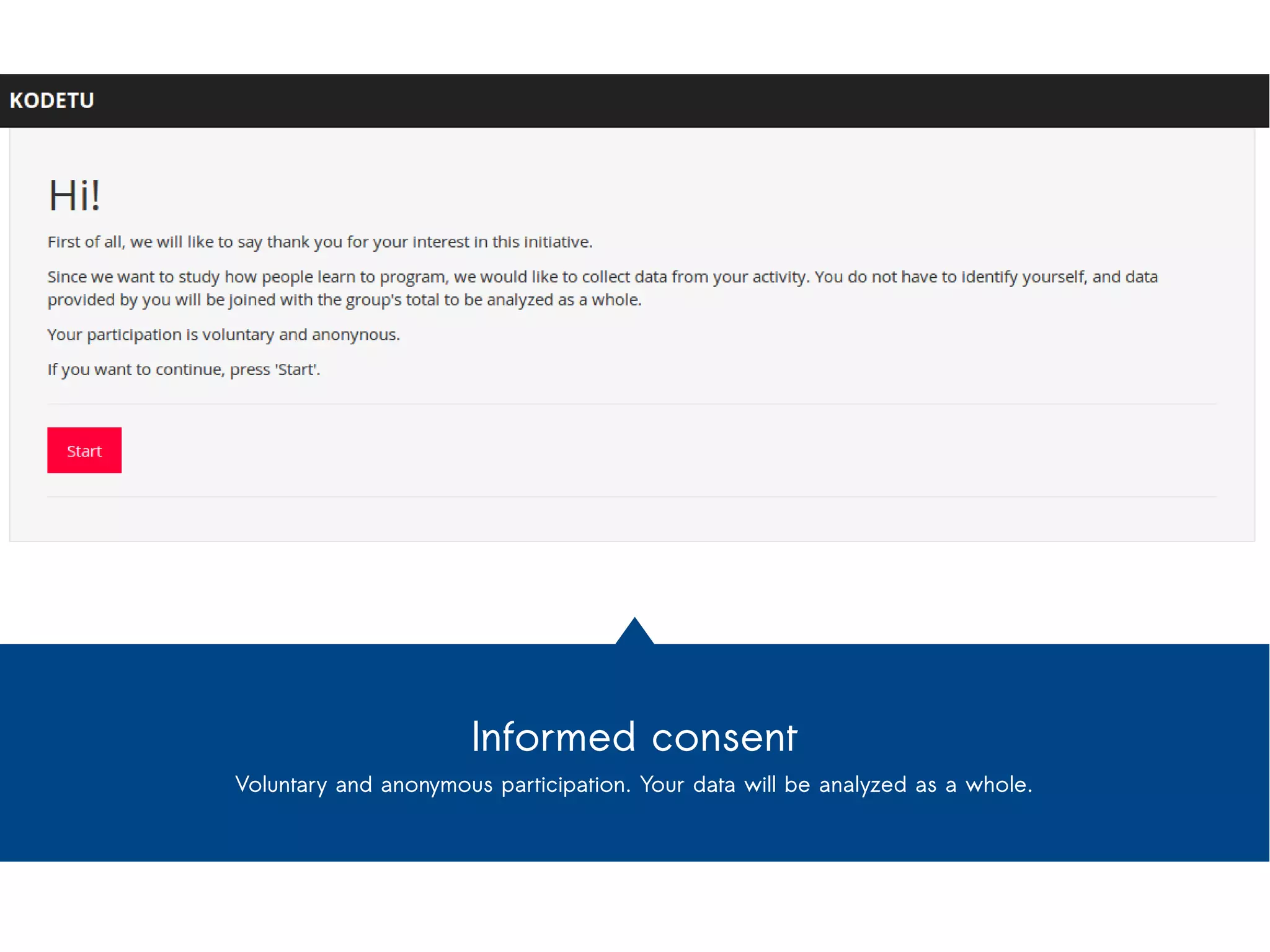
Informed consent 
Voluntary and anonymous participation. Your data will be analyzed as a whole.
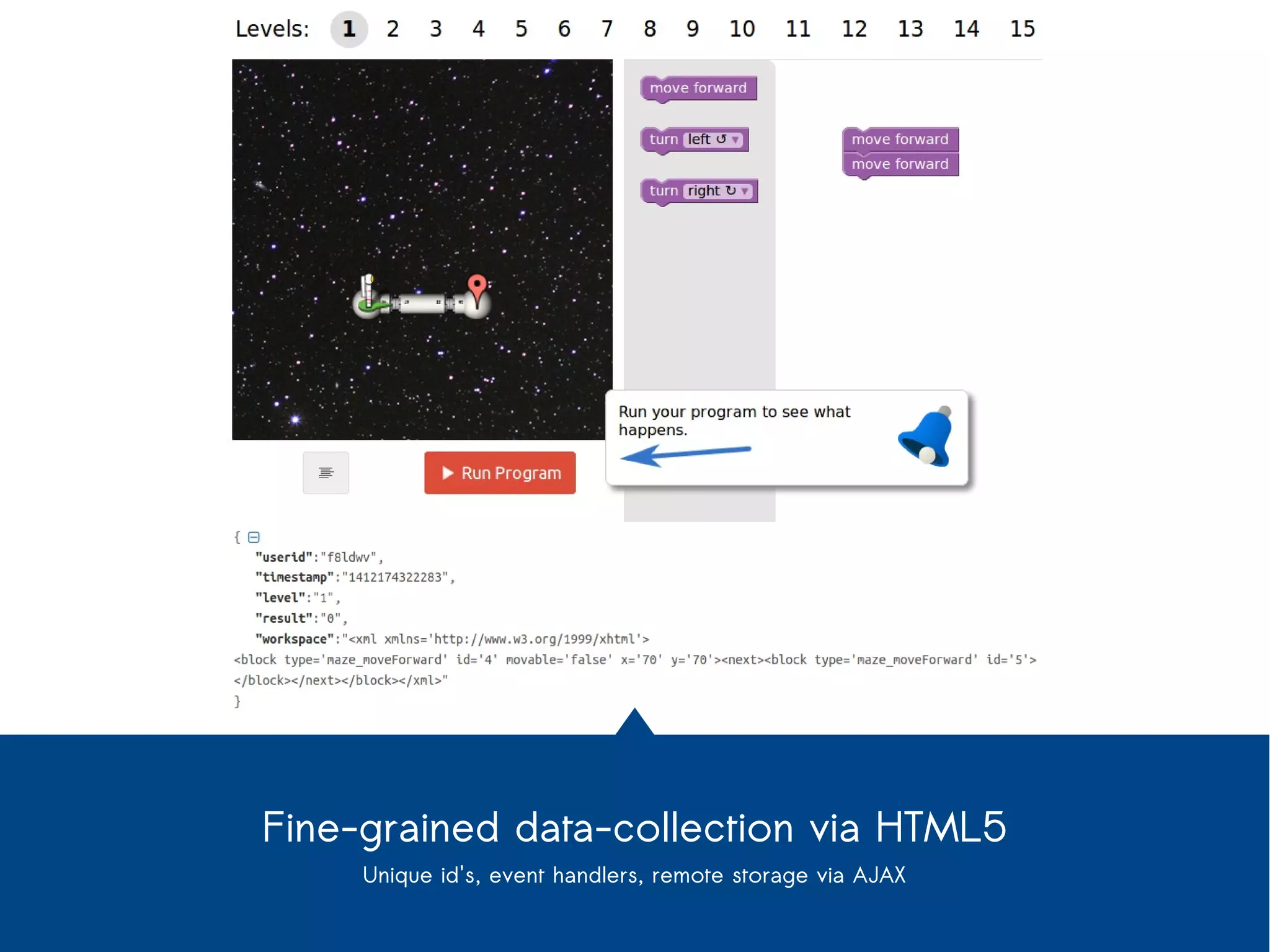
Fine-grained data-collection via HTML5 
Unique id's, event handlers, remote storage via AJAX
Thank you
References 
● P. Blikstein, 2013, April. “Multimodal learning analytics”. In Proceedings of the Third International Conference on Learning Analytics and Knowledge (pp. 
102-106). ACM. 
● M. Sharples, J. Taylor, and G. Vavoula. 2005. “Towards a theory of mobile learning”. Proceedings of mLearn 2005 1 (1), 1-9 
● J. Swenson. 2014. “Establishing an ethical literacy for learning analytics”. In Proceedings of the Fourth International Conference on Learning Analytics And 
Knowledge (LAK '14). ACM, New York, NY, USA, 246-250. DOI=10.1145/2567574.2567613 http://doi.acm.org/10.1145/2567574.2567613 
● K. Shilton. 2009. “Four billion little brothers?: privacy, mobile phones, and ubiquitous data collection”. Commun. ACM 52, 11 (November 2009), 48-53. 
DOI=10.1145/1592761.1592778 http://doi.acm.org/10.1145/1592761.1592778 
● Y. Even-Levy. 2011. “HTML5 — Opportunities for Mobile Devices”. Retrieved 07-07, 2014, from 
http://www.learningsolutionsmag.com/articles/681/html5--opportunities-for-mobile-devices 
● R. Aljohani Naif and H.C. Davis. 2012. “Learning analytics in mobile and ubiquitous learning environments”. In, 11th World Conference on Mobile and 
Contextual Learning: mLearn 2012, Helsinki, Finland, 16 - 18 Oct 2012. 
● A. Popescu. 2013. “Geolocation API Specification”. W3C Recommendation 24 October 2013. Retrieved 07-07, 2014, from 
http://www.w3.org/TR/geolocation-API/ 
● S. Block, and A. Popescu. 2011. “DeviceOrientation Event Specification”. W3C Working Draft 1 December 2011. Retrieved 07-07, 2014, from 
http://www.w3.org/TR/orientation-event/ 
● A. Kostiainen and M. Lamouri. 2012. “Battery Status API”. W3C Candidate Recommendation 08 May 2012. See http://www.w3.org/TR/battery-status/ 
● M. Lamouri. 2014. “The Network Information API”. W3C Working Group Note 10 April 2014. Retrieved 07-07, 2014, from 
http://www.w3.org/TR/netinfo-api/ 
● P. Byers, F. Hirsch and D. Hazaël-Massieux. 2009. “Permissions for Device API Access”. W3C Editor's Draft 30 September 2010. Retrieved from 
http://dev.w3.org/2009/dap/api-perms/
References 
● I. Hickson. 2013. “Web Storage”. W3C Recommendation 30 July 2013. Retrieved from: http://www.w3.org/TR/webstorage/ 
● A. Ranganathan and J. Sicking. 2013. “File API”. W3C Last Call Working Draft 12 September 2013. Retrieved from: http://www.w3.org/TR/FileAPI/ 
● N. Mehta, J. Sicking, E. Graff, A. Popescu, J. Orlow and J. Bell. 2013. “Indexed Database API”. W3C Candidate Recommendation 04 July 2013. Retrieved from: 
http://www.w3.org/TR/IndexedDB/ 
● Device APIs Working Group. Retrieved from: http://www.w3.org/2009/dap/ 
● D. Turner and A. Kostiainen. 2014. “Ambient Light Events”. W3C Last Call Working Draft 19 June 2014. Retrieved from: http://www.w3.org/TR/ambient-light/ 
● M. Cáceres and N.V. Balaji. 2014. “Ambient Temperature Events”. Unofficial Draft 07 July 2014. Retrieved from: 
https://dvcs.w3.org/hg/dap/raw-file/tip/temperature/Overview.html 
● M. Cáceres and N. V. Balaji. 2014. “Ambient Humidity Events”. Unofficial Draft 07 July 2014. Retrieved from: 
https://dvcs.w3.org/hg/dap/raw-file/default/humidity/Overview.html 
● D Tran. 2014. “Atmospheric Pressure Events”. Unofficial Draft 07 July 2014. Retrieved from: https://dvcs.w3.org/hg/dap/raw-file/default/pressure/Overview.html 
● A. Kostiainen and D. Tran. 2014. “Proximity Events”. W3C Editor's Draft 28 April 2014. Retrieved from: https://dvcs.w3.org/hg/dap/raw-file/default/proximity/Overview.html 
● S. Pietersand G. Adams. 2013. “CSSOM View Module”. W3C Working Draft 17 December 2013. Retrieved from: http://www.w3.org/TR/cssom-view/ 
● D. Schepers, S. Moon, M. Brubeck, A. Barstow. 2013. “Touch Events”. W3C Recommendation 10 October 2013. Retrieved from: http://www.w3.org/TR/touch-events/ 
● A. Kostiainen. 2014. “Vibration API”. W3C Last Call Working Draft 19 June 2014. Retrieved from: http://www.w3.org/TR/vibration/ 
● D. C. Burnett, A. Bergkvist, C. Jennings and A. Narayanan. 2014. “Media Capture and Streams”. W3C Editor's Draft 04 July 2014. Retrieved from: 
http://dev.w3.org/2011/webrtc/editor/getusermedia.html 
● A. Bergkvist , D. C. Burnett, C. Jennings and A. Narayanan. 2013. “WebRTC 1.0: Real-time Communication Between Browsers”. W3C Working Draft 10 September 2013. 
Retrieved from: http://www.w3.org/TR/webrtc/
References 
● S. Pfeiffer, P. Jägenstedt and I. Hickson. 2014. “WebVTT: The Web Video Text Tracks Format”. Draft Community Group Report 18 June 2014. Retrieved from: 
http://dev.w3.org/html5/webvtt/ 
● D. Jackson, D. Hyatt, and C. Marrin. 2009. “CSS Animations Module Level 3”, W3C Working Draft 20 March 2009. Retrieved from 
http://www.w3.org/TR/2009/WD-css3-animations-20090320 
● P. Schmitz and A. Cohen. 2001. “SMIL Animation”, W3C Recommendation 04-September-2001. Retrieved from 
http://www.w3.org/TR/2001/REC-smil-animation-20010904/ 
● J. Robinson and C. McCormack. 2012. “Timing control for script-based animations”, W3C Working Draft 21 February 2012. Retrieved from 
http://www.w3.org/TR/2012/WD-animation-timing-20120221/ 
● E. Dahlström, P. Dengler, A. Grasso, C. Lilley, C. McCormack, D. Schepers, and J. Watt. 2011. “Scalable Vector Graphics (SVG) 1.1 (Second Edition)”, W3C 
Recommendation 16 August 2011. Retrieved from http://www.w3.org/TR/2011/REC-SVG11-20110816/ 
● I. Hickson. 2012. “HTML Canvas 2D Context”, W3C Working Draft 20 March 2012. Retrieved from http://www.w3.org/TR/2012/WD-2dcontext-20120320/ 
● C. Marrin. 2011.”WebGL Specification, Version 1.0”, 10 February 2011. Retrieved from https://www.khronos.org/registry/webgl/specs/1.0/ 
● I. Hickson, 2012.“WHATWG HTML Living Standard, Last Updated 13 March 2012, 9 Web Workers”. Retrieved from 
http://www.whatwg.org/specs/web-apps/current-work/multipage/workers.html 
● I. Hickson. 2012. “HTML5 Web Messaging”. W3C Candidate Recommendation 01 May 2012. Retrieved from: http://www.w3.org/TR/webmessaging/ 
● P. Viola , and M. Jones. 2001. “Rapid object detection using a boosted cascade of simple features”. In Computer Vision and Pattern Recognition, 2001. CVPR 2001. 
Proceedings of the 2001 IEEE Computer Society Conference on (Vol. 1, pp. I-511). IEEE. 
● G. Shires and H. Wennborg. 2012. “Web Speech API Specification”. 19 October 2012. Retrieved from: 
https://dvcs.w3.org/hg/speech-api/raw-file/tip/speechapi.html 
● I. Hickson. 2012. “The WebSocket API”. W3C Candidate Recommendation 20 September 2012. Retrieved from: http://www.w3.org/TR/websockets/ 
● A. van Kesteren. 2012. “XMLHttpRequest Level 2”. W3C Working Draft 17 January 2012. Retrieved from: http://www.w3.org/TR/XMLHttpRequest2/
References 
● J. Mann. 2012. “High Resolution Time”. W3C Recommendation 17 December 2012. Retrieved from: http://www.w3.org/TR/hr-time/ 
● J. Mann, Z. Wang and A. Quach. 2012. “User Timing”. Editor's Draft July 11, 2012. Retrieved from: 
https://w3c.github.io/web-performance/specs/UserTiming/Overview.html 
● A. Jain, J. Mann, Z. Wang and A. Quach. 2014. “Resource Timing”. Editor's Draft June 09, 2014. Retrieved from: 
https://w3c.github.io/web-performance/specs/ResourceTiming/Overview.html 
● Z. Wang and A. Jain. 2013. “Navigation Timing”. Editor's Draft January 25th, 2013. Retrieved from: 
https://w3c.github.io/web-performance/specs/NavigationTiming/Overview.html 
● A. van Kesteren, A. Gregor, Msger, A. Russell and R. Berjon. 2014. ” W3C DOM4”. W3C Candidate Recommendation 08 May 2014. Retrieved from: 
http://www.w3.org/TR/dom/ 
● HTML5: Drag and drop: http://www.w3.org/TR/2010/WD-html5-20101019/dnd.html 
● HTML5: Focus management: http://www.w3.org/TR/html5/editing.html#focus 
● J. Mann and A. Jain. 2013.“Page Visibility (Second Edition)”. W3C Recommendation 29 October 2013. Retrieved from: http://www.w3.org/TR/page-visibility/ 
● A. van Kesteren and T. Çelik. 2012. “Fullscreen API”. W3C Working Draft 03 July 2012. Retrieved from: http://www.w3.org/TR/fullscreen/ 
● V. Scheib. 2013. “Pointer Lock API”. W3C Candidate Recommendation 17 December 2013. Retrieved from: http://www.w3.org/TR/pointerlock/ 
● HTML5: Session history and navigation: http://www.w3.org/TR/2011/WD-html5-20110113/history.html 
● Eynon R, Fry J and Schroeder, R. 2008. “The Ethics of Internet Research”. In: G. Blank, R. Lee and N. Fielding (eds) Handbook of Online Research Methods. 
Sage: London. 
● R. Ferguson and S. Buckingham Shum. 2012. “Social learning analytics: five approaches”. In: 2nd International Conference on Learning Analytics & Knowledge 
(LAK '12), 29 Apr - 02 May 2012, Vancouver, British Columbia, Canada, pp. 23–33.
References 
● S. Slade and P. Prinsloo. 2013. “Learning Analytics: Ethical Issues and Dilemmas”. American Behavioral Scientist 
0002764213479366, first published on March 4, 2013 doi:10.1177/0002764213479366 
● A. Pardo and G. Siemens. 2014. “Ethical and privacy principles for learning analytics”. British Journal of Educational 
Technology 45, 438-450. 
● A. K. Ghosh and T. M. Swaminatha. 2001. “Software security and privacy risks in mobile e-commerce”. Commun. ACM 44, 2 
(Feb. 2001), 51-57. DOI=10.1145/359205.359227 http://doi.acm.org/10.1145/359205.359227. 
● P. Klasnja, S. Consolvo and T. Choudhury. 2009. “Exploring privacy concerns about personal sensing”. In H. Tokuda, M.Beigl, 
A. Friday, A.J.Bernheim Brush & Y.Tobe (Eds). International conference pervasive (pp. 176-183). Berlin: Springer Verlag. 
● EUP. 1995. Directive 95/46/EC of the European Parliament and of the Council of 24 October 1995 on the protection of 
individuals with regard to the processing of personal data and on the free movement of such data. European Union: 
European Parliament. 
● EUP. 2002. Directive 2002/58/EC of the European Parliament and of the Council of 12 July 2002 concerning the processing 
of personal data and the protection of privacy in the electronic communications sector. European Union: European Parliament. 
● EUP. 2014. The working party on the protection of individuals with regards to the processing of personal data. Opinion 
05/2014 on Anonymisation Techniques. 
● D. Kay, N. Korn, and C. Oppenheim. 2012. “Legal, Risk and Ethical Aspects of Analytics in Higher Education”. Center for 
Educational Technology & Interoperability Standards, vol. 1, no. 6.

A Multimodal Learning Analytics view of HTML5 APIs: technical benefits and privacy risks

  • 1.
    A MULTIMODAL LEARNINGANALYTICS VIEW OF HTML5 APIs: TECHNICAL BENEFITS AND PRIVACY RISKS Pablo Garaizar & Mariluz Guenaga DeustoTech Learning University of Deusto TEEM'2014, Salamanca, Spain
  • 2.
    Mobile devices allow learners to...
  • 3.
    learn outside theschool, virtually everywhere (mLearning)
  • 4.
    communicate and sharelearning experiences (PLEs)
  • 5.
    explore and enhancethe real world (AR, sensors)
  • 6.
    provide insights abouttheir learning processes effortlessly (LA)
  • 7.
    mLearning + LearningAnalytics = researchers dream!
  • 9.
    Geolocation & Orientation Is the learner at school/home? Is she commuting? Where does the learning process take place? Is the context suitable for learning?
  • 10.
    Microphone & Camera Is the learner in a noisy context? Is she looking at the mobile device?
  • 11.
    Battery & NetworkInformation Does the lack of battery / cost of the network access disrupt the learning scenario? How?
  • 12.
    Local Storage Whatdid the learner do when she was offline? Did it affect learning processes?
  • 13.
    Drafts: ambient light,temperature, humidity, atmospheric pressure, etc. Insights about the context of learning processes
  • 14.
    mLearning + LearningAnalytics = users nightmare!
  • 15.
    LA privacy issuesare not only about user-id anonymization The relation between id's and users could be reconstructed via EDM
  • 16.
    Students are notmere sources of data Who takes advantage from your LA study? If the answer is not your students, you are using them.
  • 17.
    Goal: mutual trust Customizing content, preventing failure, enhancing learning
  • 18.
    mLearning + LearningAnalytics = a difficult balance
  • 19.
    Informed consent Voluntaryand anonymous participation. Your data will be analyzed as a whole.
  • 20.
    Fine-grained data-collection viaHTML5 Unique id's, event handlers, remote storage via AJAX
  • 21.
  • 22.
    References ● P.Blikstein, 2013, April. “Multimodal learning analytics”. In Proceedings of the Third International Conference on Learning Analytics and Knowledge (pp. 102-106). ACM. ● M. Sharples, J. Taylor, and G. Vavoula. 2005. “Towards a theory of mobile learning”. Proceedings of mLearn 2005 1 (1), 1-9 ● J. Swenson. 2014. “Establishing an ethical literacy for learning analytics”. In Proceedings of the Fourth International Conference on Learning Analytics And Knowledge (LAK '14). ACM, New York, NY, USA, 246-250. DOI=10.1145/2567574.2567613 http://doi.acm.org/10.1145/2567574.2567613 ● K. Shilton. 2009. “Four billion little brothers?: privacy, mobile phones, and ubiquitous data collection”. Commun. ACM 52, 11 (November 2009), 48-53. DOI=10.1145/1592761.1592778 http://doi.acm.org/10.1145/1592761.1592778 ● Y. Even-Levy. 2011. “HTML5 — Opportunities for Mobile Devices”. Retrieved 07-07, 2014, from http://www.learningsolutionsmag.com/articles/681/html5--opportunities-for-mobile-devices ● R. Aljohani Naif and H.C. Davis. 2012. “Learning analytics in mobile and ubiquitous learning environments”. In, 11th World Conference on Mobile and Contextual Learning: mLearn 2012, Helsinki, Finland, 16 - 18 Oct 2012. ● A. Popescu. 2013. “Geolocation API Specification”. W3C Recommendation 24 October 2013. Retrieved 07-07, 2014, from http://www.w3.org/TR/geolocation-API/ ● S. Block, and A. Popescu. 2011. “DeviceOrientation Event Specification”. W3C Working Draft 1 December 2011. Retrieved 07-07, 2014, from http://www.w3.org/TR/orientation-event/ ● A. Kostiainen and M. Lamouri. 2012. “Battery Status API”. W3C Candidate Recommendation 08 May 2012. See http://www.w3.org/TR/battery-status/ ● M. Lamouri. 2014. “The Network Information API”. W3C Working Group Note 10 April 2014. Retrieved 07-07, 2014, from http://www.w3.org/TR/netinfo-api/ ● P. Byers, F. Hirsch and D. Hazaël-Massieux. 2009. “Permissions for Device API Access”. W3C Editor's Draft 30 September 2010. Retrieved from http://dev.w3.org/2009/dap/api-perms/
  • 23.
    References ● I.Hickson. 2013. “Web Storage”. W3C Recommendation 30 July 2013. Retrieved from: http://www.w3.org/TR/webstorage/ ● A. Ranganathan and J. Sicking. 2013. “File API”. W3C Last Call Working Draft 12 September 2013. Retrieved from: http://www.w3.org/TR/FileAPI/ ● N. Mehta, J. Sicking, E. Graff, A. Popescu, J. Orlow and J. Bell. 2013. “Indexed Database API”. W3C Candidate Recommendation 04 July 2013. Retrieved from: http://www.w3.org/TR/IndexedDB/ ● Device APIs Working Group. Retrieved from: http://www.w3.org/2009/dap/ ● D. Turner and A. Kostiainen. 2014. “Ambient Light Events”. W3C Last Call Working Draft 19 June 2014. Retrieved from: http://www.w3.org/TR/ambient-light/ ● M. Cáceres and N.V. Balaji. 2014. “Ambient Temperature Events”. Unofficial Draft 07 July 2014. Retrieved from: https://dvcs.w3.org/hg/dap/raw-file/tip/temperature/Overview.html ● M. Cáceres and N. V. Balaji. 2014. “Ambient Humidity Events”. Unofficial Draft 07 July 2014. Retrieved from: https://dvcs.w3.org/hg/dap/raw-file/default/humidity/Overview.html ● D Tran. 2014. “Atmospheric Pressure Events”. Unofficial Draft 07 July 2014. Retrieved from: https://dvcs.w3.org/hg/dap/raw-file/default/pressure/Overview.html ● A. Kostiainen and D. Tran. 2014. “Proximity Events”. W3C Editor's Draft 28 April 2014. Retrieved from: https://dvcs.w3.org/hg/dap/raw-file/default/proximity/Overview.html ● S. Pietersand G. Adams. 2013. “CSSOM View Module”. W3C Working Draft 17 December 2013. Retrieved from: http://www.w3.org/TR/cssom-view/ ● D. Schepers, S. Moon, M. Brubeck, A. Barstow. 2013. “Touch Events”. W3C Recommendation 10 October 2013. Retrieved from: http://www.w3.org/TR/touch-events/ ● A. Kostiainen. 2014. “Vibration API”. W3C Last Call Working Draft 19 June 2014. Retrieved from: http://www.w3.org/TR/vibration/ ● D. C. Burnett, A. Bergkvist, C. Jennings and A. Narayanan. 2014. “Media Capture and Streams”. W3C Editor's Draft 04 July 2014. Retrieved from: http://dev.w3.org/2011/webrtc/editor/getusermedia.html ● A. Bergkvist , D. C. Burnett, C. Jennings and A. Narayanan. 2013. “WebRTC 1.0: Real-time Communication Between Browsers”. W3C Working Draft 10 September 2013. Retrieved from: http://www.w3.org/TR/webrtc/
  • 24.
    References ● S.Pfeiffer, P. Jägenstedt and I. Hickson. 2014. “WebVTT: The Web Video Text Tracks Format”. Draft Community Group Report 18 June 2014. Retrieved from: http://dev.w3.org/html5/webvtt/ ● D. Jackson, D. Hyatt, and C. Marrin. 2009. “CSS Animations Module Level 3”, W3C Working Draft 20 March 2009. Retrieved from http://www.w3.org/TR/2009/WD-css3-animations-20090320 ● P. Schmitz and A. Cohen. 2001. “SMIL Animation”, W3C Recommendation 04-September-2001. Retrieved from http://www.w3.org/TR/2001/REC-smil-animation-20010904/ ● J. Robinson and C. McCormack. 2012. “Timing control for script-based animations”, W3C Working Draft 21 February 2012. Retrieved from http://www.w3.org/TR/2012/WD-animation-timing-20120221/ ● E. Dahlström, P. Dengler, A. Grasso, C. Lilley, C. McCormack, D. Schepers, and J. Watt. 2011. “Scalable Vector Graphics (SVG) 1.1 (Second Edition)”, W3C Recommendation 16 August 2011. Retrieved from http://www.w3.org/TR/2011/REC-SVG11-20110816/ ● I. Hickson. 2012. “HTML Canvas 2D Context”, W3C Working Draft 20 March 2012. Retrieved from http://www.w3.org/TR/2012/WD-2dcontext-20120320/ ● C. Marrin. 2011.”WebGL Specification, Version 1.0”, 10 February 2011. Retrieved from https://www.khronos.org/registry/webgl/specs/1.0/ ● I. Hickson, 2012.“WHATWG HTML Living Standard, Last Updated 13 March 2012, 9 Web Workers”. Retrieved from http://www.whatwg.org/specs/web-apps/current-work/multipage/workers.html ● I. Hickson. 2012. “HTML5 Web Messaging”. W3C Candidate Recommendation 01 May 2012. Retrieved from: http://www.w3.org/TR/webmessaging/ ● P. Viola , and M. Jones. 2001. “Rapid object detection using a boosted cascade of simple features”. In Computer Vision and Pattern Recognition, 2001. CVPR 2001. Proceedings of the 2001 IEEE Computer Society Conference on (Vol. 1, pp. I-511). IEEE. ● G. Shires and H. Wennborg. 2012. “Web Speech API Specification”. 19 October 2012. Retrieved from: https://dvcs.w3.org/hg/speech-api/raw-file/tip/speechapi.html ● I. Hickson. 2012. “The WebSocket API”. W3C Candidate Recommendation 20 September 2012. Retrieved from: http://www.w3.org/TR/websockets/ ● A. van Kesteren. 2012. “XMLHttpRequest Level 2”. W3C Working Draft 17 January 2012. Retrieved from: http://www.w3.org/TR/XMLHttpRequest2/
  • 25.
    References ● J.Mann. 2012. “High Resolution Time”. W3C Recommendation 17 December 2012. Retrieved from: http://www.w3.org/TR/hr-time/ ● J. Mann, Z. Wang and A. Quach. 2012. “User Timing”. Editor's Draft July 11, 2012. Retrieved from: https://w3c.github.io/web-performance/specs/UserTiming/Overview.html ● A. Jain, J. Mann, Z. Wang and A. Quach. 2014. “Resource Timing”. Editor's Draft June 09, 2014. Retrieved from: https://w3c.github.io/web-performance/specs/ResourceTiming/Overview.html ● Z. Wang and A. Jain. 2013. “Navigation Timing”. Editor's Draft January 25th, 2013. Retrieved from: https://w3c.github.io/web-performance/specs/NavigationTiming/Overview.html ● A. van Kesteren, A. Gregor, Msger, A. Russell and R. Berjon. 2014. ” W3C DOM4”. W3C Candidate Recommendation 08 May 2014. Retrieved from: http://www.w3.org/TR/dom/ ● HTML5: Drag and drop: http://www.w3.org/TR/2010/WD-html5-20101019/dnd.html ● HTML5: Focus management: http://www.w3.org/TR/html5/editing.html#focus ● J. Mann and A. Jain. 2013.“Page Visibility (Second Edition)”. W3C Recommendation 29 October 2013. Retrieved from: http://www.w3.org/TR/page-visibility/ ● A. van Kesteren and T. Çelik. 2012. “Fullscreen API”. W3C Working Draft 03 July 2012. Retrieved from: http://www.w3.org/TR/fullscreen/ ● V. Scheib. 2013. “Pointer Lock API”. W3C Candidate Recommendation 17 December 2013. Retrieved from: http://www.w3.org/TR/pointerlock/ ● HTML5: Session history and navigation: http://www.w3.org/TR/2011/WD-html5-20110113/history.html ● Eynon R, Fry J and Schroeder, R. 2008. “The Ethics of Internet Research”. In: G. Blank, R. Lee and N. Fielding (eds) Handbook of Online Research Methods. Sage: London. ● R. Ferguson and S. Buckingham Shum. 2012. “Social learning analytics: five approaches”. In: 2nd International Conference on Learning Analytics & Knowledge (LAK '12), 29 Apr - 02 May 2012, Vancouver, British Columbia, Canada, pp. 23–33.
  • 26.
    References ● S.Slade and P. Prinsloo. 2013. “Learning Analytics: Ethical Issues and Dilemmas”. American Behavioral Scientist 0002764213479366, first published on March 4, 2013 doi:10.1177/0002764213479366 ● A. Pardo and G. Siemens. 2014. “Ethical and privacy principles for learning analytics”. British Journal of Educational Technology 45, 438-450. ● A. K. Ghosh and T. M. Swaminatha. 2001. “Software security and privacy risks in mobile e-commerce”. Commun. ACM 44, 2 (Feb. 2001), 51-57. DOI=10.1145/359205.359227 http://doi.acm.org/10.1145/359205.359227. ● P. Klasnja, S. Consolvo and T. Choudhury. 2009. “Exploring privacy concerns about personal sensing”. In H. Tokuda, M.Beigl, A. Friday, A.J.Bernheim Brush & Y.Tobe (Eds). International conference pervasive (pp. 176-183). Berlin: Springer Verlag. ● EUP. 1995. Directive 95/46/EC of the European Parliament and of the Council of 24 October 1995 on the protection of individuals with regard to the processing of personal data and on the free movement of such data. European Union: European Parliament. ● EUP. 2002. Directive 2002/58/EC of the European Parliament and of the Council of 12 July 2002 concerning the processing of personal data and the protection of privacy in the electronic communications sector. European Union: European Parliament. ● EUP. 2014. The working party on the protection of individuals with regards to the processing of personal data. Opinion 05/2014 on Anonymisation Techniques. ● D. Kay, N. Korn, and C. Oppenheim. 2012. “Legal, Risk and Ethical Aspects of Analytics in Higher Education”. Center for Educational Technology & Interoperability Standards, vol. 1, no. 6.