A Method of Teaching Multimodal Creative
Writing
Zuzana Husárová
Abstract: The paper introduces a method for teaching and relec-
tion of the creative writing with the use of new media and digital
technologies. The method should lead to a more atractive edu-
cational process for a broad range of students. Thanks to its use
of playful and participatory potential of new media, it aims to ef-
fectively encourage students in various ields. It simultaneously
inclines to the newest ways of incorporating students into the edu-
cational process – it reacts to students´ digital, multimedial world
and teaches them how to creatively participate on it. The use of the
possibilities of collaboration on the Internet blog conirms the need
for creativity, multisensory stimulation and inclusion of skills into
the educational process.
1 Introduction
Having in mind humanistic tendencies, connected with school edu-
cation, it is important to change a student from the object of teach-
ing, a pure “reproductive mechanism” into an independent subject,
a partner in learning process, i.e. into a living being who thinks,
acts, creates, feels, evaluates, expects, who learns by experiencing
and interiorizing. Reading of literature provides the students with
background material - ideas, myths, legends, cultural memory of
mankind, etc., and creative writing provides the students with the
possibility of self-expression1
.
At irst it has to be mentioned that the position of creative writing in
any media is in the Slovak educational system neither stable nor strong,
although there are some initiatives trying to strengthen its status. Viera
Eliašová has been publishing on the use of creative writing in many
1
Eliašová 2001, p. 476.
Z. Husárová
areas2
and has (co-)edited several publications on this issue3
. Worth
mentioning is also the activity of Daniela Bačová, who proposed the
integration of drama in English language teaching4
. Creative writing is
in the secondary education included into the classes of Slovak language
and the format of creative writing is traditionally reserved almost ex-
clusively for some basic insights into the journalistic style and essays on
various topics (ranging from descriptions of nature; through address-
ing historical or economic issues; to contemplations on the questions
like: “if I were a chair”). There is no class dealing solely with creative
writing, which is diferent in comparison with some other types of art
that are taught at primary and secondary schools, like ine art edu-
cation and musical education. The situation at the university level is
slightly diferent, creative writing is sometimes taught at the foreign
language and literature programmes or Slovak language and literature
programmes. There are also some classes concerning creative writing
at the departments of Journalism (e.g. Philosophy of Creative Writing)
and obviously, within the department of Screenwriting. In Slovakia,
there does not exist a tradition of (creative) writing departments, as is
the case in the Anglophone world. Paul Dawson5
mentions the situa-
tion at universities with creative writing curriculum: „And if students
could not be given talent (for that, too, obviously must already exist as
a genetic quotient), they could be taught the process and craft of writ-
ing in order to develop their talent.“ However, despite the fact that in
Slovakia, the “transmission of craftsmanship” is besides some teachers´
solitary activities and private workshops reduced to the “hands” of au-
thors, the creative texts are produced. One could thus assume that the
text production in the creative way is according to our system meant to
be almost self-learned from the very basics given to us at schools and
reserved for those born with a talent who do not need to study writing.
Even though our system does not intend to educate students for careers
of professional writers, it should still focus on the activities of creative
writing. Viera Eliašová, who has been actively engaged in the topic of
2
See Eliašová 2001, 2005, 2011.
3
See Eliašová (ed.) 2003, 2006, 2007.
4
See Bačová 1999.
5
Dawson 2008, online.
A Method of Teaching Multimodal Creative Writing
creative writing in the school and university environment, states that
creative writing techniques “serve to reinforce desirable goals in both
spheres, i.e. verbal and writen language expression, skills in decoding
oral and writen language, basic comprehension, analytical abilities, lit-
erary interpretation.“6
Creative writing does not develop only the skills
connected with language and understanding of the literary text, but it
should be considered also as a very efective method of working on the
students´ abilities to express themselves. If followed by the perform-
ance of the text, it could be treated also as a method of building the
self-esteem in public presentation, as a way to overcome timidity and
diidence and a way how to develop “one´s own voice.”
2 Bridging creative writing and contemporary teaching
methods
Paul Dawson states in his paper Creative writing and postmodern inter-
disciplinarity7
that the most productive way how to conceive creative
writing is as a pedagogy that stands within multiple other disciplines
- like English, cultural studies, media and communication, ilm and
theatre studies, and the creative arts. Dawson writes that creative writ-
ing “is best understood as an interdisciplinary pedagogy, rather than
a discrete discipline that can be illuminated by drawing upon other
modes of knowledge.“8
The orientation towards a multitude of modes
is proposed also by a New London Group in their substantially inlu-
ential manifesto. This group of scholars proposed in the mid 1990s an
outline for “pedagogy of multiliteracies”, where the term “multilitera-
cies” covers two distinctive dimensions of “literacies“ – multilinguistic
and multimodal.
Regarding the multimodal pedagogical approach, they present these
modes: writen language, oral language, visual representation, audio
representation, tactile representation, gestural representation, spatial
representation, representation to oneself (may take the form of feel-
6
Eliašová 2001, p. 477.
7
Dawson 2008, online.
8
Ibid.
Z. Husárová
ings and emotions or rehearsing action sequences in one’s mind’s eye).9
These scholars state that the meaning is multimodal, especially due to
today´s communication that uses also new media channels, due to the
technological development and its possibilities, and therefore a vari-
ety of modes of meaning should be implemented into the educational
methods. Although the writen language prevailed in the educational
environment, today´s era and its requirements call for the use of other
modes as well. They claim that “much of our everyday representational
experience is intrinsically multimodal.“10
Therefore, if our contempo-
rary school and university environment wants to keep track with the
everyday reality, orientation towards a multitude of representational
modes is a must. These scholars also require that all forms of repre-
sentation are considered as dynamic processes of transformation and not
as processes of reproduction. They understand learning as a process of
self-re-creation, and conceive it in the terms of transformation pedagogy
rather than as a method of repetition of the knowledge. Kalanzis and
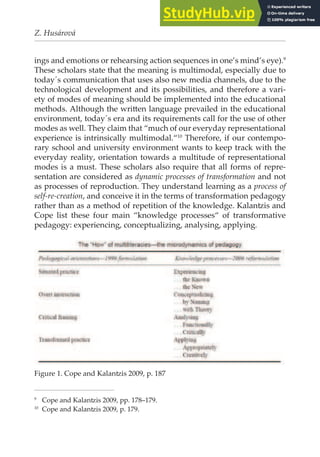
Cope list these four main “knowledge processes“ of transformative
pedagogy: experiencing, conceptualizing, analysing, applying.
Figure 1. Cope and Kalanzis 2009, p. 187
9
Cope and Kalanzis 2009, pp. 178–179.
10
Cope and Kalanzis 2009, p. 179.
A Method of Teaching Multimodal Creative Writing
By experiencing, the need to connect the educational environment with
the other spheres of life is stressed in order to make the education
more life-like as well as to draw from learners´ experiences. Experienc-
ing is diferentiated to experiencing the known and experiencing the new.
While the former focuses on the learners´ natural tendency to bring
their own life experiences, knowledge, culture to the learning environ-
ment, the later focuses on their dealing with the unknown situations,
handling new information, collecting new data that might bring the
transformative efect. Conceptualizing refers to the learners´ active proc-
ess of understanding the learned mater and to the ability to place it
within the existing theoretical frame. This knowledge process contains
two subparts: conceptualizing by naming (categorizing, developing con-
cepts) and conceptualizing with theory (building interpretative frame-
works, schemas, theories). Analyzing requires a critical approach from
the learner; to analyze functionally means to develop logical connections,
think about the cause and efect, induce, deduce and to analyze critically
means to evaluate their own and other´s motives, approaches, perspec-
tives, stances, interests. The fourth knowledge process is applying. By
the notion of applying appropriately, the scholars state that the learners
use the acquired knowledge in a speciic (or simulated) real-life situa-
tion to test its validity. Applying creatively denotes that the learners ap-
ply the knowledge in a creative form, that they use their knowledge to
make something new.
The humanistic approaches to teaching and the new fast changing
social environment do not intend to implement these learner-centred
processes into the old scheme of teaching approach. The necessity to
educate people for the existing (and forthcoming) social structure de-
mands that the new possibilities of learning via new media will also
have an important position in the current curricula. But rather than
using new technological possibilities for teaching the same material,
the more eicient, more interesting ways of “active learning,” with a
focus on the interest-driven activities that induce knowledge and com-
petence, should be considered. These more eicient and more interest-
ing ways of teaching should be obviously student-centred, should be
oriented at developing their potential, their creativity, cognitive proc-
esses as well as improve their skills of handling a variety of modes in
Z. Husárová
order to construct a multisensory experience. Nicola Yelland11
claims
the necessity to implement technologies into the teaching that would be
based on the current trends: “in the information age or knowledge era,
we should not be mapping the use of new Technologies onto old cur-
ricula; rather, we need to rethink our curricula and pedagogies in light
of the impact that we know new technologies can have on learning and
meaning making in contemporary times.“ When trying to educate peo-
ple for the current society and when anticipating the coming trends,
we have to direct our methods to bring about not just, in the words of
Marlene Scardamalia and Carl Bereiter12
“knowledge about“ but also
the “knowledge of“. The traditional model that focuses on the “knowl-
edge about” concentrates on the learning of the material and not on
experiencing it. The orientation towards “knowledge of” is directed
at students´ active approach to knowledge acquiring – at the problem
solving tasks, at the incorporation of inventiveness and creativity. The
education should be directed at the students who should already in
the educational environment think about, and formulate ideas about,
the way how to actively contribute to the society. In his article Liberal
Education in the Knowledge Society, Carl Bereiter13
asks: “What should it
mean to be an educated person in the 21st century?” And later in his
article writes that the educational environment should be a “workshop
for the production of knowledge”14
and the students should produce
knowledge.
The understanding of the education in the terms of such a “work-
shop”, where the students acquire the “knowledge of”, is conceptu-
ally connected with a “practice-led research” that has been gaining its
credit in the artistic community. But while the irst two terms can be ap-
plied to any type of educational environment, “practice-led research” is
a concept for university milieu and practitioners in the ield of creative
arts. Hazel Smith and Roger Dean15
deine “practice-led research” as “a
means to characterise the way in which practice can result in research
11
Yelland 2007, pp. 1–2.
12
See Scardamalia and Bereiter 2006.
13
Bereiter 2002, p. 11.
14
Bereiter 2002, p. 19.
15
Smith and Dean 2009, p. 2.
A Method of Teaching Multimodal Creative Writing
insights, such as those that arise out of making a creative work and/or
in the documentation and theorisation of that work,“ and understand
it also as a reversed idea - “that academic research can lead to crea-
tive practice.“ Smith and Dean do not perceive practice-led research
and research-led practice as two divided processes, but rather as proc-
esses that function interwoven in a common web of creative processes.
Among the other authors active in the sphere of practice-led research,
belong R. Dean, J. Motram, S. Biggs, M. Mencia, E. Barret, B. Bolt, R.
Stewart, G. Perry and others.
3 Creative writing and digital environment
The development of the common grounds of digital environment and
digital technologies, support of creativity and pedagogical practice has
been a widely discussed phenomenon. This trend can be proven not
just by the emphasis on the digital humanities, but also by the research
and artistic projects focusing on the increase of the credit of the elec-
tronic art as a practice for innovative thinking and development of in-
novative works. The assets of the use of digital technologies and the
creative possibilities of new media for the advancement and efective-
ness in the educational process have been a subject of various theo-
retical works (L. Unsworth, J. Hughes, R. Godwin-Jones, G. Gordon,
A. Gunder, G, Landow, D. S. Miall, D. Michael, K. Pullinger, G. Reid,
D. Schafer, H. Smith and others). Professionals in the humanities have
implemented a variety of methods in the efort to work with new media
in the educational process – from the creation of the irst open hyper-
text networks at the American universities in the 1990s that were aimed
at the active illing of the knowledge on literature, arts and theories
(e.g. Victorian Web, Cyberspace, Hypertext & Critical Theory); through
the use of wikis, blogs, social networks, virtual environments to sup-
port students´ activity; to the creation of conditions for the use of new
media in the creative expressions of multifarious kinds. The report on
the digital learning in the educational environment called Confronting
the Challenges of Participatory Culture: Media Education for the 21st
Century
writen by Henry Jenkins and hic collaborators has been widely inlu-
ential among other initiatives discussing the new tendencies in educa-
tion in the digital and post-digital age.
Z. Husárová
The concept of creativity support through electronic literature has-
been explored in the research projects ELMCIP,iStori.es and has been
one of the main objectives of the theoretical projects of Electronic Lit-
erature Organization. The theme of bridging between literature and
electronic media in Slovakia has been discussed and researched within
a grant “Text on the Internet as a Phenomenon of Cultural (R)evolu-
tion“, which continues to inquire the questions postulated by a grant
“Literature in Cyberspace”.
It is obvious that the contemporary educational environment in Slo-
vakia needs to relect the current global trends in the society, in the
communication, in the humanities, as well as the progressive peda-
gogical voices. The “user-friendliness” of operations, the phenomena
of play and game, the work with several media, collaborative and par-
ticipatory projects – do not occur just within social networks. Thanks
to the possibilities of the creation of text and literature, they are also
means for the development of students´ potential. Creative literary
practice can mean, besides writing of a text, also the work with sound
and music, the use of visual material, performance, collaborative online
projects and combinations of intermedial relations. This practice wants
to spark the multisensory stimulations that are essential for the efec-
tive atainment of the experiencing the new. This practice follows the con-
temporary trend of interpersonal interaction in the digital multimedia
world as well as pedagogical ways oriented at the digital environment.
In the contemporary discourse of aesthetics and art theory, the term
“post-digital” has been very inluential. This notion relects the fact that
digitality, digital media, digital technologies, digital art have become
so much incorporated into our everyday practice that we turned into
the “post” state. Therefore the inclusion of digitality into the education
should deinitely not be considered as something new, but rather as
something completely natural. Especially, since we have to face the fact
that “digital natives” (children who were born during the era of dig-
ital technologies and who have been interacting with them from a very
early age) are emerging in our schools.
A Method of Teaching Multimodal Creative Writing
4 Teaching Multimodal Creative Writing
New media have an immersive and performative potential that encourages
students to get inside a poem and play with it. Giving students opportuni-
ties to create poems or respond to and annotate existing poems using new
media allows them to practice with technology in meaningful ways. Our
students are already immersed in new media and the question is no longer
whether we should use digital technologies in the classroom, but rather how
they are being integrated into the curricula.16
Within the Department of English Language and Literature at the Fa-
culty of Education, Comenius University in Bratislava, I proposed and
developed a MA course whose objective is to teach multimodal creative
writing. The course is structured as a workshop of creative writing with
the use of new media and the aim of the course is not only to inspi-
re students to write poems and short narratives on a range of experi-
mental forms or suggested topics, but also to make them think about
various innovative ways how literature and English language can be
taught through the use of creative writing and digital technologies. The
idea of Jeanete Hughes and Amy John “to practice with technology in
meaningful ways” proved to be adequate, since students started to get
a hold of working with blogs (and not only Facebook) and appreciated
the possibilities to learn to work with new media for speciic purposes.
In the framework of innovative and progressive approaches to the
pedagogical activity, my aim was to develop and use a method that
could, from a broader point of view, stimulate students´ creative poten-
tial through the combination of creative writing techniques and the use
of new media technologies. My method for teaching creative writing
with the use of new media – multimodal creative writing – ofers the
possibilities of students´ creative “self-re-creation” with the means of
media and their connections, by which it also enhances the students´
skills that are not given enough room for advanced activation at the uni-
versity level. I proposed, developed and qualitatively veriied a method
of procedural teaching of creative writing with the help of digital tech-
nologies. The method is centred on the inclusion of the combination of
knowledge and skills into the educational process and the grasping of
16
Hughes and John 2009, p. 22.
Z. Husárová
literary and artistic concepts as well as providing a space for individual
self-realization through the creative practice. The method should lead
to a greater awareness of this needs to a more advanced inclusion of
creativity, multisensory stimulation and combination of knowledge
and skills into the teaching. It should head towards a more atractive
education for a broad range of age groups. The method wants to en-
courage students efectively and aims to implement the playful and
participatory potential of new media and the inclination towards the
tendency of “the ludiication of culture” (a notion proposed by Joost
Raessens17
) – in order to achieve the students´ development in various
areas through the curriculum. At the same time, the method reacts to
the digital, multimedial world of the learners and encourages them to
practice their creative participation in it.
The method I implemented is based on the interconnections of peda-
gogical models, methods and techniques that were already introduced
– multiliteracies, especially the emphasis on multimodalities, knowl-
edge processes, orientation towards “knowledge of”, “practice-led
research”. These methods stress the creative activity, development of
knowledge as well as skills and motivate towards the implementation
of experience, conceptualization, analysis and the application of the ac-
quired knowledge.
Viera Eliašová18
writes that creative writing can be understood either
as “the main and inal teaching focus” or it may be used in connection
with a literary text, as “a means for encouraging personal involvement
with the text”, as an activity that strengthens students´ relationship
with the literary text. Since my course was aimed at creative writing
per se, I used it at the main focus.
For the purpose of the course, I created a website called Novomedi-
álna literatúra (New Media Literature) at the blog server tumblr with
the web address htp://nmlit.tumblr.com/. This website serves as an on-
line teaching environment and students´ works are openly accessible.
The activity on the blog consisted of these stages: I wrote weekly blogs
aimed at brief introductions of a speciic technique of experimental lite-
17
Raessens 2006, pp. 52–57.
18
Eliašová 2001, p. 477
A Method of Teaching Multimodal Creative Writing
rature with the examples of literary works. For each technique I also set
up a blog entry for students´ works. After having read the blogs, stu-
dents created their works through a given technique, published them
on their own blogs and inserted a link into the speciied blog entry. For
each class, they were also supposed to propose a characterization of the
technique that relected their “knowledge of“ a speciic literary process
(they were asked questions like - what works were they inspired by
and how they proceeded during the creative process) and they illed in
a reply on my questions about what they learnt, understood or grasped
in the creative process. They also sometimes mentioned their initial dif-
iculties with handling the theme along with their surprise about inal
success of achieving the goal. The irst set of questions asked what poe-
try means for them, what they consider to be functions of poetry and
creative writing. Their answers relected the diversity of understanding
of poetry and in broader sense, literature:
“The function of poetry is that it makes us feel the moment - you stop
and read and feel and it is as if you were in Matrix - the whole world
spinning around you in slow motion, while your time has its own pace.“
(Peta), “poetry for me are words. People are writing (and expressing,
and rapping, and whispering, and shouting) poetry because words can
change things...poetry is when you ly for the irst time and your feet no
longer touch the ground :-) (Evita), “It’s a brain-squeezing activity that
makes me pleasantly tired afterwards.“ (Sona), “It enables us to share
the experience that is unique and in a way non-transferable.“ (Lydia),
“a way of artistic expression of not only my feelings and emotions, but
also my opinions and observations“ (Zuzana), “It really helped me to
get through some hard times during my life, I just grabbed a pen and
wrote - geting my deepest feelings out of me.” (martiseqqq), “there is
something inside your head that is telling you that THIS is really IT.”
(Jan), “a kind of art to amuse people, to make them think about things
and issues, and a way to express oneself or tell something what is on
your mind.” (Barbora), “the possibility to relax and forget all the pro-
blems and duties of everyday life and on the other hand it is the way
to express one´s feelings and thoughts, say something what is maybe
hidden in real life .” (Kristina), “Every time I read a poem I`d like to
know exactly what does it mean, what the author felt when he was
Z. Husárová
writing it.” (Martinamas), “a living organism, with its own organs,
veins and tissues. Pulsing, still growing and continually changing...
degenerating and changing into the hybrid monster, an experiment of
society which is in progress, still seeking for new impulses, stimuli,
excitements. A child, creation, tumour, provocation of contemporary
society which doesn´t want to stagnate or bore, but wants to be new,
cool, original and breathtaking. Shocking... a kind of divinity for me. Or
religion...a kind of addiction. It is a drug...a memory cursed into a ver-
se, a moment which will never repeat but still remains in a poem clear
an eternal as at that time. POETRY is an intimate relationship without
touching bodies, where the organs of connection are words.“ (Vanda)
The students wrote also some thoughts on the possibilities of the use of
poetry in the educational process after the irst class:
Writing as such helps to develop imagination, creativity, self-ex-
pression and to form one´s opinions. Nowadays, new media are
very atractive for learners. So I think, if the teacher combines writ-
ing and technologies, he/she can increase the positive efect of learn-
ing. (Nina)
Students can actually become more interested in the subject that uses
poetry as one of its tools. They can learn how to work with language,
how to combine diferent word classes, how to make rhymes… they
can work with dictionaries, rhyming dictionaries and have some fun
- what is the best, they can gain some new vocabulary and it is also
a way how to relax :)(martiseqqq)
Another, very often an omited, part of the educational process is to
give your learners the chance to be creative and to openly state their
opinions, to discuss, ind arguments pro and contra, not just memo-
rizing and mechanically repeating what is given by the teacher and
the books, but to learn to have and to express their own opinions,
thoughts, arguments. To use your imagination, to create something
can be very motivating and can give the learners new ways and pos-
sibilities for self-expression. (Evita)
During the course, the students created works with these techniques:
1. a fridge poem
2. a poem on an everyday object
A Method of Teaching Multimodal Creative Writing
3. a short narrative with a direct quotation from other cultural
work of any kind
4. a remix of a colleague´s short narrative from a previous class –
the narrative should be writen in a surrealist mode and with a
change of narrator/focalizer/metaiction
5. a visual poem or a collage
6. an anagram/lipogram/generative poem (Oulipian tradition)
7. a sound poem/audio poem
8. a found text/ a text in a nonliterary way - graph, scheme, in-
struction manual (Fluxus tradition)
9. a poem/narrative based on social media/a tweet poem/ a “re-
verse thinking” poem
10. hypertext/fragmented text
11. a video poem/narrative – collaboration between 2 students
12. a project on teaching English through any experimental tech-
nique
The course was lead as a workshop, but used the model of a “lipped
classroom“ – students read the introductory blogs online at home, they
created their works at home. The time during the class was devoted to
the students´ oral performances of the works, discussions that followed
each performance, during which the students provided their comments
and insights into each other´s works, some suggestions about their im-
provements, conceptualizations and analyses. The only one set of po-
ems that was created in the classroom was the irst set – fridge poems
– during the very irst class. I used it besides the ice-breaking activity
also as a means to inspire students to think about poems in the expe-
rimental way of constraints, to treat poems not as results of a “muse”
or “epiphany” but rather in the Oulipian tradition. The Oulipo mem-
bers believe that by seting a speciic constraint, the author inds new
inspirations and new literary possibilities. They perceive the self-im-
posed constraints as new creative forces, stimulations of creativity and
writer´s imagination. All the tasks that the students were given, were
aimed at writing the literature in an experimental way. The connection
between the experimental literature and electronic literature is very
Z. Husárová
tight; electronic literature draws from the experimental tendencies in
the 20th
century (concrete literature, kinetic literature, visual and sound
poetry, video poetry, combinatory literature) and is usually considered
as one of the contemporary tendencies of experimental literature. Even
though not all the techniques were oriented at the direct use of new
media, all of the techniques have inspired the new media writing, the
new media literature is based on the principles of experimental litera-
ture and the used techniques relect some examples of contemporary
writing. I chose the experimental literature for some other speciic rea-
sons: it is playful, engaging, multimodal, students can use a variety of
found material, they do not feel forced “to wait for the muse”, since the
inspiration can come from working with the material. The main rea-
son is that they perceive creating such literature more as a fun and can
overcome the “I am not a poet, therefore I feel unable/ashamed to wri-
te” type of feeling. At the beginning it was essential to make them feel
comfortable in the role of text producers, and this goal was achieved by
the use of experimental literary techniques. These techniques helped
them in this initial process of self-re-creation. These techniques stress
the interesting concept rather than the rhyming scheme, students can
“experience the known” as well as “experience the new” through va-
rious modalities, depending on the preference, inclination, a particular
mood or inspiration. In the inal question titled General achievement,
the students provided some thoughts about writing in an experimental
way:
When I had the theme and constriction (or certain rules + the inspi-
rational blog) I was able to come up with ideas, shape them, make
a concept. So I learned that to write I need boundaries and topic,
rather than the patience to wait for a muse. (Peta)
I´m very happy to have learned that poetry is not just rhymes writ-
ten by genius, but also me, ordinary people are able to create some-
thing we can name poetry, which I´m very proud of. It is great to
know about fridge poetry, haptic poetry, oulipo and others, I have
had no idea before and I don´t know how could I live without it
:) (Kristina)
Before I was able to create only some “normal” poems with rhymes
and everything but now... oh my, what can I do now? I can express
A Method of Teaching Multimodal Creative Writing
my deepest feelings in much more ways than I could ever imagine!
(Martiseqqq)
Many times I was surprised that even though I thought there was no
way to come up with anything for the lesson I’ve always invented
something and there are several creations I’m really proud of. (Sona)
The experimental writing techniques became also a means how to use
new media in a meaningful way as well as a means to work with new
technologies for a speciic purpose. The important element in the meth-
odology was the decision not to teach the students any programmes.
I did not intend to structure the class as a typical ICT class, where the
students learn to work with multimedia programmes (especially for
the tasks of creating sound/audio poems, video poems) but I demand-
ed from them their own initiative to look for some speciic functions
that they desire the programme to have and then use that particular
programme for a speciic goal. Obviously, the students were not es-
pecially advanced in the technological ield, but they managed to ind
their ways to handle the problems and accomplished their tasks. I got
no email asking for help in the creative process. The students learnt
themselves how to ind “in the sea of Internet possibilities” the pro-
grammes, in which they could create, edit, manipulate audio samples,
visual images, video, multimedia. They were really technological auto-
didacts, because they became motivated to accomplish the task. They
also used hypertext possibilities for poetry and narrative writing and
presentation, they remixed the existing narratives, they studied Inter-
net news and blogs and then remixed their content in their own works,
they proposed to their friends to collaborate on the Facebook on the
text formation (and thus spread the idea of using social networks in
a creative way), they recorded their readings of poems on the smart-
phones and experienced many other approaches.
The other goal of using the experimental techniques was to make
them understand the movements whose comprehension is considered
to be very demanding for students. Practice-led research proved to be
an appropriate model for this purpose, since they usually managed not
only to properly understand these movements (Surrealism, Dadaism,
Fluxus, Oulipo, Language poetry), but also to grasp the essentials of
the relationship between orality and textuality, between text and other
Z. Husárová
media, the concept of remix in literature, they managed to perceive the
role of text also beyond its semantics and towards the concreteness and
visuality. Thanks to working with the phonetic qualities of language
and with visual and kinetic poetry, they understood the tendencies that
break the strict borders between the literary and artistic forms and gen-
res and that demonstrate a need for inter/transmedial perspective. This
methodology enabled them to relect on the role of the textual expres-
sion created with or in the media and to understand the position of lan-
guage, text and literature in the contemporary society, where accord-
ing to Gunther Kress´s book Literacy in the new media age19
, the writing
loses its semantic exclusivity and is supported by visuals – increasingly
complex multimodality. Gunther Kress stresses here the importance of
schools to acknowledge the semiotic afordances of various medialities
and multimodal texts, because they might bring new insights.
Students were also able to use the techniques in their own teaching
process. Many of the students teach privately, so they tried to imple-
ment some literary techniques into their classes. The focus of the meth-
odology and choice of the techniques was therefore also aimed to con-
sider the possibilities of the use of new media writing in the subjects
that are not related with the creative writing – for example the teaching
of literature, of all four language skills (listening, speaking, reading,
writing) including the intercultural communication, the teaching of
grammar and pronunciation, incorporation into the classes of musical
and art education and many others. When asked about their relections
on the teaching, they wrote:
I think that to give the student an opportunity to manipulate with
language, gives them much more than just learning something by
heart. This creative activity is on the one hand real fun because the
combination that came out can be hilarious and on the other hand it
gives students feeling that they themselves are able to create poems
and may inspire them to write some more. (Lydia)
I was surprised that my students found it fun and that they were
able to create something - as I wrote in my project, their level of
English and vocabulary are poor. I have realized that New media
19
See Kress 2003.
A Method of Teaching Multimodal Creative Writing
literature can be used in everyday classroom life as a valuable exer-
cise for students. I decided to made with my students constrained
poetry, because it can be maybe helpful for them to have something
that leads them. (Martinamas)
I found out that the biggest issue with this task is the fear of being
“not good enough” – in other words that the outcome of student´s
work would not be creative enough, or would not match the expec-
tations. Therefore the teacher would have to make sure that the stu-
dents...are provided with the climate where they can be free, crea-
tive and safe. (Peta)
During the course of the class, students worked with all of the modali-
ties of meaning incorporated into the pedagogy of multiliteracies. They
created their works in writen language (text), visual representation
(visual poetry), oral language, audio representation (sound poetry). Af-
ter the representation to oneself, they also performed their works and
thus exercised oral representation and gestural representation. Some
students created haptic objects (rubic cube with text, paper dice with
text, a conceptual travelling diary, an Oulipo inluenced love story and
others) – tactile representation for the classes, others explored the pos-
sibilities of spatial representation – when constructing a physical paper
house with doors or when organizing the structures of hypertext po-
ems. They also practiced all four main knowledge processes: experienc-
ing the known and experiencing the new played an important role in their
creative process (they wrote about their own emotions, surroundings,
close topics but also learnt new forms and ways how to work with the
known). Conceptualizing was used mostly when they wrote relections
on their experiences with the working process and when they later put
their works into some categories. Analysing was reserved mostly for the
classroom environment, where we discussed and analysed students´
works in the whole group. Applying process happened both when they
constructed new poems (students learnt still more and more about the
creative possibilities after the discussions) as well as during the teach-
ing project, where they applied the “knowledge of“ how to implement
the experimental and/or multimodal literature into their teaching.
Z. Husárová
5 Conclusion
I proposed, developed and used a method of teaching multimodal crea-
tive writing. My method ofers the possibilities of students´ creative
“self-re-creations” and self-realizations, it enhances a combination of
knowledge and skills, exercises four main knowledge processes – ex-
periencing, conceptualizing, analyzing, applying. It wants to foster a
more advanced orientation to creativity, multisensory stimulation and
inclusion of easy-access tools in the form of multimedia, new media,
digital technologies into the current curricula. The method is based
on the interconnections of multimodal pedagogy, it is build on stress-
ing the “knowledge of”, on the “practice-led research” and “lipped
classroom”. The method aims towards a more atractive education for
students, towards their active and efective encouragement towards
learning and developing their creative potential. It implements the par-
ticipatory and collaborative world of multimedia and new media pos-
sibilities. The changing world of communication, media environment,
the still more dominant concepts of play and game in the education, the
still more demanding expectations of students leaving their universi-
ties to master a combination of knowledge and skills on a high level,
force us to propose and develop those teaching methods that carry the
demands of the students, their potential and needs in their centre - in
order for the students to be ready to become the knowledge base of this
society.
Changes in the media environment are altering our understanding
of literacy and requiring new habits of mind, new ways of process-
ing culture and interacting with the world around us. We are just
beginning to identify and assess these emerging sets of social skills
and cultural competencies. We have only a broad sense of which
competencies are most likely to mater as young people move from
the realms of play and education and into the adult world of work
and society.20
Key words: creative writing, new media, innovative pedagogy, multili-
teracies, multimodality, electronic literature
20
Jenkins et al. 2006, p. 21.
A Method of Teaching Multimodal Creative Writing
Bibliography
Bačová, D. (1999): The Position of Children’s Theatre and Drama in Educa-
tion in Slovakia during the last 15 Years. In: Research in Drama Educa-
tion: The Journal of Applied Theatre and Performance, Vol. 4, No. 1,
pp. 91–100.
Bereiter, C. (2002): Liberal Education in the Knowledge Society. In: Liberal
Education in the Knowledge Society. Ed. Smith, B. Peru, Illinois: Open
Court Publishing Company, pp. 11–33.
Cope, B., Kalanzis, M. (2009): “Multiliteracies”: New Literacies, New
Learning. In: Pedagogies: An International Journal, No. 4, pp. 164–195.
Creative Writing: Príručka pre učiteľov anglického jazyka: (2003). Ed.
Eliašová, V. Bratislava: Metodické centrum mesta Bratislavy.
Dawson, P. (2008): Creative writing and postmodern interdisciplinarity.
In: TEXT, April, Vol. 12, No. 1, [cit. 2012-07-06]. Available at: <htp://
www.textjournal.com.au/april08/dawson.htm>.
Eliašová, V. (2006): K niektorým aspektom tvorivého písania v jazykovej a
literárnej výučbe. In: K problematike vyučovania materinského jazyka
a literatúry : Zborník príspevkov z 2. celoslovenskej konferencie
učiteľov slovenčiny. Ed. Vojtech, M. Bratislava: Univerzita Komen-
ského, pp. 10–30.
Eliašová, V. (2001): Literature and Creative Writing Projects. In: CAUCE,
Revista de Filología y su Didáctica, No. 24, pp. 473–480.
Eliašová, V. (2011): Tvorivé písanie a možnosti jeho využitia v edukačnom
procese. Bratislava: Univerzita Komenského.
Eliašová, V. (2005): Tvorivé písanie vo výučbe anglického jazyka na stred-
ných školách. Dizertačná práca. Bratislava: FiF UK.
Hughes, J., John, A. (2009): From Page to Digital Stage: Creating Digital
Performances of Poetry. In: Voices from the Middle, March, Vol. 16,
No. 3, pp. 15–22.
Jenkins, H. et al. (2006): Confronting the Challenges of Participatory Cul-
ture: Media Education for the 21st
Century. Chicago: The MacArthur
Foundation.
Kress, G. (2003): Literacy in the new media age. London: Routledge.
Z. Husárová
Na stope slovám. Praktická príručka pre učiteľov slovenského jazyka a
literatúry (2007) : Ed. Eliašová, V., Kočanová, M., Lacko, I. Bratislava:
Štátny pedagogický ústav.
Raessens, J. (2006): Playful Identities, or the Ludiication of Culture. In:
Games and Culture, Vol. 1, No. 1, pp. 52–57.
Scardamalia, M., Bereiter, C. (2006): Knowledge building: Theory, peda-
gogy, and Technology. In: Cambridge Handbook of the Learning
Sciences. Ed. Sawyer, K. New York: Cambridge University Press, pp.
97–118.H5ePd5Ea4Dg-4o8g01ie8Xs:–
Smith, H., Dean, R. T. (2009): Practice-led Research, Research-led Practice
in the Creative Arts. Edinburgh University Press.
Zborník zo Sympózia o tvorivom písaní. (2006): Ed. Eliašová, V. Bratisla-
va: Metodicko-pedagogické centrum Bratislavského kraja v Bratislave
v spolupráci s Učiteľským neinvestičným fondom.
Yelland, N. (2007): Shift to the future: Rethinking learning with new tech-
nologies in education. New York: Routledge.
Acknowledgements
The paper was writen within the Grant of Comenius University No.
UK/408/2012: “Novomediálna literatúra ako smerovanie rozvoja kreativity.”
I would like to thank to all my students for sharing their thoughts and
opinions on the subject mater.

A Method Of Teaching Multimodal Creative Writing

  • 1.
    A Method ofTeaching Multimodal Creative Writing Zuzana Husárová Abstract: The paper introduces a method for teaching and relec- tion of the creative writing with the use of new media and digital technologies. The method should lead to a more atractive edu- cational process for a broad range of students. Thanks to its use of playful and participatory potential of new media, it aims to ef- fectively encourage students in various ields. It simultaneously inclines to the newest ways of incorporating students into the edu- cational process – it reacts to students´ digital, multimedial world and teaches them how to creatively participate on it. The use of the possibilities of collaboration on the Internet blog conirms the need for creativity, multisensory stimulation and inclusion of skills into the educational process. 1 Introduction Having in mind humanistic tendencies, connected with school edu- cation, it is important to change a student from the object of teach- ing, a pure “reproductive mechanism” into an independent subject, a partner in learning process, i.e. into a living being who thinks, acts, creates, feels, evaluates, expects, who learns by experiencing and interiorizing. Reading of literature provides the students with background material - ideas, myths, legends, cultural memory of mankind, etc., and creative writing provides the students with the possibility of self-expression1 . At irst it has to be mentioned that the position of creative writing in any media is in the Slovak educational system neither stable nor strong, although there are some initiatives trying to strengthen its status. Viera Eliašová has been publishing on the use of creative writing in many 1 Eliašová 2001, p. 476.
  • 2.
    Z. Husárová areas2 and has(co-)edited several publications on this issue3 . Worth mentioning is also the activity of Daniela Bačová, who proposed the integration of drama in English language teaching4 . Creative writing is in the secondary education included into the classes of Slovak language and the format of creative writing is traditionally reserved almost ex- clusively for some basic insights into the journalistic style and essays on various topics (ranging from descriptions of nature; through address- ing historical or economic issues; to contemplations on the questions like: “if I were a chair”). There is no class dealing solely with creative writing, which is diferent in comparison with some other types of art that are taught at primary and secondary schools, like ine art edu- cation and musical education. The situation at the university level is slightly diferent, creative writing is sometimes taught at the foreign language and literature programmes or Slovak language and literature programmes. There are also some classes concerning creative writing at the departments of Journalism (e.g. Philosophy of Creative Writing) and obviously, within the department of Screenwriting. In Slovakia, there does not exist a tradition of (creative) writing departments, as is the case in the Anglophone world. Paul Dawson5 mentions the situa- tion at universities with creative writing curriculum: „And if students could not be given talent (for that, too, obviously must already exist as a genetic quotient), they could be taught the process and craft of writ- ing in order to develop their talent.“ However, despite the fact that in Slovakia, the “transmission of craftsmanship” is besides some teachers´ solitary activities and private workshops reduced to the “hands” of au- thors, the creative texts are produced. One could thus assume that the text production in the creative way is according to our system meant to be almost self-learned from the very basics given to us at schools and reserved for those born with a talent who do not need to study writing. Even though our system does not intend to educate students for careers of professional writers, it should still focus on the activities of creative writing. Viera Eliašová, who has been actively engaged in the topic of 2 See Eliašová 2001, 2005, 2011. 3 See Eliašová (ed.) 2003, 2006, 2007. 4 See Bačová 1999. 5 Dawson 2008, online.
  • 3.
    A Method ofTeaching Multimodal Creative Writing creative writing in the school and university environment, states that creative writing techniques “serve to reinforce desirable goals in both spheres, i.e. verbal and writen language expression, skills in decoding oral and writen language, basic comprehension, analytical abilities, lit- erary interpretation.“6 Creative writing does not develop only the skills connected with language and understanding of the literary text, but it should be considered also as a very efective method of working on the students´ abilities to express themselves. If followed by the perform- ance of the text, it could be treated also as a method of building the self-esteem in public presentation, as a way to overcome timidity and diidence and a way how to develop “one´s own voice.” 2 Bridging creative writing and contemporary teaching methods Paul Dawson states in his paper Creative writing and postmodern inter- disciplinarity7 that the most productive way how to conceive creative writing is as a pedagogy that stands within multiple other disciplines - like English, cultural studies, media and communication, ilm and theatre studies, and the creative arts. Dawson writes that creative writ- ing “is best understood as an interdisciplinary pedagogy, rather than a discrete discipline that can be illuminated by drawing upon other modes of knowledge.“8 The orientation towards a multitude of modes is proposed also by a New London Group in their substantially inlu- ential manifesto. This group of scholars proposed in the mid 1990s an outline for “pedagogy of multiliteracies”, where the term “multilitera- cies” covers two distinctive dimensions of “literacies“ – multilinguistic and multimodal. Regarding the multimodal pedagogical approach, they present these modes: writen language, oral language, visual representation, audio representation, tactile representation, gestural representation, spatial representation, representation to oneself (may take the form of feel- 6 Eliašová 2001, p. 477. 7 Dawson 2008, online. 8 Ibid.
  • 4.
    Z. Husárová ings andemotions or rehearsing action sequences in one’s mind’s eye).9 These scholars state that the meaning is multimodal, especially due to today´s communication that uses also new media channels, due to the technological development and its possibilities, and therefore a vari- ety of modes of meaning should be implemented into the educational methods. Although the writen language prevailed in the educational environment, today´s era and its requirements call for the use of other modes as well. They claim that “much of our everyday representational experience is intrinsically multimodal.“10 Therefore, if our contempo- rary school and university environment wants to keep track with the everyday reality, orientation towards a multitude of representational modes is a must. These scholars also require that all forms of repre- sentation are considered as dynamic processes of transformation and not as processes of reproduction. They understand learning as a process of self-re-creation, and conceive it in the terms of transformation pedagogy rather than as a method of repetition of the knowledge. Kalanzis and Cope list these four main “knowledge processes“ of transformative pedagogy: experiencing, conceptualizing, analysing, applying. Figure 1. Cope and Kalanzis 2009, p. 187 9 Cope and Kalanzis 2009, pp. 178–179. 10 Cope and Kalanzis 2009, p. 179.
  • 5.
    A Method ofTeaching Multimodal Creative Writing By experiencing, the need to connect the educational environment with the other spheres of life is stressed in order to make the education more life-like as well as to draw from learners´ experiences. Experienc- ing is diferentiated to experiencing the known and experiencing the new. While the former focuses on the learners´ natural tendency to bring their own life experiences, knowledge, culture to the learning environ- ment, the later focuses on their dealing with the unknown situations, handling new information, collecting new data that might bring the transformative efect. Conceptualizing refers to the learners´ active proc- ess of understanding the learned mater and to the ability to place it within the existing theoretical frame. This knowledge process contains two subparts: conceptualizing by naming (categorizing, developing con- cepts) and conceptualizing with theory (building interpretative frame- works, schemas, theories). Analyzing requires a critical approach from the learner; to analyze functionally means to develop logical connections, think about the cause and efect, induce, deduce and to analyze critically means to evaluate their own and other´s motives, approaches, perspec- tives, stances, interests. The fourth knowledge process is applying. By the notion of applying appropriately, the scholars state that the learners use the acquired knowledge in a speciic (or simulated) real-life situa- tion to test its validity. Applying creatively denotes that the learners ap- ply the knowledge in a creative form, that they use their knowledge to make something new. The humanistic approaches to teaching and the new fast changing social environment do not intend to implement these learner-centred processes into the old scheme of teaching approach. The necessity to educate people for the existing (and forthcoming) social structure de- mands that the new possibilities of learning via new media will also have an important position in the current curricula. But rather than using new technological possibilities for teaching the same material, the more eicient, more interesting ways of “active learning,” with a focus on the interest-driven activities that induce knowledge and com- petence, should be considered. These more eicient and more interest- ing ways of teaching should be obviously student-centred, should be oriented at developing their potential, their creativity, cognitive proc- esses as well as improve their skills of handling a variety of modes in
  • 6.
    Z. Husárová order toconstruct a multisensory experience. Nicola Yelland11 claims the necessity to implement technologies into the teaching that would be based on the current trends: “in the information age or knowledge era, we should not be mapping the use of new Technologies onto old cur- ricula; rather, we need to rethink our curricula and pedagogies in light of the impact that we know new technologies can have on learning and meaning making in contemporary times.“ When trying to educate peo- ple for the current society and when anticipating the coming trends, we have to direct our methods to bring about not just, in the words of Marlene Scardamalia and Carl Bereiter12 “knowledge about“ but also the “knowledge of“. The traditional model that focuses on the “knowl- edge about” concentrates on the learning of the material and not on experiencing it. The orientation towards “knowledge of” is directed at students´ active approach to knowledge acquiring – at the problem solving tasks, at the incorporation of inventiveness and creativity. The education should be directed at the students who should already in the educational environment think about, and formulate ideas about, the way how to actively contribute to the society. In his article Liberal Education in the Knowledge Society, Carl Bereiter13 asks: “What should it mean to be an educated person in the 21st century?” And later in his article writes that the educational environment should be a “workshop for the production of knowledge”14 and the students should produce knowledge. The understanding of the education in the terms of such a “work- shop”, where the students acquire the “knowledge of”, is conceptu- ally connected with a “practice-led research” that has been gaining its credit in the artistic community. But while the irst two terms can be ap- plied to any type of educational environment, “practice-led research” is a concept for university milieu and practitioners in the ield of creative arts. Hazel Smith and Roger Dean15 deine “practice-led research” as “a means to characterise the way in which practice can result in research 11 Yelland 2007, pp. 1–2. 12 See Scardamalia and Bereiter 2006. 13 Bereiter 2002, p. 11. 14 Bereiter 2002, p. 19. 15 Smith and Dean 2009, p. 2.
  • 7.
    A Method ofTeaching Multimodal Creative Writing insights, such as those that arise out of making a creative work and/or in the documentation and theorisation of that work,“ and understand it also as a reversed idea - “that academic research can lead to crea- tive practice.“ Smith and Dean do not perceive practice-led research and research-led practice as two divided processes, but rather as proc- esses that function interwoven in a common web of creative processes. Among the other authors active in the sphere of practice-led research, belong R. Dean, J. Motram, S. Biggs, M. Mencia, E. Barret, B. Bolt, R. Stewart, G. Perry and others. 3 Creative writing and digital environment The development of the common grounds of digital environment and digital technologies, support of creativity and pedagogical practice has been a widely discussed phenomenon. This trend can be proven not just by the emphasis on the digital humanities, but also by the research and artistic projects focusing on the increase of the credit of the elec- tronic art as a practice for innovative thinking and development of in- novative works. The assets of the use of digital technologies and the creative possibilities of new media for the advancement and efective- ness in the educational process have been a subject of various theo- retical works (L. Unsworth, J. Hughes, R. Godwin-Jones, G. Gordon, A. Gunder, G, Landow, D. S. Miall, D. Michael, K. Pullinger, G. Reid, D. Schafer, H. Smith and others). Professionals in the humanities have implemented a variety of methods in the efort to work with new media in the educational process – from the creation of the irst open hyper- text networks at the American universities in the 1990s that were aimed at the active illing of the knowledge on literature, arts and theories (e.g. Victorian Web, Cyberspace, Hypertext & Critical Theory); through the use of wikis, blogs, social networks, virtual environments to sup- port students´ activity; to the creation of conditions for the use of new media in the creative expressions of multifarious kinds. The report on the digital learning in the educational environment called Confronting the Challenges of Participatory Culture: Media Education for the 21st Century writen by Henry Jenkins and hic collaborators has been widely inlu- ential among other initiatives discussing the new tendencies in educa- tion in the digital and post-digital age.
  • 8.
    Z. Husárová The conceptof creativity support through electronic literature has- been explored in the research projects ELMCIP,iStori.es and has been one of the main objectives of the theoretical projects of Electronic Lit- erature Organization. The theme of bridging between literature and electronic media in Slovakia has been discussed and researched within a grant “Text on the Internet as a Phenomenon of Cultural (R)evolu- tion“, which continues to inquire the questions postulated by a grant “Literature in Cyberspace”. It is obvious that the contemporary educational environment in Slo- vakia needs to relect the current global trends in the society, in the communication, in the humanities, as well as the progressive peda- gogical voices. The “user-friendliness” of operations, the phenomena of play and game, the work with several media, collaborative and par- ticipatory projects – do not occur just within social networks. Thanks to the possibilities of the creation of text and literature, they are also means for the development of students´ potential. Creative literary practice can mean, besides writing of a text, also the work with sound and music, the use of visual material, performance, collaborative online projects and combinations of intermedial relations. This practice wants to spark the multisensory stimulations that are essential for the efec- tive atainment of the experiencing the new. This practice follows the con- temporary trend of interpersonal interaction in the digital multimedia world as well as pedagogical ways oriented at the digital environment. In the contemporary discourse of aesthetics and art theory, the term “post-digital” has been very inluential. This notion relects the fact that digitality, digital media, digital technologies, digital art have become so much incorporated into our everyday practice that we turned into the “post” state. Therefore the inclusion of digitality into the education should deinitely not be considered as something new, but rather as something completely natural. Especially, since we have to face the fact that “digital natives” (children who were born during the era of dig- ital technologies and who have been interacting with them from a very early age) are emerging in our schools.
  • 9.
    A Method ofTeaching Multimodal Creative Writing 4 Teaching Multimodal Creative Writing New media have an immersive and performative potential that encourages students to get inside a poem and play with it. Giving students opportuni- ties to create poems or respond to and annotate existing poems using new media allows them to practice with technology in meaningful ways. Our students are already immersed in new media and the question is no longer whether we should use digital technologies in the classroom, but rather how they are being integrated into the curricula.16 Within the Department of English Language and Literature at the Fa- culty of Education, Comenius University in Bratislava, I proposed and developed a MA course whose objective is to teach multimodal creative writing. The course is structured as a workshop of creative writing with the use of new media and the aim of the course is not only to inspi- re students to write poems and short narratives on a range of experi- mental forms or suggested topics, but also to make them think about various innovative ways how literature and English language can be taught through the use of creative writing and digital technologies. The idea of Jeanete Hughes and Amy John “to practice with technology in meaningful ways” proved to be adequate, since students started to get a hold of working with blogs (and not only Facebook) and appreciated the possibilities to learn to work with new media for speciic purposes. In the framework of innovative and progressive approaches to the pedagogical activity, my aim was to develop and use a method that could, from a broader point of view, stimulate students´ creative poten- tial through the combination of creative writing techniques and the use of new media technologies. My method for teaching creative writing with the use of new media – multimodal creative writing – ofers the possibilities of students´ creative “self-re-creation” with the means of media and their connections, by which it also enhances the students´ skills that are not given enough room for advanced activation at the uni- versity level. I proposed, developed and qualitatively veriied a method of procedural teaching of creative writing with the help of digital tech- nologies. The method is centred on the inclusion of the combination of knowledge and skills into the educational process and the grasping of 16 Hughes and John 2009, p. 22.
  • 10.
    Z. Husárová literary andartistic concepts as well as providing a space for individual self-realization through the creative practice. The method should lead to a greater awareness of this needs to a more advanced inclusion of creativity, multisensory stimulation and combination of knowledge and skills into the teaching. It should head towards a more atractive education for a broad range of age groups. The method wants to en- courage students efectively and aims to implement the playful and participatory potential of new media and the inclination towards the tendency of “the ludiication of culture” (a notion proposed by Joost Raessens17 ) – in order to achieve the students´ development in various areas through the curriculum. At the same time, the method reacts to the digital, multimedial world of the learners and encourages them to practice their creative participation in it. The method I implemented is based on the interconnections of peda- gogical models, methods and techniques that were already introduced – multiliteracies, especially the emphasis on multimodalities, knowl- edge processes, orientation towards “knowledge of”, “practice-led research”. These methods stress the creative activity, development of knowledge as well as skills and motivate towards the implementation of experience, conceptualization, analysis and the application of the ac- quired knowledge. Viera Eliašová18 writes that creative writing can be understood either as “the main and inal teaching focus” or it may be used in connection with a literary text, as “a means for encouraging personal involvement with the text”, as an activity that strengthens students´ relationship with the literary text. Since my course was aimed at creative writing per se, I used it at the main focus. For the purpose of the course, I created a website called Novomedi- álna literatúra (New Media Literature) at the blog server tumblr with the web address htp://nmlit.tumblr.com/. This website serves as an on- line teaching environment and students´ works are openly accessible. The activity on the blog consisted of these stages: I wrote weekly blogs aimed at brief introductions of a speciic technique of experimental lite- 17 Raessens 2006, pp. 52–57. 18 Eliašová 2001, p. 477
  • 11.
    A Method ofTeaching Multimodal Creative Writing rature with the examples of literary works. For each technique I also set up a blog entry for students´ works. After having read the blogs, stu- dents created their works through a given technique, published them on their own blogs and inserted a link into the speciied blog entry. For each class, they were also supposed to propose a characterization of the technique that relected their “knowledge of“ a speciic literary process (they were asked questions like - what works were they inspired by and how they proceeded during the creative process) and they illed in a reply on my questions about what they learnt, understood or grasped in the creative process. They also sometimes mentioned their initial dif- iculties with handling the theme along with their surprise about inal success of achieving the goal. The irst set of questions asked what poe- try means for them, what they consider to be functions of poetry and creative writing. Their answers relected the diversity of understanding of poetry and in broader sense, literature: “The function of poetry is that it makes us feel the moment - you stop and read and feel and it is as if you were in Matrix - the whole world spinning around you in slow motion, while your time has its own pace.“ (Peta), “poetry for me are words. People are writing (and expressing, and rapping, and whispering, and shouting) poetry because words can change things...poetry is when you ly for the irst time and your feet no longer touch the ground :-) (Evita), “It’s a brain-squeezing activity that makes me pleasantly tired afterwards.“ (Sona), “It enables us to share the experience that is unique and in a way non-transferable.“ (Lydia), “a way of artistic expression of not only my feelings and emotions, but also my opinions and observations“ (Zuzana), “It really helped me to get through some hard times during my life, I just grabbed a pen and wrote - geting my deepest feelings out of me.” (martiseqqq), “there is something inside your head that is telling you that THIS is really IT.” (Jan), “a kind of art to amuse people, to make them think about things and issues, and a way to express oneself or tell something what is on your mind.” (Barbora), “the possibility to relax and forget all the pro- blems and duties of everyday life and on the other hand it is the way to express one´s feelings and thoughts, say something what is maybe hidden in real life .” (Kristina), “Every time I read a poem I`d like to know exactly what does it mean, what the author felt when he was
  • 12.
    Z. Husárová writing it.”(Martinamas), “a living organism, with its own organs, veins and tissues. Pulsing, still growing and continually changing... degenerating and changing into the hybrid monster, an experiment of society which is in progress, still seeking for new impulses, stimuli, excitements. A child, creation, tumour, provocation of contemporary society which doesn´t want to stagnate or bore, but wants to be new, cool, original and breathtaking. Shocking... a kind of divinity for me. Or religion...a kind of addiction. It is a drug...a memory cursed into a ver- se, a moment which will never repeat but still remains in a poem clear an eternal as at that time. POETRY is an intimate relationship without touching bodies, where the organs of connection are words.“ (Vanda) The students wrote also some thoughts on the possibilities of the use of poetry in the educational process after the irst class: Writing as such helps to develop imagination, creativity, self-ex- pression and to form one´s opinions. Nowadays, new media are very atractive for learners. So I think, if the teacher combines writ- ing and technologies, he/she can increase the positive efect of learn- ing. (Nina) Students can actually become more interested in the subject that uses poetry as one of its tools. They can learn how to work with language, how to combine diferent word classes, how to make rhymes… they can work with dictionaries, rhyming dictionaries and have some fun - what is the best, they can gain some new vocabulary and it is also a way how to relax :)(martiseqqq) Another, very often an omited, part of the educational process is to give your learners the chance to be creative and to openly state their opinions, to discuss, ind arguments pro and contra, not just memo- rizing and mechanically repeating what is given by the teacher and the books, but to learn to have and to express their own opinions, thoughts, arguments. To use your imagination, to create something can be very motivating and can give the learners new ways and pos- sibilities for self-expression. (Evita) During the course, the students created works with these techniques: 1. a fridge poem 2. a poem on an everyday object
  • 13.
    A Method ofTeaching Multimodal Creative Writing 3. a short narrative with a direct quotation from other cultural work of any kind 4. a remix of a colleague´s short narrative from a previous class – the narrative should be writen in a surrealist mode and with a change of narrator/focalizer/metaiction 5. a visual poem or a collage 6. an anagram/lipogram/generative poem (Oulipian tradition) 7. a sound poem/audio poem 8. a found text/ a text in a nonliterary way - graph, scheme, in- struction manual (Fluxus tradition) 9. a poem/narrative based on social media/a tweet poem/ a “re- verse thinking” poem 10. hypertext/fragmented text 11. a video poem/narrative – collaboration between 2 students 12. a project on teaching English through any experimental tech- nique The course was lead as a workshop, but used the model of a “lipped classroom“ – students read the introductory blogs online at home, they created their works at home. The time during the class was devoted to the students´ oral performances of the works, discussions that followed each performance, during which the students provided their comments and insights into each other´s works, some suggestions about their im- provements, conceptualizations and analyses. The only one set of po- ems that was created in the classroom was the irst set – fridge poems – during the very irst class. I used it besides the ice-breaking activity also as a means to inspire students to think about poems in the expe- rimental way of constraints, to treat poems not as results of a “muse” or “epiphany” but rather in the Oulipian tradition. The Oulipo mem- bers believe that by seting a speciic constraint, the author inds new inspirations and new literary possibilities. They perceive the self-im- posed constraints as new creative forces, stimulations of creativity and writer´s imagination. All the tasks that the students were given, were aimed at writing the literature in an experimental way. The connection between the experimental literature and electronic literature is very
  • 14.
    Z. Husárová tight; electronicliterature draws from the experimental tendencies in the 20th century (concrete literature, kinetic literature, visual and sound poetry, video poetry, combinatory literature) and is usually considered as one of the contemporary tendencies of experimental literature. Even though not all the techniques were oriented at the direct use of new media, all of the techniques have inspired the new media writing, the new media literature is based on the principles of experimental litera- ture and the used techniques relect some examples of contemporary writing. I chose the experimental literature for some other speciic rea- sons: it is playful, engaging, multimodal, students can use a variety of found material, they do not feel forced “to wait for the muse”, since the inspiration can come from working with the material. The main rea- son is that they perceive creating such literature more as a fun and can overcome the “I am not a poet, therefore I feel unable/ashamed to wri- te” type of feeling. At the beginning it was essential to make them feel comfortable in the role of text producers, and this goal was achieved by the use of experimental literary techniques. These techniques helped them in this initial process of self-re-creation. These techniques stress the interesting concept rather than the rhyming scheme, students can “experience the known” as well as “experience the new” through va- rious modalities, depending on the preference, inclination, a particular mood or inspiration. In the inal question titled General achievement, the students provided some thoughts about writing in an experimental way: When I had the theme and constriction (or certain rules + the inspi- rational blog) I was able to come up with ideas, shape them, make a concept. So I learned that to write I need boundaries and topic, rather than the patience to wait for a muse. (Peta) I´m very happy to have learned that poetry is not just rhymes writ- ten by genius, but also me, ordinary people are able to create some- thing we can name poetry, which I´m very proud of. It is great to know about fridge poetry, haptic poetry, oulipo and others, I have had no idea before and I don´t know how could I live without it :) (Kristina) Before I was able to create only some “normal” poems with rhymes and everything but now... oh my, what can I do now? I can express
  • 15.
    A Method ofTeaching Multimodal Creative Writing my deepest feelings in much more ways than I could ever imagine! (Martiseqqq) Many times I was surprised that even though I thought there was no way to come up with anything for the lesson I’ve always invented something and there are several creations I’m really proud of. (Sona) The experimental writing techniques became also a means how to use new media in a meaningful way as well as a means to work with new technologies for a speciic purpose. The important element in the meth- odology was the decision not to teach the students any programmes. I did not intend to structure the class as a typical ICT class, where the students learn to work with multimedia programmes (especially for the tasks of creating sound/audio poems, video poems) but I demand- ed from them their own initiative to look for some speciic functions that they desire the programme to have and then use that particular programme for a speciic goal. Obviously, the students were not es- pecially advanced in the technological ield, but they managed to ind their ways to handle the problems and accomplished their tasks. I got no email asking for help in the creative process. The students learnt themselves how to ind “in the sea of Internet possibilities” the pro- grammes, in which they could create, edit, manipulate audio samples, visual images, video, multimedia. They were really technological auto- didacts, because they became motivated to accomplish the task. They also used hypertext possibilities for poetry and narrative writing and presentation, they remixed the existing narratives, they studied Inter- net news and blogs and then remixed their content in their own works, they proposed to their friends to collaborate on the Facebook on the text formation (and thus spread the idea of using social networks in a creative way), they recorded their readings of poems on the smart- phones and experienced many other approaches. The other goal of using the experimental techniques was to make them understand the movements whose comprehension is considered to be very demanding for students. Practice-led research proved to be an appropriate model for this purpose, since they usually managed not only to properly understand these movements (Surrealism, Dadaism, Fluxus, Oulipo, Language poetry), but also to grasp the essentials of the relationship between orality and textuality, between text and other
  • 16.
    Z. Husárová media, theconcept of remix in literature, they managed to perceive the role of text also beyond its semantics and towards the concreteness and visuality. Thanks to working with the phonetic qualities of language and with visual and kinetic poetry, they understood the tendencies that break the strict borders between the literary and artistic forms and gen- res and that demonstrate a need for inter/transmedial perspective. This methodology enabled them to relect on the role of the textual expres- sion created with or in the media and to understand the position of lan- guage, text and literature in the contemporary society, where accord- ing to Gunther Kress´s book Literacy in the new media age19 , the writing loses its semantic exclusivity and is supported by visuals – increasingly complex multimodality. Gunther Kress stresses here the importance of schools to acknowledge the semiotic afordances of various medialities and multimodal texts, because they might bring new insights. Students were also able to use the techniques in their own teaching process. Many of the students teach privately, so they tried to imple- ment some literary techniques into their classes. The focus of the meth- odology and choice of the techniques was therefore also aimed to con- sider the possibilities of the use of new media writing in the subjects that are not related with the creative writing – for example the teaching of literature, of all four language skills (listening, speaking, reading, writing) including the intercultural communication, the teaching of grammar and pronunciation, incorporation into the classes of musical and art education and many others. When asked about their relections on the teaching, they wrote: I think that to give the student an opportunity to manipulate with language, gives them much more than just learning something by heart. This creative activity is on the one hand real fun because the combination that came out can be hilarious and on the other hand it gives students feeling that they themselves are able to create poems and may inspire them to write some more. (Lydia) I was surprised that my students found it fun and that they were able to create something - as I wrote in my project, their level of English and vocabulary are poor. I have realized that New media 19 See Kress 2003.
  • 17.
    A Method ofTeaching Multimodal Creative Writing literature can be used in everyday classroom life as a valuable exer- cise for students. I decided to made with my students constrained poetry, because it can be maybe helpful for them to have something that leads them. (Martinamas) I found out that the biggest issue with this task is the fear of being “not good enough” – in other words that the outcome of student´s work would not be creative enough, or would not match the expec- tations. Therefore the teacher would have to make sure that the stu- dents...are provided with the climate where they can be free, crea- tive and safe. (Peta) During the course of the class, students worked with all of the modali- ties of meaning incorporated into the pedagogy of multiliteracies. They created their works in writen language (text), visual representation (visual poetry), oral language, audio representation (sound poetry). Af- ter the representation to oneself, they also performed their works and thus exercised oral representation and gestural representation. Some students created haptic objects (rubic cube with text, paper dice with text, a conceptual travelling diary, an Oulipo inluenced love story and others) – tactile representation for the classes, others explored the pos- sibilities of spatial representation – when constructing a physical paper house with doors or when organizing the structures of hypertext po- ems. They also practiced all four main knowledge processes: experienc- ing the known and experiencing the new played an important role in their creative process (they wrote about their own emotions, surroundings, close topics but also learnt new forms and ways how to work with the known). Conceptualizing was used mostly when they wrote relections on their experiences with the working process and when they later put their works into some categories. Analysing was reserved mostly for the classroom environment, where we discussed and analysed students´ works in the whole group. Applying process happened both when they constructed new poems (students learnt still more and more about the creative possibilities after the discussions) as well as during the teach- ing project, where they applied the “knowledge of“ how to implement the experimental and/or multimodal literature into their teaching.
  • 18.
    Z. Husárová 5 Conclusion Iproposed, developed and used a method of teaching multimodal crea- tive writing. My method ofers the possibilities of students´ creative “self-re-creations” and self-realizations, it enhances a combination of knowledge and skills, exercises four main knowledge processes – ex- periencing, conceptualizing, analyzing, applying. It wants to foster a more advanced orientation to creativity, multisensory stimulation and inclusion of easy-access tools in the form of multimedia, new media, digital technologies into the current curricula. The method is based on the interconnections of multimodal pedagogy, it is build on stress- ing the “knowledge of”, on the “practice-led research” and “lipped classroom”. The method aims towards a more atractive education for students, towards their active and efective encouragement towards learning and developing their creative potential. It implements the par- ticipatory and collaborative world of multimedia and new media pos- sibilities. The changing world of communication, media environment, the still more dominant concepts of play and game in the education, the still more demanding expectations of students leaving their universi- ties to master a combination of knowledge and skills on a high level, force us to propose and develop those teaching methods that carry the demands of the students, their potential and needs in their centre - in order for the students to be ready to become the knowledge base of this society. Changes in the media environment are altering our understanding of literacy and requiring new habits of mind, new ways of process- ing culture and interacting with the world around us. We are just beginning to identify and assess these emerging sets of social skills and cultural competencies. We have only a broad sense of which competencies are most likely to mater as young people move from the realms of play and education and into the adult world of work and society.20 Key words: creative writing, new media, innovative pedagogy, multili- teracies, multimodality, electronic literature 20 Jenkins et al. 2006, p. 21.
  • 19.
    A Method ofTeaching Multimodal Creative Writing Bibliography Bačová, D. (1999): The Position of Children’s Theatre and Drama in Educa- tion in Slovakia during the last 15 Years. In: Research in Drama Educa- tion: The Journal of Applied Theatre and Performance, Vol. 4, No. 1, pp. 91–100. Bereiter, C. (2002): Liberal Education in the Knowledge Society. In: Liberal Education in the Knowledge Society. Ed. Smith, B. Peru, Illinois: Open Court Publishing Company, pp. 11–33. Cope, B., Kalanzis, M. (2009): “Multiliteracies”: New Literacies, New Learning. In: Pedagogies: An International Journal, No. 4, pp. 164–195. Creative Writing: Príručka pre učiteľov anglického jazyka: (2003). Ed. Eliašová, V. Bratislava: Metodické centrum mesta Bratislavy. Dawson, P. (2008): Creative writing and postmodern interdisciplinarity. In: TEXT, April, Vol. 12, No. 1, [cit. 2012-07-06]. Available at: <htp:// www.textjournal.com.au/april08/dawson.htm>. Eliašová, V. (2006): K niektorým aspektom tvorivého písania v jazykovej a literárnej výučbe. In: K problematike vyučovania materinského jazyka a literatúry : Zborník príspevkov z 2. celoslovenskej konferencie učiteľov slovenčiny. Ed. Vojtech, M. Bratislava: Univerzita Komen- ského, pp. 10–30. Eliašová, V. (2001): Literature and Creative Writing Projects. In: CAUCE, Revista de Filología y su Didáctica, No. 24, pp. 473–480. Eliašová, V. (2011): Tvorivé písanie a možnosti jeho využitia v edukačnom procese. Bratislava: Univerzita Komenského. Eliašová, V. (2005): Tvorivé písanie vo výučbe anglického jazyka na stred- ných školách. Dizertačná práca. Bratislava: FiF UK. Hughes, J., John, A. (2009): From Page to Digital Stage: Creating Digital Performances of Poetry. In: Voices from the Middle, March, Vol. 16, No. 3, pp. 15–22. Jenkins, H. et al. (2006): Confronting the Challenges of Participatory Cul- ture: Media Education for the 21st Century. Chicago: The MacArthur Foundation. Kress, G. (2003): Literacy in the new media age. London: Routledge.
  • 20.
    Z. Husárová Na stopeslovám. Praktická príručka pre učiteľov slovenského jazyka a literatúry (2007) : Ed. Eliašová, V., Kočanová, M., Lacko, I. Bratislava: Štátny pedagogický ústav. Raessens, J. (2006): Playful Identities, or the Ludiication of Culture. In: Games and Culture, Vol. 1, No. 1, pp. 52–57. Scardamalia, M., Bereiter, C. (2006): Knowledge building: Theory, peda- gogy, and Technology. In: Cambridge Handbook of the Learning Sciences. Ed. Sawyer, K. New York: Cambridge University Press, pp. 97–118.H5ePd5Ea4Dg-4o8g01ie8Xs:– Smith, H., Dean, R. T. (2009): Practice-led Research, Research-led Practice in the Creative Arts. Edinburgh University Press. Zborník zo Sympózia o tvorivom písaní. (2006): Ed. Eliašová, V. Bratisla- va: Metodicko-pedagogické centrum Bratislavského kraja v Bratislave v spolupráci s Učiteľským neinvestičným fondom. Yelland, N. (2007): Shift to the future: Rethinking learning with new tech- nologies in education. New York: Routledge. Acknowledgements The paper was writen within the Grant of Comenius University No. UK/408/2012: “Novomediálna literatúra ako smerovanie rozvoja kreativity.” I would like to thank to all my students for sharing their thoughts and opinions on the subject mater.