The 13th Annual CamTESOL
Conference
on English Language Teaching
25/02/2017 1Svetlana Lukovic
Music and Art in
English for Academic Purposes
25/02/2017 2Svetlana Lukovic
to build bridges for
the future
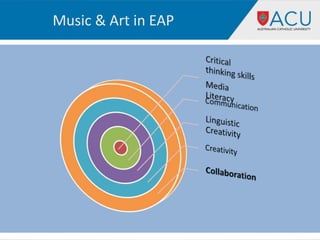
Music & Art in EAP
• Personal background and interests
• Theoretical background and 21st century skills
Language theories
Neuroscience
Psychology
Linguistic Creativity
 Communicative and Linguistic Competence
• Institutional context and needs
25/02/2017 3Svetlana Lukovic
Music & Art in EAP
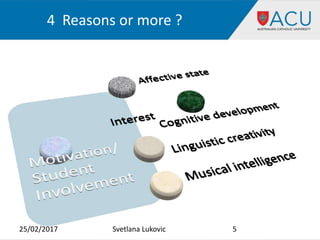
4 Reasons or more ?
25/02/2017 5Svetlana Lukovic
Context and needs
25/02/2017 6Svetlana Lukovic
• A 20-week course – direct entry into a degree course
• Not subject specific but skill-based
• Learning resources drawn from a range of disciplines
• Skills and conventions vital for tertiary studies
• Assessments designed to measure improvement,
competencies and proficiency
Assessments
•Presentations (some topics : Art and Music)
Art used for practice
•Reflective writing ( for personal experience part)
Lyrics and music to enhance practice
25/02/2017 7Svetlana Lukovic
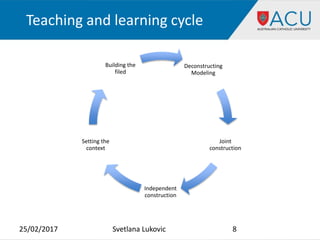
Teaching and learning cycle
Deconstructing
Modeling
Joint
construction
Independent
construction
Setting the
context
Building the
filed
25/02/2017 Svetlana Lukovic 8
Objectives
• To create a practice or task presentation with art
topic
• Teacher
– provides context,
– builds the field,
– provides the structure, language and a model,
– uses adequate resources
• Pre-teach and raise awareness about an artist
through reading or listening activities
• Research skills introduced
25/02/2017 9Svetlana Lukovic
Presentation : Phase 1
25/02/2017 10Svetlana Lukovic
• Over four weeks ( 8 days teaching about 16hrs
in total )
• Introduce the artist ( a reading passage or a
video clip to raise awareness and interest
• Set a research task ( Find something about …)
for homework on Friday
• Following week : students report on their
findings
Modelling
25/02/2017 Svetlana Lukovic 11
Presentation : Phase 2
• Model presentation: Information on artist,
description and impression
• Presentation language, phrases as well as
specific language for discussing art
• Marking criteria used to give feedback to the
teacher
• Post presentation :discussion questions
( critical thinking skills)
25/02/2017 Svetlana Lukovic 12
Discussion
25/02/2017 Svetlana Lukovic 13
Presentation Phase 3
• Students choose an artist or an artwork
• Students prepare their presentations for Week 5
• Setting
• Each student has a handout/ a task to give feedback
to their partner – choose three components
• Insert student clip
• Peer and teacher feedback
25/02/2017 14Svetlana Lukovic
Independent Stage
25/02/2017 Svetlana Lukovic 15
Classroom experience
• Highly motivated students
• Research done thoroughly
• Tried to impress the audience
• Proud of their own cultural background
• All well chosen and a good representation / range of
styles
• Personally, learned about artwork created in China,
Cambodia, Japan, Indonesia, Vietnam, China , Italy,
France, Russia and other countries
25/02/2017 16Svetlana Lukovic
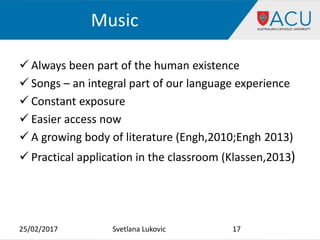
Music
 Always been part of the human existence
 Songs – an integral part of our language experience
 Constant exposure
 Easier access now
 A growing body of literature (Engh,2010;Engh 2013)
 Practical application in the classroom (Klassen,2013)
25/02/2017 Svetlana Lukovic 17
Music in EAP
 can enhance second language acquisition
 can improve learning environment
 can create a more relaxed and confident students
 can motivate students
 can reinforce learning in complex and comprehensive
ways
 can integrate language skills through communicative
and interactive experiences
25/02/2017 18Svetlana Lukovic
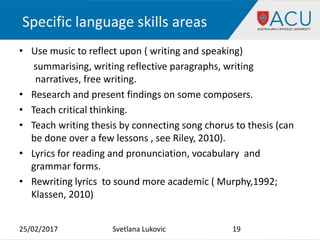
Specific language skills areas
• Use music to reflect upon ( writing and speaking)
summarising, writing reflective paragraphs, writing
narratives, free writing.
• Research and present findings on some composers.
• Teach critical thinking.
• Teach writing thesis by connecting song chorus to thesis (can
be done over a few lessons , see Riley, 2010).
• Lyrics for reading and pronunciation, vocabulary and
grammar forms.
• Rewriting lyrics to sound more academic ( Murphy,1992;
Klassen, 2010)
25/02/2017 19Svetlana Lukovic
Reflective writing
Songs – usually reflect personal experience or
reaction
Lyrics – can teach how to write essays – think
of chorus being thesis or how to reflect on
past experience
Life was a party to be thrown
But that was a million years ago
Can we party and learn from partying ?
25/02/2017 Svetlana Lukovic 20
Assessment
• Instructions
• Marking guide
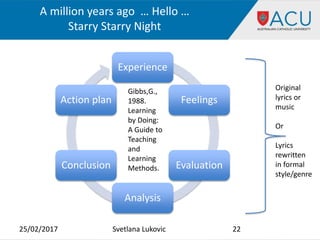
• Gibbs model
25/02/2017 Svetlana Lukovic 21
Experience
Feelings
Evaluation
Analysis
Conclusion
Action plan
25/02/2017 Svetlana Lukovic 22
Original
lyrics or
music
Or
Lyrics
rewritten
in formal
style/genre
Gibbs,G.,
1988.
Learning
by Doing:
A Guide to
Teaching
and
Learning
Methods.
A million years ago … Hello …
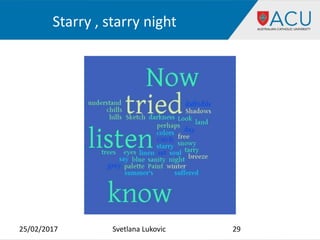
Starry Starry Night
Imagine these were your words
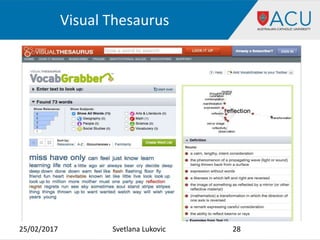
• WorditOut /Visual Thesaurus handout
• Guess what happened
• Discuss the event and/ or experience
• What happened? How did you feel?
• Discuss language – formality
• Hand out the original lyrics
25/02/2017 Svetlana Lukovic 23
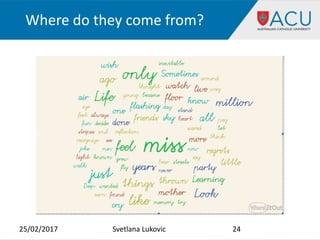
Where do they come from?
25/02/2017 Svetlana Lukovic 24
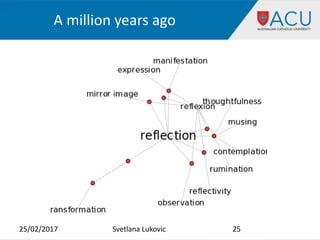
A million years ago
25/02/2017 Svetlana Lukovic 25
The collaboration principle
Combine, create and share
Step 1
In pairs create/ make new words using the word “reflection”
You can only use the letters that this word contains. The
rules are not to use pronouns, prepositions, abbreviations,
acronyms, articles and proper names. You can make nouns,
verbs, adjectives and adverbs only. You need to write them
down and you have 3 mins to finish.
After you have finished , a team/pair member writes on the
board and the team/ pair with the highest number of correct
words wins. Teachers, have prizes ready.
25/02/2017 26Svetlana Lukovic
Collaboration principle
Step 2
• In pairs, decide which words belong to academic words list
and write a sentence for each.
• Give students 5 – 7 minutes to complete sentences.
• Next, students write them on the mini white boards, A3 paper
or an empty Padlet wall. Whichever you use, do a class
review, or ask the pairs/ teams to review the sentences
written by other teams.
• The aim is to have correct sentences and the correct use of
prepositions.
25/02/2017 27Svetlana Lukovic
Visual Thesaurus
25/02/2017 Svetlana Lukovic 28
Starry , starry night
25/02/2017 Svetlana Lukovic 29
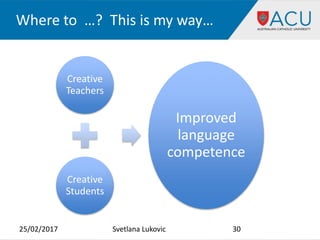
Where to …? This is my way…
Creative
Teachers
Creative
Students
Improved
language
competence
25/02/2017 Svetlana Lukovic 30
Reference List
Allison, D. (2004). Creativity, students’ academic writing, and EAP: Exploring comments on writing in an English
language degree programme. Journal of English for Academic Purposes, 3(3), 191-209.
Amabile, T. M. (1998). How to Kill Creativity. Harvard Business Review, 76(5), 76-87.
Bowen, T. (1997, October ). Effective vocabulary learning and teaching . Workshop, Novi Sad, Serbia
Engh, D. (2013) Effective use of music in language learning: a need analysis. Humanising Language Teaching
15 (5). Retrieved from http://www.hltmag.co.uk/oct13/mart03.htm
Engh, D (2013). Why Use Music in English Language Learning? A Survey of the Literature. English Language Teaching
6(2). doi:10.5539/elt.v6n2p113
Franken, R. (1994). Human Motivation (3rd ed). Pacific Grove, Calif. : Brooks/Cole Pub. Co.
Gibbs, G., 1988. Learning by Doing: A Guide to Teaching and Learning Methods. Oxford: Further Educational Unit, Oxford
Polytechnic
Gibbons, P. (2002). Scaffolding language scaffolding learning: Teaching second language learners in the mainstream classroom
Portsmouth: Heinemann.
Gibbons, P. (2009). English learners academic literacy and thinking: Learning in the challenge zone. Portsmouth: Heinemann.
Hyland, K. (2014). Genre and second language writing. Michigan: University of Michigan Press.
James, M. (2015). Managing the Classroom for Creativity. Creative Education, 6(10), 1032-1043.
doi: 10.4236/ce.2015.61010225/02/2017 31Svetlana Lukovic
Reference List
Kaufman, J. C., & Beghetto, R. A. (2009). Beyond big and little: The four C model of creativity. Review of General
Psychology, 13, 1-12.
Klassen, M.A ( 2013). Using song to enhance learning in the EAP classroom. Pathways and promises; English for
Academic Purposes Conference. Manitoba: The University of Manitoba
Retrieved from https://umanitoba.ca/student/elc/media/Music-as-an-
Enhancement-for-Second-Language-Learning
Maley, A. (2015). Overview: Creativity – that what, they why and the how. In A. Maley and N. Peachey (Eds).
Creativity in the English language classroom. Retrieved from https://www.teachingenglish.org.uk
Martin, J.R., & Rose, D. (2012). Learning to write, reading to learn: Genre, knowledge and pedagogy in the Sydney
school. Bristol: Equinox.
McMeans, A. (2015). Incorporating social media in the classroom. Education, 135 (3). 289-290.
Murphy, T. (1992). Music & Song. Oxford: Oxford University Press.
Patel, A. (2003). Language, music, syntax and the brain. Nature Neuroscience, 6 (7), 674-681.
http://dx.doi.org/10.1038/nn1082
25/02/2017 32Svetlana Lukovic
Reference List
Riley, K. (2010). Teaching conceptual frameworks, critical thinking, and academic writing by connecting
song chorus to thesis statement. Retrieved from http://www.corndancer.com/tunes/tunes_main.html
Tomlinson, B. (2015). Challenging teaches to use their course book creatively. In A. Maley and N. Peachey
(Eds). Creativity in the English language classroom. Retrieved from https://www.teachingenglish.org.uk
Woodward, T.(2015). A framework for learning creativity. In A. Maley and N. Peachey
(Eds). Creativity in the English language classroom. Retrieved from https://www.teachingenglish.org.uk
Wright , A. (2015). Medium : companion or slave ?.In A. Maley and N. Peachey (Eds). Creativity in the
English language classroom. Retrieved from https://www.teachingenglish.org.uk
25/02/2017 33Svetlana Lukovic

Cam tesol sl. final copy

  • 1.
    The 13th AnnualCamTESOL Conference on English Language Teaching 25/02/2017 1Svetlana Lukovic
  • 2.
    Music and Artin English for Academic Purposes 25/02/2017 2Svetlana Lukovic to build bridges for the future
  • 3.
    Music & Artin EAP • Personal background and interests • Theoretical background and 21st century skills Language theories Neuroscience Psychology Linguistic Creativity  Communicative and Linguistic Competence • Institutional context and needs 25/02/2017 3Svetlana Lukovic
  • 4.
  • 5.
    4 Reasons ormore ? 25/02/2017 5Svetlana Lukovic
  • 6.
    Context and needs 25/02/20176Svetlana Lukovic • A 20-week course – direct entry into a degree course • Not subject specific but skill-based • Learning resources drawn from a range of disciplines • Skills and conventions vital for tertiary studies • Assessments designed to measure improvement, competencies and proficiency
  • 7.
    Assessments •Presentations (some topics: Art and Music) Art used for practice •Reflective writing ( for personal experience part) Lyrics and music to enhance practice 25/02/2017 7Svetlana Lukovic
  • 8.
    Teaching and learningcycle Deconstructing Modeling Joint construction Independent construction Setting the context Building the filed 25/02/2017 Svetlana Lukovic 8
  • 9.
    Objectives • To createa practice or task presentation with art topic • Teacher – provides context, – builds the field, – provides the structure, language and a model, – uses adequate resources • Pre-teach and raise awareness about an artist through reading or listening activities • Research skills introduced 25/02/2017 9Svetlana Lukovic
  • 10.
    Presentation : Phase1 25/02/2017 10Svetlana Lukovic • Over four weeks ( 8 days teaching about 16hrs in total ) • Introduce the artist ( a reading passage or a video clip to raise awareness and interest • Set a research task ( Find something about …) for homework on Friday • Following week : students report on their findings
  • 11.
  • 12.
    Presentation : Phase2 • Model presentation: Information on artist, description and impression • Presentation language, phrases as well as specific language for discussing art • Marking criteria used to give feedback to the teacher • Post presentation :discussion questions ( critical thinking skills) 25/02/2017 Svetlana Lukovic 12
  • 13.
  • 14.
    Presentation Phase 3 •Students choose an artist or an artwork • Students prepare their presentations for Week 5 • Setting • Each student has a handout/ a task to give feedback to their partner – choose three components • Insert student clip • Peer and teacher feedback 25/02/2017 14Svetlana Lukovic
  • 15.
  • 16.
    Classroom experience • Highlymotivated students • Research done thoroughly • Tried to impress the audience • Proud of their own cultural background • All well chosen and a good representation / range of styles • Personally, learned about artwork created in China, Cambodia, Japan, Indonesia, Vietnam, China , Italy, France, Russia and other countries 25/02/2017 16Svetlana Lukovic
  • 17.
    Music  Always beenpart of the human existence  Songs – an integral part of our language experience  Constant exposure  Easier access now  A growing body of literature (Engh,2010;Engh 2013)  Practical application in the classroom (Klassen,2013) 25/02/2017 Svetlana Lukovic 17
  • 18.
    Music in EAP can enhance second language acquisition  can improve learning environment  can create a more relaxed and confident students  can motivate students  can reinforce learning in complex and comprehensive ways  can integrate language skills through communicative and interactive experiences 25/02/2017 18Svetlana Lukovic
  • 19.
    Specific language skillsareas • Use music to reflect upon ( writing and speaking) summarising, writing reflective paragraphs, writing narratives, free writing. • Research and present findings on some composers. • Teach critical thinking. • Teach writing thesis by connecting song chorus to thesis (can be done over a few lessons , see Riley, 2010). • Lyrics for reading and pronunciation, vocabulary and grammar forms. • Rewriting lyrics to sound more academic ( Murphy,1992; Klassen, 2010) 25/02/2017 19Svetlana Lukovic
  • 20.
    Reflective writing Songs –usually reflect personal experience or reaction Lyrics – can teach how to write essays – think of chorus being thesis or how to reflect on past experience Life was a party to be thrown But that was a million years ago Can we party and learn from partying ? 25/02/2017 Svetlana Lukovic 20
  • 21.
    Assessment • Instructions • Markingguide • Gibbs model 25/02/2017 Svetlana Lukovic 21
  • 22.
    Experience Feelings Evaluation Analysis Conclusion Action plan 25/02/2017 SvetlanaLukovic 22 Original lyrics or music Or Lyrics rewritten in formal style/genre Gibbs,G., 1988. Learning by Doing: A Guide to Teaching and Learning Methods. A million years ago … Hello … Starry Starry Night
  • 23.
    Imagine these wereyour words • WorditOut /Visual Thesaurus handout • Guess what happened • Discuss the event and/ or experience • What happened? How did you feel? • Discuss language – formality • Hand out the original lyrics 25/02/2017 Svetlana Lukovic 23
  • 24.
    Where do theycome from? 25/02/2017 Svetlana Lukovic 24
  • 25.
    A million yearsago 25/02/2017 Svetlana Lukovic 25
  • 26.
    The collaboration principle Combine,create and share Step 1 In pairs create/ make new words using the word “reflection” You can only use the letters that this word contains. The rules are not to use pronouns, prepositions, abbreviations, acronyms, articles and proper names. You can make nouns, verbs, adjectives and adverbs only. You need to write them down and you have 3 mins to finish. After you have finished , a team/pair member writes on the board and the team/ pair with the highest number of correct words wins. Teachers, have prizes ready. 25/02/2017 26Svetlana Lukovic
  • 27.
    Collaboration principle Step 2 •In pairs, decide which words belong to academic words list and write a sentence for each. • Give students 5 – 7 minutes to complete sentences. • Next, students write them on the mini white boards, A3 paper or an empty Padlet wall. Whichever you use, do a class review, or ask the pairs/ teams to review the sentences written by other teams. • The aim is to have correct sentences and the correct use of prepositions. 25/02/2017 27Svetlana Lukovic
  • 28.
  • 29.
    Starry , starrynight 25/02/2017 Svetlana Lukovic 29
  • 30.
    Where to …?This is my way… Creative Teachers Creative Students Improved language competence 25/02/2017 Svetlana Lukovic 30
  • 31.
    Reference List Allison, D.(2004). Creativity, students’ academic writing, and EAP: Exploring comments on writing in an English language degree programme. Journal of English for Academic Purposes, 3(3), 191-209. Amabile, T. M. (1998). How to Kill Creativity. Harvard Business Review, 76(5), 76-87. Bowen, T. (1997, October ). Effective vocabulary learning and teaching . Workshop, Novi Sad, Serbia Engh, D. (2013) Effective use of music in language learning: a need analysis. Humanising Language Teaching 15 (5). Retrieved from http://www.hltmag.co.uk/oct13/mart03.htm Engh, D (2013). Why Use Music in English Language Learning? A Survey of the Literature. English Language Teaching 6(2). doi:10.5539/elt.v6n2p113 Franken, R. (1994). Human Motivation (3rd ed). Pacific Grove, Calif. : Brooks/Cole Pub. Co. Gibbs, G., 1988. Learning by Doing: A Guide to Teaching and Learning Methods. Oxford: Further Educational Unit, Oxford Polytechnic Gibbons, P. (2002). Scaffolding language scaffolding learning: Teaching second language learners in the mainstream classroom Portsmouth: Heinemann. Gibbons, P. (2009). English learners academic literacy and thinking: Learning in the challenge zone. Portsmouth: Heinemann. Hyland, K. (2014). Genre and second language writing. Michigan: University of Michigan Press. James, M. (2015). Managing the Classroom for Creativity. Creative Education, 6(10), 1032-1043. doi: 10.4236/ce.2015.61010225/02/2017 31Svetlana Lukovic
  • 32.
    Reference List Kaufman, J.C., & Beghetto, R. A. (2009). Beyond big and little: The four C model of creativity. Review of General Psychology, 13, 1-12. Klassen, M.A ( 2013). Using song to enhance learning in the EAP classroom. Pathways and promises; English for Academic Purposes Conference. Manitoba: The University of Manitoba Retrieved from https://umanitoba.ca/student/elc/media/Music-as-an- Enhancement-for-Second-Language-Learning Maley, A. (2015). Overview: Creativity – that what, they why and the how. In A. Maley and N. Peachey (Eds). Creativity in the English language classroom. Retrieved from https://www.teachingenglish.org.uk Martin, J.R., & Rose, D. (2012). Learning to write, reading to learn: Genre, knowledge and pedagogy in the Sydney school. Bristol: Equinox. McMeans, A. (2015). Incorporating social media in the classroom. Education, 135 (3). 289-290. Murphy, T. (1992). Music & Song. Oxford: Oxford University Press. Patel, A. (2003). Language, music, syntax and the brain. Nature Neuroscience, 6 (7), 674-681. http://dx.doi.org/10.1038/nn1082 25/02/2017 32Svetlana Lukovic
  • 33.
    Reference List Riley, K.(2010). Teaching conceptual frameworks, critical thinking, and academic writing by connecting song chorus to thesis statement. Retrieved from http://www.corndancer.com/tunes/tunes_main.html Tomlinson, B. (2015). Challenging teaches to use their course book creatively. In A. Maley and N. Peachey (Eds). Creativity in the English language classroom. Retrieved from https://www.teachingenglish.org.uk Woodward, T.(2015). A framework for learning creativity. In A. Maley and N. Peachey (Eds). Creativity in the English language classroom. Retrieved from https://www.teachingenglish.org.uk Wright , A. (2015). Medium : companion or slave ?.In A. Maley and N. Peachey (Eds). Creativity in the English language classroom. Retrieved from https://www.teachingenglish.org.uk 25/02/2017 33Svetlana Lukovic

Editor's Notes

  • #19 ml.
  • #29 I only wanted to have fun Learning to fly, learning to run I let my heart decide the way When I was young Deep down I must have always known That this would be inevitable To earn my stripes I'd have to pay And bear my soul I know I'm not the only one Who regrets the things they've done Sometimes I just feel it's only me Who can't stand the reflection that they see I wish I could live a little more Look up to the sky, not just the floor I feel like my life is flashing by And all I can do is watch and cry I miss the air, I miss my friends I miss my mother, I miss it when Life was a party to be thrown But that was a million years ago
  • #31 .