A Holistic Approach to Property Valuations
Using text analytics to detect crucial missing data from property listings
can strengthen the property valuation process by ensuring greater
accuracy.
Executive Summary
The unreliability of property valuations was one
of the key findings that emerged from the (2008)
Financial Crisis Inquiry Commission’s probe. Two
key reasons among the various factors con-
tributing to not-so-fair valuations are missing
and/or inaccurate property listing data and not
leveraging data from different sources to the
fullest extent.
Incorporating all the available data (structured
and unstructured) has its own challenges. With
the current explosion of data, understanding the
context and relevance and extracting meaning
from the data available has become difficult.
An important step in the valuation process is iden-
tifying a set of comparables for a given “subject
property.” Since the last recession, automated
comparable identification methods have gained
momentum given their consistency and lower
costs. We believe that a holistic approach needs
to be taken that optimizes various aspects such
as selection of additional relevant data, and deter-
mining if this additional data can provide benefits
and how to integrate the derived benefits into
the business architecture. We use the sensing,
thinking, acting and recursion (STAR)1
working
model to approach the issue of ensuring more
accurate valuations.
Introduction
Since the 2008 recession, property valuations
have come under scrutiny in the mortgage
business.2
In the light of unintentional as well
intentional errors, regulators have recommended
or mandated the use of more data from sources
such as public records and property tax data in
the valuation process.3,4,5
The challenge, however,
is to store and analyze this additional data without
compromising too much speed or accuracy. Also,
it is important to understand the benefits that can
be extracted from the additional data, since there
is a belief that most of the data is redundant.
It has been estimated that only 20% of the data
in the world is structured. A staggering 80% is
unstructured data, most of which is not or cannot
be leveraged for business purposes.6,7
The over-
whelming rate of data generation is a challenge
that most technology firms are trying to address.
Another consideration is whether the bigger,
unstructured data will actually lead to better
results and will ROI actually increase proportion-
ally with data.8,9,10
The hype around big data11
seems to be subsiding
and the focus has now shifted to trying to enhance
the ROI of big data.
cognizant 20-20 insights | august 2015
• Cognizant 20-20 Insights
cognizant 20-20 insights 2
We looked at some real-world examples and case
studies to understand the true benefits of using
big data and allied concepts in the mortgage
industry.
The case study below describes the use of text
data to increase the accuracy of decision-making.
Real Estate Industry Case Study: Using
Unstructured Data for Enhancing
Accuracy of Property Valuations
Among the challenges faced by the real estate
industry (especially for multiple listings) are
inconsistency of data, incomplete/missing data
and a multiplicity of sources.4,14
Multiple listing
data is used to decide comparable properties
(listed and sold) to value the “subject property.”
Thus, data completeness is critical for identifica-
tion of comparable properties and the valuation
process. Comparable identification, in turn, is
important for both manual appraisals (full or
BPO) and automated valuations such as AVM.
Since the 2008 recession, automated valuations
and automated comparable identification
methods/processes have gained some traction.
These provide consistent results at lower costs,12,13
thus enabling more frequent valuations and
better decision-making. The most frequently
used automated comparable identification
method is based on Euclidian distance on key
property parameters such as area, age, number
of bedrooms and bathrooms, etc. However, infor-
mation on many of these parameters is missing in
many multiple listings. The accuracy of valuations
is not only relevant for identification of collateral
fraud but also for providing an accurate picture to
lenders on their individual property and portfolio
losses. For example, a large lender in the U.S. has
a portfolio of around 10 million properties. The
average price of each property is about $250K.
The typical default rate is around 10%. This works
out to almost $250 billion worth of properties
at risk. An error in valuation of only 10% would
mean a potential loss of about $25 billion.
In such a scenario, leveraging unstructured data
to improve the accuracy of valuation is well worth
the effort.
We decided to analyze the data in eight multiple
listings for various numeric, categorical and
unstructured fields/variables. There were about
200 variables for which data can be captured by
a real-estate broker. We noticed that the values
in certain key variables such as garages were
missing in up to 100% of some of the listings.
We studied broker remarks (free-flow text data)
to see if more information about these missing
fields was available to validate the numeric data
fields. We decided to use R code to find out in how
many instances some information is provided in
the broker remarks for the eight main variables:
garage, appliances, living area, exterior features,
construction material, parking carport, amenities
and porch type.
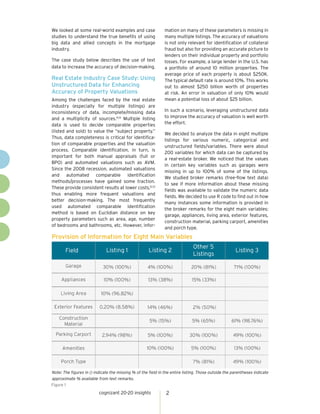
Provision of Information for Eight Main Variables
Figure 1
Note: The figures in () indicate the missing % of the field in the entire listing. Those outside the parentheses indicate
approximate % available from text remarks.
cognizant 20-20 insights 3
Figure 1 (preceding page) indicates that text
analyses can provide some information either for
validation of the numeric/categorical variables or
to fill in the missing data. This is different from the
typical text analytics of sentiments and emotions
in that it leverages much more granular infor-
mation in the text. Such data/information in the
unstructured fields has the potential to enhance
the quality or quantity of the numeric and/or
categorical field, thus enhancing the models and
their lifts.
We conducted an analysis to understand the
additional accuracy provided to the valuation
models by virtue of additional data/info available
through text data. We used a score developed
to provide the closeness of the comparable
properties to the subject property. We restricted
the use of text analytics to broker remarks,
though it can be used with any unstructured data.
The comparable property scores are a function
of variables such as property type, area, number
of baths, number of beds, price rate, proximity to
subject, lot size, age, etc. A lot of information for
these independent variables was available in the
remarks field.
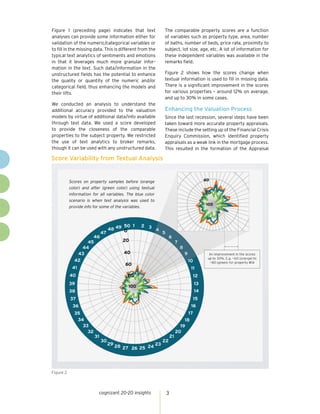
Figure 2 shows how the scores change when
textual information is used to fill in missing data.
There is a significant improvement in the scores
for various properties – around 12% on average,
and up to 30% in some cases.
Enhancing the Valuation Process
Since the last recession, several steps have been
taken toward more accurate property appraisals.
These include the setting up of the Financial Crisis
Enquiry Commission, which identified property
appraisals as a weak link in the mortgage process.
This resulted in the formation of the Appraisal
Figure 2
Scores on property samples before (orange
color) and after (green color) using textual
information for all variables. The blue color
scenario is when text analysis was used to
provide info for some of the variables.
Score Variability from Textual Analysis
cognizant 20-20 insights 4
Foundation authorized by Congress. It came up
with several Valuation Advisories. A key aspect
mentioned was that “using automation to select
comparable properties that will produce credible
and reliable value estimates is the challenge of the
AVM.”13
On the other hand, it had been emphasized
by Fannie Mae15
that existing automation software
solutions are not sufficient and do not guarantee
good data quality. As the identification of reliable
comparable properties is important even in non-
automated methods such as BPO/appraisals, any
issue with data or the software will affect both
automated and manual methods.
The leveraging of unstructured data becomes
challenging particularly for mass appraisals.
This is an area where the approach used in the
case study above can be valuable. The entire
process can be automated to a significant
extent, thus meeting the regulatory require-
ments. In most real-world scenarios, there is sig-
nificant redundancy in the data provided.8,9
This
redundancy can be leveraged to validate and/or
reduce missing values from data obtained from a
single source or similar sources.
Below we discuss integrating these enhanced
models with the existing selection process for
comparables in terms of data, methodology and
process.
Data: The STAR approach to addressing the
valuation problem highlights that the agent
remarks/comments in the multiple listing services
(MLS) is one source of data regarding a property.
The other possible sources are public records
data, property tax data and property insurance
data. However, data from each of these sources
would have different limitations of accuracy.
Demographic sources such as Acxiom, Experian,
etc. can provide information about the neigh-
borhood, etc. of the subject property. These
aspects and challenges must be considered when
designing the enterprise architecture.
Methodology: The Euclidean approach is a
commonly used method to identify comparable
properties in the industry12,13
because it is simple
and intuitive. The overall methodology is not
impacted by virtue of using the text analytics
to validate/impute missing data. It is a step that
comes before application of the selection meth-
odology.
Process: The overall process of property
valuation, either the application of automated
valuation models to comparable properties or
using comparable properties with respect to a
subject for broker price opinion or full appraisal,
requires comparable selection. The current
process of comparable selection primarily uses
MLS data. Software is used mostly to pull data
from the listings and then to use it downstream,
in the valuation process. The software deployed
by the industry typically uses the RESO schema.
One needs to integrate the text analytics
approach used in the case study above with the
pulling of the data from MLS and then move it to
the data warehouse or update the database and
have it reflected in the unified view of the data. In
fact, developing and integrating a text analytics
module to the existing MLS software provides
a significant opportunity to the agent to be
more effective in deciding which listing to focus
on among the available set of listings. It also
provides an efficient way for the end customer
to extract more information from the listings
quickly. Another challenge or opportunity is the
development of software apps or platforms that
are able to integrate data from non-MLS sources
(property tax, public records, etc.) into the data
warehouse.
The data model and the technology to pull
data (structured, unstructured) from different
sources would be context-specific. Based on our
experience, however, we believe that a unified
single view of the data is a significant improve-
ment and aligns well with the modeling factory
approach. This supports quick updates and vali-
dations of the valuation models.
Acknowledgements
Aan Chauhan, T.R. Rajarajan, Sunil Patil
Footnotes
1
	 Merchant Edward, “Making Analytics Actionable for Financial Institutions,” Cognizant White paper,
2014.http://www.cognizant.com/InsightsWhitepapers/Making-Analytics-Actionable-for-Financial-
Institutions-Part-1-of-3-codex992.pdf
2
	 “The Financial Crisis Enquiry Report,” Financial Crisis Enquiry Commission (FCEC), U.S., January 2011.
http://fcic.law.stanford.edu/report
3
	 Geffner, M, “Home appraisals come under more scrutiny,” Bankrate.com, 2010. http://www.bankrate.
com/finance/real-estate/home-appraisals-come-under-more-scrutiny-1.aspx
4
	 Stewart, D, “The Sudden Rise of Property Valuation Frauds,” NDC data brief, 2014.
5
	 “December 2010 Interagency Appraisal and Evaluation Guidelines,” Appraisal Standards Board (ASB),
2010. https://netforum.avectra.com/eweb/DynamicPage.aspx?Site=taf&WebCode=ASB
6
	 Michael Walker, “Data Science Central, Structured vs. Unstructured Data: The Rise of Data Anarchy,”
December, 2012. http://www.datasciencecentral.com/profiles/blogs/structured-vs-unstructured-data-
the-rise-of-data-anarchy
7
	 https://en.wikipedia.org/wiki/Unstructured_data
8
	 Wu Michael, “Why is there so Much Statistical Redundancy in Big Data?” 2012a. https://community.
lithium.com/t5/Science-of-Social-blog/Why-is-there-so-Much-Statistical-Redundancy-in-Big-Data/
ba-p/61924
9
	 Wu Michael, “The Big Data Fallacy: Data ≠ Information,” 2012b. https://community.lithium.com/t5/
Science-of-Social-blog/The-2nd-Fallacy-of-Big-Data-Information-Insights/ba-p/68080
10
	 Ray Poynter, “The Signal and the Noise: Lessons for marketers, insight professionals, and users of big
data from Nate Silver’s recent book,” 2014. http://www.index-files.com/7dpdf/52ef1da61f0b67ac3d44
607d
11
	 “Gartner’s 2013 Hype Cycle for Emerging Technologies Maps Out Evolving Relationship Between
Humans and Machines,” 2013. http://www.gartner.com/newsroom/id/2575515
12
	 “Identifying Comparable Properties,” Appraisal Practices Board (APB), 2013a. http://www.txapprais-
ers.org/VA4.pdf
13
	 “Identifying Comparable Properties In Automated Valuation Models for Mass appraisal,” Appraisal
Practices Board (APB), 2013b. http://www.txappraisers.org/VA5.pdf
14
	 Taggart, J., “Can you really trust just MLS data?” NDC Data Brief, 2013.
15
	 Fannie Mae, Appraisal-property-report-faqs. http://webcache.googleusercontent.com/search?q
=cache:RYZUiINjtDUJ:https://www.fanniemae.com/content/faq/appraisal-property-report-faqs.
pdf+&cd=1&hl=en&ct=clnk&gl=in
About Cognizant
Cognizant (NASDAQ: CTSH) is a leading provider of information technology, consulting, and business
process outsourcing services, dedicated to helping the world’s leading companies build stronger busi-
nesses. Headquartered in Teaneck, New Jersey (U.S.), Cognizant combines a passion for client satisfac-
tion, technology innovation, deep industry and business process expertise, and a global, collaborative
workforce that embodies the future of work. With over 100 development and delivery centers worldwide
and approximately 218,000 employees as of June 30, 2015, Cognizant is a member of the NASDAQ-100,
the S&P 500, the Forbes Global 2000, and the Fortune 500 and is ranked among the top performing and
fastest growing companies in the world. Visit us online at www.cognizant.com or follow us on Twitter: Cognizant.
World Headquarters
500 Frank W. Burr Blvd.
Teaneck, NJ 07666 USA
Phone: +1 201 801 0233
Fax: +1 201 801 0243
Toll Free: +1 888 937 3277
Email: inquiry@cognizant.com
European Headquarters
1 Kingdom Street
Paddington Central
London W2 6BD
Phone: +44 (0) 20 7297 7600
Fax: +44 (0) 20 7121 0102
Email: infouk@cognizant.com
Cognizant Japan KK
2F, Kojimachi Miyuki Building,
3-4 Ni-Bancyo Chiyoda-ku
Tokyo 102-0084 Japan
Phone: +81-3-5216-6888
Fax: +81-3-5216-6887
­­© Copyright 2015, Cognizant. All rights reserved. No part of this document may be reproduced, stored in a retrieval system, transmitted in any form or by any
means, electronic, mechanical, photocopying, recording, or otherwise, without the express written permission from Cognizant. The information contained herein is
subject to change without notice. All other trademarks mentioned herein are the property of their respective owners.
Codex 1368
About the Authors
Edward Merchant is the Chief Technology Officer in Cognizant’s Banking & Financial Services Business
Unit. He is responsible for advising and coaching BFS clients seeking effective and affordable ways
to address chronic business and operational challenges through the creative use of both mature
and emerging technologies. As the global co-lead for the BFS Technology and Architecture Office,
Ed manages a team of solution architects and engineers responsible for converting concepts into
implementable software designs. Over the course of his 30+ year career, he has held a variety
of systems engineering, architectural design and IT operations leadership roles within financial
institutions (regional and divisional CIO positions, Global Head of IT Strategy and Architecture, Global
Head of Vendor Management), IT Services providers (sector and country BU Head positions) and
strategic advisory firms (Big 4 partner). Ed holds an M.S. in mechanical engineering from Fairleigh
Dickinson University and a B.S. in industrial education and technology from Montclair State University.
He can be reached at Edward.Merchant@cognizant.com.
Nipun Kapur is Director and Chief Architect, TAO, in Cognizant’s Banking & Financial Services (BFS)
Business Unit. He is responsible for specialized consulting to existing and potential BFS clients. Nipun
has an M.Tech. and Ph.D. from Indian Institute of Technology, Roorkee. He has been associated with
analytical/mathematical modeling for over 20 years – with the past 15 years focused on BFSI domains.
Nipun has set up analytics COEs (GE Insurance Risk, CoreLogic) in India, leading highly qualified teams
working on model development, evaluation, productization and production. He has been published in
various national and international journals in the area of risk and modelling. Nipun is a certified Six
Sigma (Green Belt) from GE. He can be reached at Nipun.Kapur@cognizant.com.

A Holistic Approach to Property Valuations

  • 1.
    A Holistic Approachto Property Valuations Using text analytics to detect crucial missing data from property listings can strengthen the property valuation process by ensuring greater accuracy. Executive Summary The unreliability of property valuations was one of the key findings that emerged from the (2008) Financial Crisis Inquiry Commission’s probe. Two key reasons among the various factors con- tributing to not-so-fair valuations are missing and/or inaccurate property listing data and not leveraging data from different sources to the fullest extent. Incorporating all the available data (structured and unstructured) has its own challenges. With the current explosion of data, understanding the context and relevance and extracting meaning from the data available has become difficult. An important step in the valuation process is iden- tifying a set of comparables for a given “subject property.” Since the last recession, automated comparable identification methods have gained momentum given their consistency and lower costs. We believe that a holistic approach needs to be taken that optimizes various aspects such as selection of additional relevant data, and deter- mining if this additional data can provide benefits and how to integrate the derived benefits into the business architecture. We use the sensing, thinking, acting and recursion (STAR)1 working model to approach the issue of ensuring more accurate valuations. Introduction Since the 2008 recession, property valuations have come under scrutiny in the mortgage business.2 In the light of unintentional as well intentional errors, regulators have recommended or mandated the use of more data from sources such as public records and property tax data in the valuation process.3,4,5 The challenge, however, is to store and analyze this additional data without compromising too much speed or accuracy. Also, it is important to understand the benefits that can be extracted from the additional data, since there is a belief that most of the data is redundant. It has been estimated that only 20% of the data in the world is structured. A staggering 80% is unstructured data, most of which is not or cannot be leveraged for business purposes.6,7 The over- whelming rate of data generation is a challenge that most technology firms are trying to address. Another consideration is whether the bigger, unstructured data will actually lead to better results and will ROI actually increase proportion- ally with data.8,9,10 The hype around big data11 seems to be subsiding and the focus has now shifted to trying to enhance the ROI of big data. cognizant 20-20 insights | august 2015 • Cognizant 20-20 Insights
  • 2.
    cognizant 20-20 insights2 We looked at some real-world examples and case studies to understand the true benefits of using big data and allied concepts in the mortgage industry. The case study below describes the use of text data to increase the accuracy of decision-making. Real Estate Industry Case Study: Using Unstructured Data for Enhancing Accuracy of Property Valuations Among the challenges faced by the real estate industry (especially for multiple listings) are inconsistency of data, incomplete/missing data and a multiplicity of sources.4,14 Multiple listing data is used to decide comparable properties (listed and sold) to value the “subject property.” Thus, data completeness is critical for identifica- tion of comparable properties and the valuation process. Comparable identification, in turn, is important for both manual appraisals (full or BPO) and automated valuations such as AVM. Since the 2008 recession, automated valuations and automated comparable identification methods/processes have gained some traction. These provide consistent results at lower costs,12,13 thus enabling more frequent valuations and better decision-making. The most frequently used automated comparable identification method is based on Euclidian distance on key property parameters such as area, age, number of bedrooms and bathrooms, etc. However, infor- mation on many of these parameters is missing in many multiple listings. The accuracy of valuations is not only relevant for identification of collateral fraud but also for providing an accurate picture to lenders on their individual property and portfolio losses. For example, a large lender in the U.S. has a portfolio of around 10 million properties. The average price of each property is about $250K. The typical default rate is around 10%. This works out to almost $250 billion worth of properties at risk. An error in valuation of only 10% would mean a potential loss of about $25 billion. In such a scenario, leveraging unstructured data to improve the accuracy of valuation is well worth the effort. We decided to analyze the data in eight multiple listings for various numeric, categorical and unstructured fields/variables. There were about 200 variables for which data can be captured by a real-estate broker. We noticed that the values in certain key variables such as garages were missing in up to 100% of some of the listings. We studied broker remarks (free-flow text data) to see if more information about these missing fields was available to validate the numeric data fields. We decided to use R code to find out in how many instances some information is provided in the broker remarks for the eight main variables: garage, appliances, living area, exterior features, construction material, parking carport, amenities and porch type. Provision of Information for Eight Main Variables Figure 1 Note: The figures in () indicate the missing % of the field in the entire listing. Those outside the parentheses indicate approximate % available from text remarks.
  • 3.
    cognizant 20-20 insights3 Figure 1 (preceding page) indicates that text analyses can provide some information either for validation of the numeric/categorical variables or to fill in the missing data. This is different from the typical text analytics of sentiments and emotions in that it leverages much more granular infor- mation in the text. Such data/information in the unstructured fields has the potential to enhance the quality or quantity of the numeric and/or categorical field, thus enhancing the models and their lifts. We conducted an analysis to understand the additional accuracy provided to the valuation models by virtue of additional data/info available through text data. We used a score developed to provide the closeness of the comparable properties to the subject property. We restricted the use of text analytics to broker remarks, though it can be used with any unstructured data. The comparable property scores are a function of variables such as property type, area, number of baths, number of beds, price rate, proximity to subject, lot size, age, etc. A lot of information for these independent variables was available in the remarks field. Figure 2 shows how the scores change when textual information is used to fill in missing data. There is a significant improvement in the scores for various properties – around 12% on average, and up to 30% in some cases. Enhancing the Valuation Process Since the last recession, several steps have been taken toward more accurate property appraisals. These include the setting up of the Financial Crisis Enquiry Commission, which identified property appraisals as a weak link in the mortgage process. This resulted in the formation of the Appraisal Figure 2 Scores on property samples before (orange color) and after (green color) using textual information for all variables. The blue color scenario is when text analysis was used to provide info for some of the variables. Score Variability from Textual Analysis
  • 4.
    cognizant 20-20 insights4 Foundation authorized by Congress. It came up with several Valuation Advisories. A key aspect mentioned was that “using automation to select comparable properties that will produce credible and reliable value estimates is the challenge of the AVM.”13 On the other hand, it had been emphasized by Fannie Mae15 that existing automation software solutions are not sufficient and do not guarantee good data quality. As the identification of reliable comparable properties is important even in non- automated methods such as BPO/appraisals, any issue with data or the software will affect both automated and manual methods. The leveraging of unstructured data becomes challenging particularly for mass appraisals. This is an area where the approach used in the case study above can be valuable. The entire process can be automated to a significant extent, thus meeting the regulatory require- ments. In most real-world scenarios, there is sig- nificant redundancy in the data provided.8,9 This redundancy can be leveraged to validate and/or reduce missing values from data obtained from a single source or similar sources. Below we discuss integrating these enhanced models with the existing selection process for comparables in terms of data, methodology and process. Data: The STAR approach to addressing the valuation problem highlights that the agent remarks/comments in the multiple listing services (MLS) is one source of data regarding a property. The other possible sources are public records data, property tax data and property insurance data. However, data from each of these sources would have different limitations of accuracy. Demographic sources such as Acxiom, Experian, etc. can provide information about the neigh- borhood, etc. of the subject property. These aspects and challenges must be considered when designing the enterprise architecture. Methodology: The Euclidean approach is a commonly used method to identify comparable properties in the industry12,13 because it is simple and intuitive. The overall methodology is not impacted by virtue of using the text analytics to validate/impute missing data. It is a step that comes before application of the selection meth- odology. Process: The overall process of property valuation, either the application of automated valuation models to comparable properties or using comparable properties with respect to a subject for broker price opinion or full appraisal, requires comparable selection. The current process of comparable selection primarily uses MLS data. Software is used mostly to pull data from the listings and then to use it downstream, in the valuation process. The software deployed by the industry typically uses the RESO schema. One needs to integrate the text analytics approach used in the case study above with the pulling of the data from MLS and then move it to the data warehouse or update the database and have it reflected in the unified view of the data. In fact, developing and integrating a text analytics module to the existing MLS software provides a significant opportunity to the agent to be more effective in deciding which listing to focus on among the available set of listings. It also provides an efficient way for the end customer to extract more information from the listings quickly. Another challenge or opportunity is the development of software apps or platforms that are able to integrate data from non-MLS sources (property tax, public records, etc.) into the data warehouse. The data model and the technology to pull data (structured, unstructured) from different sources would be context-specific. Based on our experience, however, we believe that a unified single view of the data is a significant improve- ment and aligns well with the modeling factory approach. This supports quick updates and vali- dations of the valuation models.
  • 5.
    Acknowledgements Aan Chauhan, T.R.Rajarajan, Sunil Patil Footnotes 1 Merchant Edward, “Making Analytics Actionable for Financial Institutions,” Cognizant White paper, 2014.http://www.cognizant.com/InsightsWhitepapers/Making-Analytics-Actionable-for-Financial- Institutions-Part-1-of-3-codex992.pdf 2 “The Financial Crisis Enquiry Report,” Financial Crisis Enquiry Commission (FCEC), U.S., January 2011. http://fcic.law.stanford.edu/report 3 Geffner, M, “Home appraisals come under more scrutiny,” Bankrate.com, 2010. http://www.bankrate. com/finance/real-estate/home-appraisals-come-under-more-scrutiny-1.aspx 4 Stewart, D, “The Sudden Rise of Property Valuation Frauds,” NDC data brief, 2014. 5 “December 2010 Interagency Appraisal and Evaluation Guidelines,” Appraisal Standards Board (ASB), 2010. https://netforum.avectra.com/eweb/DynamicPage.aspx?Site=taf&WebCode=ASB 6 Michael Walker, “Data Science Central, Structured vs. Unstructured Data: The Rise of Data Anarchy,” December, 2012. http://www.datasciencecentral.com/profiles/blogs/structured-vs-unstructured-data- the-rise-of-data-anarchy 7 https://en.wikipedia.org/wiki/Unstructured_data 8 Wu Michael, “Why is there so Much Statistical Redundancy in Big Data?” 2012a. https://community. lithium.com/t5/Science-of-Social-blog/Why-is-there-so-Much-Statistical-Redundancy-in-Big-Data/ ba-p/61924 9 Wu Michael, “The Big Data Fallacy: Data ≠ Information,” 2012b. https://community.lithium.com/t5/ Science-of-Social-blog/The-2nd-Fallacy-of-Big-Data-Information-Insights/ba-p/68080 10 Ray Poynter, “The Signal and the Noise: Lessons for marketers, insight professionals, and users of big data from Nate Silver’s recent book,” 2014. http://www.index-files.com/7dpdf/52ef1da61f0b67ac3d44 607d 11 “Gartner’s 2013 Hype Cycle for Emerging Technologies Maps Out Evolving Relationship Between Humans and Machines,” 2013. http://www.gartner.com/newsroom/id/2575515 12 “Identifying Comparable Properties,” Appraisal Practices Board (APB), 2013a. http://www.txapprais- ers.org/VA4.pdf 13 “Identifying Comparable Properties In Automated Valuation Models for Mass appraisal,” Appraisal Practices Board (APB), 2013b. http://www.txappraisers.org/VA5.pdf 14 Taggart, J., “Can you really trust just MLS data?” NDC Data Brief, 2013. 15 Fannie Mae, Appraisal-property-report-faqs. http://webcache.googleusercontent.com/search?q =cache:RYZUiINjtDUJ:https://www.fanniemae.com/content/faq/appraisal-property-report-faqs. pdf+&cd=1&hl=en&ct=clnk&gl=in
  • 6.
    About Cognizant Cognizant (NASDAQ:CTSH) is a leading provider of information technology, consulting, and business process outsourcing services, dedicated to helping the world’s leading companies build stronger busi- nesses. Headquartered in Teaneck, New Jersey (U.S.), Cognizant combines a passion for client satisfac- tion, technology innovation, deep industry and business process expertise, and a global, collaborative workforce that embodies the future of work. With over 100 development and delivery centers worldwide and approximately 218,000 employees as of June 30, 2015, Cognizant is a member of the NASDAQ-100, the S&P 500, the Forbes Global 2000, and the Fortune 500 and is ranked among the top performing and fastest growing companies in the world. Visit us online at www.cognizant.com or follow us on Twitter: Cognizant. World Headquarters 500 Frank W. Burr Blvd. Teaneck, NJ 07666 USA Phone: +1 201 801 0233 Fax: +1 201 801 0243 Toll Free: +1 888 937 3277 Email: inquiry@cognizant.com European Headquarters 1 Kingdom Street Paddington Central London W2 6BD Phone: +44 (0) 20 7297 7600 Fax: +44 (0) 20 7121 0102 Email: infouk@cognizant.com Cognizant Japan KK 2F, Kojimachi Miyuki Building, 3-4 Ni-Bancyo Chiyoda-ku Tokyo 102-0084 Japan Phone: +81-3-5216-6888 Fax: +81-3-5216-6887 ­­© Copyright 2015, Cognizant. All rights reserved. No part of this document may be reproduced, stored in a retrieval system, transmitted in any form or by any means, electronic, mechanical, photocopying, recording, or otherwise, without the express written permission from Cognizant. The information contained herein is subject to change without notice. All other trademarks mentioned herein are the property of their respective owners. Codex 1368 About the Authors Edward Merchant is the Chief Technology Officer in Cognizant’s Banking & Financial Services Business Unit. He is responsible for advising and coaching BFS clients seeking effective and affordable ways to address chronic business and operational challenges through the creative use of both mature and emerging technologies. As the global co-lead for the BFS Technology and Architecture Office, Ed manages a team of solution architects and engineers responsible for converting concepts into implementable software designs. Over the course of his 30+ year career, he has held a variety of systems engineering, architectural design and IT operations leadership roles within financial institutions (regional and divisional CIO positions, Global Head of IT Strategy and Architecture, Global Head of Vendor Management), IT Services providers (sector and country BU Head positions) and strategic advisory firms (Big 4 partner). Ed holds an M.S. in mechanical engineering from Fairleigh Dickinson University and a B.S. in industrial education and technology from Montclair State University. He can be reached at Edward.Merchant@cognizant.com. Nipun Kapur is Director and Chief Architect, TAO, in Cognizant’s Banking & Financial Services (BFS) Business Unit. He is responsible for specialized consulting to existing and potential BFS clients. Nipun has an M.Tech. and Ph.D. from Indian Institute of Technology, Roorkee. He has been associated with analytical/mathematical modeling for over 20 years – with the past 15 years focused on BFSI domains. Nipun has set up analytics COEs (GE Insurance Risk, CoreLogic) in India, leading highly qualified teams working on model development, evaluation, productization and production. He has been published in various national and international journals in the area of risk and modelling. Nipun is a certified Six Sigma (Green Belt) from GE. He can be reached at Nipun.Kapur@cognizant.com.