Evaluating the Evaluation
Bank Evaluation Programs
Doug Potts, MAI, VP
Commerce Bank
A Few Questions
• True/False?
– Most loan transactions require appraisals.
• True/False?
– Evaluations are killing the appraisal profession.
• True/False?
– Reg B will eventually create more business for appraisers.
• True/False?
– Reg B will - in time - increase available consumer credit.
A Primer on Bank Lending
• Major Purposes
• New Loans (new collateral)
• Subsequent Transactions (existing collateral)
• Problem Loan Management (“exiting” collateral)
• Major Loan Categories
• Consumer purpose lending (GSE / HELOC)
• Commercial business lending (C & I)
• Commercial investment lending (CRE)
• Unclassified lending – the “junk drawer”
Bank Portfolios--Risks & Rewards
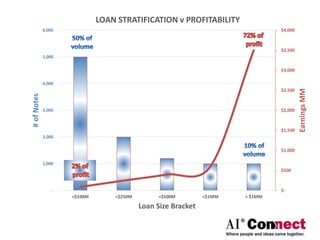
• Where does most of a bank’s workload sit?
• Do renewals generate new $ for added cost?
• New loans generate growth in profits
• 80/20 rule with a vengeance
• Loan profitability sits in the 20%
• But the workload sits in the 80%
• Renewed loans generate $0 added profit
• But comprises the bulk of a bank portfolio
$-
$500
$1,000
$1,500
$2,000
$2,500
$3,000
$3,500
$4,000
-
1,000
2,000
3,000
4,000
5,000
6,000
<$100M <$250M <$500M <$1MM > $1MM
Earnings
MM
#
of
Notes
Loan Size Bracket
LOAN STRATIFICATION v PROFITABILITY
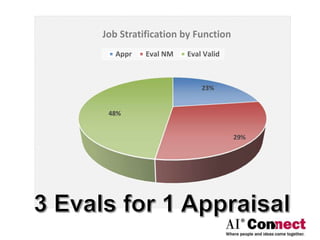
23%
29%
48%
Job Stratification by Function
Appr Eval NM Eval Valid
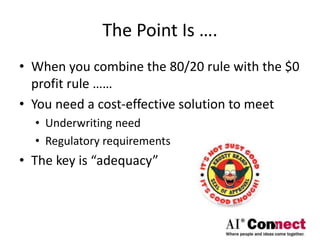
The Point Is ….
• When you combine the 80/20 rule with the $0
profit rule ……
• You need a cost-effective solution to meet
• Underwriting need
• Regulatory requirements
• The key is “adequacy”
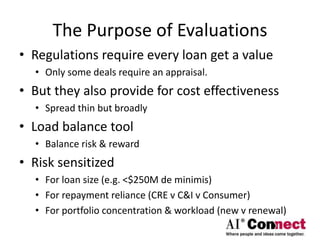
The Purpose of Evaluations
• Regulations require every loan get a value
• Only some deals require an appraisal.
• But they also provide for cost effectiveness
• Spread thin but broadly
• Load balance tool
• Balance risk & reward
• Risk sensitized
• For loan size (e.g. <$250M de minimis)
• For repayment reliance (CRE v C&I v Consumer)
• For portfolio concentration & workload (new v renewal)
Program Basics
• External Vendor Procured
• Proliferating Options
• Growing array of vendors
• Growing array of evaluation styles & products
• Coverage & Fulfillment
• Internally Developed
• Licensed or Unlicensed Team Members
• Qualifications & Training
• Data Sourcing & Inspections
• QA / QC Controls
Evaluation – Scope of Work
• Interagency Appraisal & Evaluation Guidelines
• Flexibility v rigidness
• When & where to use
• Defining the problem
• Creating the solution
What will your regulator permit?
2010 IAG Requirements
• Should contain sufficient information
• Details analysis, assumptions, conclusions
• Should be documented in the credit file or reproducible.
• Identify the location of the property.
• Provide a description of the property and its current and
projected use.
• Provide an estimate of the property’s market value in its
actual physical condition, use and zoning designation as of the
effective date of the evaluation (that is, the date that the
analysis was completed), with any limiting conditions.
• Describe the method(s) the institution used to confirm the
property’s actual physical condition and the extent to which
an inspection was performed.
2010 IAG Requirements #2
• Describe the analysis that was performed and the supporting
information that was used in valuing the property.
• Describe the supplemental information that was considered
when using an analytical method or technological tool.
• Indicate all source(s) of information used in the analysis, as
applicable, to value the property, including:
– External data sources (such as market sales databases and public tax
and land records);
– Property-specific data (such as previous sales data for the subject
property, tax assessment data, and comparable sales information);
– Evidence of a property inspection;
– Photos of the property;
– Description of the neighborhood; or
– Local market conditions.
2010 IAG Requirements #3
• Include information on the preparer when an evaluation is
performed by a person, such as the name and contact
information, and signature (electronic or other legally
permissible signature) of the preparer.
Let’s Re-Arrange the IAG Ideas
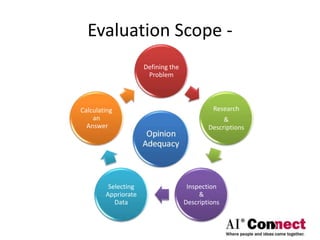
Evaluations have 5 major elements
• Define the problem to be solved
• Get needed research elements
• Make needed inspections as appropriate
• Selecting the right data
• Doing the math & calculations
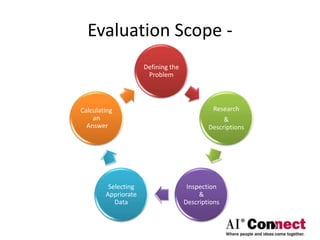
Evaluation Scope -
Defining the
Problem
Research
&
Descriptions
Inspection
&
Descriptions
Selecting
Appriorate
Data
Calculating
an
Answer
Eval Content - Preliminaries
• Defining the Problem
• Complexity
• Effective date(s) – what is this?
• Limiting conditions
• Can the premise be prospective?
• Can the zoning be prospective?
• Basic research & descriptions -
• Property specific records
• Neighborhood & market trends
• Current & projected use
• Current zoning designation
Eval Content – Inspection Elements
• Methods to confirm physical condition
• Describe extent of inspection
• Evidence of inspection
• Descriptions inspection details - granularity
• Property photos
More on Inspections
• “Methods to confirm physical condition”
• “Describe extent of inspection”
• What about?
• Out of territory property
• Borrower or lender representation?
• Shelf life of the representation/inspection?
• Origination v Renewal?
• Flexible standard?
• Credit Quality? Pass v non-pass?
Eval Content –Selecting Data
• “As applicable” data
• External sales databases etc.
• Local market conditions
• Comparable sales
Eval Content – Calculate an Answer
• Provide value in actual physical condition
• Is that the only condition allowed?
• Describe analysis performed
• Describe supporting information
• Data sourcing & selection
• What valuation technique? What methods?
• Analytical method or technological tool
• Analysis performed & supporting information
• Supplemental information
Eval Content - Fingerprints
• “When performed by a person”
• Name / contact info
• Actual signature
• Electronic signature
• Is the evaluator qualified?
• What about state restrictions?
Evaluation Scope -
Defining the
Problem
Research
&
Descriptions
Inspection
&
Descriptions
Selecting
Appriorate
Data
Calculating
an
Answer
Limitations
• Shelf life of evaluations
• Tailoring for loan-specific issues
• LTV adequacy
• Lease structures
• Environmental impacts & offsets
• As-is value v prospective value
Evaluation Options & Risk
What program to develop and use?
“You get to pick your problems, you don’t get to
pick no problems….”
• Internal Program
• External Vendor Program
• Appraisal Only – “no evaluations”
• Hybrid?
• What about BPO?
The Nexus -- Risk v Regulation
• Triangulating competing elements
• Accuracy
• Adequacy
• Efficiency
• Cost effectiveness
• Does an evaluation need to be accurate?
• Is accuracy always cost effective?
• Is precision always necessary?
• What about low LTV transactions?
• Using a shotgun to shoot a fly…
External v Internal Eval Programs
• Consider the business model --
• Collateral class – conventional v oddball
• Market coverage – urban v tract suburb v rural
• External Model
• Consistency & uniform product – predictable
• Within its limits – highly reliable system
• Fulfillment failure risk
• Internal Model
• Flexibility & adaptability
• Precision subordinated to practicality of business
• Disclosure Risks
External Products
• Appraiser-centric or broker-centric
• Available options
• How to compare them?
• How to review them?
• Fulfillment issues
• E & O dynamics
Vendor List
• Product type – residential v commercial
• Geographic coverage
• National
• Urban coverage
• Rural coverage
• Appraiser- v broker-centric
• Branch from national appraisal firm
• Local vendor based approach
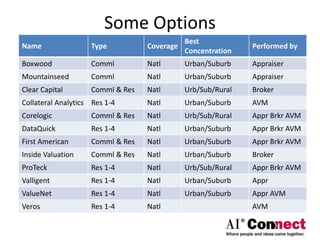
Some Options
Name Type Coverage
Best
Concentration
Performed by
Boxwood Comml Natl Urban/Suburb Appraiser
Mountainseed Comml Natl Urban/Suburb Appraiser
Clear Capital Comml & Res Natl Urb/Sub/Rural Broker
Collateral Analytics Res 1-4 Natl Urban/Suburb AVM
Corelogic Comml & Res Natl Urb/Sub/Rural Appr Brkr AVM
DataQuick Res 1-4 Natl Urban/Suburb Appr Brkr AVM
First American Comml & Res Natl Urban/Suburb Appr Brkr AVM
Inside Valuation Comml & Res Natl Urban/Suburb Broker
ProTeck Res 1-4 Natl Urb/Sub/Rural Appr Brkr AVM
Valligent Res 1-4 Natl Urban/Suburb Appr
ValueNet Res 1-4 Natl Urban/Suburb Appr AVM
Veros Res 1-4 Natl AVM
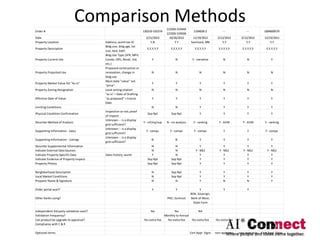
Comparison Methods
Order # 130219-53537A
121026-52344A
121026-52450A
1334928.3 -- -- 1004000579
Date 2/21/2013 10/26/2012 11/19/2012 2/12/2012 2/12/2012 12/23/2011
Property Location Address; assmt tax ID Y,N Y Y Sanitized, MN Y,Y Y,Y Y,Y
Property Description
Bldg size, bldg age, lot
size, bed, bath
Y,Y,Y,Y,Y Y,Y,Y,Y,Y Y,Y,Y,Y,Y Y,Y,Y,Y,Y Y,Y,Y,Y,Y Y,Y,Y,Y,Y
Property Current Use
Bldg Use Type (SFR, MFH,
Condo, Offc, Retail, Ind,
etc.)
Y N Y - narrative N N Y
Property Projected Use
Proposed construction or
renovation, change in
bldg use
N N N N N N
Property Market Value Est "As-Is"
Must state "value" not
"price"
Y Y Y Y Y Y
Property Zoning Designation Local zoning citation N N N N N N
Effective Date of Value
"as is" = Date of Drafting
"as proposed" = Future
Date
Y Y Y Y Y Y
Limiting Conditions N N Y Y Y Y
Physical Condition Confirmation
Inspection or not; proof
of inspect
Sep Rpt Sep Rpt Y Y Y Y
Describe Method of Analysis
Unknown -- is a display
grid sufficient?
Y - inf/eq/sup N - no analysis Y - ranking Y - AVM Y - AVM Y - ranking
Supporting Information - Sales
Unknown -- is a display
grid sufficient?
Y - comps Y - comps Y - comps Y Y Y - comps
Supporting Information - Listings
Unknown -- is a display
grid sufficient?
N N Y Y Y Y
Describe Supplemental Information N N Y Y Y Y
Indicate External Data Sources N N Y - MLS Y - MLS Y - MLS Y - MLS
Indicate Property Specific Data Sales history; assmt Y N Y Y Y Y
Indicate Evidence of Property Inspect Sep Rpt Sep Rpt Y Y Y Y
Property Photos Sep Rpt Sep Rpt Y Y Y Y
Neighborhood Description N Sep Rpt Y Y Y Y
Local Market Conditions N Sep Rpt Y Y Y Y
Preparer Name & Signature N N Y N N Y
Order portal avail? Y Y Y Y Y
Other banks using? PNC; Suntrust
BOK, Soverign,
Bank of West;
State Farm
Independent 3rd party validation avail? No No NA
Validation Frequency? Monthly to Annual
Can product be upgrade to appraisal? Yes extra fee Yes extra fee Yes extra fee Yes extra fee
Compliance with C & R
Optional items: Cert Appr Signs non-appr revs non-appr revs Cert Appr Signs
Evaluation Review Needs
• General v specific
• Checklist only?
• Part of the purpose is speed/efficiency
• Drags on velocity
• Secondary data confirmations
• Secondary corroborating data
• Secondary inspections
Evaluation Review Questions
1. Adequately identifies the collateral property (e.g. legal description, tax number,
street address, etc.)?
2. Adequately describes the collateral’s current and (if applicable) projected use?
3. Provides an estimate of the collateral’s market value in “As is” condition & use &
(if applicable) zoning as of the effective date of the Alternate Valuation?
4. Indicates all source(s) used in the analysis, as applicable, to value the property
(e.g. external data sources, property specific data, photos, neighborhood
description, description of local market conditions)?
5. Describes the analysis that was performed and the supporting information that
was used in valuing the property?
6. Evidence of a sufficient property inspection (e.g. photographs, comments)?
7. Includes all other relevant information (described as needed in Comments
below)?
8. Report includes preparer name and signature?
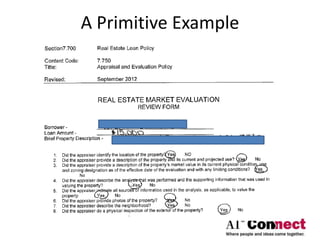
A Primitive Example
Here’s an Interesting Wrinkle
This review intends to fulfill Regulation B requirements for
Residential 1- to 4-unit dwellings. Transactions secured by 1- to
4-unit dwellings that qualify for an evalution by law may be
valued for xxxx by outside providers. The valuation document
under review may be labeled “Appraisal;” but because of its
limited content, it is reviewed under “evaluation” content
standards outlined in the Interagency Appraisal & Evaluation
Guidelines (effective Dec-2010).
Vendor Management
• Fulfilling possibilities
• List of serviced counties
• How many active vendors
• How many jobs by county last year
• Avg fee by county
• How many fulfillment failures by county
• Contracts – NDAs - Processing
• The follow-up process
• What changes can be incorporated to improve?
• Portals & ownership
To AMC or Not to AMC
• Geographic coverage
• Panel control
• Customary & Reasonable Fees
• Waterfall process - upgrades
• Portals
• Invoicing
• Compliance challenges
• Would it just be cheaper to bring it in house?
Automated Valuation Modeling
• Products & Options
• Hit Rates
• Confidence Intervals & FSD
• AVM Cascades & Selection Tables
• Program Benefits
• Speed – returns in moments
• Cost effective – even in a cascade/waterfall
AVM Validation - Challenges
• Regulatory compliance – modelling policy
• Sample spread
• Sample size
• Sample cost
• Sample frequency
• Validations methods applied to each event
• Who owns the validation process?
Trends in Vendor Mgmt
• Fed management requirements are heavy
• And getting heavier
• Escalating compliance costs
• Many banks are considering moving to in-
house programs
• More product control
• Compliance is no worse than vendor management
• Cost is ≤ to vendor management
Internal Evaluation Risks
• Adequacy of Facts
• Sufficient documentation
• Potential inaccuracies
• Adequacy of Opinions
• Recognize all needed elements?
• Disregard elements?
• Value precision?
• Does adequate alone = misleading?
• Misleading to whom?
• Potential inaccuracies acceptable – big picture
• Risk is internal business decision
Disclosure Risks
• Does it matter if an opinion is not disclosed?
• Can a consumer recognize the difference between an
evaluation and appraisal?
• Consumer wounded ego.
• What about credit denial?
• Consumer uses a disclosed eval in unintended ways
• Eval walks to another bank – portability
• Divorce litigation or tax appeal
• Price representations & negotiations
• Personal financial statement
• Estate planning or donation
What About Fed/State Compliance
• The enforcement referral
• The court subpoena
• The patchwork quilt of state regulators
• Mandatory v non-mandatory states
• Scope of practice Issues
• State enforcement risk to an internal program
• Built-in exemptions
• Fed requirements for qualified evaluators
• What about AI Ethics/Standards?
Comparing possible programs
• Outside vendor appraisal
• Appraisal-centric eval
• Internal team eval – non licensed
• Internal team eval –licensed
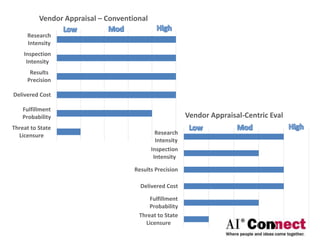
Research
Intensity
Inspection
Intensity
Results
Precision
Delivered Cost
Fulfillment
Probability
Threat to State
Licensure
Vendor Appraisal – Conventional
Research
Intensity
Inspection
Intensity
Results Precision
Delivered Cost
Fulfillment
Probability
Threat to State
Licensure
Vendor Appraisal-Centric Eval
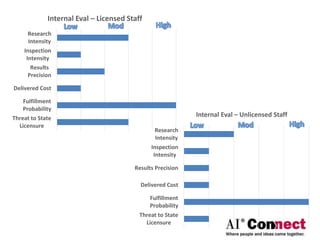
Research
Intensity
Inspection
Intensity
Results
Precision
Delivered Cost
Fulfillment
Probability
Threat to State
Licensure
Internal Eval – Licensed Staff
Research
Intensity
Inspection
Intensity
Results Precision
Delivered Cost
Fulfillment
Probability
Threat to State
Licensure
Internal Eval – Unlicensed Staff
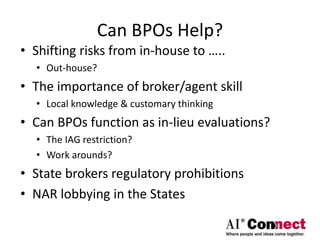
Can BPOs Help?
• Shifting risks from in-house to …..
• Out-house?
• The importance of broker/agent skill
• Local knowledge & customary thinking
• Can BPOs function as in-lieu evaluations?
• The IAG restriction?
• Work arounds?
• State brokers regulatory prohibitions
• NAR lobbying in the States
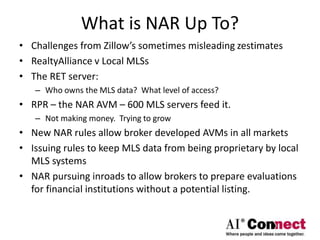
What is NAR Up To?
• Challenges from Zillow’s sometimes misleading zestimates
• RealtyAlliance v Local MLSs
• The RET server:
– Who owns the MLS data? What level of access?
• RPR – the NAR AVM – 600 MLS servers feed it.
– Not making money. Trying to grow
• New NAR rules allow broker developed AVMs in all markets
• Issuing rules to keep MLS data from being proprietary by local
MLS systems
• NAR pursuing inroads to allow brokers to prepare evaluations
for financial institutions without a potential listing.
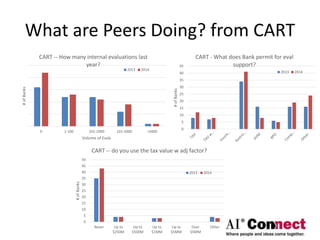
What are Peers Doing? from CART
0 1-100 101-1000 101-5000 >5000
#
of
Banks
Volume of Evals
CART -- How many internal evaluations last
year?
2013 2014
0
5
10
15
20
25
30
35
40
45
#
of
Banks
CART - What does Bank permit for eval
support?
2013 2014
0
5
10
15
20
25
30
35
40
45
50
Never Up to
$250M
Up to
$500M
Up to
$1MM
Up to
$5MM
Over
$5MM
Other
#
of
Banks
CART -- do you use the tax value w adj factor?
2013 2014
Dodd Frank & Reg B / ECOA
• Key New Definitions
• Borrower
• Transaction
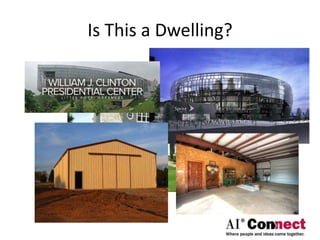
• Collateral – what is a dwelling?
• Notification v disclosure
• Consumer purpose or
• Secured by 1-4 Unit Dwelling
• The Dwelling Trump Card
• Mission creep from law to rule-making
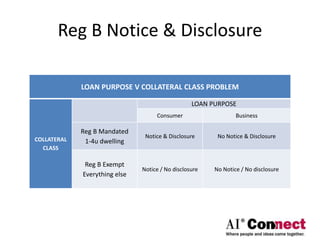
Reg B Notice & Disclosure
LOAN PURPOSE V COLLATERAL CLASS PROBLEM
COLLATERAL
CLASS
LOAN PURPOSE
Consumer Business
Reg B Mandated
1-4u dwelling
Notice & Disclosure No Notice & Disclosure
Reg B Exempt
Everything else
Notice / No disclosure No Notice / No disclosure
Is This a Dwelling?
Reg B Impacts Community Banks
• Increases financing & liability risk
• Forces disclosure of potentially inaccurate but otherwise
adequate analysis
• Requires deal restructure – financing unsecured to avoid
documentation of value
• Potentially inaccurate but otherwise adequate can be
misconstrued or misused by borrower
• Alternative is to order more vendor product to deflect risk
• Limits credit access to community borrowers
• Inflexible rules don’t sync with the physical collateral world
• Added cost of vendor product
• Added delay of vendor product
Reg B Impacts Consumers
• Increases confusion
• Blurs distinctions from consumer to biz deals
• Treats all “valuations” equally for disclosure
• Increases cost
• Vendor products more costly than internal products
• Prioritizes precision over adequacy
• Increases delay
• Vendor products take additional time
• Risk of fulfillment failure
Homebuilder Impacts
• Reg B intended to give each of thousands of
individual consumers an individual appraisal.
but instead ….
• Reg B requires a handful of homebuilders to
receive thousands of appraisals
Hybrid Product – the BPO Eval
• Can it “shift the risk” ?
• How to qualify the valuation elements?
• Opine price or value -- both?
• IAG limitations
• Review based qualification of BPO opinion?
• Separate opinion using BPO elements only?
• Convert into bank-issued estimate of value
• Who inks it?
• Qualification v state compliance risk
• Wiggle words - disclaimers
• E & O need?
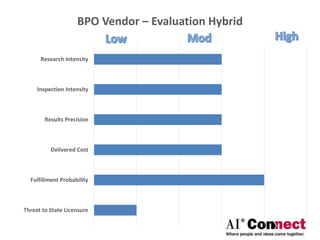
Research Intensity
Inspection Intensity
Results Precision
Delivered Cost
Fulfillment Probability
Threat to State Licensure
BPO Vendor – Evaluation Hybrid
Appraisers Re-enter the Eval Space
• USPAP & state restrictions
• Economics
• E & O coverage
Techtonic Shifts
• AI Standards v USPAP
• FRTs v RET? Where do evaluations fit?
• Should we cage USPAP into FRT only?
• HR 5148 (Leutkemeyer TILA High Risk Mortgage Bill)
• Federal pre-emption – supremacy clause
• See Gibbons v Ogden 22 US 1 (1824)
• See Gade v National Solid Wastes Mgmt Assoc 505
US 88.98 (1992)
• See Florida Lime v Avocado Growers Inc v Paul 373
US 132, 142-43 (1962)
The Pre-Flight Evaluation
• The good-housekeeping seal of approval
• Post-eval changes to loan
– Impact on eval reliability
• Ordering a subsequent appraisal
– Valuation priority of place
Foreclosure Evaluations
• What is allowed – de minimis rules.
• Risks v benefits of use
• Can you manage the inspection?
• How to manage accounting needs
• Fair Value
• Liquidation / Distress Value
• Pre-foreclosure requirements
• Post-foreclosure surprises
The Forensic Evaluation
• Multiple evaluations over time
• Same asset
• Allows a measure of market change
• Retrospective analysis to test an appraisal
• Showing editorial selection process
• What comps were uncovered but not used
Evaluation in Portfolio Monitoring
• The Nexus of Accuracy v Adequacy
• Existing collateral & the subsequent transaction
• Transaction cost v flat profitability shift
• Floor values on file as adequacy filter
• Against current balance? Increasing balance?
• Declining value? Physical deterioration?
• Methods?
• Owner occupied class
• Investment class
• Special cases
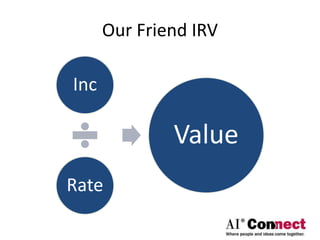
Our Friend IRV
Inc
Rate
Value
$0
$1,000,000
$2,000,000
$3,000,000
$4,000,000
$5,000,000
$6,000,000
$7,000,000
$8,000,000
$9,000,000
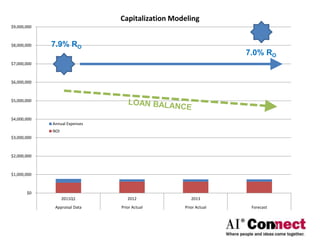
2011Q1 2012 2013
Appraisal Data Prior Actual Prior Actual Forecast
Capitalization Modeling
Annual Expenses
NOI
7.9% RO
7.0% RO
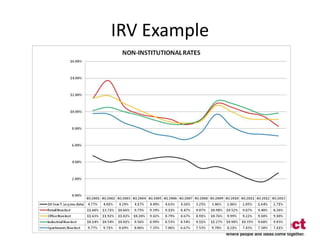
IRV Example
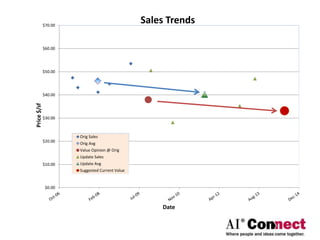
$0.00
$10.00
$20.00
$30.00
$40.00
$50.00
$60.00
$70.00
Price
$/sf
Date
Sales Trends
Orig Sales
Orig Avg
Value Opinion @ Orig
Update Sales
Update Avg
Suggested Current Value
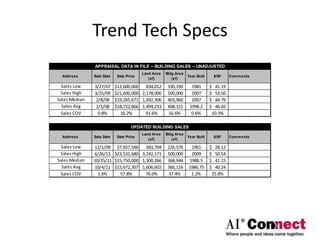
Trend Tech Specs
3/27/07 $13,600,000 834,012 330,190 1981 41.19
$
3/25/09 $21,600,000 2,178,000 500,000 2007 53.50
$
2/8/08 $19,265,671 1,692,306 403,960 2007 44.79
$
2/5/08 $18,722,866 1,494,233 408,151 1998.2 46.02
$
0.8% 16.2% 41.6% 16.6% 0.6% 10.3%
12/1/09 $7,657,546 583,704 226,576 1961 28.12
$
6/26/13 $23,531,680 3,242,171 500,000 2009 50.54
$
10/25/11 $15,750,000 1,300,266 368,944 1988.5 41.15
$
10/4/11 $15,672,307 1,606,602 366,116 1986.75 40.24
$
1.6% 57.8% 76.0% 37.4% 1.2% 25.8%
Sales Avg
Sales COV
Sales Low
Sales High
Sales Median
UPDATED BUILDING SALES
Address Sale Date Sale Price
Land Area
(sf)
Bldg Area
(sf)
Year Built $/SF Comments
Sales Low
Sales High
Sales Median
Sales Avg
Sales COV
APPRAISAL DATA IN FILE -- BUILDING SALES -- UNADJUSTED
Address Sale Date Sale Price
Land Area
(sf)
Bldg Area
(sf)
Year Built $/SF Comments
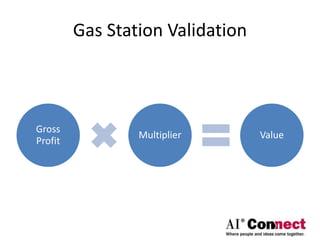
Gas Station Validation
Gross
Profit
Multiplier Value
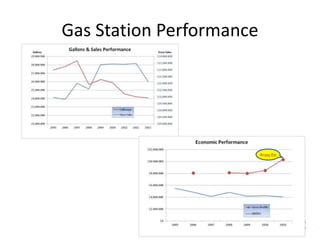
Gas Station Performance
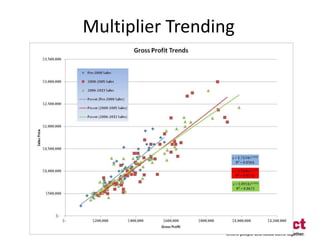
Multiplier Trending
Experiences
• How is Reg B working for you?
• How are evaluations working for you?
Credit Evaluating system.pptx

Credit Evaluating system.pptx

  • 2.
    Evaluating the Evaluation BankEvaluation Programs Doug Potts, MAI, VP Commerce Bank
  • 3.
    A Few Questions •True/False? – Most loan transactions require appraisals. • True/False? – Evaluations are killing the appraisal profession. • True/False? – Reg B will eventually create more business for appraisers. • True/False? – Reg B will - in time - increase available consumer credit.
  • 4.
    A Primer onBank Lending • Major Purposes • New Loans (new collateral) • Subsequent Transactions (existing collateral) • Problem Loan Management (“exiting” collateral) • Major Loan Categories • Consumer purpose lending (GSE / HELOC) • Commercial business lending (C & I) • Commercial investment lending (CRE) • Unclassified lending – the “junk drawer”
  • 5.
    Bank Portfolios--Risks &Rewards • Where does most of a bank’s workload sit? • Do renewals generate new $ for added cost? • New loans generate growth in profits • 80/20 rule with a vengeance • Loan profitability sits in the 20% • But the workload sits in the 80% • Renewed loans generate $0 added profit • But comprises the bulk of a bank portfolio
  • 6.
    $- $500 $1,000 $1,500 $2,000 $2,500 $3,000 $3,500 $4,000 - 1,000 2,000 3,000 4,000 5,000 6,000 <$100M <$250M <$500M<$1MM > $1MM Earnings MM # of Notes Loan Size Bracket LOAN STRATIFICATION v PROFITABILITY
  • 7.
    23% 29% 48% Job Stratification byFunction Appr Eval NM Eval Valid
  • 8.
    The Point Is…. • When you combine the 80/20 rule with the $0 profit rule …… • You need a cost-effective solution to meet • Underwriting need • Regulatory requirements • The key is “adequacy”
  • 9.
    The Purpose ofEvaluations • Regulations require every loan get a value • Only some deals require an appraisal. • But they also provide for cost effectiveness • Spread thin but broadly • Load balance tool • Balance risk & reward • Risk sensitized • For loan size (e.g. <$250M de minimis) • For repayment reliance (CRE v C&I v Consumer) • For portfolio concentration & workload (new v renewal)
  • 10.
    Program Basics • ExternalVendor Procured • Proliferating Options • Growing array of vendors • Growing array of evaluation styles & products • Coverage & Fulfillment • Internally Developed • Licensed or Unlicensed Team Members • Qualifications & Training • Data Sourcing & Inspections • QA / QC Controls
  • 11.
    Evaluation – Scopeof Work • Interagency Appraisal & Evaluation Guidelines • Flexibility v rigidness • When & where to use • Defining the problem • Creating the solution What will your regulator permit?
  • 12.
    2010 IAG Requirements •Should contain sufficient information • Details analysis, assumptions, conclusions • Should be documented in the credit file or reproducible. • Identify the location of the property. • Provide a description of the property and its current and projected use. • Provide an estimate of the property’s market value in its actual physical condition, use and zoning designation as of the effective date of the evaluation (that is, the date that the analysis was completed), with any limiting conditions. • Describe the method(s) the institution used to confirm the property’s actual physical condition and the extent to which an inspection was performed.
  • 13.
    2010 IAG Requirements#2 • Describe the analysis that was performed and the supporting information that was used in valuing the property. • Describe the supplemental information that was considered when using an analytical method or technological tool. • Indicate all source(s) of information used in the analysis, as applicable, to value the property, including: – External data sources (such as market sales databases and public tax and land records); – Property-specific data (such as previous sales data for the subject property, tax assessment data, and comparable sales information); – Evidence of a property inspection; – Photos of the property; – Description of the neighborhood; or – Local market conditions.
  • 14.
    2010 IAG Requirements#3 • Include information on the preparer when an evaluation is performed by a person, such as the name and contact information, and signature (electronic or other legally permissible signature) of the preparer.
  • 15.
    Let’s Re-Arrange theIAG Ideas Evaluations have 5 major elements • Define the problem to be solved • Get needed research elements • Make needed inspections as appropriate • Selecting the right data • Doing the math & calculations
  • 16.
    Evaluation Scope - Definingthe Problem Research & Descriptions Inspection & Descriptions Selecting Appriorate Data Calculating an Answer
  • 17.
    Eval Content -Preliminaries • Defining the Problem • Complexity • Effective date(s) – what is this? • Limiting conditions • Can the premise be prospective? • Can the zoning be prospective? • Basic research & descriptions - • Property specific records • Neighborhood & market trends • Current & projected use • Current zoning designation
  • 18.
    Eval Content –Inspection Elements • Methods to confirm physical condition • Describe extent of inspection • Evidence of inspection • Descriptions inspection details - granularity • Property photos
  • 19.
    More on Inspections •“Methods to confirm physical condition” • “Describe extent of inspection” • What about? • Out of territory property • Borrower or lender representation? • Shelf life of the representation/inspection? • Origination v Renewal? • Flexible standard? • Credit Quality? Pass v non-pass?
  • 20.
    Eval Content –SelectingData • “As applicable” data • External sales databases etc. • Local market conditions • Comparable sales
  • 21.
    Eval Content –Calculate an Answer • Provide value in actual physical condition • Is that the only condition allowed? • Describe analysis performed • Describe supporting information • Data sourcing & selection • What valuation technique? What methods? • Analytical method or technological tool • Analysis performed & supporting information • Supplemental information
  • 22.
    Eval Content -Fingerprints • “When performed by a person” • Name / contact info • Actual signature • Electronic signature • Is the evaluator qualified? • What about state restrictions?
  • 23.
    Evaluation Scope - Definingthe Problem Research & Descriptions Inspection & Descriptions Selecting Appriorate Data Calculating an Answer
  • 24.
    Limitations • Shelf lifeof evaluations • Tailoring for loan-specific issues • LTV adequacy • Lease structures • Environmental impacts & offsets • As-is value v prospective value
  • 25.
    Evaluation Options &Risk What program to develop and use? “You get to pick your problems, you don’t get to pick no problems….” • Internal Program • External Vendor Program • Appraisal Only – “no evaluations” • Hybrid? • What about BPO?
  • 26.
    The Nexus --Risk v Regulation • Triangulating competing elements • Accuracy • Adequacy • Efficiency • Cost effectiveness • Does an evaluation need to be accurate? • Is accuracy always cost effective? • Is precision always necessary? • What about low LTV transactions? • Using a shotgun to shoot a fly…
  • 27.
    External v InternalEval Programs • Consider the business model -- • Collateral class – conventional v oddball • Market coverage – urban v tract suburb v rural • External Model • Consistency & uniform product – predictable • Within its limits – highly reliable system • Fulfillment failure risk • Internal Model • Flexibility & adaptability • Precision subordinated to practicality of business • Disclosure Risks
  • 28.
    External Products • Appraiser-centricor broker-centric • Available options • How to compare them? • How to review them? • Fulfillment issues • E & O dynamics
  • 29.
    Vendor List • Producttype – residential v commercial • Geographic coverage • National • Urban coverage • Rural coverage • Appraiser- v broker-centric • Branch from national appraisal firm • Local vendor based approach
  • 30.
    Some Options Name TypeCoverage Best Concentration Performed by Boxwood Comml Natl Urban/Suburb Appraiser Mountainseed Comml Natl Urban/Suburb Appraiser Clear Capital Comml & Res Natl Urb/Sub/Rural Broker Collateral Analytics Res 1-4 Natl Urban/Suburb AVM Corelogic Comml & Res Natl Urb/Sub/Rural Appr Brkr AVM DataQuick Res 1-4 Natl Urban/Suburb Appr Brkr AVM First American Comml & Res Natl Urban/Suburb Appr Brkr AVM Inside Valuation Comml & Res Natl Urban/Suburb Broker ProTeck Res 1-4 Natl Urb/Sub/Rural Appr Brkr AVM Valligent Res 1-4 Natl Urban/Suburb Appr ValueNet Res 1-4 Natl Urban/Suburb Appr AVM Veros Res 1-4 Natl AVM
  • 31.
    Comparison Methods Order #130219-53537A 121026-52344A 121026-52450A 1334928.3 -- -- 1004000579 Date 2/21/2013 10/26/2012 11/19/2012 2/12/2012 2/12/2012 12/23/2011 Property Location Address; assmt tax ID Y,N Y Y Sanitized, MN Y,Y Y,Y Y,Y Property Description Bldg size, bldg age, lot size, bed, bath Y,Y,Y,Y,Y Y,Y,Y,Y,Y Y,Y,Y,Y,Y Y,Y,Y,Y,Y Y,Y,Y,Y,Y Y,Y,Y,Y,Y Property Current Use Bldg Use Type (SFR, MFH, Condo, Offc, Retail, Ind, etc.) Y N Y - narrative N N Y Property Projected Use Proposed construction or renovation, change in bldg use N N N N N N Property Market Value Est "As-Is" Must state "value" not "price" Y Y Y Y Y Y Property Zoning Designation Local zoning citation N N N N N N Effective Date of Value "as is" = Date of Drafting "as proposed" = Future Date Y Y Y Y Y Y Limiting Conditions N N Y Y Y Y Physical Condition Confirmation Inspection or not; proof of inspect Sep Rpt Sep Rpt Y Y Y Y Describe Method of Analysis Unknown -- is a display grid sufficient? Y - inf/eq/sup N - no analysis Y - ranking Y - AVM Y - AVM Y - ranking Supporting Information - Sales Unknown -- is a display grid sufficient? Y - comps Y - comps Y - comps Y Y Y - comps Supporting Information - Listings Unknown -- is a display grid sufficient? N N Y Y Y Y Describe Supplemental Information N N Y Y Y Y Indicate External Data Sources N N Y - MLS Y - MLS Y - MLS Y - MLS Indicate Property Specific Data Sales history; assmt Y N Y Y Y Y Indicate Evidence of Property Inspect Sep Rpt Sep Rpt Y Y Y Y Property Photos Sep Rpt Sep Rpt Y Y Y Y Neighborhood Description N Sep Rpt Y Y Y Y Local Market Conditions N Sep Rpt Y Y Y Y Preparer Name & Signature N N Y N N Y Order portal avail? Y Y Y Y Y Other banks using? PNC; Suntrust BOK, Soverign, Bank of West; State Farm Independent 3rd party validation avail? No No NA Validation Frequency? Monthly to Annual Can product be upgrade to appraisal? Yes extra fee Yes extra fee Yes extra fee Yes extra fee Compliance with C & R Optional items: Cert Appr Signs non-appr revs non-appr revs Cert Appr Signs
  • 32.
    Evaluation Review Needs •General v specific • Checklist only? • Part of the purpose is speed/efficiency • Drags on velocity • Secondary data confirmations • Secondary corroborating data • Secondary inspections
  • 33.
    Evaluation Review Questions 1.Adequately identifies the collateral property (e.g. legal description, tax number, street address, etc.)? 2. Adequately describes the collateral’s current and (if applicable) projected use? 3. Provides an estimate of the collateral’s market value in “As is” condition & use & (if applicable) zoning as of the effective date of the Alternate Valuation? 4. Indicates all source(s) used in the analysis, as applicable, to value the property (e.g. external data sources, property specific data, photos, neighborhood description, description of local market conditions)? 5. Describes the analysis that was performed and the supporting information that was used in valuing the property? 6. Evidence of a sufficient property inspection (e.g. photographs, comments)? 7. Includes all other relevant information (described as needed in Comments below)? 8. Report includes preparer name and signature?
  • 34.
  • 35.
    Here’s an InterestingWrinkle This review intends to fulfill Regulation B requirements for Residential 1- to 4-unit dwellings. Transactions secured by 1- to 4-unit dwellings that qualify for an evalution by law may be valued for xxxx by outside providers. The valuation document under review may be labeled “Appraisal;” but because of its limited content, it is reviewed under “evaluation” content standards outlined in the Interagency Appraisal & Evaluation Guidelines (effective Dec-2010).
  • 36.
    Vendor Management • Fulfillingpossibilities • List of serviced counties • How many active vendors • How many jobs by county last year • Avg fee by county • How many fulfillment failures by county • Contracts – NDAs - Processing • The follow-up process • What changes can be incorporated to improve? • Portals & ownership
  • 37.
    To AMC orNot to AMC • Geographic coverage • Panel control • Customary & Reasonable Fees • Waterfall process - upgrades • Portals • Invoicing • Compliance challenges • Would it just be cheaper to bring it in house?
  • 38.
    Automated Valuation Modeling •Products & Options • Hit Rates • Confidence Intervals & FSD • AVM Cascades & Selection Tables • Program Benefits • Speed – returns in moments • Cost effective – even in a cascade/waterfall
  • 39.
    AVM Validation -Challenges • Regulatory compliance – modelling policy • Sample spread • Sample size • Sample cost • Sample frequency • Validations methods applied to each event • Who owns the validation process?
  • 40.
    Trends in VendorMgmt • Fed management requirements are heavy • And getting heavier • Escalating compliance costs • Many banks are considering moving to in- house programs • More product control • Compliance is no worse than vendor management • Cost is ≤ to vendor management
  • 41.
    Internal Evaluation Risks •Adequacy of Facts • Sufficient documentation • Potential inaccuracies • Adequacy of Opinions • Recognize all needed elements? • Disregard elements? • Value precision? • Does adequate alone = misleading? • Misleading to whom? • Potential inaccuracies acceptable – big picture • Risk is internal business decision
  • 42.
    Disclosure Risks • Doesit matter if an opinion is not disclosed? • Can a consumer recognize the difference between an evaluation and appraisal? • Consumer wounded ego. • What about credit denial? • Consumer uses a disclosed eval in unintended ways • Eval walks to another bank – portability • Divorce litigation or tax appeal • Price representations & negotiations • Personal financial statement • Estate planning or donation
  • 43.
    What About Fed/StateCompliance • The enforcement referral • The court subpoena • The patchwork quilt of state regulators • Mandatory v non-mandatory states • Scope of practice Issues • State enforcement risk to an internal program • Built-in exemptions • Fed requirements for qualified evaluators • What about AI Ethics/Standards?
  • 44.
    Comparing possible programs •Outside vendor appraisal • Appraisal-centric eval • Internal team eval – non licensed • Internal team eval –licensed
  • 45.
    Research Intensity Inspection Intensity Results Precision Delivered Cost Fulfillment Probability Threat toState Licensure Vendor Appraisal – Conventional Research Intensity Inspection Intensity Results Precision Delivered Cost Fulfillment Probability Threat to State Licensure Vendor Appraisal-Centric Eval
  • 46.
    Research Intensity Inspection Intensity Results Precision Delivered Cost Fulfillment Probability Threat toState Licensure Internal Eval – Licensed Staff Research Intensity Inspection Intensity Results Precision Delivered Cost Fulfillment Probability Threat to State Licensure Internal Eval – Unlicensed Staff
  • 47.
    Can BPOs Help? •Shifting risks from in-house to ….. • Out-house? • The importance of broker/agent skill • Local knowledge & customary thinking • Can BPOs function as in-lieu evaluations? • The IAG restriction? • Work arounds? • State brokers regulatory prohibitions • NAR lobbying in the States
  • 48.
    What is NARUp To? • Challenges from Zillow’s sometimes misleading zestimates • RealtyAlliance v Local MLSs • The RET server: – Who owns the MLS data? What level of access? • RPR – the NAR AVM – 600 MLS servers feed it. – Not making money. Trying to grow • New NAR rules allow broker developed AVMs in all markets • Issuing rules to keep MLS data from being proprietary by local MLS systems • NAR pursuing inroads to allow brokers to prepare evaluations for financial institutions without a potential listing.
  • 49.
    What are PeersDoing? from CART 0 1-100 101-1000 101-5000 >5000 # of Banks Volume of Evals CART -- How many internal evaluations last year? 2013 2014 0 5 10 15 20 25 30 35 40 45 # of Banks CART - What does Bank permit for eval support? 2013 2014 0 5 10 15 20 25 30 35 40 45 50 Never Up to $250M Up to $500M Up to $1MM Up to $5MM Over $5MM Other # of Banks CART -- do you use the tax value w adj factor? 2013 2014
  • 50.
    Dodd Frank &Reg B / ECOA • Key New Definitions • Borrower • Transaction • Collateral – what is a dwelling? • Notification v disclosure • Consumer purpose or • Secured by 1-4 Unit Dwelling • The Dwelling Trump Card • Mission creep from law to rule-making
  • 51.
    Reg B Notice& Disclosure LOAN PURPOSE V COLLATERAL CLASS PROBLEM COLLATERAL CLASS LOAN PURPOSE Consumer Business Reg B Mandated 1-4u dwelling Notice & Disclosure No Notice & Disclosure Reg B Exempt Everything else Notice / No disclosure No Notice / No disclosure
  • 52.
    Is This aDwelling?
  • 53.
    Reg B ImpactsCommunity Banks • Increases financing & liability risk • Forces disclosure of potentially inaccurate but otherwise adequate analysis • Requires deal restructure – financing unsecured to avoid documentation of value • Potentially inaccurate but otherwise adequate can be misconstrued or misused by borrower • Alternative is to order more vendor product to deflect risk • Limits credit access to community borrowers • Inflexible rules don’t sync with the physical collateral world • Added cost of vendor product • Added delay of vendor product
  • 54.
    Reg B ImpactsConsumers • Increases confusion • Blurs distinctions from consumer to biz deals • Treats all “valuations” equally for disclosure • Increases cost • Vendor products more costly than internal products • Prioritizes precision over adequacy • Increases delay • Vendor products take additional time • Risk of fulfillment failure
  • 55.
    Homebuilder Impacts • RegB intended to give each of thousands of individual consumers an individual appraisal. but instead …. • Reg B requires a handful of homebuilders to receive thousands of appraisals
  • 56.
    Hybrid Product –the BPO Eval • Can it “shift the risk” ? • How to qualify the valuation elements? • Opine price or value -- both? • IAG limitations • Review based qualification of BPO opinion? • Separate opinion using BPO elements only? • Convert into bank-issued estimate of value • Who inks it? • Qualification v state compliance risk • Wiggle words - disclaimers • E & O need?
  • 57.
    Research Intensity Inspection Intensity ResultsPrecision Delivered Cost Fulfillment Probability Threat to State Licensure BPO Vendor – Evaluation Hybrid
  • 58.
    Appraisers Re-enter theEval Space • USPAP & state restrictions • Economics • E & O coverage
  • 59.
    Techtonic Shifts • AIStandards v USPAP • FRTs v RET? Where do evaluations fit? • Should we cage USPAP into FRT only? • HR 5148 (Leutkemeyer TILA High Risk Mortgage Bill) • Federal pre-emption – supremacy clause • See Gibbons v Ogden 22 US 1 (1824) • See Gade v National Solid Wastes Mgmt Assoc 505 US 88.98 (1992) • See Florida Lime v Avocado Growers Inc v Paul 373 US 132, 142-43 (1962)
  • 60.
    The Pre-Flight Evaluation •The good-housekeeping seal of approval • Post-eval changes to loan – Impact on eval reliability • Ordering a subsequent appraisal – Valuation priority of place
  • 61.
    Foreclosure Evaluations • Whatis allowed – de minimis rules. • Risks v benefits of use • Can you manage the inspection? • How to manage accounting needs • Fair Value • Liquidation / Distress Value • Pre-foreclosure requirements • Post-foreclosure surprises
  • 62.
    The Forensic Evaluation •Multiple evaluations over time • Same asset • Allows a measure of market change • Retrospective analysis to test an appraisal • Showing editorial selection process • What comps were uncovered but not used
  • 63.
    Evaluation in PortfolioMonitoring • The Nexus of Accuracy v Adequacy • Existing collateral & the subsequent transaction • Transaction cost v flat profitability shift • Floor values on file as adequacy filter • Against current balance? Increasing balance? • Declining value? Physical deterioration? • Methods? • Owner occupied class • Investment class • Special cases
  • 64.
  • 65.
    $0 $1,000,000 $2,000,000 $3,000,000 $4,000,000 $5,000,000 $6,000,000 $7,000,000 $8,000,000 $9,000,000 2011Q1 2012 2013 AppraisalData Prior Actual Prior Actual Forecast Capitalization Modeling Annual Expenses NOI 7.9% RO 7.0% RO
  • 66.
  • 67.
    $0.00 $10.00 $20.00 $30.00 $40.00 $50.00 $60.00 $70.00 Price $/sf Date Sales Trends Orig Sales OrigAvg Value Opinion @ Orig Update Sales Update Avg Suggested Current Value
  • 68.
    Trend Tech Specs 3/27/07$13,600,000 834,012 330,190 1981 41.19 $ 3/25/09 $21,600,000 2,178,000 500,000 2007 53.50 $ 2/8/08 $19,265,671 1,692,306 403,960 2007 44.79 $ 2/5/08 $18,722,866 1,494,233 408,151 1998.2 46.02 $ 0.8% 16.2% 41.6% 16.6% 0.6% 10.3% 12/1/09 $7,657,546 583,704 226,576 1961 28.12 $ 6/26/13 $23,531,680 3,242,171 500,000 2009 50.54 $ 10/25/11 $15,750,000 1,300,266 368,944 1988.5 41.15 $ 10/4/11 $15,672,307 1,606,602 366,116 1986.75 40.24 $ 1.6% 57.8% 76.0% 37.4% 1.2% 25.8% Sales Avg Sales COV Sales Low Sales High Sales Median UPDATED BUILDING SALES Address Sale Date Sale Price Land Area (sf) Bldg Area (sf) Year Built $/SF Comments Sales Low Sales High Sales Median Sales Avg Sales COV APPRAISAL DATA IN FILE -- BUILDING SALES -- UNADJUSTED Address Sale Date Sale Price Land Area (sf) Bldg Area (sf) Year Built $/SF Comments
  • 69.
  • 70.
  • 71.
  • 72.
    Experiences • How isReg B working for you? • How are evaluations working for you?