A Guide to Gaining Knowledge about:A Guide to Gaining Knowledge about:
Cultural and/or EconomicallyCultural and/or Economically
Diverse GiftednessDiverse Giftedness
Charity WellsCharity Wells
Deborah AllenDeborah Allen
Robby ChapmanRobby Chapman
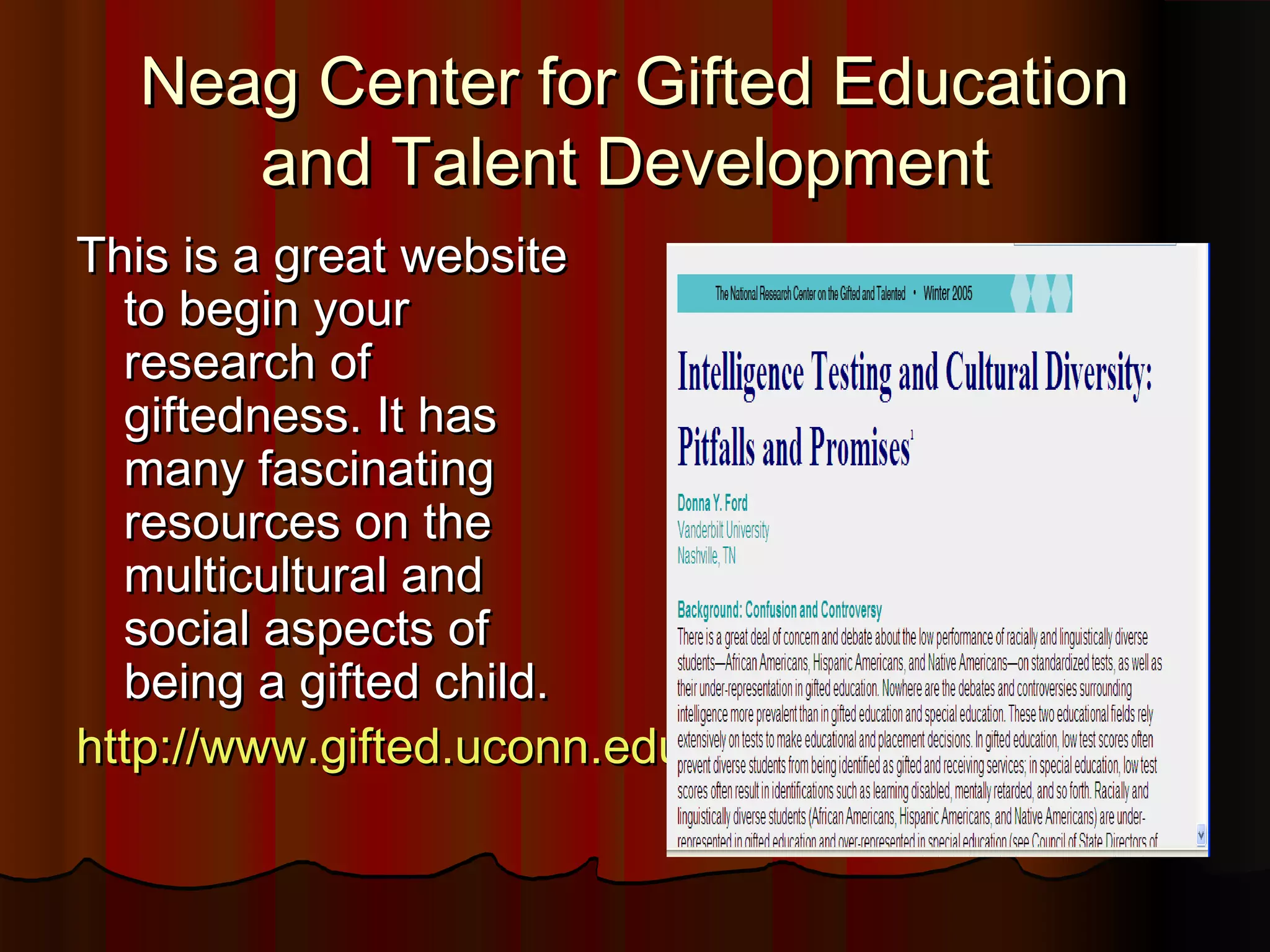
Neag Center for Gifted EducationNeag Center for Gifted Education
and Talent Developmentand Talent Development
This is a great websiteThis is a great website
to begin yourto begin your
research ofresearch of
giftedness. It hasgiftedness. It has
many fascinatingmany fascinating
resources on theresources on the
multicultural andmulticultural and
social aspects ofsocial aspects of
being a gifted child.being a gifted child.
http://www.gifted.uconn.edu/nrcgt/http://www.gifted.uconn.edu/nrcgt/
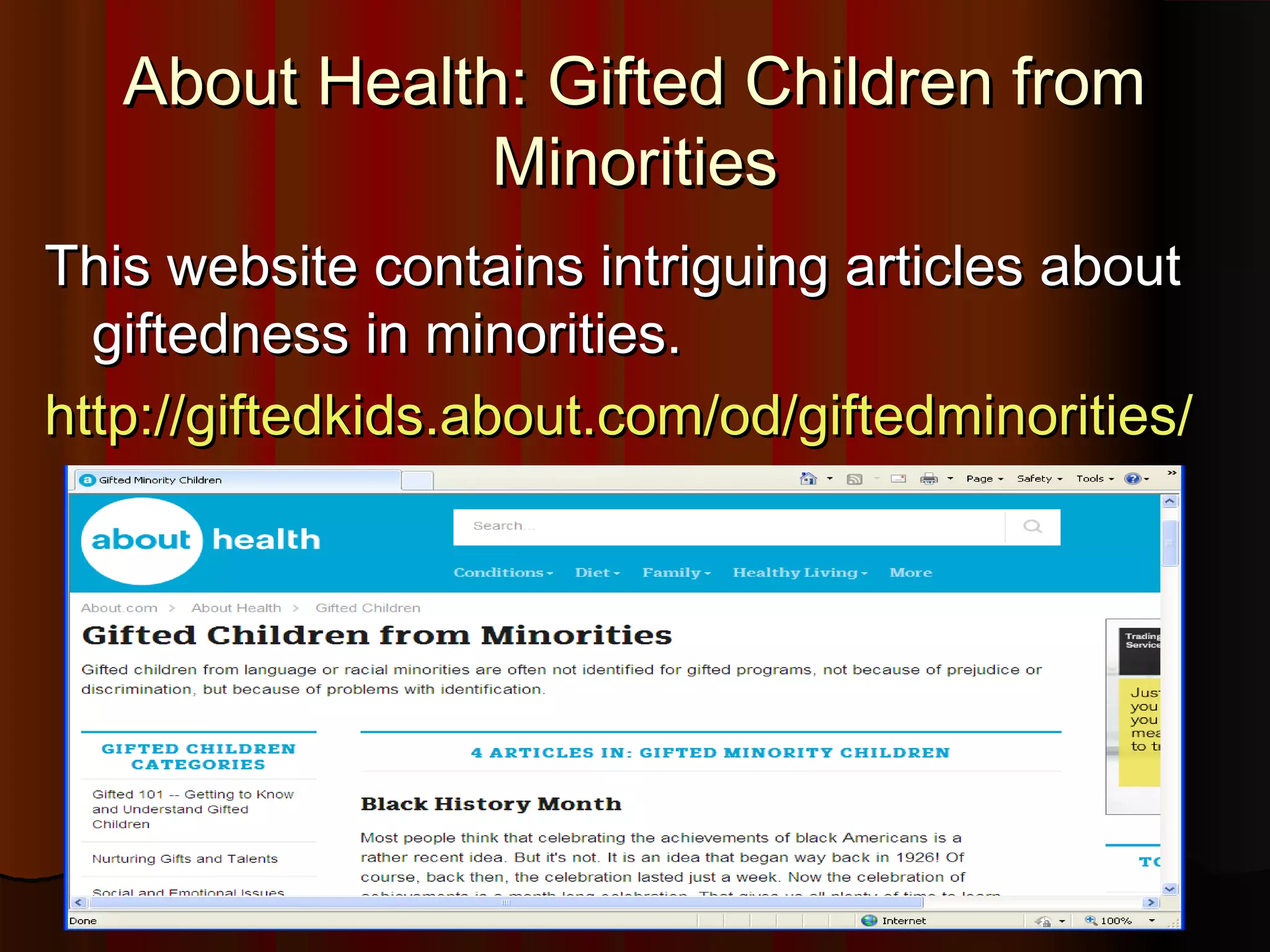
About Health: Gifted Children fromAbout Health: Gifted Children from
MinoritiesMinorities
This website contains intriguing articles aboutThis website contains intriguing articles about
giftedness in minorities.giftedness in minorities.
http://giftedkids.about.com/od/giftedminorities/http://giftedkids.about.com/od/giftedminorities/
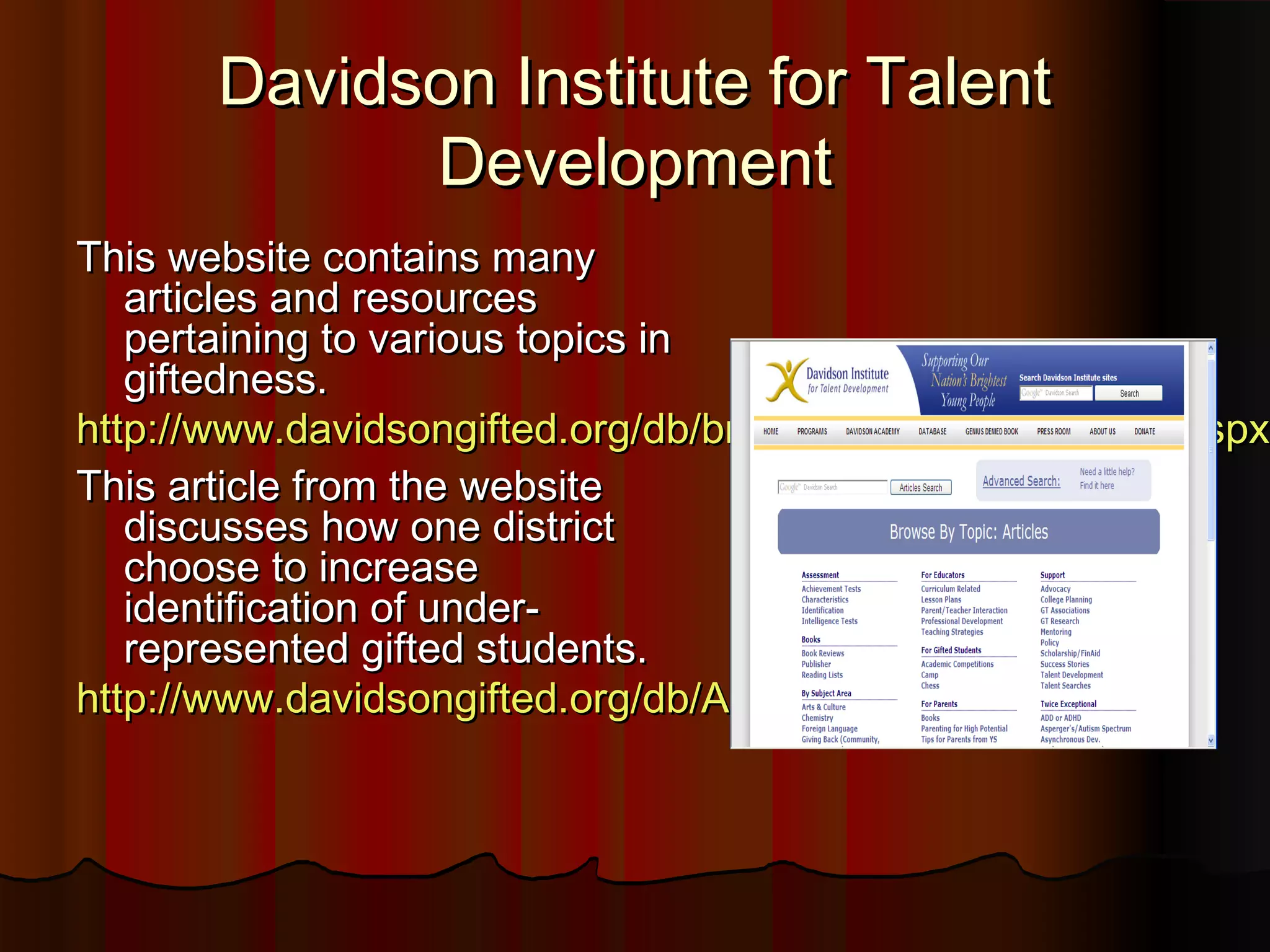
Davidson Institute for TalentDavidson Institute for Talent
DevelopmentDevelopment
This website contains manyThis website contains many
articles and resourcesarticles and resources
pertaining to various topics inpertaining to various topics in
giftedness.giftedness.
http://www.davidsongifted.org/db/browse_by_topic_articles.aspxhttp://www.davidsongifted.org/db/browse_by_topic_articles.aspx
This article from the websiteThis article from the website
discusses how one districtdiscusses how one district
choose to increasechoose to increase
identification of under-identification of under-
represented gifted students.represented gifted students.
http://www.davidsongifted.org/db/Articles_id_10463.aspxhttp://www.davidsongifted.org/db/Articles_id_10463.aspx
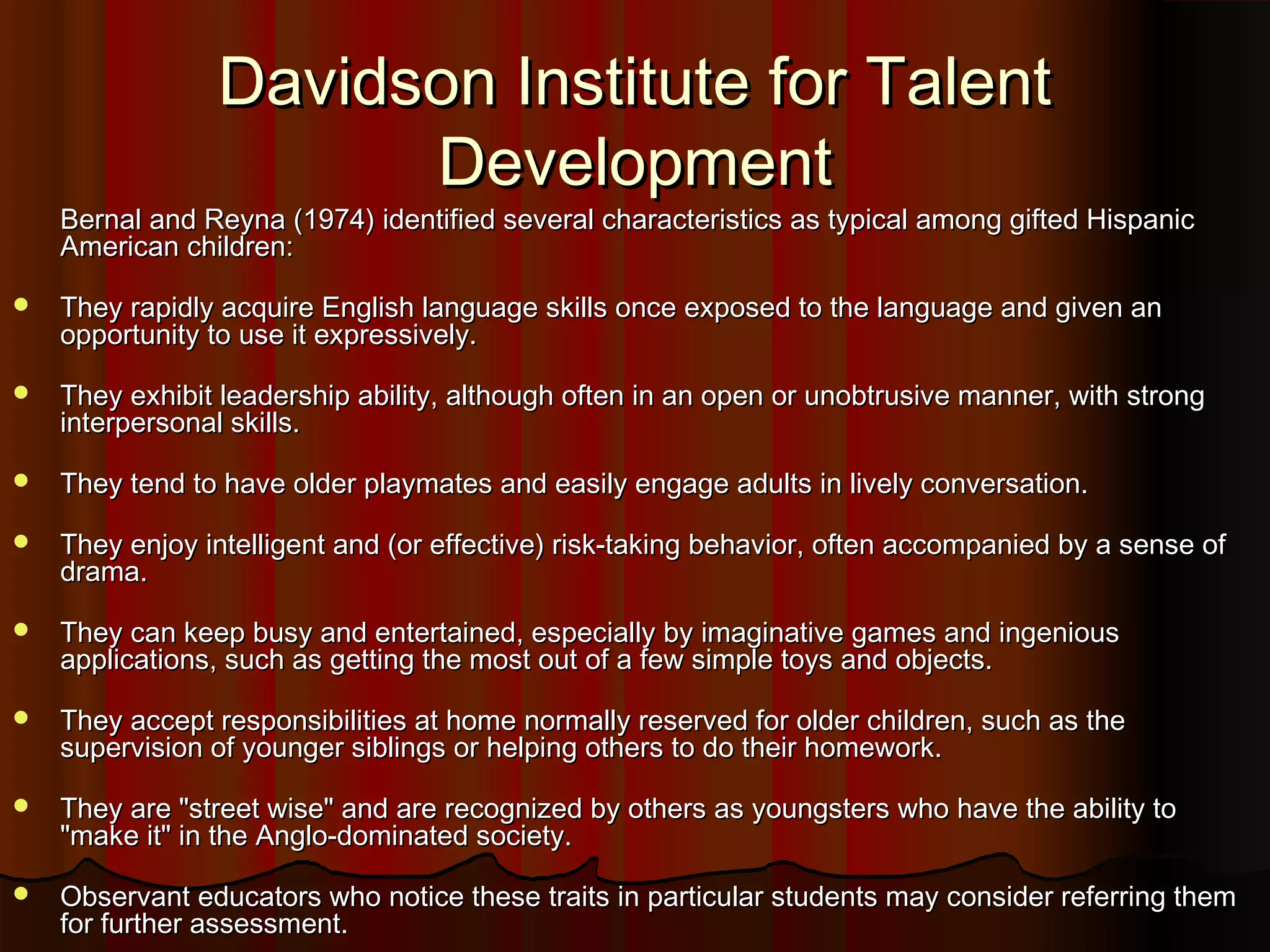
Bernal and Reyna (1974) identified several characteristics as typical among gifted HispanicBernal and Reyna (1974) identified several characteristics as typical among gifted Hispanic
American children:American children:
 They rapidly acquire English language skills once exposed to the language and given anThey rapidly acquire English language skills once exposed to the language and given an
opportunity to use it expressively.opportunity to use it expressively.
 They exhibit leadership ability, although often in an open or unobtrusive manner, with strongThey exhibit leadership ability, although often in an open or unobtrusive manner, with strong
interpersonal skills.interpersonal skills.
 They tend to have older playmates and easily engage adults in lively conversation.They tend to have older playmates and easily engage adults in lively conversation.
 They enjoy intelligent and (or effective) risk-taking behavior, often accompanied by a sense ofThey enjoy intelligent and (or effective) risk-taking behavior, often accompanied by a sense of
drama.drama.
 They can keep busy and entertained, especially by imaginative games and ingeniousThey can keep busy and entertained, especially by imaginative games and ingenious
applications, such as getting the most out of a few simple toys and objects.applications, such as getting the most out of a few simple toys and objects.
 They accept responsibilities at home normally reserved for older children, such as theThey accept responsibilities at home normally reserved for older children, such as the
supervision of younger siblings or helping others to do their homework.supervision of younger siblings or helping others to do their homework.
 They are "street wise" and are recognized by others as youngsters who have the ability toThey are "street wise" and are recognized by others as youngsters who have the ability to
"make it" in the Anglo-dominated society."make it" in the Anglo-dominated society.
 Observant educators who notice these traits in particular students may consider referring themObservant educators who notice these traits in particular students may consider referring them
for further assessment.for further assessment.
Davidson Institute for TalentDavidson Institute for Talent
DevelopmentDevelopment
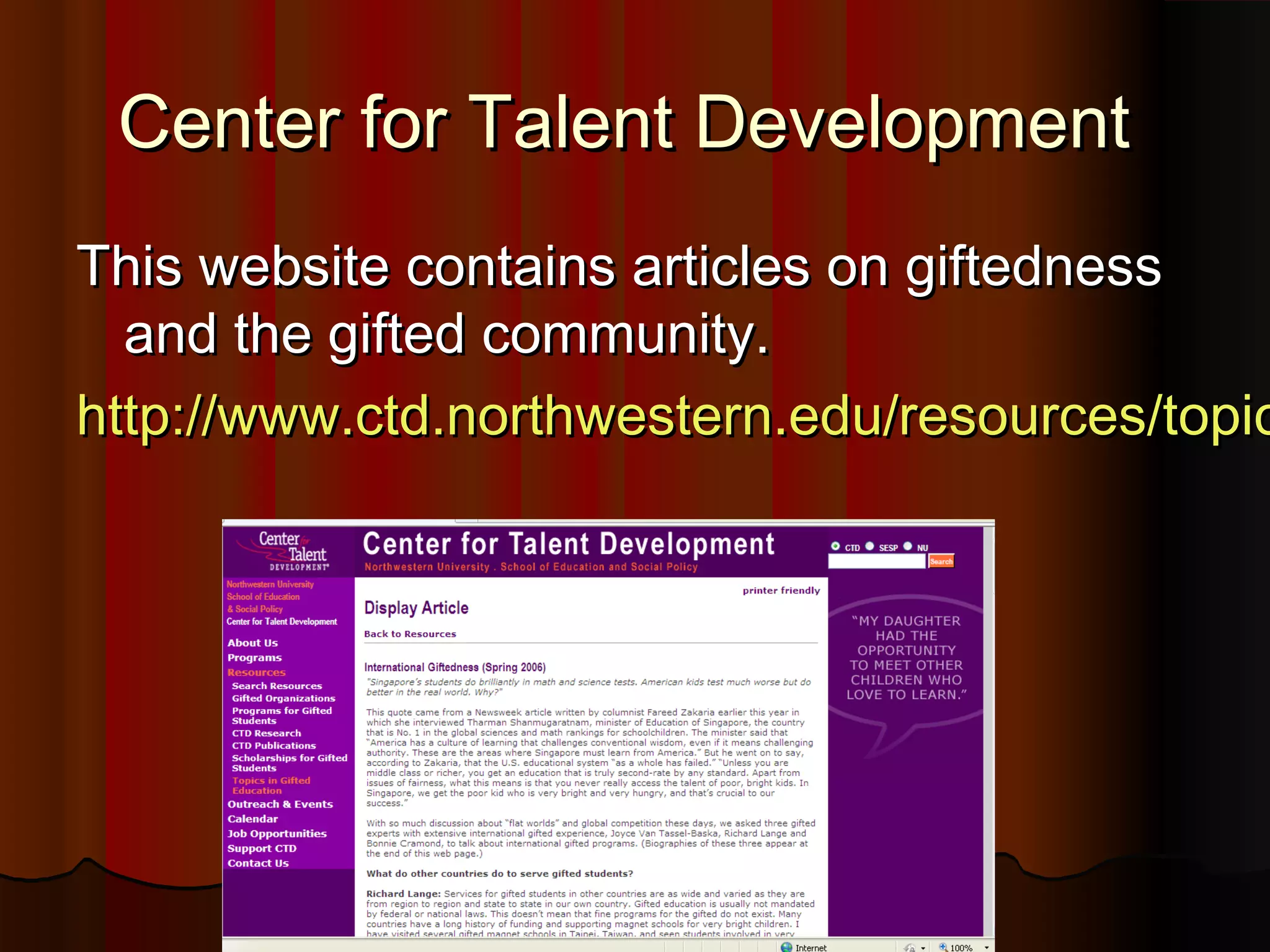
Center for Talent DevelopmentCenter for Talent Development
This website contains articles on giftednessThis website contains articles on giftedness
and the gifted community.and the gifted community.
http://www.ctd.northwestern.edu/resources/topichttp://www.ctd.northwestern.edu/resources/topic
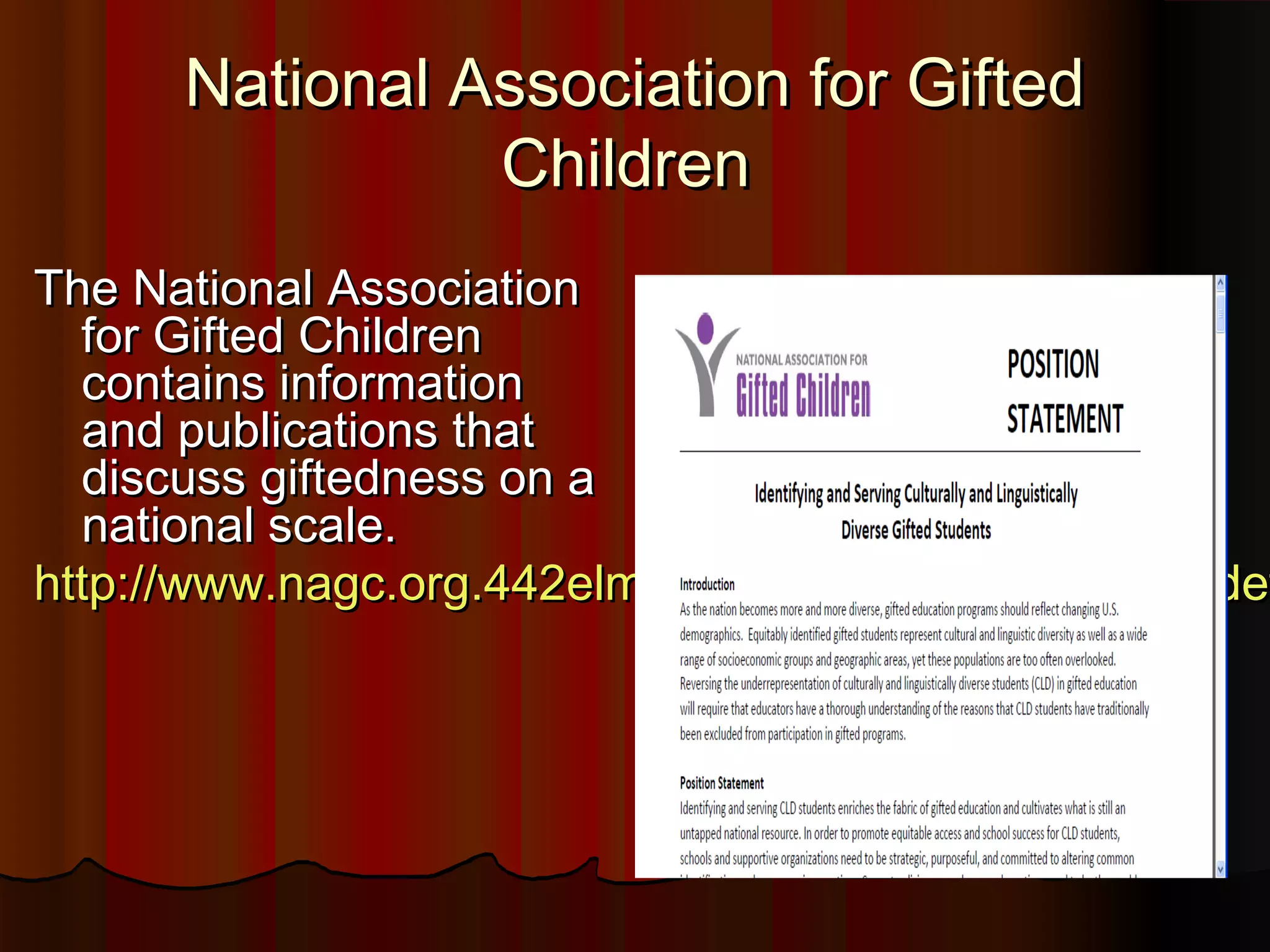
National Association for GiftedNational Association for Gifted
ChildrenChildren
The National AssociationThe National Association
for Gifted Childrenfor Gifted Children
contains informationcontains information
and publications thatand publications that
discuss giftedness on adiscuss giftedness on a
national scale.national scale.
http://www.nagc.org.442elmp01.blackmesh.com/sites/dehttp://www.nagc.org.442elmp01.blackmesh.com/sites/def
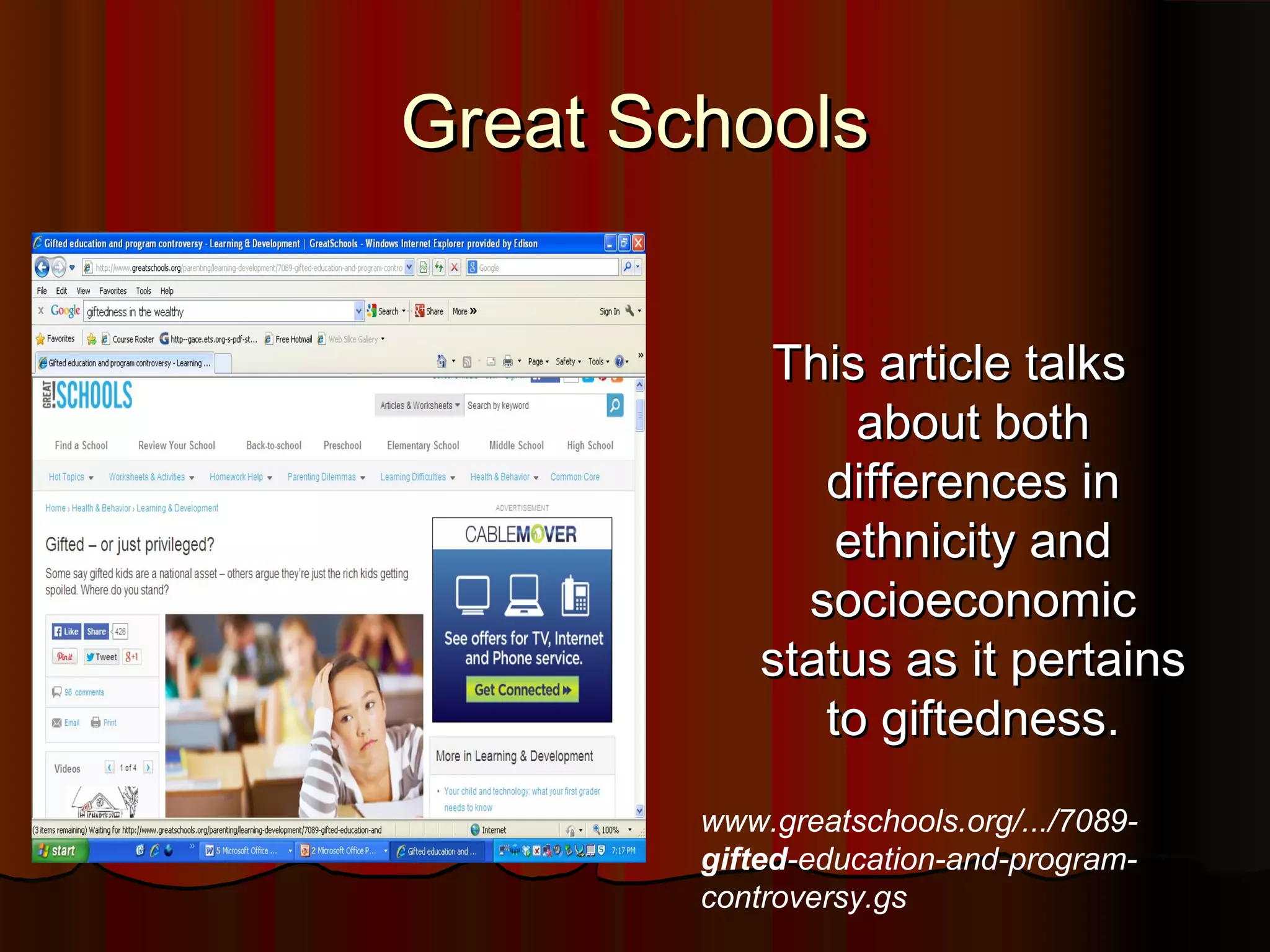
Great SchoolsGreat Schools
This article talksThis article talks
about bothabout both
differences indifferences in
ethnicity andethnicity and
socioeconomicsocioeconomic
status as it pertainsstatus as it pertains
to giftedness.to giftedness.
www.greatschools.org/.../7089-
gifted-education-and-program-
controversy.gs
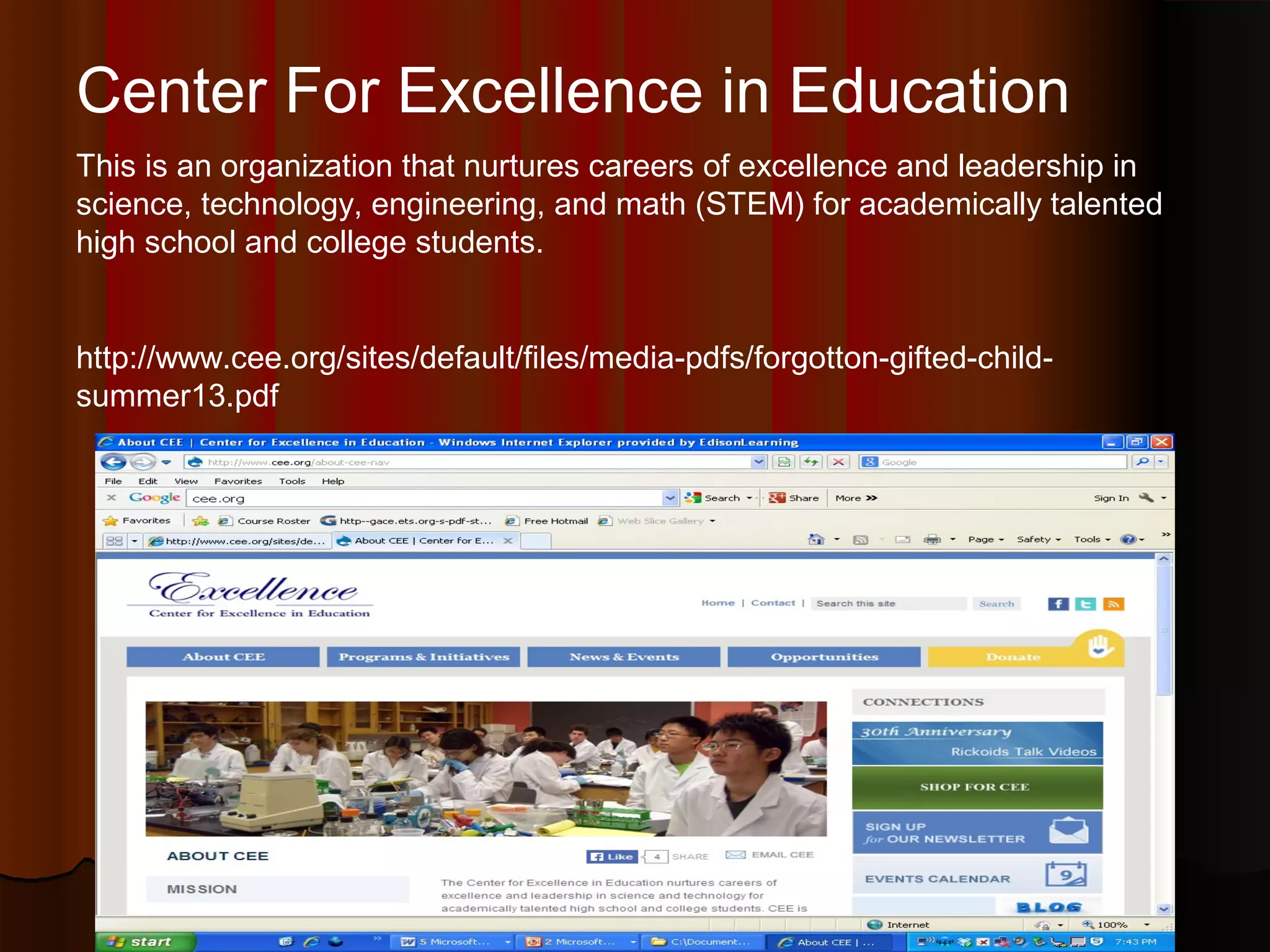
Center For Excellence in Education
This is an organization that nurtures careers of excellence and leadership in
science, technology, engineering, and math (STEM) for academically talented
high school and college students.
http://www.cee.org/sites/default/files/media-pdfs/forgotton-gifted-child-
summer13.pdf
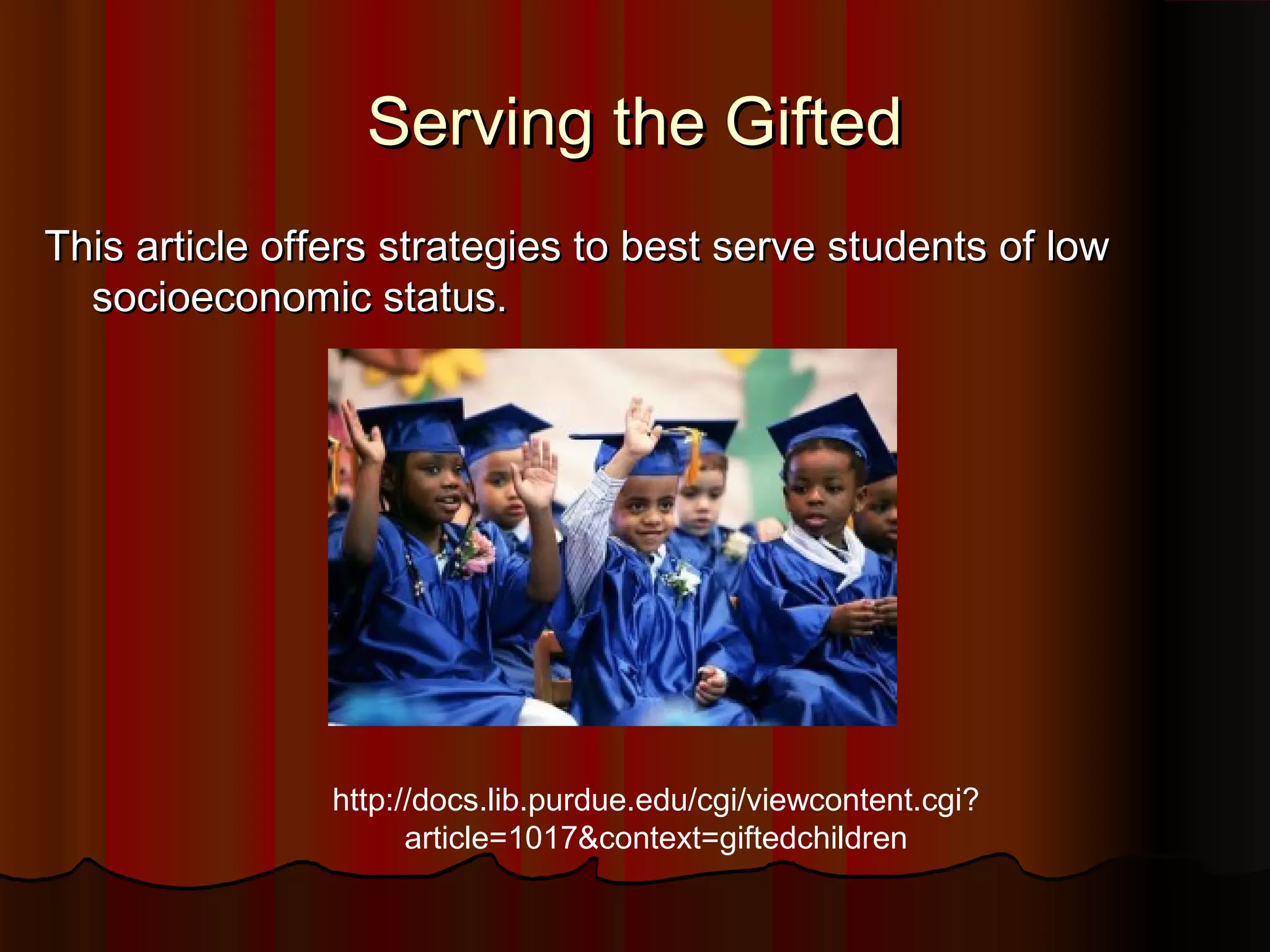
Serving the GiftedServing the Gifted
This article offers strategies to best serve students of lowThis article offers strategies to best serve students of low
socioeconomic status.socioeconomic status.
http://docs.lib.purdue.edu/cgi/viewcontent.cgi?
article=1017&context=giftedchildren
Question #1Question #1
1. How can you ensure that multilingual1. How can you ensure that multilingual
students are identified for gifted programsstudents are identified for gifted programs
regardless of their language barriers?regardless of their language barriers?
(Think-Pair-Share)(Think-Pair-Share)
Question #3Question #3
2. Think of a minority student in your class2. Think of a minority student in your class
that exhibits some of the characteristics ofthat exhibits some of the characteristics of
gifted students. Write a short four linegifted students. Write a short four line
poem describing them as a student.poem describing them as a student.
Question #3Question #3
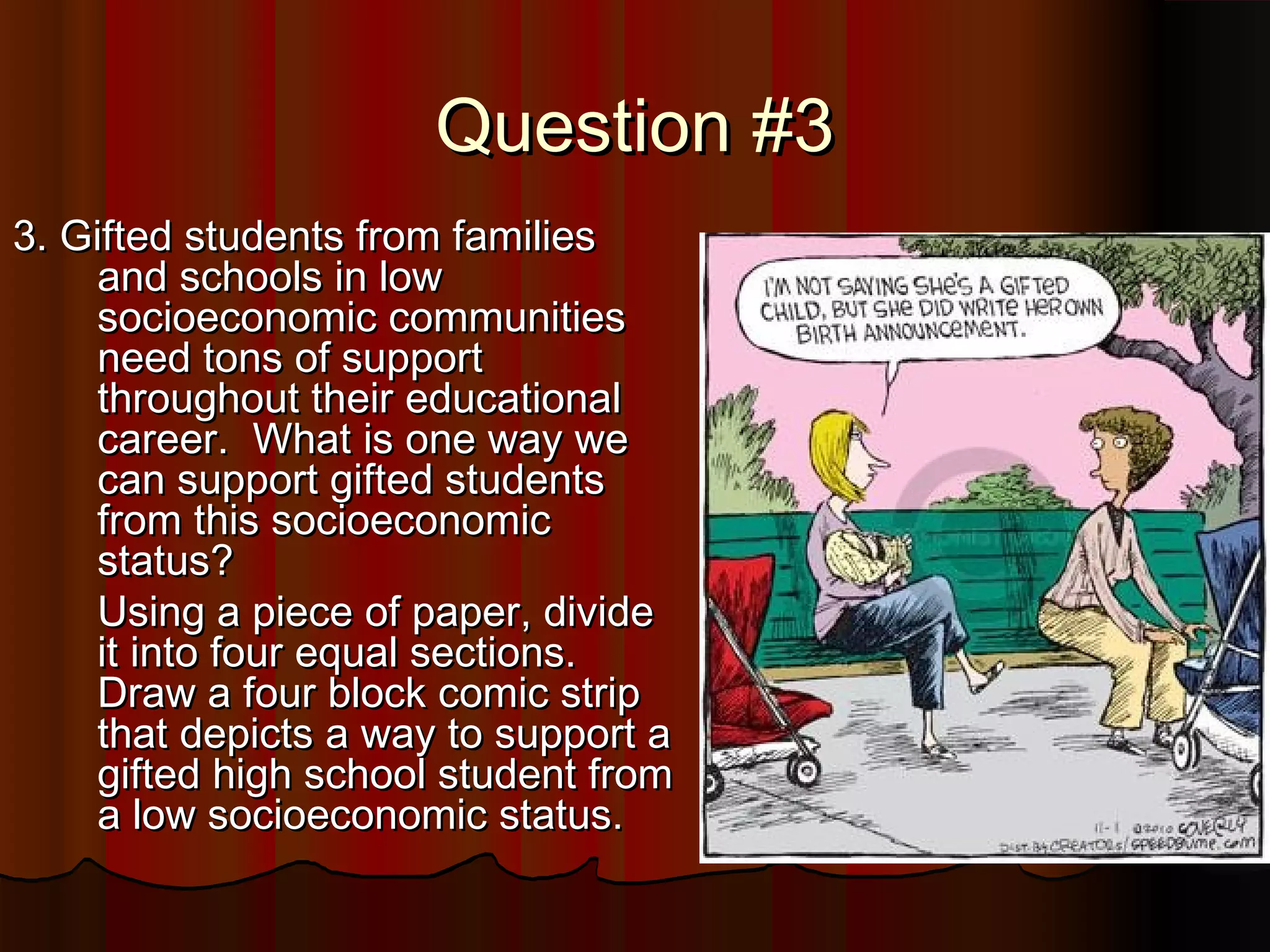
3. Gifted students from families3. Gifted students from families
and schools in lowand schools in low
socioeconomic communitiessocioeconomic communities
need tons of supportneed tons of support
throughout their educationalthroughout their educational
career. What is one way wecareer. What is one way we
can support gifted studentscan support gifted students
from this socioeconomicfrom this socioeconomic
status?status?
Using a piece of paper, divideUsing a piece of paper, divide
it into four equal sections.it into four equal sections.
Draw a four block comic stripDraw a four block comic strip
that depicts a way to support athat depicts a way to support a
gifted high school student fromgifted high school student from
a low socioeconomic status.a low socioeconomic status.

A Guide to Gaining Knowledge about: Cultural and/or Economically Diverse Giftedness

  • 1.
    A Guide toGaining Knowledge about:A Guide to Gaining Knowledge about: Cultural and/or EconomicallyCultural and/or Economically Diverse GiftednessDiverse Giftedness Charity WellsCharity Wells Deborah AllenDeborah Allen Robby ChapmanRobby Chapman
  • 2.
    Neag Center forGifted EducationNeag Center for Gifted Education and Talent Developmentand Talent Development This is a great websiteThis is a great website to begin yourto begin your research ofresearch of giftedness. It hasgiftedness. It has many fascinatingmany fascinating resources on theresources on the multicultural andmulticultural and social aspects ofsocial aspects of being a gifted child.being a gifted child. http://www.gifted.uconn.edu/nrcgt/http://www.gifted.uconn.edu/nrcgt/
  • 3.
    About Health: GiftedChildren fromAbout Health: Gifted Children from MinoritiesMinorities This website contains intriguing articles aboutThis website contains intriguing articles about giftedness in minorities.giftedness in minorities. http://giftedkids.about.com/od/giftedminorities/http://giftedkids.about.com/od/giftedminorities/
  • 4.
    Davidson Institute forTalentDavidson Institute for Talent DevelopmentDevelopment This website contains manyThis website contains many articles and resourcesarticles and resources pertaining to various topics inpertaining to various topics in giftedness.giftedness. http://www.davidsongifted.org/db/browse_by_topic_articles.aspxhttp://www.davidsongifted.org/db/browse_by_topic_articles.aspx This article from the websiteThis article from the website discusses how one districtdiscusses how one district choose to increasechoose to increase identification of under-identification of under- represented gifted students.represented gifted students. http://www.davidsongifted.org/db/Articles_id_10463.aspxhttp://www.davidsongifted.org/db/Articles_id_10463.aspx
  • 5.
    Bernal and Reyna(1974) identified several characteristics as typical among gifted HispanicBernal and Reyna (1974) identified several characteristics as typical among gifted Hispanic American children:American children:  They rapidly acquire English language skills once exposed to the language and given anThey rapidly acquire English language skills once exposed to the language and given an opportunity to use it expressively.opportunity to use it expressively.  They exhibit leadership ability, although often in an open or unobtrusive manner, with strongThey exhibit leadership ability, although often in an open or unobtrusive manner, with strong interpersonal skills.interpersonal skills.  They tend to have older playmates and easily engage adults in lively conversation.They tend to have older playmates and easily engage adults in lively conversation.  They enjoy intelligent and (or effective) risk-taking behavior, often accompanied by a sense ofThey enjoy intelligent and (or effective) risk-taking behavior, often accompanied by a sense of drama.drama.  They can keep busy and entertained, especially by imaginative games and ingeniousThey can keep busy and entertained, especially by imaginative games and ingenious applications, such as getting the most out of a few simple toys and objects.applications, such as getting the most out of a few simple toys and objects.  They accept responsibilities at home normally reserved for older children, such as theThey accept responsibilities at home normally reserved for older children, such as the supervision of younger siblings or helping others to do their homework.supervision of younger siblings or helping others to do their homework.  They are "street wise" and are recognized by others as youngsters who have the ability toThey are "street wise" and are recognized by others as youngsters who have the ability to "make it" in the Anglo-dominated society."make it" in the Anglo-dominated society.  Observant educators who notice these traits in particular students may consider referring themObservant educators who notice these traits in particular students may consider referring them for further assessment.for further assessment. Davidson Institute for TalentDavidson Institute for Talent DevelopmentDevelopment
  • 6.
    Center for TalentDevelopmentCenter for Talent Development This website contains articles on giftednessThis website contains articles on giftedness and the gifted community.and the gifted community. http://www.ctd.northwestern.edu/resources/topichttp://www.ctd.northwestern.edu/resources/topic
  • 7.
    National Association forGiftedNational Association for Gifted ChildrenChildren The National AssociationThe National Association for Gifted Childrenfor Gifted Children contains informationcontains information and publications thatand publications that discuss giftedness on adiscuss giftedness on a national scale.national scale. http://www.nagc.org.442elmp01.blackmesh.com/sites/dehttp://www.nagc.org.442elmp01.blackmesh.com/sites/def
  • 8.
    Great SchoolsGreat Schools Thisarticle talksThis article talks about bothabout both differences indifferences in ethnicity andethnicity and socioeconomicsocioeconomic status as it pertainsstatus as it pertains to giftedness.to giftedness. www.greatschools.org/.../7089- gifted-education-and-program- controversy.gs
  • 9.
    Center For Excellencein Education This is an organization that nurtures careers of excellence and leadership in science, technology, engineering, and math (STEM) for academically talented high school and college students. http://www.cee.org/sites/default/files/media-pdfs/forgotton-gifted-child- summer13.pdf
  • 10.
    Serving the GiftedServingthe Gifted This article offers strategies to best serve students of lowThis article offers strategies to best serve students of low socioeconomic status.socioeconomic status. http://docs.lib.purdue.edu/cgi/viewcontent.cgi? article=1017&context=giftedchildren
  • 11.
    Question #1Question #1 1.How can you ensure that multilingual1. How can you ensure that multilingual students are identified for gifted programsstudents are identified for gifted programs regardless of their language barriers?regardless of their language barriers? (Think-Pair-Share)(Think-Pair-Share)
  • 12.
    Question #3Question #3 2.Think of a minority student in your class2. Think of a minority student in your class that exhibits some of the characteristics ofthat exhibits some of the characteristics of gifted students. Write a short four linegifted students. Write a short four line poem describing them as a student.poem describing them as a student.
  • 13.
    Question #3Question #3 3.Gifted students from families3. Gifted students from families and schools in lowand schools in low socioeconomic communitiessocioeconomic communities need tons of supportneed tons of support throughout their educationalthroughout their educational career. What is one way wecareer. What is one way we can support gifted studentscan support gifted students from this socioeconomicfrom this socioeconomic status?status? Using a piece of paper, divideUsing a piece of paper, divide it into four equal sections.it into four equal sections. Draw a four block comic stripDraw a four block comic strip that depicts a way to support athat depicts a way to support a gifted high school student fromgifted high school student from a low socioeconomic status.a low socioeconomic status.

Editor's Notes

  • #3 Neag Center for Gifted Education and Talent Development The University of Connecticut is home to the Neag Center for Gifted Education and Talent Development. It is the only federally funded research organization, known as The National Research Center on the Gifted and Talented (NRC/GT) and has existed since 1990 with various university partnerships. The earliest research emphasized studies related to creativity, assessment, identification, programming, and evaluation. Several studies conducted by the research team are considered seminal research that guides the design and development of programs and services to meet the needs of gifted and talented students. The Neag Center for Gifted Education and Talent Development comprises many unique teaching, research, and service components.
  • #4 About Health is a website that includes many articles and resources include many aspects of health and family. The section on gifted children explores articles on issues that affect gifted children and their family. The topic of giftedness in minorities and at a socioeconomic status is also given consideration.
  • #5 The Davidson Institute for Talent Development serves profoundly gifted young people 18 and under. Profoundly gifted students are those who score in the 99.9th percentile on IQ and achievement tests. These students often share the following characteristics: An extreme need for constant mental stimulation An ability to learn and process complex information rapidly A need to explore subjects in surprising depth An insatiable curiosity; endless questions and inquiries A need for precision in thinking and expression-often answering questions with “that depends...” An ability to focus intently on a subject of interest for long periods of time An inability to concentrate on a task that is not intellectually challenging, including repetitious ideas or material presented in small pieces In addition, they provide information and educational opportunities for teachers, school administrators, school counselors, pediatricians, psychologists, psychiatrists and other professionals.
  • #7 The Center for Talent Development (CTD), housed at Northwestern University’s School of Education and Social Policy, is an accredited learning center and research facility that identifies, educates and supports gifted students and their families and serves as a leader in gifted education. They use research-proven methods for identifying and educating gifted students such that they are challenged and inspired to learn, achieve and realize their full potential.
  • #8 NAGC staff and leaders support and develop policies and practices that encourage and respond to the diverse expressions of gifts and talents in children and youth from all cultures, racial and ethnic backgrounds, and socioeconomic groups. NAGC invests its resources to train teachers, encourage parents, and educate administrators and policy makers on how to develop and support gifted children.
  • #9 According to the National Center for Education Statistics paints a picture of how ethnicity greatly defines the rate at which students are served. Asian and Caucasian students had triple the percentage of African American and Hispanic students being served in the gifted programs in the state of Georgia.
  • #10 -the U.S. education fails in comparison to those around the world. As third world countries are putting more funding towards revamping their education system, especially areas concerning STEM and gifted programs, the U.S. continues to cut funding for education.
  • #11 Gifted students in low socioeconomic communities need a significant support staff during their educational careers. Students and families need: information pertinent to preparation for college, monitoring and supporting academic performance, foster mentor relationships with adults who are in a position to do so, and screening for students who are eligible for state scholarships. Essentially, students from low socioeconomic status need scaffolding and support from the start of education to the pursuit of higher education.