Journal of IT and Economic Development 5(2), 1-17, October 2014 1
A Framework for Project Success
Mark Allen, Del Alleyne, Crystal Farmer, Angela McRae, Charles Turner
College of Engineering, Drexel University, USA
mha44@drexel.edu, dca25@drexel.edu, crf62@drexel.edu, am3627@drexel.edu, cet79@drexel.edu
Abstract
The objective of A Framework for Project Success study was to investigate factors commonly
critical to assisting with project success in contrast to project failure. Proctor & Gamble’s New
Growth Factory served as an example of a successful project, while the U.S. Coast Guard’s 123-
Foot Patrol Boat project represented those that have failed. An organization’s investment in
researching the project experiences of other organizations can save the sometimes catastrophic
cost of failed projects. The environment of this study was that of a graduate-level course in project
management as a discipline, while the environment for the application of the study’s findings was
that of projects of any size, location, and type of organization. The study’s stakeholders were the
five study team members along with their professor. The studied project stakeholders included the
project sponsors, project managers, project management team members, project staff, contractor
staff, and customers. The original objective of the study to investigate critical success factors of
projects, retained its place in the study. The team decided also to contrast the factors against a
failed project because project failures garner so much attention. The survey identified the project
management plan, the responsibility assignment matrix, and monitoring of the budget, schedule,
and products as important to project success. The professional experience concluded that
insufficient external influence, hampered project manager, overly broad scope, and inadequate
budget can lead to failure. The study generally found that external influence, project manager and
scope, schedule, and budget are factors critical to project success and failure.
Keywords: Project Management, Quality Management, Budget, Project Manager
Introduction
Success is the intent of most every project, but project failures seem to attract more
attention. The objective of this study is to investigate factors commonly critical to assisting with
project success. The study’s scope includes a breakdown of three common critical success
factors applied to an example of a successful project along with an example of a failed project.
Critical success factors (CSFs) are strongly related to mission and strategic goals of the business
Journal of IT and Economic Development 5(2), 1-17, October 2014 2
or project. Organizations’ missions and strategic goals are focused on what needs to be achieved,
whereas CSFs focus on the most important area and guide one to achieve the goal. (Mind tools)
Limitations of the study include the small quantity of people available to the survey, and
limited information sources for analysis. The methodology for this study included a qualitative
examination of the roles that factors play in the success and failure of a project. Data were
collected through document review, project analysis, professional experience, and qualitative
survey
The three factors on which this paper is structured include external influence, project
manager, and scope, schedule, and budget. Proctor & Gamble’s (P&G’s) New Growth Factory
serves as an example of a successful project, while the U.S. Coast Guard’s 123-Foot Patrol Boat
project represents those that have failed. The structure begins with a literature review and
explanation of the research methodology, and ends with a summary, conclusions, references, and
appendix.
Literature Review
In 2013, according to Gartner, Inc., the world’s leading information technology research
and advisory company, the projected failure rate for projects from now until 2016 is
approximately 20 to 28 percent. Gartner advised that organizations should accept the increased
risk to achieve the desired return and to accept failure and move on. Since the organizations have
increased focus on cost management, they should embrace the failure (Gartner, 2013).
In this present paper, literature reviews attempt to argue the point made by Gartner.
While organizations should understand when failing projects should just be terminated, not
accepting that failure will just occur and adapting their behavior and learning critical attributes to
assist with project success is advantageous for the organization.
Journal of IT and Economic Development 5(2), 1-17, October 2014 3
Two of the reviews of literature that provide evidence that standards and behaviors can
assist with successful projects are A Guide to the Project Management Body of Knowledge (5th ed.)
and Project Management: A Managerial Approach (8th ed.). Both provide information and tools that
contribute to the agreement that there are behaviors that can guide the project to be successful.
Methodology
A qualitative approach was taken to examine the roles that different factors play in the
success and failure of a project. The factors that were analyzed in this paper include external
influences such as organization influences, structures and success factors, project manager’s
characteristics, and the importance of scope, schedule, and budget. Data were collected through
document review, project analysis, professional experience, and qualitative survey.
A survey was used to collect information from the people on a project by the use of
structured questionnaires. The most efficient way to understand what projects need, both external
to the project and internally, to be successful is to question those that have been or currently are
part of a project team. A survey of nine questions was asked to a group of 6 people who ranged
from an executive and project manager (PM) to people who have participated on a project team.
For factors that contributed to a successful project, the group focused on characteristics of a PM.
Characteristics included understanding lessons learned of previous projects, building a good
relationship with the team and stakeholders, and ensuring teamwork.
The Project Management Plan (PMP) was identified as being the most important tool
since it documents the goals, objectives, and scope of the project. The group also noted that
having a responsibility assignment matrix (RAM) is very helpful to understand the roles and
responsibility of the team. The group agreed that they did not use a work breakdown structure
Journal of IT and Economic Development 5(2), 1-17, October 2014 4
very often, but that monitoring of the budget, schedule, and products is extremely important to
the success of the project. The full survey is in Appendix A.
Description and Analysis of Project
According to Pakseresht and Asgari (2012), Ronald Daniel, a top senior partner at
McKinsey & Company, was among the first experts who offered critical success factors (CSFs)
as the business guidance, in 1961. John Rockart, from MIT’s School of Management, built on
Daniel’s idea of CSF. Rockart defines critical success factors as, “the limited number of areas in
which results, if they are satisfactory will ensure successful competitive performance for the
organization. They are the few key areas where things must go right for the business to flourish.
If results in these areas are not adequate the organization’s efforts for the period will be less than
desired.” He concluded that CSFs are “areas of activity that should receive constant careful
attention from management” (Mind tools).
The New Growth Factory at P&G serves as an excellent example of a state-of-the-art
project that owes its achievements in great part to the critical success factors of external
influence, project manager, and scope, schedule, and budget. In 2000, the products and divisions
within P&G seemed stagnant - limited in both innovation and growth. P&G’s quest was to
stimulate and systematize these two important areas. This was an important organizational goal
that P&G’s leadership felt necessary, as the corporation was not growing fast enough for their
liking. To help remedy the situation, P&G leadership launched a project called the New Growth
Factory, which was tasked to systematize innovation and growth. More than ten years after
launching the project, P&G’s revenue doubled while new and innovative thinking and product
development have been very successful.
Journal of IT and Economic Development 5(2), 1-17, October 2014 5
The U.S. Coast Guard’s 123-Foot Patrol Boat project serves as an example of a project
that failed due in great part to its inability to exploit the critical success factors noted above. The
project converted eight of its 110-foot patrol boats into more capable 123-foot cutters but
cancelled the project when the cutters developed hull cracks and engine failures that made them
unseaworthy. “In September 2004, more serious flaws in the boat conversion program became
obvious after the first one, the Matagorda, was launched. As it traveled in relatively heavy seas
from Key West to Miami, large cracks appeared in the hull and deck” (Lipton, 2006). A project
within the Coast Guard’s Deepwater program, the project failed as the program failed. The
Coast Guard’s personnel funding had been reduced to the point that it had insufficient acquisition
personnel and had to depend on contractors to fill the gap. The program eventually applied
lessons learned to other projects and succeeded as a program, but the Patrol Boat project never
recovered due largely to the critical success factors analyzed below.
Critical Success Factor - External Influence
Organizational Influence
Projects require a high degree of organization and planning to progress smoothly and
profitably. Companies must create a collaborative and friendly culture and be willing to change
the culture by retaining younger staff and have them commit to training and development.
Leadership must be able to communicate and delegate effectively to get team members involved
and keep them motivated to accomplish goals and objectives. The culture of the organization
generally dictates how the project will be organized and the project team leader’s degree of
authority and influence.
P&G’s New Growth Factory has flourished as a project due in part to its organizational
influence. From an organizational standpoint, the leaders of P&G were very much behind the
Journal of IT and Economic Development 5(2), 1-17, October 2014 6
project. They laid the foundation for the project and were very involved in setting the vision and
inspiration for the project. At P&G that inspiration lies in a sense of purpose driven from the top
down—the message that each innovation improves people’s lives.
The U.S. Coast Guard’s failed 123-Foot Patrol Boat project did not benefit from
organizational influence. As Congress cut the Coast Guard’s personnel funds, the service was
forced to outsource acquisition oversight. As an organization, the Coast Guard was unable to
gain sufficient funding, which hampered the PM’s ability to staff the project.
Organizational Structure
Projects are organized basically into three types of structures:
1. Functional structures – Functional projects are usually limited to the scope of their
discipline or functional group and are characterized by limited project management authority.
2. Projectized organizations – Project teams are often co-located. Project resources are
assigned directly to the PM on a permanent basis. The PM, in this case, has a high degree of
authority and influence.
3. Matrix structures – are a blend of functional and projectized organizations. Matrix
organizations are characterized as to the degree of PM authority and influence.
These levels of authority and influence are a direct result of senior management’s
interpretation of the project management role, the culture and strength of the existing
management team, and to what degree they choose to delegate authority within the organization.
Influence can either be weak, which corresponds to a Project Coordinator role; it can be
balanced, which corresponds to a part-time Project Manager role; or it can be strong, which
corresponds to a full-time Program Manager or Project Manager (Drexel University, 2014).
Journal of IT and Economic Development 5(2), 1-17, October 2014 7
The New Growth Factory enjoyed an effective organizational structure. P&G developed
organizational structures to specifically drive new growth. In a handful of business units the
company created small groups focused primarily on new-growth initiatives. Dedicated teams
within the groups conducted market research, developed technology, created business plans, and
tested assumptions for specific projects.
The 123-Foot Patrol Boat project was cancelled partly because the Coast Guard’s parent,
the Department of Homeland Security, was only 4 years old and as such provided minimal
assistance with acquisition or recognition of the need for assistance. The matrix structure of the
project gave the PM a degree of autonomy but also a degree of isolation.
Critical Success Factor - Project Manager
Stakeholder Partnership
The relationship between the PM and stakeholders is a partnership. PMI defines a
stakeholder as “an individual, group, or organization who may affect, be affected by, or perceive
itself to be affected by a decision, activity, or outcome of a project” (p.563). Eskerod and Jepsen
(2013) discuss two possible alternatives to stakeholder management, proactive or reactive. “A
proactive strategy implies that you try to anticipate what will happen in relation to the
stakeholder and plan and act to mitigate events before they happen”(Eskerod & Jepsen, 2013,
p.49). Conversely, “a reactive strategy implies that you do something in response to the actions
and requirements of the stakeholder…in other words limiting your communication to times when
action or decisions by the stakeholder is required” (Eskerod & Jepsen, 2013, p.49). Eskerod and
Jepsen (2013) recommend that the PM get in front of any situation affecting the stakeholder by
choosing proactive strategy (49).
Journal of IT and Economic Development 5(2), 1-17, October 2014 8
Identifying all stakeholders from the beginning of the project impacts the PM’s ability to
positively interact with them. “The key benefit of this process is that it allows the project
manager to identify the appropriate focus for each stakeholder or group of stakeholders” (PMI,
2013, p.393). It is necessary for the PM to “…think of all the people who are affected…who
have influence or power…or have an interest” in helping or hindering the project (TOGAF,
Identify Stakeholders, para. 1). Just as solutions need to be tailored to problems, conflict
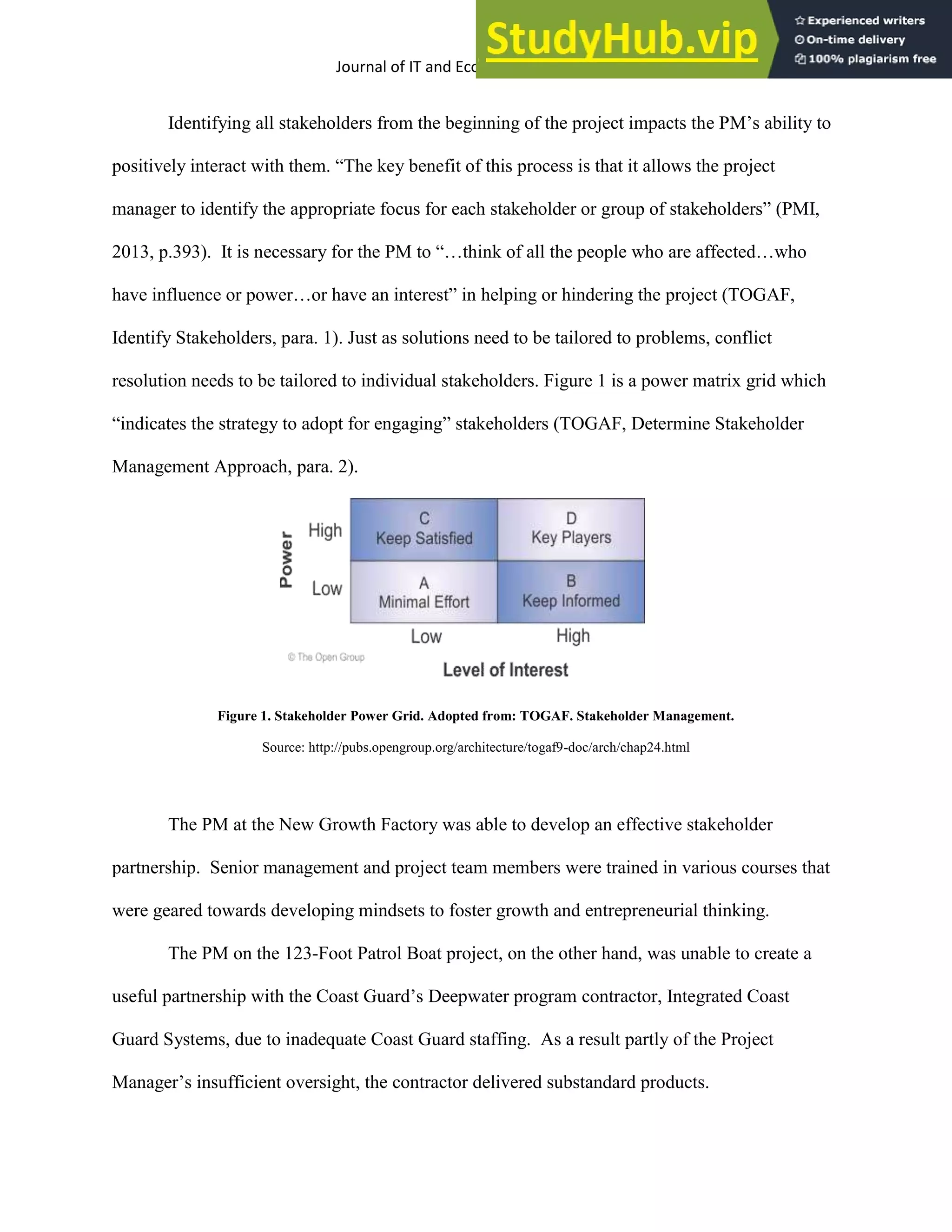
resolution needs to be tailored to individual stakeholders. Figure 1 is a power matrix grid which
“indicates the strategy to adopt for engaging” stakeholders (TOGAF, Determine Stakeholder
Management Approach, para. 2).
Figure 1. Stakeholder Power Grid. Adopted from: TOGAF. Stakeholder Management.
Source: http://pubs.opengroup.org/architecture/togaf9-doc/arch/chap24.html
The PM at the New Growth Factory was able to develop an effective stakeholder
partnership. Senior management and project team members were trained in various courses that
were geared towards developing mindsets to foster growth and entrepreneurial thinking.
The PM on the 123-Foot Patrol Boat project, on the other hand, was unable to create a
useful partnership with the Coast Guard’s Deepwater program contractor, Integrated Coast
Guard Systems, due to inadequate Coast Guard staffing. As a result partly of the Project
Manager’s insufficient oversight, the contractor delivered substandard products.
Journal of IT and Economic Development 5(2), 1-17, October 2014 9
Lessons Learned
Lessons learned can serve as a roadmap to success by studying failures on similar
projects from the past, and also, studying how teams in similar situations overcame obstacles.
However, because every project is unique, Flahiff (2013) emphasizes the advantage of including
lessons learned throughout the current project.
Traditional lessons learned are held when the project is complete, presumably so that the
team does not make these same mistakes on future projects. The problem with this approach is
most people can't remember what happened two weeks ago, much less what happened six
months or two years ago. (Lessons-learned session items are team-, project-, or technology-
specific, para. 1)
Lessons learned were captured in a timely manner by the New Growth Factory, which
formed a group of new growth business guides to help teams working on growth and innovation
projects. The guides include several entrepreneurs who have succeeded - and, even more
important, failed - in starting businesses.
While the 123-Foot Patrol Boat Project failed, its parent Deepwater program applied the
following lessons learned to other projects:
 Ensure a competitive process for acquisition.
 Renegotiate existing contracts as necessary to ensure companies honor commitments
to deliver as promised.
 Empower Coast Guard engineers to closely monitor contractor work.
 Create a Coast Guard office to oversee the procurement and maintenance of its ships
and airplanes.
Team Building
How the PM interacts with a stakeholder can influence project success or failure. Good
relationships can be the difference between outstanding success and dismal failure because it’s
Journal of IT and Economic Development 5(2), 1-17, October 2014 10
all about getting people to like and trust you so that they will deliver what you need them to
deliver at the right time in the right way (Young, M., 2009, Para. 1).
Whether it is a team member, senior manager, or investor, strengthening relationships
with stakeholders increases the likelihood that the PM will be able to accomplish what is needed
through other people. Working well with a team includes resisting the urge to micromanage. “If
a project manager attempts to control every aspect of the process, team members may feel as if
their leader doesn’t trust them or doesn’t value their contributions. This can be detrimental to
project management success” (University Alliance, 2014, Provide Leadership Without
Micromanaging, para. 1).
Encouraging others to step forward and trusting team members to complete tasks
properly is made easier when the PM knows both industry standards and the capabilities of
individuals on her team. University Alliance (2014) recommends the following: “… learn
everything you can about your team and what each person will be contributing to the project.
This will help you gain the confidence of your collaborators and enable you to manage the
workflow more effectively (Do Your Homework).”
Based on the idea of disruptive-innovation theory, which was the concept of driving
growth through new offerings that are simpler, more convenient, easier to access, or more
affordable, the New Growth Factory began by holding a two-day workshop for seven new-
product-development teams. The attendees explored how to shake up embedded ways of
thinking that can inhibit disruptive approaches. The learning harnessed from these workshops
were paramount to development of new products.
The challenge for the 123-Foot Patrol Boat Project Manager was to build and maintain a
cohesive team during the distraction of the Coast Guard, Congressional, and media investigations
Journal of IT and Economic Development 5(2), 1-17, October 2014 11
when the project began to fail. While this leader and the project team did their best, they were
disadvantaged from project inception by lack of funding and personnel.
Critical Success Factor - Scope, Schedule, and Budget
Despite the recognized criticality of project success for organizations, a considerable
proportion of projects continue to either not meet their due dates, exceed budget, not deliver the
specifications, and ultimately not meet customer satisfaction. That is why project management
success and failure remains an area of considerable interest in contemporary project management
literature. Understanding the scope, schedule, and budget of a project are critical criteria when it
comes to the overall success of that project. The PM must be very competent in these aspects of
the project as he or she is often a key member of the contract negotiations team for contract
projects, based on his or her expertise in scheduling, estimating cost, and expected role in scope
control.
Scope
The scope specifies the customer’s contractual expectations, mandatory tasks, and
products to be procured and delivered; and can be characterized as a specific and exact list of
deliverables required to successfully meet program objectives. In other words, the authorized
work elements for the program are defined. Typically this scope is documented in a project
scope statement or statement of work (SOW), which officially defines the project boundaries.
Successful projects will have an instrument to organize this defined work in order to
make sure that the entire scope of work is broken down into manageable pieces and identified
properly; this instrument is called the work breakdown structure (WBS). A WBS tailored for
effective management control is used in this process. While defining the actual work expected to be
completed, successful projects also make it a good practice to also identify exactly which
Journal of IT and Economic Development 5(2), 1-17, October 2014 12
organizations will be responsible for the work defined in the WBS. They use a tool called an
organizational breakdown structure (OBS), which defines the organizational elements needed to plan,
execute and control the work, as well as illustrate the responsible organizational reporting
relationships which preserves unambiguous accountability for getting the work done. A well
constructed WBS and OBS can be integrated in a manner that permits cost and schedule performance
measurement by elements of either or both structures, as needed. These measurement points are very
useful to help identify the health of the project and help chart the course for the project success. Once
the project WBS and OBS are completed, a RAM is developed. The RAM reflects the relationship
between the program WBS (tasks) and program OBS (responsible organization). The overall
organization of the scope, responsible individuals, and cost delivered by the WBS, OBS, and RAM is
imperative to help bound the project and identify the work and individuals that are vital to the
project. It’s no secret that organizations that effectively utilize these tools when planning their
projects are much more successful than those who do not.
P&G’s New Growth Factory benefited from a well defined and closely monitored scope.
It was a project initiated to develop new products and services through growth and innovation.
The Coast Guard’s Patrol Boat Project failed in part because the SOW was written so
broadly that the Coast Guard had to depend heavily on the contractor to monitor its own work.
Schedule
A project schedule presents linked activities with planned dates, durations, milestones,
and resources. Successful projects use some sort of schedule hierarchy in order to be able to
organize and analyze the project’s schedule. The Integrated Master Plan (IMP) is an event-
oriented plan used to communicate the program’s approach to meeting program SOW
requirements. While the IMP illustrates the project’s what and how, the Integrated Master
Schedule (IMS) illustrates the project’s how and when. The IMS is a linked network of project-
Journal of IT and Economic Development 5(2), 1-17, October 2014 13
planned activities, which support the project’s IMP by containing all detail tasks necessary to
meet those events, accomplishments, and criteria. The IMS is used as the primary tracking tool
for status, performance measurement, and earned value measurement (EVM): day-to-day
execution. The IMS provides a comparison of current status to the established baseline, which
provides visibility into schedule variations and insight into trends and impacts; facilitates
identification of potential risk, risk mitigation, and opportunities; and identifies schedule priority
including the critical path(s). The IMS is a line of communication across the entire project and
helps facilitate "what if" and/or recovery scenarios.
Projects succeed using a well thought out IMS because the IMS clearly demonstrates how
the project is structured and defines an executable plan.
P&G’s New Growth Factory employed a definitive production schedule that identified
what needed to be produced and when.
Budget
Successful projects after they have defined and scheduled the work are astute in knowing
how to properly allocate budget to that work. One of the first steps in this process is control
account planning. Control accounts are control points where cost, schedule, and technical scope
are managed. They are established as a mechanism where budgets are planned, actual costs are
collected or summarized, performance is claimed or summarized, and variance analysis is
accomplished. The control account plan shows time-phased planning of tasks and their
associated budget by element of cost (labor, material, subcontract, etc.) for a control account.
The New Growth Factory benefited from an effectively and substantially funded budget.
P&G spends nearly $2 billion annually on R&D — roughly 50% more than its closest competitor
and more than most other competitors combined.
Journal of IT and Economic Development 5(2), 1-17, October 2014 14
The 123-Foot Patrol Boat project failed in large part because its budget failed to allow for
sufficient acquisition personnel to monitor contractor work.
Controlling and Monitoring
After this three-step process of defining and planning the work, scheduling the work, and
allocating budget to the work is completed, the formal performance measurement baseline
(PMB) and integrated technical, cost, and schedule baseline are established. This PMB will be
the time-phased budget plan, to which the project will execute and against which project
performance will be measured. The PMB is used with the support of earned value reporting to
manage the project, product development, and contract execution. Successful projects invariably
utilize these processes to establish the PMB and measure it with the support of earned value
much more effectively and efficiently than projects that fail.
Summary
This study pursued factors commonly critical to assisting with project success in contrast
to project failure. Its methodology employed four different approaches to research - qualitative
survey, professional experience, document review, and project analysis. The survey revealed that
the Project Management Plan was the most important tool since it documents the goals,
objectives, and scope of the project. Those surveyed also noted a RAM is very helpful to
understand the roles and responsibility of the team. Finally the survey found that monitoring of
the budget, schedule, and products is extremely important to the success of a project.
Professional career experience was consulted for the study through service in the Coast Guard
during the failed 123-Foot Patrol Boat project lifecycle. It was determined that the project failed
due to insufficient external influence; hampered project manager; overly broad scope, and
Journal of IT and Economic Development 5(2), 1-17, October 2014 15
inadequate budget. As a result, the contractors delivered ships that were unseaworthy. On the
other hand, the New Growth Factory was successful partly due to implementing the three success
factors. Research of documents such as books and professional journal articles added to the
repertoire leading to project analysis findings that external influence; project manager; and
scope, schedule, and budget are factors critical to project success and failure.
Conclusions
This research paper determined that — by applying the critical success factors of external
influence; project manager; and scope, schedule, and budget — projects will have an advantage
of achieving success. The P&G New Growth Factory proves the critical success factors assisted
in a successful project, and the U.S. Coast Guard’s 123-Foot Patrol Boat project shows how lack
these factors can cause a project to fail. Implications of this study include the affirmation that
organizations can profit from the pursuit of project management as both an academic discipline
and a profession. An organization’s investment in researching the project experiences of other
organizations can facilitate learning vicariously without the cost of failed projects. The study’s
lessons can be applied to a great variety of projects. The critical success factors are general
enough to be applied to small and large projects, locally and globally, in both the civilian and
Government sectors.
References
Drexel University, Goodwin College of Professional Studies Week 3 Lecture Notes, Retrieved November
24, 2014
Eskerod, P., Jepsen, A. (2013). Fundamentals of Project Management: Project Stakeholder Management
Flahiff, J. (2013). Project management lessons learned shouldn’t be limited to postmortems. Retrieved
from http://searchcio.techtarget.com/tip/Project-management-lessons-learned-shouldnt-be-
limited-to-postmortems
Journal of IT and Economic Development 5(2), 1-17, October 2014 16
Gartner, Inc. (2013). Gartnery Says Smart Organizations Will embrace Fact and Frequent Project
Failure in Their Quest for Agility. Retrieved from http://www.gartner.com/newsroom/id/2477816
Lipton, Eric. (December 9, 2006). Failure to Navigate: Billions Later, Plan to Remake the Coast Guard
Fleet Stumbles. The New York Times. The New York Times Company
Mind Tools. Critical Success Factors. Identifying the Things that Really Matter for Success. Retrieved
from http://www.mindtools.com/pages/article/newLDR_80.htm
Pakseresht, Afshin, Dr. Gholamreza Asgari. (2012). Determining the Critical Success Factors in
Construction Projects: AHP Approach. Interdisciplinary Journal of Contemporary Research in
Business. Retrieved from http://journal-archieves26.webs.com/383-393.pdf
PMI. (2013). A Guide to the Project Management Body of Knowledge (5th ed.). Publisher: PMI. ISBN:
9781935589679
TOGAF. Stakeholder Management. Retrieved from http://pubs.opengroup.org/architecture/togaf9-
doc/arch/chap24.html
University Alliance. (2014). Five Secrets To Project Management Success. Retrieved from Villanova
website at http://www.villanovau.com/resources/project-management/5-secrets-project-
management/#.VHVMYYe7mnc
Young, M. (2009). Building Relationships in Project Management. Retrieved from Projectsmart.co.uk
website at http://www.projectsmart.co.uk/building-relationships-in-project-management.php
Acknowledgment
We would like to thank Dr. Victor Sohmen (Project Management Program, College of
Engineering, Drexel University, Philadelphia, PA), for guiding, reviewing and editing this work
for publication.
Appendix A
Qualitative Survey: Determining People’s Perspective of Project Success
1. What is the definition of a successful project?
 Objective met
 The project was completed and met the measureable objectives
 Objective met and successfully
 The project was understood
Journal of IT and Economic Development 5(2), 1-17, October 2014 17
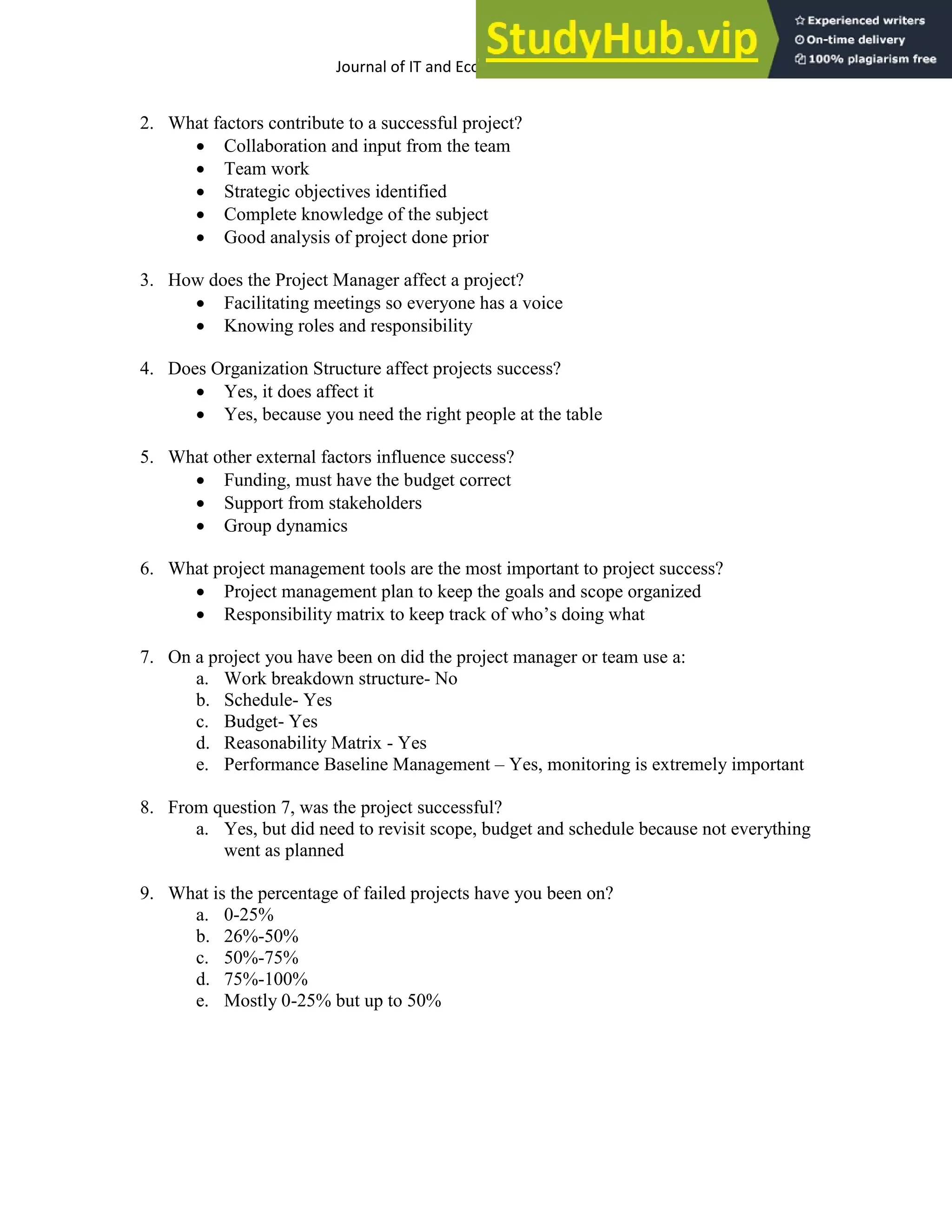
2. What factors contribute to a successful project?
 Collaboration and input from the team
 Team work
 Strategic objectives identified
 Complete knowledge of the subject
 Good analysis of project done prior
3. How does the Project Manager affect a project?
 Facilitating meetings so everyone has a voice
 Knowing roles and responsibility
4. Does Organization Structure affect projects success?
 Yes, it does affect it
 Yes, because you need the right people at the table
5. What other external factors influence success?
 Funding, must have the budget correct
 Support from stakeholders
 Group dynamics
6. What project management tools are the most important to project success?
 Project management plan to keep the goals and scope organized
 Responsibility matrix to keep track of who’s doing what
7. On a project you have been on did the project manager or team use a:
a. Work breakdown structure- No
b. Schedule- Yes
c. Budget- Yes
d. Reasonability Matrix - Yes
e. Performance Baseline Management – Yes, monitoring is extremely important
8. From question 7, was the project successful?
a. Yes, but did need to revisit scope, budget and schedule because not everything
went as planned
9. What is the percentage of failed projects have you been on?
a. 0-25%
b. 26%-50%
c. 50%-75%
d. 75%-100%
e. Mostly 0-25% but up to 50%
Copyright of Journal of Information Technology & Economic Development is the property of
Global Strategic Management, Inc. and its content may not be copied or emailed to multiple
sites or posted to a listserv without the copyright holder's express written permission.
However, users may print, download, or email articles for individual use.

A Framework For Project Success

  • 1.
    Journal of ITand Economic Development 5(2), 1-17, October 2014 1 A Framework for Project Success Mark Allen, Del Alleyne, Crystal Farmer, Angela McRae, Charles Turner College of Engineering, Drexel University, USA mha44@drexel.edu, dca25@drexel.edu, crf62@drexel.edu, am3627@drexel.edu, cet79@drexel.edu Abstract The objective of A Framework for Project Success study was to investigate factors commonly critical to assisting with project success in contrast to project failure. Proctor & Gamble’s New Growth Factory served as an example of a successful project, while the U.S. Coast Guard’s 123- Foot Patrol Boat project represented those that have failed. An organization’s investment in researching the project experiences of other organizations can save the sometimes catastrophic cost of failed projects. The environment of this study was that of a graduate-level course in project management as a discipline, while the environment for the application of the study’s findings was that of projects of any size, location, and type of organization. The study’s stakeholders were the five study team members along with their professor. The studied project stakeholders included the project sponsors, project managers, project management team members, project staff, contractor staff, and customers. The original objective of the study to investigate critical success factors of projects, retained its place in the study. The team decided also to contrast the factors against a failed project because project failures garner so much attention. The survey identified the project management plan, the responsibility assignment matrix, and monitoring of the budget, schedule, and products as important to project success. The professional experience concluded that insufficient external influence, hampered project manager, overly broad scope, and inadequate budget can lead to failure. The study generally found that external influence, project manager and scope, schedule, and budget are factors critical to project success and failure. Keywords: Project Management, Quality Management, Budget, Project Manager Introduction Success is the intent of most every project, but project failures seem to attract more attention. The objective of this study is to investigate factors commonly critical to assisting with project success. The study’s scope includes a breakdown of three common critical success factors applied to an example of a successful project along with an example of a failed project. Critical success factors (CSFs) are strongly related to mission and strategic goals of the business
  • 2.
    Journal of ITand Economic Development 5(2), 1-17, October 2014 2 or project. Organizations’ missions and strategic goals are focused on what needs to be achieved, whereas CSFs focus on the most important area and guide one to achieve the goal. (Mind tools) Limitations of the study include the small quantity of people available to the survey, and limited information sources for analysis. The methodology for this study included a qualitative examination of the roles that factors play in the success and failure of a project. Data were collected through document review, project analysis, professional experience, and qualitative survey The three factors on which this paper is structured include external influence, project manager, and scope, schedule, and budget. Proctor & Gamble’s (P&G’s) New Growth Factory serves as an example of a successful project, while the U.S. Coast Guard’s 123-Foot Patrol Boat project represents those that have failed. The structure begins with a literature review and explanation of the research methodology, and ends with a summary, conclusions, references, and appendix. Literature Review In 2013, according to Gartner, Inc., the world’s leading information technology research and advisory company, the projected failure rate for projects from now until 2016 is approximately 20 to 28 percent. Gartner advised that organizations should accept the increased risk to achieve the desired return and to accept failure and move on. Since the organizations have increased focus on cost management, they should embrace the failure (Gartner, 2013). In this present paper, literature reviews attempt to argue the point made by Gartner. While organizations should understand when failing projects should just be terminated, not accepting that failure will just occur and adapting their behavior and learning critical attributes to assist with project success is advantageous for the organization.
  • 3.
    Journal of ITand Economic Development 5(2), 1-17, October 2014 3 Two of the reviews of literature that provide evidence that standards and behaviors can assist with successful projects are A Guide to the Project Management Body of Knowledge (5th ed.) and Project Management: A Managerial Approach (8th ed.). Both provide information and tools that contribute to the agreement that there are behaviors that can guide the project to be successful. Methodology A qualitative approach was taken to examine the roles that different factors play in the success and failure of a project. The factors that were analyzed in this paper include external influences such as organization influences, structures and success factors, project manager’s characteristics, and the importance of scope, schedule, and budget. Data were collected through document review, project analysis, professional experience, and qualitative survey. A survey was used to collect information from the people on a project by the use of structured questionnaires. The most efficient way to understand what projects need, both external to the project and internally, to be successful is to question those that have been or currently are part of a project team. A survey of nine questions was asked to a group of 6 people who ranged from an executive and project manager (PM) to people who have participated on a project team. For factors that contributed to a successful project, the group focused on characteristics of a PM. Characteristics included understanding lessons learned of previous projects, building a good relationship with the team and stakeholders, and ensuring teamwork. The Project Management Plan (PMP) was identified as being the most important tool since it documents the goals, objectives, and scope of the project. The group also noted that having a responsibility assignment matrix (RAM) is very helpful to understand the roles and responsibility of the team. The group agreed that they did not use a work breakdown structure
  • 4.
    Journal of ITand Economic Development 5(2), 1-17, October 2014 4 very often, but that monitoring of the budget, schedule, and products is extremely important to the success of the project. The full survey is in Appendix A. Description and Analysis of Project According to Pakseresht and Asgari (2012), Ronald Daniel, a top senior partner at McKinsey & Company, was among the first experts who offered critical success factors (CSFs) as the business guidance, in 1961. John Rockart, from MIT’s School of Management, built on Daniel’s idea of CSF. Rockart defines critical success factors as, “the limited number of areas in which results, if they are satisfactory will ensure successful competitive performance for the organization. They are the few key areas where things must go right for the business to flourish. If results in these areas are not adequate the organization’s efforts for the period will be less than desired.” He concluded that CSFs are “areas of activity that should receive constant careful attention from management” (Mind tools). The New Growth Factory at P&G serves as an excellent example of a state-of-the-art project that owes its achievements in great part to the critical success factors of external influence, project manager, and scope, schedule, and budget. In 2000, the products and divisions within P&G seemed stagnant - limited in both innovation and growth. P&G’s quest was to stimulate and systematize these two important areas. This was an important organizational goal that P&G’s leadership felt necessary, as the corporation was not growing fast enough for their liking. To help remedy the situation, P&G leadership launched a project called the New Growth Factory, which was tasked to systematize innovation and growth. More than ten years after launching the project, P&G’s revenue doubled while new and innovative thinking and product development have been very successful.
  • 5.
    Journal of ITand Economic Development 5(2), 1-17, October 2014 5 The U.S. Coast Guard’s 123-Foot Patrol Boat project serves as an example of a project that failed due in great part to its inability to exploit the critical success factors noted above. The project converted eight of its 110-foot patrol boats into more capable 123-foot cutters but cancelled the project when the cutters developed hull cracks and engine failures that made them unseaworthy. “In September 2004, more serious flaws in the boat conversion program became obvious after the first one, the Matagorda, was launched. As it traveled in relatively heavy seas from Key West to Miami, large cracks appeared in the hull and deck” (Lipton, 2006). A project within the Coast Guard’s Deepwater program, the project failed as the program failed. The Coast Guard’s personnel funding had been reduced to the point that it had insufficient acquisition personnel and had to depend on contractors to fill the gap. The program eventually applied lessons learned to other projects and succeeded as a program, but the Patrol Boat project never recovered due largely to the critical success factors analyzed below. Critical Success Factor - External Influence Organizational Influence Projects require a high degree of organization and planning to progress smoothly and profitably. Companies must create a collaborative and friendly culture and be willing to change the culture by retaining younger staff and have them commit to training and development. Leadership must be able to communicate and delegate effectively to get team members involved and keep them motivated to accomplish goals and objectives. The culture of the organization generally dictates how the project will be organized and the project team leader’s degree of authority and influence. P&G’s New Growth Factory has flourished as a project due in part to its organizational influence. From an organizational standpoint, the leaders of P&G were very much behind the
  • 6.
    Journal of ITand Economic Development 5(2), 1-17, October 2014 6 project. They laid the foundation for the project and were very involved in setting the vision and inspiration for the project. At P&G that inspiration lies in a sense of purpose driven from the top down—the message that each innovation improves people’s lives. The U.S. Coast Guard’s failed 123-Foot Patrol Boat project did not benefit from organizational influence. As Congress cut the Coast Guard’s personnel funds, the service was forced to outsource acquisition oversight. As an organization, the Coast Guard was unable to gain sufficient funding, which hampered the PM’s ability to staff the project. Organizational Structure Projects are organized basically into three types of structures: 1. Functional structures – Functional projects are usually limited to the scope of their discipline or functional group and are characterized by limited project management authority. 2. Projectized organizations – Project teams are often co-located. Project resources are assigned directly to the PM on a permanent basis. The PM, in this case, has a high degree of authority and influence. 3. Matrix structures – are a blend of functional and projectized organizations. Matrix organizations are characterized as to the degree of PM authority and influence. These levels of authority and influence are a direct result of senior management’s interpretation of the project management role, the culture and strength of the existing management team, and to what degree they choose to delegate authority within the organization. Influence can either be weak, which corresponds to a Project Coordinator role; it can be balanced, which corresponds to a part-time Project Manager role; or it can be strong, which corresponds to a full-time Program Manager or Project Manager (Drexel University, 2014).
  • 7.
    Journal of ITand Economic Development 5(2), 1-17, October 2014 7 The New Growth Factory enjoyed an effective organizational structure. P&G developed organizational structures to specifically drive new growth. In a handful of business units the company created small groups focused primarily on new-growth initiatives. Dedicated teams within the groups conducted market research, developed technology, created business plans, and tested assumptions for specific projects. The 123-Foot Patrol Boat project was cancelled partly because the Coast Guard’s parent, the Department of Homeland Security, was only 4 years old and as such provided minimal assistance with acquisition or recognition of the need for assistance. The matrix structure of the project gave the PM a degree of autonomy but also a degree of isolation. Critical Success Factor - Project Manager Stakeholder Partnership The relationship between the PM and stakeholders is a partnership. PMI defines a stakeholder as “an individual, group, or organization who may affect, be affected by, or perceive itself to be affected by a decision, activity, or outcome of a project” (p.563). Eskerod and Jepsen (2013) discuss two possible alternatives to stakeholder management, proactive or reactive. “A proactive strategy implies that you try to anticipate what will happen in relation to the stakeholder and plan and act to mitigate events before they happen”(Eskerod & Jepsen, 2013, p.49). Conversely, “a reactive strategy implies that you do something in response to the actions and requirements of the stakeholder…in other words limiting your communication to times when action or decisions by the stakeholder is required” (Eskerod & Jepsen, 2013, p.49). Eskerod and Jepsen (2013) recommend that the PM get in front of any situation affecting the stakeholder by choosing proactive strategy (49).
  • 8.
    Journal of ITand Economic Development 5(2), 1-17, October 2014 8 Identifying all stakeholders from the beginning of the project impacts the PM’s ability to positively interact with them. “The key benefit of this process is that it allows the project manager to identify the appropriate focus for each stakeholder or group of stakeholders” (PMI, 2013, p.393). It is necessary for the PM to “…think of all the people who are affected…who have influence or power…or have an interest” in helping or hindering the project (TOGAF, Identify Stakeholders, para. 1). Just as solutions need to be tailored to problems, conflict resolution needs to be tailored to individual stakeholders. Figure 1 is a power matrix grid which “indicates the strategy to adopt for engaging” stakeholders (TOGAF, Determine Stakeholder Management Approach, para. 2). Figure 1. Stakeholder Power Grid. Adopted from: TOGAF. Stakeholder Management. Source: http://pubs.opengroup.org/architecture/togaf9-doc/arch/chap24.html The PM at the New Growth Factory was able to develop an effective stakeholder partnership. Senior management and project team members were trained in various courses that were geared towards developing mindsets to foster growth and entrepreneurial thinking. The PM on the 123-Foot Patrol Boat project, on the other hand, was unable to create a useful partnership with the Coast Guard’s Deepwater program contractor, Integrated Coast Guard Systems, due to inadequate Coast Guard staffing. As a result partly of the Project Manager’s insufficient oversight, the contractor delivered substandard products.
  • 9.
    Journal of ITand Economic Development 5(2), 1-17, October 2014 9 Lessons Learned Lessons learned can serve as a roadmap to success by studying failures on similar projects from the past, and also, studying how teams in similar situations overcame obstacles. However, because every project is unique, Flahiff (2013) emphasizes the advantage of including lessons learned throughout the current project. Traditional lessons learned are held when the project is complete, presumably so that the team does not make these same mistakes on future projects. The problem with this approach is most people can't remember what happened two weeks ago, much less what happened six months or two years ago. (Lessons-learned session items are team-, project-, or technology- specific, para. 1) Lessons learned were captured in a timely manner by the New Growth Factory, which formed a group of new growth business guides to help teams working on growth and innovation projects. The guides include several entrepreneurs who have succeeded - and, even more important, failed - in starting businesses. While the 123-Foot Patrol Boat Project failed, its parent Deepwater program applied the following lessons learned to other projects:  Ensure a competitive process for acquisition.  Renegotiate existing contracts as necessary to ensure companies honor commitments to deliver as promised.  Empower Coast Guard engineers to closely monitor contractor work.  Create a Coast Guard office to oversee the procurement and maintenance of its ships and airplanes. Team Building How the PM interacts with a stakeholder can influence project success or failure. Good relationships can be the difference between outstanding success and dismal failure because it’s
  • 10.
    Journal of ITand Economic Development 5(2), 1-17, October 2014 10 all about getting people to like and trust you so that they will deliver what you need them to deliver at the right time in the right way (Young, M., 2009, Para. 1). Whether it is a team member, senior manager, or investor, strengthening relationships with stakeholders increases the likelihood that the PM will be able to accomplish what is needed through other people. Working well with a team includes resisting the urge to micromanage. “If a project manager attempts to control every aspect of the process, team members may feel as if their leader doesn’t trust them or doesn’t value their contributions. This can be detrimental to project management success” (University Alliance, 2014, Provide Leadership Without Micromanaging, para. 1). Encouraging others to step forward and trusting team members to complete tasks properly is made easier when the PM knows both industry standards and the capabilities of individuals on her team. University Alliance (2014) recommends the following: “… learn everything you can about your team and what each person will be contributing to the project. This will help you gain the confidence of your collaborators and enable you to manage the workflow more effectively (Do Your Homework).” Based on the idea of disruptive-innovation theory, which was the concept of driving growth through new offerings that are simpler, more convenient, easier to access, or more affordable, the New Growth Factory began by holding a two-day workshop for seven new- product-development teams. The attendees explored how to shake up embedded ways of thinking that can inhibit disruptive approaches. The learning harnessed from these workshops were paramount to development of new products. The challenge for the 123-Foot Patrol Boat Project Manager was to build and maintain a cohesive team during the distraction of the Coast Guard, Congressional, and media investigations
  • 11.
    Journal of ITand Economic Development 5(2), 1-17, October 2014 11 when the project began to fail. While this leader and the project team did their best, they were disadvantaged from project inception by lack of funding and personnel. Critical Success Factor - Scope, Schedule, and Budget Despite the recognized criticality of project success for organizations, a considerable proportion of projects continue to either not meet their due dates, exceed budget, not deliver the specifications, and ultimately not meet customer satisfaction. That is why project management success and failure remains an area of considerable interest in contemporary project management literature. Understanding the scope, schedule, and budget of a project are critical criteria when it comes to the overall success of that project. The PM must be very competent in these aspects of the project as he or she is often a key member of the contract negotiations team for contract projects, based on his or her expertise in scheduling, estimating cost, and expected role in scope control. Scope The scope specifies the customer’s contractual expectations, mandatory tasks, and products to be procured and delivered; and can be characterized as a specific and exact list of deliverables required to successfully meet program objectives. In other words, the authorized work elements for the program are defined. Typically this scope is documented in a project scope statement or statement of work (SOW), which officially defines the project boundaries. Successful projects will have an instrument to organize this defined work in order to make sure that the entire scope of work is broken down into manageable pieces and identified properly; this instrument is called the work breakdown structure (WBS). A WBS tailored for effective management control is used in this process. While defining the actual work expected to be completed, successful projects also make it a good practice to also identify exactly which
  • 12.
    Journal of ITand Economic Development 5(2), 1-17, October 2014 12 organizations will be responsible for the work defined in the WBS. They use a tool called an organizational breakdown structure (OBS), which defines the organizational elements needed to plan, execute and control the work, as well as illustrate the responsible organizational reporting relationships which preserves unambiguous accountability for getting the work done. A well constructed WBS and OBS can be integrated in a manner that permits cost and schedule performance measurement by elements of either or both structures, as needed. These measurement points are very useful to help identify the health of the project and help chart the course for the project success. Once the project WBS and OBS are completed, a RAM is developed. The RAM reflects the relationship between the program WBS (tasks) and program OBS (responsible organization). The overall organization of the scope, responsible individuals, and cost delivered by the WBS, OBS, and RAM is imperative to help bound the project and identify the work and individuals that are vital to the project. It’s no secret that organizations that effectively utilize these tools when planning their projects are much more successful than those who do not. P&G’s New Growth Factory benefited from a well defined and closely monitored scope. It was a project initiated to develop new products and services through growth and innovation. The Coast Guard’s Patrol Boat Project failed in part because the SOW was written so broadly that the Coast Guard had to depend heavily on the contractor to monitor its own work. Schedule A project schedule presents linked activities with planned dates, durations, milestones, and resources. Successful projects use some sort of schedule hierarchy in order to be able to organize and analyze the project’s schedule. The Integrated Master Plan (IMP) is an event- oriented plan used to communicate the program’s approach to meeting program SOW requirements. While the IMP illustrates the project’s what and how, the Integrated Master Schedule (IMS) illustrates the project’s how and when. The IMS is a linked network of project-
  • 13.
    Journal of ITand Economic Development 5(2), 1-17, October 2014 13 planned activities, which support the project’s IMP by containing all detail tasks necessary to meet those events, accomplishments, and criteria. The IMS is used as the primary tracking tool for status, performance measurement, and earned value measurement (EVM): day-to-day execution. The IMS provides a comparison of current status to the established baseline, which provides visibility into schedule variations and insight into trends and impacts; facilitates identification of potential risk, risk mitigation, and opportunities; and identifies schedule priority including the critical path(s). The IMS is a line of communication across the entire project and helps facilitate "what if" and/or recovery scenarios. Projects succeed using a well thought out IMS because the IMS clearly demonstrates how the project is structured and defines an executable plan. P&G’s New Growth Factory employed a definitive production schedule that identified what needed to be produced and when. Budget Successful projects after they have defined and scheduled the work are astute in knowing how to properly allocate budget to that work. One of the first steps in this process is control account planning. Control accounts are control points where cost, schedule, and technical scope are managed. They are established as a mechanism where budgets are planned, actual costs are collected or summarized, performance is claimed or summarized, and variance analysis is accomplished. The control account plan shows time-phased planning of tasks and their associated budget by element of cost (labor, material, subcontract, etc.) for a control account. The New Growth Factory benefited from an effectively and substantially funded budget. P&G spends nearly $2 billion annually on R&D — roughly 50% more than its closest competitor and more than most other competitors combined.
  • 14.
    Journal of ITand Economic Development 5(2), 1-17, October 2014 14 The 123-Foot Patrol Boat project failed in large part because its budget failed to allow for sufficient acquisition personnel to monitor contractor work. Controlling and Monitoring After this three-step process of defining and planning the work, scheduling the work, and allocating budget to the work is completed, the formal performance measurement baseline (PMB) and integrated technical, cost, and schedule baseline are established. This PMB will be the time-phased budget plan, to which the project will execute and against which project performance will be measured. The PMB is used with the support of earned value reporting to manage the project, product development, and contract execution. Successful projects invariably utilize these processes to establish the PMB and measure it with the support of earned value much more effectively and efficiently than projects that fail. Summary This study pursued factors commonly critical to assisting with project success in contrast to project failure. Its methodology employed four different approaches to research - qualitative survey, professional experience, document review, and project analysis. The survey revealed that the Project Management Plan was the most important tool since it documents the goals, objectives, and scope of the project. Those surveyed also noted a RAM is very helpful to understand the roles and responsibility of the team. Finally the survey found that monitoring of the budget, schedule, and products is extremely important to the success of a project. Professional career experience was consulted for the study through service in the Coast Guard during the failed 123-Foot Patrol Boat project lifecycle. It was determined that the project failed due to insufficient external influence; hampered project manager; overly broad scope, and
  • 15.
    Journal of ITand Economic Development 5(2), 1-17, October 2014 15 inadequate budget. As a result, the contractors delivered ships that were unseaworthy. On the other hand, the New Growth Factory was successful partly due to implementing the three success factors. Research of documents such as books and professional journal articles added to the repertoire leading to project analysis findings that external influence; project manager; and scope, schedule, and budget are factors critical to project success and failure. Conclusions This research paper determined that — by applying the critical success factors of external influence; project manager; and scope, schedule, and budget — projects will have an advantage of achieving success. The P&G New Growth Factory proves the critical success factors assisted in a successful project, and the U.S. Coast Guard’s 123-Foot Patrol Boat project shows how lack these factors can cause a project to fail. Implications of this study include the affirmation that organizations can profit from the pursuit of project management as both an academic discipline and a profession. An organization’s investment in researching the project experiences of other organizations can facilitate learning vicariously without the cost of failed projects. The study’s lessons can be applied to a great variety of projects. The critical success factors are general enough to be applied to small and large projects, locally and globally, in both the civilian and Government sectors. References Drexel University, Goodwin College of Professional Studies Week 3 Lecture Notes, Retrieved November 24, 2014 Eskerod, P., Jepsen, A. (2013). Fundamentals of Project Management: Project Stakeholder Management Flahiff, J. (2013). Project management lessons learned shouldn’t be limited to postmortems. Retrieved from http://searchcio.techtarget.com/tip/Project-management-lessons-learned-shouldnt-be- limited-to-postmortems
  • 16.
    Journal of ITand Economic Development 5(2), 1-17, October 2014 16 Gartner, Inc. (2013). Gartnery Says Smart Organizations Will embrace Fact and Frequent Project Failure in Their Quest for Agility. Retrieved from http://www.gartner.com/newsroom/id/2477816 Lipton, Eric. (December 9, 2006). Failure to Navigate: Billions Later, Plan to Remake the Coast Guard Fleet Stumbles. The New York Times. The New York Times Company Mind Tools. Critical Success Factors. Identifying the Things that Really Matter for Success. Retrieved from http://www.mindtools.com/pages/article/newLDR_80.htm Pakseresht, Afshin, Dr. Gholamreza Asgari. (2012). Determining the Critical Success Factors in Construction Projects: AHP Approach. Interdisciplinary Journal of Contemporary Research in Business. Retrieved from http://journal-archieves26.webs.com/383-393.pdf PMI. (2013). A Guide to the Project Management Body of Knowledge (5th ed.). Publisher: PMI. ISBN: 9781935589679 TOGAF. Stakeholder Management. Retrieved from http://pubs.opengroup.org/architecture/togaf9- doc/arch/chap24.html University Alliance. (2014). Five Secrets To Project Management Success. Retrieved from Villanova website at http://www.villanovau.com/resources/project-management/5-secrets-project- management/#.VHVMYYe7mnc Young, M. (2009). Building Relationships in Project Management. Retrieved from Projectsmart.co.uk website at http://www.projectsmart.co.uk/building-relationships-in-project-management.php Acknowledgment We would like to thank Dr. Victor Sohmen (Project Management Program, College of Engineering, Drexel University, Philadelphia, PA), for guiding, reviewing and editing this work for publication. Appendix A Qualitative Survey: Determining People’s Perspective of Project Success 1. What is the definition of a successful project?  Objective met  The project was completed and met the measureable objectives  Objective met and successfully  The project was understood
  • 17.
    Journal of ITand Economic Development 5(2), 1-17, October 2014 17 2. What factors contribute to a successful project?  Collaboration and input from the team  Team work  Strategic objectives identified  Complete knowledge of the subject  Good analysis of project done prior 3. How does the Project Manager affect a project?  Facilitating meetings so everyone has a voice  Knowing roles and responsibility 4. Does Organization Structure affect projects success?  Yes, it does affect it  Yes, because you need the right people at the table 5. What other external factors influence success?  Funding, must have the budget correct  Support from stakeholders  Group dynamics 6. What project management tools are the most important to project success?  Project management plan to keep the goals and scope organized  Responsibility matrix to keep track of who’s doing what 7. On a project you have been on did the project manager or team use a: a. Work breakdown structure- No b. Schedule- Yes c. Budget- Yes d. Reasonability Matrix - Yes e. Performance Baseline Management – Yes, monitoring is extremely important 8. From question 7, was the project successful? a. Yes, but did need to revisit scope, budget and schedule because not everything went as planned 9. What is the percentage of failed projects have you been on? a. 0-25% b. 26%-50% c. 50%-75% d. 75%-100% e. Mostly 0-25% but up to 50%
  • 18.
    Copyright of Journalof Information Technology & Economic Development is the property of Global Strategic Management, Inc. and its content may not be copied or emailed to multiple sites or posted to a listserv without the copyright holder's express written permission. However, users may print, download, or email articles for individual use.