The document presents a novel fast video search algorithm utilizing Histogram of Oriented Gradients (HOG) features to enhance the retrieval of video clips from large databases. The proposed algorithm, combined with an active search method, demonstrates significant improvements in search speed and robustness, achieving results 271 times faster than conventional methods. Experimental evaluations indicate that the algorithm maintains high accuracy even in the presence of Gaussian noise, making it a valuable contribution to video search technology.
![David C. Wyld et al. (Eds) : ITCS, JSE, SIP, ARIA, NLP - 2016
pp. 35–41, 2016. © CS & IT-CSCP 2016 DOI : 10.5121/csit.2016.60304
A FAST SEARCH ALGORITHM FOR LARGE
VIDEO DATABASE USING HOG BASED
FEATURES
Qiu Chen1
, Koji Kotani2
, Feifei Lee3
and Tadahiro Ohmi4
1
Department of information and Communication Engineering,
Kogakuin University, Japan
2
Department of Electronics, Graduate School of Engineering,
Tohoku University, Japan
3
School of Optical-Electrical and Computer Engineering,
University of Shanghai for Science and Technology, China
4
New Industry Creation Hatchery Center, Tohoku University, Japan
chen@cc.kogakuin.ac.jp, feifeilee1701@163.com
ABSTRACT
In this paper, we propose a novel fast video search algorithm for large video database.
Histogram of Oriented Gradients (HOG) has been reported which can be reliably applied to
object detection, especially pedestrian detection. We use HOG based features as a feature
vector of a frame image in this study. Combined with active search, a temporal pruning
algorithm, fast and robust video search can be achieved. The proposed search algorithm has
been evaluated by 6 hours of video to search for given 200 video clips which each length is 15
seconds. Experimental results show the proposed algorithm can detect the similar video clip
more accurately and robust against Gaussian noise than conventional fast video search
algorithm.
KEYWORDS
Fast search, Video database, HOG Features
1. INTRODUCTION
In recent years, video content becomes commonplace on the web and the size of video database
quickly increases due to rapid developments of internet connection and disk storage technology
in recent years. Video retrieval has become a hot area of research in current. Video search is an
important problem in this area because it has a wide range of applications such as TV
commercials detection [1], video copyright enforcement [2],[3], video clustering and so on. In
this paper, video search means when a user presents a query video clip to the search engine, the
search engine should identify all similar ones, that is to say, accurately locate the position of
query video clip if it exists in the video database.](https://image.slidesharecdn.com/afastsearchalgorithmforlarge-160210093350/85/A-fast-search-algorithm-for-large-1-320.jpg)
![David C. Wyld et al. (Eds) : ITCS, JSE, SIP, ARIA, NLP - 2016
pp. 35–41, 2016. © CS & IT-CSCP 2016 DOI : 10.5121/csit.2016.60304
A FAST SEARCH ALGORITHM FOR LARGE
VIDEO DATABASE USING HOG BASED
FEATURES
Qiu Chen1
, Koji Kotani2
, Feifei Lee3
and Tadahiro Ohmi4
1
Department of information and Communication Engineering,
Kogakuin University, Japan
2
Department of Electronics, Graduate School of Engineering,
Tohoku University, Japan
3
School of Optical-Electrical and Computer Engineering,
University of Shanghai for Science and Technology, China
4
New Industry Creation Hatchery Center, Tohoku University, Japan
chen@cc.kogakuin.ac.jp, feifeilee1701@163.com
ABSTRACT
In this paper, we propose a novel fast video search algorithm for large video database.
Histogram of Oriented Gradients (HOG) has been reported which can be reliably applied to
object detection, especially pedestrian detection. We use HOG based features as a feature
vector of a frame image in this study. Combined with active search, a temporal pruning
algorithm, fast and robust video search can be achieved. The proposed search algorithm has
been evaluated by 6 hours of video to search for given 200 video clips which each length is 15
seconds. Experimental results show the proposed algorithm can detect the similar video clip
more accurately and robust against Gaussian noise than conventional fast video search
algorithm.
KEYWORDS
Fast search, Video database, HOG Features
1. INTRODUCTION
In recent years, video content becomes commonplace on the web and the size of video database
quickly increases due to rapid developments of internet connection and disk storage technology
in recent years. Video retrieval has become a hot area of research in current. Video search is an
important problem in this area because it has a wide range of applications such as TV
commercials detection [1], video copyright enforcement [2],[3], video clustering and so on. In
this paper, video search means when a user presents a query video clip to the search engine, the
search engine should identify all similar ones, that is to say, accurately locate the position of
query video clip if it exists in the video database.](https://image.slidesharecdn.com/afastsearchalgorithmforlarge-160210093350/75/A-fast-search-algorithm-for-large-1-2048.jpg)
![36 Computer Science & Information Technology (CS & IT)
Many video search algorithms [7]-[10] have been proposed, and achieves successes to a certain
extent. But such algorithms, however, are computational-power hungry for the exhaustive search
of large video database. For large video database, Search speed is an important issue of video
search. Base on active search [4], a temporal pruning algorithm, Kashino et al. [1] improved the
conventional multimedia search algorithm. Nevertheless, their feature extraction utilizes intensity
features of the frame image, so the results may be sensitive to small change of luminance and
motion in the frame. In this paper, we utilizes a new feature based on Histogram of Oriented
Gradients (HOG) [5] features, which had been reliably applied to object detection, especially
pedestrian detection [6][11]. It has the following advantages: computational simplicity, motion-
insensitivity and luminance-insensitivity. Because such a feature is compatible with active search
algorithm, fast search speed can also be achieved by combining HOG based features and active
search.
Figure 1. Processing steps of HOG based features.
In section 2, we will first introduce HOG based features, and then describe fast video search
algorithm we employ in section 3. Experimental results compared to conventional search
approach will be discussed in section 4. Finally, conclusions are given in section 5.
2. HOG BASED FEATURES
Histogram of Oriented Gradients (HOG) [5] features has been developed for object recognition
previously. Figure 1 shows the processing steps of HOG based features. In HOG, for each pixel
of an input image, the intensity difference of the horizontally adjacent pixels (fx) and the intensity
difference of the vertically adjacent pixels (fy) are first calculated by using simple subtraction
operations shown as formula (1), (2).
݂ݕ = ݂ሺ݅, ݆ + 1ሻ − ݂ሺ݅, ݆ − 1ሻ (1)
݂ݔ = ݂ሺ݅ + 1, ݆ሻ − ݂ሺ݅ − 1, ݆ሻ (2)
ߙ = ݊ܽݐିଵ ௬
௫
(3)
Each intensity variation vector is then quantized simply by the oriented angle calculated by
formula (3). The number of vectors quantized in each quantization region is counted and a
histogram is generated.](https://image.slidesharecdn.com/afastsearchalgorithmforlarge-160210093350/85/A-fast-search-algorithm-for-large-2-320.jpg)
![Computer Science & Information Technology (CS & IT) 37
The essence of HOG based features above can be considered that the operation detects and
quantizes the direction of intensity variation in the image blocks. Hence HOG based features
contain very effective image feature information. We will describe how to apply it as feature
vector of frame to solving the fast video search problem in next section.
3. PROPOSED VIDEO SEARCH ALGORITHM
The procedure of proposed fast search algorithm is shown in figure 2. In the pre-processing stage,
the feature vectors are calculated from the query video clip and the video database HOG method
described in section 2. The feature vectors are then quantized using VQ algorithm which applied
quantization by combinations of scalar quantization (SVQ) for each feature dimension [1]. In the
search stage, the windows are applied to both the query feature vectors and the feature vectors of
video database. In the next step, the number of vectors quantized in the windows of the query
video clip and video database are counted and feature vector histograms are created respectively.
The similarity between these histograms is then calculated. If the similarity exceeded a threshold
value given previously, the query video clip will be detected and located. Otherwise, the window
on the video database will be skipped to the next position determined by the similarity in current
position and the threshold value. In the last step, the window on the video database is shifted
forward in time and the search proceeds.
Figure 2. The procedure of proposed fast search algorithm
Here, histogram intersection is used as the similarity measure [4], and is defined as formula (4).
∑=
=
=
L
l
DlQl
DQQD
hh
N
HHSS
1
),min(
1
),(
(4)](https://image.slidesharecdn.com/afastsearchalgorithmforlarge-160210093350/85/A-fast-search-algorithm-for-large-3-320.jpg)
![38 Computer Science & Information Technology (CS & IT)
where hQl, hDl are the numbers of feature vectors contained in the l-th bin of the histograms for
the query and the stored signal, respectively, L is the number of histogram bins, and N is the total
number of feature vectors contained in the histogram. The skip width w is shown by formula (5).
<+−
=
otherwise
SSNfloor
w QDQD
1
)(1))(( θθ
(5)
where floor(x) means the greatest integral value less than x, and θ is a given threshold.
4. EXPERIMENTAL RESULTS AND DISCUSSIONS
We performed all of the experiments on a conventional PC @ 3.2GHz (4G memory). The
algorithm was implemented in ANSI C. We used 6 hours of video captured from TV program. In
the experiment, the video frame rate was 14.97 fps, and image size was 80*60 as shown in table
I.
Tabel I: Parameters of Video dataset.
Video content News, drama, sports etc.
Video length
Query video clips: 15s * 200
Video database sequence: 6 hours
Frame rate 14.98 fps
Frame number
Query video clips: 15s * 200
Video database sequence: 6 hours
Image format PPM
Capture size 80*60
We captured 6 hours of video twice, one for video database sequence and the other for query
video clips. Query video clips were generated by selecting video clips randomly for 200 times
from the second video. Then we can perform search for 200 video clips from 6 hours of video.
The threshold θ is 0.7 determined by preparing experiments according to FAR and FRR curve,
which will be discussed later.
We utilized a 1-hour video sequence by selecting randomly from the second video to determine
boundary threshold which were used to implement scalar VQ process (SVQ).
To suit the search task, quantization levels of HOG are set at 8 in θ -axis (totally 9) in the feature
extraction stage. Thus, the number of histogram bins is total 512. Similarity calculation between
the feature vector histograms will be quite faster compared with conventional algorithm which
number of histogram bins is 4096.
4.1. Image Features of Conventional Algorithm
In conventional algorithm [1], they use small scaled images as video features. An image feature
vector is defined as formula (6).
))(,)(,),(()( 1 kgkgkgkg Wj ⋅⋅⋅⋅⋅⋅= (6)](https://image.slidesharecdn.com/afastsearchalgorithmforlarge-160210093350/85/A-fast-search-algorithm-for-large-4-320.jpg)
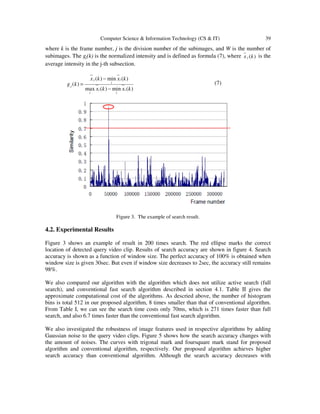
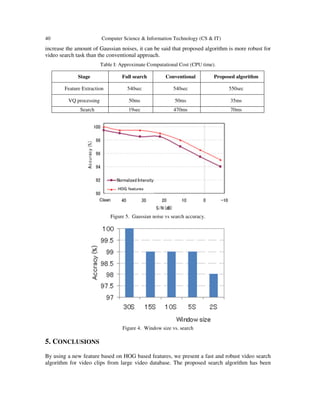
![Computer Science & Information Technology (CS & IT) 41
evaluated by 6 hours of video to search for 200 video clips. Experimental results show that search
time costs only 70ms, which is 271 times faster than full search, and also 6.7 times faster than the
conventional fast search algorithm. Furthermore, proposed algorithm is more robust against
Gaussian noise for video search task than the conventional approach.
REFERENCES
[1] K., Kashino, T. Kurozumi, and H. Murase, “Quick AND/OR search for multimedia signals based on
histogram features”, IEICE Trans., J83-D-II(12), 2000, pp. 2735-2744.
[2] S.S. Cheung and A. Zakhor, “Efficient video similarity measurement with video signature”, IEEE
Trans. on Circuits and System for Video Technology, 13(1), 2003, pp. 59-74.
[3] A. Hampapur, K. Hyun, and R. Bolle, “Comparison of sequence matching techniques for video copy
detection”, SPIE. Storage and Retrieval for Media Databases 2002, 4676, San Jose, CA, USA, 2002,
pp. 194-201.
[4] V.V. Vinod, H. Murase, “Focused color intersection with efficient searching for object extraction”,
Pattern Recognition, 30(10), 1997, pp. 1787-1797.
[5] N. Dalal and B. Triggs, “Histograms of oriented gradients for human detection”, In CVPR, pp. 886–
893, 2005.
[6] C. Hou, H. Ai, and S. Lao, “Multiview pedestrian detection based on vector boosting”, In Asian
Conference on Computer Vision, pp.18–22, 2007.
[7] L. Agnihotre, N. Dimitrova, T. McGee, S. Jeannin, S. Schaffer, J. Nesvadba, “Evolvable visual
commercial detector”, In Proceedings of IEEE. International Conference on Computer Vision and
Pattern Recognition, vol. 2, 2003, pp. 79-84.
[8] R. Lienhart, C. Kuhmunch, W. Effelsberg, “On the detection and recognition of television
commercials”, In Proceedings of IEEE Conference on Multimedia Computing and Systems, 1997, pp.
509-516.
[9] R. Mohan, “Video sequence matching”, In Proceedings of the International Conference on Audio,
Speech and Signal Processing, vol. 6, 1998, pp. 3679-3700.
[10] A. Araujo, M. Makar, V. Chandrasekhar, D. Chen, S. Tsai, H. Chen, R. Angst, and B. Girod,
“Efficient video search using image queries”, In Proceedings of International Conference on Image
Processing, pp. 3082-3086, 2014.
[11] Q. Zhu, M. C. Yeh, K. T. Cheng, and S. Avidan, “Fast human detection using a cascade of
histograms of oriented gradients” In CVPR, pp. 1491–1498, 2006.](https://image.slidesharecdn.com/afastsearchalgorithmforlarge-160210093350/85/A-fast-search-algorithm-for-large-7-320.jpg)


