Content-Based Video
Retrieval System
Presented by:
Edmund Liang
CSE 8337: Information Retrieval
Introduction
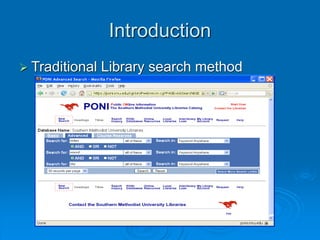
 Traditional Library search method
Introduction (cont.)
 Other search engines still using
description search method.
 Current image search method: by
description.
Introduction (cont.)
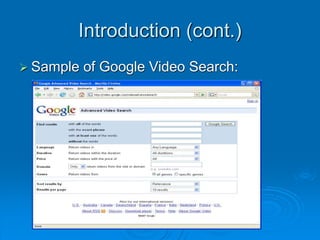
 Sample of Google Video Search:
Introduction (cont.)
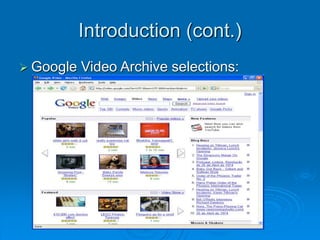
 Google Video Archive selections:
Introduction (cont.)
 Picture is worth a thousand words.
 More than words can express.
 Growing number video clips on MySpace
and YouTube, there is a need for a video
search engine.
Introduction (cont.)
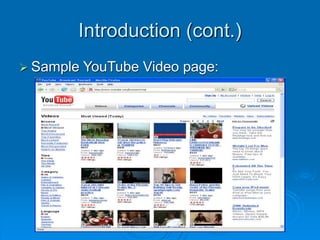
 Sample YouTube Video page:
Introduction (cont.)
 Therefore, we need a better search
technique – Content-Based Video
Retrieval System (CBVR).
Introduction (cont.)
 What good is video retrieval?
 Historical Achieve
 Forensic documents
 Fingerprint & DNA matching
 Security usage
Overview (cont.)
 CBVR has two Approaches:
 Attribute based
 Object based
 CBVR can be done by:
 Color
 Texture
 Shape
 Spatial relationship
 Semantic primitives
 Browsing
 Objective Attribute
 Subjective Attribute
 Motion
 Text & domain concepts
Overview (cont.)
 CBVR has two phases:
 Database Population phase
• Video shot boundary detection
• Key Frames selection
• Feature extraction
 Video Retrieval phase
• Similarity measure
Overview (cont.)
 How CBVR works:
[Wang, Li, Wiederhold, 2001]
Database Population Phase
 Here are the three major procedures:
 Shot boundary detection – partition, segments
[Luo, Hwang, Wu, 2004]
Database Population Phase (cont)
 Key frames selection – select characteristics
 Extracting low-level spatial features like color,
texture, shape, etc.
[Luo, Hwang, Wu, 2004]
Database Population Phase (cont.)
 Video is complex data type – audio & video
 Audio can be handled by query by humming.
 Voice recognition system using Patricia-like tree
to construct all possible substrings of a
sentence.
 Audio is categorized by: speech, music, and
sound.
 Audio retrieval methods: Hidden Markov Model,
Boolean Search with multi-query using Fuzzy
Logic.
Database Population Phase (cont)
 Most simple database storage: description
of video as index along with the video.
 Human effort is involved in this case.
 We are searching for automatic video
indexing and digital image storage method
– Latent Semantic Indexing (LSI)
Database Population Phase (cont.)
 LSI is using vector space model – low rank
approximation of vector space represent image
document collection.
 Original matrix is replaced by an as close as
possible matrix, where its column space is only
the subspace of the original matrix column
space.
 By reducing the rank of the matrix, noises
(duplicate frames) are reduce to improve
storage and retrieval performance.
 Term indexing is referred to the process of
assigning terms to the content of the video.
Database Population Phase (cont.)
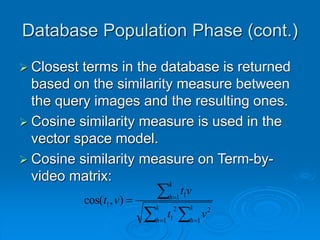
 Closest terms in the database is returned
based on the similarity measure between
the query images and the resulting ones.
 Cosine similarity measure is used in the
vector space model.
 Cosine similarity measure on Term-by-
video matrix:







k
h
k
h
k
h
v
t
v
t
v
t
1
2
1
2
1
1 1
1 )
,
cos(
Database Population Phase (cont.)
 Enterprise database like Oracle introduces
new object type: ORDImage, which
contains four different visual attributes:
global color, local color, texture and shape.
 ORDImageIndex provides
multidimensional index structure to speed
up stored feature vectors.
Database Population Phase (cont.)
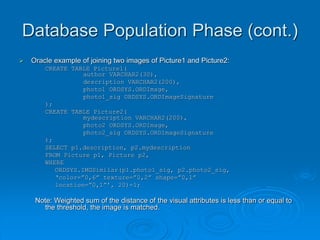
 Oracle example of joining two images of Picture1 and Picture2:
CREATE TABLE Picture1(
author VARCHAR2(30),
description VARCHAR2(200),
photo1 ORDSYS.ORDImage,
photo1_sig ORDSYS.ORDImageSignature
);
CREATE TABLE Picture2(
mydescription VARCHAR2(200),
photo2 ORDSYS.ORDImage,
photo2_sig ORDSYS.ORDImageSignature
);
SELECT p1.description, p2.mydescription
FROM Picture p1, Picture p2,
WHERE
ORDSYS.IMGSimilar(p1.photo1_sig, p2.photo2_sig,
‘color=”0,6” texture=”0,2” shape=”0,1”
location=”0,1”’, 20)=1;
Note: Weighted sum of the distance of the visual attributes is less than or equal to
the threshold, the image is matched.
Image Retrieval Phase
 Query by example (QBE)
 Allow to select sample image to search.
[Wang, Li, Wiederhold, 2001]
Image Retrieval Phase (cont.)
[Li, Shapiro 2004]
Yet Another CBVR Application Interface
Image Retrieval Phase (cont.)
 Query by color anglogram
 Histogram intersection measures is a fairly
standard metric to analyze histogram base on
features.
 Image is divided into 5 sub-images, upper
right, upper left, lower right, lower left, and the
center image.
Image Retrieval Phase (cont.)
 Query by color anglogram (cont.)
 Convert RGB to HSV [wikipedia]
 Global and sub-image histogram forms LSI
matrix.
[Zhao & Grosky 2002]
Image Retrieval Phase (cont)
 Sample results:
Ancient Towers
Ancient Columns
Horses Figure
[Zhao & Grosky 2002]
Image Retrieval Phase (cont.)
 Retrieve by shape anglogram
 Each image is divided into 256 block.
 Each block is approximated with hue and
saturated value.
 Corresponding feature points are mapped
perceptually base on the saturated value.
 Feature histogram is obtained by measure the
largest angle of the nearest feature points.
Image Retrieval Phase (cont.)
 Query by shape anglogram (cont): Demo
[Zhao & Grosky 2002]
Image Retrieval Phase (cont.)
 Query by shape anglogram sample output:
[Zhao & Grosky 2002]
Image Retrieval Phase (cont.)
 Query by color and other category
selection combination.
 Use training dataset: sky, sun, land, water,
boat, grass, horse, rhino, bird, human,
pyramid, column, tower, sphinx, and snow.
 Sun(5%), grass (15%), Sky(20%) combine
with the LSI matrix to return better results.
Future Works
 Handle multi-layer images
 Include human-intractable relevance
retrieval feedback system.
 Eliminate bias objects but not affecting the
performance.
Summary
 Content-Based Video Retrieval system contains
two phases:
 Database population phase
• Shot boundary detection
• Key frames selection
• Extract low-level features
 Image retrieval phase
• Query by example
• Query by color anglogram
• Query by shape anglogram
• Query by color anglogram and category bit.
Conclusion
 Content-based Video Retrieval system is
not a sound system.
 Video stream will become the main stream
in the years to come.
 Better off if we had a efficient CBVR
search engine ready.
 Still many area needs to be improved.
The End
Thank you.

image processing image processing image processing

  • 1.
    Content-Based Video Retrieval System Presentedby: Edmund Liang CSE 8337: Information Retrieval
  • 2.
  • 3.
    Introduction (cont.)  Othersearch engines still using description search method.  Current image search method: by description.
  • 4.
    Introduction (cont.)  Sampleof Google Video Search:
  • 5.
    Introduction (cont.)  GoogleVideo Archive selections:
  • 6.
    Introduction (cont.)  Pictureis worth a thousand words.  More than words can express.  Growing number video clips on MySpace and YouTube, there is a need for a video search engine.
  • 7.
  • 8.
    Introduction (cont.)  Therefore,we need a better search technique – Content-Based Video Retrieval System (CBVR).
  • 9.
    Introduction (cont.)  Whatgood is video retrieval?  Historical Achieve  Forensic documents  Fingerprint & DNA matching  Security usage
  • 10.
    Overview (cont.)  CBVRhas two Approaches:  Attribute based  Object based  CBVR can be done by:  Color  Texture  Shape  Spatial relationship  Semantic primitives  Browsing  Objective Attribute  Subjective Attribute  Motion  Text & domain concepts
  • 11.
    Overview (cont.)  CBVRhas two phases:  Database Population phase • Video shot boundary detection • Key Frames selection • Feature extraction  Video Retrieval phase • Similarity measure
  • 12.
    Overview (cont.)  HowCBVR works: [Wang, Li, Wiederhold, 2001]
  • 13.
    Database Population Phase Here are the three major procedures:  Shot boundary detection – partition, segments [Luo, Hwang, Wu, 2004]
  • 14.
    Database Population Phase(cont)  Key frames selection – select characteristics  Extracting low-level spatial features like color, texture, shape, etc. [Luo, Hwang, Wu, 2004]
  • 15.
    Database Population Phase(cont.)  Video is complex data type – audio & video  Audio can be handled by query by humming.  Voice recognition system using Patricia-like tree to construct all possible substrings of a sentence.  Audio is categorized by: speech, music, and sound.  Audio retrieval methods: Hidden Markov Model, Boolean Search with multi-query using Fuzzy Logic.
  • 16.
    Database Population Phase(cont)  Most simple database storage: description of video as index along with the video.  Human effort is involved in this case.  We are searching for automatic video indexing and digital image storage method – Latent Semantic Indexing (LSI)
  • 17.
    Database Population Phase(cont.)  LSI is using vector space model – low rank approximation of vector space represent image document collection.  Original matrix is replaced by an as close as possible matrix, where its column space is only the subspace of the original matrix column space.  By reducing the rank of the matrix, noises (duplicate frames) are reduce to improve storage and retrieval performance.  Term indexing is referred to the process of assigning terms to the content of the video.
  • 18.
    Database Population Phase(cont.)  Closest terms in the database is returned based on the similarity measure between the query images and the resulting ones.  Cosine similarity measure is used in the vector space model.  Cosine similarity measure on Term-by- video matrix:        k h k h k h v t v t v t 1 2 1 2 1 1 1 1 ) , cos(
  • 19.
    Database Population Phase(cont.)  Enterprise database like Oracle introduces new object type: ORDImage, which contains four different visual attributes: global color, local color, texture and shape.  ORDImageIndex provides multidimensional index structure to speed up stored feature vectors.
  • 20.
    Database Population Phase(cont.)  Oracle example of joining two images of Picture1 and Picture2: CREATE TABLE Picture1( author VARCHAR2(30), description VARCHAR2(200), photo1 ORDSYS.ORDImage, photo1_sig ORDSYS.ORDImageSignature ); CREATE TABLE Picture2( mydescription VARCHAR2(200), photo2 ORDSYS.ORDImage, photo2_sig ORDSYS.ORDImageSignature ); SELECT p1.description, p2.mydescription FROM Picture p1, Picture p2, WHERE ORDSYS.IMGSimilar(p1.photo1_sig, p2.photo2_sig, ‘color=”0,6” texture=”0,2” shape=”0,1” location=”0,1”’, 20)=1; Note: Weighted sum of the distance of the visual attributes is less than or equal to the threshold, the image is matched.
  • 21.
    Image Retrieval Phase Query by example (QBE)  Allow to select sample image to search. [Wang, Li, Wiederhold, 2001]
  • 22.
    Image Retrieval Phase(cont.) [Li, Shapiro 2004] Yet Another CBVR Application Interface
  • 23.
    Image Retrieval Phase(cont.)  Query by color anglogram  Histogram intersection measures is a fairly standard metric to analyze histogram base on features.  Image is divided into 5 sub-images, upper right, upper left, lower right, lower left, and the center image.
  • 24.
    Image Retrieval Phase(cont.)  Query by color anglogram (cont.)  Convert RGB to HSV [wikipedia]  Global and sub-image histogram forms LSI matrix. [Zhao & Grosky 2002]
  • 25.
    Image Retrieval Phase(cont)  Sample results: Ancient Towers Ancient Columns Horses Figure [Zhao & Grosky 2002]
  • 26.
    Image Retrieval Phase(cont.)  Retrieve by shape anglogram  Each image is divided into 256 block.  Each block is approximated with hue and saturated value.  Corresponding feature points are mapped perceptually base on the saturated value.  Feature histogram is obtained by measure the largest angle of the nearest feature points.
  • 27.
    Image Retrieval Phase(cont.)  Query by shape anglogram (cont): Demo [Zhao & Grosky 2002]
  • 28.
    Image Retrieval Phase(cont.)  Query by shape anglogram sample output: [Zhao & Grosky 2002]
  • 29.
    Image Retrieval Phase(cont.)  Query by color and other category selection combination.  Use training dataset: sky, sun, land, water, boat, grass, horse, rhino, bird, human, pyramid, column, tower, sphinx, and snow.  Sun(5%), grass (15%), Sky(20%) combine with the LSI matrix to return better results.
  • 30.
    Future Works  Handlemulti-layer images  Include human-intractable relevance retrieval feedback system.  Eliminate bias objects but not affecting the performance.
  • 31.
    Summary  Content-Based VideoRetrieval system contains two phases:  Database population phase • Shot boundary detection • Key frames selection • Extract low-level features  Image retrieval phase • Query by example • Query by color anglogram • Query by shape anglogram • Query by color anglogram and category bit.
  • 32.
    Conclusion  Content-based VideoRetrieval system is not a sound system.  Video stream will become the main stream in the years to come.  Better off if we had a efficient CBVR search engine ready.  Still many area needs to be improved.
  • 33.