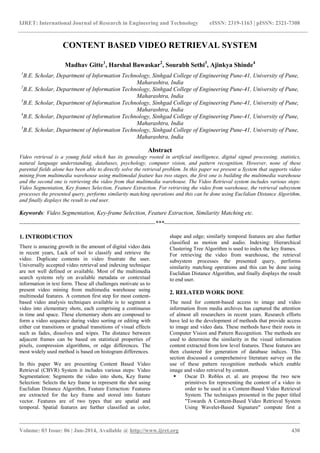
IJRET: International Journal of Research in Engineering and Technology eISSN: 2319-1163 | pISSN: 2321-7308
_______________________________________________________________________________________
Volume: 03 Issue: 06 | Jun-2014, Available @ http://www.ijret.org 430
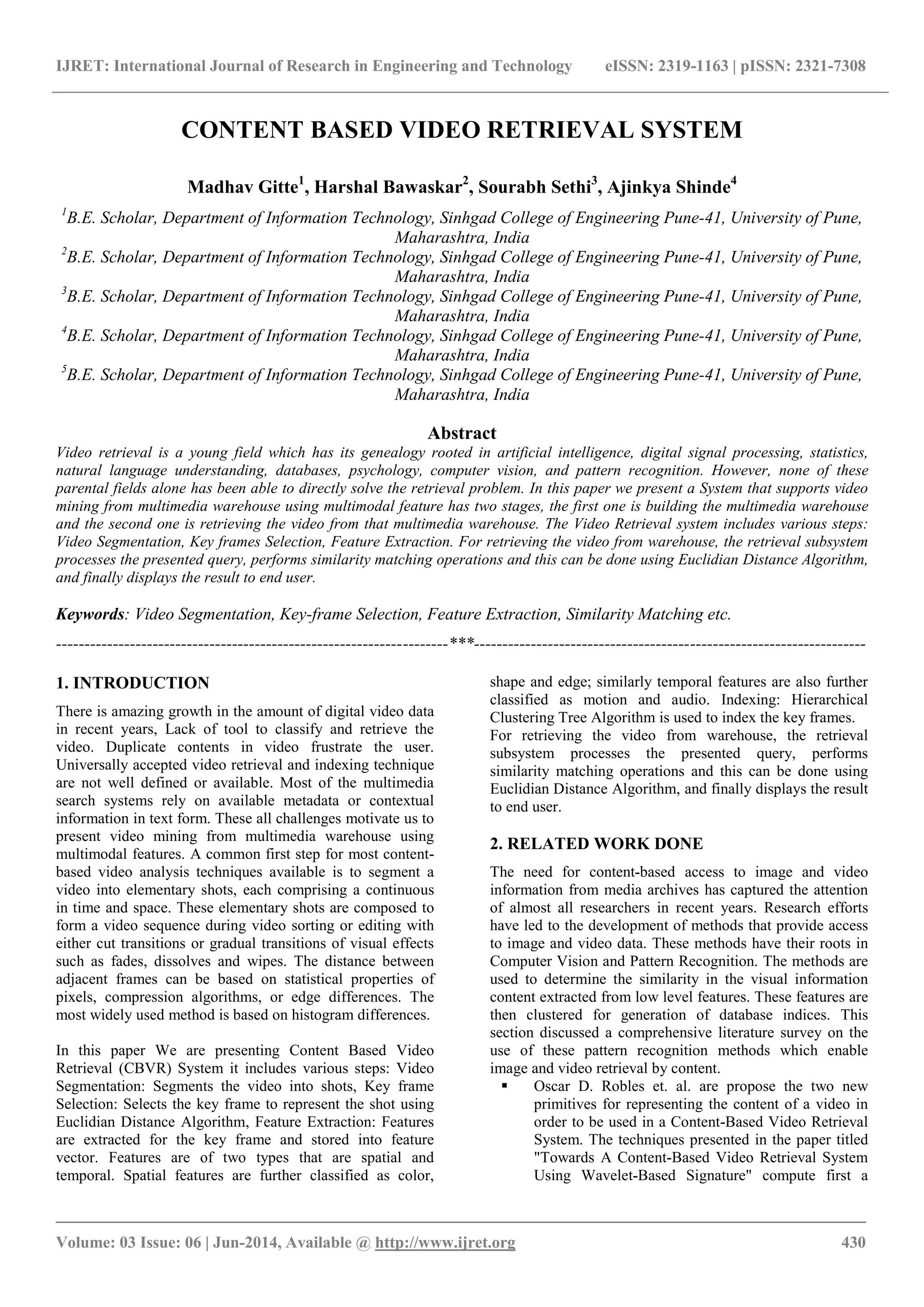
CONTENT BASED VIDEO RETRIEVAL SYSTEM
Madhav Gitte1
, Harshal Bawaskar2
, Sourabh Sethi3
, Ajinkya Shinde4
1
B.E. Scholar, Department of Information Technology, Sinhgad College of Engineering Pune-41, University of Pune,
Maharashtra, India
2
B.E. Scholar, Department of Information Technology, Sinhgad College of Engineering Pune-41, University of Pune,
Maharashtra, India
3
B.E. Scholar, Department of Information Technology, Sinhgad College of Engineering Pune-41, University of Pune,
Maharashtra, India
4
B.E. Scholar, Department of Information Technology, Sinhgad College of Engineering Pune-41, University of Pune,
Maharashtra, India
5
B.E. Scholar, Department of Information Technology, Sinhgad College of Engineering Pune-41, University of Pune,
Maharashtra, India
Abstract
Video retrieval is a young field which has its genealogy rooted in artificial intelligence, digital signal processing, statistics,
natural language understanding, databases, psychology, computer vision, and pattern recognition. However, none of these
parental fields alone has been able to directly solve the retrieval problem. In this paper we present a System that supports video
mining from multimedia warehouse using multimodal feature has two stages, the first one is building the multimedia warehouse
and the second one is retrieving the video from that multimedia warehouse. The Video Retrieval system includes various steps:
Video Segmentation, Key frames Selection, Feature Extraction. For retrieving the video from warehouse, the retrieval subsystem
processes the presented query, performs similarity matching operations and this can be done using Euclidian Distance Algorithm,
and finally displays the result to end user.
Keywords: Video Segmentation, Key-frame Selection, Feature Extraction, Similarity Matching etc.
---------------------------------------------------------------------***---------------------------------------------------------------------
1. INTRODUCTION
There is amazing growth in the amount of digital video data
in recent years, Lack of tool to classify and retrieve the
video. Duplicate contents in video frustrate the user.
Universally accepted video retrieval and indexing technique
are not well defined or available. Most of the multimedia
search systems rely on available metadata or contextual
information in text form. These all challenges motivate us to
present video mining from multimedia warehouse using
multimodal features. A common first step for most content-
based video analysis techniques available is to segment a
video into elementary shots, each comprising a continuous
in time and space. These elementary shots are composed to
form a video sequence during video sorting or editing with
either cut transitions or gradual transitions of visual effects
such as fades, dissolves and wipes. The distance between
adjacent frames can be based on statistical properties of
pixels, compression algorithms, or edge differences. The
most widely used method is based on histogram differences.
In this paper We are presenting Content Based Video
Retrieval (CBVR) System it includes various steps: Video
Segmentation: Segments the video into shots, Key frame
Selection: Selects the key frame to represent the shot using
Euclidian Distance Algorithm, Feature Extraction: Features
are extracted for the key frame and stored into feature
vector. Features are of two types that are spatial and
temporal. Spatial features are further classified as color,
shape and edge; similarly temporal features are also further
classified as motion and audio. Indexing: Hierarchical
Clustering Tree Algorithm is used to index the key frames.
For retrieving the video from warehouse, the retrieval
subsystem processes the presented query, performs
similarity matching operations and this can be done using
Euclidian Distance Algorithm, and finally displays the result
to end user.
2. RELATED WORK DONE
The need for content-based access to image and video
information from media archives has captured the attention
of almost all researchers in recent years. Research efforts
have led to the development of methods that provide access
to image and video data. These methods have their roots in
Computer Vision and Pattern Recognition. The methods are
used to determine the similarity in the visual information
content extracted from low level features. These features are
then clustered for generation of database indices. This
section discussed a comprehensive literature survey on the
use of these pattern recognition methods which enable
image and video retrieval by content.
 Oscar D. Robles et. al. are propose the two new
primitives for representing the content of a video in
order to be used in a Content-Based Video Retrieval
System. The techniques presented in the paper titled
"Towards A Content-Based Video Retrieval System
Using Wavelet-Based Signature" compute first a
IJRET: International Journal of Research in Engineering and Technology eISSN: 2319-1163 | pISSN: 2321-7308
_______________________________________________________________________________________
Volume: 03 Issue: 06 | Jun-2014, Available @ http://www.ijret.org 431
multi-resolution representation using the Haar
Transform. Two types of signatures are extracted
afterwards, one based on multi-resolution global
color histograms and the other one based on multi-
resolution local color histograms. The tests
performed in the experiments include the recall
measure achieved with the proposed primitives[14].
 A system for ―Recognizing Objects in Video
Sequences‖ is presented by Visser et al. They use the
Kalman filter to obtain segmented blobs from the
video, classify the blobs using the probability ration
test, and apply several different temporal methods,
which results in sequential classification methods
over the video sequence containing the blob[12].
 ―A Semantic Video Retrieval Approach using Audio
Analysis‖ is presented by Bakker and Lew in which
the audio can be automatically categorized into
semantic categories such as explosions, music,
speech, etc. In their research literature, significant
attention has been given to the visual aspect of video,
however, relatively little work directly uses audio
content for video retrieval. The paper gives an
overview of our current research directions in
semantic video retrieval using audio content. In this
paper discuss the effectiveness of classifying audio
into semantic categories by combining both global
and local audio features based in the frequency
spectrum. Furthermore, introduce two novel features
called Frequency Spectrum Differentials (FSD), and
Differential Swap Rate (DSR)[13].
3. ARCHITECTURAL BLOCK DIAGRAM
The following figure shows the architectural block diagram;
there are two blocks shown, first block indicates the off-line
processing and second block indicates on-line processing.
3.1. Off Line Processing:
In off-line processing administrator uploads the various
video clips/data and gives it to the media descriptors the
media descriptor performs the feature extraction of that
video and then the key frame is chosen from the available
frame and indexing is done on that key frame and these
indexes are stored on data warehouse along with indexes
and various other features also gets stored on data
warehouse.
Fig -1: Architectural block diagram
3.2. On-Line Processing
In on-line processing block user takes a one short video clip
and it is given to the query media then query media give it to
the media descriptor, media descriptor performs feature
extraction based on the given video then these features are
given to the search engine, then search engine request to the
data warehouse taking that various features and data
warehouse match features of requested video with stored
video on data warehouse and final matched result is given to
the user.
4. FLOW OF SYSTEM
Fig -2: Execution flow of system
The above figure shows the flow of system; in this system
different clients are interacting with the server through the
network. The server system also interacted with data
warehouse, the video data stored in warehouse. The server
IJRET: International Journal of Research in Engineering and Technology eISSN: 2319-1163 | pISSN: 2321-7308
_______________________________________________________________________________________
Volume: 03 Issue: 06 | Jun-2014, Available @ http://www.ijret.org 432
system performs various operations on video clips these are
segmentation, key frame extraction, feature extraction,
classification and clustering, indexing and matching
similarity by using various algorithms. These features are
matched with features stored in data warehouse and user
gets the final retrieved result from data warehouse.
4.1 Video Segmentation
Fig -3: Video Segmentation
Video segmentation is first step towards the content based
video search aiming to segment moving objects in video
sequences. Segmentation of Video done with the help of
step by step process of video segmentation, The complete
video is first converted into scenes, then scenes are
converted into shots and finally shots are converted into
various frames[10].
4.2 Key-Frame Selection
Selects the key frame among the extracted frames of the
video, to represent the shot using Euclidian Distance
Algorithm.
4.2.1 Euclidian Distance
Euclidean distance is used as a similarity measure between
two feature vectors and minimum Euclidean distance yields
the best similarity.
4.3 Feature Extraction
Features are extracted for the key frame and stored into
feature vector. Features are of two types that are spatial and
temporal.
4.3.1 Spatial
Spatial features are further classified as color, shape and
edge;
• For Color feature we are using Local Color
Histogram (LCH) and Global Color Histogram
(GCH), Average RGB Algorithms.
• For Shape and Edge we are using Eccentricity
Algorithm.
4.3.2 Temporal
Temporal features are also further classified as motion and
audio.
4.4 Classification and Clustering
4.4.1 Classification
Classification of video contents is done based on Support
Vector Machines (SVM). Automatic Content Based
Retrieval and Semantic Classification of the Video Contents
[15] presented a learning framework where construction of a
high-level video index is visualized through the synthesis of
its set of elemental features. This is done through the
medium of Support Vector Machines (SVM). The support
vector machines associate each set of data points in the
multidimensional feature space to one of the classes during
training.
4.4.2 Clustering
For Clustering we are using K- Mean’s clustering
algorithm.
This is a widely used clustering algorithm. It assumes that
we know the number of clusters k. This is an iterative
algorithm which keeps track of the cluster centers (means).
The centers are in the same feature space as x.
1. Randomly choose k centers μ1, . . . , μk.
2. Repeat.
3. Assign x1 . . . xn to their nearest centers, respectively.
4. Update μi to the mean of the items assigned to it.
5. Until the clusters no longer change.
Step 3 is equivalent to creating a Voronoi diagram under the
current centers. k-means clustering is sensitive to the initial
cluster centers. It is in fact an optimization problem with a
lot of local optimal. It is of course sensitive to k too. Both
should be chosen with care.
4.5 Indexing
For Indexing purpose we are using B+ Tree to store index of
the specified frames. Indexing is done with the help of
Hierarchical Clustering Tree (HCT) algorithm.
4.6 Matching Similarity
In retrieval stage of a Video search system, features of the
given query video is also extracted. After that the similarity
between the features of the query video and the stored
feature vectors is determined. That means that computing
the similarity between two videos can be transformed into
the problem of computing the similarity between two feature
vectors [11]. This similarity measure is used to give a
distance between the query video and a candidate match
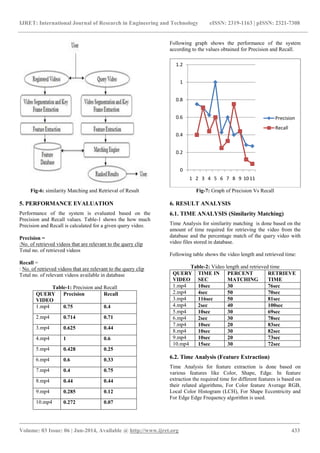
from the feature data database as shown in Figure. 6.
IJRET: International Journal of Research in Engineering and Technology eISSN: 2319-1163 | pISSN: 2321-7308
_______________________________________________________________________________________
Volume: 03 Issue: 06 | Jun-2014, Available @ http://www.ijret.org 433
Fig-6: similarity Matching and Retrieval of Result
5. PERFORMANCE EVALUATION
Performance of the system is evaluated based on the
Precision and Recall values. Table-1 shows the how much
Precision and Recall is calculated for a given query video.
Precision =
:No. of retrieved videos that are relevant to the query clip
Total no. of retrieved videos
Recall =
: No. of retrieved videos that are relevant to the query clip
Total no. of relevant videos available in database
Table-1: Precision and Recall
QUERY
VIDEO
Precision Recall
1.mp4 0.75 0.4
2.mp4 0.714 0.71
3.mp4 0.625 0.44
4.mp4 1 0.6
5.mp4 0.428 0.25
6.mp4 0.6 0.33
7.mp4 0.4 0.75
8.mp4 0.44 0.44
9.mp4 0.285 0.12
10.mp4 0.272 0.07
Following graph shows the performance of the system
according to the values obtained for Precision and Recall.
Fig-7: Graph of Precision Vs Recall
6. RESULT ANALYSIS
6.1. TIME ANALYSIS (Similarity Matching)
Time Analysis for similarity matching is done based on the
amount of time required for retrieving the video from the
database and the percentage match of the query video with
video files stored in database.
Following table shows the video length and retrieved time:
Table-2: Video length and retrieved time
QUERY
VIDEO
TIME IN
SEC
PERCENT
MATCHING
RETRIEVE
TIME
1.mp4 10sec 30 76sec
2.mp4 4sec 50 70sec
3.mp4 116sec 50 81sec
4.mp4 2sec 40 100sec
5.mp4 10sec 30 69sec
6.mp4 2sec 30 78sec
7.mp4 10sec 20 83sec
8.mp4 10sec 30 82sec
9.mp4 10sec 20 73sec
10.mp4 15sec 30 72sec
6.2. Time Analysis (Feature Extraction)
Time Analysis for feature extraction is done based on
various features like Color, Shape, Edge. In feature
extraction the required time for different features is based on
their related algorithms, For Color feature Average RGB,
Local Color Histogram (LCH), For Shape Eccentricity and
For Edge Edge Frequency algorithm is used.
0
0.2
0.4
0.6
0.8
1
1.2
1 2 3 4 5 6 7 8 9 1011
Precision
Recall
IJRET: International Journal of Research in Engineering and Technology eISSN: 2319-1163 | pISSN: 2321-7308
_______________________________________________________________________________________
Volume: 03 Issue: 06 | Jun-2014, Available @ http://www.ijret.org 434
Table-3: Time analysis
QUER
Y
VIDEO
Avg.
RGB
LCH ECCENT
RICITY
EDGE
FREQUE
NCY
1.mp4 0.11sec 0.11sec 0.811sec 0.562sec
2.mp4 0.047sec 0.047sec 0.281sec 0.187sec
3.mp4 0.146sec 0.156sec 1.809sec 0.843sec
4.mp4 0.062sec 0.047sec 7.426sec 0.312sec
5.mp4 0.093sec 0.094sec 0.936sec 0.406sec
6.mp4 0.093sec 0.125sec 0.952sec 0.53sec
7.mp4 0.109sec 0.109sec 0.905sec 0.546sec
8.mp4 0.062sec 0.062sec 0.406sec 0.312sec
9.mp4 0.109sec 0.125sec 0.358sec 0.624sec
10.mp4 0.125sec 0.124sec 0.359sec 0.608sec
6.3. Final Retrieval
After final retrieval of the video from the database, the
various results are shown when user queries the video to the
database. The total no of videos retrieved by the system, No
of similar videos are available in the database and most
matched videos from database with the query video.
Table-4: Final Retrieval
QUERY
VIDEO
Most
Matched
Total
Retrieved by
System
Similar
Available in
Database
1.mp4 3 4 5
2.mp4 5 7 7
3.mp4 5 8 9
4.mp4 4 4 5
5.mp4 3 7 8
6.mp4 3 5 6
7.mp4 2 7 12
8.mp4 4 9 9
9.mp4 2 7 8
10.mp4 3 11 13
Following Graph shows the No. of videos most matched
with query video, total videos retrieved by the system and
similar videos available in the database.
Fig-8.Graph of most matched, retrieved and available video
7. CONCLUSIONS
This Paper has been envisioned for the purpose of retrieving
the video from the Multimedia Database by using efficient
algorithms to increase the performance of the system which
is difficult in traditional video retrieving system. We are
implementing Content Based Video Retrieval System.
REFERENCES
[1] Avinash N. Bhute, B.B. Meshram ―Automated
Multimedia Information Retrieval using Color and
Texture Feature Technique‖ IJECCE Volume 3,
Issue 5, ISSN (Online): 2249–071X, ISSN (Print):
2278–4209
[2] Ashok Ghatol "Implementation of Parallel Image
Processing Using NVIDIA GPU framework."
Advances in Computing Communication and
Control. Springer Berlin Heidelberg, 2011. 457-464.
[3] Journal article – NianhuaXie, Li Li, XianglinZeng,
and Stephen Maybank ―A Survey on Visual Content-
Based Video Indexing and Retrieval‖ IEEE
Transactions On Systems, Man, And Cybernetics—
Part C:Applications And Reviews, Vol. 41, No. 6,
November 2011.
[4] Journal article – Hyun Sung Chang, SanghoonSull,
Sang Uk Lee ―Efficient Video Indexing Scheme for
Content-Based Retrieval‖ IEEE Transactions On
Circuits And Systems For Video Technology, Vol. 9,
No. 8, December 1999.
[5] Lijie Liu, GuoliangFan ,―Combined Key Frame
Extraction and Object Based Video Segmentation‖
IEEE Transactions On Circuits And Systems For
Video Technology, Vol. 15, No. 7, July 2005.
[6] Hang-Bong Kang, ―Spatio –Temporal Feature
Extraction FromCompressed Video Data‖, IEEE
Tencon, 1999.
[7] O. Chapelle, P. Haffner, and V. Vapnik, ―Svms for
histogram based image classification,‖ IEEE Trans.
Neural Netw., vol. 10, pp. 1055–1064, 1999.
[8] Rachid, Benmokhtar and Benoit Huet, Sid- Ahmed
Berrani and Patrick Lechat ― Video Shots Key
Frames Indexing And Retrival Through Pattern
Analysis and fusion Techniques‖, CRE 46134752.
0
2
4
6
8
10
12
14
1 2 3 4 5 6 7 8 9 10 11
Most
Total
Retrieved by
System
Similar
Available in
Database
IJRET: International Journal of Research in Engineering and Technology eISSN: 2319-1163 | pISSN: 2321-7308
_______________________________________________________________________________________
Volume: 03 Issue: 06 | Jun-2014, Available @ http://www.ijret.org 435
[9] Bosque, José L., Oscar D. Robles, Luis Pastor, and
Angel Rodríguez. "Parallel CBIR implementations
with load balancing algorithms." Journal of parallel
and distributed computing 66, no. 8 (2006): 1062-
1075.
[10] Dimitrovski, Ivica, et al. "Video Content-Based
Retrieval System." EUROCON, 2007. The
International Conference on &# 34; Computer as a
Tool&# 34;. IEEE, 2007.
[11] H. Farid and E. P. Simoncelli, Differentiation of
discrete multidimensional signals, IEEE Trans Image
Processing, vol.13(4), pp. 496--508, Apr 2004.
[12] Visser, R., Sebe, N., Bakker, E.: Object recognition
for video retrieval. In: International Conference on
Image and Video Retrieval, Lecture Notes in
Computer Science, vol. 2383, Springer (2002) 250–
259.
[13] Bakker, E., Lew, M.: Semantic video retrieval using
audio analysis. In: International Conference on Image
and Video Retrieval, Lecture Notes in Computer
Science, vol. 2383, Springer (2002) 260–267
[14] Robles, Oscar D., et al. "Towards a content-based
video retrieval system using wavelet-based
signatures." 7th IASTED International Conference on
Computer Graphics and Imaging-CGIM. 2004.
[15] Ankush Mittal, Sumit Gupta(2006), ―Automatic
content-based retrieval and semantic classification of
video content‖, Int. J. on Digital Libraries 6(1): pp.
30-38.
BIOGRAPHIES
Madhav V. Gitte, is a Final year Graduate
student, Pursuing his bachelor degree in
Information Technology at Sinhgad
College of Engineering Pune-41,
University of Pune, India. His area of
interest is in image compression, Database and Algorithms
Harshal P. Bawaskar, is a Final year
Graduate student, Pursuing his bachelor
degree in Information Technology at
Sinhgad College of Engineering Pune -41,
University of Pune, India. His area of
interest is in Video processing, Data Warehousing and Data
Mining.
Sourabh Sethi, is a Final year Graduate
student, Pursuing his bachelor degree in
Information Technology at Sinhgad
College of Engineering Pune-41,University
of Pune, India. His area of interest is in
Image processing, XML, Web Mining.
Ajinkya V. Shinde, is a Final year
Graduate student, Pursuing his bachelor
degree in Information Technology at
Sinhgad College of Engineering Pune-41,
University of Pune, India. His area of
interest is in android developing ,c#, java,c, Database and
Algorithms

Content based video retrieval system

  • 1.
    IJRET: International Journalof Research in Engineering and Technology eISSN: 2319-1163 | pISSN: 2321-7308 _______________________________________________________________________________________ Volume: 03 Issue: 06 | Jun-2014, Available @ http://www.ijret.org 430 CONTENT BASED VIDEO RETRIEVAL SYSTEM Madhav Gitte1 , Harshal Bawaskar2 , Sourabh Sethi3 , Ajinkya Shinde4 1 B.E. Scholar, Department of Information Technology, Sinhgad College of Engineering Pune-41, University of Pune, Maharashtra, India 2 B.E. Scholar, Department of Information Technology, Sinhgad College of Engineering Pune-41, University of Pune, Maharashtra, India 3 B.E. Scholar, Department of Information Technology, Sinhgad College of Engineering Pune-41, University of Pune, Maharashtra, India 4 B.E. Scholar, Department of Information Technology, Sinhgad College of Engineering Pune-41, University of Pune, Maharashtra, India 5 B.E. Scholar, Department of Information Technology, Sinhgad College of Engineering Pune-41, University of Pune, Maharashtra, India Abstract Video retrieval is a young field which has its genealogy rooted in artificial intelligence, digital signal processing, statistics, natural language understanding, databases, psychology, computer vision, and pattern recognition. However, none of these parental fields alone has been able to directly solve the retrieval problem. In this paper we present a System that supports video mining from multimedia warehouse using multimodal feature has two stages, the first one is building the multimedia warehouse and the second one is retrieving the video from that multimedia warehouse. The Video Retrieval system includes various steps: Video Segmentation, Key frames Selection, Feature Extraction. For retrieving the video from warehouse, the retrieval subsystem processes the presented query, performs similarity matching operations and this can be done using Euclidian Distance Algorithm, and finally displays the result to end user. Keywords: Video Segmentation, Key-frame Selection, Feature Extraction, Similarity Matching etc. ---------------------------------------------------------------------***--------------------------------------------------------------------- 1. INTRODUCTION There is amazing growth in the amount of digital video data in recent years, Lack of tool to classify and retrieve the video. Duplicate contents in video frustrate the user. Universally accepted video retrieval and indexing technique are not well defined or available. Most of the multimedia search systems rely on available metadata or contextual information in text form. These all challenges motivate us to present video mining from multimedia warehouse using multimodal features. A common first step for most content- based video analysis techniques available is to segment a video into elementary shots, each comprising a continuous in time and space. These elementary shots are composed to form a video sequence during video sorting or editing with either cut transitions or gradual transitions of visual effects such as fades, dissolves and wipes. The distance between adjacent frames can be based on statistical properties of pixels, compression algorithms, or edge differences. The most widely used method is based on histogram differences. In this paper We are presenting Content Based Video Retrieval (CBVR) System it includes various steps: Video Segmentation: Segments the video into shots, Key frame Selection: Selects the key frame to represent the shot using Euclidian Distance Algorithm, Feature Extraction: Features are extracted for the key frame and stored into feature vector. Features are of two types that are spatial and temporal. Spatial features are further classified as color, shape and edge; similarly temporal features are also further classified as motion and audio. Indexing: Hierarchical Clustering Tree Algorithm is used to index the key frames. For retrieving the video from warehouse, the retrieval subsystem processes the presented query, performs similarity matching operations and this can be done using Euclidian Distance Algorithm, and finally displays the result to end user. 2. RELATED WORK DONE The need for content-based access to image and video information from media archives has captured the attention of almost all researchers in recent years. Research efforts have led to the development of methods that provide access to image and video data. These methods have their roots in Computer Vision and Pattern Recognition. The methods are used to determine the similarity in the visual information content extracted from low level features. These features are then clustered for generation of database indices. This section discussed a comprehensive literature survey on the use of these pattern recognition methods which enable image and video retrieval by content.  Oscar D. Robles et. al. are propose the two new primitives for representing the content of a video in order to be used in a Content-Based Video Retrieval System. The techniques presented in the paper titled "Towards A Content-Based Video Retrieval System Using Wavelet-Based Signature" compute first a
  • 2.
    IJRET: International Journalof Research in Engineering and Technology eISSN: 2319-1163 | pISSN: 2321-7308 _______________________________________________________________________________________ Volume: 03 Issue: 06 | Jun-2014, Available @ http://www.ijret.org 431 multi-resolution representation using the Haar Transform. Two types of signatures are extracted afterwards, one based on multi-resolution global color histograms and the other one based on multi- resolution local color histograms. The tests performed in the experiments include the recall measure achieved with the proposed primitives[14].  A system for ―Recognizing Objects in Video Sequences‖ is presented by Visser et al. They use the Kalman filter to obtain segmented blobs from the video, classify the blobs using the probability ration test, and apply several different temporal methods, which results in sequential classification methods over the video sequence containing the blob[12].  ―A Semantic Video Retrieval Approach using Audio Analysis‖ is presented by Bakker and Lew in which the audio can be automatically categorized into semantic categories such as explosions, music, speech, etc. In their research literature, significant attention has been given to the visual aspect of video, however, relatively little work directly uses audio content for video retrieval. The paper gives an overview of our current research directions in semantic video retrieval using audio content. In this paper discuss the effectiveness of classifying audio into semantic categories by combining both global and local audio features based in the frequency spectrum. Furthermore, introduce two novel features called Frequency Spectrum Differentials (FSD), and Differential Swap Rate (DSR)[13]. 3. ARCHITECTURAL BLOCK DIAGRAM The following figure shows the architectural block diagram; there are two blocks shown, first block indicates the off-line processing and second block indicates on-line processing. 3.1. Off Line Processing: In off-line processing administrator uploads the various video clips/data and gives it to the media descriptors the media descriptor performs the feature extraction of that video and then the key frame is chosen from the available frame and indexing is done on that key frame and these indexes are stored on data warehouse along with indexes and various other features also gets stored on data warehouse. Fig -1: Architectural block diagram 3.2. On-Line Processing In on-line processing block user takes a one short video clip and it is given to the query media then query media give it to the media descriptor, media descriptor performs feature extraction based on the given video then these features are given to the search engine, then search engine request to the data warehouse taking that various features and data warehouse match features of requested video with stored video on data warehouse and final matched result is given to the user. 4. FLOW OF SYSTEM Fig -2: Execution flow of system The above figure shows the flow of system; in this system different clients are interacting with the server through the network. The server system also interacted with data warehouse, the video data stored in warehouse. The server
  • 3.
    IJRET: International Journalof Research in Engineering and Technology eISSN: 2319-1163 | pISSN: 2321-7308 _______________________________________________________________________________________ Volume: 03 Issue: 06 | Jun-2014, Available @ http://www.ijret.org 432 system performs various operations on video clips these are segmentation, key frame extraction, feature extraction, classification and clustering, indexing and matching similarity by using various algorithms. These features are matched with features stored in data warehouse and user gets the final retrieved result from data warehouse. 4.1 Video Segmentation Fig -3: Video Segmentation Video segmentation is first step towards the content based video search aiming to segment moving objects in video sequences. Segmentation of Video done with the help of step by step process of video segmentation, The complete video is first converted into scenes, then scenes are converted into shots and finally shots are converted into various frames[10]. 4.2 Key-Frame Selection Selects the key frame among the extracted frames of the video, to represent the shot using Euclidian Distance Algorithm. 4.2.1 Euclidian Distance Euclidean distance is used as a similarity measure between two feature vectors and minimum Euclidean distance yields the best similarity. 4.3 Feature Extraction Features are extracted for the key frame and stored into feature vector. Features are of two types that are spatial and temporal. 4.3.1 Spatial Spatial features are further classified as color, shape and edge; • For Color feature we are using Local Color Histogram (LCH) and Global Color Histogram (GCH), Average RGB Algorithms. • For Shape and Edge we are using Eccentricity Algorithm. 4.3.2 Temporal Temporal features are also further classified as motion and audio. 4.4 Classification and Clustering 4.4.1 Classification Classification of video contents is done based on Support Vector Machines (SVM). Automatic Content Based Retrieval and Semantic Classification of the Video Contents [15] presented a learning framework where construction of a high-level video index is visualized through the synthesis of its set of elemental features. This is done through the medium of Support Vector Machines (SVM). The support vector machines associate each set of data points in the multidimensional feature space to one of the classes during training. 4.4.2 Clustering For Clustering we are using K- Mean’s clustering algorithm. This is a widely used clustering algorithm. It assumes that we know the number of clusters k. This is an iterative algorithm which keeps track of the cluster centers (means). The centers are in the same feature space as x. 1. Randomly choose k centers μ1, . . . , μk. 2. Repeat. 3. Assign x1 . . . xn to their nearest centers, respectively. 4. Update μi to the mean of the items assigned to it. 5. Until the clusters no longer change. Step 3 is equivalent to creating a Voronoi diagram under the current centers. k-means clustering is sensitive to the initial cluster centers. It is in fact an optimization problem with a lot of local optimal. It is of course sensitive to k too. Both should be chosen with care. 4.5 Indexing For Indexing purpose we are using B+ Tree to store index of the specified frames. Indexing is done with the help of Hierarchical Clustering Tree (HCT) algorithm. 4.6 Matching Similarity In retrieval stage of a Video search system, features of the given query video is also extracted. After that the similarity between the features of the query video and the stored feature vectors is determined. That means that computing the similarity between two videos can be transformed into the problem of computing the similarity between two feature vectors [11]. This similarity measure is used to give a distance between the query video and a candidate match from the feature data database as shown in Figure. 6.
  • 4.
    IJRET: International Journalof Research in Engineering and Technology eISSN: 2319-1163 | pISSN: 2321-7308 _______________________________________________________________________________________ Volume: 03 Issue: 06 | Jun-2014, Available @ http://www.ijret.org 433 Fig-6: similarity Matching and Retrieval of Result 5. PERFORMANCE EVALUATION Performance of the system is evaluated based on the Precision and Recall values. Table-1 shows the how much Precision and Recall is calculated for a given query video. Precision = :No. of retrieved videos that are relevant to the query clip Total no. of retrieved videos Recall = : No. of retrieved videos that are relevant to the query clip Total no. of relevant videos available in database Table-1: Precision and Recall QUERY VIDEO Precision Recall 1.mp4 0.75 0.4 2.mp4 0.714 0.71 3.mp4 0.625 0.44 4.mp4 1 0.6 5.mp4 0.428 0.25 6.mp4 0.6 0.33 7.mp4 0.4 0.75 8.mp4 0.44 0.44 9.mp4 0.285 0.12 10.mp4 0.272 0.07 Following graph shows the performance of the system according to the values obtained for Precision and Recall. Fig-7: Graph of Precision Vs Recall 6. RESULT ANALYSIS 6.1. TIME ANALYSIS (Similarity Matching) Time Analysis for similarity matching is done based on the amount of time required for retrieving the video from the database and the percentage match of the query video with video files stored in database. Following table shows the video length and retrieved time: Table-2: Video length and retrieved time QUERY VIDEO TIME IN SEC PERCENT MATCHING RETRIEVE TIME 1.mp4 10sec 30 76sec 2.mp4 4sec 50 70sec 3.mp4 116sec 50 81sec 4.mp4 2sec 40 100sec 5.mp4 10sec 30 69sec 6.mp4 2sec 30 78sec 7.mp4 10sec 20 83sec 8.mp4 10sec 30 82sec 9.mp4 10sec 20 73sec 10.mp4 15sec 30 72sec 6.2. Time Analysis (Feature Extraction) Time Analysis for feature extraction is done based on various features like Color, Shape, Edge. In feature extraction the required time for different features is based on their related algorithms, For Color feature Average RGB, Local Color Histogram (LCH), For Shape Eccentricity and For Edge Edge Frequency algorithm is used. 0 0.2 0.4 0.6 0.8 1 1.2 1 2 3 4 5 6 7 8 9 1011 Precision Recall
  • 5.
    IJRET: International Journalof Research in Engineering and Technology eISSN: 2319-1163 | pISSN: 2321-7308 _______________________________________________________________________________________ Volume: 03 Issue: 06 | Jun-2014, Available @ http://www.ijret.org 434 Table-3: Time analysis QUER Y VIDEO Avg. RGB LCH ECCENT RICITY EDGE FREQUE NCY 1.mp4 0.11sec 0.11sec 0.811sec 0.562sec 2.mp4 0.047sec 0.047sec 0.281sec 0.187sec 3.mp4 0.146sec 0.156sec 1.809sec 0.843sec 4.mp4 0.062sec 0.047sec 7.426sec 0.312sec 5.mp4 0.093sec 0.094sec 0.936sec 0.406sec 6.mp4 0.093sec 0.125sec 0.952sec 0.53sec 7.mp4 0.109sec 0.109sec 0.905sec 0.546sec 8.mp4 0.062sec 0.062sec 0.406sec 0.312sec 9.mp4 0.109sec 0.125sec 0.358sec 0.624sec 10.mp4 0.125sec 0.124sec 0.359sec 0.608sec 6.3. Final Retrieval After final retrieval of the video from the database, the various results are shown when user queries the video to the database. The total no of videos retrieved by the system, No of similar videos are available in the database and most matched videos from database with the query video. Table-4: Final Retrieval QUERY VIDEO Most Matched Total Retrieved by System Similar Available in Database 1.mp4 3 4 5 2.mp4 5 7 7 3.mp4 5 8 9 4.mp4 4 4 5 5.mp4 3 7 8 6.mp4 3 5 6 7.mp4 2 7 12 8.mp4 4 9 9 9.mp4 2 7 8 10.mp4 3 11 13 Following Graph shows the No. of videos most matched with query video, total videos retrieved by the system and similar videos available in the database. Fig-8.Graph of most matched, retrieved and available video 7. CONCLUSIONS This Paper has been envisioned for the purpose of retrieving the video from the Multimedia Database by using efficient algorithms to increase the performance of the system which is difficult in traditional video retrieving system. We are implementing Content Based Video Retrieval System. REFERENCES [1] Avinash N. Bhute, B.B. Meshram ―Automated Multimedia Information Retrieval using Color and Texture Feature Technique‖ IJECCE Volume 3, Issue 5, ISSN (Online): 2249–071X, ISSN (Print): 2278–4209 [2] Ashok Ghatol "Implementation of Parallel Image Processing Using NVIDIA GPU framework." Advances in Computing Communication and Control. Springer Berlin Heidelberg, 2011. 457-464. [3] Journal article – NianhuaXie, Li Li, XianglinZeng, and Stephen Maybank ―A Survey on Visual Content- Based Video Indexing and Retrieval‖ IEEE Transactions On Systems, Man, And Cybernetics— Part C:Applications And Reviews, Vol. 41, No. 6, November 2011. [4] Journal article – Hyun Sung Chang, SanghoonSull, Sang Uk Lee ―Efficient Video Indexing Scheme for Content-Based Retrieval‖ IEEE Transactions On Circuits And Systems For Video Technology, Vol. 9, No. 8, December 1999. [5] Lijie Liu, GuoliangFan ,―Combined Key Frame Extraction and Object Based Video Segmentation‖ IEEE Transactions On Circuits And Systems For Video Technology, Vol. 15, No. 7, July 2005. [6] Hang-Bong Kang, ―Spatio –Temporal Feature Extraction FromCompressed Video Data‖, IEEE Tencon, 1999. [7] O. Chapelle, P. Haffner, and V. Vapnik, ―Svms for histogram based image classification,‖ IEEE Trans. Neural Netw., vol. 10, pp. 1055–1064, 1999. [8] Rachid, Benmokhtar and Benoit Huet, Sid- Ahmed Berrani and Patrick Lechat ― Video Shots Key Frames Indexing And Retrival Through Pattern Analysis and fusion Techniques‖, CRE 46134752. 0 2 4 6 8 10 12 14 1 2 3 4 5 6 7 8 9 10 11 Most Total Retrieved by System Similar Available in Database
  • 6.
    IJRET: International Journalof Research in Engineering and Technology eISSN: 2319-1163 | pISSN: 2321-7308 _______________________________________________________________________________________ Volume: 03 Issue: 06 | Jun-2014, Available @ http://www.ijret.org 435 [9] Bosque, José L., Oscar D. Robles, Luis Pastor, and Angel Rodríguez. "Parallel CBIR implementations with load balancing algorithms." Journal of parallel and distributed computing 66, no. 8 (2006): 1062- 1075. [10] Dimitrovski, Ivica, et al. "Video Content-Based Retrieval System." EUROCON, 2007. The International Conference on &# 34; Computer as a Tool&# 34;. IEEE, 2007. [11] H. Farid and E. P. Simoncelli, Differentiation of discrete multidimensional signals, IEEE Trans Image Processing, vol.13(4), pp. 496--508, Apr 2004. [12] Visser, R., Sebe, N., Bakker, E.: Object recognition for video retrieval. In: International Conference on Image and Video Retrieval, Lecture Notes in Computer Science, vol. 2383, Springer (2002) 250– 259. [13] Bakker, E., Lew, M.: Semantic video retrieval using audio analysis. In: International Conference on Image and Video Retrieval, Lecture Notes in Computer Science, vol. 2383, Springer (2002) 260–267 [14] Robles, Oscar D., et al. "Towards a content-based video retrieval system using wavelet-based signatures." 7th IASTED International Conference on Computer Graphics and Imaging-CGIM. 2004. [15] Ankush Mittal, Sumit Gupta(2006), ―Automatic content-based retrieval and semantic classification of video content‖, Int. J. on Digital Libraries 6(1): pp. 30-38. BIOGRAPHIES Madhav V. Gitte, is a Final year Graduate student, Pursuing his bachelor degree in Information Technology at Sinhgad College of Engineering Pune-41, University of Pune, India. His area of interest is in image compression, Database and Algorithms Harshal P. Bawaskar, is a Final year Graduate student, Pursuing his bachelor degree in Information Technology at Sinhgad College of Engineering Pune -41, University of Pune, India. His area of interest is in Video processing, Data Warehousing and Data Mining. Sourabh Sethi, is a Final year Graduate student, Pursuing his bachelor degree in Information Technology at Sinhgad College of Engineering Pune-41,University of Pune, India. His area of interest is in Image processing, XML, Web Mining. Ajinkya V. Shinde, is a Final year Graduate student, Pursuing his bachelor degree in Information Technology at Sinhgad College of Engineering Pune-41, University of Pune, India. His area of interest is in android developing ,c#, java,c, Database and Algorithms