Received February 18, 2020, accepted March 7, 2020, date of publication March 13, 2020, date of current version March 24, 2020.
Digital Object Identifier 10.1109/ACCESS.2020.2980589
A Collaborative Approach Toward Scientific
Paper Recommendation Using
Citation Context
NAZMUS SAKIB1, RODINA BINTI AHMAD 1, AND KHALID HARUNA 2
1Department of Software Engineering, Faculty of Computer Science and Information Technology, University of Malaya, Kuala Lumpur 50603, Malaysia
2Department of Computer Science, Faculty of Computer Science and Information Technology, Bayero University, Kano 3011, Nigeria
Corresponding author: Rodina Binti Ahmad (rodina@um.edu.my)
This work was supported by the University of Malaya Research Grant (UMRG) under Grant RP061A-18SBS.
ABSTRACT Researchers face difculties in nding relevant papers to their research interest as the number
of scientic publication is rapidly increasing on the web. Scientic paper recommenders have emerged as
a leading solution to help researchers by automatically suggesting relevant and useful publications. Several
approaches have been proposed on improving recommender systems. However, most existing approaches
depend on priori user proles, and thus they cannot recommend papers to new user. Furthermore, the existing
approaches utilize non-public contextual information, and thus it cannot adequately nd similarities between
papers due to copyright restrictions. Also, the existing approaches consider only single level paper-citation
relation to identify similarities between papers. Considering the above challenges, this paper presents a
collaborative ltering based recommendation approach for scientic papers that does not depend on priori
user proles and which utilizes only public contextual information. Using citation context, we utilized 2-level
paper-citation relations to nd hidden associations between papers. The rational underlying this approach is
that, two papers are co-occurred with same cited paper(s) and two papers are co-occurring with same citing
paper(s) are signicantly similar to some extent. To evaluate the performance of the proposed approach,
publicly available datasets are used to conduct extensive experiments. The experimental results demonstrate
that the proposed approach has signicantly outperforms the baseline approaches in terms of precision,
recall, F1, mean average precision, and mean reciprocal rank, which are commonly used information retrieval
metrics. The novelty of this study is that, with the proposed approach, researchers are able to nd relevant
and useful publications over the internet regardless of their previous research experiences and research area.
INDEX TERMS Scientic paper recommendation systems, collaborative ltering, contextual information,
citation context, 2-level paper-citation relation matrix.
I. INTRODUCTION
The number of freely available scientic papers on the web
has increased, thus recommender systems have become popu-
lar for not only industry but also academia [1]. Unfortunately,
fewer studies have examined scientic paper recommender
systems in comparison with other recommender systems
domains, such as movie and music. Researchers usually per-
form bibliographical search daily to nd relevant scientic
papers to their research interest. However, they typically need
to lter huge number of scientic papers to nd those relevant
papers. This is a time consuming and difcult task. Moreover,
it becomes worse in nding and keeping track relevant papers
The associate editor coordinating the review of this manuscript and
approving it for publication was Davide Aloini.
for the novice researchers and who do not have sufcient
knowledge in the research area. Hence, an efcient scientic
papers recommender system that can generate high quality
recommendations is essentially needed [2].
Previous studies have utilized different recommendation
techniques to provide personalized recommendations for
scientic papers. Most commonly used technique is con-
tent based ltering. Content based ltering approaches usu-
ally extract contents to create relationships between items
(e.g., scientic papers). Different contents have been used
in the literature. Some of them are, authors [3] extract title
and abstract from a single paper, authors [4] extract whole
contents of a list of papers authored by an author, authors [5]
extract papers’ keywords and so on to provide recommen-
dation. Most of these approaches extract various contents
51246
This work is licensed under a Creative Commons Attribution 4.0 License. For more information, see https://creativecommons.org/licenses/by/4.0/
VOLUME 8, 2020
N. Sakib et al.: Collaborative Approach Toward Scientific Paper Recommendation Using Citation Context
FIGURE 1. Paper’s similarity based on (a) co-occurred (b) co-occurring.
from the scientic papers to build user prole to provide
recommendations. These priori user prole based approaches
cannot work well for new recommender systems. Also, all the
contents of the scientic papers cannot be freely accessible
due to copyright restrictions. Moreover, content based lter-
ing cannot capture user interests properly due to ambiguity of
natural language [6].
Collaborative ltering is a classical recommendation
approach that is exploited in scientic paper recommender
systems [7]. It creates paper-citation matrix to nd rela-
tionships between scientic papers. Here, citing papers are
represented as users and cited papers are represented as items.
Two citing papers (users) can be similar if they have com-
mon cited papers (items). In this research, we consider two
papers are signicantly similar to some extent if they are
co-occurred with the same cited paper(s) and are co-occurring
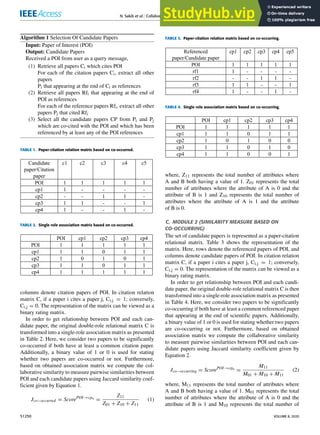
with the same citing paper(s) respectively. As can be seen
from Fig. 1(a), C1 and C2 are two citing papers and P1, P2 and
P3 are three cited papers. Papers P1 and P2 are being cited
simultaneously by the citing paper C1, and papers P2 and
P3 are being cited simultaneously by the citing paper C2.
There is no paper that cited both papers P1 and P3. Despite
this, P1 and P3 papers are similar to some extend because
P1 and P3 are co-occurred with the same cited paper P2.
Aa can be seen form Fig. 1(b), P1, P2 and P3 are three citing
papers and R1 and R2 are two cited papers. P1 and P2 papers
cited the same paper R1, and P2 and P3 papers cited the same
paper R2. There is no common paper that cited by both the
papers P1 and P3. Despite this, P1 and P3 are similar to some
extend because P1 and P3 are co-occurring with the same
citing paper P2.
This paper proposes a collaborative approach for scientic
paper recommendation that utilizes citation context. Using
citation context, 2-level paper-citation relations (i.e., two
papers with the same citing paper(s) and two papers with the
same cited paper(s)) are generated to nd similar papers. The
proposed approach mines hidden associations between scien-
tic papers separately based on these paper-citation relations
and later combines to compute similarities between paper of
interest and candidate papers.
The main contribution in our work is, proposing a novel
approach towards scientic paper recommendation that com-
bines 2-level paper-citation relations based on citation context
to recommend papers as paper references to user.
The rest of the paper is structured as follows. Some related
works on existing recommendation approaches is presented
in Section II. Section III introduces the proposed method-
ology. Experimental setup and evaluation are presented in
Section IV. Section V discusses our results in detail. Finally,
Section VI concludes the paper.
II. RELATED WORK
The recommender systems are introduced to solve the infor-
mation overload problem by suggesting items of interest to
user. Since emerged as effective tools, several recommen-
dation algorithms have been successfully applied in many
elds such as e-commerce [8, 9], movie [10, 11], music
[12, 13], news [14], e-learning [15, 16] and so on [17, 18].
As aforementioned, due to the increase of scientic articles
publications in recent years, it is becoming notably pop-
ular and challenging to apply recommendation techniques
in scientic community. This section presents some related
works on scientic papers recommender systems. There is
two classes of recommendation techniques in this domain:
priori user prole based and non priori user prole based
recommendation technique.
A. PRIORI USER PROFILE BASED TECHNIQUE
A priori user prole based technique is a recommendation
technique that creates user profiles based on users’ previous
research interests and their paper access history [5]. Different
researchers have constructed different proles using differ-
ent contextual information. Agarwal et al. [19] proposed a
subspace clustering approach with the help of collaborative
filtering. The model utilizes researchers’ previous reading
habits to build user prole. Sugiyama and Kan [20] intro-
duced a citation network based user prole creation model
to understand researchers’ interests clearly. The contents of
researchers’ previous publications were used to construct
user prole. And, papers are recommended to user by com-
paring the prole with the content of the candidate papers.
Authors extended their work [4] to solve the sparsity problem.
They apply collaborative ltering method to identify poten-
tial citation papers from researcher’s previous publications.
Later, authors again extended their work [21] to solve the
VOLUME 8, 2020 51247
N. Sakib et al.: Collaborative Approach Toward Scientific Paper Recommendation Using Citation Context
multidisciplinary problems. Authors investigate different sec-
tions of the scientic papers to nd better paper presentations.
Different from above the studies, Xia et al. [22] proposed an
author based recommendation approach by considering com-
mon authors relations and their historical preferences. Using
these information, a graph based article ranking algorithm
was used to build user prole and later based on prole, new
recommendation lists were generated. Zhao et al. [23] pro-
posed a graph based recommendation model that constructs
user profile based on researchers’ knowledge gaps. Authors
investigate researchers’ background knowledge and target
knowledge, and later create a concept map. Guo et al. [24]
proposed a ne-grained approach that uses co-authorship,
author-paper, paper-citation, and paper-keyword relations to
construct multi-relations graph. The approach employs a
topic cluster model and a random walk model to produce
recommendations. Kaya [5] proposed a score based recom-
mendation model that constructs user prole based on dif-
ferent contextual information such as the number of users’
published publications, the number of citations of the publica-
tions, year of publications, and articles keywords. Scores are
calculated based on these information and later top-n papers
are recommended to a researcher. Ma and Wang [25] pro-
posed a personalized recommendation method based on het-
erogeneous graph. User and paper proles were created based
on contents of papers (i.e., title, keywords, abstract). Later,
two meta-path based proximity measures were employed
to nd similarity of neighbors, and recommendation was
generated based on user feature vector and paper feature
vector. Bulut et al. [26] proposed a deep learning based
paper recommendation system by considering user’s previous
research interests. User prole was created based on differ-
ent contextual information (i.e., title, year, authors, abstract,
and keywords) of each publication previously written by
researcher.
Most of these works [4], [5], [19]-[26] do not use publicly
available contextual information to build user prole. Thus,
these approaches cannot adequately nd similarities between
papers due to copyright restrictions. Also, the recommenda-
tions are fully depended on priori user proles, hence as said
before, it cannot provide useful recommendations for new
users.
B. NON PRIORI USER PROFILE BASED TECHNIQUE
A non priori user prole based technique is a recommenda-
tion technique that does not require any information stored
a priori [3]. In existing studies, different researchers have pro-
posed different approaches. McNee et al. [7] explored citation
network of the scientic paper using collaborative ltering.
The aim was to utilize the neighbor-based collaborative l-
tering to recommend citations. Gori and Pucci [27] proposed
a graph model based approach that creates a citation graph
based on paper citation relations. A random-walk algorithm
was employed to the citation graph to compute similarity
scores. Meng et al. [28] proposed a unied graph-based
model with random walk using various types of informa-
tion (e.g., authorship, content, citation and collaboration
network). They incorporated information into the model to
generate recommendations. Liu et al. [29] proposed a pseudo
relevance feedback based graph model that extracts various
meta paths from heterogeneous bibliographic graph to nd
important seed nodes. Later, a random walk algorithm on
heterogeneous bibliographic graph was employed to com-
pute the papers’ ranking. Different from the above studies,
Nascimento et al. [3] proposed a source independent frame-
work that utilizes only publicly available contextual infor-
mation. Title and abstract were extracted from the paper of
interest to apply content based recommendation method to
generate top-n recommendations. Raamkumar et al. [30] pro-
posed a recommendation model that utilizes publicly avail-
able contextual author-specied keywords from papers. The
model creates a citation network based on these keywords to
apply two coverage measure techniques to build a reading list
of scientic papers. Liu et al. [31] proposed a neighbor-based
collaborative ltering for citation recommendation. Using
citation context, a single level paper-citation relation was
exploited to nd similar neighbors. They mined hidden asso-
ciations between paper of interest and its references to rec-
ommend citations. Haruna et al. [32] also exploited single
level paper-citation relation by mining hidden associations
between paper of interest and its citations to nd similar
neighbors. Son and Kim [33] proposed a recommendation
model that utilizes multilevel citation networks to nd rel-
evant papers. They considered both ‘cites’ and ‘cited by’
relationships between scientic papers beyond a single level
to recommend high quality papers. Waheed et al. [34] pro-
posed a hybrid approach that combines multilevel citation
networks and authors relationship networks. They identi-
ed key authors from their relationship networks to recom-
mend papers to user. Mu et al. [35] proposed a multi-layered
mutual reinforcement rules based citation recommendation
framework. A multi-layered graph was constructed based
on multiple types of relations between authors, papers,
and keywords. Further, authors incorporated personalized
query information into this multi-layered graph to achieve
query-focused personalized recommendation. Dai et al. [36]
proposed a recommendation method that combines low-rank
sparse matrix with ne-grained paper and author afnity
matrix to alleviate the sparsity problem of traditional collab-
orative ltering. Firstly, ne-grained paper and author afn-
ity matrix were extracted from heterogeneous bibliographic
network, and then integrated these matrices into low-rank
and sparse matrix factorization. Dai et al. [37] proposed
a global citation recommendation model using topic learn-
ing and joint feature regression that extracts various text
content and citation features from citation network. Differ-
ent citation features (i.e., title, abstract, keywords, citation
count, author history, and meta-path) were extracted and
integrated with topic model to learn the process of feature
regression. Yang et al. [38] proposed a context-aware citation
51248 VOLUME 8, 2020
N. Sakib et al.: Collaborative Approach Toward Scientific Paper Recommendation Using Citation Context
FIGURE 2. Overview of the proposed recommendation approach.
recommendation model using convolutional neural networks
(CNN). A Long-Short-Term Memory (LSTM) model was
created based on citation context vectors and scientic paper
vectors to measure the relevancy. Later, papers with high
relevancy scores were recommended as recommendation list.
Khan et al. [39] proposed a recommendation approach that
utilizes in-text citation frequencies and in-text citation pat-
terns to nd most relevant scientic articles. The authors
investigated different logical sections of papers to identify
in-text citation pattern and, then based on these patterns,
relevancy score is calculated to rank the articles.
Most of these works [3], [27]-[30], [33]-[39] either extract
some paper contents or utilize graph model-based tech-
niques for recommending papers. Apart from them, in this
work we propose a neighbor-based collaborative approach
for scientic paper recommendation that utilizes only easily
obtained publicly available contextual citation relations infor-
mation. In addition, unlike some works [7], [31]-[32] that
utilize single level paper-citation relation, we employ 2-level
paper-citation relationships with the help of citation context
to nd similar neighbors. The experimental results have been
shown to verify the effectiveness of the proposed approach.
III. PROPOSED METHODOLOGY
Our proposed approach starts by accepting user’s query from
a user as Paper of Interest (POI) to which a user wants to
get other recommendations similar to it. Once the POI is
received, the extraction stage starts and the extractor extracts
all the candidate papers. Next, our proposed approach analy-
ses extracted candidate papers by several computations of the
recommendation process stage, and nally presents Top-N
recommendations to the user. Fig. 2 shows the overview
of our proposed approach. It mainly includes the following
several stages: (1) data extraction and selection of candidate
papers, (2) measuring similarity score of each candidate paper
for 2-level paper citation relations (module 1 and module 2),
and (3) Normalizing results by combining obtained similar-
ity scores from 2-level paper-citation relations, and sorting
scores to recommend Top-N papers to user. The brief descrip-
tion of each stage is provided below:
A. DATA EXTRACTION AND SELECTION
OF CANDIDATE PAPERS
In the rst stage, candidate papers are selected based on cita-
tion papers and reference papers of Paper of Interest (POI).
Citation papers are a list of papers which cites POI and
reference papers are a list of papers appearing at the end
of POI. The relations between POI and these papers are
‘‘cited’’ and conversely, ‘‘cites’’. The algorithm for selection
of the candidate papers is given below in Algorithm 1.
B. MODULE 1 (SIMILARITY MEASURE BASED
ON CO-OCCURRED)
The extracted set of candidate papers is represented as a
paper-citation relational matrix. Table 1 shows the represen-
tation of the matrix. Here, rows denote candidate papers, and
VOLUME 8, 2020 51249
N. Sakib et al.: Collaborative Approach Toward Scientific Paper Recommendation Using Citation Context
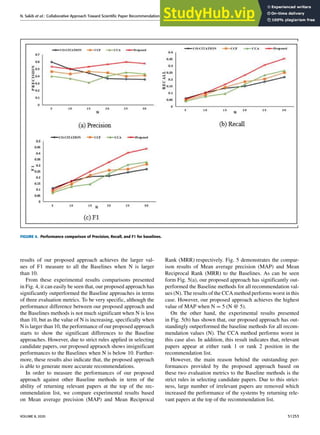
Algorithm 1 Selection Of Candidate Papers
Input: Paper of Interest (POI)
Output: Candidate Papers
Received a POI from user as a query message,
(1) Retrieve all papers Ci which cites POI
For each of the citation papers Ci, extract all other
papers
Pi that appearing at the end of Ci as references
(2) Retrieve all papers Rfi that appearing at the end of
POI as references
For each of the reference papers Rfi, extract all other
papers Pj that cited Rfi
(3) Select all the candidate papers CP from Pi and Pj
which are co-cited with the POI and which has been
referenced by at least any of the POI references
TABLE 1. Paper-citation relation matrix based on co-occurred.
TABLE 2. Single role association matrix based on co-occurred.
columns denote citation papers of POI. In citation relation
matrix C, if a paper i cites a paper j, Ci,j = 1; conversely,
Ci,j = 0. The representation of the matrix can be viewed as a
binary rating matrix.
In order to get relationship between POI and each can-
didate paper, the original double-role relational matrix C is
transformed into a single-role association matrix as presented
in Table 2. Here, we consider two papers to be signicantly
co-occurred if both have at least a common citation paper.
Additionally, a binary value of 1 or 0 is used for stating
whether two papers are co-occurred or not. Furthermore,
based on obtained association matrix we compute the col-
laborative similarity to measure pairwise similarities between
POI and each candidate papers using Jaccard similarity coef-
cient given by Equation 1.
Jco−occurred = ScorePOI→cpn =
Z11
Z01 + Z10 + Z11
(1)
TABLE 3. Paper-citation relation matrix based on co-occurring.
TABLE 4. Single role association matrix based on co-occurring.
where, Z11 represents the total number of attributes where
A and B both having a value of 1. Z01 represents the total
number of attributes where the attribute of A is 0 and the
attribute of B is 1 and Z10 represents the total number of
attributes where the attribute of A is 1 and the attribute
of B is 0.
C. MODULE 2 (SIMILARITY MEASURE BASED ON
CO-OCCURRING)
The set of candidate papers is represented as a paper-citation
relational matrix. Table 3 shows the representation of the
matrix. Here, rows denote the referenced papers of POI, and
columns denote candidate papers of POI. In citation relation
matrix C, if a paper i cites a paper j, Ci,j = 1; conversely,
Ci,j = 0. The representation of the matrix can be viewed as a
binary rating matrix.
In order to get relationship between POI and each candi-
date paper, the original double-role relational matrix C is then
transformed into a single-role association matrix as presented
in Table 4. Here, we consider two papers to be signicantly
co-occurring if both have at least a common referenced paper
that appearing at the end of scientic papers. Additionally,
a binary value of 1 or 0 is used for stating whether two papers
are co-occurring or not. Furthermore, based on obtained
association matrix we compute the collaborative similarity
to measure pairwise similarities between POI and each can-
didate papers using Jaccard similarity coefcient given by
Equation 2.
Jco−occurring = ScorePOI→cpn =
M11
M01 + M10 + M11
(2)
where, M11 represents the total number of attributes where
A and B both having a value of 1. M01 represents the total
number of attributes where the attribute of A is 0 and the
attribute of B is 1 and M10 represents the total number of
51250 VOLUME 8, 2020
N. Sakib et al.: Collaborative Approach Toward Scientific Paper Recommendation Using Citation Context
FIGURE 3. Scenario of our proposed recommendation approach.
attributes where the attribute of A is 1 and the attribute of
B is 0.
D. RESULTS NORMALIZATION
The two different similarity scores from Jco−occurred and
Jco−occurring are then normalized to get a final score, which
gives the relevancy of each candidate papers to POI. We
combine these two scores using Equation 3.
ResultsNormalization
=
PN
n=1 ((Jco-occurred (POI, cpn))+(Jco-occurring(POI, cpn)))
2
(3)
E. RECOMMENDATION STAGE
The results obtained from Equation 3 is then ranked and
presents the Top-N most similar papers to the user as a set
of recommendations list.
Fig. 3 represents a scenario of our proposed approach. For
example, c1, c2, c3, c4 and c5, are citation papers and rf1,
rf2, rf3, rf4, and rf5 are referenced papers for POI. Candidate
papers (cp1, cp2, cp3 and cp4) are papers that are co-cited
with POI and which has been referenced by at least any of
the POI referenced paper. Table 5 shows an example of how
nal scores for candidate papers are calculated.
For example, the collaborative similarity score of cp1 for
co-occurred relationship is 0.8 (using Equation 1 from
Table 2) and the collaborative similarity score of cp1 for
co-occurring relationship is 0.8 (using Equation 2 from
Table 4).
IV. EXPERIMENTS
A. DATASET
We utilized publicly available dataset provided by
Sugiyama and Kan [21] in our experiment. The dataset pre-
sented publication list of 50 researchers from various eld
TABLE 5. The calculation of final scores for candidate papers.
TABLE 6. Data statistics.
of computer science such as software engineering, program-
ming language, security, operating system, networks, infor-
mation retrieval, graphics and user interface. We collected
citation and reference papers for every one of researchers’
publications and used Google Scholar to extract all the refer-
ences of each of the POI’s citations and all other papers that
cited any of the referenced paper of POI. Table 6 presents
some statistics about our utilized dataset.
VOLUME 8, 2020 51251
N. Sakib et al.: Collaborative Approach Toward Scientific Paper Recommendation Using Citation Context
B. BASELINE METHODS
To demonstrate the effectiveness of our proposed approach,
we compare the experimental results with three baselines
explained bellow:
The method presented by McNee et al. [7] rstly intro-
duces the paper-citation relation matrix as rating matrix and
generates recommendation based on direct citation-relation.
It counts the number of times papers are co-cited with a given
POI to compute their similarities and recommends papers
based on highest total co-citation count.
Another method presented by Liu et al. [31] introduces
the use of association matrix in citation recommendation
based on single level paper-citation relation matrix. It mines
the hidden relation between POI and its reference papers by
transforming paper-citation relation matrix into single role
association matrix and computes pairwise papers’ similarity.
Another method presented by Haruna et al. [32] mines
the hidden relation between POI and its citation papers by
transforming single level paper-citation relation matrix into
single role association matrix. Further, based on these paper
representations, it calculates pairwise papers’ similarity for
recommending papers.
In this research, we have also utilized the advantages of
neighbor-based collaborative approach for scientic paper
recommendation similar to these three baseline methods.
In addition, unlike the work presented in [7] that rstly intro-
duces paper-citation relation matrix as rating matrix and uti-
lizes only direct citation-relation between papers, we employ
hidden associations between scientic papers to nd similar
papers. Also, unlike the works presented in [31] and [32] that
utilize only single level paper-citation relation, we employ
2-level paper-citation relationships to nd similar neighbors.
C. EVALUATION METRICS
To evaluate the quality of our proposed approach, we divided
dataset into a training set and a test set using the follow-
ing procedure. For each of the POI paper, we performed
5-fold cross validation by selecting 20% as a test set. Then,
we employed three most commonly used evaluation metrics
in our experiments to assess the general performance: (a) Pre-
cision: it measures the accuracy of the system by recommend-
ing relevant papers to researcher; (b) Recall: it measures the
ratio of relevant papers in the Top-N recommendation list to
the whole set of papers; (c) F1: it is a harmonic mean of
precision and recall.
Pr ecision =
Number of relevantpapers
Total number of recommended papers
(4)
Recall =
Number of relevat papers
Total number of relevant papers
(5)
F1 =
2 × Pr ecision × Recall
Pr ecision + Recall
(6)
Besides three commonly used metrics, we also employed
two other metrics: Mean average precision (MAP) and Mean
Reciprocal Rank (MRR). Unlike previous three metrics, these
two metrics consider the rank information of the relevant
papers to evaluate the ability of the system in providing useful
recommendations. Mean average precision (MAP) measures
the average of all AP, where Average Precision (AP) is the
average of precision values of the relevant papers for all rank
position and Mean Reciprocal Rank (MRR) measures the rst
ranking position of the relevant papers in the recommendation
list averaged over all researchers.
MAP =
1
I
X
i∈I
1
ni
n
X
k=1
P(Rik) (7)
MRR =
1
I
X
i∈I
1
rank(i)
(8)
where, I denotes the set of papers, ni is the number of relevant
papers in the recommendation list, N is the length of rec-
ommendation list, P(Rik) represents the precision of retrieve
papers from the top until paper k is reached, rank(i) represents
the rank of the rst relevant paper in the recommendation
list.
V. RESULTS AND ANALYSIS
This section represents the experimental results of our pro-
posed approach against Baseline approaches in term of sci-
entic paper recommendation. We present aggregated results
obtained by the proposed approach over all the 50 researchers
of our dataset. Fig. 4 demonstrates the results comparisons
based on precision, recall and F1 evaluation metrics respec-
tively. As can be seen from the Fig. 4(a), our proposed
approach achieves larger values of precision over the Baseline
approaches for different N recommendation values. How-
ever, the results of the co-citation approach outperformed
the proposed approach when N = 5 (N @ 5). But the
results become less signicant when the number of rec-
ommendation values (N) increases. Besides that, the results
of our proposed model has signicantly outperformed the
other Baseline approaches for all N recommendation values.
Thus, the experimental results demonstrate that our proposed
approach is signicantly able to return relevant papers to the
user than others.
Fig. 4(b), demonstrates the results comparison based on
recall. As can be seen from this gure, the proposed approach
achieves larger values of recall as the value of recommenda-
tion (N) is increasing. However, the co-citation method out-
performed the proposed approach when N = 5 (N @ 5). But
the result of co-citation method becomes less signicant as
the number of recommendation values (N) increases. In addi-
tion, the experimental results of our proposed approach has
signicantly outperformed the other Baseline methods for
all N recommendation values. Hence, this indicates, our pro-
posed approach is signicantly able to remove less related
papers before recommending to the user than others.
The experimental results comparisons based on F1 mea-
sure is depicted in Fig. 4(c). As can be seen, similar to the
experimental results of recall presented in Fig. 4(b), our pro-
posed approach achieves almost same values of F1 measure
to the co-citation method when N is less than 15, but the
51252 VOLUME 8, 2020
N. Sakib et al.: Collaborative Approach Toward Scientific Paper Recommendation Using Citation Context
FIGURE 4. Performance comparison of Precision, Recall, and F1 for baselines.
results of our proposed approach achieves the larger val-
ues of F1 measure to all the Baselines when N is larger
than 10.
From these experimental results comparisons presented
in Fig. 4, it can easily be seen that, our proposed approach has
signicantly outperformed the Baseline approaches in terms
of three evaluation metrics. To be very specic, although the
performance difference between our proposed approach and
the Baselines methods is not much signicant when N is less
than 10, but as the value of N is increasing, specically when
N is larger than 10, the performance of our proposed approach
starts to show the signicant differences to the Baseline
approaches. However, due to strict rules applied in selecting
candidate papers, our proposed appraoch shows insignicant
performances to the Baselines when N is below 10. Further-
more, these results also indicate that, the proposed approach
is able to generate more accurate recommendations.
In order to measure the performances of our proposed
approach against other Baseline methods in term of the
ability of returning relevant papers at the top of the rec-
ommendation list, we compare experimental results based
on Mean average precision (MAP) and Mean Reciprocal
Rank (MRR) respectively. Fig. 5 demonstrates the compar-
ison results of Mean average precision (MAP) and Mean
Reciprocal Rank (MRR) to the Baselines. As can be seen
form Fig. 5(a), our proposed approach has signicantly out-
performed the Baseline methods for all recommendation val-
ues (N). The results of the CCA method performs worst in this
case. However, our proposed approach achieves the highest
value of MAP when N = 5 (N @ 5).
On the other hand, the experimental results presented
in Fig. 5(b) has shown that, our proposed approach has out-
standingly outperformed the baseline methods for all recom-
mendation values (N). The CCA method performs worst in
this case also. In addition, this result indicates that, relevant
papers appear at either rank 1 or rank 2 position in the
recommendation list.
However, the main reason behind the outstanding per-
formances provided by the proposed approach based on
these two evaluation metrics to the Baseline methods is the
strict rules in selecting candidate papers. Due to this strict-
ness, large number of irrelevant papers are removed which
increased the performance of the systems by returning rele-
vant papers at the top of the recommendation list.
VOLUME 8, 2020 51253
N. Sakib et al.: Collaborative Approach Toward Scientific Paper Recommendation Using Citation Context
FIGURE 5. Performance comparison of MAP and MRR for baselines.
VI. CONCLUSION
The enormous amount of information over the internet makes
it difcult for researchers to locate the most important scien-
tic papers for their current work or study. Considering this
situation, this study has successfully proposed a personalized
scientic paper recommendation approach for recommend-
ing relevant scientic papers as paper references to users.
Unlike traditional collaborative ltering applied in scholarly
recommender systems, we utilize 2-level contextual citation
relations based on citation context to nd collaborative sim-
ilarities. Also different from others, this study separately
mines hidden associations that exit between POI and can-
didate papers to provide closely related and useful list of
papers as recommendations. Experimental results on publicly
available dataset demonstrate that, our proposed approach
outperforms the Baseline approaches in term of precision,
recall, F1, MAP, and MRR. This indicates that, mining latent
associations separately in calculating collaborative similari-
ties generate better recommendations than others.
One big advantage of the proposed approach is that it
only utilizes easily obtained citation relations information for
recommending papers. For further work, we hope to include
additional features such as authors and journals informa-
tion to improve our recommendation approach for improved
performances.
REFERENCES
[1] F. Xia, W. Wang, T. M. Bekele, and H. Liu, ‘‘Big scholarly data: A survey,’’
IEEE Trans. Big Data, vol. 3, no. 1, pp. 18–35, Mar. 2017.
[2] X. Bai, M. Wang, I. Lee, Z. Yang, X. Kong, and F. Xia, ‘‘Scientific paper
recommendation: A survey,’’ IEEE Access, vol. 7, pp. 9324–9339, 2019.
[3] C. Nascimento, A. H. F. Laender, A. S. da Silva, and M. A. Gonçalves,
‘‘A source independent framework for research paper recommendation,’’
in Proc. 11th Annu. Int. ACM/IEEE Joint Conf. Digit. Libraries (JCDL),
2011, pp. 297–306.
[4] K. Sugiyama and M.-Y. Kan, ‘‘Exploiting potential citation papers in schol-
arly paper recommendation,’’ in Proc. 13th ACM/IEEE-CS Joint Conf.
Digit. Libraries (JCDL), 2013, pp. 153–162.
[5] B. Kaya, ‘‘User profile based paper recommendation system,’’ Int. J. Intell.
Syst. Appl. Eng., vol. 2, no. 6, pp. 151–157, Jun. 2018.
[6] C. Bhagavatula, S. Feldman, R. Power, and W. Ammar, ‘‘Content-based
citation recommendation,’’ 2018, arXiv:1802.08301. [Online]. Available:
http://arxiv.org/abs/1802.08301
[7] S. M. McNee, I. Albert, D. Cosley, P. Gopalkrishnan, S. K. Lam,
A. M. Rashid, J. A. Konstan, and J. Riedl, ‘‘On the recommending of
citations for research papers,’’ in Proc. ACM Conf. Comput. Supported
Cooperat. Work (CSCW), 2002, pp. 116–125.
[8] J. Wang and Y. Zhang, ‘‘Opportunity model for e-commerce recommenda-
tion: Right product; right time,’’ in Proc. 36th Int. ACM SIGIR Conf. Res.
Develop. Inf. Retr. (SIGIR), 2013, pp. 303–312.
[9] Z. Wu, J. Wu, J. Cao, and D. Tao, ‘‘HySAD: A semi-supervised hybrid
shilling attack detector for trustworthy product recommendation,’’ in Proc.
18th ACM SIGKDD Int. Conf. Knowl. Discovery Data Mining (KDD),
2012, pp. 985–993.
[10] L. O. Colombo-Mendoza, R. Valencia-GarcĂ­a, A. RodrĂ­guez-GonzĂĄlez,
G. Alor-Hernández, and J. J. Samper-Zapater, ‘‘RecomMetz: A context-
aware knowledge-based mobile recommender system for movie
showtimes,’’ Expert Syst. Appl., vol. 42, no. 3, pp. 1202–1222,
Feb. 2015.
[11] Y. Shi, M. Larson, and A. Hanjalic, ‘‘Mining mood-specific movie sim-
ilarity with matrix factorization for context-aware recommendation,’’ in
Proc. Workshop Context-Aware Movie Recommendation (CAMRa), 2010,
pp. 34–40.
[12] N. Hariri, B. Mobasher, and R. Burke, ‘‘Context-aware music recommen-
dation based on latenttopic sequential patterns,’’ in Proc. 6th ACM Conf.
Recommender Syst. (RecSys), 2012, pp. 131–138.
[13] Q. Li, S. H. Myaeng, and B. M. Kim, ‘‘A probabilistic music recommender
considering user opinions and audio features,’’ Inf. Process. Manage.,
vol. 43, no. 2, pp. 473–487, Mar. 2007.
[14] F. Garcin, C. Dimitrakakis, and B. Faltings, ‘‘Personalized news recom-
mendation with context trees,’’ 2013, arXiv:1303.0665. [Online]. Avail-
able: http://arxiv.org/abs/1303.0665
[15] J. Bobadilla, F. Serradilla, and A. Hernando, ‘‘Collaborative filtering
adapted to recommender systems of e-learning,’’ Knowl.-Based Syst.,
vol. 22, no. 4, pp. 261–265, May 2009.
[16] W. Chen, Z. Niu, X. Zhao, and Y. Li, ‘‘A hybrid recommendation algorithm
adapted in e-learning environments,’’ World Wide Web, vol. 17, no. 2,
pp. 271–284, Mar. 2014.
[17] E. Medvet, A. Bartoli, and G. Piccinin, ‘‘Publication venue recommenda-
tion based on paper abstract,’’ in Proc. IEEE 26th Int. Conf. Tools Artif.
Intell., Nov. 2014, pp. 1004–1010.
[18] J. Tang, S. Wu, J. Sun, and H. Su, ‘‘Cross-domain collaboration recommen-
dation,’’ in Proc. 18th ACM SIGKDD Int. Conf. Knowl. Discovery Data
Mining (KDD), 2012, pp. 1285–1293.
51254 VOLUME 8, 2020
N. Sakib et al.: Collaborative Approach Toward Scientific Paper Recommendation Using Citation Context
[19] N. Agarwal, E. Haque, H. Liu, and L. Parsons, ‘‘Research paper recom-
mender systems: A subspace clustering approach,’’ in Proc. Int. Conf. Web-
Age Inf. Manage. Berlin, Germany: Springer, 2005, pp. 475–491.
[20] K. Sugiyama and M.-Y. Kan, ‘‘Scholarly paper recommendation via user’s
recent research interests,’’ in Proc. 10th Annu. Joint Conf. Digit. Libraries
(JCDL), 2010, pp. 29–38.
[21] K. Sugiyama and M.-Y. Kan, ‘‘A comprehensive evaluation of schol-
arly paper recommendation using potential citation papers,’’ Int. J. Digit.
Libraries, vol. 16, no. 2, pp. 91–109, Jun. 2015.
[22] F. Xia, H. Liu, I. Lee, and L. Cao, ‘‘Scientific article recommendation:
Exploiting common author relations and historical preferences,’’ IEEE
Trans. Big Data, vol. 2, no. 2, pp. 101–112, Jun. 2016.
[23] W. Zhao, R. Wu, and H. Liu, ‘‘Paper recommendation based on the
knowledge gap between a researcher’s background knowledge and
research target,’’ Inf. Process. Manage., vol. 52, no. 5, pp. 976–988,
Sep. 2016.
[24] L. Guo, X. Cai, F. Hao, D. Mu, C. Fang, and L. Yang, ‘‘Exploiting fine-
grained co-authorship for personalized citation recommendation,’’ IEEE
Access, vol. 5, pp. 12714–12725, 2017.
[25] X. Ma and R. Wang, ‘‘Personalized scientific paper recommendation
based on heterogeneous graph representation,’’ IEEE Access, vol. 7,
pp. 79887–79894, 2019.
[26] B. Bulut, E. Gündoğan, B. Kaya, R. Alhajj, and M. Kaya, ‘‘User’s research
interests based paper recommendation system: A deep learning approach,’’
in Putting Social Media and Networking Data in Practice for Education,
Planning, Prediction and Recommendation. Cham, Switzerland: Springer,
2020, pp. 117–130.
[27] M. Gori and A. Pucci, ‘‘Research paper recommender systems: A random-
walk based approach,’’ in Proc. IEEE/WIC/ACM Int. Conf. Web Intell. (WI
Main Conf.)(WI), Dec. 2006, pp. 778–781.
[28] F. Meng, D. Gao, W. Li, X. Sun, and Y. Hou, ‘‘A unified graph model
for personalized query-oriented reference paper recommendation,’’ in
Proc. 22nd ACM Int. Conf. Conf. Inf. Knowl. Manage. (CIKM), 2013,
pp. 1509–1512.
[29] X. Liu, Y. Yu, C. Guo, and Y. Sun, ‘‘Meta-path-based ranking with pseudo
relevance feedback on heterogeneous graph for citation recommendation,’’
in Proc. 23rd ACM Int. Conf. Conf. Inf. Knowl. Manage. (CIKM), 2014,
pp. 121–130.
[30] A. S. Raamkumar, S. Foo, and N. Pang, ‘‘Using author-specified keywords
in building an initial reading list of research papers in scientic paper
retrieval and recommender systems,’’ Inf. Process. Manage., vol. 53, no. 3,
pp. 577–594, May 2017.
[31] H. Liu, X. Kong, X. Bai, W. Wang, T. M. Bekele, and F. Xia, ‘‘Context-
based collaborative filtering for citation recommendation,’’ IEEE Access,
vol. 3, pp. 1695–1703, 2015.
[32] K. Haruna, M. Akmar Ismail, D. Damiasih, J. Sutopo, and T. Herawan,
‘‘A collaborative approach for research paper recommender system,’’ PLoS
ONE, vol. 12, no. 10, 2017, Art. no. e0184516.
[33] J. Son and S. B. Kim, ‘‘Academic paper recommender system using
multilevel simultaneous citation networks,’’ Decis. Support Syst., vol. 105,
pp. 24–33, Jan. 2018.
[34] W. Waheed, M. Imran, B. Raza, A. K. Malik, and H. A. Khattak, ‘‘A hybrid
approach toward research paper recommendation using centrality mea-
sures and author ranking,’’ IEEE Access, vol. 7, pp. 33145–33158, 2019.
[35] D. Mu, L. Guo, X. Cai, and F. Hao, ‘‘Query-focused personalized citation
recommendation with mutually reinforced ranking,’’ IEEE Access, vol. 6,
pp. 3107–3119, 2018.
[36] T. Dai, T. Gao, L. Zhu, X. Cai, and S. Pan, ‘‘Low-rank and sparse matrix
factorization for scientic paper recommendation in heterogeneous net-
work,’’ IEEE Access, vol. 6, pp. 59015–59030, 2018.
[37] T. Dai, L. Zhu, Y. Wang, H. Zhang, X. Cai, and Y. Zheng, ‘‘Joint model
feature regression and topic learning for global citation recommendation,’’
IEEE Access, vol. 7, pp. 1706–1720, 2019.
[38] L. Yang, Y. Zheng, X. Cai, H. Dai, D. Mu, L. Guo, and T. Dai, ‘‘A LSTM
based model for personalized context-aware citation recommendation,’’
IEEE Access, vol. 6, pp. 59618–59627, 2018.
[39] A. Mehmood Khan, A. Shahid, M. Tanvir Afzal, F. Nazar, F. S. Alotaibi,
and K. H. Alyoubi, ‘‘SwICS: Section-wise in-text citation score,’’ IEEE
Access, vol. 7, pp. 137090–137102, 2019.
NAZMUS SAKIB received the Bachelor of Sci-
ence (Engineering) degree in computer science
and engineering from the Sylhet Engineering
College, Sylhet, Bangladesh, under the School
of Applied Science and Technology, Shahjalal
University of Science and Technology, Sylhet.
He is currently a Lecturer (study leave) with the
Department of Computer Science and Engineer-
ing, Dhaka International University (DIU), Dhaka,
Bangladesh. He is also a Research Student with the
University of Malaya, Malaysia, with a specialization in computer science.
His research interests include recommender systems, big data analytics, and
e-learning systems.
RODINA BINTI AHMAD received the bache-
lor’s and master’s degrees from USA, and the
Ph.D. degree in the area of information sys-
tems management from the National University
of Malaysia, in 2006. She started teaching at the
Computer Science Department, University Tech-
nology Malaysia, in 1991. She moved to the Uni-
versity of Malaya to continue her teaching career,
in 1993. She has been serving with the Department
of Software Engineering, UM. She has been very
actively involved in various research activities and publications in the area
of requirements engineering, e-learning, software process improvement, and
application of AI in software development and education. She has published
more than 80 publication items in journals and proceedings and has pre-
sented in various international conferences. She has been actively involved
as a Journal Associate Editor and a Reviewer for various international
journals and conferences. Moreover, she has been enthusiastically keen in
teaching and supervising handful of master’s and Ph.D. students. She has
been involved in developing IT-based approach to help kids with autism and
also pursuing her interest in book writing.
KHALID HARUNA received the B.Sc. and M.Sc.
degrees in computer science from Bayero Univer-
sity, Kano, Nigeria, in 2011 and 2015, respectively,
and the Ph.D. degree in information systems from
the University of Malaya, Malaysia, in 2018. He is
currently a Lecturer with the Department of Com-
puter Science, Bayero University. His research
interests include recommender systems, the Inter-
net of Things, semantic web, big data analyt-
ics, sentiment analysis, soft set, and e-learning
systems.
VOLUME 8, 2020 51255

A Collaborative Approach Toward Scientific Paper Recommendation Using Citation Context

  • 1.
    Received February 18,2020, accepted March 7, 2020, date of publication March 13, 2020, date of current version March 24, 2020. Digital Object Identifier 10.1109/ACCESS.2020.2980589 A Collaborative Approach Toward Scientific Paper Recommendation Using Citation Context NAZMUS SAKIB1, RODINA BINTI AHMAD 1, AND KHALID HARUNA 2 1Department of Software Engineering, Faculty of Computer Science and Information Technology, University of Malaya, Kuala Lumpur 50603, Malaysia 2Department of Computer Science, Faculty of Computer Science and Information Technology, Bayero University, Kano 3011, Nigeria Corresponding author: Rodina Binti Ahmad (rodina@um.edu.my) This work was supported by the University of Malaya Research Grant (UMRG) under Grant RP061A-18SBS. ABSTRACT Researchers face difficulties in finding relevant papers to their research interest as the number of scientific publication is rapidly increasing on the web. Scientific paper recommenders have emerged as a leading solution to help researchers by automatically suggesting relevant and useful publications. Several approaches have been proposed on improving recommender systems. However, most existing approaches depend on priori user profiles, and thus they cannot recommend papers to new user. Furthermore, the existing approaches utilize non-public contextual information, and thus it cannot adequately find similarities between papers due to copyright restrictions. Also, the existing approaches consider only single level paper-citation relation to identify similarities between papers. Considering the above challenges, this paper presents a collaborative filtering based recommendation approach for scientific papers that does not depend on priori user profiles and which utilizes only public contextual information. Using citation context, we utilized 2-level paper-citation relations to find hidden associations between papers. The rational underlying this approach is that, two papers are co-occurred with same cited paper(s) and two papers are co-occurring with same citing paper(s) are significantly similar to some extent. To evaluate the performance of the proposed approach, publicly available datasets are used to conduct extensive experiments. The experimental results demonstrate that the proposed approach has significantly outperforms the baseline approaches in terms of precision, recall, F1, mean average precision, and mean reciprocal rank, which are commonly used information retrieval metrics. The novelty of this study is that, with the proposed approach, researchers are able to find relevant and useful publications over the internet regardless of their previous research experiences and research area. INDEX TERMS Scientific paper recommendation systems, collaborative filtering, contextual information, citation context, 2-level paper-citation relation matrix. I. INTRODUCTION The number of freely available scientific papers on the web has increased, thus recommender systems have become popu- lar for not only industry but also academia [1]. Unfortunately, fewer studies have examined scientific paper recommender systems in comparison with other recommender systems domains, such as movie and music. Researchers usually per- form bibliographical search daily to find relevant scientific papers to their research interest. However, they typically need to filter huge number of scientific papers to find those relevant papers. This is a time consuming and difficult task. Moreover, it becomes worse in finding and keeping track relevant papers The associate editor coordinating the review of this manuscript and approving it for publication was Davide Aloini. for the novice researchers and who do not have sufficient knowledge in the research area. Hence, an efficient scientific papers recommender system that can generate high quality recommendations is essentially needed [2]. Previous studies have utilized different recommendation techniques to provide personalized recommendations for scientific papers. Most commonly used technique is con- tent based filtering. Content based filtering approaches usu- ally extract contents to create relationships between items (e.g., scientific papers). Different contents have been used in the literature. Some of them are, authors [3] extract title and abstract from a single paper, authors [4] extract whole contents of a list of papers authored by an author, authors [5] extract papers’ keywords and so on to provide recommen- dation. Most of these approaches extract various contents 51246 This work is licensed under a Creative Commons Attribution 4.0 License. For more information, see https://creativecommons.org/licenses/by/4.0/ VOLUME 8, 2020
  • 2.
    N. Sakib etal.: Collaborative Approach Toward Scientific Paper Recommendation Using Citation Context FIGURE 1. Paper’s similarity based on (a) co-occurred (b) co-occurring. from the scientific papers to build user profile to provide recommendations. These priori user profile based approaches cannot work well for new recommender systems. Also, all the contents of the scientific papers cannot be freely accessible due to copyright restrictions. Moreover, content based filter- ing cannot capture user interests properly due to ambiguity of natural language [6]. Collaborative filtering is a classical recommendation approach that is exploited in scientific paper recommender systems [7]. It creates paper-citation matrix to find rela- tionships between scientific papers. Here, citing papers are represented as users and cited papers are represented as items. Two citing papers (users) can be similar if they have com- mon cited papers (items). In this research, we consider two papers are significantly similar to some extent if they are co-occurred with the same cited paper(s) and are co-occurring with the same citing paper(s) respectively. As can be seen from Fig. 1(a), C1 and C2 are two citing papers and P1, P2 and P3 are three cited papers. Papers P1 and P2 are being cited simultaneously by the citing paper C1, and papers P2 and P3 are being cited simultaneously by the citing paper C2. There is no paper that cited both papers P1 and P3. Despite this, P1 and P3 papers are similar to some extend because P1 and P3 are co-occurred with the same cited paper P2. Aa can be seen form Fig. 1(b), P1, P2 and P3 are three citing papers and R1 and R2 are two cited papers. P1 and P2 papers cited the same paper R1, and P2 and P3 papers cited the same paper R2. There is no common paper that cited by both the papers P1 and P3. Despite this, P1 and P3 are similar to some extend because P1 and P3 are co-occurring with the same citing paper P2. This paper proposes a collaborative approach for scientific paper recommendation that utilizes citation context. Using citation context, 2-level paper-citation relations (i.e., two papers with the same citing paper(s) and two papers with the same cited paper(s)) are generated to find similar papers. The proposed approach mines hidden associations between scien- tific papers separately based on these paper-citation relations and later combines to compute similarities between paper of interest and candidate papers. The main contribution in our work is, proposing a novel approach towards scientific paper recommendation that com- bines 2-level paper-citation relations based on citation context to recommend papers as paper references to user. The rest of the paper is structured as follows. Some related works on existing recommendation approaches is presented in Section II. Section III introduces the proposed method- ology. Experimental setup and evaluation are presented in Section IV. Section V discusses our results in detail. Finally, Section VI concludes the paper. II. RELATED WORK The recommender systems are introduced to solve the infor- mation overload problem by suggesting items of interest to user. Since emerged as effective tools, several recommen- dation algorithms have been successfully applied in many fields such as e-commerce [8, 9], movie [10, 11], music [12, 13], news [14], e-learning [15, 16] and so on [17, 18]. As aforementioned, due to the increase of scientific articles publications in recent years, it is becoming notably pop- ular and challenging to apply recommendation techniques in scientific community. This section presents some related works on scientific papers recommender systems. There is two classes of recommendation techniques in this domain: priori user profile based and non priori user profile based recommendation technique. A. PRIORI USER PROFILE BASED TECHNIQUE A priori user profile based technique is a recommendation technique that creates user profiles based on users’ previous research interests and their paper access history [5]. Different researchers have constructed different profiles using differ- ent contextual information. Agarwal et al. [19] proposed a subspace clustering approach with the help of collaborative filtering. The model utilizes researchers’ previous reading habits to build user profile. Sugiyama and Kan [20] intro- duced a citation network based user profile creation model to understand researchers’ interests clearly. The contents of researchers’ previous publications were used to construct user profile. And, papers are recommended to user by com- paring the profile with the content of the candidate papers. Authors extended their work [4] to solve the sparsity problem. They apply collaborative filtering method to identify poten- tial citation papers from researcher’s previous publications. Later, authors again extended their work [21] to solve the VOLUME 8, 2020 51247
  • 3.
    N. Sakib etal.: Collaborative Approach Toward Scientific Paper Recommendation Using Citation Context multidisciplinary problems. Authors investigate different sec- tions of the scientific papers to find better paper presentations. Different from above the studies, Xia et al. [22] proposed an author based recommendation approach by considering com- mon authors relations and their historical preferences. Using these information, a graph based article ranking algorithm was used to build user profile and later based on profile, new recommendation lists were generated. Zhao et al. [23] pro- posed a graph based recommendation model that constructs user profile based on researchers’ knowledge gaps. Authors investigate researchers’ background knowledge and target knowledge, and later create a concept map. Guo et al. [24] proposed a fine-grained approach that uses co-authorship, author-paper, paper-citation, and paper-keyword relations to construct multi-relations graph. The approach employs a topic cluster model and a random walk model to produce recommendations. Kaya [5] proposed a score based recom- mendation model that constructs user profile based on dif- ferent contextual information such as the number of users’ published publications, the number of citations of the publica- tions, year of publications, and articles keywords. Scores are calculated based on these information and later top-n papers are recommended to a researcher. Ma and Wang [25] pro- posed a personalized recommendation method based on het- erogeneous graph. User and paper profiles were created based on contents of papers (i.e., title, keywords, abstract). Later, two meta-path based proximity measures were employed to find similarity of neighbors, and recommendation was generated based on user feature vector and paper feature vector. Bulut et al. [26] proposed a deep learning based paper recommendation system by considering user’s previous research interests. User profile was created based on differ- ent contextual information (i.e., title, year, authors, abstract, and keywords) of each publication previously written by researcher. Most of these works [4], [5], [19]-[26] do not use publicly available contextual information to build user profile. Thus, these approaches cannot adequately find similarities between papers due to copyright restrictions. Also, the recommenda- tions are fully depended on priori user profiles, hence as said before, it cannot provide useful recommendations for new users. B. NON PRIORI USER PROFILE BASED TECHNIQUE A non priori user profile based technique is a recommenda- tion technique that does not require any information stored a priori [3]. In existing studies, different researchers have pro- posed different approaches. McNee et al. [7] explored citation network of the scientific paper using collaborative filtering. The aim was to utilize the neighbor-based collaborative fil- tering to recommend citations. Gori and Pucci [27] proposed a graph model based approach that creates a citation graph based on paper citation relations. A random-walk algorithm was employed to the citation graph to compute similarity scores. Meng et al. [28] proposed a unified graph-based model with random walk using various types of informa- tion (e.g., authorship, content, citation and collaboration network). They incorporated information into the model to generate recommendations. Liu et al. [29] proposed a pseudo relevance feedback based graph model that extracts various meta paths from heterogeneous bibliographic graph to find important seed nodes. Later, a random walk algorithm on heterogeneous bibliographic graph was employed to com- pute the papers’ ranking. Different from the above studies, Nascimento et al. [3] proposed a source independent frame- work that utilizes only publicly available contextual infor- mation. Title and abstract were extracted from the paper of interest to apply content based recommendation method to generate top-n recommendations. Raamkumar et al. [30] pro- posed a recommendation model that utilizes publicly avail- able contextual author-specified keywords from papers. The model creates a citation network based on these keywords to apply two coverage measure techniques to build a reading list of scientific papers. Liu et al. [31] proposed a neighbor-based collaborative filtering for citation recommendation. Using citation context, a single level paper-citation relation was exploited to find similar neighbors. They mined hidden asso- ciations between paper of interest and its references to rec- ommend citations. Haruna et al. [32] also exploited single level paper-citation relation by mining hidden associations between paper of interest and its citations to find similar neighbors. Son and Kim [33] proposed a recommendation model that utilizes multilevel citation networks to find rel- evant papers. They considered both ‘cites’ and ‘cited by’ relationships between scientific papers beyond a single level to recommend high quality papers. Waheed et al. [34] pro- posed a hybrid approach that combines multilevel citation networks and authors relationship networks. They identi- fied key authors from their relationship networks to recom- mend papers to user. Mu et al. [35] proposed a multi-layered mutual reinforcement rules based citation recommendation framework. A multi-layered graph was constructed based on multiple types of relations between authors, papers, and keywords. Further, authors incorporated personalized query information into this multi-layered graph to achieve query-focused personalized recommendation. Dai et al. [36] proposed a recommendation method that combines low-rank sparse matrix with fine-grained paper and author affinity matrix to alleviate the sparsity problem of traditional collab- orative filtering. Firstly, fine-grained paper and author affin- ity matrix were extracted from heterogeneous bibliographic network, and then integrated these matrices into low-rank and sparse matrix factorization. Dai et al. [37] proposed a global citation recommendation model using topic learn- ing and joint feature regression that extracts various text content and citation features from citation network. Differ- ent citation features (i.e., title, abstract, keywords, citation count, author history, and meta-path) were extracted and integrated with topic model to learn the process of feature regression. Yang et al. [38] proposed a context-aware citation 51248 VOLUME 8, 2020
  • 4.
    N. Sakib etal.: Collaborative Approach Toward Scientific Paper Recommendation Using Citation Context FIGURE 2. Overview of the proposed recommendation approach. recommendation model using convolutional neural networks (CNN). A Long-Short-Term Memory (LSTM) model was created based on citation context vectors and scientific paper vectors to measure the relevancy. Later, papers with high relevancy scores were recommended as recommendation list. Khan et al. [39] proposed a recommendation approach that utilizes in-text citation frequencies and in-text citation pat- terns to find most relevant scientific articles. The authors investigated different logical sections of papers to identify in-text citation pattern and, then based on these patterns, relevancy score is calculated to rank the articles. Most of these works [3], [27]-[30], [33]-[39] either extract some paper contents or utilize graph model-based tech- niques for recommending papers. Apart from them, in this work we propose a neighbor-based collaborative approach for scientific paper recommendation that utilizes only easily obtained publicly available contextual citation relations infor- mation. In addition, unlike some works [7], [31]-[32] that utilize single level paper-citation relation, we employ 2-level paper-citation relationships with the help of citation context to find similar neighbors. The experimental results have been shown to verify the effectiveness of the proposed approach. III. PROPOSED METHODOLOGY Our proposed approach starts by accepting user’s query from a user as Paper of Interest (POI) to which a user wants to get other recommendations similar to it. Once the POI is received, the extraction stage starts and the extractor extracts all the candidate papers. Next, our proposed approach analy- ses extracted candidate papers by several computations of the recommendation process stage, and finally presents Top-N recommendations to the user. Fig. 2 shows the overview of our proposed approach. It mainly includes the following several stages: (1) data extraction and selection of candidate papers, (2) measuring similarity score of each candidate paper for 2-level paper citation relations (module 1 and module 2), and (3) Normalizing results by combining obtained similar- ity scores from 2-level paper-citation relations, and sorting scores to recommend Top-N papers to user. The brief descrip- tion of each stage is provided below: A. DATA EXTRACTION AND SELECTION OF CANDIDATE PAPERS In the first stage, candidate papers are selected based on cita- tion papers and reference papers of Paper of Interest (POI). Citation papers are a list of papers which cites POI and reference papers are a list of papers appearing at the end of POI. The relations between POI and these papers are ‘‘cited’’ and conversely, ‘‘cites’’. The algorithm for selection of the candidate papers is given below in Algorithm 1. B. MODULE 1 (SIMILARITY MEASURE BASED ON CO-OCCURRED) The extracted set of candidate papers is represented as a paper-citation relational matrix. Table 1 shows the represen- tation of the matrix. Here, rows denote candidate papers, and VOLUME 8, 2020 51249
  • 5.
    N. Sakib etal.: Collaborative Approach Toward Scientific Paper Recommendation Using Citation Context Algorithm 1 Selection Of Candidate Papers Input: Paper of Interest (POI) Output: Candidate Papers Received a POI from user as a query message, (1) Retrieve all papers Ci which cites POI For each of the citation papers Ci, extract all other papers Pi that appearing at the end of Ci as references (2) Retrieve all papers Rfi that appearing at the end of POI as references For each of the reference papers Rfi, extract all other papers Pj that cited Rfi (3) Select all the candidate papers CP from Pi and Pj which are co-cited with the POI and which has been referenced by at least any of the POI references TABLE 1. Paper-citation relation matrix based on co-occurred. TABLE 2. Single role association matrix based on co-occurred. columns denote citation papers of POI. In citation relation matrix C, if a paper i cites a paper j, Ci,j = 1; conversely, Ci,j = 0. The representation of the matrix can be viewed as a binary rating matrix. In order to get relationship between POI and each can- didate paper, the original double-role relational matrix C is transformed into a single-role association matrix as presented in Table 2. Here, we consider two papers to be significantly co-occurred if both have at least a common citation paper. Additionally, a binary value of 1 or 0 is used for stating whether two papers are co-occurred or not. Furthermore, based on obtained association matrix we compute the col- laborative similarity to measure pairwise similarities between POI and each candidate papers using Jaccard similarity coef- ficient given by Equation 1. Jco−occurred = ScorePOI→cpn = Z11 Z01 + Z10 + Z11 (1) TABLE 3. Paper-citation relation matrix based on co-occurring. TABLE 4. Single role association matrix based on co-occurring. where, Z11 represents the total number of attributes where A and B both having a value of 1. Z01 represents the total number of attributes where the attribute of A is 0 and the attribute of B is 1 and Z10 represents the total number of attributes where the attribute of A is 1 and the attribute of B is 0. C. MODULE 2 (SIMILARITY MEASURE BASED ON CO-OCCURRING) The set of candidate papers is represented as a paper-citation relational matrix. Table 3 shows the representation of the matrix. Here, rows denote the referenced papers of POI, and columns denote candidate papers of POI. In citation relation matrix C, if a paper i cites a paper j, Ci,j = 1; conversely, Ci,j = 0. The representation of the matrix can be viewed as a binary rating matrix. In order to get relationship between POI and each candi- date paper, the original double-role relational matrix C is then transformed into a single-role association matrix as presented in Table 4. Here, we consider two papers to be significantly co-occurring if both have at least a common referenced paper that appearing at the end of scientific papers. Additionally, a binary value of 1 or 0 is used for stating whether two papers are co-occurring or not. Furthermore, based on obtained association matrix we compute the collaborative similarity to measure pairwise similarities between POI and each can- didate papers using Jaccard similarity coefficient given by Equation 2. Jco−occurring = ScorePOI→cpn = M11 M01 + M10 + M11 (2) where, M11 represents the total number of attributes where A and B both having a value of 1. M01 represents the total number of attributes where the attribute of A is 0 and the attribute of B is 1 and M10 represents the total number of 51250 VOLUME 8, 2020
  • 6.
    N. Sakib etal.: Collaborative Approach Toward Scientific Paper Recommendation Using Citation Context FIGURE 3. Scenario of our proposed recommendation approach. attributes where the attribute of A is 1 and the attribute of B is 0. D. RESULTS NORMALIZATION The two different similarity scores from Jco−occurred and Jco−occurring are then normalized to get a final score, which gives the relevancy of each candidate papers to POI. We combine these two scores using Equation 3. ResultsNormalization = PN n=1 ((Jco-occurred (POI, cpn))+(Jco-occurring(POI, cpn))) 2 (3) E. RECOMMENDATION STAGE The results obtained from Equation 3 is then ranked and presents the Top-N most similar papers to the user as a set of recommendations list. Fig. 3 represents a scenario of our proposed approach. For example, c1, c2, c3, c4 and c5, are citation papers and rf1, rf2, rf3, rf4, and rf5 are referenced papers for POI. Candidate papers (cp1, cp2, cp3 and cp4) are papers that are co-cited with POI and which has been referenced by at least any of the POI referenced paper. Table 5 shows an example of how final scores for candidate papers are calculated. For example, the collaborative similarity score of cp1 for co-occurred relationship is 0.8 (using Equation 1 from Table 2) and the collaborative similarity score of cp1 for co-occurring relationship is 0.8 (using Equation 2 from Table 4). IV. EXPERIMENTS A. DATASET We utilized publicly available dataset provided by Sugiyama and Kan [21] in our experiment. The dataset pre- sented publication list of 50 researchers from various field TABLE 5. The calculation of final scores for candidate papers. TABLE 6. Data statistics. of computer science such as software engineering, program- ming language, security, operating system, networks, infor- mation retrieval, graphics and user interface. We collected citation and reference papers for every one of researchers’ publications and used Google Scholar to extract all the refer- ences of each of the POI’s citations and all other papers that cited any of the referenced paper of POI. Table 6 presents some statistics about our utilized dataset. VOLUME 8, 2020 51251
  • 7.
    N. Sakib etal.: Collaborative Approach Toward Scientific Paper Recommendation Using Citation Context B. BASELINE METHODS To demonstrate the effectiveness of our proposed approach, we compare the experimental results with three baselines explained bellow: The method presented by McNee et al. [7] firstly intro- duces the paper-citation relation matrix as rating matrix and generates recommendation based on direct citation-relation. It counts the number of times papers are co-cited with a given POI to compute their similarities and recommends papers based on highest total co-citation count. Another method presented by Liu et al. [31] introduces the use of association matrix in citation recommendation based on single level paper-citation relation matrix. It mines the hidden relation between POI and its reference papers by transforming paper-citation relation matrix into single role association matrix and computes pairwise papers’ similarity. Another method presented by Haruna et al. [32] mines the hidden relation between POI and its citation papers by transforming single level paper-citation relation matrix into single role association matrix. Further, based on these paper representations, it calculates pairwise papers’ similarity for recommending papers. In this research, we have also utilized the advantages of neighbor-based collaborative approach for scientific paper recommendation similar to these three baseline methods. In addition, unlike the work presented in [7] that firstly intro- duces paper-citation relation matrix as rating matrix and uti- lizes only direct citation-relation between papers, we employ hidden associations between scientific papers to find similar papers. Also, unlike the works presented in [31] and [32] that utilize only single level paper-citation relation, we employ 2-level paper-citation relationships to find similar neighbors. C. EVALUATION METRICS To evaluate the quality of our proposed approach, we divided dataset into a training set and a test set using the follow- ing procedure. For each of the POI paper, we performed 5-fold cross validation by selecting 20% as a test set. Then, we employed three most commonly used evaluation metrics in our experiments to assess the general performance: (a) Pre- cision: it measures the accuracy of the system by recommend- ing relevant papers to researcher; (b) Recall: it measures the ratio of relevant papers in the Top-N recommendation list to the whole set of papers; (c) F1: it is a harmonic mean of precision and recall. Pr ecision = Number of relevantpapers Total number of recommended papers (4) Recall = Number of relevat papers Total number of relevant papers (5) F1 = 2 × Pr ecision × Recall Pr ecision + Recall (6) Besides three commonly used metrics, we also employed two other metrics: Mean average precision (MAP) and Mean Reciprocal Rank (MRR). Unlike previous three metrics, these two metrics consider the rank information of the relevant papers to evaluate the ability of the system in providing useful recommendations. Mean average precision (MAP) measures the average of all AP, where Average Precision (AP) is the average of precision values of the relevant papers for all rank position and Mean Reciprocal Rank (MRR) measures the first ranking position of the relevant papers in the recommendation list averaged over all researchers. MAP = 1 I X i∈I 1 ni n X k=1 P(Rik) (7) MRR = 1 I X i∈I 1 rank(i) (8) where, I denotes the set of papers, ni is the number of relevant papers in the recommendation list, N is the length of rec- ommendation list, P(Rik) represents the precision of retrieve papers from the top until paper k is reached, rank(i) represents the rank of the first relevant paper in the recommendation list. V. RESULTS AND ANALYSIS This section represents the experimental results of our pro- posed approach against Baseline approaches in term of sci- entific paper recommendation. We present aggregated results obtained by the proposed approach over all the 50 researchers of our dataset. Fig. 4 demonstrates the results comparisons based on precision, recall and F1 evaluation metrics respec- tively. As can be seen from the Fig. 4(a), our proposed approach achieves larger values of precision over the Baseline approaches for different N recommendation values. How- ever, the results of the co-citation approach outperformed the proposed approach when N = 5 (N @ 5). But the results become less significant when the number of rec- ommendation values (N) increases. Besides that, the results of our proposed model has significantly outperformed the other Baseline approaches for all N recommendation values. Thus, the experimental results demonstrate that our proposed approach is significantly able to return relevant papers to the user than others. Fig. 4(b), demonstrates the results comparison based on recall. As can be seen from this figure, the proposed approach achieves larger values of recall as the value of recommenda- tion (N) is increasing. However, the co-citation method out- performed the proposed approach when N = 5 (N @ 5). But the result of co-citation method becomes less significant as the number of recommendation values (N) increases. In addi- tion, the experimental results of our proposed approach has significantly outperformed the other Baseline methods for all N recommendation values. Hence, this indicates, our pro- posed approach is significantly able to remove less related papers before recommending to the user than others. The experimental results comparisons based on F1 mea- sure is depicted in Fig. 4(c). As can be seen, similar to the experimental results of recall presented in Fig. 4(b), our pro- posed approach achieves almost same values of F1 measure to the co-citation method when N is less than 15, but the 51252 VOLUME 8, 2020
  • 8.
    N. Sakib etal.: Collaborative Approach Toward Scientific Paper Recommendation Using Citation Context FIGURE 4. Performance comparison of Precision, Recall, and F1 for baselines. results of our proposed approach achieves the larger val- ues of F1 measure to all the Baselines when N is larger than 10. From these experimental results comparisons presented in Fig. 4, it can easily be seen that, our proposed approach has signicantly outperformed the Baseline approaches in terms of three evaluation metrics. To be very specic, although the performance difference between our proposed approach and the Baselines methods is not much signicant when N is less than 10, but as the value of N is increasing, specically when N is larger than 10, the performance of our proposed approach starts to show the signicant differences to the Baseline approaches. However, due to strict rules applied in selecting candidate papers, our proposed appraoch shows insignicant performances to the Baselines when N is below 10. Further- more, these results also indicate that, the proposed approach is able to generate more accurate recommendations. In order to measure the performances of our proposed approach against other Baseline methods in term of the ability of returning relevant papers at the top of the rec- ommendation list, we compare experimental results based on Mean average precision (MAP) and Mean Reciprocal Rank (MRR) respectively. Fig. 5 demonstrates the compar- ison results of Mean average precision (MAP) and Mean Reciprocal Rank (MRR) to the Baselines. As can be seen form Fig. 5(a), our proposed approach has signicantly out- performed the Baseline methods for all recommendation val- ues (N). The results of the CCA method performs worst in this case. However, our proposed approach achieves the highest value of MAP when N = 5 (N @ 5). On the other hand, the experimental results presented in Fig. 5(b) has shown that, our proposed approach has out- standingly outperformed the baseline methods for all recom- mendation values (N). The CCA method performs worst in this case also. In addition, this result indicates that, relevant papers appear at either rank 1 or rank 2 position in the recommendation list. However, the main reason behind the outstanding per- formances provided by the proposed approach based on these two evaluation metrics to the Baseline methods is the strict rules in selecting candidate papers. Due to this strict- ness, large number of irrelevant papers are removed which increased the performance of the systems by returning rele- vant papers at the top of the recommendation list. VOLUME 8, 2020 51253
  • 9.
    N. Sakib etal.: Collaborative Approach Toward Scientific Paper Recommendation Using Citation Context FIGURE 5. Performance comparison of MAP and MRR for baselines. VI. CONCLUSION The enormous amount of information over the internet makes it difficult for researchers to locate the most important scien- tific papers for their current work or study. Considering this situation, this study has successfully proposed a personalized scientific paper recommendation approach for recommend- ing relevant scientific papers as paper references to users. Unlike traditional collaborative filtering applied in scholarly recommender systems, we utilize 2-level contextual citation relations based on citation context to find collaborative sim- ilarities. Also different from others, this study separately mines hidden associations that exit between POI and can- didate papers to provide closely related and useful list of papers as recommendations. Experimental results on publicly available dataset demonstrate that, our proposed approach outperforms the Baseline approaches in term of precision, recall, F1, MAP, and MRR. This indicates that, mining latent associations separately in calculating collaborative similari- ties generate better recommendations than others. One big advantage of the proposed approach is that it only utilizes easily obtained citation relations information for recommending papers. For further work, we hope to include additional features such as authors and journals informa- tion to improve our recommendation approach for improved performances. REFERENCES [1] F. Xia, W. Wang, T. M. Bekele, and H. Liu, ‘‘Big scholarly data: A survey,’’ IEEE Trans. Big Data, vol. 3, no. 1, pp. 18–35, Mar. 2017. [2] X. Bai, M. Wang, I. Lee, Z. Yang, X. Kong, and F. Xia, ‘‘Scientific paper recommendation: A survey,’’ IEEE Access, vol. 7, pp. 9324–9339, 2019. [3] C. Nascimento, A. H. F. Laender, A. S. da Silva, and M. A. Gonçalves, ‘‘A source independent framework for research paper recommendation,’’ in Proc. 11th Annu. Int. ACM/IEEE Joint Conf. Digit. Libraries (JCDL), 2011, pp. 297–306. [4] K. Sugiyama and M.-Y. Kan, ‘‘Exploiting potential citation papers in schol- arly paper recommendation,’’ in Proc. 13th ACM/IEEE-CS Joint Conf. Digit. Libraries (JCDL), 2013, pp. 153–162. [5] B. Kaya, ‘‘User profile based paper recommendation system,’’ Int. J. Intell. Syst. Appl. Eng., vol. 2, no. 6, pp. 151–157, Jun. 2018. [6] C. Bhagavatula, S. Feldman, R. Power, and W. Ammar, ‘‘Content-based citation recommendation,’’ 2018, arXiv:1802.08301. [Online]. Available: http://arxiv.org/abs/1802.08301 [7] S. M. McNee, I. Albert, D. Cosley, P. Gopalkrishnan, S. K. Lam, A. M. Rashid, J. A. Konstan, and J. Riedl, ‘‘On the recommending of citations for research papers,’’ in Proc. ACM Conf. Comput. Supported Cooperat. Work (CSCW), 2002, pp. 116–125. [8] J. Wang and Y. Zhang, ‘‘Opportunity model for e-commerce recommenda- tion: Right product; right time,’’ in Proc. 36th Int. ACM SIGIR Conf. Res. Develop. Inf. Retr. (SIGIR), 2013, pp. 303–312. [9] Z. Wu, J. Wu, J. Cao, and D. Tao, ‘‘HySAD: A semi-supervised hybrid shilling attack detector for trustworthy product recommendation,’’ in Proc. 18th ACM SIGKDD Int. Conf. Knowl. Discovery Data Mining (KDD), 2012, pp. 985–993. [10] L. O. Colombo-Mendoza, R. Valencia-García, A. Rodríguez-González, G. Alor-Hernández, and J. J. Samper-Zapater, ‘‘RecomMetz: A context- aware knowledge-based mobile recommender system for movie showtimes,’’ Expert Syst. Appl., vol. 42, no. 3, pp. 1202–1222, Feb. 2015. [11] Y. Shi, M. Larson, and A. Hanjalic, ‘‘Mining mood-specific movie sim- ilarity with matrix factorization for context-aware recommendation,’’ in Proc. Workshop Context-Aware Movie Recommendation (CAMRa), 2010, pp. 34–40. [12] N. Hariri, B. Mobasher, and R. Burke, ‘‘Context-aware music recommen- dation based on latenttopic sequential patterns,’’ in Proc. 6th ACM Conf. Recommender Syst. (RecSys), 2012, pp. 131–138. [13] Q. Li, S. H. Myaeng, and B. M. Kim, ‘‘A probabilistic music recommender considering user opinions and audio features,’’ Inf. Process. Manage., vol. 43, no. 2, pp. 473–487, Mar. 2007. [14] F. Garcin, C. Dimitrakakis, and B. Faltings, ‘‘Personalized news recom- mendation with context trees,’’ 2013, arXiv:1303.0665. [Online]. Avail- able: http://arxiv.org/abs/1303.0665 [15] J. Bobadilla, F. Serradilla, and A. Hernando, ‘‘Collaborative filtering adapted to recommender systems of e-learning,’’ Knowl.-Based Syst., vol. 22, no. 4, pp. 261–265, May 2009. [16] W. Chen, Z. Niu, X. Zhao, and Y. Li, ‘‘A hybrid recommendation algorithm adapted in e-learning environments,’’ World Wide Web, vol. 17, no. 2, pp. 271–284, Mar. 2014. [17] E. Medvet, A. Bartoli, and G. Piccinin, ‘‘Publication venue recommenda- tion based on paper abstract,’’ in Proc. IEEE 26th Int. Conf. Tools Artif. Intell., Nov. 2014, pp. 1004–1010. [18] J. Tang, S. Wu, J. Sun, and H. Su, ‘‘Cross-domain collaboration recommen- dation,’’ in Proc. 18th ACM SIGKDD Int. Conf. Knowl. Discovery Data Mining (KDD), 2012, pp. 1285–1293. 51254 VOLUME 8, 2020
  • 10.
    N. Sakib etal.: Collaborative Approach Toward Scientific Paper Recommendation Using Citation Context [19] N. Agarwal, E. Haque, H. Liu, and L. Parsons, ‘‘Research paper recom- mender systems: A subspace clustering approach,’’ in Proc. Int. Conf. Web- Age Inf. Manage. Berlin, Germany: Springer, 2005, pp. 475–491. [20] K. Sugiyama and M.-Y. Kan, ‘‘Scholarly paper recommendation via user’s recent research interests,’’ in Proc. 10th Annu. Joint Conf. Digit. Libraries (JCDL), 2010, pp. 29–38. [21] K. Sugiyama and M.-Y. Kan, ‘‘A comprehensive evaluation of schol- arly paper recommendation using potential citation papers,’’ Int. J. Digit. Libraries, vol. 16, no. 2, pp. 91–109, Jun. 2015. [22] F. Xia, H. Liu, I. Lee, and L. Cao, ‘‘Scientific article recommendation: Exploiting common author relations and historical preferences,’’ IEEE Trans. Big Data, vol. 2, no. 2, pp. 101–112, Jun. 2016. [23] W. Zhao, R. Wu, and H. Liu, ‘‘Paper recommendation based on the knowledge gap between a researcher’s background knowledge and research target,’’ Inf. Process. Manage., vol. 52, no. 5, pp. 976–988, Sep. 2016. [24] L. Guo, X. Cai, F. Hao, D. Mu, C. Fang, and L. Yang, ‘‘Exploiting fine- grained co-authorship for personalized citation recommendation,’’ IEEE Access, vol. 5, pp. 12714–12725, 2017. [25] X. Ma and R. Wang, ‘‘Personalized scientific paper recommendation based on heterogeneous graph representation,’’ IEEE Access, vol. 7, pp. 79887–79894, 2019. [26] B. Bulut, E. Gündoğan, B. Kaya, R. Alhajj, and M. Kaya, ‘‘User’s research interests based paper recommendation system: A deep learning approach,’’ in Putting Social Media and Networking Data in Practice for Education, Planning, Prediction and Recommendation. Cham, Switzerland: Springer, 2020, pp. 117–130. [27] M. Gori and A. Pucci, ‘‘Research paper recommender systems: A random- walk based approach,’’ in Proc. IEEE/WIC/ACM Int. Conf. Web Intell. (WI Main Conf.)(WI), Dec. 2006, pp. 778–781. [28] F. Meng, D. Gao, W. Li, X. Sun, and Y. Hou, ‘‘A unified graph model for personalized query-oriented reference paper recommendation,’’ in Proc. 22nd ACM Int. Conf. Conf. Inf. Knowl. Manage. (CIKM), 2013, pp. 1509–1512. [29] X. Liu, Y. Yu, C. Guo, and Y. Sun, ‘‘Meta-path-based ranking with pseudo relevance feedback on heterogeneous graph for citation recommendation,’’ in Proc. 23rd ACM Int. Conf. Conf. Inf. Knowl. Manage. (CIKM), 2014, pp. 121–130. [30] A. S. Raamkumar, S. Foo, and N. Pang, ‘‘Using author-specified keywords in building an initial reading list of research papers in scientific paper retrieval and recommender systems,’’ Inf. Process. Manage., vol. 53, no. 3, pp. 577–594, May 2017. [31] H. Liu, X. Kong, X. Bai, W. Wang, T. M. Bekele, and F. Xia, ‘‘Context- based collaborative filtering for citation recommendation,’’ IEEE Access, vol. 3, pp. 1695–1703, 2015. [32] K. Haruna, M. Akmar Ismail, D. Damiasih, J. Sutopo, and T. Herawan, ‘‘A collaborative approach for research paper recommender system,’’ PLoS ONE, vol. 12, no. 10, 2017, Art. no. e0184516. [33] J. Son and S. B. Kim, ‘‘Academic paper recommender system using multilevel simultaneous citation networks,’’ Decis. Support Syst., vol. 105, pp. 24–33, Jan. 2018. [34] W. Waheed, M. Imran, B. Raza, A. K. Malik, and H. A. Khattak, ‘‘A hybrid approach toward research paper recommendation using centrality mea- sures and author ranking,’’ IEEE Access, vol. 7, pp. 33145–33158, 2019. [35] D. Mu, L. Guo, X. Cai, and F. Hao, ‘‘Query-focused personalized citation recommendation with mutually reinforced ranking,’’ IEEE Access, vol. 6, pp. 3107–3119, 2018. [36] T. Dai, T. Gao, L. Zhu, X. Cai, and S. Pan, ‘‘Low-rank and sparse matrix factorization for scientific paper recommendation in heterogeneous net- work,’’ IEEE Access, vol. 6, pp. 59015–59030, 2018. [37] T. Dai, L. Zhu, Y. Wang, H. Zhang, X. Cai, and Y. Zheng, ‘‘Joint model feature regression and topic learning for global citation recommendation,’’ IEEE Access, vol. 7, pp. 1706–1720, 2019. [38] L. Yang, Y. Zheng, X. Cai, H. Dai, D. Mu, L. Guo, and T. Dai, ‘‘A LSTM based model for personalized context-aware citation recommendation,’’ IEEE Access, vol. 6, pp. 59618–59627, 2018. [39] A. Mehmood Khan, A. Shahid, M. Tanvir Afzal, F. Nazar, F. S. Alotaibi, and K. H. Alyoubi, ‘‘SwICS: Section-wise in-text citation score,’’ IEEE Access, vol. 7, pp. 137090–137102, 2019. NAZMUS SAKIB received the Bachelor of Sci- ence (Engineering) degree in computer science and engineering from the Sylhet Engineering College, Sylhet, Bangladesh, under the School of Applied Science and Technology, Shahjalal University of Science and Technology, Sylhet. He is currently a Lecturer (study leave) with the Department of Computer Science and Engineer- ing, Dhaka International University (DIU), Dhaka, Bangladesh. He is also a Research Student with the University of Malaya, Malaysia, with a specialization in computer science. His research interests include recommender systems, big data analytics, and e-learning systems. RODINA BINTI AHMAD received the bache- lor’s and master’s degrees from USA, and the Ph.D. degree in the area of information sys- tems management from the National University of Malaysia, in 2006. She started teaching at the Computer Science Department, University Tech- nology Malaysia, in 1991. She moved to the Uni- versity of Malaya to continue her teaching career, in 1993. She has been serving with the Department of Software Engineering, UM. She has been very actively involved in various research activities and publications in the area of requirements engineering, e-learning, software process improvement, and application of AI in software development and education. She has published more than 80 publication items in journals and proceedings and has pre- sented in various international conferences. She has been actively involved as a Journal Associate Editor and a Reviewer for various international journals and conferences. Moreover, she has been enthusiastically keen in teaching and supervising handful of master’s and Ph.D. students. She has been involved in developing IT-based approach to help kids with autism and also pursuing her interest in book writing. KHALID HARUNA received the B.Sc. and M.Sc. degrees in computer science from Bayero Univer- sity, Kano, Nigeria, in 2011 and 2015, respectively, and the Ph.D. degree in information systems from the University of Malaya, Malaysia, in 2018. He is currently a Lecturer with the Department of Com- puter Science, Bayero University. His research interests include recommender systems, the Inter- net of Things, semantic web, big data analyt- ics, sentiment analysis, soft set, and e-learning systems. VOLUME 8, 2020 51255