A Checklist For Grading
BY: VENUS D. CARBONEL
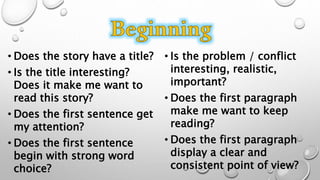
• Does the story have a title?
• Is the title interesting?
Does it make me want to
read this story?
• Does the first sentence get
my attention?
• Does the first sentence
begin with strong word
choice?
• Is the problem / conflict
interesting, realistic,
important?
• Does the first paragraph
make me want to keep
reading?
• Does the first paragraph
display a clear and
consistent point of view?
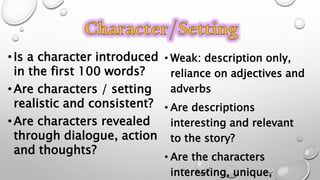
• Is a character introduced
in the first 100 words?
• Are characters / setting
realistic and consistent?
•Are characters revealed
through dialogue, action
and thoughts?
• Weak: description only,
reliance on adjectives and
adverbs
• Are descriptions
interesting and relevant
to the story?
• Are the characters
interesting, unique,
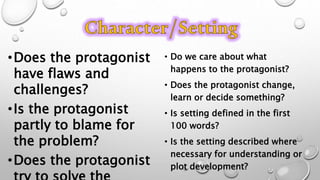
•Does the protagonist
have flaws and
challenges?
•Is the protagonist
partly to blame for
the problem?
•Does the protagonist
• Do we care about what
happens to the protagonist?
• Does the protagonist change,
learn or decide something?
• Is setting defined in the first
100 words?
• Is the setting described where
necessary for understanding or
plot development?
•Is there a clear and consistent point of
view?
•If there are multiple viewpoints, are
there clear breaks or transitions
between pov’s?
•Is there a clear and unique narrative
voice?
•Are there scenes (dialogue and action)?
•Are sentence structure and length varied?
•Are the sentences of one length, very short
or very long?
•Are many sentences passive?
•Are transitions smooth?
PLOT
•Are all events clearly related to the
conflict?
•Does the initial conflict build through
complications?
•Are the complications structured into
the plot?
•Is there a turning point?
PLOT
•Does the story stay focused on one
conflict?
•Is backstory worked into the plot?
•Does suspense build up until the
climax?
•Is the resolution the right length?
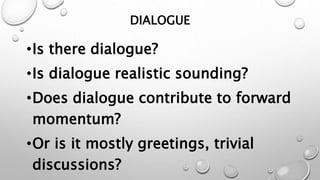
DIALOGUE
•Is there dialogue?
•Is dialogue realistic sounding?
•Does dialogue contribute to forward
momentum?
•Or is it mostly greetings, trivial
discussions?
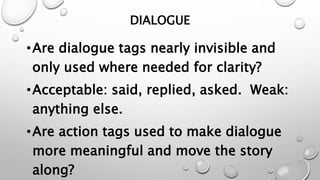
DIALOGUE
•Are dialogue tags nearly invisible and
only used where needed for clarity?
•Acceptable: said, replied, asked. Weak:
anything else.
•Are action tags used to make dialogue
more meaningful and move the story
along?
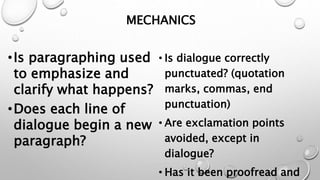
MECHANICS
•Is paragraphing used
to emphasize and
clarify what happens?
•Does each line of
dialogue begin a new
paragraph?
• Is dialogue correctly
punctuated? (quotation
marks, commas, end
punctuation)
• Are exclamation points
avoided, except in
dialogue?
• Has it been proofread and

A checklist for grading

  • 1.
    A Checklist ForGrading BY: VENUS D. CARBONEL
  • 2.
    • Does thestory have a title? • Is the title interesting? Does it make me want to read this story? • Does the first sentence get my attention? • Does the first sentence begin with strong word choice? • Is the problem / conflict interesting, realistic, important? • Does the first paragraph make me want to keep reading? • Does the first paragraph display a clear and consistent point of view?
  • 3.
    • Is acharacter introduced in the first 100 words? • Are characters / setting realistic and consistent? •Are characters revealed through dialogue, action and thoughts? • Weak: description only, reliance on adjectives and adverbs • Are descriptions interesting and relevant to the story? • Are the characters interesting, unique,
  • 4.
    •Does the protagonist haveflaws and challenges? •Is the protagonist partly to blame for the problem? •Does the protagonist • Do we care about what happens to the protagonist? • Does the protagonist change, learn or decide something? • Is setting defined in the first 100 words? • Is the setting described where necessary for understanding or plot development?
  • 5.
    •Is there aclear and consistent point of view? •If there are multiple viewpoints, are there clear breaks or transitions between pov’s? •Is there a clear and unique narrative voice?
  • 6.
    •Are there scenes(dialogue and action)? •Are sentence structure and length varied? •Are the sentences of one length, very short or very long? •Are many sentences passive? •Are transitions smooth?
  • 7.
    PLOT •Are all eventsclearly related to the conflict? •Does the initial conflict build through complications? •Are the complications structured into the plot? •Is there a turning point?
  • 8.
    PLOT •Does the storystay focused on one conflict? •Is backstory worked into the plot? •Does suspense build up until the climax? •Is the resolution the right length?
  • 9.
    DIALOGUE •Is there dialogue? •Isdialogue realistic sounding? •Does dialogue contribute to forward momentum? •Or is it mostly greetings, trivial discussions?
  • 10.
    DIALOGUE •Are dialogue tagsnearly invisible and only used where needed for clarity? •Acceptable: said, replied, asked. Weak: anything else. •Are action tags used to make dialogue more meaningful and move the story along?
  • 11.
    MECHANICS •Is paragraphing used toemphasize and clarify what happens? •Does each line of dialogue begin a new paragraph? • Is dialogue correctly punctuated? (quotation marks, commas, end punctuation) • Are exclamation points avoided, except in dialogue? • Has it been proofread and