Volume 3, Issue 2, February – 2018 International Journal of Innovative Science and Research Technology
ISSN No:-2456 –2165
IJISRT18FB259 www.ijisrt.com 740
A Brief Survey Paper on Sentiment Analysis
Archana Kalia
Lecturer, Information Technology Department,
VPM Polytechnic, Thane.
Abstract:-Sentiment Analysis (SA) is a current topic of
research in data mining field. SA is the process of
computing of opinions, sentiments and subjectivity of text.
This survey paper gives a comprehensive overview of this
field. Out of many, three topics of SA applications are
investigated and presented briefly in this survey. This
survey presents a clear idea of SA techniques and with
brief details. The main contributions of this paper include
the sophisticated categorizations of the methods
considered and the illustration of the recent trend of
research in the sentiment analysis and its contribution in
related areas.
Keywords:- Sentiment analysis, Opinion mining, Document
level SA, Sentence level SA, Aspect level SA.
I. INTRODUCTION
Sentiment Analysis (SA) or Opinion Mining (OM) is the
arithmetic, algebraic and algorithmic study of people’s
opinions, attitudes and emotions toward an entity. The entity
can be represented as individuals, events or topics. SA and
OM express a mutual meaning. However, some researchers
stated that OM and SA have slightly different convictions.
Opinion Mining is the process of extraction and analysis of
people’s opinion about an entity while Sentiment Analysis
identifies the sentiment expressed in a text or document and
then analyzes it. Therefore, the target of SA is to find
opinions, identify the sentiments they express, and then
categorize their polarity. There are three main classification
levels in SA: Document-level, Sentence-level, and Aspect
level SA
Document-level SA analyze a text document and declare it as
positive or negative opinion or sentiment. It considers the
whole document as a basic information unit or entity
Sentence-level SA tries to analyze sentiment expressed in each
sentence. The first step is to identify whether the sentence is
subjective or objective. If the sentence is subjective, Sentence-
level SA will determine whether the sentence expresses
positive or negative opinions.
Aspect-level SA analyze the above sentiment with respect to
the specific aspects of entities.It performs fine grained analysis
and directly looks at the opinion. The goal of this level of
analysis is to discover sentiments on aspects of items.
II. OPINION MINING OF MOVIE REVIEWS: AN
DOCUMENT LEVEL APPROACH
In this paper an Opinion Mining System is considered. It is
termed as “Document based Sentiment Orientation System”
which is based on unsupervised approach that determines the
sentiment orientation of documents. Sentiment orientation
determines the polarity of documents. It classifies the
documents as positive and negative This approach helps the
users in decision making by providing the summary of total
number of positive and negative documents.
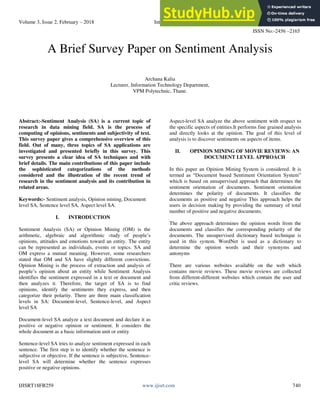
The above approach determines the opinion words from the
documents and classifies the corresponding polarity of the
documents. The unsupervised dictionary based technique is
used in this system. WordNet is used as a dictionary to
determine the opinion words and their synonyms and
antonyms
There are various websites available on the web which
contains movie reviews. These movie reviews are collected
from different-different websites which contain the user and
critic reviews.
Volume 3, Issue 2, February – 2018 International Journal of Innovative Science and Research Technology
ISSN No:-2456 –2165
IJISRT18FB259 www.ijisrt.com 741
Figure 1: Document Based Sentiment Orientation System
All the collected reviews are applied to the proposed system
which classifies the reviews as positive, negative and neutral.
Final results are presented in graphical charts.
III. SENTIMENT ANALYSIS ON TWITTER DATA
USING SUPPORT VECTOR MACHINE: A
SENTENCE LEVEL APPROACH
Sentence level approach uses different machine learning
classifier Naïve Bayes and Support vector machine. The
feature is used is unigram and bigrams. The process starts by
getting the tweets from twitter, then passes by each tweet and
labels it as positive, or negative. After that the features in each
tweet will be extracted and represented in a feature vector.
Then, these feature vectors will be used in the training phase
of the classifier.
Before determining the polarity of the collected reviews,
preprocessing of the collected reviews are necessary to get the
cleaned reviews. Pre-processed reviews are applied as input.
Unlike the binary classification problem, it was suggested that
opinion subjectivity and expresser credibility should also be
taken into consideration. A framework was proposed that
provides a compact numeric summarization of opinions on
micro-blogs platforms.
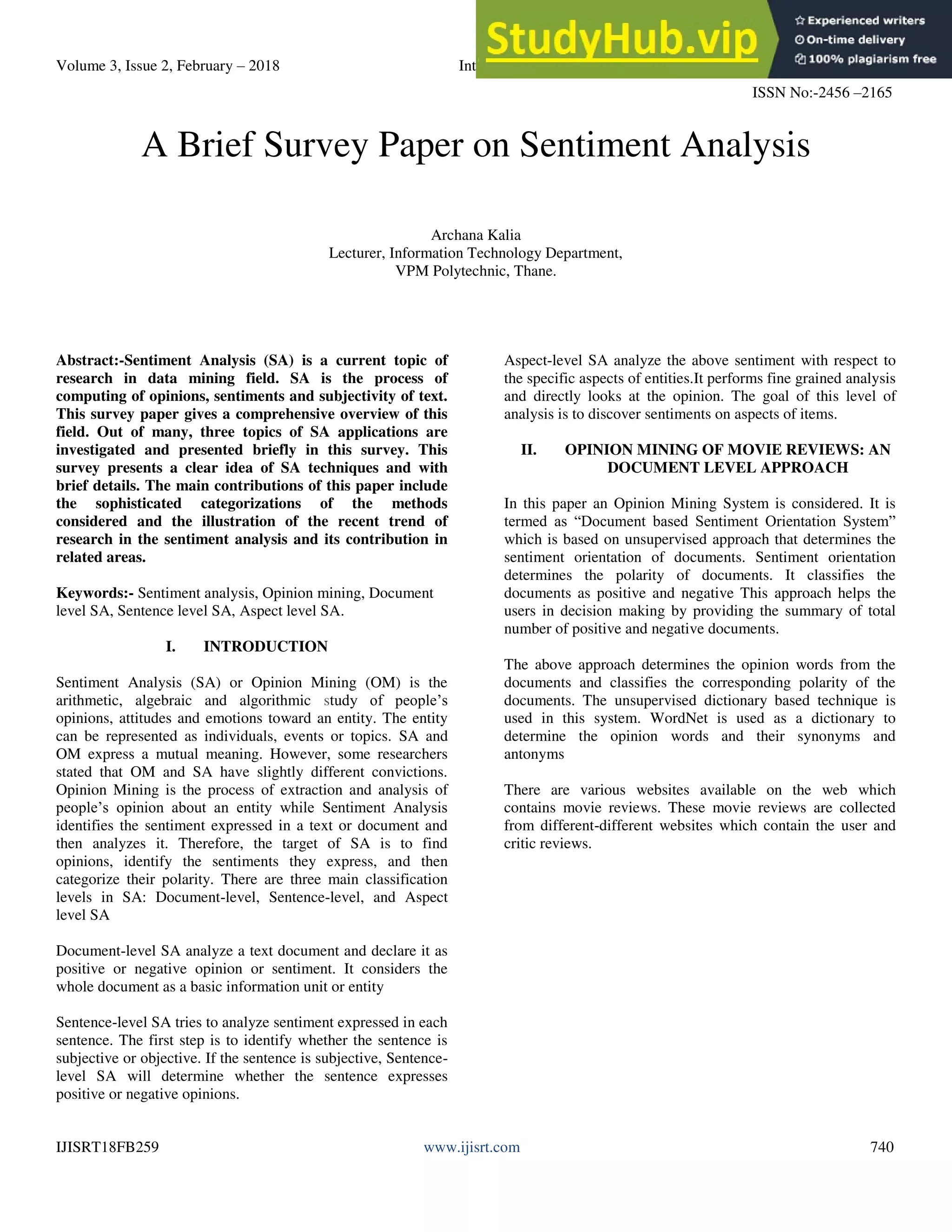
The above process identified and extracted the topics
mentioned in the opinions associated with the queries of users,
and then classified the opinions using SVM.
It was found out that the consideration of user credibility and
opinion subjectivity is essential for aggregating micro-blog
opinions.
It was proved that the above mechanism can effectively
discover market intelligence (MI) for supporting decision-
makers by establishing a monitoring system to track external
opinions on different aspects of a business in real-time.
Figure 2: Sentence Level Sentiment Orientation System
IV. SENTIMENT ANALYSIS ON TWEETS ABOUT
DIABETES: AN ASPECT-LEVEL APPROACH
In recent years, some methods of sentiment analysis have been
developed for the health domain. An aspect-level sentiment
analysis method based on ontologies in the diabetes domain
was proposed. The sentiment of the aspects was calculated by
considering the words around the aspect which are obtained
through N-gram methods (N-gram after, N-gram before, and
N-gram around).
To evaluate the effectiveness of our method, a corpus from
Twitter was obtained, which has been manually labeled at
aspect level as positive, negative, or neutral. The experimental
results show that the best result was obtained through the N-
gram around method with a precision of 81.93%, a recall of
81.13%, and an -measure of 81.24%.
The proposed sentiment classification approach is divided into
three main components:
• Preprocessing module,
• Semantic annotation module, and
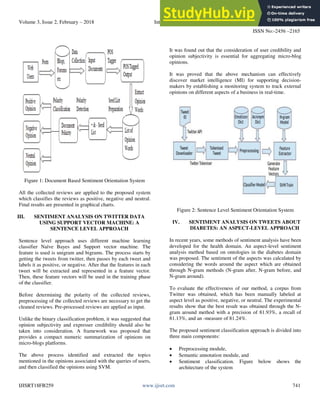
• Sentiment classification. Figure below shows the
architecture of the system
Volume 3, Issue 2, February – 2018 International Journal of Innovative Science and Research Technology
ISSN No:-2456 –2165
IJISRT18FB259 www.ijisrt.com 742
.
Figure 3.Aspect-level System Architecture
A. Preprocessing Module:
This module consists in the preprocessing of the corpus to
clean and correct the text.
a) It involves five processes. The first process, called
normalization, consists of three main tasks.
• The special characters that do not provide important
information were removed.
• Correction of spelling errors
• Replace the abbreviations and shorthand notations by
their expansions which are not identified by the
Hunspell dictionary.
b) The second step, known as tokenization, consists in
dividing text into a sequence of tokens, which roughly
correspond to “words.”
c) The third step involves assembling the tokenized text into
sentences.
d) The fourth step consists in processing a sequence of
words and assigning a lexical category to each word.
e) The fifth step refers to the process of mapping words to
their base form.
• Semantic Annotation Module: This module involves
the detection of aspects by means of the semantic
annotation technique. The semantic annotation is
carried out through of a natural language processing
(NLP) tool, namely, Stanford NLP, and in
accordance with domain ontology.
• Sentiment Classification: This module calculates the
polarity of each aspect found on the SentiWordNet
(SWN) lexicon.
In this segment, the sentiments of the aspects of each tweet are
obtained. This process has been carried out using the “N-gram
after,” “N-gram before,” and “N-gram around” methods. N-
gram technique collects the number of words which are near
of the aspect which are then considered for the sentiment
analysis.
In the current work the N-gram of high information gain
feature extracted from the tweets is combined with the
sentiment lexiconsto train the classifier and evaluate the
performance of predicted result.
V. COMPARATIVE STUDY
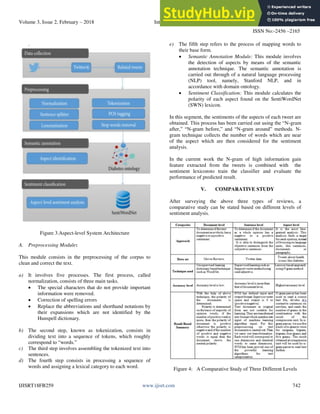
After surveying the above three types of reviews, a
comparative study can be stated based on different levels of
sentiment analysis.
Figure 4: A Comparative Study of Three Different Levels
Volume 3, Issue 2, February – 2018 International Journal of Innovative Science and Research Technology
ISSN No:-2456 –2165
IJISRT18FB259 www.ijisrt.com 743
VI. PROCESS OF SUMMARIZATION
Apart from analyzing and extracting opinion information from
individual documents, the process of summarization involves
aggregating and representing sentiment information drawn
from an individual document or from a collection of
documents.
The process of summarization is of different following types:
A. Single-Document Sentiment Summaries:
When user might desire an at-a-glance presentation of the
main points made in a single review, it is considered as single-
document sentiment summaries.
B. Multi Document Sentiment Summaries:
The automatic determination of marketsentiment or the
majority “leaning” of an entire body of investors, from the
individual remarks of those investors is a type of multi-
document opinion-oriented summarization.
C. Generic Summarization:
Generic summarization assumes that the audience that reads
the summary is a general one.It determines the appropriateness
of including a phrase or a sentence into the summary only
based on the information contained in the input documents.
D. Focused Summarization
While focused summarization, targets at generating summaries
for specific information of interest, especially for the
information requested by users.
Specifically, a query-focused summarization system usually
takes a question asked by a user, and 10 then generates a
summary with respect to the query, ignoring all other content
from the original document(s).
E. Extractive Summarization:
The most prominent multi-document summarization
approaches have been extractive summarization methods,
where sentences from the original documents are selected for
inclusion in the final summary. Extractive methods have been
popular mainly because they are relatively simple to construct,
since the problem can be converted to a sentence selection
task and the output summary does not suffer from
ungrammaticality.
F. Abstractive Summarization
When people write summaries, they tend to abstract the
content and seldom use entire sentences taken closely from the
original documents. If human summaries are compared with
the input documents, we can observe several operations on
how humans use and modify the input content: sentence
compression, information fusion, paraphrasing, and
generation.
Therefore, summarization research has moved towards the
area of abstractive summarization. Abstract-based methods are
often designed to approximate how human construct
summaries.
VII. BROADER EFFECTS OF SENTIMENT
ANALYSIS
Sentiment-Analysis technologies have some of the larger
effects that hamper the existence of opinion-oriented
information-access.
A. Privacy:
It should be a matter of concern that applications that gather
data about people’s preferences can trigger concerns about
privacy violations.
B. Manipulation:
Since sentiment-analysis technologies allow users to consult
many people who are unknown to them, hence that it is
difficult for users to evaluate the trustworthiness of those
people they are consulting. Thus, sentiment analysis
technologies might probably make it easier for users to be
mis-led by destructive entities, a problem that originator of
such systems might wish to prevent.
C. Economic Impact:
Many customers who are swept by online reviews say that
these reviews significantly influence their purchasing
decisions.
D. Interactions with Word of Mouth (WOM):
Some studies point out that the number of reviews, positive or
negative, may simply reflect
“Word of mouth”, so that in some cases, what is really the
underlying correlative (if any) of economic impact is not the
amount of positive feedback but merely the amount of
feedback in total.
VIII. CONCLUSION
The process of sentiment analysis involves various text
analytics technique and accepted opinion mining process to
determine and find out subjective information from given
entity.
Thus sentiment analysis process determine how a certain
person or group reacts to a subject matter they are being
referred to. They react because they are either interested or
involved. And, these reactions get stored in their social media
accounts which make social media as one of the leading
platforms in the internet where anyone can basically do
opinion mining.
Volume 3, Issue 2, February – 2018 International Journal of Innovative Science and Research Technology
ISSN No:-2456 –2165
IJISRT18FB259 www.ijisrt.com 744
Maximum businesses are mostly benefitted from sentiment
analysis now-a-days. Few individuals refer to it as social
site to analysis it since it also typically analyzes the
ongoing activities which are ongoing in these major social
networking sites. The paper shows that businesses can
solely count positive and negative reviews of their brands.
Thus it also helps them to measure their overall
performance, especially on their online presence.
On the other hand, certain people can also get a lot from
opinion mining. They are making a class or identification
for themselves or just trying to know anything that regards
to them. Actors, celebrities, famous writers and all other
popular individuals can definitely benefit from the idea of
sentiment analysis technique. They can simply learn how
to inspire the common public, how people show their
reaction (negatively and positively) to any recent move
they make and which of it stimulate people's attitude
towards them.
REFERENCES
[1]. Sentiment Classification with Convolutional Neural
Networks: an Experimental Study on a Large-scale
Chinese Conversation CorpusBy Lei Zhang Email:
lei.zhang@xiaoi.com,Chengcai Chen Email:
arlene.chen@xiaoi.com
[2]. Opinion mining of movie reviews at document level –
Richa Sharma, Shweta Nigam and Rekha Jain.
[3]. Twitter Sentiment Analysis with Deep Convolutional
Neural Networks Aliaksei Severyn_Google
Inc.aseveryn@gmail.com
[4]. Alessandro Moschittiy Qatar Computing Research
Instituteamoschitti@qf.org.qa
[5]. Survey on sentiment analysis of movie reviews Neha
NehraM.E (CSE), L.J Institute of Engineering and
Technology, Gujarat Technological University, Gujarat,
India.
[6]. Applications of Deep Learning to Sentiment Analysis of
Movie Reviews.
[7]. HoushmandShirani-Mehr Department of Management
Science &Engineering Stanford University
hshirani@stanford.edu
[8]. A Literature Review on Opinion Mining and Sentiment
Analysis Md. Daiyan1, Dr. S. K. Tiwari2, Manish
Kumar3, M. Aftab Alam4
[9]. 1,3Research Scholar, Institute of Computer Science & IT,
Magadh University, Bodh Gaya, Bihar2 Associate
Professor, Department Of Mathematics, Magadh
University, Bodh Gaya, Bihar4Research Scholar,
Department of Computer Science & IT, Singhania
University, PacheriBari,Rajasthan.
[10]. Convolutional Neural Networks for Sentence
Classification Yoon Kim New York University
yhk255@nyu.edu
[11]. Deep Convolutional Neural Networks forSentiment
Analysis of Short TextsC´ıceroNogueira dos
SantosBrazilian Research Lab IBM
Researchcicerons@br.ibm.com Ma´ıraGattiBrazilian
Research Lab IBM Research mairacg@br.ibm

A Brief Survey Paper on Sentiment Analysis.pdf

  • 1.
    Volume 3, Issue2, February – 2018 International Journal of Innovative Science and Research Technology ISSN No:-2456 –2165 IJISRT18FB259 www.ijisrt.com 740 A Brief Survey Paper on Sentiment Analysis Archana Kalia Lecturer, Information Technology Department, VPM Polytechnic, Thane. Abstract:-Sentiment Analysis (SA) is a current topic of research in data mining field. SA is the process of computing of opinions, sentiments and subjectivity of text. This survey paper gives a comprehensive overview of this field. Out of many, three topics of SA applications are investigated and presented briefly in this survey. This survey presents a clear idea of SA techniques and with brief details. The main contributions of this paper include the sophisticated categorizations of the methods considered and the illustration of the recent trend of research in the sentiment analysis and its contribution in related areas. Keywords:- Sentiment analysis, Opinion mining, Document level SA, Sentence level SA, Aspect level SA. I. INTRODUCTION Sentiment Analysis (SA) or Opinion Mining (OM) is the arithmetic, algebraic and algorithmic study of people’s opinions, attitudes and emotions toward an entity. The entity can be represented as individuals, events or topics. SA and OM express a mutual meaning. However, some researchers stated that OM and SA have slightly different convictions. Opinion Mining is the process of extraction and analysis of people’s opinion about an entity while Sentiment Analysis identifies the sentiment expressed in a text or document and then analyzes it. Therefore, the target of SA is to find opinions, identify the sentiments they express, and then categorize their polarity. There are three main classification levels in SA: Document-level, Sentence-level, and Aspect level SA Document-level SA analyze a text document and declare it as positive or negative opinion or sentiment. It considers the whole document as a basic information unit or entity Sentence-level SA tries to analyze sentiment expressed in each sentence. The first step is to identify whether the sentence is subjective or objective. If the sentence is subjective, Sentence- level SA will determine whether the sentence expresses positive or negative opinions. Aspect-level SA analyze the above sentiment with respect to the specific aspects of entities.It performs fine grained analysis and directly looks at the opinion. The goal of this level of analysis is to discover sentiments on aspects of items. II. OPINION MINING OF MOVIE REVIEWS: AN DOCUMENT LEVEL APPROACH In this paper an Opinion Mining System is considered. It is termed as “Document based Sentiment Orientation System” which is based on unsupervised approach that determines the sentiment orientation of documents. Sentiment orientation determines the polarity of documents. It classifies the documents as positive and negative This approach helps the users in decision making by providing the summary of total number of positive and negative documents. The above approach determines the opinion words from the documents and classifies the corresponding polarity of the documents. The unsupervised dictionary based technique is used in this system. WordNet is used as a dictionary to determine the opinion words and their synonyms and antonyms There are various websites available on the web which contains movie reviews. These movie reviews are collected from different-different websites which contain the user and critic reviews.
  • 2.
    Volume 3, Issue2, February – 2018 International Journal of Innovative Science and Research Technology ISSN No:-2456 –2165 IJISRT18FB259 www.ijisrt.com 741 Figure 1: Document Based Sentiment Orientation System All the collected reviews are applied to the proposed system which classifies the reviews as positive, negative and neutral. Final results are presented in graphical charts. III. SENTIMENT ANALYSIS ON TWITTER DATA USING SUPPORT VECTOR MACHINE: A SENTENCE LEVEL APPROACH Sentence level approach uses different machine learning classifier Naïve Bayes and Support vector machine. The feature is used is unigram and bigrams. The process starts by getting the tweets from twitter, then passes by each tweet and labels it as positive, or negative. After that the features in each tweet will be extracted and represented in a feature vector. Then, these feature vectors will be used in the training phase of the classifier. Before determining the polarity of the collected reviews, preprocessing of the collected reviews are necessary to get the cleaned reviews. Pre-processed reviews are applied as input. Unlike the binary classification problem, it was suggested that opinion subjectivity and expresser credibility should also be taken into consideration. A framework was proposed that provides a compact numeric summarization of opinions on micro-blogs platforms. The above process identified and extracted the topics mentioned in the opinions associated with the queries of users, and then classified the opinions using SVM. It was found out that the consideration of user credibility and opinion subjectivity is essential for aggregating micro-blog opinions. It was proved that the above mechanism can effectively discover market intelligence (MI) for supporting decision- makers by establishing a monitoring system to track external opinions on different aspects of a business in real-time. Figure 2: Sentence Level Sentiment Orientation System IV. SENTIMENT ANALYSIS ON TWEETS ABOUT DIABETES: AN ASPECT-LEVEL APPROACH In recent years, some methods of sentiment analysis have been developed for the health domain. An aspect-level sentiment analysis method based on ontologies in the diabetes domain was proposed. The sentiment of the aspects was calculated by considering the words around the aspect which are obtained through N-gram methods (N-gram after, N-gram before, and N-gram around). To evaluate the effectiveness of our method, a corpus from Twitter was obtained, which has been manually labeled at aspect level as positive, negative, or neutral. The experimental results show that the best result was obtained through the N- gram around method with a precision of 81.93%, a recall of 81.13%, and an -measure of 81.24%. The proposed sentiment classification approach is divided into three main components: • Preprocessing module, • Semantic annotation module, and • Sentiment classification. Figure below shows the architecture of the system
  • 3.
    Volume 3, Issue2, February – 2018 International Journal of Innovative Science and Research Technology ISSN No:-2456 –2165 IJISRT18FB259 www.ijisrt.com 742 . Figure 3.Aspect-level System Architecture A. Preprocessing Module: This module consists in the preprocessing of the corpus to clean and correct the text. a) It involves five processes. The first process, called normalization, consists of three main tasks. • The special characters that do not provide important information were removed. • Correction of spelling errors • Replace the abbreviations and shorthand notations by their expansions which are not identified by the Hunspell dictionary. b) The second step, known as tokenization, consists in dividing text into a sequence of tokens, which roughly correspond to “words.” c) The third step involves assembling the tokenized text into sentences. d) The fourth step consists in processing a sequence of words and assigning a lexical category to each word. e) The fifth step refers to the process of mapping words to their base form. • Semantic Annotation Module: This module involves the detection of aspects by means of the semantic annotation technique. The semantic annotation is carried out through of a natural language processing (NLP) tool, namely, Stanford NLP, and in accordance with domain ontology. • Sentiment Classification: This module calculates the polarity of each aspect found on the SentiWordNet (SWN) lexicon. In this segment, the sentiments of the aspects of each tweet are obtained. This process has been carried out using the “N-gram after,” “N-gram before,” and “N-gram around” methods. N- gram technique collects the number of words which are near of the aspect which are then considered for the sentiment analysis. In the current work the N-gram of high information gain feature extracted from the tweets is combined with the sentiment lexiconsto train the classifier and evaluate the performance of predicted result. V. COMPARATIVE STUDY After surveying the above three types of reviews, a comparative study can be stated based on different levels of sentiment analysis. Figure 4: A Comparative Study of Three Different Levels
  • 4.
    Volume 3, Issue2, February – 2018 International Journal of Innovative Science and Research Technology ISSN No:-2456 –2165 IJISRT18FB259 www.ijisrt.com 743 VI. PROCESS OF SUMMARIZATION Apart from analyzing and extracting opinion information from individual documents, the process of summarization involves aggregating and representing sentiment information drawn from an individual document or from a collection of documents. The process of summarization is of different following types: A. Single-Document Sentiment Summaries: When user might desire an at-a-glance presentation of the main points made in a single review, it is considered as single- document sentiment summaries. B. Multi Document Sentiment Summaries: The automatic determination of marketsentiment or the majority “leaning” of an entire body of investors, from the individual remarks of those investors is a type of multi- document opinion-oriented summarization. C. Generic Summarization: Generic summarization assumes that the audience that reads the summary is a general one.It determines the appropriateness of including a phrase or a sentence into the summary only based on the information contained in the input documents. D. Focused Summarization While focused summarization, targets at generating summaries for specific information of interest, especially for the information requested by users. Specifically, a query-focused summarization system usually takes a question asked by a user, and 10 then generates a summary with respect to the query, ignoring all other content from the original document(s). E. Extractive Summarization: The most prominent multi-document summarization approaches have been extractive summarization methods, where sentences from the original documents are selected for inclusion in the final summary. Extractive methods have been popular mainly because they are relatively simple to construct, since the problem can be converted to a sentence selection task and the output summary does not suffer from ungrammaticality. F. Abstractive Summarization When people write summaries, they tend to abstract the content and seldom use entire sentences taken closely from the original documents. If human summaries are compared with the input documents, we can observe several operations on how humans use and modify the input content: sentence compression, information fusion, paraphrasing, and generation. Therefore, summarization research has moved towards the area of abstractive summarization. Abstract-based methods are often designed to approximate how human construct summaries. VII. BROADER EFFECTS OF SENTIMENT ANALYSIS Sentiment-Analysis technologies have some of the larger effects that hamper the existence of opinion-oriented information-access. A. Privacy: It should be a matter of concern that applications that gather data about people’s preferences can trigger concerns about privacy violations. B. Manipulation: Since sentiment-analysis technologies allow users to consult many people who are unknown to them, hence that it is difficult for users to evaluate the trustworthiness of those people they are consulting. Thus, sentiment analysis technologies might probably make it easier for users to be mis-led by destructive entities, a problem that originator of such systems might wish to prevent. C. Economic Impact: Many customers who are swept by online reviews say that these reviews significantly influence their purchasing decisions. D. Interactions with Word of Mouth (WOM): Some studies point out that the number of reviews, positive or negative, may simply reflect “Word of mouth”, so that in some cases, what is really the underlying correlative (if any) of economic impact is not the amount of positive feedback but merely the amount of feedback in total. VIII. CONCLUSION The process of sentiment analysis involves various text analytics technique and accepted opinion mining process to determine and find out subjective information from given entity. Thus sentiment analysis process determine how a certain person or group reacts to a subject matter they are being referred to. They react because they are either interested or involved. And, these reactions get stored in their social media accounts which make social media as one of the leading platforms in the internet where anyone can basically do opinion mining.
  • 5.
    Volume 3, Issue2, February – 2018 International Journal of Innovative Science and Research Technology ISSN No:-2456 –2165 IJISRT18FB259 www.ijisrt.com 744 Maximum businesses are mostly benefitted from sentiment analysis now-a-days. Few individuals refer to it as social site to analysis it since it also typically analyzes the ongoing activities which are ongoing in these major social networking sites. The paper shows that businesses can solely count positive and negative reviews of their brands. Thus it also helps them to measure their overall performance, especially on their online presence. On the other hand, certain people can also get a lot from opinion mining. They are making a class or identification for themselves or just trying to know anything that regards to them. Actors, celebrities, famous writers and all other popular individuals can definitely benefit from the idea of sentiment analysis technique. They can simply learn how to inspire the common public, how people show their reaction (negatively and positively) to any recent move they make and which of it stimulate people's attitude towards them. REFERENCES [1]. Sentiment Classification with Convolutional Neural Networks: an Experimental Study on a Large-scale Chinese Conversation CorpusBy Lei Zhang Email: lei.zhang@xiaoi.com,Chengcai Chen Email: arlene.chen@xiaoi.com [2]. Opinion mining of movie reviews at document level – Richa Sharma, Shweta Nigam and Rekha Jain. [3]. Twitter Sentiment Analysis with Deep Convolutional Neural Networks Aliaksei Severyn_Google Inc.aseveryn@gmail.com [4]. Alessandro Moschittiy Qatar Computing Research Instituteamoschitti@qf.org.qa [5]. Survey on sentiment analysis of movie reviews Neha NehraM.E (CSE), L.J Institute of Engineering and Technology, Gujarat Technological University, Gujarat, India. [6]. Applications of Deep Learning to Sentiment Analysis of Movie Reviews. [7]. HoushmandShirani-Mehr Department of Management Science &Engineering Stanford University hshirani@stanford.edu [8]. A Literature Review on Opinion Mining and Sentiment Analysis Md. Daiyan1, Dr. S. K. Tiwari2, Manish Kumar3, M. Aftab Alam4 [9]. 1,3Research Scholar, Institute of Computer Science & IT, Magadh University, Bodh Gaya, Bihar2 Associate Professor, Department Of Mathematics, Magadh University, Bodh Gaya, Bihar4Research Scholar, Department of Computer Science & IT, Singhania University, PacheriBari,Rajasthan. [10]. Convolutional Neural Networks for Sentence Classification Yoon Kim New York University yhk255@nyu.edu [11]. Deep Convolutional Neural Networks forSentiment Analysis of Short TextsC´ıceroNogueira dos SantosBrazilian Research Lab IBM Researchcicerons@br.ibm.com Ma´ıraGattiBrazilian Research Lab IBM Research mairacg@br.ibm