A Beginners guide To COMLEX Level 1 
Prepared by COMQUEST Osteopathic Specialists LLC
A.T. Still, MD DO 
An osteopath is only a human engineer, who should understand 
all the laws governing his engine and thereby master disease.
now let’s prep…
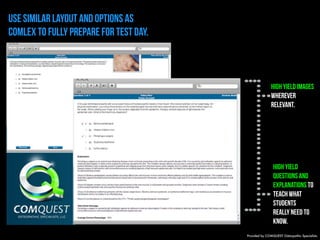
use Similar layout and options as 
COMLEX to fully prepare for test day. 
High yield images 
wherever 
relevant. 
High yield 
questions and 
explanations to 
teach what 
students 
really need to 
know. 
Provided by COMQUEST Osteopathic Specialists.
level 1: question https://flic.kr/p/6okjAW 
A 65-year-old Chinese female presents with 
weight loss, generalized pruritis, and dark 
urine. She denies any pain but, upon further 
history, admits to clay colored stools. Physical 
examination reveals jaundice and scleral 
icterus. Diagnostic studies are significant for 
elevated conjugated bilirubin, alkaline 
phosphates, and GGT. Ultrasound reveals a mass 
at the confluence of the hepatic ducts. CA19-9 
and CEA levels are elevated. 
The most likely etiologic organism responsible 
for this patient’s condition is 
Provided by COMQUEST Osteopathic Specialists.
OPTIONS 
A: PARAGONIMUS WESTERMANI 
B: SCHISTOSOMA JAPONICUM 
C: FASCIOLA HEPATICA 
D: SCHISTOSOMA HAEMATOBIUM 
E: CLONORCHIS SINESIS 
Provided by COMQUEST Osteopathic Specialists.
OPTIONS 
A: PARAGONIMUS WESTERMANI 
B: SCHISTOSOMA JAPONICUM 
C: FASCIOLA HEPATICA 
D: SCHISTOSOMA HAEMATOBIUM 
E: CLONORCHIS SINESIS 
Provided by COMQUEST Osteopathic Specialists.
EXPLANATION 
All of the choices are trematodes / flukes which are non-segmented flatforms. The two types of liver 
flukes are Clonorchis sinesis (also called "Chinese liver fluke") and Fasciola hepatica (also called the 
"sheep liver fluke"). Clonorchis sinesis is endemic in Korea, China, Taiwan, and Vietnam - but has been 
reported in the United States, usually in Asian immigrants. 
The transmission is by ingestion of undercooked freshwater fish containing metacercariae. It results in 
inflammation and intermittent obstruction of the biliary ducts and long-term infection may lead to 
cholangiocarcinoma. All of these flukes are treated with praziquantel (see exception below). Choice A 
(Paragonimus westermani) is a lung fluke found in southeast Asia and Japan. 
It is spread by ingestion of undercooked or pickled crab or crayfish. Choice B (Schistosoma japonicum) is a 
blood fluke found in the Far East. Snails are the intermediate host, and once released, the infective 
cercariae swim and penetrate the skin of the human host (human contact with water is necessary for 
infection). Choice C (Fasciola hepatica) is also called the sheep liver fluke. 
It is found worldwide, in places where sheep and cattle are raised. Transmission is by consumption of raw 
watercress. Unlike other flukes, this is treated with triclabendazole. Choice D (Schistosoma haematobium) 
is found in Africa and the Middle East. Cystitis and ureteritis with hematuria may be seen and can progress 
to bladder cancer. 
Provided by COMQUEST Osteopathic Specialists.
TAKE HOME MESSAGE 
You may not get too many questions on flukes, but a 
couple may show up on test day and the previous 
information is important to remember. They can all be 
treated with praziquantel, except for Fasciola 
hepatica (triclabendazole). A serious complication of 
Clonorchis sinesis is cholangiocarcinoma. 
Provided by COMQUEST Osteopathic Specialists.
sample level 2 question 
A 12-year-old male presents to the office complaining of 
a pruritic rash of the arms, axilla, and buttocks of 1 weeks duration. 
Past medical history reveals that the patient has a history of severe 
eczema treated with topical steroids and has been treated for tinea 
corporis multiples times in the past year. Physical examination reveals 
numerous excoriations and clusters of erythematous papules and 
vesicles on the sides of the fingers and in the web spaces. 
What is the most likely diagnosis? 
https://flic.kr/p/dcjJ3i Provided by COMQUEST Osteopathic Specialists.
OPTIONS 
A: TINEA CORPORIS 
B: ATOPIC DERMATITIS 
C: SCABIES 
D: URTICARIA 
E: ALLERGIC CONTACT DERMATITIS 
https://flic.kr/p/5fddH1 Provided by COMQUEST Osteopathic Specialists.
OPTIONS 
A: TINEA CORPORIS 
B: ATOPIC DERMATITIS 
C: SCABIES 
D: URTICARIA 
E: ALLERGIC CONTACT DERMATITIS 
https://flic.kr/p/5fddH1 Provided by COMQUEST Osteopathic Specialists.
Explanation 
Scabies is a contagious skin infection caused by the mite Sarcoptes scabiei. Scabies is characterized by intense pruritis 
due to a hypersensitivity reaction induced by the eggs and feces left behind by the female mite as she burrows into the 
skin. Scabies can be seen in patients of all ages and household members are frequently infected as well. 
The primary lesions are characterized by papules, burrows (seen in the exhibit), vesicles, and pustules. Scratching 
results in excoriated papules, crusted lesions, and can lead to secondary bacterial infection. The lesions of scabies 
are classically located on the finger webs, flexor surfaces of the wrists, arms, axilla, waistline, umbilicus, genitalia, 
and feet. The diagnosis of scabies is often made clinically, but a skin scraping viewed under microscopy allows direct 
visualization of the mite, eggs, and feces, and provides a definitive diagnosis. 
The treatment of choice is permethrin 5% lotion applied over the entire body for 8 to 12 hours with re-application one 
week later. Symptomatic household members should be treated as well. All clothing and bed linens should be washed 
to eliminate mites and eggs. Choice A (Tinea corporis) is a fungal skin infection that involves skin regions other than 
the scalp (tinea capitis), groin (tinea cruris), hands (tinea manuum), feet (tinea pedis), or nails (onychomycosis). The 
condition is classically an annular lesion with erythematous edges and central clearing. Close inspection may reveal 
scales. 
Treatment of choice is a topical azole. Choice B (Atopic dermatitis) is a non-contagious, inflammatory skin disorder 
thought to be caused by a malfunction in the body’s immune system. The skin condition most commonly presents as dry, 
scaly, and pruritic patches of the hands, feet, chest, neck, face, or posterior surfaces of the elbows and knees. 
Provided by COMQUEST Osteopathic Specialists.
Explanation (Cont’d) 
Patients often experience multiple relapses. Treatment includes the use of mild soaps, frequent application of 
emollients, and the use of topical corticosteroids for acute exacerbations. 
On test day, think of atopic dermatitis if the patient also suffers from asthma or allergic rhinitis. The three conditions 
are frequently associated and comprise the “allergic triad. Choice D (Urticaria), commonly referred to as hives, is a 
hypersensitivity reaction caused by the release of histamine from mast cells and basophils in response to a trigger. 
Potential triggers include medications, foods, exercise, and exposure to the cold. On history, patients complain of 
severe pruritis and may note that the lesions disappear and reappear in new locations. 
On physical examination, urticarial lesions are well circumscribed, red to white, palpable wheals of varying size. In 
some instances, urticaria may signify a severe allergic reaction and precede the development of life-threatening 
angioedema or anaphylactic shock. The treatment of choice for urticaria is an H1-blocking antihistamine. Epinephrine 
should be administered in the case of concurrent angioedema or anaphylactic shock. Choice E (Allergic contact 
dermatitis) is a type IV hypersensitivity reaction classically caused by contact with poison ivy, nickel, or latex. 
On test day, look for a child with a history of playing in the woods or wearing new jewelry. The lesions are described 
as very pruritic and appear as vesicles and papules on a red base. In the case of poison ivy, the lesions appear in linear 
streaks as a result of the skin brushing against the leaves. The treatment of choice is a topical corticosteroid and 
avoidance of the causal substance. 
Provided by COMQUEST Osteopathic Specialists.
TAKE HOME MESSAGE 
Scabies is a pruritic skin infection caused by the mite Sarcoptes 
scabiei. The lesions include papules, burrows, vesicles, and pustules 
located on the flex or surfaces of the arms, axilla, waistline, 
umbilicus, genitalia, feet, and finger webs. 
A definitive diagnosis is made by viewing a skin scraping under 
microscopy and identifying the mite, eggs, or feces. The treatment of 
choice is permethrin 5% lotion. Clothing and bed linens should be 
washed and symptomatic household members should be treated to 
prevent reinfection. 
Provided by COMQUEST Osteopathic Specialists.
THE DAY BEFORE THE TEST 
do your favorite recreational activity and exercise. If you feel the URGE to study, 
don't fight IT. but don't let it completely take over your day. 
https://flic.kr/p/5wcC16
COMLEX LEVEL 1 
INCLUDES 400 
QUESTIONS TAKEN 
OVER A PERIOD OF 8 
HOURS. 
TRY NOT TO EXHAUST 
YOURSELF THE DAY 
BEFORE! 
https://flic.kr/p/9yhGAR
WAKE UP EARLY 
DON’T RUSH OUT. PLAN FOR HAVING BREAKFAST AND LEAVE 
ENOUGH TIME FOR ANY UNEXPECTED EVENTS like TRAFFIC. 
https://flic.kr/p/4STFMz
GOING OVER 
STUDY MATERIALS 
ON THE DAY OF THE TEST 
PROBABLY WONT DO YOU MUCH 
GOOD 
https://flic.kr/p/5jArfe
Avoid 
people who are 
panicking 
https://flic.kr/p/us2aa
AVOID THESE 
FOR BREAKFAST AND LUNCH 
https://flic.kr/p/7bSLnu https://flic.kr/p/6A9jW1 
https://flic.kr/p/4Y5emW
BUT DO ENJOY 
THESE INSTEAD 
https://flic.kr/p/8Fjtfi 
https://flic.kr/p/e2xafc 
https://flic.kr/p/eGTngM
YOU GET A LOCKER 
LEAVE ALL YOUR Personal items, 
INCLUDING pens, CELL phones, watches, 
hats, electronic devices, outerwear, 
purses, and wallets. 
! 
No food or drink are permitted inside 
the testing room. 
! 
YOU WILL BE ABLE TO ACCESS YOUR 
PERSONAL PROPERTY DURING THE LUNCH 
TIME BETWEEN SESSIONS, BUT NOT DURING 
BREAKS. 
http://bit.ly/1C2n5UT
you’re PERMITTED to go to the restroom during two optional, 10 minute breaks 
(following sections 2,6), but that will count against your time. 
LUNCH BREAKS DON’T count against your total exam time. 
https://flic.kr/p/6q549p
breaking down your comlex 
The exam consists of two, four-hour exam sessions separated by a 40- 
minute lunch break that does not count against your total exam time. 
Each of the four-hour sessions allows a 10-minute break which is 
subtracted from the four-hour exam time. 
https://flic.kr/p/emQhYF
https://flic.kr/p/4QCVn9
YOU WILL BE 
NOTIFIED 
VIA EMAIL WHEN YOUR SCORES ARE 
READY, TYPICALLY 4-8 WEEKS AFTER 
YOU TAKE THE EXAM. 
https://flic.kr/p/6osrZ
HELPFUL RESOURCES 
OMT Review COMQUEST NBOME osteopathic.com SOMA 
https://flic.kr/p/dFqy4S

A Beginners Guide To COMLEX Level 1 - (COMQUEST)

  • 1.
    A Beginners guideTo COMLEX Level 1 Prepared by COMQUEST Osteopathic Specialists LLC
  • 2.
    A.T. Still, MDDO An osteopath is only a human engineer, who should understand all the laws governing his engine and thereby master disease.
  • 3.
  • 4.
    use Similar layoutand options as COMLEX to fully prepare for test day. High yield images wherever relevant. High yield questions and explanations to teach what students really need to know. Provided by COMQUEST Osteopathic Specialists.
  • 5.
    level 1: questionhttps://flic.kr/p/6okjAW A 65-year-old Chinese female presents with weight loss, generalized pruritis, and dark urine. She denies any pain but, upon further history, admits to clay colored stools. Physical examination reveals jaundice and scleral icterus. Diagnostic studies are significant for elevated conjugated bilirubin, alkaline phosphates, and GGT. Ultrasound reveals a mass at the confluence of the hepatic ducts. CA19-9 and CEA levels are elevated. The most likely etiologic organism responsible for this patient’s condition is Provided by COMQUEST Osteopathic Specialists.
  • 6.
    OPTIONS A: PARAGONIMUSWESTERMANI B: SCHISTOSOMA JAPONICUM C: FASCIOLA HEPATICA D: SCHISTOSOMA HAEMATOBIUM E: CLONORCHIS SINESIS Provided by COMQUEST Osteopathic Specialists.
  • 7.
    OPTIONS A: PARAGONIMUSWESTERMANI B: SCHISTOSOMA JAPONICUM C: FASCIOLA HEPATICA D: SCHISTOSOMA HAEMATOBIUM E: CLONORCHIS SINESIS Provided by COMQUEST Osteopathic Specialists.
  • 8.
    EXPLANATION All ofthe choices are trematodes / flukes which are non-segmented flatforms. The two types of liver flukes are Clonorchis sinesis (also called "Chinese liver fluke") and Fasciola hepatica (also called the "sheep liver fluke"). Clonorchis sinesis is endemic in Korea, China, Taiwan, and Vietnam - but has been reported in the United States, usually in Asian immigrants. The transmission is by ingestion of undercooked freshwater fish containing metacercariae. It results in inflammation and intermittent obstruction of the biliary ducts and long-term infection may lead to cholangiocarcinoma. All of these flukes are treated with praziquantel (see exception below). Choice A (Paragonimus westermani) is a lung fluke found in southeast Asia and Japan. It is spread by ingestion of undercooked or pickled crab or crayfish. Choice B (Schistosoma japonicum) is a blood fluke found in the Far East. Snails are the intermediate host, and once released, the infective cercariae swim and penetrate the skin of the human host (human contact with water is necessary for infection). Choice C (Fasciola hepatica) is also called the sheep liver fluke. It is found worldwide, in places where sheep and cattle are raised. Transmission is by consumption of raw watercress. Unlike other flukes, this is treated with triclabendazole. Choice D (Schistosoma haematobium) is found in Africa and the Middle East. Cystitis and ureteritis with hematuria may be seen and can progress to bladder cancer. Provided by COMQUEST Osteopathic Specialists.
  • 9.
    TAKE HOME MESSAGE You may not get too many questions on flukes, but a couple may show up on test day and the previous information is important to remember. They can all be treated with praziquantel, except for Fasciola hepatica (triclabendazole). A serious complication of Clonorchis sinesis is cholangiocarcinoma. Provided by COMQUEST Osteopathic Specialists.
  • 10.
    sample level 2question A 12-year-old male presents to the office complaining of a pruritic rash of the arms, axilla, and buttocks of 1 weeks duration. Past medical history reveals that the patient has a history of severe eczema treated with topical steroids and has been treated for tinea corporis multiples times in the past year. Physical examination reveals numerous excoriations and clusters of erythematous papules and vesicles on the sides of the fingers and in the web spaces. What is the most likely diagnosis? https://flic.kr/p/dcjJ3i Provided by COMQUEST Osteopathic Specialists.
  • 11.
    OPTIONS A: TINEACORPORIS B: ATOPIC DERMATITIS C: SCABIES D: URTICARIA E: ALLERGIC CONTACT DERMATITIS https://flic.kr/p/5fddH1 Provided by COMQUEST Osteopathic Specialists.
  • 12.
    OPTIONS A: TINEACORPORIS B: ATOPIC DERMATITIS C: SCABIES D: URTICARIA E: ALLERGIC CONTACT DERMATITIS https://flic.kr/p/5fddH1 Provided by COMQUEST Osteopathic Specialists.
  • 13.
    Explanation Scabies isa contagious skin infection caused by the mite Sarcoptes scabiei. Scabies is characterized by intense pruritis due to a hypersensitivity reaction induced by the eggs and feces left behind by the female mite as she burrows into the skin. Scabies can be seen in patients of all ages and household members are frequently infected as well. The primary lesions are characterized by papules, burrows (seen in the exhibit), vesicles, and pustules. Scratching results in excoriated papules, crusted lesions, and can lead to secondary bacterial infection. The lesions of scabies are classically located on the finger webs, flexor surfaces of the wrists, arms, axilla, waistline, umbilicus, genitalia, and feet. The diagnosis of scabies is often made clinically, but a skin scraping viewed under microscopy allows direct visualization of the mite, eggs, and feces, and provides a definitive diagnosis. The treatment of choice is permethrin 5% lotion applied over the entire body for 8 to 12 hours with re-application one week later. Symptomatic household members should be treated as well. All clothing and bed linens should be washed to eliminate mites and eggs. Choice A (Tinea corporis) is a fungal skin infection that involves skin regions other than the scalp (tinea capitis), groin (tinea cruris), hands (tinea manuum), feet (tinea pedis), or nails (onychomycosis). The condition is classically an annular lesion with erythematous edges and central clearing. Close inspection may reveal scales. Treatment of choice is a topical azole. Choice B (Atopic dermatitis) is a non-contagious, inflammatory skin disorder thought to be caused by a malfunction in the body’s immune system. The skin condition most commonly presents as dry, scaly, and pruritic patches of the hands, feet, chest, neck, face, or posterior surfaces of the elbows and knees. Provided by COMQUEST Osteopathic Specialists.
  • 14.
    Explanation (Cont’d) Patientsoften experience multiple relapses. Treatment includes the use of mild soaps, frequent application of emollients, and the use of topical corticosteroids for acute exacerbations. On test day, think of atopic dermatitis if the patient also suffers from asthma or allergic rhinitis. The three conditions are frequently associated and comprise the “allergic triad. Choice D (Urticaria), commonly referred to as hives, is a hypersensitivity reaction caused by the release of histamine from mast cells and basophils in response to a trigger. Potential triggers include medications, foods, exercise, and exposure to the cold. On history, patients complain of severe pruritis and may note that the lesions disappear and reappear in new locations. On physical examination, urticarial lesions are well circumscribed, red to white, palpable wheals of varying size. In some instances, urticaria may signify a severe allergic reaction and precede the development of life-threatening angioedema or anaphylactic shock. The treatment of choice for urticaria is an H1-blocking antihistamine. Epinephrine should be administered in the case of concurrent angioedema or anaphylactic shock. Choice E (Allergic contact dermatitis) is a type IV hypersensitivity reaction classically caused by contact with poison ivy, nickel, or latex. On test day, look for a child with a history of playing in the woods or wearing new jewelry. The lesions are described as very pruritic and appear as vesicles and papules on a red base. In the case of poison ivy, the lesions appear in linear streaks as a result of the skin brushing against the leaves. The treatment of choice is a topical corticosteroid and avoidance of the causal substance. Provided by COMQUEST Osteopathic Specialists.
  • 15.
    TAKE HOME MESSAGE Scabies is a pruritic skin infection caused by the mite Sarcoptes scabiei. The lesions include papules, burrows, vesicles, and pustules located on the flex or surfaces of the arms, axilla, waistline, umbilicus, genitalia, feet, and finger webs. A definitive diagnosis is made by viewing a skin scraping under microscopy and identifying the mite, eggs, or feces. The treatment of choice is permethrin 5% lotion. Clothing and bed linens should be washed and symptomatic household members should be treated to prevent reinfection. Provided by COMQUEST Osteopathic Specialists.
  • 16.
    THE DAY BEFORETHE TEST do your favorite recreational activity and exercise. If you feel the URGE to study, don't fight IT. but don't let it completely take over your day. https://flic.kr/p/5wcC16
  • 17.
    COMLEX LEVEL 1 INCLUDES 400 QUESTIONS TAKEN OVER A PERIOD OF 8 HOURS. TRY NOT TO EXHAUST YOURSELF THE DAY BEFORE! https://flic.kr/p/9yhGAR
  • 18.
    WAKE UP EARLY DON’T RUSH OUT. PLAN FOR HAVING BREAKFAST AND LEAVE ENOUGH TIME FOR ANY UNEXPECTED EVENTS like TRAFFIC. https://flic.kr/p/4STFMz
  • 19.
    GOING OVER STUDYMATERIALS ON THE DAY OF THE TEST PROBABLY WONT DO YOU MUCH GOOD https://flic.kr/p/5jArfe
  • 20.
    Avoid people whoare panicking https://flic.kr/p/us2aa
  • 21.
    AVOID THESE FORBREAKFAST AND LUNCH https://flic.kr/p/7bSLnu https://flic.kr/p/6A9jW1 https://flic.kr/p/4Y5emW
  • 22.
    BUT DO ENJOY THESE INSTEAD https://flic.kr/p/8Fjtfi https://flic.kr/p/e2xafc https://flic.kr/p/eGTngM
  • 23.
    YOU GET ALOCKER LEAVE ALL YOUR Personal items, INCLUDING pens, CELL phones, watches, hats, electronic devices, outerwear, purses, and wallets. ! No food or drink are permitted inside the testing room. ! YOU WILL BE ABLE TO ACCESS YOUR PERSONAL PROPERTY DURING THE LUNCH TIME BETWEEN SESSIONS, BUT NOT DURING BREAKS. http://bit.ly/1C2n5UT
  • 24.
    you’re PERMITTED togo to the restroom during two optional, 10 minute breaks (following sections 2,6), but that will count against your time. LUNCH BREAKS DON’T count against your total exam time. https://flic.kr/p/6q549p
  • 25.
    breaking down yourcomlex The exam consists of two, four-hour exam sessions separated by a 40- minute lunch break that does not count against your total exam time. Each of the four-hour sessions allows a 10-minute break which is subtracted from the four-hour exam time. https://flic.kr/p/emQhYF
  • 26.
  • 27.
    YOU WILL BE NOTIFIED VIA EMAIL WHEN YOUR SCORES ARE READY, TYPICALLY 4-8 WEEKS AFTER YOU TAKE THE EXAM. https://flic.kr/p/6osrZ
  • 28.
    HELPFUL RESOURCES OMTReview COMQUEST NBOME osteopathic.com SOMA https://flic.kr/p/dFqy4S