Statistical Process Control in Healthcare Thursday, July 10, 2008 Christy Dean-Benson, BSCIS, MCSE, HCM Manager, Clinical Informatics and Analysis Moses Cone Health System (MCHS) [email_address] 336-832-8724
Agenda We serve our communities by preventing illness, restoring health and providing comfort, through exceptional people delivering exceptional care.   Statistical Process Control (SPC) in Healthcare  Data Analysis and Interpretation
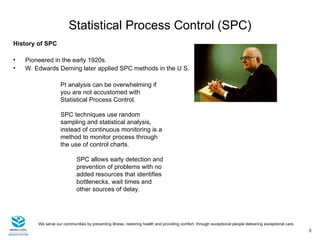
Statistical Process Control (SPC) History of SPC Pioneered in the early 1920s.  W. Edwards Deming later applied SPC methods in the U S.  We serve our communities by preventing illness, restoring health and providing comfort, through exceptional people delivering exceptional care.   PI analysis can be overwhelming if you are not accustomed with Statistical Process Control. SPC techniques use random sampling and statistical analysis, instead of continuous monitoring is a method to monitor process through the use of control charts. SPC allows early detection and prevention of problems with no added resources that identifies bottlenecks, wait times and other sources of delay.
Elements of a Control Chart Central line Lower control limit -LCL Upper control limit- UCL Process values plotted We serve our communities by preventing illness, restoring health and providing comfort, through exceptional people delivering exceptional care.
Why use a Control Chart (SPC) Control ongoing process Correct problems as they occur Is your process stable? Analyze variations We serve our communities by preventing illness, restoring health and providing comfort, through exceptional people delivering exceptional care.
What is a SPC We serve our communities by preventing illness, restoring health and providing comfort, through exceptional people delivering exceptional care.   Whether you are looking at patient falls, wait times, medication timing, or you must first examine and fully understand the process first.  Select few indicators and develop a collection plan Ask Questions How much data do you really need?
What is a SPC? We serve our communities by preventing illness, restoring health and providing comfort, through exceptional people delivering exceptional care.   Turn data into information that can be easily understood Why Variation is important Two types of variation  Common cause variation  which is intrinsic to the process and will always be present.  Special cause variation  which stems from external sources and indicates that the  process is out of statistical control.
Are we in Control? We serve our communities by preventing illness, restoring health and providing comfort, through exceptional people delivering exceptional care.   In Control Out  of Control
Variations We serve our communities by preventing illness, restoring health and providing comfort, through exceptional people delivering exceptional care.   Common  cause variation  which is intrinsic to the process and will always be present.  Characteristics:  Equipment problem Abnormal fluctuation in volume (Flu Season) Failure to follow procedure
Common  Cause Variation Time to make a decision Monitor New Process Investigate We serve our communities by preventing illness, restoring health and providing comfort, through exceptional people delivering exceptional care.
Variations We serve our communities by preventing illness, restoring health and providing comfort, through exceptional people delivering exceptional care.   Special  cause variation  which stems from external sources and indicates that the process is out of statistical control.  Characteristics:  Not normal to process  Exceptions to the system  Considered abnormalities
Special Cause Variation Time to make a decision. Remove the problem Further investigation We serve our communities by preventing illness, restoring health and providing comfort, through exceptional people delivering exceptional care.
Statistical Process Control (SPC) Primary SPC tools are X-Bar and R-Charts (Range charts). X-Bar Average of a sample  Charts come from the same data set.  Measurements are organized into groups The data included should cover a specific time period Charted on a line control chart with the center line being X double bar and UCL and LCL  We serve our communities by preventing illness, restoring health and providing comfort, through exceptional people delivering exceptional care.   Source: ASQ
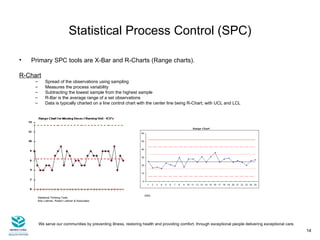
Statistical Process Control (SPC) Primary SPC tools are X-Bar and R-Charts (Range charts). R-Chart Spread of the observations using sampling Measures the process variability  Subtracting the lowest sample from the highest sample R-Bar is the average range of a set observations Data is typically charted on a line control chart with the center line being R-Chart, with UCL and LCL We serve our communities by preventing illness, restoring health and providing comfort, through exceptional people delivering exceptional care.   Statistical Thinking Tools  Bob Luttman, Robert Luttman & Associates ASQ
Patterns and Analysis of Control Charts 1 or more data points is outside of the UCL and LCL We serve our communities by preventing illness, restoring health and providing comfort, through exceptional people delivering exceptional care.   Series of 7 data points on one side of the center line Interpreting Control Chart Patterns  Analysis can help the following: Determine current level of existing processes Verify stability of existing processes Determine if improvement is needed Issues using SPC for PI

Vha Spc Webinar

  • 1.
    Statistical Process Controlin Healthcare Thursday, July 10, 2008 Christy Dean-Benson, BSCIS, MCSE, HCM Manager, Clinical Informatics and Analysis Moses Cone Health System (MCHS) [email_address] 336-832-8724
  • 2.
    Agenda We serveour communities by preventing illness, restoring health and providing comfort, through exceptional people delivering exceptional care. Statistical Process Control (SPC) in Healthcare Data Analysis and Interpretation
  • 3.
    Statistical Process Control(SPC) History of SPC Pioneered in the early 1920s. W. Edwards Deming later applied SPC methods in the U S. We serve our communities by preventing illness, restoring health and providing comfort, through exceptional people delivering exceptional care. PI analysis can be overwhelming if you are not accustomed with Statistical Process Control. SPC techniques use random sampling and statistical analysis, instead of continuous monitoring is a method to monitor process through the use of control charts. SPC allows early detection and prevention of problems with no added resources that identifies bottlenecks, wait times and other sources of delay.
  • 4.
    Elements of aControl Chart Central line Lower control limit -LCL Upper control limit- UCL Process values plotted We serve our communities by preventing illness, restoring health and providing comfort, through exceptional people delivering exceptional care.
  • 5.
    Why use aControl Chart (SPC) Control ongoing process Correct problems as they occur Is your process stable? Analyze variations We serve our communities by preventing illness, restoring health and providing comfort, through exceptional people delivering exceptional care.
  • 6.
    What is aSPC We serve our communities by preventing illness, restoring health and providing comfort, through exceptional people delivering exceptional care. Whether you are looking at patient falls, wait times, medication timing, or you must first examine and fully understand the process first. Select few indicators and develop a collection plan Ask Questions How much data do you really need?
  • 7.
    What is aSPC? We serve our communities by preventing illness, restoring health and providing comfort, through exceptional people delivering exceptional care. Turn data into information that can be easily understood Why Variation is important Two types of variation Common cause variation which is intrinsic to the process and will always be present. Special cause variation which stems from external sources and indicates that the process is out of statistical control.
  • 8.
    Are we inControl? We serve our communities by preventing illness, restoring health and providing comfort, through exceptional people delivering exceptional care. In Control Out of Control
  • 9.
    Variations We serveour communities by preventing illness, restoring health and providing comfort, through exceptional people delivering exceptional care. Common cause variation which is intrinsic to the process and will always be present. Characteristics: Equipment problem Abnormal fluctuation in volume (Flu Season) Failure to follow procedure
  • 10.
    Common CauseVariation Time to make a decision Monitor New Process Investigate We serve our communities by preventing illness, restoring health and providing comfort, through exceptional people delivering exceptional care.
  • 11.
    Variations We serveour communities by preventing illness, restoring health and providing comfort, through exceptional people delivering exceptional care. Special cause variation which stems from external sources and indicates that the process is out of statistical control. Characteristics: Not normal to process Exceptions to the system Considered abnormalities
  • 12.
    Special Cause VariationTime to make a decision. Remove the problem Further investigation We serve our communities by preventing illness, restoring health and providing comfort, through exceptional people delivering exceptional care.
  • 13.
    Statistical Process Control(SPC) Primary SPC tools are X-Bar and R-Charts (Range charts). X-Bar Average of a sample Charts come from the same data set. Measurements are organized into groups The data included should cover a specific time period Charted on a line control chart with the center line being X double bar and UCL and LCL We serve our communities by preventing illness, restoring health and providing comfort, through exceptional people delivering exceptional care. Source: ASQ
  • 14.
    Statistical Process Control(SPC) Primary SPC tools are X-Bar and R-Charts (Range charts). R-Chart Spread of the observations using sampling Measures the process variability Subtracting the lowest sample from the highest sample R-Bar is the average range of a set observations Data is typically charted on a line control chart with the center line being R-Chart, with UCL and LCL We serve our communities by preventing illness, restoring health and providing comfort, through exceptional people delivering exceptional care. Statistical Thinking Tools Bob Luttman, Robert Luttman & Associates ASQ
  • 15.
    Patterns and Analysisof Control Charts 1 or more data points is outside of the UCL and LCL We serve our communities by preventing illness, restoring health and providing comfort, through exceptional people delivering exceptional care. Series of 7 data points on one side of the center line Interpreting Control Chart Patterns Analysis can help the following: Determine current level of existing processes Verify stability of existing processes Determine if improvement is needed Issues using SPC for PI