Merger &   Acquisition The Sale Process Infrastructure Development  S.W. LEUNG 12 January 2004 (Modified 2 Sept. 2007 / Nov. 2008)
Agenda 1. Introduction 2.  The Process 3.  The Typical Bidder 4.  The Schedule 5. The Project Administration 6. Q&A
Infrastructure  & Energy Assets cover the following: Utilities (water treatment and distribution, waste processing, etc.) Energy (electricity generation, transmission & distribution, oil and gas distribution and storage) Renewable energy (wind energy, solar energy, bio-fuels like ethanol and bio-disel) Transports (toll roads, bridges and tunnels, ports, airports, rails and light rail franchises) Infrastructure-like business (communications infrastructure, i.e. tower) Other  industries like: Natural resources (forestry, coal mines, iron ores, etc.) Other regulated and regulated-like businesses Introduction M&A Targets
Agenda 1. Introduction 2.  The Typical Process 3.  The Bidder 4.  The Schedule 5. The Project Administration 6. Q&A
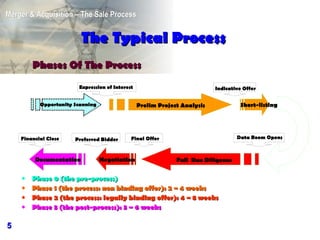
The Typical Process Phases Of The Process Full  Due Diligence Prelim Project Analysis Short-listing Opportunity Scanning Documentation Expression of Interest  Indicative Offer   Negotiation Final Offer  Preferred Bidder   Financial Close   Phase 0 (the pre-process) Phase 1 (the process: non binding offer): 2 ~ 4 weeks Phase 2 (the process: legally binding offer): 4 ~ 8 weeks  Phase 3 (the post-process): 3 ~ 6 weeks   Data Room Opens
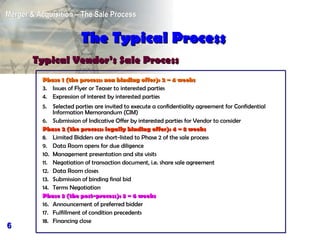
The Typical Process Typical Vendor’s Sale  Process Phase 1 (the process: non binding offer): 2 ~ 4 weeks Issues of Flyer or Teaser to interested parties Expression of interest by interested parties Selected parties are invited to execute a confidentiality agreement for Confidential Information Memorandum (CIM) Submission of Indicative Offer by interested parties for Vendor to consider Phase 2 (the process: legally binding offer): 4 ~ 8 weeks   Limited Bidders are short-listed to Phase 2 of the sale process Data Room opens for due diligence Management presentation and site visits Negotiation of transaction document, i.e. share sale agreement Data Room closes Submission of binding final bid  Terms Negotiation Phase 3 (the post-process): 3 ~ 6 weeks   Announcement of preferred bidder Fulfillment of condition precedents Financing close
Agenda 1. Introduction 2.  The Typical Process 3.  The Bidder 4.  The Schedule 5. The Project Administration 6. Q&A
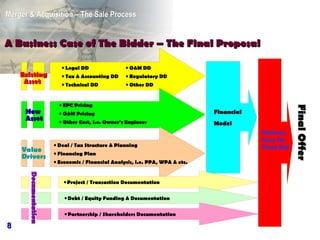
A Business Case of The Bidder – The Final Proposal Financial Model Legal DD Tax & Accounting DD Technical DD Business Case for Final Bid Final Offer O&M DD Regulatory DD  Other DD Existing Asset EPC Pricing O&M Pricing Other Cost, i.e. Owner’s Engineer New Asset Deal / Tax Structure & Planning Financing Plan Economic / Financial Analysis , i.e. PPA, WPA & etc. Debt / Equity Funding & Documentation Project / Transaction Documentation Partnership / Shareholders Documentation Documentation Value Drivers
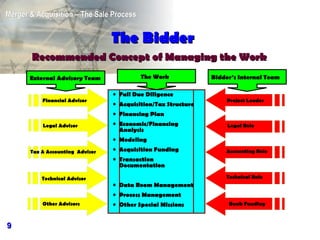
The  Bidder Recommended Concept of Managing  the  Work Full Due Diligence Acquisition/Tax Structure Financing Plan Economic/Financing Analysis Modeling Acquisition Funding Transaction Documentation Data Room Management Process Management Other Special Missions Financial Advisor Legal Advisor Tax & Accounting  Advisor  Technical Advisor Other Advisors Project Leader Technical Role Legal Role Accounting Role Bank Funding External Advisory Team Bidder’s Internal Team The Work
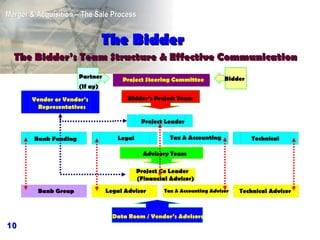
The  Bidder The Bidder’s Team Structure & Effective Communication Project Steering Committee Bidder’s Project Team Advisory Team Project Leader Tax & Accounting Technical Bank Funding Legal Project Co Leader (Financial Advisor) Vendor or Vendor’s Representatives Tax & Accounting Advisor Legal Advisor Bank Group Technical Advisor Data Room / Vendor’s Advisors Bidder Partner (If ay)
Agenda 1. Introduction 2.  The Typical Process 3.  The Bidder 4.  The Schedule 5. The Project Administration 6. Q&A
The  Schedule 1.  Interim due diligence review ( within the week of [10-14] days after access to data room )   1.1  Legal, tax, accounting and technical due diligence review meeting 1.2  Preliminary acquisition structure review meeting 1.3  Share purchase agreement preliminary comments review meeting 1.4  Preliminary financing plan review meeting (pre and post acquisition financing plan) 1.5  Assumption book and preliminary financing model review meeting 1.6  Other essential meetings as required 2.  Final due diligence review ( Within the [week of 1 week] before the final offer due date ) 2.1  Legal, tax, accounting and technical due diligence review meeting 2.2  Final acquisition structure review meeting 2.3  Share purchase agreement bid version review meeting 2.4  Financing plan review meeting 2.5  Financial model review meeting 2.6  Final board presentation page turn  2.7  Other essential meetings as required Proposed Key Milestone Activities 3.  Bidder’s board approval: [4-5] days before the final bid due date  4.  Execution of MOU before execution of final offer bid letter  (if a consortium) 5.  Execution of final offer bid letter: at least [1] day before the final offer due date
Agenda 1. Introduction 2.  The Typical Process 3.  The Bidder 4.  The Schedule 5. The Project Administration 6. Q&A
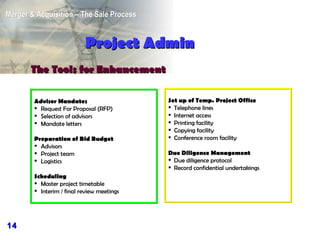
Project Admin Advisor Mandates Request For Proposal (RFP)  Selection of advisors Mandate letters Preparation of Bid Budget Advisors Project team Logistics Scheduling Master project timetable Interim / final review meetings Set up of Temp. Project Office Telephone lines Internet access Printing facility Copying facility Conference room facility Due Diligence Management Due diligence protocol Record confidential undertakings The Tools for Enhancement
Acquisition  The Sale Process Infrastructure Development  S.W. LEUNG 12 January 2004 Q&A Thank You!

A Recommended Process for M&A

  • 1.
    Merger & Acquisition The Sale Process Infrastructure Development S.W. LEUNG 12 January 2004 (Modified 2 Sept. 2007 / Nov. 2008)
  • 2.
    Agenda 1. Introduction2. The Process 3. The Typical Bidder 4. The Schedule 5. The Project Administration 6. Q&A
  • 3.
    Infrastructure &Energy Assets cover the following: Utilities (water treatment and distribution, waste processing, etc.) Energy (electricity generation, transmission & distribution, oil and gas distribution and storage) Renewable energy (wind energy, solar energy, bio-fuels like ethanol and bio-disel) Transports (toll roads, bridges and tunnels, ports, airports, rails and light rail franchises) Infrastructure-like business (communications infrastructure, i.e. tower) Other industries like: Natural resources (forestry, coal mines, iron ores, etc.) Other regulated and regulated-like businesses Introduction M&A Targets
  • 4.
    Agenda 1. Introduction2. The Typical Process 3. The Bidder 4. The Schedule 5. The Project Administration 6. Q&A
  • 5.
    The Typical ProcessPhases Of The Process Full Due Diligence Prelim Project Analysis Short-listing Opportunity Scanning Documentation Expression of Interest Indicative Offer Negotiation Final Offer Preferred Bidder Financial Close Phase 0 (the pre-process) Phase 1 (the process: non binding offer): 2 ~ 4 weeks Phase 2 (the process: legally binding offer): 4 ~ 8 weeks Phase 3 (the post-process): 3 ~ 6 weeks Data Room Opens
  • 6.
    The Typical ProcessTypical Vendor’s Sale Process Phase 1 (the process: non binding offer): 2 ~ 4 weeks Issues of Flyer or Teaser to interested parties Expression of interest by interested parties Selected parties are invited to execute a confidentiality agreement for Confidential Information Memorandum (CIM) Submission of Indicative Offer by interested parties for Vendor to consider Phase 2 (the process: legally binding offer): 4 ~ 8 weeks Limited Bidders are short-listed to Phase 2 of the sale process Data Room opens for due diligence Management presentation and site visits Negotiation of transaction document, i.e. share sale agreement Data Room closes Submission of binding final bid Terms Negotiation Phase 3 (the post-process): 3 ~ 6 weeks Announcement of preferred bidder Fulfillment of condition precedents Financing close
  • 7.
    Agenda 1. Introduction2. The Typical Process 3. The Bidder 4. The Schedule 5. The Project Administration 6. Q&A
  • 8.
    A Business Caseof The Bidder – The Final Proposal Financial Model Legal DD Tax & Accounting DD Technical DD Business Case for Final Bid Final Offer O&M DD Regulatory DD Other DD Existing Asset EPC Pricing O&M Pricing Other Cost, i.e. Owner’s Engineer New Asset Deal / Tax Structure & Planning Financing Plan Economic / Financial Analysis , i.e. PPA, WPA & etc. Debt / Equity Funding & Documentation Project / Transaction Documentation Partnership / Shareholders Documentation Documentation Value Drivers
  • 9.
    The BidderRecommended Concept of Managing the Work Full Due Diligence Acquisition/Tax Structure Financing Plan Economic/Financing Analysis Modeling Acquisition Funding Transaction Documentation Data Room Management Process Management Other Special Missions Financial Advisor Legal Advisor Tax & Accounting Advisor Technical Advisor Other Advisors Project Leader Technical Role Legal Role Accounting Role Bank Funding External Advisory Team Bidder’s Internal Team The Work
  • 10.
    The BidderThe Bidder’s Team Structure & Effective Communication Project Steering Committee Bidder’s Project Team Advisory Team Project Leader Tax & Accounting Technical Bank Funding Legal Project Co Leader (Financial Advisor) Vendor or Vendor’s Representatives Tax & Accounting Advisor Legal Advisor Bank Group Technical Advisor Data Room / Vendor’s Advisors Bidder Partner (If ay)
  • 11.
    Agenda 1. Introduction2. The Typical Process 3. The Bidder 4. The Schedule 5. The Project Administration 6. Q&A
  • 12.
    The Schedule1. Interim due diligence review ( within the week of [10-14] days after access to data room ) 1.1 Legal, tax, accounting and technical due diligence review meeting 1.2 Preliminary acquisition structure review meeting 1.3 Share purchase agreement preliminary comments review meeting 1.4 Preliminary financing plan review meeting (pre and post acquisition financing plan) 1.5 Assumption book and preliminary financing model review meeting 1.6 Other essential meetings as required 2. Final due diligence review ( Within the [week of 1 week] before the final offer due date ) 2.1 Legal, tax, accounting and technical due diligence review meeting 2.2 Final acquisition structure review meeting 2.3 Share purchase agreement bid version review meeting 2.4 Financing plan review meeting 2.5 Financial model review meeting 2.6 Final board presentation page turn 2.7 Other essential meetings as required Proposed Key Milestone Activities 3. Bidder’s board approval: [4-5] days before the final bid due date 4. Execution of MOU before execution of final offer bid letter (if a consortium) 5. Execution of final offer bid letter: at least [1] day before the final offer due date
  • 13.
    Agenda 1. Introduction2. The Typical Process 3. The Bidder 4. The Schedule 5. The Project Administration 6. Q&A
  • 14.
    Project Admin AdvisorMandates Request For Proposal (RFP) Selection of advisors Mandate letters Preparation of Bid Budget Advisors Project team Logistics Scheduling Master project timetable Interim / final review meetings Set up of Temp. Project Office Telephone lines Internet access Printing facility Copying facility Conference room facility Due Diligence Management Due diligence protocol Record confidential undertakings The Tools for Enhancement
  • 15.
    Acquisition TheSale Process Infrastructure Development S.W. LEUNG 12 January 2004 Q&A Thank You!