CFO M&A Strategies and ExperiencesDecember 2, 2010Proprietary and ConfidentialAlan Stewart
Why do acquisitions? The lay of the land.Proprietary and Confidential          2Why do acquisitions?How did ICF source deal opportunities?What type of reliance they had on internal & external experts?How did ICF perform due diligence?Negotiate to closing of the transactionPost closing integration
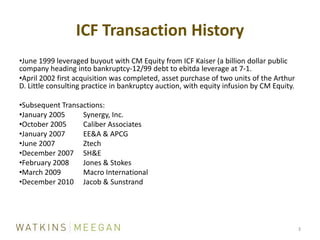
ICF Transaction History3June 1999 leveraged buyout with CM Equity from ICF Kaiser (a billion dollar public company heading into bankruptcy-12/99 debt to ebitda leverage at 7-1.April 2002 first acquisition was completed, asset purchase of two units of the Arthur D. Little consulting practice in bankruptcy auction, with equity infusion by CM Equity.Subsequent Transactions:January 2005 	Synergy, Inc.October 2005 	Caliber AssociatesJanuary 2007 	EE&A & APCGJune 2007 	ZtechDecember 2007	SH&EFebruary 2008	Jones & StokesMarch 2009	Macro InternationalDecember 2010	Jacob & Sunstrand
How did ICF source deal opportunities?4As a private company before we had capacity to acquire companies:	Hired buyside investment bankers in 2004 for a one year 	engagement	Reviewed potential targets and arranged CEO meetings	Participated in numerous auctions to understand process and 	playersAs we deleveraged and had capacity for acquisitions:	Pursued and closed Synergy and Caliber acquisitions	Hired full time M&A staff person	Expanded contacts for CEO to pursue deals	Expanded reach to investment banking community for deals 	and participate in more limited auctions
What type of reliance they had on internal & external experts5Necessary to have a mix of external and internal resources and used:External accounting firms to audit quality of earnings, backlog and rate structure as well as revenue recognition practices and tax issues.Outside counsel for legal corporate review and government contracts reviewWe often had an independent survey of major customers completed.HR experts to review plans, 401k issues, conversion issues.Internal staff to review government contracts, backlog, pipeline and proposals, rate structure, accounting systems and processes, internal IT systems, HR benefits, facilities, etc.
Upon acceptance of a expression of interest (versus letter of intent), we obtained limited exclusivity with the target.Provided our due diligence request list and plan for due diligence.If sensitive of disclosure, we would send in an accounting firm to provide a business review of the target and expand work as needed.We would request an electronic data room where possible.Prepared documents which incorporated the due diligence reports from our external and internal experts, with our integration plan and financial model combining the companies.  These reports were used for our Board of Directors and commercial bank approval.  We used debt to acquire all but our first acquisition.We started the integration planning process during the due diligence process.How did ICF perform due diligence6
Negotiate to closing of the transactionGet major terms on expression of interest or letter of intentObtain limited exclusivity for 30 to 60 daysOften negotiated two step agreement (signing with conditions to close)Work directly through company executives and not investment bankers where possible.Map out benefits strategy and prepare all employee presentationWe required a significant portion of billable employees to sign ICF standard agreements as a condition to close (intellectual property, code of ethics, nonsolicitation of clients or employees for one year after termination of employment).  Also, we required all Key employees sign contracts as a condition to close.Ensure that the senior and next one or two levels of management are sold on the deal, understand their new reporting, and their compensation arrangements prior to closing, and preferably signing if possible.Work out refined financial model after signing if possible.Proprietary and Confidential          7
Post closing integration8Identify internal integration teamInvolve integration team in due diligence as early as possibleHave weekly joint meetings on integration to identify all issues and develop plan and responsibility for actionsCultural implications and communications are criticalGet into the details as quickly as possibleBe open, honest and upfront during the integration processConsider retention bonuses for corporate staff, historical knowledge is importantEvaluate corporate staff for keepers as early as possibleUpdate post performance on financial, employee, customer results and review
Acquisition Integration Overview Presentation Proprietary and Confidential
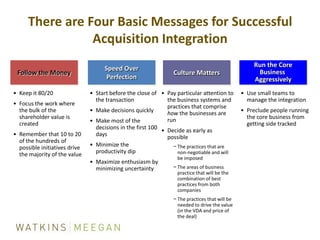
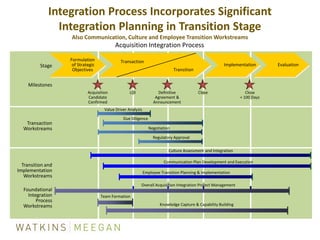
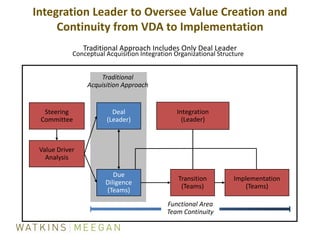
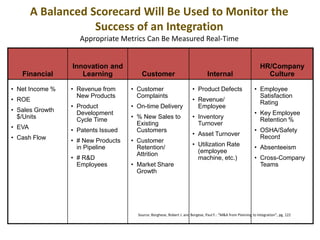
There are Four Basic Messages for Successful Acquisition IntegrationSpeed OverPerfectionFollow the MoneyRun the CoreBusiness AggressivelyCulture MattersStart before the close of the transaction
Make decisions quickly
Make most of the decisions in the first 100 days
Minimize the productivity dip
Maximize enthusiasm by minimizing uncertainty
Keep it 80/20

Watkins Meegan Lunch & Learn Series:

  • 1.
    CFO M&A Strategiesand ExperiencesDecember 2, 2010Proprietary and ConfidentialAlan Stewart
  • 2.
    Why do acquisitions?The lay of the land.Proprietary and Confidential 2Why do acquisitions?How did ICF source deal opportunities?What type of reliance they had on internal & external experts?How did ICF perform due diligence?Negotiate to closing of the transactionPost closing integration
  • 3.
    ICF Transaction History3June1999 leveraged buyout with CM Equity from ICF Kaiser (a billion dollar public company heading into bankruptcy-12/99 debt to ebitda leverage at 7-1.April 2002 first acquisition was completed, asset purchase of two units of the Arthur D. Little consulting practice in bankruptcy auction, with equity infusion by CM Equity.Subsequent Transactions:January 2005 Synergy, Inc.October 2005 Caliber AssociatesJanuary 2007 EE&A & APCGJune 2007 ZtechDecember 2007 SH&EFebruary 2008 Jones & StokesMarch 2009 Macro InternationalDecember 2010 Jacob & Sunstrand
  • 4.
    How did ICFsource deal opportunities?4As a private company before we had capacity to acquire companies: Hired buyside investment bankers in 2004 for a one year engagement Reviewed potential targets and arranged CEO meetings Participated in numerous auctions to understand process and playersAs we deleveraged and had capacity for acquisitions: Pursued and closed Synergy and Caliber acquisitions Hired full time M&A staff person Expanded contacts for CEO to pursue deals Expanded reach to investment banking community for deals and participate in more limited auctions
  • 5.
    What type ofreliance they had on internal & external experts5Necessary to have a mix of external and internal resources and used:External accounting firms to audit quality of earnings, backlog and rate structure as well as revenue recognition practices and tax issues.Outside counsel for legal corporate review and government contracts reviewWe often had an independent survey of major customers completed.HR experts to review plans, 401k issues, conversion issues.Internal staff to review government contracts, backlog, pipeline and proposals, rate structure, accounting systems and processes, internal IT systems, HR benefits, facilities, etc.
  • 6.
    Upon acceptance ofa expression of interest (versus letter of intent), we obtained limited exclusivity with the target.Provided our due diligence request list and plan for due diligence.If sensitive of disclosure, we would send in an accounting firm to provide a business review of the target and expand work as needed.We would request an electronic data room where possible.Prepared documents which incorporated the due diligence reports from our external and internal experts, with our integration plan and financial model combining the companies. These reports were used for our Board of Directors and commercial bank approval. We used debt to acquire all but our first acquisition.We started the integration planning process during the due diligence process.How did ICF perform due diligence6
  • 7.
    Negotiate to closingof the transactionGet major terms on expression of interest or letter of intentObtain limited exclusivity for 30 to 60 daysOften negotiated two step agreement (signing with conditions to close)Work directly through company executives and not investment bankers where possible.Map out benefits strategy and prepare all employee presentationWe required a significant portion of billable employees to sign ICF standard agreements as a condition to close (intellectual property, code of ethics, nonsolicitation of clients or employees for one year after termination of employment). Also, we required all Key employees sign contracts as a condition to close.Ensure that the senior and next one or two levels of management are sold on the deal, understand their new reporting, and their compensation arrangements prior to closing, and preferably signing if possible.Work out refined financial model after signing if possible.Proprietary and Confidential 7
  • 8.
    Post closing integration8Identifyinternal integration teamInvolve integration team in due diligence as early as possibleHave weekly joint meetings on integration to identify all issues and develop plan and responsibility for actionsCultural implications and communications are criticalGet into the details as quickly as possibleBe open, honest and upfront during the integration processConsider retention bonuses for corporate staff, historical knowledge is importantEvaluate corporate staff for keepers as early as possibleUpdate post performance on financial, employee, customer results and review
  • 9.
    Acquisition Integration OverviewPresentation Proprietary and Confidential
  • 10.
    There are FourBasic Messages for Successful Acquisition IntegrationSpeed OverPerfectionFollow the MoneyRun the CoreBusiness AggressivelyCulture MattersStart before the close of the transaction
  • 11.
  • 12.
    Make most ofthe decisions in the first 100 days
  • 13.
  • 14.
    Maximize enthusiasm byminimizing uncertainty
  • 15.

Editor's Notes

  • #6 Perception of IT within organizations:Separate control environmentOwnership of IT controls is unclearComplexCreates additional risks Specialized skills
  • #8 Global economies are more interdependent than ever and geopolitical risks impact everyone. Electronic infrastructure and commerce are integrated in business processes around the globe. Hence the need of stronger IT controls and reliance on the same.Give examples about recent events:1998 AT&T switch failure led to communications network failing which prohibited credit card transactions to be processed for over 24 hours2003 Major power failure in Northeast and Canada was partially due to failure in IT general controls and application controls processing data that led to overload
  • #9 IT General Controls are at the infrastructure level, Network, OS, DB
  • #10 The following slides are a subset of the materials in the Acquisition Integration (AI) Handbook and provide an introduction to the AI process and concepts.The handbook guides the potential M&M integration and more importantly helps build a capability for acquiring and integrating additional companies in the future. The handbook and tools provided are the starting point – these materials will be iterated and improved throughout the process of using them.Definition of acquisition integration: The process of combining two or more companies once they have come under common ownership.