More Related Content


![PERI-PROSTHETIC FRACTURE NAIL-PLATE CONSTRUCT [NPC].pptx](https://cdn.slidesharecdn.com/ss_thumbnails/drarunkumardrmohamedashrafperiprostheticfrasturenail-plateconstructnpc-260209164459-7e9d15a1-thumbnail.jpg?width=640&height=640&fit=bounds)


![CTEV [ clubfoot] DR ARUN LAL ,DR MOHAMED ASHRAF travancore medical college k...](https://cdn.slidesharecdn.com/ss_thumbnails/ctevclubfootdrarunlaldrmohamedashraftravancoremedicalcollegekollamkeralaindia-260208063247-18fc466c-thumbnail.jpg?width=640&height=640&fit=bounds)


Poster021808
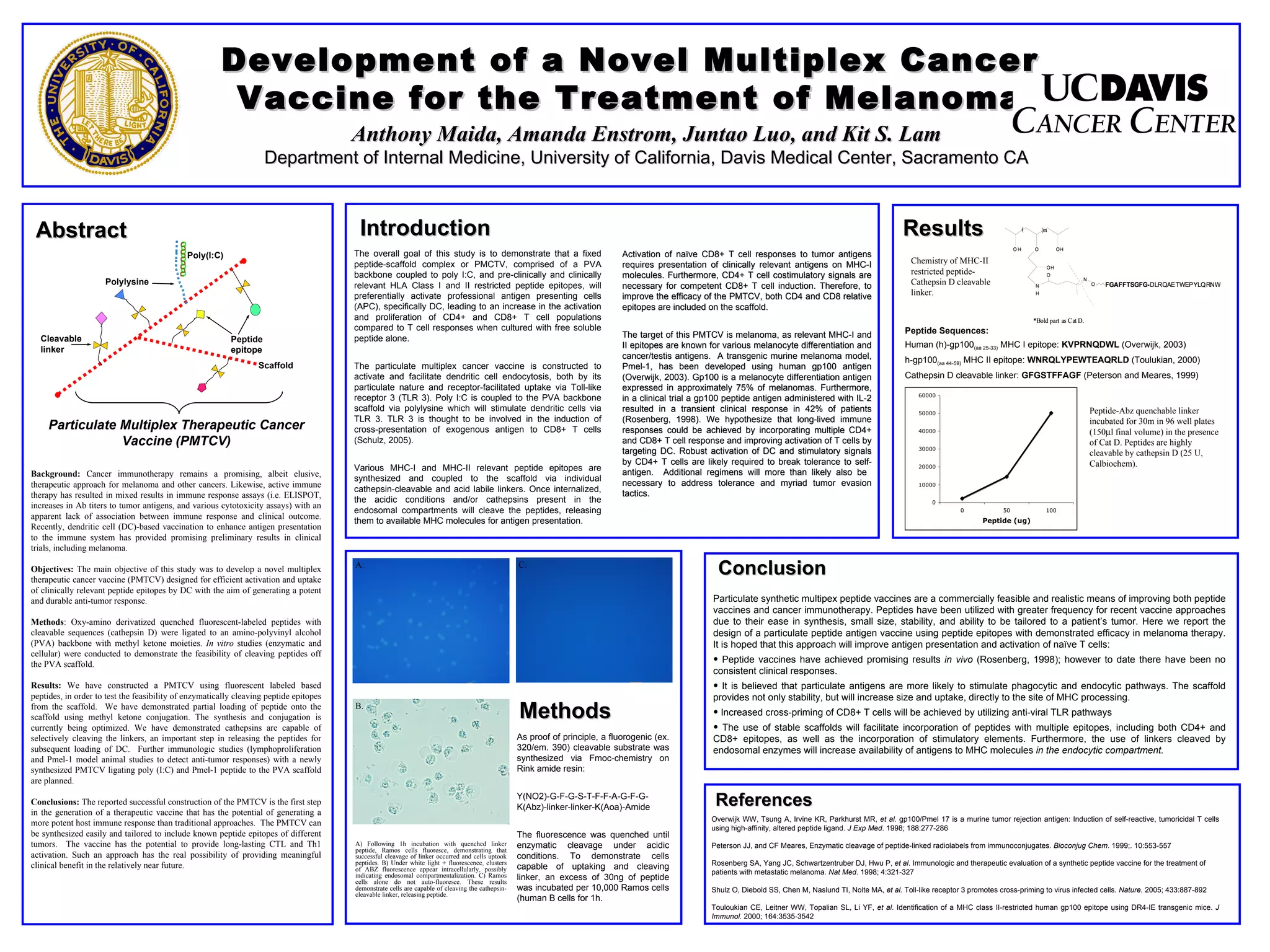
- 1. Abstract Development ofa Novel Multiplex Cancer Vaccine for the Treatment of Melanoma Anthony Maida, Amanda Enstrom, Juntao Luo, and Kit S. Lam Department of Internal Medicine, University of California, Davis Medical Center, Sacramento CA Methods As proof of principle, a fluorogenic (ex. 320/em. 390) cleavable substrate was synthesized via Fmoc-chemistry on Rink amide resin: Y(NO2)-G-F-G-S-T-F-F-A-G-F-G-K(Abz)-linker-linker-K(Aoa)-Amide The fluorescence was quenched until enzymatic cleavage under acidic conditions. To demonstrate cells capable of uptaking and cleaving linker, an excess of 30ng of peptide was incubated per 10,000 Ramos cells (human B cells for 1h. Introduction The overall goal of this study is to demonstrate that a fixed peptide-scaffold complex or PMCTV, comprised of a PVA backbone coupled to poly I:C, and pre-clinically and clinically relevant HLA Class I and II restricted peptide epitopes, will preferentially activate professional antigen presenting cells (APC), specifically DC, leading to an increase in the activation and proliferation of CD4+ and CD8+ T cell populations compared to T cell responses when cultured with free soluble peptide alone. The particulate multiplex cancer vaccine is constructed to activate and facilitate dendritic cell endocytosis, both by its particulate nature and receptor-facilitated uptake via Toll-like receptor 3 (TLR 3). Poly I:C is coupled to the PVA backbone scaffold via polylysine which will stimulate dendritic cells via TLR 3. TLR 3 is thought to be involved in the induction of cross-presentation of exogenous antigen to CD8+ T cells (Schulz, 2005). Various MHC-I and MHC-II relevant peptide epitopes are synthesized and coupled to the scaffold via individual cathepsin-cleavable and acid labile linkers. Once internalized, the acidic conditions and/or cathepsins present in the endosomal compartments will cleave the peptides, releasing them to available MHC molecules for antigen presentation. Background: Cancer immunotherapy remains a promising, albeit elusive, therapeutic approach for melanoma and other cancers. Likewise, active immune therapy has resulted in mixed results in immune response assays (i.e. ELISPOT, increases in Ab titers to tumor antigens, and various cytotoxicity assays) with an apparent lack of association between immune response and clinical outcome. Recently, dendritic cell (DC)-based vaccination to enhance antigen presentation to the immune system has provided promising preliminary results in clinical trials, including melanoma. Objectives: The main objective of this study was to develop a novel multiplex therapeutic cancer vaccine (PMTCV) designed for efficient activation and uptake of clinically relevant peptide epitopes by DC with the aim of generating a potent and durable anti-tumor response. Methods : Oxy-amino derivatized quenched fluorescent-labeled peptides with cleavable sequences (cathepsin D) were ligated to an amino-polyvinyl alcohol (PVA) backbone with methyl ketone moieties. In vitro studies (enzymatic and cellular) were conducted to demonstrate the feasibility of cleaving peptides off the PVA scaffold. Results: We have constructed a PMTCV using fluorescent labeled based peptides, in order to test the feasibility of enzymatically cleaving peptide epitopes from the scaffold. We have demonstrated partial loading of peptide onto the scaffold using methyl ketone conjugation. The synthesis and conjugation is currently being optimized. We have demonstrated cathepsins are capable of selectively cleaving the linkers, an important step in releasing the peptides for subsequent loading of DC. Further immunologic studies (lymphoproliferation and Pmel-1 model animal studies to detect anti-tumor responses) with a newly synthesized PMTCV ligating poly (I:C) and Pmel-1 peptide to the PVA scaffold are planned. Conclusions: The reported successful construction of the PMTCV is the first step in the generation of a therapeutic vaccine that has the potential of generating a more potent host immune response than traditional approaches. The PMTCV can be synthesized easily and tailored to include known peptide epitopes of different tumors. The vaccine has the potential to provide long-lasting CTL and Th1 activation. Such an approach has the real possibility of providing meaningful clinical benefit in the relatively near future. References Overwijk WW, Tsung A, Irvine KR, Parkhurst MR, et al. gp100/Pmel 17 is a murine tumor rejection antigen: Induction of self-reactive, tumoricidal T cells using high-affinity, altered peptide ligand. J Exp Med . 1998; 188:277-286 Peterson JJ, and CF Meares, Enzymatic cleavage of peptide-linked radiolabels from immunoconjugates . Bioconjug Chem . 1999;. 10:553-557 Rosenberg SA, Yang JC, Schwartzentruber DJ, Hwu P, et al . Immunologic and therapeutic evaluation of a synthetic peptide vaccine for the treatment of patients with metastatic melanoma. Nat Med . 1998; 4:321-327 Shulz O, Diebold SS, Chen M, Naslund TI, Nolte MA, et al. Toll-like receptor 3 promotes cross-priming to virus infected cells. Nature. 2005; 433:887-892 Touloukian CE, Leitner WW, Topalian SL, Li YF, et al . Identification of a MHC class II-restricted human gp100 epitope using DR4-IE transgenic mice. J Immunol. 2000; 164:3535-3542 Results Peptide Sequences: Human (h)-gp100 (aa 25-33) MHC I epitope: KVPRNQDWL (Overwijk, 2003) h-gp100 (aa 44-59) MHC II epitope: WNRQLYPEWTEAQRLD (Toulukian, 2000) Cathepsin D cleavable linker: GFGSTFFAGF (Peterson and Meares, 1999) Conclusion Particulate synthetic multipex peptide vaccines are a commercially feasible and realistic means of improving both peptide vaccines and cancer immunotherapy. Peptides have been utilized with greater frequency for recent vaccine approaches due to their ease in synthesis, small size, stability, and ability to be tailored to a patient’s tumor. Here we report the design of a particulate peptide antigen vaccine using peptide epitopes with demonstrated efficacy in melanoma therapy. It is hoped that this approach will improve antigen presentation and activation of naïve T cells: Peptide vaccines have achieved promising results in vivo (Rosenberg, 1998); however to date there have been no consistent clinical responses. It is believed that particulate antigens are more likely to stimulate phagocytic and endocytic pathways. The scaffold provides not only stability, but will increase size and uptake, directly to the site of MHC processing. Increased cross-priming of CD8+ T cells will be achieved by utilizing anti-viral TLR pathways The use of stable scaffolds will facilitate incorporation of peptides with multiple epitopes, including both CD4+ and CD8+ epitopes, as well as the incorporation of stimulatory elements. Furthermore, the use of linkers cleaved by endosomal enzymes will increase availability of antigens to MHC molecules in the endocytic compartment. Activation of naïve CD8+ T cell responses to tumor antigens requires presentation of clinically relevant antigens on MHC-I molecules. Furthermore, CD4+ T cell costimulatory signals are necessary for competent CD8+ T cell induction. Therefore, to improve the efficacy of the PMTCV, both CD4 and CD8 relative epitopes are included on the scaffold. The target of this PMTCV is melanoma, as relevant MHC-I and II epitopes are known for various melanocyte differentiation and cancer/testis antigens. A transgenic murine melanoma model, Pmel-1, has been developed using human gp100 antigen (Overwijk, 2003). Gp100 is a melanocyte differentiation antigen expressed in approximately 75% of melanomas. Furthermore, in a clinical trial a gp100 peptide antigen administered with IL-2 resulted in a transient clinical response in 42% of patients (Rosenberg, 1998). We hypothesize that long-lived immune responses could be achieved by incorporating multiple CD4+ and CD8+ T cell response and improving activation of T cells by targeting DC. Robust activation of DC and stimulatory signals by CD4+ T cells are likely required to break tolerance to self-antigen. Additional regimens will more than likely also be necessary to address tolerance and myriad tumor evasion tactics. A) Following 1h incubation with quenched linker peptide, Ramos cells fluoresce, demonstrating that successful cleavage of linker occurred and cells uptook peptides. B) Under white light + fluorescence, clusters of ABZ fluorescence appear intracellularly, possibly indicating endosomal compartmentalization. C) Ramos cells alone do not auto-fluoresce. These results demonstrate cells are capable of cleaving the cathepsin-cleavable linker, releasing peptide. A. B. C. Chemistry of MHC-II restricted peptide-Cathepsin D cleavable linker. Peptide-Abz quenchable linker incubated for 30m in 96 well plates (150 l final volume) in the presence of Cat D. Peptides are highly cleavable by cathepsin D (25 U, Calbiochem). Scaffold Poly(I:C) Peptide epitope Polylysine Cleavable linker Particulate Multiplex Therapeutic Cancer Vaccine (PMTCV)