


BANK CAPITAL CRISIS! Where is the capital for growth? Roger G. Powell Managing Director Phone: 215-665-6687 Janney Montgomery Scott  LLC   October 2008 North Carolina Bankers Association Management Team Conference
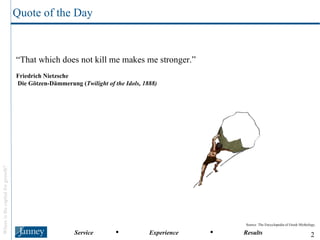
“ That which does not kill me makes me stronger.”   Friedrich Nietzsche  Die Götzen-Dämmerung ( Twilight of the Idols, 1888) Quote of the Day Source: The Encyclopedia of Greek Mythology.
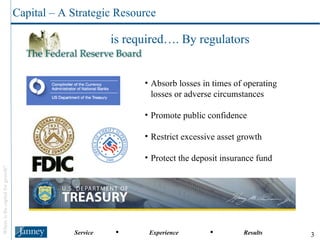
Capital – A Strategic Resource Absorb losses in times of operating losses or adverse circumstances Promote public confidence Restrict excessive asset growth Protect the deposit insurance fund is required…. By regulators
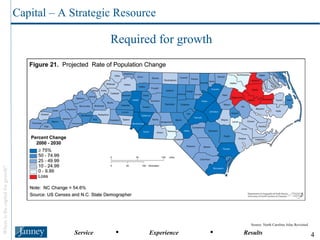
Capital – A Strategic Resource Required for growth Source: North Carolina Atlas Revisited
A growth ‘edge’ for regional and community banks Local re-intermediation Borrowers seek ‘strategic partner’ who values them as a customer Depositors seek a local bank - no ‘global’ risk Stable funding base of ‘core’ deposits Finding the right customers Relationship vs. product/price segments Small – and medium-size businesses where size and nature of credit makes ‘case’ underwriting the preferred risk management method.   Capital – A Strategic Resource Required for growth
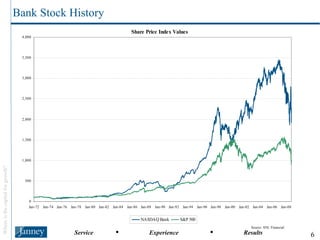
Bank Stock History Source: SNL Financial.
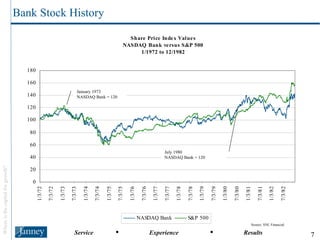
Bank Stock History January 1973 NASDAQ Bank = 120 July 1980 NASDAQ Bank = 120 Source: SNL Financial.
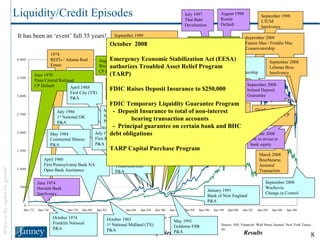
It has been an ‘event’ full 35 years! October 1974 Franklin National P&A January 1991 Bank of New England P&A March 2008 BearStearns Assisted Transaction September 2008 Wachovia Change in Control September 1998 LTCM Insolvency July 1997 Thai Baht  Devaluation September 2008 Fannie Mae / Freddie Mac Conservatorship August 1998 Russia  Default January 1994 Metallgesellschaft AG CP Default July 2008 IndyMac Conservatorship 1974 REITs / Atlanta Real Estate June 1974 Herstatt Bank Insolvency Liquidity/Credit Episodes September 2008 Lehman Bros Insolvency September 2008 Ireland Deposit Guarantee October 1983 1 st  National Midland (TX) P&A May 1991 Goldome FSB P&A September 1989 Lomas Financial  Lomas Life Leasing CP Default August 1989 Wang Labs and Wang Credit CP Default September 1988 American Savings P&A March 1990 Mortgage & Realty Trust CP Default September 1991 Southeast Banks (FL) P&A January 1997 Mercury Finance CP Default June 1991 Columbia Gas System CP Default January 1992 Crossland Savings P&A June 1970 Penn Central Railroad CP Default April 1988 First City (TX) P&A July 1986 1 st  National OK P&A May 1984 Continental Illinois P&A April 1980 First Pennsylvania Bank NA Open Bank Assistance March 1989 MCorp (TX) P&A July 1988 First RepublicBank P&A July 1989 TexasAmerican P&A October 2008 UK to invest in bank equity October 2008 Fed to invest in CP October  2008 Emergency Economic Stabilization Act (EESA) authorizes Troubled Asset Relief Program (TARP) FDIC Raises Deposit Insurance to $250,000 FDIC Temporary Liquidity Guarantee Program -  Deposit Insurance to total of non-interest  bearing transaction accounts -  Principal guarantee on certain bank and BHC debt obligations TARP Capital Purchase Program Source: SNL Financial. Wall Street Journal. New York Times, etc.
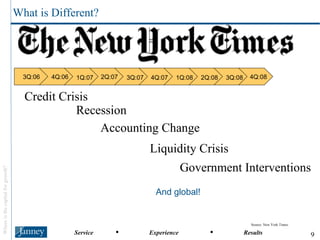
3Q:06 What is Different?  4Q:06 1Q:07 2Q:07 3Q:07 4Q:07 1Q:08 2Q:08 3Q:08 4Q:08 Credit Crisis Recession Accounting Change Liquidity Crisis And global! Government Interventions Source: New York Times.
… what’s next?
… what’s next?
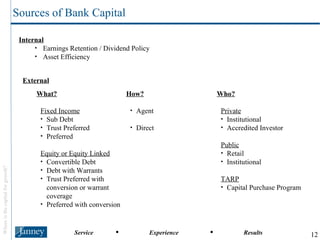
External Sources of Bank Capital Internal Earnings Retention / Dividend Policy Asset Efficiency What? Fixed Income Sub Debt Trust Preferred Preferred Equity or Equity Linked Convertible Debt Debt with Warrants Trust Preferred with conversion or warrant coverage Preferred with conversion How? Agent Direct Who? Private Institutional Accredited Investor Public Retail Institutional TARP Capital Purchase Program
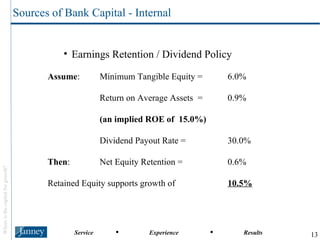
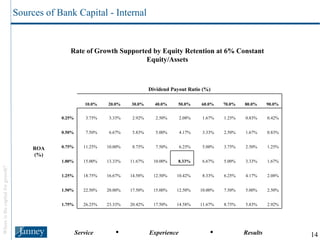
Earnings Retention / Dividend Policy Assume : Minimum Tangible Equity =  6.0%  Return on Average Assets  =  0.9% (an implied ROE of  15.0%) Dividend Payout Rate = 30.0% Then : Net Equity Retention = 0.6% Retained Equity supports growth of  10.5% Sources of Bank Capital - Internal
Sources of Bank Capital - Internal 2.92% 5.83% 8.75% 11.67% 14.58% 17.50% 20.42% 23.33% 26.25% 1.75% 2.50% 5.00% 7.50% 10.00% 12.50% 15.00% 17.50% 20.00% 22.50% 1.50% 2.08% 4.17% 6.25% 8.33% 10.42% 12.50% 14.58% 16.67% 18.75% 1.25% 1.67% 3.33% 5.00% 6.67% 8.33% 10.00% 11.67% 13.33% 15.00% 1.00% 1.25% 2.50% 3.75% 5.00% 6.25% 7.50% 8.75% 10.00% 11.25% 0.75% 0.83% 1.67% 2.50% 3.33% 4.17% 5.00% 5.83% 6.67% 7.50% 0.50% 0.42% 0.83% 1.25% 1.67% 2.08% 2.50% 2.92% 3.33% 3.75% 0.25% ROA (%) 90.0% 80.0% 70.0% 60.0% 50.0% 40.0% 30.0% 20.0% 10.0% 11.67% Dividend Payout Ratio (%) Rate of Growth Supported by Equity Retention at 6% Constant Equity/Assets
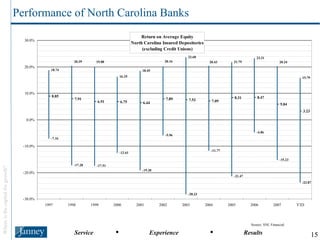
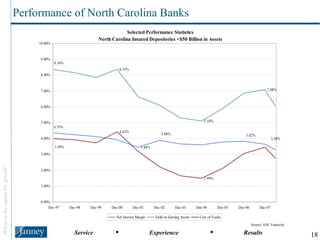
Performance of North Carolina Banks Source: SNL Financial.
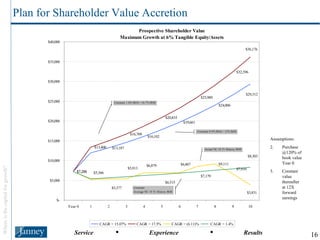
Plan for Shareholder Value Accretion Assumptions: Purchase @120% of book value Year 0 Constant value thereafter at 12X forward earnings
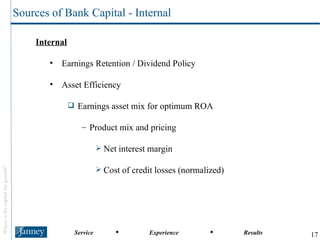
Internal Earnings Retention / Dividend Policy Asset Efficiency Earnings asset mix for optimum ROA Product mix and pricing Net interest margin Cost of credit losses (normalized) Sources of Bank Capital - Internal
Performance of North Carolina Banks Source: SNL Financial.
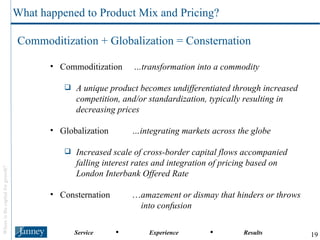
Commoditization  …transformation into a commodity A unique product becomes undifferentiated through increased competition, and/or standardization, typically resulting in decreasing prices   Globalization  …integrating markets across the globe Increased scale of cross-border capital flows accompanied falling interest rates and integration of pricing based on London Interbank Offered Rate Consternation … amazement or dismay that hinders or throws    into confusion  What happened to Product Mix and Pricing? Commoditization + Globalization = Consternation
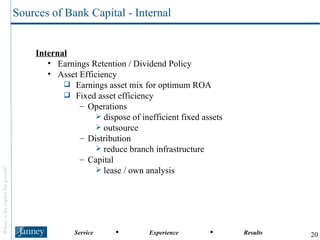
Internal Earnings Retention / Dividend Policy Asset Efficiency Earnings asset mix for optimum ROA Fixed asset efficiency Operations  dispose of inefficient fixed assets  outsource Distribution  reduce branch infrastructure Capital lease / own analysis Sources of Bank Capital - Internal
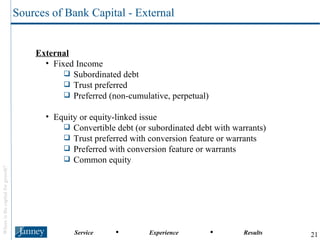
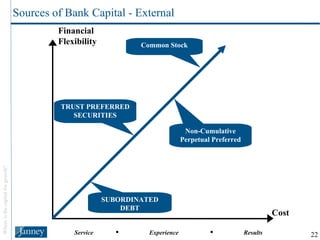
External Fixed Income Subordinated debt Trust preferred Preferred (non-cumulative, perpetual) Equity or equity-linked issue Convertible debt (or subordinated debt with warrants) Trust preferred with conversion feature or warrants Preferred with conversion feature or warrants Common equity Sources of Bank Capital - External
Sources of Bank Capital - External Financial Flexibility Cost SUBORDINATED DEBT TRUST PREFERRED SECURITIES Non-Cumulative Perpetual Preferred Common Stock
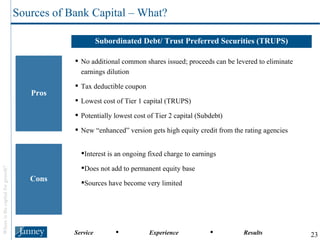
Subordinated Debt/ Trust Preferred Securities (TRUPS) Pros Cons No additional common shares issued; proceeds can be levered to eliminate earnings dilution Tax deductible coupon Lowest cost of Tier 1 capital (TRUPS) Potentially lowest cost of Tier 2 capital (Subdebt) New “enhanced” version gets high equity credit from the rating agencies Interest is an ongoing fixed charge to earnings Does not add to permanent equity base Sources have become very limited Sources of Bank Capital – What?
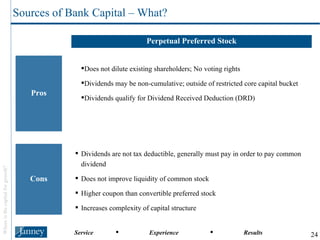
Perpetual Preferred Stock Pros Cons Does not dilute existing shareholders; No voting rights Dividends may be non-cumulative; outside of restricted core capital bucket Dividends qualify for Dividend Received Deduction (DRD) Dividends are not tax deductible, generally must pay in order to pay common dividend Does not improve liquidity of common stock Higher coupon than convertible preferred stock Increases complexity of capital structure Sources of Bank Capital – What?
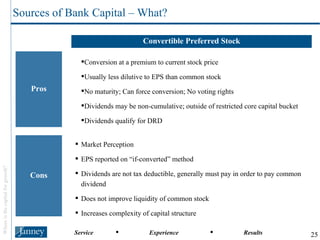
Convertible Preferred Stock Pros Cons Conversion at a premium to current stock price Usually less dilutive to EPS than common stock No maturity; Can force conversion; No voting rights Dividends may be non-cumulative; outside of restricted core capital bucket Dividends qualify for DRD Market Perception EPS reported on “if-converted” method Dividends are not tax deductible, generally must pay in order to pay common dividend Does not improve liquidity of common stock Increases complexity of capital structure Sources of Bank Capital – What?
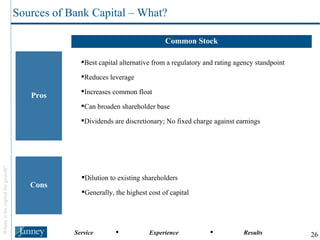
Common Stock Pros Cons Best capital alternative from a regulatory and rating agency standpoint Reduces leverage Increases common float Can broaden shareholder base Dividends are discretionary; No fixed charge against earnings Dilution to existing shareholders Generally, the highest cost of capital Sources of Bank Capital – What?
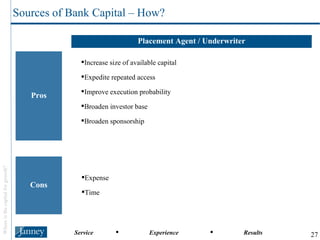
Placement Agent / Underwriter Pros Cons Increase size of available capital Expedite repeated access Improve execution probability Broaden investor base Broaden sponsorship Expense Time Sources of Bank Capital – How?
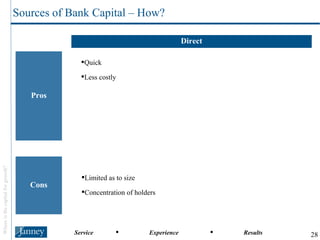
Direct Pros Cons Quick Less costly Limited as to size Concentration of holders Sources of Bank Capital – How?
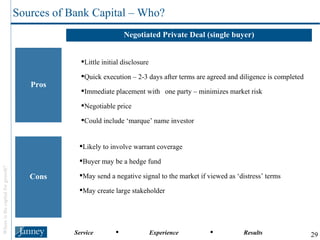
Negotiated Private Deal (single buyer) Pros Cons Little initial disclosure Quick execution – 2-3 days after terms are agreed and diligence is completed Immediate placement with  one party – minimizes market risk Negotiable price Could include ‘marque’ name investor Likely to involve warrant coverage Buyer may be a hedge fund May send a negative signal to the market if viewed as ‘distress’ terms May create large stakeholder Sources of Bank Capital – Who?
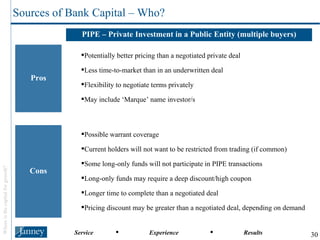
PIPE – Private Investment in a Public Entity (multiple buyers) Pros Cons Potentially better pricing than a negotiated private deal Less time-to-market than in an underwritten deal Flexibility to negotiate terms privately May include ‘Marque’ name investor/s Possible warrant coverage Current holders will not want to be restricted from trading (if common) Some long-only funds will not participate in PIPE transactions   Long-only funds may require a deep discount/high coupon Longer time to complete than a negotiated deal Pricing discount may be greater than a negotiated deal, depending on demand Sources of Bank Capital – Who?
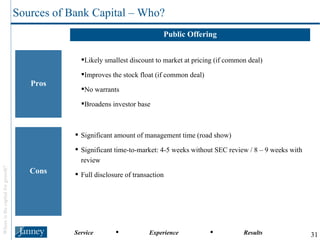
Public Offering Pros Cons Likely smallest discount to market at pricing (if common deal) Improves the stock float (if common deal) No warrants Broadens investor base Significant amount of management time (road show) Significant time-to-market:  4-5 weeks without SEC review / 8 – 9 weeks with review Full disclosure of transaction Sources of Bank Capital – Who?
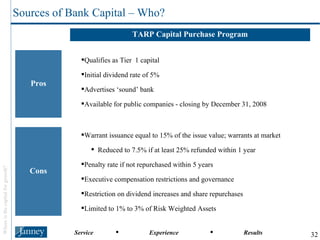
TARP Capital Purchase Program Pros Cons Qualifies as Tier  1 capital Initial dividend rate of 5% Advertises ‘sound’ bank Available for public companies - closing by December 31, 2008 Warrant issuance equal to 15% of the issue value; warrants at market Reduced to 7.5% if at least 25% refunded within 1 year Penalty rate if not repurchased within 5 years Executive compensation restrictions and governance Restriction on dividend increases and share repurchases Limited to 1% to 3% of Risk Weighted Assets Sources of Bank Capital – Who?
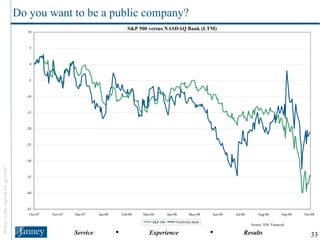
Do you want to be a public company? Source: SNL Financial.
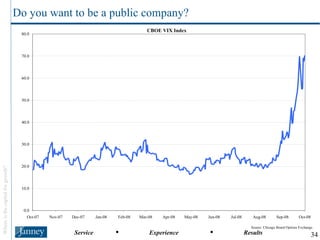
Do you want to be a public company? Source: Chicago Board Options Exchange.
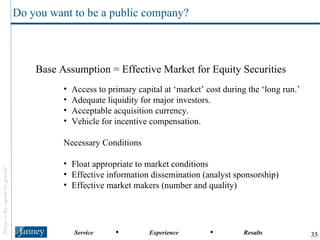
Base Assumption = Effective Market for Equity Securities Access to primary capital at ‘market’ cost during the ‘long run.’ Adequate liquidity for major investors. Acceptable acquisition currency. Vehicle for incentive compensation. Necessary Conditions Float appropriate to market conditions Effective information dissemination (analyst sponsorship) Effective market makers (number and quality) Do you want to be a public company?
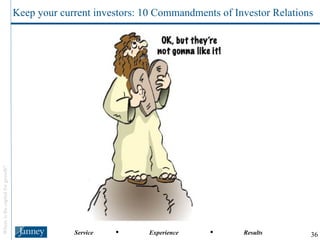
Keep your current investors: 10 Commandments of Investor Relations
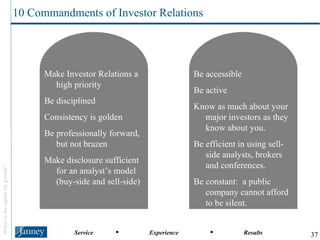
Make Investor Relations a high priority Be disciplined Consistency is golden Be professionally forward, but not brazen Make disclosure sufficient for an analyst’s model (buy-side and sell-side) Be accessible Be active Know as much about your major investors as they know about you. Be efficient in using sell-side analysts, brokers and conferences. Be constant:  a public company cannot afford to be silent. 10 Commandments of Investor Relations
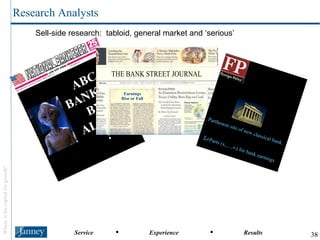
Sell-side research:  tabloid, general market and ‘serious’ Research Analysts NATIONAL BANKERER ABC BANKED BY  ALIENS ? Parthenon site of new classical bank.  ≠ Parts (x,….∞) for bank earnings !
Some like it hot
 

Bank Capital Crisis! Oct 2008

  • 1.
    BANK CAPITAL CRISIS!Where is the capital for growth? Roger G. Powell Managing Director Phone: 215-665-6687 Janney Montgomery Scott LLC October 2008 North Carolina Bankers Association Management Team Conference
  • 2.
    “ That whichdoes not kill me makes me stronger.” Friedrich Nietzsche Die Götzen-Dämmerung ( Twilight of the Idols, 1888) Quote of the Day Source: The Encyclopedia of Greek Mythology.
  • 3.
    Capital – AStrategic Resource Absorb losses in times of operating losses or adverse circumstances Promote public confidence Restrict excessive asset growth Protect the deposit insurance fund is required…. By regulators
  • 4.
    Capital – AStrategic Resource Required for growth Source: North Carolina Atlas Revisited
  • 5.
    A growth ‘edge’for regional and community banks Local re-intermediation Borrowers seek ‘strategic partner’ who values them as a customer Depositors seek a local bank - no ‘global’ risk Stable funding base of ‘core’ deposits Finding the right customers Relationship vs. product/price segments Small – and medium-size businesses where size and nature of credit makes ‘case’ underwriting the preferred risk management method. Capital – A Strategic Resource Required for growth
  • 6.
    Bank Stock HistorySource: SNL Financial.
  • 7.
    Bank Stock HistoryJanuary 1973 NASDAQ Bank = 120 July 1980 NASDAQ Bank = 120 Source: SNL Financial.
  • 8.
    It has beenan ‘event’ full 35 years! October 1974 Franklin National P&A January 1991 Bank of New England P&A March 2008 BearStearns Assisted Transaction September 2008 Wachovia Change in Control September 1998 LTCM Insolvency July 1997 Thai Baht Devaluation September 2008 Fannie Mae / Freddie Mac Conservatorship August 1998 Russia Default January 1994 Metallgesellschaft AG CP Default July 2008 IndyMac Conservatorship 1974 REITs / Atlanta Real Estate June 1974 Herstatt Bank Insolvency Liquidity/Credit Episodes September 2008 Lehman Bros Insolvency September 2008 Ireland Deposit Guarantee October 1983 1 st National Midland (TX) P&A May 1991 Goldome FSB P&A September 1989 Lomas Financial Lomas Life Leasing CP Default August 1989 Wang Labs and Wang Credit CP Default September 1988 American Savings P&A March 1990 Mortgage & Realty Trust CP Default September 1991 Southeast Banks (FL) P&A January 1997 Mercury Finance CP Default June 1991 Columbia Gas System CP Default January 1992 Crossland Savings P&A June 1970 Penn Central Railroad CP Default April 1988 First City (TX) P&A July 1986 1 st National OK P&A May 1984 Continental Illinois P&A April 1980 First Pennsylvania Bank NA Open Bank Assistance March 1989 MCorp (TX) P&A July 1988 First RepublicBank P&A July 1989 TexasAmerican P&A October 2008 UK to invest in bank equity October 2008 Fed to invest in CP October 2008 Emergency Economic Stabilization Act (EESA) authorizes Troubled Asset Relief Program (TARP) FDIC Raises Deposit Insurance to $250,000 FDIC Temporary Liquidity Guarantee Program - Deposit Insurance to total of non-interest bearing transaction accounts - Principal guarantee on certain bank and BHC debt obligations TARP Capital Purchase Program Source: SNL Financial. Wall Street Journal. New York Times, etc.
  • 9.
    3Q:06 What isDifferent? 4Q:06 1Q:07 2Q:07 3Q:07 4Q:07 1Q:08 2Q:08 3Q:08 4Q:08 Credit Crisis Recession Accounting Change Liquidity Crisis And global! Government Interventions Source: New York Times.
  • 10.
  • 11.
  • 12.
    External Sources ofBank Capital Internal Earnings Retention / Dividend Policy Asset Efficiency What? Fixed Income Sub Debt Trust Preferred Preferred Equity or Equity Linked Convertible Debt Debt with Warrants Trust Preferred with conversion or warrant coverage Preferred with conversion How? Agent Direct Who? Private Institutional Accredited Investor Public Retail Institutional TARP Capital Purchase Program
  • 13.
    Earnings Retention /Dividend Policy Assume : Minimum Tangible Equity = 6.0% Return on Average Assets = 0.9% (an implied ROE of 15.0%) Dividend Payout Rate = 30.0% Then : Net Equity Retention = 0.6% Retained Equity supports growth of 10.5% Sources of Bank Capital - Internal
  • 14.
    Sources of BankCapital - Internal 2.92% 5.83% 8.75% 11.67% 14.58% 17.50% 20.42% 23.33% 26.25% 1.75% 2.50% 5.00% 7.50% 10.00% 12.50% 15.00% 17.50% 20.00% 22.50% 1.50% 2.08% 4.17% 6.25% 8.33% 10.42% 12.50% 14.58% 16.67% 18.75% 1.25% 1.67% 3.33% 5.00% 6.67% 8.33% 10.00% 11.67% 13.33% 15.00% 1.00% 1.25% 2.50% 3.75% 5.00% 6.25% 7.50% 8.75% 10.00% 11.25% 0.75% 0.83% 1.67% 2.50% 3.33% 4.17% 5.00% 5.83% 6.67% 7.50% 0.50% 0.42% 0.83% 1.25% 1.67% 2.08% 2.50% 2.92% 3.33% 3.75% 0.25% ROA (%) 90.0% 80.0% 70.0% 60.0% 50.0% 40.0% 30.0% 20.0% 10.0% 11.67% Dividend Payout Ratio (%) Rate of Growth Supported by Equity Retention at 6% Constant Equity/Assets
  • 15.
    Performance of NorthCarolina Banks Source: SNL Financial.
  • 16.
    Plan for ShareholderValue Accretion Assumptions: Purchase @120% of book value Year 0 Constant value thereafter at 12X forward earnings
  • 17.
    Internal Earnings Retention/ Dividend Policy Asset Efficiency Earnings asset mix for optimum ROA Product mix and pricing Net interest margin Cost of credit losses (normalized) Sources of Bank Capital - Internal
  • 18.
    Performance of NorthCarolina Banks Source: SNL Financial.
  • 19.
    Commoditization …transformationinto a commodity A unique product becomes undifferentiated through increased competition, and/or standardization, typically resulting in decreasing prices Globalization …integrating markets across the globe Increased scale of cross-border capital flows accompanied falling interest rates and integration of pricing based on London Interbank Offered Rate Consternation … amazement or dismay that hinders or throws into confusion What happened to Product Mix and Pricing? Commoditization + Globalization = Consternation
  • 20.
    Internal Earnings Retention/ Dividend Policy Asset Efficiency Earnings asset mix for optimum ROA Fixed asset efficiency Operations dispose of inefficient fixed assets outsource Distribution reduce branch infrastructure Capital lease / own analysis Sources of Bank Capital - Internal
  • 21.
    External Fixed IncomeSubordinated debt Trust preferred Preferred (non-cumulative, perpetual) Equity or equity-linked issue Convertible debt (or subordinated debt with warrants) Trust preferred with conversion feature or warrants Preferred with conversion feature or warrants Common equity Sources of Bank Capital - External
  • 22.
    Sources of BankCapital - External Financial Flexibility Cost SUBORDINATED DEBT TRUST PREFERRED SECURITIES Non-Cumulative Perpetual Preferred Common Stock
  • 23.
    Subordinated Debt/ TrustPreferred Securities (TRUPS) Pros Cons No additional common shares issued; proceeds can be levered to eliminate earnings dilution Tax deductible coupon Lowest cost of Tier 1 capital (TRUPS) Potentially lowest cost of Tier 2 capital (Subdebt) New “enhanced” version gets high equity credit from the rating agencies Interest is an ongoing fixed charge to earnings Does not add to permanent equity base Sources have become very limited Sources of Bank Capital – What?
  • 24.
    Perpetual Preferred StockPros Cons Does not dilute existing shareholders; No voting rights Dividends may be non-cumulative; outside of restricted core capital bucket Dividends qualify for Dividend Received Deduction (DRD) Dividends are not tax deductible, generally must pay in order to pay common dividend Does not improve liquidity of common stock Higher coupon than convertible preferred stock Increases complexity of capital structure Sources of Bank Capital – What?
  • 25.
    Convertible Preferred StockPros Cons Conversion at a premium to current stock price Usually less dilutive to EPS than common stock No maturity; Can force conversion; No voting rights Dividends may be non-cumulative; outside of restricted core capital bucket Dividends qualify for DRD Market Perception EPS reported on “if-converted” method Dividends are not tax deductible, generally must pay in order to pay common dividend Does not improve liquidity of common stock Increases complexity of capital structure Sources of Bank Capital – What?
  • 26.
    Common Stock ProsCons Best capital alternative from a regulatory and rating agency standpoint Reduces leverage Increases common float Can broaden shareholder base Dividends are discretionary; No fixed charge against earnings Dilution to existing shareholders Generally, the highest cost of capital Sources of Bank Capital – What?
  • 27.
    Placement Agent /Underwriter Pros Cons Increase size of available capital Expedite repeated access Improve execution probability Broaden investor base Broaden sponsorship Expense Time Sources of Bank Capital – How?
  • 28.
    Direct Pros ConsQuick Less costly Limited as to size Concentration of holders Sources of Bank Capital – How?
  • 29.
    Negotiated Private Deal(single buyer) Pros Cons Little initial disclosure Quick execution – 2-3 days after terms are agreed and diligence is completed Immediate placement with one party – minimizes market risk Negotiable price Could include ‘marque’ name investor Likely to involve warrant coverage Buyer may be a hedge fund May send a negative signal to the market if viewed as ‘distress’ terms May create large stakeholder Sources of Bank Capital – Who?
  • 30.
    PIPE – PrivateInvestment in a Public Entity (multiple buyers) Pros Cons Potentially better pricing than a negotiated private deal Less time-to-market than in an underwritten deal Flexibility to negotiate terms privately May include ‘Marque’ name investor/s Possible warrant coverage Current holders will not want to be restricted from trading (if common) Some long-only funds will not participate in PIPE transactions Long-only funds may require a deep discount/high coupon Longer time to complete than a negotiated deal Pricing discount may be greater than a negotiated deal, depending on demand Sources of Bank Capital – Who?
  • 31.
    Public Offering ProsCons Likely smallest discount to market at pricing (if common deal) Improves the stock float (if common deal) No warrants Broadens investor base Significant amount of management time (road show) Significant time-to-market: 4-5 weeks without SEC review / 8 – 9 weeks with review Full disclosure of transaction Sources of Bank Capital – Who?
  • 32.
    TARP Capital PurchaseProgram Pros Cons Qualifies as Tier 1 capital Initial dividend rate of 5% Advertises ‘sound’ bank Available for public companies - closing by December 31, 2008 Warrant issuance equal to 15% of the issue value; warrants at market Reduced to 7.5% if at least 25% refunded within 1 year Penalty rate if not repurchased within 5 years Executive compensation restrictions and governance Restriction on dividend increases and share repurchases Limited to 1% to 3% of Risk Weighted Assets Sources of Bank Capital – Who?
  • 33.
    Do you wantto be a public company? Source: SNL Financial.
  • 34.
    Do you wantto be a public company? Source: Chicago Board Options Exchange.
  • 35.
    Base Assumption =Effective Market for Equity Securities Access to primary capital at ‘market’ cost during the ‘long run.’ Adequate liquidity for major investors. Acceptable acquisition currency. Vehicle for incentive compensation. Necessary Conditions Float appropriate to market conditions Effective information dissemination (analyst sponsorship) Effective market makers (number and quality) Do you want to be a public company?
  • 36.
    Keep your currentinvestors: 10 Commandments of Investor Relations
  • 37.
    Make Investor Relationsa high priority Be disciplined Consistency is golden Be professionally forward, but not brazen Make disclosure sufficient for an analyst’s model (buy-side and sell-side) Be accessible Be active Know as much about your major investors as they know about you. Be efficient in using sell-side analysts, brokers and conferences. Be constant: a public company cannot afford to be silent. 10 Commandments of Investor Relations
  • 38.
    Sell-side research: tabloid, general market and ‘serious’ Research Analysts NATIONAL BANKERER ABC BANKED BY ALIENS ? Parthenon site of new classical bank.  ≠ Parts (x,….∞) for bank earnings !
  • 39.
  • 40.

Editor's Notes

  • #2 Good Morning! Thank you, Kim, for the opportunity to address an issue that is not only of commercial interest but has helped refine my focus, and that of my colleagues, on broader issues that impact the banking industry. It is always a pleasure to visit in North Carolina, my native state, and the incubator of many of the best practices in today’s banking, and a microcosm illustrating (almost) the full range of issues in the industry today. I hope that the perspective which I bring, of 35 years as an involved observer of banks and banking from the large the small, from the local to the global and from the fully integrated to the mono-line, will be useful to you. I am certain that I will learn from your questions and comments. Some questions I will direct to my colleague, Jason Weber, a Vice President with Janney who is here with me. Let me tell you what I’m going to tell you: Running a bank is hard… and not getting easier; Capital planning is reverting from ‘just-in-time’ to an older and more conservative practice Your best source of capital is from retention – despite your decreased need for investment banking help, and Capital markets will reopen and a new, different ‘normal’ will be obtained..