C O M P A R A T I V E C L I M A T E C H A N G E L A W
U N I V E R S I T Y O F S T R A T H C L Y D E
S E P T E M B E R 1 8 , 2 0 1 4
E L E A N O R S T E I N
United States of America:
climate change law in the
federalism context
Federal structure
 The U.S. has been a federal constitutional democracy
since 1789 – having “voted” against British rule in
1776
 Under its written constitution, the federal
government has broad enumerated powers but the
balance is reserved to the 50 states
The states’ powers
 The police power: to protect the resources and
people in each state’s sovereign territory
 Interpreted as the basis for state environmental
regulation
 And embedded in federal (Clean Air Act) and state
statutes
 Federal government establishes the floor: states can
do better, but not worse
 States regulate the energy industry except for
interstate/cross border matters
What sources of law are we talking about?
 Congressional Law
 Executive (presidential) decisions
 Regulation by executive agencies
 Laws and regulations of states
 Judicial decisions
Federal regulatory authority
 Based on Supreme Court expansion of federal
powers under the constitutional provision that the
federal government alone regulates interstate
commerce
 There is now an enormous federal regulatory state
 The Clean Air Act today provides the basis for federal
regulation of air pollution.
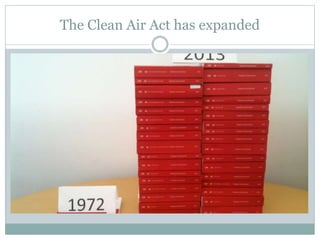
The Clean Air Act has expanded
Background: federal climate policy 1990s-2008
 Under what some called a “petroleum-based
administration,” until 2008 only voluntary measures
prevailed on the federal level
 Giving rise to regional, state-, and city-based
approaches
 Out of the urgency for climate action
The failure of Congress
 A comprehensive climate change law passed the US
House of Representatives in 2009;
 In 2010, a comparable law failed to make it to the
Senate floor for a vote
 And hopes for congressional action on climate
ended.
A challenge or an opportunity?
 The federal system has provided both
 But mostly an opportunity, during the era of federal
silence, for states to take the lead and serve as
laboratories
 In historically unique alliances for cap-and-trade
programs in the Northeast and the West [a market
approach]
 In California’s 2006 statute setting statewide GHG
reduction targets [combines command-and-control
approach and market mechanisms – cap & trade]
As to the US approach to climate change
 It has been halting, decentralized, and ineffective on
the necessary scale
 The attack on climate science, and the denial lobby,
have held back federal climate action
 And litigation by states has been necessary to force
federal action has been a major component.
13 States challenged federal EPA to regulate carbon
under the Clean Air Act
 Presenting a tremendous weight of scientific
evidence
 Supported by clear statutory language
 And, finally, the publication in January 2007 of the
IPCC’s Third Assessment Report
and in April 2007, the Supreme Court interpreted
the CAA
 to require regulation of carbon emissions from
mobile sources
 By the federal Environmental Protection Agency
 After 2009, under new management, the EPA made
necessary findings that GHGs threatened human
health and welfare and
 Promulgated extensive regulations limiting GHG
emissions from new automobiles.
Consensus about climate is growing,
 But the power of the fossil fuel industry
 Fears of economic consequences of moving off fossil
fuel
 And a well-funded denial lobby
 Still hold sway in many states and in the lower house
of Congress
In North Carolina, for example
 The State legislature prohibited scientists and
academia from discussion of the increased rates of
sea level rise;
 Two weeks later, a report established that SLR was
actually increasing at a far faster rate in that state
than anywhere in the world
Although climate change impacts are severe
 Drought in the US South and West
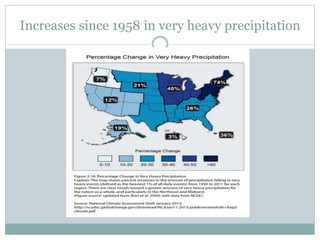
 Extreme precipitation in the Northeast
 Severe coastal storms, hurricanes, and flooding
 Wildfires in the West
 Disappearance of Western snowpack
 Sea level rise on the coasts and estuaries
 Vector-borne tropical diseases
 Melting Alaskan ice exposes coast to storms
 Climate disasters in 2012 cost the American
economy more than $100 billion.
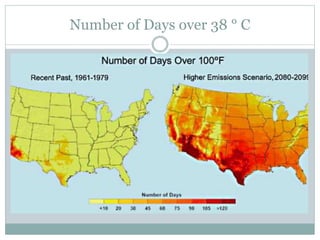
Number of Days over 38 ° C
Increases since 1958 in very heavy precipitation
Subnational climate initiatives
 Including new regional innovations involving about
half the states
 And sometimes Canadian provinces or Mexican
states
 Gave rise to constitutional challenges: were states
usurping federal power?
The remaining states, however
 In the Southeast and Midwest
 Are coal-dependent and
 Responsible for the bulk of US GHG emissions
A new federal Clean Power Plan
 Will help cut carbon emissions from the power sector
by 30% from 2005 levels
 Will expand federal regulation to stationary sources
 And has already been challenged in court by 12 states
The effect of these rules:
 New federal clean automobile rules and state power
plant rules + recession likely to result in the US
meeting its Copenhagen pledge: 17% reduction below
2005 levels by 2020.
Current EPA and state regulation
 Under the Clean Air Act, both jurisdictions play a
role:
 New power plants (federally regulated)
 and existing power plants (state regulated)
 In June the EPA released guidelines: the states then
design programs that fit in those guidelines to
achieve assigned reductions.
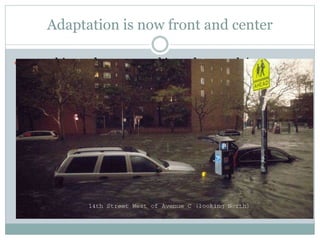
Adaptation is now front and center
 even this modest proposal is under attack in
Congress and in at least 4 lawsuits in federal court.
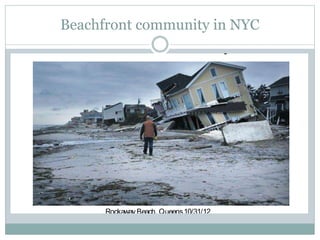
Beachfront community in NYC
Rockaway Beach, Queens10/31/12
http://share.banoosh.com/2012/11/11/long-island-residents-in-
new-york-protest-against-power-outage/#!prettyPhoto-20719/0/
Hurricane Sandy
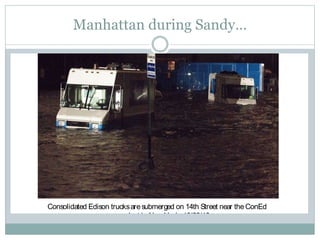
Manhattan during Sandy…
Consolidated Edison trucksaresubmerged on 14th Street near theConEd
power plant in NewYork. 10/29/12
http://bigstory.ap.org/article/coned-prepped-big-storm-got-even-bigger-1
Superstorm Sandy put adaptation on the agenda
 And forced government to recognize climate change
impacts
 In New York last year $1 billion available for
improving resiliency
 a multi-stakeholder collaboration designed
innovative rebuilding schemes, based on the work of
Amsterdam and London
 And power companies work with climate scientists
on a long-term climate impact assessment
Leading the state to review how we use energy
 Integration of renewable energy and energy
efficiency into the power system
 Greater decentralization and islanding
 Valuing low-carbon and no-carbon power
 Looking to models in UK, Germany, Denmark
The future:economic trends
 Growing domestic production of natural gas and crude oil continues
to reshape the U.S. energy economy, with crude oil production
approaching the historical high achieved in 1970 of 9.6 million
barrels per day
 With BAU, annual growth will average 0.8 million barrels per day
(MMbbl/d) through 2016, when it rises to 9.5 MMbbl/d
 Domestic crude oil production is expected to level off and then
slowly decline after 2020, natural gas production grows steadily,
with a 56% increase between 2012 and 2040, when production will
reach 37.6 trillion cubic feet/year
 Low natural gas prices boost natural gas-intensive industries and
suppress renewable investment
The future: social trends
 1 in 4 Americans think that global warming is not happening, and
half say they are "worried" about it.
 There has been an increase in the proportion of Americans who
believe global warming is not happening (23%, up 7 percentage
points since April 2013). But about two in three Americans (63%)
believe global warming is happening, a number that has been
consistent since spring 2013.
 .
 Fewer than half of Americans (38%) believe they personally will be
harmed a “moderate amount” or a “great deal” by global warming.
 By contrast, majorities believe that global warming will harm future
generations of people (65%) and plant and animal species (65%).
Will we keep our lovely autumn maples, birch and beech?

U.S. Climate

  • 1.
    C O MP A R A T I V E C L I M A T E C H A N G E L A W U N I V E R S I T Y O F S T R A T H C L Y D E S E P T E M B E R 1 8 , 2 0 1 4 E L E A N O R S T E I N United States of America: climate change law in the federalism context
  • 2.
    Federal structure  TheU.S. has been a federal constitutional democracy since 1789 – having “voted” against British rule in 1776  Under its written constitution, the federal government has broad enumerated powers but the balance is reserved to the 50 states
  • 3.
    The states’ powers The police power: to protect the resources and people in each state’s sovereign territory  Interpreted as the basis for state environmental regulation  And embedded in federal (Clean Air Act) and state statutes  Federal government establishes the floor: states can do better, but not worse  States regulate the energy industry except for interstate/cross border matters
  • 4.
    What sources oflaw are we talking about?  Congressional Law  Executive (presidential) decisions  Regulation by executive agencies  Laws and regulations of states  Judicial decisions
  • 5.
    Federal regulatory authority Based on Supreme Court expansion of federal powers under the constitutional provision that the federal government alone regulates interstate commerce  There is now an enormous federal regulatory state  The Clean Air Act today provides the basis for federal regulation of air pollution.
  • 6.
    The Clean AirAct has expanded
  • 7.
    Background: federal climatepolicy 1990s-2008  Under what some called a “petroleum-based administration,” until 2008 only voluntary measures prevailed on the federal level  Giving rise to regional, state-, and city-based approaches  Out of the urgency for climate action
  • 8.
    The failure ofCongress  A comprehensive climate change law passed the US House of Representatives in 2009;  In 2010, a comparable law failed to make it to the Senate floor for a vote  And hopes for congressional action on climate ended.
  • 9.
    A challenge oran opportunity?  The federal system has provided both  But mostly an opportunity, during the era of federal silence, for states to take the lead and serve as laboratories  In historically unique alliances for cap-and-trade programs in the Northeast and the West [a market approach]  In California’s 2006 statute setting statewide GHG reduction targets [combines command-and-control approach and market mechanisms – cap & trade]
  • 10.
    As to theUS approach to climate change  It has been halting, decentralized, and ineffective on the necessary scale  The attack on climate science, and the denial lobby, have held back federal climate action  And litigation by states has been necessary to force federal action has been a major component.
  • 11.
    13 States challengedfederal EPA to regulate carbon under the Clean Air Act  Presenting a tremendous weight of scientific evidence  Supported by clear statutory language  And, finally, the publication in January 2007 of the IPCC’s Third Assessment Report
  • 12.
    and in April2007, the Supreme Court interpreted the CAA  to require regulation of carbon emissions from mobile sources  By the federal Environmental Protection Agency  After 2009, under new management, the EPA made necessary findings that GHGs threatened human health and welfare and  Promulgated extensive regulations limiting GHG emissions from new automobiles.
  • 13.
    Consensus about climateis growing,  But the power of the fossil fuel industry  Fears of economic consequences of moving off fossil fuel  And a well-funded denial lobby  Still hold sway in many states and in the lower house of Congress
  • 14.
    In North Carolina,for example  The State legislature prohibited scientists and academia from discussion of the increased rates of sea level rise;  Two weeks later, a report established that SLR was actually increasing at a far faster rate in that state than anywhere in the world
  • 15.
    Although climate changeimpacts are severe  Drought in the US South and West  Extreme precipitation in the Northeast  Severe coastal storms, hurricanes, and flooding  Wildfires in the West  Disappearance of Western snowpack  Sea level rise on the coasts and estuaries  Vector-borne tropical diseases  Melting Alaskan ice exposes coast to storms  Climate disasters in 2012 cost the American economy more than $100 billion.
  • 16.
    Number of Daysover 38 ° C
  • 17.
    Increases since 1958in very heavy precipitation
  • 18.
    Subnational climate initiatives Including new regional innovations involving about half the states  And sometimes Canadian provinces or Mexican states  Gave rise to constitutional challenges: were states usurping federal power?
  • 19.
    The remaining states,however  In the Southeast and Midwest  Are coal-dependent and  Responsible for the bulk of US GHG emissions
  • 20.
    A new federalClean Power Plan  Will help cut carbon emissions from the power sector by 30% from 2005 levels  Will expand federal regulation to stationary sources  And has already been challenged in court by 12 states
  • 21.
    The effect ofthese rules:  New federal clean automobile rules and state power plant rules + recession likely to result in the US meeting its Copenhagen pledge: 17% reduction below 2005 levels by 2020.
  • 22.
    Current EPA andstate regulation  Under the Clean Air Act, both jurisdictions play a role:  New power plants (federally regulated)  and existing power plants (state regulated)  In June the EPA released guidelines: the states then design programs that fit in those guidelines to achieve assigned reductions.
  • 23.
    Adaptation is nowfront and center  even this modest proposal is under attack in Congress and in at least 4 lawsuits in federal court.
  • 24.
    Beachfront community inNYC Rockaway Beach, Queens10/31/12 http://share.banoosh.com/2012/11/11/long-island-residents-in- new-york-protest-against-power-outage/#!prettyPhoto-20719/0/ Hurricane Sandy
  • 25.
    Manhattan during Sandy… ConsolidatedEdison trucksaresubmerged on 14th Street near theConEd power plant in NewYork. 10/29/12 http://bigstory.ap.org/article/coned-prepped-big-storm-got-even-bigger-1
  • 26.
    Superstorm Sandy putadaptation on the agenda  And forced government to recognize climate change impacts  In New York last year $1 billion available for improving resiliency  a multi-stakeholder collaboration designed innovative rebuilding schemes, based on the work of Amsterdam and London  And power companies work with climate scientists on a long-term climate impact assessment
  • 27.
    Leading the stateto review how we use energy  Integration of renewable energy and energy efficiency into the power system  Greater decentralization and islanding  Valuing low-carbon and no-carbon power  Looking to models in UK, Germany, Denmark
  • 28.
    The future:economic trends Growing domestic production of natural gas and crude oil continues to reshape the U.S. energy economy, with crude oil production approaching the historical high achieved in 1970 of 9.6 million barrels per day  With BAU, annual growth will average 0.8 million barrels per day (MMbbl/d) through 2016, when it rises to 9.5 MMbbl/d  Domestic crude oil production is expected to level off and then slowly decline after 2020, natural gas production grows steadily, with a 56% increase between 2012 and 2040, when production will reach 37.6 trillion cubic feet/year  Low natural gas prices boost natural gas-intensive industries and suppress renewable investment
  • 29.
    The future: socialtrends  1 in 4 Americans think that global warming is not happening, and half say they are "worried" about it.  There has been an increase in the proportion of Americans who believe global warming is not happening (23%, up 7 percentage points since April 2013). But about two in three Americans (63%) believe global warming is happening, a number that has been consistent since spring 2013.  .  Fewer than half of Americans (38%) believe they personally will be harmed a “moderate amount” or a “great deal” by global warming.  By contrast, majorities believe that global warming will harm future generations of people (65%) and plant and animal species (65%).
  • 30.
    Will we keepour lovely autumn maples, birch and beech?

Editor's Notes

  • #13 Massachusetts v. EPA, 549 U.S. 497 (2007)
  • #29 Executive summary Projections in the Annual Energy Outlook 2014 (AEO2014) http://www.eia.gov/forecasts/aeo/er/pdf/0383er%282014%29.pdf
  • #30 The most recent national Climate Change in the American Mind survey. See http://environment.yale.edu/climate-communication/article/Climate-Beliefs-November-2013#sthash.zTcVfrRx.dpuf Yale Project on Climate Change Communication, Yale School of Forestry and the Environment, November 2013
  • #31 Adirondack Autumn, Eleanor Stein, oil on canvas, 16 x 20, en plein air