LSE Environmental Society  Roundtable Presentation by Marisa Beck, Jan. 22, 2009 Please note:  I have collected the information in this presentation to my best knowledge and based on my personal experience in Poznan and the resources listed below. However, of course, neither do I guarantee correctness nor do I claim completeness!
POZNAN  ... so what???
The Essentials The Convention 1992: Rio Earth Summit 192 countries are Parties objective: avoid dangerous climate change Annex I: industrialized countries and economies in transition    commitment to return to 1990 levels Prime authority of Convention: COP Bodies: SBSTA, SBI, expert groups, UNFCCC secretary Observers: 50+ intergovernmental agencies, 600+ NGOs
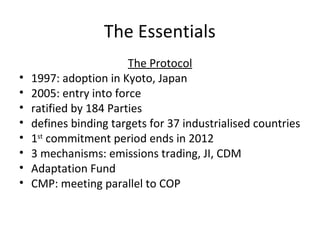
The Essentials The Protocol 1997: adoption in Kyoto, Japan 2005: entry into force ratified by 184 Parties defines binding targets for 37 industrialised countries 1 st  commitment period ends in 2012 3 mechanisms: emissions trading, JI, CDM Adaptation Fund CMP: meeting parallel to COP
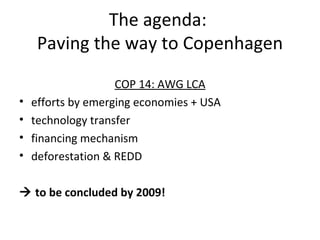
The agenda:  Paving the way to Copenhagen COP 14: AWG LCA efforts by emerging economies + USA technology transfer financing mechanism deforestation & REDD    to be concluded by 2009!
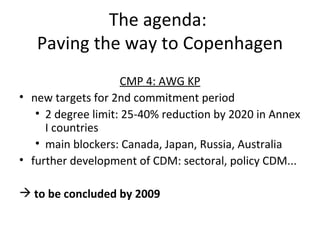
The agenda:  Paving the way to Copenhagen CMP 4: AWG KP new targets for 2nd commitment period 2 degree limit: 25-40% reduction by 2020 in Annex I countries main blockers: Canada, Japan, Russia, Australia further development of CDM: sectoral, policy CDM... to be concluded by 2009
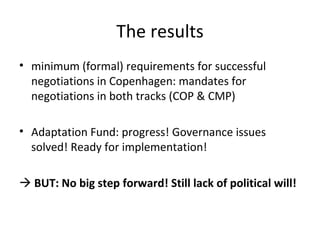
The results minimum (formal) requirements for successful negotiations in Copenhagen: mandates for negotiations in both tracks (COP & CMP) Adaptation Fund: progress! Governance issues solved! Ready for implementation!    BUT: No big step forward! Still lack of political will!
Technology Transfer & Financing  Top spot on Poznan‘s agenda – how come? Convention Art 4.3: „ ...  new and additional financial resources  to meet the agreed full costs incurred by developing country Parties in complying with their obligations ...“ (source: UN, 1992) Convention Art 4.5: „ ... to  promote, facilitate and finance , as appropriate, the  transfer of, or access to, environmentally sound technologies and know-how  to other Parties, particularly to developing countries ...““ (source: UN, 1992)    review showed: insufficient implementation!
Technology Transfer & Financing COP 13 Bali Action Plan:  „ Nationally appropriate mitigation actions by developing country Parties in the context of sustainable development, supported and enabled by technology, financing and capacity-building, in a  measurable, reportable  and  verifiable  manner.“ (source: UNFCCC, 2007) NEW: clear linkage of DC actions to cooperation through MRV criteria    definition? performance indicators?
Technology Transfer & Financing What are the most important issues? massive scale-up of public funds for adaptation, mitigation necessary large scale technology cooperation required mechanisms to mobilize private investments in innovation, deployment and diffusion of clean technologies heart of the debate: Industry Competitiveness!
Technology Transfer & Financing  What happened at COP 14? multiple proposals by developing countries:   establishment of a new and additional funds/mechanisms/institutions under the UNFCCC  binding obligations for Annex I parties (‚polluter pays‘) enhancement of research cooperation & joint ventures compulsory licensing of patented technologies    want access to technologies to boost domestic economy
Technology Transfer & Financing  blocked by many Annex I countries:  use existing institutions, processes & mechanisms focus on (bilateral) voluntary agreements improve „enabling environments“ for tech diffusion, e.g. strong IPR regimes positive exceptions:  Norway: auctioning of AAUs Switzerland: carbon tax    want export to new markets, but fear low-cost competition
What‘s next? Critical processes in 2009:   define shared vision for new agreement: establish political will! establish strong negotiation coalitions, avoid North-South divide  leadership of new US-administration? green bail-out investments? On the road to Copenhagen ... parties‘ submissions by February meetings in March/April and June in Bonn first draft of negotiation text expected in June
COPENHAGEN  ... we can???
Wanna know more???  Resources General:  www.unfccc.int United Nations (1992):  United Nations Framework Convention on Climate Change.  See:  http://unfccc.int/resource/docs/convkp/conveng.pdf UNFCCC (2007):  Bali Action Plan .  Decision -/CP.13.  See:   http://unfccc.int/files/meetings/cop_13/application/pdf/cp_bali_action.pdf Poznan results: “Between Poznan and Copenhagen: The climate train in the “valley of death” by C. Bals, Germanwatch.  January 2009.  http://www.germanwatch.org/klima/c14rese.pdf
Wanna know more??? Resources MRVs: “Measuring the way to a new global climate agreement.” Discussion paper by the World Resource Institute. December 2008. http://pdf.wri.org/measuring_the_way_to_a_new_global_climate_agreement.pdf Technology Transfer: “Innovation and Technology Transfer” by S. Tomlinson, P. Zorlu, & C. Langley, an E3G report with contributions from the Chatham House. November 2008.  http://www.e3g.org/images/uploads/E3G_Innovation_and_Technology_Full_Report.pdf
Wanna know more??? Resources Financing: “Investment and financial flows to address climate change. An update.” Technical Paper by the UNFCCC. December 2008.  http://unfccc.int/files/cooperation_and_support/financial_mechanism/application/pdf/background_paper.pdf

Pres Poznan 22 01

  • 1.
    LSE Environmental Society Roundtable Presentation by Marisa Beck, Jan. 22, 2009 Please note: I have collected the information in this presentation to my best knowledge and based on my personal experience in Poznan and the resources listed below. However, of course, neither do I guarantee correctness nor do I claim completeness!
  • 2.
    POZNAN ...so what???
  • 3.
    The Essentials TheConvention 1992: Rio Earth Summit 192 countries are Parties objective: avoid dangerous climate change Annex I: industrialized countries and economies in transition  commitment to return to 1990 levels Prime authority of Convention: COP Bodies: SBSTA, SBI, expert groups, UNFCCC secretary Observers: 50+ intergovernmental agencies, 600+ NGOs
  • 4.
    The Essentials TheProtocol 1997: adoption in Kyoto, Japan 2005: entry into force ratified by 184 Parties defines binding targets for 37 industrialised countries 1 st commitment period ends in 2012 3 mechanisms: emissions trading, JI, CDM Adaptation Fund CMP: meeting parallel to COP
  • 5.
    The agenda: Paving the way to Copenhagen COP 14: AWG LCA efforts by emerging economies + USA technology transfer financing mechanism deforestation & REDD  to be concluded by 2009!
  • 6.
    The agenda: Paving the way to Copenhagen CMP 4: AWG KP new targets for 2nd commitment period 2 degree limit: 25-40% reduction by 2020 in Annex I countries main blockers: Canada, Japan, Russia, Australia further development of CDM: sectoral, policy CDM... to be concluded by 2009
  • 7.
    The results minimum(formal) requirements for successful negotiations in Copenhagen: mandates for negotiations in both tracks (COP & CMP) Adaptation Fund: progress! Governance issues solved! Ready for implementation!  BUT: No big step forward! Still lack of political will!
  • 8.
    Technology Transfer &Financing Top spot on Poznan‘s agenda – how come? Convention Art 4.3: „ ... new and additional financial resources to meet the agreed full costs incurred by developing country Parties in complying with their obligations ...“ (source: UN, 1992) Convention Art 4.5: „ ... to promote, facilitate and finance , as appropriate, the transfer of, or access to, environmentally sound technologies and know-how to other Parties, particularly to developing countries ...““ (source: UN, 1992)  review showed: insufficient implementation!
  • 9.
    Technology Transfer &Financing COP 13 Bali Action Plan: „ Nationally appropriate mitigation actions by developing country Parties in the context of sustainable development, supported and enabled by technology, financing and capacity-building, in a measurable, reportable and verifiable manner.“ (source: UNFCCC, 2007) NEW: clear linkage of DC actions to cooperation through MRV criteria  definition? performance indicators?
  • 10.
    Technology Transfer &Financing What are the most important issues? massive scale-up of public funds for adaptation, mitigation necessary large scale technology cooperation required mechanisms to mobilize private investments in innovation, deployment and diffusion of clean technologies heart of the debate: Industry Competitiveness!
  • 11.
    Technology Transfer &Financing What happened at COP 14? multiple proposals by developing countries: establishment of a new and additional funds/mechanisms/institutions under the UNFCCC binding obligations for Annex I parties (‚polluter pays‘) enhancement of research cooperation & joint ventures compulsory licensing of patented technologies  want access to technologies to boost domestic economy
  • 12.
    Technology Transfer &Financing blocked by many Annex I countries: use existing institutions, processes & mechanisms focus on (bilateral) voluntary agreements improve „enabling environments“ for tech diffusion, e.g. strong IPR regimes positive exceptions: Norway: auctioning of AAUs Switzerland: carbon tax  want export to new markets, but fear low-cost competition
  • 13.
    What‘s next? Criticalprocesses in 2009: define shared vision for new agreement: establish political will! establish strong negotiation coalitions, avoid North-South divide leadership of new US-administration? green bail-out investments? On the road to Copenhagen ... parties‘ submissions by February meetings in March/April and June in Bonn first draft of negotiation text expected in June
  • 14.
    COPENHAGEN ...we can???
  • 15.
    Wanna know more??? Resources General: www.unfccc.int United Nations (1992): United Nations Framework Convention on Climate Change. See: http://unfccc.int/resource/docs/convkp/conveng.pdf UNFCCC (2007): Bali Action Plan . Decision -/CP.13. See: http://unfccc.int/files/meetings/cop_13/application/pdf/cp_bali_action.pdf Poznan results: “Between Poznan and Copenhagen: The climate train in the “valley of death” by C. Bals, Germanwatch. January 2009. http://www.germanwatch.org/klima/c14rese.pdf
  • 16.
    Wanna know more???Resources MRVs: “Measuring the way to a new global climate agreement.” Discussion paper by the World Resource Institute. December 2008. http://pdf.wri.org/measuring_the_way_to_a_new_global_climate_agreement.pdf Technology Transfer: “Innovation and Technology Transfer” by S. Tomlinson, P. Zorlu, & C. Langley, an E3G report with contributions from the Chatham House. November 2008. http://www.e3g.org/images/uploads/E3G_Innovation_and_Technology_Full_Report.pdf
  • 17.
    Wanna know more???Resources Financing: “Investment and financial flows to address climate change. An update.” Technical Paper by the UNFCCC. December 2008. http://unfccc.int/files/cooperation_and_support/financial_mechanism/application/pdf/background_paper.pdf