Game	Design
FROM:	HAFIZ	AMMAR	SIDDIQUI	– COURSE:	GAME	DEVELOPMENT	– INSTITUTE:	UNIVERSITY	OF	MANAGEMENT	AND	TECHNOLOGY
Game	Design
• The process of planningand creating the content of a game
• Art of applying design to create a game
• Defines that how the game will work from start to end
• Describes that what a game consists of and how it plays
• All basic game design components are related to each other which are gameplay,
mechanics, storylineand aesthetics
FROM:	HAFIZ	AMMAR	SIDDIQUI	– COURSE:	GAME	DEVELOPMENT	– INSTITUTE:	UNIVERSITY	OF	MANAGEMENT	AND	TECHNOLOGY
Gameplay	and	Experience
FROM:	HAFIZ	AMMAR	SIDDIQUI	– COURSE:	GAME	DEVELOPMENT	– INSTITUTE:	UNIVERSITY	OF	MANAGEMENT	AND	TECHNOLOGY
Gameplay	and	Experience
• A specific way in which a player interacts with a game
• Defines the way a game is played
• Explains howa player is involved with a game
• Gameplayis usuallydefined with the help of two major characteristics
• Game Type: Define the viewpoints,styles, temporalaspect and ending type of a game
• Playability: Set of factors that measurethe ease and fun in playinga game
FROM:	HAFIZ	AMMAR	SIDDIQUI	– COURSE:	GAME	DEVELOPMENT	– INSTITUTE:	UNIVERSITY	OF	MANAGEMENT	AND	TECHNOLOGY
Playability
• Learning: How quickly a player can learn and dominate a game. The learning curve and
distribution of tutorials in a game for a player
• Immersion: How seamlessly a player is integrated in the virtual world of a game. The
perception which is created around a player
• Efficiency: How time and resources are managed in a game. The structuring of
challenges for a player
• Satisfaction: How much a player is satisfied after playingor completing a game
FROM:	HAFIZ	AMMAR	SIDDIQUI	– COURSE:	GAME	DEVELOPMENT	– INSTITUTE:	UNIVERSITY	OF	MANAGEMENT	AND	TECHNOLOGY
Playability
• Emotion: How much a game induces feelings in a player. The provocation of different
feelings in a shortspace of time in a player
• Motivation: How much a player is keen to play and complete a game. The degree of
motivation which pushes a player continuouslyto advancein a game
• Socialization: How much a game allows a player to socialize with other players
FROM:	HAFIZ	AMMAR	SIDDIQUI	– COURSE:	GAME	DEVELOPMENT	– INSTITUTE:	UNIVERSITY	OF	MANAGEMENT	AND	TECHNOLOGY
Game	Mechanics
FROM:	HAFIZ	AMMAR	SIDDIQUI	– COURSE:	GAME	DEVELOPMENT	– INSTITUTE:	UNIVERSITY	OF	MANAGEMENT	AND	TECHNOLOGY
Game	Mechanics
• Defines how a game works
• Combination ofmethods that provideinteraction with the game state
• Relation between objects inside a game space with the help of rules which are
triggered by actions using skills and chance in order to achieve goals
• It consists of space, objects, actions, goals, rules, skills, and chance
FROM:	HAFIZ	AMMAR	SIDDIQUI	– COURSE:	GAME	DEVELOPMENT	– INSTITUTE:	UNIVERSITY	OF	MANAGEMENT	AND	TECHNOLOGY
Space
• A set of elements or a universewith structureis a space
• Defines a place or a combination ofplaces inside a game
• Properties of space:
• It is either discrete or continuous on a scale
• It has a number of dimensions
• It has bounded areas which can be connected with each other
FROM:	HAFIZ	AMMAR	SIDDIQUI	– COURSE:	GAME	DEVELOPMENT	– INSTITUTE:	UNIVERSITY	OF	MANAGEMENT	AND	TECHNOLOGY
Objects
• Anything that can be seen or manipulated in a game is an object, space acts as a
container of objects in a game
• Properties of object:
• It has a set of attributes that contain informationaboutan object
• It has a state which is a set of current values of its attributes
• It has a set of behaviors thatit can perform dependingon its own state or game state
• Game state is a set of current states of all the objects in its space
FROM:	HAFIZ	AMMAR	SIDDIQUI	– COURSE:	GAME	DEVELOPMENT	– INSTITUTE:	UNIVERSITY	OF	MANAGEMENT	AND	TECHNOLOGY
Actions
• Interaction of a player with a game by doing some activity on objects is an action, what
a player does in a game
• What operations a player can do in a game
• Verbs of a player in a game
• Choices a player can make in a game
• Actions can change the state of a game and the state of objects
FROM:	HAFIZ	AMMAR	SIDDIQUI	– COURSE:	GAME	DEVELOPMENT	– INSTITUTE:	UNIVERSITY	OF	MANAGEMENT	AND	TECHNOLOGY
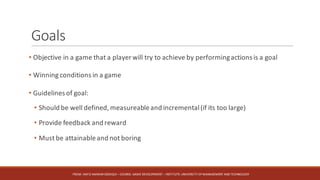
Goals
• Objective in a game that a player will try to achieve by performingactions is a goal
• Winning conditions in a game
• Guidelines of goal:
• Should be well defined, measureableand incremental(if its too large)
• Provide feedback and reward
• Must be attainableand not boring
FROM:	HAFIZ	AMMAR	SIDDIQUI	– COURSE:	GAME	DEVELOPMENT	– INSTITUTE:	UNIVERSITY	OF	MANAGEMENT	AND	TECHNOLOGY
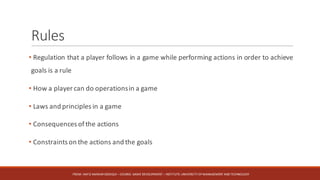
Rules
• Regulation that a player follows in a game while performing actions in order to achieve
goals is a rule
• How a player can do operationsin a game
• Laws and principles in a game
• Consequences ofthe actions
• Constraints on the actions and the goals
FROM:	HAFIZ	AMMAR	SIDDIQUI	– COURSE:	GAME	DEVELOPMENT	– INSTITUTE:	UNIVERSITY	OF	MANAGEMENT	AND	TECHNOLOGY
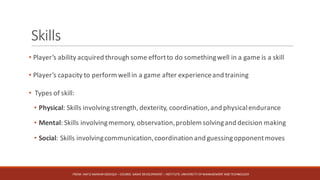
Skills
• Player’s ability acquired through some effortto do somethingwell in a game is a skill
• Player’s capacity to perform wellin a game after experienceand training
• Types of skill:
• Physical: Skills involving strength, dexterity, coordination,and physicalendurance
• Mental: Skills involvingmemory, observation,problem solvingand decision making
• Social: Skills involvingcommunication,coordination and guessingopponentmoves
FROM:	HAFIZ	AMMAR	SIDDIQUI	– COURSE:	GAME	DEVELOPMENT	– INSTITUTE:	UNIVERSITY	OF	MANAGEMENT	AND	TECHNOLOGY
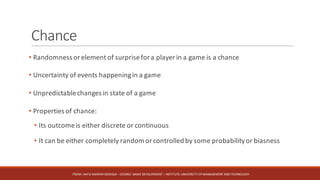
Chance
• Randomness or element of surprisefor a player in a game is a chance
• Uncertainty of events happeningin a game
• Unpredictablechanges in state of a game
• Properties of chance:
• Its outcomeis either discrete or continuous
• It can be either completely random or controlled by some probabilityor biasness
FROM:	HAFIZ	AMMAR	SIDDIQUI	– COURSE:	GAME	DEVELOPMENT	– INSTITUTE:	UNIVERSITY	OF	MANAGEMENT	AND	TECHNOLOGY
Storyline	and	Narrative
FROM:	HAFIZ	AMMAR	SIDDIQUI	– COURSE:	GAME	DEVELOPMENT	– INSTITUTE:	UNIVERSITY	OF	MANAGEMENT	AND	TECHNOLOGY
Storyline	and	Narrative
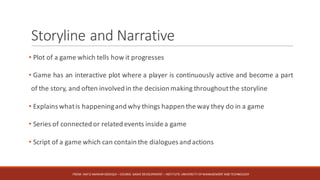
• Plot of a game which tells how it progresses
• Game has an interactive plot where a player is continuously active and become a part
of the story, and often involved in the decision making throughoutthe storyline
• Explains whatis happeningand why things happen the way they do in a game
• Series of connected or related events insidea game
• Script of a game which can contain the dialogues and actions
FROM:	HAFIZ	AMMAR	SIDDIQUI	– COURSE:	GAME	DEVELOPMENT	– INSTITUTE:	UNIVERSITY	OF	MANAGEMENT	AND	TECHNOLOGY
Types	of	Story
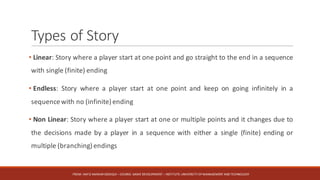
• Linear: Story where a player start at one point and go straight to the end in a sequence
with single (finite) ending
• Endless: Story where a player start at one point and keep on going infinitely in a
sequencewith no (infinite) ending
• Non Linear: Story where a player start at one or multiple points and it changes due to
the decisions made by a player in a sequence with either a single (finite) ending or
multiple (branching) endings
FROM:	HAFIZ	AMMAR	SIDDIQUI	– COURSE:	GAME	DEVELOPMENT	– INSTITUTE:	UNIVERSITY	OF	MANAGEMENT	AND	TECHNOLOGY
Types	of	Story
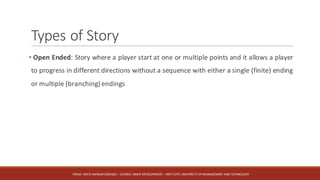
• Open Ended: Story where a player start at one or multiple points and it allows a player
to progress in different directions without a sequence with either a single (finite) ending
or multiple (branching) endings
FROM:	HAFIZ	AMMAR	SIDDIQUI	– COURSE:	GAME	DEVELOPMENT	– INSTITUTE:	UNIVERSITY	OF	MANAGEMENT	AND	TECHNOLOGY
Aesthetics	and	Level	Design
FROM:	HAFIZ	AMMAR	SIDDIQUI	– COURSE:	GAME	DEVELOPMENT	– INSTITUTE:	UNIVERSITY	OF	MANAGEMENT	AND	TECHNOLOGY
Aesthetics
• Visual, auraland haptic experiencethat a player encounters in a game
• Way a game presents itself to a player
• Overalllook and feel of a game
• How the content of a game is displayed
• Every game follows a particular artistic style which uses specific drawing techniques for
creating visuals inside a game
FROM:	HAFIZ	AMMAR	SIDDIQUI	– COURSE:	GAME	DEVELOPMENT	– INSTITUTE:	UNIVERSITY	OF	MANAGEMENT	AND	TECHNOLOGY
Level	Design
• Process of planning and creating space (level) inside a game that is available to a player
during a specific object or through out the complete game
• Activity of creating playablecontentfor a player in a game
• Guidelines of level design:
• Each level must haveat least one entry point
• Each level must haveat least one exit point (if ending type is not infinite)
• Design of all levels should be consistent
FROM:	HAFIZ	AMMAR	SIDDIQUI	– COURSE:	GAME	DEVELOPMENT	– INSTITUTE:	UNIVERSITY	OF	MANAGEMENT	AND	TECHNOLOGY
Reference
• The	Art	of	Game	Design	- Jesse	Schell	
• Game	Design	Essentials	- Briar	Lee	Mitchell
• Challenges	for	Game	Designers	- Brenda	Brathwaite,	Ian	Schreiber	
FROM:	HAFIZ	AMMAR	SIDDIQUI	– COURSE:	GAME	DEVELOPMENT	– INSTITUTE:	UNIVERSITY	OF	MANAGEMENT	AND	TECHNOLOGY

9-Game Design (Game Development - UMT Spring 2017/2018)

  • 1.
  • 2.
    Game Design • The processof planningand creating the content of a game • Art of applying design to create a game • Defines that how the game will work from start to end • Describes that what a game consists of and how it plays • All basic game design components are related to each other which are gameplay, mechanics, storylineand aesthetics FROM: HAFIZ AMMAR SIDDIQUI – COURSE: GAME DEVELOPMENT – INSTITUTE: UNIVERSITY OF MANAGEMENT AND TECHNOLOGY
  • 3.
  • 4.
    Gameplay and Experience • A specificway in which a player interacts with a game • Defines the way a game is played • Explains howa player is involved with a game • Gameplayis usuallydefined with the help of two major characteristics • Game Type: Define the viewpoints,styles, temporalaspect and ending type of a game • Playability: Set of factors that measurethe ease and fun in playinga game FROM: HAFIZ AMMAR SIDDIQUI – COURSE: GAME DEVELOPMENT – INSTITUTE: UNIVERSITY OF MANAGEMENT AND TECHNOLOGY
  • 5.
    Playability • Learning: Howquickly a player can learn and dominate a game. The learning curve and distribution of tutorials in a game for a player • Immersion: How seamlessly a player is integrated in the virtual world of a game. The perception which is created around a player • Efficiency: How time and resources are managed in a game. The structuring of challenges for a player • Satisfaction: How much a player is satisfied after playingor completing a game FROM: HAFIZ AMMAR SIDDIQUI – COURSE: GAME DEVELOPMENT – INSTITUTE: UNIVERSITY OF MANAGEMENT AND TECHNOLOGY
  • 6.
    Playability • Emotion: Howmuch a game induces feelings in a player. The provocation of different feelings in a shortspace of time in a player • Motivation: How much a player is keen to play and complete a game. The degree of motivation which pushes a player continuouslyto advancein a game • Socialization: How much a game allows a player to socialize with other players FROM: HAFIZ AMMAR SIDDIQUI – COURSE: GAME DEVELOPMENT – INSTITUTE: UNIVERSITY OF MANAGEMENT AND TECHNOLOGY
  • 7.
  • 8.
    Game Mechanics • Defines howa game works • Combination ofmethods that provideinteraction with the game state • Relation between objects inside a game space with the help of rules which are triggered by actions using skills and chance in order to achieve goals • It consists of space, objects, actions, goals, rules, skills, and chance FROM: HAFIZ AMMAR SIDDIQUI – COURSE: GAME DEVELOPMENT – INSTITUTE: UNIVERSITY OF MANAGEMENT AND TECHNOLOGY
  • 9.
    Space • A setof elements or a universewith structureis a space • Defines a place or a combination ofplaces inside a game • Properties of space: • It is either discrete or continuous on a scale • It has a number of dimensions • It has bounded areas which can be connected with each other FROM: HAFIZ AMMAR SIDDIQUI – COURSE: GAME DEVELOPMENT – INSTITUTE: UNIVERSITY OF MANAGEMENT AND TECHNOLOGY
  • 10.
    Objects • Anything thatcan be seen or manipulated in a game is an object, space acts as a container of objects in a game • Properties of object: • It has a set of attributes that contain informationaboutan object • It has a state which is a set of current values of its attributes • It has a set of behaviors thatit can perform dependingon its own state or game state • Game state is a set of current states of all the objects in its space FROM: HAFIZ AMMAR SIDDIQUI – COURSE: GAME DEVELOPMENT – INSTITUTE: UNIVERSITY OF MANAGEMENT AND TECHNOLOGY
  • 11.
    Actions • Interaction ofa player with a game by doing some activity on objects is an action, what a player does in a game • What operations a player can do in a game • Verbs of a player in a game • Choices a player can make in a game • Actions can change the state of a game and the state of objects FROM: HAFIZ AMMAR SIDDIQUI – COURSE: GAME DEVELOPMENT – INSTITUTE: UNIVERSITY OF MANAGEMENT AND TECHNOLOGY
  • 12.
    Goals • Objective ina game that a player will try to achieve by performingactions is a goal • Winning conditions in a game • Guidelines of goal: • Should be well defined, measureableand incremental(if its too large) • Provide feedback and reward • Must be attainableand not boring FROM: HAFIZ AMMAR SIDDIQUI – COURSE: GAME DEVELOPMENT – INSTITUTE: UNIVERSITY OF MANAGEMENT AND TECHNOLOGY
  • 13.
    Rules • Regulation thata player follows in a game while performing actions in order to achieve goals is a rule • How a player can do operationsin a game • Laws and principles in a game • Consequences ofthe actions • Constraints on the actions and the goals FROM: HAFIZ AMMAR SIDDIQUI – COURSE: GAME DEVELOPMENT – INSTITUTE: UNIVERSITY OF MANAGEMENT AND TECHNOLOGY
  • 14.
    Skills • Player’s abilityacquired through some effortto do somethingwell in a game is a skill • Player’s capacity to perform wellin a game after experienceand training • Types of skill: • Physical: Skills involving strength, dexterity, coordination,and physicalendurance • Mental: Skills involvingmemory, observation,problem solvingand decision making • Social: Skills involvingcommunication,coordination and guessingopponentmoves FROM: HAFIZ AMMAR SIDDIQUI – COURSE: GAME DEVELOPMENT – INSTITUTE: UNIVERSITY OF MANAGEMENT AND TECHNOLOGY
  • 15.
    Chance • Randomness orelement of surprisefor a player in a game is a chance • Uncertainty of events happeningin a game • Unpredictablechanges in state of a game • Properties of chance: • Its outcomeis either discrete or continuous • It can be either completely random or controlled by some probabilityor biasness FROM: HAFIZ AMMAR SIDDIQUI – COURSE: GAME DEVELOPMENT – INSTITUTE: UNIVERSITY OF MANAGEMENT AND TECHNOLOGY
  • 16.
  • 17.
    Storyline and Narrative • Plot ofa game which tells how it progresses • Game has an interactive plot where a player is continuously active and become a part of the story, and often involved in the decision making throughoutthe storyline • Explains whatis happeningand why things happen the way they do in a game • Series of connected or related events insidea game • Script of a game which can contain the dialogues and actions FROM: HAFIZ AMMAR SIDDIQUI – COURSE: GAME DEVELOPMENT – INSTITUTE: UNIVERSITY OF MANAGEMENT AND TECHNOLOGY
  • 18.
    Types of Story • Linear: Storywhere a player start at one point and go straight to the end in a sequence with single (finite) ending • Endless: Story where a player start at one point and keep on going infinitely in a sequencewith no (infinite) ending • Non Linear: Story where a player start at one or multiple points and it changes due to the decisions made by a player in a sequence with either a single (finite) ending or multiple (branching) endings FROM: HAFIZ AMMAR SIDDIQUI – COURSE: GAME DEVELOPMENT – INSTITUTE: UNIVERSITY OF MANAGEMENT AND TECHNOLOGY
  • 19.
    Types of Story • Open Ended:Story where a player start at one or multiple points and it allows a player to progress in different directions without a sequence with either a single (finite) ending or multiple (branching) endings FROM: HAFIZ AMMAR SIDDIQUI – COURSE: GAME DEVELOPMENT – INSTITUTE: UNIVERSITY OF MANAGEMENT AND TECHNOLOGY
  • 20.
  • 21.
    Aesthetics • Visual, auralandhaptic experiencethat a player encounters in a game • Way a game presents itself to a player • Overalllook and feel of a game • How the content of a game is displayed • Every game follows a particular artistic style which uses specific drawing techniques for creating visuals inside a game FROM: HAFIZ AMMAR SIDDIQUI – COURSE: GAME DEVELOPMENT – INSTITUTE: UNIVERSITY OF MANAGEMENT AND TECHNOLOGY
  • 22.
    Level Design • Process ofplanning and creating space (level) inside a game that is available to a player during a specific object or through out the complete game • Activity of creating playablecontentfor a player in a game • Guidelines of level design: • Each level must haveat least one entry point • Each level must haveat least one exit point (if ending type is not infinite) • Design of all levels should be consistent FROM: HAFIZ AMMAR SIDDIQUI – COURSE: GAME DEVELOPMENT – INSTITUTE: UNIVERSITY OF MANAGEMENT AND TECHNOLOGY
  • 23.
    Reference • The Art of Game Design - Jesse Schell •Game Design Essentials - Briar Lee Mitchell • Challenges for Game Designers - Brenda Brathwaite, Ian Schreiber FROM: HAFIZ AMMAR SIDDIQUI – COURSE: GAME DEVELOPMENT – INSTITUTE: UNIVERSITY OF MANAGEMENT AND TECHNOLOGY