Civil War SOL US1.9a Issues that Divided the Nation Lisa Pennington Social Studies Instructional Specialist Portsmouth Public Schools
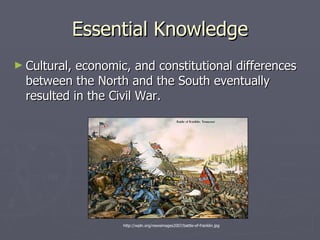
Essential Knowledge Cultural, economic, and constitutional differences between the North and the South eventually resulted in the Civil War.  http://wpln.org/newsimages2007/battle-of-franklin.jpg
Key Words Tariff:  tax on exports from a country (the goods that leave a country) Urban:  having to do with a city or city life Advocate:  to support or defend a person or an idea Great Britain:  was a major buyer of the South’s cotton since England had many factories that made cloth and clothing from the cotton
Issues that Divided the Nation
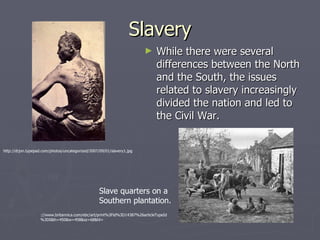
Slavery While there were several differences between the North and the South, the issues related to slavery increasingly divided the nation and led to the Civil War.  ://www.britannica.com/ebc/art/print%3Fid%3D14387%26articleTypeId%3D0&h=450&w=458&sz=68&hl= Slave quarters on a Southern plantation. http://drjon.typepad.com/photos/uncategorized/2007/09/01/slavery1.jpg
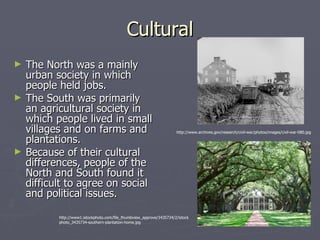
Cultural The North was a mainly urban society in which people held jobs. The South was primarily an agricultural society in which people lived in small villages and on farms and plantations. Because of their cultural differences, people of the North and South found it difficult to agree on social and political issues. http://www1.istockphoto.com/file_thumbview_approve/3435734/2/istockphoto_3435734-southern-plantation-home.jpg http://www.archives.gov/research/civil-war/photos/images/civil-war-080.jpg
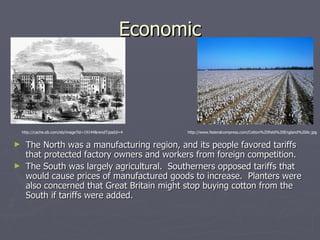
Economic The North was a manufacturing region, and its people favored tariffs that protected factory owners and workers from foreign competition. The South was largely agricultural.  Southerners opposed tariffs that would cause prices of manufactured goods to increase.  Planters were also concerned that Great Britain might stop buying cotton from the South if tariffs were added. http://www.federalcompress.com/Cotton%20field%20England%20Ar.jpg http://cache.eb.com/eb/image?id=19144&rendTypeId=4
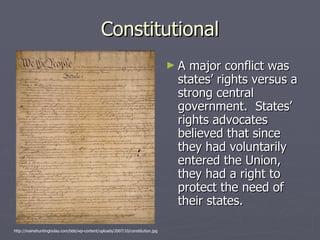
Constitutional A major conflict was states’ rights versus a strong central government.  States’ rights advocates believed that since they had voluntarily entered the Union, they had a right to protect the need of their states.  http://mainehuntingtoday.com/bbb/wp-content/uploads/2007/10/constitution.jpg

9a issues divided the nation

  • 1.
    Civil War SOLUS1.9a Issues that Divided the Nation Lisa Pennington Social Studies Instructional Specialist Portsmouth Public Schools
  • 2.
    Essential Knowledge Cultural,economic, and constitutional differences between the North and the South eventually resulted in the Civil War. http://wpln.org/newsimages2007/battle-of-franklin.jpg
  • 3.
    Key Words Tariff: tax on exports from a country (the goods that leave a country) Urban: having to do with a city or city life Advocate: to support or defend a person or an idea Great Britain: was a major buyer of the South’s cotton since England had many factories that made cloth and clothing from the cotton
  • 4.
  • 5.
    Slavery While therewere several differences between the North and the South, the issues related to slavery increasingly divided the nation and led to the Civil War. ://www.britannica.com/ebc/art/print%3Fid%3D14387%26articleTypeId%3D0&h=450&w=458&sz=68&hl= Slave quarters on a Southern plantation. http://drjon.typepad.com/photos/uncategorized/2007/09/01/slavery1.jpg
  • 6.
    Cultural The Northwas a mainly urban society in which people held jobs. The South was primarily an agricultural society in which people lived in small villages and on farms and plantations. Because of their cultural differences, people of the North and South found it difficult to agree on social and political issues. http://www1.istockphoto.com/file_thumbview_approve/3435734/2/istockphoto_3435734-southern-plantation-home.jpg http://www.archives.gov/research/civil-war/photos/images/civil-war-080.jpg
  • 7.
    Economic The Northwas a manufacturing region, and its people favored tariffs that protected factory owners and workers from foreign competition. The South was largely agricultural. Southerners opposed tariffs that would cause prices of manufactured goods to increase. Planters were also concerned that Great Britain might stop buying cotton from the South if tariffs were added. http://www.federalcompress.com/Cotton%20field%20England%20Ar.jpg http://cache.eb.com/eb/image?id=19144&rendTypeId=4
  • 8.
    Constitutional A majorconflict was states’ rights versus a strong central government. States’ rights advocates believed that since they had voluntarily entered the Union, they had a right to protect the need of their states. http://mainehuntingtoday.com/bbb/wp-content/uploads/2007/10/constitution.jpg