




Chap 7: Motivating and Managing People and Groups in Business Organizations Lecture 07
Chapter 7 Motivating and Managing People and Groups in Business Organizations Understand the nature and sources of work  motivation and appreciate motivation is under the voluntary control of an employee. Describe five different theories of work   motivation  and identify how they work together to determine work motivation. Identify the characteristics of groups and teams  and distinguish between important types of groups and teams.
Chapter 7 Motivating and Managing People and Groups in Business Organizations Explain the factors that create high-performance groups and teams . Identify the sources of organizational conflict  and understand how bargaining and negotiation is used to resolve conflicts between people and groups.
 
Chapter 7 Motivating and Managing People and Groups in Business Organizations Every company strives to produce and market the kind of goods customers want so it can generate high revenues and profits to benefit all its stockholders A critical determinant of a company’s ability to motivate is  its human resources
Chapter 7 Motivating and Managing People and Groups in Business Organizations Managing People Leaders try to influence and persuade employees to develop work behaviors and attitudes that lead to increased efficiency and effectiveness
  Chapter 7 Motivating and Managing People and Groups in Business Organizations Managing People The principal determinant of employees’ desire and willingness to work hard and perform at a high level is their work motivation
 
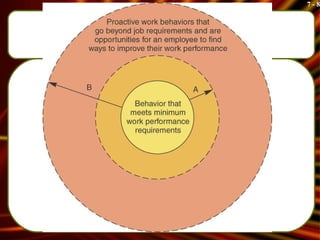
Chapter 7 Motivating and Managing People and Groups in Business Organizations   Motivating Employee performance may be minimal, proactive performing effectively and efficiently, or below minimum level Evaluate the role of leadership in the  Container Store  video and relate to influence and communication
Chapter 7 Motivating and Managing People and Groups in Business Organizations Motivating Employees know if they do not perform at the minimum level they risk being punished or sanctioned( 制裁 ) and this may motivate them to put in enough effort to perform at the minimum level
Chapter 7 Motivating and Managing People and Groups in Business Organizations Motivating Leaders need to know or understand what motivates employees to perform at a high level and then create a workplace that contains these motivators
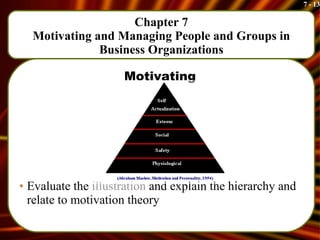
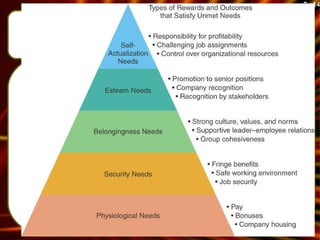
  Chapter 7 Motivating and Managing People and Groups in Business Organizations   Motivating Maslow’s hierarchy of needs state  unsatisfied  needs motivate people to satisfy their needs.
Chapter 7 Motivating and Managing People and Groups in Business Organizations Motivating Evaluate the  illustration  and explain the hierarchy and relate to motivation theory
 
 
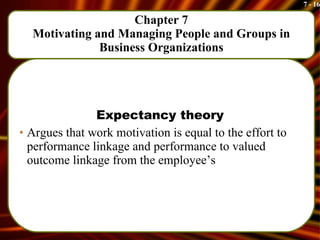
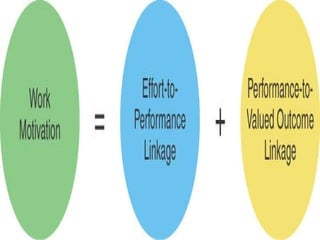
Chapter 7 Motivating and Managing People and Groups in Business Organizations Expectancy theory Argues that work motivation is equal to the effort to performance linkage and performance to valued outcome linkage from the employee’s
 
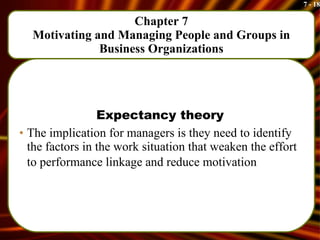
Chapter 7 Motivating and Managing People and Groups in Business Organizations Expectancy theory The implication for managers is they need to identify the factors in the work situation that weaken the effort to performance linkage and reduce motivation
Chapter 7 Motivating and Managing People and Groups in Business Organizations Expectancy theory Managers also need to center on the need to prove to employees there is a strong job performance to outcome linkage An incentive system is a good example of strengthening this linkage
 
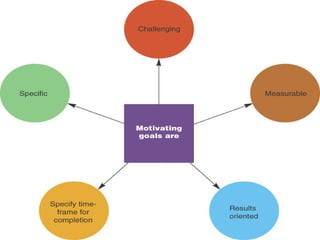
Chapter 7 Motivating and Managing People and Groups in Business Organizations Additional motivation theories include goal-setting suggests the goals used to assess job performance need five properties to be successful These properties are specific, challenging, and measurable, results oriented, and specify a time frame for completion Evaluate the illustration of  Employee Motivation  and relate to managing people and groups
 
Chapter 7 Motivating and Managing People and Groups in Business Organizations Motivating Goal setting properties Specific Challenging Measurable Results oriented Specify a time frame for completion
 
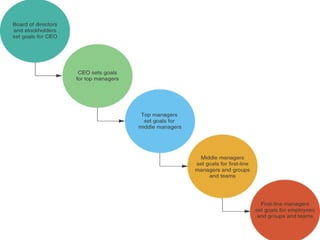
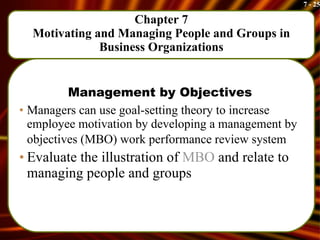
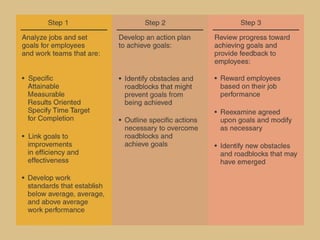
Chapter 7 Motivating and Managing People and Groups in Business Organizations Management by Objectives Managers can use goal-setting theory to increase employee motivation by developing a management by objectives (MBO) work performance review system   Evaluate the illustration of  MBO  and relate to managing people and groups
 
Chapter 7 Motivating and Managing People and Groups in Business Organizations Equity Theory Focuses on employee’s perception of fairness of manager’s evaluation and reward of their job performance
 
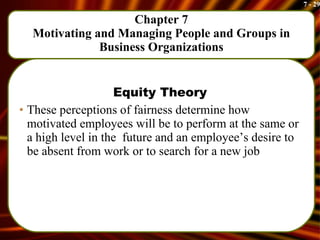
Chapter 7 Motivating and Managing People and Groups in Business Organizations Equity Theory These perceptions of fairness determine how motivated employees will be to perform at the same or a high level in the  future and an employee’s desire to be absent from work or to search for a new job
 
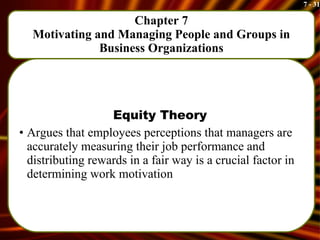
Chapter 7 Motivating and Managing People and Groups in Business Organizations Equity Theory Argues that employees perceptions that managers are accurately measuring their job performance and distributing rewards in a fair way is a crucial factor in determining work motivation
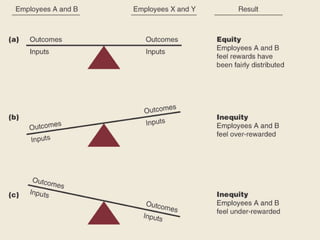
Chapter 7 Motivating and Managing People and Groups in Business Organizations Equity Theory Reveals employees’ perceptions about the value of the rewards they receive are affected by their perceptions about the value of the rewards other is receiving as well Evaluate the illustration of this  theory  -- relate to motivating people  (Define fair and perception)
 
Chapter 7 Motivating and Managing People and Groups in Business Organizations Job Enrichment To encourage employees to perform at a higher level and be more satisfied with their work,  researchers suggest manager should design jobs so that they offer employees greater rewards or desired outcomes Evaluate  Job Enrichment Videos 1 – 4  and relate to motivating and managing
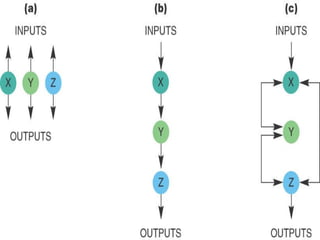
Chapter 7 Motivating and Managing People and Groups in Business Organizations Groups Teams are collective and groups are linear while employee’s interaction is minimal if any
 
Chapter 7 Motivating and Managing People and Groups in Business Organizations Groups   There are advantages in using groups and teams only when managers design and manage groups correctly When groups or teams become too large problems arise that detract from the groups performance
 
Chapter 7 Motivating and Managing People and Groups in Business Organizations Evaluate the role of motivation and management in the  Busfields  video and relate to groups in business organizations
 
Chapter 7 Motivating and Managing People and Groups in Business Organizations Groups The lack of conflict in an organization suggests a lack of creativity with too much emphasis on conformity and the stifling of innovation and new ideas
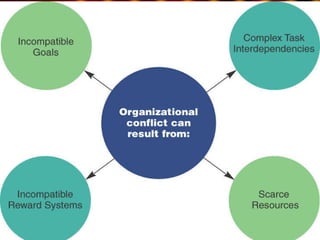
Chapter 7 Motivating and Managing People and Groups in Business Organizations Groups Conflict occurs inter-group and intra-group while competing for resources and incompatible  rewards and goals and complex task interdependencies
Chapter 7 Motivating and Managing People and Groups in Business Organizations Groups Negotiation and bargaining tactics make compromise more like likely emphasize common goals focus on the problem, not the people create opportunities for joint gain focus on what is fair

981 Chap07 Biz (Final)

  • 1.
    Chap 7: Motivatingand Managing People and Groups in Business Organizations Lecture 07
  • 2.
    Chapter 7 Motivatingand Managing People and Groups in Business Organizations Understand the nature and sources of work motivation and appreciate motivation is under the voluntary control of an employee. Describe five different theories of work motivation and identify how they work together to determine work motivation. Identify the characteristics of groups and teams and distinguish between important types of groups and teams.
  • 3.
    Chapter 7 Motivatingand Managing People and Groups in Business Organizations Explain the factors that create high-performance groups and teams . Identify the sources of organizational conflict and understand how bargaining and negotiation is used to resolve conflicts between people and groups.
  • 4.
  • 5.
    Chapter 7 Motivatingand Managing People and Groups in Business Organizations Every company strives to produce and market the kind of goods customers want so it can generate high revenues and profits to benefit all its stockholders A critical determinant of a company’s ability to motivate is its human resources
  • 6.
    Chapter 7 Motivatingand Managing People and Groups in Business Organizations Managing People Leaders try to influence and persuade employees to develop work behaviors and attitudes that lead to increased efficiency and effectiveness
  • 7.
    Chapter7 Motivating and Managing People and Groups in Business Organizations Managing People The principal determinant of employees’ desire and willingness to work hard and perform at a high level is their work motivation
  • 8.
  • 9.
    Chapter 7 Motivatingand Managing People and Groups in Business Organizations Motivating Employee performance may be minimal, proactive performing effectively and efficiently, or below minimum level Evaluate the role of leadership in the Container Store video and relate to influence and communication
  • 10.
    Chapter 7 Motivatingand Managing People and Groups in Business Organizations Motivating Employees know if they do not perform at the minimum level they risk being punished or sanctioned( 制裁 ) and this may motivate them to put in enough effort to perform at the minimum level
  • 11.
    Chapter 7 Motivatingand Managing People and Groups in Business Organizations Motivating Leaders need to know or understand what motivates employees to perform at a high level and then create a workplace that contains these motivators
  • 12.
    Chapter7 Motivating and Managing People and Groups in Business Organizations Motivating Maslow’s hierarchy of needs state unsatisfied needs motivate people to satisfy their needs.
  • 13.
    Chapter 7 Motivatingand Managing People and Groups in Business Organizations Motivating Evaluate the illustration and explain the hierarchy and relate to motivation theory
  • 14.
  • 15.
  • 16.
    Chapter 7 Motivatingand Managing People and Groups in Business Organizations Expectancy theory Argues that work motivation is equal to the effort to performance linkage and performance to valued outcome linkage from the employee’s
  • 17.
  • 18.
    Chapter 7 Motivatingand Managing People and Groups in Business Organizations Expectancy theory The implication for managers is they need to identify the factors in the work situation that weaken the effort to performance linkage and reduce motivation
  • 19.
    Chapter 7 Motivatingand Managing People and Groups in Business Organizations Expectancy theory Managers also need to center on the need to prove to employees there is a strong job performance to outcome linkage An incentive system is a good example of strengthening this linkage
  • 20.
  • 21.
    Chapter 7 Motivatingand Managing People and Groups in Business Organizations Additional motivation theories include goal-setting suggests the goals used to assess job performance need five properties to be successful These properties are specific, challenging, and measurable, results oriented, and specify a time frame for completion Evaluate the illustration of Employee Motivation and relate to managing people and groups
  • 22.
  • 23.
    Chapter 7 Motivatingand Managing People and Groups in Business Organizations Motivating Goal setting properties Specific Challenging Measurable Results oriented Specify a time frame for completion
  • 24.
  • 25.
    Chapter 7 Motivatingand Managing People and Groups in Business Organizations Management by Objectives Managers can use goal-setting theory to increase employee motivation by developing a management by objectives (MBO) work performance review system Evaluate the illustration of MBO and relate to managing people and groups
  • 26.
  • 27.
    Chapter 7 Motivatingand Managing People and Groups in Business Organizations Equity Theory Focuses on employee’s perception of fairness of manager’s evaluation and reward of their job performance
  • 28.
  • 29.
    Chapter 7 Motivatingand Managing People and Groups in Business Organizations Equity Theory These perceptions of fairness determine how motivated employees will be to perform at the same or a high level in the future and an employee’s desire to be absent from work or to search for a new job
  • 30.
  • 31.
    Chapter 7 Motivatingand Managing People and Groups in Business Organizations Equity Theory Argues that employees perceptions that managers are accurately measuring their job performance and distributing rewards in a fair way is a crucial factor in determining work motivation
  • 32.
    Chapter 7 Motivatingand Managing People and Groups in Business Organizations Equity Theory Reveals employees’ perceptions about the value of the rewards they receive are affected by their perceptions about the value of the rewards other is receiving as well Evaluate the illustration of this theory -- relate to motivating people (Define fair and perception)
  • 33.
  • 34.
    Chapter 7 Motivatingand Managing People and Groups in Business Organizations Job Enrichment To encourage employees to perform at a higher level and be more satisfied with their work, researchers suggest manager should design jobs so that they offer employees greater rewards or desired outcomes Evaluate Job Enrichment Videos 1 – 4 and relate to motivating and managing
  • 35.
    Chapter 7 Motivatingand Managing People and Groups in Business Organizations Groups Teams are collective and groups are linear while employee’s interaction is minimal if any
  • 36.
  • 37.
    Chapter 7 Motivatingand Managing People and Groups in Business Organizations Groups There are advantages in using groups and teams only when managers design and manage groups correctly When groups or teams become too large problems arise that detract from the groups performance
  • 38.
  • 39.
    Chapter 7 Motivatingand Managing People and Groups in Business Organizations Evaluate the role of motivation and management in the Busfields video and relate to groups in business organizations
  • 40.
  • 41.
    Chapter 7 Motivatingand Managing People and Groups in Business Organizations Groups The lack of conflict in an organization suggests a lack of creativity with too much emphasis on conformity and the stifling of innovation and new ideas
  • 42.
    Chapter 7 Motivatingand Managing People and Groups in Business Organizations Groups Conflict occurs inter-group and intra-group while competing for resources and incompatible rewards and goals and complex task interdependencies
  • 43.
    Chapter 7 Motivatingand Managing People and Groups in Business Organizations Groups Negotiation and bargaining tactics make compromise more like likely emphasize common goals focus on the problem, not the people create opportunities for joint gain focus on what is fair