Motivating and
Engaging Workers
How do we motivate people?
How can we improve engagement?
When did you last enjoy
your work? And why?
Business leaders and human resource
managers consider the “lack of employee
engagement” one of their top priorities.
But why do many workers not feel engaged?
Without motivation,
nothing would be produced.
Firms exist to coordinate and
motivate people’s economic
activity.
- John Roberts, “The Modern Firm”
A motivated worker
is not necessarily an
engaged worker.
Technically, we cannot make people feel motivated or
engaged. But we can certainly set up the right conditions
that maximize the probability that it will happen (even
though success is never certain).
Managers are responsible for making engagement a
built-in property of the organization.
Is employee engagement about intrinsic or
extrinsic motivation?
Does an author write books because she loves the writing process?
Or because she loves the support and encouragement from
readers? Maybe a bit of both?
The CHAMPFROGS model deals
specifically with motivation in
the context of work-life.
It consists of ten motivators that
are either intrinsic, extrinsic, or
a bit of both.
The CHAMPFROGS model is
influenced by several other
models of human motivation.
• Two-Factor Theory, Frederick Herzberg
• The Hierarchy of Needs, Abraham Maslow
• Theory of Self-Determination, Edward L.
Deci and Richard M. Ryan
• 16 Basic Desires Theory, Steven Reiss
Curiosity
The workers have plenty of
things to investigate and to
think about.
Honor
Workers feel proud that their
values are reflected in how
they work.
Acceptance
Colleagues approve of what
people do and who they are.
Mastery
The work challenges
people’s competence but
it is within their abilities.
Power
There’s enough room for
workers to influence what
happens around them.
Freedom
People are independent
of others with their work
and responsibilities.
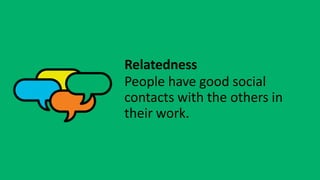
Relatedness
People have good social
contacts with the others in
their work.
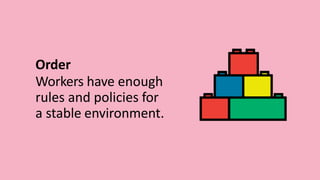
Order
Workers have enough
rules and policies for
a stable environment.
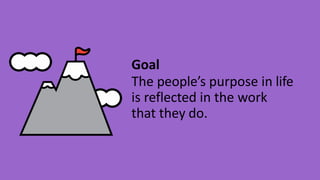
Goal
The people’s purpose in life
is reflected in the work
that they do.
Status
People have a good position
and are recognized by their
colleagues.
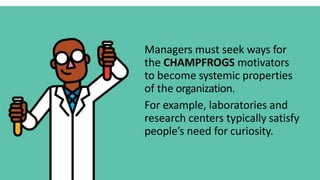
Managers must seek ways for
the CHAMPFROGS motivators
to become systemic properties
of the organization.
For example, laboratories and
research centers typically satisfy
people’s need for curiosity.
The goal of an organization is to
engage people for productivity.
Use your time to understand how
to make the organization a system
that engages people.
Manage the system,
not the people.

12 motivation and engagement