Alcohol, Tobacco, and
   Other Drugs: A
Community Concern

      Chapter 12
Introduction
• Use, misuse, and abuse of mind-altering
  substances predates recorded history
• Chronic alcohol and other drug abuse or
  dependence is regarded as destructive behavior
  in most cultures
• Affects individuals and the surrounding
  community
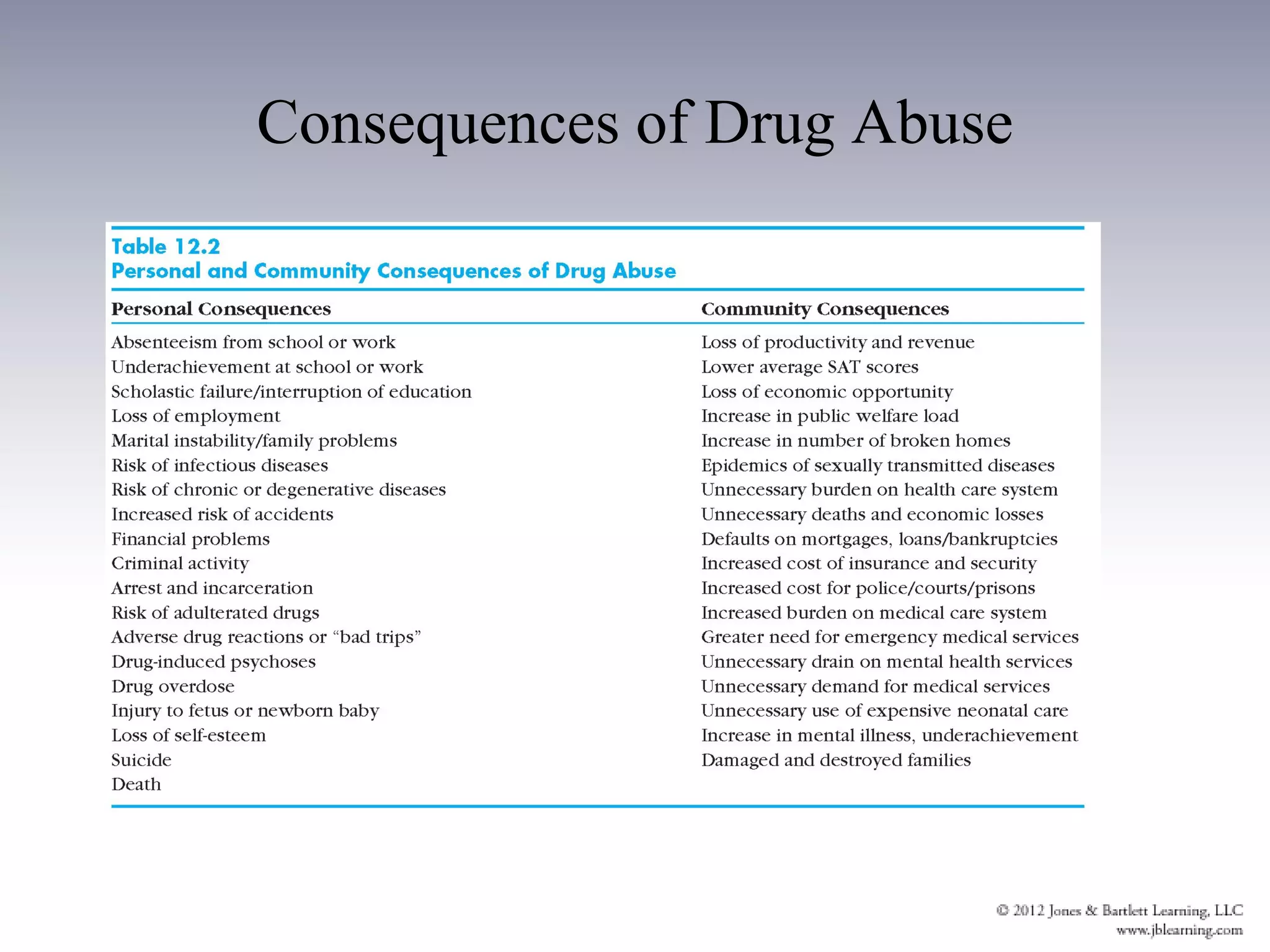
Consequences of Drug Abuse
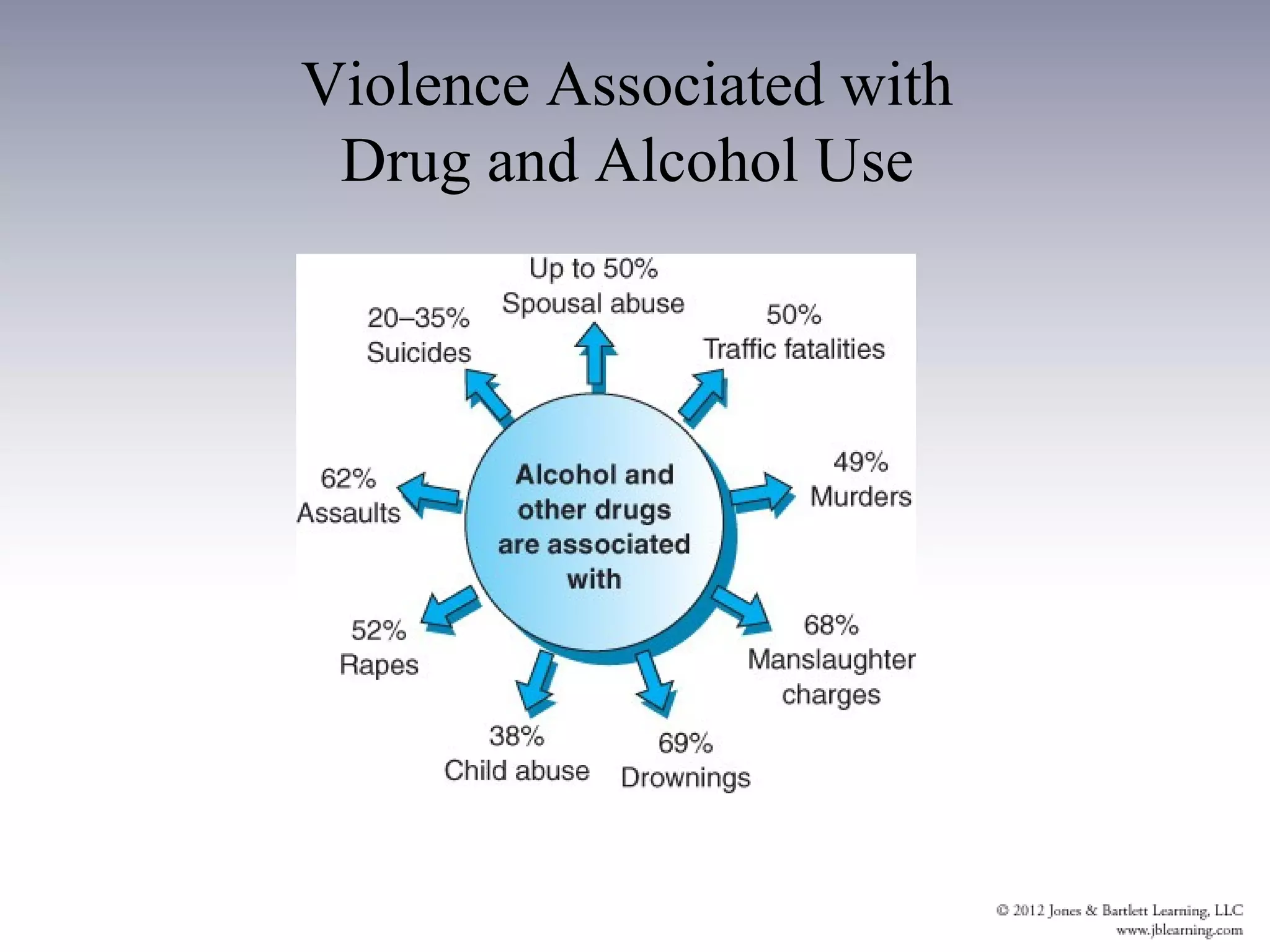
Violence Associated with
 Drug and Alcohol Use
Scope of the Current Drug Problem
• More deaths, illnesses, and disabilities can be
  attributed to substance abuse than any other
  preventable health condition
• Economic costs include direct costs (health
  care, premature death, impaired productivity)
  and indirect costs (crime and law enforcement,
  courts, jails, social work)
• Those abusing are threats to themselves, their
  families, and their communities
Definitions
•   Drug
•   Psychoactive drugs
•   Drug use
•   Drug misuse
•   Drug abuse
•   Drug dependence
Factors that Contribute to Alcohol,
      Tobacco, and Other Drug Abuse
• Risk factors – factors that increase the
  probability of drug use
• Protective factors – factors that lower the
  probability of drug use
• Both can be genetic or environmental
Inherited Risk Factors
• Most research related to drug dependence and
  inherited risk is on alcoholism
• Research has shown genetic and biological
  markers may predispose someone to increased
  susceptibility to develop alcohol-related
  problems
Environmental Risk Factors
•   Personal factors
•   Home and family life
•   School and peer groups
•   Sociocultural environment
Types of Drugs Abused and Resulting
                Problems
• Legal drugs
  • Alcohol, nicotine, nonprescription (over-the-
    counter) drugs, prescription drugs
• Illegal (illicit) drugs and controlled substances
  • Marijuana, narcotics, cocaine and crack
    cocaine, hallucinogens, stimulants, depressants,
    club drugs and designer drugs, anabolic drugs,
    inhalants
Legal Drugs
• Can be legally bought and sold in the
  marketplace
  • Includes drugs that can be closely regulated,
    likely regulated, and not regulated at all
Alcohol
•   Number one drug problem in the United States
•   Binge drinking
•   Underage drinking
•   Problem drinkers
•   Alcoholism
•   Blood alcohol concentration (BAC)
•   FAS
Nicotine
• Psychoactive and addictive drug present in
  tobacco products
• Synar Amendment
• Environmental tobacco smoke (ETS) or
  secondhand smoke
Over the Counter Drugs (OTCs)
• Legal drugs other than alcohol and tobacco
  that can be purchased without a physician’s
  prescription
• Carefully regulated by the Food and Drug
  Administration (FDA)
• Most only provide symptomatic relief, not a
  cure
• Subject to misuse and abuse
Prescription Drugs
• Can be purchased only with a physician’s
  prescription because they have serious side
  effects for some people
• Regulated by the FDA
• Over 4,000 prescription drugs available
• Subject to misuse and abuse
• Risk of dependence
• Risk of unintentional overdose
Controlled Substances and Illicit Drugs
• Those regulated by the Controlled Substances
  Act of 1970
     • Cannot be cultivated, manufactured, bought,
       sold, or used within the confines of the law
     • Schedule I – high potential for abuse; no
       accepted medical uses
     • Schedules II-V – have medical uses; scheduled
       based on potential for risk of dependence or
       abuse
     • Drug Enforcement Agency (DEA) responsible
       for enforcing Controlled Substances Act
Marijuana
• Products derived from hemp plant
• Most abused illicit drug in the U.S.
• Acute effects – reduced concentration, slowed
  reaction time, impaired short term memory,
  impaired judgment
• Chronic effects – damage to the respiratory
  system (if smoked), amotivational syndrome
Narcotics
• Opium and its derivatives, morphine and
  heroin, come from an oriental poppy plant
• Narcotics numb the senses and reduce pain
  • High potential for abuse
• Opium poppies do not grow in U.S.; drug
  trafficking problems
• Heroin addiction leads to significant
  community health problems
Cocaine and Crack Cocaine
• Cocaine is the psychoactive ingredient in the
  leaves of the coca plant
• Powerful and addictive euphoriant/stimulant
• Purified forms – salt (white powder), dried
  paste (crack)
Hallucinogens
• Produce illusions, hallucinations, changes in
  perceptions
• Synesthesia – mixing of the senses
• Both naturally derived and synthetic
• LSD, mescaline, peyote, mushrooms
Stimulants
• Drugs that increase the activity of the central
  nervous system
• Amphetamines
  • Schedule II prescription drugs; widely abused
  • Methamphetamines often made in clandestine
    labs
Depressants
•   Slow down the central nervous system
•   May lower anxiety and inhibitions
•   Tolerance develops
•   Strong physical dependence
•   Alcohol, barbiturates, benzodiazapines
Club Drugs and Designer Drugs
• Illicit drugs, primarily synthetic, most
  commonly encountered at nightclubs and raves
• MDMA (ecstasy) most popular club drug
• Rohypnol – “date rape” drug
• Designer drugs – synthesized by amateur
  chemists in secret labs
  • Constantly change design to stay ahead of law
    enforcement
Anabolic Drugs
• Protein-building drugs
• Anabolic/androgenic steroids, testosterone,
  human growth hormone
• Have some legitimate medical uses
• Sometimes abused by athletes and body
  builders
• Acute and chronic side effects
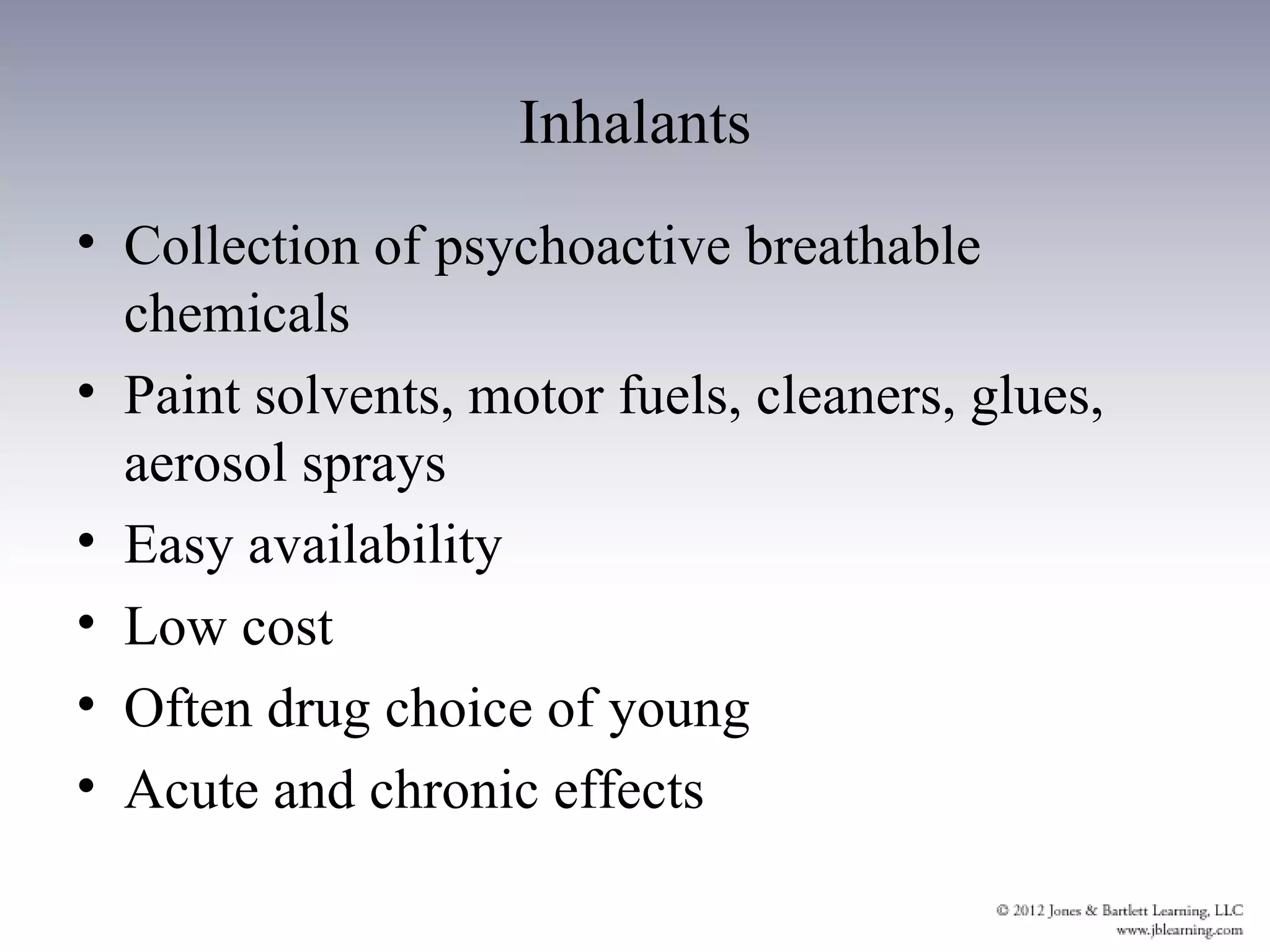
Inhalants
• Collection of psychoactive breathable
  chemicals
• Paint solvents, motor fuels, cleaners, glues,
  aerosol sprays
• Easy availability
• Low cost
• Often drug choice of young
• Acute and chronic effects
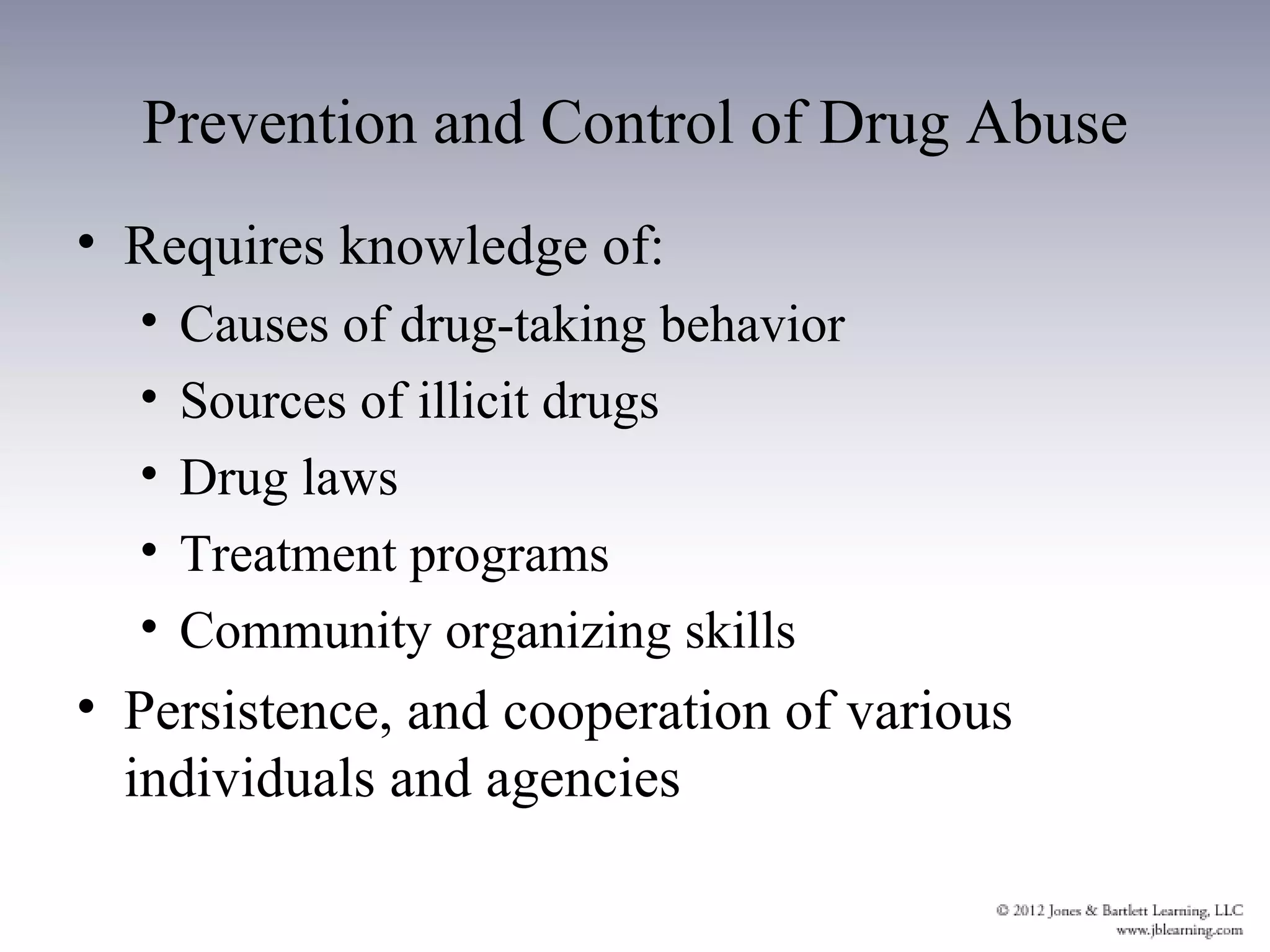
Prevention and Control of Drug Abuse
• Requires knowledge of:
  •   Causes of drug-taking behavior
  •   Sources of illicit drugs
  •   Drug laws
  •   Treatment programs
  •   Community organizing skills
• Persistence, and cooperation of various
  individuals and agencies
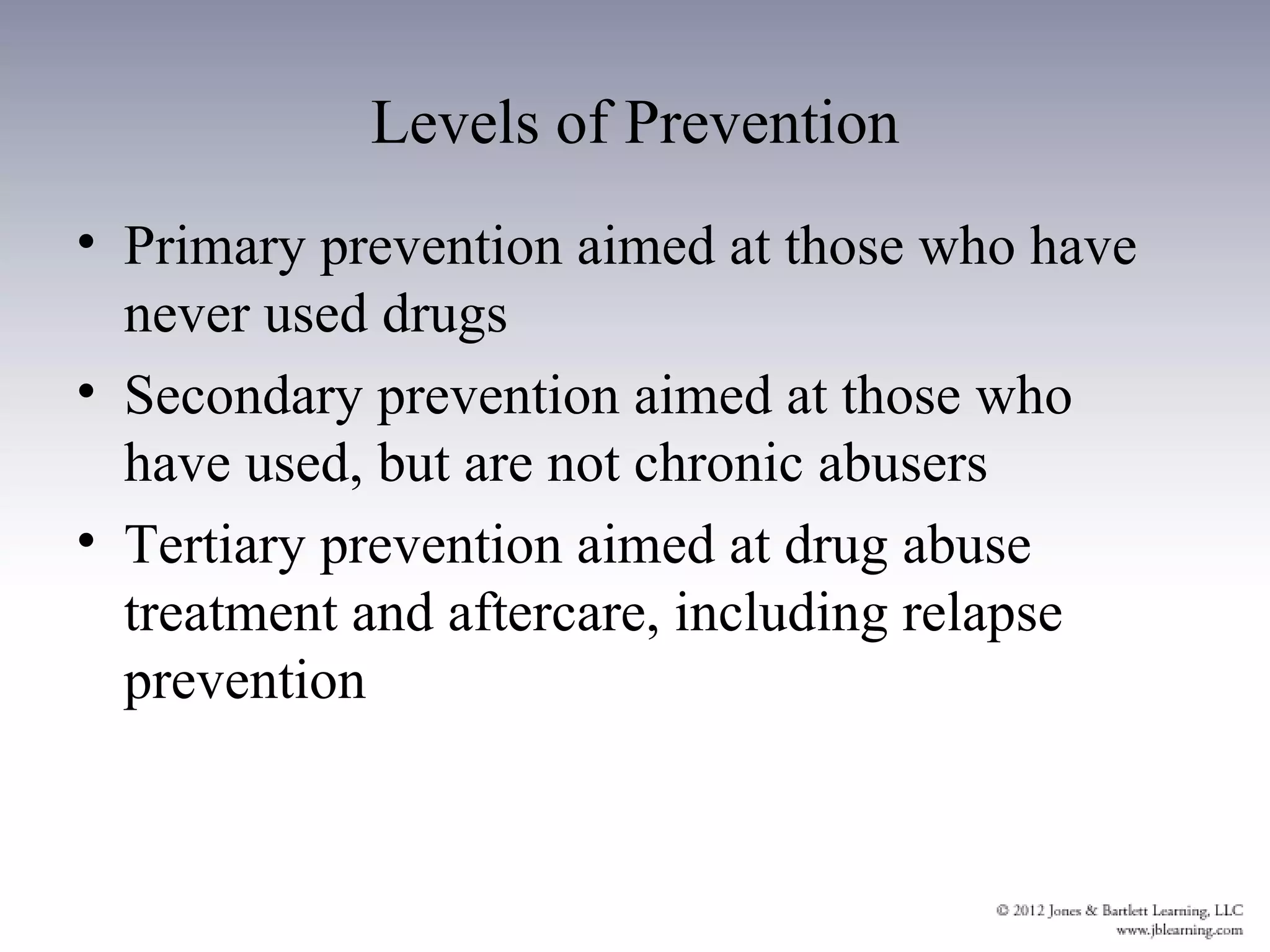
Levels of Prevention
• Primary prevention aimed at those who have
  never used drugs
• Secondary prevention aimed at those who
  have used, but are not chronic abusers
• Tertiary prevention aimed at drug abuse
  treatment and aftercare, including relapse
  prevention
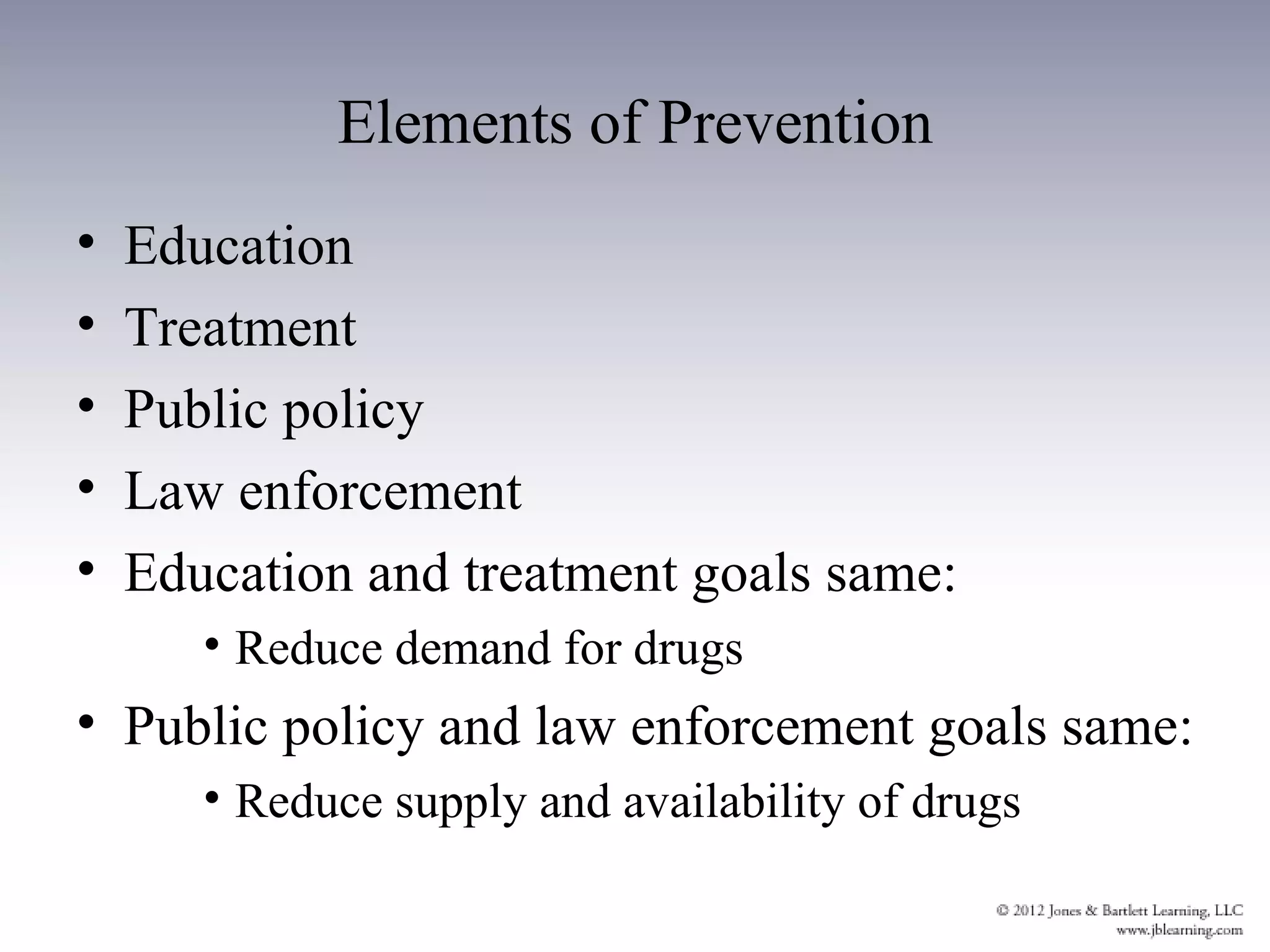
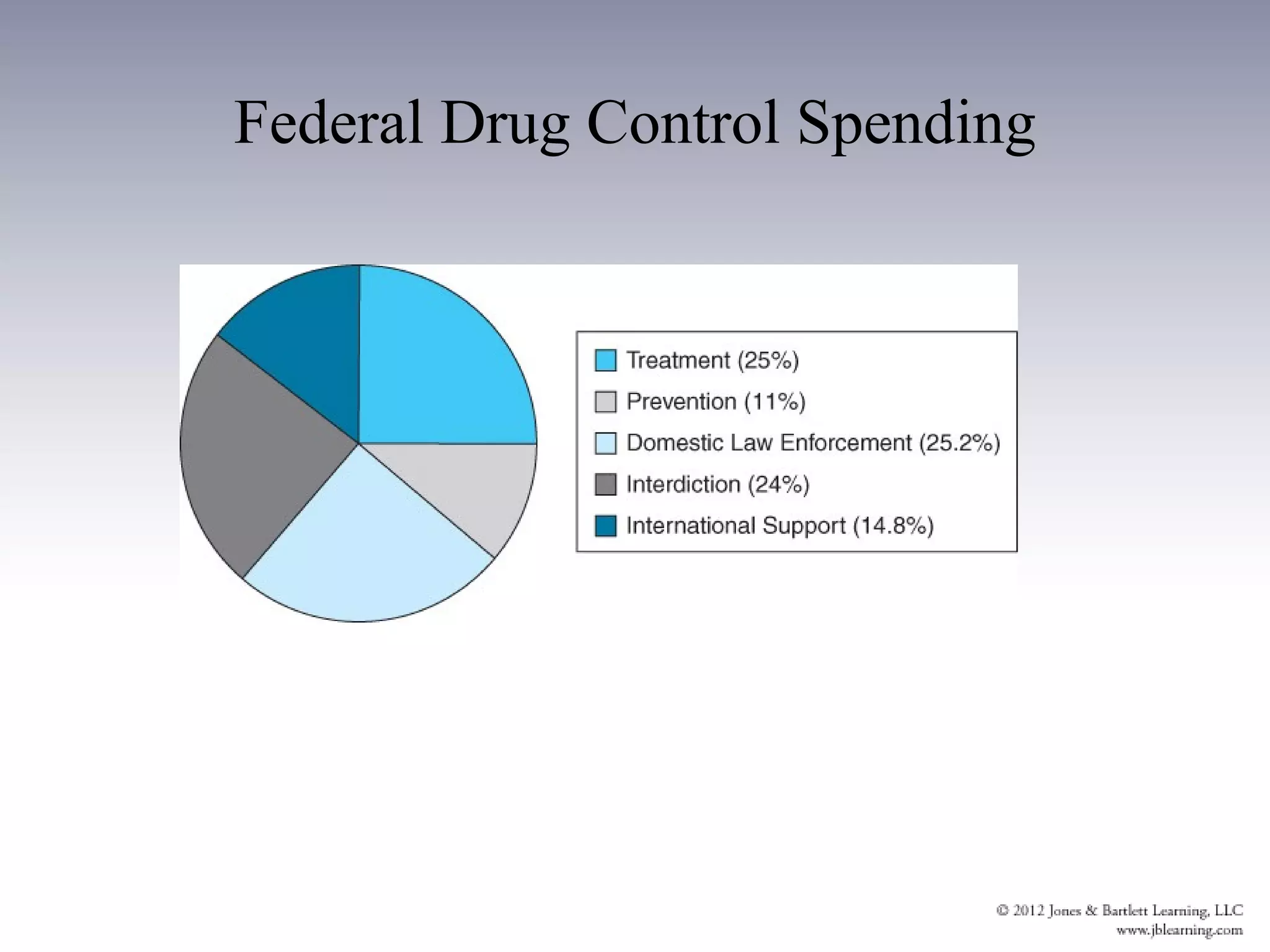
Elements of Prevention
•   Education
•   Treatment
•   Public policy
•   Law enforcement
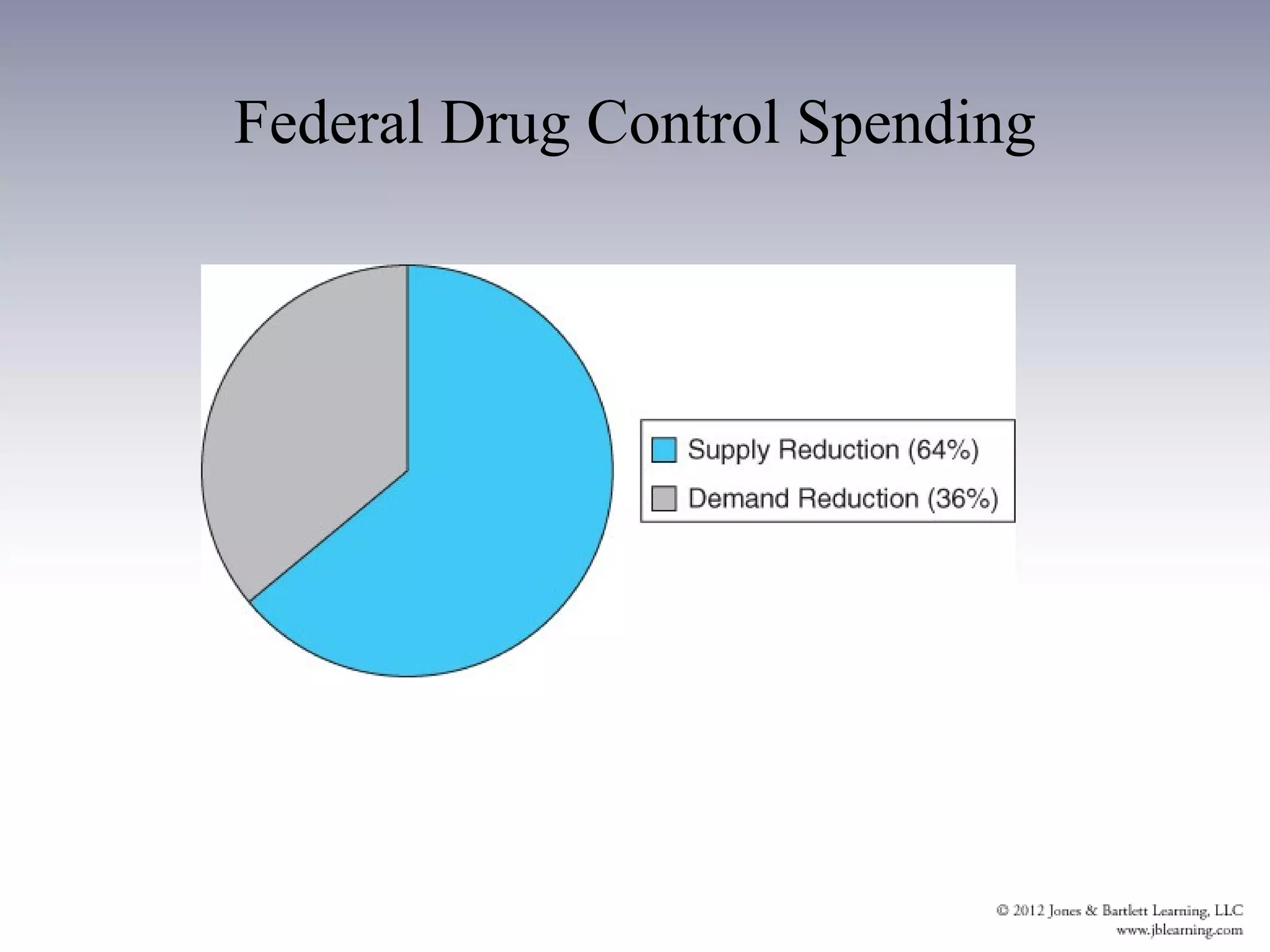
•   Education and treatment goals same:
       • Reduce demand for drugs
• Public policy and law enforcement goals same:
       • Reduce supply and availability of drugs
Governmental Drug Prevention and Control
        Agencies and Programs
• Include a multitude of federal, state, and local
  agencies
• Aim to reduce either the supply or demand for
  drugs
Federal Drug Control Spending
Federal Agencies and Programs
• Office of National Drug Control Policy
• Department of Health and Human Services
• Substance Abuse and Mental Health Services
  Administration (SAMSHA)
• National Institute on Drug Abuse
• Department of Homeland Security
• Department of Justice
• Bureau of Alcohol, Tobacco, Firearms, and
  Explosives (ATF)
State and Local Agencies and Programs
• State departments of health, education, mental
  health, justice, and law enforcement all
  address drug abuse prevention and control
  issues
• Some states have passed laws that conflict
  with federal laws
• Local communities have individuals, task
  forces, or agencies to prioritize problems and
  decide approaches for solving them
Nongovernmental Drug Prevention and
     Control Agencies and Programs
• Community-based drug education programs
• School-based drug education programs
     • DARE, student assistance programs, peer
       counseling programs
• Workplace-based drug education programs
     • Employee assistance programs
• Voluntary health agencies
Discussion Questions
• How can risk factors for drug abuse be utilized
  to aide in drug abuse prevention?

• How should federal, state, and local funds be
  used to successfully deal with drug abuse
  problems?

90110 pp tx_ch12

  • 1.
    Alcohol, Tobacco, and Other Drugs: A Community Concern Chapter 12
  • 2.
    Introduction • Use, misuse,and abuse of mind-altering substances predates recorded history • Chronic alcohol and other drug abuse or dependence is regarded as destructive behavior in most cultures • Affects individuals and the surrounding community
  • 3.
  • 4.
    Violence Associated with Drug and Alcohol Use
  • 5.
    Scope of theCurrent Drug Problem • More deaths, illnesses, and disabilities can be attributed to substance abuse than any other preventable health condition • Economic costs include direct costs (health care, premature death, impaired productivity) and indirect costs (crime and law enforcement, courts, jails, social work) • Those abusing are threats to themselves, their families, and their communities
  • 6.
    Definitions • Drug • Psychoactive drugs • Drug use • Drug misuse • Drug abuse • Drug dependence
  • 7.
    Factors that Contributeto Alcohol, Tobacco, and Other Drug Abuse • Risk factors – factors that increase the probability of drug use • Protective factors – factors that lower the probability of drug use • Both can be genetic or environmental
  • 8.
    Inherited Risk Factors •Most research related to drug dependence and inherited risk is on alcoholism • Research has shown genetic and biological markers may predispose someone to increased susceptibility to develop alcohol-related problems
  • 9.
    Environmental Risk Factors • Personal factors • Home and family life • School and peer groups • Sociocultural environment
  • 10.
    Types of DrugsAbused and Resulting Problems • Legal drugs • Alcohol, nicotine, nonprescription (over-the- counter) drugs, prescription drugs • Illegal (illicit) drugs and controlled substances • Marijuana, narcotics, cocaine and crack cocaine, hallucinogens, stimulants, depressants, club drugs and designer drugs, anabolic drugs, inhalants
  • 11.
    Legal Drugs • Canbe legally bought and sold in the marketplace • Includes drugs that can be closely regulated, likely regulated, and not regulated at all
  • 12.
    Alcohol • Number one drug problem in the United States • Binge drinking • Underage drinking • Problem drinkers • Alcoholism • Blood alcohol concentration (BAC) • FAS
  • 13.
    Nicotine • Psychoactive andaddictive drug present in tobacco products • Synar Amendment • Environmental tobacco smoke (ETS) or secondhand smoke
  • 14.
    Over the CounterDrugs (OTCs) • Legal drugs other than alcohol and tobacco that can be purchased without a physician’s prescription • Carefully regulated by the Food and Drug Administration (FDA) • Most only provide symptomatic relief, not a cure • Subject to misuse and abuse
  • 15.
    Prescription Drugs • Canbe purchased only with a physician’s prescription because they have serious side effects for some people • Regulated by the FDA • Over 4,000 prescription drugs available • Subject to misuse and abuse • Risk of dependence • Risk of unintentional overdose
  • 16.
    Controlled Substances andIllicit Drugs • Those regulated by the Controlled Substances Act of 1970 • Cannot be cultivated, manufactured, bought, sold, or used within the confines of the law • Schedule I – high potential for abuse; no accepted medical uses • Schedules II-V – have medical uses; scheduled based on potential for risk of dependence or abuse • Drug Enforcement Agency (DEA) responsible for enforcing Controlled Substances Act
  • 17.
    Marijuana • Products derivedfrom hemp plant • Most abused illicit drug in the U.S. • Acute effects – reduced concentration, slowed reaction time, impaired short term memory, impaired judgment • Chronic effects – damage to the respiratory system (if smoked), amotivational syndrome
  • 18.
    Narcotics • Opium andits derivatives, morphine and heroin, come from an oriental poppy plant • Narcotics numb the senses and reduce pain • High potential for abuse • Opium poppies do not grow in U.S.; drug trafficking problems • Heroin addiction leads to significant community health problems
  • 19.
    Cocaine and CrackCocaine • Cocaine is the psychoactive ingredient in the leaves of the coca plant • Powerful and addictive euphoriant/stimulant • Purified forms – salt (white powder), dried paste (crack)
  • 20.
    Hallucinogens • Produce illusions,hallucinations, changes in perceptions • Synesthesia – mixing of the senses • Both naturally derived and synthetic • LSD, mescaline, peyote, mushrooms
  • 21.
    Stimulants • Drugs thatincrease the activity of the central nervous system • Amphetamines • Schedule II prescription drugs; widely abused • Methamphetamines often made in clandestine labs
  • 22.
    Depressants • Slow down the central nervous system • May lower anxiety and inhibitions • Tolerance develops • Strong physical dependence • Alcohol, barbiturates, benzodiazapines
  • 23.
    Club Drugs andDesigner Drugs • Illicit drugs, primarily synthetic, most commonly encountered at nightclubs and raves • MDMA (ecstasy) most popular club drug • Rohypnol – “date rape” drug • Designer drugs – synthesized by amateur chemists in secret labs • Constantly change design to stay ahead of law enforcement
  • 24.
    Anabolic Drugs • Protein-buildingdrugs • Anabolic/androgenic steroids, testosterone, human growth hormone • Have some legitimate medical uses • Sometimes abused by athletes and body builders • Acute and chronic side effects
  • 25.
    Inhalants • Collection ofpsychoactive breathable chemicals • Paint solvents, motor fuels, cleaners, glues, aerosol sprays • Easy availability • Low cost • Often drug choice of young • Acute and chronic effects
  • 26.
    Prevention and Controlof Drug Abuse • Requires knowledge of: • Causes of drug-taking behavior • Sources of illicit drugs • Drug laws • Treatment programs • Community organizing skills • Persistence, and cooperation of various individuals and agencies
  • 27.
    Levels of Prevention •Primary prevention aimed at those who have never used drugs • Secondary prevention aimed at those who have used, but are not chronic abusers • Tertiary prevention aimed at drug abuse treatment and aftercare, including relapse prevention
  • 28.
    Elements of Prevention • Education • Treatment • Public policy • Law enforcement • Education and treatment goals same: • Reduce demand for drugs • Public policy and law enforcement goals same: • Reduce supply and availability of drugs
  • 29.
    Governmental Drug Preventionand Control Agencies and Programs • Include a multitude of federal, state, and local agencies • Aim to reduce either the supply or demand for drugs
  • 30.
  • 31.
  • 32.
    Federal Agencies andPrograms • Office of National Drug Control Policy • Department of Health and Human Services • Substance Abuse and Mental Health Services Administration (SAMSHA) • National Institute on Drug Abuse • Department of Homeland Security • Department of Justice • Bureau of Alcohol, Tobacco, Firearms, and Explosives (ATF)
  • 33.
    State and LocalAgencies and Programs • State departments of health, education, mental health, justice, and law enforcement all address drug abuse prevention and control issues • Some states have passed laws that conflict with federal laws • Local communities have individuals, task forces, or agencies to prioritize problems and decide approaches for solving them
  • 34.
    Nongovernmental Drug Preventionand Control Agencies and Programs • Community-based drug education programs • School-based drug education programs • DARE, student assistance programs, peer counseling programs • Workplace-based drug education programs • Employee assistance programs • Voluntary health agencies
  • 35.
    Discussion Questions • Howcan risk factors for drug abuse be utilized to aide in drug abuse prevention? • How should federal, state, and local funds be used to successfully deal with drug abuse problems?