УДК 811.11(075.3)
ББК 81.2Англ-922
Н55
Рекомендовано Міністерством освіти і науки України
(Наказ М О Н України від 07.02.2014 № 1 2 3 )
Видано за рахунок державних коштів. Продаж заборонено
Наукову експертизу проводив Центр наукових досліджень
та викладання іноземних мов НАН України.
Експерт Ільченко О.М., доктор філологічних наук, професор,
заступник директора з наукової роботи.
Психолого-педагогічну експертизу проводив Інститут педагогіки
НАПН України.
Експерт Алексеенко І.В., молодший науковий співробітник
лабораторії навчання іноземних мов.
Незалежні експерти:
Марк Форхенд, завуч Мовної школи «Міжнародний Дім», м. Київ
Відповідальні за підготовку підручника:
Коваленко ОН., головний спеціаліст департаменту загальної середньої
та дошкільної освіти МОН України;
Шопулко М.Н., методист вищої категорії відділу науково-методичного
забезпечення змісту освіти основної і старшої школи
Інституту інноваційних технологій і змісту освіти МОН України.
Несвіт А. М.
Н55 Англійська мова (6-й рік навч.): підруч. для 6 кл.
загальноосвіт. навч. закл. / А.М. Несвіт. - Київ: Гене-
за, 2014. - 224 с.
ІБВЦ 978-966-11-0424-1.
Підручник «АНГЛІЙСЬКА МОВА» створений відповід­
но до нової програми з іноземних мов (2012 р.) і рекомен­
дований для оволодіння англійською мовою в 6-му класі
загальноосвітніх навчальних закладів (шостий рік навчан­
ня). Він є складовою навчально-методичного комплекту і
продовжує серію НМК автора А.М. Несвіт.
Підручник побудовано на принципах комунікативності,
інтегрованого розвитку чотирьох видів мовленнєвої діяль­
ності: аудіювання, говоріння, читання і письма. У ньому
дотримано загальнодидактичні принципи посильності, ло­
гічності, доступності, активності та наочності у навчанні.
УДК 811.11(075.3)
ББК 81.2Англ-922
©Алла Несвіт, 2014
©Видавництво «Генеза»,
оригінал-макет, 2014ISBN 978-966-11-0424-1
Любі діти!
Гучний шкільний дзвінок уже покликав вас
за парти, а в пам’яті ще зберігаються сповнені
радощів дні літніх канікул, нові друзі,
дивовижні відкриття та цікаві місця, про які
----розповідають фотографії, сувеніри й листівки.
У цьому навчальному році, працюючи з
навчальним матеріалом розділу 1, ви навчитеся
описувати зовнішність своїх рідних та розповідати
про їхні риси характеру. Тато й мама, брати й
сестри, бабусі та дідусі - це найрідніші люди, до яких ви завжди
можете прийти зі своїми перемогами та поразками, яким завжди
можете відкрити свої щирі душі.
Також ви дізнаєтеся про різні види магазинів, товари, які в них
продаються, та навчитеся спілкуватися під час відвідування
магазинів (розділ 2). Вивчаючи розділ 3, ви навчитеся розповідати
про особливості харчування у вашій родині, про свої улюблені
рецепти домашніх страв.
Спорт загартовує організм і характер, додає впевненості у своїх
силах. Про літні та зимові види спорту, необхідність тренувань,
спортивні захоплення ваших ровесників ви прочитаєте в розділі 4.
Життя цікаве, тому що можна подорожувати та пізнавати нове.
Про різні види подорожей, про підготовку до відвідування іншого
міста чи країни ви дізнаєтеся в розділі 5.
Із цього підручника ви отримаєте інформацію про столицю
Великої Британії, місто Лондон, про її визначні місця та культурні
пам’ятки (розділ 6). А також ви навчитеся розповідати про столицю
України - місто Київ та визначні місця, які й донині зберігають
пам’ять про життя у давнину та відомості про культурну спадщину
українців (розділ 7).
Звичайно, ваші будні - це шкільне життя, спілкування з учите­
лями та ровесниками, можливість пізнавати нове на кожному
уроці. Розділ 8 стане підсумковою сходинкою в опрацюванні про­
грами для 6 класу. Ви навчитеся розповідати про ваші улюблені
шкільні предмети. У підручнику також подано граматичний довід­
ник та англо-український словник.
Бажаємо, щоб кожен урок за нашим підручником додавав вам
упевненості у своїх силах та допомагав відчути радість спілкування
англійською мовою.
З повагою,
Алла Несвіт
З
illn|fti^[Î!JÆtii:©;iîi,
Welcome Back!
talk about the first day at
school;
read the dialogue about summer
holidays;
listen to a dialogue;
write a paragraph about your
summer holidays;
revise question words and types
of questions; the Past Simple
Tense.
!> > Lessons g - 2.
1. Look at the pictures. Ask and answer the questions. Use the words in the box
given below.
• to meet in the school yard • to greet a new pupil in class •
to play in the playground • to greet a teacher •
• Where are the children?
• Do they know each other?
• What are they doing?
2. Listen and read the dialogue. Then match it with one of the pictures in Ex. 1.
Ann: Hi, Jane! How are you?
Jane: Hi, Ann! I ’m fine, thanks. Where did you spend your summer
holidays?
o 5
o o o
•. o
Ann: I went to the seaside with my parents. And you?
Jane: I visited my grandparents in Yaremcha.
Ann: Did you enjoy your time there?
Jane: Yes, I did. I took a lot of photos. Come and see them one day!
Ann: Oh, look! Our classmates are coming.
Jane: Let’s go and meet them!
3. Agree or disagree.
1. The girls don’t know each other very well.
2. Both girls had a nice summer.
3. Ann took lots of photos in summer.
4. Match the words in the box to their definitions.
• seaside • classmates • holidays • summer •
1. The period of time when schoolchildren have a rest.
2. The season of the year when it is the warmest.
3. A place by the sea where people go on holiday.
4. Pupils who study in the same group.
5. Complete the sentences with the words from the dialogue of Ex.2.
1. What are the longest school..... ?
2. A ll m y ..... are interesting people.
3. Have you enjoyed your trip to the ..... ? - Yes, I have. I swam
in the sea almost all day long.
4. My favourite season i s ....... I have my birthday in July.
''pTammar Lab: Articles^WOb °
(See Grammar Reference pp. 181-182)
6. a) Complete the sentences with the necessary articles a I an, 0 or the.
b) Look at the picture on page 7 and describe it.
Today is ..... first of September........children are in ....... school
yard. They a re .....happy.........teachers meet them before...... lessons.
Look at Dan! He has got ..... bunch of flowers in ..... his hands.
..... flowers are for Miss Alison.
Look at Ann! She has got ..... new school bag in her hand........
school bag is pink and white.
o . •
O O o
'ponversatiorTLab: Agree or Disagre^/f^T £
7. Work in pairs. Act out the dialogues as in the examples.
A: Did you visit your granny in A: Have you been to London in
summer? summer?
B: Yes, I did. B: No, I haven’t.
1. you / to help your grandparents / Yes
2. you / to read a lot of books / No
3. you / to buy lots of souvenirs / Yes
4. you / to be in the youth camp / No
8. Write a paragraph about your summer holidays for a school newspaper.
Include the following:
• where you went;
• who you went with;
• what you did there;
• what you liked / didn’t like about your trip.
o 7
o talk about your fam ily and
friends; describe people’s
appearance and character,
their interests;
o read about a fam ily tree
project;
o listen to a dialogue with
personal information;
o write a story about your sister /
brother / friend;
o revise comparative and
superlative degrees of
adjectives; the Present Simple
Tense, the Present Continuous
1. Work in pairs. Talk with your friend.
1. How many people are there in your family?
2. Have you got any brothers or sisters?
3. How do you get on with them?
4. Would you like to have a larger or a smaller family? Why?
Why not?
5. What traditions have you got in your family?
2. Listen, read and say which family looks like yours.
Different Families, Different Lives
1. I ’m Olha. I ’m new to Kyiv. My father has a new job here. He likes
his job. I ’m from Kharkiv. I miss my native city! My grandparents
live in Kharkiv, so I only see them in the holidays. Two of my cousins
live in Kyiv and I see them at the weekend.
I go to a new school. I’m in the sixth form. My classmates are
really nice. I’ve got a younger brother. He is five. He doesn’t go to
school. He goes to the kindergarten. I like music and dancing.
2. My name is John. I’m 12 years old and I ’m in Year 6. My favourite
subjects are English and Drama. I ’ve got two brothers and a sister.
W e live with my mum and dad in London. I love travelling. My
parents were born in Edinburgh, so we’ve got lots of relatives in
Scotland. We go there once or twice a year to stay with my aunt and
10 ,o o
o
o . •
O O O
o o
uncle. I’ve got three cousins. Robert and me are of the same age.
Mark is two years younger, and Alice is the oldest one. She is 20, and
she is a student. I love my family.
3. Agree or disagree with the sentences. Correct the false ones.
E xam ple:
Olha lives in Ukraine. True.
. • ■ ”
1. Olha lives in Ukraine.
2. John’s family originally came from Bozeman, a town in the
USA.
3. John spends a lot of time with his cousins.
4. Olha likes her new city.
4. Work in pairs. Student A answers questions 1-6 for the first text of Ex. 2.
Student B answers questions 1-6 for the second text of Ex. 2.
1. What is his / her name?
2. Where does he / she live?
3. What’s his / her native city?
4. Who does he / she live with?
5. Who does he / she visit in his / her native city?
6. How many brothers / sisters does the person have?
5. Work in pairs.
a) Write a list of questions to interview your friend about his / her close family.
b) Ask each other questions about your families.
6. Write a paragraph about your family. Use the plan given below and Ex. 2 as
an example. Include the following:
• write your name and age;
• give information about your family members;
• include information about your hobbies;
• write something about the school where you study.
11
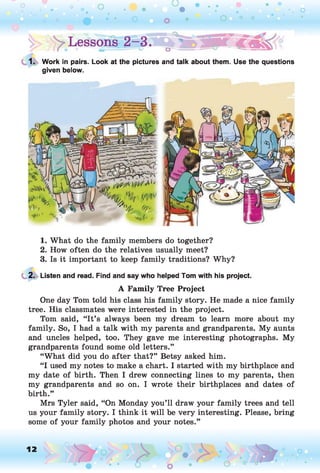
1. Work in pairs. Look at the pictures and talk about them. Use the questions
given below.
1. What do the family members do together?
2. How often do the relatives usually meet?
3. Is it important to keep family traditions? Why?
2. Listen and read. Find and say who helped Tom with his project.
A Family Tree Project
One day Tom told his class his family story. He made a nice family
tree. His classmates were interested in the project.
Tom said, “It’s always been my dream to learn more about my
family. So, I had a talk with my parents and grandparents. My aunts
and uncles helped, too. They gave me interesting photographs. My
grandparents found some old letters.”
“What did you do after that?” Betsy asked him.
“I used my notes to make a chart. I started with my birthplace and
my date of birth. Then I drew connecting lines to my parents, then
my grandparents and so on. I wrote their birthplaces and dates of
birth.”
Mrs Tyler said, “On Monday you’ll draw your family trees and tell
us your family story. I think it will be very interesting. Please, bring
some of your family photos and your notes.”
12 ,o o
o
o . •
O O o
3. Read the text of Ex. 2 again and order the sentences.
___ A Ask your relatives for some interesting photographs.
___ B Try to find old letters.
___ C Talk to your parents and grandparents.
___ D Use your notes to make a chart.
___ E W rite your birthplace and date of birth.
4. Look at the picture of a family tree on page 14 and talk about Mrs Tyler’s
relatives. Use the prompts given below.
1....... are Mrs Tyler’s parents.
2 ..... are Mrs Tyler’s grandparents.
3 ..... aunt and uncle.
4 ..... cousins.
5 ..... a sister and a brother.
6 ..... nieces and nephews.
7 ..... wife.
8 ..... husband.
o O, 13
o
о о о
•. о
О О о ] ° о
John
Mrs and Mr Tyler
Mrs and Mr Marks
Mr and Mrs Johnson
Alice Tom
Mrs and Mr Johnson Mr and Mrs Gilbert
ram п ІЦ т ^ ^
Read and compare.
Old —older (старший за віком) - the oldest (найстарший за віком)
Old —elder (старший за народженням у родині) - the eldest (най­
старший у родині)
1. Mary is two years older than
Jim. / Mary is older than
Jim by two years.
2. My granddad is the oldest
member of the family.
1. There are three children in
our family. My elder brother
is Tom. My elder sister is
Kate. Steve is the eldest
child.
My elder sister is three years older than me. Maria is the eldest
daughter. (Вона раніше всіх народилася.) Helen is the oldest child,
(їй найбільше років.)
14 .О о
О
C 5. Choose the correct item to complete the sentences.
1. Ann’s older / elder sister lived in Great Britain last year.
2. Whose grandmother is older / elder - yours or Ivan’s?
3. Victoria is the oldest / eldest student in our class.
4. Is Peter your older / elder or younger brother?
5. My uncle is the oldest / eldest member of the family.
6. My cousin is two years older / elder than me.
'vConversation Lab j ^
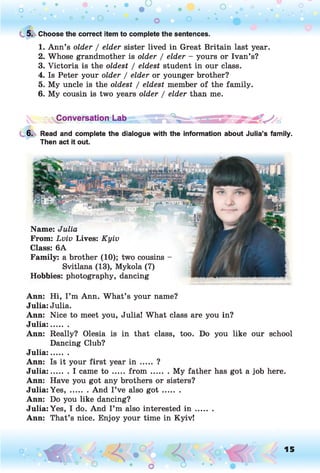
6. Read and complete the dialogue with the information about Julia’s family.
Then act it out.
Name: Julia
From: Lviv Lives: Kyiv
Class: 6A
Family: a brother (10); two cousins -
Svitlana (13), Mykola (7)
Hobbies: photography, dancing
Ann: Hi, I ’m Ann. What’s your name?
Julia: Julia.
Ann: Nice to meet you, Julia! What class are you in?
Julia:.......
Ann: Really? Olesia is in that class, too. Do you like our school
Dancing Club?
Julia:.......
Ann: Is it your first year in ..... ?
Julia:....... I came to .......fro m ......... My father has got a job here.
Ann: Have you got any brothers or sisters?
Julia: Y e s ,....... And I’ve also g o t .........
Ann: Do you like dancing?
Julia: Yes, I do. And I’m also interested i n .......
Ann: That’s nice. Enjoy your time in Kyiv!
o O, 15
O
o o o
•. o
O 0 0
. He / She is from
y Lessons < m k!(
1. Work in pairs. Think of the ideas to complete the sentences. What makes
a good parent (student A) and a good child (student B)? Compare your lists.
Explain your choice.
1. A good parent is someone who:
- thinks about the child;
- talks to the child;
2. A good child (son or daughter) is someone who:
- respects his/her parents;
- helps about the house;
• • O O
( 7. Write about your friend’s family. Start like this:
I ’ve got a new friend. His / Her name is
.. , but he / she is living in ..... now.
2. Work in two groups. Read the stories on pages 16-17 and order the state'
ments (A-E) given below.
___ A Personal interests
___ B Appearance
___ C What we do together
___ D Introduction
E Character
Group A
My Father
This is a photo of my father. He’s got a round
face. His eyes are grey. He is handsome. He is
friendly and kind-hearted.
My father loves making models of planes. He is
also fond of sports. His favourite sport is football.
We often play together at the weekend. My dad
enjoys reading and fishing.
I think that my father is the best.
16
O
O
O 0
o
Group B
My Mother
This is a photo of my mum. She is a pretty
woman. She’s got blue eyes and a nice smile. She
is kind and hard-working.
My mother loves cooking and knitting. She also
loves gardening. W e’ve got a lot of flowers both
in our flat and in our country house.
My mum understands me. We always talk about
my school life and my friends. I often ask my
mum for advice.
3. Work in groups. Talk about your father and mother. Use the statements in
Ex. 2 as a plan. Answer your friends’ questions.
Reading Lab S B S S U f c
4. Work in pairs. Take turns to ask and answer the questions in the table on
page 18.
E xam ple:
A: How many sisters and brothers do you have?
B: I have one elder sister and two younger brothers. What about you?
A: I am the only child in the family. I don’t have any sisters and
brothers.
o O, 17
O
Questions You Your Friend
• How many sisters and brothers
do you have?
• Is it better to be the eldest,
youngest or the middle child?
Why?
5. Read Inna’s story about her sister Maria. Find the sentences to describe the
pictures given below.
My Lovely Sister
My name is Inna. I am the third daughter in my family. I have one
older brother and one older sister.
My sister’s name is Eva. I think she is my best friend. I like her
because she is a helpful person. She always helps me with my home­
work. Besides, she is a good listener too. She always listens to my
school stories. She gives me advice on how to solve my problems.
Eva is a good cook. When I am hungry, she always cooks some
delicious food. Not only that, my sister is a kind person. Sometimes
she makes me laugh at her jokes. That’s why I love her very much.
6. Work in pairs. Ask and answer the questions.
1. How many children are there in that family?
2. Who is Inna’s best friend?
3. What is Eva like?
4. What do the girls do when they are together?
18
►What are linkers?
Linkers are words that connect ideas in a text logically.
►When do we use them?
When you describe a person, a place or a thing, use them to list
facts, link events across time, compare and contrast ideas, etc.
Here are some examples:
To list some points: To give reasons why:
Besides, ..... That’s w h y .....
Not only that, ..... , ..... , s o ...../ .........because.........
Sometimes...../ A ls o .........
7. Work in groups. Look through Inna’s story in Ex. 5 again. Use the notes to
write Eva’s sentences about Inna. Start like this:
My sister Inna i s ....... She always.........Sometimes she.........She
also....... Besides,........ When we are together.........
1. Always asks me to help her with her homework.
2. Tells me about her friends and school life.
3. Solve her problems together.
4. A good eater.
5. Listens to my funny stories.
8. Write a story about your brother or sister, or a friend. Use the text in Ex. 5 as
1. Work in groups. Take turns to read an opinion, respond and add information.
E xam ple:
I t ’s good to live in a large family.
A :I think so, too. Brothers and sisters can help each other.
B: Large families are usually very friendly. They spend a lot of
time together.
1. It’s great to have a sister or a brother.
2. It is very good to be the youngest child in the family.
y Lesson 6. ► o
*
19
O
C. 2. Read the text and say whether it gives a clear description of aunt Liudmyla.
Aunt Liudmyla
K ate: I like my aunt Liudmyla the most. She
has thick straight brown hair and dark brown
eyes. She’s got a nice smile.
She’s very helpful. I can always ask her for
advice.
My aunt likes reading, gardening and she
often takes long walks. She is a very active per­
son. She is very kind-hearted. She doesn’t like it
when people do not agree with her.
I would like to be like my aunt.
3. Work in pairs. Take turns to ask and answer the questions.
1. Who in her family does Kate like the most?
2. What does Kate’s aunt look like?
3. What does the girl like most about her aunt?
4. What kind of a person is the woman?
' vv £ ° nversatiord -ab
4. Speak in class. Talk about your aunt or uncle. Use the words in the tables to
help you.
Face
My aunt has got a (an) happy face.
My uncle sad
oval
round
Character
My aunt is kind-hearted, but he/she i s .....
My uncle is not polite,
My mother’s sister intelligent,
My father’s brother brilliant,
smart,
talented,
energetic,
charming,
patient,
o .•
O O O
Likes and Dislikes
Hobby Sport Food Pets
gardening running grapes dogs
sewing football strawberries cats
knitting jogging kiwi fruit fish
fishing basketball pineapples birds
5. a) Write a few sentences about your relatives.
b) Work in pairs. Your friend must respond to each sentence with another
sentence.
E xam ple:
A: My aunt is very helpful.
B: Do you often ask her for advice?
A: Yes, I do.
6. Write a paragraph about your aunt or uncle. Use Ex. 2 as a model.
Include the following: a face, a character, likes and dislikes.
Say what you like most about this person.
|> > L e s s o n s y - 8 . Ceskl'
1. a) Listen to the opinion. Then listen to the responses. Say who you agree
with. Present your own opinion.
E xam ple:
A: Relatives are more important than friends.
B: I think so, too. Family members are our dearest people in the
world. We must support each other.
C: I don’t think so. You can choose your friends, but you can’t
choose your family.
1. It’s good to be the only child in the family.
2. Brothers and sisters must always help and support each other.
b) Work in pairs. Agree or disagree with the statements. Explain your point of
view.
o 21
o o o
•. o
O
t 2. Read Dan’s email to his penfriend. What are the names of people in the photo
he attached.
From: Dan dan@inet.com
13 To: Alex alex@inet.com
Subject: My Friends
Attached: Dan’s Friends.JPG (328KB)
H i Alex,
Here is a photo of me and my friends! A good-looking boy on
the right is me, of course! I ’m very cheerful, but sometimes lazy.
The boy in the middle is my friend Oles. His hair is blond! Oles
has a good sense of humour. We are never bored when we are
together. The girl with the long hair is Natalie. She’s nice, but
she can be bossy sometimes. She’s very clever and helps us a lot
at school. Maria’s the one with the shorter dark hair. She is
really funny. And finally, there’s my friend Vira. She’s the one
with long fair hair.
That’s all for now. Don’t forget to send me a picture of you
and your friends.
Dan -I
22
C 3. Ask and answer the questions.
1. Who is Dan writing an email to?
2. What are Dan’s friends’ names?
3. Where are the friends in the photo?
4. What does Dan write about his friends?
4. Look at the children in the photo and describe their appearance. What do you
think the children’s characters are like? Use the phrases given below.
1.......is re a lly ..... 5. ......is extremely ...
2. ...... looks ..... 6. ...... has got quite ..
3. ...... looks like a ..... 7. ...... looks as i f .....
4. ......is rath er.....
Conversation Lab
5. Work in groups. Talk about different kinds of people. Use the words in the
table on page 24. Start like this:
All people are very different in their character. My friends are cheer­
ful, sociable and caring. I don’t like to talk to moody and gloomy people.
Etc.
o O , 23
O
Positive Qualities Negative Qualities
sociable moody
cheerful greedy
patient gloomy
caring strict
having a good sense of humour curious
intelligent lazy
6. Read, complete and write down the sentences. Use the words: energetic,
polite, charming, patient, kind-hearted, brilliant, smart, talented.
1. My cousin is v e r y ....... He always says “please” and “thank
you” .
2. Our neighbour’s son is v e r y ....... He gets only excellent marks
at school.
3. Their children are v e r y ....... They can sing beautifully.
4. They are a(n) ..... family. They play sport every weekend.
5. Miss Alison is a(n) ..... and ..... teacher. She never shouts at
her pupils.
6. My aunt is a(n) ..... lady. Everybody likes her immediately.
7. Clark is a(n) ..... student. He reads books every day.
7. Write a short story about your friend. Describe the person’s appearance and
character. Why is this person special for you?
< * »
^>Lesson°9. Grammar
1. a) Work in pairs. Take turns to ask and answer the questions in the table on
page 25. Add information.
b) Speak in class. Tell your classmates about your friend’s relatives.
E xam ple:
A: How many relatives have you got?
B: I have got two aunts and three uncles. They live in different
parts of Ukraine. Two uncles live in Kyiv, the capital of
Ukraine. One uncle lives in Zaporizhzhia. My two aunts live in
Lviv.
o . •
O O O
Questions You Your Friend
• How many relatives have you got?
• How often do you meet them?
• How old is your oldest aunt
(uncle, cousin, etc.)?
• How old is your youngest aunt
(uncle, cousin, etc.)?
• What are your family traditions?
• Does your family honour them?
2. Complete the sentences with the correct tense form of the verbs.
1. A: Where ..... (to be) Steve now?
B: He ..... (to look) at the photos we brought from Great
Britain.
2. Sandra..... (to be) very generous. She always .....(to bring) me
presents, when she ..... (to travel) to other countries.
3. W h y .....(to be) the dog so quiet today? He always...... (to bark),
when h e ..... (to see) the postman.
4. Look, Jane! I ..... already ..... (to buy) some new CDs........you
..... (to want) to listen to them?
5. A: Hi, Brian! Can I speak to Laura, please?
B: Sorry, sh e..... (to have) a shower now.
6....... y o u ....... (to watch) that programme together yesterday?
3. Put the verbs into the Present Simple, the Present Continuous, the Past
Simple or the Future Simple tenses.
1. J u lia ..... (to sew) a button on her blouse now.
2. Betty and Sandra ..... (to visit) their relatives in London next
summer.
3....... y o u ....... (to know) how to vacuum the carpet?
4. Can yo u .....(to help) your sister to decorate a house for a birth­
day party?
5. They.....(to be) tired yesterday. They......(to work) in the garden.
6. The girls .....(to sweep) the floor two days ago.
~ nConversation Lab ^
4. Work in pairs. Read and order the sentences to make a dialogue. Act it out.
- OK. My father is a businessman. He works for a TV
company.
o O , 25
O
O O O
•. o• - • . .
• • O o • o 0 0
- Are you the only child in the family?
- Yes, I do. W e always help each other and never argue.
- Hi, Mark! I know nothing about your family. Tell me
about your parents, please.
- No, I ’m not. I have got an elder brother. He is nearly 19.
- Really? And what about your mother?
- My mother is a cook. She works in a restaurant.
- Do you get on well with him?
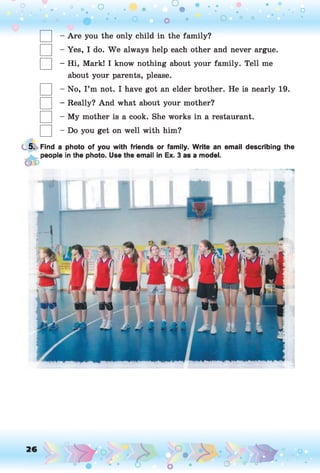
5. Find a photo of you with friends or family. Write an email describing the
S§.e^ 'assessmen* •
Think of your records. Decide how well you know it:
4 = very well, 3 = OK, 2 = a little, 1 = needs to improve
Skills Now I can... 4 3 2 1
• give a simple description or presentation
of people
□ □ □ □
• describe people’s appearance and charac­
ter
□ □ □ □
{J • talk about people’s likes and dislikes □ □ □ □
• ask for / present information about my
friend’s family □ □ □ □
• catch the main point in clear simple mes­
sages
□ □ □ □
( • understand and extract the essential □ □ □ □
information from short, recorded pas­
sages dealing with personal information
• identify specific information in short sto­
ries about family and friends
□ □ □ □

• write a short story about my relatives □ □ □ □
27
1 к 1 -^Ж
л
j ■1
talk about shops and
shopping; your future plans;
read about your friend’s
shopping day; the best
London shops for children;
listen to a short story;
write a paragraph about your
shopping day;
revise pronouns some / any,
much / many,
learn about countable and
uncountable nouns; modal
verbs may / might.
o
! > : > Lesson ( . » ■ C jT 'a iP ^ i
1. a) Listen and repeat. Which is your favourite place to go shopping?
E xam ple: My favourite place to go shopping is a department
store. I like to buy new clothes.
a supermarket a department store the baker’s
the greengrocer’s the grocer’s a dairy
the butcher’s a toy store a market
b) Say what things you can buy in these places.
E xam ple:
We can buy oranges at the greengrocer’s.
2. Listen and read. Say what Ann’s favourite place to go shopping is.
A Shopping Day
Today is Saturday. This is the day when we do the shopping. My
mother often takes me with her. W e usually have a long shopping list.
o . •
O O o
First we go to the baker’s to get some bread. Then we buy some
milk, butter, sour cream and cottage cheese at the dairy. A fter that
we go to the butcher’s where we buy meat, sausages, steak, ham or
bacon.
My favourite place to go is our local market. It is very big and
nice. You can buy everything you need there: food, clothes and toys.
The best places to do the shopping in a big city are supermarkets
and shopping malls. People can save their time and even have fun
there.
3. Read the sentences and order them according to the text of Ex. 2.
___ A W e buy meat at the butcher’s.
___ B We are at the baker’s.
___ C The local market is my favourite place.
___ D We have got a long shopping list.
___ E We buy sour cream and milk.
4. Look at the pictures in Ex. 1 (page 30). Read and say where the people are.
E xam ple:
^ A n n : Can I have a bottle of milk, please?
Ann is at the dairy.
o O, 31
o
Conversation Lab
5. Say that you would like to buy these things.
E xam ple:
I would like to buy a can of Coke.
6. Complete the sentences with the new words.
1. Buy two kilos of meat at the ..... , Ann.
2. Let’s go to th e ....... The vegetables are always fresh there.
3. They always sell fresh bread at th is .......
4. We have got a long shopping list, but not much time. It’s better
to do the shopping in th e .......
5. Excuse me. Where can I find ..... ? I want to buy some souve­
nirs.
7. Write a paragraph about your shopping day. Use the questions below to help
you.
f fto
• Where do you usually do the shopping?
• Do you have a shopping list?
• What’s your favourite place to do the shopping?
O
y Lesson 2.
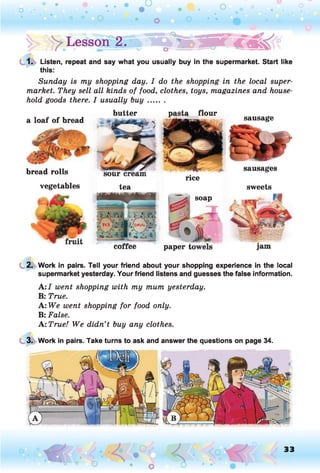
1. Listen, repeat and say what you usually buy in the supermarket. Start like
this:
Sunday is my shopping day. I do the shopping in the local super­
market. They sell all kinds of food, clothes, toys, magazines and house­
hold goods there. I usually buy.......
butter pasta flour
a loaf of bread sausage
bread rolls
vegetables tea
sausages
sweets
paper
rice
soap
2. Work in pairs. Tell your friend about your shopping experience in the local
supermarket yesterday. Your friend listens and guesses the false information.
A: I went shopping with my mum yesterday.
B: True.
A: We went shopping for food only.
B: False.
A: True! We didn’t buy any clothes.
3. Work in pairs. Take turns to ask and answer the questions on page 34.
33
o o o
•. o
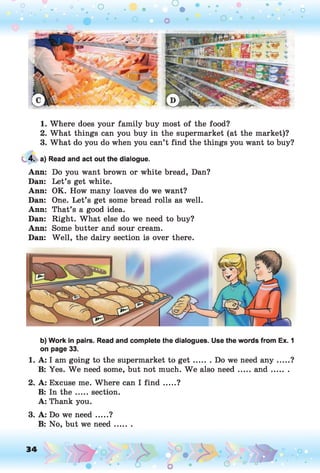
1. Where does your family buy most of the food?
2. What things can you buy in the supermarket (at the market)?
3. What do you do when you can’t find the things you want to buy?
4. a) Read and act out the dialogue.
Ann: Do you want brown or white bread, Dan?
Dan: Let’s get white.
Ann: OK. How many loaves do we want?
Dan: One. Let’s get some bread rolls as well.
Ann: That’s a good idea.
Dan: Right. What else do we need to buy?
Ann: Some butter and sour cream.
Dan: Well, the dairy section is over there.
b) Work in pairs. Read and complete the dialogues. Use the words from Ex. 1
on page 33.
1. A: I am going to the supermarket to g e t ....... Do we need a n y...... ?
B: Yes. We need some, but not much. W e also need.....a n d .........
2. A: Excuse me. Where can I fin d .....?
B: In th e .....section.
A: Thank you.
3. A: Do we need.....?
B: No, but we need.......
34 o
O
o . •
O O o
4. A: W e forgot to g e t .....?
B: I ’ll get it/them.
Where is it? / Where are they?
A: In th e .....section over there.
5. Play a game. Work in two groups. Act as in the model. Use the words: milk,
apples, juice, rice, peaches, etc.
E xam ple:
T each er: Milk.
G rou p A: How much milk?
T each er: Right. One point. Apples.
G rou p B: How many apples?
T each er: Juice.
G rou p B: How many juice?
T each er: Wrong! “How much juice?” Group B doesn’t get a point.
^Conversation Lab
6. Work in pairs. Read, complete and act out the dialogue. Use the words:
much, many, any, some.
Dan: How ..... cheese is there?
Ann: There isn’t ..... left.
Dan: W e need.....cheese then. What about eggs? H o w ...... eggs have
we got? Ten eggs.
Ann: So, we don’t n eed.......
Dan: OK. H o w .....bread have we got?
Ann: W e haven’t got .....bread and ...... flour left.
Dan: How .....bread do we need?
Ann: One loaf.
Dan: And h o w ..... flour?
Ann: One kilo, I think.
7. Write your shopping list for this week. Write how much food you need to buy.
O , 35
O
'vsUstening Lab
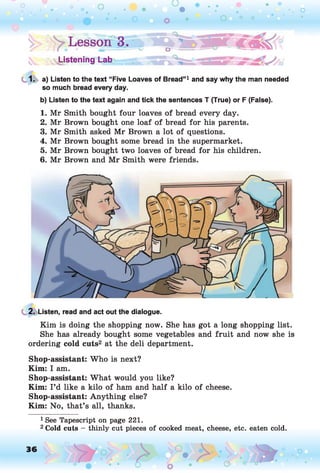
1. a) Listen to the text “Five Loaves of Bread”1 and say why the man needed
so much bread every day.
b) Listen to the text again and tick the sentences T (True) or F (False).
1. Mr Smith bought four loaves of bread every day.
2. Mr Brown bought one loaf of bread for his parents.
3. Mr Smith asked Mr Brown a lot of questions.
4. Mr Brown bought some bread in the supermarket.
5. Mr Brown bought two loaves of bread for his children.
6. Mr Brown and Mr Smith were friends.
2. Listen, read and act out the dialogue.
Kim is doing the shopping now. She has got a long shopping list.
She has already bought some vegetables and fruit and now she is
ordering cold cuts2 at the deli department.
Shop-assistant: Who is next?
Kim: I am.
Shop-assistant: What would you like?
Kim: I ’d like a kilo of ham and half a kilo of cheese.
Shop-assistant: Anything else?
Kim: No, that’s all, thanks.
1See Tapescript on page 221.
2Cold cuts - thinly cut pieces of cooked meat, cheese, etc. eaten cold.
36 o
3. Work in pairs. Take turns to ask and answer the questions.
1. Where is Kim?
2. What does she want to buy?
3. Who is she talking to?
4. How much ham does she want to buy?
5. How much cheese does she want to buy?
6. Does Kim want to buy anything else?
Conversation Lab
4. Work in pairs. Act out the situation “In the Supermarket”. Use the dialogue
of Ex. 2 on page 36 as an example.
R o le Card A. You are the customer. You are doing the shopping in
the supermarket. W rite a shopping list. Order what you want.
R o le Card B. You are the shop-assistant. Talk to the customer and
help him / her to buy the things he / she is looking for.*12
Shopping List
1/2 kilo of cheese
1 kilo of meat
2 kilos of potatoes
1 kilo of oranges
o O, 37
O
o o
o
t 5. Read and choose the correct item to complete the sentences. Write the cor­
rect words.
1. Tom always ..... the shopping on Sundays.
A do B does C is doing
2. The things which are sim ilar.....in the same area in the super­
market.
A is B will be C are
3. Steve ..... already..... cold cuts at the deli department.
A have ordered B is ordering C has ordered
4. - What would you like?
— I .....a kilo of apples, please.
A want B like C would like
5. - Excuse me, can you help me? I ..... for the confectionery
department.
A am looking B looked C look
6. I h ave.....a kilo of fish, but I haven’t .......any cheese and sau­
sages.
A buy B buys C bought
> Lessonsf4-5l
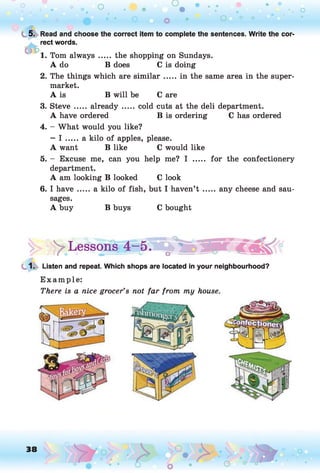
1. Listen and repeat. Which shops are located in your neighbourhood?
E xam ple:
There is a nice grocer’s not far from my house.
38
2. Look at the pictures in Ex. 1 and say what things you can buy in these shops.
E xam ple:
I can buy a loaf of bread at the bakery.
3. Read and say what shops the children are in.
39
o o o
•. o
0 • • o o ** o ° °
t 4. Work in pairs. Look at the shopping list. Ask your friend where you can buy
these things.
E xam ple.
A: Where do you buy milk?
B: In the supermarket. Where do you buy a T-shirt?
A: At the clothes shop.
SHOPPING LIST
Milk
cakes
carrot
potatoes
oranges
a T-shirt
a teddy bear
a computer game
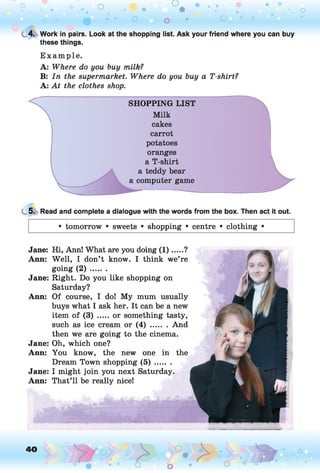
5. Read and complete a dialogue with the words from the box. Then act it out.
• tomorrow • sweets • shopping • centre • clothing •
Jane: Hi, Ann! What are you doing (1 ).....?
Ann: Well, I don’t know. I think we’re
going ( 2 ) .......
Jane: Right. Do you like shopping on
Saturday?
Ann: Of course, I do! My mum usually
buys what I ask her. It can be a new
item of (3) .....or something tasty,
such as ice cream or ( 4 ) ....... And
then we are going to the cinema.
Jane: Oh, which one?
Ann: You know, the new one in the
Dream Town shopping ( 5 ) .......
Jane: I might join you next Saturday.
Ann: That’ll be really nice!
____
40 o
^Grammar Lab: Talking about future plans
• Use Present Continuous Tense when you are sure about your
future plans.
• Use may / might when you are not sure about them.
What are ^I might do the
shopping. you doing
tomorrow?
6. Complete the sentences. Use the words from the box given below.
• might go • might buy • may give • might do •
might ask • might help •
1. I’m meeting Jack next Sunday. I .....him to give me his new DVD.
2. W e are going shopping tomorrow. We ..... a new toy for my
sister.
3. He’s visiting his aunt next Saturday. T h e y ..... the shopping
together.
4. She’s having some free time tomorrow. S h e..... to the swim­
ming pool.
5. They’re having a test tomorrow. Their teacher..... them some
difficult questions.
6. They are preparing a shopping list for tomorrow. We .....them
do that.
Conversation Lab
7. Read and act out the situation.
You are in London. Your host family gave you some lunch money.
You have £10.00 (ten pounds) to buy the food in the school canteen.
You have to choose at least one food item from each category.
o O, 41
O
O O
O
•. o
FRUIT / VEGETABLES
A p p le..................£0.50
Orange............... £1.00
Banana............... £1.00
SANDWICHES
Sausage sandwich . . . £1.25
Vegetable sandwich . . £0.70
Chicken sandwich . . . £1.50
DRINKS
M ilk .................... £0.60 / cup
Ju ice.................... £1.50
T e a .......................£0.20
SNACKS
Biscuit............... £0.40
Crisps..................£1.20
Sweets..................£0.25
What will you choose to eat from this list? Why?
E xam ple:
I may / might buy an orange and a banana, because there are a lot
of vitamins in fruit. Besides, I like these fruits very much. They are
tasty.
8. Write about you plans for the coming weekend. Use the correct structures:
the Present Continuous Tense or may / might.
y Lesson 6. » “ o i ^ T WÈËkki
1. Listen, read and act out the dialogues on page 43.
42 , o o
o
Jane is not sure if the department store is open or not, so she is
calling there to find out.
Operator: Macy’s, may I help you?
Jane: Yes, please. How late are you open tonight?
Operator: Until 9:00 p.m.
Jane: Thank you very much.
2. A t the Shoe Shop.
Ann: I ’d like a pair of shoes, please.
Shop-assistant: What kind of shoes would you like?
Ann: Low-heeled shoes for everyday wear.
Shop-assistant: What colour would you like?
Ann: Black.
Shop-assistant: What size do you wear?
Ann: Four. Can I try them on?
Shop-assistant: Of course.
2. Work in pairs. Take turns to ask and answer the questions.
1. What does Jane want to do tonight?
2. What store does she want to go to?
3. Why is she calling the department store?
4. Where is Ann?
5. What does she want to buy?
6. What size of shoes does she wear?
3. a) Work in pairs. Complete the conversation and act it out.
b) Listen and check.
Jane: Hi, Ann! You look wonderful today!
Where ( 1 ).....y o u ...... (to buy) your
new T-shirt and this pair of jeans?
Ann: In the clothes shop.
Jane: Where ( 2 ) ..... (to be) it?
Ann: It is not far from Theatralna
Underground Station. You (3) .....
(to go) straight ahead along Bohdan
Khmelnytskiy Street, and it’s on the
right. You ( 4 ) .....(not / to have to)
go far.
Jane: How much ( 5 ) .....(to be) the things
you bought?
o O, 43
O
Ann: I don’t remember the exact price of the T-shirt, but the jeans
(6) ..... (to be) 350 UAH. The style is more important for me
than the price. And the price is quite important for my mum.
She usually (7) ..... (to pay) for the purchase.
vConversationcLab: a Discussion
4. Work in groups. Discuss what is very / quite / not so / not at all important to
know when you buy something. Use the ideas and the phrases from the box
given below.
E xam ple:
To my mind, the price is not so important when you want to buy
good clothes to wear.
1. Price.
2. Colour.
3. Comfort.
4. Name of the designer.
5. Size.
6. Quality.
7. ...
5. You are on holiday in another city or country. Write an email to your parents.
Tell them what things you have already bought, ask them if they want you to
buy anything else. Give the details. Use the questions below to help you.
• What did you buy?
• Where did you buy it?
• Why did you buy it?
• Do you like it? Why?
Expressing Your Opinion
I think...
To my mind...
In my opinion...
!> : > Lesson |.» ■ e ^ S S B ®
Reading Lab: Jigsaw Reading
1. Work in three groups. Read the text and find the names of banknotes and
coins of different countries in it.
1. In Ukraine people use hryvnias (UAH) and kopiykas (kop). The
coins are 1 kopiyka, 2 kopiykas, 5 kopiykas, 10 kopiykas, 25 kopiykas
and 50 kopiykas. There is also a one-hryvnia coin. A ll the coins are
round. Every coin has the National Coat of Arms on one side of it.
Ukrainians use 1, 2, 5, 10, 20, 50, 100, 200 and 500-hryvnia
banknotes. Every banknote has a portrait of a famous Ukrainian per­
son on it.
2. In Great Britain people use pounds (£) and pence (p). The coins are
1 penny, 2 pence, 5 pence, 10 pence, 20 pence and 50 pence. There are
also £1 and £2 coins. The coins are round. But two coins have got
seven sides. The little coin with seven sides is the 20-pence coin and
the big one with seven sides is the 50-pence coin. There is a portrait
of the Queen of England on every coin. There are £5, £10, £20, and
£50 banknotes.
45
3. In the USA people use dollars ($) and cents (c). American coins are
sometimes called change. Each coin has its own name. A one cent coin
is called a penny. A 5-cent coin is called a nickel. A 10-cent coin is
called a dime. A 25-cent coin is a quarter. There are 1, 2, 5, 10, 20,
50 and 100-dollar banknotes in the USA. You can see a portrait of an
American president on one side and a picture of a famous building on
the other.
2. Speak in class. Share the information you have read in Ex. 1 with your class'
mates.
3. Work in pairs. Complete and act out the dialogues.
Coins and Currency
1. A: How much is a penny worth?
B: A penny is worth one cent.
2. A: Soda costs seventy-five cents. Do you have enough change?
B: Yes. I have a/two/three ..... (5) a n d .......
3. A: I need to go to the supermarket. Do you have any cash?
B: Let me see. I have a twenty-dollar bill.
A: Twenty dollars is enough. Thanks.
4. Look at the pictures on page 47. Act out the dialogues as in the example.
E xam ple:
A: How much is this notebook, please?
B: Two pounds. How many would you like?
A: I ’ll take three, please.
B: How would you like to pay?
A: In cash. Here you are.
B: Thank you. Here’s your receipt and your change.
Conversation Lab
5. Work in pairs. Play a game “Buying Food and Getting Change”. Take turns
to play the role of the shopper.
You have 200.00 hryvnias. Go shopping. Look at the pictures and
say what you can buy, at what price and how much change you get.
6. Write where you went shopping yesterday, what you bought and how much
it cost. Start like this:
/ went shopping yesterday. I had a long shopping list. Etc.
o 47
!> Lessong8-9.
1. Ann and Dan are in London. They want to buy some souvenirs for their family
and friends. Look at the photos and say what they can buy in these shops.
Hamley’s Mystical Fairies
Forbidden Planet Hope and Greenwood Shop
2. Look through the texts (1-4) on page 49. Say what the names of the shops
are.
A Mystical Fairies
B Hope and Greenwood
C Forbidden Planet
D Hamley’s
Best London Shops for Children
1 .....is the greatest toy shop in the world. It is in London in Regent
Street. The shop has seven floors of toys to explore! People from all
over the world come to visit it. You can buy the most wonderful toys
and games there. There are always lots of toy demonstrations there,
so you can try before you buy.
2 .... is a girl’s dream! This shop is full of fairy and princess dresses.
There are also lots of accessories: bags, scarves and wigs! Girls can be
part of Fairy School and Princess Academy. They can learn how to be
fairies and princess, do arts and crafts, decorate a fairy cake, sing and
dance. Boys can try on a costume of a pirate or a wizard and have fun.
3 .... is the world’s largest and best-known entertainment shop. This
is where you can find the latest comics and graphic novels from
science fiction and fantasy stories. You can also buy action figures,
books, DVDs and toys.
4....... is a confectionery. It is in Russell Street. You can buy tradi­
tional sweets in old-fashioned glass jars. You can discover for yourself
Candy Bananas, Rainbow Drops and even Flying Saucers! And you can
use the jars for your new creative ideas!
3. Work in groups of four. Read the information about one of the shops in Ex. 2.
Take notes. Then share the information with your friends.
4. Read and say which place it is.
1. You can wear a costume of a pirate there.
2. You can choose a nice toy for your younger brother or sister
there.
3. You go there to buy a box of traditional chocolates.
4. It is an exciting place to shop for girls.
5. You can learn to do some crafts there.
6. It is the world’s largest entertainment shop.
5. Work in pairs. Read, complete and act out the dialogue. Use the Past Simple
negatives and questions.
Olha: (1) ..... (you / to have) a nice holiday in London?
Bohdan: Yes, thanks. It was good. We saw the most famous land­
marks. We also looked round some museums and saw a show at
the Globe Theatre. We (2) ..... (not / to try) to do too much.
Olha: Which museum (3) ..... (you / to go) to?
Bohdan: ( 4 ) ....... I (5) ....... (to get) to know much there.
49
(you / toOlha: It’s fascinating, isn’t it? And what show (6)
watch)?
Bohdan: Oh, a musical about monsters. I ( 7 ) .....(not / to like) it.
Olha: Where (8) ..... (you / to stay)?
Bohdan: A t the hotel. The rooms were very comfortable there.
Olha: And (9) ..... (Susan / to enjoy) the holidays?
Bohdan: Yes, she did. She (10) ..... (to do) some shopping, too.
; ^Conversation Lab J
g*
6. Read and act out the situation.
Your friend is going to London next month. Tell him / her about
places to go shopping there. Answer his / her questions.
7. Write an email to your English-speaking friend. Ask him / her about:
• the places she usually does the shopping;
(p p • the best places to buy souvenirs;
• thank him / her for his / her recommendations.
50
O o o
^ ^Lesson010. grammar Revision
1. Work in pairs. Ask and answer the questions as in the example.
E x a m p l e :
A: How many nickels are there in a dollar?
B: There are 20 nickels in a dollar.
A: How many pennies are there in a pound?
B: .....
2. a) Write down anything you don’t know about shopping. You may want to
think about places to do the shopping, things to buy, etc. Write down ques­
tions starting with:
Why ... ? When ... ? Where ... ? Who ... ? What ... ? How ... ?
b) Work in pairs. Discuss your questions with your friend. Can you answer
them?
3. Write the words in the correct order to make sentences.
1. gone / Sue / today / has / shopping/ . / making / she / is /
Now / for / salad / dinner / .
2. bag / so / Your / heavy / is / . / you / What / bought / have / ?
3. are / We / clothes / in / shop / the / . / are / for / W e /
looking / a / shirt / new .
4. barbecue / you / some / food / buy / for / Can / the / ?
^Conversation Lab ,
4. Read, complete and act out the dialogue.
Ann: Hello, Kim! How are you?
Kim: .......
Ann: I’m fine. I went shopping yesterday morning with Jane and my
mum.
o O, 51
O
o o o
•. o
Kim: ..... ?
Ann: Well, first I went to the clothes department and I bought a new
blouse.
Kim: .....?
Ann: No, it wasn’t very expensive. We paid fifty hryvnias for it.
Then we went to a music shop. Jane wanted to look at the CDs.
She likes listening to music.
Kim: ..... ?
Ann: Yes, sh e....... Those two CDs co st.........A fter that, we went to
the market. They sell nice clothes there.
5. Put the verbs in brackets into the correct tense form.
Maria (1 ).....(to go) shopping with her mother last Saturday. They
(2) ..... (to want) to buy some presents for the coming holiday.
A t first the girl and her mum (3 ).....(to buy) a nice tie for father,
then they (4 ) .....(to look) at the toys for Maria’s classmates. The girl
(5 ) .....(to see) nice dolls, jigsaw puzzles and interesting board games.
Then they ( 6 ) .....(to visit) the ladies’ and junior dresses section.
While Maria’s mother (7) ..... (to try on) a new skirt, the girl
( 8 ) .....(to go) to look at the other departments. Maria ( 9 ) .......(not /
even / to notice) how she (1 0 )..... (to get) lost. She (11) ..... (to ask)
the shop-assistant to help her. Soon her mum (12) ..... (to have)
nothing to worry about.
52 , o o
o
S§elf-assessment
Think of your records. Decide how well you know it:
4 = very well, 3 = OK, 2 = a little, 1 = needs to improve
Skills N o w I can... 4 3 2 1
• describe my personal shopping experien­
ces
□ □ □ □
• talk about different kinds of shops in the
place where I live
□ □ □ □
v d • ask about things and make simple trans­
actions in shops
□ □ □ □
• give and receive information about prices □ □ □ □
• catch the main point in clear simple tele­
phone messages
□ □ □ □
• understand and extract the essential
information from a short, recorded dia­
logue
□ □ □ □
• identify specific information in short sto­
ries about shopping experience
□ □ □ □

• write a paragraph about my shopping day □ □ □ □
O , 53
O
Fçrod and Drinks
W'lCM-
talk about food and drinks;
meals and favourite recipes;
read about your daily diet;
listen to a story about meals
and cooking in Ukraine;
write a paragraph / a letter
to a friend about your
typical meals during the day:
revise the articles;
learn about verbs related to
senses.
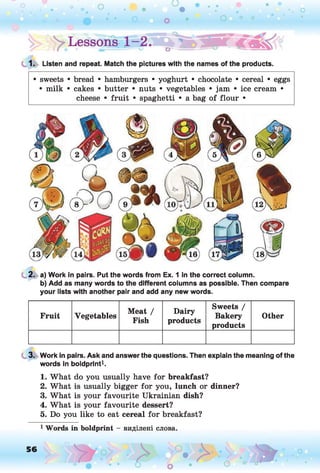
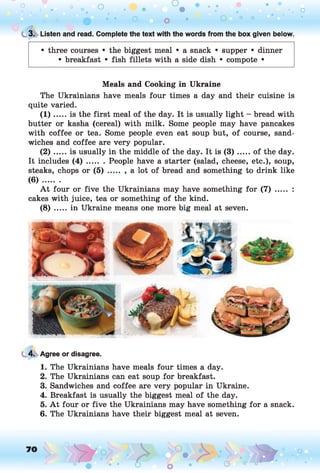
1. Listen and repeat. Match the pictures with the names of the products.
• sweets • bread • hamburgers • yoghurt • chocolate • cereal • eggs
• milk • cakes • butter • nuts • vegetables • jam • ice cream •
cheese • fruit • spaghetti • a bag of flour •
2. a) Work in pairs. Put the words from Ex. 1 in the correct column.
b) Add as many words to the different columns as possible. Then compare
your lists with another pair and add any new words.
Fruit Vegetables
Meat /
Fish
Dairy
products
Sweets /
Bakery
products
Other
3. Work in pairs. Ask and answer the questions. Then explain the meaning of the
words in boldprint1.
1. What do you usually have for breakfast?
2. What is usually bigger for you, lunch or dinner?
3. What is your favourite Ukrainian dish?
4. What is your favourite dessert?
5. Do you like to eat cereal for breakfast?
1 W ords in boldprint - виділені слова.
56
О
O O O O O
o . •
O O
C 4. Work in pairs. Talk about the pictures in Ex. 1 on page 56 as in the example.
E xam ple.
A: What food (products) do you like to eat?
B: I like fruit. I usually have an apple or a banana in my lunch
box. I also like to eat tasty things, such as chocolates and sweets.
My mum says that I mustn’t eat a lot of these.
5. Speak in class. Talk about food from Ex. 1 on page 56. What do you usually
eat at home and at school? Your classmates guess the false information.
E xam ple.
A: I usually eat bread and butter, and cheese for breakfast at
home.
B: True.
A: I always eat hamburgers and apples at school.
B: False. They don’t sell hamburgers in our school canteen.
^Reading Lab
6. a) Read the title of the text. Say what products it is going to be about. Do you
think that you eat the right food or not?
b) Read the text and check your ideas. What products do you need to add to
your daily diet?
Eat the Right Food
People cannot live without food. Animals, fish, birds and plants
cannot live without food either.
57
o o o
•. o
There are different kinds of food. Some kinds of food like bread,
sugar, meat, butter, cheese and rice make you strong and give you
energy.
Meat, fish and milk help you to grow. Vegetables, eggs and corn­
flakes make your bones and teeth strong. You should eat vegetables
and fruit because they have got a lot of vitamins. Vitamins are impor­
tant for your eyes, skin, bones, hair and for other parts of your body.
There are thirteen types of vitamins (A, B, C and so on).
Eat the right food! Remember the proverb, “Good health is above
wealth.”
7. Agree or disagree.
1. People can live without food.
2. Meat, fish and milk make your bones and teeth strong.
3. Vegetables, eggs and cornflakes help you to grow.
4. Vitamins are important for your eyes, skin, bones, hair and
for other parts of your body.
5. There are fourteen types of vitamins (A, B, C and so on).
8. Look at the pictures and match them to the words in the box.
• spicy • sweet • sour • salty • bitter •
E xam ple.
1. Sugar - sweet
o . •
O O o
O• •
o O O o
^Grammar Lab: Verbs related to sen djectives^ :j
Verbs related to senses are: to feel, to hear, to smell, to look, to
see, to taste, to sound.
They are followed by adjectives, not adverbs:
This cake smells delicious. This coffee tastes bitter.
Conversation Lab
9. Complete the dialogues and act them out.
1. Mum: Would you like some .....in your tea?
, please.Ann: Sure, pass me a ™
2. Tom: Mum, give me some , please.
Mum: Why would you like to add it to your dish?
Tom: I ’d like to make i t .......
3. Jane: This tastes t o o ....... Why have you put so much
sugar in it?
Mum: Sorry, my dear. I didn’t notice how much sugar I put in
it.
Dad:
4. Kate: Dad, this tastes........W ill you pass me some
sugar, please?
Certainly!
5. Kim: Granny, why is this .....? I can’t eat it.
Granny: It’s OK, it’s n o t.......
10.Write a paragraph about the food you eat. Use the questions below to help
you.
&
Which food do you eat to be strong and energetic?
Which food helps you to grow?
Which food with a lot of vitamins do you eat?
Do you eat the right food?
« . < ■ - . • 4 .° ' p .'m
° O ^ • o 6 . T
59
O
1. a) Work in pairs. Take turns to ask and answer the questions in the table. Add
information.
E xam ple:
A: Do you usually eat a big breakfast?
B: No, I don’t. I usually have a sandwich and a cup of tea. What
about you?
A: I usually have a big breakfast. I have a bowl of cereal, eggs
and toast.
Questions You
Your
Friend
• Do you eat a big breakfast?
• Do you cook breakfast by yourself?
• When do you eat your breakfast?
• What do you drink in the morning: tea
or coffee?
• Do you like to eat fast food in the
morning?
• Do you eat rice or potatoes in the
morning?
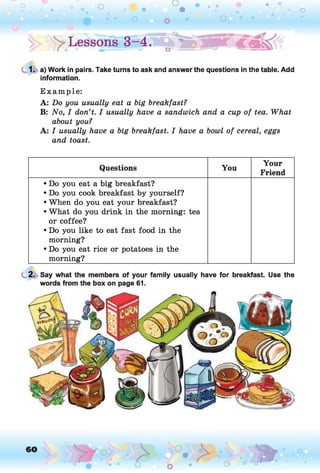
2. Say what the members of your family usually have for breakfast. Use the
words from the box on page 61.
o . •
O O O
• bread and butter • porridge • eggs • cheese • sausages • sand­
wiches • tea (with milk or with lemon) • coffee • milk • juice •
cocoa • sweets • cookies • juice • puddings • pancakes •
3. Read and say what children usually have for breakfast on a typical day.
Kate: I always have a boiled egg, some toast and a glass of milk or
orange juice for breakfast. I can’t go to school without breakfast.
I usually have lunch at school. There’s a great choice of things to eat.
You can have burgers, baked potatoes, pizza, sausages and lots of
other things.
Kim: I love milk, so I always have cereal for breakfast with lots of
milk on it! I don’t have school lunches. I buy my own. If I go to the
café near school, I have a milkshake. Chocolate’s my favourite fla­
vour.
Dan: I ’m a vegetarian, so I don’t eat meat. I eat both cheese and eggs
instead. I eat lots of fruit and vegetables, too. I start the day with
either some fruit or yoghurt. I usually have a banana or an orange.
I take a packed lunch to school with me. This is usually cheese sand­
wiches and a couple of apples.
4. Look through the text of Ex. 2 and say who:
• thinks vegetables are healthy. Dan
• only eats a little for breakfast. .....
• always has cereal for breakfast with lots of milk .....
• can’t go to school without breakfast. .....
o O, 61
O
L 5. Read and complete the sentences. Choose the correct word.
1. I was .....tired. The porridge tastes......... (awful / awfully)
2. She cried ....... This coffee tastes......... (bitter / bitterly)
3. Those flowers lo o k ....... She sin gs.........(beautiful / beautiful­
ly)
4. This dish tastes....... That was a ....... creamy soup. (delicious /
deliciously!).
5. Your tape recorder sounds....... The boy cooked......... (wonder­
ful / wonderfully)
Conversation Lab
6. Read and act out the situations.
• Tell your friend about your favourite dish.
• Ask your friend about the dishes he / she usually eats for
breakfast / lunch / dinner.
7. Read and act out a dialogue about the food you eat for breakfast. Start like
this:
Ann: Hi, Toml Why are you eating a banana? Haven’t you had break­
fast?
Tom: Hi, Annl You see, I cannot eat before going to school. And I
always have a small snack of healthy food like nuts, fruit,
vegetables or yoghurt.
Ann: But I always have my breakfast at home. I eat foods like cereal,
bread, eggs, milk and dairy foods which keep me going until
lunch.
Tom: .......
Ann: .......
8. Write a paragraph about your typical meals during the day. Use the questions
given below to help you. What kinds of food do you eat every day?
• Do you usually eat fruit and vegetables? What kinds?
• How often do you drink milk or water?
• What kinds of food do you like to cook?
• Where do you usually buy your food?
1 Deliciously — надзвичайно смачно.
|> >Lesson g-6 . 0$WP-€<&<J
1. a) Listen and repeat.
• bread and butter • porridge • sausage • sandwiches • cocoa
powder • borshch • pampushki • fish soup • chicken broth
• noodle soup • pea soup • mushroom soup • cutlets • boiled meat •
fried meat • roast meat • fried / boiled / mashed potatoes •
vegetables • pancakes • compote • sour milk •
b) Speak in class. Talk about food you usually have for breakfast and dinner.
E xam ple:
I usually have boiled eggs and porridge for breakfast.
2. Work in pairs. Tell each other which foods you like and don’t like to have for
dinner. Use the following phrases:
I lik e ....... I quite lik e .........I don’t lik e .........I prefer......
o 63
C.3. Listen and read what children say about meals and what they prefer to eat.
Ann: I eat three times a day. Dinner is the biggest meal of the day
for me. Soup (traditionally borshch) is a must during dinner. It is
served with dark bread or pampushki with garlic. My mum cooks
chicken broth, noodle soup, pea soup or mushroom soup for dinner.
A ll of them are very tasty. I like borshch most of all.
Tom: Dinner is the biggest meal of the day for me, too. I start my
dinner with a salad. Then my mum serves a bowl of soup or chicken
broth. A fter that we have a meat or fish dish. As a side dish we
usually have fried, boiled or mashed potatoes and vegetables cooked
in different ways. W e finish our dinner with ice cream or apple pie.
4. Read and complete the sentences with the phrases from Ex. 3.
1. Some people like a light breakfast, others p refer.......
2. Dinner is the biggest.......
3. Soup is a must du rin g.......
4. As a side dish we usually h ave.......
5. We finish our dinner w ith .......
5. Read and act out the dialogues.
1.
Ann: What kind of breakfast do you usually have in the morning?
Jane: I usually have a cup of tea and a cheese sandwich. And what
about you?
Ann: I don’t eat much. Just some cornflakes, an egg and toast with
jam and butter. Sometimes I drink a cup of coffee and eat bis­
cuits.
Jane: Oh, it’s too much for me.
2.
Mother: Dan, it’s lunchtime. Wash your hands and sit down at the
dinner table.
Dan: OK, Mum. I am really hungry. What’s for lunch today?
64 ,o
o
Mother: Vegetable salad, chicken soup and then meat and potatoes.
Dan: Oh, that’s wonderful! What are we having for dessert?
Mother: Some ice cream.
Dan: Thank you, Mum, for a tasty lunch.
Mother: I ’m glad you like it.
Conversation Lab
6. Work in groups. Take turns to read an opinion and give your response. Add
information.
E xam p le:
A: Breakfast is the most important meal of the day.
B: I don’t think so. I don’t eat a big breakfast.
C: What do you usually have for breakfast?
B: I usually have a sandwich and a glass of juice.
1. Breakfast is the most important meal of the day.
2. It’s important to have hot soup for dinner.
3. You can eat as many sweets as you want.
7. Write a short letter to your English-speaking friend. Tell him / her what your
family members usually eat for dinner. Ask him / her questions about their
family dinners. Start like this:
Dear Mary,
Thank you for your letter. It was interesting for me to learn
about your favourite dishes. I ’m going to tell you what my family
usually have for dinner.
65
Lessons- 7^8.
Listening Lab
1. Listen to the conversation. Name the things that Ann puts into the cake. Act
the dialogue out.
Jane: This cake tastes delicious, Ann.
Ann: Thanks. I tried to do my best. Besides, it’s easy to make.
Jane: What is in it?
Ann: There’s flour, of course. And sugar, cocoa powder and baking
soda.
Jane: Did you put in any eggs?
Ann: No, there aren’t any eggs. There’s a little salt, water and
vegetable oil.
Jane: Is that it?
Ann: I think so. No... I forgot. There is vinegar and vanilla. That’s
all.
Jane: Thanks. I ’ll try to cook it myself.
I B
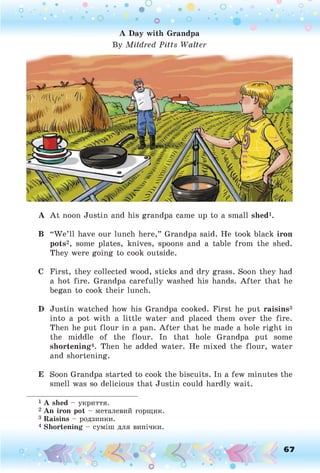
2. Look at the picture and the title of the text in Ex. 3 on page 67. What are the
man and boy doing? Where are they? What do you think the text is going to
be about?3
3. Read the first two paragraphs (A, B) and check your ideas. Then read the text
and find the sentences which describe the process of cooking.
66 o
A Day with Grandpa
By M ild red P itts W a lter
A A t noon Justin and his grandpa came up to a small shed1.
B “W e’ll have our lunch here,” Grandpa said. He took black iron
pots2, some plates, knives, spoons and a table from the shed.
They were going to cook outside.
C First, they collected wood, sticks and dry grass. Soon they had
a hot fire. Grandpa carefully washed his hands. After that he
began to cook their lunch.
D Justin watched how his Grandpa cooked. First he put raisins3
into a pot with a little water and placed them over the fire.
Then he put flour in a pan. A fter that he made a hole right in
the middle of the flour. In that hole Grandpa put some
shortening4. Then he added water. He mixed the flour, water
and shortening.
E Soon Grandpa started to cook the biscuits. In a few minutes the
smell was so delicious that Justin could hardly wait.
1 A shed - укриття.
2 An iron pot - металевий горщик.
3 Raisins - родзинки.
4 Shortening - суміш для випічки.
О 67
L 4. Read the text of Ex. 3 and match the questions (1-6) with paragraphs (A-E).
1. Did the man or his grandson cook lunch?
2. Where did the man and the boy come one day?
3. How did Grandpa prepare the dough for the biscuits?
4. What did they collect for the fire?
5. Where did Grandpa cook the biscuits?
6. What things did they have to cook outside?
5. Read and complete the sentences with the correct item.
1. Justin and his grandpa came up to a small shed a t .......
A one o’clock B twelve o’clock
2. Grandpa cooked.......
A fish soup B some biscuits
3. Justin and his grandpa had lunch.......
A in the shed B outside
4. They cooked their meals o n .......
A a fire B a gas stove
6. Speak in class. Talk about a picnic you once had with your parents or grand­
parents. What food did you eat? How did you cook outside?
Conversation Lab
7. Work in pairs. Complete the dialogue with the questions from the box and act
it out.
• Can I make a sandwich for you?
• Would you prefer a ham or tuna sanwich?
• Can you wait for a minute?
• Are you hungry, dear?
Mum: ( 1 ) .......
Tom: Yes, I am very hungry and I ’d like to eat something before
having dinner.
Mum: ( 2 ) .......
Tom: Yes, sure. What sandwich can you make?
Mum: ( 3 ) .......
Tom: I prefer a ham sandwich. Do we have all the ingredients: bread,
ketchup, ham and pickles?
Mum: My dear, we have everything. ( 4 ) .......
Tom: Certainly, I am very hungry, but I can wait for a minute.
8. Write questions to get more information.
| 1. I ’ve bought lots of food today.
2. W e’re going to cook a traditional Ukrainian dish at the week­
end.
|> ^Lessons 9-10
1. Listen and repeat. Then match the words in the box with their definitions.
• fresh • fried • frozen • raw • spicy • sweet • tasty • vegetarian •
1. W ith a hot, strong flavour.
2. Good, with lots of flavour.
3. Not cooked.
4. For people who don’t eat meat or fish.
5. Preserved by becoming very cold.
6. Cooked in hot oil.
7. Recently picked, caught or prepared.
8. W ith lots of sugar.
2. Write two types of food that go with each of the words in Ex. 1. Then check
your list with your friend. Does he / she agree with you?
E xam ple.
Fresh - fresh vegetables, fresh juice, etc.
69
o o o
•. o
0 • • o o • O ° °
t 3. Listen and read. Complete the text with the words from the box given below.
• three courses • the biggest meal • a snack • supper • dinner
• breakfast • fish fillets with a side dish • compote •
Meals and Cooking in Ukraine
The Ukrainians have meals four times a day and their cuisine is
quite varied.
(1) ...... is the first meal of the day. It is usually light - bread with
butter or kasha (cereal) with milk. Some people may have pancakes
with coffee or tea. Some people even eat soup but, of course, sand­
wiches and coffee are very popular.
( 2 ) ... is usually in the middle of the day. It is (3 ) ...... of the day.
It includes ( 4 ) ....... People have a starter (salad, cheese, etc.), soup,
steaks, chops or ( 5 ) ........a lot of bread and something to drink like
(6) ........
A t four or five the Ukrainians may have something for (7) ..... :
cakes with juice, tea or something of the kind.
(8) ....,. in Ukraine means one more big meal at seven.
4. Agree or disagree.
1. The Ukrainians have meals four times a day.
2. The Ukrainians can eat soup for breakfast.
3. Sandwiches and coffee are very popular in Ukraine.
4. Breakfast is usually the biggest meal of the day.
5. A t four or five the Ukrainians may have something for a snack.
6. The Ukrainians have their biggest meal at seven.
o . •
O O o
C 5. Make up questions to the following answers. Then work in pairs and practise
them.
1. A: .....?
B: Yes, tea is one of the most popular drinks in the world.
2. A: .....?
B: In Ukraine people drink tea with lemon.
3. A: .....?
B: In England people drink tea with milk.
4. A: .....?
B: Yes, tea comes from the leaves of a plant.
5. A: .....?
B: The tea plant or bush needs a warm climate and lots of
rain.
6. A: .....?
B: It grows well in China, India, Japan, Turkey and some
countries in Africa.
Conversation Lab
6. Work in pairs. Act out the situation.
A guest from an English-speaking country is visiting you. He / She
is interviewing you about the traditional Ukrainian dishes.
a) Write a list of questions about the traditional Ukrainian dishes.
b) Answer your guest’s questions.
7. Speak in class. Tell your classmates what you know about the traditional
Ukrainian cuisine.
8. Read the letter given below and write down Sue’s answer to it.
Dear Sue,
I ’m just writing to thank you for inviting me to the picnic next
Sunday. I think we’ll have a fantastic time together. It will be won­
derful to spend time with you and your classmates.
Will you write me the details about the food, please? What kind
of food do I need to take with me?
Thanks again and hope to see you soon.
All the best,
Ann.
o O, 71
O
^Lesson?11*.cGramlnar Revisig^ °
1. Ann went shopping yesterday and bought some food. Read and complete
the sentences. Use some or any where necessary.
E xam ple:
(+ ) grapes - She bought some grapes, because she likes grapes very
much.
1. (- ) cheese .....
2. (+) mushrooms .....
3. (- ) carrots .....
4. (+) rice .....
5. (- ) cornflakes .....
6. (+) oil .....
2. Read and complete the text with the correct form of the verbs in brackets.
Justin (1) ..... (not / to mind) that his clothes (2) ..... (to be) so
dirty and wrinkled. He (3) ..... (to have) a great time, though he
( 4 ) .....(to work) hard and (5 ) ...... (to get) hungry. When they ( 6 ) ......
(to stop) for lunch, grandpa (7) ..... (to build) a fire and (8) .....
(to make) biscuits. A t first, Justin (9) ..... (to tease) grandpa about
putting raisins in the dough, but after tasting them, he (10) .....
(to decide) they (11) ..... (to be) the best biscuits ever. And this day
with grandpa (1 2 ).....(to be) the best day ever, too.
72 , o
o
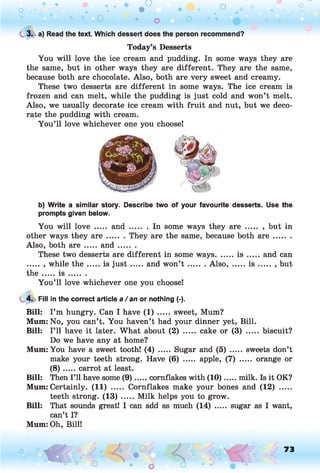
C 3. a) Read the text. Which dessert does the person recommend?
Today’s Desserts
You will love the ice cream and pudding. In some ways they are
the same, but in other ways they are different. They are the same,
because both are chocolate. Also, both are very sweet and creamy.
These two desserts are different in some ways. The ice cream is
frozen and can melt, while the pudding is just cold and won’t melt.
Also, we usually decorate ice cream with fruit and nut, but we deco­
rate the pudding with cream.
You’ll love whichever one you choose!
b) Write a similar story. Describe two of your favourite desserts. Use the
prompts given below.
You will love ..... a n d ........In some ways they are ....... , but in
other ways they a r e ....... They are the same, because both a r e .........
Also, both are ..... a n d .......
These two desserts are different in some ways....... i s ...... and can
....... while th e .....is ju s t...... and won’t .........Also, ...... i s ...... , but
th e ..... i s .......
You’ll love whichever one you choose!
4. Fill in the correct article a/ an or nothing (-).
Bill: I’m hungry. Can I have (1) ..... sweet, Mum?
Mum: No, you can’t. You haven’t had your dinner yet, Bill.
Bill: I’ll have it later. What about (2) ..... cake or (3) ..... biscuit?
Do we have any at home?
Mum: You have a sweet tooth! (4) ..... Sugar and (5) ..... sweets don’t
make your teeth strong. Have (6) ..... apple, (7) ..... orange or
(8) ...... carrot at least.
Bill: Then I’ll have some (9 ).....cornflakes with (1 0 )......milk. Is it OK?
Mum: Certainly. (11) ..... Cornflakes make your bones and (12) .....
teeth strong. (13) ..... Milk helps you to grow.
Bill: That sounds great! I can add as much (14) ..... sugar as I want,
can’t I?
Mum: Oh, Bill!
73
o o o
•. o
C. 5. Work in pairs. Look at the pictures. Disagree with your friend. Talk with him /
her as in the example.
E xam ple:
A: These vegetables taste delicious!
B: Oh, no! They taste awful!
135 x 5 - 124 : 6 =
• delicious • beautiful • difficult • scary • rough • friendly
• soft • ugly • awful • easy •
6. Write a short letter to thank your friend for the wonderful dinner party you
attended at his / her place last weekend. Use the word lists and the questions
9 to help you.
• When did you go to the dinner party?
• Who invited you there? What was the occasion?
• Which were the dishes you enjoyed the most?
• What was the party like?
Food: tasty, delicious, well-cooked, etc.
Atmosphere at the party: friendly, relaxing, great music, lots of
games.
S§.e^ 'assessmen* •
Think of your records. Decide how well you know it:
4 = very well, 3 = OK, 2 = a little, 1 = needs to improve
Skills N ow I can... 4 3 2 1
• explain what food and drinks I like/dis-
like
□ □ □ □
• describe my everyday eating habits □ □ □ □
• get simple information about meals and
favourite dishes
□ □ □ □
• interact in structured situations □ □ □ □
(H
• understand simple routine exchanges in
predictable everyday situations
□ □ □ □
w • understand simple instructions related to
food and meals
□ □ □ □
• understand short, simple texts related to
the topic
□ □ □ □
• identify specific information in simple
written material such as letters
□ □ □ □

• write a letter to a friend about my typical
meals during the day
□ □ □ □
75
•'Уш
talk about different kinds of
sport; your friends’
favourite sports activities;
read about sport in our life;
listen to a sports
questionnaire;
write an email about Sports
Day;
revise the Present Perfect
Tense.
1. Listen and repeat. Say what kind of sport you are fond of.
E xam ple:
A: I ’m fond of athletics. And you?
B: I ’m fond of judo.
athletics ski-jumping cycling
sailing boxing judo
2. Look at the pictures and say what kinds of sport the sportsmen enjoy.
E xam ple:
M r Johnson enjoys swimming.
78
-o
o . •
O O o
C 3. Read and say why it is important to go in for sport.
Sport in Our Life
People all over the world are fond of sports and games. There are
summer and winter sports. The most popular winter sports are ska­
ting and skiing. Some people greatly enjoy figure skating and ski-
jumping. It’s so nice to go to a skating rink or to a forest on a frosty
sunny day!
The most popular summer sports are swimming, cycling, and sailing.
It’s so wonderful to breathe in the fresh air and enjoy nature!
Children like to attend sports clubs and train in the gym. Athletics
and gymnastics have great popularity among girls. Boys go in for
boxing, football, tennis, and basketball.
4. Read and complete the sentences.
1. People all over the world are fond o f .......
2. The most popular winter sports a r e .......
3. The most popular summer sports a r e .......
4. Children all over the world like to p la y .....games.
5....... have great popularity among girls.
6. Boys go in f o r .......
Conversation Lab
5. a) Work in pairs. Take turns to ask and answer the questions.
E xam ple:
A: Do you play any sports?
B: No, I don’t. I have no free time. What about you?
A: Yes, I do. I play football. I t ’s my favourite sport. I also like
watching football matches on TV. My favourite football team
is “Dynamo”.
o O, 79
O
Questions You Your Friend
• Do you play any sports?
• Do you like quiet or noisy games?
• How often do you play games?
• Do you watch sports on TV?
• What sports do you like to watch?
b) Speak in class. Talk about your friend.
E xam ple:
I have found out that Ivan plays football. He likes watching foot­
ball matches on TV. His favourite football team is “Real Madrid”.
6.
i f a
a) Read, complete and write down the sentences. Use the adverbs: slowly,
well, hard, quickly, carefully, loudly.
1. Paul rides his bike v e r y ....... One day he’ll have an accident.
2. You have to train .....if you want to win the competition.
3. Rita plays tennis....... One day she’ll be a champion.
4. The children were talking.......The coach asked them to be quiet.
5. Bill was very tired after his training and he walked hom e.......
6. You have made a lot of mistakes. You must listen to m e .......
b) Make your own sentences with the adverbs in the list.
|> y Lessons
1. Look at the pictures and say what sports clubs children can attend in their
school.
C 2. Listen to the boys talking about sports1. Mark the sentences T (True) and
F (False).
1. Steve goes in for tennis.
2. Steve joined the sports club last year.
3. Steve trains three days a week.
4. Dan is very busy. He can attend the sports club only at the
weekend.
5. Steve invites Dan to a contest in March.
6. Dan can go to watch the contest.
1See Tapescript on page 221.
^Learning Strategies: Email Meçsages^^^^ ~
Email Messages
• are short messages sent from one person to another over the
Internet
• have a specific purpose: to provide information, share ideas with
others or entertain
• quickly deliver information to one person or to many people at
the same time______________________________________________________
3. a) Read Margaret’s email to Graham and say what she reminds him about.
From:
123 To:
Subject:
Attached
Dear Graham,
Mum asked me to remind you about the school meeting on
Wednesday. We need you to attend it. They are going to discuss
the plan for the school Sports Day. We want to organize a few
sports competitions.
Please, come to the meeting on Wednesday, at 6 p.m.
Love,
Margaret.
□
-I
81
o o o
•. o
b) Work in pairs. Take turns to ask and answer the questions.
1. Why do the children need to attend the meeting at school?
2. When does the meeting start?
3. Who must be present at the meeting?
4. Your school is organizing a sports competition. Write an email to your friend.
In your email:
* inform him / her about the upcoming sporting event;
* ask if your friend would like to take part in it;
* say that you are going to participate in the swimming competition.
:sSC °nversati°nd_ab
5. Read, complete and act out the dialogue.
Alex: Hello, Steve? How are you?
Steve:.......
Alex: I ’m very tired. Today is my sports day. I go swimming in the
morning and then play tennis in the afternoon.
Steve:.......
Alex: Oh, really? I like sport a lot, too. My favourite sport is football.
Do you train at the Sports Centre?
Steve:.......
Alex: Are you in the school basketball team?
Steve:.......
Alex: I like watching basketball on TV. Do you like watching sport on
TV?
Steve:
82
o . •
O O O
O
t 6. Read and complete the sentences. Fill in the necessary modal verbs in the
questions. Match questions and answers.
1. When ..... you ski?
2. W hy ..... not you ski two
years ago?
3. When ..... you go skiing
in the mountains?
4. When ..... you ..... go
skiing in the mountains
with your friends?
5. What ..... you say about
yourself as a skier?
a) I was able to go skiing in the
mountains last year.
b) I will be able to go to the moun­
tains with my friends next year.
c) I could ski when I was 7.
d) I cannot say that I am a good
skier.
e) Two years ago I couldn’t ski
because I lived in a warm country.
7. Read and complete the text. Put the verbs in brackets into the correct tense
form.
Tom and his schoolmates (1) ..... (to play) a match against a team
from another school. They usually (2 ).....(to play) football, but today
they ( 3 ) .....(to play) basketball. Tom ( 4 ) ...... (to like) playing basket­
ball very much. His team usually ( 5 ) .....(to wear) white T-shirts, but
today they (6 ) .....(to wear) yellow T-shirts. Other children from their
school (7) ..... (to watch) the match. Tom’s team usually (8) .....
(to win) their matches because they (9) ..... (to train) a lot. They
(10) ..... (to win) three Cup Finals in the previous three years. They
(1 1 ) ....(to win) today, too.
< • < ? .*<J * • • *
83
O o
1. Work in pairs. Talk with your friend about summer and winter sports. Use the
questions below to help you.
1. What summer (winter) sports do you know?
2. What summer (winter) sports do you enjoy?
3. What games do children like to play?
4. What is your favourite sport or game?
5. Do you like to play games or do you like to watch them?
6. Why is sport so popular with children and grown-ups?
2. Look at the pictures. Talk about the children’s favourite sports.
E xam ple:
Andriy goes in for boxing. He attends the Sports Centre. He
trains in the gym three times a week.
Andriy
boxing
the Sports
Centre
three times
a week
Maryna
swimming
a swimming
pool
twice a week
Oleksandr
to do karate
the Sports Club
twice a week
Yana
to play
badminton
the school gym
once a week
o . •
O O O
C 3. Read and act out the dialogue.
A: Have you ever played tennis in your life?
B: Yes, I have. I played tennis last summer.
A: Did you like it?
B: It was OK, but I didn’t enjoy the weather very much! It was
too hot!
A: Do you attend the tennis club now?
B: No, I don’t, but I am going to join it.
4. Work in groups of four. Write a list of kinds of sport on a sheet of paper. One
person thinks of a sport and the others have to guess which sport it is.
E xam ple:
B: Is it a team game?
A: No, it isn’t.
C: Do you use a ball?
A: No, I don’t.
D: Do you compete with others?
A: Yes, I do.
B: Is it a water sport?
A: Yes, it is.
C: Is it yachting?
A: Yes, it is. It is yachting.
hockey
basketball
yachting
swimming
tennis
5. Speak in class. Use the table below to give advice to your classmates.
E xam ple:
I f you want to play football well, you should do exercise to stretch
your legs.
Advice Why?
Football’, to do exercise to stretch legs
Tennis: to do exercise to relax arms
Have good sports results: to eat healthy food to give you energy
Running: wear comfortable shoes not to injure your feet
~ «Conversation Lab J
6. Read and act out the situations.
1. Say what sport (game) you enjoy most, why you are fond of it,
which season is good for it, what kinds of games you can’t play yet,
but would like to learn.
o O, 85
O
o o o
•. o
2. Your friend took part in a school basketball competition yesterday.
The team won the game. Ask your friend questions to know how long
they trained to become the winners, where their trainings were held
and who their coach was.
7. Write a paragraph for a school newspaper about your favourite kind of sport.
E xam ples:
A: I think running is a wonderful sport. We can run all year round.
We can run everywhere: in the yard, in the park, in the sportsground
or at the stadium. We can go jogging in the morning and in the eve­
ning. Running makes us strong and healthy.
Running is good exercise for everyone. It is popular with people of
different ages. I started running two years ago. I train with my father
every morning. I t ’s fun!
B: Basketball is my favourite sport. It is a team game. There are
five players in each team. The objective is to shoot a ball through a bas­
ket of another team. The team with the most points at the end of the
game wins. You can practise basketball in the gym or on the sports-
ground.
Basketball is one of the world’s most popular sports. Many basket­
ball fans watch the games on TV.
86 ,o o
o o
!> > Lesson 6.» ^ 0 1
1. Match the words with the pictures. Then listen and check.
□ score a goal □ swim 100 metres □ win a cup □ ride a horse
□ watch a cricket match □ climb a mountain □ go skiing
□ run a race □ play badminton □ meet a sports star
2. Work in pairs. Ask and answer questions as in the example.
E xam ple.
A: Have you ever scored a goal?
B: No, I haven’t.
A: Have you ever ridden a horse?
B: Yes, I have.
3. Listen, read and act out the dialogue.
Dan: Hey, this looks fun. A sports questionnaire.
Jane: Oh, no! Not sport!
87
o o o
•. o
Dan: Go on, then. Ask me the questions.
Jane: OK. Have you ever scored a goal?
Dan: Yes, I have. For the school football team!
Jane: Have you ever swum 100 metres?
Dan: Yes, I have. In fact, I’ve swum 200 metres!
Jane: And have you ever won a medal?
Dan: No, I haven’t. And I ’ve never won a competition.
Jane: Have you ever climbed a mountain?
Dan: Me? Are you joking? I ’ve never climbed a hill.
4. Work in pairs. Do the quiz from Dan’s magazine. Answer short questions and
add more information.
A: Have you ever played badminton?
B: Yes, I have.
5. Look at the pictures and say what the athletes or players are doing. Say what
other sports or games we can watch and play in these places.
E xam ple:
The boys are in the gym. They are doing gymnastics at the moment.
They are training hard to be good sportsmen.
6. Read and complete the sentences. Put the verbs in brackets into the correct
tense form.
1....... w e ....... (to have) a hard game yesterday?
2. The field at this stadium ... (to be) very good.
3....... you e v e r ....... (to be) to the Sports Palace?
4. What kinds of sp ort..... the Greeks ..... (to compete) in?
5. The boy looks happy: he ..... (to win) the sports competition.
6. My classmates ..... (to train) in the gym now.
88
t r-.> o •. mo
• •
o .
o o O
o
• O
o
o • .
y Lesson 7.
1. Work in pairs. Discuss the statements. Add information.
E xam ple:
A: I think it’s hard to become a famous sportsman. You have to
train a lot. You must spend lots of hours a day in the gym or at
the stadium.
B: In my opinion, it’s very important to have a good coach, too.
1. It’s hard to become a famous sportsman.
2. It’s better to watch sport than do / play it.
3. Sport helps people to make good friends.
2. Listen and read the text. Say why Melanie has become a basketball team
member.
Backyard Basketball Superstar
By Monica Klein
Jeremy was the captain1 of the basketball team, the Flyers. This
season2 they needed one more player for their team.
Jeremy’s younger sister, Melanie, trained a lot for the tryout3.
Soon Jeremy and Melanie were at home.
“I know Melanie, you are tired. I’ll clean your room,” said Jeremy.
“W ill you?” said Melanie.
“Sure. And since you are so tired, you won’t try out for the Flyers
tomorrow.”
o O, 89
O
о о о
•. о
О О о ] ° о
“Don’t worry, Jeremy,” said Melanie. “I ’ll
play the best at the tryouts.”
The next morning many boys and girls
tried out to shoot the ball1234 into the basket.
A ll the team members decided that Melanie
was the best.
“Welcome to the Flyers, Melanie! You can
run fast, jump high and really throw a basket­
ball,” they said.
Jeremy smiled. He was proud of his sister.
1 A captain — капітан (команди).
2 A season — т ут : спортивний сезон.
3 A tryout - відбір гравців.
4 To shoot the ball - т ут : кидати м’яч.
3. Agree or disagree with the statements below.
1. Jeremy had a younger brother.
2. Melanie wanted to join the basketball team.
3. Melanie was tired after the training and asked Jeremy to clean
her room.
4. Jeremy’s sister was the worst player at the tryout.
5. Jeremy welcomed Melanie into his team.
^yGrammar Lab: Modal Verbs
Present Past
Can = to be able to so something
Must / Have to
Could = was, were able to do
something
Had to
4. Work in pairs. Read, complete and act out the dialogues.
1. - .....?
- I’ll be able to skate with Ben after lunch.
2. - ......?
- Oh, yes. I am sure Ann can jump very well.
3. - ..... ?
- They couldn’t win that game, because they didn’t train well.
4. - ..... ?
- We had to wait for our turn for two hours.
90 ,o o
o o
C 5. Read and complete the sentences. Fill in the modal verbs in the correct tense
form. There are positive and negative sentences.
1....... I take part in the contest tomorrow?
2. I ..... swim a year ago, but now I .......
3. Their son .....walk when he was one year old.
4. You ..... train hard if you want to win the competition.
5. I have broken my leg a n d ..... miss my trainings.
6. T h e y .....go to the basketball competition yesterday.
7. Sue ..... practise a lot. She hasn’t attended the sports club
during the last week.
6. Write your own sports story for a school newspaper. Use Ex. 2 as an example.
Lesson 8.
1. Work in pairs. Ask your friend:
• what his / her favourite sport is;
• what sport he / she is good at;
• what sport he / she would like to be good at;
• where he / she usually plays sports;
• if he / she likes to watch sports on TV or at the stadium.
2. Work in pairs. Read and say what the children enjoy doing in these situations.
E xam ple:
A: Dan is at the school stadium. What does he enjoy doing there?
B: He enjoys playing football with his friends.1
1. The school playground is always full of boys and girls. What
do they enjoy doing there?
2. W e have got a new stadium in our town. What will the chil­
dren enjoy doing there?
3. There is a skating rink in the Sports Centre. What do the girls
enjoy doing there?
4. Your father is going to attend a football match. What is he
going to enjoy doing there?
91
C. 3. Look at Shannon’s notes. Make sentences as in the example.
E xam ple:
Shannon goes jogging every morning.
to go jogging every morning
to play tennis three times a week
to go skiing once a month in winter
to do gymnastics twice a week
to go swimming every weekend in summer
vConversationd-ab .
4. Read and act out the situation.
You are in the youth camp. Talk about your favourite kind of
sport. Say how often you train and where.
Answer your friends’ questions.
92 o
C 5. Play a mime game.
Pupil A mimes one of the sports. The other pupils must guess and say
what kinds of sport he/she goes in for.
Ask pupil A a question to get more information. Pupil A answers this
question.
E xam ple: Pupil A mimes boating.
One of the pupils: You go in for boating. How often
do you train?
P u p il A: I train three times a week.
6. Put the words from the list into four categories.
Hockey, tennis, basketball, golf, boating, horse riding, swimming,
table tennis, football, skateboarding, athletics, cycling, volleyball,
karate, skating, skiing, running, boxing, wrestling.
Water Sports
Adventure
Sports
Ball Games
Other Individual
Sports
ySelf-assessment
Think of your records. Decide how well you know it:
4 = very well, 3 = OK, 2 = a little, 1 = needs to improve
Skills Now I can... 4 3 2 1
eT
• say what sports I like/dislike and explain why
• describe my favourite kind of sport
• talk about school sports activities and events
• get simple information on routine matters
to do with free time
□
□
□
□
□
□
□
□
□
□
□
□
□
□
□
□
• understand simple routine exchanges in
predictable everyday situations
• understand phrases and expressions rela­
ted to sports activities
□
□
□
□
□
□
□
□
«
• understand short, simple texts related to
the topic
• identify specific information in simple
written material such as email letters
□
□
□
□
□
□
□
□

• write an email about a school sporting
event
□ □ □ □
93
Travelling
talk about travelling, means
of transport and travel
documents;
read about travelling in
London;
listen to your friend talking
about his / her travelling
experience;
write a story for a school
magazine;
learn about the modal verb
should.
1. a) Look at the pictures and say how people can get from one place to another.
E xam ple: People can get from one place to another by plane.
by plane by train by bus
by car by ship on foot
2. Work in pairs. Talk about different means of travelling. Use the words in the
box given below.
• fast • slow • cheap • expensive •
E xam ple:
A: I think travelling by train is slower than by plane.
B: I agree with you. Travelling by plane is the fastest way of
travelling.
3. Read and complete the text with the missing parts (A-F).
People are fond of travelling. They can travel by plane or train,
( 1 ) ........by ship or ( 2 ) .........
Large ships, modern aeroplanes and comfortable trains carry
passengers (3) ..... to another. Railway stations and airports are
always busy places in summer and ( 4 ) ........People pack their lug­
gage into their suitcases, bags or rucksacks. They hurry to visit
their relatives or friends.
96 o
o . •
O O O
Travelling is very pleasant and interesting. W e go sightseeing
(5) ..... and visit well-known cathedrals, museums, theatres and
cinemas. We enjoy nature and learn more about ( 6 ) .......
Travel broadens the mind!
A in different cities
B by car or bus
C people’s traditions
D on foot
E on holidays
F from one place
4. Work in pairs. Ask and answer the questions.
1. Why do people travel?
2. What are the most popular means of travelling?
3. Where do people pack their luggage?
4. What do people learn about while travelling?
5. Play a game. Look at the pictures in Ex. 1, p. 61. Choose one means of trans­
port. Don’t name it. Tell your classmates a sentence about it. Let them guess
what it is.
E xam ple:
It is a very comfortable way of travelling. I t ’s very fast. You
don’t have to carry your luggage with you. Etc.
6. Write a paragraph about your favourite means of travelling. Use the questions
given below to help you.
• Do you like to travel?
• What means of travelling do you like best of all?
• When was the last time you travelled?
• Did you enjoy your travels? Why?
o 97
1. Look at the pictures and say how they travel around the city and how much
time it takes them to get there.
E xam ple:
Ann goes to school by bus. I t takes her 20 minutes to get there.
• Ann / school / by bus / 20 minutes
• Miss Alison / the theatre / by underground / half an hour
• Mr Parker / the hospital / by car / 40 minutes
• Jim / by bike
2. Work in pairs. Ask and answer the questions as in the example. Use the
words from the box given below.
E xam ple.
A: Can I ask you a few questions, please?
B: Sure.
A: How do you get to school?
B: By underground.
A: And your best friend?
B: H e goes to school on foot.
A: And one last question - how long does it take you to get there?
B: I t takes me nearly h alf an hour to get there.
• school • the Zoo • a museum • a square • a market place
• a supermarket •
3. You and your classmates are planning a trip to London.
a) Work in groups. Study the word combinations in the box on page 99. Take
turns to share your ideas about this trip. Agree or disagree.
98 o
o . •
O O o
• meet children of your age • use the language • go sightseeing
• eat different food • learn about a different culture
• buy souvenirs • make new friends •
E xam ple.
A: When I travel to London, I can meet children of my age and
make new friends.
B: That’s right, you can also go sightseeing a lot.
4. Read what Ann thinks about going on a trip to another country.
Travelling somewhere is a good idea. We
can learn about a different culture and meet
new friends. We can use English in real situa­
tions.
It’s important to be ready for a trip. My
parents try to find some information about the
country we are going to. We read about the
country’s famous places, people and culture.
But sometimes there are some negative
things. For example, the weather is rainy.
It’s not always pleasant to walk under the rain! I also have to buy
souvenirs for my relatives and friends. It’s difficult for me!
But, anyway, travelling is a great experience. You can find new
friends and get new skills.
5. Agree or disagree.
1. Ann always worries about the coming trip.
2. Ann tries to know something about the country she’s going to
visit.
3. Ann thinks that travelling is a good way to meet new faces.
4. Ann says that while travelling you can learn new life skills.
6. Tell your classmates about the main advantages of going to another country.
Use Ex. 3 as a model. Start like this:
Nowadays many students go on school trips. They visit the towns and
cities around Ukraine and some are lucky to go to another country. Etc.
7. Write a paragraph for a school English language magazine. Include the
following:
• inform the readers about the next school trip;
• say how you are going to travel;
• write what places you are going to visit.
o O, 99
O
o • . . • • •
• . •. o
0 • o | ° °
|> Lesson 3. < « | ^
1. Look at the pictures and talk about them as in the example. Use the adjec­
tives in the box and add a suitable adverb like much/a lot/ less / not much.
E xam ple: Travelling by plane / travelling by train / fast. -
Travelling by plane is much faster than travelling by train.
• fast • comfortable • easy • exciting • difficult •
travelling by plane travelling by train
travelling by bus travelling by ship
o . •
O O o
C 2. Listen and read. Say who went to another country: Ann or Dan.
Ann: I remember my first trip to my grandmother. We went there by
car. It look us two hours to get there. I am the first grandchild of my
family, so we try to visit her as often as possible. I always take some
of my favourite books for a ride.
Dan: I enjoy travelling with my parents. They always plan our holi­
days very well. Two years ago I had my first trip abroad. W e went to
Egypt. It was my first trip by aeroplane, and I liked it a lot. The flight
lasted for four hours. I watched TV and had a rest during the trip.
W e stayed in a lovely hotel. I rode a camel and dived with an aqua­
lung. That was fantastic!
3. Work in pairs. Ask and answer the questions.
1. Who had the shortest journey?
2. Who regularly visits his / her relatives?
3. Who had a chance to relax while travelling?
4. Who usually takes some books for a ride?
5. Who visited a far away country?
6. Who liked diving with an aqualung?
yConversationd-ab .
4. Read and act out a situation.
You’re talking with your English-speaking friend Jane. She is
sharing with you her memories about her family trips. Listen and ask
questions to get more information.
Jane: I remember our fam ily road trips. We had them almost every
summer. We went to Brighton to visit our A unt Em ily and Uncle
George. I t took us more than four hours to get there. When we tra ­
velled, my mum usually drove. I sat in the back passenger seat with
my suitcase. I t was fu ll of different things. I met my friends. We had
a lot of fun at the seaside.
E xam ple:
D id you stay with your aunt for a month?
D id you have any cousins there?
5. Write a short story about the best trip you ever had. Use the questions given
below to help you.
• Where did you go?
• Who did you go there with?
• What means of transport did you use?
• How long were you there?
• Did you like your trip or not? Why?
o 101
!> Lesson 4.»
1. Look at the pictures given below and say which items:
... are perfect in cold weather?
... are good to wear when it is hot and sunny?
... are perfect for the beach?
... can you wear in winter / in summer?
shorts gloves boots a blouse
sandals a dress a hat a swimsuit
jeans a T-shirt a skirt a sweater
2. Look at the photo on page 103. Answer the questions given below.
• What can you see?
• Where are the people?
• What are they doing?
102 o
3. Ann and her mum are getting ready to go to Cracow. Read and listen to the
dialogue. Say what things they have mentioned in their conversation.
□ means of transport EH weather EH the tickets EH activities to do
EH clothes EH books EH money
EH food EH a hotel EH time for a trip
Ann: Mum, are you going to take trainers?
Mum: Yes, I ’ve already packed them.
Ann: Should I take my new shoes?
Mum: No, you shouldn’t take too much luggage. You’d better take
your walking shoes! W e’re going to do a lot of sightseeing.
Ann: OK.
(In a few minutes.)
Ann: Mum, we haven’t written the luggage labels yet. Should I do
that?
Mum: Sure. I need to find our plane tickets and our passports, too.
Ann: Here they are. On the table.
Mum: OK. I ’ll put them in my hand luggage.
4. Answer the questions.
1. Where are Mum and Ann going?
2. Does Ann know anything about the coming trip?
3. Have they packed their luggage yet?
4. Have they written the luggage labets yet?
5. Where will Mum put their plane tickets and passports?
o O, 103
o
o O
• • *
o • •
. o
O o O O
V.Grammar Lab: Using should  s a f i s *
Should means “This is a good idea. This is a good piece of advice.”
W e use the simple form of a verb after should:
You should take warm clothes with you.
Negative: should not = shouldn’t:
You shouldn’t take so much luggage with you. The trip is not long.
5. Read and give some advice to the children. Use should.
f I like to travel a lot. When >
I am on holidays I try to visit
places I have never been before.
What should I do to get the most
of my trip?_____________________ j
f Travelling always means'
adventures and new experience.
What should I do if I get lost in
a. new city?
When you are on holidays, time always
flies so quickly! What should I do to prepare
for my trip well?
6. Complete the sentences with should or shouldn’t. Write them down.
1. Your plane leaves at 10.00. You ..... (to get) to the airport by
8.00.
2. When you go to London, y o u ..... (to visit) Westminster Abbey.
3. You ..... (to waste) your money on things you don’t need.
4. If you travel by underground in London, y o u .....(to remember)
to press the button on the door to open it.
5. Y o u .....(to walk) alone in a new city. You can easily get lost.
6. Y o u .....(to keep) an eye on your personal belongings. Someone
can steal them.
7. Your English-speaking friend is coming to Ukraine in spring. Write an email
to him / her. In your email:
* say that you are glad that he / she is coming soon;
* say what clothes he / she should take with him / her;
* write what places you are going to visit.
104
! > Lessong %
1. Listen and repeat. Match the pictures to the definitions given below.
a travel document
SINGLE USE TICKET - No. 001
VALID FOR ONE JOURNEY
a single ticket
a passport
D f l V R I DE R
E X P IR E S ONI
2 6 / 0 3 / 0 9
FROMi Rock Hot«1
£ 3.00DAVR1DER PAID CASH
2 6 / 0 3 / 0 9 o8ii9
valid on daw of lasoa
a bus pass
a return ticket
a token
• An official document with a photograph and some personal
information which a child must have while travelling;
• in the UK, a ticket for travel to a place and then back again;
• a document which gives you the right to travel on a public bus;
• an official document with a photograph and some personal
information for a citizen of any country travelling abroad;
• a thing that you need to travel by underground;
• a small piece of paper or a card given to a passenger to show
that they have paid for one journey.
2. Read and complete the sentences. Use the words from Ex. 1.
1. While travelling by underground in Kyiv, you should b u y .......
It costs two hryvnias.
2. It’s better to buy a w eekly....... It’ll be cheaper to travel by
bus then.
3. May I have a retu rn ..... to Birmingham, please?
4. Mum, have you seen my travel.....? - Here it is, in your handbag.
5. There’s no need to bu y.......I don’t know how long I’ll stay there.
6. You should buy ..... if you want to save some money on train
trips.
o O, 105
O
o o o
•. o
C. 3. a) Listen and match the dialogues (1-4) to the pictures (A-D).
b) Work in pairs. Act out similar dialogues.
1.
A: I think the quickest way to get there is by underground.
B: You’re quite right. Let’s buy two tokens then.
A: Oh no! There is a queue there.
B: We can buy tokens from the token machine.
A: Great!
2.
A: One single to Trafalgar Square, please.
B: One pound fifty, please.
A: Here you are.
B: Your ticket and your change, please.
A: Thank you.
3.
Assistant: Next please.
Mrs Parker: Hi. How much is a ticket to Leeds?
Assistant: Return or single?
Mrs Parker: Return, please.
Assistant: Let me see. That’s £42.00.
106 ,o o
o
o .
O O o
Mrs Parker: And what time is the next train?
Assistant: The next train is at half past three.
Mrs Parker: OK, I ’d like two return tickets to Leeds, please -
one for adult and one for a child.
Assistant: That’s £72.00.
Mrs Parker: Here you are.
Assistant: Here’s your change and tickets. Have a nice journey.
Mrs Parker: Thanks.
4.
A: Fares, please!
B: Two tickets, please.
A: That’s three hryvnias.
B: Here you are.
A: Do you want me to punch your tickets?
B: Yes, please.
A: Your tickets and your change.
B: Thank you.
4. Work in groups. Read the Internet pages. Answer the questions given below.
1. What means of transport is this webpage for?
2. Which kind of information can you get from this webpage?
3. How long is the journey time?
4. Which details do you need to know?
The bus service between London and Oxford is excellent. Buses
run up to every 10 minutes, 24 hours a day. The journey time is 100
minutes.
Buses to Oxford run from Victoria Coach Station Gate 10, and
Buckingham Palace Road outside Victoria Station. They arrive at
Gloucester Green Station. They also stop at other locations on the
way into Oxford.
You can book a return fare for just 1.50 GBP each way. Book in
advance to get cheap fares.
Q G r o u p A ,
t o m t o m t o
t g / B c a s “
o 107
O O O
•. o
O O O O o
There is a regular train service from London to Oxford. The
trains run from 6:00 am to midnight during the week. The journey
time from London to Oxford is normally 60 minutes for direct ser­
vices. Trains from London to Oxford run from Paddington Station.
The train arrives at Oxford Station. It is a five minute walk to
Oxford City centre.
You can travel from London to Oxford for just 4 GBP one way if
you book in advance online.
You will have to pay 18 GBP if you buy your ticket at the station
on the day of your trip.
5. Speak in class. Share the information you’ve read with your classmates.
Answer your friends’ questions.
6. Say what documents and tickets you should have / buy when:
• you are travelling by bus;
• you are travelling by underground;
• you are travelling with your parents by plane;
• you are travelling by taxi;
• you are travelling by train.
7. Put the verbs in brackets into the correct form. Write.
Since ancient times people (1) ..... (to dream) of flying in the
sky. A t first people ( 2 ) ..... flew in a hot air balloon, and it ( 3 ) .......
(to be) a great victory. In the 20th century aeroplanes (4) ..... (to
appear). The first aeroplanes were small and ( 5 ) ..... (can / not / to
fly) very far. Nowadays the engineers (6) ..... (to make) very big
planes. They (7) ..... (can / to fly) a long distance and (8) ..... (to
carry) passengers from one city to another and from one country to
another. And it ( 9 ) ..... (not / to take) them much time. Travelling
to England, for example, (10) ..... (to last) for three and a half
hours and you can reach the USA in ten hours.
yConversatiord-ab .
108 o
People who travel by plane (1 1 )..... (to arrive) at the airport. A
traveller has to come two hours earlier to the airport if he (1 2 ).....
(not / to want) to miss the plane, and to get everything ready on
time.
|> > Lesson 6.»
1. Look at the photos. Answer the questions.
1. Have you ever travelled by train?
2. Where did you go?
3. Who did you go with?
4. Did you like your trip?
2. Listen, read and act out the dialogue.
Molly: How are we going to travel, Mum?
Mrs Parker: We are going to travel by train.
O , 109
O
Molly: And where do the trains stop?
Mrs Parker: They stop at the railway stations. Hurry up, Molly! We
must get there in time before the train starts. If we are late,
we can miss the train. A ll the passengers must take their seats
in time.
Molly: Can I have a seat by the window?
Mrs Parker: Sure.
3. Ask and answer the questions.
1. Where do the trains stop?
2. W hy do the passengers usually hurry up?
3. What happens to a person who is late for the train?
4. When must the passengers take their seats?
5. Have you ever travelled by train?
6. What did you like about your trip?
Conversation Lab
4. Work in two groups. Have a class discussion. Talk about pros and cons of
travelling by train. Use the table given below.
E xam ple:
G rou p A: Travelling by train is the most comfortable means of
travelling.
G rou p B: Travelling by train is very slow.
o . •
O O o
Group A: For Group B: Against
1. W e can go by train in any
weather.
2. W e can travel comfortably in
a sleeping-car.
3. It is easy to get to the railway
station.
4.......
1. The trip is very long.
2. The speed is not fast.
3. Sometimes the tracks are
bad.
4.......
5. Read and complete the sentences. Use the words from the box given below.
• travel • slower • could • read • dining-car • fields
• compartment • summer •
Travelling by train is (1) ..... than by plane. But Mary likes to
( 2 ) .....by train. She went to her grandmother by train last ( 3 ) .........
Her train was comfortable with a ( 4 ) ....... She ( 5 ) .......see beautiful
(6) ..... and forests through the (7) ..... window and she (8) .....
books.
6. Write about your travels by train. Use the words: to go for a trip, a fast train,
a slow train, to make new friends, a sleeping-car, a dining-car, to look through
(PPf/ie window, to read books.
o 111
1. Listen and repeat. Compare the things in the photos with the ones in Ukraine.
Are they the same or different? What differences are there?
E xam ple.
The bus stops are similar in the UK and in Ukraine. But I think
that the streets are much cleaner in London.
a bus stop a noticeboard
the underground map a ticket machine
112
O o
^Reading Lab: Jigsaw Reading
2. Work in two groups. Read one of the texts from a guidebook and take notes
to answer the questions. Then share the information with another group.
1. What is special about this means of transport in London?
2. How do you know where this means of transport goes?
3. Where can you buy a ticket?
4. What surprised you most about this means of transport?
Group A. London Buses
If you are on holiday in London: travel
by bus. London buses are called double-
deckers. They have a bus driver and some­
times a conductor. Look at the sign on the
front, on the side or on the back of the bus
to know where the bus is going. Read the
noticeboard at the bus stop to know the
stops on the bus route.
When you get on the bus, show your bus pass to the driver or buy
a ticket from him. Keep it till the end of your trip!
Group B. London Underground (Tube)
You can get to most places in London
very quickly by underground (Tube). There
are many lines on the London Underground.
So it’s better to get an underground map
when you get into an underground sta­
tion. A ll the lines are of different colours
on the map. Buy a ticket from the ticket
office at the underground station, or from
a ticket machine. Keep the ticket till the
end of your journey!
O , 113
o
L 3. Work in pairs. Take turns to ask and answer the questions.
1. How should you travel around London? Why?
2. What is unusual about travelling on London buses?
3. What is the underground? What do you know about travelling
by this means of transport?
4. Read and choose the correct item.
1. Look at the sign on the front, the side or the back of the
bus to find o u t ........
A when to get o ff
B where the bus is going
C how much the ticket is
2. When you ..... the bus, the bus driver says, “Fares, please.”
A get on B get o ff C get on
3. You can get to most places in London very qu ick ly........
A by underground (Tube) B on foot C by bus
4....... on the underground different colours on the map.
A Some of the lines
B Two of the lines
C A ll the lines
Conversation Lab: A M onologue
5. Speak in class. Read and act out one of the situations.
1. You are in London for the first time. You want to see the city.
What means of transport will you choose and why?
2. You were at a summer language school in London. Tell your
classmates how you travelled in the morning and went home in
the afternoon.
6. Complete the sentences with too, to or two. Write.
1. Our class is g o in g ..... the railway station.
2. When we get back ..... school, we will draw pictures of aero­
planes.
3. John likes travelling by bike and by c a r,.......
4. The train leaves / arrives a t .....o’clock.
5. We w an t.....show these photos.......our friends.
6. It takes ..... much time ..... get there on foot.
7. You can get ..... most places in London by Tube.
• o o
O O O
^Lesson08. Grammar
1. Look at the pictures and write sentences as in the example.
E xam ple:
This is the first time our class has travelled to another city.
2. Work in pairs and act out the situation. Use the prompts of the questions and
the words in the box on page 116.
Pupil A was on a tour in one of the cities in Ukraine. He / She
talks about his / her trip.
Pupil B asks him / her questions.
Questions:
How did you fin d ..... ?
How did you lik e ..... ?
What did you think o f ..... ?
What w a s.....like?
What about ..... ?
How did you spend..... ?
Where did y o u ..... ?
What did y o u ..... ?
O
O O
O
•. o
• interesting • exciting • amusing • tiring • boring
• useful • wonderful •
3. Write about your friend’s trip. Use the answers from Ex. 2 on page 115.
vVsC °nversati°rd -ab B B S S U 4 *
4. Work in pairs. Talk with your friend. Then work in groups of four and share
your answers.
1. What information can you get from ...
• a guidebook?
• a map?
• the Internet?
2. Why is it good to know ...
• a foreign language?
• the cultural differences?
• what the weather is going to be like?
3. Which is better ...
• to travel with a family or with a friend?
• to travel around your native country or visit another country?
• to travel with a group of classmates or with a group of new
peers?
5. Complete the text with the correct forms of the verbs given in brackets.
Next weekend we are going to Lviv with my family. W e (1) .....
(not / to go) by car because there (2) ..... (to be) too much traffic
in big cities. W e (3) ..... (not / to go) by train because it (4) .....
(to take) much time. Besides, there ( 5 ) .....(to be) no return tickets
for the dates we asked. My father (6) ..... (already / to buy) plane
tickets. This is the first time I (7) ..... (to travel) by air. I ’m really
excited.
I ( 8 ) .....(already / to write) the list of things I ’m going to take
with me. I (9) .....(to take) much luggage because it ’s summer, and
the days are nice and warm. I think I (1 0 ).....(to take) my umbrella
in case it rains.
My mum (11) ..... (not / to pack) our suitcases yet. She is going
to do that tomorrow, and I ’ll help her. I (12) ..... (always / to do)
that when we go on a family trip. W e have already decided which
116 ,o o
O
o . •
O O O
places we would like to visit.
I ’m sure we’ll have a wonderful time together.
Self-assessm ent
Think of your records. Decide how well you know it:
4 = very well, 3 = OK, 2 = a little, 1 = needs to improve
Skills Now I can... 4 3 2 1
• describe my travelling experience
• get simple information about travel, use
of public transport, travel documents
• ask for and give some pieces of advice
• buy tickets and prepare for a trip
□
□
□
□
□
□
□
□
□
□
□
□
□
□
□
□
•
• catch the main point in short, clear,
simple messages
• understand enough to keep conversation
going
• understand phrases and expressions rela­
ted to travelling and transport
□
□
□
□
□
□
□
□
□
□
□
□
• identify specific information found on
the Internet
□ □ □ □
 • write a short story for a school maga­
zine
□ □ □ □
117
talk about places to visit in
London;
read about the Tower of
London and other sights;
listen to a dialogue “Planning
an Excursion” ;
write a letter about a trip to
London;
learn about comparisons with
OS ... OS j not CIS ... OS.
.f-T
o
• • o
o
o • O 0 0
Lessons- 1^2.
• •
. o
1. a) Listen and repeat. Which of these places have you read about?
• Trafalgar Square • Tower Bridge • Buckingham Palace
• St. Paul’s Cathedral • Nelson’s Column • the London Eye
• the Globe Theatre • the Houses of Parliament and Big Ben
• Madame Tussauds Museum •
b) Look at the photos. Which is a palace? a bridge? a cathedral? a theatre?
a park? Match them to the list of landmarks in Ex. 1a. Where can you see
these places of interest?
E xam ple.
There is a bridge in Photo 1. There are no other bridges in the
photos. I think it’s Tower Bridge.
120
o . •
O O o
C 2. Listen and read. Which of the places in Ex. 1 on page 120 have the children
mentioned in their stories?
Jane: Hello! I ’m Jane. I was born in London, the
capital of the UK. It is also the capital of England.
My native city is beautiful. It is full of cinemas,
theatres, museums and art galleries. Tourists come
here to visit Buckingham Palace, St. Paul’s Cathedral,
Tower Bridge and many other places of interest.
Tom: Hi! I’m Tom. I’m in London with my family. It’s
a great city with beautiful parks and gardens. We
have been to Regent’s Park recently. It is in the
northern part of the city. This is the place where
London Zoo is. People can also play sports here: ten­
nis, netball, athletics, cricket, softball, football and
rugby. In addition, there are three playgrounds for
children, each with an attendant, and there is boating on the main lake.
3. Ask and answer the questions.
1. Where are the children?
2. What are they doing there?
3. Which places of interest have they visited?
4. Close your books. Listen to the children again. Say three things you remem­
ber about London.
5. Read and complete the sentences. Use the adjectives from the box given
below.
• exciting • lovely • wonderful • interesting • amazing
• historical • beautiful • nice • famous •
1. London is ..... for its parks and gardens.
2. You can learn m any.....things while visiting places of interest
in London.
3. Madame Tussauds Museum can tell you a lot of ..... stories
about the people of the UK.
4. There are many ..... tours around London. The best way to
travel is by double-decker.
5. You can spend a few days in London. Your time there will be
full o f ..... trips and .....impressions.
6. W e were in London last summer. W e had a lot o f .....excursions
and a .....boat trip along the Thames River. W e saw Big Ben.
o O, 121
O
6. Read and act out the situation.
Pupil A. You are in London. Now you’re talking with your friend via
Skype. Read your role card and be ready to answer the questions.
You’re in London for a week. You’re interested in history, so you
want to see famous museums.
You have been to the Tower of London and had a walk along
Tower Bridge.
You have seen Nelson’s Column in Trafalgar Square.
You’re going to Madame Tussauds Museum tomorrow. You want
to take photos with the British kings and queens.___________________
Pupil B: One of your friends is in London now. You’re talking with
him / her via Skype. Ask questions to get more information about
his / her trip.
7. Write sentences about the places in Ex. 1 on page 120. Use the adjectives and
the examples given below.
E xam ples.
A: Tower Bridge is in London. It is a busy and vital crossing of the
Thames River. It is the only Thames bridge which opens. You can have
a nice walk along it. You can also enjoy the view of the city from it.
B: Big Ben is the name of the clock in the clock tower of the Houses
of Parliament. It weights more than 14 tons. It is a famous symbol of
London.
122
O o
|> > Lessons®-4.5 jb ^ l ( p f
1. Work on your own. Listen, read and find the places on the map.
• the River Thames • the National Gallery
• the Houses of Parliament • Westminster Abbey
• the British Museum • Trafalgar Square •
Central
Criminal
Court
Bank of
England
Royal
Exchange
St. James's
Palace
Queen
Victoria
Memorial
Southwark
Cathedral
Wellington
Arch
Guy's
Hospital
Buckingham’
Palace
B Victoria
AAlbcrt
Museum
Lambeth
Palace
Chelsea
Royal |
Hospital
2. Work in groups. Play a game. A leader says two or three sentences about one
of the places on the map. The others must guess what place it is.
E xam ple:
A leader: This is a bridge across the Thames River. It is behind
the Houses of Parliament.
S tu dent: I t ’s Westminster Bridge.
o 123
C. 3. Work in pairs. Talk with your friend about the places you would like to visit in
London.
E xam ple:
A: I think London is a fantastic city. Those who are fond of his­
tory can visit the Tower of London and Madame Tussauds Museum.
Those who are interested in art can go to the National Gallery.
Personally, I would like to have a ride on the London Eye.
B: London is the city where ancient and modern live side by side.
I would like to have a boat tour along the Thames River. It is
exciting!
4. Read the text and match the paragraphs (1-3) with the headings (A-C).
A Buckingham Palace
B St. Paul’s Cathedral
C Westminster Abbey
1. It is a royal church. It is more than 900 years old. It is situated
not far from the Houses of Parliament. It was founded in 1050 as
a monastery, but later it was rebuilt. There are tombs of nearly all
the kings and queens of Britain there. The Abbey is the symbol of
English traditions. One of the treasures of the Abbey is the ancient
Coronation Chair.
2. This cathedral is the most famous of all English architecture. It
dates back to the 17th century. It has the second largest ring of
bells in the world. Inside the cathedral you can see many monu­
ments to generals and admirals. The cathedral is famous for its
Whispering Gallery.
o . •
O O O
3. The palace is the official London residence of the Queen and her
family. Above the State Entrance is the central balcony where the
Royal Family appear on occasions of national holidays. The palace
is like a small town with a police station, two post offices, a hospi­
tal, two sports clubs, a cinema and a swimming pool.
5. Work in pairs. Talk about the photos. Use the information from Ex. 3.
Conversation Lab
6. Work in pairs. Take turns to ask and answer the questions about the photos.
Use the prepositions: in the middle of i n front of, behind, on the left of, on
the right of.
E xam ple:
A: Where is Nelson’s Column?
B: It is in the middle of Trafalgar Square.
7. Look at the cards on page 126. Write which places of interest in London
Peter is going to visit during his trip to Great Britain. Use the words: to be
going to, to have fun, to visit.
o 125
o o o
•. o
Example:
On Monday he is going to take pictures in Trafalgar Square.
MONDAY TUESDAY WEDNESDAY
Trafalgar Square The Houses of Westminster Abbey
Parliament
THURSDAY FRIDAY SATURDAY
The Globe Theatre St. Paul’s Cathedral The Tower of London
126 ,o
o
o
O
o
|> > Lessonsg-6.
1. Work in pairs. Choose one of the photos. Take turns to ask and answer the
questions about it. Use the information given below.
E xam ple:
A: Where is Madame Tussauds Museum?
B: It is in London. It is in Marylebone Road.
A: What exhibits can you see there?
B: There a re .......
> The London Eye: Westminster Bridge Road, London
To be designed by the British architects, to have a ride, to see the
picturesque view of London, to admire the cityscape, to enjoy time
with friends.
> Madame Tussauds Waxworks Museum: Marylebone Road, London
To display over 300 wax figures of historical and royal figures, film
stars and sports stars, to take photos with famous people.
> The Tower of London: Tower Hill, London
To see the figures of armoured kings, to see the Crown Jewels, to
discover interesting stories about the past, to see the black ravens,
to talk to a Beefeater.
o O, 127
O
o o
. o
O 0 0
t 2. Listen and read. Which fact about the Tower of London do you find the most
interesting?
The Tower of London
In the past the Tower of London served as a royal palace, a fortress
and a prison. Today it is a wonderful museum.
Black ravens meet tourists there. They have lived here for centu­
ries. The Raven Master takes care of the ravens. He gives them meat
in the morning and in the evening. The old legend says that if the
ravens are lost or fly away, the Crown will fall and Britain with it.
You can also see “Beefeaters” in their traditional Tudor uniforms
in the Tower of London. They usually tell the visitors a lot of interes­
ting things about the Tower of London.
3. Read and order the sentences according to the text of Ex. 2.
..... You can also see “Beefeaters” in their traditional Tudor
uniforms.
..... Many kings lived in the Tower of London.
..... The Raven Master takes care of the black ravens.
..... Today the Tower of London is a wonderful museum.
C 4. Work in pairs. Ask and answer the questions to the missing parts of the sen­
tences.
1.......gives the black ravens meat in the morning and in the evening.
2. According to the legend .....will fall without ravens in it.
3. Today the Tower of London is a wonderful.......
4....... lived in the Tower of London.
Grammar Lab: Comparisons with as / no t as
When we want to say that two people or things are the same, we
use as ... as ... . In negations we use not as ... as.
5. Work in pairs. Look at the photos and talk about them.
Example.
Westminster Abbey is as popular among the tourists as St. Paul’s
Cathedral.
Steve hasn’t taken as many photos of London as Alex.
Westminster Abbey St. Paul’s Cathedral
6. Write the sentences as in the example. Use as ... as or not as ... as.
E xample:
The Houses of Parliament is beautiful. Buckingham Palace is beautiful
too. - The Houses of Parliament is as beautiful as Buckingham Palace.
1. The Houses of Parliament is beautiful. Buckingham Palace is
beautiful, too.
2. St. Paul’s Cathedral is old. Westminster Abbey is older than
St. Paul’s Cathedral.
3. Trafalgar Square is famous. Parliament Square is famous, too.
4. Oxford is beautiful. London is more beautiful.
5. Whitehall is crowded. Oxford Street is more crowded.
6. London is a busy city. Kyiv is busy, too.
129
1. Read and match the words with the symbols.
• to turn right • to turn left • to go along • to come into
• to go round • to go out of • on the left • on the right •
2. Work in pairs. Draw a plan of a street. Talk with your friend as in the example.
Example:
Kim: Excuse me, sir. How can I get to the post office from here?
A stranger: Walk two blocks to Market Square. Then turn right in
Forest Street. Go two more blocks to Apple Street, cross the street
and go straight on. The post office is half-way down the street
on the right-hand side.
130
o
O
C 3. Listen and complete the dialogue with the questions from the box. Then act
it out. There is one question that you don’t need.
A Are we going to stand in a queue to buy tickets?
B Shall I take my new camera with me?
C What are you talking about?
D What time do we have to meet at?
E W hy do we have to meet so early?
The children are in London. They are talking about their visit to
a museum.
Jane: Are you ready for tomorrow, Alex?
Alex: ( 1 ) .......
Jane: Don’t you remember? We are going to Madame Tussauds
Museum. It has wax models of famous people from all over the
world.
Alex: ( 2 ) .......
Jane: We meet at the museum at nine o’clock.
Alex: Nine o’clock? I don’t like to get up early. ( 3 ) .......
Jane: No, we are not. My parents have bought the tickets online.
Alex: Brilliant, Jane! ( 4 ) .......
Jane: Of course! You will have a photo of you with the British Queen!
Alex: That sounds great!
o O, 131
o
o o o
•. o
0 • • o o • O ° °
t 4. Read the sentences and tick J (Jane), A (Alex). Say who:
Jane
reminds the friend about the plans for the weekend,
doesn’t like to get up early.
tells the friend some information about the museum,
will take a camera to the museum,
has asked parents to buy the tickets,
will take a photo with the British Queen.
Conversation Lab ^ '
5. Work in pairs. Talk with your friend about a place to visit. Discuss the ques­
tions:
• the day and the time;
• the tickets;
• the place to meet.
6. Read and complete Ann’s letter to Jane. Put the words in brackets into the
Past Simple Tense.
06
Dear Jane,
I (1 ) ..... (to have) a wonderful trip to London last summer. It
(2 ) ..... (to be) fantastic! I (3 ) ..... (to go) on an excursion to
St. Paul’s Cathedral. I (4 ) ..... (to hear) my friend in the
Whispering Gallery. He (5 ) ..... (to be) 100 feet away!
I also (6 ) .....(to go) to Madame Tussauds Waxworks Museum.
I (7 ) ..... (to see) Madame Tussauds portrait. She (8 ) ..... (to
make) it before her death. Sometimes I (9 ) ..... (to feel) uncom­
fortable in the company of wax models.
In the Globe Theatre I (10) ..... (to discover) amazing facts
about William Shakespeare.
Write me soon and tell me all your news.
Best wishes,
Ann.
132 o
O o o
^Lesson08. Grammar Revision
1. Read and complete the travel brochure with the word combinations from the
box given below.
• the Tower of London • Buckingham Palace • the National Gallery
• Green Park • the London Eye • (Trafalgar) Square • the West End •
See all the SIGHTS of London
with non-stop BUS TOURS
Do you like art? Well, v is it .....in
Trafalgar.......
For an amazing view
of London, take a ride on
......... A t 135 metres,
even Big Ben looks small!
Next stop, ........ It’s
got very long and interes­
ting history. Today it’s
a museum and you can
visit some of the towers.
There is also a great
view of Tower Bridge.
Our last stop i s ........
There are lots of theatres
and cinemas there.
Next stop, ........This
is the home of the Queen
of England and her
family. You can visit the
Palace and also walk
around....... It’s next to
the Palace.
London is a great place
to have fun!
o o o
•. o
C. 2. Read and order the paragraphs to build a text.
The English Parks
A In March and April there are a lot of flowers in the parks. English
people like roses, daffodils and tulips a lot. The rose is the symbol
of England. The daffodil is the symbol of Wales.____________________
B In Hyde Park, people like to sit on the grass or to read books on
the benches under the trees. They also like to visit the beautiful rose
garden there and go boating on the lake.____________________________
C There are many parks in London as well as in other cities and
towns in England. The most famous London parks are Hyde Park,
St. James’s Park and Green Park.___________________________________
D Green Park is a quiet place with a lot of beautiful trees. Green
Park has no lakes, no buildings and few monuments. The only flowers
are daffodils.
E In St. James’s Park you can sit by the lake and watch swans,
geese, ducks and other birds which live there._______________________
Regent’s Park Green Park
3. Work in pairs. Take turns to ask and answer the questions about the text in
Ex. 2.
1. Are there many parks in England?
2. What London parks do you know?
3. Why is spring a lovely season in England?
4. Are there many flowers in the English parks?
5. What do people like to do in Hyde Park?
6. What birds can you see on the lake in St. James’s Park?
4. Work in pairs. Ask questions to get more information.
They have already visited London this year.
134 ,o o
o o
^Conversation Lab .
5. Read and complete the dialogue. Use the phrases: Why don’t we... , Shall
we ..., How about..., Let’s ... .
Ann and Kim are in England. They are going to spend this week­
end together. They are trying to decide what to do.
Ann: So, what (1) ..... do this weekend? Have you got any ideas?
Kim: Let’s go to a museum!
Ann: Museum? That’s a good idea!
Kim: Which (2) ..... visit?
Ann: (3) ..... going to the British Museum? There are lots of good
exhibitions there.
Kim: Yes, all right. ( 4 ) .....is fine with me. How ( 5 ) .......get there?
Ann: (6) ..... go by underground?
Kim: (7) ..... go by double-decker bus, we’ll be able to see more of
the city.
Ann: (8) ..... go by (9) ..... , then.
Kim: OK.
6. You’re planning a trip to London. Write which places you would like to visit
Self-assessment
Think of your records. Decide how well you know it:
4 = very well, 3 = OK, 2 = a little, 1 = needs to improve
Skills N o w I can... 4 3 2 1
• give a simple description or presentation
of places to visit in London
□ □ □ □
• get simple information about the places
of interest in London
□ □ □ □
• make brief statements about the historical
sights
□ □ □ □
• catch the main point in short, clear,
simple messages
□ □ □ □
• understand the essential information
during a conversation
□ □ □ □
«
• identify specific information in simple
written materials such as travel bro­
chures describing places of interest
□ □ □ □

• write a letter about a trip to London □ □ □ □
135
,о;
talk about K yiv, the capital
of Ukraine;
read about places to visit in
Kyiv;
listen to a guided tour;
write a letter about the
places you visited last
summer;
learn to ask for directions
and give directions to others
1. Look and say what you can see in these places.
Example:
There are many museums in Kyiv. My favourite place to go is the
Museum of Zoology. I can see lots of animals there.
a museum / the Museum a theatre / the National Opera
of Zoology
a cinema a square
2. Read and complete the text with the sentences (A-D) on page 139.
Kyiv
The capital of Ukraine is Kyiv. It is one of the most beautiful
cities in the world. (1 )....... More than three million people live there.
The streets of K yiv are beautiful. They are lined with chestnut
trees, lime trees and poplars. (2) .....
K yiv is the political, economic, scientific, industrial and cul­
tural centre of Ukraine. It has a lot of museums, art galleries, con-
138 o
o . •
O O o
cert halls, theatres and cinemas. ( 3 ) .....K yiv is also famous for its
attractive parks.
The city has a well-developed transport system. ( 4 ) ....... There is
also an underground, a railway station, an airport and a river port.
A The chestnut tree is a symbol of Kyiv.
B Many buses, minibuses, trolley-buses, trams and cars carry
passengers around the city.
C Kyiv is located on the picturesque banks of the Dnipro River.
D They are very popular with tourists.
3. Work in pairs. Take turns to ask and answer the questions about Kyiv.
1. Where is Kyiv?
2. How many people live in the capital city?
3. Are the streets of K yiv wide or narrow? What are they lined
with?
4. What sights can people see in Kyiv?
5. Does K yiv have a well-developed transport system or not?
6. How can you travel around the city?
4. Play a guessing game. Work in groups. Group A chooses a word from the
text in Ex. 2 and explains it. Group B looks through the text and guesses
which word it is.
Example:
G rou p A: This is a kind of a tree. It is a symbol of Kyiv. The
streets of the capital are lined with them.
G rou p B: I t ’s a chestnut tree.
o O, 139
O
5. Listen, read and act out the dialogue.
Ann: Hi, Kim! I haven’t seen you for ages. How are you?
Kim: Hi, Ann! I ’m fine. And what about you?
Ann: Just fine. Where are you going?
Kim: To the theatre. W ill you come with me? The performance starts
at one o’clock.
Ann: I ’d love to, but I’m afraid I can’t. I haven’t seen my granny for
about a month. W e are going to visit her today.
Kim: Bye, then. Say “hi” to your granny for me. See you on Monday!
Ann: Bye-bye, Kim! Have fun!
6. Write the words in the correct order to make sentences.
*fl> E xample:
and / nice I of I streets / wide / Kyiv / The / are / .
The streets of Kyiv are wide and nice.
1. famous / is / K yiv / its / parks / for / attractive / .
2. year / visit / K yiv / people / every / A lot of / .
3. has / transport / city / well-developed / The / a / system / .
4. are / many / galleries / K yiv / in / art / There / .
5. proud / capital / Ukrainians / of / are / their / .
^Lessons.. 2 -3 .^*3 b'S |R T
1. a) Listen and repeat the names of places of interest in Kyiv.
• St. Sophia’s Cathedral • Independence Square • the Kyiv-
Pecherska Lavra • Khreshchatyk Street • Andriyivskiy Uzviz
(Descent) • the Golden Gate • the House with Chimeras
• Mariyinskiy Palace • St. Andrew’s Church •
b) Look at the photos on pages 140-141. Which is a square? a palace?
a cathedral? a museum? Match the photos (1-9) to the list of landmarks given
above.
140 ,o
o
2. Work in pairs. Talk about the photos to Ex. 1.
Examples.
1.
A: Have you ever been to Kyiv?
B: Yes, I have. Which tourist attractions have you visited?
A: I have seen the Golden Gate and St. Sophia’s Cathedral.
2.
A: Have you ever been to Kyiv?
B: No, I haven’t. But I ’d like to go there one day. I ’d like to have
a walk along Khreshchatyk Street and visit the Kyiv-Pecherska
Lavra. These places are popular with tourists.
3. Listen, read and say what places in Kyiv you have already visited or would
like to visit.
A Trip Around Kyiv
Kyiv, the capital of Ukraine, is on the Dnipro River. The city is
more than 1500 years old. The main street of the capital is
Khreshchatyk Street. Independence Square is at the northern end of
Khreshchatyk Street. It is the most popular place for national celebra­
tions and holiday events.
The historical heart of the city is Podil. A ll the visitors who come
here admire St. Andrew’s Church. Andriyivskiy Uzviz (Descent) is
very popular with tourists. It is the best place to buy Ukrainian
souvenirs and art and crafts.
St. Sophia’s Cathedral is famous for its beautiful mosaics and frescoes.
The Golden Gate is another monument from the 11th century. It
was built during the time of Yaroslav the Wise and it served as the
main entrance to the city.
o O, 141
O
o o o
•. o
Kyiv is a city where ancient and modern live side by side. There
are so many places to visit that we can’t see everything during one
short trip.
4. Read and match.
1. St. Andrew’s Church a) unique exhibits telling the history of
2. St. Sophia’s Ukraine
Cathedral b) beautiful mosaics and frescoes
3. The Golden Gate c) splendid design, carved ornamenta-
4. Andriyivskiy Uzviz tion, sculpture
d) the best place to buy souvenirs
e) served as the main entrance to the city
Conversation Lab
5. Work in pairs. Look at the pictures to Ex. 1 on page 140 and talk about the
places to visit in Kyiv.
Example:
A: What are you going to do this weekend?
B: I am going on an excursion. I think that Andriyivskiy Uzviz
is a nice place to visit. I t is very popular with tourists. W ill
you join me?
A: With great pleasure.
6.
tffc
Your English-speaking friend is going to visit Ukraine in summer. Write
a letter to him / her. In your letter:
• say that you’ll be glad to meet your friend in Ukraine;
• write about the sights of Kyiv, the capital city;
• write about the places to visit in your native town.
142
P O
1. Work in groups. Read the texts. Then take turns to ask and answer the ques'
tions below. Take notes.
Group A.
Mariyinskiy Palace is in an old part of the city on the top of a hill.
Mariya Oleksandrivna, the wife of the Tsar Oleksandr II, gave money
to build a big park near the palace. That’s why people called this park
and the palace “Mariyinskiy” . The park is one of the favourite places
of Kyivites. Children are happy here with their bikes, balls and mini­
cars. Elderly people sit on the benches and talk with their friends.
Teenagers chat about their friends and school life.
1. Where is Mariyinskiy Palace?
2. What place is one of the favourite places among the Kyivites?
3. Why are children happy in the park?
4. What do elderly people do in the park?
5. What do teenagers do in the park?
Group B.
The Kyiv-Pecherska Lavra is on the green hills above the Dnipro.
In the 9th century a monk called Anthony dug a small cave there.
Later some other monks came and stayed there.
Many talented and famous people lived in the Kyiv-Pecherska
Lavra. They wrote about their lives in the caves. Some of the monks
were great artists. They painted beautiful icons.
Some of the monks were doctors and helped people. Today the
Kyiv-Pecherska Lavra is both a monastery and a tourist attraction.
Monks live, study, work and pray here.
Mariyinskiy Palace the Kyiv-Pecherska Lavra
o 143
1. Where is the Kyiv-Pecherska Lavra situated?
2. Who dug a small cave in the 9th century there?
3. What did monks do there?
4. What did monks paint in the monastery?
5. What is the Kyiv-Pecherska Lavra today?
2. Exchange the information you’ve read with the pupils from another group.
Use the questions and your notes.
3. Read and act out the telephone conversation.
Andrew: Hello. This is Andrew. May I speak to Ann, please?
Jane: I am sorry, Andrew. She is out. Would you like to leave a mes­
sage for her?
Andrew: Yes, please. Tell her that we are going to meet her at
Khreshchatyk Underground Station.
Jane: OK, Andrew, I ’ll tell her.
Andrew: Thank you. Goodbye!
4. Speak in class. Tell your classmates what places in Kyiv you would like to
visit. Start like this:
A: Kyiv is the capital of Ukraine. I t ’s one of the most beautiful cities
in the world. I t ’s on the picturesque banks of the Dnipro River. When
I ’m in Kyiv I ’d like to visit the Golden Gate.
B: To my mind, the beauty of Kyiv is in its ancient architecture and
old monuments. But you can also see modern buildings and visit
modern cinemas.
C: Kyiv is one of the most beautiful cities in the world. When you are
in Kyiv, you can come closer to the ancient walls, touch them and feel
how different things were hundreds of years ago.
• • • • . • _ P o o
O .• . • • * U .
° ° o • o O * '• 0
( 5. Put the verbs in brackets in the correct tense form and write down the sen­
tences.
1. Many talented architects ..... (to work) for 10 years to create
St. Volodymyr’s Cathedral.
2. The children ..... (to look) at a great collection of tropical and
subtropical plants now. They o ften .....(to come) to the Museum
of Zoology in Kyiv.
3. Yesterday two teams ..... (to take part) in the football match
from 7 till 9 at the stadium “Dynamo” . The famous team
“Dynamo” ..... (to win) that game.
4. St. Sophia’s Cathedral.....(to be) one of K yiv’s most impressive
landmarks. Its construction ..... (to begin) in 1037, although
much of the Baroque exterior ..... (to date) from the 18th cen­
tury. The cathedral ..... (to be) famous for its ancient mosaics
and frescoes. It also.....(to house) the tombs of several Kyyivan
Princes, including its founder Yaroslav the Wise.
|> >> Lesson ’5,' C,1 o
1. Listen and repeat.
Asking for Directions
(^Excuse me. How do I get to St. Sophia’s Cathedral?
Excuse me. Do you know the way to
Khreshchatyk Underground Station?
(^Excuse me. Is there a souvenir shop near here?
o • o Ô
145
C. 2. Complete the phrases.
• turn • straight • supermarket • left • right • keep •
Giving Directions
G o ....on. Just....going. It’s Go straight on and
about five minutes. take the th ird....on
the left.
Go straight on and
tu rn ......
It’s the second turn Turn right at th e ....
on th e ...... then left in to ....
Street, and....is on
your right.
146
1. A: Excuse me. How do I .... t o ..... from here?
B: OK. Go .....on, and it’s the second ....... , no, the th ird ..... on
th e .......
A: Thank you v e r y .......
B: You’re welcome.
2. A: .... me. Is there a ..... near here?
B: Yes. G o .... on a n d ..... the second ..... on th e ....... The
is ..... the bank.
A: .....very much.
B: That’s OK. No problem.
3. A: Excuse me. Do you know th e .... to St. Andrew’s Church?
B: No, I ’m sorry. I ’m not from here.
A: OK. Thanks.
o 147
O
4. A: Excuse me. Do you know .... ?
B: Yes....... le ft ............. Street and th e ...... is on the n ext...... on
you r.......
A: Thank you very much.
B: Not at all.
4. Read and complete the text with the words from the box given below.
• architect • receptions • hunting • buildings • office • animals •
Horodetskiy House, or The House with Chimeras is one of the
weirdest, but most popular (1) ..... in Kyiv. It was designed by the
( 2 ) .....Vladyslav Horodetskiy and completed in 1902. The building is
decorated with exotic (3) ..... and creatures such as elephants,
rhinoceros, and dolphins, because of Horodetskiy’s passion for
( 4 ) ....... The house is situated in Bankova Street, opposite the (5 ) ......
of the President of Ukraine.
The House with Chimeras is used for government and presidential
(6) ..... and is not open to the public.
5. Ask questions to the sentences given below.
1. She has already seen a very interesting film about animals.
2. They have already visited the National Historical Museum of
Ukraine.
3. Tom has never heard of this place before.
4. My parents have already read many books about Kyiv.
148 o
y Lesson 6.
1. Match the sentences (1-6) to the pictures (A-E).
Example:
The main road in our city is very noisy.
the main road a road sign a pedestrian crossing
a pavement the traffic lights an underground
station sign1
1. Mrs Petrenko is walking along Khreshchatyk Street.
2. Joe is going to cross the street at the traffic lights.
3. Sue is looking for the underground station.
4. Dan ans Alex are waiting for their friends on the pavement.
5. Look, Helen! There’s a pedestrian crossing over there. Let’s
cross the street there.
6. It’s Sunday. There is no traffic on the road.
2. Complete the sentences.
1. You can go - the traffic ..... is green.
2. Where is the nearest ..... station?
3. My aunt and uncle live on the ..... road.
o O, 149
O
4. Can you read that ro a d ..... ?
5. A t the ..... , do we go left, right or straight on?
6. Walk on th e ....... not in the road!
3. Work in pairs. Act out the dialogues.
1.
A: Excuse me. How far is it from ..... t o ..... ?
B: It’s pretty far. It’s about ..... minutes walk.
A: And what’s the best way to get there?
B: Go straight on and take the second turn right at the traffic
lights. There is a bus stop there. Take Bus ..... and get o ff at
the fifth stop.
A: Thank you.
B: You’re welcome.
2.
A: Excuse me. Is there a minibus going from here to ..... ?
B: I ’m sorry. I don’t know. I ’m on a visit here. You should try
asking.
A: OK.
3.
B: Excuse me. I ’m looking f o r ..... Underground Station.
A: Do you see that pedestrian crossing over there?
B: Yes, I do.
A: You should cross the street there. Then just keep going along
the street, and take the second turn on the left. You’ll see the
underground station sign there.
B: Thank you very much.
A: You’re welcome.
Conversation Lab
4. Read and act out the situation. Use the information from the table on
page 151.
Pupil A: You are a tourist. Ask someone to help you find the place
you are looking for.
Pupil B: You are a Kyivite. Help the tourist to find the place he / she
is looking for.
150
o . •
O O O
• see a famous cathedral • learn more about nature in Ukraine
• stay • buy a souvenir • see traditional Ukrainian artworks
• enjoy a picturesque view • see ancient mosaics and frescoes
• learn more about Ukrainian history • admire some unusual
buildings • take part in some traditional celebrations
• see famous paintings • watch an opera • watch a 3D film •
Pupil A: Where can I ..... ?
Pupil B: There is a good museum in Kyiv. It is in Bohdan Khmelnitskiy
Street.
Andriyivskiy Uzviz the city’s most artistic street
The Golden Gate an ancient fortification built by Yaroslav
the Wise
Horodetskiy House an unusual Art Nouveau house
Independence Square the main square in Kyiv, the place of
national celebrations and important
events
Mariyinskiy Park a charming city centre park
Mariyinskiy Park Independence Square The Golden Gate
5. Write a paragraph about places to visit in Kyiv. Use the information from the
table in Ex. 4.
4$Example.
Andriyivskiy Uzviz is Kyiv’s most artistic street. You can buy tra­
ditional Ukrainian souvenirs there.
o O, 151
O
1. Read the advertisements and choose the place to visit. Explain your choice.
Example.
Ann: I love drawing. So when there is an art exhibition in my city,
I usually go there. This weekend I ’m going to the Lavra Gallery to
see the paintings by modern artists.
2. Read and complete the sentences. Use the words and word combinations
from the box given below. Change the forms if necessary.
• a map • a guide • a guidebook • typical • to go sightseeing
• an art gallery • to visit museums • to go on a guided tour
• to get lost • to take photos •
1. You should visit th is ....... The exhibitions are really great
there.
2. I .....in the old part of the city, Podil.
3. I ..... lots o f ..... during my trip to Kyiv last year.
4. Please, call me in case y o u ...............
5. This museum has an impressive collection of paintings. I think
I’ll go t o .....this afternoon.
6. O u r..... was very good. She told us a lot of legends from the
history of Kyiv.
7. You can get ..... in the tourist information centre.
8. The ..... you gave me was quite useful. It had all the necessary
maps and brief information about the sights in the city I visited.
3. Read Jane’s letter to Ann. Which places in Kyiv has she visited?
152 ,o o
o
o .•
O O o
Dear Granny,
I ’m writing to tell you about my stay in Kyiv. I ’ve visited all
the main sights of the capital. I ’ve seen St. Sophia’s Cathedral,
St. Andrew’s Church and the Golden Gate. My parents and I also
went on a boat trip along the Dnipro River yesterday.
Khreshchatyk Street, Kyiv’s main street, is a goodplace both to take
a walk and for shopping. There is a large underground shopping and
recreation centre called Metrohrad in the centre of Kyiv. It runs from
Bessarabskiy Market to Lva Tolstoho Square. We’ve bought many things
there.
That’s all for now. I ’ll show you all my holiday photos when
I am back in London.
Best wishes,
Jane
4. Look through the text in Ex. 3 again. Say if the following sentences are
T (True) or F (False).
1. Jane is on a school trip in Kyiv.
2. Jane has visited a lot of sights in Kyiv.
3. Jane would like to travel along the Dnipro River one day.
4. Jane liked everything about Kyiv.
5. Jane used a guidebook all the time.
6. Jane thinks that shopping in Kyiv is great.
Conversation Lab
5. Read and act out the situation.
A group of English-speaking children are on a visit to your school.
Tell them what you know about the capital of Ukraine.
o O, 153
O
C. 6. Write about the places you / your friend visited last summer. Start like this:
• Last summer I was in Kyiv. The art and architecture of this
• city are world treasures. I was in Kyiv w ith ....... We visited the
; Kyiv-Percherska Lavra, or the Monastery of the Caves. It has two
; l l th-century cathedrals in its grounds. The world-famous cata-
combs of the Lavra, a bell tower, and museum collections attract
• tourists year after year. ........We also went on an excursion to
• ....... It was.........
^LessorfB. Grammar Revision
1. a) Look at the pictures and talk about the places the children visited last
summer / are going to visit next summer.
b) Work in pairs / groups. Talk about your last / next holidays.
Examples:
1. We visited Kyiv last summer. We went on excursions there. We
saw........We also went t o .........
2. We are going to visit Kyiv next summer. We are going to
travel by train. We are going to visit some museums there.
C 2. Listen, read and act out the dialogues.
1.
Jane: What are you going to do on holidays, Ann?
Ann: We are going to visit our grandparents in the country first.
W e’re going to travel by car. Then I ’ll have a rest at home.
Maybe, we’ll go on an excursion to one of the museums or take
a boat tour on the Dnipro River.
Jane: I’m going to stay in Kyiv in August. Could I possibly join you
on your trip?
Ann: Certainly. I ’ll be happy to spend some time with you. Let’s go
and tell Dan. He likes making holiday plans!
2.
Dan: Hello, Steve! How was the excursion? When did you get back?
Steve: A t about seven o’clock in the evening.
Dan: Did you have a good time?
Steve: Yes, I did.
Dan: How did you get there?
Steve: By underground, of course. It’s very convenient and quick.
3. Read the dialogues in Ex. 2 and say who:
..... has got good news for Ann and Dan.
..... asks about the plans for the coming holidays.
..... asks about the means of transport a person travelled by.
..... tells his friend about his last trip.
..... tells his friend about the plans for the coming holidays.
..... likes travelling by underground.
155
t, 4. Work in pairs. Look and say what museums the children have visited and
what they have seen there.
Examples:
1. - What places in Kyiv has Jane visited?
- Jane has visited the Golden Gate. She has seen a good exhi­
bition there.
2. - Who has been to the Kyiv-Pecherska Lavra?
- Kim has been there. She has visited different museums there.
1. Jane / the Golden Gate
2. Kim / the Kyiv-Pecherska Lavra
3. Peter / St. Sophia’s Cathedral
4. Emily / Andriyivskiy Uzviz
Conversation Lab
5. Work in pairs. Take turns to ask and answer the questions.
When you visit new towns / cities, do you...
• go sightseeing?
• take a map with you?
• buy a guidebook?
• take photos?
• visit museums and art galleries?
• look round for shops?
• often get lost?
• go on a guided tour?
156
C 6. Write about your favourite place in Kyiv.
E xamples.
A: My favourite part of Kyiv is the Lower City, or Podil in Ukrainian.
It is a historical part of the city. People who visit Kyiv for the first
time often go to Podil and Andriyivskiy Uzviz located near St.
Andrew’s Church. Here you can see traditional folk arts festivals
and concerts. You can also visit interesting art galleries and shops.
You can buy some nice hand-made souvenirs in this street as well.
B: Kyiv, the capital of Ukraine, has a lot of parks and recreation
areas where you can just relax and enjoy the fresh air and sur­
roundings. The most popular place to spend free time is Hydropark.
This large riverside park is a good place for swimming, sunbathing,
rowing and playing beach volleyball.
^Self-assessment
Think of your records. Decide how well you know it:
4 = very well, 3 = OK, 2 = a little, 1 = needs to improve
Skills Now I can... 4 3 2 1
-
• give a simple description or presentation
of places to visit in Kyiv
• get simple information about the places of
interest in Kyiv
• use simple descriptive language to make
brief statements about the historical sights
• discuss what to do, where to go and make
arrangements to meet
• ask and give directions referring to a map
or plan
□
□
□
□
□
□
□
□
□
□
□
□
□
□
□
□
□
□
□
□
•
• catch the main point in short, clear, simple
messages
• understand enough to keep conversation
going
• understand simple directions for how to get
from A to B, on foot or public transport
□
□
□
□
□
□
□
□
□
□
□
□
«
• identify the necessary information in simple
written materials such as short stories
describing places of interest
□ □ □ □
• write a letter about the places I visited last
summer
□ □ □ □
157
Scho.oLLife
o talk about different school
subjects;
o read an email about your
friend’s favourite school
day;
o listen to a quiz;
o write a short story about
your favourite lessons;
o revise different types of
questions.
1. Listen and repeat. Match the pictures with the names of the school subjects
in the box given below.
Example.
Number 1 is Music.
• Mathematics • Ukrainian • World Literature • Biology
• Physical Education (PE) • Music • Computer Studies
• Geography • History • A rt • English • Handicrafts •
160 ,o
o
C 2. Work in pairs. Act out the dialogues. Use the words from Ex. 1 on page 160.
E xam p le:
1. - What’s your favourite subject?
- History. I like learning about the past. And what about you?
- I like Computer Studies. I t ’s interesting.
2. - What is our third lesson today?
- Let me have a look. I t ’s Geography. I t ’s in Room 12.
- Did you colour the map of Ukraine?
- Yes, I did. I like working with maps.
3. Read the email. What is Olia’s favourite school day?
4. Say if the following sentences are T (True) or F (False). Correct the false sen­
tences.
E xam p le.
The second lesson on Friday is Maths. - False. The second lesson
is English.1
1. The lesson before English is Maths.
2. The fifth lesson is History.
3. PE is on Wednesday.
4. Nina’s favourite day is Friday.
5. Nina likes Maths and English.
6. Nina visits her friends at weekends.
o O, 161
O
Conversation Lab
5. Read and complete the dialogue. Then act it out. Use the verbs in the Present
Simple Tense.
A: Tell me about your school, Jane.
B: (0) / go (I / to go) to a theatre
school in London.
A: What subjects (1) ..... (you / to
study)?
B: Well, (2) ..... (I / to study) subjects
like English, Maths and Science,
but (3) ..... (I / to do) Drama,
Dance and Singing, too.
A: Which subject (4) ..... (you / to
like) best?
B: (5) ..... (I / to love) Drama. (6) ..... (we / always / to have)
a lot of fun.
A: ( 7 ) .....(you / to like) singing?
B: No, ( 8 ) .....(I / to hate ) it! ( 9 ) .......(my teacher / always / to
tell) me I need to practise more.
6. Read and complete the text. Use the words from the box given below.
• feelings • Mathematics • understand • draw • subjects
• watercolours • Art • paint • emotions •
paintings. A rt helps us (9)
I am sure that ( 1 ) .....is very impor­
tant and useful. We can’t do any calcu­
lations without it. But I also like other
(2) .....we study at school, too. One of
them is ( 3 ) ........I ’m fond of drawing
and painting in these lessons. When we
(4) ..... we draw pictures with a pen,
a pencil or chalk. When we (5) ..... we
paint pictures with paint and use paint­
brushes. We may paint in (6) ..... or in
oils. When we draw or paint we express
our (7) ..... and (8) ..... through the
.. other subjects much more clearly.
!> > Lesson | . » P E lT S S W I€_^<
1. a) Look at the chart and talk about the pupils. What school subjects do they
have on these days of the week?
E xam p le:
I t ’s Monday today. Carol has got History on her timetable. Peter
has got Biology. Mandy has got Music. Tony has got Maths.
b) Work in pairs. Talk about school subjects you have got in your timetable.
E xam p le:
A: What lessons do you have on Monday?
B: I have English, Geography, Mathematics, History, Ukrainian
and PE on Monday.
o 163
O O O
•. o
Work in pairs. Look at the pictures. Ask and answer the questions about
the pupils’ favourite school subjects.
Mandy
E xam p le.
1. (C arol)
A: W hat subjects does Carol like?
B: She likes English. She really likes P.E.
A: Does she like M aths?
B: N o, she doesn’t. She is not good at doing the sums.
2. (P eter)
A: What .....?
B: He ..... Geography, but he ..... Spanish.
A: Does .....?
B: Yes, ...............He ....... Science, too.
3. (M a n d y)
A: What .....?
B: She ..... Drama and she ..... Music.
A: Does .....?
B: ..... , sh e....... History i s .........
4. (Tony)
A: What .....?
B: He .....Computer Studies.
A: .....?
B: .........
3. Read the sentences and say whose these words are.
Example.
“I like Science.” - Peter likes Science.
1. “I like Music and Drama.”
2. “I like English, but I don’t like Science.”
3. “I don’t like Spanish.”
4. “I like Geography and Science.”
5. “I really hate Maths.”
6. “I like English but I don’t like Maths.”
7. “My favourite subject is Computer Studies.”
8. “I hate History.”
9. “My favourite subject is PE.”
Conversation Lab
4. Work in pairs. Read and act out the dialogues. Then make up similar ones
about the subjects you study at school.
1.
A: Hi, Jack! What is your first les­
son?
B: Oh, hi, Kate! It’s Geography.
A: Is Geography interesting?
B: Yes, it is. W e work with maps. We
learn about mountains and valleys,
about water routes and using them
for trade. We talk about countries
and cities, specific buildings and
interesting places, people and
nature.
165
O O O
•. o
O O O 1 ° O
A: Ann, can you help me with my
English exercise?
B: Sure. What’s the number?
A: It’s Exercise 5 on page 120. I didn’t
understand the use of the Present
Perfect Tense in the lesson yester­
day. And I can’t do my homework.
B: OK, let’s read the rules first and
then we’ll do the exercise.
5. Read and complete the email. Use the words from the box given below.
• homework • library • teacher • university • test
• excursion • test • lesson •
From:
HI To:
Subject:
Alex
|Tom
|A t school today
H i Tom, —
You weren’t at school today. What happened? Are you OK? —
Mr. Smith gave us lots of History (0 ) homework yesterday.
We’ve got a new Art (1 ) .......Her name is Miss Evans, and she
said I should study Art at the (2 ) .......
John talked a lot in the Maths lesson, so he had to go and
work in the (3 ) .......
Do you remember that we are going on the (4) ..... to the
Museum of Water tomorrow? Our Biology teacher told us a lot
about water at the (5) .....last week: where we use it, why we need
it, how clean it is. And we’ll see everything with our own eyes.
Oh, we’ve got a Maths (6 ) .....tomorrow, so I might want to
stay at home again!
Alex
~ A
166
O O O O O
O ° flo
!> Lesson | .» € « | ^
1. Look, read and match the pictures with the geographical names in the box.
• mountains • a valley • a river • the sea • the ocean • a continent
• countries (the USA / Canada / Great Britain) • cities • a map
• a famous building (The Houses of Parliament) • the Earth
• a flag • a lake • a hill • an ocean •
167
O
o o o
•. o
0 • • o o • O ° °
t 2. Look at the picture. Find the objects in the box given below. Then read and
choose the correct words to complete the sentences.
• a forest • a mountain • a lake • an island • a valley •
a hill • a river • the sea • a volcano • farmland • a landmark •
Example.
We climbed the big forest / mountain.
1. There’s some farmland / lake near the village.
2. Let’s walk up the hill / island.
3. The coast / valley was very wide.
4. How deep is the hill / lake?
5. Which is the longest mountain / river in your country?
6. There was a fire in that forest / river last year.
7. There isn’t a village on the island / sea.
8. Are there many landmarks / volcanoes in Great Britain?
168 ,o o
o
o . •
O O o• w -
° ° o • o o
C 3. Work in groups. Do the quiz.
on Eartj™
C f-iya
*Mtl^highest mountain in the world?
* A Everest ' B' Ben Nevis clHovermj
5. What’s the biggest city in the world?
A Tokyo B Kyiv C London
2. How many oceans are tnere~on^Eartn?*^|
MK&ifo.ur^_ B three C five
What s the longest riverwih*the*wor-ld^
A the Thames B the Amazon C the Nile
%№nlwhich school subiectidoichirdren^learn where countries
and what natural resources they have?
A MusiSfc B English C Geography
Conversation Lab
4. Work in pairs. Act out the dialogues about the things you talk in Geography
lessons.
1. A: Do you work with the map in Geography lessons?
B: Yes, we do.
A: How many continents can you find on the map?
B: We can find seven continents on the map.
2. A: Can you find mountains and valleys on the continents?
B: Yes, we can.
o 169
3. A: Are there many rivers and seas on our planet?
B: Yes, there are. There are more rivers than seas on our planet.
4. A: Do people live along the banks of the rivers / at the seaside /
in the cities / in the villages?
B: Today people live mostly in towns and cities. But they prefer
to have holidays at the seaside or on the banks of the rivers.
5. Write Yes / No questions and short answers.
Example.
We learned how landscapes change in our Geography lesson yester­
day. (x )
Did we learn how landscapes change in our Geography lesson yes­
terday? - No, we didn’t.
The population of the Earth is constantly growing. (vO
Is the population of the Earth constantly growing? - Yes, it is.
1. The weather is different in different parts of our planet. (S)
2. As a mathematician you can study mountains and the ocean floor.
(*)
3. When we build new houses we change the lives of the crea­
tures around us. {/)
4. Tomorrow we’ll speak about planet Earth! (x)
5. My brother was good at Geography when he studied at school.
(*)
6. My friend’s sister knows a lot about the geography of Ukraine.
(S)
! > Lesson
1. Match the words (1-10) with their definitions (a-j).
1. A river a) a very big hill
2. A coast b) the number of people that live in a particular
country
3. The sea c) the large area of salty water
4. A mountain d) the temperature and other conditions such as
sun, rain and wind
5. Weather e) a drawing of a particular area which shows its
main features
6. Climate f) the area where the land meets the sea
7. A population g) an area of lower land between two lines of moun­
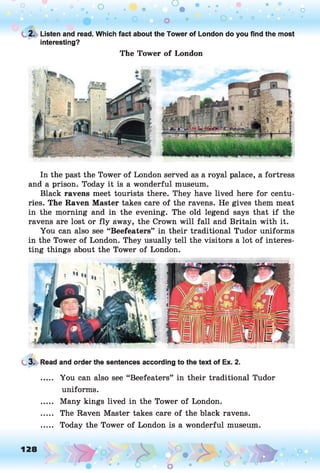
tains usually with a river flowing through it
8. A valley h) useful areas of land or minerals such as coal or
oil that exist in a country
9. A resource i) a natural flow of water across a country into the
sea
10. A map j) the typical weather conditions of a particular
area
2. Read and complete the sentences. Use the words from the box given below.
• valleys • maps • resources • rivers • climates • mountains
• coast • population • weather • continents • seas • people •
1. A t the Geography lessons we work w ith .......
2. There are ..... a n d ....... oceans.........a n d ....... on the Earth.
3. Are there 6 or 7 .....on our planet?
4. Geography informs us about the places and communities in
which ..... live and work.
5. What’s th e ..... like today?
6. These flowers will grow in c o ld .......
7. Ukraine is rich in m ineral.......
8. About 67.2 percent of the ..... of Ukraine lives in cities.
o O, 171
O
C. 3. Read the pupils’ opinions about the lesson of Geography.
Ann: My favourite subject is Geography. We started
studying it this year. Our teacher, Maryna
Ivanivna, tells us a lot of fun facts about the
countries in the world. Geography teaches us
about oceans, volcanoes, earthquakes and all
kinds of other things.
Dan: Geography is so exciting for mel We speak
about different things in the lessons: the land­
scapes of our planet, its mountains and plains,
oceans and seas, rivers and lakes. W e have
learned that landscapes are different on diffe­
rent continents. Asia, North America, Europe
are covered with forests. You can find vast
grasslands1 on these continents. The largest
desert is the Sahara, in Africa. In the last les­
son we talked about weather and human activity, which changes
the land.
4. Read and tick the sentences: A (Ann), D (Dan) or NG (not given).
1. We watch videos in the Geography lessons.
2. Geography teaches us information about the world.
3. There are a lot of encyclopaedias in my school library.
4. I ’m reading about Europe now.
5. The Earth is full of natural resources.
6. In the Geography lessons we learn about natural disasters.
^Conversation Lab ,
5. Work in three groups. Role-play the situation.
Each group has got a card with some information about one of the
continents. Read and study the information on the role card. Colour this
continent on the map. Then talk about this continent in class. Another group
listens and asks questions.
1 Vast grasslands - великі території, покриті травою.
172
>• >'• • *
o . •
O O O
O
Group A: Europe
It is the sixth largest continent in size and
the third largest in population. It is famous
for its temperate climate, forests and grass­
lands. It is home to the smallest country in
the world - the Vatican. The tallest mountain
is Mount Elbrus in Russia.
Group B: Asia
This continent is the world’s largest and
most populous with over 4 billion people.
It also contains the world’s most populous
country, China, and the world’s largest coun­
try, Russia. It has almost 30% of the world’s
land area and contains 60% of the world’s
population. It’s highest point Mount Everest
is here. The lowest point on land, the Dead
Sea, is also here.
Group C: North America
It is the third largest of the seven conti­
nents. It’s three largest countries are Canada,
Mexico, and the United States of America.
Columbus discovered this continent, but it
was named after an Italian explorer Amerigo
Vespucci. Lake Superior, the largest fresh­
water lake in the world, is on this continent.
The country of Greenland is the biggest
island on the planet.*6
http://www.ducksters.com/geography/oceans.php
6. Look through the information cards to Ex. 5 and write about one of the con-
a. tinents.
173
!> > Lesson®-6.
1. Listen and repeat. Say what you usually do in PE lessons.
Example.
We usually run in the lessons. Some pupils run faster than others.
But we all get great pleasure from running.
• to run • to jump • to play with a ball • to jump in length
• to climb on the rope • to climb the wall bar • to do a pull-up
• to skip rope •
174
o . •
O O o
C 2. Read the pupils’ opinions about the lessons of Physical Education and say
why they like or don’t like the lessons. Do you like your PE lessons?
John: PE is my favourite subject at school. I like it because it’s fun,
competitive and it’s like exercising, but better. PE is a time to
have fun with friends and stay healthy. I also like playing hockey.
I think PE is the only subject where I don’t need to sit in a chair
the whole time. I like to play games like basketball or soccer.
Kate: I like my school PE lessons. They are always active and we don’t
have to sit at the desks. W e always play team games such as
football, basketball or volleyball. I love to be part of a team.
However, I ’m very shy and don’t like it when people look at me.
So when we do some individual exercise, my results are not very
good. I have to practise more.
3. Read and complete the sentences. Use the words from the box given below.
• PE lessons • climbing • exercises • little • physical • a child •
1. If you move ..... , you become physically weak.
2. If it is warm, ..... are at the stadium not in the gym.
3. But I really wanted to jump, climb on ropes and wall bars when
I w a s.......
4. PE lessons help us improve our health and develop our .....
abilities.
5. You can ask your PE teacher to give you a break if you have
a problem with ..... a rope or doing pull-ups.
6. A t the beginning of the lesson we always warm-up.......
o O, 175
O
C. 4. Read and complete the text with the missing parts (A-H) given after the text.
Say what helped the girl to win a race.
“Come on. You can do it. You’re fast!” said my friend Lizzy. Those
encouraging words convinced me ( 1 ) .....that race. It was a girl’s race
held in the PE lesson two days ago. For some minutes I stood trem­
bling ( 2 ) ........There were ten nervous runners ( 3 ) ......... Everybody
wanted to win. We all (4) ..... on our shirts. Everyone was ready.
Bang! The starter’s pistol went off, and we ( 5 ) .....along the stadium.
When I reached ( 6 ) ..... , I noticed that there were only three other
runners around me. Then I saw Lizzy. She screamed excitedly, “You
are going ( 7 ) ..... !” I began to run faster. I crossed ( 8 ) ....... I won!
My gold medal is one of my special treasures.
A thundered straight ahead
B to sign up for
C to win the race
D at the starting line
E at the stadium
F the finish line
G wore jumbo numbers
H the halfway point
5. Work in pairs. Make up dialogues as in the example. Why do children need
physical education? Use the phrases in the box.
Example.
A: Does Physical Education improve children’s bodies and muscles?
B: Yes, it does.
• to develop children’s bodies and muscles (motor skills)
• to participate in physical activities • to provide regular,
physical activities for all children • to improve self-discipline
• to reduce stress • to strengthen peer relationships
• to help children to become more confident and independent
• to give children the opportunity to set their personal goals
• to improve children’s health •
6. Complete the text given below with the correct form of the verbs to play, to
go, to come or to do.
&
I’m preparing to run in a school race. I (1) ..... jogging every
morning and (2) ..... swimming twice a week. I (3) ..... for a run
almost every evenings and at weekends. I sometimes ask my brother
to ( 4 ) .....with me but he prefers to ( 5 ) ...... boxing. My sister ( 6 ) ......
ballet at the ballet school and while she is at her class I (7) .....
basketball in the gym. I (8) ..... to basketball practice regularly
because I’m in the team and we ( 9 ) .....matches most weekends. I also
(10) ...... football with my friends. By (1 1 ).....so much exercise I hope
to be really fit for the race. I ’m not going to relax afterwards either -
I plan to (12) ..... skiing with my family in the Carpathians!
o O, 177
O
1. Look at the pictures and say what children do in the English lessons. Match
the pictures (A-l) to the activities. Use the phrases from the box given below.
• to do exercises from the textbook • to write spelling dictations
• to work in pairs • to work in groups • to do a project
• to learn vocabulary • to discuss different topics
• to make up a story • to role-play • to listen to spoken
English of native speakers • to learn about culture •
178 ,o
o
C 2. Listen and repeat. Say what you usually do in the English lessons.
Example.
We often listen to spoken English of native speakers using head­
phones. Sometimes native speakers come to our lessons and we com­
municate with them.
3. Complete the sentences with the correct form of the verbs in brackets.
1. The pupils ..... (not to do) Exercise 5 yet.
2. My frien d ..... already..... (to finish) his homework.
3. I ..... (to read) many English books last month.
4....... w e ....... (to see) an interesting film in History tomorrow?
5. I ..... (to do) my homework now.
6. Helen ..... (not to do) her homework yesterday.
7....... h e .......(to do) the sums in the Maths lessons?
4. Read and choose the correct modal verb.
Example.
Students who do exercises every day can / must be physically
active for a lifetime.
1. My friend is so imaginative that he could / should draw himself
deep underwater finding treasure yesterday.
2. Everybody can / has to read Maths material slowly and tho­
roughly.
3. W e can / had to divide all literature into two groups depending
on their form: prose and poetry.
4. Pupils mustn’t / must pay much attention to all the subjects
because they are all important.
5. You can / can’t be a well-educated person if you don’t know at
least one foreign language.
6. They could / can make crafts, draw and paint in A rt lessons
when they were in the fifth form.
Conversation Lab
5. Work in small groups. Discuss your favourite school subjecs. Each group
speaks in class. In pupils’ reports they tell their classmates:
• what subject is their favourite;
• what activities they do during their favourite lesson;
• why they like this subject.
o O, 179
O
o o
o
t 6. Write what you usually do in the English lessons. Use the words from the box
given below.
&
• to read the text from the textbook and answer the questions
to the text • to write sentences • to do grammar exercises
• to learn poems and songs by heart • to ask and answer
the questions on a given topic • to make up stories or dialogues
• to set up role-plays • to take part in different quiz-games
• to recite rhymes and poems •
Think of your records. Decide how well you know it:
4 = very well, 3 = OK, 2 = a little, 1 = needs to improve
ySelf-assessment
Skills Now I can... 4 3 2 1
*
• describe daily school routines
• talk about different school subjects
• ask and answer questions about my
favourite subjects and school life
• reply to simple direct questions about
personal details
• initiate and respond to simple state­
ments about school life
□
□
□
□
□
□
□
□
□
□
□
□
□
□
□
□
□
□
□
□
•
• catch the main point in short, clear,
simple messages
• understand enough to keep conversation
going
• understand the information during the
discussion
□
□
□
□
□
□
□
□
□
□
□
□
• get an idea of the content of a timetable □ □ □ □
 • write a short story about my favourite
lessons and classroom activities
□ □ □ □
180
о . •
О
О о
о о
о • о о • • ф
G RAM M AR REFERENCE
ГРАМ АТИ Ч Н И Й ДОВІДНИК
T H E A R T IC L E
Артикль
Артикль - це службова частина мови, яка вживається перед імен­
ником. В англійській мові є два артиклі - неозначений (а/ап) та озна­
чений (the).
Неозначений артикль (а/ап ) походить від числівника one і тому
вживається тільки в однині зі злічуваними іменниками (countable
nouns).
Злічувані іменники - це іменники, які мають форму однини та
множини, тобто їх можна порахувати.
Наприклад: a booh, a pen, an egg, an orange.
З незлічуваними іменниками (uncountable nouns) неозначений
артикль не вживається. Незлічувані іменники треба запам’ятати:
sugar, milk, water, advice, information, luggage, traffic, work, music,
rain, weather, spaghetti, news, etc.
З незлічуваними іменниками використовуються дієслова в однині;
означений артикль the та слова some, any, much, по.
Наприклад:
Look! H ere’s the luggage.
I ’d like some milk.
Is there any juice?У
У множині неозначений артикль також відсутній (нульовий
артикль):
There is a book on the desk. There are books on the desk.
Артикль а вживається перед іменниками, які починаються з голос­
них звуків (vow els): а, е, і, о, и.
Артикль an вживається перед іменниками, які починаються з при­
голосних звуків (consonants): b, с, d, f, g, h, j, k, 1, m, n, p, q, r, s, t, v,
w, x, y, z.
Наприклад: a cat, a desk, an apple, an umbrella.
Винятки:
a uniform
a useful book
an hour
o 181
Зазвичай артикль ставиться перед іменниками, але якщо іменник
має одне або кілька означень, то артикль ставиться перед ними:
a day, a windy day, a very windy day.
Неозначений артикль показує, що певний предмет належить до
групи однорідних предметів, але не виділяє його:
Give те a pen, please. - Дай мені ручку, будь ласка.
(У цьому реченні артикль означає, що того, хто просить, влаштовує
будь-який олівець, а не якийсь конкретно).
Означений артикль the походить від вказівного займенника this
(that). Він показує, що певний предмет якимось чином виділяється з
групи однорідних:
Give те the pen, please. - Дай мені, будь ласка, ручку.
(У цьому реченні просять якусь певну ручку: ту, що в руках у
співрозмовника; ту, що знаходиться на столі тощо).
У такому випадку артикль можна замінити вказівним займенником
this або that.
Це загальноприйняті правила вживання артикля, але існує ще
багато спеціальних правил, з якими ви ознайомитеся нижче.
1. Неозначений артикль а/an вживається, коли вперше згадується
про якийсь предмет. Якщо ж повідомляється про цей предмет знову,
то вживаємо означений артикль the. Наприклад:
Look! There is a cat in my room. The cat is brown and white.
2. Означений артикль вживається з назвами музичних інструментів:
I play the piano. She plays the guitar.
3. Якщо повідомляється про заняття спортом, вживання їжі, назви
країн чи предмети, які вивчаємо в школі, то артиклі не вживаються.
Наприклад:
I play tennis.
I listen to the news at breakfast.
I have never been to Italy.
I like English.
4. Артикль також не вживається:
а) перед прізвищами, іменами людей, кличками тварин і птахів:
Stepanenko, Ivan, Nina, Druzhok, Murka.
182
Примі тка. Якщо перед прізвищем у множині вживається
означений артикль, це означає, що йдеться про всіх членів сім’ї:
the Kovalenkos - Коваленки;
б) перед назвами континентів, країн, міст, сіл: Europe, Ukraine,
Poland, Kyiv, Vesele.
Винятки:
the Crimea, the Netherlands, the Philippines, the Caucasus.
в) якщо перед іменником стоїть присвійний, вказівний, питальний
займенник або неозначений займенник some, any, по, each, every: ту
sister, this booh, that street, some studen ts, no pens, each pupil, every day.
5. З означеним артиклем the вживаються:
а) назви країн, що складаються із загального іменника з одним або
кількома означеннями перед ним;
the United States of America, the United Kingdom of Great Britain
and Northern Ireland;
б) назви морів, океанів, річок, заток, проток, каналів і гірських
хребтів: the A tlantic Ocean, the Black Sea, the Dnipro River, the Desna
River, the Alps.
Означений артикль the вживається з іменниками як в однині, так
і в множині.
THE NOUN
Іменник
Іменники в англійській мові, як і в українській, вживаються в
однині і множині. В українській мові іменник - змінна частина мови,
натомість в англійській мові іменники не змінюються (не мають
відмінкових закінчень).
Іменники в англійській мові поділяються на злічувані (ті, які
можна порахувати) та незлічувані (ті, які не можна порахувати).
Злічувані іменники мають форми однини та множини, а незлічувані
лише форму однини.
Наприклад:
- злічувані: a book - books, a paper - papers;
- незлічувані: water, advice, juice, etc.
До групи незлічуваних іменників належать іменники, що
позначають:
О 183
- рідини, тверді речовини, гази тощо: bread, butter, air, corn, flour,
etc;
- шкільні предмети, науки: Literature, Maths, History, etc;
- мови: English, French, Spanish, Ukrainian, etc;
- назви видів спорту: baseball, golf, football, cycling, billiards, etc;
- назви природних явищ: fog, snow, sunlight, shade, etc;
- збірні іменники: luggage, jewellery, money, rubbish, furniture, sta­
tionery, etc.
Примі тка: а) Слова, що позначають назви напоїв, можуть вжива­
тися і у значенні злічуваних іменників. Порівняйте:
W ould you like a coffee? (= a cup of coffee)
Two sodas, please. (= two cups of soda)
Значна кількість незлічуваних іменників, може стати злічуваними
в словосполученнях зі словами a piece of, a box of, а сир of, a bag of,
a game of та ін.
Наприклад: a piece of advice, a loaf of bread, a glass of milk, a bottle
of water, a kilo of meat, a bar of chocolate, a bag of flour, a pair of
trousers, etc.
Ф орм а множини іменників утворюється додаванням до форми
однини закінчення -s, яке після дзвінких приголосних і голосних
вимовляється як звук /z/, а після глухих приголосних - як /s/.
Наприклад:
a pen - five pens /z/
a book - two books /s/
Іменники, що закінчуються на -s, -ss, -x, -sh, -ch, у множині мають
закінчення -es, яке вимовляється як /iz/:
a watch - seven watches /iz/
Якщо іменник в однині закінчується на -у з попередньою
приголосною, у множині додається закінчення -es; при цьому у
змінюється на і:
a story - three stories
У деяких іменників, що в однині закінчуються на -f або -fe, у
множині f змінюється на v і додається закінчення -(e)s.
a leaf - many leaves
a knife - seven knives
184
Винятки: a roof - roofs, a belief - beliefs.
Форма множини деяких іменників утворюється не за правилами.
Ці іменники необхідно запам’ятати:
a man - men
a woman - women
a person - people
a child - children
a foot - feet
a tooth - teeth
a mouse - mice
В англійській мові іменник має два відмінки: з а г а л ь н и й (the
Common Case) і п р и с в і й н и й (the Possessive Case).
(Note: We don’t use these terms when teaching English in English.)
Загальний відмінок не має спеціальних відмінкових закінчень.
Зв’язок іменника у загальному відмінку з іншими словами в реченні
виражається прийменниками і місцем у реченні. Так, іменник, що
стоїть перед присудком, є підметом, а після присудка — прямим
додатком:
The teacher asks the student. - Учитель запитує учня.
The student asks the teacher. - Учень запитує вчителя.
Різні зв’язки іменника, що відповідають непрямим відмінкам в
українській мові, виражаються за допомогою прийменників:
The boy gave the book to his sister. - Хлопець дав книжку своїй
сестрі.
The streets of the city were narrow. - Вулиці міста були вузькі.
Не wrote with a pen. - Він писав ручкою.
Присвійний відмінок вказує на належність предмета якійсь особі.
В однині він утворюється додаванням до іменника апострофа і закін­
чення -s, яке вимовляється за тими самими правилами, що й закінчен­
ня множини іменників.
the g irl’s book — книжка дівчинки
the cat’s tail — хвіст кота
Присвійний відмінок іменників у м н о ж и н і утворюється
додаванням до них апострофа після закінчення -s:
students’ books — книжки студентів
Якщо іменник у множині не закінчується на -s, то присвійний
відмінок утворюється додаванням -’s:
the children’s toys — дитячі іграшки
О О, 185
О
Замість присвійного відмінка може вживатися іменник із
прийменником of:
ту friend’s brother — the brother of my friend (брат мого друга)
В англійській мові прикметники не змінюються ні за родами, ні за
числами, ні за відмінками. Вони змінюються лише за ступенями
порівняння.
Якісні прикметники мають о с н о в н у фо р м у (the positive
degree), в и щи й (the comparative degree or comparatives) і н а й ­
в и щ и й (the superlative degree or superlatives) с т у п е н і порівняння.
Форми вищого і найвищого ступенів порівняння прикметників
можуть бути, як і в українській мові, п р о с т и м и і с к л а д е н и м и .
Прості форми ступенів порівняння прикметників утворюються
додаванням до основної форми закінчення -ег у вищому та -est - у
найвищому ступені:
old - older - the oldest.
Складені форми ступенів порівняння утворюються за допомогою
слів more (більш ) у вищому ступені та most (найбільш ) — у
найвищому. Основна форма прикметника залишається без змін:
beautiful - more beautiful - the most beautiful.
В англійській мові прості форми ступенів порівняння мають:
а) усі односкладові прикметники:
short - shorter - shortest
б) двоскладові прикметники, що закінчуються на -у, -er, -le, -ow:
easy - easier - easiest
clever - cleverer - cleverest
simple - simpler - simplest
narrow - narrower - narrowest
в) двоскладові прикметники з наголосом на другому складі:
T H E A D J E C T I V E
Пр икметник
Ступені порівняння прикметників
(Com paratives and Superlatives)
186
о . •
О
О о
polite - politer - politest
Складені форми ступенів порівняння мають усі багатоскладові
прикметники і двоскладові з наголосом на першому складі, крім тих,
що закінчуються на -у, -er, -le, -ow:
interesting - more interesting - the most interesting
famous - more famous - the most famous
Винятки:
Ступені порівняння деяких прикметників в англійській мові, як і
в українській, утворилися від інших коренів. їх потрібно запам’ятати.
good, - better - the best гарний —кращий —найкращий
bad - worse - the worst поганий —гірший —найгірший
little - less - the least малий —менший —найменший
much (m any) - more - the most багато —більше —найбільше
При утворенні простих форм ступенів порівняння прикметників
дотримуються таких правил орфографії:
а) якщо прикметник закінчується на -е, то перед закінченнями -ег
та -est воно випадає:
nice - nicer - the nicest
б) в односкладових прикметниках перед закінченнями -ег та -est
подвоюється кінцева приголосна, якщо перед нею стоїть короткий
голосний звук:
big - bigger - the biggest
в) якщо прикметник закінчується буквою -у з попередньою
приголосною, то перед -er, -est літера у змінюється на і:
funny - funnier - the funniest
Вищ ий ступінь порівняння прикметників (comparatives) вживається
для порівняння двох людей, тварин, предметів або явищ.
She is taller than you.
Н айвищ ий ступінь порівняння прикметників (superlatives)
вживається для порівняння трьох і більше людей, тварин, предметів
або явищ.
I t is the shortest story in the booh.
This is the most dangerous fish in the sea.
o O, 187
O
о о о
•. о
T H E N U M E R A L
Числівник
В англійській мові числівники поділяються на кількісні (cardinal)
та порядкові (ordinal).
Cardinal
1 —one
2 —two
3 —three
4 —four
5 —five
6 - six
7 —seven
8 —eight
9 —nine
10 - ten
11 —eleven
12 —twelve
13 - thirteen
14 —fourteen
15 - fifteen
16 —sixteen
17 - seventeen
N um erals
18 —eighteen
19 —nineteen
20 —twenty
21 —twenty-one
22 —twenty-two
23 —twenty-three
24 —twenty-four
25 - twenty-five
26 - twenty-six
30 —thirty
40 —forty
50 - fifty
60 - sixty
70 - seventy
80 —eighty
90 - ninety
100 - a hundred / one hundred
Порядкові числівники (ordinal), крім перших трьох, утворюються
шляхом додаванням суфікса -th до відповідних кількісних числівників.
При цьому деякі з них зазнають змін у написанні й вимові.
O rdinal
1st _ first
2nd - second
3rd - third
4th —fourth
5th - fifth
6th - sixth
7th - seventh
8th - eighth
9th - ninth
10th - tenth
Hth _ eleventh
12th - twelfth
13th - thirteenth
14th - fourteenth
15th - fifteenth
N um erals
16th - sixteenth
17th —seventeenth
19th - nineteenth
20th - twentieth
21st - twenty-first
22nd —twenty-second
23rd - twenty-third
24th - twenty-fourth
25th - twenty-fifth
26th - twenty-sixth
30th - thirtieth
40th - fortieth
50th - fiftieth
60th - sixtieth
70th - seventieth
188 o
o °
o
О .
•
•
.•
•
•
•
0
О
•
О
•
•
•
° ° о « о * •
80th - eightieth 100th - one hundredth
90th - ninetieth
Зазвичай порядкові числівники вживаються з означеним артиклем.
T H E P R O N O U N
Займенник
Займенник - частина мови, що лише вказує на предмет, ознаку та
кількість, але не називає його.
В англійській мові займенники поділяються на: особові, присвійні,
зворотні, вказівні, неозначені, питальні.
Особові займенники (Personal Prounouns)
Особові займенники в англійській мові мають два відмінки:
н а з и в н и й і о б ’ єкт ний.
Називний відмінок:
І - я
you - ти
he - він
she - вона
it - воно (він, вона - для неживих предметів і тварин)
we - ми
you - ви
they —вони
Особові займенники в називному відмінку виконують функцію
підмета (subject pronouns):
The girl is reading. - She is reading.
Mark likes ice cream very much. - He likes ice cream very much.
О б’єктний відмінок:
me - мене, мені
you - тебе, тобі
him - його, йому
her - її, їй
it - його, йому, її, їй
us - нас, нам
you - вас, вам
them - їх, їм
189
о о о
•. о
Особові займенники в об’єктному відмінку виконують функцію
додатка (object pronouns).
I like him.
Після прийменників особові займенники вживаються лише у формі
об’єктного відмінка.
Dan talks to her.
The Possessive Pronouns
Присвійні займенники
Присвійні займенники мають дві форми: відносну, яка вживається
лише як означення до іменника (possessive adjectives), та абсолютну,
яка вживається самостійно, тобто без іменника (possessive pronouns).
Відносна форма Абсолютна форма
т у mine
your yours
his his
her hers
its its
our ours
their theirs
This is your book. Give me mine. - Це твоя книжка.
В англійській мові немає такого присвійного займенника, що
відповідав би українському займеннику свій. Останній перекладається
на англійську мову різними присвійними займенниками залежно від
особи, якої він стосується:
I read ту book yesterday. — Я читав свою книжку вчора.
She read her book yesterday. — Вона читала свою книжку вчора.
The Reflexive Pronouns
Зворотні займенники
Від присвійних займенників ту, our, your і т. д. шляхом додавання
закінчень -self (в однині) та -selves (у множині) утворюються зворотні
займенники myself, ourselves, yourselves і т. д., які часто відповідають
українським себе в різних відмінках та сам.
I have done it myself. — Я зробив це сам.
190 о
О О о
THE ADVERB
Прислівник
Прислівник в англійській мові, як і в українській, — це частина
мови, що вказує на ознаку дії (стану) або якості.
Nina studies very well.
He speaks loudly.
Прислівники поділяються на прості й похідні. До похідних при­
слівників належать такі, які утворюються додаванням суфіксів до
прикметників та іменників.
Більшість прислівників утворюються від прикметників за допомо­
гою суфікса -1у:
usual - usually
Винятки:
good - well
fast - fast
hard - hard
Деякі правила правопису.
Якщо прикметник закінчується на -у, змініть його та додайте
суфікс -1у:
noisy - noisily
Закінчення -е залишається перед суфіксом -1у:
nice - nicely
Виняток:
true - truly
Закінчення -1е змінюється на -1у:
possible - possibly
За своїм значенням прислівники в англійській мові поділяються на
окремі групи. Розглянемо деякі зних.
Adverbs of manner (прислівники способу дії): badly, well, slowly,
quickly та ін. показують, як відбувається дія. Як правило, такі при­
слівники стоять у кінці речення, але ті, які закінчуються на -1у, інко­
ли можуть знаходитися і всередині речення.
We ran to the river quickly.
We quickly ran to the river.
Adverbs of time (прислівники часу): today, yesterday, soon, now,
late, then, when, since, before та adverbs of place (прислівники місця):
о О, 191
О
here, there, above, downstairs, outside, where - зазвичай вживаються
на початку або в кінці речення.
Не was not at school yesterday. - Його не було у школі вчора.
Tomorrow we have six lessons. - Завтра ми маємо шість уроків.
Adverbs of Frequency (прислівники частотності): often, never, ever,
always, sometimes, seldom та ін., як правило, вживаються всередині
речення, між підметом та присудком, або після форм допоміжного
дієслова to be.
I sometimes visit my friends.
Do you usually go to the library on Saturday?
I am occasionally good at w riting test.
Прислівники normally, usually, often, sometimes та occasionally
можуть також вживатися на початку речення.
Normally we have five lessons on Thursday. - Зазвичай ми маємо
п’ять уроків у четвер.
THE VERB
Дієслово
Дієслово —це частина мови, яка означає дію предмета. Особливістю
англійської мови є те, що в ній дуже легко можна утворити дієслова
практично від будь-якого іменника, назви предмета чи явища. Для
цього часто достатньо додати перед словом службову частину мови -
частку to.
Наприклад:
work —робота
to work —працювати
Дієслово в англійській мові має особові й неособові форми. Особові
форми дієслова вказують на особу, число, спосіб, час дії і стан. До
особових належать форми дієслова в трьох особах однини і множини,
в усіх часах активного і пасивного стану, в дійсному і наказовому
способах. Ці форми дієслів вживаються в реченні в ролі присудка.
I study English at school. - Я вивчаю англійську мову у школі.
We study English at school. - Ми вивчаємо англійську мову у школі.
Study English at school! - Вивчайте англійську мову у школі.
В англійській мові розрізняють чотири групи часових форм
дієслова:
Simple Tenses - неозначені часи
Continuous Tenses - тривалі часи
Perfect Tenses - перфектні / доконані часи
Perfect Continuous Tenses - перфектно-тривалі часи
У кожній групі, крім теперішнього (Present), минулого (P a s t) та
майбутнього часу (F u tu re), є ще форма Future-in-the-Past, що виражає
майбутню дію відносно минулого часу.
За способом утворення Past Sim ple та Past Participle дієслова в
англійській мові поділяють на правильні й неправильні. Правильні
дієслова утворюють другу та третю форми додаванням закінчення -ed
до базової форми.
w ork - w orked - w orked
p la y - p la y e d - p la y e d
try - trie d - trie d
Неправильні дієслова утворюють ці форми по-різному, тому їх
треба запам ’ятати, скориставшись таблицею неправильних дієслів
(див. форзаци).
w rite - w rote - w ritte n
В англійській мові є ще й так звані допоміжні дієслова. Вони
слугують для побудови стверджувальної, заперечної та питальної
форм дієслова у різних групах часів.
У шостому класі вивчаються деякі часи груп Sim ple, Continuous та
Perfect.
P R E S E N T S IM P L E T E N S E
Теперішній простий (неозначений) час
Теперіш ній простий (неозначений) час вживається:
• для вираження постійної або повторюваної дії чи звички, яка
характеризує підмет та відбувається взагалі, а не в момент мовлення:
I go to school on foot.
I g e t u p a t seven o’clock.
• з дієсловами to see, to know, to hear, to feel, to w ant, to hate, to
love, to understand та деякими іншими для вираження дії, що
відбувається в момент мовлення:
I see A n n n e a r т у house.
• для вираження думок, почуттів чи надання постійної харак­
теристики:
She p la y s the piano.
• для вираження незмінної істини, загальновідомого факту,
необмеженого часовими рамками:
S p rin g comes a fte r w in ter.
193
Стверджувальна форма дієслова в теперішньому простому
(неозначеному) часі в усіх особах однини та множини співпадає з
базовою формою дієслова без частки to. Єдиний виняток - третя особа
однини, де додається закінчення -s або -es.
I p lay.
Y ou p lay.
Н е (S h e, I t ) plays.
W e (T h e y ) p lay.
Закінчення -s після глухих приголосних вимовляється як звук /s/,
а після дзвінких приголосних і голосних - як /z/.
She speaks, / s / H e reads, j z j
Якщо основа дієслова закінчується на -s, -sh, -ss, -ch, -tch, -x, то в
третій особі однини до дієслова додається закінчення -es, яке
вимовляється як /iz/:
She w atches T V every day. - Вона дивиться телевізор щодня.
Якщо дієслово закінчується на -у з попередньою приголосною, то
перед -es буква -у змінюється на -і:
Якщо перед -у стоїть голосна, то до дієслова додається лише
закінчення -s:
Н е p lays fo o tb all on S undays. - Він грає у футбол щонеділі.
Заперечна форма в Present Simple Tense утворюється за допомогою
допоміжного дієслова do (does), заперечної частки not та базової
форми основного дієслова без частки to.
I d o n ’t work. / Н е doesn’t work. / Y ou d o n ’t work.
Питальна форма Present Simple Tense утворюється з допоміжного
дієслова do (does) та базової форми основного дієслова без частки to.
Допоміжне дієслово ставиться перед підметом.
D o I work? D o we work?
D o you work? D o you work?
Does he (s h e ) work? D o they work?
H e tries.
194 o
о . •
О О о
Короткі відповіді:
- Yes, I do. / N o , I don’t.
- Yes, she does. / N o , she doesn’t.
Відмінювання дієслова to be:
Affirmative
(Стверджувальна форма)
Negative
(Заперечна форма)
Interrogative
(Питальна форма)
I am. I am not. Am I?
You are. You are not. Are you?
Не (she, it) is. He (She, It) is not. Is he (she, it) is?
We are. We are not. Are we?
You are. You are not. Are you?
They are. They are not. Are they?
Short answers (Короткі відповіді)
Yes, I am. No, I am not. / No, I ’m not.
Yes, you are. No, you are not. / No, you aren’t.
Yes, he (she, it) is. No, he (she, it) is not (isn’t.)
Yes, we are. No, we are not. / No, we aren’t.
Yes, you are. No, you are not. / No, you aren’t.
Yes, they are. No, they are not. / No, they aren’t.
Відмінювання дієслова to h a v e :
Affirmative
(Стверджувальна форма)
Negative
(Заперечна форма)
Interrogative
(Питальна форма)
I have. I do not have. Do I have?
You have. You do not have. Do you have?
He (she, it) has. He (She, It) does not have. Does he (she, it) have?
We have. W e do not have. Do we have?
You have. You do not have. Do you have?
They have. They do not have. Do they have?
Short answers (Короткі відповіді)
Yes, I have. No, I do not (don’t) have.
Yes, you have. No, you do not (don’t) have.
Yes, he (she, it) has. No, he (she, it) does not (doesn’t) have.
Yes, we have. No, we do not (don’t) have.
Yes, you have. No, you do not (don’t) have.
Yes, they have. No, they do not (don’t) have.
О О, 195
О
P A S T S IM P L E T E N S E
М инулий простий (неозначений) час
Past Sim ple Tense вживається для вираження одноразової або
постійної дії в минулому, яка не пов’язана з теперішнім моментом
мовлення. Зазначений час описує минулі події. На українську мову
він перекладається минулим часом доконаного або недоконаного виду
залежно від змісту речення.
Past Sim ple Tense часто вживається з обставинними словами yes­
terday учора, last week минулого т и ж н я , last year т о р ік, last sum m er
минулого л іт а , the other day недавно, цим и дням и тощо.
I w ent to the lib ra ry on S a tu rd a y . - Я ходив до бібліотеки у суботу.
Для того щоб утворити стверджувальну форму Past Simple Tense,
треба до базової форми правильного дієслова додати закінчення -ed.
I w orked.
Y ou worked.
Н е (S h e ) worked.
W e worked.
T h ey w orked.
Закінчення -ed вимовляється так:
/t/ —після глухих приголосних, крім t:
to help - helped /t/;
/d/ —після дзвінких приголосних, крім d, і після голосних:
to open - opened /d/;
/id/ —після приголосних t, d:
to w a n t - w an ted /id/.
Дієслова, що закінчуються в інфінітиві буквою -у, якій передує
приголосна, змінюють -у на -і перед закінченням -ed:
to stu d y — studied:
Дієслова, що закінчуються буквою -е, втрачають її перед закінченням
-ed:
to live - lived.
Past Simple Tense неправильних дієслів треба запам’ятати (див.
список неправильних дієслів).
Як правильні, так і неправильні дієслова в Past Simple Tense мають
однакову форму для всіх осіб однини і множини.
I re a d a book yesterday.
Y ou read a book yesterday.
H e (S h e ) re a d a book yesterday.
W e read a book yesterday.
T h ey re a d a book yesterday.
196
о . •
О О о
Виняток становить дієслово to be:
I was
He (She, It) was
We were
You were
They were
Питальна і заперечна форми Past Simple Tense утворюються за
тими самими правилами, що й Present Simple Tense, але допоміжне
дієслово to do вживається в Past Simple (d id ) в усіх особах.
I did not play.
You did not play.
He (She, It ) did not play.
Affirmative
(Стверджувальна форма)
Negative
(Заперечна форма)
Interrogative
(Питальна форма)
I played. I did not play. Did I play?
You played. You did not play. Did you play?
Не (She, It) played. He (She, It) did not play. Did he (she, it) play?
We played. We did not play. Did we play?
You played. You did not play. Did you play?
They played. They did not play. Did they play?
Short answers (Короткі відповіді)
Yes, I did. No, I did not. / No, I didn’t.
Yes, you did. No, you did not. / No, you didn’t.
Yes, he (she, it) did. No, he (she, it) did not (didn’t.)
Yes, we did. No, we did not. / No, we didn’t.
Yes, you did. No, you did not. / No, you didn’t.
Yes, they did. No, they did not. / No, they didn’t.
F U T U R E S IM P L E T E N S E
Майбутній простий (неозначений) час
Future Sim ple Tense вживається для вираження одноразової,
постійної або повторюваної дії, що відбудеться в майбутньому. При
цьому часто вживаються такі слова: tom orrow - завтра, next week -
наступного тижня, next month - наступного місяця, next year -
наступного року тощо.
I will go to the library tomorrow. - Я піду до бібліотеки завтра.
В сучасній англійській мові стверджувальна, питальна та заперечна
форми Future Sim ple Tense утворюються за допомогою допоміжного
дієслова will та базової форми основного дієслова без частки to.
О О, 197
О
У загальному запитанні допоміжне дієслово w ill ставиться перед
підметом.
Affirmative
(Стверджувальна форма)
Negative
(Заперечна форма)
Interrogative
(Питальна форма)
I will (ГН) read. I will not (won’t) read. W ill I read?
You will (you’ll) read. You will not (won’t) read. W ill you read?
He will (he’ll) read. He will not (won’t) read. W ill he read?
She will (she’ll) read. She will not (won’t) read. W ill she read?
It will (it’ll) read. It will (won’t) read.
We will (we’ll) read. We will not (won’t) read. W ill we read?
C O N T IN U O U S T E N S E S
Тривалі часи
Часи групи Continuous вживаються для вираження дії як процесу,
тобто дії, що триває в момент мовлення чи в теперішній період часу
(Present Continuous Tense), тривала в якийсь момент чи період часу в
минулому (P ast Continuous Tense), триватиме в певний момент чи
період часу в майбутньому (F utu re Continuous Tense).
Часи групи Continuous утворюються з допоміжного дієслова to be
у відповідній часовій формі та дієприкметника теперішнього часу
(Present Participle) основного дієслова.
Present Participle утворюється додаванням закінчення -ing до
інфінітива основного дієслова без частки to:
read - reading
Дієслова, що закінчуються в інфінітиві на -е, втрачають його перед
закінченням -ing: give - giving.
У дієсловах, що закінчуються на приголосну з попередньою
короткою наголошеною голосною, перед закінченням -ing кінцева
приголосна подвоюється: to run - running, to sit - sitting.
Якщо дієслово закінчується буквосполученням -іе, то перед
закінченням -ing, -іе змінюється на -у: lie - lying.
P R E S E N T C O N T IN U O U S T E N S E
Теперіш ній тривалий час
Теперішній тривалий час вживається для вираження дії, яка
відбувається в момент мовлення. Present Continuous Tense може
вживатися з такими словами, що позначають час виконання дії: now,
at the moment, at present.
198
З такими словами, як: to believe, to feel, to hear, to know, to like,
to see, to smell, to sound, to taste, to think, to understand, to want —
теперішній тривалий час не вживається, замість нього вживаємо
Present Simple Tense.
Affirmative
(Стверджувальна форма)
Negative
(Заперечна форма)
Interrogative
(Питальна форма)
I am working. I am not working. Am I working?
You are working. You are not working. Are you working?
He (she, it) is working. He (she, it) is not working. Is he (she, it) working?
We are working. We are not working. Are we working?
You are working. You are not working. Are you working?
They are working. They are not working. Are they working?
Short answers (Короткі відповіді)
Yes, I am. No, I am not. / (I’m not.)
Yes, you are. No, you are not. / No, you aren’t.
Yes, he (she, it) is. No, he (she, it) is not (isn’t.)
Yes, we are. No, we are not. / No, we aren’t.
Yes, you are. No, you are not. / No, you aren’t.
Yes, they are. No, they are not. / No, they aren’t.
Present Continuous Tense також вживається для вираження
запланованої дії в найближчому майбутньому, яка найчастіше
виражається словами, що означають рух.
I a m going to K y iv tom orrow . - Завтра я їду до Києва.
PRESENT PERFECT TENSE
Теперішній доконаний (завершений) час
Present Perfect Tense вживається:
• для позначення часу, який почався в минулому та продовжуєть­
ся під час мовлення:
I have lived here a ll m y life . - Я мешкаю тут усе своє життя;
• коли є результат дії. У цьому випадку ми не вказуємо час.
Присудок перекладається дієсловом доконаного виду:
I have already w ritten a letter. - Я вже написав листа.
Present Perfect Tense вживається з прислівниками just — щойно,
already — вже, yet - ще та прийменниками for - протягом, since - з.
о О, 199
О
Yet (ще) вживається наприкінці питального та заперечного речень:
I have not read the book yet. - Я ще не прочитав книжку.
For (протягом) позначає період тривалості дії:
I have known him for five years. - Я знаю його п’ять років.
Since (з) вказує на початок дії:
We have lived in Lviv since 1998. - Ми живемо у Львові з 1998 року.
Present Perfect Tense утворюється за допомогою дієслова to have у
Present Simple Tense та дієприкметника минулого часу. Для того щоб
утворити дієприкметник минулого часу від правильних дієслів, треба
додати закінчення -ed до базової форми дієслова; для неправильних
дієслів - це форми, які знаходяться в третій колонці списку
неправильних дієслів.
Affirmative
(Стверджувальна форма)
Negative
(Заперечна форма)
Interrogative
(Питальна форма)
I have done. I have not done. Have I done?
You have done. You have not done. Have you done?
He (she, it) has done. He (she, it) has not done. Has he (she, it) done?
We have done. W et have not done. Have we done?
You have done. You have not done. Have you done?
They have done. They have not done. Have they done?
Short answers (Короткі відповіді)
Yes, I have. No, I have not (haven’t).
Yes, you have. No, you have not (haven’t).
Yes, he (she, it) has. No, he (she, it) has not (hasn’t).
Yes, we have. No, we have not (haven’t).
Yes, you have. No, you have not (haven’t).
Yes, they have. No, they have not (haven’t).
MODAL VERBS
Модальні дієслова
Дієслова can (could), may (m ight), must (had to), should (ought
to) та деякі інші відносяться до групи модальних дієслів (Modal
Verbs). Модальні дієслова не вживаються самостійно, а тільки у спо­
лученні з інфінітивом основного (змістового) дієслова. Вони познача­
ють можливість, здатність, імовірність, необхідність виконання дії,
яка зазначається основним дієсловом.
H e can do it h im self. - Він може зробити це самостійно.
They тау соте to n ig h t. - Можливо, вони прийдуть сьогодні ввече­
рі.
I must speak to h im . - Я повинен поговорити з ним.
I might do the shopping on S a tu rd a y . - Можливо, я піду за покуп­
ками у суботу.
Модальні дієслова не мають усіх часових форм, як інші дієслова.
Вони також не мають неособових форм дієслова - інфінітиву, дієприк­
метників І та II та герундію.
Модальні дієслова сап та тау мають форми теперішнього та мину­
лого часів: сап - could, тау - might.
Модальне дієслово must має лишу форму теперішнього часу, а в
інших часових формах необхідно використовувати його еквівалент -
have to.
Необхідно пам ’ятати, що:
- інфінітив, який стоїть після модальних дієслів, вживається без
частки to. (Виняток: модальне дієслово ought to.)
Наприклад:
I can do it. - Ти можеш це зробити.
Y ou may take it. - Ти можеш це взяти.
Y ou should help h im . - Тобі варто йому допомогти.
But: Y ou ought to help h im . - Тобі варто йому допомогти.
- У третій особі однини теперішнього часу модальні дієслова не
мають закінчення -s: Н е can do it. Н е m ay take it.
- Питальна форма утворюється без використання допоміжного
дієслова to do, причому модальне дієслово ставиться перед підметом.
Наприклад:
Can you do it? - Чи ти можеш це зробити?
May I take it? - Чи можна мені це взяти?
Should I buy that? - Чи варто мені це купувати?
- Заперечна форма утворюється за допомогою заперечної частки
not, яка приєднується до модального дієслова:
Н е cannot (can’t) do it. H e may not (mayn’t) take it.
У розмовному стилі в заперечній формі зазвичай використовують­
ся такі скорочення:
cannot = can’t
could not = couldn’t
may not = mayn’t
201
о о о
•. о
might not = mightn’t
must not = mustn’t
should not = shouldn’t
Значення деяких модальних дієслів
CAN
Модальне дієслово can (could) використовується для позначення
ф ізичної чи розум ової здат ност і виконати ту чи іншу дію. Поряд із
зазначеним модальним дієсловом у різних часових формах використо­
вується його еквівалент - структура to be able to do something.
H e can read very well. - Він уміє читати дуже добре.
Н е could sw im very w ell when he was young. - Він умів добре плава­
ти, коли був молодим.
MAY / MIGHT
Модальне дієслово тау / might використовується для позначення
дозволу виконати ту чи іншу дію, а також для висловлення ймовірнос­
т і виконання тієї чи іншої дії:
Y ou may take т у d ictio n ary. - Ти можеш скористатися моїм слов­
ником.
Н е тау / might know h er address. - Можливо, він знає її адресу.
MUST
Модальне дієслово must використовується для висловлення необ­
хід но ст і виконання тієї чи іншої дії (згідно існуючих правил):
Y ou must go there tom orrow . - Ти повинен сходити туди завтра.
SHOULD
Модальне дієслово should використовується для висловлення пора­
ди, р еко м е н д а ц ії щодо виконання тієї чи іншої дії:
Y ou should ask h er fo r advice. - Тобі варто звернутися до неї за
порадою.
Y ou should consult a doctor. - Тобі варто порадитися із лікарем.
Інші значення модальних дієслів вивчаються на наступних етапах
навчання.
о . •
О О о
• • •
° ° о « о о • • 4
ENGLISH-UKRAINIAN VOCABULARY
АНГЛО-УКРАЇНСЬКИЙ СЛОВНИК
А , а
ability, п /a'bilgti/ здібність; здат­
ність
about, prep /a'baut/ про
abroad, adv /a'brtxd/ за кордоном
accessory, п /ak'sesari/ аксесуар
accident, п /'reksadant/ аварія,
катастрофа
across, prep /a'krr>s//l3lkrr>:s/ через
active, adj /'cektiv/ активний, жвавий
activity, n /rek'tiVgti/ діяльність
add, v /гей/ додавати
addition, n /a'dijan/ додаток
admiral, n /'redmaral/ адмірал
admire, v /ad'maia/ милуватися
adventure, n /ad'ventja/ пригода
advertisement, n /ad'v3:ti,sm3nt/
оголошення
advice, n /ad'vais/ порада
aeroplane, n /'earaplein/ літак
afterwards, adv /'a:ftawadz/ опісля
again, adv /а'деп/ знову
agree with smb, plir /а'дгі:/ пого­
джуватися з кимось
agree, v /а'дгі;/ погоджуватися
air, її /еа/ повітря
airport, її /'eapo:t/ аеропорт
almost, adv /'a:lmaust/ майже
along, prep /а'Іщ/ вздовж
although, conj /о:1'баи/ хоча
always, adv /'odw^z/ завжди
amusing, adj /a'mjuzir)/ захоплюючий
ancient, adj /'einjant/ стародавній
answer, n /'a:nsa/ відповідь
answer, v /'a:nsa/ відповідати
anyway, adv /'eniwei/ у будь-якому
випадку
appear, v /з'ріа/ з’являтися
appearance, 7? /a'piarans/ зовніш­
ність
aqualung, n /'rekwaUp/ акваланг
architect, n /'a:kgtekt/ архітектор
architecture, n /'crkatekt/a/ архітек­
тура
area, n /'еагіа/ територія
armoured, adj /'a:mad/ озброєний
around, prep /a'raund/ навколо
arrive, v /a'raiv/ прибувати
art gallery, phr /a:t/ /'дгеїагі/ ху­
дожня галерея
Art, n /a:t/ урок малювання
artistic, adj /a:'tistik/ художній
at weekends, phr /at'wi:kandz/ на ви­
хідних
athlete, n /'reGlkt/ атлет
athletics, n /ceG'letiks/ атлетика
attached, adj /a'tsetjt/ прикріплена
інформація
attend, v /a'tend/ відвідувати
attendant, n /a'tendant/ особа, гцо
супроводить; супровідник
attract, v /a'trsekt/ приваблювати
attraction, n /a'trrekjan/ атракціон,
місце для розваг
aunt, п /a:nt/ тітка
awful, adj /'з:ґз1/ жахливий
в, b
bacon, n /'Ьеікзп/ бекон baker’s, п /'beikaz/ хлібний магазин
baked potato, phr /beikt pa'teitau/ bakery, n /'Ьеікзгі/ хлібний мага-
печена картопля зин
О 203
о о о
•. о
• *
baking soda, phr /'beikip 'sauda/
сода для випічки
bank, п /Ьгерк/ берег
banknote, її /'brepknaut/ кредит­
ний білет, банкнот
bark, v /Ьа:к/ гавкати
basketball, п /'baiskatbad/ баскетбол
be afraid of smth, p lir /bi a'freid av/
боятися чогось
be bored, p lir /bi'ba:d/ нудьгувати
be born, phr /Ьі'Ьа:п/ народитися
be fond of, phr /bi 'fond av/ любити
be full of, phr /bi 'fol av/ бути напов­
неним
be good at, phr /bi 'gud at/ вміти
добре робити щось
be interested in, phr /bi'intrgStgdin/
цікавитись
be late for, phr /bi 'leit fa/ запізню­
ватися на
be lined with, phr /bi 'lamd wiS/
бути обсадженим
be located, phr /bi la'keitid/ розта­
шовуватись
be proud of, phr /bi 'praud av/
пишатися
be situated, phr /bi 'sitjueitid/ роз­
ташовуватись
beach, n /bftj/ узбережжя
bean, n /Ьіш/ біб
beautifully, adv /'bjuitafali/ красиво
beauty, n /'bju:ti/ краса
behind, prep /bi'haind/ позаду
bench, n /bentj/ лавиця
besides, adv /bi'saidz/ окрім
billion, n /'biljan/ мільярд
Biology, n /Ьаі'віабзі/ урок біології
birthplace, n /'Ьз:0р1еЕз/ місце наро­
дження
bitter, adj /'bita/ гіркий
blouse, n /blauz/ блуза
C,
calculation, n /.krelkjgileijan/ розра­
хунок
board game, phr /'ba:d ,деіш/ на-
стольна гра
boating, n /'bautip/ кататися (пла­
вати) на човні
boiled meat, phr /'baild ,mi;t/ варене
м’ясо
boldprint, n /'bauld .print/ надруко­
ване жирним шрифтом
bone, n /Ьаип/ кістка
book in advance, phr /buk/ /ad'vams/
замовляти заздалегідь
boots, n /bu:t/ чобіт
bottle, n /'botl/ пляшка
bowl, n /Ьаиі/ полумисок
boxing, n /'bnksip/ бокс
bread roll, n /'bred.rol/ булочка
bread, n /bred/ хліб
breakfast, n /'brekfast/ сніданок
breathe in, phr /brfS in/ дихати
bridge, n /Ьпбз/ міст
brief, adj /brrf/ короткий
brilliant, adj /'briljant/ чудовий
brochure, n /'brauja/ брошура
broth, n /Ьгв0/ бульон
brother, n /'Ьглба/ брат
building, n /'bildip/ будівля
bunch, n /bAntJ/ букет
burger, n /'Ьз:да/ бургер
bus driver, phr /bAs'draiva/ водій
автобуса
bus pass, phr /'bAs,pa:s/ проїзний
квиток на автобус
bus stop, phr /'bAs.stop/ зупинка
автобуса
bus, n /Ьлб/ автобус
businessman, n /'bizr^sman/ бізнесмен
busy, adj fbizi/ зайнятий; жвавий
butcher’s, n /'butjaz/ мясний магазин
butter, n /'bAta/ масло
button, n /'bAtn/ ґудзик
by heart, adv /'bai ,ha:t/ напам’ять
c
call, v /ка:1/ дзвонити
camp, n /кгешр/ табір
204
O
O
o °
o
о . •
О О о
can of Соке, п /кэп av 'кэик/ баноч­
ка кока-коли
canteen, п /kren'tm/ їдальня
capital, n /'krepatl/ столиця
captain, n /'kreptgn/ капітан
car, n /ka:/ автомобіль
card, n /ka:d/ картка
carefully, adv /'кеэ/эП/ уважно;
обережно
caring, adj /'кеэгщ/ турботливий
carpet, n /'ka:pgt/ килим
carry, v /'кгегі/ возити; перевози­
ти; носити
catacomb, n /'kretokuim/ катакомба
category, n /'kfetagsri/ категорія
cathedral, n /кэ'0i:dгэ1/ собор
cave, n /keiv/ печера
celebration, n /,selg 'brei/эп/ святку­
вання
cent, n /sent/ цент (0,01 долара);
сто, сотня
centre, п /'senta/ центр
century, п /'sentjsri/ століття
cereal, п Дізгізі/ 1) хлібний злак;
2) зернові; 3) вівсянка, вівсяна
каша; 2. adj хлібний, зерновий
certainly, adv /'s3itnli/ звичайно
chalk, п /tjb:k/ крейда
champion, п /'фетрізп/ чемпіон
change, п /tjeind3/ здача
change, v /tjeind3/ розмінювати,
міняти
charming, adj /'tjd:mir)/ миловидний
chart, n /tja:t/ схема, таблиця
cheap, adj /tjlp/ дешевий
cheerful, adj /'t/iafal/ веселий
chemist’s, n /'kemgsts/ аптека
chestnut tree, n /'tfesnAt/ каштан
chicken, n, adj /'tjikgn/ курка;
курячий
chocolate, n /'tfoklgt/ шоколад
choice, n /t/ois/ вибір
choose food item, phr /tju:z/ виби­
рати їжу (напр. з меню)
choose, v /tju:z/ вибирати
chop, v /t|bp/ нарізувати; криши­
ти; шаткувати
* •
church, п /tj3itj/ церква
cinema, п кінотеатр
citizen, n /'sitgzan/ громадянин
city, n /'siti/ місто
classmate, n /'kla:smeit/ одноклас­
ник
clearly, adv /'кіізіі/ чітко; ясно
climate, n /'klaiiHgt/ клімат
climb, v /klaim/ лазити
clothes, n /kbuSz/ одяг
clothing, n /'кізибіц/ одяг
coach, її /lout// тренер
coast, n /kaust/ узбережжя
cocoa powder, phr /'loulou 'pauda/
какао порошок
cocoa, n /'каикзи/ какао
coffee, n /'knfi/ кава
coin, n /loin/ монета
cold cuts, n /lould kAts/ нарізка
collect, v /ko'lekt/ збирати
collection, n /Іо'іеіфп/ колекція
colourful, adj /'клМзІ/ кольоровий
come up, phr /клшлр/ підходити
comfort, n /'kAmfot/ комфорт,
зручність
comfortable, adj /'клшйзЬзІ/ зруч­
ний
comfortably, adv /'клшйзЬП/ зручно
communicate with smb, phr /кз'ш-
ju:ngkeit/ спілкуватися з ки­
мось
community, n /lo'mjuingti/ спільно­
та; община
company, n /'клшрзпі/ компанія
compare, v /кзт'рез/ порівнювати
compartment, n /kom'paitmont/
купе
competition, n /.квшрдй/зп/ зма­
гання
complete, v, adj /кзт'рШ/ допо­
внювати; доповнений
compote, n /'kompot/ компот
Computer Studies, n /lom'pjuita
'stAdiz/ урок інформатики
concert hall, n /'knnsat ,hо:1/ кон­
цертна зала
condition, n /lon'di/an/ умова
-
О
о о о
•. о
• *
conductor, п /kan'dAkta/ кондук­
тор; контролер
confectionery, п /kan'fekfnari/ кон­
дитерський (магазин, відділ)
con fident, adj /'ktmfgdant/ впевне­
ний
connect, v /ka'nekt/ з’єднувати
con nectin g line, p lir /ka'nektir) ,lain/
з’єднувальна лінія
con stan tly, adv /'ktmstantli/ постій­
но
construction, n /kan'strAkJan/ будів­
ництво
contain, v /kan'tein/ містити
contest, n /'ktmtest/ змагання
continent, n /'kontanant/ континент
convenient, adj /kan'vmiant/ зруч­
ний
con versation , n /.ktmva'seijan/ роз­
мова
convince, v /kan'vins/ запевняти
cookie, n /'kuki/ печиво
cooking, n /'kukip/ приготування
їжі
corn flak es, її, pi /'ka:nfleiks/ куку­
рудзяні пластівці
correct, adj /ka'rekt/ правильний
cost, v /kost/ коштувати
D,
d a ffo d il, n /'drefadil/ нарцис
d airy, її /'deari/ молочний магазин
d an cin g, її /’da:nsip/ танці
d ark , adj /da:k/ темний
date ba ck , phr /'deit ,brek/ датува­
тися
date o f birth , phr /'deit av ,Ьз:9/ дата
народження
d au gh te r, її /'do:ta/ донька
dear, adj /dia/ дорогий
decide, v /di'said/ вирішувати
decorated, adj /'dekareitid/ прикра­
шений
decorate, v /'dekareit/ прикрашати
costum e, її /'knstjum/ костюм
cottage cheese, phr /'квїкіз .tjlz/
дом аш ній сир
coun try, її /'клпїгі/ к раїн а
couple, її /'клраї/ пара
cover, v /'клча/ покривати
c raft, її /kra:ft/ 1) рем есло; 2) ум і­
ліст ь, вправність, м айстер­
ність; спритність
cream y soup, phr /'kri:mi ,su:p/ cyn-
пюре
cream y, adj /'krrmi/ пюре
creatu re, її /'krrtja/ створіння
crick et, її /'кггіф/ крікет (вид
спорту)
crossin g, її /'krnsip/ перехід
crow ded, adj /'kraud^d/ заповне­
ний лю дьми
c u ltu ra l d ifferen ce, phr /'kAltJaral
'difarans/ культурн а відмінність
cu ltu re, 71 /'клЦГа/ культура
curiou s, adj /'kjuarias/ допитливий
currency, n /'kAransi/ валю та
custom er, n /'kAstama/ покупець
cutlet, її /'kAtlgt/ котлета
cycling, n /'saiklip/ велосипедний
спорт
d
definition, n /,def|nijan/ визначення
d eli (d e p artm en t), n /'deli/ відділ
нарізки
delicious, adj /di'lijas/ смачний
d eliver, v /di'liva/ доставляти
d ep artm en t store, phr /di'pa:tmant
sta:/ універмаг
dep artm en t, n /di'pa:tmant/ відділ
(у магазині)
depen d on, v /di'pend/ залежати
від
describe, v /di'skraib/ описувати
desert, n /'dezat/ пустеля
design, n /di'zam/ дизайн
о . •
О
О о
designer, п /di'zamа/ дизайнер
dessert, п /di'z3it/ десерт
detail, п /'d i:tei1/ деталь
develop, v /di'velap/ розвивати
dialogue, п /'daiabg/ діалог
dictation, п /dik'tei/эп/ диктант
different, a d j /'difarant/ різний
difficult, a d j /'difikalt/ важ ки й
dig, v /dig/ копати
dining-car, n /'damip ka:/ вагон-
ресторан
dinner, n /'dina/ обід, вечеря
dinosaur, n /'damasa:/ динозавр
disagree, к /.disa'gri;/ не погодж у­
ватися
discover, v /dis'kAva/ відкривати
discuss, v /di'skAs/ обговорювати;
дискутувати
dish, n /dij/ страва, блю до
display, v /dis'plei/ виставляти
E,
Earth, n /з:9/ Зем ля (п лан ета)
earthquake, n /'3:9kweik/ зем ле­
трус
easy, a d j /'iizi/ легки й , легко
eat smth for ... (breakfast, etc) /i:t/
їсти щось на ... (сніданок, і т. д.)
either ... or, p h r /'аіба/ чи ... чи
elderly, adv /'eldali/ п охи лого віку
else, adv /els/ щ е
email, n /'ілпеїі/ електронний лист
emotion, n /i'maujanal/ ем оція
encourage, v /іп'клпйз/ заохочува­
ти
encyclopaedia, n /in.saikla'piidia/
енциклопедія
energetic, a d j /,ena'd3etik/ енергій­
ний
energy, n /,епайзі/ енергія
engineer, n /.епбЗзПіа/ інж енер
English, n /'mglijy урок а н гл ій ­
ської мови
enjoy doing smth, p h r /іп'йзаі/
насолодж уватись чимось
* •
distance, п /'distans/ відстань
dive, v /daiv/ пірнати
divide, v /dg'vaid/ ділити; розлідяти
do a pull-up, p h r /риі/ перетягува­
ти
do karate, p h r /ka'raiti/ займатися
карате
do the shopping, p h r /'Jbpiq/ роби­
ти покупки
dollar, n /'dob/ долар
double-decker, n /.dAbal'deka/ дабл-
декер (двоп оверхови й авт обус
у В ел и к ій Б р и т а н ії)
dough, п /dau/ 1) тісто; 2) паста,
густа маса
Drama, п /'dra:ma/ урок актор­
ської майстерності
dream, v /driim/ мріяти
dream, п /driim/ мрія
during, prep /'djuarip/ під час
Є
entertain, v /.enta'tein/ розважати
entertainment, n /.enta'teinmant/
розвага
entrance, n /'entrains/ вхід
everyone, p ron /'evriwAn/ кожний
everything, p ron /'evri9ip/ все
exact, a d j /ig'zrekt/ точний
example, n /ig'zaimpal/ приклад
excellent, a d j /'eksalant/ чудовий
excitedly, adv /ik'saitgd/ збуджено
exciting, a d j /ik'saitip/ 1) збуджую­
чий; хвилюючий; 2) захоплюю­
чий; зворушливий
excursion, п /ik'sk3:Jan/ екскурсія
excuse, v /ik'skjuiz/ вибачатись
exhibit, v /ig'zibgt/ виставляти на
показ
exist, v /ig'zist/ існувати
exotic, a d j /ig'zotik/ екзотичний
expensive, a d j /ik'sprensiv/ доро­
гий; коштовний
experience, n /ik'spiarians/ досвід
explain, v /ik'splein/ пояснювати
^ '.«Ц ,0’О
explore, v /ik'spfo:/ досліджувати
explorer, n /ik'spfo:гз/ дослідник
express smb’s opinion, phr /ik'spres/
висловлювати чиюсь думку
express, v /ik'spres/ виражати
О • . . • • •
• . •. о
о о ° °
exterior, п /ik'stisris/ екстер’єр,
зовнішній вигляд
extremely, adv /ik'striimli/ надзви­
чайно
F, f
fair, adj Дез/ світлий (про волос­
ся)
fairy, п /'fearі/ фея
false, adj /foils/ неправильний
family, n /'foemsli/ сім’я, родина
famous, adj /'feimas/ відомий
fantastic, adj /fren'trestik/ фантас­
тичний; дивовижний
fare, її Дез/ плата за проїзд
fascinating, adj /'fresgiieitip/ чарів­
ний, чарівливий; чарівничий;
принадний
fast food, phr /fa:st/ /fu:d/ їжа
швидкого приготування
fast, adj /fa:st/ швидкий
favourite, adj /'feivarl// улюблений
feature, n /'fiitfo/ риса
feel, v /Ш/ відчувати; почуватися
feet, 11 /Ш/ ступні
festival, n /'festival/ фестиваль;
святкування
field, n /fi:ld/ поле
figure skating, n /'figa 'skeitip/
фігурне катання
find, v (found, found) /faind/ зна­
ходити
fire, її /faia/ вогонь
fish fillet, phr /fij/ /'filgt/ філе риби
fishmonger’s, n /'fi/niApgaz/ риб­
ний магазин
flag, n /fkeg/ прапор
flavour, n /'fleiva/ наповнювач
floor, n /ffo:/ поверх
flour, n /flaua/ мука
flow, v /Ази/ текти
flower, n /Тіаиз/ квітка
fly away, v /'flai з'weі/ відлітати
flying saucer, n /'flai-ip/ /'soiss/ лі­
таюча тарілка
foot, 11 /fut/ ступня
forest, 11 /'fDTgSt/ ЛІС
form, n /fo:m/ форма
fortification, n /.foitgfgkeijan/ фор­
тифікаційне укріплення
fortress, 11 /'foltrgS/ фортеця
free time, phr /fri:/ вільний час
French, n /frentj/ урок французь­
кої мови
fresco, n /'fresksu/ фреска
fresh, adj /frej/ свіжий
fried, adj /fraid/ смажений
friend, n /frend/ товариш, друг
frosty, adj /'frosti/ морозний
fruit, n /fruit/ фрукт, -И
fun, її Длп/ розвага
G, g
garden, ii /'gaidn/ сад
gardening, n /'gaidnір/ садівництво
garlic, n /'gailik/ часник
general, n /.бзепзгзі/ генерал
Geography, її /бзі'пдгзґі/ урок гео­
графії
get on well with smb, phr /get/ добре
ладити з кимось
give smb a break, phr /giv/ надати
комусь відпочинок (перерву)
о . •
О
О о
glad, adj /glasd/ радий
glass, adj /gla:s/ скляний
gloomy, adj /glu:mi/ угрюмий
gloves, n /ділу/ рукавиці
go along, p lir /дзи з'ївц/ іти вздовж
go in for sport, phr /дзи/ займати­
ся спортом
go off, phr /дзи зу/ вирушати
go round, phr /дзи raund/ ходити
навколо
go sightseeing, phr /дзи 'saitsnp/
оглядати визначні місця
golf, n /golf/ гольф
good, ady (better, best) /gud/ хоро­
ший, добрий (кращий, найкра­
щий)
government, п /'длузтзгй/ уряд
grandchild, п /'grasntjaild/ онук,
онука
granddad, п /'grandfed/ дідусь
grandparents, п /'grasnpesrsnts/
дідусь і бабуся
grandson, її /'gransAii/ онук
Н,
hair, п /Ьез/ волосся
ham, її /hæm/ ветчина
hamburger, п /'1ізгтЬз:дз/ гамбур­
гер
Handicrafts, n /'hændikra:fts/ урок
ручної праці
hand-made, adj /.hænd'meid/ виго­
товлений вручну
handsome, adj /'hænssm/ статний
(про чоловіка)
happen, V /'hæpsn/ траплятися;
відбуватися
hard, adj /ha:d/ важкий, важко
hardly, adv /'ha:dli/ ледве, ледь
have fun, phr /hævCm/ розважатися
have great popularity, phr /hæv
greit pnpjuiærsti/ мати значну
популярність
headphones, n /'hedfsunz/ навуш­
ники
* •
granny, її /'granі/ бабуся
grape, п /дгеїр/ виноград
graphic, adj /'grsefik/ графічний
grass, п /gra:s/ трава
grasslands, n /'gra:slfend/ саванна;
територія, вкрита травою
great, adj /greit/ видатний; велич­
ний
greedy, adj /'grrdi/ жадібний
greengrocer’s, n /'grm.grsussz/
магазин овочів і фруктів
grocer’s, п /'grsussz/ магазин бака-
леї
group, п /дги:р/ група
grow, v /дгзи/ рости, вирощувати
grown-up, п /'дгзицлр/ дорослий
guess, v /ges/ здогадуватися
guidebook, п /'gaidbuk/ путівник
guided tour, phr /'gaidid.tus/ подо­
рож з екскурсоводом
gymnastics, n /d3im'nasstiks/ гім­
настика
h
health, ii /helG/ здоров’я
healthy, adj /'helGi/ здоровий
hear, v /hіз/ чути
heavy, adj /'hevi/ важкий
helpful, adj /'helpfsl/ той, який
допомагає
hill, n Дні/ пагорб
history, п /'histsri/ історія
History, n /'histsri/ урок історії
hockey, n /'hoki/ хокей
hole, n /Изиі/ дірка
holidays, n /'holgdi/ канікули
homework, n /'Іізшшузік/ домашнє
завдання
hope, n /Изир/ надія; сподівання
horse riding, n /ho:s'raidip/ верхова
їзда
hospital, n /'hospitl/ лікарня
host family, phr /hsust'ffemsli/ сім’я,
яка приймає гостя
^-1іЩ “О о
hot air balloon, phr /hot ез Ьз'кгп/
повітряна куля
household goods, phr /'haushsuld
gudz/ товари домашнього вжитку
How late are you open tonight? /hau/
До котрої години у вас відкрито?
О • . . • • •
• . •. о
о о ° °
human, adj /'hjuanan/ людський
hungry, adj /'Іілгідп/ голодний
hunting, п /'hAntip/ полювання
hurry up, v /Йлгілр/ поспішати
hurry, v /Йлгі/ поспішати
husband, п /'hAzbsnd/ чоловік
І, і
ice cream, п /'ais ,kri;m/ морозиво
icon, п /'aiktm/ ікона
idea, п /аіУїз/ ідея
imaginative, adj /і'тзгЬздПзЬу/ уяв­
ний
immediately, adv /ітМізШ/ негай­
но
important, adj /im'poitant/ важли­
вий
impression, n /im'pre/зп/ враження
impressive, adj /im'presiv/ вражаю­
чий
improve, v /im'pru:v/ покращувати
in time, phr /in'taim/ вчасно
include, v /in'klu:d/ включати
independent, adj /.indi,'pendant/
незалежний; самостійний
individual, adj /.іпйдУїйзизІ/ інди­
відуальний
industrial, adj /in'dAStral/ промис­
ловий
inform, v /in'fa:m/ інформувати
information, n /.infa'mei/an/ інфор­
мація
ingredient, n /in'grrdisnt/ складова
injure, v /'іпйзз/ отримати травму;
пошкодити
inside, adv /in'said/ усередині
intelligent, adj /іпЧеІІДззгЛ/ розум­
ний
interesting, adj /'rntri,stiід/ цікавий
Internet, n /'intanet/ Інтернет
interview, v, n /'int3vju:/ брати
інтерв’ю; інтерв’ю
introduction, n /.ітгз'бліфп/ вступ
invite, v /in'vait/ запрошувати
iron pot, phr /'аізп ,pr)t/ залізний
казанок
island, n /'aibnd/ острів
It takes me ..., phr /it/ Мені по­
трібно ...
J, j
jam, n /йзгеш/ варення, джем
jar, її /63а:/ банка; глек, глечик
jeans, її /д$г.га/ джинси
jigsaw puzzle, її /'d3igsa: 'рлгзі/ пазл
job, її /йзвЬ/ робота
jogging, п /'йзвдіц/ біг підтюпцем
join, v /йзаіп/ приєднуватись
210
journey, п /Дзз:пі/ подорож
judo, її /'бзихізи/ дзюдо
jump, v /бзлшр/ стрибати
junior dresses section, phr /Дзи:піз
'dresiz 's3kj3n/ відділ суконь для
дівчаток-підлітків
keep fit, phr /'kfp ,fit/ бути у хоро­
шій фізичній формі
keep smb going, phr /кі:р/ тримати
когось в активному стані
keep, v /кйр/ тримати, підтриму­
вати
ketchup, п /'ket/эр/ кетчуп
kind, adj /kaind/ добрий
kind, n /kaind/ вид
L,
lake, n /Іеік/ озеро
land, n /lrend/ земля
landmark, n /'lrendmcrk/ визначне
історичне місце
landscape, n /'lrendskeip/ ландшафт
large, adj /la:d3/ великий
last, adj /la:st/ останній
last, v /la:st/ продовжуватися
late, adj /leit/ пізно, запізнювати­
ся
lazy, adj /'eizi/ ледачий
learn, v /1з:п/ вивчати, вчити
leave, v /1i:v/ від’їжджати
leg, її /leg/ нога
legend, її /їебззпб/ легенда
length, n /1ер0/ довжина
lesson, n /'lesan/ урок
library, n /'laibrari/ бібліотека
lime tree, n /'laim ,tri;/ липа
line, n /lain/ лінія
linker, n /'Ііркз/ слово-зв’язка
M,
magazine, n /.mrega'zm/ журнал
main road, phr /'mein ,raud/ цен­
тральна вулиця
make crafts, phr /'meik 'kra:fts/ ви­
робляти вироби
kindergarten, n /'kindaga:tn/ дитя­
чий садок
kind-hearted, adj /.kaind'hadgd/добро­
сердний
kiwi fruit, n /'ki:wi: fru:t/ фрукт ківі
knife, n /naïf/ ніж
knitting, n /'nitip/ в’язання на
спицях
know, v /паи/ знати
1
list, 11 /list/ список, перелік
listen, v /'lisan/ слухати
listener, n /'lisana/ слухач
loaf, n /lauf/ буханка
local, adj /'laukal/ місцевий
location, n /lau'keijan/ місцезнахо­
дження
logically, adv /'Івйздкаїі/ логічно
look for, v /lukfa/ шукати
look through, v /luk 0ru:/ перегля­
дати
loudly, adv /'laudli/ гучно
lovely, adv /'Lvvli/ чудовий
low, adj /Іаи/ низький
luggage label, phr /їлдібз ДеіЬІ/
ярлик до багажу
luggage, її /їлдібз/ багаж
lunch, п /kntj/ ланч, другий сні­
данок
lunch box, п /їлпфЬпкБ/ коробка
для сніданку
m
make smb laugh, phr /meik/ /la:f/
розсмішити когось
make up a story, phr /meik/ скла­
дати історію (оповідання)
map, її /шгер/ карта
^ .и т “о
о о о
•. о
• *
market place, phr /їпаїїф pleis/ рин­
кова площа
market, п /'таїф/ ринок
mashed, adj /mrejt/ потовчений
match, n /mretj/ матч
Mathematics (Maths), n /щзгбі,-
'mretiks/ урок математики
may /шеі/ модальне недостатнє
дієслово, що виражає: 1) при­
пущення, імовірність, можли­
вість: 2) сумнів, невпевне­
ність; 3) прохання; 4) дозвіл
та ін.
meal, п /тій/ їжа
means of travelling, plir /mi:nz/
засіб подорожування
meat, n /тій/ м’ясо
meet, v /тій/ зустрічати
melt, v /melt/ танути
message, п /'теєкіз/ повідомлення
middle, adj /'midi/ середина
midnight, п /'midnait/ опівніч
might /mait/ past від may модаль­
не недостатнє дієслово, що
виражає: 1) припущення, імо­
вірність, можливість: 2) сум­
нів, невпевненість
milkshake, п /milkjeik/ молочний
коктейль
mineral, adj /'miпагаї/ мінеральний
minibus, п /'minibAs/ міні-автобус
minicar, п /'mimka:/ міні-автомо­
біль
miss, v /mis/ пропустити; сумувати
mistake, п /mi/steik/ помилка
mix, v /miks/ змішувати
model, п /'modi/ модель
modern, adj /'rrmdn/ сучасний
monastery, n /'mtmastri/ монастир
money, n /'тлпі/ гроші
monk, n /тлцк/ монах
monster, n /'mtmsta/ монстр
moody, adj /'mu:di/людина настрою
mosaic, n /mau'zei-ік/ мозаїка
mountain, n /'таипфі/ гора
move, v /mu:v/ рухатися
muscle, n /'mAsal/ мускул
museum, n /mjui'ziam/ музей
mushroom, n /'тлГт:т/ гриб
Music, n /'mju:zik/ урок музики
N, n
narrow, adj /'пгегзи/ вузький
National Coat of Arms, the /'пз/зпзі/
Національний Герб
native speaker, plir /'neitiv 'spi:lo/
носій мови
native, adj /'neitiv/ рідний
natural disaster, phr /'nretjaral/
природна катастрофа
natural resources, phr /'nretjaral
ri'zo:siz/ природні ресурси
nature, n /'neitja/ природа
necessary, adj /'nesgsari/ необхід­
ний
need, v /ni;d/ потребувати
neighbourhood, n /'neiba/ 1) сусід­
ство, близкість; 2) округа,
район, квартал
nephew, п /'nefju:/ племінник
nervous, adj /'m:vas/ знервований
netball, n /'netba:l/ нетбол
never, adv /'neva/ ніколи
newspaper, n /'nju:s,peipa/ газета
nickel, n /'mkal/ амер. розм. моне­
та в 5 центів
niece, п /nils/ племінниця
noisy, adj /'noizi/ шумний
noisy, adv /'naizi/ шумно
noodle soup, phr /'nuidl ,su:p/ суп з
макаронами
normally, adv /'naimali/ зазвичай
not only that, phr /not e'unli ,6ret/
не тільки це
notebook, n /'nautbuk/ блокнот
note, n /naut/ нотатка, запис
nothing, pron /'пл9щ/ нічого
notice, v /'nautgS/ помічати
о . •
О
О о
о о о о о
noticeboard, n /'nautgS.baid/ вивіска
novel, п /'naval/ роман
nowadays, adv /'nauadeiz/ сьогодні
nuclear accident, phr /'nju:klia 'reksi-
dant/ ядерна катастрофа
number, n /'плшЬэ/ номер
О, о
ocean, n /'aufan/ океан
office, n /,Df|s/ офісне приміщення
oil, її phr /oil/ олія
on foot, phr /an fu:t/ пішки
on time, phr /an taim/ вчасно
once, adv /wAns/ один раз
online, adv /'anlain/ онлайн, в
Інтернеті
opinion, n /a'pinjan/ думка
opportunity, її /.apgtjuingti/ можли­
вість
opposite, prep /'apazgt/ навпроти
order, v /'ada/ замовляти
organize, v /'a:ganaiz/ організову­
вати
originally, adv /а'гкізіпаїі/ за похо­
дженням
ornamentation, n /,a:nameriteijan/ ор­
намент
outside, prep /aut'said/ назовні
own, adj /аші/ власний
Р, Р
pack one’s luggage, phr /рзгк/ паку­
вати багаж; складати речі
paint, її /peint/ фарба
paint, v /peint/ малювати фарбами
paintbrush, п /'peintbrAj/ пензлик
для фарби
pair, п /реа/ пара
pan, п /ргеп/ каструля
pancake, п /'ргепкеїк/ млинець
paragraph, п /'preragra:f/ абзац
parents, п /'pearant/ батьки
participate, v /pa/tisJpeit/ брати
участь
particular, adv /pa'tikjgb/ особли­
вий
pass smb, v /pa:s/ передавати щось
комусь
passenger, n /'presind3a/ пасажир
passion, n /'prejan/ пристрасть
passport, ii /'pa:spa:t/ паспорт
pasta, ii /'psesta/ паста, макарони
patient, adj /'peijant/ терплячий
pavement, n /'peivmant/ тротуар
pay, v /реї/ платити
pedestrian crossing, phr /pedestrian
'krosip/ пішохідний перехід
peer, n /ріа/ товариш; одноліток
репсе, її pi /pens/ від репну пенс
penny, п /'репі/ {рі репсе - про
грошову суму від twopence до
elevenpence; pennies - про окре­
мі монети) пенні, пенс
people, п /'рііраї/ люди
perfect, adj /'p3:fikt/ чудовий
performance, п /pa'fa:mans/ виста­
ва
person, п /'p3:san/ особа
personal belongings, phr /'p3:sanal
Ьі'іщцщ/ особисті речі
personal, adj /'p3:sanal/ особистий
photograph, n /'fautagra:f/ фотогра­
фія
photography, n /fa'tografi/ фотогра­
фування
Physical Education (PE), n /'fizikal
'edjukeijan/ урок фізичної куль­
тури
physical, adj /'fizikal/ фізичний
^ ' Я Щ “о
pickles, n /piklz/ соління; пікулі;
солоні (мариновані) огірки
picnic, п /'рікшк/ пікнік
picture, п /'piktja/ малюнок
picturesque, adj /piktja'resk/ ма­
льовничий
pineapple, n /'pamrepal/ ананас
pistol, n /'pistl/ пістолет
pizza, n /'piitsa/ піца
place snith over the fire, phr /pleis/
поставити щось на вогонь
plain, її /ріеіп/ рівнина
plane, її /ріеіп/ літак
planet, п /'ріаепід/ планета
plant, п /plaint/ рослина
plate, п /pleit/ тарілка
playground, n /'pleigraund/ ігровий
майданчик
pleasant, adj /'plezant/ приємний
pleasure, n /'ріезз/ задоволення
plum, n /рілш/ слива
poem, n /'рзидш/ вірш; поезія
point, v /point/ вказувати
polite, adj /po'lait/ вічливий
political, adj /po'litikol/ політичний
poplar, її /'рвріа/ тополя
popular, adj /'popjgb/ популярний
population, ii /,pnpjдіеі/зп/ насе­
лення
populous, adj /'papjgbs/ багато­
людний; густонаселений
porridge, n /'рвгійз/ каша
portrait, n /'pa:trJ,t/ портрет
possible, adj /'pnsgbol/ можливий
post office, n /'poust'nfis/ поштове
відділення
postman, її /'paustman/ листоноша
potato, n /pa'teitau/ картопля
pound, n /paund/ фунт стерлінгів
practice, n /'præktgs/ практика;
тренування
pray, v /ргеї/ молитися
prefer, v /рп'ґз:/ надавати перева­
гу
prepare, v /рп'реа/ готувати
preposition, її /.prepa'zijan/ при­
йменник
present, її /'prezant/ подарунок
present, v /pri'zent/ дарувати
preserved, adj /рп'гзіу/ консерво­
ваний
presidential, adj /.prezàdenjal/ пре­
зидентський
previous, adj /'priivias/ попередній
price, n /prais/ ціна
princess, n /.prin'ses/ принцеса
prison, n /'prizan/ в’язниця
problem, n /'ргвЬІат/ проблема
process, n /'prausas/ процес
product, n /'prndAkt/ продукт
project, n /'prod3akt/ проект
provide information, phr /pra'vaid/
забезпечувати інформацією
provide, v /pra'vaid/ забезпечувати
public transport, phr /'рлЬІік/ гро­
мадський транспорт
pudding, її /'pudip/ пудинг
punch a ticket, phr /pAntJ/ компос­
тирувати квиток
purchase, n /'p3:tj|s/ покупка
Q, q
quality, n /'kwülgti/ якість
Queen of England, the, phr /kwiin/
королева Англії
question, n /'kwestjan/ запитання
questionnaire, n /,kwestja'nea/ вікто­
рина
queue, n /kju:/ черга
214
quickly, adv /'kwikli/ швидко
quiet, adj /kwaiat/ тихий
quiet, adj /kwaiat/ тихо
quiz, n /kwiz/ вікторина; опиту­
вання
quiz-game, n /'kwiz ,деіш/ віктори-
на-гра
О
• • • . . • оо . • . •
° ° О « о
R,
race, п /reis/ перегони
railway station, п /'reilwei 'steijon/
залізнична станція
raisin, п /'reizan/ родзинка
rather, adv /'га:бо/ досить
raven, п /'reivon/ ворон
reach, v /ri:tjy досягати
ready, adj /'redi/ готовий
real situation, phr /паї/ /.sitju'eijon/
справжня ситуація
really look like, phr справді вигля­
дає
reason, n /'riizan/ причина
receipt, n /ri'siit/ чек за покупку
reception, n /ri'sepjon/ прийом
recite, v /ri'sait/ декламувати
recreation centre, phr /.rekri'eijon/
туристичний центр, місце від­
починку
reduce, v /ri'dju:s/ скорочувати
regular service, ph r /'regjgb/
постійний сервіс
regular, adj /'regjgb/ регулярний
regularly, adv /'regjgbli/ постійно,
регулярно
relationship, n /ri'leijonjip/ стосунки
relative, adj /'relotrv/ родич
relax, v /ri'lreks/ розслабитися
relaxing, adj /ri'lreksip/ пом’як­
шуючий, розслаблюючий
remember, v /ri'membo/ пам’ятати
remind smb of/about smth, phr
/ri'maind/ нагадувати комусь
про щось
r
remind, v /ri'maind/ нагадувати
repeat, v /ri'prt/ повторювати
residence, n /'rezgdans/ резиденція
resource, n /n'zo:s/ ресурс
respect, v /ri'spekt/ поважати
respond, v /ri'sptmd/ давати відпо­
відь
restaurant, n /'restsrent/ ресторан
result, n /ri'zAlt/ результат
return ticket, phr /пЧз:п/ квиток у
обидва кінці
rhyme, п /гаїт/ рима
rice, п /rais/ рис
ride a horse, phr /raid/ їздити вер­
хи на коні
right-hand side, adj /'raithrend ,said/
справа
river port, phr /'rivs ,po:t/ річний
порт
river, n /'rivs/ річка
riverside, n /'rivssaid/ берег річки
road sign, phr /'rsud ,sain/ дорож­
ній знак
roast, adj /roust/ печений
role, n, adj /гзиі/ роль
role-play, n /'rsulplei/ рольова гра
rough, adv /глґ/ грубий
round, adj /raund/ круглий
rowing, n /'гзшц/ гребля
royal, adj /'гоїзі/ королівський
rucksack, n /'rAksrek/ рюкзак
run from ... to ... , phr /глп/ їздить
від ... до ...
runner, п /'глпз/ бігун
S, s
sailing, її /'seilip/ парусний спорт
salad, п /'ssebd/ салат
salt, п /so:It/ сіль
salty, adj /'so:lti/ солоний
same, adj /seim/ той самий
sandal, n /'srendl/ сандалія
sandwich, n /'srendwid3/ бутерброд
sausage, n /'sDsid3/ ковбаса
sausages, n /'sr>sid3iz/ сосиски
save, v /seiv/ економити
save smb’s time, phr /seiv/ еконо­
мити чийсь час
^ -д°-И “
о о о
•. о
• *
scary, adj /skeari/ страшний
school gym, p lir /'sku:l ,йзіт/ шкіль­
ний спортивний зал
schoolmate, п /'sku:lmeit/ товариш
по школі
Science, п /'scuans/ урок природо­
знавства
scientific, adj /.saian'tifik/ науко­
вий
scientist, п /'saiantgst/ учений
score a goal, phr /ska:/ забити гол
scream, v /skriim/ кричати
seafood, n /'si;fu:d/ морепродукти
seaside, n /'siisaid/ морське узбе­
режжя
season, n /'siizan/ пора року; сезон
section, n /'sekjan/ відділ (у мага­
зині)
self-discipline, n /selfdisiplin/ само­
дисципліна
sentence, n /'sentans/ речення
serve, v /s3:v/ служити
service, v /'s3:vgs/ сервіс, послуга
set personal goals, phr /set/ визна­
чати (ставити) особисті цілі
set up role-plays, phr /set лр/ ста­
вити рольові ігри
sew, v /sau/ шити
sewing, n /'samp/ шиття
share, v /Jea/ ділитися
shed, n /Jed/ укриття
ship, n /Jip/ корабель
shoot a ball, phr /Ju:t/ кидати м’яч
shop, n /Jbp/ магазин
shop-assistant, n /Jop a'sistant/ про­
давець
shopping list, phr /'Jdpip list/ спи­
сок покупок
shopping mall, phr /Jnpip,ша:1/ тор-
гівельний центр
shorts, n /Ja:ts/ шорти
shout, v /Jaut/ кричати
side dish, phr /said dij/ гарнір
side, n /said/ сторона
sight, n /salt/ вид; місце
sightseeing, n /'sait.snp/ огляд ви­
значних місць
216
similar, adj /'simala/ схожий
singing, n /'sipip/ спів
single ticket, phr /'sipgal/ квиток в
один кінець
sister, п /'sista/ сестра
situation, n /.sitju'eijan/ ситуація
size, її /saiz/ розмір (одягу)
skate, v /skeit/ кататися на ковза­
нах
skateboarding, n /'skeitba:dip/ ката­
тися на скейті
skating rink, n /'skeitip гірк/ каток
skier, n /'skiia/ лижник
skiing, n /'skrip/ лижний спорт
ski-jumping, n /'ski'd3Ampip/ стриб­
ки на лижах
skill, n /skil/ уміння
skip rope, ii /skip 'гаир/ скакалка
skirt, n /sk3:t/ спідниця
slow, adj /slau/ повільний
slowly, adv /'slauli/ повільно
smart, adj /sma:t/ розумний
smell, v /smel/ нюхати; відчувати
запах
smile, n /small/ посміхатися;
посмішка
snack, n /snrek/ закуска
soap, її /saup/ мило
soccer, n Дока/ футбол
sociable, adj /'saufabl/ любить спід-
куватися
soft, adj /soft/ м’який
softball, n /'softball/ м’який м’яч
solve, v /solv/ вирішувати
son, 11 /SAn/ СИН
sound, v /saund/ звучати; відчува­
ти звук
sour cream, n /sauakriim/ сметана
sour milk, phr /sauamilk/ кисле
молоко
sour, adj /saua/ кислий
souvenir, n /,su:va'nia/ сувенір
spaghetti, ii /spa'geti/ спагетті
Spanish, n /'sp'renij/ урок іспан­
ської мови
specific, adj /spg'sifik/ сцецифіч-
ний
о . •
О О о
spelling, п Дреіщ/ правопис
spicy, adj /spaisi/ 1) присмачений
спеціями; змішаний із спеція­
ми; 2) пряний, ароматний;
3) розм. гострий, пікантний
splendid, adj /'splendid/ чудовий
spoon, п /spu:n/ ложка
sporting event, plir /'spo:tig iVent/
спортивна подія
sports centre, phr /'spo:ts ,sento/
спортивний центр
sports club, phr /'spo:ts ,к1лЬ/ спор­
тивний клуб
sports venue, phr /'spo:ts'venju:/ місце
для проведення спортивних
заходів
sportsground, п /'spoitsgraund/
спортивний майданчик
sportsman, п /'spoitsmon/ спортс­
мен
square, п /skweo/ площа
stadium, п /'steidiom/ стадіон
starter, п /'sta:to/ страва, з якої
починають обід
stay, v /stei/ зупинятися, залиша­
тися
steak, п /steik/ стейк
stick, v /stik/ 1) приклеювати;
2) дотримуватись
story, п /'sto:ri/ історія; оповіда­
ння
straight ahead, phr /'streit o'hed/
прямо
straight, adj, adv /streit/ прямий;
прямо
strawberry, n /'stго:Ьзгі/ полуниця
strengthen, v /'strepGon/ укріплю-
* •
вати
stress, n /stres/ стрес
stretch, v /stretj/ простягати; дава­
ти відпочинок
strict, adj /strikt/ суворий
structure, n /'strAktfo/ структура
style, n /stall/ стиль
subject, n /'sAbd3ikt/ шкільний пред­
мет
subtropical, adj /.SAb'trupikol/ суб­
тропічний
suitable, adj /'suitobol/ той, що під­
ходить
suitcase, n /'su:tkeis/ чемодан
sunbathing, n /'sAnbeiSip/ загоран­
ня на сонці
supermarket, n Дігрзщсгіф/ супер­
маркет
superstar, n /'suiposta:/ зірка (ви­
датна особа)
support, v /so'poit/ підтримувати
sure, adj /Jo:/ звичайно; впевне­
ний
surprised, adj /so'praizd/ здивова­
ний
surroundings, n /so'raundipz/ око­
лиці
swan, n /'swtm/ лебідь
sweater, n /'sweto/ светр
sweet, n /swiit/ цукерка
sweet, adj /swiit/ солодкий
swimming pool, n /'swimip pu:l/ ба­
сейн
swimsuit, n /'swimsuit/ купальний
костюм
symbol, n /'simbol/ символ
T, t
take care of, phr /teikkeorov/ піклу­
ватися
take turns, phr /'teik /з:пг/ по черзі
talented, adj /'trelontgd/ таланови­
тий
taste, v /teist/ 1) пробувати на
смак; куштувати; 2) дегустува­
ти; 3) мати смак, присмак;
to taste sour - бути кислим на
смак; 4) їсти, пити
О О
О
217
о о о
•. о
• *
tasty, adj /'teisti/ смачний
taxi rank, p lir /'treksi ,ггецк/ стоян­
ка таксі
team, n /trm/ команда
teenager, n /'ti:neid33/ підліток
telephone, n /'telgfaun/ телефон;
телефонувати
tell smb, phr /tel/ розповідати ко­
мусь
temperate, adj /'tempargt/ помірний
temperature, n /Четрі/д/з/ темпе­
ратура
tennis, n /'tengs/ теніс
test, ii /test/ тест
textbook, n /'tekstbuk/ підручник
that’s why, phr /'Srets 'wai/ ось чому
theatre school, phr /'Qiatasku:l/ теа­
тральна школа
theatre, її /'Grata/ театр
thoroughly, adv /'влгаїі/ ретельно
through, prep /Qru:/ через; крізь
throw, v /Qrau/ кидати
ticket, n /'tikgt/ квиток
time, n /taim/ час
timetable, n /'taim,teibal/ розклад
уроків
tired, adj /taiad/ стомлений
tiring, adj /'taiarir)/ стомлюючий
toast, ii /taust/ шматочок підсма­
женого хліба; грінка; тост
today, adv /ta'dei/ сьогодні
together, adv Да'деба/ разом
token machine, phr /'taukan ma'Jrn/
автомат для продажу жетонів
на проїзд
token, п /'taukan/ жетон (напр.,
для проїзду в метро)
tomb, п /tu:m/ усипальниця, гроб­
ниця
tonight, adv /ta'nait/ сьогодні ввечері
topic, її /Чврік/ тема
tour, п /tua/ тур; поїздка
tourist information centre, phr
/'tuargSt/ інформаційний турис­
тичний центр
tourist, п /'tuargSt/ турист
tower, n /'taua/ вежа
toy demonstration, phr /tai/ демон­
страція іграшок
toy store, phr /'tai ,sta:/ магазин
іграшок
trade, n /treid/ торгівля
tradition, n /tra'dijan/ традиція
traffic lights, phr /'trrefik/ світло­
фор
traffic, n /'taefik/ транспортний потік
train, n /trein/ потяг
train, v /trein/ тренуватися
training, n /'treinпд/ тренування
transport system, phr /'trrenspa:t 'sis-
tam/ транспортна система
transport, її /'trrenspa:t/ транспорт
travel document, phr /'trreval/ про­
їзний документ (дитини)
travelling, n /'trrevalip/ подорожу­
вання
treasure, її /Чгеза/ скарб
tremble, v /'trembal/ тремтіти
trip, n /trip/ подорож
tropical, adj /'tropikal/ тропічний
true, adj /tru:/ правильний
try smth on, phr /trai/ приміряти
try, v /trai/ намагатися
tryout, n /traiaut/ випробовування
T-shirt, ii /'tij3:t/ футболка
turn, n Дз:п/ черга
twice, adv /twais/ двічі
typical, adj /'tipikal/ типовий
U, u
ugly, adj /'лдіі/ жахливий, непри­
ємний
Ukrainian, n /ju:'kreinjan/ урок
української мови
umbrella, ті /лш'ЬгеІа/ парасолька
uncle, ті Дцкаї/ ДЯДЬКО
uncomfortable, adv /лп'клтйаЬаІ/
незручно
218 о
о . •
О
О о
о о о о о
underground, п /'лпбздгаипб/ метро
understand, v /'Ands'stnend/ розуміти
uniform, п /'juaiafoim/ форма
university, п /'ju:ni,'v3:si,tі/ універ­
ситет
upcoming, adj /'лр.клшщ/ той, що
наближається
use, v /ju:z/ використовувати
useful, adj /'ju:sbl/ корисний
V,
vacuum, v /'vrekjusm/ пилососити
valley, v /'vseli/ долина
vanilla, v /vs'nib/ ваніль
vegetable, v /ЬейзЬЬзІ/ овоч
vegetarian, n /уебЗзЧезгЬп/ вегета­
ріанець
view, n /vju:/ вид
vinegar, n /Чтшдз/ уксус
W ,
wait, v /weit/ очікувати
walk, v /wo:k/ ходити пішки
walking shoes, phr /'wo:kip Ju:z/
взуття на низькій платформі
warm-up, п /wo:m лр/ підготовча
вправа
water route, phr /'wo:to,ru:t/ водний
шлях
water sport, phr /'wo:to,spo:t/ вод­
ний вид спорту
water, її /'wo:to/ вода
watercolours, n /'wo:t9,kAb/ аква­
рельні фарби
wax, n /wreks/ віск
weak, adj /wi:k/ слабкий
wealth, n /welG/ багатство
wearjumbo numbers,phr /weo'бзлпіЬзи
.плтЬог/ надягати номерні знаки
(у спортивних змаганнях)
wear, v /weo/ носити (про одяг)
weather, п /'weSo/ погода
web page, п /'webpeid3/ сторінка
Інтернету
weekend, п /,wi:k'end/ вихідний день
V
visit, v /'viZgt/ відвідувати
vital, adj /'vaitl/ життєвонеобхід-
ний
vitamin, n /ЧчЬгПзП/ вітамін
vocabulary, n /vo'krebjgbri/ словник
volcano, n /vnikeinou/ вулкан
volleyball, n /'vd!ibo:l/ волейбол
w
weird, adj /wiod/ дикий
welcome, v /'welkom/ ласкаво за­
прошувати
well-cooked, adj /.wel'kukt/ добре
приготовлений
well-developed, adj /'weldo'velopt/
добре розвинений
well-educated, adj /'wel'edjukeitad/
добреосвічений
What’s happened? /'wots'hrepond/ Що
трапилось?
whichever, conj /witf'evo/ щоб то не
було
wide, adj /waid/ широкий
wife, n /waif/ дружина
wig, n /wig/ перука
win a competition, phr /'win з 'kmn-
Paitijbn/ виграти змагання
win a cup, phr /'win з 'клр/ виграти
кубок
winner, п /'wins/ переможець
without, prep /wiS'aut/ без
wonderful, adj /'wAndsbl/ чудовий
o
о о о
•. о
• *
wordcombination,plir /wsid'kDmbjpeiJan/
словосполучення
World Literature, n /w3:ld 'litritja/
урок світової літератури
worry about, v /'wAri a'baut/ хвилю­
ватися про
worth, n /w3:9/ 1.1) цінність, зна­
чення; важливість; гідність;
2) ціна, вартість; 2. adj pred.
1 ) вартий, що має вартість,
ціну; 2) що заслуговує; що має
цінність, важливість
wrestling, п /'reslip/ боротьба
Y, У
yachting, п /'jntip/ плавати на яхті yoghurt, п /'jogat/ йогурт
yard, п /ja:d/ подвір’я
220 о
TAPESCRIPTS
Exercise 1, page 36
Five Loaves of Bread
Mr Brown went to the market every day. He always bought five
loaves of bread there.
One day Mr Brown met his friend, Mr Smith.
Mr Smith said, “I meet you almost every day and I always see you
with five loaves of bread. Why do you always buy five loaves, no more
and no less?”
“I lend two and with the other two I pay my debts1,” answered
Mr Brown.
“I don’t understand you,” said Mr Smith.
“Oh, well, my wife and I eat one loaf, I give two to my children,
and two loaves to my father and mother,” said Mr Brown.
Dan: Hi, Steve! I haven’t seen you for ages! How are you getting on?
Steve: I’m quite well, thank you. I spend lots of time in the gym.
Dan: Do you play tennis?
Steve: No, I don’t. I joined the basketball club last year. Do you want
to join me?
Dan: How often do you train?
Steve: On Mondays, Wednesdays, Thursdays and Saturdays.
Dan: Oh, no! I have some free time only at the weekend.
Steve: Then come and watch our city basketball contest in June!
Dan: W ith great pleasure. I’ve got enough time on holidays.
1 debts - борги
Exercise 2, page 81
221
о о о
•. о
CONTENTS
Любі діт и!........................................................................................З
Introduction Welcome B ack !............................................................ 4
Unit 1. My Family and Friends..........................................................8
Unit 2. Shopping............................................................................ 28
Unit 3. Food and Drinks.................................................................54
Unit 4. Sports and Games...............................................................76
Unit 5. Travelling............................................................................ 94
Unit 6. Great Britain: London......................................................118
Unit 7. Ukraine: K yiv....................................................................136
Unit 8. School L ife ........................................................................ 158
Grammar Reference.......................................................................181
English-Ukrainian Vocabulary...................................................... 202
Tapescripts.................................................................................... 221
o
O O o
Навчальне видання
НЕСВІТ Алла Миколаївна
А Н ГЛ ІЙ С ЬК А МОВА
(6-й рік навчання)
Підручник для 6 класу
загальноосвітніх навчальних закладів
Рекомендовано Міністерством освіти
і науки України
Видано за рахунок державних коштів. Продаж заборонено
Головний редактор Наталія Заблоцька
Редактор Тамара Іващенко
Художній редактор Юлія Ясінська
Художник Вікторія Дунаева
Обкладинка Тетяни Кущ
Технічний редактор Цезарина Федосіхіна
Комп’ютерна верстка Наталії Корсун
Формат 70х100/16.
Ум. друк. арк. 18,144. Обл.-вид. арк. 16,95.
Тираж 199 892 пр. Вид. № 1462.
Зам. №
Видавництво «Генеза», вул. Тимошенка, 2-л, м. Київ, 04212.
Свідоцтво суб’єкта видавничої справи серія ДК № 3966 від 01.02.2011.
Віддруковано з готових позитивів у ТОВ «ПЕТ», вул. Ольмінського, 17,
м. Харків, 61024. Свідоцтво суб’єкта видавничої справи серія ДК № 4526
від 18.04.2013.

6

  • 2.
    УДК 811.11(075.3) ББК 81.2Англ-922 Н55 РекомендованоМіністерством освіти і науки України (Наказ М О Н України від 07.02.2014 № 1 2 3 ) Видано за рахунок державних коштів. Продаж заборонено Наукову експертизу проводив Центр наукових досліджень та викладання іноземних мов НАН України. Експерт Ільченко О.М., доктор філологічних наук, професор, заступник директора з наукової роботи. Психолого-педагогічну експертизу проводив Інститут педагогіки НАПН України. Експерт Алексеенко І.В., молодший науковий співробітник лабораторії навчання іноземних мов. Незалежні експерти: Марк Форхенд, завуч Мовної школи «Міжнародний Дім», м. Київ Відповідальні за підготовку підручника: Коваленко ОН., головний спеціаліст департаменту загальної середньої та дошкільної освіти МОН України; Шопулко М.Н., методист вищої категорії відділу науково-методичного забезпечення змісту освіти основної і старшої школи Інституту інноваційних технологій і змісту освіти МОН України. Несвіт А. М. Н55 Англійська мова (6-й рік навч.): підруч. для 6 кл. загальноосвіт. навч. закл. / А.М. Несвіт. - Київ: Гене- за, 2014. - 224 с. ІБВЦ 978-966-11-0424-1. Підручник «АНГЛІЙСЬКА МОВА» створений відповід­ но до нової програми з іноземних мов (2012 р.) і рекомен­ дований для оволодіння англійською мовою в 6-му класі загальноосвітніх навчальних закладів (шостий рік навчан­ ня). Він є складовою навчально-методичного комплекту і продовжує серію НМК автора А.М. Несвіт. Підручник побудовано на принципах комунікативності, інтегрованого розвитку чотирьох видів мовленнєвої діяль­ ності: аудіювання, говоріння, читання і письма. У ньому дотримано загальнодидактичні принципи посильності, ло­ гічності, доступності, активності та наочності у навчанні. УДК 811.11(075.3) ББК 81.2Англ-922 ©Алла Несвіт, 2014 ©Видавництво «Генеза», оригінал-макет, 2014ISBN 978-966-11-0424-1
  • 3.
    Любі діти! Гучний шкільнийдзвінок уже покликав вас за парти, а в пам’яті ще зберігаються сповнені радощів дні літніх канікул, нові друзі, дивовижні відкриття та цікаві місця, про які ----розповідають фотографії, сувеніри й листівки. У цьому навчальному році, працюючи з навчальним матеріалом розділу 1, ви навчитеся описувати зовнішність своїх рідних та розповідати про їхні риси характеру. Тато й мама, брати й сестри, бабусі та дідусі - це найрідніші люди, до яких ви завжди можете прийти зі своїми перемогами та поразками, яким завжди можете відкрити свої щирі душі. Також ви дізнаєтеся про різні види магазинів, товари, які в них продаються, та навчитеся спілкуватися під час відвідування магазинів (розділ 2). Вивчаючи розділ 3, ви навчитеся розповідати про особливості харчування у вашій родині, про свої улюблені рецепти домашніх страв. Спорт загартовує організм і характер, додає впевненості у своїх силах. Про літні та зимові види спорту, необхідність тренувань, спортивні захоплення ваших ровесників ви прочитаєте в розділі 4. Життя цікаве, тому що можна подорожувати та пізнавати нове. Про різні види подорожей, про підготовку до відвідування іншого міста чи країни ви дізнаєтеся в розділі 5. Із цього підручника ви отримаєте інформацію про столицю Великої Британії, місто Лондон, про її визначні місця та культурні пам’ятки (розділ 6). А також ви навчитеся розповідати про столицю України - місто Київ та визначні місця, які й донині зберігають пам’ять про життя у давнину та відомості про культурну спадщину українців (розділ 7). Звичайно, ваші будні - це шкільне життя, спілкування з учите­ лями та ровесниками, можливість пізнавати нове на кожному уроці. Розділ 8 стане підсумковою сходинкою в опрацюванні про­ грами для 6 класу. Ви навчитеся розповідати про ваші улюблені шкільні предмети. У підручнику також подано граматичний довід­ ник та англо-український словник. Бажаємо, щоб кожен урок за нашим підручником додавав вам упевненості у своїх силах та допомагав відчути радість спілкування англійською мовою. З повагою, Алла Несвіт З
  • 4.
    illn|fti^[Î!JÆtii:©;iîi, Welcome Back! talk aboutthe first day at school; read the dialogue about summer holidays; listen to a dialogue; write a paragraph about your summer holidays; revise question words and types of questions; the Past Simple Tense.
  • 5.
    !> > Lessonsg - 2. 1. Look at the pictures. Ask and answer the questions. Use the words in the box given below. • to meet in the school yard • to greet a new pupil in class • to play in the playground • to greet a teacher • • Where are the children? • Do they know each other? • What are they doing? 2. Listen and read the dialogue. Then match it with one of the pictures in Ex. 1. Ann: Hi, Jane! How are you? Jane: Hi, Ann! I ’m fine, thanks. Where did you spend your summer holidays? o 5
  • 6.
    o o o •.o Ann: I went to the seaside with my parents. And you? Jane: I visited my grandparents in Yaremcha. Ann: Did you enjoy your time there? Jane: Yes, I did. I took a lot of photos. Come and see them one day! Ann: Oh, look! Our classmates are coming. Jane: Let’s go and meet them! 3. Agree or disagree. 1. The girls don’t know each other very well. 2. Both girls had a nice summer. 3. Ann took lots of photos in summer. 4. Match the words in the box to their definitions. • seaside • classmates • holidays • summer • 1. The period of time when schoolchildren have a rest. 2. The season of the year when it is the warmest. 3. A place by the sea where people go on holiday. 4. Pupils who study in the same group. 5. Complete the sentences with the words from the dialogue of Ex.2. 1. What are the longest school..... ? 2. A ll m y ..... are interesting people. 3. Have you enjoyed your trip to the ..... ? - Yes, I have. I swam in the sea almost all day long. 4. My favourite season i s ....... I have my birthday in July. ''pTammar Lab: Articles^WOb ° (See Grammar Reference pp. 181-182) 6. a) Complete the sentences with the necessary articles a I an, 0 or the. b) Look at the picture on page 7 and describe it. Today is ..... first of September........children are in ....... school yard. They a re .....happy.........teachers meet them before...... lessons. Look at Dan! He has got ..... bunch of flowers in ..... his hands. ..... flowers are for Miss Alison. Look at Ann! She has got ..... new school bag in her hand........ school bag is pink and white.
  • 7.
    o . • OO o 'ponversatiorTLab: Agree or Disagre^/f^T £ 7. Work in pairs. Act out the dialogues as in the examples. A: Did you visit your granny in A: Have you been to London in summer? summer? B: Yes, I did. B: No, I haven’t. 1. you / to help your grandparents / Yes 2. you / to read a lot of books / No 3. you / to buy lots of souvenirs / Yes 4. you / to be in the youth camp / No 8. Write a paragraph about your summer holidays for a school newspaper. Include the following: • where you went; • who you went with; • what you did there; • what you liked / didn’t like about your trip. o 7
  • 9.
    o talk aboutyour fam ily and friends; describe people’s appearance and character, their interests; o read about a fam ily tree project; o listen to a dialogue with personal information; o write a story about your sister / brother / friend; o revise comparative and superlative degrees of adjectives; the Present Simple Tense, the Present Continuous
  • 10.
    1. Work inpairs. Talk with your friend. 1. How many people are there in your family? 2. Have you got any brothers or sisters? 3. How do you get on with them? 4. Would you like to have a larger or a smaller family? Why? Why not? 5. What traditions have you got in your family? 2. Listen, read and say which family looks like yours. Different Families, Different Lives 1. I ’m Olha. I ’m new to Kyiv. My father has a new job here. He likes his job. I ’m from Kharkiv. I miss my native city! My grandparents live in Kharkiv, so I only see them in the holidays. Two of my cousins live in Kyiv and I see them at the weekend. I go to a new school. I’m in the sixth form. My classmates are really nice. I’ve got a younger brother. He is five. He doesn’t go to school. He goes to the kindergarten. I like music and dancing. 2. My name is John. I’m 12 years old and I ’m in Year 6. My favourite subjects are English and Drama. I ’ve got two brothers and a sister. W e live with my mum and dad in London. I love travelling. My parents were born in Edinburgh, so we’ve got lots of relatives in Scotland. We go there once or twice a year to stay with my aunt and 10 ,o o o
  • 11.
    o . • OO O o o uncle. I’ve got three cousins. Robert and me are of the same age. Mark is two years younger, and Alice is the oldest one. She is 20, and she is a student. I love my family. 3. Agree or disagree with the sentences. Correct the false ones. E xam ple: Olha lives in Ukraine. True. . • ■ ” 1. Olha lives in Ukraine. 2. John’s family originally came from Bozeman, a town in the USA. 3. John spends a lot of time with his cousins. 4. Olha likes her new city. 4. Work in pairs. Student A answers questions 1-6 for the first text of Ex. 2. Student B answers questions 1-6 for the second text of Ex. 2. 1. What is his / her name? 2. Where does he / she live? 3. What’s his / her native city? 4. Who does he / she live with? 5. Who does he / she visit in his / her native city? 6. How many brothers / sisters does the person have? 5. Work in pairs. a) Write a list of questions to interview your friend about his / her close family. b) Ask each other questions about your families. 6. Write a paragraph about your family. Use the plan given below and Ex. 2 as an example. Include the following: • write your name and age; • give information about your family members; • include information about your hobbies; • write something about the school where you study. 11
  • 12.
    1. Work inpairs. Look at the pictures and talk about them. Use the questions given below. 1. What do the family members do together? 2. How often do the relatives usually meet? 3. Is it important to keep family traditions? Why? 2. Listen and read. Find and say who helped Tom with his project. A Family Tree Project One day Tom told his class his family story. He made a nice family tree. His classmates were interested in the project. Tom said, “It’s always been my dream to learn more about my family. So, I had a talk with my parents and grandparents. My aunts and uncles helped, too. They gave me interesting photographs. My grandparents found some old letters.” “What did you do after that?” Betsy asked him. “I used my notes to make a chart. I started with my birthplace and my date of birth. Then I drew connecting lines to my parents, then my grandparents and so on. I wrote their birthplaces and dates of birth.” Mrs Tyler said, “On Monday you’ll draw your family trees and tell us your family story. I think it will be very interesting. Please, bring some of your family photos and your notes.” 12 ,o o o
  • 13.
    o . • OO o 3. Read the text of Ex. 2 again and order the sentences. ___ A Ask your relatives for some interesting photographs. ___ B Try to find old letters. ___ C Talk to your parents and grandparents. ___ D Use your notes to make a chart. ___ E W rite your birthplace and date of birth. 4. Look at the picture of a family tree on page 14 and talk about Mrs Tyler’s relatives. Use the prompts given below. 1....... are Mrs Tyler’s parents. 2 ..... are Mrs Tyler’s grandparents. 3 ..... aunt and uncle. 4 ..... cousins. 5 ..... a sister and a brother. 6 ..... nieces and nephews. 7 ..... wife. 8 ..... husband. o O, 13 o
  • 14.
    о о о •.о О О о ] ° о John Mrs and Mr Tyler Mrs and Mr Marks Mr and Mrs Johnson Alice Tom Mrs and Mr Johnson Mr and Mrs Gilbert ram п ІЦ т ^ ^ Read and compare. Old —older (старший за віком) - the oldest (найстарший за віком) Old —elder (старший за народженням у родині) - the eldest (най­ старший у родині) 1. Mary is two years older than Jim. / Mary is older than Jim by two years. 2. My granddad is the oldest member of the family. 1. There are three children in our family. My elder brother is Tom. My elder sister is Kate. Steve is the eldest child. My elder sister is three years older than me. Maria is the eldest daughter. (Вона раніше всіх народилася.) Helen is the oldest child, (їй найбільше років.) 14 .О о О
  • 15.
    C 5. Choosethe correct item to complete the sentences. 1. Ann’s older / elder sister lived in Great Britain last year. 2. Whose grandmother is older / elder - yours or Ivan’s? 3. Victoria is the oldest / eldest student in our class. 4. Is Peter your older / elder or younger brother? 5. My uncle is the oldest / eldest member of the family. 6. My cousin is two years older / elder than me. 'vConversation Lab j ^ 6. Read and complete the dialogue with the information about Julia’s family. Then act it out. Name: Julia From: Lviv Lives: Kyiv Class: 6A Family: a brother (10); two cousins - Svitlana (13), Mykola (7) Hobbies: photography, dancing Ann: Hi, I ’m Ann. What’s your name? Julia: Julia. Ann: Nice to meet you, Julia! What class are you in? Julia:....... Ann: Really? Olesia is in that class, too. Do you like our school Dancing Club? Julia:....... Ann: Is it your first year in ..... ? Julia:....... I came to .......fro m ......... My father has got a job here. Ann: Have you got any brothers or sisters? Julia: Y e s ,....... And I’ve also g o t ......... Ann: Do you like dancing? Julia: Yes, I do. And I’m also interested i n ....... Ann: That’s nice. Enjoy your time in Kyiv! o O, 15 O
  • 16.
    o o o •.o O 0 0 . He / She is from y Lessons < m k!( 1. Work in pairs. Think of the ideas to complete the sentences. What makes a good parent (student A) and a good child (student B)? Compare your lists. Explain your choice. 1. A good parent is someone who: - thinks about the child; - talks to the child; 2. A good child (son or daughter) is someone who: - respects his/her parents; - helps about the house; • • O O ( 7. Write about your friend’s family. Start like this: I ’ve got a new friend. His / Her name is .. , but he / she is living in ..... now. 2. Work in two groups. Read the stories on pages 16-17 and order the state' ments (A-E) given below. ___ A Personal interests ___ B Appearance ___ C What we do together ___ D Introduction E Character Group A My Father This is a photo of my father. He’s got a round face. His eyes are grey. He is handsome. He is friendly and kind-hearted. My father loves making models of planes. He is also fond of sports. His favourite sport is football. We often play together at the weekend. My dad enjoys reading and fishing. I think that my father is the best. 16 O O O 0 o
  • 17.
    Group B My Mother Thisis a photo of my mum. She is a pretty woman. She’s got blue eyes and a nice smile. She is kind and hard-working. My mother loves cooking and knitting. She also loves gardening. W e’ve got a lot of flowers both in our flat and in our country house. My mum understands me. We always talk about my school life and my friends. I often ask my mum for advice. 3. Work in groups. Talk about your father and mother. Use the statements in Ex. 2 as a plan. Answer your friends’ questions. Reading Lab S B S S U f c 4. Work in pairs. Take turns to ask and answer the questions in the table on page 18. E xam ple: A: How many sisters and brothers do you have? B: I have one elder sister and two younger brothers. What about you? A: I am the only child in the family. I don’t have any sisters and brothers. o O, 17 O
  • 18.
    Questions You YourFriend • How many sisters and brothers do you have? • Is it better to be the eldest, youngest or the middle child? Why? 5. Read Inna’s story about her sister Maria. Find the sentences to describe the pictures given below. My Lovely Sister My name is Inna. I am the third daughter in my family. I have one older brother and one older sister. My sister’s name is Eva. I think she is my best friend. I like her because she is a helpful person. She always helps me with my home­ work. Besides, she is a good listener too. She always listens to my school stories. She gives me advice on how to solve my problems. Eva is a good cook. When I am hungry, she always cooks some delicious food. Not only that, my sister is a kind person. Sometimes she makes me laugh at her jokes. That’s why I love her very much. 6. Work in pairs. Ask and answer the questions. 1. How many children are there in that family? 2. Who is Inna’s best friend? 3. What is Eva like? 4. What do the girls do when they are together? 18
  • 19.
    ►What are linkers? Linkersare words that connect ideas in a text logically. ►When do we use them? When you describe a person, a place or a thing, use them to list facts, link events across time, compare and contrast ideas, etc. Here are some examples: To list some points: To give reasons why: Besides, ..... That’s w h y ..... Not only that, ..... , ..... , s o ...../ .........because......... Sometimes...../ A ls o ......... 7. Work in groups. Look through Inna’s story in Ex. 5 again. Use the notes to write Eva’s sentences about Inna. Start like this: My sister Inna i s ....... She always.........Sometimes she.........She also....... Besides,........ When we are together......... 1. Always asks me to help her with her homework. 2. Tells me about her friends and school life. 3. Solve her problems together. 4. A good eater. 5. Listens to my funny stories. 8. Write a story about your brother or sister, or a friend. Use the text in Ex. 5 as 1. Work in groups. Take turns to read an opinion, respond and add information. E xam ple: I t ’s good to live in a large family. A :I think so, too. Brothers and sisters can help each other. B: Large families are usually very friendly. They spend a lot of time together. 1. It’s great to have a sister or a brother. 2. It is very good to be the youngest child in the family. y Lesson 6. ► o * 19 O
  • 20.
    C. 2. Readthe text and say whether it gives a clear description of aunt Liudmyla. Aunt Liudmyla K ate: I like my aunt Liudmyla the most. She has thick straight brown hair and dark brown eyes. She’s got a nice smile. She’s very helpful. I can always ask her for advice. My aunt likes reading, gardening and she often takes long walks. She is a very active per­ son. She is very kind-hearted. She doesn’t like it when people do not agree with her. I would like to be like my aunt. 3. Work in pairs. Take turns to ask and answer the questions. 1. Who in her family does Kate like the most? 2. What does Kate’s aunt look like? 3. What does the girl like most about her aunt? 4. What kind of a person is the woman? ' vv £ ° nversatiord -ab 4. Speak in class. Talk about your aunt or uncle. Use the words in the tables to help you. Face My aunt has got a (an) happy face. My uncle sad oval round Character My aunt is kind-hearted, but he/she i s ..... My uncle is not polite, My mother’s sister intelligent, My father’s brother brilliant, smart, talented, energetic, charming, patient,
  • 21.
    o .• O OO Likes and Dislikes Hobby Sport Food Pets gardening running grapes dogs sewing football strawberries cats knitting jogging kiwi fruit fish fishing basketball pineapples birds 5. a) Write a few sentences about your relatives. b) Work in pairs. Your friend must respond to each sentence with another sentence. E xam ple: A: My aunt is very helpful. B: Do you often ask her for advice? A: Yes, I do. 6. Write a paragraph about your aunt or uncle. Use Ex. 2 as a model. Include the following: a face, a character, likes and dislikes. Say what you like most about this person. |> > L e s s o n s y - 8 . Ceskl' 1. a) Listen to the opinion. Then listen to the responses. Say who you agree with. Present your own opinion. E xam ple: A: Relatives are more important than friends. B: I think so, too. Family members are our dearest people in the world. We must support each other. C: I don’t think so. You can choose your friends, but you can’t choose your family. 1. It’s good to be the only child in the family. 2. Brothers and sisters must always help and support each other. b) Work in pairs. Agree or disagree with the statements. Explain your point of view. o 21
  • 22.
    o o o •.o O t 2. Read Dan’s email to his penfriend. What are the names of people in the photo he attached. From: Dan dan@inet.com 13 To: Alex alex@inet.com Subject: My Friends Attached: Dan’s Friends.JPG (328KB) H i Alex, Here is a photo of me and my friends! A good-looking boy on the right is me, of course! I ’m very cheerful, but sometimes lazy. The boy in the middle is my friend Oles. His hair is blond! Oles has a good sense of humour. We are never bored when we are together. The girl with the long hair is Natalie. She’s nice, but she can be bossy sometimes. She’s very clever and helps us a lot at school. Maria’s the one with the shorter dark hair. She is really funny. And finally, there’s my friend Vira. She’s the one with long fair hair. That’s all for now. Don’t forget to send me a picture of you and your friends. Dan -I 22
  • 23.
    C 3. Askand answer the questions. 1. Who is Dan writing an email to? 2. What are Dan’s friends’ names? 3. Where are the friends in the photo? 4. What does Dan write about his friends? 4. Look at the children in the photo and describe their appearance. What do you think the children’s characters are like? Use the phrases given below. 1.......is re a lly ..... 5. ......is extremely ... 2. ...... looks ..... 6. ...... has got quite .. 3. ...... looks like a ..... 7. ...... looks as i f ..... 4. ......is rath er..... Conversation Lab 5. Work in groups. Talk about different kinds of people. Use the words in the table on page 24. Start like this: All people are very different in their character. My friends are cheer­ ful, sociable and caring. I don’t like to talk to moody and gloomy people. Etc. o O , 23 O
  • 24.
    Positive Qualities NegativeQualities sociable moody cheerful greedy patient gloomy caring strict having a good sense of humour curious intelligent lazy 6. Read, complete and write down the sentences. Use the words: energetic, polite, charming, patient, kind-hearted, brilliant, smart, talented. 1. My cousin is v e r y ....... He always says “please” and “thank you” . 2. Our neighbour’s son is v e r y ....... He gets only excellent marks at school. 3. Their children are v e r y ....... They can sing beautifully. 4. They are a(n) ..... family. They play sport every weekend. 5. Miss Alison is a(n) ..... and ..... teacher. She never shouts at her pupils. 6. My aunt is a(n) ..... lady. Everybody likes her immediately. 7. Clark is a(n) ..... student. He reads books every day. 7. Write a short story about your friend. Describe the person’s appearance and character. Why is this person special for you? < * » ^>Lesson°9. Grammar 1. a) Work in pairs. Take turns to ask and answer the questions in the table on page 25. Add information. b) Speak in class. Tell your classmates about your friend’s relatives. E xam ple: A: How many relatives have you got? B: I have got two aunts and three uncles. They live in different parts of Ukraine. Two uncles live in Kyiv, the capital of Ukraine. One uncle lives in Zaporizhzhia. My two aunts live in Lviv.
  • 25.
    o . • OO O Questions You Your Friend • How many relatives have you got? • How often do you meet them? • How old is your oldest aunt (uncle, cousin, etc.)? • How old is your youngest aunt (uncle, cousin, etc.)? • What are your family traditions? • Does your family honour them? 2. Complete the sentences with the correct tense form of the verbs. 1. A: Where ..... (to be) Steve now? B: He ..... (to look) at the photos we brought from Great Britain. 2. Sandra..... (to be) very generous. She always .....(to bring) me presents, when she ..... (to travel) to other countries. 3. W h y .....(to be) the dog so quiet today? He always...... (to bark), when h e ..... (to see) the postman. 4. Look, Jane! I ..... already ..... (to buy) some new CDs........you ..... (to want) to listen to them? 5. A: Hi, Brian! Can I speak to Laura, please? B: Sorry, sh e..... (to have) a shower now. 6....... y o u ....... (to watch) that programme together yesterday? 3. Put the verbs into the Present Simple, the Present Continuous, the Past Simple or the Future Simple tenses. 1. J u lia ..... (to sew) a button on her blouse now. 2. Betty and Sandra ..... (to visit) their relatives in London next summer. 3....... y o u ....... (to know) how to vacuum the carpet? 4. Can yo u .....(to help) your sister to decorate a house for a birth­ day party? 5. They.....(to be) tired yesterday. They......(to work) in the garden. 6. The girls .....(to sweep) the floor two days ago. ~ nConversation Lab ^ 4. Work in pairs. Read and order the sentences to make a dialogue. Act it out. - OK. My father is a businessman. He works for a TV company. o O , 25 O
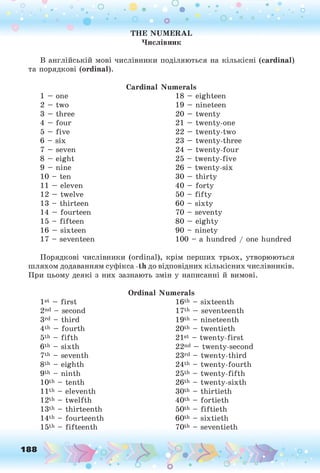
  • 26.
    O O O •.o• - • . . • • O o • o 0 0 - Are you the only child in the family? - Yes, I do. W e always help each other and never argue. - Hi, Mark! I know nothing about your family. Tell me about your parents, please. - No, I ’m not. I have got an elder brother. He is nearly 19. - Really? And what about your mother? - My mother is a cook. She works in a restaurant. - Do you get on well with him? 5. Find a photo of you with friends or family. Write an email describing the
  • 27.
    S§.e^ 'assessmen* • Thinkof your records. Decide how well you know it: 4 = very well, 3 = OK, 2 = a little, 1 = needs to improve Skills Now I can... 4 3 2 1 • give a simple description or presentation of people □ □ □ □ • describe people’s appearance and charac­ ter □ □ □ □ {J • talk about people’s likes and dislikes □ □ □ □ • ask for / present information about my friend’s family □ □ □ □ • catch the main point in clear simple mes­ sages □ □ □ □ ( • understand and extract the essential □ □ □ □ information from short, recorded pas­ sages dealing with personal information • identify specific information in short sto­ ries about family and friends □ □ □ □ • write a short story about my relatives □ □ □ □ 27
  • 28.
    1 к 1-^Ж л j ■1
  • 29.
    talk about shopsand shopping; your future plans; read about your friend’s shopping day; the best London shops for children; listen to a short story; write a paragraph about your shopping day; revise pronouns some / any, much / many, learn about countable and uncountable nouns; modal verbs may / might.
  • 30.
    o ! > :> Lesson ( . » ■ C jT 'a iP ^ i 1. a) Listen and repeat. Which is your favourite place to go shopping? E xam ple: My favourite place to go shopping is a department store. I like to buy new clothes. a supermarket a department store the baker’s the greengrocer’s the grocer’s a dairy the butcher’s a toy store a market b) Say what things you can buy in these places. E xam ple: We can buy oranges at the greengrocer’s. 2. Listen and read. Say what Ann’s favourite place to go shopping is. A Shopping Day Today is Saturday. This is the day when we do the shopping. My mother often takes me with her. W e usually have a long shopping list.
  • 31.
    o . • OO o First we go to the baker’s to get some bread. Then we buy some milk, butter, sour cream and cottage cheese at the dairy. A fter that we go to the butcher’s where we buy meat, sausages, steak, ham or bacon. My favourite place to go is our local market. It is very big and nice. You can buy everything you need there: food, clothes and toys. The best places to do the shopping in a big city are supermarkets and shopping malls. People can save their time and even have fun there. 3. Read the sentences and order them according to the text of Ex. 2. ___ A W e buy meat at the butcher’s. ___ B We are at the baker’s. ___ C The local market is my favourite place. ___ D We have got a long shopping list. ___ E We buy sour cream and milk. 4. Look at the pictures in Ex. 1 (page 30). Read and say where the people are. E xam ple: ^ A n n : Can I have a bottle of milk, please? Ann is at the dairy. o O, 31 o
  • 32.
    Conversation Lab 5. Saythat you would like to buy these things. E xam ple: I would like to buy a can of Coke. 6. Complete the sentences with the new words. 1. Buy two kilos of meat at the ..... , Ann. 2. Let’s go to th e ....... The vegetables are always fresh there. 3. They always sell fresh bread at th is ....... 4. We have got a long shopping list, but not much time. It’s better to do the shopping in th e ....... 5. Excuse me. Where can I find ..... ? I want to buy some souve­ nirs. 7. Write a paragraph about your shopping day. Use the questions below to help you. f fto • Where do you usually do the shopping? • Do you have a shopping list? • What’s your favourite place to do the shopping? O
  • 33.
    y Lesson 2. 1.Listen, repeat and say what you usually buy in the supermarket. Start like this: Sunday is my shopping day. I do the shopping in the local super­ market. They sell all kinds of food, clothes, toys, magazines and house­ hold goods there. I usually buy....... butter pasta flour a loaf of bread sausage bread rolls vegetables tea sausages sweets paper rice soap 2. Work in pairs. Tell your friend about your shopping experience in the local supermarket yesterday. Your friend listens and guesses the false information. A: I went shopping with my mum yesterday. B: True. A: We went shopping for food only. B: False. A: True! We didn’t buy any clothes. 3. Work in pairs. Take turns to ask and answer the questions on page 34. 33
  • 34.
    o o o •.o 1. Where does your family buy most of the food? 2. What things can you buy in the supermarket (at the market)? 3. What do you do when you can’t find the things you want to buy? 4. a) Read and act out the dialogue. Ann: Do you want brown or white bread, Dan? Dan: Let’s get white. Ann: OK. How many loaves do we want? Dan: One. Let’s get some bread rolls as well. Ann: That’s a good idea. Dan: Right. What else do we need to buy? Ann: Some butter and sour cream. Dan: Well, the dairy section is over there. b) Work in pairs. Read and complete the dialogues. Use the words from Ex. 1 on page 33. 1. A: I am going to the supermarket to g e t ....... Do we need a n y...... ? B: Yes. We need some, but not much. W e also need.....a n d ......... 2. A: Excuse me. Where can I fin d .....? B: In th e .....section. A: Thank you. 3. A: Do we need.....? B: No, but we need....... 34 o O
  • 35.
    o . • OO o 4. A: W e forgot to g e t .....? B: I ’ll get it/them. Where is it? / Where are they? A: In th e .....section over there. 5. Play a game. Work in two groups. Act as in the model. Use the words: milk, apples, juice, rice, peaches, etc. E xam ple: T each er: Milk. G rou p A: How much milk? T each er: Right. One point. Apples. G rou p B: How many apples? T each er: Juice. G rou p B: How many juice? T each er: Wrong! “How much juice?” Group B doesn’t get a point. ^Conversation Lab 6. Work in pairs. Read, complete and act out the dialogue. Use the words: much, many, any, some. Dan: How ..... cheese is there? Ann: There isn’t ..... left. Dan: W e need.....cheese then. What about eggs? H o w ...... eggs have we got? Ten eggs. Ann: So, we don’t n eed....... Dan: OK. H o w .....bread have we got? Ann: W e haven’t got .....bread and ...... flour left. Dan: How .....bread do we need? Ann: One loaf. Dan: And h o w ..... flour? Ann: One kilo, I think. 7. Write your shopping list for this week. Write how much food you need to buy. O , 35 O
  • 36.
    'vsUstening Lab 1. a)Listen to the text “Five Loaves of Bread”1 and say why the man needed so much bread every day. b) Listen to the text again and tick the sentences T (True) or F (False). 1. Mr Smith bought four loaves of bread every day. 2. Mr Brown bought one loaf of bread for his parents. 3. Mr Smith asked Mr Brown a lot of questions. 4. Mr Brown bought some bread in the supermarket. 5. Mr Brown bought two loaves of bread for his children. 6. Mr Brown and Mr Smith were friends. 2. Listen, read and act out the dialogue. Kim is doing the shopping now. She has got a long shopping list. She has already bought some vegetables and fruit and now she is ordering cold cuts2 at the deli department. Shop-assistant: Who is next? Kim: I am. Shop-assistant: What would you like? Kim: I ’d like a kilo of ham and half a kilo of cheese. Shop-assistant: Anything else? Kim: No, that’s all, thanks. 1See Tapescript on page 221. 2Cold cuts - thinly cut pieces of cooked meat, cheese, etc. eaten cold. 36 o
  • 37.
    3. Work inpairs. Take turns to ask and answer the questions. 1. Where is Kim? 2. What does she want to buy? 3. Who is she talking to? 4. How much ham does she want to buy? 5. How much cheese does she want to buy? 6. Does Kim want to buy anything else? Conversation Lab 4. Work in pairs. Act out the situation “In the Supermarket”. Use the dialogue of Ex. 2 on page 36 as an example. R o le Card A. You are the customer. You are doing the shopping in the supermarket. W rite a shopping list. Order what you want. R o le Card B. You are the shop-assistant. Talk to the customer and help him / her to buy the things he / she is looking for.*12 Shopping List 1/2 kilo of cheese 1 kilo of meat 2 kilos of potatoes 1 kilo of oranges o O, 37 O
  • 38.
    o o o t 5.Read and choose the correct item to complete the sentences. Write the cor­ rect words. 1. Tom always ..... the shopping on Sundays. A do B does C is doing 2. The things which are sim ilar.....in the same area in the super­ market. A is B will be C are 3. Steve ..... already..... cold cuts at the deli department. A have ordered B is ordering C has ordered 4. - What would you like? — I .....a kilo of apples, please. A want B like C would like 5. - Excuse me, can you help me? I ..... for the confectionery department. A am looking B looked C look 6. I h ave.....a kilo of fish, but I haven’t .......any cheese and sau­ sages. A buy B buys C bought > Lessonsf4-5l 1. Listen and repeat. Which shops are located in your neighbourhood? E xam ple: There is a nice grocer’s not far from my house. 38
  • 39.
    2. Look atthe pictures in Ex. 1 and say what things you can buy in these shops. E xam ple: I can buy a loaf of bread at the bakery. 3. Read and say what shops the children are in. 39
  • 40.
    o o o •.o 0 • • o o ** o ° ° t 4. Work in pairs. Look at the shopping list. Ask your friend where you can buy these things. E xam ple. A: Where do you buy milk? B: In the supermarket. Where do you buy a T-shirt? A: At the clothes shop. SHOPPING LIST Milk cakes carrot potatoes oranges a T-shirt a teddy bear a computer game 5. Read and complete a dialogue with the words from the box. Then act it out. • tomorrow • sweets • shopping • centre • clothing • Jane: Hi, Ann! What are you doing (1 ).....? Ann: Well, I don’t know. I think we’re going ( 2 ) ....... Jane: Right. Do you like shopping on Saturday? Ann: Of course, I do! My mum usually buys what I ask her. It can be a new item of (3) .....or something tasty, such as ice cream or ( 4 ) ....... And then we are going to the cinema. Jane: Oh, which one? Ann: You know, the new one in the Dream Town shopping ( 5 ) ....... Jane: I might join you next Saturday. Ann: That’ll be really nice! ____ 40 o
  • 41.
    ^Grammar Lab: Talkingabout future plans • Use Present Continuous Tense when you are sure about your future plans. • Use may / might when you are not sure about them. What are ^I might do the shopping. you doing tomorrow? 6. Complete the sentences. Use the words from the box given below. • might go • might buy • may give • might do • might ask • might help • 1. I’m meeting Jack next Sunday. I .....him to give me his new DVD. 2. W e are going shopping tomorrow. We ..... a new toy for my sister. 3. He’s visiting his aunt next Saturday. T h e y ..... the shopping together. 4. She’s having some free time tomorrow. S h e..... to the swim­ ming pool. 5. They’re having a test tomorrow. Their teacher..... them some difficult questions. 6. They are preparing a shopping list for tomorrow. We .....them do that. Conversation Lab 7. Read and act out the situation. You are in London. Your host family gave you some lunch money. You have £10.00 (ten pounds) to buy the food in the school canteen. You have to choose at least one food item from each category. o O, 41 O
  • 42.
    O O O •. o FRUIT/ VEGETABLES A p p le..................£0.50 Orange............... £1.00 Banana............... £1.00 SANDWICHES Sausage sandwich . . . £1.25 Vegetable sandwich . . £0.70 Chicken sandwich . . . £1.50 DRINKS M ilk .................... £0.60 / cup Ju ice.................... £1.50 T e a .......................£0.20 SNACKS Biscuit............... £0.40 Crisps..................£1.20 Sweets..................£0.25 What will you choose to eat from this list? Why? E xam ple: I may / might buy an orange and a banana, because there are a lot of vitamins in fruit. Besides, I like these fruits very much. They are tasty. 8. Write about you plans for the coming weekend. Use the correct structures: the Present Continuous Tense or may / might. y Lesson 6. » “ o i ^ T WÈËkki 1. Listen, read and act out the dialogues on page 43. 42 , o o o
  • 43.
    Jane is notsure if the department store is open or not, so she is calling there to find out. Operator: Macy’s, may I help you? Jane: Yes, please. How late are you open tonight? Operator: Until 9:00 p.m. Jane: Thank you very much. 2. A t the Shoe Shop. Ann: I ’d like a pair of shoes, please. Shop-assistant: What kind of shoes would you like? Ann: Low-heeled shoes for everyday wear. Shop-assistant: What colour would you like? Ann: Black. Shop-assistant: What size do you wear? Ann: Four. Can I try them on? Shop-assistant: Of course. 2. Work in pairs. Take turns to ask and answer the questions. 1. What does Jane want to do tonight? 2. What store does she want to go to? 3. Why is she calling the department store? 4. Where is Ann? 5. What does she want to buy? 6. What size of shoes does she wear? 3. a) Work in pairs. Complete the conversation and act it out. b) Listen and check. Jane: Hi, Ann! You look wonderful today! Where ( 1 ).....y o u ...... (to buy) your new T-shirt and this pair of jeans? Ann: In the clothes shop. Jane: Where ( 2 ) ..... (to be) it? Ann: It is not far from Theatralna Underground Station. You (3) ..... (to go) straight ahead along Bohdan Khmelnytskiy Street, and it’s on the right. You ( 4 ) .....(not / to have to) go far. Jane: How much ( 5 ) .....(to be) the things you bought? o O, 43 O
  • 44.
    Ann: I don’tremember the exact price of the T-shirt, but the jeans (6) ..... (to be) 350 UAH. The style is more important for me than the price. And the price is quite important for my mum. She usually (7) ..... (to pay) for the purchase. vConversationcLab: a Discussion 4. Work in groups. Discuss what is very / quite / not so / not at all important to know when you buy something. Use the ideas and the phrases from the box given below. E xam ple: To my mind, the price is not so important when you want to buy good clothes to wear. 1. Price. 2. Colour. 3. Comfort. 4. Name of the designer. 5. Size. 6. Quality. 7. ... 5. You are on holiday in another city or country. Write an email to your parents. Tell them what things you have already bought, ask them if they want you to buy anything else. Give the details. Use the questions below to help you. • What did you buy? • Where did you buy it? • Why did you buy it? • Do you like it? Why? Expressing Your Opinion I think... To my mind... In my opinion...
  • 45.
    !> : >Lesson |.» ■ e ^ S S B ® Reading Lab: Jigsaw Reading 1. Work in three groups. Read the text and find the names of banknotes and coins of different countries in it. 1. In Ukraine people use hryvnias (UAH) and kopiykas (kop). The coins are 1 kopiyka, 2 kopiykas, 5 kopiykas, 10 kopiykas, 25 kopiykas and 50 kopiykas. There is also a one-hryvnia coin. A ll the coins are round. Every coin has the National Coat of Arms on one side of it. Ukrainians use 1, 2, 5, 10, 20, 50, 100, 200 and 500-hryvnia banknotes. Every banknote has a portrait of a famous Ukrainian per­ son on it. 2. In Great Britain people use pounds (£) and pence (p). The coins are 1 penny, 2 pence, 5 pence, 10 pence, 20 pence and 50 pence. There are also £1 and £2 coins. The coins are round. But two coins have got seven sides. The little coin with seven sides is the 20-pence coin and the big one with seven sides is the 50-pence coin. There is a portrait of the Queen of England on every coin. There are £5, £10, £20, and £50 banknotes. 45
  • 46.
    3. In theUSA people use dollars ($) and cents (c). American coins are sometimes called change. Each coin has its own name. A one cent coin is called a penny. A 5-cent coin is called a nickel. A 10-cent coin is called a dime. A 25-cent coin is a quarter. There are 1, 2, 5, 10, 20, 50 and 100-dollar banknotes in the USA. You can see a portrait of an American president on one side and a picture of a famous building on the other. 2. Speak in class. Share the information you have read in Ex. 1 with your class' mates. 3. Work in pairs. Complete and act out the dialogues. Coins and Currency 1. A: How much is a penny worth? B: A penny is worth one cent. 2. A: Soda costs seventy-five cents. Do you have enough change? B: Yes. I have a/two/three ..... (5) a n d ....... 3. A: I need to go to the supermarket. Do you have any cash? B: Let me see. I have a twenty-dollar bill. A: Twenty dollars is enough. Thanks. 4. Look at the pictures on page 47. Act out the dialogues as in the example. E xam ple: A: How much is this notebook, please? B: Two pounds. How many would you like? A: I ’ll take three, please. B: How would you like to pay? A: In cash. Here you are. B: Thank you. Here’s your receipt and your change.
  • 47.
    Conversation Lab 5. Workin pairs. Play a game “Buying Food and Getting Change”. Take turns to play the role of the shopper. You have 200.00 hryvnias. Go shopping. Look at the pictures and say what you can buy, at what price and how much change you get. 6. Write where you went shopping yesterday, what you bought and how much it cost. Start like this: / went shopping yesterday. I had a long shopping list. Etc. o 47
  • 48.
    !> Lessong8-9. 1. Annand Dan are in London. They want to buy some souvenirs for their family and friends. Look at the photos and say what they can buy in these shops. Hamley’s Mystical Fairies Forbidden Planet Hope and Greenwood Shop 2. Look through the texts (1-4) on page 49. Say what the names of the shops are. A Mystical Fairies B Hope and Greenwood C Forbidden Planet D Hamley’s
  • 49.
    Best London Shopsfor Children 1 .....is the greatest toy shop in the world. It is in London in Regent Street. The shop has seven floors of toys to explore! People from all over the world come to visit it. You can buy the most wonderful toys and games there. There are always lots of toy demonstrations there, so you can try before you buy. 2 .... is a girl’s dream! This shop is full of fairy and princess dresses. There are also lots of accessories: bags, scarves and wigs! Girls can be part of Fairy School and Princess Academy. They can learn how to be fairies and princess, do arts and crafts, decorate a fairy cake, sing and dance. Boys can try on a costume of a pirate or a wizard and have fun. 3 .... is the world’s largest and best-known entertainment shop. This is where you can find the latest comics and graphic novels from science fiction and fantasy stories. You can also buy action figures, books, DVDs and toys. 4....... is a confectionery. It is in Russell Street. You can buy tradi­ tional sweets in old-fashioned glass jars. You can discover for yourself Candy Bananas, Rainbow Drops and even Flying Saucers! And you can use the jars for your new creative ideas! 3. Work in groups of four. Read the information about one of the shops in Ex. 2. Take notes. Then share the information with your friends. 4. Read and say which place it is. 1. You can wear a costume of a pirate there. 2. You can choose a nice toy for your younger brother or sister there. 3. You go there to buy a box of traditional chocolates. 4. It is an exciting place to shop for girls. 5. You can learn to do some crafts there. 6. It is the world’s largest entertainment shop. 5. Work in pairs. Read, complete and act out the dialogue. Use the Past Simple negatives and questions. Olha: (1) ..... (you / to have) a nice holiday in London? Bohdan: Yes, thanks. It was good. We saw the most famous land­ marks. We also looked round some museums and saw a show at the Globe Theatre. We (2) ..... (not / to try) to do too much. Olha: Which museum (3) ..... (you / to go) to? Bohdan: ( 4 ) ....... I (5) ....... (to get) to know much there. 49
  • 50.
    (you / toOlha:It’s fascinating, isn’t it? And what show (6) watch)? Bohdan: Oh, a musical about monsters. I ( 7 ) .....(not / to like) it. Olha: Where (8) ..... (you / to stay)? Bohdan: A t the hotel. The rooms were very comfortable there. Olha: And (9) ..... (Susan / to enjoy) the holidays? Bohdan: Yes, she did. She (10) ..... (to do) some shopping, too. ; ^Conversation Lab J g* 6. Read and act out the situation. Your friend is going to London next month. Tell him / her about places to go shopping there. Answer his / her questions. 7. Write an email to your English-speaking friend. Ask him / her about: • the places she usually does the shopping; (p p • the best places to buy souvenirs; • thank him / her for his / her recommendations. 50 O o o
  • 51.
    ^ ^Lesson010. grammarRevision 1. Work in pairs. Ask and answer the questions as in the example. E x a m p l e : A: How many nickels are there in a dollar? B: There are 20 nickels in a dollar. A: How many pennies are there in a pound? B: ..... 2. a) Write down anything you don’t know about shopping. You may want to think about places to do the shopping, things to buy, etc. Write down ques­ tions starting with: Why ... ? When ... ? Where ... ? Who ... ? What ... ? How ... ? b) Work in pairs. Discuss your questions with your friend. Can you answer them? 3. Write the words in the correct order to make sentences. 1. gone / Sue / today / has / shopping/ . / making / she / is / Now / for / salad / dinner / . 2. bag / so / Your / heavy / is / . / you / What / bought / have / ? 3. are / We / clothes / in / shop / the / . / are / for / W e / looking / a / shirt / new . 4. barbecue / you / some / food / buy / for / Can / the / ? ^Conversation Lab , 4. Read, complete and act out the dialogue. Ann: Hello, Kim! How are you? Kim: ....... Ann: I’m fine. I went shopping yesterday morning with Jane and my mum. o O, 51 O
  • 52.
    o o o •.o Kim: ..... ? Ann: Well, first I went to the clothes department and I bought a new blouse. Kim: .....? Ann: No, it wasn’t very expensive. We paid fifty hryvnias for it. Then we went to a music shop. Jane wanted to look at the CDs. She likes listening to music. Kim: ..... ? Ann: Yes, sh e....... Those two CDs co st.........A fter that, we went to the market. They sell nice clothes there. 5. Put the verbs in brackets into the correct tense form. Maria (1 ).....(to go) shopping with her mother last Saturday. They (2) ..... (to want) to buy some presents for the coming holiday. A t first the girl and her mum (3 ).....(to buy) a nice tie for father, then they (4 ) .....(to look) at the toys for Maria’s classmates. The girl (5 ) .....(to see) nice dolls, jigsaw puzzles and interesting board games. Then they ( 6 ) .....(to visit) the ladies’ and junior dresses section. While Maria’s mother (7) ..... (to try on) a new skirt, the girl ( 8 ) .....(to go) to look at the other departments. Maria ( 9 ) .......(not / even / to notice) how she (1 0 )..... (to get) lost. She (11) ..... (to ask) the shop-assistant to help her. Soon her mum (12) ..... (to have) nothing to worry about. 52 , o o o
  • 53.
    S§elf-assessment Think of yourrecords. Decide how well you know it: 4 = very well, 3 = OK, 2 = a little, 1 = needs to improve Skills N o w I can... 4 3 2 1 • describe my personal shopping experien­ ces □ □ □ □ • talk about different kinds of shops in the place where I live □ □ □ □ v d • ask about things and make simple trans­ actions in shops □ □ □ □ • give and receive information about prices □ □ □ □ • catch the main point in clear simple tele­ phone messages □ □ □ □ • understand and extract the essential information from a short, recorded dia­ logue □ □ □ □ • identify specific information in short sto­ ries about shopping experience □ □ □ □ • write a paragraph about my shopping day □ □ □ □ O , 53 O
  • 54.
  • 55.
    talk about foodand drinks; meals and favourite recipes; read about your daily diet; listen to a story about meals and cooking in Ukraine; write a paragraph / a letter to a friend about your typical meals during the day: revise the articles; learn about verbs related to senses.
  • 56.
    1. Listen andrepeat. Match the pictures with the names of the products. • sweets • bread • hamburgers • yoghurt • chocolate • cereal • eggs • milk • cakes • butter • nuts • vegetables • jam • ice cream • cheese • fruit • spaghetti • a bag of flour • 2. a) Work in pairs. Put the words from Ex. 1 in the correct column. b) Add as many words to the different columns as possible. Then compare your lists with another pair and add any new words. Fruit Vegetables Meat / Fish Dairy products Sweets / Bakery products Other 3. Work in pairs. Ask and answer the questions. Then explain the meaning of the words in boldprint1. 1. What do you usually have for breakfast? 2. What is usually bigger for you, lunch or dinner? 3. What is your favourite Ukrainian dish? 4. What is your favourite dessert? 5. Do you like to eat cereal for breakfast? 1 W ords in boldprint - виділені слова. 56 О
  • 57.
    O O OO O o . • O O C 4. Work in pairs. Talk about the pictures in Ex. 1 on page 56 as in the example. E xam ple. A: What food (products) do you like to eat? B: I like fruit. I usually have an apple or a banana in my lunch box. I also like to eat tasty things, such as chocolates and sweets. My mum says that I mustn’t eat a lot of these. 5. Speak in class. Talk about food from Ex. 1 on page 56. What do you usually eat at home and at school? Your classmates guess the false information. E xam ple. A: I usually eat bread and butter, and cheese for breakfast at home. B: True. A: I always eat hamburgers and apples at school. B: False. They don’t sell hamburgers in our school canteen. ^Reading Lab 6. a) Read the title of the text. Say what products it is going to be about. Do you think that you eat the right food or not? b) Read the text and check your ideas. What products do you need to add to your daily diet? Eat the Right Food People cannot live without food. Animals, fish, birds and plants cannot live without food either. 57
  • 58.
    o o o •.o There are different kinds of food. Some kinds of food like bread, sugar, meat, butter, cheese and rice make you strong and give you energy. Meat, fish and milk help you to grow. Vegetables, eggs and corn­ flakes make your bones and teeth strong. You should eat vegetables and fruit because they have got a lot of vitamins. Vitamins are impor­ tant for your eyes, skin, bones, hair and for other parts of your body. There are thirteen types of vitamins (A, B, C and so on). Eat the right food! Remember the proverb, “Good health is above wealth.” 7. Agree or disagree. 1. People can live without food. 2. Meat, fish and milk make your bones and teeth strong. 3. Vegetables, eggs and cornflakes help you to grow. 4. Vitamins are important for your eyes, skin, bones, hair and for other parts of your body. 5. There are fourteen types of vitamins (A, B, C and so on). 8. Look at the pictures and match them to the words in the box. • spicy • sweet • sour • salty • bitter • E xam ple. 1. Sugar - sweet
  • 59.
    o . • OO o O• • o O O o ^Grammar Lab: Verbs related to sen djectives^ :j Verbs related to senses are: to feel, to hear, to smell, to look, to see, to taste, to sound. They are followed by adjectives, not adverbs: This cake smells delicious. This coffee tastes bitter. Conversation Lab 9. Complete the dialogues and act them out. 1. Mum: Would you like some .....in your tea? , please.Ann: Sure, pass me a ™ 2. Tom: Mum, give me some , please. Mum: Why would you like to add it to your dish? Tom: I ’d like to make i t ....... 3. Jane: This tastes t o o ....... Why have you put so much sugar in it? Mum: Sorry, my dear. I didn’t notice how much sugar I put in it. Dad: 4. Kate: Dad, this tastes........W ill you pass me some sugar, please? Certainly! 5. Kim: Granny, why is this .....? I can’t eat it. Granny: It’s OK, it’s n o t....... 10.Write a paragraph about the food you eat. Use the questions below to help you. & Which food do you eat to be strong and energetic? Which food helps you to grow? Which food with a lot of vitamins do you eat? Do you eat the right food? « . < ■ - . • 4 .° ' p .'m ° O ^ • o 6 . T 59 O
  • 60.
    1. a) Workin pairs. Take turns to ask and answer the questions in the table. Add information. E xam ple: A: Do you usually eat a big breakfast? B: No, I don’t. I usually have a sandwich and a cup of tea. What about you? A: I usually have a big breakfast. I have a bowl of cereal, eggs and toast. Questions You Your Friend • Do you eat a big breakfast? • Do you cook breakfast by yourself? • When do you eat your breakfast? • What do you drink in the morning: tea or coffee? • Do you like to eat fast food in the morning? • Do you eat rice or potatoes in the morning? 2. Say what the members of your family usually have for breakfast. Use the words from the box on page 61.
  • 61.
    o . • OO O • bread and butter • porridge • eggs • cheese • sausages • sand­ wiches • tea (with milk or with lemon) • coffee • milk • juice • cocoa • sweets • cookies • juice • puddings • pancakes • 3. Read and say what children usually have for breakfast on a typical day. Kate: I always have a boiled egg, some toast and a glass of milk or orange juice for breakfast. I can’t go to school without breakfast. I usually have lunch at school. There’s a great choice of things to eat. You can have burgers, baked potatoes, pizza, sausages and lots of other things. Kim: I love milk, so I always have cereal for breakfast with lots of milk on it! I don’t have school lunches. I buy my own. If I go to the café near school, I have a milkshake. Chocolate’s my favourite fla­ vour. Dan: I ’m a vegetarian, so I don’t eat meat. I eat both cheese and eggs instead. I eat lots of fruit and vegetables, too. I start the day with either some fruit or yoghurt. I usually have a banana or an orange. I take a packed lunch to school with me. This is usually cheese sand­ wiches and a couple of apples. 4. Look through the text of Ex. 2 and say who: • thinks vegetables are healthy. Dan • only eats a little for breakfast. ..... • always has cereal for breakfast with lots of milk ..... • can’t go to school without breakfast. ..... o O, 61 O
  • 62.
    L 5. Readand complete the sentences. Choose the correct word. 1. I was .....tired. The porridge tastes......... (awful / awfully) 2. She cried ....... This coffee tastes......... (bitter / bitterly) 3. Those flowers lo o k ....... She sin gs.........(beautiful / beautiful­ ly) 4. This dish tastes....... That was a ....... creamy soup. (delicious / deliciously!). 5. Your tape recorder sounds....... The boy cooked......... (wonder­ ful / wonderfully) Conversation Lab 6. Read and act out the situations. • Tell your friend about your favourite dish. • Ask your friend about the dishes he / she usually eats for breakfast / lunch / dinner. 7. Read and act out a dialogue about the food you eat for breakfast. Start like this: Ann: Hi, Toml Why are you eating a banana? Haven’t you had break­ fast? Tom: Hi, Annl You see, I cannot eat before going to school. And I always have a small snack of healthy food like nuts, fruit, vegetables or yoghurt. Ann: But I always have my breakfast at home. I eat foods like cereal, bread, eggs, milk and dairy foods which keep me going until lunch. Tom: ....... Ann: ....... 8. Write a paragraph about your typical meals during the day. Use the questions given below to help you. What kinds of food do you eat every day? • Do you usually eat fruit and vegetables? What kinds? • How often do you drink milk or water? • What kinds of food do you like to cook? • Where do you usually buy your food? 1 Deliciously — надзвичайно смачно.
  • 63.
    |> >Lesson g-6. 0$WP-€<&<J 1. a) Listen and repeat. • bread and butter • porridge • sausage • sandwiches • cocoa powder • borshch • pampushki • fish soup • chicken broth • noodle soup • pea soup • mushroom soup • cutlets • boiled meat • fried meat • roast meat • fried / boiled / mashed potatoes • vegetables • pancakes • compote • sour milk • b) Speak in class. Talk about food you usually have for breakfast and dinner. E xam ple: I usually have boiled eggs and porridge for breakfast. 2. Work in pairs. Tell each other which foods you like and don’t like to have for dinner. Use the following phrases: I lik e ....... I quite lik e .........I don’t lik e .........I prefer...... o 63
  • 64.
    C.3. Listen andread what children say about meals and what they prefer to eat. Ann: I eat three times a day. Dinner is the biggest meal of the day for me. Soup (traditionally borshch) is a must during dinner. It is served with dark bread or pampushki with garlic. My mum cooks chicken broth, noodle soup, pea soup or mushroom soup for dinner. A ll of them are very tasty. I like borshch most of all. Tom: Dinner is the biggest meal of the day for me, too. I start my dinner with a salad. Then my mum serves a bowl of soup or chicken broth. A fter that we have a meat or fish dish. As a side dish we usually have fried, boiled or mashed potatoes and vegetables cooked in different ways. W e finish our dinner with ice cream or apple pie. 4. Read and complete the sentences with the phrases from Ex. 3. 1. Some people like a light breakfast, others p refer....... 2. Dinner is the biggest....... 3. Soup is a must du rin g....... 4. As a side dish we usually h ave....... 5. We finish our dinner w ith ....... 5. Read and act out the dialogues. 1. Ann: What kind of breakfast do you usually have in the morning? Jane: I usually have a cup of tea and a cheese sandwich. And what about you? Ann: I don’t eat much. Just some cornflakes, an egg and toast with jam and butter. Sometimes I drink a cup of coffee and eat bis­ cuits. Jane: Oh, it’s too much for me. 2. Mother: Dan, it’s lunchtime. Wash your hands and sit down at the dinner table. Dan: OK, Mum. I am really hungry. What’s for lunch today? 64 ,o o
  • 65.
    Mother: Vegetable salad,chicken soup and then meat and potatoes. Dan: Oh, that’s wonderful! What are we having for dessert? Mother: Some ice cream. Dan: Thank you, Mum, for a tasty lunch. Mother: I ’m glad you like it. Conversation Lab 6. Work in groups. Take turns to read an opinion and give your response. Add information. E xam p le: A: Breakfast is the most important meal of the day. B: I don’t think so. I don’t eat a big breakfast. C: What do you usually have for breakfast? B: I usually have a sandwich and a glass of juice. 1. Breakfast is the most important meal of the day. 2. It’s important to have hot soup for dinner. 3. You can eat as many sweets as you want. 7. Write a short letter to your English-speaking friend. Tell him / her what your family members usually eat for dinner. Ask him / her questions about their family dinners. Start like this: Dear Mary, Thank you for your letter. It was interesting for me to learn about your favourite dishes. I ’m going to tell you what my family usually have for dinner. 65
  • 66.
    Lessons- 7^8. Listening Lab 1.Listen to the conversation. Name the things that Ann puts into the cake. Act the dialogue out. Jane: This cake tastes delicious, Ann. Ann: Thanks. I tried to do my best. Besides, it’s easy to make. Jane: What is in it? Ann: There’s flour, of course. And sugar, cocoa powder and baking soda. Jane: Did you put in any eggs? Ann: No, there aren’t any eggs. There’s a little salt, water and vegetable oil. Jane: Is that it? Ann: I think so. No... I forgot. There is vinegar and vanilla. That’s all. Jane: Thanks. I ’ll try to cook it myself. I B 2. Look at the picture and the title of the text in Ex. 3 on page 67. What are the man and boy doing? Where are they? What do you think the text is going to be about?3 3. Read the first two paragraphs (A, B) and check your ideas. Then read the text and find the sentences which describe the process of cooking. 66 o
  • 67.
    A Day withGrandpa By M ild red P itts W a lter A A t noon Justin and his grandpa came up to a small shed1. B “W e’ll have our lunch here,” Grandpa said. He took black iron pots2, some plates, knives, spoons and a table from the shed. They were going to cook outside. C First, they collected wood, sticks and dry grass. Soon they had a hot fire. Grandpa carefully washed his hands. After that he began to cook their lunch. D Justin watched how his Grandpa cooked. First he put raisins3 into a pot with a little water and placed them over the fire. Then he put flour in a pan. A fter that he made a hole right in the middle of the flour. In that hole Grandpa put some shortening4. Then he added water. He mixed the flour, water and shortening. E Soon Grandpa started to cook the biscuits. In a few minutes the smell was so delicious that Justin could hardly wait. 1 A shed - укриття. 2 An iron pot - металевий горщик. 3 Raisins - родзинки. 4 Shortening - суміш для випічки. О 67
  • 68.
    L 4. Readthe text of Ex. 3 and match the questions (1-6) with paragraphs (A-E). 1. Did the man or his grandson cook lunch? 2. Where did the man and the boy come one day? 3. How did Grandpa prepare the dough for the biscuits? 4. What did they collect for the fire? 5. Where did Grandpa cook the biscuits? 6. What things did they have to cook outside? 5. Read and complete the sentences with the correct item. 1. Justin and his grandpa came up to a small shed a t ....... A one o’clock B twelve o’clock 2. Grandpa cooked....... A fish soup B some biscuits 3. Justin and his grandpa had lunch....... A in the shed B outside 4. They cooked their meals o n ....... A a fire B a gas stove 6. Speak in class. Talk about a picnic you once had with your parents or grand­ parents. What food did you eat? How did you cook outside? Conversation Lab 7. Work in pairs. Complete the dialogue with the questions from the box and act it out. • Can I make a sandwich for you? • Would you prefer a ham or tuna sanwich? • Can you wait for a minute? • Are you hungry, dear? Mum: ( 1 ) ....... Tom: Yes, I am very hungry and I ’d like to eat something before having dinner. Mum: ( 2 ) ....... Tom: Yes, sure. What sandwich can you make? Mum: ( 3 ) ....... Tom: I prefer a ham sandwich. Do we have all the ingredients: bread, ketchup, ham and pickles?
  • 69.
    Mum: My dear,we have everything. ( 4 ) ....... Tom: Certainly, I am very hungry, but I can wait for a minute. 8. Write questions to get more information. | 1. I ’ve bought lots of food today. 2. W e’re going to cook a traditional Ukrainian dish at the week­ end. |> ^Lessons 9-10 1. Listen and repeat. Then match the words in the box with their definitions. • fresh • fried • frozen • raw • spicy • sweet • tasty • vegetarian • 1. W ith a hot, strong flavour. 2. Good, with lots of flavour. 3. Not cooked. 4. For people who don’t eat meat or fish. 5. Preserved by becoming very cold. 6. Cooked in hot oil. 7. Recently picked, caught or prepared. 8. W ith lots of sugar. 2. Write two types of food that go with each of the words in Ex. 1. Then check your list with your friend. Does he / she agree with you? E xam ple. Fresh - fresh vegetables, fresh juice, etc. 69
  • 70.
    o o o •.o 0 • • o o • O ° ° t 3. Listen and read. Complete the text with the words from the box given below. • three courses • the biggest meal • a snack • supper • dinner • breakfast • fish fillets with a side dish • compote • Meals and Cooking in Ukraine The Ukrainians have meals four times a day and their cuisine is quite varied. (1) ...... is the first meal of the day. It is usually light - bread with butter or kasha (cereal) with milk. Some people may have pancakes with coffee or tea. Some people even eat soup but, of course, sand­ wiches and coffee are very popular. ( 2 ) ... is usually in the middle of the day. It is (3 ) ...... of the day. It includes ( 4 ) ....... People have a starter (salad, cheese, etc.), soup, steaks, chops or ( 5 ) ........a lot of bread and something to drink like (6) ........ A t four or five the Ukrainians may have something for (7) ..... : cakes with juice, tea or something of the kind. (8) ....,. in Ukraine means one more big meal at seven. 4. Agree or disagree. 1. The Ukrainians have meals four times a day. 2. The Ukrainians can eat soup for breakfast. 3. Sandwiches and coffee are very popular in Ukraine. 4. Breakfast is usually the biggest meal of the day. 5. A t four or five the Ukrainians may have something for a snack. 6. The Ukrainians have their biggest meal at seven.
  • 71.
    o . • OO o C 5. Make up questions to the following answers. Then work in pairs and practise them. 1. A: .....? B: Yes, tea is one of the most popular drinks in the world. 2. A: .....? B: In Ukraine people drink tea with lemon. 3. A: .....? B: In England people drink tea with milk. 4. A: .....? B: Yes, tea comes from the leaves of a plant. 5. A: .....? B: The tea plant or bush needs a warm climate and lots of rain. 6. A: .....? B: It grows well in China, India, Japan, Turkey and some countries in Africa. Conversation Lab 6. Work in pairs. Act out the situation. A guest from an English-speaking country is visiting you. He / She is interviewing you about the traditional Ukrainian dishes. a) Write a list of questions about the traditional Ukrainian dishes. b) Answer your guest’s questions. 7. Speak in class. Tell your classmates what you know about the traditional Ukrainian cuisine. 8. Read the letter given below and write down Sue’s answer to it. Dear Sue, I ’m just writing to thank you for inviting me to the picnic next Sunday. I think we’ll have a fantastic time together. It will be won­ derful to spend time with you and your classmates. Will you write me the details about the food, please? What kind of food do I need to take with me? Thanks again and hope to see you soon. All the best, Ann. o O, 71 O
  • 72.
    ^Lesson?11*.cGramlnar Revisig^ ° 1.Ann went shopping yesterday and bought some food. Read and complete the sentences. Use some or any where necessary. E xam ple: (+ ) grapes - She bought some grapes, because she likes grapes very much. 1. (- ) cheese ..... 2. (+) mushrooms ..... 3. (- ) carrots ..... 4. (+) rice ..... 5. (- ) cornflakes ..... 6. (+) oil ..... 2. Read and complete the text with the correct form of the verbs in brackets. Justin (1) ..... (not / to mind) that his clothes (2) ..... (to be) so dirty and wrinkled. He (3) ..... (to have) a great time, though he ( 4 ) .....(to work) hard and (5 ) ...... (to get) hungry. When they ( 6 ) ...... (to stop) for lunch, grandpa (7) ..... (to build) a fire and (8) ..... (to make) biscuits. A t first, Justin (9) ..... (to tease) grandpa about putting raisins in the dough, but after tasting them, he (10) ..... (to decide) they (11) ..... (to be) the best biscuits ever. And this day with grandpa (1 2 ).....(to be) the best day ever, too. 72 , o o
  • 73.
    C 3. a)Read the text. Which dessert does the person recommend? Today’s Desserts You will love the ice cream and pudding. In some ways they are the same, but in other ways they are different. They are the same, because both are chocolate. Also, both are very sweet and creamy. These two desserts are different in some ways. The ice cream is frozen and can melt, while the pudding is just cold and won’t melt. Also, we usually decorate ice cream with fruit and nut, but we deco­ rate the pudding with cream. You’ll love whichever one you choose! b) Write a similar story. Describe two of your favourite desserts. Use the prompts given below. You will love ..... a n d ........In some ways they are ....... , but in other ways they a r e ....... They are the same, because both a r e ......... Also, both are ..... a n d ....... These two desserts are different in some ways....... i s ...... and can ....... while th e .....is ju s t...... and won’t .........Also, ...... i s ...... , but th e ..... i s ....... You’ll love whichever one you choose! 4. Fill in the correct article a/ an or nothing (-). Bill: I’m hungry. Can I have (1) ..... sweet, Mum? Mum: No, you can’t. You haven’t had your dinner yet, Bill. Bill: I’ll have it later. What about (2) ..... cake or (3) ..... biscuit? Do we have any at home? Mum: You have a sweet tooth! (4) ..... Sugar and (5) ..... sweets don’t make your teeth strong. Have (6) ..... apple, (7) ..... orange or (8) ...... carrot at least. Bill: Then I’ll have some (9 ).....cornflakes with (1 0 )......milk. Is it OK? Mum: Certainly. (11) ..... Cornflakes make your bones and (12) ..... teeth strong. (13) ..... Milk helps you to grow. Bill: That sounds great! I can add as much (14) ..... sugar as I want, can’t I? Mum: Oh, Bill! 73
  • 74.
    o o o •.o C. 5. Work in pairs. Look at the pictures. Disagree with your friend. Talk with him / her as in the example. E xam ple: A: These vegetables taste delicious! B: Oh, no! They taste awful! 135 x 5 - 124 : 6 = • delicious • beautiful • difficult • scary • rough • friendly • soft • ugly • awful • easy • 6. Write a short letter to thank your friend for the wonderful dinner party you attended at his / her place last weekend. Use the word lists and the questions 9 to help you. • When did you go to the dinner party? • Who invited you there? What was the occasion? • Which were the dishes you enjoyed the most? • What was the party like? Food: tasty, delicious, well-cooked, etc. Atmosphere at the party: friendly, relaxing, great music, lots of games.
  • 75.
    S§.e^ 'assessmen* • Thinkof your records. Decide how well you know it: 4 = very well, 3 = OK, 2 = a little, 1 = needs to improve Skills N ow I can... 4 3 2 1 • explain what food and drinks I like/dis- like □ □ □ □ • describe my everyday eating habits □ □ □ □ • get simple information about meals and favourite dishes □ □ □ □ • interact in structured situations □ □ □ □ (H • understand simple routine exchanges in predictable everyday situations □ □ □ □ w • understand simple instructions related to food and meals □ □ □ □ • understand short, simple texts related to the topic □ □ □ □ • identify specific information in simple written material such as letters □ □ □ □ • write a letter to a friend about my typical meals during the day □ □ □ □ 75
  • 76.
  • 77.
    talk about differentkinds of sport; your friends’ favourite sports activities; read about sport in our life; listen to a sports questionnaire; write an email about Sports Day; revise the Present Perfect Tense.
  • 78.
    1. Listen andrepeat. Say what kind of sport you are fond of. E xam ple: A: I ’m fond of athletics. And you? B: I ’m fond of judo. athletics ski-jumping cycling sailing boxing judo 2. Look at the pictures and say what kinds of sport the sportsmen enjoy. E xam ple: M r Johnson enjoys swimming. 78 -o
  • 79.
    o . • OO o C 3. Read and say why it is important to go in for sport. Sport in Our Life People all over the world are fond of sports and games. There are summer and winter sports. The most popular winter sports are ska­ ting and skiing. Some people greatly enjoy figure skating and ski- jumping. It’s so nice to go to a skating rink or to a forest on a frosty sunny day! The most popular summer sports are swimming, cycling, and sailing. It’s so wonderful to breathe in the fresh air and enjoy nature! Children like to attend sports clubs and train in the gym. Athletics and gymnastics have great popularity among girls. Boys go in for boxing, football, tennis, and basketball. 4. Read and complete the sentences. 1. People all over the world are fond o f ....... 2. The most popular winter sports a r e ....... 3. The most popular summer sports a r e ....... 4. Children all over the world like to p la y .....games. 5....... have great popularity among girls. 6. Boys go in f o r ....... Conversation Lab 5. a) Work in pairs. Take turns to ask and answer the questions. E xam ple: A: Do you play any sports? B: No, I don’t. I have no free time. What about you? A: Yes, I do. I play football. I t ’s my favourite sport. I also like watching football matches on TV. My favourite football team is “Dynamo”. o O, 79 O
  • 80.
    Questions You YourFriend • Do you play any sports? • Do you like quiet or noisy games? • How often do you play games? • Do you watch sports on TV? • What sports do you like to watch? b) Speak in class. Talk about your friend. E xam ple: I have found out that Ivan plays football. He likes watching foot­ ball matches on TV. His favourite football team is “Real Madrid”. 6. i f a a) Read, complete and write down the sentences. Use the adverbs: slowly, well, hard, quickly, carefully, loudly. 1. Paul rides his bike v e r y ....... One day he’ll have an accident. 2. You have to train .....if you want to win the competition. 3. Rita plays tennis....... One day she’ll be a champion. 4. The children were talking.......The coach asked them to be quiet. 5. Bill was very tired after his training and he walked hom e....... 6. You have made a lot of mistakes. You must listen to m e ....... b) Make your own sentences with the adverbs in the list. |> y Lessons 1. Look at the pictures and say what sports clubs children can attend in their school.
  • 81.
    C 2. Listento the boys talking about sports1. Mark the sentences T (True) and F (False). 1. Steve goes in for tennis. 2. Steve joined the sports club last year. 3. Steve trains three days a week. 4. Dan is very busy. He can attend the sports club only at the weekend. 5. Steve invites Dan to a contest in March. 6. Dan can go to watch the contest. 1See Tapescript on page 221. ^Learning Strategies: Email Meçsages^^^^ ~ Email Messages • are short messages sent from one person to another over the Internet • have a specific purpose: to provide information, share ideas with others or entertain • quickly deliver information to one person or to many people at the same time______________________________________________________ 3. a) Read Margaret’s email to Graham and say what she reminds him about. From: 123 To: Subject: Attached Dear Graham, Mum asked me to remind you about the school meeting on Wednesday. We need you to attend it. They are going to discuss the plan for the school Sports Day. We want to organize a few sports competitions. Please, come to the meeting on Wednesday, at 6 p.m. Love, Margaret. □ -I 81
  • 82.
    o o o •.o b) Work in pairs. Take turns to ask and answer the questions. 1. Why do the children need to attend the meeting at school? 2. When does the meeting start? 3. Who must be present at the meeting? 4. Your school is organizing a sports competition. Write an email to your friend. In your email: * inform him / her about the upcoming sporting event; * ask if your friend would like to take part in it; * say that you are going to participate in the swimming competition. :sSC °nversati°nd_ab 5. Read, complete and act out the dialogue. Alex: Hello, Steve? How are you? Steve:....... Alex: I ’m very tired. Today is my sports day. I go swimming in the morning and then play tennis in the afternoon. Steve:....... Alex: Oh, really? I like sport a lot, too. My favourite sport is football. Do you train at the Sports Centre? Steve:....... Alex: Are you in the school basketball team? Steve:....... Alex: I like watching basketball on TV. Do you like watching sport on TV? Steve: 82
  • 83.
    o . • OO O O t 6. Read and complete the sentences. Fill in the necessary modal verbs in the questions. Match questions and answers. 1. When ..... you ski? 2. W hy ..... not you ski two years ago? 3. When ..... you go skiing in the mountains? 4. When ..... you ..... go skiing in the mountains with your friends? 5. What ..... you say about yourself as a skier? a) I was able to go skiing in the mountains last year. b) I will be able to go to the moun­ tains with my friends next year. c) I could ski when I was 7. d) I cannot say that I am a good skier. e) Two years ago I couldn’t ski because I lived in a warm country. 7. Read and complete the text. Put the verbs in brackets into the correct tense form. Tom and his schoolmates (1) ..... (to play) a match against a team from another school. They usually (2 ).....(to play) football, but today they ( 3 ) .....(to play) basketball. Tom ( 4 ) ...... (to like) playing basket­ ball very much. His team usually ( 5 ) .....(to wear) white T-shirts, but today they (6 ) .....(to wear) yellow T-shirts. Other children from their school (7) ..... (to watch) the match. Tom’s team usually (8) ..... (to win) their matches because they (9) ..... (to train) a lot. They (10) ..... (to win) three Cup Finals in the previous three years. They (1 1 ) ....(to win) today, too. < • < ? .*<J * • • * 83 O o
  • 84.
    1. Work inpairs. Talk with your friend about summer and winter sports. Use the questions below to help you. 1. What summer (winter) sports do you know? 2. What summer (winter) sports do you enjoy? 3. What games do children like to play? 4. What is your favourite sport or game? 5. Do you like to play games or do you like to watch them? 6. Why is sport so popular with children and grown-ups? 2. Look at the pictures. Talk about the children’s favourite sports. E xam ple: Andriy goes in for boxing. He attends the Sports Centre. He trains in the gym three times a week. Andriy boxing the Sports Centre three times a week Maryna swimming a swimming pool twice a week Oleksandr to do karate the Sports Club twice a week Yana to play badminton the school gym once a week
  • 85.
    o . • OO O C 3. Read and act out the dialogue. A: Have you ever played tennis in your life? B: Yes, I have. I played tennis last summer. A: Did you like it? B: It was OK, but I didn’t enjoy the weather very much! It was too hot! A: Do you attend the tennis club now? B: No, I don’t, but I am going to join it. 4. Work in groups of four. Write a list of kinds of sport on a sheet of paper. One person thinks of a sport and the others have to guess which sport it is. E xam ple: B: Is it a team game? A: No, it isn’t. C: Do you use a ball? A: No, I don’t. D: Do you compete with others? A: Yes, I do. B: Is it a water sport? A: Yes, it is. C: Is it yachting? A: Yes, it is. It is yachting. hockey basketball yachting swimming tennis 5. Speak in class. Use the table below to give advice to your classmates. E xam ple: I f you want to play football well, you should do exercise to stretch your legs. Advice Why? Football’, to do exercise to stretch legs Tennis: to do exercise to relax arms Have good sports results: to eat healthy food to give you energy Running: wear comfortable shoes not to injure your feet ~ «Conversation Lab J 6. Read and act out the situations. 1. Say what sport (game) you enjoy most, why you are fond of it, which season is good for it, what kinds of games you can’t play yet, but would like to learn. o O, 85 O
  • 86.
    o o o •.o 2. Your friend took part in a school basketball competition yesterday. The team won the game. Ask your friend questions to know how long they trained to become the winners, where their trainings were held and who their coach was. 7. Write a paragraph for a school newspaper about your favourite kind of sport. E xam ples: A: I think running is a wonderful sport. We can run all year round. We can run everywhere: in the yard, in the park, in the sportsground or at the stadium. We can go jogging in the morning and in the eve­ ning. Running makes us strong and healthy. Running is good exercise for everyone. It is popular with people of different ages. I started running two years ago. I train with my father every morning. I t ’s fun! B: Basketball is my favourite sport. It is a team game. There are five players in each team. The objective is to shoot a ball through a bas­ ket of another team. The team with the most points at the end of the game wins. You can practise basketball in the gym or on the sports- ground. Basketball is one of the world’s most popular sports. Many basket­ ball fans watch the games on TV. 86 ,o o o o
  • 87.
    !> > Lesson6.» ^ 0 1 1. Match the words with the pictures. Then listen and check. □ score a goal □ swim 100 metres □ win a cup □ ride a horse □ watch a cricket match □ climb a mountain □ go skiing □ run a race □ play badminton □ meet a sports star 2. Work in pairs. Ask and answer questions as in the example. E xam ple. A: Have you ever scored a goal? B: No, I haven’t. A: Have you ever ridden a horse? B: Yes, I have. 3. Listen, read and act out the dialogue. Dan: Hey, this looks fun. A sports questionnaire. Jane: Oh, no! Not sport! 87
  • 88.
    o o o •.o Dan: Go on, then. Ask me the questions. Jane: OK. Have you ever scored a goal? Dan: Yes, I have. For the school football team! Jane: Have you ever swum 100 metres? Dan: Yes, I have. In fact, I’ve swum 200 metres! Jane: And have you ever won a medal? Dan: No, I haven’t. And I ’ve never won a competition. Jane: Have you ever climbed a mountain? Dan: Me? Are you joking? I ’ve never climbed a hill. 4. Work in pairs. Do the quiz from Dan’s magazine. Answer short questions and add more information. A: Have you ever played badminton? B: Yes, I have. 5. Look at the pictures and say what the athletes or players are doing. Say what other sports or games we can watch and play in these places. E xam ple: The boys are in the gym. They are doing gymnastics at the moment. They are training hard to be good sportsmen. 6. Read and complete the sentences. Put the verbs in brackets into the correct tense form. 1....... w e ....... (to have) a hard game yesterday? 2. The field at this stadium ... (to be) very good. 3....... you e v e r ....... (to be) to the Sports Palace? 4. What kinds of sp ort..... the Greeks ..... (to compete) in? 5. The boy looks happy: he ..... (to win) the sports competition. 6. My classmates ..... (to train) in the gym now. 88 t r-.> o •. mo
  • 89.
    • • o . oo O o • O o o • . y Lesson 7. 1. Work in pairs. Discuss the statements. Add information. E xam ple: A: I think it’s hard to become a famous sportsman. You have to train a lot. You must spend lots of hours a day in the gym or at the stadium. B: In my opinion, it’s very important to have a good coach, too. 1. It’s hard to become a famous sportsman. 2. It’s better to watch sport than do / play it. 3. Sport helps people to make good friends. 2. Listen and read the text. Say why Melanie has become a basketball team member. Backyard Basketball Superstar By Monica Klein Jeremy was the captain1 of the basketball team, the Flyers. This season2 they needed one more player for their team. Jeremy’s younger sister, Melanie, trained a lot for the tryout3. Soon Jeremy and Melanie were at home. “I know Melanie, you are tired. I’ll clean your room,” said Jeremy. “W ill you?” said Melanie. “Sure. And since you are so tired, you won’t try out for the Flyers tomorrow.” o O, 89 O
  • 90.
    о о о •.о О О о ] ° о “Don’t worry, Jeremy,” said Melanie. “I ’ll play the best at the tryouts.” The next morning many boys and girls tried out to shoot the ball1234 into the basket. A ll the team members decided that Melanie was the best. “Welcome to the Flyers, Melanie! You can run fast, jump high and really throw a basket­ ball,” they said. Jeremy smiled. He was proud of his sister. 1 A captain — капітан (команди). 2 A season — т ут : спортивний сезон. 3 A tryout - відбір гравців. 4 To shoot the ball - т ут : кидати м’яч. 3. Agree or disagree with the statements below. 1. Jeremy had a younger brother. 2. Melanie wanted to join the basketball team. 3. Melanie was tired after the training and asked Jeremy to clean her room. 4. Jeremy’s sister was the worst player at the tryout. 5. Jeremy welcomed Melanie into his team. ^yGrammar Lab: Modal Verbs Present Past Can = to be able to so something Must / Have to Could = was, were able to do something Had to 4. Work in pairs. Read, complete and act out the dialogues. 1. - .....? - I’ll be able to skate with Ben after lunch. 2. - ......? - Oh, yes. I am sure Ann can jump very well. 3. - ..... ? - They couldn’t win that game, because they didn’t train well. 4. - ..... ? - We had to wait for our turn for two hours. 90 ,o o o o
  • 91.
    C 5. Readand complete the sentences. Fill in the modal verbs in the correct tense form. There are positive and negative sentences. 1....... I take part in the contest tomorrow? 2. I ..... swim a year ago, but now I ....... 3. Their son .....walk when he was one year old. 4. You ..... train hard if you want to win the competition. 5. I have broken my leg a n d ..... miss my trainings. 6. T h e y .....go to the basketball competition yesterday. 7. Sue ..... practise a lot. She hasn’t attended the sports club during the last week. 6. Write your own sports story for a school newspaper. Use Ex. 2 as an example. Lesson 8. 1. Work in pairs. Ask your friend: • what his / her favourite sport is; • what sport he / she is good at; • what sport he / she would like to be good at; • where he / she usually plays sports; • if he / she likes to watch sports on TV or at the stadium. 2. Work in pairs. Read and say what the children enjoy doing in these situations. E xam ple: A: Dan is at the school stadium. What does he enjoy doing there? B: He enjoys playing football with his friends.1 1. The school playground is always full of boys and girls. What do they enjoy doing there? 2. W e have got a new stadium in our town. What will the chil­ dren enjoy doing there? 3. There is a skating rink in the Sports Centre. What do the girls enjoy doing there? 4. Your father is going to attend a football match. What is he going to enjoy doing there? 91
  • 92.
    C. 3. Lookat Shannon’s notes. Make sentences as in the example. E xam ple: Shannon goes jogging every morning. to go jogging every morning to play tennis three times a week to go skiing once a month in winter to do gymnastics twice a week to go swimming every weekend in summer vConversationd-ab . 4. Read and act out the situation. You are in the youth camp. Talk about your favourite kind of sport. Say how often you train and where. Answer your friends’ questions. 92 o
  • 93.
    C 5. Playa mime game. Pupil A mimes one of the sports. The other pupils must guess and say what kinds of sport he/she goes in for. Ask pupil A a question to get more information. Pupil A answers this question. E xam ple: Pupil A mimes boating. One of the pupils: You go in for boating. How often do you train? P u p il A: I train three times a week. 6. Put the words from the list into four categories. Hockey, tennis, basketball, golf, boating, horse riding, swimming, table tennis, football, skateboarding, athletics, cycling, volleyball, karate, skating, skiing, running, boxing, wrestling. Water Sports Adventure Sports Ball Games Other Individual Sports ySelf-assessment Think of your records. Decide how well you know it: 4 = very well, 3 = OK, 2 = a little, 1 = needs to improve Skills Now I can... 4 3 2 1 eT • say what sports I like/dislike and explain why • describe my favourite kind of sport • talk about school sports activities and events • get simple information on routine matters to do with free time □ □ □ □ □ □ □ □ □ □ □ □ □ □ □ □ • understand simple routine exchanges in predictable everyday situations • understand phrases and expressions rela­ ted to sports activities □ □ □ □ □ □ □ □ « • understand short, simple texts related to the topic • identify specific information in simple written material such as email letters □ □ □ □ □ □ □ □ • write an email about a school sporting event □ □ □ □ 93
  • 94.
  • 95.
    talk about travelling,means of transport and travel documents; read about travelling in London; listen to your friend talking about his / her travelling experience; write a story for a school magazine; learn about the modal verb should.
  • 96.
    1. a) Lookat the pictures and say how people can get from one place to another. E xam ple: People can get from one place to another by plane. by plane by train by bus by car by ship on foot 2. Work in pairs. Talk about different means of travelling. Use the words in the box given below. • fast • slow • cheap • expensive • E xam ple: A: I think travelling by train is slower than by plane. B: I agree with you. Travelling by plane is the fastest way of travelling. 3. Read and complete the text with the missing parts (A-F). People are fond of travelling. They can travel by plane or train, ( 1 ) ........by ship or ( 2 ) ......... Large ships, modern aeroplanes and comfortable trains carry passengers (3) ..... to another. Railway stations and airports are always busy places in summer and ( 4 ) ........People pack their lug­ gage into their suitcases, bags or rucksacks. They hurry to visit their relatives or friends. 96 o
  • 97.
    o . • OO O Travelling is very pleasant and interesting. W e go sightseeing (5) ..... and visit well-known cathedrals, museums, theatres and cinemas. We enjoy nature and learn more about ( 6 ) ....... Travel broadens the mind! A in different cities B by car or bus C people’s traditions D on foot E on holidays F from one place 4. Work in pairs. Ask and answer the questions. 1. Why do people travel? 2. What are the most popular means of travelling? 3. Where do people pack their luggage? 4. What do people learn about while travelling? 5. Play a game. Look at the pictures in Ex. 1, p. 61. Choose one means of trans­ port. Don’t name it. Tell your classmates a sentence about it. Let them guess what it is. E xam ple: It is a very comfortable way of travelling. I t ’s very fast. You don’t have to carry your luggage with you. Etc. 6. Write a paragraph about your favourite means of travelling. Use the questions given below to help you. • Do you like to travel? • What means of travelling do you like best of all? • When was the last time you travelled? • Did you enjoy your travels? Why? o 97
  • 98.
    1. Look atthe pictures and say how they travel around the city and how much time it takes them to get there. E xam ple: Ann goes to school by bus. I t takes her 20 minutes to get there. • Ann / school / by bus / 20 minutes • Miss Alison / the theatre / by underground / half an hour • Mr Parker / the hospital / by car / 40 minutes • Jim / by bike 2. Work in pairs. Ask and answer the questions as in the example. Use the words from the box given below. E xam ple. A: Can I ask you a few questions, please? B: Sure. A: How do you get to school? B: By underground. A: And your best friend? B: H e goes to school on foot. A: And one last question - how long does it take you to get there? B: I t takes me nearly h alf an hour to get there. • school • the Zoo • a museum • a square • a market place • a supermarket • 3. You and your classmates are planning a trip to London. a) Work in groups. Study the word combinations in the box on page 99. Take turns to share your ideas about this trip. Agree or disagree. 98 o
  • 99.
    o . • OO o • meet children of your age • use the language • go sightseeing • eat different food • learn about a different culture • buy souvenirs • make new friends • E xam ple. A: When I travel to London, I can meet children of my age and make new friends. B: That’s right, you can also go sightseeing a lot. 4. Read what Ann thinks about going on a trip to another country. Travelling somewhere is a good idea. We can learn about a different culture and meet new friends. We can use English in real situa­ tions. It’s important to be ready for a trip. My parents try to find some information about the country we are going to. We read about the country’s famous places, people and culture. But sometimes there are some negative things. For example, the weather is rainy. It’s not always pleasant to walk under the rain! I also have to buy souvenirs for my relatives and friends. It’s difficult for me! But, anyway, travelling is a great experience. You can find new friends and get new skills. 5. Agree or disagree. 1. Ann always worries about the coming trip. 2. Ann tries to know something about the country she’s going to visit. 3. Ann thinks that travelling is a good way to meet new faces. 4. Ann says that while travelling you can learn new life skills. 6. Tell your classmates about the main advantages of going to another country. Use Ex. 3 as a model. Start like this: Nowadays many students go on school trips. They visit the towns and cities around Ukraine and some are lucky to go to another country. Etc. 7. Write a paragraph for a school English language magazine. Include the following: • inform the readers about the next school trip; • say how you are going to travel; • write what places you are going to visit. o O, 99 O
  • 100.
    o • .. • • • • . •. o 0 • o | ° ° |> Lesson 3. < « | ^ 1. Look at the pictures and talk about them as in the example. Use the adjec­ tives in the box and add a suitable adverb like much/a lot/ less / not much. E xam ple: Travelling by plane / travelling by train / fast. - Travelling by plane is much faster than travelling by train. • fast • comfortable • easy • exciting • difficult • travelling by plane travelling by train travelling by bus travelling by ship
  • 101.
    o . • OO o C 2. Listen and read. Say who went to another country: Ann or Dan. Ann: I remember my first trip to my grandmother. We went there by car. It look us two hours to get there. I am the first grandchild of my family, so we try to visit her as often as possible. I always take some of my favourite books for a ride. Dan: I enjoy travelling with my parents. They always plan our holi­ days very well. Two years ago I had my first trip abroad. W e went to Egypt. It was my first trip by aeroplane, and I liked it a lot. The flight lasted for four hours. I watched TV and had a rest during the trip. W e stayed in a lovely hotel. I rode a camel and dived with an aqua­ lung. That was fantastic! 3. Work in pairs. Ask and answer the questions. 1. Who had the shortest journey? 2. Who regularly visits his / her relatives? 3. Who had a chance to relax while travelling? 4. Who usually takes some books for a ride? 5. Who visited a far away country? 6. Who liked diving with an aqualung? yConversationd-ab . 4. Read and act out a situation. You’re talking with your English-speaking friend Jane. She is sharing with you her memories about her family trips. Listen and ask questions to get more information. Jane: I remember our fam ily road trips. We had them almost every summer. We went to Brighton to visit our A unt Em ily and Uncle George. I t took us more than four hours to get there. When we tra ­ velled, my mum usually drove. I sat in the back passenger seat with my suitcase. I t was fu ll of different things. I met my friends. We had a lot of fun at the seaside. E xam ple: D id you stay with your aunt for a month? D id you have any cousins there? 5. Write a short story about the best trip you ever had. Use the questions given below to help you. • Where did you go? • Who did you go there with? • What means of transport did you use? • How long were you there? • Did you like your trip or not? Why? o 101
  • 102.
    !> Lesson 4.» 1.Look at the pictures given below and say which items: ... are perfect in cold weather? ... are good to wear when it is hot and sunny? ... are perfect for the beach? ... can you wear in winter / in summer? shorts gloves boots a blouse sandals a dress a hat a swimsuit jeans a T-shirt a skirt a sweater 2. Look at the photo on page 103. Answer the questions given below. • What can you see? • Where are the people? • What are they doing? 102 o
  • 103.
    3. Ann andher mum are getting ready to go to Cracow. Read and listen to the dialogue. Say what things they have mentioned in their conversation. □ means of transport EH weather EH the tickets EH activities to do EH clothes EH books EH money EH food EH a hotel EH time for a trip Ann: Mum, are you going to take trainers? Mum: Yes, I ’ve already packed them. Ann: Should I take my new shoes? Mum: No, you shouldn’t take too much luggage. You’d better take your walking shoes! W e’re going to do a lot of sightseeing. Ann: OK. (In a few minutes.) Ann: Mum, we haven’t written the luggage labels yet. Should I do that? Mum: Sure. I need to find our plane tickets and our passports, too. Ann: Here they are. On the table. Mum: OK. I ’ll put them in my hand luggage. 4. Answer the questions. 1. Where are Mum and Ann going? 2. Does Ann know anything about the coming trip? 3. Have they packed their luggage yet? 4. Have they written the luggage labets yet? 5. Where will Mum put their plane tickets and passports? o O, 103 o
  • 104.
    o O • •* o • • . o O o O O V.Grammar Lab: Using should s a f i s * Should means “This is a good idea. This is a good piece of advice.” W e use the simple form of a verb after should: You should take warm clothes with you. Negative: should not = shouldn’t: You shouldn’t take so much luggage with you. The trip is not long. 5. Read and give some advice to the children. Use should. f I like to travel a lot. When > I am on holidays I try to visit places I have never been before. What should I do to get the most of my trip?_____________________ j f Travelling always means' adventures and new experience. What should I do if I get lost in a. new city? When you are on holidays, time always flies so quickly! What should I do to prepare for my trip well? 6. Complete the sentences with should or shouldn’t. Write them down. 1. Your plane leaves at 10.00. You ..... (to get) to the airport by 8.00. 2. When you go to London, y o u ..... (to visit) Westminster Abbey. 3. You ..... (to waste) your money on things you don’t need. 4. If you travel by underground in London, y o u .....(to remember) to press the button on the door to open it. 5. Y o u .....(to walk) alone in a new city. You can easily get lost. 6. Y o u .....(to keep) an eye on your personal belongings. Someone can steal them. 7. Your English-speaking friend is coming to Ukraine in spring. Write an email to him / her. In your email: * say that you are glad that he / she is coming soon; * say what clothes he / she should take with him / her; * write what places you are going to visit. 104
  • 105.
    ! > Lessong% 1. Listen and repeat. Match the pictures to the definitions given below. a travel document SINGLE USE TICKET - No. 001 VALID FOR ONE JOURNEY a single ticket a passport D f l V R I DE R E X P IR E S ONI 2 6 / 0 3 / 0 9 FROMi Rock Hot«1 £ 3.00DAVR1DER PAID CASH 2 6 / 0 3 / 0 9 o8ii9 valid on daw of lasoa a bus pass a return ticket a token • An official document with a photograph and some personal information which a child must have while travelling; • in the UK, a ticket for travel to a place and then back again; • a document which gives you the right to travel on a public bus; • an official document with a photograph and some personal information for a citizen of any country travelling abroad; • a thing that you need to travel by underground; • a small piece of paper or a card given to a passenger to show that they have paid for one journey. 2. Read and complete the sentences. Use the words from Ex. 1. 1. While travelling by underground in Kyiv, you should b u y ....... It costs two hryvnias. 2. It’s better to buy a w eekly....... It’ll be cheaper to travel by bus then. 3. May I have a retu rn ..... to Birmingham, please? 4. Mum, have you seen my travel.....? - Here it is, in your handbag. 5. There’s no need to bu y.......I don’t know how long I’ll stay there. 6. You should buy ..... if you want to save some money on train trips. o O, 105 O
  • 106.
    o o o •.o C. 3. a) Listen and match the dialogues (1-4) to the pictures (A-D). b) Work in pairs. Act out similar dialogues. 1. A: I think the quickest way to get there is by underground. B: You’re quite right. Let’s buy two tokens then. A: Oh no! There is a queue there. B: We can buy tokens from the token machine. A: Great! 2. A: One single to Trafalgar Square, please. B: One pound fifty, please. A: Here you are. B: Your ticket and your change, please. A: Thank you. 3. Assistant: Next please. Mrs Parker: Hi. How much is a ticket to Leeds? Assistant: Return or single? Mrs Parker: Return, please. Assistant: Let me see. That’s £42.00. 106 ,o o o
  • 107.
    o . O Oo Mrs Parker: And what time is the next train? Assistant: The next train is at half past three. Mrs Parker: OK, I ’d like two return tickets to Leeds, please - one for adult and one for a child. Assistant: That’s £72.00. Mrs Parker: Here you are. Assistant: Here’s your change and tickets. Have a nice journey. Mrs Parker: Thanks. 4. A: Fares, please! B: Two tickets, please. A: That’s three hryvnias. B: Here you are. A: Do you want me to punch your tickets? B: Yes, please. A: Your tickets and your change. B: Thank you. 4. Work in groups. Read the Internet pages. Answer the questions given below. 1. What means of transport is this webpage for? 2. Which kind of information can you get from this webpage? 3. How long is the journey time? 4. Which details do you need to know? The bus service between London and Oxford is excellent. Buses run up to every 10 minutes, 24 hours a day. The journey time is 100 minutes. Buses to Oxford run from Victoria Coach Station Gate 10, and Buckingham Palace Road outside Victoria Station. They arrive at Gloucester Green Station. They also stop at other locations on the way into Oxford. You can book a return fare for just 1.50 GBP each way. Book in advance to get cheap fares. Q G r o u p A , t o m t o m t o t g / B c a s “ o 107
  • 108.
    O O O •.o O O O O o There is a regular train service from London to Oxford. The trains run from 6:00 am to midnight during the week. The journey time from London to Oxford is normally 60 minutes for direct ser­ vices. Trains from London to Oxford run from Paddington Station. The train arrives at Oxford Station. It is a five minute walk to Oxford City centre. You can travel from London to Oxford for just 4 GBP one way if you book in advance online. You will have to pay 18 GBP if you buy your ticket at the station on the day of your trip. 5. Speak in class. Share the information you’ve read with your classmates. Answer your friends’ questions. 6. Say what documents and tickets you should have / buy when: • you are travelling by bus; • you are travelling by underground; • you are travelling with your parents by plane; • you are travelling by taxi; • you are travelling by train. 7. Put the verbs in brackets into the correct form. Write. Since ancient times people (1) ..... (to dream) of flying in the sky. A t first people ( 2 ) ..... flew in a hot air balloon, and it ( 3 ) ....... (to be) a great victory. In the 20th century aeroplanes (4) ..... (to appear). The first aeroplanes were small and ( 5 ) ..... (can / not / to fly) very far. Nowadays the engineers (6) ..... (to make) very big planes. They (7) ..... (can / to fly) a long distance and (8) ..... (to carry) passengers from one city to another and from one country to another. And it ( 9 ) ..... (not / to take) them much time. Travelling to England, for example, (10) ..... (to last) for three and a half hours and you can reach the USA in ten hours. yConversatiord-ab . 108 o
  • 109.
    People who travelby plane (1 1 )..... (to arrive) at the airport. A traveller has to come two hours earlier to the airport if he (1 2 )..... (not / to want) to miss the plane, and to get everything ready on time. |> > Lesson 6.» 1. Look at the photos. Answer the questions. 1. Have you ever travelled by train? 2. Where did you go? 3. Who did you go with? 4. Did you like your trip? 2. Listen, read and act out the dialogue. Molly: How are we going to travel, Mum? Mrs Parker: We are going to travel by train. O , 109 O
  • 110.
    Molly: And wheredo the trains stop? Mrs Parker: They stop at the railway stations. Hurry up, Molly! We must get there in time before the train starts. If we are late, we can miss the train. A ll the passengers must take their seats in time. Molly: Can I have a seat by the window? Mrs Parker: Sure. 3. Ask and answer the questions. 1. Where do the trains stop? 2. W hy do the passengers usually hurry up? 3. What happens to a person who is late for the train? 4. When must the passengers take their seats? 5. Have you ever travelled by train? 6. What did you like about your trip? Conversation Lab 4. Work in two groups. Have a class discussion. Talk about pros and cons of travelling by train. Use the table given below. E xam ple: G rou p A: Travelling by train is the most comfortable means of travelling. G rou p B: Travelling by train is very slow.
  • 111.
    o . • OO o Group A: For Group B: Against 1. W e can go by train in any weather. 2. W e can travel comfortably in a sleeping-car. 3. It is easy to get to the railway station. 4....... 1. The trip is very long. 2. The speed is not fast. 3. Sometimes the tracks are bad. 4....... 5. Read and complete the sentences. Use the words from the box given below. • travel • slower • could • read • dining-car • fields • compartment • summer • Travelling by train is (1) ..... than by plane. But Mary likes to ( 2 ) .....by train. She went to her grandmother by train last ( 3 ) ......... Her train was comfortable with a ( 4 ) ....... She ( 5 ) .......see beautiful (6) ..... and forests through the (7) ..... window and she (8) ..... books. 6. Write about your travels by train. Use the words: to go for a trip, a fast train, a slow train, to make new friends, a sleeping-car, a dining-car, to look through (PPf/ie window, to read books. o 111
  • 112.
    1. Listen andrepeat. Compare the things in the photos with the ones in Ukraine. Are they the same or different? What differences are there? E xam ple. The bus stops are similar in the UK and in Ukraine. But I think that the streets are much cleaner in London. a bus stop a noticeboard the underground map a ticket machine 112 O o
  • 113.
    ^Reading Lab: JigsawReading 2. Work in two groups. Read one of the texts from a guidebook and take notes to answer the questions. Then share the information with another group. 1. What is special about this means of transport in London? 2. How do you know where this means of transport goes? 3. Where can you buy a ticket? 4. What surprised you most about this means of transport? Group A. London Buses If you are on holiday in London: travel by bus. London buses are called double- deckers. They have a bus driver and some­ times a conductor. Look at the sign on the front, on the side or on the back of the bus to know where the bus is going. Read the noticeboard at the bus stop to know the stops on the bus route. When you get on the bus, show your bus pass to the driver or buy a ticket from him. Keep it till the end of your trip! Group B. London Underground (Tube) You can get to most places in London very quickly by underground (Tube). There are many lines on the London Underground. So it’s better to get an underground map when you get into an underground sta­ tion. A ll the lines are of different colours on the map. Buy a ticket from the ticket office at the underground station, or from a ticket machine. Keep the ticket till the end of your journey! O , 113 o
  • 114.
    L 3. Workin pairs. Take turns to ask and answer the questions. 1. How should you travel around London? Why? 2. What is unusual about travelling on London buses? 3. What is the underground? What do you know about travelling by this means of transport? 4. Read and choose the correct item. 1. Look at the sign on the front, the side or the back of the bus to find o u t ........ A when to get o ff B where the bus is going C how much the ticket is 2. When you ..... the bus, the bus driver says, “Fares, please.” A get on B get o ff C get on 3. You can get to most places in London very qu ick ly........ A by underground (Tube) B on foot C by bus 4....... on the underground different colours on the map. A Some of the lines B Two of the lines C A ll the lines Conversation Lab: A M onologue 5. Speak in class. Read and act out one of the situations. 1. You are in London for the first time. You want to see the city. What means of transport will you choose and why? 2. You were at a summer language school in London. Tell your classmates how you travelled in the morning and went home in the afternoon. 6. Complete the sentences with too, to or two. Write. 1. Our class is g o in g ..... the railway station. 2. When we get back ..... school, we will draw pictures of aero­ planes. 3. John likes travelling by bike and by c a r,....... 4. The train leaves / arrives a t .....o’clock. 5. We w an t.....show these photos.......our friends. 6. It takes ..... much time ..... get there on foot. 7. You can get ..... most places in London by Tube.
  • 115.
    • o o OO O ^Lesson08. Grammar 1. Look at the pictures and write sentences as in the example. E xam ple: This is the first time our class has travelled to another city. 2. Work in pairs and act out the situation. Use the prompts of the questions and the words in the box on page 116. Pupil A was on a tour in one of the cities in Ukraine. He / She talks about his / her trip. Pupil B asks him / her questions. Questions: How did you fin d ..... ? How did you lik e ..... ? What did you think o f ..... ? What w a s.....like? What about ..... ? How did you spend..... ? Where did y o u ..... ? What did y o u ..... ? O
  • 116.
    O O O •. o •interesting • exciting • amusing • tiring • boring • useful • wonderful • 3. Write about your friend’s trip. Use the answers from Ex. 2 on page 115. vVsC °nversati°rd -ab B B S S U 4 * 4. Work in pairs. Talk with your friend. Then work in groups of four and share your answers. 1. What information can you get from ... • a guidebook? • a map? • the Internet? 2. Why is it good to know ... • a foreign language? • the cultural differences? • what the weather is going to be like? 3. Which is better ... • to travel with a family or with a friend? • to travel around your native country or visit another country? • to travel with a group of classmates or with a group of new peers? 5. Complete the text with the correct forms of the verbs given in brackets. Next weekend we are going to Lviv with my family. W e (1) ..... (not / to go) by car because there (2) ..... (to be) too much traffic in big cities. W e (3) ..... (not / to go) by train because it (4) ..... (to take) much time. Besides, there ( 5 ) .....(to be) no return tickets for the dates we asked. My father (6) ..... (already / to buy) plane tickets. This is the first time I (7) ..... (to travel) by air. I ’m really excited. I ( 8 ) .....(already / to write) the list of things I ’m going to take with me. I (9) .....(to take) much luggage because it ’s summer, and the days are nice and warm. I think I (1 0 ).....(to take) my umbrella in case it rains. My mum (11) ..... (not / to pack) our suitcases yet. She is going to do that tomorrow, and I ’ll help her. I (12) ..... (always / to do) that when we go on a family trip. W e have already decided which 116 ,o o O
  • 117.
    o . • OO O places we would like to visit. I ’m sure we’ll have a wonderful time together. Self-assessm ent Think of your records. Decide how well you know it: 4 = very well, 3 = OK, 2 = a little, 1 = needs to improve Skills Now I can... 4 3 2 1 • describe my travelling experience • get simple information about travel, use of public transport, travel documents • ask for and give some pieces of advice • buy tickets and prepare for a trip □ □ □ □ □ □ □ □ □ □ □ □ □ □ □ □ • • catch the main point in short, clear, simple messages • understand enough to keep conversation going • understand phrases and expressions rela­ ted to travelling and transport □ □ □ □ □ □ □ □ □ □ □ □ • identify specific information found on the Internet □ □ □ □ • write a short story for a school maga­ zine □ □ □ □ 117
  • 119.
    talk about placesto visit in London; read about the Tower of London and other sights; listen to a dialogue “Planning an Excursion” ; write a letter about a trip to London; learn about comparisons with OS ... OS j not CIS ... OS. .f-T
  • 120.
    o • • o o o• O 0 0 Lessons- 1^2. • • . o 1. a) Listen and repeat. Which of these places have you read about? • Trafalgar Square • Tower Bridge • Buckingham Palace • St. Paul’s Cathedral • Nelson’s Column • the London Eye • the Globe Theatre • the Houses of Parliament and Big Ben • Madame Tussauds Museum • b) Look at the photos. Which is a palace? a bridge? a cathedral? a theatre? a park? Match them to the list of landmarks in Ex. 1a. Where can you see these places of interest? E xam ple. There is a bridge in Photo 1. There are no other bridges in the photos. I think it’s Tower Bridge. 120
  • 121.
    o . • OO o C 2. Listen and read. Which of the places in Ex. 1 on page 120 have the children mentioned in their stories? Jane: Hello! I ’m Jane. I was born in London, the capital of the UK. It is also the capital of England. My native city is beautiful. It is full of cinemas, theatres, museums and art galleries. Tourists come here to visit Buckingham Palace, St. Paul’s Cathedral, Tower Bridge and many other places of interest. Tom: Hi! I’m Tom. I’m in London with my family. It’s a great city with beautiful parks and gardens. We have been to Regent’s Park recently. It is in the northern part of the city. This is the place where London Zoo is. People can also play sports here: ten­ nis, netball, athletics, cricket, softball, football and rugby. In addition, there are three playgrounds for children, each with an attendant, and there is boating on the main lake. 3. Ask and answer the questions. 1. Where are the children? 2. What are they doing there? 3. Which places of interest have they visited? 4. Close your books. Listen to the children again. Say three things you remem­ ber about London. 5. Read and complete the sentences. Use the adjectives from the box given below. • exciting • lovely • wonderful • interesting • amazing • historical • beautiful • nice • famous • 1. London is ..... for its parks and gardens. 2. You can learn m any.....things while visiting places of interest in London. 3. Madame Tussauds Museum can tell you a lot of ..... stories about the people of the UK. 4. There are many ..... tours around London. The best way to travel is by double-decker. 5. You can spend a few days in London. Your time there will be full o f ..... trips and .....impressions. 6. W e were in London last summer. W e had a lot o f .....excursions and a .....boat trip along the Thames River. W e saw Big Ben. o O, 121 O
  • 122.
    6. Read andact out the situation. Pupil A. You are in London. Now you’re talking with your friend via Skype. Read your role card and be ready to answer the questions. You’re in London for a week. You’re interested in history, so you want to see famous museums. You have been to the Tower of London and had a walk along Tower Bridge. You have seen Nelson’s Column in Trafalgar Square. You’re going to Madame Tussauds Museum tomorrow. You want to take photos with the British kings and queens.___________________ Pupil B: One of your friends is in London now. You’re talking with him / her via Skype. Ask questions to get more information about his / her trip. 7. Write sentences about the places in Ex. 1 on page 120. Use the adjectives and the examples given below. E xam ples. A: Tower Bridge is in London. It is a busy and vital crossing of the Thames River. It is the only Thames bridge which opens. You can have a nice walk along it. You can also enjoy the view of the city from it. B: Big Ben is the name of the clock in the clock tower of the Houses of Parliament. It weights more than 14 tons. It is a famous symbol of London. 122 O o
  • 123.
    |> > Lessons®-4.5jb ^ l ( p f 1. Work on your own. Listen, read and find the places on the map. • the River Thames • the National Gallery • the Houses of Parliament • Westminster Abbey • the British Museum • Trafalgar Square • Central Criminal Court Bank of England Royal Exchange St. James's Palace Queen Victoria Memorial Southwark Cathedral Wellington Arch Guy's Hospital Buckingham’ Palace B Victoria AAlbcrt Museum Lambeth Palace Chelsea Royal | Hospital 2. Work in groups. Play a game. A leader says two or three sentences about one of the places on the map. The others must guess what place it is. E xam ple: A leader: This is a bridge across the Thames River. It is behind the Houses of Parliament. S tu dent: I t ’s Westminster Bridge. o 123
  • 124.
    C. 3. Workin pairs. Talk with your friend about the places you would like to visit in London. E xam ple: A: I think London is a fantastic city. Those who are fond of his­ tory can visit the Tower of London and Madame Tussauds Museum. Those who are interested in art can go to the National Gallery. Personally, I would like to have a ride on the London Eye. B: London is the city where ancient and modern live side by side. I would like to have a boat tour along the Thames River. It is exciting! 4. Read the text and match the paragraphs (1-3) with the headings (A-C). A Buckingham Palace B St. Paul’s Cathedral C Westminster Abbey 1. It is a royal church. It is more than 900 years old. It is situated not far from the Houses of Parliament. It was founded in 1050 as a monastery, but later it was rebuilt. There are tombs of nearly all the kings and queens of Britain there. The Abbey is the symbol of English traditions. One of the treasures of the Abbey is the ancient Coronation Chair. 2. This cathedral is the most famous of all English architecture. It dates back to the 17th century. It has the second largest ring of bells in the world. Inside the cathedral you can see many monu­ ments to generals and admirals. The cathedral is famous for its Whispering Gallery.
  • 125.
    o . • OO O 3. The palace is the official London residence of the Queen and her family. Above the State Entrance is the central balcony where the Royal Family appear on occasions of national holidays. The palace is like a small town with a police station, two post offices, a hospi­ tal, two sports clubs, a cinema and a swimming pool. 5. Work in pairs. Talk about the photos. Use the information from Ex. 3. Conversation Lab 6. Work in pairs. Take turns to ask and answer the questions about the photos. Use the prepositions: in the middle of i n front of, behind, on the left of, on the right of. E xam ple: A: Where is Nelson’s Column? B: It is in the middle of Trafalgar Square. 7. Look at the cards on page 126. Write which places of interest in London Peter is going to visit during his trip to Great Britain. Use the words: to be going to, to have fun, to visit. o 125
  • 126.
    o o o •.o Example: On Monday he is going to take pictures in Trafalgar Square. MONDAY TUESDAY WEDNESDAY Trafalgar Square The Houses of Westminster Abbey Parliament THURSDAY FRIDAY SATURDAY The Globe Theatre St. Paul’s Cathedral The Tower of London 126 ,o o o O o
  • 127.
    |> > Lessonsg-6. 1.Work in pairs. Choose one of the photos. Take turns to ask and answer the questions about it. Use the information given below. E xam ple: A: Where is Madame Tussauds Museum? B: It is in London. It is in Marylebone Road. A: What exhibits can you see there? B: There a re ....... > The London Eye: Westminster Bridge Road, London To be designed by the British architects, to have a ride, to see the picturesque view of London, to admire the cityscape, to enjoy time with friends. > Madame Tussauds Waxworks Museum: Marylebone Road, London To display over 300 wax figures of historical and royal figures, film stars and sports stars, to take photos with famous people. > The Tower of London: Tower Hill, London To see the figures of armoured kings, to see the Crown Jewels, to discover interesting stories about the past, to see the black ravens, to talk to a Beefeater. o O, 127 O
  • 128.
    o o . o O0 0 t 2. Listen and read. Which fact about the Tower of London do you find the most interesting? The Tower of London In the past the Tower of London served as a royal palace, a fortress and a prison. Today it is a wonderful museum. Black ravens meet tourists there. They have lived here for centu­ ries. The Raven Master takes care of the ravens. He gives them meat in the morning and in the evening. The old legend says that if the ravens are lost or fly away, the Crown will fall and Britain with it. You can also see “Beefeaters” in their traditional Tudor uniforms in the Tower of London. They usually tell the visitors a lot of interes­ ting things about the Tower of London. 3. Read and order the sentences according to the text of Ex. 2. ..... You can also see “Beefeaters” in their traditional Tudor uniforms. ..... Many kings lived in the Tower of London. ..... The Raven Master takes care of the black ravens. ..... Today the Tower of London is a wonderful museum.
  • 129.
    C 4. Workin pairs. Ask and answer the questions to the missing parts of the sen­ tences. 1.......gives the black ravens meat in the morning and in the evening. 2. According to the legend .....will fall without ravens in it. 3. Today the Tower of London is a wonderful....... 4....... lived in the Tower of London. Grammar Lab: Comparisons with as / no t as When we want to say that two people or things are the same, we use as ... as ... . In negations we use not as ... as. 5. Work in pairs. Look at the photos and talk about them. Example. Westminster Abbey is as popular among the tourists as St. Paul’s Cathedral. Steve hasn’t taken as many photos of London as Alex. Westminster Abbey St. Paul’s Cathedral 6. Write the sentences as in the example. Use as ... as or not as ... as. E xample: The Houses of Parliament is beautiful. Buckingham Palace is beautiful too. - The Houses of Parliament is as beautiful as Buckingham Palace. 1. The Houses of Parliament is beautiful. Buckingham Palace is beautiful, too. 2. St. Paul’s Cathedral is old. Westminster Abbey is older than St. Paul’s Cathedral. 3. Trafalgar Square is famous. Parliament Square is famous, too. 4. Oxford is beautiful. London is more beautiful. 5. Whitehall is crowded. Oxford Street is more crowded. 6. London is a busy city. Kyiv is busy, too. 129
  • 130.
    1. Read andmatch the words with the symbols. • to turn right • to turn left • to go along • to come into • to go round • to go out of • on the left • on the right • 2. Work in pairs. Draw a plan of a street. Talk with your friend as in the example. Example: Kim: Excuse me, sir. How can I get to the post office from here? A stranger: Walk two blocks to Market Square. Then turn right in Forest Street. Go two more blocks to Apple Street, cross the street and go straight on. The post office is half-way down the street on the right-hand side. 130 o O
  • 131.
    C 3. Listenand complete the dialogue with the questions from the box. Then act it out. There is one question that you don’t need. A Are we going to stand in a queue to buy tickets? B Shall I take my new camera with me? C What are you talking about? D What time do we have to meet at? E W hy do we have to meet so early? The children are in London. They are talking about their visit to a museum. Jane: Are you ready for tomorrow, Alex? Alex: ( 1 ) ....... Jane: Don’t you remember? We are going to Madame Tussauds Museum. It has wax models of famous people from all over the world. Alex: ( 2 ) ....... Jane: We meet at the museum at nine o’clock. Alex: Nine o’clock? I don’t like to get up early. ( 3 ) ....... Jane: No, we are not. My parents have bought the tickets online. Alex: Brilliant, Jane! ( 4 ) ....... Jane: Of course! You will have a photo of you with the British Queen! Alex: That sounds great! o O, 131 o
  • 132.
    o o o •.o 0 • • o o • O ° ° t 4. Read the sentences and tick J (Jane), A (Alex). Say who: Jane reminds the friend about the plans for the weekend, doesn’t like to get up early. tells the friend some information about the museum, will take a camera to the museum, has asked parents to buy the tickets, will take a photo with the British Queen. Conversation Lab ^ ' 5. Work in pairs. Talk with your friend about a place to visit. Discuss the ques­ tions: • the day and the time; • the tickets; • the place to meet. 6. Read and complete Ann’s letter to Jane. Put the words in brackets into the Past Simple Tense. 06 Dear Jane, I (1 ) ..... (to have) a wonderful trip to London last summer. It (2 ) ..... (to be) fantastic! I (3 ) ..... (to go) on an excursion to St. Paul’s Cathedral. I (4 ) ..... (to hear) my friend in the Whispering Gallery. He (5 ) ..... (to be) 100 feet away! I also (6 ) .....(to go) to Madame Tussauds Waxworks Museum. I (7 ) ..... (to see) Madame Tussauds portrait. She (8 ) ..... (to make) it before her death. Sometimes I (9 ) ..... (to feel) uncom­ fortable in the company of wax models. In the Globe Theatre I (10) ..... (to discover) amazing facts about William Shakespeare. Write me soon and tell me all your news. Best wishes, Ann. 132 o O o o
  • 133.
    ^Lesson08. Grammar Revision 1.Read and complete the travel brochure with the word combinations from the box given below. • the Tower of London • Buckingham Palace • the National Gallery • Green Park • the London Eye • (Trafalgar) Square • the West End • See all the SIGHTS of London with non-stop BUS TOURS Do you like art? Well, v is it .....in Trafalgar....... For an amazing view of London, take a ride on ......... A t 135 metres, even Big Ben looks small! Next stop, ........ It’s got very long and interes­ ting history. Today it’s a museum and you can visit some of the towers. There is also a great view of Tower Bridge. Our last stop i s ........ There are lots of theatres and cinemas there. Next stop, ........This is the home of the Queen of England and her family. You can visit the Palace and also walk around....... It’s next to the Palace. London is a great place to have fun!
  • 134.
    o o o •.o C. 2. Read and order the paragraphs to build a text. The English Parks A In March and April there are a lot of flowers in the parks. English people like roses, daffodils and tulips a lot. The rose is the symbol of England. The daffodil is the symbol of Wales.____________________ B In Hyde Park, people like to sit on the grass or to read books on the benches under the trees. They also like to visit the beautiful rose garden there and go boating on the lake.____________________________ C There are many parks in London as well as in other cities and towns in England. The most famous London parks are Hyde Park, St. James’s Park and Green Park.___________________________________ D Green Park is a quiet place with a lot of beautiful trees. Green Park has no lakes, no buildings and few monuments. The only flowers are daffodils. E In St. James’s Park you can sit by the lake and watch swans, geese, ducks and other birds which live there._______________________ Regent’s Park Green Park 3. Work in pairs. Take turns to ask and answer the questions about the text in Ex. 2. 1. Are there many parks in England? 2. What London parks do you know? 3. Why is spring a lovely season in England? 4. Are there many flowers in the English parks? 5. What do people like to do in Hyde Park? 6. What birds can you see on the lake in St. James’s Park? 4. Work in pairs. Ask questions to get more information. They have already visited London this year. 134 ,o o o o
  • 135.
    ^Conversation Lab . 5.Read and complete the dialogue. Use the phrases: Why don’t we... , Shall we ..., How about..., Let’s ... . Ann and Kim are in England. They are going to spend this week­ end together. They are trying to decide what to do. Ann: So, what (1) ..... do this weekend? Have you got any ideas? Kim: Let’s go to a museum! Ann: Museum? That’s a good idea! Kim: Which (2) ..... visit? Ann: (3) ..... going to the British Museum? There are lots of good exhibitions there. Kim: Yes, all right. ( 4 ) .....is fine with me. How ( 5 ) .......get there? Ann: (6) ..... go by underground? Kim: (7) ..... go by double-decker bus, we’ll be able to see more of the city. Ann: (8) ..... go by (9) ..... , then. Kim: OK. 6. You’re planning a trip to London. Write which places you would like to visit Self-assessment Think of your records. Decide how well you know it: 4 = very well, 3 = OK, 2 = a little, 1 = needs to improve Skills N o w I can... 4 3 2 1 • give a simple description or presentation of places to visit in London □ □ □ □ • get simple information about the places of interest in London □ □ □ □ • make brief statements about the historical sights □ □ □ □ • catch the main point in short, clear, simple messages □ □ □ □ • understand the essential information during a conversation □ □ □ □ « • identify specific information in simple written materials such as travel bro­ chures describing places of interest □ □ □ □ • write a letter about a trip to London □ □ □ □ 135
  • 136.
  • 137.
    talk about Kyiv, the capital of Ukraine; read about places to visit in Kyiv; listen to a guided tour; write a letter about the places you visited last summer; learn to ask for directions and give directions to others
  • 138.
    1. Look andsay what you can see in these places. Example: There are many museums in Kyiv. My favourite place to go is the Museum of Zoology. I can see lots of animals there. a museum / the Museum a theatre / the National Opera of Zoology a cinema a square 2. Read and complete the text with the sentences (A-D) on page 139. Kyiv The capital of Ukraine is Kyiv. It is one of the most beautiful cities in the world. (1 )....... More than three million people live there. The streets of K yiv are beautiful. They are lined with chestnut trees, lime trees and poplars. (2) ..... K yiv is the political, economic, scientific, industrial and cul­ tural centre of Ukraine. It has a lot of museums, art galleries, con- 138 o
  • 139.
    o . • OO o cert halls, theatres and cinemas. ( 3 ) .....K yiv is also famous for its attractive parks. The city has a well-developed transport system. ( 4 ) ....... There is also an underground, a railway station, an airport and a river port. A The chestnut tree is a symbol of Kyiv. B Many buses, minibuses, trolley-buses, trams and cars carry passengers around the city. C Kyiv is located on the picturesque banks of the Dnipro River. D They are very popular with tourists. 3. Work in pairs. Take turns to ask and answer the questions about Kyiv. 1. Where is Kyiv? 2. How many people live in the capital city? 3. Are the streets of K yiv wide or narrow? What are they lined with? 4. What sights can people see in Kyiv? 5. Does K yiv have a well-developed transport system or not? 6. How can you travel around the city? 4. Play a guessing game. Work in groups. Group A chooses a word from the text in Ex. 2 and explains it. Group B looks through the text and guesses which word it is. Example: G rou p A: This is a kind of a tree. It is a symbol of Kyiv. The streets of the capital are lined with them. G rou p B: I t ’s a chestnut tree. o O, 139 O
  • 140.
    5. Listen, readand act out the dialogue. Ann: Hi, Kim! I haven’t seen you for ages. How are you? Kim: Hi, Ann! I ’m fine. And what about you? Ann: Just fine. Where are you going? Kim: To the theatre. W ill you come with me? The performance starts at one o’clock. Ann: I ’d love to, but I’m afraid I can’t. I haven’t seen my granny for about a month. W e are going to visit her today. Kim: Bye, then. Say “hi” to your granny for me. See you on Monday! Ann: Bye-bye, Kim! Have fun! 6. Write the words in the correct order to make sentences. *fl> E xample: and / nice I of I streets / wide / Kyiv / The / are / . The streets of Kyiv are wide and nice. 1. famous / is / K yiv / its / parks / for / attractive / . 2. year / visit / K yiv / people / every / A lot of / . 3. has / transport / city / well-developed / The / a / system / . 4. are / many / galleries / K yiv / in / art / There / . 5. proud / capital / Ukrainians / of / are / their / . ^Lessons.. 2 -3 .^*3 b'S |R T 1. a) Listen and repeat the names of places of interest in Kyiv. • St. Sophia’s Cathedral • Independence Square • the Kyiv- Pecherska Lavra • Khreshchatyk Street • Andriyivskiy Uzviz (Descent) • the Golden Gate • the House with Chimeras • Mariyinskiy Palace • St. Andrew’s Church • b) Look at the photos on pages 140-141. Which is a square? a palace? a cathedral? a museum? Match the photos (1-9) to the list of landmarks given above. 140 ,o o
  • 141.
    2. Work inpairs. Talk about the photos to Ex. 1. Examples. 1. A: Have you ever been to Kyiv? B: Yes, I have. Which tourist attractions have you visited? A: I have seen the Golden Gate and St. Sophia’s Cathedral. 2. A: Have you ever been to Kyiv? B: No, I haven’t. But I ’d like to go there one day. I ’d like to have a walk along Khreshchatyk Street and visit the Kyiv-Pecherska Lavra. These places are popular with tourists. 3. Listen, read and say what places in Kyiv you have already visited or would like to visit. A Trip Around Kyiv Kyiv, the capital of Ukraine, is on the Dnipro River. The city is more than 1500 years old. The main street of the capital is Khreshchatyk Street. Independence Square is at the northern end of Khreshchatyk Street. It is the most popular place for national celebra­ tions and holiday events. The historical heart of the city is Podil. A ll the visitors who come here admire St. Andrew’s Church. Andriyivskiy Uzviz (Descent) is very popular with tourists. It is the best place to buy Ukrainian souvenirs and art and crafts. St. Sophia’s Cathedral is famous for its beautiful mosaics and frescoes. The Golden Gate is another monument from the 11th century. It was built during the time of Yaroslav the Wise and it served as the main entrance to the city. o O, 141 O
  • 142.
    o o o •.o Kyiv is a city where ancient and modern live side by side. There are so many places to visit that we can’t see everything during one short trip. 4. Read and match. 1. St. Andrew’s Church a) unique exhibits telling the history of 2. St. Sophia’s Ukraine Cathedral b) beautiful mosaics and frescoes 3. The Golden Gate c) splendid design, carved ornamenta- 4. Andriyivskiy Uzviz tion, sculpture d) the best place to buy souvenirs e) served as the main entrance to the city Conversation Lab 5. Work in pairs. Look at the pictures to Ex. 1 on page 140 and talk about the places to visit in Kyiv. Example: A: What are you going to do this weekend? B: I am going on an excursion. I think that Andriyivskiy Uzviz is a nice place to visit. I t is very popular with tourists. W ill you join me? A: With great pleasure. 6. tffc Your English-speaking friend is going to visit Ukraine in summer. Write a letter to him / her. In your letter: • say that you’ll be glad to meet your friend in Ukraine; • write about the sights of Kyiv, the capital city; • write about the places to visit in your native town. 142 P O
  • 143.
    1. Work ingroups. Read the texts. Then take turns to ask and answer the ques' tions below. Take notes. Group A. Mariyinskiy Palace is in an old part of the city on the top of a hill. Mariya Oleksandrivna, the wife of the Tsar Oleksandr II, gave money to build a big park near the palace. That’s why people called this park and the palace “Mariyinskiy” . The park is one of the favourite places of Kyivites. Children are happy here with their bikes, balls and mini­ cars. Elderly people sit on the benches and talk with their friends. Teenagers chat about their friends and school life. 1. Where is Mariyinskiy Palace? 2. What place is one of the favourite places among the Kyivites? 3. Why are children happy in the park? 4. What do elderly people do in the park? 5. What do teenagers do in the park? Group B. The Kyiv-Pecherska Lavra is on the green hills above the Dnipro. In the 9th century a monk called Anthony dug a small cave there. Later some other monks came and stayed there. Many talented and famous people lived in the Kyiv-Pecherska Lavra. They wrote about their lives in the caves. Some of the monks were great artists. They painted beautiful icons. Some of the monks were doctors and helped people. Today the Kyiv-Pecherska Lavra is both a monastery and a tourist attraction. Monks live, study, work and pray here. Mariyinskiy Palace the Kyiv-Pecherska Lavra o 143
  • 144.
    1. Where isthe Kyiv-Pecherska Lavra situated? 2. Who dug a small cave in the 9th century there? 3. What did monks do there? 4. What did monks paint in the monastery? 5. What is the Kyiv-Pecherska Lavra today? 2. Exchange the information you’ve read with the pupils from another group. Use the questions and your notes. 3. Read and act out the telephone conversation. Andrew: Hello. This is Andrew. May I speak to Ann, please? Jane: I am sorry, Andrew. She is out. Would you like to leave a mes­ sage for her? Andrew: Yes, please. Tell her that we are going to meet her at Khreshchatyk Underground Station. Jane: OK, Andrew, I ’ll tell her. Andrew: Thank you. Goodbye! 4. Speak in class. Tell your classmates what places in Kyiv you would like to visit. Start like this: A: Kyiv is the capital of Ukraine. I t ’s one of the most beautiful cities in the world. I t ’s on the picturesque banks of the Dnipro River. When I ’m in Kyiv I ’d like to visit the Golden Gate. B: To my mind, the beauty of Kyiv is in its ancient architecture and old monuments. But you can also see modern buildings and visit modern cinemas. C: Kyiv is one of the most beautiful cities in the world. When you are in Kyiv, you can come closer to the ancient walls, touch them and feel how different things were hundreds of years ago.
  • 145.
    • • •• . • _ P o o O .• . • • * U . ° ° o • o O * '• 0 ( 5. Put the verbs in brackets in the correct tense form and write down the sen­ tences. 1. Many talented architects ..... (to work) for 10 years to create St. Volodymyr’s Cathedral. 2. The children ..... (to look) at a great collection of tropical and subtropical plants now. They o ften .....(to come) to the Museum of Zoology in Kyiv. 3. Yesterday two teams ..... (to take part) in the football match from 7 till 9 at the stadium “Dynamo” . The famous team “Dynamo” ..... (to win) that game. 4. St. Sophia’s Cathedral.....(to be) one of K yiv’s most impressive landmarks. Its construction ..... (to begin) in 1037, although much of the Baroque exterior ..... (to date) from the 18th cen­ tury. The cathedral ..... (to be) famous for its ancient mosaics and frescoes. It also.....(to house) the tombs of several Kyyivan Princes, including its founder Yaroslav the Wise. |> >> Lesson ’5,' C,1 o 1. Listen and repeat. Asking for Directions (^Excuse me. How do I get to St. Sophia’s Cathedral? Excuse me. Do you know the way to Khreshchatyk Underground Station? (^Excuse me. Is there a souvenir shop near here? o • o Ô 145
  • 146.
    C. 2. Completethe phrases. • turn • straight • supermarket • left • right • keep • Giving Directions G o ....on. Just....going. It’s Go straight on and about five minutes. take the th ird....on the left. Go straight on and tu rn ...... It’s the second turn Turn right at th e .... on th e ...... then left in to .... Street, and....is on your right. 146
  • 147.
    1. A: Excuseme. How do I .... t o ..... from here? B: OK. Go .....on, and it’s the second ....... , no, the th ird ..... on th e ....... A: Thank you v e r y ....... B: You’re welcome. 2. A: .... me. Is there a ..... near here? B: Yes. G o .... on a n d ..... the second ..... on th e ....... The is ..... the bank. A: .....very much. B: That’s OK. No problem. 3. A: Excuse me. Do you know th e .... to St. Andrew’s Church? B: No, I ’m sorry. I ’m not from here. A: OK. Thanks. o 147 O
  • 148.
    4. A: Excuseme. Do you know .... ? B: Yes....... le ft ............. Street and th e ...... is on the n ext...... on you r....... A: Thank you very much. B: Not at all. 4. Read and complete the text with the words from the box given below. • architect • receptions • hunting • buildings • office • animals • Horodetskiy House, or The House with Chimeras is one of the weirdest, but most popular (1) ..... in Kyiv. It was designed by the ( 2 ) .....Vladyslav Horodetskiy and completed in 1902. The building is decorated with exotic (3) ..... and creatures such as elephants, rhinoceros, and dolphins, because of Horodetskiy’s passion for ( 4 ) ....... The house is situated in Bankova Street, opposite the (5 ) ...... of the President of Ukraine. The House with Chimeras is used for government and presidential (6) ..... and is not open to the public. 5. Ask questions to the sentences given below. 1. She has already seen a very interesting film about animals. 2. They have already visited the National Historical Museum of Ukraine. 3. Tom has never heard of this place before. 4. My parents have already read many books about Kyiv. 148 o
  • 149.
    y Lesson 6. 1.Match the sentences (1-6) to the pictures (A-E). Example: The main road in our city is very noisy. the main road a road sign a pedestrian crossing a pavement the traffic lights an underground station sign1 1. Mrs Petrenko is walking along Khreshchatyk Street. 2. Joe is going to cross the street at the traffic lights. 3. Sue is looking for the underground station. 4. Dan ans Alex are waiting for their friends on the pavement. 5. Look, Helen! There’s a pedestrian crossing over there. Let’s cross the street there. 6. It’s Sunday. There is no traffic on the road. 2. Complete the sentences. 1. You can go - the traffic ..... is green. 2. Where is the nearest ..... station? 3. My aunt and uncle live on the ..... road. o O, 149 O
  • 150.
    4. Can youread that ro a d ..... ? 5. A t the ..... , do we go left, right or straight on? 6. Walk on th e ....... not in the road! 3. Work in pairs. Act out the dialogues. 1. A: Excuse me. How far is it from ..... t o ..... ? B: It’s pretty far. It’s about ..... minutes walk. A: And what’s the best way to get there? B: Go straight on and take the second turn right at the traffic lights. There is a bus stop there. Take Bus ..... and get o ff at the fifth stop. A: Thank you. B: You’re welcome. 2. A: Excuse me. Is there a minibus going from here to ..... ? B: I ’m sorry. I don’t know. I ’m on a visit here. You should try asking. A: OK. 3. B: Excuse me. I ’m looking f o r ..... Underground Station. A: Do you see that pedestrian crossing over there? B: Yes, I do. A: You should cross the street there. Then just keep going along the street, and take the second turn on the left. You’ll see the underground station sign there. B: Thank you very much. A: You’re welcome. Conversation Lab 4. Read and act out the situation. Use the information from the table on page 151. Pupil A: You are a tourist. Ask someone to help you find the place you are looking for. Pupil B: You are a Kyivite. Help the tourist to find the place he / she is looking for. 150
  • 151.
    o . • OO O • see a famous cathedral • learn more about nature in Ukraine • stay • buy a souvenir • see traditional Ukrainian artworks • enjoy a picturesque view • see ancient mosaics and frescoes • learn more about Ukrainian history • admire some unusual buildings • take part in some traditional celebrations • see famous paintings • watch an opera • watch a 3D film • Pupil A: Where can I ..... ? Pupil B: There is a good museum in Kyiv. It is in Bohdan Khmelnitskiy Street. Andriyivskiy Uzviz the city’s most artistic street The Golden Gate an ancient fortification built by Yaroslav the Wise Horodetskiy House an unusual Art Nouveau house Independence Square the main square in Kyiv, the place of national celebrations and important events Mariyinskiy Park a charming city centre park Mariyinskiy Park Independence Square The Golden Gate 5. Write a paragraph about places to visit in Kyiv. Use the information from the table in Ex. 4. 4$Example. Andriyivskiy Uzviz is Kyiv’s most artistic street. You can buy tra­ ditional Ukrainian souvenirs there. o O, 151 O
  • 152.
    1. Read theadvertisements and choose the place to visit. Explain your choice. Example. Ann: I love drawing. So when there is an art exhibition in my city, I usually go there. This weekend I ’m going to the Lavra Gallery to see the paintings by modern artists. 2. Read and complete the sentences. Use the words and word combinations from the box given below. Change the forms if necessary. • a map • a guide • a guidebook • typical • to go sightseeing • an art gallery • to visit museums • to go on a guided tour • to get lost • to take photos • 1. You should visit th is ....... The exhibitions are really great there. 2. I .....in the old part of the city, Podil. 3. I ..... lots o f ..... during my trip to Kyiv last year. 4. Please, call me in case y o u ............... 5. This museum has an impressive collection of paintings. I think I’ll go t o .....this afternoon. 6. O u r..... was very good. She told us a lot of legends from the history of Kyiv. 7. You can get ..... in the tourist information centre. 8. The ..... you gave me was quite useful. It had all the necessary maps and brief information about the sights in the city I visited. 3. Read Jane’s letter to Ann. Which places in Kyiv has she visited? 152 ,o o o
  • 153.
    o .• O Oo Dear Granny, I ’m writing to tell you about my stay in Kyiv. I ’ve visited all the main sights of the capital. I ’ve seen St. Sophia’s Cathedral, St. Andrew’s Church and the Golden Gate. My parents and I also went on a boat trip along the Dnipro River yesterday. Khreshchatyk Street, Kyiv’s main street, is a goodplace both to take a walk and for shopping. There is a large underground shopping and recreation centre called Metrohrad in the centre of Kyiv. It runs from Bessarabskiy Market to Lva Tolstoho Square. We’ve bought many things there. That’s all for now. I ’ll show you all my holiday photos when I am back in London. Best wishes, Jane 4. Look through the text in Ex. 3 again. Say if the following sentences are T (True) or F (False). 1. Jane is on a school trip in Kyiv. 2. Jane has visited a lot of sights in Kyiv. 3. Jane would like to travel along the Dnipro River one day. 4. Jane liked everything about Kyiv. 5. Jane used a guidebook all the time. 6. Jane thinks that shopping in Kyiv is great. Conversation Lab 5. Read and act out the situation. A group of English-speaking children are on a visit to your school. Tell them what you know about the capital of Ukraine. o O, 153 O
  • 154.
    C. 6. Writeabout the places you / your friend visited last summer. Start like this: • Last summer I was in Kyiv. The art and architecture of this • city are world treasures. I was in Kyiv w ith ....... We visited the ; Kyiv-Percherska Lavra, or the Monastery of the Caves. It has two ; l l th-century cathedrals in its grounds. The world-famous cata- combs of the Lavra, a bell tower, and museum collections attract • tourists year after year. ........We also went on an excursion to • ....... It was......... ^LessorfB. Grammar Revision 1. a) Look at the pictures and talk about the places the children visited last summer / are going to visit next summer. b) Work in pairs / groups. Talk about your last / next holidays. Examples: 1. We visited Kyiv last summer. We went on excursions there. We saw........We also went t o ......... 2. We are going to visit Kyiv next summer. We are going to travel by train. We are going to visit some museums there.
  • 155.
    C 2. Listen,read and act out the dialogues. 1. Jane: What are you going to do on holidays, Ann? Ann: We are going to visit our grandparents in the country first. W e’re going to travel by car. Then I ’ll have a rest at home. Maybe, we’ll go on an excursion to one of the museums or take a boat tour on the Dnipro River. Jane: I’m going to stay in Kyiv in August. Could I possibly join you on your trip? Ann: Certainly. I ’ll be happy to spend some time with you. Let’s go and tell Dan. He likes making holiday plans! 2. Dan: Hello, Steve! How was the excursion? When did you get back? Steve: A t about seven o’clock in the evening. Dan: Did you have a good time? Steve: Yes, I did. Dan: How did you get there? Steve: By underground, of course. It’s very convenient and quick. 3. Read the dialogues in Ex. 2 and say who: ..... has got good news for Ann and Dan. ..... asks about the plans for the coming holidays. ..... asks about the means of transport a person travelled by. ..... tells his friend about his last trip. ..... tells his friend about the plans for the coming holidays. ..... likes travelling by underground. 155
  • 156.
    t, 4. Workin pairs. Look and say what museums the children have visited and what they have seen there. Examples: 1. - What places in Kyiv has Jane visited? - Jane has visited the Golden Gate. She has seen a good exhi­ bition there. 2. - Who has been to the Kyiv-Pecherska Lavra? - Kim has been there. She has visited different museums there. 1. Jane / the Golden Gate 2. Kim / the Kyiv-Pecherska Lavra 3. Peter / St. Sophia’s Cathedral 4. Emily / Andriyivskiy Uzviz Conversation Lab 5. Work in pairs. Take turns to ask and answer the questions. When you visit new towns / cities, do you... • go sightseeing? • take a map with you? • buy a guidebook? • take photos? • visit museums and art galleries? • look round for shops? • often get lost? • go on a guided tour? 156
  • 157.
    C 6. Writeabout your favourite place in Kyiv. E xamples. A: My favourite part of Kyiv is the Lower City, or Podil in Ukrainian. It is a historical part of the city. People who visit Kyiv for the first time often go to Podil and Andriyivskiy Uzviz located near St. Andrew’s Church. Here you can see traditional folk arts festivals and concerts. You can also visit interesting art galleries and shops. You can buy some nice hand-made souvenirs in this street as well. B: Kyiv, the capital of Ukraine, has a lot of parks and recreation areas where you can just relax and enjoy the fresh air and sur­ roundings. The most popular place to spend free time is Hydropark. This large riverside park is a good place for swimming, sunbathing, rowing and playing beach volleyball. ^Self-assessment Think of your records. Decide how well you know it: 4 = very well, 3 = OK, 2 = a little, 1 = needs to improve Skills Now I can... 4 3 2 1 - • give a simple description or presentation of places to visit in Kyiv • get simple information about the places of interest in Kyiv • use simple descriptive language to make brief statements about the historical sights • discuss what to do, where to go and make arrangements to meet • ask and give directions referring to a map or plan □ □ □ □ □ □ □ □ □ □ □ □ □ □ □ □ □ □ □ □ • • catch the main point in short, clear, simple messages • understand enough to keep conversation going • understand simple directions for how to get from A to B, on foot or public transport □ □ □ □ □ □ □ □ □ □ □ □ « • identify the necessary information in simple written materials such as short stories describing places of interest □ □ □ □ • write a letter about the places I visited last summer □ □ □ □ 157
  • 158.
  • 159.
    o talk aboutdifferent school subjects; o read an email about your friend’s favourite school day; o listen to a quiz; o write a short story about your favourite lessons; o revise different types of questions.
  • 160.
    1. Listen andrepeat. Match the pictures with the names of the school subjects in the box given below. Example. Number 1 is Music. • Mathematics • Ukrainian • World Literature • Biology • Physical Education (PE) • Music • Computer Studies • Geography • History • A rt • English • Handicrafts • 160 ,o o
  • 161.
    C 2. Workin pairs. Act out the dialogues. Use the words from Ex. 1 on page 160. E xam p le: 1. - What’s your favourite subject? - History. I like learning about the past. And what about you? - I like Computer Studies. I t ’s interesting. 2. - What is our third lesson today? - Let me have a look. I t ’s Geography. I t ’s in Room 12. - Did you colour the map of Ukraine? - Yes, I did. I like working with maps. 3. Read the email. What is Olia’s favourite school day? 4. Say if the following sentences are T (True) or F (False). Correct the false sen­ tences. E xam p le. The second lesson on Friday is Maths. - False. The second lesson is English.1 1. The lesson before English is Maths. 2. The fifth lesson is History. 3. PE is on Wednesday. 4. Nina’s favourite day is Friday. 5. Nina likes Maths and English. 6. Nina visits her friends at weekends. o O, 161 O
  • 162.
    Conversation Lab 5. Readand complete the dialogue. Then act it out. Use the verbs in the Present Simple Tense. A: Tell me about your school, Jane. B: (0) / go (I / to go) to a theatre school in London. A: What subjects (1) ..... (you / to study)? B: Well, (2) ..... (I / to study) subjects like English, Maths and Science, but (3) ..... (I / to do) Drama, Dance and Singing, too. A: Which subject (4) ..... (you / to like) best? B: (5) ..... (I / to love) Drama. (6) ..... (we / always / to have) a lot of fun. A: ( 7 ) .....(you / to like) singing? B: No, ( 8 ) .....(I / to hate ) it! ( 9 ) .......(my teacher / always / to tell) me I need to practise more. 6. Read and complete the text. Use the words from the box given below. • feelings • Mathematics • understand • draw • subjects • watercolours • Art • paint • emotions • paintings. A rt helps us (9) I am sure that ( 1 ) .....is very impor­ tant and useful. We can’t do any calcu­ lations without it. But I also like other (2) .....we study at school, too. One of them is ( 3 ) ........I ’m fond of drawing and painting in these lessons. When we (4) ..... we draw pictures with a pen, a pencil or chalk. When we (5) ..... we paint pictures with paint and use paint­ brushes. We may paint in (6) ..... or in oils. When we draw or paint we express our (7) ..... and (8) ..... through the .. other subjects much more clearly.
  • 163.
    !> > Lesson| . » P E lT S S W I€_^< 1. a) Look at the chart and talk about the pupils. What school subjects do they have on these days of the week? E xam p le: I t ’s Monday today. Carol has got History on her timetable. Peter has got Biology. Mandy has got Music. Tony has got Maths. b) Work in pairs. Talk about school subjects you have got in your timetable. E xam p le: A: What lessons do you have on Monday? B: I have English, Geography, Mathematics, History, Ukrainian and PE on Monday. o 163
  • 164.
    O O O •.o Work in pairs. Look at the pictures. Ask and answer the questions about the pupils’ favourite school subjects. Mandy E xam p le. 1. (C arol) A: W hat subjects does Carol like? B: She likes English. She really likes P.E. A: Does she like M aths? B: N o, she doesn’t. She is not good at doing the sums. 2. (P eter) A: What .....? B: He ..... Geography, but he ..... Spanish. A: Does .....? B: Yes, ...............He ....... Science, too. 3. (M a n d y) A: What .....? B: She ..... Drama and she ..... Music. A: Does .....? B: ..... , sh e....... History i s .........
  • 165.
    4. (Tony) A: What.....? B: He .....Computer Studies. A: .....? B: ......... 3. Read the sentences and say whose these words are. Example. “I like Science.” - Peter likes Science. 1. “I like Music and Drama.” 2. “I like English, but I don’t like Science.” 3. “I don’t like Spanish.” 4. “I like Geography and Science.” 5. “I really hate Maths.” 6. “I like English but I don’t like Maths.” 7. “My favourite subject is Computer Studies.” 8. “I hate History.” 9. “My favourite subject is PE.” Conversation Lab 4. Work in pairs. Read and act out the dialogues. Then make up similar ones about the subjects you study at school. 1. A: Hi, Jack! What is your first les­ son? B: Oh, hi, Kate! It’s Geography. A: Is Geography interesting? B: Yes, it is. W e work with maps. We learn about mountains and valleys, about water routes and using them for trade. We talk about countries and cities, specific buildings and interesting places, people and nature. 165
  • 166.
    O O O •.o O O O 1 ° O A: Ann, can you help me with my English exercise? B: Sure. What’s the number? A: It’s Exercise 5 on page 120. I didn’t understand the use of the Present Perfect Tense in the lesson yester­ day. And I can’t do my homework. B: OK, let’s read the rules first and then we’ll do the exercise. 5. Read and complete the email. Use the words from the box given below. • homework • library • teacher • university • test • excursion • test • lesson • From: HI To: Subject: Alex |Tom |A t school today H i Tom, — You weren’t at school today. What happened? Are you OK? — Mr. Smith gave us lots of History (0 ) homework yesterday. We’ve got a new Art (1 ) .......Her name is Miss Evans, and she said I should study Art at the (2 ) ....... John talked a lot in the Maths lesson, so he had to go and work in the (3 ) ....... Do you remember that we are going on the (4) ..... to the Museum of Water tomorrow? Our Biology teacher told us a lot about water at the (5) .....last week: where we use it, why we need it, how clean it is. And we’ll see everything with our own eyes. Oh, we’ve got a Maths (6 ) .....tomorrow, so I might want to stay at home again! Alex ~ A 166
  • 167.
    O O OO O O ° flo !> Lesson | .» € « | ^ 1. Look, read and match the pictures with the geographical names in the box. • mountains • a valley • a river • the sea • the ocean • a continent • countries (the USA / Canada / Great Britain) • cities • a map • a famous building (The Houses of Parliament) • the Earth • a flag • a lake • a hill • an ocean • 167 O
  • 168.
    o o o •.o 0 • • o o • O ° ° t 2. Look at the picture. Find the objects in the box given below. Then read and choose the correct words to complete the sentences. • a forest • a mountain • a lake • an island • a valley • a hill • a river • the sea • a volcano • farmland • a landmark • Example. We climbed the big forest / mountain. 1. There’s some farmland / lake near the village. 2. Let’s walk up the hill / island. 3. The coast / valley was very wide. 4. How deep is the hill / lake? 5. Which is the longest mountain / river in your country? 6. There was a fire in that forest / river last year. 7. There isn’t a village on the island / sea. 8. Are there many landmarks / volcanoes in Great Britain? 168 ,o o o
  • 169.
    o . • OO o• w - ° ° o • o o C 3. Work in groups. Do the quiz. on Eartj™ C f-iya *Mtl^highest mountain in the world? * A Everest ' B' Ben Nevis clHovermj 5. What’s the biggest city in the world? A Tokyo B Kyiv C London 2. How many oceans are tnere~on^Eartn?*^| MK&ifo.ur^_ B three C five What s the longest riverwih*the*wor-ld^ A the Thames B the Amazon C the Nile %№nlwhich school subiectidoichirdren^learn where countries and what natural resources they have? A MusiSfc B English C Geography Conversation Lab 4. Work in pairs. Act out the dialogues about the things you talk in Geography lessons. 1. A: Do you work with the map in Geography lessons? B: Yes, we do. A: How many continents can you find on the map? B: We can find seven continents on the map. 2. A: Can you find mountains and valleys on the continents? B: Yes, we can. o 169
  • 170.
    3. A: Arethere many rivers and seas on our planet? B: Yes, there are. There are more rivers than seas on our planet. 4. A: Do people live along the banks of the rivers / at the seaside / in the cities / in the villages? B: Today people live mostly in towns and cities. But they prefer to have holidays at the seaside or on the banks of the rivers. 5. Write Yes / No questions and short answers. Example. We learned how landscapes change in our Geography lesson yester­ day. (x ) Did we learn how landscapes change in our Geography lesson yes­ terday? - No, we didn’t. The population of the Earth is constantly growing. (vO Is the population of the Earth constantly growing? - Yes, it is. 1. The weather is different in different parts of our planet. (S) 2. As a mathematician you can study mountains and the ocean floor. (*) 3. When we build new houses we change the lives of the crea­ tures around us. {/) 4. Tomorrow we’ll speak about planet Earth! (x) 5. My brother was good at Geography when he studied at school. (*) 6. My friend’s sister knows a lot about the geography of Ukraine. (S)
  • 171.
    ! > Lesson 1.Match the words (1-10) with their definitions (a-j). 1. A river a) a very big hill 2. A coast b) the number of people that live in a particular country 3. The sea c) the large area of salty water 4. A mountain d) the temperature and other conditions such as sun, rain and wind 5. Weather e) a drawing of a particular area which shows its main features 6. Climate f) the area where the land meets the sea 7. A population g) an area of lower land between two lines of moun­ tains usually with a river flowing through it 8. A valley h) useful areas of land or minerals such as coal or oil that exist in a country 9. A resource i) a natural flow of water across a country into the sea 10. A map j) the typical weather conditions of a particular area 2. Read and complete the sentences. Use the words from the box given below. • valleys • maps • resources • rivers • climates • mountains • coast • population • weather • continents • seas • people • 1. A t the Geography lessons we work w ith ....... 2. There are ..... a n d ....... oceans.........a n d ....... on the Earth. 3. Are there 6 or 7 .....on our planet? 4. Geography informs us about the places and communities in which ..... live and work. 5. What’s th e ..... like today? 6. These flowers will grow in c o ld ....... 7. Ukraine is rich in m ineral....... 8. About 67.2 percent of the ..... of Ukraine lives in cities. o O, 171 O
  • 172.
    C. 3. Readthe pupils’ opinions about the lesson of Geography. Ann: My favourite subject is Geography. We started studying it this year. Our teacher, Maryna Ivanivna, tells us a lot of fun facts about the countries in the world. Geography teaches us about oceans, volcanoes, earthquakes and all kinds of other things. Dan: Geography is so exciting for mel We speak about different things in the lessons: the land­ scapes of our planet, its mountains and plains, oceans and seas, rivers and lakes. W e have learned that landscapes are different on diffe­ rent continents. Asia, North America, Europe are covered with forests. You can find vast grasslands1 on these continents. The largest desert is the Sahara, in Africa. In the last les­ son we talked about weather and human activity, which changes the land. 4. Read and tick the sentences: A (Ann), D (Dan) or NG (not given). 1. We watch videos in the Geography lessons. 2. Geography teaches us information about the world. 3. There are a lot of encyclopaedias in my school library. 4. I ’m reading about Europe now. 5. The Earth is full of natural resources. 6. In the Geography lessons we learn about natural disasters. ^Conversation Lab , 5. Work in three groups. Role-play the situation. Each group has got a card with some information about one of the continents. Read and study the information on the role card. Colour this continent on the map. Then talk about this continent in class. Another group listens and asks questions. 1 Vast grasslands - великі території, покриті травою. 172 >• >'• • *
  • 173.
    o . • OO O O Group A: Europe It is the sixth largest continent in size and the third largest in population. It is famous for its temperate climate, forests and grass­ lands. It is home to the smallest country in the world - the Vatican. The tallest mountain is Mount Elbrus in Russia. Group B: Asia This continent is the world’s largest and most populous with over 4 billion people. It also contains the world’s most populous country, China, and the world’s largest coun­ try, Russia. It has almost 30% of the world’s land area and contains 60% of the world’s population. It’s highest point Mount Everest is here. The lowest point on land, the Dead Sea, is also here. Group C: North America It is the third largest of the seven conti­ nents. It’s three largest countries are Canada, Mexico, and the United States of America. Columbus discovered this continent, but it was named after an Italian explorer Amerigo Vespucci. Lake Superior, the largest fresh­ water lake in the world, is on this continent. The country of Greenland is the biggest island on the planet.*6 http://www.ducksters.com/geography/oceans.php 6. Look through the information cards to Ex. 5 and write about one of the con- a. tinents. 173
  • 174.
    !> > Lesson®-6. 1.Listen and repeat. Say what you usually do in PE lessons. Example. We usually run in the lessons. Some pupils run faster than others. But we all get great pleasure from running. • to run • to jump • to play with a ball • to jump in length • to climb on the rope • to climb the wall bar • to do a pull-up • to skip rope • 174
  • 175.
    o . • OO o C 2. Read the pupils’ opinions about the lessons of Physical Education and say why they like or don’t like the lessons. Do you like your PE lessons? John: PE is my favourite subject at school. I like it because it’s fun, competitive and it’s like exercising, but better. PE is a time to have fun with friends and stay healthy. I also like playing hockey. I think PE is the only subject where I don’t need to sit in a chair the whole time. I like to play games like basketball or soccer. Kate: I like my school PE lessons. They are always active and we don’t have to sit at the desks. W e always play team games such as football, basketball or volleyball. I love to be part of a team. However, I ’m very shy and don’t like it when people look at me. So when we do some individual exercise, my results are not very good. I have to practise more. 3. Read and complete the sentences. Use the words from the box given below. • PE lessons • climbing • exercises • little • physical • a child • 1. If you move ..... , you become physically weak. 2. If it is warm, ..... are at the stadium not in the gym. 3. But I really wanted to jump, climb on ropes and wall bars when I w a s....... 4. PE lessons help us improve our health and develop our ..... abilities. 5. You can ask your PE teacher to give you a break if you have a problem with ..... a rope or doing pull-ups. 6. A t the beginning of the lesson we always warm-up....... o O, 175 O
  • 176.
    C. 4. Readand complete the text with the missing parts (A-H) given after the text. Say what helped the girl to win a race. “Come on. You can do it. You’re fast!” said my friend Lizzy. Those encouraging words convinced me ( 1 ) .....that race. It was a girl’s race held in the PE lesson two days ago. For some minutes I stood trem­ bling ( 2 ) ........There were ten nervous runners ( 3 ) ......... Everybody wanted to win. We all (4) ..... on our shirts. Everyone was ready. Bang! The starter’s pistol went off, and we ( 5 ) .....along the stadium. When I reached ( 6 ) ..... , I noticed that there were only three other runners around me. Then I saw Lizzy. She screamed excitedly, “You are going ( 7 ) ..... !” I began to run faster. I crossed ( 8 ) ....... I won! My gold medal is one of my special treasures. A thundered straight ahead B to sign up for C to win the race D at the starting line E at the stadium F the finish line G wore jumbo numbers H the halfway point
  • 177.
    5. Work inpairs. Make up dialogues as in the example. Why do children need physical education? Use the phrases in the box. Example. A: Does Physical Education improve children’s bodies and muscles? B: Yes, it does. • to develop children’s bodies and muscles (motor skills) • to participate in physical activities • to provide regular, physical activities for all children • to improve self-discipline • to reduce stress • to strengthen peer relationships • to help children to become more confident and independent • to give children the opportunity to set their personal goals • to improve children’s health • 6. Complete the text given below with the correct form of the verbs to play, to go, to come or to do. & I’m preparing to run in a school race. I (1) ..... jogging every morning and (2) ..... swimming twice a week. I (3) ..... for a run almost every evenings and at weekends. I sometimes ask my brother to ( 4 ) .....with me but he prefers to ( 5 ) ...... boxing. My sister ( 6 ) ...... ballet at the ballet school and while she is at her class I (7) ..... basketball in the gym. I (8) ..... to basketball practice regularly because I’m in the team and we ( 9 ) .....matches most weekends. I also (10) ...... football with my friends. By (1 1 ).....so much exercise I hope to be really fit for the race. I ’m not going to relax afterwards either - I plan to (12) ..... skiing with my family in the Carpathians! o O, 177 O
  • 178.
    1. Look atthe pictures and say what children do in the English lessons. Match the pictures (A-l) to the activities. Use the phrases from the box given below. • to do exercises from the textbook • to write spelling dictations • to work in pairs • to work in groups • to do a project • to learn vocabulary • to discuss different topics • to make up a story • to role-play • to listen to spoken English of native speakers • to learn about culture • 178 ,o o
  • 179.
    C 2. Listenand repeat. Say what you usually do in the English lessons. Example. We often listen to spoken English of native speakers using head­ phones. Sometimes native speakers come to our lessons and we com­ municate with them. 3. Complete the sentences with the correct form of the verbs in brackets. 1. The pupils ..... (not to do) Exercise 5 yet. 2. My frien d ..... already..... (to finish) his homework. 3. I ..... (to read) many English books last month. 4....... w e ....... (to see) an interesting film in History tomorrow? 5. I ..... (to do) my homework now. 6. Helen ..... (not to do) her homework yesterday. 7....... h e .......(to do) the sums in the Maths lessons? 4. Read and choose the correct modal verb. Example. Students who do exercises every day can / must be physically active for a lifetime. 1. My friend is so imaginative that he could / should draw himself deep underwater finding treasure yesterday. 2. Everybody can / has to read Maths material slowly and tho­ roughly. 3. W e can / had to divide all literature into two groups depending on their form: prose and poetry. 4. Pupils mustn’t / must pay much attention to all the subjects because they are all important. 5. You can / can’t be a well-educated person if you don’t know at least one foreign language. 6. They could / can make crafts, draw and paint in A rt lessons when they were in the fifth form. Conversation Lab 5. Work in small groups. Discuss your favourite school subjecs. Each group speaks in class. In pupils’ reports they tell their classmates: • what subject is their favourite; • what activities they do during their favourite lesson; • why they like this subject. o O, 179 O
  • 180.
    o o o t 6.Write what you usually do in the English lessons. Use the words from the box given below. & • to read the text from the textbook and answer the questions to the text • to write sentences • to do grammar exercises • to learn poems and songs by heart • to ask and answer the questions on a given topic • to make up stories or dialogues • to set up role-plays • to take part in different quiz-games • to recite rhymes and poems • Think of your records. Decide how well you know it: 4 = very well, 3 = OK, 2 = a little, 1 = needs to improve ySelf-assessment Skills Now I can... 4 3 2 1 * • describe daily school routines • talk about different school subjects • ask and answer questions about my favourite subjects and school life • reply to simple direct questions about personal details • initiate and respond to simple state­ ments about school life □ □ □ □ □ □ □ □ □ □ □ □ □ □ □ □ □ □ □ □ • • catch the main point in short, clear, simple messages • understand enough to keep conversation going • understand the information during the discussion □ □ □ □ □ □ □ □ □ □ □ □ • get an idea of the content of a timetable □ □ □ □ • write a short story about my favourite lessons and classroom activities □ □ □ □ 180
  • 181.
    о . • О Оо о о о • о о • • ф G RAM M AR REFERENCE ГРАМ АТИ Ч Н И Й ДОВІДНИК T H E A R T IC L E Артикль Артикль - це службова частина мови, яка вживається перед імен­ ником. В англійській мові є два артиклі - неозначений (а/ап) та озна­ чений (the). Неозначений артикль (а/ап ) походить від числівника one і тому вживається тільки в однині зі злічуваними іменниками (countable nouns). Злічувані іменники - це іменники, які мають форму однини та множини, тобто їх можна порахувати. Наприклад: a booh, a pen, an egg, an orange. З незлічуваними іменниками (uncountable nouns) неозначений артикль не вживається. Незлічувані іменники треба запам’ятати: sugar, milk, water, advice, information, luggage, traffic, work, music, rain, weather, spaghetti, news, etc. З незлічуваними іменниками використовуються дієслова в однині; означений артикль the та слова some, any, much, по. Наприклад: Look! H ere’s the luggage. I ’d like some milk. Is there any juice?У У множині неозначений артикль також відсутній (нульовий артикль): There is a book on the desk. There are books on the desk. Артикль а вживається перед іменниками, які починаються з голос­ них звуків (vow els): а, е, і, о, и. Артикль an вживається перед іменниками, які починаються з при­ голосних звуків (consonants): b, с, d, f, g, h, j, k, 1, m, n, p, q, r, s, t, v, w, x, y, z. Наприклад: a cat, a desk, an apple, an umbrella. Винятки: a uniform a useful book an hour o 181
  • 182.
    Зазвичай артикль ставитьсяперед іменниками, але якщо іменник має одне або кілька означень, то артикль ставиться перед ними: a day, a windy day, a very windy day. Неозначений артикль показує, що певний предмет належить до групи однорідних предметів, але не виділяє його: Give те a pen, please. - Дай мені ручку, будь ласка. (У цьому реченні артикль означає, що того, хто просить, влаштовує будь-який олівець, а не якийсь конкретно). Означений артикль the походить від вказівного займенника this (that). Він показує, що певний предмет якимось чином виділяється з групи однорідних: Give те the pen, please. - Дай мені, будь ласка, ручку. (У цьому реченні просять якусь певну ручку: ту, що в руках у співрозмовника; ту, що знаходиться на столі тощо). У такому випадку артикль можна замінити вказівним займенником this або that. Це загальноприйняті правила вживання артикля, але існує ще багато спеціальних правил, з якими ви ознайомитеся нижче. 1. Неозначений артикль а/an вживається, коли вперше згадується про якийсь предмет. Якщо ж повідомляється про цей предмет знову, то вживаємо означений артикль the. Наприклад: Look! There is a cat in my room. The cat is brown and white. 2. Означений артикль вживається з назвами музичних інструментів: I play the piano. She plays the guitar. 3. Якщо повідомляється про заняття спортом, вживання їжі, назви країн чи предмети, які вивчаємо в школі, то артиклі не вживаються. Наприклад: I play tennis. I listen to the news at breakfast. I have never been to Italy. I like English. 4. Артикль також не вживається: а) перед прізвищами, іменами людей, кличками тварин і птахів: Stepanenko, Ivan, Nina, Druzhok, Murka. 182
  • 183.
    Примі тка. Якщоперед прізвищем у множині вживається означений артикль, це означає, що йдеться про всіх членів сім’ї: the Kovalenkos - Коваленки; б) перед назвами континентів, країн, міст, сіл: Europe, Ukraine, Poland, Kyiv, Vesele. Винятки: the Crimea, the Netherlands, the Philippines, the Caucasus. в) якщо перед іменником стоїть присвійний, вказівний, питальний займенник або неозначений займенник some, any, по, each, every: ту sister, this booh, that street, some studen ts, no pens, each pupil, every day. 5. З означеним артиклем the вживаються: а) назви країн, що складаються із загального іменника з одним або кількома означеннями перед ним; the United States of America, the United Kingdom of Great Britain and Northern Ireland; б) назви морів, океанів, річок, заток, проток, каналів і гірських хребтів: the A tlantic Ocean, the Black Sea, the Dnipro River, the Desna River, the Alps. Означений артикль the вживається з іменниками як в однині, так і в множині. THE NOUN Іменник Іменники в англійській мові, як і в українській, вживаються в однині і множині. В українській мові іменник - змінна частина мови, натомість в англійській мові іменники не змінюються (не мають відмінкових закінчень). Іменники в англійській мові поділяються на злічувані (ті, які можна порахувати) та незлічувані (ті, які не можна порахувати). Злічувані іменники мають форми однини та множини, а незлічувані лише форму однини. Наприклад: - злічувані: a book - books, a paper - papers; - незлічувані: water, advice, juice, etc. До групи незлічуваних іменників належать іменники, що позначають: О 183
  • 184.
    - рідини, твердіречовини, гази тощо: bread, butter, air, corn, flour, etc; - шкільні предмети, науки: Literature, Maths, History, etc; - мови: English, French, Spanish, Ukrainian, etc; - назви видів спорту: baseball, golf, football, cycling, billiards, etc; - назви природних явищ: fog, snow, sunlight, shade, etc; - збірні іменники: luggage, jewellery, money, rubbish, furniture, sta­ tionery, etc. Примі тка: а) Слова, що позначають назви напоїв, можуть вжива­ тися і у значенні злічуваних іменників. Порівняйте: W ould you like a coffee? (= a cup of coffee) Two sodas, please. (= two cups of soda) Значна кількість незлічуваних іменників, може стати злічуваними в словосполученнях зі словами a piece of, a box of, а сир of, a bag of, a game of та ін. Наприклад: a piece of advice, a loaf of bread, a glass of milk, a bottle of water, a kilo of meat, a bar of chocolate, a bag of flour, a pair of trousers, etc. Ф орм а множини іменників утворюється додаванням до форми однини закінчення -s, яке після дзвінких приголосних і голосних вимовляється як звук /z/, а після глухих приголосних - як /s/. Наприклад: a pen - five pens /z/ a book - two books /s/ Іменники, що закінчуються на -s, -ss, -x, -sh, -ch, у множині мають закінчення -es, яке вимовляється як /iz/: a watch - seven watches /iz/ Якщо іменник в однині закінчується на -у з попередньою приголосною, у множині додається закінчення -es; при цьому у змінюється на і: a story - three stories У деяких іменників, що в однині закінчуються на -f або -fe, у множині f змінюється на v і додається закінчення -(e)s. a leaf - many leaves a knife - seven knives 184
  • 185.
    Винятки: a roof- roofs, a belief - beliefs. Форма множини деяких іменників утворюється не за правилами. Ці іменники необхідно запам’ятати: a man - men a woman - women a person - people a child - children a foot - feet a tooth - teeth a mouse - mice В англійській мові іменник має два відмінки: з а г а л ь н и й (the Common Case) і п р и с в і й н и й (the Possessive Case). (Note: We don’t use these terms when teaching English in English.) Загальний відмінок не має спеціальних відмінкових закінчень. Зв’язок іменника у загальному відмінку з іншими словами в реченні виражається прийменниками і місцем у реченні. Так, іменник, що стоїть перед присудком, є підметом, а після присудка — прямим додатком: The teacher asks the student. - Учитель запитує учня. The student asks the teacher. - Учень запитує вчителя. Різні зв’язки іменника, що відповідають непрямим відмінкам в українській мові, виражаються за допомогою прийменників: The boy gave the book to his sister. - Хлопець дав книжку своїй сестрі. The streets of the city were narrow. - Вулиці міста були вузькі. Не wrote with a pen. - Він писав ручкою. Присвійний відмінок вказує на належність предмета якійсь особі. В однині він утворюється додаванням до іменника апострофа і закін­ чення -s, яке вимовляється за тими самими правилами, що й закінчен­ ня множини іменників. the g irl’s book — книжка дівчинки the cat’s tail — хвіст кота Присвійний відмінок іменників у м н о ж и н і утворюється додаванням до них апострофа після закінчення -s: students’ books — книжки студентів Якщо іменник у множині не закінчується на -s, то присвійний відмінок утворюється додаванням -’s: the children’s toys — дитячі іграшки О О, 185 О
  • 186.
    Замість присвійного відмінкаможе вживатися іменник із прийменником of: ту friend’s brother — the brother of my friend (брат мого друга) В англійській мові прикметники не змінюються ні за родами, ні за числами, ні за відмінками. Вони змінюються лише за ступенями порівняння. Якісні прикметники мають о с н о в н у фо р м у (the positive degree), в и щи й (the comparative degree or comparatives) і н а й ­ в и щ и й (the superlative degree or superlatives) с т у п е н і порівняння. Форми вищого і найвищого ступенів порівняння прикметників можуть бути, як і в українській мові, п р о с т и м и і с к л а д е н и м и . Прості форми ступенів порівняння прикметників утворюються додаванням до основної форми закінчення -ег у вищому та -est - у найвищому ступені: old - older - the oldest. Складені форми ступенів порівняння утворюються за допомогою слів more (більш ) у вищому ступені та most (найбільш ) — у найвищому. Основна форма прикметника залишається без змін: beautiful - more beautiful - the most beautiful. В англійській мові прості форми ступенів порівняння мають: а) усі односкладові прикметники: short - shorter - shortest б) двоскладові прикметники, що закінчуються на -у, -er, -le, -ow: easy - easier - easiest clever - cleverer - cleverest simple - simpler - simplest narrow - narrower - narrowest в) двоскладові прикметники з наголосом на другому складі: T H E A D J E C T I V E Пр икметник Ступені порівняння прикметників (Com paratives and Superlatives) 186
  • 187.
    о . • О Оо polite - politer - politest Складені форми ступенів порівняння мають усі багатоскладові прикметники і двоскладові з наголосом на першому складі, крім тих, що закінчуються на -у, -er, -le, -ow: interesting - more interesting - the most interesting famous - more famous - the most famous Винятки: Ступені порівняння деяких прикметників в англійській мові, як і в українській, утворилися від інших коренів. їх потрібно запам’ятати. good, - better - the best гарний —кращий —найкращий bad - worse - the worst поганий —гірший —найгірший little - less - the least малий —менший —найменший much (m any) - more - the most багато —більше —найбільше При утворенні простих форм ступенів порівняння прикметників дотримуються таких правил орфографії: а) якщо прикметник закінчується на -е, то перед закінченнями -ег та -est воно випадає: nice - nicer - the nicest б) в односкладових прикметниках перед закінченнями -ег та -est подвоюється кінцева приголосна, якщо перед нею стоїть короткий голосний звук: big - bigger - the biggest в) якщо прикметник закінчується буквою -у з попередньою приголосною, то перед -er, -est літера у змінюється на і: funny - funnier - the funniest Вищ ий ступінь порівняння прикметників (comparatives) вживається для порівняння двох людей, тварин, предметів або явищ. She is taller than you. Н айвищ ий ступінь порівняння прикметників (superlatives) вживається для порівняння трьох і більше людей, тварин, предметів або явищ. I t is the shortest story in the booh. This is the most dangerous fish in the sea. o O, 187 O
  • 188.
    о о о •.о T H E N U M E R A L Числівник В англійській мові числівники поділяються на кількісні (cardinal) та порядкові (ordinal). Cardinal 1 —one 2 —two 3 —three 4 —four 5 —five 6 - six 7 —seven 8 —eight 9 —nine 10 - ten 11 —eleven 12 —twelve 13 - thirteen 14 —fourteen 15 - fifteen 16 —sixteen 17 - seventeen N um erals 18 —eighteen 19 —nineteen 20 —twenty 21 —twenty-one 22 —twenty-two 23 —twenty-three 24 —twenty-four 25 - twenty-five 26 - twenty-six 30 —thirty 40 —forty 50 - fifty 60 - sixty 70 - seventy 80 —eighty 90 - ninety 100 - a hundred / one hundred Порядкові числівники (ordinal), крім перших трьох, утворюються шляхом додаванням суфікса -th до відповідних кількісних числівників. При цьому деякі з них зазнають змін у написанні й вимові. O rdinal 1st _ first 2nd - second 3rd - third 4th —fourth 5th - fifth 6th - sixth 7th - seventh 8th - eighth 9th - ninth 10th - tenth Hth _ eleventh 12th - twelfth 13th - thirteenth 14th - fourteenth 15th - fifteenth N um erals 16th - sixteenth 17th —seventeenth 19th - nineteenth 20th - twentieth 21st - twenty-first 22nd —twenty-second 23rd - twenty-third 24th - twenty-fourth 25th - twenty-fifth 26th - twenty-sixth 30th - thirtieth 40th - fortieth 50th - fiftieth 60th - sixtieth 70th - seventieth 188 o o ° o
  • 189.
    О . • • .• • • • 0 О • О • • • ° °о « о * • 80th - eightieth 100th - one hundredth 90th - ninetieth Зазвичай порядкові числівники вживаються з означеним артиклем. T H E P R O N O U N Займенник Займенник - частина мови, що лише вказує на предмет, ознаку та кількість, але не називає його. В англійській мові займенники поділяються на: особові, присвійні, зворотні, вказівні, неозначені, питальні. Особові займенники (Personal Prounouns) Особові займенники в англійській мові мають два відмінки: н а з и в н и й і о б ’ єкт ний. Називний відмінок: І - я you - ти he - він she - вона it - воно (він, вона - для неживих предметів і тварин) we - ми you - ви they —вони Особові займенники в називному відмінку виконують функцію підмета (subject pronouns): The girl is reading. - She is reading. Mark likes ice cream very much. - He likes ice cream very much. О б’єктний відмінок: me - мене, мені you - тебе, тобі him - його, йому her - її, їй it - його, йому, її, їй us - нас, нам you - вас, вам them - їх, їм 189
  • 190.
    о о о •.о Особові займенники в об’єктному відмінку виконують функцію додатка (object pronouns). I like him. Після прийменників особові займенники вживаються лише у формі об’єктного відмінка. Dan talks to her. The Possessive Pronouns Присвійні займенники Присвійні займенники мають дві форми: відносну, яка вживається лише як означення до іменника (possessive adjectives), та абсолютну, яка вживається самостійно, тобто без іменника (possessive pronouns). Відносна форма Абсолютна форма т у mine your yours his his her hers its its our ours their theirs This is your book. Give me mine. - Це твоя книжка. В англійській мові немає такого присвійного займенника, що відповідав би українському займеннику свій. Останній перекладається на англійську мову різними присвійними займенниками залежно від особи, якої він стосується: I read ту book yesterday. — Я читав свою книжку вчора. She read her book yesterday. — Вона читала свою книжку вчора. The Reflexive Pronouns Зворотні займенники Від присвійних займенників ту, our, your і т. д. шляхом додавання закінчень -self (в однині) та -selves (у множині) утворюються зворотні займенники myself, ourselves, yourselves і т. д., які часто відповідають українським себе в різних відмінках та сам. I have done it myself. — Я зробив це сам. 190 о О О о
  • 191.
    THE ADVERB Прислівник Прислівник ванглійській мові, як і в українській, — це частина мови, що вказує на ознаку дії (стану) або якості. Nina studies very well. He speaks loudly. Прислівники поділяються на прості й похідні. До похідних при­ слівників належать такі, які утворюються додаванням суфіксів до прикметників та іменників. Більшість прислівників утворюються від прикметників за допомо­ гою суфікса -1у: usual - usually Винятки: good - well fast - fast hard - hard Деякі правила правопису. Якщо прикметник закінчується на -у, змініть його та додайте суфікс -1у: noisy - noisily Закінчення -е залишається перед суфіксом -1у: nice - nicely Виняток: true - truly Закінчення -1е змінюється на -1у: possible - possibly За своїм значенням прислівники в англійській мові поділяються на окремі групи. Розглянемо деякі зних. Adverbs of manner (прислівники способу дії): badly, well, slowly, quickly та ін. показують, як відбувається дія. Як правило, такі при­ слівники стоять у кінці речення, але ті, які закінчуються на -1у, інко­ ли можуть знаходитися і всередині речення. We ran to the river quickly. We quickly ran to the river. Adverbs of time (прислівники часу): today, yesterday, soon, now, late, then, when, since, before та adverbs of place (прислівники місця): о О, 191 О
  • 192.
    here, there, above,downstairs, outside, where - зазвичай вживаються на початку або в кінці речення. Не was not at school yesterday. - Його не було у школі вчора. Tomorrow we have six lessons. - Завтра ми маємо шість уроків. Adverbs of Frequency (прислівники частотності): often, never, ever, always, sometimes, seldom та ін., як правило, вживаються всередині речення, між підметом та присудком, або після форм допоміжного дієслова to be. I sometimes visit my friends. Do you usually go to the library on Saturday? I am occasionally good at w riting test. Прислівники normally, usually, often, sometimes та occasionally можуть також вживатися на початку речення. Normally we have five lessons on Thursday. - Зазвичай ми маємо п’ять уроків у четвер. THE VERB Дієслово Дієслово —це частина мови, яка означає дію предмета. Особливістю англійської мови є те, що в ній дуже легко можна утворити дієслова практично від будь-якого іменника, назви предмета чи явища. Для цього часто достатньо додати перед словом службову частину мови - частку to. Наприклад: work —робота to work —працювати Дієслово в англійській мові має особові й неособові форми. Особові форми дієслова вказують на особу, число, спосіб, час дії і стан. До особових належать форми дієслова в трьох особах однини і множини, в усіх часах активного і пасивного стану, в дійсному і наказовому способах. Ці форми дієслів вживаються в реченні в ролі присудка. I study English at school. - Я вивчаю англійську мову у школі. We study English at school. - Ми вивчаємо англійську мову у школі. Study English at school! - Вивчайте англійську мову у школі. В англійській мові розрізняють чотири групи часових форм дієслова: Simple Tenses - неозначені часи
  • 193.
    Continuous Tenses -тривалі часи Perfect Tenses - перфектні / доконані часи Perfect Continuous Tenses - перфектно-тривалі часи У кожній групі, крім теперішнього (Present), минулого (P a s t) та майбутнього часу (F u tu re), є ще форма Future-in-the-Past, що виражає майбутню дію відносно минулого часу. За способом утворення Past Sim ple та Past Participle дієслова в англійській мові поділяють на правильні й неправильні. Правильні дієслова утворюють другу та третю форми додаванням закінчення -ed до базової форми. w ork - w orked - w orked p la y - p la y e d - p la y e d try - trie d - trie d Неправильні дієслова утворюють ці форми по-різному, тому їх треба запам ’ятати, скориставшись таблицею неправильних дієслів (див. форзаци). w rite - w rote - w ritte n В англійській мові є ще й так звані допоміжні дієслова. Вони слугують для побудови стверджувальної, заперечної та питальної форм дієслова у різних групах часів. У шостому класі вивчаються деякі часи груп Sim ple, Continuous та Perfect. P R E S E N T S IM P L E T E N S E Теперішній простий (неозначений) час Теперіш ній простий (неозначений) час вживається: • для вираження постійної або повторюваної дії чи звички, яка характеризує підмет та відбувається взагалі, а не в момент мовлення: I go to school on foot. I g e t u p a t seven o’clock. • з дієсловами to see, to know, to hear, to feel, to w ant, to hate, to love, to understand та деякими іншими для вираження дії, що відбувається в момент мовлення: I see A n n n e a r т у house. • для вираження думок, почуттів чи надання постійної харак­ теристики: She p la y s the piano. • для вираження незмінної істини, загальновідомого факту, необмеженого часовими рамками: S p rin g comes a fte r w in ter. 193
  • 194.
    Стверджувальна форма дієсловав теперішньому простому (неозначеному) часі в усіх особах однини та множини співпадає з базовою формою дієслова без частки to. Єдиний виняток - третя особа однини, де додається закінчення -s або -es. I p lay. Y ou p lay. Н е (S h e, I t ) plays. W e (T h e y ) p lay. Закінчення -s після глухих приголосних вимовляється як звук /s/, а після дзвінких приголосних і голосних - як /z/. She speaks, / s / H e reads, j z j Якщо основа дієслова закінчується на -s, -sh, -ss, -ch, -tch, -x, то в третій особі однини до дієслова додається закінчення -es, яке вимовляється як /iz/: She w atches T V every day. - Вона дивиться телевізор щодня. Якщо дієслово закінчується на -у з попередньою приголосною, то перед -es буква -у змінюється на -і: Якщо перед -у стоїть голосна, то до дієслова додається лише закінчення -s: Н е p lays fo o tb all on S undays. - Він грає у футбол щонеділі. Заперечна форма в Present Simple Tense утворюється за допомогою допоміжного дієслова do (does), заперечної частки not та базової форми основного дієслова без частки to. I d o n ’t work. / Н е doesn’t work. / Y ou d o n ’t work. Питальна форма Present Simple Tense утворюється з допоміжного дієслова do (does) та базової форми основного дієслова без частки to. Допоміжне дієслово ставиться перед підметом. D o I work? D o we work? D o you work? D o you work? Does he (s h e ) work? D o they work? H e tries. 194 o
  • 195.
    о . • ОО о Короткі відповіді: - Yes, I do. / N o , I don’t. - Yes, she does. / N o , she doesn’t. Відмінювання дієслова to be: Affirmative (Стверджувальна форма) Negative (Заперечна форма) Interrogative (Питальна форма) I am. I am not. Am I? You are. You are not. Are you? Не (she, it) is. He (She, It) is not. Is he (she, it) is? We are. We are not. Are we? You are. You are not. Are you? They are. They are not. Are they? Short answers (Короткі відповіді) Yes, I am. No, I am not. / No, I ’m not. Yes, you are. No, you are not. / No, you aren’t. Yes, he (she, it) is. No, he (she, it) is not (isn’t.) Yes, we are. No, we are not. / No, we aren’t. Yes, you are. No, you are not. / No, you aren’t. Yes, they are. No, they are not. / No, they aren’t. Відмінювання дієслова to h a v e : Affirmative (Стверджувальна форма) Negative (Заперечна форма) Interrogative (Питальна форма) I have. I do not have. Do I have? You have. You do not have. Do you have? He (she, it) has. He (She, It) does not have. Does he (she, it) have? We have. W e do not have. Do we have? You have. You do not have. Do you have? They have. They do not have. Do they have? Short answers (Короткі відповіді) Yes, I have. No, I do not (don’t) have. Yes, you have. No, you do not (don’t) have. Yes, he (she, it) has. No, he (she, it) does not (doesn’t) have. Yes, we have. No, we do not (don’t) have. Yes, you have. No, you do not (don’t) have. Yes, they have. No, they do not (don’t) have. О О, 195 О
  • 196.
    P A ST S IM P L E T E N S E М инулий простий (неозначений) час Past Sim ple Tense вживається для вираження одноразової або постійної дії в минулому, яка не пов’язана з теперішнім моментом мовлення. Зазначений час описує минулі події. На українську мову він перекладається минулим часом доконаного або недоконаного виду залежно від змісту речення. Past Sim ple Tense часто вживається з обставинними словами yes­ terday учора, last week минулого т и ж н я , last year т о р ік, last sum m er минулого л іт а , the other day недавно, цим и дням и тощо. I w ent to the lib ra ry on S a tu rd a y . - Я ходив до бібліотеки у суботу. Для того щоб утворити стверджувальну форму Past Simple Tense, треба до базової форми правильного дієслова додати закінчення -ed. I w orked. Y ou worked. Н е (S h e ) worked. W e worked. T h ey w orked. Закінчення -ed вимовляється так: /t/ —після глухих приголосних, крім t: to help - helped /t/; /d/ —після дзвінких приголосних, крім d, і після голосних: to open - opened /d/; /id/ —після приголосних t, d: to w a n t - w an ted /id/. Дієслова, що закінчуються в інфінітиві буквою -у, якій передує приголосна, змінюють -у на -і перед закінченням -ed: to stu d y — studied: Дієслова, що закінчуються буквою -е, втрачають її перед закінченням -ed: to live - lived. Past Simple Tense неправильних дієслів треба запам’ятати (див. список неправильних дієслів). Як правильні, так і неправильні дієслова в Past Simple Tense мають однакову форму для всіх осіб однини і множини. I re a d a book yesterday. Y ou read a book yesterday. H e (S h e ) re a d a book yesterday. W e read a book yesterday. T h ey re a d a book yesterday. 196
  • 197.
    о . • ОО о Виняток становить дієслово to be: I was He (She, It) was We were You were They were Питальна і заперечна форми Past Simple Tense утворюються за тими самими правилами, що й Present Simple Tense, але допоміжне дієслово to do вживається в Past Simple (d id ) в усіх особах. I did not play. You did not play. He (She, It ) did not play. Affirmative (Стверджувальна форма) Negative (Заперечна форма) Interrogative (Питальна форма) I played. I did not play. Did I play? You played. You did not play. Did you play? Не (She, It) played. He (She, It) did not play. Did he (she, it) play? We played. We did not play. Did we play? You played. You did not play. Did you play? They played. They did not play. Did they play? Short answers (Короткі відповіді) Yes, I did. No, I did not. / No, I didn’t. Yes, you did. No, you did not. / No, you didn’t. Yes, he (she, it) did. No, he (she, it) did not (didn’t.) Yes, we did. No, we did not. / No, we didn’t. Yes, you did. No, you did not. / No, you didn’t. Yes, they did. No, they did not. / No, they didn’t. F U T U R E S IM P L E T E N S E Майбутній простий (неозначений) час Future Sim ple Tense вживається для вираження одноразової, постійної або повторюваної дії, що відбудеться в майбутньому. При цьому часто вживаються такі слова: tom orrow - завтра, next week - наступного тижня, next month - наступного місяця, next year - наступного року тощо. I will go to the library tomorrow. - Я піду до бібліотеки завтра. В сучасній англійській мові стверджувальна, питальна та заперечна форми Future Sim ple Tense утворюються за допомогою допоміжного дієслова will та базової форми основного дієслова без частки to. О О, 197 О
  • 198.
    У загальному запитаннідопоміжне дієслово w ill ставиться перед підметом. Affirmative (Стверджувальна форма) Negative (Заперечна форма) Interrogative (Питальна форма) I will (ГН) read. I will not (won’t) read. W ill I read? You will (you’ll) read. You will not (won’t) read. W ill you read? He will (he’ll) read. He will not (won’t) read. W ill he read? She will (she’ll) read. She will not (won’t) read. W ill she read? It will (it’ll) read. It will (won’t) read. We will (we’ll) read. We will not (won’t) read. W ill we read? C O N T IN U O U S T E N S E S Тривалі часи Часи групи Continuous вживаються для вираження дії як процесу, тобто дії, що триває в момент мовлення чи в теперішній період часу (Present Continuous Tense), тривала в якийсь момент чи період часу в минулому (P ast Continuous Tense), триватиме в певний момент чи період часу в майбутньому (F utu re Continuous Tense). Часи групи Continuous утворюються з допоміжного дієслова to be у відповідній часовій формі та дієприкметника теперішнього часу (Present Participle) основного дієслова. Present Participle утворюється додаванням закінчення -ing до інфінітива основного дієслова без частки to: read - reading Дієслова, що закінчуються в інфінітиві на -е, втрачають його перед закінченням -ing: give - giving. У дієсловах, що закінчуються на приголосну з попередньою короткою наголошеною голосною, перед закінченням -ing кінцева приголосна подвоюється: to run - running, to sit - sitting. Якщо дієслово закінчується буквосполученням -іе, то перед закінченням -ing, -іе змінюється на -у: lie - lying. P R E S E N T C O N T IN U O U S T E N S E Теперіш ній тривалий час Теперішній тривалий час вживається для вираження дії, яка відбувається в момент мовлення. Present Continuous Tense може вживатися з такими словами, що позначають час виконання дії: now, at the moment, at present. 198
  • 199.
    З такими словами,як: to believe, to feel, to hear, to know, to like, to see, to smell, to sound, to taste, to think, to understand, to want — теперішній тривалий час не вживається, замість нього вживаємо Present Simple Tense. Affirmative (Стверджувальна форма) Negative (Заперечна форма) Interrogative (Питальна форма) I am working. I am not working. Am I working? You are working. You are not working. Are you working? He (she, it) is working. He (she, it) is not working. Is he (she, it) working? We are working. We are not working. Are we working? You are working. You are not working. Are you working? They are working. They are not working. Are they working? Short answers (Короткі відповіді) Yes, I am. No, I am not. / (I’m not.) Yes, you are. No, you are not. / No, you aren’t. Yes, he (she, it) is. No, he (she, it) is not (isn’t.) Yes, we are. No, we are not. / No, we aren’t. Yes, you are. No, you are not. / No, you aren’t. Yes, they are. No, they are not. / No, they aren’t. Present Continuous Tense також вживається для вираження запланованої дії в найближчому майбутньому, яка найчастіше виражається словами, що означають рух. I a m going to K y iv tom orrow . - Завтра я їду до Києва. PRESENT PERFECT TENSE Теперішній доконаний (завершений) час Present Perfect Tense вживається: • для позначення часу, який почався в минулому та продовжуєть­ ся під час мовлення: I have lived here a ll m y life . - Я мешкаю тут усе своє життя; • коли є результат дії. У цьому випадку ми не вказуємо час. Присудок перекладається дієсловом доконаного виду: I have already w ritten a letter. - Я вже написав листа. Present Perfect Tense вживається з прислівниками just — щойно, already — вже, yet - ще та прийменниками for - протягом, since - з. о О, 199 О
  • 200.
    Yet (ще) вживаєтьсянаприкінці питального та заперечного речень: I have not read the book yet. - Я ще не прочитав книжку. For (протягом) позначає період тривалості дії: I have known him for five years. - Я знаю його п’ять років. Since (з) вказує на початок дії: We have lived in Lviv since 1998. - Ми живемо у Львові з 1998 року. Present Perfect Tense утворюється за допомогою дієслова to have у Present Simple Tense та дієприкметника минулого часу. Для того щоб утворити дієприкметник минулого часу від правильних дієслів, треба додати закінчення -ed до базової форми дієслова; для неправильних дієслів - це форми, які знаходяться в третій колонці списку неправильних дієслів. Affirmative (Стверджувальна форма) Negative (Заперечна форма) Interrogative (Питальна форма) I have done. I have not done. Have I done? You have done. You have not done. Have you done? He (she, it) has done. He (she, it) has not done. Has he (she, it) done? We have done. W et have not done. Have we done? You have done. You have not done. Have you done? They have done. They have not done. Have they done? Short answers (Короткі відповіді) Yes, I have. No, I have not (haven’t). Yes, you have. No, you have not (haven’t). Yes, he (she, it) has. No, he (she, it) has not (hasn’t). Yes, we have. No, we have not (haven’t). Yes, you have. No, you have not (haven’t). Yes, they have. No, they have not (haven’t). MODAL VERBS Модальні дієслова Дієслова can (could), may (m ight), must (had to), should (ought to) та деякі інші відносяться до групи модальних дієслів (Modal Verbs). Модальні дієслова не вживаються самостійно, а тільки у спо­ лученні з інфінітивом основного (змістового) дієслова. Вони познача­ ють можливість, здатність, імовірність, необхідність виконання дії, яка зазначається основним дієсловом.
  • 201.
    H e cando it h im self. - Він може зробити це самостійно. They тау соте to n ig h t. - Можливо, вони прийдуть сьогодні ввече­ рі. I must speak to h im . - Я повинен поговорити з ним. I might do the shopping on S a tu rd a y . - Можливо, я піду за покуп­ ками у суботу. Модальні дієслова не мають усіх часових форм, як інші дієслова. Вони також не мають неособових форм дієслова - інфінітиву, дієприк­ метників І та II та герундію. Модальні дієслова сап та тау мають форми теперішнього та мину­ лого часів: сап - could, тау - might. Модальне дієслово must має лишу форму теперішнього часу, а в інших часових формах необхідно використовувати його еквівалент - have to. Необхідно пам ’ятати, що: - інфінітив, який стоїть після модальних дієслів, вживається без частки to. (Виняток: модальне дієслово ought to.) Наприклад: I can do it. - Ти можеш це зробити. Y ou may take it. - Ти можеш це взяти. Y ou should help h im . - Тобі варто йому допомогти. But: Y ou ought to help h im . - Тобі варто йому допомогти. - У третій особі однини теперішнього часу модальні дієслова не мають закінчення -s: Н е can do it. Н е m ay take it. - Питальна форма утворюється без використання допоміжного дієслова to do, причому модальне дієслово ставиться перед підметом. Наприклад: Can you do it? - Чи ти можеш це зробити? May I take it? - Чи можна мені це взяти? Should I buy that? - Чи варто мені це купувати? - Заперечна форма утворюється за допомогою заперечної частки not, яка приєднується до модального дієслова: Н е cannot (can’t) do it. H e may not (mayn’t) take it. У розмовному стилі в заперечній формі зазвичай використовують­ ся такі скорочення: cannot = can’t could not = couldn’t may not = mayn’t 201
  • 202.
    о о о •.о might not = mightn’t must not = mustn’t should not = shouldn’t Значення деяких модальних дієслів CAN Модальне дієслово can (could) використовується для позначення ф ізичної чи розум ової здат ност і виконати ту чи іншу дію. Поряд із зазначеним модальним дієсловом у різних часових формах використо­ вується його еквівалент - структура to be able to do something. H e can read very well. - Він уміє читати дуже добре. Н е could sw im very w ell when he was young. - Він умів добре плава­ ти, коли був молодим. MAY / MIGHT Модальне дієслово тау / might використовується для позначення дозволу виконати ту чи іншу дію, а також для висловлення ймовірнос­ т і виконання тієї чи іншої дії: Y ou may take т у d ictio n ary. - Ти можеш скористатися моїм слов­ ником. Н е тау / might know h er address. - Можливо, він знає її адресу. MUST Модальне дієслово must використовується для висловлення необ­ хід но ст і виконання тієї чи іншої дії (згідно існуючих правил): Y ou must go there tom orrow . - Ти повинен сходити туди завтра. SHOULD Модальне дієслово should використовується для висловлення пора­ ди, р еко м е н д а ц ії щодо виконання тієї чи іншої дії: Y ou should ask h er fo r advice. - Тобі варто звернутися до неї за порадою. Y ou should consult a doctor. - Тобі варто порадитися із лікарем. Інші значення модальних дієслів вивчаються на наступних етапах навчання.
  • 203.
    о . • ОО о • • • ° ° о « о о • • 4 ENGLISH-UKRAINIAN VOCABULARY АНГЛО-УКРАЇНСЬКИЙ СЛОВНИК А , а ability, п /a'bilgti/ здібність; здат­ ність about, prep /a'baut/ про abroad, adv /a'brtxd/ за кордоном accessory, п /ak'sesari/ аксесуар accident, п /'reksadant/ аварія, катастрофа across, prep /a'krr>s//l3lkrr>:s/ через active, adj /'cektiv/ активний, жвавий activity, n /rek'tiVgti/ діяльність add, v /гей/ додавати addition, n /a'dijan/ додаток admiral, n /'redmaral/ адмірал admire, v /ad'maia/ милуватися adventure, n /ad'ventja/ пригода advertisement, n /ad'v3:ti,sm3nt/ оголошення advice, n /ad'vais/ порада aeroplane, n /'earaplein/ літак afterwards, adv /'a:ftawadz/ опісля again, adv /а'деп/ знову agree with smb, plir /а'дгі:/ пого­ джуватися з кимось agree, v /а'дгі;/ погоджуватися air, її /еа/ повітря airport, її /'eapo:t/ аеропорт almost, adv /'a:lmaust/ майже along, prep /а'Іщ/ вздовж although, conj /о:1'баи/ хоча always, adv /'odw^z/ завжди amusing, adj /a'mjuzir)/ захоплюючий ancient, adj /'einjant/ стародавній answer, n /'a:nsa/ відповідь answer, v /'a:nsa/ відповідати anyway, adv /'eniwei/ у будь-якому випадку appear, v /з'ріа/ з’являтися appearance, 7? /a'piarans/ зовніш­ ність aqualung, n /'rekwaUp/ акваланг architect, n /'a:kgtekt/ архітектор architecture, n /'crkatekt/a/ архітек­ тура area, n /'еагіа/ територія armoured, adj /'a:mad/ озброєний around, prep /a'raund/ навколо arrive, v /a'raiv/ прибувати art gallery, phr /a:t/ /'дгеїагі/ ху­ дожня галерея Art, n /a:t/ урок малювання artistic, adj /a:'tistik/ художній at weekends, phr /at'wi:kandz/ на ви­ хідних athlete, n /'reGlkt/ атлет athletics, n /ceG'letiks/ атлетика attached, adj /a'tsetjt/ прикріплена інформація attend, v /a'tend/ відвідувати attendant, n /a'tendant/ особа, гцо супроводить; супровідник attract, v /a'trsekt/ приваблювати attraction, n /a'trrekjan/ атракціон, місце для розваг aunt, п /a:nt/ тітка awful, adj /'з:ґз1/ жахливий в, b bacon, n /'Ьеікзп/ бекон baker’s, п /'beikaz/ хлібний магазин baked potato, phr /beikt pa'teitau/ bakery, n /'Ьеікзгі/ хлібний мага- печена картопля зин О 203
  • 204.
    о о о •.о • * baking soda, phr /'beikip 'sauda/ сода для випічки bank, п /Ьгерк/ берег banknote, її /'brepknaut/ кредит­ ний білет, банкнот bark, v /Ьа:к/ гавкати basketball, п /'baiskatbad/ баскетбол be afraid of smth, p lir /bi a'freid av/ боятися чогось be bored, p lir /bi'ba:d/ нудьгувати be born, phr /Ьі'Ьа:п/ народитися be fond of, phr /bi 'fond av/ любити be full of, phr /bi 'fol av/ бути напов­ неним be good at, phr /bi 'gud at/ вміти добре робити щось be interested in, phr /bi'intrgStgdin/ цікавитись be late for, phr /bi 'leit fa/ запізню­ ватися на be lined with, phr /bi 'lamd wiS/ бути обсадженим be located, phr /bi la'keitid/ розта­ шовуватись be proud of, phr /bi 'praud av/ пишатися be situated, phr /bi 'sitjueitid/ роз­ ташовуватись beach, n /bftj/ узбережжя bean, n /Ьіш/ біб beautifully, adv /'bjuitafali/ красиво beauty, n /'bju:ti/ краса behind, prep /bi'haind/ позаду bench, n /bentj/ лавиця besides, adv /bi'saidz/ окрім billion, n /'biljan/ мільярд Biology, n /Ьаі'віабзі/ урок біології birthplace, n /'Ьз:0р1еЕз/ місце наро­ дження bitter, adj /'bita/ гіркий blouse, n /blauz/ блуза C, calculation, n /.krelkjgileijan/ розра­ хунок board game, phr /'ba:d ,деіш/ на- стольна гра boating, n /'bautip/ кататися (пла­ вати) на човні boiled meat, phr /'baild ,mi;t/ варене м’ясо boldprint, n /'bauld .print/ надруко­ ване жирним шрифтом bone, n /Ьаип/ кістка book in advance, phr /buk/ /ad'vams/ замовляти заздалегідь boots, n /bu:t/ чобіт bottle, n /'botl/ пляшка bowl, n /Ьаиі/ полумисок boxing, n /'bnksip/ бокс bread roll, n /'bred.rol/ булочка bread, n /bred/ хліб breakfast, n /'brekfast/ сніданок breathe in, phr /brfS in/ дихати bridge, n /Ьпбз/ міст brief, adj /brrf/ короткий brilliant, adj /'briljant/ чудовий brochure, n /'brauja/ брошура broth, n /Ьгв0/ бульон brother, n /'Ьглба/ брат building, n /'bildip/ будівля bunch, n /bAntJ/ букет burger, n /'Ьз:да/ бургер bus driver, phr /bAs'draiva/ водій автобуса bus pass, phr /'bAs,pa:s/ проїзний квиток на автобус bus stop, phr /'bAs.stop/ зупинка автобуса bus, n /Ьлб/ автобус businessman, n /'bizr^sman/ бізнесмен busy, adj fbizi/ зайнятий; жвавий butcher’s, n /'butjaz/ мясний магазин butter, n /'bAta/ масло button, n /'bAtn/ ґудзик by heart, adv /'bai ,ha:t/ напам’ять c call, v /ка:1/ дзвонити camp, n /кгешр/ табір 204 O O o ° o
  • 205.
    о . • ОО о can of Соке, п /кэп av 'кэик/ баноч­ ка кока-коли canteen, п /kren'tm/ їдальня capital, n /'krepatl/ столиця captain, n /'kreptgn/ капітан car, n /ka:/ автомобіль card, n /ka:d/ картка carefully, adv /'кеэ/эП/ уважно; обережно caring, adj /'кеэгщ/ турботливий carpet, n /'ka:pgt/ килим carry, v /'кгегі/ возити; перевози­ ти; носити catacomb, n /'kretokuim/ катакомба category, n /'kfetagsri/ категорія cathedral, n /кэ'0i:dгэ1/ собор cave, n /keiv/ печера celebration, n /,selg 'brei/эп/ святку­ вання cent, n /sent/ цент (0,01 долара); сто, сотня centre, п /'senta/ центр century, п /'sentjsri/ століття cereal, п Дізгізі/ 1) хлібний злак; 2) зернові; 3) вівсянка, вівсяна каша; 2. adj хлібний, зерновий certainly, adv /'s3itnli/ звичайно chalk, п /tjb:k/ крейда champion, п /'фетрізп/ чемпіон change, п /tjeind3/ здача change, v /tjeind3/ розмінювати, міняти charming, adj /'tjd:mir)/ миловидний chart, n /tja:t/ схема, таблиця cheap, adj /tjlp/ дешевий cheerful, adj /'t/iafal/ веселий chemist’s, n /'kemgsts/ аптека chestnut tree, n /'tfesnAt/ каштан chicken, n, adj /'tjikgn/ курка; курячий chocolate, n /'tfoklgt/ шоколад choice, n /t/ois/ вибір choose food item, phr /tju:z/ виби­ рати їжу (напр. з меню) choose, v /tju:z/ вибирати chop, v /t|bp/ нарізувати; криши­ ти; шаткувати * • church, п /tj3itj/ церква cinema, п кінотеатр citizen, n /'sitgzan/ громадянин city, n /'siti/ місто classmate, n /'kla:smeit/ одноклас­ ник clearly, adv /'кіізіі/ чітко; ясно climate, n /'klaiiHgt/ клімат climb, v /klaim/ лазити clothes, n /kbuSz/ одяг clothing, n /'кізибіц/ одяг coach, її /lout// тренер coast, n /kaust/ узбережжя cocoa powder, phr /'loulou 'pauda/ какао порошок cocoa, n /'каикзи/ какао coffee, n /'knfi/ кава coin, n /loin/ монета cold cuts, n /lould kAts/ нарізка collect, v /ko'lekt/ збирати collection, n /Іо'іеіфп/ колекція colourful, adj /'клМзІ/ кольоровий come up, phr /клшлр/ підходити comfort, n /'kAmfot/ комфорт, зручність comfortable, adj /'клшйзЬзІ/ зруч­ ний comfortably, adv /'клшйзЬП/ зручно communicate with smb, phr /кз'ш- ju:ngkeit/ спілкуватися з ки­ мось community, n /lo'mjuingti/ спільно­ та; община company, n /'клшрзпі/ компанія compare, v /кзт'рез/ порівнювати compartment, n /kom'paitmont/ купе competition, n /.квшрдй/зп/ зма­ гання complete, v, adj /кзт'рШ/ допо­ внювати; доповнений compote, n /'kompot/ компот Computer Studies, n /lom'pjuita 'stAdiz/ урок інформатики concert hall, n /'knnsat ,hо:1/ кон­ цертна зала condition, n /lon'di/an/ умова - О
  • 206.
    о о о •.о • * conductor, п /kan'dAkta/ кондук­ тор; контролер confectionery, п /kan'fekfnari/ кон­ дитерський (магазин, відділ) con fident, adj /'ktmfgdant/ впевне­ ний connect, v /ka'nekt/ з’єднувати con nectin g line, p lir /ka'nektir) ,lain/ з’єднувальна лінія con stan tly, adv /'ktmstantli/ постій­ но construction, n /kan'strAkJan/ будів­ ництво contain, v /kan'tein/ містити contest, n /'ktmtest/ змагання continent, n /'kontanant/ континент convenient, adj /kan'vmiant/ зруч­ ний con versation , n /.ktmva'seijan/ роз­ мова convince, v /kan'vins/ запевняти cookie, n /'kuki/ печиво cooking, n /'kukip/ приготування їжі corn flak es, її, pi /'ka:nfleiks/ куку­ рудзяні пластівці correct, adj /ka'rekt/ правильний cost, v /kost/ коштувати D, d a ffo d il, n /'drefadil/ нарцис d airy, її /'deari/ молочний магазин d an cin g, її /’da:nsip/ танці d ark , adj /da:k/ темний date ba ck , phr /'deit ,brek/ датува­ тися date o f birth , phr /'deit av ,Ьз:9/ дата народження d au gh te r, її /'do:ta/ донька dear, adj /dia/ дорогий decide, v /di'said/ вирішувати decorated, adj /'dekareitid/ прикра­ шений decorate, v /'dekareit/ прикрашати costum e, її /'knstjum/ костюм cottage cheese, phr /'квїкіз .tjlz/ дом аш ній сир coun try, її /'клпїгі/ к раїн а couple, її /'клраї/ пара cover, v /'клча/ покривати c raft, її /kra:ft/ 1) рем есло; 2) ум і­ ліст ь, вправність, м айстер­ ність; спритність cream y soup, phr /'kri:mi ,su:p/ cyn- пюре cream y, adj /'krrmi/ пюре creatu re, її /'krrtja/ створіння crick et, її /'кггіф/ крікет (вид спорту) crossin g, її /'krnsip/ перехід crow ded, adj /'kraud^d/ заповне­ ний лю дьми c u ltu ra l d ifferen ce, phr /'kAltJaral 'difarans/ культурн а відмінність cu ltu re, 71 /'клЦГа/ культура curiou s, adj /'kjuarias/ допитливий currency, n /'kAransi/ валю та custom er, n /'kAstama/ покупець cutlet, її /'kAtlgt/ котлета cycling, n /'saiklip/ велосипедний спорт d definition, n /,def|nijan/ визначення d eli (d e p artm en t), n /'deli/ відділ нарізки delicious, adj /di'lijas/ смачний d eliver, v /di'liva/ доставляти d ep artm en t store, phr /di'pa:tmant sta:/ універмаг dep artm en t, n /di'pa:tmant/ відділ (у магазині) depen d on, v /di'pend/ залежати від describe, v /di'skraib/ описувати desert, n /'dezat/ пустеля design, n /di'zam/ дизайн
  • 207.
    о . • О Оо designer, п /di'zamа/ дизайнер dessert, п /di'z3it/ десерт detail, п /'d i:tei1/ деталь develop, v /di'velap/ розвивати dialogue, п /'daiabg/ діалог dictation, п /dik'tei/эп/ диктант different, a d j /'difarant/ різний difficult, a d j /'difikalt/ важ ки й dig, v /dig/ копати dining-car, n /'damip ka:/ вагон- ресторан dinner, n /'dina/ обід, вечеря dinosaur, n /'damasa:/ динозавр disagree, к /.disa'gri;/ не погодж у­ ватися discover, v /dis'kAva/ відкривати discuss, v /di'skAs/ обговорювати; дискутувати dish, n /dij/ страва, блю до display, v /dis'plei/ виставляти E, Earth, n /з:9/ Зем ля (п лан ета) earthquake, n /'3:9kweik/ зем ле­ трус easy, a d j /'iizi/ легки й , легко eat smth for ... (breakfast, etc) /i:t/ їсти щось на ... (сніданок, і т. д.) either ... or, p h r /'аіба/ чи ... чи elderly, adv /'eldali/ п охи лого віку else, adv /els/ щ е email, n /'ілпеїі/ електронний лист emotion, n /i'maujanal/ ем оція encourage, v /іп'клпйз/ заохочува­ ти encyclopaedia, n /in.saikla'piidia/ енциклопедія energetic, a d j /,ena'd3etik/ енергій­ ний energy, n /,епайзі/ енергія engineer, n /.епбЗзПіа/ інж енер English, n /'mglijy урок а н гл ій ­ ської мови enjoy doing smth, p h r /іп'йзаі/ насолодж уватись чимось * • distance, п /'distans/ відстань dive, v /daiv/ пірнати divide, v /dg'vaid/ ділити; розлідяти do a pull-up, p h r /риі/ перетягува­ ти do karate, p h r /ka'raiti/ займатися карате do the shopping, p h r /'Jbpiq/ роби­ ти покупки dollar, n /'dob/ долар double-decker, n /.dAbal'deka/ дабл- декер (двоп оверхови й авт обус у В ел и к ій Б р и т а н ії) dough, п /dau/ 1) тісто; 2) паста, густа маса Drama, п /'dra:ma/ урок актор­ ської майстерності dream, v /driim/ мріяти dream, п /driim/ мрія during, prep /'djuarip/ під час Є entertain, v /.enta'tein/ розважати entertainment, n /.enta'teinmant/ розвага entrance, n /'entrains/ вхід everyone, p ron /'evriwAn/ кожний everything, p ron /'evri9ip/ все exact, a d j /ig'zrekt/ точний example, n /ig'zaimpal/ приклад excellent, a d j /'eksalant/ чудовий excitedly, adv /ik'saitgd/ збуджено exciting, a d j /ik'saitip/ 1) збуджую­ чий; хвилюючий; 2) захоплюю­ чий; зворушливий excursion, п /ik'sk3:Jan/ екскурсія excuse, v /ik'skjuiz/ вибачатись exhibit, v /ig'zibgt/ виставляти на показ exist, v /ig'zist/ існувати exotic, a d j /ig'zotik/ екзотичний expensive, a d j /ik'sprensiv/ доро­ гий; коштовний experience, n /ik'spiarians/ досвід explain, v /ik'splein/ пояснювати ^ '.«Ц ,0’О
  • 208.
    explore, v /ik'spfo:/досліджувати explorer, n /ik'spfo:гз/ дослідник express smb’s opinion, phr /ik'spres/ висловлювати чиюсь думку express, v /ik'spres/ виражати О • . . • • • • . •. о о о ° ° exterior, п /ik'stisris/ екстер’єр, зовнішній вигляд extremely, adv /ik'striimli/ надзви­ чайно F, f fair, adj Дез/ світлий (про волос­ ся) fairy, п /'fearі/ фея false, adj /foils/ неправильний family, n /'foemsli/ сім’я, родина famous, adj /'feimas/ відомий fantastic, adj /fren'trestik/ фантас­ тичний; дивовижний fare, її Дез/ плата за проїзд fascinating, adj /'fresgiieitip/ чарів­ ний, чарівливий; чарівничий; принадний fast food, phr /fa:st/ /fu:d/ їжа швидкого приготування fast, adj /fa:st/ швидкий favourite, adj /'feivarl// улюблений feature, n /'fiitfo/ риса feel, v /Ш/ відчувати; почуватися feet, 11 /Ш/ ступні festival, n /'festival/ фестиваль; святкування field, n /fi:ld/ поле figure skating, n /'figa 'skeitip/ фігурне катання find, v (found, found) /faind/ зна­ ходити fire, її /faia/ вогонь fish fillet, phr /fij/ /'filgt/ філе риби fishmonger’s, n /'fi/niApgaz/ риб­ ний магазин flag, n /fkeg/ прапор flavour, n /'fleiva/ наповнювач floor, n /ffo:/ поверх flour, n /flaua/ мука flow, v /Ази/ текти flower, n /Тіаиз/ квітка fly away, v /'flai з'weі/ відлітати flying saucer, n /'flai-ip/ /'soiss/ лі­ таюча тарілка foot, 11 /fut/ ступня forest, 11 /'fDTgSt/ ЛІС form, n /fo:m/ форма fortification, n /.foitgfgkeijan/ фор­ тифікаційне укріплення fortress, 11 /'foltrgS/ фортеця free time, phr /fri:/ вільний час French, n /frentj/ урок французь­ кої мови fresco, n /'fresksu/ фреска fresh, adj /frej/ свіжий fried, adj /fraid/ смажений friend, n /frend/ товариш, друг frosty, adj /'frosti/ морозний fruit, n /fruit/ фрукт, -И fun, її Длп/ розвага G, g garden, ii /'gaidn/ сад gardening, n /'gaidnір/ садівництво garlic, n /'gailik/ часник general, n /.бзепзгзі/ генерал Geography, її /бзі'пдгзґі/ урок гео­ графії get on well with smb, phr /get/ добре ладити з кимось give smb a break, phr /giv/ надати комусь відпочинок (перерву)
  • 209.
    о . • О Оо glad, adj /glasd/ радий glass, adj /gla:s/ скляний gloomy, adj /glu:mi/ угрюмий gloves, n /ділу/ рукавиці go along, p lir /дзи з'ївц/ іти вздовж go in for sport, phr /дзи/ займати­ ся спортом go off, phr /дзи зу/ вирушати go round, phr /дзи raund/ ходити навколо go sightseeing, phr /дзи 'saitsnp/ оглядати визначні місця golf, n /golf/ гольф good, ady (better, best) /gud/ хоро­ ший, добрий (кращий, найкра­ щий) government, п /'длузтзгй/ уряд grandchild, п /'grasntjaild/ онук, онука granddad, п /'grandfed/ дідусь grandparents, п /'grasnpesrsnts/ дідусь і бабуся grandson, її /'gransAii/ онук Н, hair, п /Ьез/ волосся ham, її /hæm/ ветчина hamburger, п /'1ізгтЬз:дз/ гамбур­ гер Handicrafts, n /'hændikra:fts/ урок ручної праці hand-made, adj /.hænd'meid/ виго­ товлений вручну handsome, adj /'hænssm/ статний (про чоловіка) happen, V /'hæpsn/ траплятися; відбуватися hard, adj /ha:d/ важкий, важко hardly, adv /'ha:dli/ ледве, ледь have fun, phr /hævCm/ розважатися have great popularity, phr /hæv greit pnpjuiærsti/ мати значну популярність headphones, n /'hedfsunz/ навуш­ ники * • granny, її /'granі/ бабуся grape, п /дгеїр/ виноград graphic, adj /'grsefik/ графічний grass, п /gra:s/ трава grasslands, n /'gra:slfend/ саванна; територія, вкрита травою great, adj /greit/ видатний; велич­ ний greedy, adj /'grrdi/ жадібний greengrocer’s, n /'grm.grsussz/ магазин овочів і фруктів grocer’s, п /'grsussz/ магазин бака- леї group, п /дги:р/ група grow, v /дгзи/ рости, вирощувати grown-up, п /'дгзицлр/ дорослий guess, v /ges/ здогадуватися guidebook, п /'gaidbuk/ путівник guided tour, phr /'gaidid.tus/ подо­ рож з екскурсоводом gymnastics, n /d3im'nasstiks/ гім­ настика h health, ii /helG/ здоров’я healthy, adj /'helGi/ здоровий hear, v /hіз/ чути heavy, adj /'hevi/ важкий helpful, adj /'helpfsl/ той, який допомагає hill, n Дні/ пагорб history, п /'histsri/ історія History, n /'histsri/ урок історії hockey, n /'hoki/ хокей hole, n /Изиі/ дірка holidays, n /'holgdi/ канікули homework, n /'Іізшшузік/ домашнє завдання hope, n /Изир/ надія; сподівання horse riding, n /ho:s'raidip/ верхова їзда hospital, n /'hospitl/ лікарня host family, phr /hsust'ffemsli/ сім’я, яка приймає гостя ^-1іЩ “О о
  • 210.
    hot air balloon,phr /hot ез Ьз'кгп/ повітряна куля household goods, phr /'haushsuld gudz/ товари домашнього вжитку How late are you open tonight? /hau/ До котрої години у вас відкрито? О • . . • • • • . •. о о о ° ° human, adj /'hjuanan/ людський hungry, adj /'Іілгідп/ голодний hunting, п /'hAntip/ полювання hurry up, v /Йлгілр/ поспішати hurry, v /Йлгі/ поспішати husband, п /'hAzbsnd/ чоловік І, і ice cream, п /'ais ,kri;m/ морозиво icon, п /'aiktm/ ікона idea, п /аіУїз/ ідея imaginative, adj /і'тзгЬздПзЬу/ уяв­ ний immediately, adv /ітМізШ/ негай­ но important, adj /im'poitant/ важли­ вий impression, n /im'pre/зп/ враження impressive, adj /im'presiv/ вражаю­ чий improve, v /im'pru:v/ покращувати in time, phr /in'taim/ вчасно include, v /in'klu:d/ включати independent, adj /.indi,'pendant/ незалежний; самостійний individual, adj /.іпйдУїйзизІ/ інди­ відуальний industrial, adj /in'dAStral/ промис­ ловий inform, v /in'fa:m/ інформувати information, n /.infa'mei/an/ інфор­ мація ingredient, n /in'grrdisnt/ складова injure, v /'іпйзз/ отримати травму; пошкодити inside, adv /in'said/ усередині intelligent, adj /іпЧеІІДззгЛ/ розум­ ний interesting, adj /'rntri,stiід/ цікавий Internet, n /'intanet/ Інтернет interview, v, n /'int3vju:/ брати інтерв’ю; інтерв’ю introduction, n /.ітгз'бліфп/ вступ invite, v /in'vait/ запрошувати iron pot, phr /'аізп ,pr)t/ залізний казанок island, n /'aibnd/ острів It takes me ..., phr /it/ Мені по­ трібно ... J, j jam, n /йзгеш/ варення, джем jar, її /63а:/ банка; глек, глечик jeans, її /д$г.га/ джинси jigsaw puzzle, її /'d3igsa: 'рлгзі/ пазл job, її /йзвЬ/ робота jogging, п /'йзвдіц/ біг підтюпцем join, v /йзаіп/ приєднуватись 210 journey, п /Дзз:пі/ подорож judo, її /'бзихізи/ дзюдо jump, v /бзлшр/ стрибати junior dresses section, phr /Дзи:піз 'dresiz 's3kj3n/ відділ суконь для дівчаток-підлітків
  • 211.
    keep fit, phr/'kfp ,fit/ бути у хоро­ шій фізичній формі keep smb going, phr /кі:р/ тримати когось в активному стані keep, v /кйр/ тримати, підтриму­ вати ketchup, п /'ket/эр/ кетчуп kind, adj /kaind/ добрий kind, n /kaind/ вид L, lake, n /Іеік/ озеро land, n /lrend/ земля landmark, n /'lrendmcrk/ визначне історичне місце landscape, n /'lrendskeip/ ландшафт large, adj /la:d3/ великий last, adj /la:st/ останній last, v /la:st/ продовжуватися late, adj /leit/ пізно, запізнювати­ ся lazy, adj /'eizi/ ледачий learn, v /1з:п/ вивчати, вчити leave, v /1i:v/ від’їжджати leg, її /leg/ нога legend, її /їебззпб/ легенда length, n /1ер0/ довжина lesson, n /'lesan/ урок library, n /'laibrari/ бібліотека lime tree, n /'laim ,tri;/ липа line, n /lain/ лінія linker, n /'Ііркз/ слово-зв’язка M, magazine, n /.mrega'zm/ журнал main road, phr /'mein ,raud/ цен­ тральна вулиця make crafts, phr /'meik 'kra:fts/ ви­ робляти вироби kindergarten, n /'kindaga:tn/ дитя­ чий садок kind-hearted, adj /.kaind'hadgd/добро­ сердний kiwi fruit, n /'ki:wi: fru:t/ фрукт ківі knife, n /naïf/ ніж knitting, n /'nitip/ в’язання на спицях know, v /паи/ знати 1 list, 11 /list/ список, перелік listen, v /'lisan/ слухати listener, n /'lisana/ слухач loaf, n /lauf/ буханка local, adj /'laukal/ місцевий location, n /lau'keijan/ місцезнахо­ дження logically, adv /'Івйздкаїі/ логічно look for, v /lukfa/ шукати look through, v /luk 0ru:/ перегля­ дати loudly, adv /'laudli/ гучно lovely, adv /'Lvvli/ чудовий low, adj /Іаи/ низький luggage label, phr /їлдібз ДеіЬІ/ ярлик до багажу luggage, її /їлдібз/ багаж lunch, п /kntj/ ланч, другий сні­ данок lunch box, п /їлпфЬпкБ/ коробка для сніданку m make smb laugh, phr /meik/ /la:f/ розсмішити когось make up a story, phr /meik/ скла­ дати історію (оповідання) map, її /шгер/ карта ^ .и т “о
  • 212.
    о о о •.о • * market place, phr /їпаїїф pleis/ рин­ кова площа market, п /'таїф/ ринок mashed, adj /mrejt/ потовчений match, n /mretj/ матч Mathematics (Maths), n /щзгбі,- 'mretiks/ урок математики may /шеі/ модальне недостатнє дієслово, що виражає: 1) при­ пущення, імовірність, можли­ вість: 2) сумнів, невпевне­ ність; 3) прохання; 4) дозвіл та ін. meal, п /тій/ їжа means of travelling, plir /mi:nz/ засіб подорожування meat, n /тій/ м’ясо meet, v /тій/ зустрічати melt, v /melt/ танути message, п /'теєкіз/ повідомлення middle, adj /'midi/ середина midnight, п /'midnait/ опівніч might /mait/ past від may модаль­ не недостатнє дієслово, що виражає: 1) припущення, імо­ вірність, можливість: 2) сум­ нів, невпевненість milkshake, п /milkjeik/ молочний коктейль mineral, adj /'miпагаї/ мінеральний minibus, п /'minibAs/ міні-автобус minicar, п /'mimka:/ міні-автомо­ біль miss, v /mis/ пропустити; сумувати mistake, п /mi/steik/ помилка mix, v /miks/ змішувати model, п /'modi/ модель modern, adj /'rrmdn/ сучасний monastery, n /'mtmastri/ монастир money, n /'тлпі/ гроші monk, n /тлцк/ монах monster, n /'mtmsta/ монстр moody, adj /'mu:di/людина настрою mosaic, n /mau'zei-ік/ мозаїка mountain, n /'таипфі/ гора move, v /mu:v/ рухатися muscle, n /'mAsal/ мускул museum, n /mjui'ziam/ музей mushroom, n /'тлГт:т/ гриб Music, n /'mju:zik/ урок музики N, n narrow, adj /'пгегзи/ вузький National Coat of Arms, the /'пз/зпзі/ Національний Герб native speaker, plir /'neitiv 'spi:lo/ носій мови native, adj /'neitiv/ рідний natural disaster, phr /'nretjaral/ природна катастрофа natural resources, phr /'nretjaral ri'zo:siz/ природні ресурси nature, n /'neitja/ природа necessary, adj /'nesgsari/ необхід­ ний need, v /ni;d/ потребувати neighbourhood, n /'neiba/ 1) сусід­ ство, близкість; 2) округа, район, квартал nephew, п /'nefju:/ племінник nervous, adj /'m:vas/ знервований netball, n /'netba:l/ нетбол never, adv /'neva/ ніколи newspaper, n /'nju:s,peipa/ газета nickel, n /'mkal/ амер. розм. моне­ та в 5 центів niece, п /nils/ племінниця noisy, adj /'noizi/ шумний noisy, adv /'naizi/ шумно noodle soup, phr /'nuidl ,su:p/ суп з макаронами normally, adv /'naimali/ зазвичай not only that, phr /not e'unli ,6ret/ не тільки це notebook, n /'nautbuk/ блокнот note, n /naut/ нотатка, запис nothing, pron /'пл9щ/ нічого notice, v /'nautgS/ помічати
  • 213.
    о . • О Оо о о о о о noticeboard, n /'nautgS.baid/ вивіска novel, п /'naval/ роман nowadays, adv /'nauadeiz/ сьогодні nuclear accident, phr /'nju:klia 'reksi- dant/ ядерна катастрофа number, n /'плшЬэ/ номер О, о ocean, n /'aufan/ океан office, n /,Df|s/ офісне приміщення oil, її phr /oil/ олія on foot, phr /an fu:t/ пішки on time, phr /an taim/ вчасно once, adv /wAns/ один раз online, adv /'anlain/ онлайн, в Інтернеті opinion, n /a'pinjan/ думка opportunity, її /.apgtjuingti/ можли­ вість opposite, prep /'apazgt/ навпроти order, v /'ada/ замовляти organize, v /'a:ganaiz/ організову­ вати originally, adv /а'гкізіпаїі/ за похо­ дженням ornamentation, n /,a:nameriteijan/ ор­ намент outside, prep /aut'said/ назовні own, adj /аші/ власний Р, Р pack one’s luggage, phr /рзгк/ паку­ вати багаж; складати речі paint, її /peint/ фарба paint, v /peint/ малювати фарбами paintbrush, п /'peintbrAj/ пензлик для фарби pair, п /реа/ пара pan, п /ргеп/ каструля pancake, п /'ргепкеїк/ млинець paragraph, п /'preragra:f/ абзац parents, п /'pearant/ батьки participate, v /pa/tisJpeit/ брати участь particular, adv /pa'tikjgb/ особли­ вий pass smb, v /pa:s/ передавати щось комусь passenger, n /'presind3a/ пасажир passion, n /'prejan/ пристрасть passport, ii /'pa:spa:t/ паспорт pasta, ii /'psesta/ паста, макарони patient, adj /'peijant/ терплячий pavement, n /'peivmant/ тротуар pay, v /реї/ платити pedestrian crossing, phr /pedestrian 'krosip/ пішохідний перехід peer, n /ріа/ товариш; одноліток репсе, її pi /pens/ від репну пенс penny, п /'репі/ {рі репсе - про грошову суму від twopence до elevenpence; pennies - про окре­ мі монети) пенні, пенс people, п /'рііраї/ люди perfect, adj /'p3:fikt/ чудовий performance, п /pa'fa:mans/ виста­ ва person, п /'p3:san/ особа personal belongings, phr /'p3:sanal Ьі'іщцщ/ особисті речі personal, adj /'p3:sanal/ особистий photograph, n /'fautagra:f/ фотогра­ фія photography, n /fa'tografi/ фотогра­ фування Physical Education (PE), n /'fizikal 'edjukeijan/ урок фізичної куль­ тури physical, adj /'fizikal/ фізичний ^ ' Я Щ “о
  • 214.
    pickles, n /piklz/соління; пікулі; солоні (мариновані) огірки picnic, п /'рікшк/ пікнік picture, п /'piktja/ малюнок picturesque, adj /piktja'resk/ ма­ льовничий pineapple, n /'pamrepal/ ананас pistol, n /'pistl/ пістолет pizza, n /'piitsa/ піца place snith over the fire, phr /pleis/ поставити щось на вогонь plain, її /ріеіп/ рівнина plane, її /ріеіп/ літак planet, п /'ріаепід/ планета plant, п /plaint/ рослина plate, п /pleit/ тарілка playground, n /'pleigraund/ ігровий майданчик pleasant, adj /'plezant/ приємний pleasure, n /'ріезз/ задоволення plum, n /рілш/ слива poem, n /'рзидш/ вірш; поезія point, v /point/ вказувати polite, adj /po'lait/ вічливий political, adj /po'litikol/ політичний poplar, її /'рвріа/ тополя popular, adj /'popjgb/ популярний population, ii /,pnpjдіеі/зп/ насе­ лення populous, adj /'papjgbs/ багато­ людний; густонаселений porridge, n /'рвгійз/ каша portrait, n /'pa:trJ,t/ портрет possible, adj /'pnsgbol/ можливий post office, n /'poust'nfis/ поштове відділення postman, її /'paustman/ листоноша potato, n /pa'teitau/ картопля pound, n /paund/ фунт стерлінгів practice, n /'præktgs/ практика; тренування pray, v /ргеї/ молитися prefer, v /рп'ґз:/ надавати перева­ гу prepare, v /рп'реа/ готувати preposition, її /.prepa'zijan/ при­ йменник present, її /'prezant/ подарунок present, v /pri'zent/ дарувати preserved, adj /рп'гзіу/ консерво­ ваний presidential, adj /.prezàdenjal/ пре­ зидентський previous, adj /'priivias/ попередній price, n /prais/ ціна princess, n /.prin'ses/ принцеса prison, n /'prizan/ в’язниця problem, n /'ргвЬІат/ проблема process, n /'prausas/ процес product, n /'prndAkt/ продукт project, n /'prod3akt/ проект provide information, phr /pra'vaid/ забезпечувати інформацією provide, v /pra'vaid/ забезпечувати public transport, phr /'рлЬІік/ гро­ мадський транспорт pudding, її /'pudip/ пудинг punch a ticket, phr /pAntJ/ компос­ тирувати квиток purchase, n /'p3:tj|s/ покупка Q, q quality, n /'kwülgti/ якість Queen of England, the, phr /kwiin/ королева Англії question, n /'kwestjan/ запитання questionnaire, n /,kwestja'nea/ вікто­ рина queue, n /kju:/ черга 214 quickly, adv /'kwikli/ швидко quiet, adj /kwaiat/ тихий quiet, adj /kwaiat/ тихо quiz, n /kwiz/ вікторина; опиту­ вання quiz-game, n /'kwiz ,деіш/ віктори- на-гра О
  • 215.
    • • •. . • оо . • . • ° ° О « о R, race, п /reis/ перегони railway station, п /'reilwei 'steijon/ залізнична станція raisin, п /'reizan/ родзинка rather, adv /'га:бо/ досить raven, п /'reivon/ ворон reach, v /ri:tjy досягати ready, adj /'redi/ готовий real situation, phr /паї/ /.sitju'eijon/ справжня ситуація really look like, phr справді вигля­ дає reason, n /'riizan/ причина receipt, n /ri'siit/ чек за покупку reception, n /ri'sepjon/ прийом recite, v /ri'sait/ декламувати recreation centre, phr /.rekri'eijon/ туристичний центр, місце від­ починку reduce, v /ri'dju:s/ скорочувати regular service, ph r /'regjgb/ постійний сервіс regular, adj /'regjgb/ регулярний regularly, adv /'regjgbli/ постійно, регулярно relationship, n /ri'leijonjip/ стосунки relative, adj /'relotrv/ родич relax, v /ri'lreks/ розслабитися relaxing, adj /ri'lreksip/ пом’як­ шуючий, розслаблюючий remember, v /ri'membo/ пам’ятати remind smb of/about smth, phr /ri'maind/ нагадувати комусь про щось r remind, v /ri'maind/ нагадувати repeat, v /ri'prt/ повторювати residence, n /'rezgdans/ резиденція resource, n /n'zo:s/ ресурс respect, v /ri'spekt/ поважати respond, v /ri'sptmd/ давати відпо­ відь restaurant, n /'restsrent/ ресторан result, n /ri'zAlt/ результат return ticket, phr /пЧз:п/ квиток у обидва кінці rhyme, п /гаїт/ рима rice, п /rais/ рис ride a horse, phr /raid/ їздити вер­ хи на коні right-hand side, adj /'raithrend ,said/ справа river port, phr /'rivs ,po:t/ річний порт river, n /'rivs/ річка riverside, n /'rivssaid/ берег річки road sign, phr /'rsud ,sain/ дорож­ ній знак roast, adj /roust/ печений role, n, adj /гзиі/ роль role-play, n /'rsulplei/ рольова гра rough, adv /глґ/ грубий round, adj /raund/ круглий rowing, n /'гзшц/ гребля royal, adj /'гоїзі/ королівський rucksack, n /'rAksrek/ рюкзак run from ... to ... , phr /глп/ їздить від ... до ... runner, п /'глпз/ бігун S, s sailing, її /'seilip/ парусний спорт salad, п /'ssebd/ салат salt, п /so:It/ сіль salty, adj /'so:lti/ солоний same, adj /seim/ той самий sandal, n /'srendl/ сандалія sandwich, n /'srendwid3/ бутерброд sausage, n /'sDsid3/ ковбаса sausages, n /'sr>sid3iz/ сосиски save, v /seiv/ економити save smb’s time, phr /seiv/ еконо­ мити чийсь час ^ -д°-И “
  • 216.
    о о о •.о • * scary, adj /skeari/ страшний school gym, p lir /'sku:l ,йзіт/ шкіль­ ний спортивний зал schoolmate, п /'sku:lmeit/ товариш по школі Science, п /'scuans/ урок природо­ знавства scientific, adj /.saian'tifik/ науко­ вий scientist, п /'saiantgst/ учений score a goal, phr /ska:/ забити гол scream, v /skriim/ кричати seafood, n /'si;fu:d/ морепродукти seaside, n /'siisaid/ морське узбе­ режжя season, n /'siizan/ пора року; сезон section, n /'sekjan/ відділ (у мага­ зині) self-discipline, n /selfdisiplin/ само­ дисципліна sentence, n /'sentans/ речення serve, v /s3:v/ служити service, v /'s3:vgs/ сервіс, послуга set personal goals, phr /set/ визна­ чати (ставити) особисті цілі set up role-plays, phr /set лр/ ста­ вити рольові ігри sew, v /sau/ шити sewing, n /'samp/ шиття share, v /Jea/ ділитися shed, n /Jed/ укриття ship, n /Jip/ корабель shoot a ball, phr /Ju:t/ кидати м’яч shop, n /Jbp/ магазин shop-assistant, n /Jop a'sistant/ про­ давець shopping list, phr /'Jdpip list/ спи­ сок покупок shopping mall, phr /Jnpip,ша:1/ тор- гівельний центр shorts, n /Ja:ts/ шорти shout, v /Jaut/ кричати side dish, phr /said dij/ гарнір side, n /said/ сторона sight, n /salt/ вид; місце sightseeing, n /'sait.snp/ огляд ви­ значних місць 216 similar, adj /'simala/ схожий singing, n /'sipip/ спів single ticket, phr /'sipgal/ квиток в один кінець sister, п /'sista/ сестра situation, n /.sitju'eijan/ ситуація size, її /saiz/ розмір (одягу) skate, v /skeit/ кататися на ковза­ нах skateboarding, n /'skeitba:dip/ ката­ тися на скейті skating rink, n /'skeitip гірк/ каток skier, n /'skiia/ лижник skiing, n /'skrip/ лижний спорт ski-jumping, n /'ski'd3Ampip/ стриб­ ки на лижах skill, n /skil/ уміння skip rope, ii /skip 'гаир/ скакалка skirt, n /sk3:t/ спідниця slow, adj /slau/ повільний slowly, adv /'slauli/ повільно smart, adj /sma:t/ розумний smell, v /smel/ нюхати; відчувати запах smile, n /small/ посміхатися; посмішка snack, n /snrek/ закуска soap, її /saup/ мило soccer, n Дока/ футбол sociable, adj /'saufabl/ любить спід- куватися soft, adj /soft/ м’який softball, n /'softball/ м’який м’яч solve, v /solv/ вирішувати son, 11 /SAn/ СИН sound, v /saund/ звучати; відчува­ ти звук sour cream, n /sauakriim/ сметана sour milk, phr /sauamilk/ кисле молоко sour, adj /saua/ кислий souvenir, n /,su:va'nia/ сувенір spaghetti, ii /spa'geti/ спагетті Spanish, n /'sp'renij/ урок іспан­ ської мови specific, adj /spg'sifik/ сцецифіч- ний
  • 217.
    о . • ОО о spelling, п Дреіщ/ правопис spicy, adj /spaisi/ 1) присмачений спеціями; змішаний із спеція­ ми; 2) пряний, ароматний; 3) розм. гострий, пікантний splendid, adj /'splendid/ чудовий spoon, п /spu:n/ ложка sporting event, plir /'spo:tig iVent/ спортивна подія sports centre, phr /'spo:ts ,sento/ спортивний центр sports club, phr /'spo:ts ,к1лЬ/ спор­ тивний клуб sports venue, phr /'spo:ts'venju:/ місце для проведення спортивних заходів sportsground, п /'spoitsgraund/ спортивний майданчик sportsman, п /'spoitsmon/ спортс­ мен square, п /skweo/ площа stadium, п /'steidiom/ стадіон starter, п /'sta:to/ страва, з якої починають обід stay, v /stei/ зупинятися, залиша­ тися steak, п /steik/ стейк stick, v /stik/ 1) приклеювати; 2) дотримуватись story, п /'sto:ri/ історія; оповіда­ ння straight ahead, phr /'streit o'hed/ прямо straight, adj, adv /streit/ прямий; прямо strawberry, n /'stго:Ьзгі/ полуниця strengthen, v /'strepGon/ укріплю- * • вати stress, n /stres/ стрес stretch, v /stretj/ простягати; дава­ ти відпочинок strict, adj /strikt/ суворий structure, n /'strAktfo/ структура style, n /stall/ стиль subject, n /'sAbd3ikt/ шкільний пред­ мет subtropical, adj /.SAb'trupikol/ суб­ тропічний suitable, adj /'suitobol/ той, що під­ ходить suitcase, n /'su:tkeis/ чемодан sunbathing, n /'sAnbeiSip/ загоран­ ня на сонці supermarket, n Дігрзщсгіф/ супер­ маркет superstar, n /'suiposta:/ зірка (ви­ датна особа) support, v /so'poit/ підтримувати sure, adj /Jo:/ звичайно; впевне­ ний surprised, adj /so'praizd/ здивова­ ний surroundings, n /so'raundipz/ око­ лиці swan, n /'swtm/ лебідь sweater, n /'sweto/ светр sweet, n /swiit/ цукерка sweet, adj /swiit/ солодкий swimming pool, n /'swimip pu:l/ ба­ сейн swimsuit, n /'swimsuit/ купальний костюм symbol, n /'simbol/ символ T, t take care of, phr /teikkeorov/ піклу­ ватися take turns, phr /'teik /з:пг/ по черзі talented, adj /'trelontgd/ таланови­ тий taste, v /teist/ 1) пробувати на смак; куштувати; 2) дегустува­ ти; 3) мати смак, присмак; to taste sour - бути кислим на смак; 4) їсти, пити О О О 217
  • 218.
    о о о •.о • * tasty, adj /'teisti/ смачний taxi rank, p lir /'treksi ,ггецк/ стоян­ ка таксі team, n /trm/ команда teenager, n /'ti:neid33/ підліток telephone, n /'telgfaun/ телефон; телефонувати tell smb, phr /tel/ розповідати ко­ мусь temperate, adj /'tempargt/ помірний temperature, n /Четрі/д/з/ темпе­ ратура tennis, n /'tengs/ теніс test, ii /test/ тест textbook, n /'tekstbuk/ підручник that’s why, phr /'Srets 'wai/ ось чому theatre school, phr /'Qiatasku:l/ теа­ тральна школа theatre, її /'Grata/ театр thoroughly, adv /'влгаїі/ ретельно through, prep /Qru:/ через; крізь throw, v /Qrau/ кидати ticket, n /'tikgt/ квиток time, n /taim/ час timetable, n /'taim,teibal/ розклад уроків tired, adj /taiad/ стомлений tiring, adj /'taiarir)/ стомлюючий toast, ii /taust/ шматочок підсма­ женого хліба; грінка; тост today, adv /ta'dei/ сьогодні together, adv Да'деба/ разом token machine, phr /'taukan ma'Jrn/ автомат для продажу жетонів на проїзд token, п /'taukan/ жетон (напр., для проїзду в метро) tomb, п /tu:m/ усипальниця, гроб­ ниця tonight, adv /ta'nait/ сьогодні ввечері topic, її /Чврік/ тема tour, п /tua/ тур; поїздка tourist information centre, phr /'tuargSt/ інформаційний турис­ тичний центр tourist, п /'tuargSt/ турист tower, n /'taua/ вежа toy demonstration, phr /tai/ демон­ страція іграшок toy store, phr /'tai ,sta:/ магазин іграшок trade, n /treid/ торгівля tradition, n /tra'dijan/ традиція traffic lights, phr /'trrefik/ світло­ фор traffic, n /'taefik/ транспортний потік train, n /trein/ потяг train, v /trein/ тренуватися training, n /'treinпд/ тренування transport system, phr /'trrenspa:t 'sis- tam/ транспортна система transport, її /'trrenspa:t/ транспорт travel document, phr /'trreval/ про­ їзний документ (дитини) travelling, n /'trrevalip/ подорожу­ вання treasure, її /Чгеза/ скарб tremble, v /'trembal/ тремтіти trip, n /trip/ подорож tropical, adj /'tropikal/ тропічний true, adj /tru:/ правильний try smth on, phr /trai/ приміряти try, v /trai/ намагатися tryout, n /traiaut/ випробовування T-shirt, ii /'tij3:t/ футболка turn, n Дз:п/ черга twice, adv /twais/ двічі typical, adj /'tipikal/ типовий U, u ugly, adj /'лдіі/ жахливий, непри­ ємний Ukrainian, n /ju:'kreinjan/ урок української мови umbrella, ті /лш'ЬгеІа/ парасолька uncle, ті Дцкаї/ ДЯДЬКО uncomfortable, adv /лп'клтйаЬаІ/ незручно 218 о
  • 219.
    о . • О Оо о о о о о underground, п /'лпбздгаипб/ метро understand, v /'Ands'stnend/ розуміти uniform, п /'juaiafoim/ форма university, п /'ju:ni,'v3:si,tі/ універ­ ситет upcoming, adj /'лр.клшщ/ той, що наближається use, v /ju:z/ використовувати useful, adj /'ju:sbl/ корисний V, vacuum, v /'vrekjusm/ пилососити valley, v /'vseli/ долина vanilla, v /vs'nib/ ваніль vegetable, v /ЬейзЬЬзІ/ овоч vegetarian, n /уебЗзЧезгЬп/ вегета­ ріанець view, n /vju:/ вид vinegar, n /Чтшдз/ уксус W , wait, v /weit/ очікувати walk, v /wo:k/ ходити пішки walking shoes, phr /'wo:kip Ju:z/ взуття на низькій платформі warm-up, п /wo:m лр/ підготовча вправа water route, phr /'wo:to,ru:t/ водний шлях water sport, phr /'wo:to,spo:t/ вод­ ний вид спорту water, її /'wo:to/ вода watercolours, n /'wo:t9,kAb/ аква­ рельні фарби wax, n /wreks/ віск weak, adj /wi:k/ слабкий wealth, n /welG/ багатство wearjumbo numbers,phr /weo'бзлпіЬзи .плтЬог/ надягати номерні знаки (у спортивних змаганнях) wear, v /weo/ носити (про одяг) weather, п /'weSo/ погода web page, п /'webpeid3/ сторінка Інтернету weekend, п /,wi:k'end/ вихідний день V visit, v /'viZgt/ відвідувати vital, adj /'vaitl/ життєвонеобхід- ний vitamin, n /ЧчЬгПзП/ вітамін vocabulary, n /vo'krebjgbri/ словник volcano, n /vnikeinou/ вулкан volleyball, n /'vd!ibo:l/ волейбол w weird, adj /wiod/ дикий welcome, v /'welkom/ ласкаво за­ прошувати well-cooked, adj /.wel'kukt/ добре приготовлений well-developed, adj /'weldo'velopt/ добре розвинений well-educated, adj /'wel'edjukeitad/ добреосвічений What’s happened? /'wots'hrepond/ Що трапилось? whichever, conj /witf'evo/ щоб то не було wide, adj /waid/ широкий wife, n /waif/ дружина wig, n /wig/ перука win a competition, phr /'win з 'kmn- Paitijbn/ виграти змагання win a cup, phr /'win з 'клр/ виграти кубок winner, п /'wins/ переможець without, prep /wiS'aut/ без wonderful, adj /'wAndsbl/ чудовий o
  • 220.
    о о о •.о • * wordcombination,plir /wsid'kDmbjpeiJan/ словосполучення World Literature, n /w3:ld 'litritja/ урок світової літератури worry about, v /'wAri a'baut/ хвилю­ ватися про worth, n /w3:9/ 1.1) цінність, зна­ чення; важливість; гідність; 2) ціна, вартість; 2. adj pred. 1 ) вартий, що має вартість, ціну; 2) що заслуговує; що має цінність, важливість wrestling, п /'reslip/ боротьба Y, У yachting, п /'jntip/ плавати на яхті yoghurt, п /'jogat/ йогурт yard, п /ja:d/ подвір’я 220 о
  • 221.
    TAPESCRIPTS Exercise 1, page36 Five Loaves of Bread Mr Brown went to the market every day. He always bought five loaves of bread there. One day Mr Brown met his friend, Mr Smith. Mr Smith said, “I meet you almost every day and I always see you with five loaves of bread. Why do you always buy five loaves, no more and no less?” “I lend two and with the other two I pay my debts1,” answered Mr Brown. “I don’t understand you,” said Mr Smith. “Oh, well, my wife and I eat one loaf, I give two to my children, and two loaves to my father and mother,” said Mr Brown. Dan: Hi, Steve! I haven’t seen you for ages! How are you getting on? Steve: I’m quite well, thank you. I spend lots of time in the gym. Dan: Do you play tennis? Steve: No, I don’t. I joined the basketball club last year. Do you want to join me? Dan: How often do you train? Steve: On Mondays, Wednesdays, Thursdays and Saturdays. Dan: Oh, no! I have some free time only at the weekend. Steve: Then come and watch our city basketball contest in June! Dan: W ith great pleasure. I’ve got enough time on holidays. 1 debts - борги Exercise 2, page 81 221
  • 222.
    о о о •.о CONTENTS Любі діт и!........................................................................................З Introduction Welcome B ack !............................................................ 4 Unit 1. My Family and Friends..........................................................8 Unit 2. Shopping............................................................................ 28 Unit 3. Food and Drinks.................................................................54 Unit 4. Sports and Games...............................................................76 Unit 5. Travelling............................................................................ 94 Unit 6. Great Britain: London......................................................118 Unit 7. Ukraine: K yiv....................................................................136 Unit 8. School L ife ........................................................................ 158 Grammar Reference.......................................................................181 English-Ukrainian Vocabulary...................................................... 202 Tapescripts.................................................................................... 221 o O O o
  • 223.
    Навчальне видання НЕСВІТ АллаМиколаївна А Н ГЛ ІЙ С ЬК А МОВА (6-й рік навчання) Підручник для 6 класу загальноосвітніх навчальних закладів Рекомендовано Міністерством освіти і науки України Видано за рахунок державних коштів. Продаж заборонено Головний редактор Наталія Заблоцька Редактор Тамара Іващенко Художній редактор Юлія Ясінська Художник Вікторія Дунаева Обкладинка Тетяни Кущ Технічний редактор Цезарина Федосіхіна Комп’ютерна верстка Наталії Корсун
  • 224.
    Формат 70х100/16. Ум. друк.арк. 18,144. Обл.-вид. арк. 16,95. Тираж 199 892 пр. Вид. № 1462. Зам. № Видавництво «Генеза», вул. Тимошенка, 2-л, м. Київ, 04212. Свідоцтво суб’єкта видавничої справи серія ДК № 3966 від 01.02.2011. Віддруковано з готових позитивів у ТОВ «ПЕТ», вул. Ольмінського, 17, м. Харків, 61024. Свідоцтво суб’єкта видавничої справи серія ДК № 4526 від 18.04.2013.