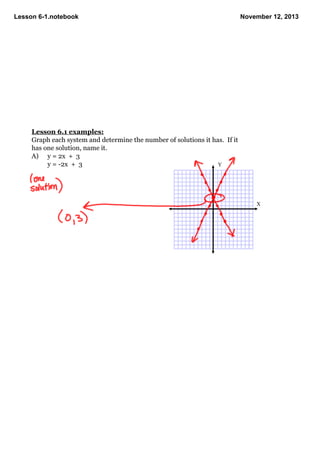
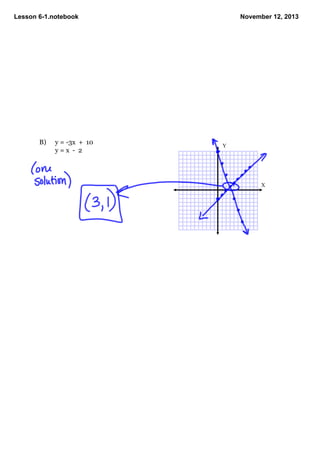
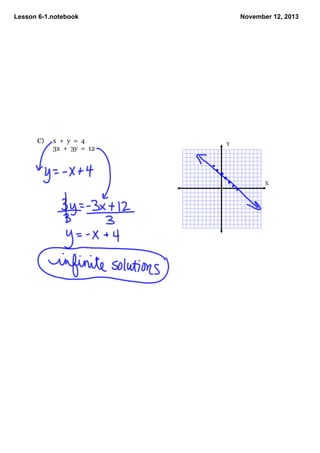
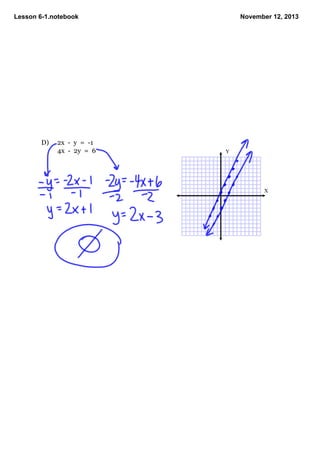
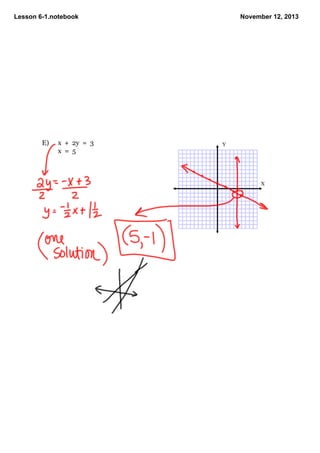
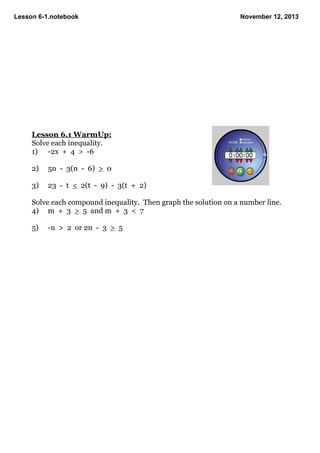
This document contains notes from a math lesson on solving systems of linear equations and inequalities. It includes examples of solving compound inequalities and graphing systems of equations. Key points covered are: systems can have one solution, infinite solutions, or no solutions; if they have one solution they are consistent and independent; if they have infinite solutions they are dependent; if they have no solution they are inconsistent. The lesson concludes with examples of graphing different systems of equations and determining the number of solutions.
![Lesson 61.notebook
November 12, 2013
Lesson 6.1:
*FYI...the solution for a system of equations is the ordered pair that is a solution for
all of the equations....
...and... systems of equations can have one solution, an infinite number of solutions,
or no solutions....
**IF the system has one solution, it is called consistent. [the graphs intersect at
one point or are the same line]
***IF the consistent system has EXACTLY one solution, it is called independent.
[the graphs intersect at exactly one point]
****IF the consistent system has an INFINITE number of solutions, it is called
dependent. [the graphs are the same line(s)]](https://image.slidesharecdn.com/8thalg-l6-131112090707-phpapp01/85/8th-alg-l6-1-3-320.jpg)
![Lesson 61.notebook
November 12, 2013
*****IF the system has no solution, it is called inconsistent. [the
graphs are parallel]
>Look at the Concept Summary chart on page 333 in your
book!
ONE way to solve a system of linear
equation is to GRAPH them!](https://image.slidesharecdn.com/8thalg-l6-131112090707-phpapp01/85/8th-alg-l6-1-4-320.jpg)